Item sets
1–25 of 31
Advanced search-
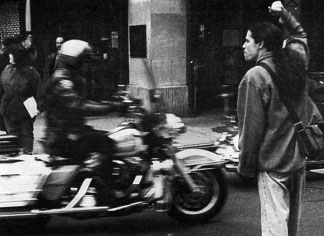 CUNY Coalition Against the Cuts, 1995 The CUNY Coalition Against the Cuts was a citywide coalition of CUNY student activists that reached its peak in spring 1995. The CUNY Coalition is best known for its “Shut the City Down” protest on March 23, 1995, when an estimated 25,000 young people packed City Hall Park. Many were beaten, pepper sprayed and arrested by Mayor Giuliani’s police force while attempting to march on Wall Street. Governor Pataki’s proposal for budget cuts and a tuition increase was modified shortly after the protest, and his plans to eliminate SEEK and College Discovery were scrapped.
 -
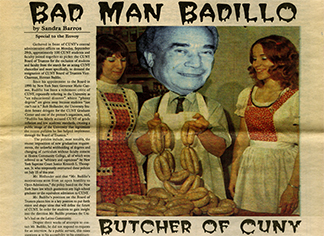 Student Liberation Action Movement, SLAM! SLAM! was a multiracial, radical student activist group at several CUNY campuses from 1996 to 2004. It was strongest at Hunter College, where it served in student government during that time. SLAM! organized students against tuition hikes and budget cuts, for access to the university, immigrants' rights, childcare access, ethnic studies, the right of welfare recipients to attend college, and also participated in city-wide planning of mobilizations against police brutality and mass imprisonment. SLAM! also helped organize national mobilizations against war and the harms of global capitalism, as part of the global justice movement.
 -
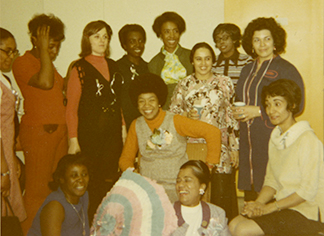 LaGuardia Community College: The Early Years of Adult and Continuing Education LaGuardia Community College opened its doors for students in 1971 in an old (barely refurbished) factory building in Long Island City, a neighborhood in western Queens suffering the effects of the deindustrialization that swept the city in those years. Veterans of those early years recall the smell of bread emanating from the giant Silvercup bakery just across the railroad tracks, as well as the smell of chewing gum from the enormous Chiclet factory next door. Founded on the co-principles of cooperative education and intensive courses, LaGuardia was designed to encourage the adult and immigrant populations of Queens, New York to integrate in-the-field experiences with progressive classroom learning. Dr. Joesph Shenker, its founder and first President, embraced the concept of 'one college,' where adult and continuing education courses and community outreach programs through matriculated studies would be equal parts of the mission.<br /><br />This collection, <span class="curated">curated by Sandy Watson and Fern Kahn, </span> emphazises the importance of Continuing Education (later Adult and Continuing Education) and contains brochures, photographs, and documents that demonstrate the range of programs and projects that were realized in those years. These programs were aimed at the non-traditional college students who made up a crucial part of the population LaGuardia was designed to serve. Some programs would become nationwide models, included instruction aimed at working mothers, those learning English for the first time, the homeless, Deaf students, and incarcerated persons.
 -
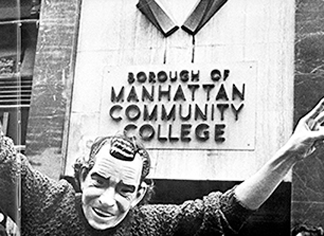 Radicalism at BMCC: The Early Years After the Second World War, the City University undertook a program of dramatic expansion that included the opening of several community colleges that would expand access to higher education to heretofore unreached groups. In keeping with this imperative, the Borough of Manhattan Community College (BMCC) opened in 1964. Originally intended to prepare students to enter business school, this idea quickly succumbed to the power of events, as students by-and-large refused to enter business administration, favoring the liberal arts. Moreover, changes in the composition of the student body that would be dramatized in the 1969 struggle for open admissions had begun to affect BMCC by the latter part of the 1960s. Faculty found themselves confronted with new kinds of students—working-class students of color who not only demanded access to the city’s institutions of higher education, but also that those institutions reflect the struggles they faced as oppressed minorities within the city and the country at large. Soon BMCC was a hotbed of radicalism, as groups like the Third World Coalition, together with radical faculty members, sought dramatic changes in the structure of their institution and its relationship to the world outside.<br /><br />This collection was <span class="curated">curated by Bill Friedheim and Jim Perlstein</span> who also saved and contributed the items. Jim was faculty advisor to the Third World Coalition and a participant in many of the struggles over curriculum, administration, and student participation in the running of the college. Bill Friedheim headed the college’s chapter of the United Federation of College Teachers (UFCT) and edited several radical publications that advocated alliances between students and radical faculty. Both were arrested along with dozens of students in the 1970 student strike and building takeovers, where students demanded an end to increases in tuition fees and a day care center for children of students, in addition to broader demands such as an end to US aggression in Southeast Asia.
 -
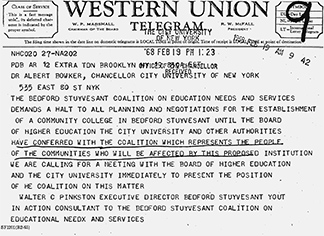 The Founding of Medgar Evers College In February 1968, the City University of New York announced plans for the creation of an “experimental” community-based college that would be located in central Brooklyn. Later named Medgar Evers College, the school was to be the first CUNY campus located in, and focused on, an underserved city neighborhood. Within days of the announcement, community leaders from several organizations began a months-long struggle with CUNY administrators to play a crucial role in determining the mission and development of the college. Over time, their efforts won the community equal representation on a committee tasked with selecting a president and, with persistence and organization, the neighborhood’s influence expanded to other areas, including building selection, hiring, and curriculum. Perhaps most impressively, it was only with the community’s insistence that Medgar Evers College became a four-year college instead of CUNY’s initially proposed two-year institution. <br /><br />The extensive influence of the community during this period represents a key moment in the history of Open Admissions at CUNY. Simultaneously, another local struggle over "community control" was occurring between the United Federation of Teachers and Brooklyn's Oceanhill-Brownsville community along with national upheaval over the Vietnam War and other social justice issues. These local and national events provide the context for, and greatly influenced, the events that unfolded at Medgar Evers College. <br /><br />Comprised largely of correspondence between Bedford-Stuyvesant representatives and CUNY officials this collection, <span class="curated">curated by Florence Tager</span>, contains everything from official documents, meeting minutes, and telegrams, to internal CUNY memos, handwritten notes, and images, all relating to the struggle over the formation of the college. <br /><br />For more on subsequent events and struggles around Medgar Evers College, see this item in the collection, a short book on the history of the college: <a href="http://cdha.cuny.edu/items/show/2261">Medgar Evers College: The Pursuit of a Community's Dream</a>, by retired CUNY professors Florence Tager and Zala Highsmith-Taylor.
 -
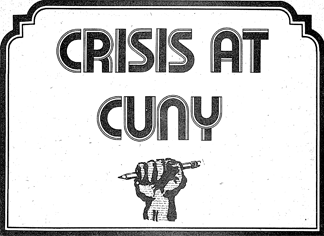 The Newt Davidson Collective The Newt Davidson Collective Collection contains a PDF of <em>Crisis at CUNY, </em>the audio and transcription of an oral history interview, and a photograph of the interviewees. The original members of the Newt Davidson Collective (approximately fifteen in total) were young and untenured faculty members and knew each other from CUNY and from anti-Vietnam War activities. They united around issues related to CUNY and in 1974 began to produce a few pamphlets (still missing) that were critical satires of CUNY administrators and their policies. Their name is mocking David Newton, a CUNY administrator who "had come out with something horrible..." Using first names only, they collectively researched, wrote, produced, and distribute <em>Crisis at CUNY</em>.<br /><br />As the 1970s wore on, students and faculty at CUNY found themselves faced with an ominous environment<em>.</em> While the open admissions struggle of the late 1960s represented a signal achievement in the struggle to secure democratic access to quality higher education, now rising costs, overcrowding, layoffs, and other cutbacks threatened this ideal.<em><br /><br />Crisis at CUNY</em> grew out of the research of the Newt Davidson Collective as they sought to understand reasons for this new climate. Their search took them deep into the complex bureacracy of the City University and its links with other key institutions. The booklet would go on to circulate among CUNY professors (who used it in teaching), radicals, and others, influencing an entire generation at CUNY.
 -
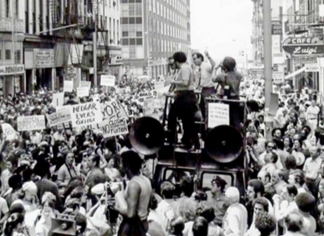 Professional Staff Congress: Formation and First Contract <address>This collection focuses on the formative years of the Professional Staff Congress/CUNY from the 1960s until 1974. Falling into several distinct periods, it covers:<br /><br /></address> <ul> <li><address>The competition between the Legislative Conference (LC) and the United Federation of College Teachers (UFCT) to become the collective bargaining agent for CUNY's faculty and staff; </address></li> <li><address>The initial division into two bargaining units with the LC and the UFCT each representing some CUNY employees and negotiating the first contracts with CUNY in 1969; </address></li> <li><address>The merger of the LC and the UFCT in 1972 to form the Professional Staff Congress (PSC) – a merger entered into only under pressure from affiliates at the state and national levels; </address></li> <li><address>The struggle to negotiate the first contract for the unified bargaining unit that led to strike authorization votes by the membership of the PSC, mediation, "fact-finding", and finally an agreement in July 1973; </address></li> <li><address>And the effort by the CUNY Chancellor, Robert Kibbee, to establish tenure quotas for departments throughout the University in 1973.</address></li> </ul> <address>At the time of the formation of the PSC/CUNY, union representation for professionals in higher education was not limited to CUNY. New York State's Taylor Law of 1967 authorized collective bargaining for public employees and faculty and staff at the State University of New York, as well as at local community colleges, also moved to union representation. Organizing was not limited to the public sector as unions formed in private colleges under the rules of the National Labor Relations Board. Faculty and staff rejected the argument that all academic employees were professionals and thus should not join unions, which were designed for blue collar workers; and that collegiality and shared academic governance provided faculty with a voice in decision making, thus making a union unnecessary. The formation of the PSC was based on an understanding that the subjects covered by the contract required a legal, enforceable instrument, negotiated directly between a union and an administration. The governance system would remain, and would still function for academic issues. </address><address><br />This collection was <span class="curated">curated by Irwin Yellowitz</span>, a member of the PSC Executive Council from 1973 to 1997 and treasurer from 1984 to 1997. </address>
 -
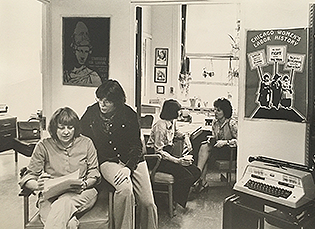 Brooklyn College Feminist Trailblazers of the 1970s Brooklyn College history professor Renate Bridenthal remembers stuffing copies of fliers into the mailboxes of women faculty members across her campus in 1971 for the first meeting of what would become the Brooklyn College Women's Organization. This group became the birthplace of one of the longest running Women's Studies Programs and Women's Centers to date, as well as the class-action lawsuit against sex discrimination against women faculty at CUNY, popularly known as the Melani Case. By 1974, co-founders Tucker Pamella Farley of English, Pat Lander of Anthropology, and Renate Bridenthal of History would join with Lilia Melani of English, Fredrica Wachsberger of Art History, and others to win academic legitimacy for the field of interdisciplinary feminist inquiry. The Women's Studies Program at Brooklyn College began to offer a joint baccalaureate from Brooklyn College's Schools of Social Sciences & Humanities. <br /><br /> Using feminist pedagogical principles of collectively steering and co-governing the program, as well as offering offering co-taught courses, these trailblazers helped develop women's studies as a field in national professional associations, as well as in high schools. <br /><br /> This collection—<span class="curated">curated by Yana Calou</span> from the larger archive at the Brooklyn College Library, with additional contributions from Renate Bridenthal and Tucker Pamella Farley—offers an introduction and overview of the achievements of first decade of the Women's Studies Program, Women's Center, and sex discrimination case. Included are the first proposals for the center and program, meeting minutes, correspondence with Brooklyn College President John Kneller, progress reports, newspaper articles, speeches, conference programs, photographs, posters, course catalogs, as well as oral histories from Renate Bridenthal and Tucker Pamella Farley. Farley also co-founded the National Women's Studies Association and founded Project CHANCE, the program and grant that enabled the establishment of the Women's Center and provided re-entry courses and support for non-traditional returning women students. <br /><br /> Renate Bridenthal fought tirelessly for childcare and against the Vietnam war, and was an outpoken advocate for gender discrimination - continuously writing and speaking to national press and the college's administration. Never compromising their vision to connect intellectual rigor with social activism, this collection features the accomplishments of these trailblazing scholar-activists within a structural climate of misogyny and homophobia. These documents host a rich archive of lessons for future gains in gender parity, both institutionally and intellectually.
 -
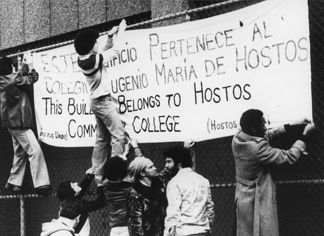 Save Hostos! <p><b>Save Hostos!: The Save Hostos Community College Movement (CUNY), 1973 to 1978</b></p> <img src="http://cdha.cuny.edu/images/jerryMeyer.jpg" alt="" style="float: right; margin-right: auto; border: 3px solid black; display: block;" width="213" height="341" /> <p>Eugenio María de Hostos Community College (CUNY) was established in response to CUNY’s enactment of Open Admissions in 1969, which guaranteed admission to one of the City’s system of colleges to city residents who had a high school diploma, or its equivalent. This led almost immediately to a doubling of enrollment at these institutions. Hostos—which was initially located on the southwest corner of East 149th Street and the Grand Concourse, in the heart of the South Bronx’s overwhelmingly Latino and African-American communities— first offered classes in the fall of 1970. <span>Latino leaders demanded a school that would meet the educational, social, and cultural needs of the South Bronx community.</span> In view of the extremely high percentage of Spanish-speaking residents and their bilingual children in the South Bronx, Hostos became the sole bilingual college in the New York City tristate area. The college pioneered in instituting educational initiatives responsive to its students’ needs. The naming of the college for the educator Eugenio María de Hostos (1839-1903): A Puerto Rican Renaissance man, who advocated for education for women, the abolition of slavery, and independence for Puerto Rico signaled the progressive intent of the college’s founders. However, Hostos’ auspicious beginning was marred by its woefully inadequate facilities, that consisted of a single, five-story edifice repurposed from an abandoned factory.</p> <p>During the 1970s, from the fall of 1973 until the spring of 1979, the Save Hostos Movement became one of the most prolonged and successful mass movements in New York City. Over that five-year period, students, staff, faculty, and members of the community mobilized three massive year-long campaigns, each of which accomplished its goal. </p> <p>• From Sept. 1973 to June 1974: “Hostos Needs Space,” a coalition of the Professional Staff Congress (PSC) and the Student Government Organization (SGO), mobilized the Hostos community to obtain the 500 Building, a recently constructed, five-story building on the southeast corner of East 149<sup>th</sup> St. and the Grand Concourse, that had housed an insurance company. This coalition accomplished its goal by enlisting the Bronx State Senator and State Assemblyperson representing the South Bronx to convince the New York State Legislature’s Black and Latino Caucus to introduce legislation that allocated funds for that purpose. <br />• From Sept. 1975 through June 1976: The “Save Hostos Committee,” an officially designated body of the Hostos Senate, and the PSC, together with the “Hostos Coalition to Save Hostos,” successfully mobilized the campus and community to prevent the closing of Hostos Community College. In addition to the employment of a full array of political tactics, members of the Community Coalition occupied Hostos’ main building until the police intervened and arrested forty students and faculty members.<br />• From Sept. 1977 to June 1978: “Hostos United/Hostos Unido,” brought together the forces that had previously supported the Save Hostos Committee and the Community Coalition to Save Hostos to carry out a massive campaign to obtain funding to reconfigure the former office building for educational use. When these tactics seemed inadequate to obtain the campaign’s goal, a very large contingent of students and many faculty occupied the 500 Building for three months, where classes were held. This four-month long occupation persisted until the announcement came from the Office of the Mayor of New York that bonds for the reconstruction of the edifice had been approved. <br /><br />The Save Hostos Movement brought together a wide range of organizations: the Hostos Chapter of the Professional Staff Congress, the Student Government Organization, many student clubs, including the <i>Federación Universitarios Socialistas Puertorriqueños</i>, the Dominican Club, the Puerto Rican Club, the Black Student Union, the Veterans’ Club, and the Christian Club. In addition, faculty and student leaders established organizations—such as Hostos Needs Space, the Save Hostos Committee, the Community Coalition to Save Hostos, and Hostos United/Hostos Unido—specifically for the purpose of saving Hostos.</p> <p>The success of the Save Hostos Movement depended upon its use of a combination of tactics that effectively politicized the campus and attracted widespread support from the residents of the communities Hostos served. The willingness of those within and outside the Hostos campus to commit themselves to this movement, and in some instances risk arrest, reflected the degree to which Hostos embodied a concrete achievement for these communities in their fight against discrimination in general, and for bilingual education. </p> <p>The successes of the three campaigns that comprised the Save Hostos Movement left a deep impression on the culture of the college. Subsequent organizations—such as the Hostos Solidarity Coalition, the Hostos Action Coalition, and the Hostos AIDS Task Force—employed similar forms of organizational forms utilizing an array of tactic to achieve educational, cultural, and political goals.<br /><br />This collection—through letters from faculty and students to elected officials, student newspapers, PSC Chapter Newsletters, meeting minutes of activist groups, photographs of demonstrations, and fliers designed by campus and community supporters of Hostos Community College—tells the story of the three campaigns that comprise the Save Hostos Movement.</p> <p><span class="curated">Curated by Gerald Meyer</span>, a faculty member at Hostos since 1972, this collection presents just some of the hundreds of items he amassed during the Save Hostos Movement from 1973 to 1978 while serving as PSC Chapter Chairperson. Meyer's additional holdings can be found in a larger, self-titled collection housed in the archives of Hostos Community College.</p> <p>Gerald Meyer is the author of <a href="http://www.sunypress.edu/p-884-vito-marcantonio.aspx" title="Vito Marcantonio" target="_blank"><i>Vito Marcantonio: Radical Politician</i></a>, co-editor of <i>The Lost World of Italian American Radicalism</i>, and author of eighty articles and reviews on a wide range of topics. He serves on the editorial boards of <i>Science & Society</i> and <i>Socialism and Democracy </i>and also serves as Co-Chair of the Vito Marcantonio Forum.</p>
 -
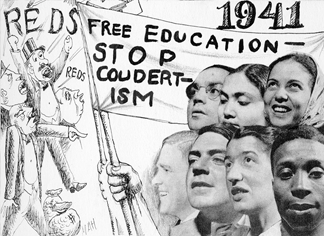 Free Speech at CCNY, 1931-1942 At City College (CCNY), the years of the Great Depression ushered in a student and faculty body as politically active as any since the school’s founding in 1847. With student activists embracing radical ideas, the college’s campus became a hotbed of protest and demonstration throughout the 1930s. William Randolph Hearst owned newspapers even derisively dubbed the college, "the little red schoolhouse." During the decade, CCNY’s grounds played host to anti-fascist rallies, peace protests, and anti-ROTC marches, all of which were held with seeming regularity and participation that frequently numbered in the thousands. <br /><br />Student efforts, however, were often the source of conflict with the college administration, with CCNY President Frederick B. Robinson personally handling matters of student discipline. Apart from one student protest gone awry in which he hit protestors with his umbrella, Robinson typically saw to the suspension and expulsion of students and the shut down—if only temporary—of campus clubs and publications that he deemed sympathetic to their causes. The antagonism between the president and the students persisted throughout Robinson's tenure, 1927 to 1939, as he drew repeated criticism from opponents who labeled his actions as attempts to stifle free speech on campus. <br /><br />Though students were often at odds with administration, they frequently found encouragement from younger faculty members, many of whom were CCNY graduates themselves and shared the same poor Jewish immigrant backgrounds as their students. However, radical political leanings of the instructors were tolerated even less by the administration than their students. When the Rapp-Coudert Committee convened in 1940 to weed out communists from the schools, more than fifty CCNY faculty and staff were fired. Dozens more testified in private and public hearings in what was a state-sanctioned anti-communist witch hunt that foreshadowed the larger federal efforts of the 1950s. <br /><br /><span class="curated">Curated by Carol Smith</span>, a former associate professor at CCNY, m<span class="s1">ost of the images are from the CCNY Archives, but some documents and images are located in the Tamiment Library, NYU; New York State Archives; Center for Marxist Studies; New York Historical Society, and the Schomberg Center for Research in Black Culture. T</span>his collection features fliers, photographs, artwork, and clippings that help to understand some of the key events that took place during a particularly contentious era at City College, the 1930s and early 1940s. <br /><br />For additional resources on the topic, refer to Smith's <a href="http://www.virtualny.cuny.edu/gutter/panels/panel1.html" target="_blank" rel="noopener">online exhibition</a>, CCNY's <a href="http://academicworks.cuny.edu/cc_arch_antiwar/" target="_blank" rel="noopener">'Antiwar Flier' collection</a> as well as digitized student newspapers in '<a href="http://digital-archives.ccny.cuny.edu/gallery/?page_id=155" target="_blank" rel="noopener">The Campus Newspaper Archive'</a>.
 -
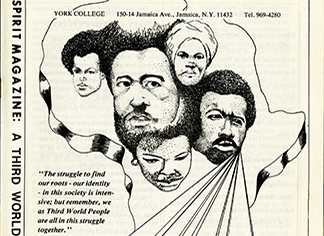 York College and the Jamaica, Queens Community In 1966 York College was founded as a four-year ("senior") college within the recently formed City University of New York (CUNY). After much initial debate over the location of the school, South Jamaica was chosen in 1971 with the hope that the college would serve as a cornerstone of the ongoing revitalization plans for the neighborhood, which were supported by the Jamaica Steering Committee and Mayor John Lindsay's administration. For many, the selection of South Jamaica demonstrated CUNY’s commitment to placing a four-year school in an underserved, largely black, Queens community. And though the economic turbulence of the 1970s would come to threaten both the college’s four-year status and its overall existence, its continued presence speaks to the important role York has played in the neighborhood over the years. <br /><br />The "York College and the Jamaica, Queens Community" collection largely focuses on the 1970s and contains news clippings related to the college’s early development in Jamaica, selections from the student publication <em>Spirit Magazine</em>, and documentation of the college’s urban planning and community leadership program designed for the South Jamaica community. <br /><br />The majority of items are selections from <em>Spirit Magazine</em>, the publication that focused on issues that students of color faced at York College. <em>Spirit</em> contained articles, poetry, artwork, opinion pieces, and promotion for events on black solidarity, Pan Africanism, and protests against discriminatory acts committed by York College. Its editors always held the goal of promoting strong ties with the South Jamaica community. The college’s emphasis on community extended to include the creation of curriculum designed to uniquely prepare the residents of South Jamaica for the burgeoning professional opportunities resulting from the area’s redevelopment efforts. This curriculum came to form the basis of the “Urban Training Program,” a federally funded project in which York College and the Jamaica Steering Committee trained two hundred Jamaica residents in the hopes of cultivating community leadership. <br /><br /><span class="curated">Curated by Obden Mondesir</span>, this collection features a mix of newspaper articles, press releases and student-produced material, all of which show CUNY's efforts to carry out its mission to provide education to all New Yorkers, particularly through the placement of York College in Jamaica. It also documents meticulous collaboration between community leaders and CUNY and the student voices that provide a critique of the York College administration and their approach to addressing issues that minority students faced.
 -
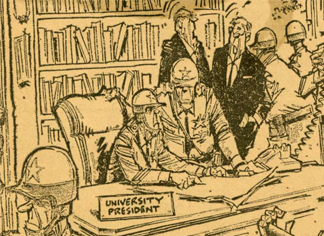 Queens College Campus Unrest Like so many colleges across the country during the late-1960s, CUNY, too, was swept up in the wave of student unrest that took the form of protests, strikes, and sit-ins. This collection focuses on the events surrounding one incident at Queens College in the spring of 1969: the student occupation of the Social Sciences (SS) Building. The collection contains papers, correspondence, and flyers produced by many of the key figures, including faculty members, student activist organizations and the campus administration. Beginning on March 27, 1969, the student led Ad Hoc Committee to End Political Suppression staged a sit-in of the SS Building largely in protest of the college's refusal to drop charges against three students from the Students for a Democratic Society (SDS) who had forced the removal of a General Electric recruiter during a protest earlier in March. After holding the SS Building for several days, in the early morning hours of April 1st, college administration requested police assistance in clearing the students from the building, at which point thirty-nine were arrested, including one faculty member. Each was charged with trespassing. In subsequent weeks, activists from SDS and the Ad Hoc Committee continued their demonstrations with an increased vigor that contributed to the school administration's decision to temporarily close the college in early May. The documents in this collection primarily concern the fallout in the weeks immediately following the April 1st arrests. While several items may give some hint to the other happenings on campus, it is important to note that simultaneous with those protests organized by the Ad Hoc Committee—the focus of this collection—were additional separate demonstrations organized by right wing student groups, and minority students from the college's SEEK program.
 -
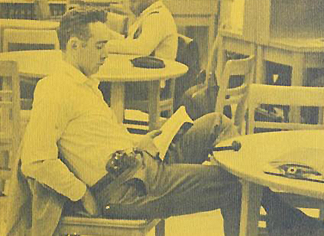 Educating for Justice - Oral Histories of John Jay College of Criminal Justice In September 1965, the City University first opened the doors to the freshly minted College of Police Science in Manhattan’s Gramercy Park neighborhood. From its earliest days, the school—renamed the John Jay College of Criminal Justice in ‘67— would rightly stand apart from the rest of CUNY’s offerings. Its initial location within New York City’s existing Police Academy was hardly the grounds of a traditional campus. And its first class of 1,000 students was unlike any other as it consisted exclusively of active officers in the city’s police force, many of whom were in their thirties with full-time jobs, families, and decades-long removal from the classroom. Yet John Jay’s distinctions were fitting given the distinctiveness of its founding mission of providing a well-rounded education for those in the law enforcement community. <br /><br />When the college opened in 1965, its creation was only made possible by the combined efforts of several prominent New York leaders, including most notably: Robert F. Wagner Jr., the city’s mayor; Michael Murphy, the police commissioner; Anna Kross, the commissioner of corrections; Patrick Murphy, the commissioner of the Police Academy; and Albert Bowker, chancellor of CUNY. Initiatives undertaken by several from this group had led to the creation of police-focused programs at Brooklyn and Baruch Colleges in the 1950s, yet John Jay marked the first higher educational institution dedicated to police science in New York. Its creation came at a time of increased pressure nationwide to expand police education. <br /><br />Within a year of the college’s opening, recent graduates from the city’s high schools joined the previously all-police population. In subsequent years, the college would relocate to accommodate an expanding curricula and student body that was also diversifying thanks to Open Admissions. Today, John Jay offers study in a range of disciplines yet its commitment to “educating for justice” remains. <br /><br />This collection features an assemblage of oral history interviews conducted by Gerald Markowitz, a distinguished professor of history at the college. The interviews, collected in advance of the college’s 25th and 40th anniversaries, served as research for his book, <em>Educating For Justice: A History of John Jay College of Criminal Justice</em> (2004). Among those interviewed were Mayors John Lindsay and Robert F. Wagner Jr., professor William Walker, and provost Basil Wilson. This collection, which will be expanded to include newly digitized interviews, is drawn from the <a href="https://dc.lib.jjay.cuny.edu/index.php/Detail/Collection/Show/collection_id/19" target="_blank">Special Collections</a> division of the Lloyd Sealy Library at John Jay College of Criminal Justice and focuses on many aspects of the college's history including its conception and creation, funding, the college and classroom environment, police education and administrative perspectives. Additional information regarding the college's history can be gathered from a <a href="http://cdha.cuny.edu/items/show/91" target="_blank">digital exhibition</a> put together by the college for its 50th anniversary.
 -
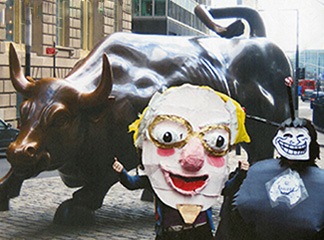 Occupy CUNY The "Occupy CUNY" collection chronicles a major period of organizing and mobilizing by CUNY Graduate Center (GC) students during and after Occupy Wall Street (OWS). The collection includes primary materials such as flyers, posters, curriculum, video and websites. In collaboration with undergraduates, tenured and adjunct faculty, staff, and community organizations, GC students boomeranged the call to occupy back into the university to both reclaim and transform it. <br /><br />Students, faculty and staff confronted rising tuition costs, education debt, campus surveillance, and police violence, as they related to a larger movement against social inequalities that swept New York City, the United States, and much of the world. In the process, they created guerrilla arts, graphic design, protest preparedness checklists, street journalism, and “pop-up” educational events and theater performances. <br /><br />Several students from the Graduate Center and other CUNY colleges helped develop OWS infrastructure over the summer before the occupation of Zuccotti Park on September 17, 2011. Soon after, they circulated public writings based on past struggles on how to fortify the occupation’s grounds and bridge anti-capitalist critiques with demands for gender, race, and sexual liberation. Throughout fall 2011, because GC students teach at many CUNY colleges, they were strategically positioned to organize weekly “General Assemblies” (GAs), and then to fan out across the CUNY system to share plans, perspectives, and resources in their classrooms and departments, as well as around the city in neighborhood assemblies and organizations. <br /><br /><span class="curated">Curated by Conor Tomás Reed</span>, items in the “Occupy CUNY” collection document pivotal OWS-inspired events that occurred on and off CUNY campuses. An info-graphic and curriculum was designed and circulated for the October 15, 2011, “Occupy CUNY Teach-In” at Washington Square Park. In the wake of the NYPD eviction of protesters in Zuccotti Park, CUNY students and faculty mobilized for the November 2011 Week of Action, including the November 17 city-wide Student Strike. Collection items also cover the November 21, 2011, CUNY Board of Trustees public hearing at Baruch College when CUNY security and NYPD attacked a crowd that was peacefully trying to enter to testify against a 5-year annual tuition increase. Occupy CUNY News was launched to document the aftermath of this two-pronged attack by NYC and CUNY elites upon the Zuccotti Park occupation and campus dissent for educational access. <br /><br />In Spring 2012, after the CUNY administration hired the “risk solutions” firm Kroll, Inc. to write a report on the November 2011 Baruch incident, GC students launched a campaign to discredit the biased report and expose the new collusion between CUNY and private security. Collection items display Fake OKCupid (online dating) pages that were produced to mock CUNY Chancellor Goldstein and a Kroll monster with wedding invitations, and even a wedding ceremony on May 1, 2012. The Kroll report’s legitimacy was threatened well before it appeared in January 2013. May 1 was also the inaugural date for the Free University of New York City, a free radical outdoor educational event that featured over forty workshops and two thousand participants, and which has since created over two-dozen similar events around the city. <br /><br />Graduate Center and CUNY organizing has flowed into many tributaries of struggle since then both on and off campuses: Black Lives Matter and police/prison abolition, women’s and LGBTQ liberation campaigns, natural disaster recovery and environmental justice, opposing the militarization of CUNY, expanding ethnic studies and radical pedagogies, demanding full free tuition, adjunct teachers’ pay equity, and beyond. This flashpoint of the CUNY movement deserves to be studied, remixed, and enacted anew. Learn more at this <a href="http://opencuny.org/occupycunydha/">supplementary website</a>, which has further materials about the collection and period.
 -
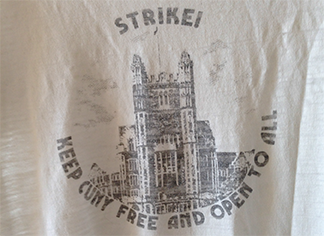 Oral Histories on Open Admissions and the Imposition of Tuition at CUNY Conducted throughout 2014, the interviews in this collection are those of City University of New York (CUNY) students, staff and faculty. Interviewer and collection curator Douglas A. Medina, PhD candidate in the Political Science Program at The Graduate Center, CUNY, explores how a community, led primarily by student activists, came together to challenge the idea of merit and racial exclusion at CUNY. In the context of Medina’s research on the Open Admission program and the imposition of tuition at the university, the interviews unpack the relationship between race, class and the purpose of a public higher education. Between 1969 and 1976 CUNY was a historical site of student and community activism. Inspired by post-Civil Rights era movements and ideologies—including Black Power, anti-imperialism, Marxism, and the New Left—students at many CUNY colleges were in the vanguard in the struggle for Blacks and Puerto Ricans to access a free, quality higher education. In the context of shifting demographics in New York City and the need for an educated workforce due to a changing labor market, students at City College (the flagship CUNY college) organized, as a core group that came to be known as the Black and Puerto Rican Student Community (BPRSC). In several interviews, City College students, faculty, and staff discuss their struggle for gaining recognition, representation, respect and equality as embodied in their Five Demands: 1. Establishment of a separate school of black and Puerto Rican studies. 2. A separate orientation for black and Puerto Rican freshman. 3. A voice for students in the setting of guidelines for the SEEK program, including the hiring and firing of personnel. 4. The racial composition of all entering classes should reflect the Black and Puerto Rican population of the New York City high schools. 5. Black and Puerto Rican history and the Spanish language should be a requirement for all education majors. The interviews about Open Admissions represent an array of perspectives from several CUNY colleges. Student, administrative staff and faculty voices highlight the complexity of the issues that arose. The debates that shaped both Open Admissions and the imposition of tuition resonate today in conversations about The American Dream, merit, college affordability, and race and class politics. This collection represents a small but significant part of the quest to not only preserve the lessons of the past as told by individuals from the CUNY community, but also show the attempt to change the future trajectory of CUNY as a necessary public institution of higher education.
 -
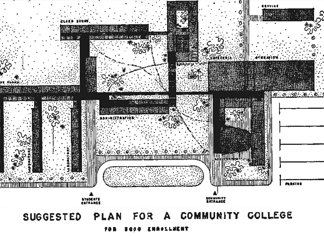 Documents on the Origins of CUNY This collection contains primary documents that trace the shift in New York State’s public policy that would ultimately lead to the 1961 consolidation of New York City’s handful of municipal colleges into one coordinated system: The City University of New York (CUNY). The new unified CUNY, which would allow for the system’s subsequent growth, was largely a product of public policy addressing a series of demographic, political and economic changes in postwar New York City. Through several reports and state legislation, the collection tracks NYC’s attempt to respond to increased demands for public higher education institutions. Since the founding of the first municipal college (what would become City College) in 1847, the residents of New York City had been provided with public access to tuition-free, college education. The municipal college system had grown slowly over the following century, totaling only four separate senior colleges (City, Hunter, Brooklyn and Queens). After the Second World War, the demand for access to public higher education began to accelerate in NYC as it did across the country. New York State laws passed in the postwar era emphasized community colleges as a major avenue of expanding access to higher education. Between 1946 and 1961, when CUNY was formally launched, the municipal system added four community colleges (NYC Tech, Bronx, Queensborough, and Staten Island). A 1948 state law mandated that in order to receive state funding a third of the financing of new community colleges would have to come from student tuition; the rest of the operating budgets were to be paid for by local governments. Bronx Community College, for example, which opened in 1957 marks the first time a municipal college received state funding as well as the first time that full-time students are charged tuition. Simultaneously CUNY’s four-year colleges were experiencing a fiscal crisis and began to appeal to the state for additional fiscal support. Nelson Rockefeller’s election as governor in fall 1958 signified another turning point in CUNY’s evolution. In order to meet the growing demand for higher education across the state, the governor appointed a committee to make recommendations to the state system of higher education. Led by Harold Heald, the committee’s report (included here) was published in 1960. At the same time, the city crafted its own response to the increased need for higher education, launching the Holy report (also included here) in 1961. Both reports concluded that New York City needed to consolidate its independent colleges to meet the growing demands. These events led to the Education Law of 1961 that established The City University of New York. At the same time, the law also repealed 1926 legislation that mandated free tuition at all public higher education institutions in the state, and replaced it with a student financial aid program. This new program also benefitted students attending private colleges in the state. Now that free tuition was no longer legally mandated, local advocates of the municipal colleges feared that the newly consolidated CUNY system would institute tuition. These policy changes, which led to creation of CUNY and thus new educational opportunities for New York City residents, also made free tuition a point of political contention. This collection offers a historical lens into some of the current issues that public education in New York continues to face.
 -
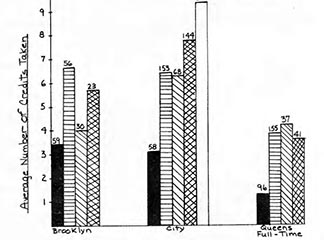 SEEK's Fight for Racial and Social Justice (1965-1969) <p>In September 1965, City College (CCNY) launched its Pre-Baccalaureate (Pre-Bac) program, an experimental initiative designed to help desegregate the college’s student population and better integrate residents from the surrounding black and Puerto Rican neighborhoods into the school. Accepting students who otherwise did not meet the school’s admission criteria, in its initial year the program provided 113 students with academic support that included, but was not limited to, a remedial program designed to prepare them for their undergraduate careers. Vitally, officials at CCNY granted professors Leslie Berger and Allen Ballard the freedom to craft a program that encouraged experimentation, challenges, and support between instructors and students.</p> <p>The success of CCNY’s program proved undeniable. By the next year, CUNY officials introduced “Operation SEEK”­­—short for “Search for Education, Elevation, and Knowledge”—a university-wide program that opened several campuses to high school graduates from disadvantaged city neighborhoods. As the earlier CCNY effort had already shown, SEEK also demonstrated the potential of students who previously had not been given the opportunity to study at four-year colleges. Moreover, the program­ offered an effective model for collegiate racial and social justice programs nationwide. Today, more than fifty years later, the SEEK program continues its serve its founding mission of providing well rounded support to those from underserved communities.</p> <p>This collection, <span class="curated">curated by Sean Molloy</span>, an English professor at William Paterson University, offers an assortment of items­—including speeches, meeting minutes, and reports—from the earliest years of SEEK. It also includes several oral history interviews with instructors and students that were conducted by Molloy. Together, the items provide key insights into a program that helped pave the way for Open Admissions in the 1970s.</p> <p><i><span>Much of this collection, including an </span></i><a href="http://cdha.cuny.edu/secondary-sources/seek" target="_blank" data-saferedirecturl="https://www.google.com/url?hl=en&q=http://cdha.cuny.edu/secondary-sources/seek&source=gmail&ust=1509037540002000&usg=AFQjCNEg0x4UhgefqFc7PrL4GI4cmUs-wQ"><i>extended introductory essay found here</i></a><i>, were drawn from Molloy’s 2016 CUNY doctoral dissertation: "<a href="http://academicworks.cuny.edu/cgi/viewcontent.cgi?article=2558&context=gc_etds" target="_blank">A Convenient Myopia: SEEK, Shaughnessy, and the rise of high stakes testing at CUNY</a>." </i>This collection is possible only due to invaluable support of Allen B. Ballard, Francee Covington, Eugenia Wiltshire, Marvina White, Noelle Berger, Nicole Futterman, Adam Penale, Sydney Van Nort, and the City College Archives & Special Collections. </p>
 -
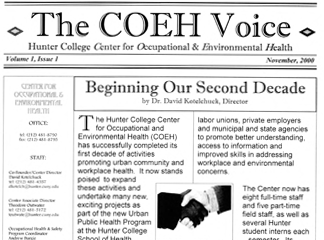 Center for Occupational and Environmental Health at Hunter College Formally established in 1990, Hunter College’s Center for Occupational and Environmental Health (COEH) was founded with the simple mission of promoting community and workplace health. Over the course of subsequent decades, the Center’s efforts to serve this founding goal would see it involved in a variety of efforts that paired it with community groups, labor unions, public employees, students, and more. A research, training, and education center, the COEH tackled topics as disparate as workplace ergonomics and hazardous waste training to asthma management and lead poisoning prevention. In so doing, the Center offered hundreds of courses, published dozens of reports, and engaged firsthand with neighborhoods across New York City. Over the course of its existence, the Hunter College-based group’s footprint would stretch far beyond CUNY, impacting groups across the city, state and Northeast region. <br /><br />Prior to the Center’s official creation in 1990, the group took early form in the mid-1980s under the cooperative efforts of founding co-directors, David Kotelchuck, associate professor and director of the Environmental and Occupational Health Sciences (EOHS) program, and Stephen Zoloth, professor and director of the Community Health Education program. Upon joining a federally funded Rutgers University-based consortium for Hazardous Waste Worker Training in 1987, the pair established the self-sustainability and the funding necessary for the formal designation of a “center.” Though it would be three years before CUNY’s Board of Trustees granted them such a status, the group’s work with the Rutgers-based collective on matters of hazardous waste training—they were the sole New York representatives—established what would remain a significant function of the Center throughout its history. <br /><br />In its early years, in addition to Hazardous Materials and Emergency Response Training that largely partnered the Center with state and city agencies, COEH’s occupational emphases also included its participation in a Minority Worker Training Program and the Susan Harwood Ergonomics Training Program. The former, a program designed to educate young people of color interested in pursuing careers in trade unions joined the COEH and the Carpenter’s Union in Manhattan. The latter, meanwhile coupled the Center with PACE (the Paper, Atomic, Chemical, and Engineering Workers International Union) through the early-2000s to provide training intended to “reduce the incidence and severity of musculoskeletal disorders” caused by workplace ergonomic hazards. <br /><br />While the Center’s occupational training programs affiliated it with unions, government agencies, and private employers, its environmental efforts permitted instead a community-centric approach. Working closely with various neighborhood groups throughout NYC, the Center: educated Brooklyn school personnel, nurses, and social workers on the topic of lead poisoning prevention; contributed to a Citywide Community Asthma Management Program that sought to reduce the illness’ effects by empowering families and communities on management and prevention techniques; trained Community Health Workers to serve as vital intermediaries between neighborhoods and health professionals; and investigated pest control efforts in conjunction with the New York City Housing Authority. <br /><br />In terms of project involvement, the Center reached the peak of its efforts in the early 2000s, a period that required eight full-time staff members, five part-timers, and several student interns in order to meet its many commitments. In later years, the Center would gradually contract with the expiration of several grants and the retirement of founding co-Director David Kotelchuck. In 2017, its last remaining effort continued to be hazardous materials training for state and city agencies, the very same effort that initially saw to the Center’s creation twenty-seven years earlier. <br /><br />This collection represents a small, but varied amount of materials saved by the COEH since the 1980s. Included are documents that precede the Center itself, curricular materials, funding breakdowns, publications, agendas, photographs, and more. Together, they help to illustrate the many efforts of the Center over its important and impactful history. Many thanks are owed to Dave Kotelchuck for retaining and sharing the documents for inclusion in this archive. <br /><br />Throughout the years, dozens of people worked at the Center in various capacities, all playing an indispensable role in the COEH's long term success. An assembled list of those faculty and staff can be found <a href="http://cdha.cuny.edu/secondary-sources/coeh-faculty-and-staff">here</a>.
 -
 CLAGS This collection highlights the history and development of CLAGS, a CUNY organization that played a leading role in the establishment and legitimization of queer studies in a time when the categories of queer and academia were widely believed to be mutually exclusive. Historian Martin Duberman, CLAGS’s founder and first executive director, was among the first academics to, not only come out as gay, but also insist that the study of sexuality is a valid, and indeed necessary, academic pursuit. In 1973, Duberman founded the Gay Academic Union and experienced first-hand the pushback of mainstream academics who vehemently dismissed what was then referred to as “gay studies.” Duberman remained determined, however, and in 1986 assembled a number of his friends and colleagues to discuss the possibility of an academic center devoted explicitly to the pursuit and wide-scale dissemination of lesbian and gay scholarship. After a series of similar meetings, the Center for Lesbian and Gay Studies was formed. While CLAGS, as it was more commonly called, was initially meant to be located at Yale, the center ultimately found its home at the CUNY Graduate Center in 1991 and has remained there ever since. As the first university-based research center in the United States explicitly devoted to the study of lesbian, gay, bisexual, transgender, and otherwise queer issues, CLAGS shaped a field that was then in its infancy. As part of CLAGS’s mission to foster and spread queer knowledge, the center is devoted to three main areas of pursuit: academic events, educational seminars, and fellowships. Every year CLAGS puts on a number of events, including smaller panel discussions and larger conferences, that bring together academics and activists to present and discuss developments in the field. CLAGS’s most notable event is the annual Kessler Lecture, which is given by a leading scholar who receives the Kessler Award for making a significant contribution to the field of queer studies. CLAGS's commitment to furthering queer research has also led to CLAGS awarding a number of fellowships and grants to scholars in support of their research. Additionally, they host “Seminars in the City” – educational programming that is open to the public. Since 1991, CLAGS has remained at the forefront of the ever-expanding field of queer studies. Some of CLAGS's first events, such as the 1992 panel, “The Nation and the Closet,” embraced an intersectional approach in order to further understand the ways in which LGBTQ functions in relation to other human rights movements. In later years CLAGS evolved to include programming related to transgender issues in academia. CLAGS has also led the way in questioning what queer activism looks like in the years following legal approval of marriage equality. Perhaps the most obvious reflection of shifting values in the field and within CLAGS is the change of the center’s name in 2014 from the Center for Lesbian and Gay Studies to the Center for LGBTQ Studies. This change highlights the inclusion of queer identity beyond “lesbian and gay” and a commitment to the advancement of queer studies. This collection was created by Christopher Morabito from primary materials housed in the CLAGS archive. The CLAGS collection’s scope and content range from memorabilia and videos from CLAGS events, to internal documents and correspondences. Many videos, including the ones featured in this collection, can be found on the CLAGS YouTube channel. For more information about CLAGS, you can also read Martin Duberman’s memoir Waiting to Land, or read the articles written by past CLAGS executive directors in the Women’s Studies Quarterly Vol. 44 No. 3 and 4: Queer Methods.
 -
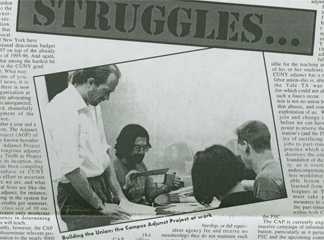 CUNY Adjunct Labor The CUNY Adjunct Labor collection documents three decades (1970-2001) of organizing efforts by part-time faculty and graduate students at CUNY to advance their interests as contingent workers. The collection emphasizes labor and organizing issues specific to adjuncts, within the Professional Staff Congress (PSC), the CUNY faculty-staff-graduate student union, and across the City University of New York system at large. Through newsletters, correspondence, legal documents, memoranda, flyers, minutes, and newspaper clippings, among other items, the collection presents a view of CUNY history that incorporates the struggles of adjuncts to win better wages, benefits, and working conditions. The documents in the collection, for the most part, are drawn from the PSC archives at NYU’s Tamiment Institute Library and the Robert F. Wagner Labor Archives. CUNY’s increased reliance on adjunct labor began with the implementation of Open Admissions at CUNY in 1970, which had significantly increased the system’s undergraduate enrollment to more than 250,000 by 1972. The use of part-time faculty at CUNY reflected national trends toward the de-professionalization of the academic labor force, as well as the broader movement in international labor markets toward a culture of labor fragmentation, dis-organization, and precarity. Because adjunct workers are undervalued and thus vulnerable in both the labor force and the larger labor movement, the CUNY adjuncts struggled for paid office hours, health and unemployment insurance, a formal grievance process, union representation, and reductions in pay disparities between full- and part-time workers, among other adjunct-specific concerns. These struggles had been waged largely on the initiative of adjuncts themselves, who organized across campuses and pressured both CUNY and the PSC to protect their interests. The persistence of CUNY adjunct teachers in their struggle for rights and representation arguably strengthened CUNY as well as the PSC itself. Beginning in 1969 with the efforts of the United Federation of College Teachers (UFCT), a union of instructional staff and lecturers (a title later replaced by that of "adjunct"), and continuing with attempts to organize independent unions and non-union worker associations for part-time labor, CUNY adjunct labor had a formative influence on, and a sometimes contentious relationship with, the PSC leadership and membership. The PSC formed in 1972 through a merger of the UFCT with the Legislative Conference (LC), the full-time faculty union. In 1974, the Adjunct Faculty Association (AFA) filed a New York Public Employment Relations Board (PERB) “Improper Practice Charge” against the PSC, charging that it had intentionally undermined the position of adjunct labor in its contract agreement with CUNY. Ultimately, this conflict did not result in the splintering of PSC, but shortly thereafter the Committee for Part-Time Personnel (CP-TP) was established to represent the interests of part-time CUNY faculty within the union. The CP-TP was able to win adjunct-specific provisions in CUNY's 1977 contract agreement with the PSC which offered incremental pay increases for adjuncts based on length of service, and also in the 1983 contract, which included the relaxation of workload limits on adjunct teachers and early notification of re-appointment and non-re-appointment. In 1986, the Doctoral Students’ Council (DSC) at the CUNY Graduate Center, along with the Graduate Students’ Union, formed the self-identified Part-Time Instructional and Research Staff Union (PTU) and also submitted a petition to the PERB for separate certification, which was denied. However, in the same year, the 1986 contract agreement included employer-funded health insurance and tuition remission for adjunct faculty. The DSC continued to press adjunct issues, and in the 1990s formed the CUNY Adjunct Project, a research and organizing group of graduate student adjuncts that agitated for improved wages and working conditions for contingent faculty. In the early 2000s, the New Caucus ran candidates for PSC leadership positions against the City University Unity Caucus (CUUC/Unity) that had controlled the union’s top officer positions for almost 25 years. The New Caucus ran on a platform that included a call for increased part-time representation in the PSC and – in part due to the large vote by adjuncts – won control of the PSC. Union struggles led on behalf of and by adjunct labor continue (for instance, in the "7K for Adjuncts" campaign of 2019) both within the PSC and through breakaway activist groups. These continuing struggles ultimately demonstrate that in addition to improving adjuncts’ working conditions and pay, the fight for adjunct equity within the union has the ability to fulfill the promise of the PSC and CUNY– an institution that was established to further the nation’s promise of access to higher education opportunities. The collection was curated by Chloe Smolarski and Irwin Yellowitz from documents provided by the PSC and Marcia Newfield, to whom gratitude is due.
 -
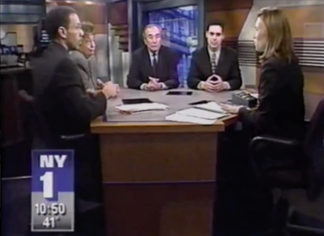 CUNY v. City Hall: Media Perspectives in the 1990s Compiled from the holdings of CUNY professor emerita Sandi Cooper, this collection features broadcast clips from the late-1990s and early-2000s that focus on battles between city and state officials, university trustees, students, labor unions, and activist faculty over the direction of the university heading into the 21st century. Topics of discussion that frequently appear in the videos include open admissions and entrance standards, graduation rates, budget cuts, remediation, and reform. These subjects were of central concern to the university's advocates during the 1990s as the decade saw CUNY face attacks on multiple fronts. At the state level, devastating budget cuts contributed to fewer courses and tuition increases. And on the city level, as many of these videos attest, CUNY faced continued pressure from Mayor Rudolph Giuliani to bend to his conservative ideological vision for the university. Though responsible for only a smaller portion of CUNY's overall budget, Giuliani's appointees to the Board of Trustees were no less damaging to the university and its mission of serving all of New York's diverse student population. A 1999 report released at the direction of the Mayor labeled CUNY as "an Institution Adrift" and took aim at both the university's Open Admissions system and its remedial programs for entering freshmen. The same year, Giuliani and his appointees were able to do away with CUNY's remediation programs and move toward the centralized control of CUNY that would become standard in the 2000s. These materials were shared with the archive following an oral history interview conducted with Cooper in 2018. That interview, also included in this collection, covers the breadth of Cooper's career through which the professor emerita reflects on her six decade-long involvement with the university, its students, and the faculty senate. Cooper, whose research specialty focuses on peace studies, spent the majority of her academic career at the College of Staten Island.
 -
 The Fight for Asian American Studies at Hunter College This collection highlights the history and activism surrounding the Hunter College Asian American Studies Program (AASP). Established in 1993, the AASP offers undergraduates a minor in Asian American studies as well as other resources and programming and is the only academic program in Asian American studies in the CUNY system. Central to the collection is the relationship between activism and the program that has defined the program’s history, most prominently the student activism of the Coalition for the Revitalization of Asian American Studies at Hunter (CRAASH) as well the program’s historical role in supporting Asian American cultural and political movements in New York City and beyond. <br /><br />The AASP was established in response to years of student and faculty demand. Asian American studies first appeared at CUNY when Dr. Betty Lee Sung taught the first Asian American studies courses at City College in 1970. Hunter’s first Asian American studies course ran independently two years later and was taught by Fay Chiang (Asian American poet, writer, artist, and once director of the prominent New York City-based Asian American artist-activist group Basement Workshop). The next decade was a struggle to continue the course, given the precarious status of community workers and graduate students who largely taught the course in addition to their various outside commitments. <br /><br />In 1989, students brought the annual East Coast Asian American Student Union (ECAASU) conference to Hunter while then assistant provost and professor of education Dr. Shirley Hune did the same with the annual Association for Asian American Studies (AAAS) conference. Not only was this the first AAAS conference held on the East Coast, thereby giving the association and the field national representation and reach, but these concurrent conferences also demonstrated to the Hunter community the broader interest in Asian American studies. CUNY-wide protests against tuition hikes imposed in 1989 acted as a platform on which Hunter students built their demands for an Asian American studies program. <br /><br />The AASP was established in 1993, with Dr. Peter Kwong as its inaugural director. In a letter to the Community Advisory Board for the new program, Kwong wrote, “Mindful of its debts to the community, the program intends to serve it.” As items from the collection show, many of the AASP’s early projects and programming were dedicated to amplifying Asian American artists and writers, women’s and feminist issues, and issues of labor and migration. <br /><br />The history of the AASP also reveals that institutional investment in and commitment to ethnic studies were never a given at Hunter or CUNY as a whole, but rather had to be fought for and defended at every turn. In 1995, a group of CUNY Asian American scholars assembled an Asian American Studies Guidebook for CUNY which detailed key challenges and suggestions for the implementation of Asian American studies across the CUNY system. This guidebook represents a case of prescient planning by this scholarly community which manifested in strides made when the efforts of Dr. Kwong and, later, Dr. Robert Ku, at Hunter aligned with those of Dr. John Kuo Wei (Jack) Tchen (director of the Asian/American Center at Queens College before going on to establish Asian American studies at NYU), and Dr. Gary Okihiro (founding director of the Asian American Studies Program at Columbia University). However, despite these linked efforts, Asian American studies did not grow to become institutionalized at other CUNY campuses. Furthermore, by 2006, the Hunter AASP had lost its one full-time faculty person, Dr. Ku, and had become effectively defunct. <br /><br />Eight students came together to form CRAASH when Hunter student Olivia Lin discovered that the program could not offer her a minor because it had no director to formally do so. In response to the freeze on the AAS minor as well as the program’s lack of full-time faculty, budget, space, course offerings, and other resources, CRAASH began organizing students in the Fall of 2007 to advocate for increased funding, the allocation of full-time professors for the program, and the expansion of course offerings. Many of CRAASH’s strategies are documented in this collection—including articles that resulted from its media outreach strategy, the 2008 “Strengthening Education: Empowering Asian American Studies” conference they organized, and their petition which collected over 1,000 signatures. <br /><br />Within one year, CRAASH’s organizing resulted in the hiring of poet and translator Jennifer Hayashida as, first, coordinator and, later, director of the AASP. Hayashida grew the program over the next several years—developing course offerings, increasing the number of AASP minors and student engagement with the program, and bringing in gifts and grants such as an NEH summer seminar for K-12 educators. However, structurally, little had changed and the program still lacked any full-time faculty other than Hayashida. <br /><br />In 2016, CRAASH launched a campaign demanding an Asian American Studies Department and major, which would have required the college to invest in five full-time faculty lines and provide necessary administrative resources to support a newly formed department. CRAASH presented its demands at a Hunter Faculty Senate meeting in September of 2016, during which the Hunter administration under President Jennifer J. Raab also announced its plans to move the AASP administratively out of the School of Arts and Sciences and into the Provost’s office. Hayashida was notified that she would not be reappointed as a Distinguished Lecturer, leaving the program with an uncertain future. The news of Hayashida’s non-reappointment came one day after she had secured a $1.7 million federal grant for Asian American Native American Pacific Islander Serving Institutions (AANAPISI) for the program, in what is a striking metaphor for the relationship between the program and the Hunter administration. CRAASH organized and successfully resisted these plans to restructure the program. The program is currently under the direction of Dr. Vivian Louie, Professor of Urban Policy and Planning. As the past has shown, the future of the program will surely depend upon administrative investment, sustained interest and commitment to the radical roots and spirit of ethnic studies, and innovation in making it work when the administration inevitably fails to deliver. <br /><br />This collection demonstrates how student and faculty struggles have been essential to securing the survival of Asian American studies at Hunter. Curated by Linda Luu—currently, a doctoral student in American Studies at NYU, a graduate of the Hunter AASP, and previous member of CRAASH—this collection features items from the early years of the AASP through contemporary activism in support of the program. Together, the items provide key insights into a program that has been instrumental in developing the discipline and practice of Asian American studies and what is known as East of California Asian American Studies. Given CUNY’s position as the first institution outside of California where Asian American studies took hold, the presence of Asian American studies across the system must be defended and expanded. For more about the history of the AASP and student activism for ethnic studies at CUNY, please see articles authored by Dr. Shirley Hune and Dr. Betty Lee Sung in <a href="https://aaari.info/cuny-forum-volume-41/" target="_blank" rel="noopener" title="Volume 4:1 of CUNY Forum">Volume 4:1 of CUNY Forum </a>and <a href="https://aaari.info/asian-american-matters-a-new-york-anthology/" target="_blank" rel="noopener" title="Asian American Matters: A New York Anthology">"Asian American Matters: A New York Anthology"</a>
 -
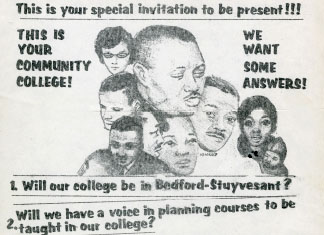 Community College 7 The history of the City University of New York (CUNY) has been fundamentally shaped and reshaped, in large part, by decisions of city and state officials, especially about where to site new colleges in the expanding municipal college system. One such controversy erupted in the early 1960s when CUNY officials and city politicians chose in 1963 to site a new community college (Kingsborough Community College) for Brooklyn in the largely white neighborhood of Sheepshead Bay, rather than in the largely Black and Puerto Rican neighborhoods of central Brooklyn. Five years later, in February 1968, when CUNY announced plans to establish a new “Community College 7 in or near Bedford-Stuyvesant… oriented to the Bedford-Stuyvesant Community and operated in consultation with the community,” the leaders of an extensive network of education advocacy groups and civil society organizations from that very community responded immediately and forcefully, with the memory of the struggle over Kingsborough Community College very much fresh in their minds. “Responsible Community Leaders,” wrote Ulysses Jordan, Chair of the Education Committee of the Bedford Stuyvesant Youth in Action Network “… were not consulted by the Educational Structure on both the state and local levels, in respect to programming and the planning stages for the development of this college," as <a href="https://cdha.cuny.edu/admin/items/show/13432">this document</a> in the Community College 7 collection indicates. <br /><br />In the months that followed, appointed representatives of the Bedford-Stuyvesant network of advocacy groups met with CUNY officials to argue for and collaborate in planning a college that they hoped would fulfill their community’s shared vision of an institution addressed to the priorities and potential of the community’s Black and Puerto Rican cjtizens. For a few key activists and leaders, many of whom were simultaneously involved in the Community Control movement for racial justice in New York City’s K-12 schools, that vision was of a college planned and governed by Central Brooklyn community leaders and organizations. As their negotiations with CUNY officials continued throughout 1968, the group’s leaders also convened and facilitated large public meetings to engage local leaders, educators, and youth expressing and framing demands for the college, and to create a system and structure for active community engagement with and control over the new college. <br /><br />Among the Bedford Stuyvesant’s community organizations’ collaborators was Donald Watkins, a white professor, dean, and Vice President at CUNY’s Brooklyn College. This collection, curated from Watkins’s papers (and generously made available to CDHA by Michael Woodsworth) details records of the meeting minutes, announcements, planning documents and correspondence of the educational coalitions and committees that convened to represent Central Brooklyn in the negotiations with CUNY over Community College 7. This collection complements the <a href="https://cdha.cuny.edu/collections/show/111">The Founding of Medgar Evers College</a> collection on this site, curated by Florence Tager, which is drawn largely from CUNY officials’ documents, meeting minutes, and telegrams, memos, handwritten notes from those events. It was curated by Juliet Young, a doctoral student in the Graduate Center’s Urban Education PhD program.
 -
 Center for Study of Women and Society The Center for the Study of Women and Society’s collection highlights the history and a few of the many achievements, victories, and struggles of the Center from its inception as an academic resource center in 1975 to the start of its Master’s program in 2015. It contains a wide range of documents including newsletters, grant proposals, meeting agendas, pamphlets, and correspondence. <br /><br />Since its beginnings, the Center has accomplished much, from putting together the <a href="https://academicworks.cuny.edu/gc_arch/2/" target="_blank" rel="noopener">Activist Women’s Voices Oral History Archives</a> (which can be found on CUNY Academic Works) that aimed to document the voices of unsung activist women, to create a handbook on integrating research on women, which was disseminated nationwide in the fall of 1985. This handbook focused on including not only research within the field of Women’s and Gender Studies, but also highlighted the research done by and about women and women of color, and had a significant impact on college curricula and introductory classes in various fields. Much of the Center’s work focused on bringing attention to feminist issues—such as representation, childcare, equal pay, and domestic violence, among many more—integrating more diverse voices and works into academia, and being a medium through which marginalized people could speak up and be heard. The Master of Arts program in Women’s and Gender Studies, which was approved in 2015 and launched in the 2016-17 academic year, is proving itself to be highly successful and has generated informative discussions and experiences, adding more depth to the Center. From 1977, when the field of Women’s Studies was still in its early phase, to the present, the Center for the Study of Women and Society continues to bring interdisciplinary feminist research to the forefront through the many events, talks, and projects taking place under its sponsorship. <br /><br />The Center was established by a group of Graduate Center faculty members—including Professors Joan Kelly, Gerda Lerner, Cynthia Fuchs-Epstein, Judith Lorber, and Gaye Tuchman—to promote interdisciplinary feminist scholarship by sponsoring conferences, speakers, and individual research. It also provided students and faculty a place to gather and share information, resources, and research in the field of women’s and gender studies. The goals of the Center at its inception included developing, encouraging, and sponsoring research projects in the study of women and society; aiding undergraduate and graduate programs at the various CUNY colleges; and developing and sponsoring community education programs on topics related to women and society. While many of these goals have not changed, they have been revised as time passed, including the successful development in 1990 of the Women’s Studies Certificate Program (WSCP). As such, the Center’s original goals relating to coursework and the development of classes became the responsibility of the WSCP, while the Center was then able to pursue more research projects and work on bringing attention to the voices of women and marginalized communities and groups. Curated by Clarisa Gonzalez and Unnati Guru, this collection offers a glimpse into the conversations, aspirations, and accomplishments of the Center for the Study of Women and Society as it navigated the intersections of feminism and academia from the late 1970s until the early 2010s.
 -
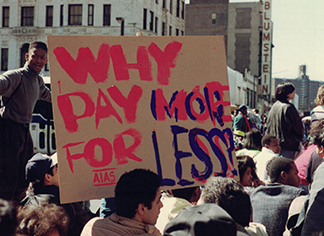 Student Strikes of 1991: Graduate Center Student Takeover In the Spring of 1991, proposed tuition hikes, cuts to the university’s operating budget, and reductions in student aid prompted system-wide student strikes at CUNY. Spurred into action by student activists at City College, groups of students began taking over their campuses throughout the CUNY system. By the end of the occupation more than two-thirds of CUNY was under student occupation. This collection includes flyers, photographs, manifestos, and other primary source materials from the Spring of 1991. They were gathered and assembled by Katherine McCaffrey, then a Graduate Center (GC) Anthropology doctoral student, highlighting the role of the GC in the system-wide movement, and providing the lens through which the struggle is understood. The 1991 strike at the Graduate Center was born in the Anthropology PhD program and reflected the progressive education doctoral students received in a program rooted not only in Marxist theory, but also in practice. This training recognized the nature of the interconnected and unequal world that we inhabited and encouraged students to use the tools of Anthropology to change it. Several documents reveal early organizing efforts of Anthropology doctoral students that laid a foundation for the strike. A key element of the program’s identity and dynamism emerged from the public nature of the City University system and neoliberal threats to the material basis of this public education that CUNY faced. Austerity ultimately had the effect of unifying students and faculty alike in opposing this direct assault against such a crucial public good. A key argument of the material included in this collection is that student mobilizations that emerged from the CUNY system from the mid-1970s through the mid-1990s were not narrowly framed simply to oppose tuition hikes but rather were more broadly conceptualized as resistance against austerity measures and the expanding war economy. Documents in this collection reveal these linkages. Student solidarity across campuses was a crucial character of the system-wide strike. Documents reveal efforts to promote solidarity and build coalitions with labor unions, community organizations, and elected officials to redirect state and city taxes towards education, healthcare, housing, and mass transit. For example, one flyer appeals to NYC labor movement members to join CUNY student strikers on an April 24, 1991 rally at the World Trade Center, arguing that the attacks on CUNY were part of city-wide attacks on city workers, public schools, health care, worker safety, child care, public transit, and beyond. Demonstrations expanded beyond individual campuses to the streets of Harlem, Lower Manhattan and Albany. Protest tactics included strikes, demonstrations, teach-ins, and takeovers of multiple buildings across campuses. The protestors also called for the restructuring of the CUNY Board of Trustees and implementing a progressive state tax structure. Protest movements cross-pollinated. One of the documents in this collection is a poster from the Latinas/os Caucus of ACT UP/NY which drew parallels between cuts to education and cuts to health care. The flyer emphasized that when "basic rights are at stake, radical responses are in order.” Another flyer ironically juxtaposed Iraqi leader Saddam Hussein with New York Governor Mario Cuomo and CUNY Chancellor Ann Reynolds, pointing both to the dubious nature of the US war on Iraq and the harm perpetrated by local officials against the public at home. Documents within this collection include dissenting opinions and analyses of the efficacy of the strike. Stanley Aronowitz, who taught in the doctoral program in Sociology, noted that the event's main success was the direct democracy that it practiced and the possibility that CUNY could become a leading "innovator in pedagogy and curriculum." Katherine McCaffrey, now a Professor of Anthropology at Montclair State University, curated the collection.
 -
 The Shutdown: CUNY Responds to the Covid-19 Pandemic <p><span style="font-weight: 400;">On</span> <span style="font-weight: 400;">December 31, 2019</span><b>,</b><span style="font-weight: 400;"> the </span><a href="https://www.who.int/news/item/29-06-2020-covidtimeline"><span style="font-weight: 400;">World Health Organization (WHO) learned from a media statement</span></a><span style="font-weight: 400;"> released by the Wuhan Municipal Health Commission that there had been cases of “viral pneumonia” in the People’s Republic of China. On February 11, the WHO </span><a href="https://www.who.int/news/item/29-06-2020-covidtimeline"><span style="font-weight: 400;">provided an official name for the novel coronavirus</span></a><span style="font-weight: 400;"> responsible for the illness: COVID-19. In less than a month after its naming, COVID-19 developed worldwide into a full-blown pandemic. Seattle was the first hot spot, soon followed by New York City, which became a major epicenter for infection. Many public and private institutions were forced to close their doors and switch to remote operations, including the City University of New York. Over the course of a week, the largest urban public university in the United States, comprised of approximately 250,000 students and 45,000 faculty across 25 campuses, was asked to transition from the traditional practice of collegiate learning and university operation to a digital format that could be successfully operated from the confines of individual homes, all while a pandemic raged across the globe and the city, consuming health, livelihoods, and life itself.</span></p> <p><span style="font-weight: 400;">For the user of the CDLA collection, these contrasting scales of time and consequence are understandably disquieting. Officially </span><a href="https://twitter.com/cuny/status/1237217302363475968?lang=en"><span style="font-weight: 400;">sanctioned notices from the CUNY administration </span></a><span style="font-weight: 400;">reassuring the student body that “...there are no confirmed coronavirus cases involving anyone in the CUNY community,”</span><span style="font-weight: 400;"> can sound naive (if not cynical) in hindsight, especially when compounded by </span><a href="https://cdha.cuny.edu/items/show/12632"><span style="font-weight: 400;">concurrent community petitions to close the college</span></a><span style="font-weight: 400;"> and </span><a href="https://cdha.cuny.edu/items/show/12362"><span style="font-weight: 400;">the circulation of the #CloseCUNY “hashtag”</span></a><span style="font-weight: 400;"> across social media outlets. Yet, the closing of a university is complex; in its role as a public institution, the CUNY system overwhelmingly serves the classically marginalized citizens of New York City, many of whom could not be assumed to possess the necessary equipment to engage in online instruction.</span><span style="font-weight: 400;"></span></p> <br /> <p><span style="font-weight: 400;"></span></p> <center><a href="https://cdha.cuny.edu/items/show/12352"><img src="https://cdha.cuny.edu/files/original/dc58b1ddffda86988d53a28c39d8fc7d.png" width="400" alt="Tweet by CUNY student suggesting administration is concerned with lack of access to technology" /></a></center> <p><span style="font-weight: 400;"><br />As </span><a href="https://cdha.cuny.edu/items/show/12352"><span style="font-weight: 400;">a CUNY student’s tweet</span></a><span style="font-weight: 400;"> pointed out, closure of the university could not proceed without considering the double-bind of educational access and lived precarity that intersects the lives of those reliant upon public institutions. Such reasoning can be seen expressed in the official communiques of CUNY authorities, such as </span><a href="https://cdha.cuny.edu/items/show/12392"><span style="font-weight: 400;">this series of tweets from the president of Lehman College</span></a><span style="font-weight: 400;">. To close CUNY was more than simply a physical “closing of doors”; it was the denial of infrastructural access to the most vulnerable and deserving students, faculty, and staff. While possessing a duty to protect the health of its community, CUNY needed to proceed in a manner that respected its core mission to provide access to quality higher education for all.</span></p> <p><span style="font-weight: 400;">Of course, to simply reiterate the official account of the digital transition does a disservice of forgetting those very voices that such accounts claim to value. While the university pondered solutions to structural inequity, the CUNY community was awash in uncertainty and consequential anxiety. Some </span><a href="https://cdha.cuny.edu/items/show/12342"><span style="font-weight: 400;">doubted the sincerity of official statements</span></a><span style="font-weight: 400;">, and saw a perceived lack of investment in preventative infrastructure as demonstrative of a lack of care. For some students, faculty and staff, this developed into </span><a href="https://cdha.cuny.edu/items/show/12412"><span style="font-weight: 400;">feelings of antagonism towards CUNY as a whole.</span></a><span style="font-weight: 400;"> Given such an outcry and the growing rate of infections across New York state and the nation, a CUNY shut-down </span><a href="https://cdha.cuny.edu/items/show/12302"><span style="font-weight: 400;">seemed bound to occur</span></a><span style="font-weight: 400;">. Yet, even if one were acutely aware of the exact timing of the closure, they would still have been stunned by the means of its announcement. On March 11, 2020, at 11:12 AM, New York Governor Andrew Cuomo surprised the CUNY community by announcing on Twitter that CUNY would be moving to online learning within a week.</span></p> <p><span style="font-weight: 400;"> </span></p> <center><a href="https://cdha.cuny.edu/items/show/12312"><img src="https://cdha.cuny.edu/files/original/2f402d8f5f6a57d2914f98565100fa1c.png" width="400" alt="Governor Andrew Cuomo's tweet announcing CUNY's shift to distance learning" /></a></center> <p><span style="font-weight: 400;"></span></p> <p><span style="font-weight: 400;">Starting March 12, CUNY would enter a </span><a href="https://cdha.cuny.edu/items/show/12322"><span style="font-weight: 400;">five-day recess</span></a><span style="font-weight: 400;"> before transitioning to fully remote instruction for the remainder of the semester. In terms of public safety, such a decision could be deemed necessary: John Jay announced that same day that </span><a href="https://cdha.cuny.edu/items/show/12452"><span style="font-weight: 400;">a COVID-19 exposure</span></a><span style="font-weight: 400;"> (defined by the CDC </span><a href="https://www.cdc.gov/coronavirus/2019-ncov/php/public-health-recommendations.html"><span style="font-weight: 400;">as being in close contact, within 6 feet for a total of 15 minutes or more, with a person who has tested positive for COVID-19</span></a><span style="font-weight: 400;">) had occurred</span><b>,</b><span style="font-weight: 400;"> and </span><a href="https://cdha.cuny.edu/items/show/12492"><span style="font-weight: 400;">Brooklyn</span></a><span style="font-weight: 400;">, </span><a href="https://cdha.cuny.edu/items/show/12522"><span style="font-weight: 400;">Lehman</span></a><span style="font-weight: 400;">, and </span><a href="https://cdha.cuny.edu/items/show/12512"><span style="font-weight: 400;">Staten Island </span></a><span style="font-weight: 400;">colleges announced exposures within the same week. But in terms of logistics, the sudden decision exacerbated further anxieties, as both students and faculty </span><a href="https://cdha.cuny.edu/items/show/12282"><span style="font-weight: 400;">scrambled</span></a><span style="font-weight: 400;"> to cope with the limitations facing the integration of face-to-face coursework into digital formats. Perhaps the most succinct example of the indeterminacy facing instruction was a </span><a href="https://cdha.cuny.edu/items/show/12562"><span style="font-weight: 400;">Queens College department email</span></a><span style="font-weight: 400;"> providing blanket approval to all course changes, due to inability of the administration to keep up with requests. </span></p> <p><span style="font-weight: 400;">With such strains facing academic continuity within the first few weeks of the online transition, CUNY administration deemed </span><a href="https://cdha.cuny.edu/items/show/12592"><span style="font-weight: 400;">another period of recalibration</span></a><span style="font-weight: 400;"> appropriate, suspending instruction from March 27 to April 1. Though coming at the expense of the traditional Spring Recess period, the extra time proved valuable for faculty, allowing for the restructuring and fine-tuning of teaching practices and syllabi. Though these new course designs hardly proved immune from problems (see the accompanying </span><a href="https://cdha.cuny.edu/collections/show/382"><i><span style="font-weight: 400;">Teaching and Learning </span></i><span style="font-weight: 400;">collection of this archive</span></a><span style="font-weight: 400;">), they at least provided time for a new reality to set in: distance learning had begun.</span></p> <p><span style="font-weight: 400;">Large questions abound: Were the difficulties in transitioning to online learning a result of Governor Cuomo’s lack of communication or CUNY’s administrative lack of power under the Cuomo administration to determine its own fate? Are the anxieties and antagonism of the CUNY community deserved or the knee-jerk reactions of a community in crisis? In the </span><i><span style="font-weight: 400;">Shutdown </span></i><span style="font-weight: 400;">collection of the CUNY Distance Learning Archive, we refrain from answering these questions. Rather, this collection seeks to preserve a moment, acquiring artifacts from CUNY staff, students, and faculty in order to reveal the range of subjective moments of crisis. <br /><br /><br /></span></p> <hr /> <p><i><span style="font-weight: 400;">This collection is part of the </span></i><a href="https://cdla.commons.gc.cuny.edu"><i><span style="font-weight: 400;">CUNY Distance Learning Archive (CDLA)</span></i></a><i><span style="font-weight: 400;">, a group project developed as part of Matthew K. Gold’s Spring 2020 “<a href="https://kinfrastructures.commons.gc.cuny.edu/">Knowledge Infrastructures</a>” seminar in the Ph.D. Program in English at The Graduate Center, CUNY, in partnership with The Interactive Technology and Pedagogy Certificate Program.</span></i><span style="font-weight: 400;"><em> All CDLA collections on the CUNY Digital History Archive website were co-curated by Travis Bartley, Nicole Cote, Zach Muhlbauer, and Stefano Morello (Project Manager).</em></span></p>
 -
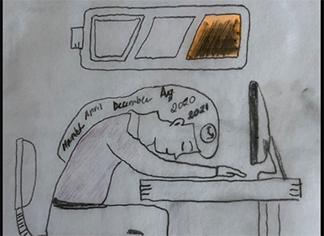 Teaching and Learning During the Time of Covid-19 <p><span style="font-weight: 400;">The CDLA’s Teaching and Learning Collection features an array of personal and institutional documentation, community resources, </span><a href="https://cdha.cuny.edu/items/show/12742"><span style="font-weight: 400;">class projects</span></a><span style="font-weight: 400;">, and digital media related to CUNY’s remote teaching and learning practices in light of the COVID-19 pandemic. The collection brings these items into conversation with one another in the interest of centering the lived experiences of CUNY students, faculty, and staff during this pivotal moment in the history of the largest urban public-university system in the United States. In an effort to help preserve the university’s institutional memory, users of this collection are invited to explore these artifacts in order to reflect on what it was like to teach and learn at CUNY during the Spring 2020 onset of the COVID-19 pandemic.</span></p> <br /> <p><span style="font-weight: 400;">With confirmed cases of COVID-19 soon to spread across the New York City area, CUNY colleges began to triage the outbreak by preparing campus-based guidance for faculty to employ in the event of a university-wide shift to distance learning formats. Collected by the Graduate Center's Teaching and Learning Center (TLC) days before the closure of onset university facilities, these documents address emergent concerns surrounding </span><a href="https://continuity.commons.gc.cuny.edu"><span style="font-weight: 400;">the practice of online teaching and learning during a public health crisis</span></a><span style="font-weight: 400;">. These resources urge CUNY faculty to rethink their role as educators by accounting for issues ranging from course communications and instructional design, to accessibility and assistive technology, to testing and assessment policies, to the precarious health and wellbeing of their students. CUNY faculty associated with the group “Rank and File Action” likewise circulated </span><a href="https://cdha.cuny.edu/items/show/12752"><span style="font-weight: 400;">a proposal</span></a><span style="font-weight: 400;"> for transitioning to distance learning, stressing the need for educators to “give up on normal,” strategically adopt tech platforms, and consider asynchronous modes of instruction, among other recommendations.</span></p> <br /> <p><span style="font-weight: 400;">Items from this collection also foreground the submerged perspectives of CUNY students as they struggled to keep pace with distance learning. In the case of student Reddit posts, these items document the self-represented concerns of CUNY students engaged in conversation with one another around the problematics of learning during the pandemic. In particular, these posts found students at odds with the </span><a href="https://cdha.cuny.edu/items/show/12902"><span style="font-weight: 400;">assessment protocol</span></a><span style="font-weight: 400;">, </span><a href="https://cdha.cuny.edu/items/show/12842"><span style="font-weight: 400;">communication practices</span></a><span style="font-weight: 400;">, and </span><a href="https://cdha.cuny.edu/items/show/12832"><span style="font-weight: 400;">rigorous workloads</span></a><span style="font-weight: 400;"> of the distance learning process. Critically, they also paid credence to the </span><a href="https://cdha.cuny.edu/items/show/12872"><span style="font-weight: 400;">essential labor practices</span></a><span style="font-weight: 400;"> and emotional toll of CUNY students as they intersected with the stresses of online coursework. </span></p> <br /><center><a href="https://cdha.cuny.edu/items/show/12872"><img src="http://stefanomorello.com/wp-content/uploads/2021/12/Screen-Shot-2021-12-10-at-9.03.54-AM.png" width="600" alt="Reddit Thread I'm Tired of These Professors" /></a></center><br /><br /> <p><span style="font-weight: 400;">CUNY educators came to highlight the urgent need for instructors to responsively design and teach their online courses in response to the social and emotional burdens of learners. In one </span><a href="https://cdha.cuny.edu/items/show/12812"><span style="font-weight: 400;">HASTAC blog post</span></a><span style="font-weight: 400;"> on the pedagogical conditions of the pandemic, for instance, Graduate Center faculty member Cathy Davidson adopted a critical perspective on instructional design for instructors to consider as they prepared for the Fall 2020 semester, urging them to not only to do no harm but also to acknowledge that harm has </span><i><span style="font-weight: 400;">already</span></i><span style="font-weight: 400;"> been done unto students in this time of untold crisis.</span></p> <br /><center><a href="https://cdha.cuny.edu/items/show/12892"><img src="https://cdha.cuny.edu/files/original/35cee72a8d1d67d6cfd62eeecfa34e31.png" width="400" alt="Teaching and Learning Center's Twitter Thread About Trauma-Informed Pedagogy" a="" /></a></center><br /> <p><span style="font-weight: 400;">Crowdsourced submissions to the collection also included academic projects by CUNY students that focus on the disproportionate impact of the pandemic on minority communities in NYC. Related items in the collection included </span><a href="https://cdha.cuny.edu/items/show/12642"><span style="font-weight: 400;">honors theses</span></a><span style="font-weight: 400;"> and</span><a href="https://cdha.cuny.edu/items/show/12742"><span style="font-weight: 400;"> digital capstone projects</span></a><span style="font-weight: 400;"> documenting individual and collective struggles during the time of the pandemic. </span></p> <br /> <p><span style="font-weight: 400;">From CUNY senior administrators to student Redditors, the value of this collection lies in its potential to inform and integrate our historical memory as a public institution of higher education. Working from the top-down, bottom-up, and middle-out, the CDLA Teaching and Learning Collection aims to render these educational experiences more legible, making visible multiple scales of the teaching and learning experience across the CUNY system. Users of this collection are thus invited to engage with these artifacts in ways that continue to protect the memory of this difficult moment going forward. It is ultimately through such acts of institutional remembrance that the embodied strife and collective resilience of this public crisis may live on unencumbered by any one dominant voice. </span></p> <hr /> <p><i><span style="font-weight: 400;">This collection is part of the </span></i><a href="https://cdla.commons.gc.cuny.edu"><i><span style="font-weight: 400;">CUNY Distance Learning Archive (CDLA)</span></i></a><i><span style="font-weight: 400;">, a group project developed as part of Matthew K. Gold’s Spring 2020 “<a href="https://kinfrastructures.commons.gc.cuny.edu/">Knowledge Infrastructures</a>” seminar in the Ph.D. Program in English at The Graduate Center, CUNY, in partnership with The Interactive Technology and Pedagogy Certificate Program.</span></i><span style="font-weight: 400;"> <em>All CDLA collections on the CUNY Digital History Archive website were co-curated by Travis Bartley, Nicole Cote, Zach Muhlbauer, and Stefano Morello (Project Manager).</em></span></p>
 -
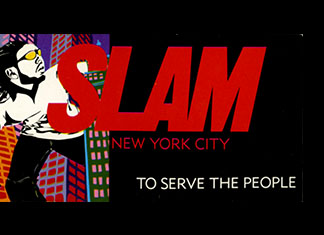 The Story of SLAM!: Oral history interviews The oral histories included here were all conducted by Professor Amaka Okechukwu, a sociologist at George Mason University, as part of the research for her book, To Fulfill These Rights: Political Struggle Over Affirmative Action and Open Admissions (Columbia University Press, 2019). Professor Okechukwu graciously contributed these oral history interviews to the CDHA. To Fulfill These Rights documents struggles over open admissions and affirmative action at universities across the country, including a groundbreaking chapter on SLAM! and the dismantling of open admissions at CUNY. This collection was curated by Lucien Baskin, a doctoral student in the Graduate Center's PhD Program in Urban Education.
 -
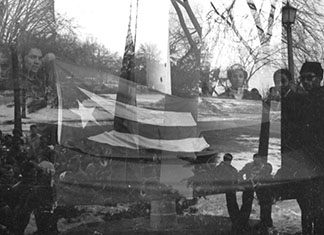 Puerto Rican Studies at Brooklyn College The fight for the creation of Puerto Rican and Black Studies programs across a number of campuses in the City University of New York (CUNY) system in late 1960s and early 1970s is one of the singular academic and political achievements of the student and community movements in these years. Stories of unity and solidarity between Puerto Rican and African American student populations and local communities were central to the struggles at many of the campuses throughout the City University. The battles for a Puerto Rican Studies department at Brooklyn College were directly connected to the larger Open Admissions movement that fundamentally reshaped CUNY after 1969. This was especially true at Brooklyn College, as this collection on the history of the fight to create a Puerto Rican Studies department at the college reveals. The efforts of a mostly Puerto Rican and African-American student-led struggle within CUNY in the years after 1968 contributed to the establishment of the larger field of U.S.-based Puerto Rican Studies (PRS) programs. As a pioneering discipline, PRS also contributed to the emerging fields of Latino Studies and Ethnic Studies, helping transform the curriculum in higher education institutions across the nation. Brooklyn College was one of several CUNY campuses at which students and faculty engaged with each other, alongside community residents, to achieve a more equitable, responsive, and integrated public education system. Influenced and supported by national organizations such as the Black Panther Party and the Young Lords Organization, the Civil Rights Movement, international struggles including opposition to the Vietnam War, and the pro-independence movement in and for Puerto Rico, student-activists at Brooklyn College engaged in various forms of protest in their efforts to transform the university system. When Puerto Rican and African-American students began to arrive in small but significant numbers at Brooklyn College (BC) and CUNY during the late 1960s, they encountered a campus that did not reflect the Brooklyn neighborhoods they knew and had grown up in. By 1968, 96 percent of the undergraduate student enrollment at Brooklyn College remained white, middle class, and largely Jewish. In that same year Puerto Rican students established the Puerto Rican Alliance (P.R.A.) at Brooklyn College, signaling the presence of pioneering Puerto Rican student-activists on the campus. The early cohort of predominantly Puerto Rican and African-American students who began integrating the Brooklyn College (BC) campus in the late 1960s became active members of the Puerto Rican Alliance and the Brooklyn League of Afro-American Collegians (B.L.A.C.)--both student clubs at BC. In April 1969 the student members of P.R.A. and B.L.A.C. presented BC President George A. Peck with a list of 18 demands that included: active recruitment and admission of more Puerto Rican and Black students into the university; establishment of Puerto Rican and Afro-American Institutes; and an end to biological and chemical warfare research and C.I.A. activities at the campus. These demands were modeled after the Black Panther Party’s 21 national demands. The 18 demands were also supported by Students for a Democratic Society (S.D.S.), a student club composed of a mostly white radical students on campus. This phase of the student-led struggle at BC is described in oral histories with pioneering student-activists included in this collection as a racially, ethnically, and linguistically inclusive movement. Later in the spring of 1969, in response to student demands and student and faculty activism on campus the BC administration approved the creation initially of the Puerto Rican and Afro-American institutes, both of which opened on the BC Campus early the following year. One of the biggest and earliest demonstrations in support of these demands at Brooklyn College became known as the “BC19” event. In May 1969, after weeks of campus protests, 19 students were arrested in their homes during a pre-dawn raid by NYC police. Pioneering student-activists faced charges for their on-campus demonstrations and were held on Rikers Island, in Queens, NY for three days. BC student and faculty activists, as well as members of the surrounding Brooklyn community (including BC alum, Congresswoman Shirley Chisholm) raised funds for bail to allow the arrested students to be released. Oral historical interviews conducted with two of the “BC19” students, Antonio Nieves and Dr. Orlando Pile are included in this collection. Finally, in January 1970, with continued support from BC faculty and staff, the Departments of Puerto Rican and Afro-American Studies were established and began operating on several CUNY campus, including Brooklyn College, Hunter College, Borough of Manhattan Community College, and City College, contributing to the longterm transformation of CUNY through new and progressive curricula and a growing and integrated student body. The initial few years after the establishment of the Department of Puerto Rican Studies (PRS) in 1970 remained fairly quiet on the BC campus. Led by students, faculty, and staff, the new academic department and the separate PRS Institute (which continued) developed courses, programs, and community-driven partnerships between Puerto Rico and the diaspora in the United States. The 1973-74 academic year marked the next major phase in the Puerto Rican struggle at Brooklyn College. Student-activists organized and mobilized to defend their right to self-determination of and control over the Department of Puerto Rican Studies. Shortly after the founding director and chair of the department resigned the BC administration organized a search committee, chaired by President John W. Kneller. In an unexpected move, President Kneller defied the decision of the search committee and in Fall 1974 chose a candidate as the new chair of the department who students, faculty, and staff opposed. Students then engaged in a series of protests demanding to have Prof. María Sánchez, the search committee’s choice, as the department’s next chairperson. Students rallied on campus and at President Kneller’s house and the gym he frequented. The protests escalated into a multi-day take-over in October 1974 of the BC Registrar’s office, ending with the arrest of 41 students and 3 faculty members. This incident became known as the BC44. Oral history interviews conducted with arrested students and one faculty member are part of this collection. This Puerto Rican Studies at Brooklyn College Collection (PRSBC) focuses on a mostly Puerto Rican led student movement at CUNY during the late 1960s and early 1970s. The collection includes oral history interviews with pioneering student-activists, photographs of participants and important events, and archival materials. The oral history interviews were recorded for a documentary film, Making the Impossible Possible (2021), directed by Tami Gold and Pam Sporn and produced by the Alliance for Puerto Rican Education and Empowerment (A.P.R.E.E.), an organization founded by several of the pioneering Brooklyn College student activists. Antonio "Tony" Nieves, student member and liaison of the Puerto Rican Alliance and the Brooklyn League of Afro-American Collegians contributed the photographs in this collection, which captured the racial and ethnic solidarity on the campus during the late 1960s. Archival materials found at Brooklyn College’s Archives and Special Collections fill out the story of institutional, pedagogical, cultural, and linguistic transformation that occurred across the CUNY system and at Brooklyn College as a result of the actions of a formidable, mostly Puerto Rican and African-American student-led, movement. The collection was curated by Gisely Colón López, a doctoral student in the Graduate Center’s Urban Education PhD program.
 -
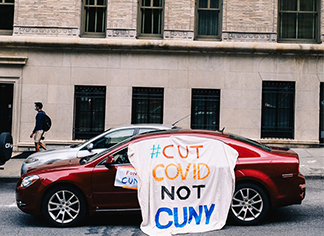 #CutCovidNotCUNY <p><span style="font-weight: 400;">The CDLA’s </span><i><span style="font-weight: 400;">#CutCOVIDNotCUNY</span></i><span style="font-weight: 400;"> collection offers a way of engaging what Donna Haraway terms “staying with the trouble,” of the potential and actualized austerity measures introduced by the CUNY administration at the outset of the pandemic, the intended pathways forward developed by the university and the state, as well as university-wide resistance to such actions. Documenting this moment in CUNY’s history establishes the collective memory of what transpired and allows for considerations of ways forward that take into account both the harried measures implemented and attempted by university and state administrations and the relentless pushback by the CUNY community. This collection can serve to inform, animate, and mobilize the CUNY community, to remind ourselves of the pushback against austerity policies and techno-solutionism in a moment of catastrophic realignment. </span></p> <p><span style="font-weight: 400;">In May of 2020, the state and city</span><a href="http://www.psc-cuny.org/news-events/cuny-adjuncts-union-aoc-and-nys-lawmakers-demand-jobs-and-new-taxes-rich"><span style="font-weight: 400;"> budget cuts</span></a><span style="font-weight: 400;"> for CUNY were projected as high as $115 million, about 20% of CUNY’s expected budget prior to the pandemic. In this moment, the CUNY administration was keen to dismiss the contingent workforce by the thousands. Reported plans by John Jay College and the College of Staten Island, for example, spoke of the dismissal of 40 percent and 35 percent respectively of their adjunct workforces—some of whom would then consequently be </span><a href="https://cdha.cuny.edu/items/show/13252"><span style="font-weight: 400;">left without health insurance</span></a><span style="font-weight: 400;"> during the largest global health crisis in a century.</span> <span style="font-weight: 400;">In swift response to the treatment of its workers at John Jay, seemingly instigated by a memo from Provost Yi Li, CUNY Rank and File activists mobilized against austerity, utilizing Twitter under the username </span><i><span style="font-weight: 400;">#CUNYstrikeready Rank and File Action</span></i><span style="font-weight: 400;"> to connect with the broader CUNY community through town halls, writing an </span><a href="https://cdha.cuny.edu/items/show/13202"><span style="font-weight: 400;">“Open Letter of Commitment to Resist Cuts at CUNY” </span></a><span style="font-weight: 400;">signed by faculty CUNY-wide, and establishing a community and public facing presence against racist austerity measures. </span></p> <p><span style="font-weight: 400;">Twitter was an important platform for the CUNY community to push against these measures, share personal perspectives, experiences, articles, and resources, and connect with others; and, accordingly, this collection documents various tweets from our community in this moment. Through the hashtag </span><i><span style="font-weight: 400;">#CutCOVIDNotCUNY,</span></i><span style="font-weight: 400;"> GC PhD candidate and Brooklyn College instructor Mikey Elster </span><a href="https://cdha.cuny.edu/items/show/13012"><span style="font-weight: 400;">used Twitter</span></a><span style="font-weight: 400;"> to draw attention to the important consideration that “the same workers on the front line of fighting the epidemic are our students.” And, the Brooklyn College PSC chapter</span><a href="https://cdha.cuny.edu/items/show/13022"><span style="font-weight: 400;"> identified the double-standard of expectations</span></a><span style="font-weight: 400;">: that CUNY workers are being cut from employment while simultaneously being asked to offer uncompensated labor to the state: <br /><br />“#CUNY + #SUNY faculty and staff are being asked to donate 15-20 hrs interviewing applicants for NYS Contact Tracing initiative. Vital work for the state's public health, but @NYGovCuomo will you also ensure these higher ed folks have thriving colleges in Fall? #CutCovidNotCUNY.” <br /><br /></span></p> <center><a href="https://cdha.cuny.edu/items/show/13242"><img src="https://cdha.cuny.edu/files/original/c4eb9d17d02798a3865d95c65639612a.png" width="400" alt="Tweet: PSC Protest Against cuts to CUNY budget during the COVID pandemic" a="" /></a></center> <p><span style="font-weight: 400;"><br />Notably early on in planning for the 2020-21 academic year, Brooklyn College mandated that its departments and programs increase class sizes while </span><a href="https://cdha.cuny.edu/items/show/13262"><span style="font-weight: 400;">simultaneously lopping off 25 percent of their course offerings</span></a><span style="font-weight: 400;">. Yet, in an article for the </span><i><span style="font-weight: 400;">Gotham Gazette</span></i><span style="font-weight: 400;"> well circulated in the CUNY Twitterverse, Professor Matt Brim of the College of Staten Island </span><a href="https://cdha.cuny.edu/items/show/13192"><span style="font-weight: 400;">explained that such measures are not new to CUNY</span></a><span style="font-weight: 400;">, stating that the university “has been in a slow-burn, decades-long state of crisis…[and that] the COVID-19 pandemic reveals with new urgency...CUNY’s longstanding, systemic failures.” And, as GC Fellow and City College instructor Harry Blain </span><a href="https://cdha.cuny.edu/items/show/13132"><span style="font-weight: 400;">pointed out on the platform</span></a><span style="font-weight: 400;">, community colleges and minority-serving institutions such as Medgar Evers College are particularly feeling the brunt: <br /><br />“@CUNY cuts fall most viciously on community colleges like @bcc_pres and @bmcc_cuny, as well as senior colleges like @NewsatMedgar that serve low-income communities.” </span></p> <p><span style="font-weight: 400;">Such harmful preemptive measures sparked protests across both the city and social media, illustrated in </span><a href="https://cdha.cuny.edu/items/show/13242"><span style="font-weight: 400;">tweets by the PSC</span></a><span style="font-weight: 400;"> and others (which included the particularly striking </span><a href="https://cdha.cuny.edu/items/show/13232"><span style="font-weight: 400;">photography by artist Erik McGregor</span></a><span style="font-weight: 400;">) that address the May Day caravan for adjunct rights, and through the hashtags </span><i><span style="font-weight: 400;">#CutCovidNotCUNY </span></i><span style="font-weight: 400;">and </span><i><span style="font-weight: 400;">#makebillionairespay, </span></i><span style="font-weight: 400;">among others. Physically at the protests (</span><a href="https://cdha.cuny.edu/items/show/13102"><span style="font-weight: 400;">New York State Senator John C. Liu</span></a><span style="font-weight: 400;">), on Twitter and online (including </span><a href="https://cdha.cuny.edu/items/show/13062"><span style="font-weight: 400;">Congressmember Alexandria Ocasio Cortez</span></a><span style="font-weight: 400;">) a number of federal, state, and local government officials and public advocates showed their support for funding CUNY despite plans by Governor Cuomo and university administration. Support for resistance to austerity measures at CUNY and those observed more broadly across the US, and considerations of the taxation of the wealthy as a viable way forward, were made by both </span><a href="https://cdha.cuny.edu/items/show/13142"><span style="font-weight: 400;">local politicians</span></a><span style="font-weight: 400;"> and </span><a href="https://cdha.cuny.edu/items/show/13162"><span style="font-weight: 400;">CUNY faculty</span></a><span style="font-weight: 400;">. <br /><br /></span></p> <center><a href="https://cdha.cuny.edu/items/show/13142"><img src="https://cdha.cuny.edu/files/original/cbf121b7be633bf049d33924f9200723.png" width="400" alt="AOC's Tweet" a="" /></a></center><br /> <p><span style="font-weight: 400;">The CDLA </span><i><span style="font-weight: 400;">#CutCOVIDNotCUNY</span></i><span style="font-weight: 400;"> collection hopes to act as a useful resource in the fight against austerity politics during the COVID-19 pandemic.</span> <span style="font-weight: 400;">Serving as a collection of responses native to the CUNY community, these experiences will therefore be preserved in the CDLA, to retain them in our collective institutional memory. This collection of the CDLA hopes to offer a preemptive measure against neoliberal master narratives through documenting the extensive pushback and activism by the CUNY community in this moment. <br /><br /></span></p> <hr /> <p><i><span style="font-weight: 400;">This collection is part of the </span></i><a href="https://cdla.commons.gc.cuny.edu"><i><span style="font-weight: 400;">CUNY Distance Learning Archive (CDLA)</span></i></a><i><span style="font-weight: 400;">, a group project developed as part of Matthew K. Gold’s Spring 2020 “<a href="https://kinfrastructures.commons.gc.cuny.edu/">Knowledge Infrastructures</a>” seminar in the Ph.D. Program in English at The Graduate Center, CUNY, in partnership with The Interactive Technology and Pedagogy Certificate Program.</span></i><span style="font-weight: 400;"> <em>All CDLA collections on the CUNY Digital History Archive website were co-curated by Travis Bartley, Nicole Cote, Zach Muhlbauer, and Stefano Morello (Project Manager).</em></span></p>
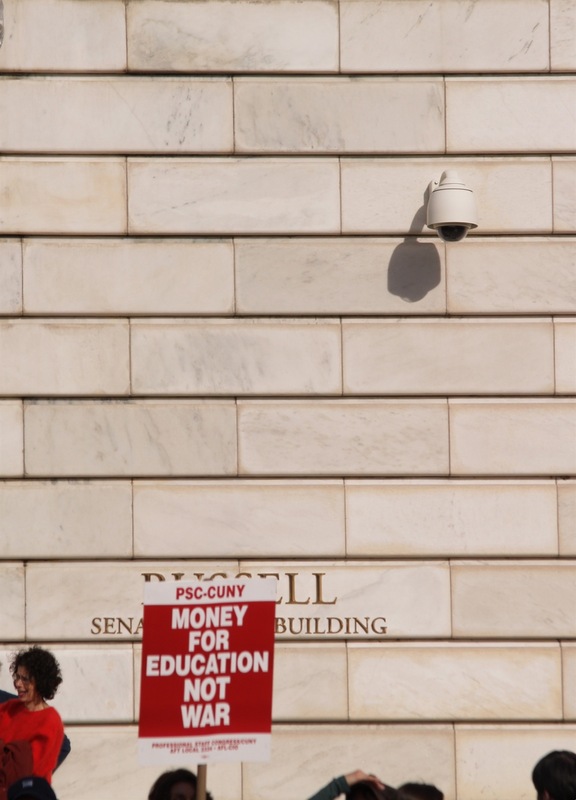
1–25 of 31