Save Hostos!
Item set
Title
Description
Save Hostos!: The Save Hostos Community College Movement (CUNY), 1973 to 1978

Eugenio María de Hostos Community College (CUNY) was established in response to CUNY’s enactment of Open Admissions in 1969, which guaranteed admission to one of the City’s system of colleges to city residents who had a high school diploma, or its equivalent. This led almost immediately to a doubling of enrollment at these institutions. Hostos—which was initially located on the southwest corner of East 149th Street and the Grand Concourse, in the heart of the South Bronx’s overwhelmingly Latino and African-American communities— first offered classes in the fall of 1970. Latino leaders demanded a school that would meet the educational, social, and cultural needs of the South Bronx community. In view of the extremely high percentage of Spanish-speaking residents and their bilingual children in the South Bronx, Hostos became the sole bilingual college in the New York City tristate area. The college pioneered in instituting educational initiatives responsive to its students’ needs. The naming of the college for the educator Eugenio María de Hostos (1839-1903): A Puerto Rican Renaissance man, who advocated for education for women, the abolition of slavery, and independence for Puerto Rico signaled the progressive intent of the college’s founders. However, Hostos’ auspicious beginning was marred by its woefully inadequate facilities, that consisted of a single, five-story edifice repurposed from an abandoned factory.
During the 1970s, from the fall of 1973 until the spring of 1979, the Save Hostos Movement became one of the most prolonged and successful mass movements in New York City. Over that five-year period, students, staff, faculty, and members of the community mobilized three massive year-long campaigns, each of which accomplished its goal.
• From Sept. 1973 to June 1974: “Hostos Needs Space,” a coalition of the Professional Staff Congress (PSC) and the Student Government Organization (SGO), mobilized the Hostos community to obtain the 500 Building, a recently constructed, five-story building on the southeast corner of East 149th St. and the Grand Concourse, that had housed an insurance company. This coalition accomplished its goal by enlisting the Bronx State Senator and State Assemblyperson representing the South Bronx to convince the New York State Legislature’s Black and Latino Caucus to introduce legislation that allocated funds for that purpose.
• From Sept. 1975 through June 1976: The “Save Hostos Committee,” an officially designated body of the Hostos Senate, and the PSC, together with the “Hostos Coalition to Save Hostos,” successfully mobilized the campus and community to prevent the closing of Hostos Community College. In addition to the employment of a full array of political tactics, members of the Community Coalition occupied Hostos’ main building until the police intervened and arrested forty students and faculty members.
• From Sept. 1977 to June 1978: “Hostos United/Hostos Unido,” brought together the forces that had previously supported the Save Hostos Committee and the Community Coalition to Save Hostos to carry out a massive campaign to obtain funding to reconfigure the former office building for educational use. When these tactics seemed inadequate to obtain the campaign’s goal, a very large contingent of students and many faculty occupied the 500 Building for three months, where classes were held. This four-month long occupation persisted until the announcement came from the Office of the Mayor of New York that bonds for the reconstruction of the edifice had been approved.
The Save Hostos Movement brought together a wide range of organizations: the Hostos Chapter of the Professional Staff Congress, the Student Government Organization, many student clubs, including the Federación Universitarios Socialistas Puertorriqueños, the Dominican Club, the Puerto Rican Club, the Black Student Union, the Veterans’ Club, and the Christian Club. In addition, faculty and student leaders established organizations—such as Hostos Needs Space, the Save Hostos Committee, the Community Coalition to Save Hostos, and Hostos United/Hostos Unido—specifically for the purpose of saving Hostos.
The success of the Save Hostos Movement depended upon its use of a combination of tactics that effectively politicized the campus and attracted widespread support from the residents of the communities Hostos served. The willingness of those within and outside the Hostos campus to commit themselves to this movement, and in some instances risk arrest, reflected the degree to which Hostos embodied a concrete achievement for these communities in their fight against discrimination in general, and for bilingual education.
The successes of the three campaigns that comprised the Save Hostos Movement left a deep impression on the culture of the college. Subsequent organizations—such as the Hostos Solidarity Coalition, the Hostos Action Coalition, and the Hostos AIDS Task Force—employed similar forms of organizational forms utilizing an array of tactic to achieve educational, cultural, and political goals.
This collection—through letters from faculty and students to elected officials, student newspapers, PSC Chapter Newsletters, meeting minutes of activist groups, photographs of demonstrations, and fliers designed by campus and community supporters of Hostos Community College—tells the story of the three campaigns that comprise the Save Hostos Movement.
Curated by Gerald Meyer, a faculty member at Hostos since 1972, this collection presents just some of the hundreds of items he amassed during the Save Hostos Movement from 1973 to 1978 while serving as PSC Chapter Chairperson. Meyer's additional holdings can be found in a larger, self-titled collection housed in the archives of Hostos Community College.
Gerald Meyer is the author of Vito Marcantonio: Radical Politician, co-editor of The Lost World of Italian American Radicalism, and author of eighty articles and reviews on a wide range of topics. He serves on the editorial boards of Science & Society and Socialism and Democracy and also serves as Co-Chair of the Vito Marcantonio Forum.
Language
Contributor
Collection
Time Periods
Items
-
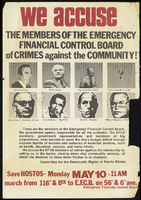 "We Accuse" “We Accuse The Members of the Emergency Financial Control Board of Crimes Against the Community” flyer was created by the Community Coalition to Save Hostos (CCSH) for the May 10, 1976 march that proceeded from El Barrio to the headquarters of the Emergency Financial Control Board located at 56th Street and Sixth Avenue in Manhattan. The Emergency Financial Control Board (EFCB) was formed in fall 1975 to make difficult funding decisions regarding city expenses. Many measures were taken to control spending, including cutting the budget of the City University of New York (CUNY). One of the EFCB’s decisions was to close Hostos Community College and merge it with Bronx Community College which clergy, students, faculty and community members actively opposed. Ultimately, through actions such as letter writing and community outreach, CCSH, Save Hostos Committee and several subcommittees were successful in saving the college from being closed.
 -
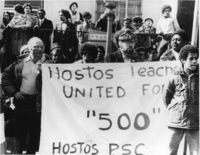 Hostos United for 500 This photograph depicts students and faculty with a sign at a rally being held across the street from "500" building a week before the building was taken over. As evident from the picture the Professional Staff Congress chapter was a driving force behind the struggle. The involvement of the union was critical and provided the continuity in the movement. From left to right faculty members Peter Roman, John Randall, Synos Mangazva are featured. By 1977, the third part of the campaign to save Hostos Community College had picked up momentum. Having extremely poor facilities, the college had acquired a second building across the street from its original location that would allow Hostos to expand. However, the 500 Grand Concourse building needed comprehensive repurposing to be useable but the college had been denied the funds necessary to prepare and occupy their second building. A fresh wave of organizing by students and faculty drove efforts to enable Hostos to continue to be a hub of opportunity for residents of the South Bronx.
 -
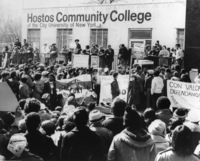 Student and Faculty Rally - Hostos United/Hostos Unido This photograph depicts a large rally that was held across the street from the "500" building a week before the take over. The rally was so massive that it halted traffic for several hours on the Grand Concourse. The various signs on display indicate the range of groups in attendance to support the struggle to defend Hostos Community College. In addition, the prevalent use of Spanish illustrates the commitment to a bilingual education. By 1977, the third part of the campaign to save Hostos had picked up momentum. Having extremely poor facilities, the college had acquired a second building across the street from its original location that would allow Hostos to expand. The 500 Grand Concourse building needed comprehensive repurposing but the college had been denied the funds necessary to prepare and occupy their second building. A fresh wave of organizing by students and faculty drove efforts to enable Hostos to continue to be a hub of opportunity for residents of the South Bronx.
 -
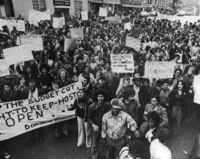
 Sit-down in front of Hostos' 500 Building Students, the PSC Chapter and community activists unite behind the fight for the second building for Hostos Community College. Signs read: "VETERANS: This is our real fight - Our Aim: 500" and, translated from Spanish, "PSC demands: Give us the 500! NOW!" The Veterans Club was a central component to the Hostos United/Hostos Unido movement and several members made important contributions to the leadership. By 1977, the third part of the campaign to save Hostos had picked up momentum. The college had acquired a second building across the street from its original location that would allow Hostos to expand. The 500 Grand Concourse building needed comprehensive repurposing but the college had been denied the funds necessary to prepare and occupy their second building. A fresh wave of organizing drove efforts to enable Hostos to continue to be a hub of opportunity for residents of the South Bronx.
 -
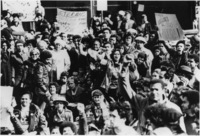
 "While Hostos is Falling Down, Chase Manhattan is Making Pounds" This image depicts one of several CUNY wide demonstrations held in against crippling budget cuts that would threatened Hostos Community College's existence. Students were concerned about the impacts of retrenchment on diversity, Open Admissions and the elimination of key departments such as Nursing and Behavioral Science. In the midst of New York City's fiscal crisis, signs show the political views of the demonstrators. Staged near a branch of Manufacturer's Hanover Trust, signs read: "While Hostos is Falling Down, Chase Manhattan is Making Pounds," "We Live here, Banks Don't" and "Puerto Rican Studies -- Lehman College."
 -
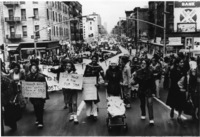 March to Gracie Mansion This a photograph of a student, faculty and staff march down Lexington avenue crossing 103 towards Gracie Mansion to raise awareness about Hostos Community College’s need for funding to complete renovations at 500 Grand Concourse. In addition to signs about the building, one, in Spanish, calls for a child care center as well. By 1977, the third part of the campaign to save Hostos Community College had picked up momentum. The college had acquired a second building across the street from its original location that would allow Hostos to expand. However, the 500 Grand Concourse building needed comprehensive repurposing and the college had been denied the funds necessary to prepare and occupy their second building. A fresh wave of organizing by students and faculty drove efforts to enable Hostos to continue to be a hub of opportunity of residents in the South Bronx.
 -
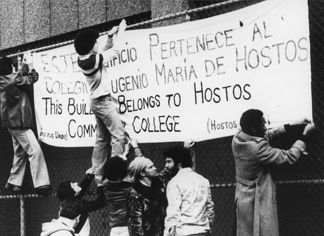
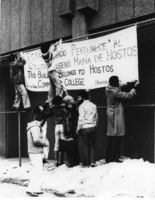 Students and Faculty Take Over the 500 Building This photograph shows student activists putting up a banner on the "500" building, marking the beginning of the takeover whose aim was to claim the building, hold classes, provide childcare as well as providing services to the students who had occupied the building. In both English and Spanish the banner states that the building belongs to Hostos Community College. To draw attention to their cause and to demand needed funding to complete renovations to the building, students and faculty occupied the property to pressure Mayor Koch and other officials to enable bond sales and renovations to proceed. This late 1970s action was a part of the third campaign to save Hostos Community College. Having extremely poor facilities, the college had acquired a second building across the street from its original location that would allow Hostos to expand. However, the 500 Grand Concourse building needed to be repurposed to be useable but the college had been denied the funds necessary to prepare and utilize the 500 building for educational use. A fresh wave of organizing by students and faculty drove efforts to enable Hostos to continue to be a hub of opportunity for residents of the South Bronx.
 -
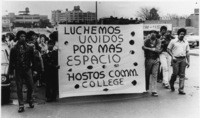 Luchemos Unidos / We Struggle United "Luchemos Unidos por Mas Espacio" sign translates to "We Struggle United for More Space." This was a student/faculty march through the community to alert the community of the campaign to acquire the 500 building. The resident's and passers'-by enthusiastic response energized a movement.
 -
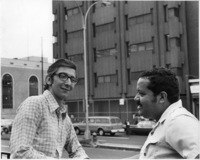 Meyer and Saunders Professor Gerald Meyer, Social Science Department, PSC Chapter chairperson and Sam Saunders, a student activist, converse across the street from Hostos Community College's 500 building. The two were co-leaders of the "Hostos Needs Space", a coalition of the Professional Staff Congress (PSC) Chapter and Student Government Organization (SGO) that organized the campaign the succeeded in obtaining the 500 building.
 -
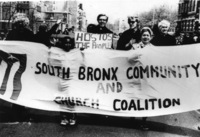 South Bronx Community and Church Coalition This photograph of South Bronx community members includes clergymen marching with a South Bronx Community and Church Coalition banner. This was the final march which celebrated the victory in saving Hostos.
 -
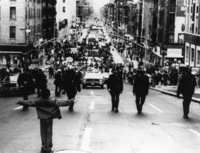 March to Gracie Mansion A young boy stretches his arms out as Hostos Community College students, professors and community organizers make their way to the Mayor's official residence to demand funding for the renovation of the 500 building. By 1977, the third part of the campaign to save Hostos Community College had picked up momentum. Having extremely poor facilities, the college had acquired a second building across the street from its original location that would allow Hostos to expand. However, the 500 Grand Concourse building needed comprehensive repurposing to be useable but the college had been denied the funds necessary to prepare and occupy their second building. A fresh wave of organizing by students and faculty drove efforts to enable Hostos to continue to be a hub of opportunity for residents of the South Bronx.
 -
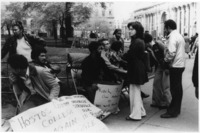 Gerald Meyer and Activists at City Hall Gerald Meyer with students at City Hall to save Hostos Community College. Some of the student in leadership were on a hunger strike to dramatize the issues plaguing Hostos Community College and their need for better facilities. By 1977, the third part of the campaign to save Hostos Community College had picked up momentum. Having extremely poor facilities, the college had acquired a second building across the street from its original location that would allow Hostos to expand. However, the 500 Grand Concourse building needed renovations to be useable but the college had been denied the funds necessary to prepare and occupy their second building. A fresh wave of organizing by students and faculty drove efforts to enable Hostos to continue to be a hub of opportunity for residents of the South Bronx.
 -
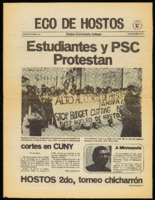 Eco De Hostos, Edición Especial, Hostos Community College, Diciembre 1974 Eco de Hostos was a bilingual student newspaper published monthly by the Office of College Relations and Development. This December 1974 issue (Spanish language edition) features an article about students, faculty and the PSC protesting against drastic budget cuts in front of the Board of Higher Education. In 1975, in response to the New York City fiscal crisis, Hostos Community College was slated to merge with Bronx Community College in order to dramatically cut spending. It was this threat that led to the second iteration of organizing to save Hostos. Determined to preserve the college for the South Bronx as a place for students to pursue a bilingual higher education, students, faculty, and community groups joined forces to keep Hostos open.
 -
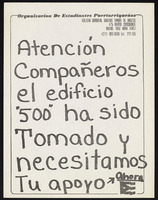 "Atención Compañeros, el edificio "500" ha sido Tomado" "Attention, Comrades, the '500' building has been taken over and we need your support - now" is the translation of the flier announcing the occupation of the 500 Grand Concourse building. By 1977, the third part of the campaign to save Hostos Community College had picked up momentum. Having extremely poor facilities, the college had acquired a second building across the street from its original location that would allow Hostos to expand. However, the 500 Grand Concourse building needed renovations to be useable but the college had been denied the funds necessary to prepare and occupy their second building. A fresh wave of organizing by students and faculty drove efforts to enable Hostos to continue to be a hub of opportunity for residents of the South Bronx.
 -
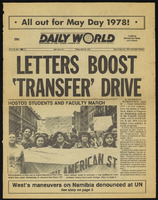 Hostos Students and Faculty March This April 28th, 1978 clipping from the Daily World shows an image of a student and faculty march to Gracie Mansion to raise awareness about Hostos Community College’s need for funding to complete renovations at 500 Grand Concourse. By 1977, the third part of the campaign to save Hostos Community College had picked up momentum. Having extremely poor facilities, the college had acquired a second building across the street from its original location that would allow Hostos to expand. However, the 500 Grand Concourse building needed renovations to be useable and the college had been denied the funds necessary to prepare and occupy their second building. A fresh wave of organizing by students and faculty drove efforts to enable Hostos to continue to be a hub of opportunity of residents in the South Bronx.
 -
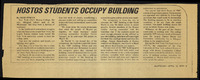 Hostos Students Occupy Building This April 12th, 1978 clipping from the Guardian describes the takeover of the 500 Grand Concourse building by Hostos Community College students and faculty to raise awareness about the college’s need for funding to complete renovations. The author, Fred Pincus, describes the community of Hostos as an effective advocate for the college and as vigilant activists that have repeatedly fought back attacks on their school. By 1977, the third part of the campaign to save Hostos Community College had picked up momentum. Having extremely poor facilities, the college had acquired a second building across the street from its original location that would allow Hostos to expand. However, the 500 Grand Concourse building needed renovations to be useable but the college had been denied the funds necessary to prepare and occupy their second building. A fresh wave of organizing by students and faculty drove efforts to enable Hostos to continue to be a hub of opportunity for residents of the South Bronx.
 -
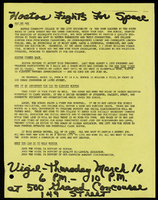 Hostos Fights for Space / Vigilia Pro Hostos This bilingual flier announces that Hostos Community College students and activists will hold a vigil to raise awareness about their need for funding to complete renovations at 500 Grand Concourse. The flier describes the urgent need for the renovations and the importance of collective action to achieve that goal. By 1977, the third part of the campaign to save Hostos Community College had picked up momentum. Having extremely poor facilities, the college had acquired a second building across the street from its original location that would allow Hostos to expand. However, the 500 Grand Concourse building needed renovations to be useable but the college had been denied the funds necessary to prepare and occupy their second building. A fresh wave of organizing by students and faculty drove efforts to enable Hostos to continue to be a hub of opportunity for residents of the South Bronx.
 -
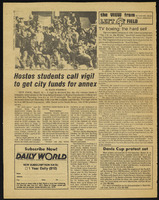 "Hostos students call vigil to get city funds for annex" This issue of the Daily World included an article stating that Hostos Community College students and activists planned a vigil to raise awareness about their need for funding to complete renovations at 500 Grand Concourse. By 1977, the third part of the campaign to save Hostos Community College had picked up momentum. Having extremely poor facilities, the college had acquired a second building across the street from its original location that would allow Hostos to expand. However, the 500 Grand Concourse building needed renovations to be useable but the college had been denied the funds necessary to prepare and occupy their second building. A fresh wave of organizing by students and faculty drove efforts to enable Hostos to continue to be a hub of opportunity for residents of the South Bronx.
 -
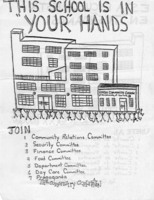 This School is in "Your" Hands / Esta Escuela Está en "Tus" Manos This flier promotes the occupation of the 500 Grand Concourse building in the Spring of 1978. To demand needed funding to complete renovations to the building, students and faculty occupied the property to run classes and activities to pressure Mayor Koch and other officials to enable bond sales and renovations to proceed. By 1977, the third part of the campaign to save Hostos Community College had picked up momentum. Having extremely poor facilities, the college had acquired a second building across the street from its original location that would allow Hostos to expand. However, the 500 Grand Concourse building needed renovations to be useable but the college had been denied the funds necessary to prepare and occupy their second building. A fresh wave of organizing by students and faculty drove efforts to enable Hostos to continue to be a hub of opportunity for residents of the South Bronx.
 -
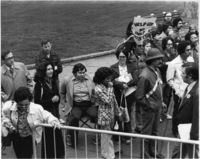 "Help Us to Help Hostos" Members of the Hostos Community College community joined a mass march in Albany against budget cuts.
 -
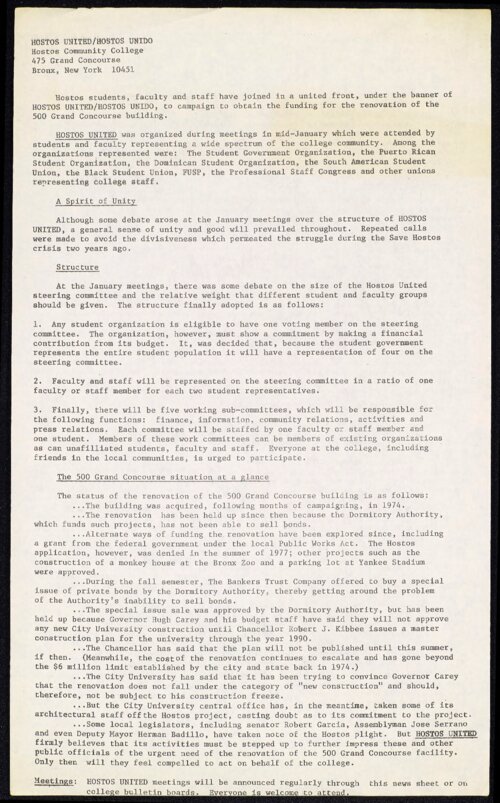 Hostos United/Hostos Unido mission statement This is the mission statement of Hostos United/Hostos Unido, an umbrella activist group that led much of the campaign to expand the college to include the 500 Grand Concourse building. The group was established in January 1978 by the Student Government Organization, the Puerto Rican Student Organization, the Dominican Student Organization, the South American Student Union, the Black Student Union, FUSP, the Professional Staff Congress and other unions representing college staff. The statement includes their mission, their structure, and a brief synopsis of the fight for improved facilities at Hostos. By 1977, the third part of the campaign to save Hostos Community College had picked up momentum. Having extremely poor facilities, the college had acquired a second building across the street from its original location that would allow Hostos to expand. However, the 500 Grand Concourse building needed renovations to be useable but the college had been denied the funds necessary to prepare and occupy their second building. A fresh wave of organizing by students and faculty drove efforts to enable Hostos to continue to be a hub of opportunity for residents of the South Bronx.
 -
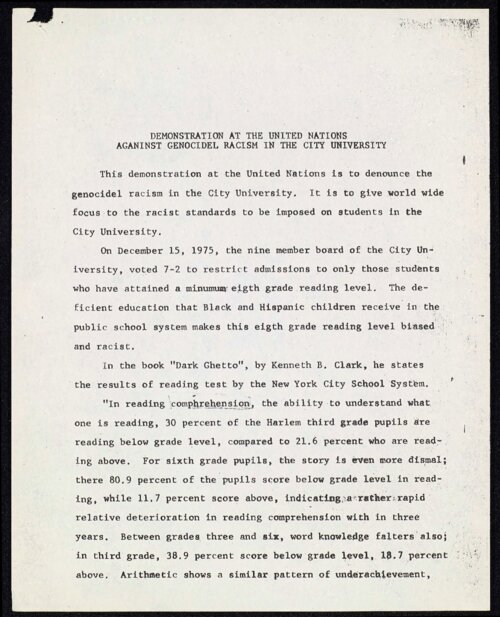 Demonstration at the United Nations Against Genocidal Racism in the City University Demonstrating at the United Nations, the President of the Black Student Union wrote this leaflet to explain how systemic racism in public education denies black and Latino students equal rights to obtain a degree. He pulls from Kenneth Clark's "Dark Ghetto" and studies conducted by David E. Lavin to build the case that admissions rules that disparately bar minority students from admission to CUNY schools tether these students to a cycle of poverty and an infringement of their human rights.
 -
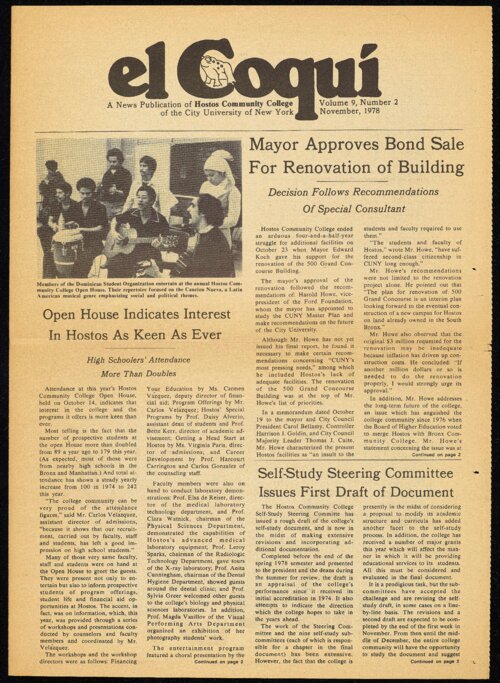 el Coquí, Volume 9, Number 2, November 1978 El Coquí was a college newspaper published monthly by the Office of College Relations and Development at Hostos Community College. This November 1978 issue featured stories including an announcement that funding for the renovation of 500 Grand Concourse was finally approved, an article about how the interest in Hostos Community College dramatically increased amongst high school students, and a discussion about the reaction to debates regarding curriculum decisions. By 1977, the third part of the campaign to save Hostos Community College had picked up momentum. Having extremely poor facilities, the college had acquired a second building across the street from its original location to allow for the expansion of Hostos. However, the 500 Grand Concourse building needed renovations to be useable and the college was denied the funds necessary to prepare and occupy this second building. A fresh wave of organizing by students and faculty drove efforts to enable Hostos to continue to be a hub of opportunity for residents in the South Bronx.
 -
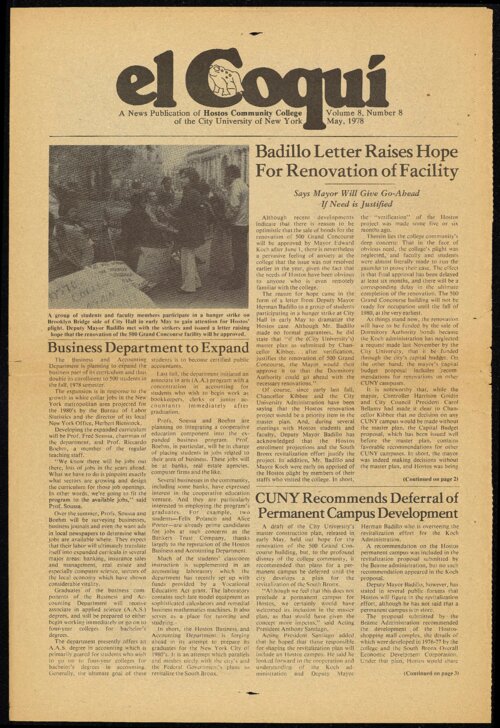 el Coquí, Volume 8, Number 8, May 1978 El Coquí was a college newspaper published monthly by the Office of College Relations and Development at Hostos Community College. This May 1978 issue featured a story announcing that Deputy Mayor Badillo had written a letter that offered some cause for optimism regarding the efforts to secure funding for the renovation of 500 Grand Concourse, a second building for the college. It also announced that the City University Master Plan recommended that the plans for a permanent Hostos campus be deferred to account for broader revitalization plans for the South Bronx. By 1977, the third part of the campaign to save Hostos Community College had picked up momentum. Having extremely poor facilities, the college had acquired a second building across the street from its original location that would allow Hostos to expand. However, the 500 Grand Concourse building needed renovations to be useable but the college had been denied the funds necessary to prepare and occupy their second building. A fresh wave of organizing by students and faculty drove efforts to enable Hostos to continue to be a hub of opportunity for residents of the South Bronx.
 -
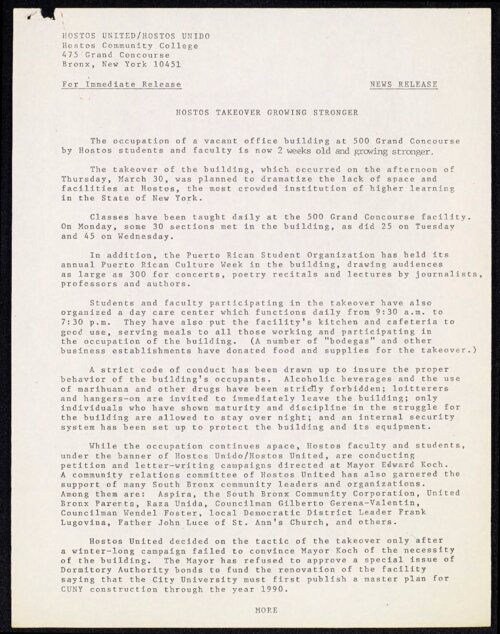 Hostos Takeover Growing Stronger, News Release, Hostos United/Hostos Unido Hostos United/Hostos Unido issued this news release on April 14th of 1978 to describe the current state of the occupation of the 500 Grand Concourse building and to offer context for how the occupation fit into a larger strategy to achieve their goals. The release describes the ways that the space was being used for classes and childcare. It also describes letter writing campaigns and other actions involved in pressuring the Mayor to acquiesce. To draw more public attention to their cause, and to demand needed funding to complete renovations to the building, students and faculty occupied the property to pressure Mayor Koch and other officials to enable bond sales and renovations to proceed. By 1977, the third part of the campaign to save Hostos Community College had picked up momentum. Having extremely poor facilities, the college had acquired a second building across the street from its original location that would allow Hostos to expand. However, the 500 Grand Concourse building needed renovations to be useable but the college had been denied the funds necessary to prepare and occupy their second building. A fresh wave of organizing by students and faculty drove efforts to enable Hostos to continue to be a hub of opportunity for residents of the South Bronx.