Save Hostos!
Item set
Title
Description
Save Hostos!: The Save Hostos Community College Movement (CUNY), 1973 to 1978

Eugenio María de Hostos Community College (CUNY) was established in response to CUNY’s enactment of Open Admissions in 1969, which guaranteed admission to one of the City’s system of colleges to city residents who had a high school diploma, or its equivalent. This led almost immediately to a doubling of enrollment at these institutions. Hostos—which was initially located on the southwest corner of East 149th Street and the Grand Concourse, in the heart of the South Bronx’s overwhelmingly Latino and African-American communities— first offered classes in the fall of 1970. Latino leaders demanded a school that would meet the educational, social, and cultural needs of the South Bronx community. In view of the extremely high percentage of Spanish-speaking residents and their bilingual children in the South Bronx, Hostos became the sole bilingual college in the New York City tristate area. The college pioneered in instituting educational initiatives responsive to its students’ needs. The naming of the college for the educator Eugenio María de Hostos (1839-1903): A Puerto Rican Renaissance man, who advocated for education for women, the abolition of slavery, and independence for Puerto Rico signaled the progressive intent of the college’s founders. However, Hostos’ auspicious beginning was marred by its woefully inadequate facilities, that consisted of a single, five-story edifice repurposed from an abandoned factory.
During the 1970s, from the fall of 1973 until the spring of 1979, the Save Hostos Movement became one of the most prolonged and successful mass movements in New York City. Over that five-year period, students, staff, faculty, and members of the community mobilized three massive year-long campaigns, each of which accomplished its goal.
• From Sept. 1973 to June 1974: “Hostos Needs Space,” a coalition of the Professional Staff Congress (PSC) and the Student Government Organization (SGO), mobilized the Hostos community to obtain the 500 Building, a recently constructed, five-story building on the southeast corner of East 149th St. and the Grand Concourse, that had housed an insurance company. This coalition accomplished its goal by enlisting the Bronx State Senator and State Assemblyperson representing the South Bronx to convince the New York State Legislature’s Black and Latino Caucus to introduce legislation that allocated funds for that purpose.
• From Sept. 1975 through June 1976: The “Save Hostos Committee,” an officially designated body of the Hostos Senate, and the PSC, together with the “Hostos Coalition to Save Hostos,” successfully mobilized the campus and community to prevent the closing of Hostos Community College. In addition to the employment of a full array of political tactics, members of the Community Coalition occupied Hostos’ main building until the police intervened and arrested forty students and faculty members.
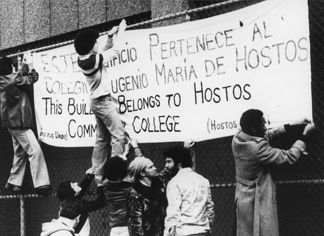
• From Sept. 1977 to June 1978: “Hostos United/Hostos Unido,” brought together the forces that had previously supported the Save Hostos Committee and the Community Coalition to Save Hostos to carry out a massive campaign to obtain funding to reconfigure the former office building for educational use. When these tactics seemed inadequate to obtain the campaign’s goal, a very large contingent of students and many faculty occupied the 500 Building for three months, where classes were held. This four-month long occupation persisted until the announcement came from the Office of the Mayor of New York that bonds for the reconstruction of the edifice had been approved.
The Save Hostos Movement brought together a wide range of organizations: the Hostos Chapter of the Professional Staff Congress, the Student Government Organization, many student clubs, including the Federación Universitarios Socialistas Puertorriqueños, the Dominican Club, the Puerto Rican Club, the Black Student Union, the Veterans’ Club, and the Christian Club. In addition, faculty and student leaders established organizations—such as Hostos Needs Space, the Save Hostos Committee, the Community Coalition to Save Hostos, and Hostos United/Hostos Unido—specifically for the purpose of saving Hostos.
The success of the Save Hostos Movement depended upon its use of a combination of tactics that effectively politicized the campus and attracted widespread support from the residents of the communities Hostos served. The willingness of those within and outside the Hostos campus to commit themselves to this movement, and in some instances risk arrest, reflected the degree to which Hostos embodied a concrete achievement for these communities in their fight against discrimination in general, and for bilingual education.
The successes of the three campaigns that comprised the Save Hostos Movement left a deep impression on the culture of the college. Subsequent organizations—such as the Hostos Solidarity Coalition, the Hostos Action Coalition, and the Hostos AIDS Task Force—employed similar forms of organizational forms utilizing an array of tactic to achieve educational, cultural, and political goals.
This collection—through letters from faculty and students to elected officials, student newspapers, PSC Chapter Newsletters, meeting minutes of activist groups, photographs of demonstrations, and fliers designed by campus and community supporters of Hostos Community College—tells the story of the three campaigns that comprise the Save Hostos Movement.
Curated by Gerald Meyer, a faculty member at Hostos since 1972, this collection presents just some of the hundreds of items he amassed during the Save Hostos Movement from 1973 to 1978 while serving as PSC Chapter Chairperson. Meyer's additional holdings can be found in a larger, self-titled collection housed in the archives of Hostos Community College.
Gerald Meyer is the author of Vito Marcantonio: Radical Politician, co-editor of The Lost World of Italian American Radicalism, and author of eighty articles and reviews on a wide range of topics. He serves on the editorial boards of Science & Society and Socialism and Democracy and also serves as Co-Chair of the Vito Marcantonio Forum.
Language
Contributor
Collection
Time Periods
Items
-
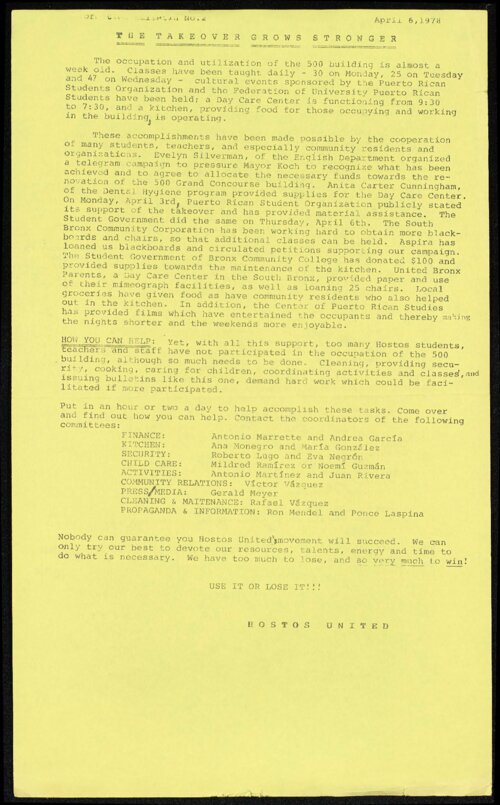 The Takeover Grows Stronger / La Toma del Edificio Está Más Fuerte Hostos United/Hostos Unido issued this bilingual bulletin on April 6, 1978 offering updates on the occupation of the 500 Grand Concourse building. The bulletin describes the ways that the space was being used for classes and childcare. It also implores more members of the Hostos community to participate in the occupation. To draw more public attention to their cause, and to demand needed funding to complete renovations to the building, students and faculty occupied the property to pressure Mayor Koch and other officials to enable bond sales and renovations to proceed. By 1977, the third part of the campaign to save Hostos Community College had picked up momentum. Having extremely poor facilities, the college had acquired a second building across the street from its original location that would allow Hostos to expand. However, the 500 Grand Concourse building needed renovations to be useable and the college was denied the funds necessary to prepare and occupy their second building. A fresh wave of organizing by students and faculty drove efforts to enable Hostos to continue to be a hub of opportunity for residents of the South Bronx.
 -
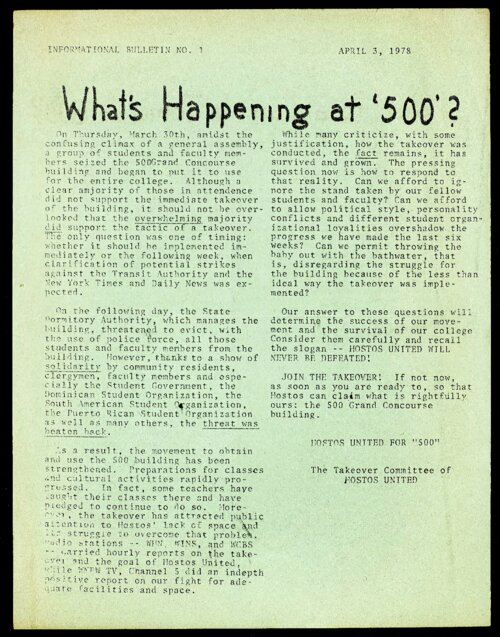 What's Happening at '500'? / Qué Pasa Con la Toma de 500? Hostos United/Hostos Unido issued this bulletin in April of 1978 to explain the occupation of the 500 Grand Concourse building. The bulletin not only encouraged members of the Hostos community to participate in and assist with the effort, but it also alluded to conflict between activists over the timing of the actual takeover. This bulletin encouraged community members to move beyond such conflict to strengthen their efforts. To draw more public attention to their cause, and to demand needed funding to complete renovations to the building, students and faculty occupied the property to run classes and activities to pressure Mayor Koch and other officials to enable bond sales and renovations to proceed. By 1977, the third part of the campaign to save Hostos Community College had picked up momentum. Having extremely poor facilities, the college had acquired a second building across the street from its original location that would allow Hostos to expand. However, the 500 Grand Concourse building needed renovations to be useable but the college had been denied the funds necessary to prepare and occupy their second building. A fresh wave of organizing by students and faculty drove efforts to enable Hostos to continue to be a hub of opportunity for residents of the South Bronx.
 -
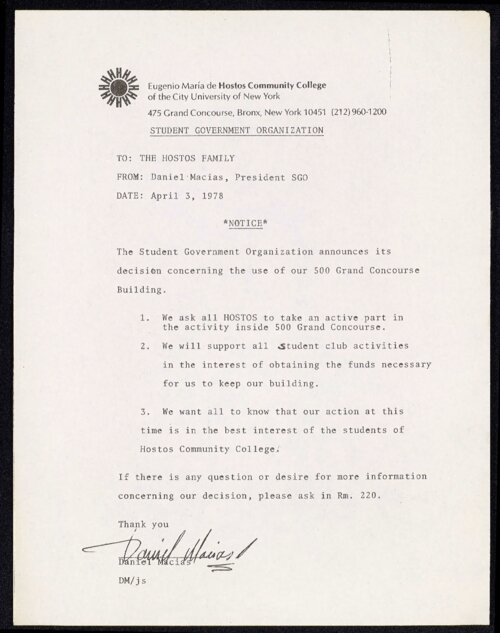 Notice of Support from Student Government Organization Daniel Macias, President of the Student Government Organization, wrote this memo in April 1978 to show support for the occupation of the 500 Grand Concourse building. Macias encouraged members of the Hostos community to participate in and assist with the effort. To draw public attention to their cause, and to demand needed funding to complete renovations to the building, students and faculty occupied the property to run classes and activities to pressure Mayor Koch and other officials to enable bond sales and renovations to proceed. By 1977, the third part of the campaign to save Hostos Community College had picked up momentum. Having extremely poor facilities, the college had acquired a second building across the street from its original location that would allow Hostos to expand. However, the 500 Grand Concourse building needed renovations to be useable but the college had been denied the funds necessary to prepare and occupy their second building. A fresh wave of organizing by students and faculty drove efforts to enable Hostos to continue to be a hub of opportunity for residents of the South Bronx.
 -
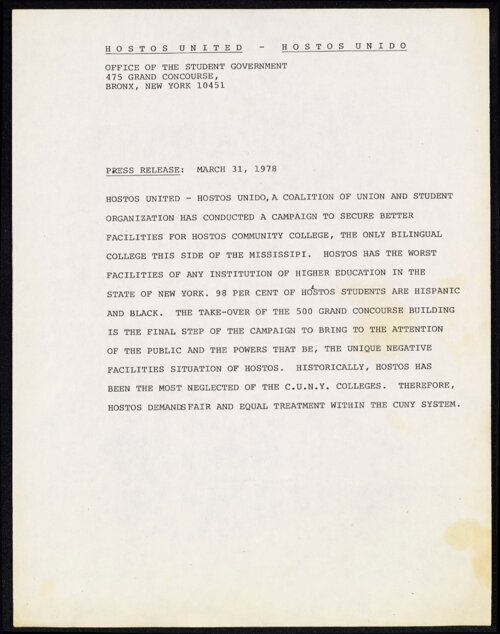 Hostos United/Hostos Unido March 1978 Press Release In March 1978, Hostos United/Hostos Unido issued this press release about the decision to occupy the 500 Grand Concourse building. To draw public attention to their cause and to demand needed funding to complete renovations to the building, students and faculty occupied the property to run classes and activities to pressure Mayor Koch and other officials to enable bond sales and renovations to proceed. By 1977, the third part of the campaign to save Hostos Community College had picked up momentum. Having extremely poor facilities, the college had acquired a second building across the street from its original location that would offer the opportunity for Hostos to expand. However, the 500 Grand Concourse building needed renovations to be useable but the college had been denied the funds necessary to prepare and occupy their second building. A fresh wave of organizing by students and faculty drove efforts to enable Hostos to continue to be a hub of opportunity for residents of the South Bronx.
 -
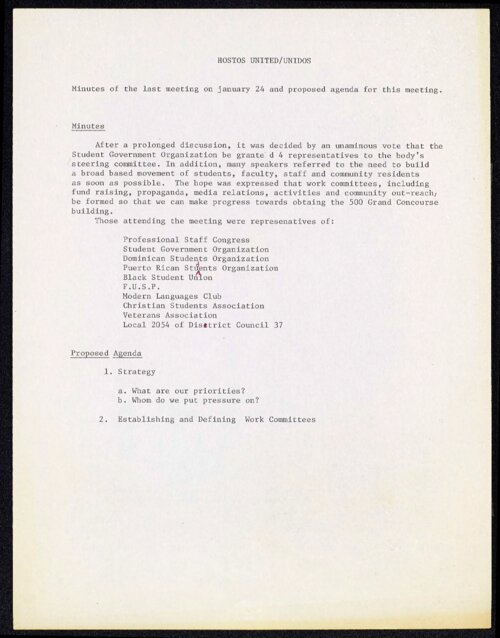 Hostos United/Hostos Unido Meeting Minutes and Proposed Agenda, January 24, 1978 These meeting minutes of the January 24th meeting of Hostos United/Hostos Unido show the plan to assess the group’s priorities and assign work to various committees. This was one of the first working meetings held by Hostos United/Hostos Unido. The group became the central activist group that led much of the campaign to expand to 500 Grand Concourse. It was organized by the Student Government Organization, the Puerto Rican Student Organization, the Dominican Student Organization, the South American Student Union, the Black Student Union, FUSP, the Professional Staff Congress and other unions representing college staff. In 1977, the third part of the campaign to save Hostos Community College was picking up momentum. Having extremely poor facilities, the college had acquired a second building across the street from its original location that would offer the opportunity for Hostos to expand. However, the 500 Grand Concourse building needed renovations to be useable but the college was denied the funds necessary to prepare and occupy their second building. A fresh wave of organizing by students and faculty drove efforts to enable Hostos to continue to be a hub of opportunity for residents of the South Bronx.
 -
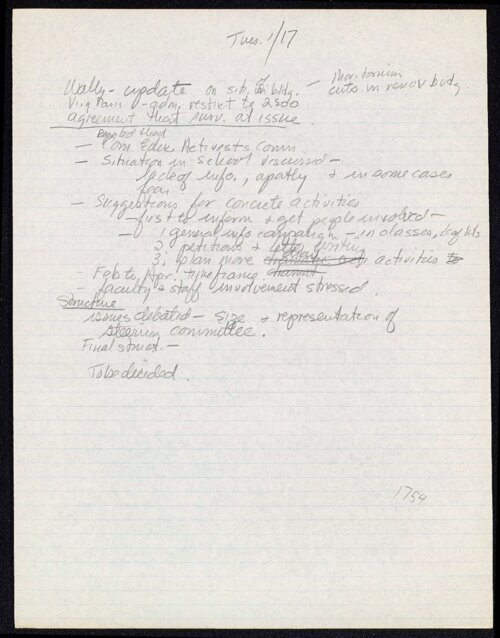 Hostos United/Hostos Unido, January 17, 1978 Meeting Notes These handwritten notes were taken during the meeting in which leaders of student and labor groups decided to form Hostos United/Hostos Unido. The group became the central activist organization that led much of the campaign to expand the college to 500 Grand Concourse. It was organized by the Student Government Organization, the Puerto Rican Student Organization, the Dominican Student Organization, the South American Student Union, the Black Student Union, FUSP, the Professional Staff Congress and other unions representing college staff. These notes capture the various positions of different organization leaders and the distribution of labor that was agreed upon by the participants. They also describe the debates about governing structure, and the initial strategic decisions that would inform activist efforts in the coming three months. In 1977, the third part of the campaign to save Hostos Community College was picking up momentum. Having extremely poor facilities, the college had acquired a second building across the street from its original location that would allow Hostos to expand. However, the 500 Grand Concourse building needed renovations to be useable but the college had been denied the funds necessary to prepare and occupy their second building. A fresh wave of organizing by students and faculty drove efforts to enable Hostos to continue to be a hub of opportunity of residents of the South Bronx.
 -
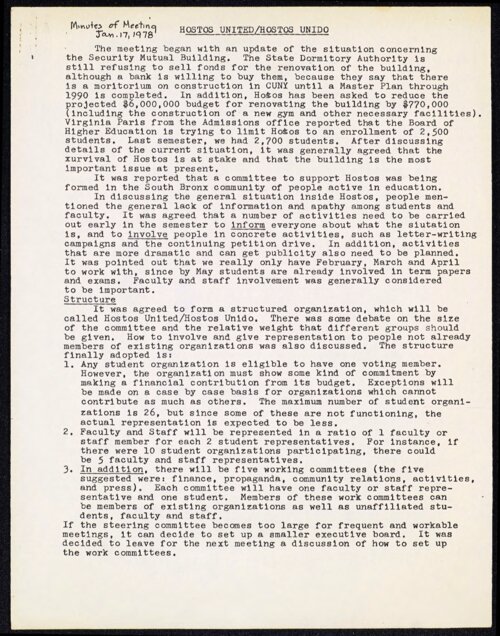 Hostos United/Hostos Unido, January 17, 1978 Meeting Minutes These meeting minutes document the decision to form Hostos United/Hostos Unido on January 17th, 1978. Hostos United/Hostos Unido became the central activist group that led much of the campaign to expand to 500 Grand Concourse. It was organized by the Student Government Organization, the Puerto Rican Student Organization, the Dominican Student Organization, the South American Student Union, the Black Student Union, FUSP, the Professional Staff Congress and other unions representing college staff. These minutes describe the issue about which the group was formed, the debates about governing structure, and the initial strategic decisions that would inform activist efforts in the coming three months. In 1977, the third part of the campaign to save Hostos Community College was picking up momentum. Having extremely poor facilities, the college had acquired a second building across the street from its original location that would allow Hostos to expand. However, the 500 Grand Concourse building needed renovations to be useable but the college had been denied the funds necessary to prepare and occupy their second building. A fresh wave of organizing by students and faculty drove efforts to enable Hostos to continue to be a hub of opportunity for residents in the South Bronx.
 -
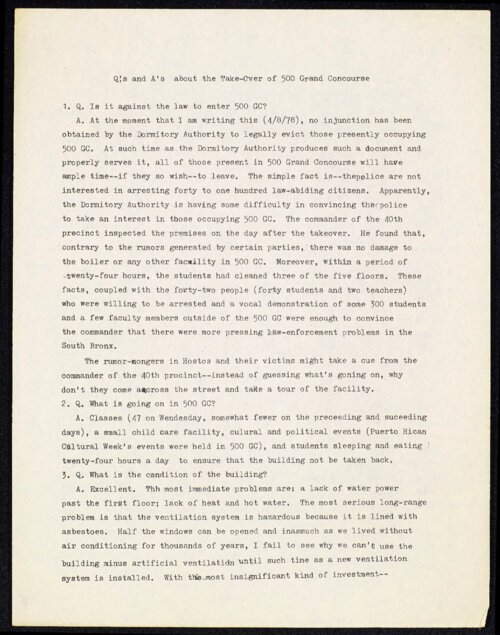 Q's and A's about the Take-Over of 500 Grand Concourse This information sheet produced by Hostos United/Hostos Unido offers students, faculty, and community members basic information about the occupation of the 500 Grand Concourse building in the Spring of 1978. To demand needed funding to complete renovations to the building, students and faculty occupied the property to run classes and activities to pressure Mayor Koch and other officials to enable bond sales and renovations to proceed. By 1977, the third part of the campaign to save Hostos Community College had picked up momentum. Having extremely poor facilities, the college had acquired a second building across the street from its original location that would allow Hostos to expand. However, the 500 Grand Concourse building needed renovations to be useable but the college had been denied the funds necessary to prepare and occupy their second building. A fresh wave of organizing by students and faculty drove efforts to enable Hostos to continue to be a hub of opportunity for residents of the South Bronx. Hostos United/Hostos Unido was an umbrella activist group that led much of the campaign to expand to 500 Grand Concourse. It was organized in January of 1978 by the Student Government Organization, the Puerto Rican Student Organization, the Dominican Student Organization, the South American Student Union, the Black Student Union, FUSP, the Professional Staff Congress and other unions representing college staff.
 -
 El Coquí, Volume 8, Number 3, December 1977 El Coquí was a college newspaper published monthly by the Office of College Relations and Development at Hostos Community College. This December 1977 issue featured stories describing President Jimmy Carter’s recent visit to the South Bronx as well as a discussion of Bankers Trust intention to purchase bonds in order to finance the renovation of the 500 Grand Concourse building. By 1977, the third part of the campaign to save Hostos Community College had picked up momentum. Having extremely poor facilities, the college had acquired a second building across the street from its original location that would allow Hostos to expand. However, the 500 Grand Concourse building needed renovations to be useable but the college had been denied the funds necessary to prepare and occupy their second building. A fresh wave of organizing by students and faculty drove efforts to enable Hostos to continue to be a hub of opportunity for residents of the South Bronx.
 -
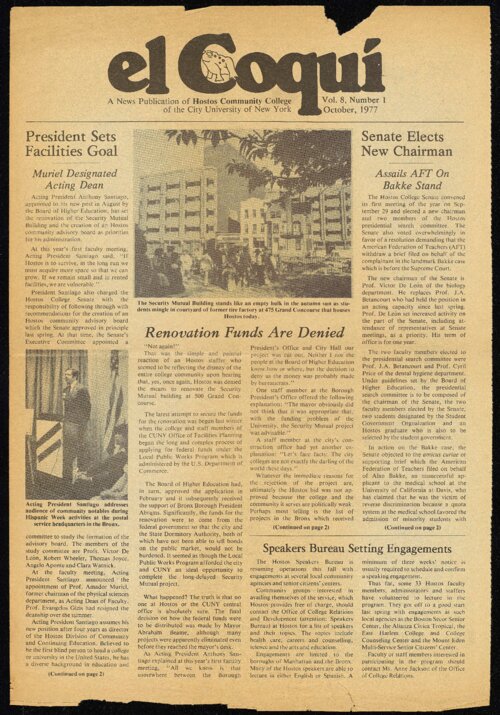 El Coquí, Volume 8, Number 1, October 1977 El Coquí was a college newspaper published monthly by the Office of College Relations and Development at Hostos Community College. This October 1977 issue featured stories on the new agenda of the incoming Acting President of the college Anthony Santiago, in the wake of Candido Antonio de Leon’s resignation. Additionally, this issue described the failure of the school to secure federal funds for the renovation of the 500 Grand Concourse building through the Local Public Works Program. The school had hoped that an application for federal assistance would bring the college needed funding to move forward on its expansion. By 1977, the third part of the campaign to save Hostos Community College had picked up momentum. Having extremely poor facilities, the college had acquired a second building across the street from its original location that would allow Hostos to expand. However, the 500 Grand Concourse building needed renovations to be useable but the college had been denied the funds necessary to prepare and occupy their second building. A fresh wave of organizing by students and faculty drove efforts to enable Hostos to continue to be a hub of opportunity for residents of the South Bronx.
 -
 El Coquí, Volume 7, Number 8, May 1977 El Coquí was a college newspaper published monthly by the Office of College Relations and Development at Hostos Community College. This 1977 issue features a story announcing the resignation of Candido Antonio de Leon from his post as President of the college. Having been with the college since its inception, and having played a frequently controversial role in the various campaigns at Hostos, de Leon’s resignation marked an important historical moment for the school.
 -
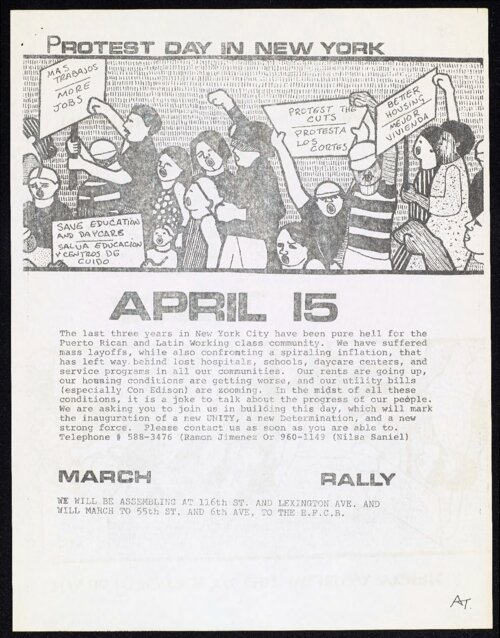 Protest Day in New York / Dia de Protesta en Nueva York This flier announces a citywide protest to the headquarters of the Emergency Financial Control Board (EFCB) in April of 1977. Targeted specifically to Puerto Ricans and the Latino American community, the flier describes rampant financial hardship and the need to protest worsening conditions. The EFCB was the body put in place to manage the budget crisis plaguing New York City. Made up largely of business people and bankers alongside city and state officials, the board was viewed as the driving force behind the massive cuts to public services New Yorkers sustained, including cuts to funding for CUNY. This flier articulates the need for Puerto Ricans and other members of the Latino community to come together to oppose the actions of the EFCB.
 -
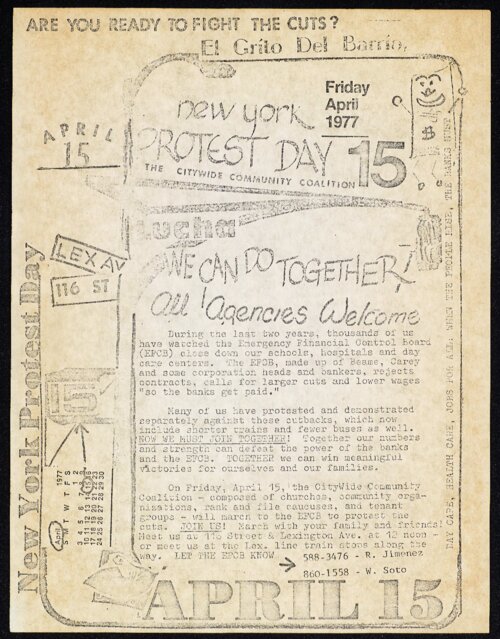 New York Protest Day Announcement This flier, distributed by the Citywide Community Coalition, announces a citywide protest to the headquarters of the Emergency Financial Control Board (EFCB) in April of 1977. The EFCB was the body put in place to manage the budget crisis plaguing New York City. Made up largely of business people and bankers alongside city and state officials, the board was viewed as the driving force behind the massive cuts to public services New Yorkers sustained, including cuts to funding for CUNY. This flier articulates the need for groups from all across the city who have independently been fighting cuts to come together to oppose the actions of the EFCB.
 -
 Gerald Meyer Statement on the 500 Grand Concourse Building Gerald Meyer, a founding faculty member at Hostos Community College and President of the Hostos chapter of the Professional Staff Congress made this statement at a press conference held on March 30, 1976. The statement articulates that facilities at the college are woefully inadequate for the needs of the student body and are inferior to facilities at other City University of New York campuses. Meyer points out that while the 500 Grand Concourse building across the street from the existing college had already been designated for Hostos, the college had not been allowed to move forward on acquiring and renovating the building. By 1977, the third part of the campaign to save Hostos Community College had picked up momentum. Having extremely poor facilities, the college had acquired a second building across the street from its original location that would allow Hostos to expand. However, the 500 Grand Concourse building needed renovations to be useable but the college had been denied the funds necessary to prepare and occupy their second building. A fresh wave of organizing by students and faculty drove efforts to enable Hostos to continue to be a hub of opportunity for residents of the South Bronx.
 -
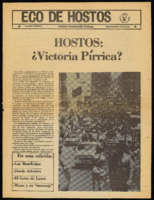 Eco de Hostos: September 1976 / Eco de Hostos: Septiembre 1976 Eco de Hostos is the Hostos Community College bilingual student newspaper. This September-October 1976 issue features stories on the victory of keeping Hostos open alongside massive cuts to its budget. Also included in this issue are discussions of the impacts of retrenchment on the school, an account of the efforts to save the school, veterans’ issues with their benefits, and editorials critiquing the actions of the college’s President, Candido Antonio de Leon.
 -
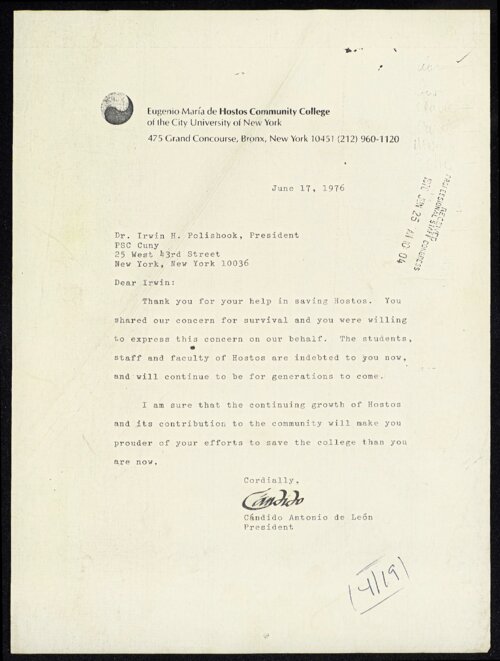 Letter to PSC President Irwin H. Polishook from Candido Antonio de Leon, Hostos President By June of 1976, when it became clear that Hostos Community College would be saved from closure, the President of the college, Candido Antonio de Leon wrote a letter to the President of the Professional Staff Congress, Irwin Polishook, thanking him for his efforts in saving the school. The Professional Staff Congress is the union that represents City University of New York faculty and staff, and they were instrumental in the campaign to prevent Hosotos Community College from closing. In 1975, in response to the New York City fiscal crisis, the City University of New York proposed massive cuts and closures across the campuses in order to dramatically cut spending. Of all the campuses in the system, the administration targeted campuses primarily serving minority communities for their most extreme measures. Hostos Community College was slated to merge with Bronx Community College in order to dramatically cut spending. It was this threat that led to the second iteration of organizing to save Hostos. Determined to preserve Hostos for the South Bronx as a place for students to pursue a bilingual higher education, students, faculty, staff, and community groups joined forces to keep Hostos open for the community.
 -
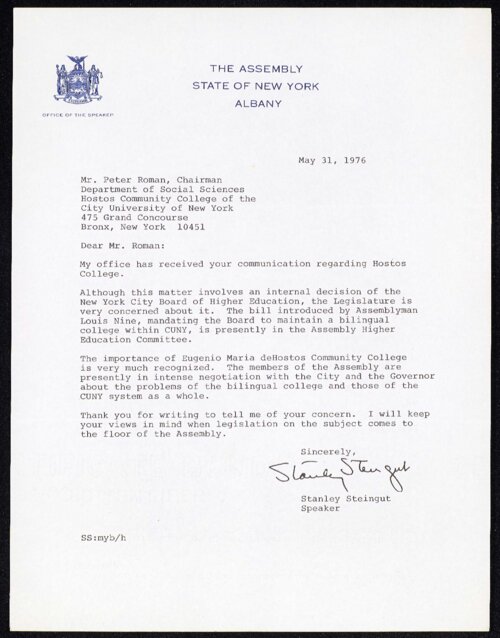 Letter from Assembly Speaker Stanley Steingut to Peter Roman The Speaker of the New York State Assembly, Stanley Steingut, wrote this letter as a response to the chairman of the Social Sciences department at Hostos Community College, Peter Roman. His letter conveys that there is a bill in the Assembly’s Higher Education Committee that would mandate the continuation of a campus dedicated to bilingual higher education. Steingut also conveys that the future of Hostos Community College is important to the legislature. In 1975, in response to the New York City fiscal crisis, the City University of New York proposed massive cuts and closures across the campuses in order to dramatically cut spending. Of all the campuses in the system, the administration targeted campuses primarily serving minority communities for their most extreme measures. Hostos Community College was slated to merge with Bronx Community College in order to dramatically cut spending. It was this threat that led to the second iteration of organizing to save Hostos. Determined to preserve Hostos for the South Bronx as a place for students to pursue a bilingual higher education, students, faculty, staff, and community groups joined forces to keep Hostos open for the community.
 -
 Community Coalition to Save Hostos Organizing Workshop The Community Coalition to Save Hostos hosted an all-day workshop to train members of the South Bronx community in organizing skills, strategies, and challenges in April of 1976. This program outlines the events of the day. The Community Coalition to Save Hostos was a collaboration between student and faculty groups and community organizations dedicated to preventing the closure of Hostos Community College. In 1975, in response to the New York City fiscal crisis, the City University of New York proposed massive cuts and closures across the campuses in order to dramatically cut spending. Of all the campuses in the system, the administration targeted campuses primarily serving minority communities for their most extreme measures. Hostos Community College was slated to merge with Bronx Community College in order to dramatically cut spending. It was this threat that led to the second iteration of organizing to save Hostos. Determined to preserve Hostos for the South Bronx as a place for students to pursue a bilingual higher education, students, faculty, staff, and community groups joined forces to keep Hostos open for the community.
 -
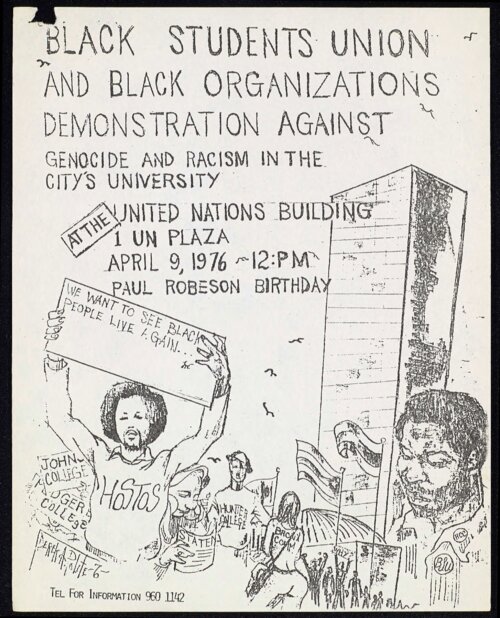 "Black Students Union and Black Organizations Demonstration Against Genocide and Racism" The Black Students Union and other supportive organizations sponsored a demonstration at the United Nations in April of 1976 to oppose the City University of New York’s proposals to close and merge colleges that mainly served minority communities. In 1975, in response to the New York City fiscal crisis, the City University of New York had proposed massive cuts and closures across the campuses in order to dramatically cut spending. The most severe cuts and closures were targeted at campuses that primarily served minority communities. Attempts to close Medgar Evers College, John Jay College, and Hostos Community College sparked widespread activism and numerous demonstrations. This flier advertised one such demonstration.
 -
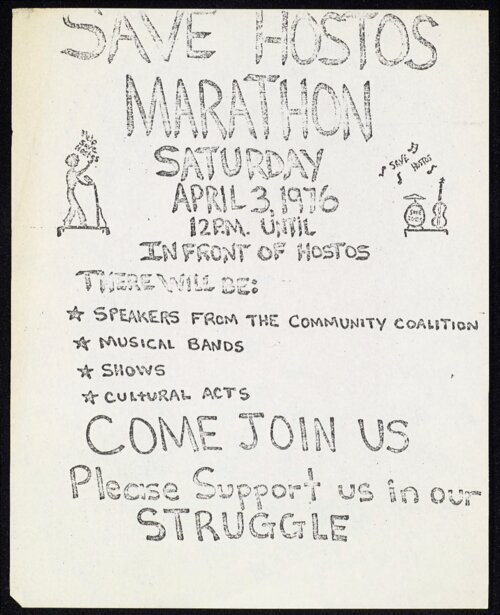 "Save Hostos Marathon" The Community Coalition to Save Hostos deployed a variety of strategies to build awareness and organize against the proposed closure of Hostos Community College. The Community Coalition was comprised of student and faculty groups and community organizations dedicated to keeping the school open. This flier promotes an April 1976 event, featuring speeches and entertainment. In 1975, in response to the New York City fiscal crisis, Hostos Community College was slated to merge with Bronx Community College in order to dramatically cut spending. It was this threat that led to the second iteration of organizing to save Hostos. Determined to preserve Hostos for the South Bronx as a place for students to pursue a bilingual higher education, students, faculty, staff, and community groups joined forces to keep Hostos open for the community.
 -
 Letter to Governor Carey from Peter Roman, Chairman of Hostos Social Sciences Department The chairman of the Social Sciences department at Hostos Community College penned this letter to Governor Hugh Carey asking him to prevent the closure of Hostos and the merger with Bronx Community College. Professor Peter Roman argues that the college is a crucial part of the South Bronx community, that its success depends on its proximity to people who need it, and that a closure or merger will actually create more costs for the city than savings by depriving the most vulnerable New Yorkers of avenues out of poverty and dependency. In 1975, in response to the New York City fiscal crisis, Hostos Community College was slated to merge with Bronx Community College in order to dramatically cut spending. It was this threat that led to the second iteration of organizing to save Hostos. Determined to preserve Hostos for the South Bronx as a place for students to pursue a bilingual higher education, students, faculty, staff, and community groups joined forces to keep Hostos open for the community.
 -
 Letter to the Editor of the New York Times: City University: On the Need to Save John Jay and Hostos On March 8, 1976 the New York Times published two letters to the editor alongside each other. Acting President of John Jay College, Gerald W. Lynch, wrote to publicly oppose the proposed merger of John Jay College with Baruch College. He argued that such a merger was unlikely to yield the financial savings that elected officials sought, that the potential losses that would result were severe, and that there were viable alternatives to the merger that would avoid such sacrifices while achieving savings. In the second letter, Peter Roman, Chairman of the Social Sciences Department at Hostos, calls the cuts "senseless, cruel, and destructive." He names the many ways the college provides for the underserved community of the South Bronx and its Spanish speaking community. In 1975, the New York City fiscal crisis led to efforts by city officials and the CUNY administration to close or merge multiple campuses in order to pay back debt owed to major banks. John Jay College was proposed to merge with Baruch College and Hostos Community College was slated to merge with Bronx Community College in order to dramatically cut spending. The proposals generated massive resistance on the part of students, faculty, and community groups.
 -
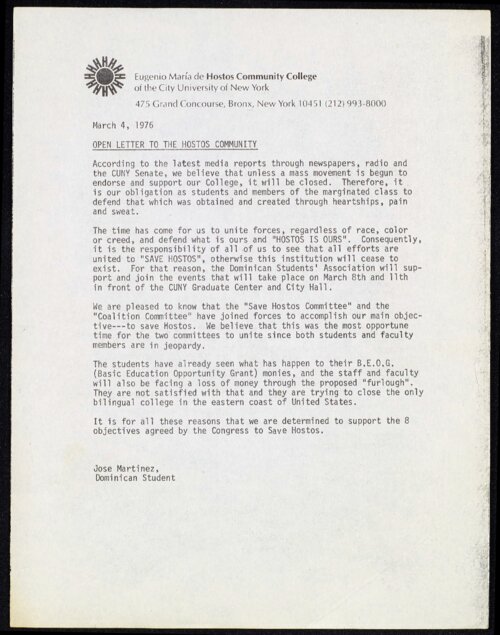 "Open Letter to the Hostos Community" / "Carta Publica a la Comunidad de Hostos" from Jose Martinez Jose Martinez wrote this open letter in both English and Spanish to the Hostos Community College community on behalf of the Dominican Students Association to state that the vulnerability of the college had become so dire that massive collective action had become necessary. Under threat of closure, student and community groups needed to join forces to prevent the City University of New York from closing the only bilingual college available for people in the South Bronx and the only such college in the eastern United States. In 1975, the New York City fiscal crisis led to efforts by city officials and the CUNY administration to close or merge multiple campuses in order to pay debts that were owed to major banks. Hostos Community College was slated to merge with Bronx Community College in order to dramatically cut spending. It was this threat that led to the second iteration of organizing to save Hostos. Determined to preserve Hostos for the South Bronx as a place for students to pursue a bilingual higher education, students, faculty, staff, and community groups joined forces to keep Hostos open.
 -
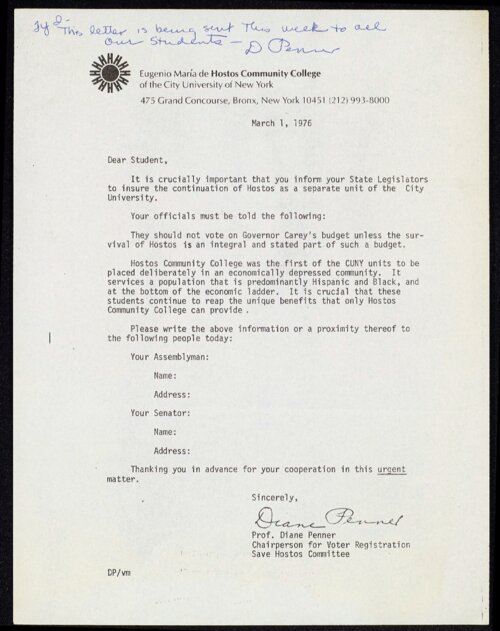 Letter to Hostos Community College Students from Professor Diane Penner Professor Diane Penner wrote this letter to the Hostos Community College student body in 1976 to encourage them to pressure state officials to oppose Hostos’ closure. As a faculty member and activist on the Save Hostos Committee, Penner’s letter gave students instructions on how to urge their representatives to protect their school. In 1975, the New York City fiscal crisis led to efforts by city officials and the CUNY administration to close or merge multiple campuses in order to pay back debt that was owed to major banks. Hostos Community College was slated to merge with Bronx Community College in order to dramatically cut spending. It was this threat that led to the second iteration of organizing to save Hostos. Determined to preserve Hostos for the South Bronx as a place for students to pursue a bilingual higher education, students, faculty, staff, and community groups joined forces to keep Hostos open. The faculty and students at Hostos Community College deployed political and protest strategies to achieve their goals.
 -
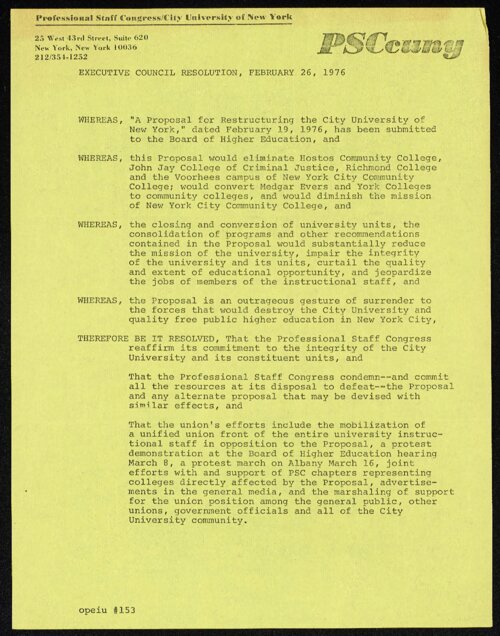 PSC/CUNY Executive Council Resolution on the Proposed Elimination of Hostos Community College In 1976, the Executive Council of the Professional Staff Congress (PSC) produced this resolution to convey their opposition to the proposal to close multiple community college campuses in New York City’s effort to save money. They also resolved to use all of their political resources to defeat the proposal and hold a demonstration to help to unify and build opposition to the proposal. The PSC, the union that represents faculty and staff employed by the City University of New York, was a crucial collaborator in all three campaigns to save Hostos Community College from inadequate facilities, budget cuts, and closure threats. In 1975, the New York City fiscal crisis led to efforts by city officials and the CUNY administration to close or merge multiple campuses in order to pay back debt that was owed to major banks. Hostos Community College was slated to merge with Bronx Community College in order to dramatically cut spending. It was this threat that led to the second iteration of organizing to save Hostos. Determined to preserve Hostos for the South Bronx as a place for students to pursue a bilingual higher education, students, faculty, the PSC, and community groups joined forces to keep Hostos open.