Save Hostos!
Item set
Title
Description
Save Hostos!: The Save Hostos Community College Movement (CUNY), 1973 to 1978

Eugenio María de Hostos Community College (CUNY) was established in response to CUNY’s enactment of Open Admissions in 1969, which guaranteed admission to one of the City’s system of colleges to city residents who had a high school diploma, or its equivalent. This led almost immediately to a doubling of enrollment at these institutions. Hostos—which was initially located on the southwest corner of East 149th Street and the Grand Concourse, in the heart of the South Bronx’s overwhelmingly Latino and African-American communities— first offered classes in the fall of 1970. Latino leaders demanded a school that would meet the educational, social, and cultural needs of the South Bronx community. In view of the extremely high percentage of Spanish-speaking residents and their bilingual children in the South Bronx, Hostos became the sole bilingual college in the New York City tristate area. The college pioneered in instituting educational initiatives responsive to its students’ needs. The naming of the college for the educator Eugenio María de Hostos (1839-1903): A Puerto Rican Renaissance man, who advocated for education for women, the abolition of slavery, and independence for Puerto Rico signaled the progressive intent of the college’s founders. However, Hostos’ auspicious beginning was marred by its woefully inadequate facilities, that consisted of a single, five-story edifice repurposed from an abandoned factory.
During the 1970s, from the fall of 1973 until the spring of 1979, the Save Hostos Movement became one of the most prolonged and successful mass movements in New York City. Over that five-year period, students, staff, faculty, and members of the community mobilized three massive year-long campaigns, each of which accomplished its goal.
• From Sept. 1973 to June 1974: “Hostos Needs Space,” a coalition of the Professional Staff Congress (PSC) and the Student Government Organization (SGO), mobilized the Hostos community to obtain the 500 Building, a recently constructed, five-story building on the southeast corner of East 149th St. and the Grand Concourse, that had housed an insurance company. This coalition accomplished its goal by enlisting the Bronx State Senator and State Assemblyperson representing the South Bronx to convince the New York State Legislature’s Black and Latino Caucus to introduce legislation that allocated funds for that purpose.
• From Sept. 1975 through June 1976: The “Save Hostos Committee,” an officially designated body of the Hostos Senate, and the PSC, together with the “Hostos Coalition to Save Hostos,” successfully mobilized the campus and community to prevent the closing of Hostos Community College. In addition to the employment of a full array of political tactics, members of the Community Coalition occupied Hostos’ main building until the police intervened and arrested forty students and faculty members.
• From Sept. 1977 to June 1978: “Hostos United/Hostos Unido,” brought together the forces that had previously supported the Save Hostos Committee and the Community Coalition to Save Hostos to carry out a massive campaign to obtain funding to reconfigure the former office building for educational use. When these tactics seemed inadequate to obtain the campaign’s goal, a very large contingent of students and many faculty occupied the 500 Building for three months, where classes were held. This four-month long occupation persisted until the announcement came from the Office of the Mayor of New York that bonds for the reconstruction of the edifice had been approved.
The Save Hostos Movement brought together a wide range of organizations: the Hostos Chapter of the Professional Staff Congress, the Student Government Organization, many student clubs, including the Federación Universitarios Socialistas Puertorriqueños, the Dominican Club, the Puerto Rican Club, the Black Student Union, the Veterans’ Club, and the Christian Club. In addition, faculty and student leaders established organizations—such as Hostos Needs Space, the Save Hostos Committee, the Community Coalition to Save Hostos, and Hostos United/Hostos Unido—specifically for the purpose of saving Hostos.
The success of the Save Hostos Movement depended upon its use of a combination of tactics that effectively politicized the campus and attracted widespread support from the residents of the communities Hostos served. The willingness of those within and outside the Hostos campus to commit themselves to this movement, and in some instances risk arrest, reflected the degree to which Hostos embodied a concrete achievement for these communities in their fight against discrimination in general, and for bilingual education.
The successes of the three campaigns that comprised the Save Hostos Movement left a deep impression on the culture of the college. Subsequent organizations—such as the Hostos Solidarity Coalition, the Hostos Action Coalition, and the Hostos AIDS Task Force—employed similar forms of organizational forms utilizing an array of tactic to achieve educational, cultural, and political goals.
This collection—through letters from faculty and students to elected officials, student newspapers, PSC Chapter Newsletters, meeting minutes of activist groups, photographs of demonstrations, and fliers designed by campus and community supporters of Hostos Community College—tells the story of the three campaigns that comprise the Save Hostos Movement.
Curated by Gerald Meyer, a faculty member at Hostos since 1972, this collection presents just some of the hundreds of items he amassed during the Save Hostos Movement from 1973 to 1978 while serving as PSC Chapter Chairperson. Meyer's additional holdings can be found in a larger, self-titled collection housed in the archives of Hostos Community College.
Gerald Meyer is the author of Vito Marcantonio: Radical Politician, co-editor of The Lost World of Italian American Radicalism, and author of eighty articles and reviews on a wide range of topics. He serves on the editorial boards of Science & Society and Socialism and Democracy and also serves as Co-Chair of the Vito Marcantonio Forum.
Language
Contributor
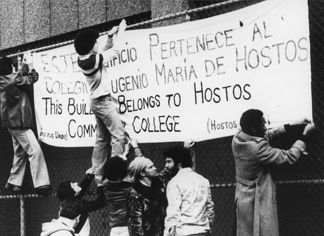
Collection
Time Periods
Items
-
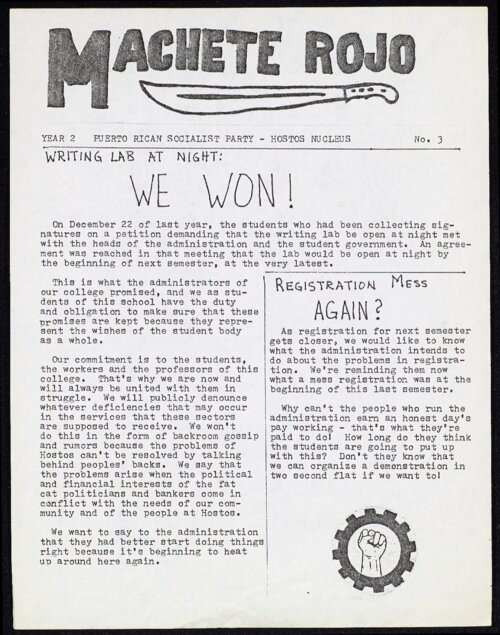 Machete Rojo: We Won! / Triunfaron Las Peticiones! El Machete Rojo was a leaflet produced by the Puerto Rican Socialist Party at Hostos Community College. This leaflet announced that student activists had successfully secured nighttime access to their writing lab, an effort that the administration of Hostos Community College had resisted. In the leaflet, student activists framed conflict at the college as overtly class-based.
 -
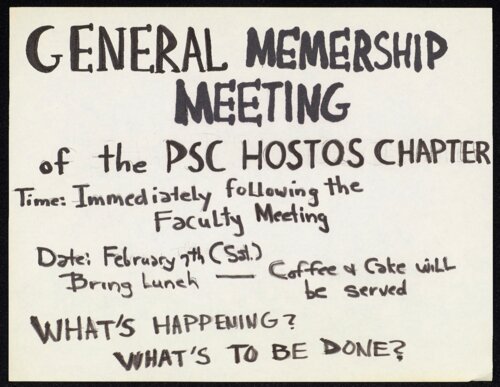 General Membership Meeting - Hostos PSC Chapter This flier announces a general membership meeting of the Hostos Community College chapter of the Professional Staff Congress (PSC). The PSC is the union that represents faculty and staff employed by the City University of New York. The PSC was a crucial collaborator in all three campaigns to save Hostos Community College from inadequate facilities, budget cuts, and closure threats.
 -
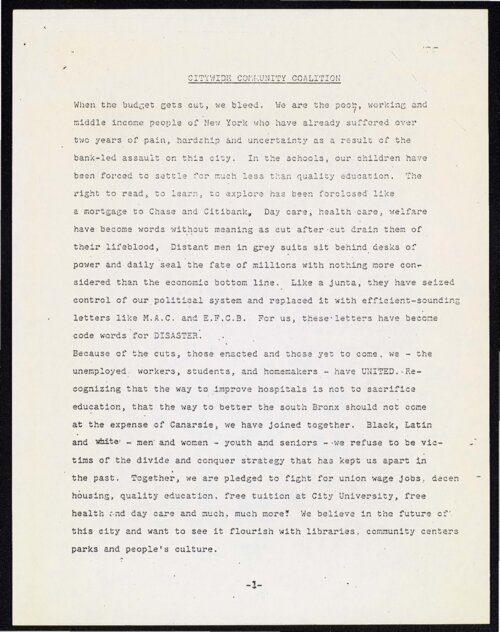 Citywide Community Coalition Mission Statement This document describes the mission of the Citywide Community Coalition (CCC), a collaboration dedicated to fighting the massive budget cuts inflicted on New Yorkers as a result of the 1975 fiscal crisis. Listing 28 groups ranging from The Association of Gypsy Cab Drivers to student, professional, political, cultural and religious organizations, the Coalition argued that the authority of the Emergency Financial Control Board and other institutions set up by the city and the state to repay the city’s debts constituted an illegitimate claim on public resources. In this mission statement, the CCC advocates for collective action to challenge the power of the banks in order to protect working and poor people of New York.
 -
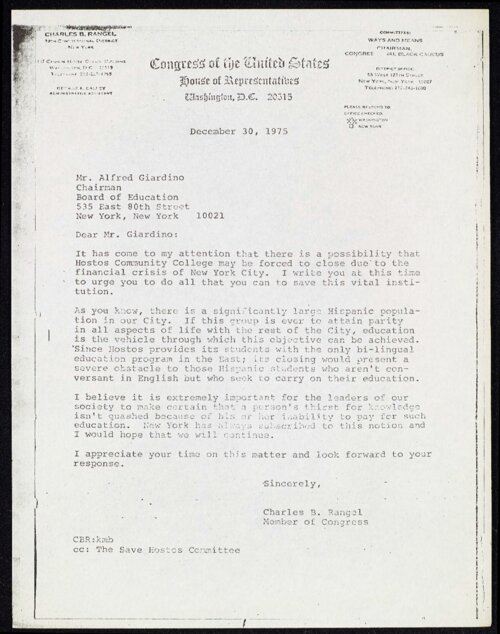 Letter from Congressman Rangel to Chairman Giardino In December 1975 Congressman Charles Rangel wrote this letter to the Chairman of the Board of [Higher] Education, Alfred Giardino, to convey his opposition to the closure of Hostos Community College. As the United States Congressman representing a substantial portion of Hostos students, Rangel articulated that the preservation of Hostos Community College was crucial in order to offer opportunities for upward mobility for members of his district who relied on bilingual education. In response to the New York City fiscal crisis that was occurring at the time, Hostos Community College was slated to merge with Bronx Community College in order to dramatically cut spending. It was this threat that led to the second iteration of organizing to save Hostos. Determined to preserve Hostos for the South Bronx as a place for students to pursue a bilingual higher education, students, faculty, staff, and community groups joined forces to keep Hostos open for the community.
 -
 De Hostos Echo, December, 1974 De Hostos Echo is the Hostos Community College bilingual student newspaper. This 1974 issue features stories on mass demonstrations to save CUNY from budget cuts. Stories also include editorials on student activism and engagement, a mission statement for the Black Student Union, an announcement of a new student-run TV news show at Hostos Community College, and an article discussing increases in Veteran’s benefits.
 -
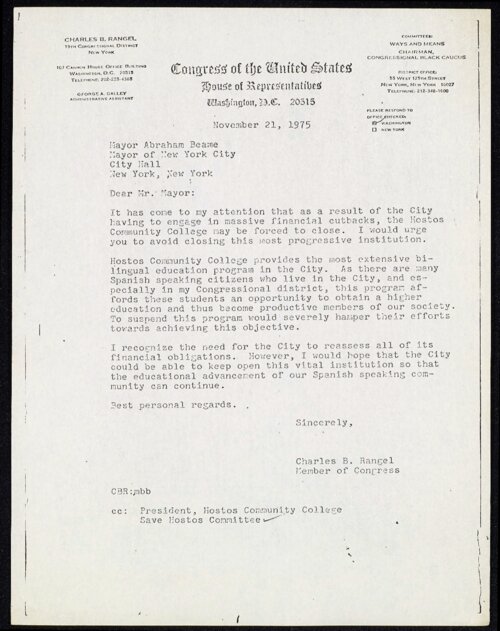 Letter to Mayor Abraham Beame from Charles B. Rangel: Notice of Potential Hostos Closure Congressman Charles Rangel wrote this letter to Mayor Abe Beame in November of 1975 to convey his opposition to the closure of Hostos Community College as a means to achieve budget cutbacks for the city. As the United States Congressman representing a substantial portion of Hostos students, Rangel urged the mayor to seek out alternative options for saving money so as to preserve Hostos Community College as a much needed resource for upward mobility in his district. In 1975, in response to the New York City fiscal crisis, Hostos Community College was slated to merge with Bronx Community College in order to dramatically cut spending. It was this threat that led to the second iteration of organizing to save Hostos. Determined to preserve Hostos for the South Bronx as a place for students to pursue a bilingual higher education, students, faculty, staff, and community groups joined forces to keep Hostos open for the community.
 -
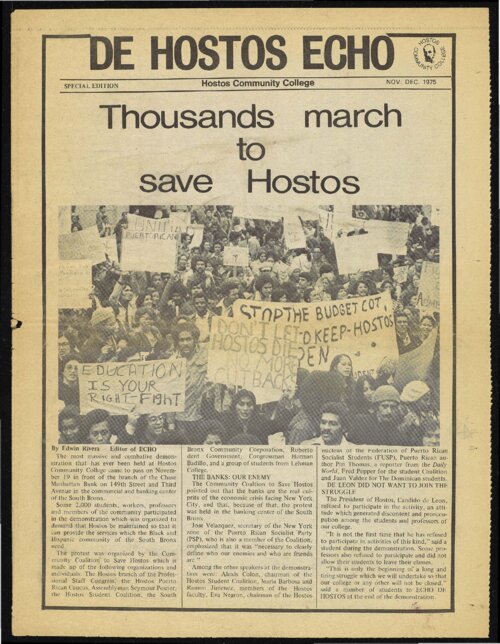 De Hostos Echo, November - December, 1975 De Hostos Echo is the Hostos Community College bilingual student newspaper. This November/December 1975 issue features stories on mass demonstrations to save the school from closure in order to deal with budget cuts. Stories also include tips for student success at the school, student election news, and editorials contextualizing the struggles happening at Hostos within a broader set of issues for CUNY community colleges. In 1975, in response to the New York City fiscal crisis, Hostos Community College was slated to merge with Bronx Community College in order to dramatically cut spending. It was this threat that led to the second iteration of organizing to save Hostos. Determined to preserve Hostos for the South Bronx as a place for students to pursue a bilingual higher education, students, faculty, and community groups joined forces to keep Hostos open for the community.
 -
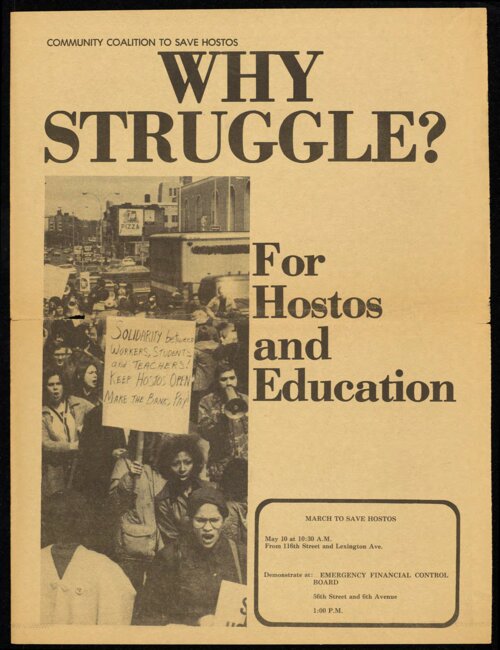 "Why Struggle? For Hostos and Education" This leaflet, distributed by the Community Coalition to Save Hostos, announces a march to the headquarters of the Emergency Financial Control Board (EFCB) in May of 1976. The EFCB was the body put in place to manage the budget crisis plaguing New York City. Made up largely of business people and bankers alongside city and state officials, the board was viewed as the driving force behind the massive cuts to public services New Yorkers sustained, including cuts to funding for CUNY. This leaflet articulates why the Community Coalition to Save Hostos was formed, the value of Hostos to its community, the efforts of those trying to stop Hostos’ closure, and solicits participation from supporters. In 1976, in response to the New York City fiscal crisis, Hostos Community College was slated to merge with Bronx Community College in order to dramatically cut spending. It was this threat that led to the second iteration of organizing to save Hostos. Determined to preserve Hostos for the South Bronx as a place for students to pursue a bilingual higher education, students, faculty, and community groups joined forces to keep Hostos open for the community.
 -
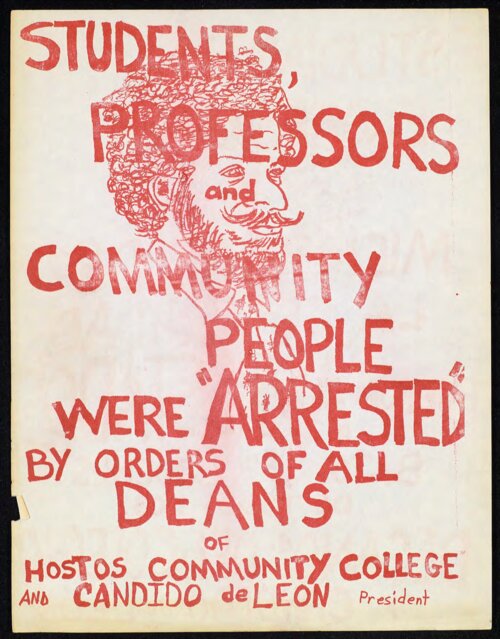 "Students, Professors, and Community People were 'Arrested' By Orders of All Deans" This 1975 flier, produced in English and Spanish, announced the arrest of those who occupied Hostos Community College in protest of the Board of Higher Education's decision to close it. This flier blames those arrests on the school's administration and President at the time. In 1975, in response to the New York City fiscal crisis, Hostos Community College was slated to merge with Bronx Community College in order to dramatically cut spending. It was this threat that led to the second iteration of organizing to save Hostos. Determined to preserve Hostos for the South Bronx as a place for students to pursue a bilingual higher education, students, faculty, and community groups joined forces to keep Hostos open for a community that wanted and needed it.
 -
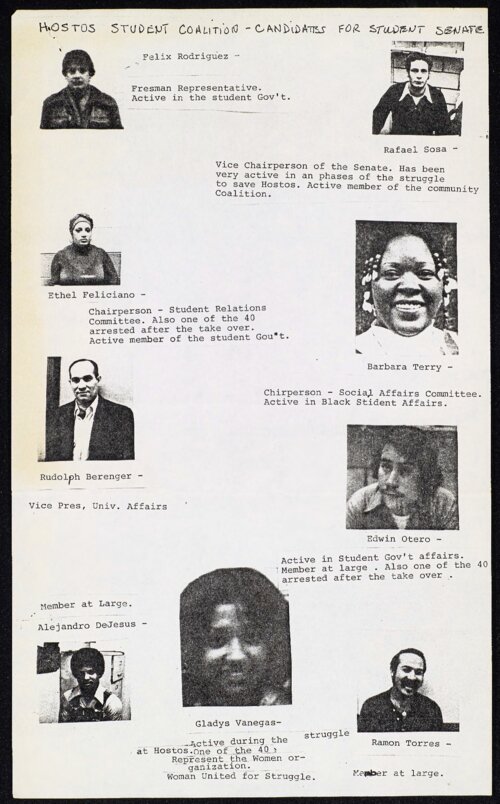 Hostos Student Coalition: Candidates for Student Senate This flier introduces the candidates for Student Senate at Hostos Community College. Many of them were activists in the occupation of the school and the effort to prevent it from being closed by the Board of Higher Education.
 -
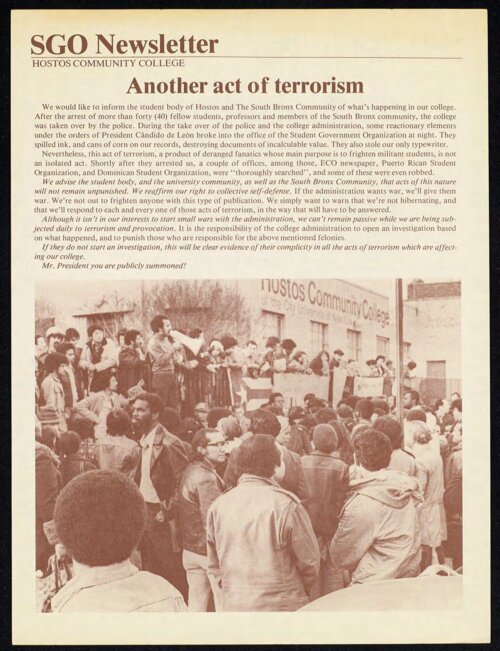 Student Government Organization Bilingual Newsletter: Student Government Office Vandalism The Student Government Organization published this bilingual newsletter in 1975 to publicize that their offices and the offices of fellow student groups had been searched and robbed in the wake of the occupation of Hostos Community College. The occupation of the school was an act of protest to prevent the school from being shut down by the Board of Higher Education. When police finally ended the occupation and arrested 40 activists, the administration regained control of the building and had access to the offices where student groups were housed. In 1975, in response to the New York City fiscal crisis, Hostos Community College was slated to merge with Bronx Community College in order to dramatically cut spending. It was this threat that led to the second iteration of organizing to save Hostos. Determined to preserve Hostos for the South Bronx as a place for students to pursue a bilingual higher education, students, faculty, and community groups joined forces to keep Hostos open for the community.
 -
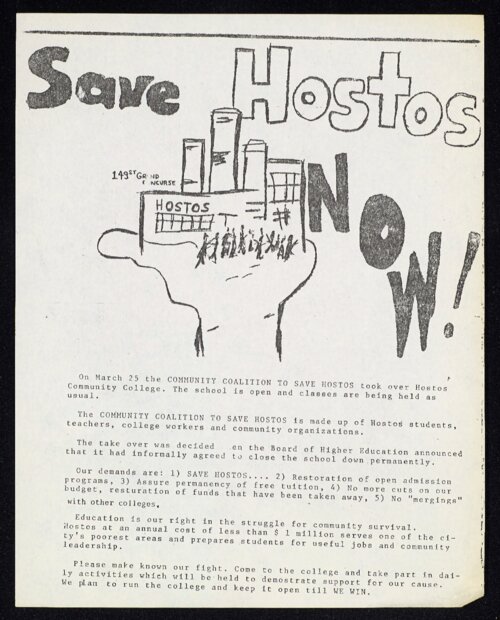 "Save Hostos Now!" In March of 1975, the Community Coalition to Save Hostos took over the school in protest over the Board of Higher Education’s decision to close Hostos Community College. This flier announces the occupation of the school and articulates the demands of the students, faculty, and community groups. In 1975, in response to the New York City fiscal crisis, Hostos Community College was slated to merge with Bronx Community College in order to dramatically cut spending. It was this threat that led to the second iteration of organizing to save Hostos. Determined to preserve Hostos for the South Bronx as a place for students to pursue a bilingual higher education, students, faculty, and community groups joined forces to keep the college open for the community.
 -
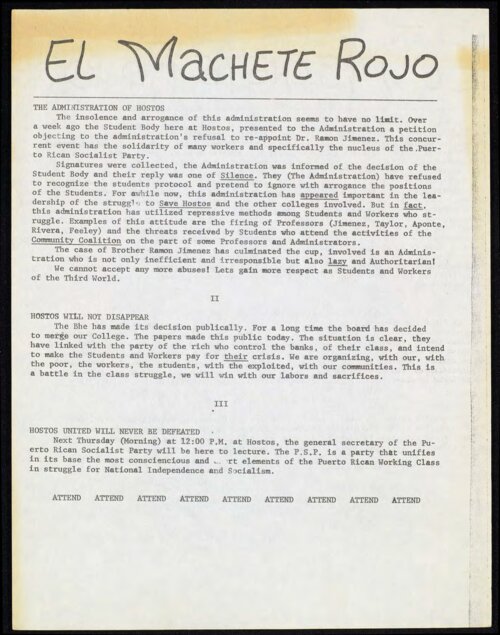 El Machete Rojo: The Administration of Hostos El Machete Rojo was a leaflet produced by the Puerto Rican Socialist Party. This leaflet shows fracturing between the students at Hostos and the administration over the firing of some faculty members who were involved in activist efforts dedicated to keeping Hostos open and preventing its merge with Bronx Community College. In this leaflet, students framed the struggle to save Hostos as an overtly class issue. In 1975, in response to the New York City fiscal crisis, Hostos Community College was slated to merge with Bronx Community College in order to dramatically cut spending. It was this threat that led to the second iteration of organizing to save Hostos. Determined to preserve Hostos for the South Bronx as a place for students to pursue a bilingual higher education, students, faculty, and community groups joined forces to keep Hostos open for the community.
 -
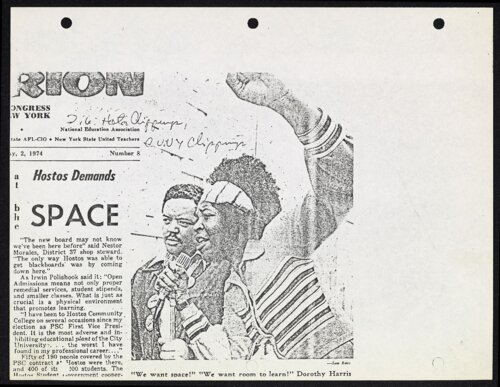 Dorothy Harris in Protest Over Space at Hostos This clipping of the May 2,1974 issue of The Clarion shows an image of student Dorothy Harris alongside an article on the campaign to secure more space for Hostos Community College. The Clarion was a widely read newspaper issued by the Professional Staff Congress, the union representing City University of New York faculty and non-teaching instructional staff. The newspaper consistently published stories that narrated student, faculty, and community efforts to improve the conditions and expand the space of Hostos Community College. This campaign was the first iteration of organizing on behalf of the school. In 1974, students, faculty, the Professional Staff Congress, and community members came together to acquire the 500 Grand Concourse building for Hostos—the first of three distinct efforts to support the school in securing needed resources and keeping its doors open for the South Bronx community.
 -
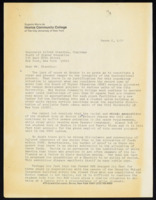 Letter from Wilfred A. Callender to Alfred Giardino: Concerns About Limited Space at Hostos In this letter to the chairman of the Board of Higher Education in 1974, Hostos English professor, and Chapter Grievance Counselor, Wilfred Callender describes the inadequacy of the facilities at Hostos, pointing out how poor infrastructure has damaging effects on the quality of education a student can receive under such conditions. Professor Callender copied major newspapers on his letter to Chairman Alfred Giardino in an effort to draw attention to what he claimed was a clear expression of discrimination in how CUNY campuses were funded. This letter was part of the first iteration of organizing on behalf of the school. In 1974, students, faculty, the Professional Staff Congress, and community members came together to acquire the 500 Grand Concourse building for Hostos—the first of three distinct efforts to support the school in securing needed resources and keeping its doors open for the South Bronx community.