Free Speech at CCNY, 1931-1942
Item set
Collection
Free Speech at CCNY, 1931-1942
Time Periods
1847-1945 The First Century of Public Higher Education in NYC
Items
1–25 of 60
Advanced search
-
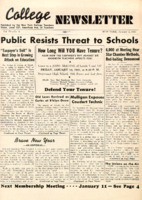 New York College Teachers Union Newsletter, January 1941 The cover of this issue of the College Newsletter, a publication of the New York College Teachers Union, includes several articles regarding the then ongoing Rapp-Coudert hearings of the early 1940s. They report on mass meetings with thousands of members of other local unions that went unreported in the New York Times. The Rapp-Coudert Committee was a New York State initiative organized in June 1940 to investigate and identify "subversive activities" and persons in New York's public schools and colleges. Several teachers' unions were targeted in the initial stages of the state's investigation as their membership rolls comprised progressive activists, many of whom had Communist ties. City College, in particular, became a target of the committee with dozens of faculty and staff called to public and private hearings.
 -
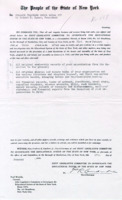 Subpoena issued to the College Teachers Union This is the subpoena that was issued to the College Teachers Union on January 27, 1941. Commanding the union's presence at a January 31st hearing before the Rapp-Coudert Committee, the document requests extensive union membership records, meeting minutes, and financial records. The Rapp-Coudert Committee was a New York State initiative organized in June 1940 to investigate and identify "subversive activities" and persons in New York's public schools and colleges. Several teachers' unions were targeted in the initial stages of the state's investigation as their membership rolls comprised progressive activists, many with alleged Communist ties. City College, in particular, became a target of the committee with dozens of faculty and staff called to public and private hearings.
 -
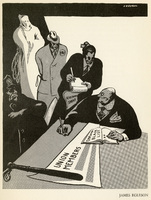 Winter Soldiers, Selection #7: James Egleson James Egleson, an American WPA artist, created this illustration for inclusion in the 1941 book, Winter Soldiers: The Story of a Conspiracy Against Schools. The book, published by the Committee for Defense of Public Education, tells the story of the Rapp-Coudert hearings and New York State’s efforts to rid its public schools and colleges of "subversive influences" and persons, particularly those with communist ties. Egleson was supported under the Works Progress Administration (WPA), the government-funded Federal Art Project that hired hundreds of artists. The Project was part of President Franklin D. Roosevelt's New Deal during the Great Depression.
 -
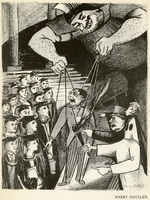 Winter Soldiers, Selection #6: Harry Gottlieb Harry Gottlieb, a social realist graphic artist, employed by the WPA, became a leader and active member of the Artists Union and the Artists Congress. A life-long member of the Communist Party, Gottleib created this illustration for inclusion in the 1941 book, Winter Soldiers: The Story of a Conspiracy Against Schools. The image features CCNY instructor William Canning, an ex-Communist Party member who disclosed the names of over fifty active party members to state officials.The book, published by the Committee for Defense of Public Education, tells the story of the Rapp-Coudert hearings and New York State’s efforts to rid its public schools and colleges of "subversive influences" and persons, particularly those with communist ties. Gottleib was supported under the Works Progress Administration (WPA), the government-funded Federal Art Project that hired hundreds of artists. The Project was part of President Franklin D. Roosevelt's New Deal during the Great Depression.
 -
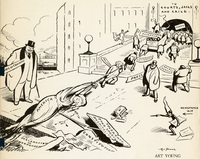 Winter Soldiers, Selection #5: Art Young Art Young, a socially conscious cartoonist and writer, created this cartoon for inclusion in the 1941 book, Winter Soldiers: The Story of a Conspiracy Against Schools. The book, published by the Committee for Defense of Public Education, tells the story of the Rapp-Coudert hearings and New York State’s efforts to rid its public schools and colleges of "subversive influences" and persons, particularly those with communist ties.
 -
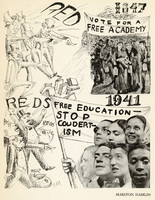 Winter Soldiers, Selection #4: Marston Hamlin Marston Hamlin created this illustration for inclusion in the 1941 book, Winter Soldiers: The Story of a Conspiracy Against Schools. The book, published by the Committee for Defense of Public Education, tells the story of the Rapp-Coudert hearings and New York State’s efforts to rid its public schools and colleges of "subversive influences" and persons, particularly those with communist ties.
 -
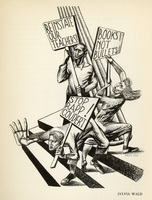 Winter Soldiers, Selection #3: Sylvia Wald Sylvia Wald, a politically and socially conscious artist, created this illustration for inclusion in the 1941 book, Winter Soldiers: The Story of a Conspiracy Against Schools. The book, published by the Committee for Defense of Public Education, tells the story of the Rapp-Coudert hearings and New York State’s efforts to rid its public schools and colleges of "subversive influences" and persons, particularly those with communist ties.
 -
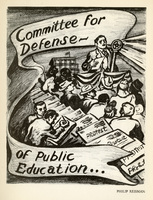 Winter Soldiers, Selection #2: Philip Reisman Philip Reisman, a social realist artist, created this print for inclusion in the 1941 book, Winter Soldiers: The Story of a Conspiracy Against Schools. The book, published by the Committee for Defense of Public Education, tells the story of the Rapp-Coudert hearings and New York State’s efforts to rid its public schools and colleges of "subversive influences" and persons, particularly those with communist ties.
 -
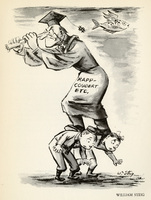 Winter Soldiers, Selection #1: William Steig William Steig, famed American cartoonist and illustrator, created this illustration for inclusion in the 1941 book, Winter Soldiers: The Story of a Conspiracy Against Schools. The book, published by the Committee for Defense of Public Education, tells the story of the Rapp-Coudert hearings and New York State’s efforts to rid its public schools and colleges of "subversive influences" and persons, particularly those with communist ties. A representative of those efforts can be seen in this image standing on the backs of schoolchildren.
 -
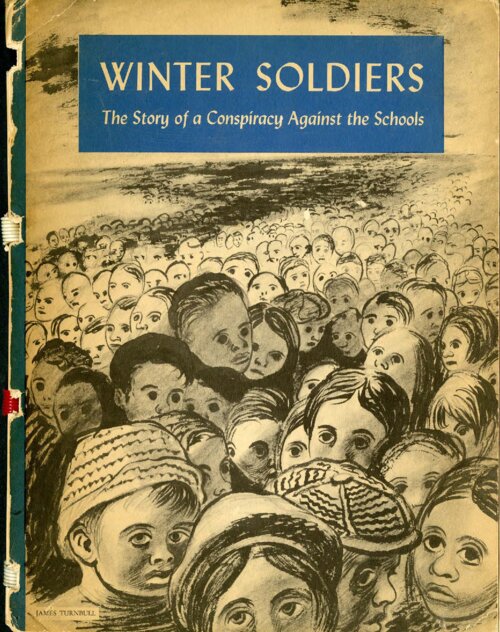 "Winter Soldiers - The Story of a Conspiracy Against the Schools" Published in 1941 by the Committee for Defense of Public Education, a joint committee of the Teachers Union and the College Teachers Union, Winter Soldiers tells the story of the Rapp-Coudert hearings and New York State's efforts to rid its public schools and colleges of "subversive influences" and persons, particularly those with communist ties. Sympathetic to the dozens of City College teachers that had been suspended or fired because of the hearings, Winter Soldiers features of a mix of story and artwork. It was created to raise money for the legal defense fund for the Rapp-Coudert victims. The text was written by Louis Lerman, one of CCNY's suspended faculty, and the drawings and graphics were contributed by some of the era's highest regarded activist artists such as Aaron Douglas, Elizabeth Olds, Louis Lozowick, Art Young, and Hugo Gellert. Many of the artists were supported under the Works Progress Administration (WPA), the government-funded Federal Art Project that hired hundreds of artists. The Project was part of President Franklin D. Roosevelt's New Deal during the Great Depression.
 -
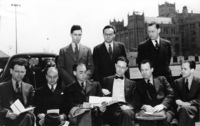 Suspended Faculty Reading Flier at Peace Rally This photograph shows nine of the eleven City College faculty and staff members that were suspended on April 22, 1941 as a result of the Rapp-Coudert hearings. The New York State sanctioned hearings sought to weed out "subversive influences" and persons from the state's public schools, in particular those individuals with ties to the Communist party as all of those in this photograph were alleged to have had. The photograph was taken on April 23 at a student peace strike at Lewisohn Stadium. Seated from left to right are: [unknown], David Cohen, librarian; Dr. Walter Scott Neff, psychology instructor; Dr. Saul Bernstein, biology instructor; John Kenneth Ackley, registrar; and Dr. Morris Cohen, chemistry instructor. Standing from left to right are: Louis Balamuth, physics instructor; Jesse Mintus, registrar's office; and Sidney Eisenberger, chemistry instructor.
 -
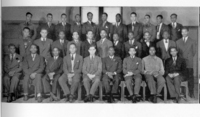 The Frederick Douglass Society, CCNY 1941 This 1941 photograph shows the members of the Frederick Douglass Society at City College (CCNY). The group, originally established in 1921 by ten black students, was one of the most active clubs on campus and, for several years, campaigned for the creation of a black history course. One of those picture here, Louis Burnham, served as president of the organization and was elected Vice President of the CCNY Student Council. After graduation he went south to organize the first chapter of the American Student Union on Black campuses. Their efforts, aided by the support of the College Teachers Union and the American Student Union, met success in the fall of 1937 with the creation of a course entitled, "Negro History and Culture." Teaching the course was the newly hired Dr. Max Yergan, the first black professor in any of the city's public colleges. Yergan's time on campus was short-lived, however, as he would soon become targeted by the Rapp-Coudert Committee and denied reappointment.
 -
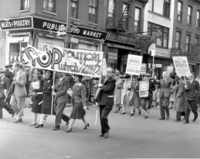 Nine Police Surveillance Photographs — 1941 May Day Parade These surveillance photographs were taken by the New York City Police Department on May Day 1941. The images show participants from multiple City College student and faculty organizations including a chapter of the American Student Union. Marchers can be seen carrying signs in reference to the ongoing Rapp-Coudert hearings. The parade started from 56th Street at 2PM with participants working their way towards Union Square for addresses later in the day. The New York Times reported that the May Day festivities of 1941 were significantly smaller than years past. In fact, the parade faced "denunciations by labor unions and labor leaders who said it was wholly communistic." As a result, the participant count of 18,788 was one-third less from the previous year's figure.
 -
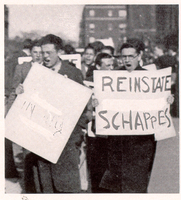 "Reinstate Schappes" Rally This photograph comes from a 1941 student rally in support of City College English instructor Morris Schappes, a self-avowed communist sentenced to prison for failing to divulge the names of his fellow party members on the faculty at CCNY. At a March 1941 hearing before the Rapp-Coudert Committee, a New York State organized communist-hunt group, Schappes freely admitted his communist ties. When state officials demanded he name other party members at CCNY, Schappes claimed there were only ever four others: three of whom had been killed in the Spanish Civil War and another that had already left the school. Testimony from a friendly, ex-communist witness contradicted Schappes' claims and so the English instructor was tried for perjury, convicted and sentenced to up to two years in prison. He would ultimately serve thirteen and a half months before his release. Following his conviction, activists protested for his release with many viewing his imprisonment as punishment for his political opinions. This was not the first time that CCNY students rallied in support of Schappes. In 1936, after the English department attempted to fire him for his political leanings, student protests forced school officials to reverse their decision.
 -
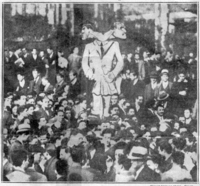 Twin Effigy of President Robinson and Italian Premier Mussolini at Protest This photograph from a November 20, 1934 rally at City College (CCNY), features a student-made, two-headed effigy of CCNY President Frederick B. Robinson and Italian Prime Minister Benito Mussolini. After being paraded around campus throughout the morning's demonstration, the seven-foot-tall cardboard piece was burned amidst student cries of "Smoke Robby out." The event was held to demand the reinstatement of twenty-one expelled students as well as the removal of Robinson. The twenty-one were expelled following an anti-fascist rally on October 9th. The expulsions were not the first issued by Robinson who regularly faced accusations of stifling free expression from left-leaning student groups and organizations. Robinson's effigy depicts him in academic regalia grasping the umbrella with which he struck students at a rally in the prior year.
 -
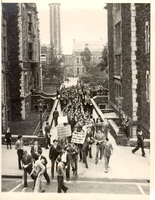 Anti-War & Anti-ROTC Rally, May 1933 This photograph captures student demonstrators on "Jingo Day" at City College (CCNY) on May 29, 1933. Their march, in protest of an ROTC review scheduled on campus at Lewisohn Stadium, would escalate with the arrival of police officers who had been called in by CCNY President Frederick B. Robinson. By protest's end, several left-leaning student organizations and publications would be shut down, and Robinson would be accused of attacking students with his umbrella. Leftist activism was particularly active on CCNY's campus during this period with the college's ROTC program just one target of protest. At CCNY, courses in military science were mandated for those enrolled in ROTC.
 -
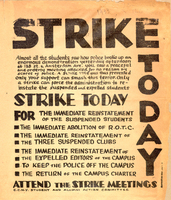 "Strike Today," 1933 One day after an anti-war/anti-ROTC demonstration that led to the suspensions of students, clubs, and campus publications, student activists assembled again, only this time to protest their treatment at (and the consequences of) the prior day's demonstration. Many of the student grievances are expressed in this flier which calls for a strike in effort to "force the administration to reinstitute suspended and expelled students" from the May 29, 1933 protest. That protest, which took place during an ROTC review on campus, escalated with the arrival of police officers who had been called in by CCNY President Frederick B. Robinson. By protest's end, several left-leaning student organizations and publications would be shut down, and Robinson would be accused of attacking students with his umbrella. Leftist activism was particularly active on CCNY's campus during this period with the college's ROTC program just one target of protest.
 -
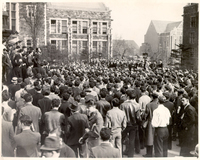 Rally on CCNY Quad, November, 20, 1934 This photograph was taken at the November 20, 1934 rally at CCNY. The demonstration was held to demand the reinstatement of twenty-one expelled students as well as the removal of college president, Frederick B. Robinson. The twenty-one were expelled following an anti-fascist rally on October 9th. At the far left side of this photograph, the students are standing atop the pedestal of the campus' main flagpole. The demonstration pictured had commenced with students hoisting a banner emblazoned with the word "STRIKE" up the fifty-foot pole. The protest began at 11am and lasted approximately two hours, attracting a crowd in upwards of 1,500 students. Due to its size, the event ultimately moved out of the area seen in the photo to the nearby Jasper Oval. By event's end, three students were reported to have been arrested during a clash with police and a two-headed effigy of CCNY President Robinson and Italian Prime Minister Benito Mussolini was burned.
 -
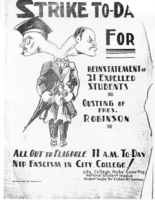 "Strike Today for: Reinstatement of 21 Expelled Students - Ousting of Pres. Robinson" This flier, from November 20, 1934, advertises a demonstration calling for the reinstatement of twenty-one expelled City College (CCNY) students as well as the removal of college president, Frederick B. Robinson. The twenty-one were expelled following an anti-fascist rally on October 9th.Commencing at 11am and lasting approximately two hours, upwards of 1,500 students participated in the demonstration with three students reported to have been arrested during a clash with police attempting to move the event off campus grounds. Following squabbles with police and organized speeches, the strike's main (and concluding) event was the burning of a two-headed effigy of CCNY President Robinson and Italian Prime Minister Benito Mussolini. Robinson is depicted in his academic regalia grasping the umbrella with which he struck students at a rally in the prior year.
 -
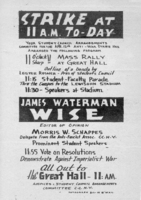 "Strike at 11am To-Day," April 12, 1935 This flier advertises an April 12, 1935 anti-war demonstration at the City College of New York (CCNY). The 11am rally was part of a nationwide day of protest and attracted front-page coverage from the New York Times the following day with the headline: "Nation's Students 'Strike' for Peace." Other demonstrations took place in New York City at Columbia University and Hunter College. In all, some 60,000 students participated in the day's events across the country. At CCNY, around 2,000 students gathered in the Great Hall to protest against war and fascism. The Times reported students carrying placards reading: "Down With Hearst!," "Oust President Robinson!," "Abolish the R.O.T.C.!," and "Build Schools — Not Battleships!"
 -
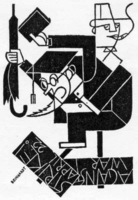 Cartoon of President Robinson Stomping on Protest Signs This illustration depicts City College President Frederick B. Robinson stomping on anti-war protest signs from an April 22, 1937 CCNY student rally. During his time at City College, Robinson drew extraordinary criticism from left-leaning student organizations who frequently accused him of attempting to stifle free expression on campus. Following one anti-war/anti-ROTC rally in May 1933, Robinson was alleged to have struck multiple students with his umbrella prior to his calling for the police. For student protestors, the umbrella quickly became a symbol of his presidency and he can be seen grasping it in this illustration. The April 22nd protest was part of a nationwide series of anti-war demonstrations that saw 1,000,000 student participants. At City College, the New York Times stated that 3,500 students assembled at college's Great Hall. Following the meeting, a large group was reported to have marched to the Italian consulate to protest Premier Benito Mussolini.
 -
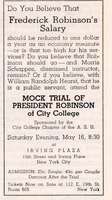 Advertisement for "Mock Trial of President Robinson" This clipping from The Student Advocate advertises a student-run mock trial of City College President Frederick B. Robinson at Irving Plaza on May 16, 1936. The trial centered on the recent firing of CCNY Professor Morris Schappes. Schappes, an English instructor, was dismissed on April 22nd after speaking on behalf of the faculty-organized Anti-fascist Association at an anti-war rally on campus.CCNY's undergraduate paper, The Campus, reported several days after the mock trial that a student jury acquitted Schappes after deliberation of "one one-hundredth of a second." The event saw several students appear as witnesses on behalf of Schappes, with others speaking against President Robinson. The student paper reported 1,500 students in attendance at the event which was sponsored by CCNY's chapter of the American Student Union, a national left-wing organization of students.
 -
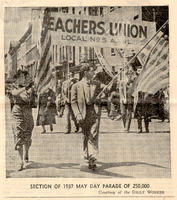 "Section of 1937 May Day Parade of 250,000" This clipping from the April 1938 edition of the Daily Worker shows marchers from a local chapter of the Teachers Union, affiliated with the A.F.L., taking part in the May Day parade of 1937. The paraders marched down 8th, 9th, and 10th Avenues in Manhattan as they worked their way towards Union Square in a show of support for organized labor unions and, in particular that year, against fascism in Spain. The Daily Worker was a newspaper published the Communist Party USA. Though they cite 250,000 participants in the day's events, a New York Times' article from May 2nd placed the figure at a more modest 70,000.
 -
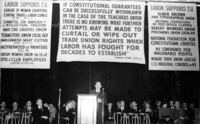 Charles Hendley Protesting the Rapp-Coudert Committee This photograph shows Charles Hendley, president of the Teachers Union, addressing over 2,000 to protest the Rapp-Coudert Committee at the Manhattan Center on November 10, 1940. The Rapp-Coudert Committee, a New York State initiative, was organized in June 1940 to investigate and identify "subversive activities" and persons in New York's public schools and colleges. Various teachers' unions, including the one led by Hendley, were especially targeted in the initial stages of the investigation as their membership rolls were comprised in no small part by far left sympathizers who had previously worked to reform education in the city and state. The committee's creation was driven largely by rising anti-communist sentiment following the Nazi-Soviet Pact of 1939; as a consequence, state officials sought to rid publicly funded schools of undesired "red" influence. Holding private hearings from September 1940 through December 1941, the group issued subpoenas to and interrogated more than 500 faculty, staff, and students. City College, in particular, became a target of the committee with dozens of faculty and staff called to public hearings. The committee demanded that they name other Communist sympathizers in the schools. By the close of the committee, more than fifty faculty and staff at CCNY were without jobs.
 -
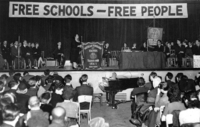 AFT Meeting: "Free Schools - Free People" This photograph shows Dr. Bella Dodd, legislative director of the New York Teachers Union and an organizer for the Communist Party, addressing a crowd in protest of the Rapp-Coudert hearings on December 11, 1940, at the Manhattan Center. The Rapp-Coudert Committee, a New York State initiative, was organized in June 1940 to investigate and identify "subversive activities" and persons in New York City's public schools and colleges. Various teachers' unions, including the one led by Dodd, were especially targeted in the initial stages of the investigation as their membership rolls provided state officials with a ready-made list of many union activists who had previously worked to reform education in the city and state. The committee's creation was driven largely by rising anti-communist sentiment following the Nazi-Soviet Pact of 1939; state officials sought to rid publicly funded schools of undesired "red" influence. Holding private hearings from September 1940 through December 1941, the group issued subpoenaed and interrogated more than 500 faculty, staff, and students. City College, in particular, became a target of the committee with dozens of faculty and staff called to public hearings, pressured to identify themselves as communists, and demanded to name names of other communist sympathizers. By the close of the committee, more than fifty faculty and staff at CCNY were left without jobs because of their refusal to cooperate with the committee.
1–25 of 60