Free Speech at CCNY, 1931-1942
Item set
Collection
Free Speech at CCNY, 1931-1942
Time Periods
1847-1945 The First Century of Public Higher Education in NYC
Items
26–50 of 60
Advanced search
-
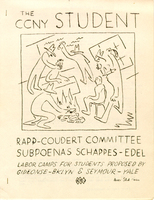 "Rapp-Coudert Committee Subpoenas Schappes-Edel" This cover of an issue of The CCNY Student features an especially critical reaction to the ongoing Rapp-Coudert hearings of 1940-41. Produced by the American Student Union, a national left-wing student organization, the cover's illustration depicts covert surveillance, interrogation, silencing, and book burning. While the images may not be entirely reflective of reality on campus at City College during they period, it was meant to evoke what many felt was the college's concerted effort to supress free expression on campus. The headline beneath the image mentions the names of two City College instructors Morris Schappes and Abraham Edel who were required to appear at the hearings.The Rapp-Coudert Committee, a New York State initiative, was organized in June 1940 to investigate and identify "subversive activities" and persons in New York's public schools and colleges. Holding private hearings from September 1940 through December 1941, the group issued subpoenas to and interrogated more than 500 faculty, staff, and students suspected of Communist ties. City College, in particular, became a target of the committee with dozens of faculty and staff called to public and private hearings. By hearing's end, more than fifty CCNY faculty and staff would be dismissed from their jobs.
 -
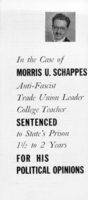 "In the Case of Morris U. Schappes" This page from a mid-1941 pamphlet was created to support recently fired and sentenced City College English instructor Morris Schappes. A self-confessed Communist, Schappes had appeared before the Rapp-Coudert Committee, a N.Y. State organized communist-hunt group, on March 6, 1941. At his hearing, Schappes admitted to prior membership in the Communist Party. When the committee demanded he name other party members at CCNY, Schappes claimed there were only ever four in addition to himself: three of whom had been killed in the Spanish Civil War and another that had already left the school. Unfortunately for Schappes, officials had previously received testimony to the contrary from an ex-communist history instructor turned friendly witness. Soon thereafter, the committee recommended to the Manhattan district attorney that Schappes be tried for perjury. As this pamphlet shows, he was convicted and sentenced for up to two years in prison. Ultimately, he would serve thirteen and a half months, all the while collecting support from activists on campus.
 -
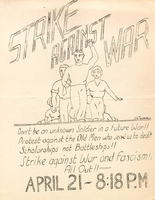 "Strike Against War" This undated flier, likely from the mid-to-late 1930s, advertises just one of many similar anti-war and anti-fascism demonstrations on the City College campus. The left-leaning groups at CCNY scheduled such protests regularly, in conjunction with larger nationwide efforts led by the American Student Union. They continually met with resistance from college administration, particularly CCNY President Frederick B. Robinson, who saw fit to expel protestors and call for police presence on campus during demonstrations. Student and faculty activism grew on campus throughout the decade as many observed the rise of fascism in Europe and foresaw an inevitable war on the continent which they wished for the United States to avoid. The scheduling of this demonstration in April marked the anniversary of the month United States entered World War I in 1917.
 -
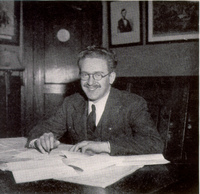 Morris Schappes at Desk This is an undated photograph of City College English instructor Morris Schappes. Schappes, a self-confessed communist, was himself twice a cause célèbre at CCNY. In April 1936, Schappes was fired after speaking on behalf of the faculty organized Anti-Fascist Association at a student-led peace protest on campus. Announcement of his dismissal was met with strong pushback from students, however, and the decision was eventually overturned. In March 1941, Schappes' political leanings would again be the source of controversy. Appearing before the Rapp-Coudert Committee, a N.Y. State organized communist-hunt group, Schappes admitted his prior membership in the Communist Party. When it was demanded that he name other party members at CCNY, Schappes claimed there were only ever four in addition to himself: three of whom had been killed in the Spanish Civil War and another that had already left the school and whose party membership was already known. Unfortunately for Schappes, officials had previously received testimony to the contrary from William Canning, an ex-communist history instructor turned friendly witness. Knowing that he was lying, Schappes was soon after tried for perjury, convicted and sentenced for up to two years in prison. Ultimately, he would serve thirteen and a half months, all the while collecting support from activists on campus.
 -
 "Free Morris Schappes" This is the logo of the Schappes Defense Committee. The group was formed shortly after City College English instructor Morris Schappes was sentenced to prison for failing to divulge the names of his fellow communists on the faculty at CCNY. At a March 1941 hearing before the Rapp-Coudert Committee, a New York State organized communist-hunt group, Schappes freely admitted his communist ties. However, when state officials demanded he name other party members at CCNY, Schappes claimed there were only ever four others: three of whom had been killed in the Spanish Civil War and another that had already left the school. Testimony from an ex-communist, turned friendly witness, contradicted Schappes' claims and so the English instructor was tried for perjury, convicted and sentenced for up to two years in prison. He would ultimately serve thirteen and a half months before his release. Following his conviction, activists protested with many viewing his imprisonment as punishment for his political opinions.
 -
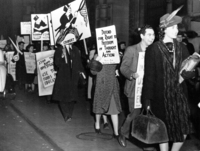 Rally against the Rapp-Coudert Committee: "Defend our Right to Freedom of Thought and Action" Taken during the Rapp-Coudert Committee hearings sometime between 1940 and 1942, this photograph shows demonstrators protesting against the statewide hunt for "subversive activities" and persons in New York's public schools and colleges. Supporters came from other colleges as indicated by one placard signed "Politics Club Brooklyn College." Holding private hearings from September 1940 through December 1941, the Rapp-Coudert Committee subpoenaed and interrogated more than 500 faculty, staff, and students, particularly those involved in any alleged Communist related organizations. City College, especially, became a target of the committee with dozens of faculty and staff called to public hearings and demanded to name names of other communist sympathizers in the school. By the close of the committee, more than fifty faculty and staff at CCNY were left without jobs after they were identified as communists by two friendly witnesses at the school.
 -
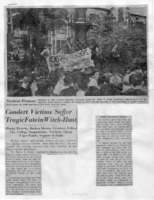 "Coudert Victims Suffer Tragic Fate in Witch-Hunt" This article and accompanying photo from The Daily Worker, the official newspaper of the Communist Party, features comments from labor leader Bella Dodd highlighting the plight faced by many of City College's instructors whose futures were in limbo due to the Rapp-Coudert hearings. Each was accused of having communist ties and, as a result of their suspension and ultimate firing, many instructors would indeed struggle to find work. The majority were unable to re-enter academia following their dismissal from City College. Dodd spoke before a crowd of students in front of CCNY's flagpole on May 27, 1941.The Rapp-Coudert Committee, a New York State initiative, was organized in June 1940 to investigate and identify "subversive activities" and persons in New York City's public schools and colleges. State officials sought to rid publicly funded schools and colleges of undesired "red" influence. They did so by holding private then public hearings from September 1940 through December 1941, issuing subpoenas and interrogating more than 500 faculty, staff, and students. City College, in particular, became a target of the committee with dozens of faculty and staff appearing before the committee and ultimately being suspended or fired because of their refusal to cooperate with the committee.
 -
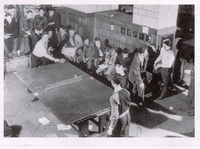 Students Playing Ping Pong in CCNY Alcoves The City College alcoves, located in the lunchroom, provided the setting for much political debate between students during the 1930s and served as the base for various student groups. They also used the space for leisure activities such as playing ping-pong. In "Memoirs of a Trotskyist," a New York Times article from 1977, Irving Kristol (class of 1940) reflected: "The first alcove on the right, as you entered the lunchroom, was Alcove No. 1, and this soon became most of what City College meant to me. It was there one ate lunch, played Ping‐Pong (sometimes with a net, sometimes without), passed the time of day between and after classes, argued incessantly and generally devoted oneself to solving the ultimate problems of the human race."
 -
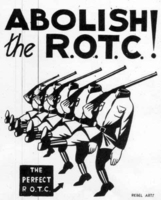 "ABOLISH the R.O.T.C.!" Graphic Published in a 1934 issue of Student Outlook, this illustration encapsulates the feelings of many left-leaning student activists towards the Reserve Officers Training Corps (ROTC) programs found on college campuses across the country. At City College, the two-year, military science based ROTC program was made initially compulsory for the entire student body shortly after World War I. However, student campaigns against the requirement were successful and ROTC became an elective in 1928.Anti-ROTC sentiment would persist in the subsequent decades, although it was not until the early 1970s and the Vietnam War that student activists successfully forced the program off of campuses. In 2013, the program returned to the CCNY campus.
 -
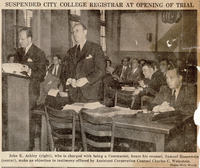 "Suspended City College Registrar at Opening of Trial" This newspaper clipping shows suspended City College registrar John K. Ackley sitting at his trial before the Board of Higher Education. Ackley had been identified for his Communist ties by the Rapp-Coudert Committee in April 1941. By June, he was the first City College employee to be tried and fired as a result of the committee's hearings. His firing marked the first of dozens for the college's faculty and staff that came at the hands of the Rapp-Coudert Committee. The state appointed group, seeking to investigate subversive influences in New York City's public schools and colleges, held private and public hearings with more than 500 faculty, staff, and students between 1940 and 1942. Shortly after his initial suspension in April, Ackley spoke before a group of Columbia students at their invitation and declared the Rapp-Coudert Committee hearings "a conspiracy against the schools, and part of a broader conspiracy against academic freedom and trade unionism." In April 1957, Ackley, later employed for the Metropolitan Music School, would be called to testify before a sub-committee of the House Committee for Un-American Activities, again for his ties to the Communist party.
 -
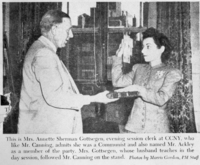 Annette Gottsegen Taking Oath Before Testimony This photograph shows Annette Sherman Gottsegen, a clerk at City College, taking an oath prior to her testimony against CCNY registrar John Ackley. Ackley would shortly thereafter be fired from his position. Gottsegen had previously been a member of the Communist Party and an active participant in the Teachers Union and the college's Anti-Fascist Association. She used her experiences with the various groups to testify against those she observed at the meetings. Gottsegen's testimony was prompted by the Rapp-Coudert Committee, a state run investigative group that subpoenaed and interrogated more than 500 faculty, staff, and students from New York's public schools and colleges between 1940 and 1942 in their quest to identify subversive influences on campuses. Particularly interested in those with Communist ties, City College became a special target of the committee with dozens of its faculty and staff called to private and public hearings.
 -
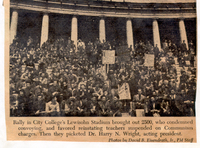 "Rally in City College's Lewisohn Stadium" This newspaper clipping features a photograph of an April 23, 1941 peace assembly at City College's Lewisohn Stadium. An annual event, the college administration cancelled all classes that day between 11am and 12pm to accommodate the gathering. With the main theme being "to keep the United States out of the war" and "to guarantee that CCNY shall not be America's War victim no. 1," attendees also protested the ongoing Rapp-Coudert hearings that saw to the suspension and dismissal of campus faculty and staff for their alleged communist ties. Speaking at the event was Canada Lee, a renowned African-American actor of stage, screen, and radio, who would later be blacklisted for his political affiliations.
 -
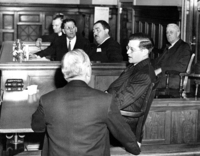 William Canning during his Testimony This photograph shows William Canning, an instructor in the City College history department, appearing before the Rapp-Coudert Committee. During his testimony, Canning, an ex-member of the Communist Party, disclosed the names of over fifty fellow faculty and staff at CCNY belonging to the party. The Rapp-Coudert Committee subpoenaed and interrogated more than 500 faculty, staff, and students from New York's public schools and colleges between 1940 and 1942 in their quest to identify subversive influences on campuses. Particularly interested in those with Communist ties, City College became a special target of the committee with dozens of its faculty and staff called to private and public hearings.
 -
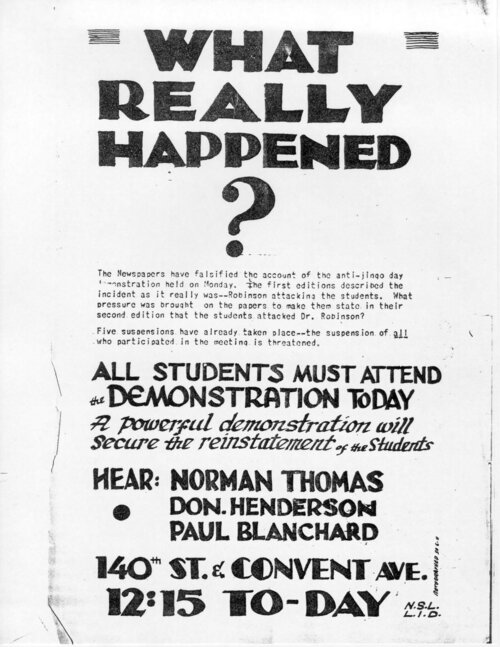 "What Really Happened?" Created within a week of the May 29, 1933 anti-war/anti-ROTC rally that led to the suspensions of students, clubs, and campus publications, this flier advertises another demonstration designed to both "secure the reinstatement of the [suspended] students" and set the record straight regarding the events of the "Jingo Day" rally. Their initial march on May 29, in protest of an ROTC review scheduled on campus at Lewisohn Stadium, escalated with the arrival of police officers who had been called in by City College (CCNY) President Frederick B. Robinson. By protest's end, several left-leaning student organizations and publications were shut down, and Robinson was accused of attacking students with his umbrella. Much to the activists' chagrin, the circumstances surrounding Robinson's actions were revised by newspapers in the days following the demonstration.
 -
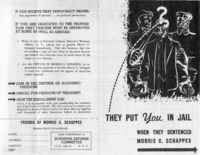 "They Put You in Jail" This is a pamphlet from 1941 created in support of recently fired and imprisoned City College English instructor Morris Schappes. Schappes, a self-avowed communist was sentenced to prison for failing to divulge the names of his fellow party members on the faculty at CCNY. At a March 1941 hearing before the Rapp-Coudert Committee, a New York State organized communist-hunt group, Schappes freely admitted his communist ties. When state officials demanded he name other party members at CCNY, Schappes claimed there were only ever four others: three of whom had been killed in the Spanish Civil War and another that had already left the school. Testimony from a friendly, ex-communist witness contradicted Schappes' claims and so the English instructor was tried for perjury, convicted and sentenced for up to two years in prison. He would ultimately serve thirteen and a half months before his release. From his conviction through his imprisonment, activists protested for his release with many viewing his imprisonment as punishment for his political opinions.
 -
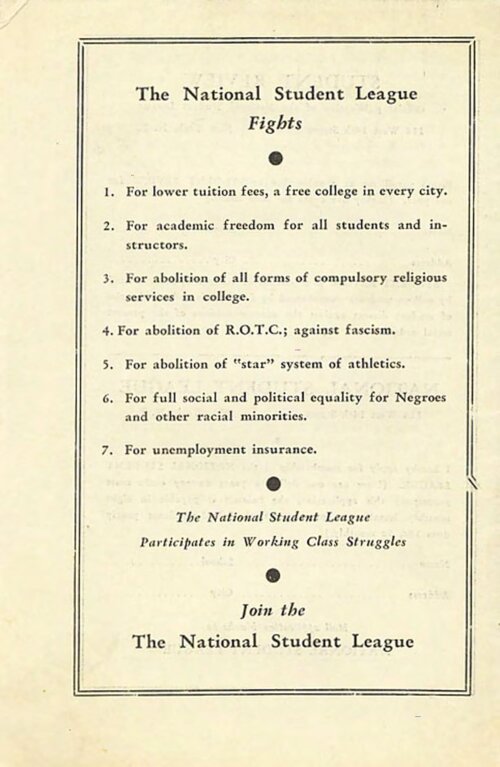 National Student League Platform Created in 1931, the National Student League (NSL) was a Communist-led coalition of radical students from across the United States. Growing out of frustrations felt by students at City College, the group expanded to other campuses embracing a single set of shared ideas. Those ideas, laid out in this platform, guided radical and progressive students efforts at City College and across the country. The NSL became part of the American Student Union, an alliance between communist, socialist and liberal students formed in 1935.
 -
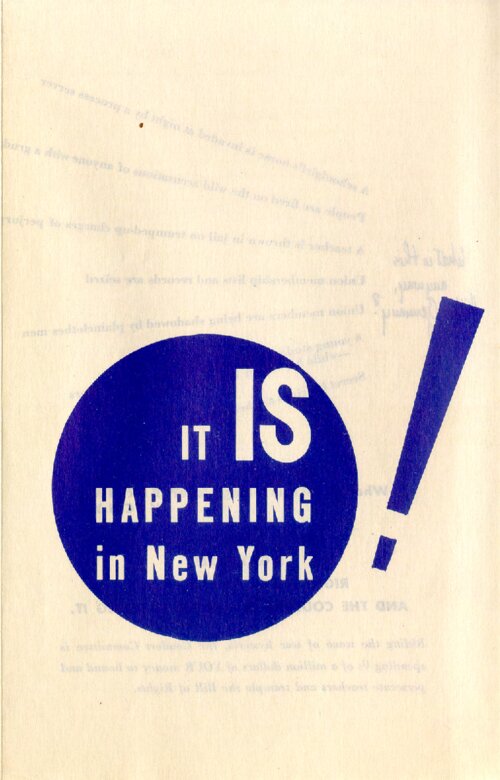 "It's Happening in New York!" Published in 1941, this pamphlet was created by the Committee for the Defense of Public Education, a joint committee between the Teachers Union and the College Teachers Union, amidst the turmoil of the Rapp-Coudert hearings. Citing a variety of injustices taking place in New York City, not least of which were the dozens of suspensions and dismissals of City College teachers suspected of having communist ties, the document likens the atmosphere in New York to that of Nazi Germany, including even a reference to Hitler's concentration camps. Such comparisons aside, the committee's aim was to increase awareness of the plight of many of their union's members who were fired by the Board of Higher Education because of their political affiliations. Morris Schappes, a CCNY instructor, was imprisoned for perjury as a result of the hearings. Throughout its existence, the committee organized letter-writing campaigns (as seen on the final page) and petition drives in an unsuccessful effort to overturn the effects of New York State's communist witch-hunt.
 -
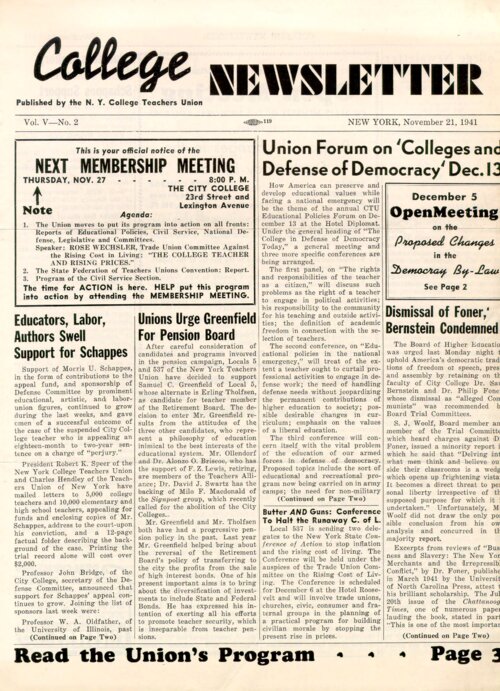 College Newsletter, November 21, 1941 Published by the New York College Teachers Union, the cover of this issue of the College Newsletter features articles about the dismissal of Morris Schappes and Phillip Foner, two City College instructors fired as a result of the Rapp-Coudert hearings. The Rapp-Coudert Committee was a New York State initiative organized in June 1940 to investigate and identify "subversive activities" and persons in New York's public schools and colleges. City College, in particular, became a target of the commitee with dozens of faculty and staff suspected of communist sympathies called to public and private hearings. Ultimately, more than fifty of the college's employees were fired from their positions.
 -
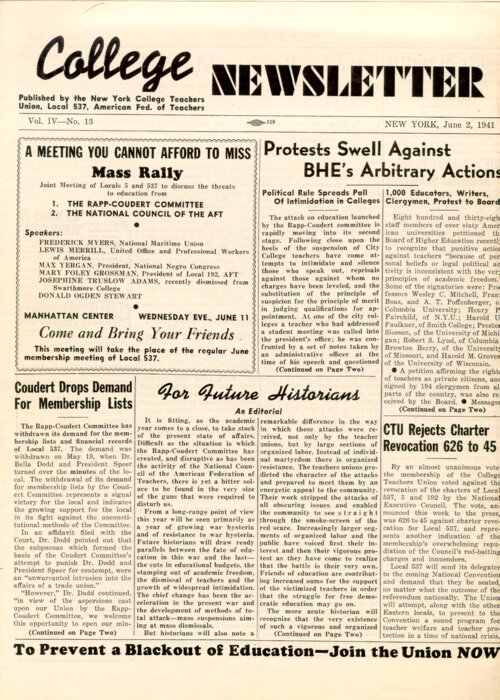 College Newsletter, June 2, 1941 The cover of this issue of the College Newsletter, a publication of the New York College Teachers Union, includes several articles regarding the then ongoing Rapp-Coudert hearings of the early 1940s. Included is one article addressed to "future historians" that speaks to the difficulties experienced by the group.The Rapp-Coudert Committee was a New York State initiative organized in June 1940 to investigate and identify "subversive activities" and persons in New York's public schools and colleges. As one article from the extract attests, several teachers' unions were targeted in the initial stages of the state's investigation as their membership rolls comprised far left activists, many of whom admitted to Communist ties. City College, in particular, became a target of the committee with dozens of faculty and staff called to public and private hearings.
 -
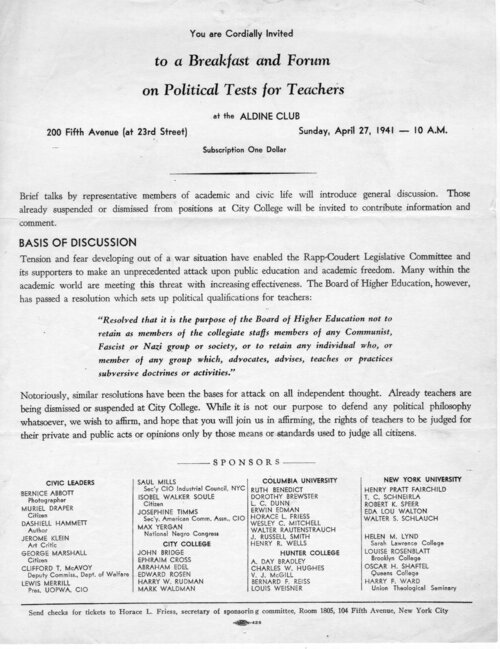 "Breakfast and Forum on Political Tests for Teachers" This flier promotes a breakfast forum discussing the Board of Higher Education's then recently passed resolution designed to "set up political qualifications for teachers." The resolution was adopted amidst the ongoing Rapp-Coudert Committee hearings which sought to rid New York's public schools of subversive influences, namely those with communist sympathies. The committee's creation was driven largely by rising anti-communist sentiment following the Nazi-Soviet Pact of 1939. Among the list of sponsors for this event were photographer Berenice Abbott and author Dashiell Hammett, as well as instructors from various colleges across New York City.
 -
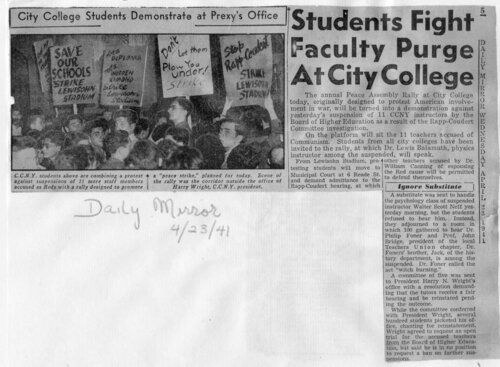 "Students Fight Faculty Purge At City College" This article from the New York Daily Mirror discusses an April 23, 1941 student rally at City College (CCNY). The rally, planned initially as an anti-war peace demonstration, was expanded to include a protest against the recent suspension of 11 CCNY instructors. The instructors were suspended by the Board of Higher Education after their alleged ties to the Communist Party and their refusal to cooperate at the public hearings of New York State's Rapp-Coudert Committee. Students had protested outside of CCNY President Harry Wright's office in the previous days.
 -
 "Eleven CCNY Teachers Suspended in College Red Hunt" This newspaper clipping from the April 23, 1941 edition of PM features eleven City College teachers suspended by the Board of Higher Education following discoveries, by the Rapp-Coudert Committee, of their communist ties. The majority of those listed would ultimately be fired from the college.PM was a daily New York newspaper printed from 1940 until 1948. Created by Ralph Ingersoll, a managing editor at Time-Life, it was an ad-free, political, liberal publication that continually struggled financially.The Rapp-Coudert Committee, a New York State initiative, was organized in June 1940 to investigate and identify "subversive activities" and persons in New York's public schools and colleges. The committee's creation was driven largely by rising anti-communist sentiment following the Nazi-Soviet Pact of 1939. State officials sought to rid publicly funded schools of undesired "red" influence. Holding private hearings from September 1940 through December 1941, the group issued subpoenas and interrogated more than 500 faculty, staff, and students in New York City. City College, in particular, became a target of the committee with dozens of faculty and staff called to public hearings after being identified as communists by two friendly witnesses from the college.
 -
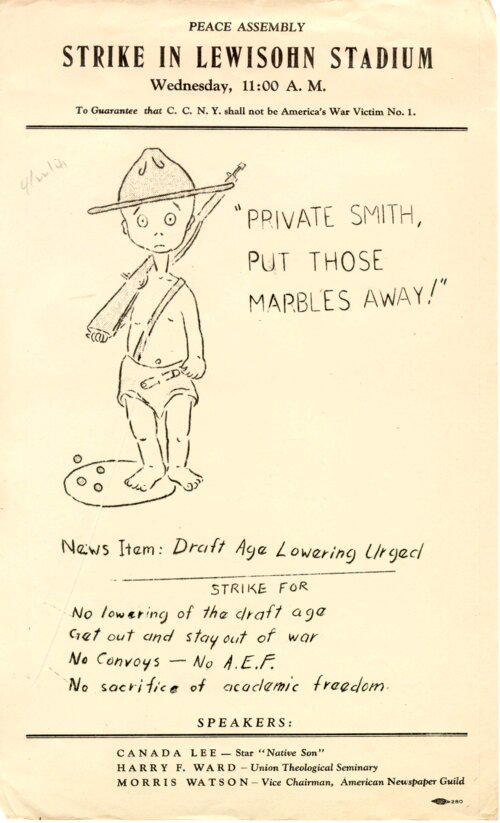 "Peace Assembly: Strike in Lewisohn Stadium" This flier advertises a peace rally at City College's Lewisohn Stadium on April 23, 1941. The assembly, one of two held simultaneously on that day, was part of an annual April peace demonstration at the school and the college cancelled all classes between 11am and 12pm. The gathering at the stadium was reportedly attended by more than 2,500 students with the main theme being "to keep the United States out of the war" and "to guarantee that CCNY shall not be America's War victim no. 1." Attendees also protested the ongoing Rapp-Coudert hearings that saw to the suspension and dismissal of campus faculty and staff for their alleged communist ties. Speaking at the event was Canada Lee, a renowned African American actor of stage, screen, and radio, who would later be blacklisted for his political affiliations.
 -
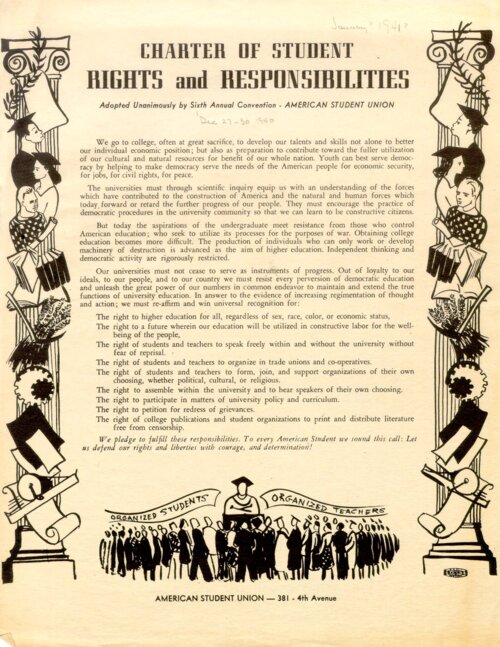 American Student Union's "Charter of Student Rights and Responsibilities," Adopted at the American Student Union's (ASU) 1940 convention, this document lays out the group's main tenets, namely the belief that peace and progress must be found and cultivated at each of the nation's universities. The charter also lists a set of progressive rights the group sought to "win universal recognition for." The ASU, a left-wing national student organization, was formed in December 1935 following the merging of the National Student League and the Socialist Student League for Industrial Democracy. At the time, it was the largest of all national student groups, counting over 20,000 members in its rolls.
 -
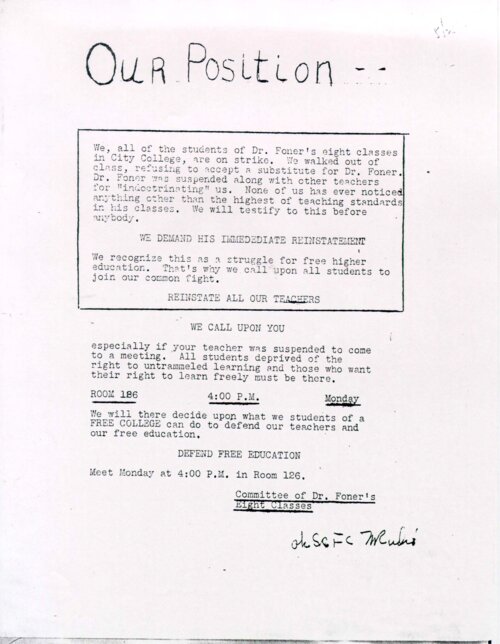 "Our Position" This flier promotes a student rally in support of suspended City College history instructor Jack Foner. Foner, a CCNY graduate of 1932, was just one victim of the Rapp-Coudert hearings which lasted from 1940 to 1941. The hearings, organized by New York State, were a concerted effort to rid the state's public schools of "subversive" and undesired influences on campuses. While Foner was alleged to have belonged to the Communist Party, no evidence was ever presented in support of the claim. Refusing to testify before the Rapp-Coudert Committee, however, Foner was shortly thereafter suspended from his position and later fired. Foner was an ardent anti-fascist and champion for civil rights as well as trade unions. He taught at CCNY along with his twin brother, Philip, who was also fired as a result of the Rapp-Coudert hearings.
26–50 of 60