Free Speech at CCNY, 1931-1942
Item set
Collection
Free Speech at CCNY, 1931-1942
Time Periods
1847-1945 The First Century of Public Higher Education in NYC
Items
51–60 of 60
Advanced search
-
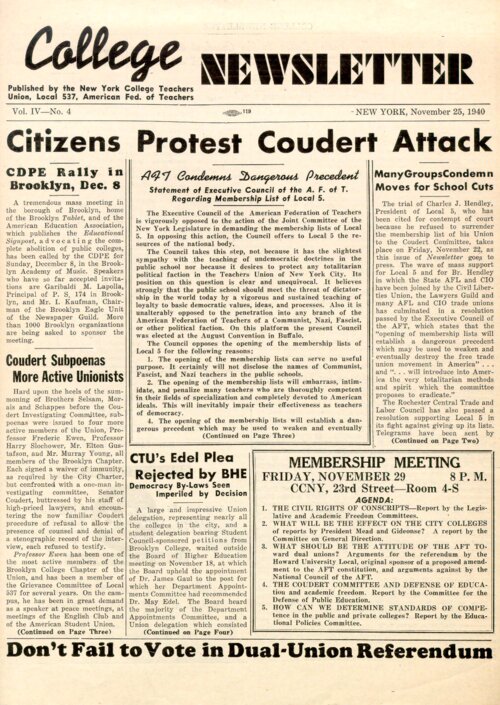 College Newsletter, November 25, 1940 Published by the New York College Teachers Union, this issue of the College Newsletter covers several reactions to the ongoing Rapp-Coudert hearings of the early 1940s.The Rapp-Coudert Committee was a New York State initiative organized in June 1940 to investigate and identify "subversive activities" and persons in New York City's public schools and colleges. As two of the articles from this extract attest, several teachers' unions were targeted in the initial stages of the investigation as their membership rolls comprised many union activists. City College, in particular, became a target of the commitee with dozens of faculty and staff called to public and private hearings.
 -
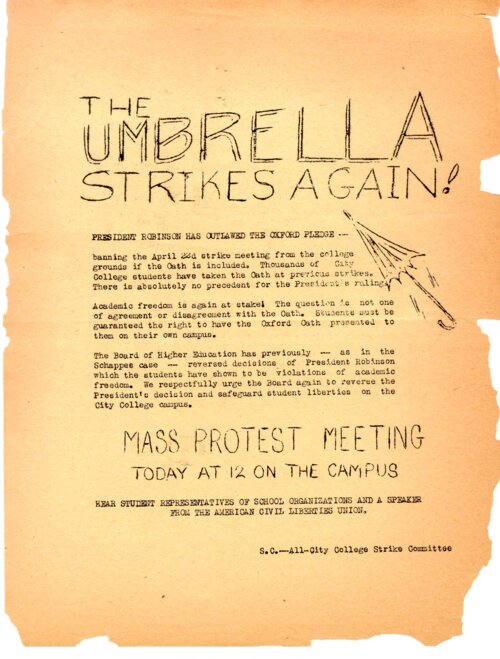 "Umbrella Strikes Again!" Flier This flier promotes an April 14, 1937 student protest against City College President Frederick B. Robinson's decision to ban the "Oxford Pledge" from the CCNY campus. The pledge, an American adaptation of the British original, comprised an oath in which students stated: "I refuse to support the Government of the United States in any war it may conduct." The oath had been a part of protest gatherings in the prior years, though with the new decision, the administration would refuse use of campus facilities to student organizations that employed the pledge. The "umbrella" mentioned on the flier was used in reference to CCNY President Robinson who, in May 1933, allegedly struck multiple students with his umbrella at an anti-war rally on campus. Students adopted the umbrella as a symbol for Robinson for the remainder of his presidency.
 -
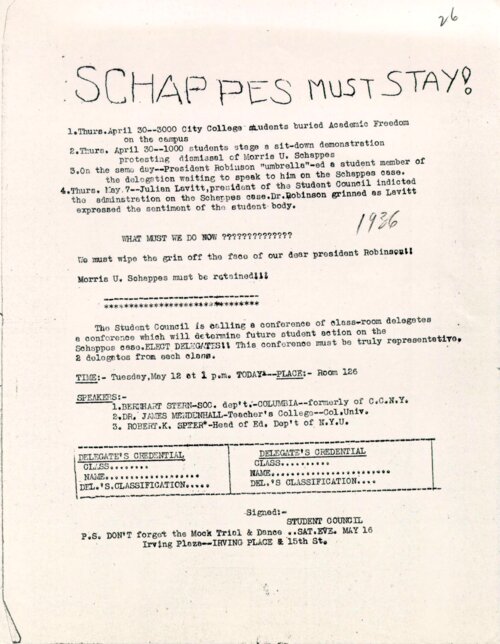 "Schappes Must Stay!" Flier This flier promotes a May 12, 1936 conference organized by City College's Student Council. The meeting, which first called for the election of student-elected delegates, was meant to "determine future student action on the Schappes case." Morris Schappes, an English instructor at the college, had been fired on April 22 after speaking on behalf of the faculty-organized Anti-fascist Association at an anti-war rally on campus earlier that day. His dismissal, attributed by administration to reasons unrelated to the protest, provoked an uproar from many students who immediately began to fight for his reinstatement. More than 1,000 students staged a several days long sit-in in front of the president's office. As a result of their efforts, he retained his job though it was not long before Schappes' political leanings would lead to his dismissal and imprisonment in 1941.
 -
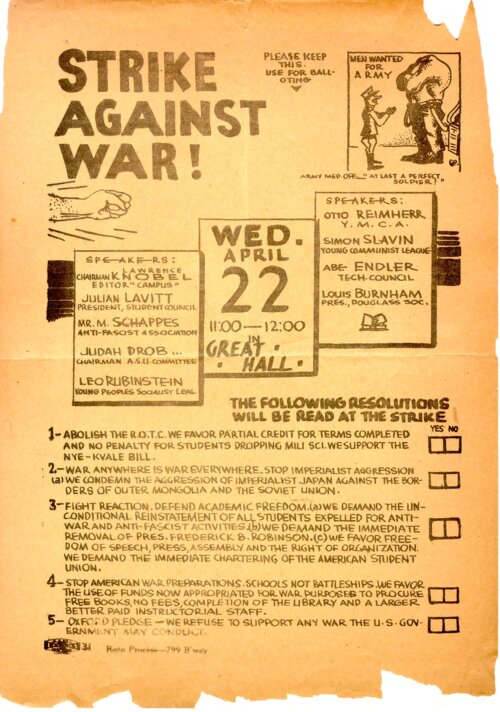 "Strike Against War!" Flier This flier advertises an April 22, 1936 anti-war demonstration in the Great Hall at the City College of New York (CCNY). The event, attended by 3,500 students, featured addresses from student and faculty leaders as well as a vote that reaffirmed the students' fight against both the ROTC on campus and CCNY President Frederick Robinson. They further denounced perceived American war preparations and Japanese imperial aggression, and announced their refusal "to support the government of the United States in any war it may undertake." Like several other rallies from the previous year, this demonstration was part of a larger coordinated nationwide effort of left-wing and liberal students that day led by the American Student Union, around 500,000 participated in all. At CCNY, day students left class at 11am to participate in the strike while evening students held a similar rally later that night. Perhaps the most immediate consequence of the protest was the firing of Morris Schappes, a professor in the English Department who had spoken at the rally on behalf of the Anti-fascist Association. His firing, announced the day of the rally though attributed to other causes, would spark an outcry amongst many in the CCNY community. As a result of their efforts, he retained his job though it was not long before Schappes' political leanings would lead to his dismissal and imprisonment in 1941.
 -
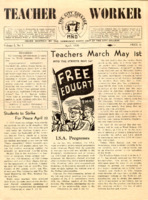 Teacher and Worker, April 1936 Articles on this front page of the April 1936 issue of City College's Teacher and Worker discuss a planned student "peace assembly" as well as preparations for faculty participation in the upcoming May Day Parade. This monthly campus publication was produced by the "Communist Party Unit of the City College."Teacher and Worker commenced publication in March 1935 and throughout its run contained anonymously written articles that discussed various campus issues as well as larger national and international concerns. The publication is just one example of rising faculty activism at CCNY during the period. Participation in the campus Communist Party as well as the Anti-fascist Association all stemmed from a desire to combat fascism and other societal injustices.
 -
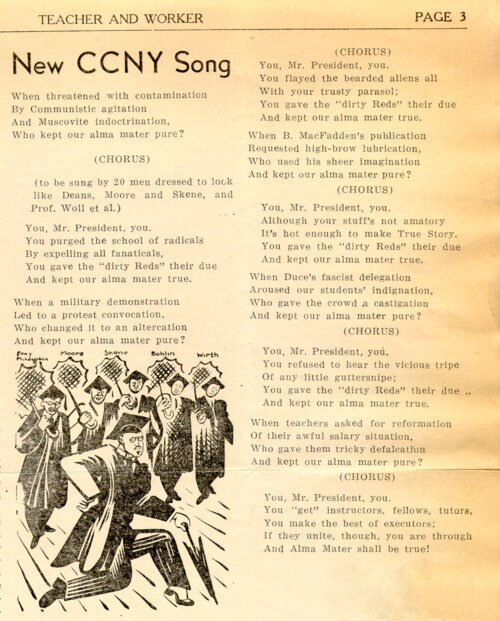 "New CCNY Song" Published in the March 1936 edition of Teacher and Worker, the lyrics from this parody song mock City College of New York (CCNY) President Frederick B. Robinson and his efforts to keep "our alma mater pure," often through the supression of free expression on campus.Throughout the decade, President Robinson and left-wing student activists were continually in conflict and the song makes reference to several incidents. The events referenced include: Robinson's expulsion of students following protests ("expelling all fanaticals"), his calling in the police on May 29, 1933 student rally ("who changed it to an altercation"), his assault on students with his umbrella at that same rally ("flayed the bearded aliens all / with your trusty parisol"), his invitation and welcoming of representatives from Mussolini's government ("Duce's fascist delegation"), and his dismissal of protesting students as "guttersnipes."The Teacher and Worker was a monthly publication created by the Communist Party Unit of the City College.
 -
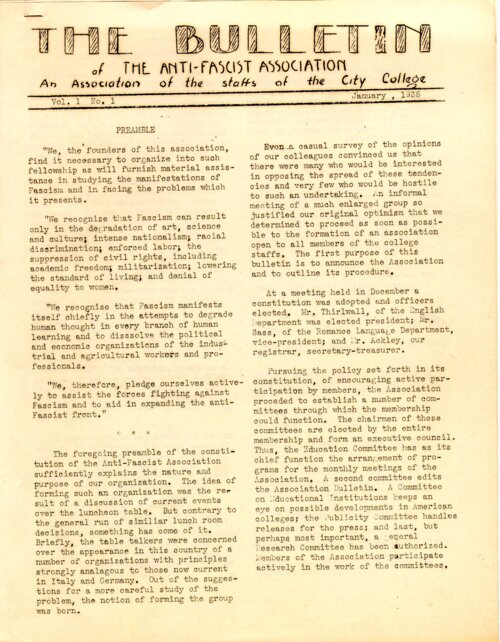 The Bulletin of the Anti-Fascist Association, January 1935 Founded by City College staff in early 1935, the Anti-Fascist Association was a collective of likeminded left-wing and liberal faculty who perceived and fought against a rising threat of fascism abroad and militarism at home. The group held monthly meetings and published their newsletters monthly as well. The document is the front page of the group's inaugural bulletin. The Anti-Fascist Association counted approximately 200 members in its ranks, including senior faculty, with representatives from the organization often speaking at student-organized anti-war rallies. In 1936, one such representative, English instructor Morris Schappes, would be fired just hours after addressing a crowd of student protestors.
 -
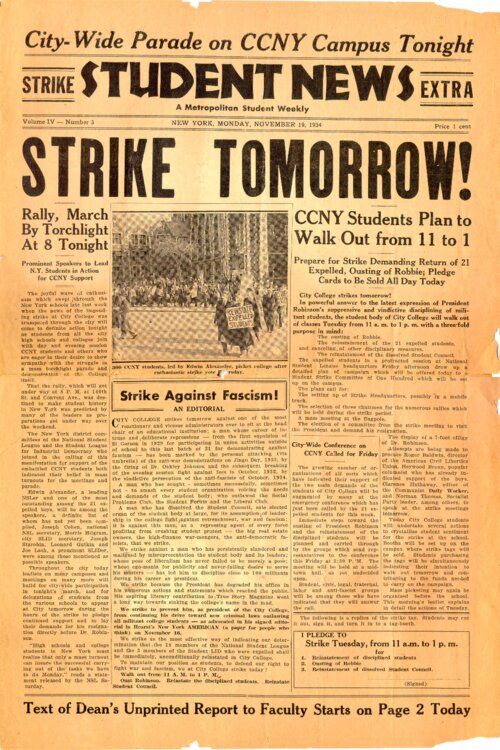 "Strike Tomorrow!" The headline for this edition of Student News announces City College students' strike set for November 20, 1934. The strike was demanded the reinstatement of twenty-one expelled students as well as the removal of City College (CCNY) President Frederick B. Robinson. The twenty-one were expelled following an anti-fascist rally on October 9th.As one article on this front page excerpt notes, the rally began at 11am. It lasted approximately two hours, attracting a crowd upwards of 1,500 students. By event's end, three students were reported to have been arrested during a clash with police and a two-headed effigy of CCNY President Robinson and Italian Prime Minister Benito Mussolini was burned.Student News was published weekly by the National Student League, a Communist-led collective of high school and college students based in New York City.
 -
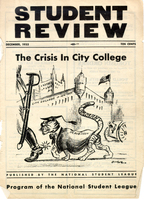 "The Crisis in City College" On this cover of the December 1933 edition of the National Student League's Student Review, CCNY President Robinson is depicted in full academic regalia as a cat, following in step behind a German military officer. Robinson's tail, meanwhile, is wagged by Tammany Hall, New York’s corrupt Democratic political machine. During his time at City College, Robinson drew extraordinary criticism from the left, particularly because of his repeated attempts to stifle free expression on campus. In May 1933, Robinson issued suspensions to a number of students, clubs, and campus publications following an anti-war/anti-ROTC rally in which he was alleged to have struck multiple students with his umbrella prior to his calling for police presence on campus.
 -
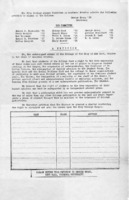 Alumni Petition for Free Expression on Campus This June 1933 petition was created by the City College Alumni Committee on Academic Freedom in protest of the college's treatment of students following a May 29th rally. The student-organized anti-war/anti-ROTC rally met resistance from the college administration who called upon the police to "disperse student" activity. In the petition, the Alumni Committee criticizes this police presence and bemoans the suspension of students, suppression of clubs and campus publications, as well as other college efforts to limit free expression on campus.
51–60 of 60