York College and the Jamaica, Queens Community
Item set
Collection
York College and the Jamaica, Queens Community
Items
1–23 of 23
Advanced search
-
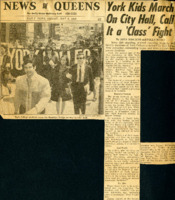 "York Kids March on City Hall, Call It a 'Class' Fight" This Daily News article details a May 1968 march by York College students in protest against what they considered inadequate campus facilities. York, the newest of the CUNY schools at the time, relied on temporary space within Queensborough Community College from 1968 to 1971. While there was much discussion over where the permanent campus ought to be placed (Jamaica), many felt little regard was given to the school's facilities in the interim.
 -
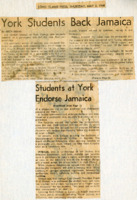 "York Students Back Jamaica" This Long Island Press article discusses the York College Student Council's decision to support the Board of Higher Education's selection of Jamaica, Queens as the permanent location for the college. At the time of the article's printing, the school had relied on temporary space within Queensborough Community College in Bayside and many on the Student Council previously supported remaining in that neighborhood. The college would remain in Bayside until 1971 before relocating to Jamaica. Even in Jamaica, they would again rely on temporary space until construction was completed on their main new building in 1985.
 -
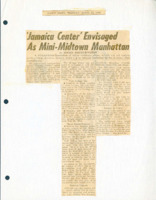 "'Jamaica Center' Envisaged As Mini-Midtown Manhattan" This April 22, 1968 article from the Daily News discusses the plans of city officials to develop the "long awaited...Jamaica Center" in the heart of South Jamaica, Queens. Intended to help reverse the neighborhood's "decay," the project was expected to provide great benefit to the area's largely black population. A significant part of the development plan, as noted in the article, was the creation of York College, CUNY's commitment to a four-year school in the underserved community. While the school moved into the neighborhood in the early 1970s, it would not be until 1985 that their permanent campus opened for classes.
 -
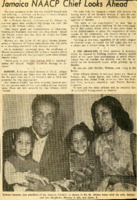 "Jamaica NAACP Chief Looks Ahead" This short article from the Daily News profiles Richard Hansen, the newly appointed president of the Jamaica branch of the NAACP. Shown with his wife and two smiling children, the article describes Hansen's hopes for the future of Jamaica, Queens and its residents. Of particular interest, the new president states "We're glad to have York College built in Jamaica," adding "higher education belongs in Jamaica."CUNY's commitment to housing a four-year college in Jamaica, Queens in New York City offered great promise for many in the often overlooked neighborhood. Throughout the 1970s, the college struggled to build a permanent campus due to the economic downturn of the decade. Until 1986, the college relied on temporary and rented spaces throughout Jamaica before settling into their new and present home.
 -
 "York College Getting a New Home in Queens" This New York Post article details the Board of Higher Education's approval of the 1970 master plan for York College's campus construction. While the plan still needed a final go-ahead from the Board of Regents and Governor Nelson Rockefeller, the proposed 50-acre, nine building campus was estimated to be completed by late 1976. The city's fiscal crisis during the decade, however, would delay construction and the college would not see the opening of its campus until 1986. Until then, York had relied on rented and temporary spaces throughout Queens since its founding in 1966. CUNY's commitment to a four-year college in Jamaica offered great promise for many in the often overlooked neighborhood.
 -
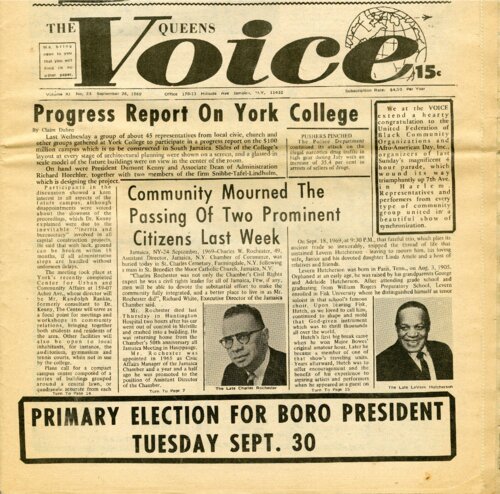 "Progress Report on York College" This article from the Queens Voice reports on a September 1969 gathering of "45 representatives from local civic, church, and other groups" concerned with the progress of the $100 million campus plans for York College in South Jamaica, Queens. Detailing the college's plans for the campus and the construction timeline (3-4 years), the article goes on to reference the frustrations of various local groups who desired greater involvement with the college planners.Their frustrations would only grow, however, as the fiscal crisis of the 1970s and battles with Governor Nelson Rockefeller threatened York's existence as a four-year school and stalled construction efforts throughout the decade. It was not until 1986, twenty years after the college's founding, that York would begin the move to its permanent campus.
 -
 "Board, City Push Hunt for York Site" This article from the New York Daily News details an early push from civic leaders to find a temporary location for the nascent York College in Jamaica, Queens. Founded in 1966, two years prior to this article's printing, the college initially relied on rented space in Bayside, Queens with the intention of eventually settling in Jamaica. As the article notes, community leaders feared for the college's future in Jamaica after the city "failed to secure two of the three sites it had promised to the BHE [Board of Higher Education]." Though established in 1966 as the fifth senior college of the City University of New York, York College spent two decades without a permanent campus. Relying first on rented space in Bayside, Queens, the school temporarily re-located to the Queensborough Community College campus from 1968-1971. The administration then relied on a mix of rented and purchased buildings in Jamaica until the opening of the first building of their permanent campus in 1986.
 -
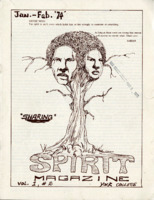 Spirit Magazine, January 1974 This is an excerpt from the January-February 1974 issue of the York College student-run Spirit Magazine. A brief article on the second page announces the college's creation of an African-American Studies program and the following article reports on the creation of the South Jamaica Neighborhood Action Program (NAP). The latter program was formed to serve as a "liaison" between community residents and municipal agencies, and to allow residents a greater voice in the affairs of their neighborhood.Spirit Magazine, a self-proclaimed "third-world publication", was the creation of York College students and reflected the concerns and priorities of the college's largely black student population.
 -
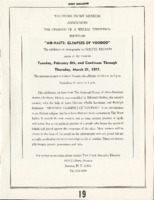 "Ah-Haiti: Glimpses of Voodoo" This advertisement from an issue of the York College student-run Spirit Magazine, demonstrates the strong relationship between students at the college and the surrounding community. The ad announces a photography exhibition entitled "Ah-Haiti: Glimpses of Voodoo" at the Store Front Museum in Jamaica, Queens. The mission of the museum, which was founded in 1971 with the goal of promoting African-American culture, aligned closely with the aims of Spirit. A self-described "third world publication," the magazine typically focused on the needs and concerns of York's large black student population placing particular emphasis on heritage and tradition.
 -
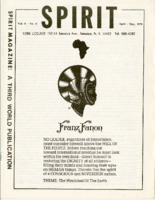 Spirit Magazine Cover, April 1979 This is the cover of the April 1979 issue of the York College student-run Spirit Magazine. Featuring a quote from Afro-Carribbean philosopher and writer, Frantz Fanon, the page introduces the issue's theme of "The Wretched of the Earth," a title of one of Fanon's most popular works. Fanon was an apt choice for the magazine as his frequent focus on colonialism and liberation spoke especially to the college's diverse black student population. The magazine, which dubbed itself a "third world publication" typically focused on the unique concerns of its readership, often dealing with issues of race and social justice as well as simple neighborhood issues in Jamaica, Queens.
 -
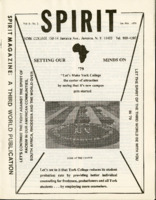 Spirit Magazine Cover, January 1979 The variety of the headlines found on this cover of the January 1979 issue of Spirit Magazine reflect the many concerns of the York College student-run publication. Framed as hopes for the upcoming year, the magazine calls for: a continued fight against racism in the U.S. and abroad, better counseling at the college for academically struggling freshman, and the construction of a new college campus. Featured perhaps most prominently, the call for a new campus was hardly unique to 1979. Plans for construction were announced as early as 1972, however, the city's economic woes delayed development forcing the college to rely on a scattered mix of rented and owned properties in Jamaica, Queens. It was not until 1986, twenty years after the college's founding, that the school opened the first of its permanent buildings on its present campus. Spirit Magazine, a self-described "third-world publication", was the creation of York College students and reflected the concerns and priorities of the college's large black student population.
 -
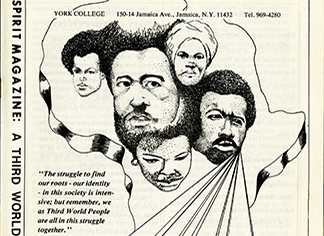
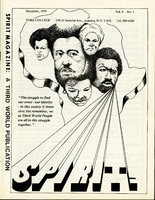 Spirit Magazine Cover, December 1978 This is the cover of the December 1978 issue of the York College student-run Spirit Magazine. Feauturing drawings depicting African-American women and men over the continent of Africa, it also includes a quote that aptly reflects the mission of the magazine. A self-described "third world publication," Spirit was the creation of York College students and reflected the concerns and priorities of the college's large black student population.
 -
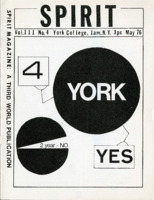 Spirit Magazine, April 1976 This is an extract from the April 1976 issue of the York College student-run Spirit Magazine. Each of the selections from this issue: the cover, the editorial, and the letter to the editor, reflect ongoing fears from students regarding the future of the college in the face of tremendous economic instability at the city, state and national levels. As the articles attest, during the turmoil, York College was threatened variously with a demotion to a two-year community college and outright closure. Fortunately, neither outcome came to bear though the college did share in the austerity measures implemented across the CUNY system. At York College, efforts to build a permanent home for the school stalled until the 1980s despite the announcement of construction plans in 1970.
 -
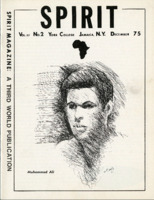 Spirit Magazine, December 1975 Feauturing an illlustration of Muhammed Ali on its cover, in this edition of the December 1975 issue of Spirit Magazine, the publication's editor-in-chief, Frank Tucker, bemoans the less than satisfactory support given to Spirit from York College administration. Not the first time Tucker has addressed the topic, in his extended editorial he compares the difference in allocated funds and facilities between Spirit and the college's main newspaper, Pandora's Box. Spirit Magazine, a self-described "third-world publication", was the creation of York College students and reflected the concerns and priorities of the college's large black student population. Pandora's Box, still in print today, had a more general focus.
 -
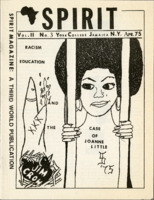 Spirit Magazine, April 1975 These selections are from the April 1975 issue of the York College student-run Spirit Magazine. The publication typically focused on the concerns and needs of the college's large black student population.The magazine's cover features Joanne Little, an African American woman charged with the murder of a white prison guard in a North Carolina jail in 1974. A lengthy article in this issue details the state's desire for the death penalty. Several months after the magazine's' printing, however, a jury found Little not guilty by way of self-defense. Among the other items included is an article detailing the Pan African Skills Project, an initiative created to bring skilled workers to places like Tanzania. The program's recruitment process and history are described in some detail. In another article, a York College student attempts to investigate claims of racism and discrimination on campus. Alleging, among other things, questionable hiring practices on the part of the college's administration, the article concludes that the present instructional staff, for several reasons, fails to contribute to the larger Jamaican community outside of the school.Finally, a memorial piece can be found for Clifford Glover, a 10-year old boy killed by a police officer in Jamaica, Queens in 1973. His death, which came as he was running away, the officer's later acquittal, and the riots that followed all remained in the neighborhood's collective memory in subsequent years.
 -
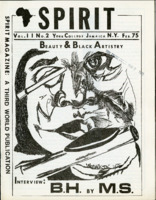 Spirit Magazine, February 1975 In this article excerpted from the December 1975 issue of York College student-run Spirit Magazine, managing editor Teddy DuBose decries proposed budget cuts to CUNY institutions at the height of the 1970s fiscal crisis in New York. DuBose further rejects the idea of implementing tuition at the city's historically free colleges. The city and state's economic woes were of such severity, however, that the protestations of DuBose and thousands of others were of little consequence. By the fall of 1976, not only did the university system face large budget cuts but full time students were responsible for tuition costs for the first time since the founding of the city's Free Academy nearly 130 years earlier. Spirit Magazine, a self-described "third-world publication," was the creation of York College students and reflected the concerns and priorities of the college's large black student population.
 -
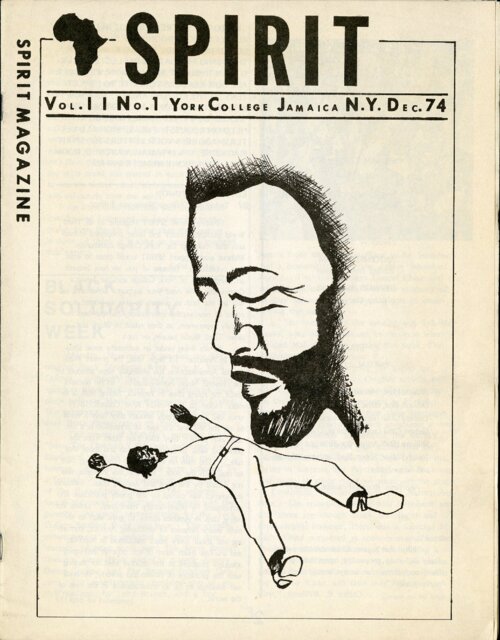 Spirit Magazine, December 1974 This excerpt from the December 1974 issue of York College's Spirit Magazine features student-produced artwork, poetry, and journalism. A self-described "third world publication," the magazine typically focused on the needs and concerns of York's large black student population.One article from this excerpt describes a talk given by noted civil rights activist Stokely Carmichael following a screening of "Black Power: Future of the U.S.A." at the Storefront Museum, an institution founded three years earlier with the mission of promoting African-American culture in Queens. Carmichael's talk largely focused on his Pan-African organization (A.A.P.R.P) though the article's authors mention other questions and points brought up at the lecture. Another article summarizes a speech given on campus by a minister from the Nation of Islam.
 -
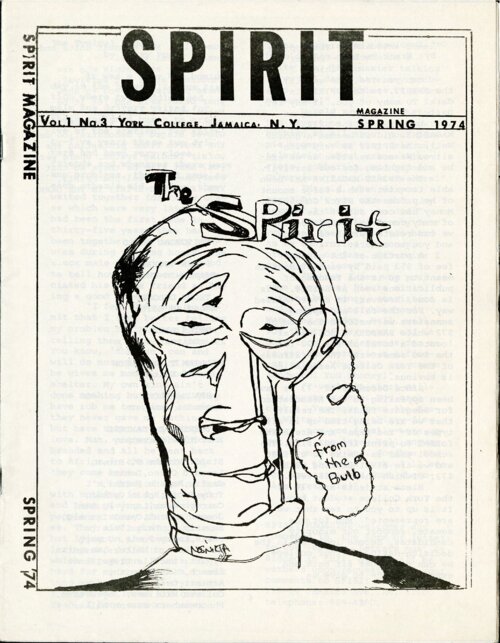 Spirit Magazine, Spring 1974 This is an excerpt from the Spring 1974 issue of the York College student-produced Spirit Magazine. Included in this selection is a call from Frank Tucker, the magazine's editor-in-chief, for greater student involvement and increased financial support from the school for the publishing of Spirit. Citing the "unfairness of the York College Association", Tucker states that Spirit receives a meager $72 per annum compared to the $21,000 allocated to the school's larger newspaper, Pandora's Box. Unlike the more general focus of the latter, Spirit typically appealed to the college's large black student population focusing on their unique concerns and needs.Another article from this issue discusses a recent "series of dragnets in the Haitian community in Brooklyn." The author describes the Immigration and Naturalization Service's efforts as unwarranted with Haitian activists alleging that the government's targeting of them was an attempt to silence their protests over the recent suicide of Turenne Deville, a Haitian in Miami, who feared deportation after being denied asylum.
 -
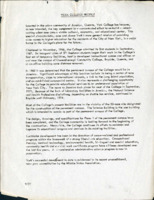 "York College Profile" This short profile of York College was likely produced by the college itself in September 1977. The one-page item briefly traces the history of the college from its establishment in 1966 and its temporary housing in Queensborough Community College through to the school's then still temporary facilities in Jamaica. As noted, the college represented CUNY's commitment to locating a four-year school in an underserved NYC community.
 -
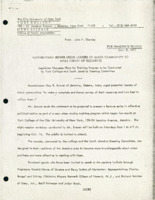 York College Press Release about Training Program and Public Events for Black Community This press release from York College features statements from state assemblyman Guy Brewer as promotion for the college's community-focused urban studies training program. Brewer, a lecturer in said program, is quoted urging Jamaica, Queens leaders to "learn how the actual strength of their communities can be 'catalogued, cross-filed and mobilized when need be in a way that will guarantee their maximum 'clout' on the political power structure." The federally funded program was "designed to train residents of the Jamaica community to become more knowledgeable about urban problems and more effective in dealing with agencies and institutions." With classes first beginning in fall 1971, the program reflected the college's commitment to playing a vital role in the life of the Jamaica community.
 -
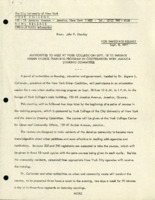 Press Release on York College Urban Studies Training Program In this press release, York College officials announce the start of the newly created Urban Studies Training Program during the Fall 1971 semester. Originally announced in May '71, the program offered a variety of courses "designed to train residents of the Jamaica community to become more knowledgeable about urban problems and more effective in dealing with agencies and institutions." With 200-250 participants expected in its initial semester, the federally funded program was created with the help of the Jamaica Steering Committee, a group comprising more than 100 neighborhood organizations. York College's presence in Jamaica reflected CUNY's commitment to offering a four-year education in underserved communities such as Jamaica, Queens. For many residents, the school offered great promise, and the creation of the urban studies training program was an effort to support the Queens community.
 -
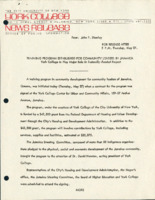 York College News Release on Training Program This press release from York College announces the creation of a "training program in community development for community leaders of Jamaica." Funded by a federal grant as well as support from York College, the announced program would feature six courses ranging from physical "land use" planning to housing policy in the inner city. The program was established at the behest of the Jamaica Steering Committee, a group composed of "more than 80" organizations in Jamaica, Queens. York College, since its establishment in 1966, reflected CUNY's commitment to housing a four-year college in Jamaica. For many residents, the school offered great promise to the underserved neighborhood.
 -
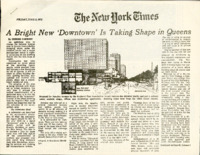 "A Bright New 'Downtown' Is Taking Shape in Queens" This New York Times article from June 2nd 1972 discusses the progress and development of a once "ambitious" construction plan on Jamaica Avenue in Queens. The plan, which set about for the "radical transformation" of the area, focused, in no small part, on the creation of a 50-acre permanent campus for York College. As the article states, development planners called the college's construction as the "'key bridge' between the black and white communities in central Queens and one of the most essential elements in the over-all plan." The fiscal crisis of the 1970s, however, along with battles with Governor Nelson Rockefeller, threatened York's existence as a four-year school and stalled construction efforts throughout the decade. It was not until 1986 that the college moved into their permanent and present location.Though founded in 1966 as the fifth senior college of the City University of New York, York College spent two decades without a permanent campus. Relying first on rented space in Bayside, Queens, the school temporarily re-located to the Queensborough Community College campus from 1968-1971, following which administration relied on a mix of rented and purchased buildings until the opening of their permanent campus in 1986.
1–23 of 23