Documents on the Origins of CUNY
Item set
Collection
Documents on the Origins of CUNY
Time Periods
1847-1945 The First Century of Public Higher Education in NYC
1946-1960 Municipal College Expansion
1961-1969 The Creation of CUNY - Open Admissions Struggle
Items
1–7 of 7
Advanced search
-
 "Administrative Management of the School System of New York City" The Survey of The Board of Education and The Board of Higher Education report was conducted in 1951 by George Strayer. It is an early effort to reorganize municipal colleges. Among other reports and legislative laws, it documents the shift in policy that would ultimately lead to the consolidation of New York City’s municipal colleges into one coordinated system. After a year of observation, study and analysis the report made recommendations as to the management of public education and higher education which included an increase in financial support to municiple colleges, the establishment of more junior colleges and technical schools and a transfer of the municipal college system to the State University of New York to excersise full mangerial responsibility.
 -
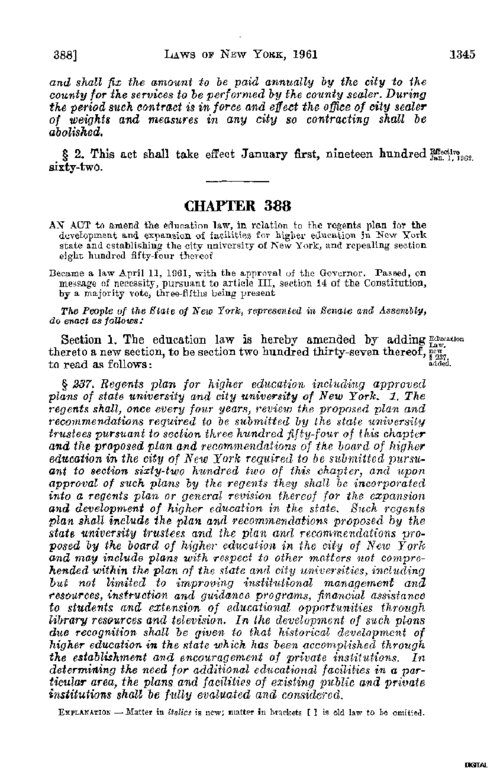 Amendment to New York State Education Law (1961) The 1961 amendment to the Education Law establishes CUNY and at the same time repeals the 1926 legal mandate for free tuition. It states that the Board of Higher Education shall be a "separate and distinct body corporate", which will administer all educational units under the general name "City University" and the college’s distinctive title. Every four years the Board of Higher Education will make recommendations to the Board of Regents including but not limited to curricula, new facilities, admission policies and funding. This funding model legalizes out of state tuition and introduces Regent College Scholarships.
 -
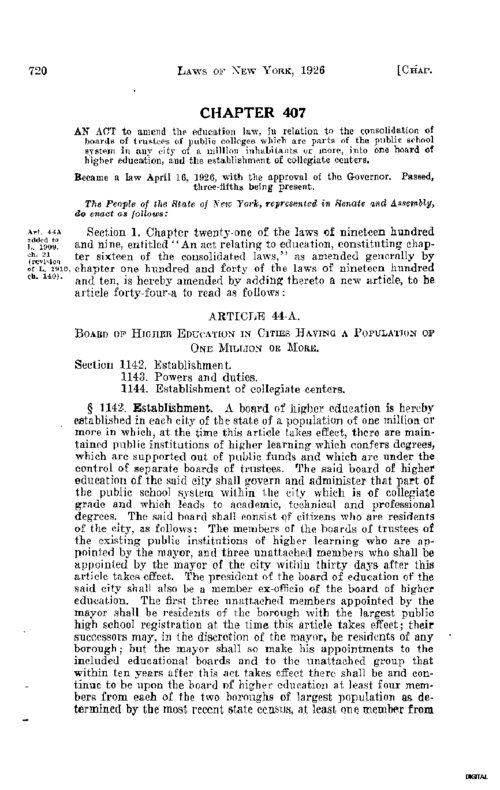 The Education Law: Chapter 407 of New York State Law (1926) This 1926 amendment to the education law legislatively establishes the legal mandate to create the Board of Higher Education and thereby reasserts free tuition as a democratic right. It offers insights into how certain policy changes paved the way for the creation of a consolidated municipal system of higher education. In article 44-A the Board of Higher Education is established as a separate entity from the Board of Education in cities with populations greater one million people. It is granted power and duties such as the acquisition of new sites and the approval of all courses. The law also outlines how funding is to be appropriated from the city to the board. Only in 1961 will the education law be repealed replacing free tuition with a Scholarly Incentive Program.
 -
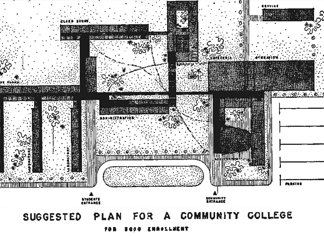
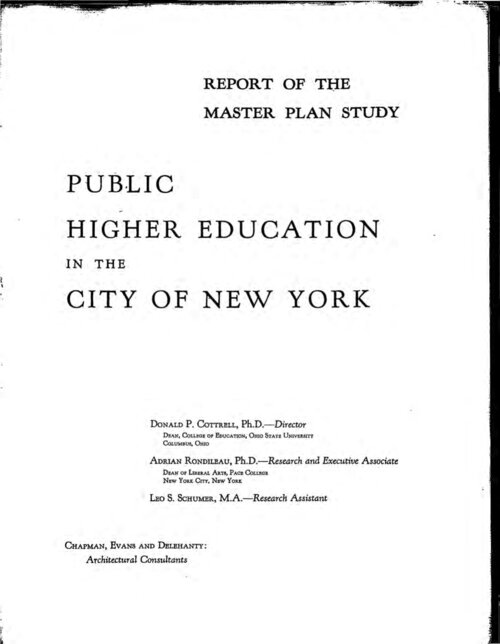 Cottrell Report: Public Higher Education in the City of New York This 48-page report provides a comprehensive survey of New York City's higher educational institutions in 1950 and its outlook over the next two decades. Commissioned by the Board of Higher Education, the study sought to identify, anticipate, and analyze the issues that the changing city would face in higher education. Divided into four chapters, the report's main findings are found in the first chapter which presents the group's general recommendations and conclusions. The majority of the findings related to ways to satisfy increased demand for higher education across the city's five boroughs. Especially interesting are the suggested capital projects which offered ideas meant to increase the capacities of the city's municipal colleges. Appendices in the back of the report provide additional insights into the population and student makeup of the colleges at mid-century.
 -
 "A Long-Range Plan for the City University of New York, 1961-1975" New York City's Board of Higher Education appointed Thomas Holy as lead consultant to write this 424-page report 1962 on the future of the City University of New York. The report articulated three major goals: to build or acquire more community and four-year colleges; to expand enrollment by creating a more flexible admissions policy; and to maintain free tuition for full-time four-year college students.
 -
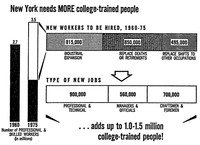 "New York needs MORE college-trained people" (from Heald Commission Report) This image from the Heald Commission Report shows the projected need for skilled and college -educated workers in its argument for additional colleges. Upon his election as governor in 1959, Nelson Rockefeller established a committee to examine the expected increase in demand for higher education in New York in the coming decades. The committee, chaired by Henry Heald, issued this report calling for an expansion of the SUNY system as well as public aid to private colleges, increased student scholarships, and an end to the tuition-free policy in New York City's municipal colleges.
 -
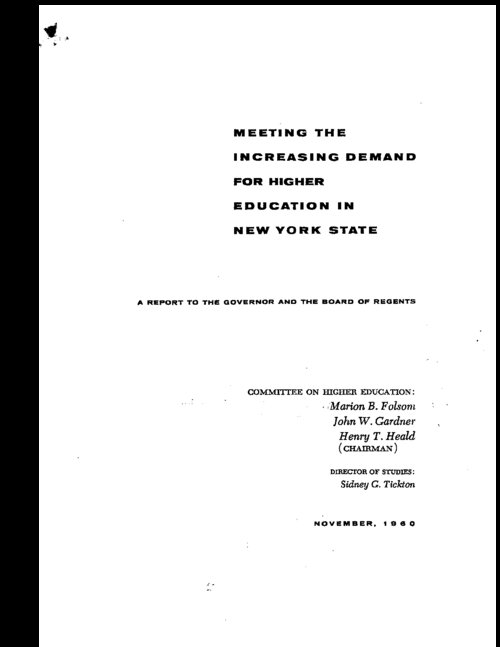 "Meeting the Increased Demand for Education in New York State" (Heald Commission Report) Upon his election as governor in 1959, Nelson Rockefeller established a committee to examine the expected increase in demand for higher education in New York in the coming decades. The committee, chaired by Henry Heald, issued this report calling for an expansion of the SUNY system as well as public aid to private colleges, increased student scholarships, and an end to the tuition-free policy in New York City's municipal colleges.
1–7 of 7