SEEK's Fight for Racial and Social Justice (1965-1969)
Item set
Collection
SEEK's Fight for Racial and Social Justice (1965-1969)
Time Periods
1961-1969 The Creation of CUNY - Open Admissions Struggle
Items
1–20 of 20
Advanced search
-
 "The Faculty Council Interim Report of the Committee on Enrollment Policy" This April 1964 report shows the deep conflicts within the CCNY faculty with regards to expanding access to new students. Complaining about limited facilities and student unreadiness, the faculty committee resisted both loosening admissions requirements and admitting many of the transfer students coming from CUNY’s new community colleges. At the same time, the committee supported a limited desegregation program, arguing euphemistically for admission of a “special group of pre-matriculated students to be selected from underprivileged areas.”
 -
 "Will Everyman Destroy the University?" In this article, CUNY’s new Vice Chancellor Timothy Healy writes of SEEK as both a practical and theoretical model for open admissions. He cites the success of the program--intended to improve higher education access for the underserved--as proof to skeptical community leaders that the newly expanded CUNY would not become a revolving door that further victimized disadvantaged black and Latino students. In Healy’s view, without “SEEK the idea of open admissions would never have been born [and] without SEEK the operation could well fail.” Short for "Search for Education, Elevation, and Knowledge," SEEK was formally established in 1966 as a CUNY-wide program to assist disadvantaged students who might otherwise lack the opportunity to study at a four-year college.
 -
 "Pre-Baccalaureate Program Student Statistics -- Fall Term 1965" This early summary of the first semester of SEEK (then known as the Pre-Baccalaureate Program) details the courses, schedules and teachers for the 113 SEEK students in Fall 1965 at CCNY. These first SEEK students took a mix of mainstream and special SEEK course sections. The only course taken by everyone was the 5-credit stretched version of English One (Composition). Anthony Penale and Toni Cade each taught three section of these writing courses. Short for "Search for Education, Elevation, and Knowledge," SEEK was established as a CUNY-wide program to assist disadvantaged students who might otherwise lack the opportunity to study at a four-year college.
 -
 Eugenia Wiltshire: An Oral History of the CCNY 1960s SEEK Program In this oral history interview, Eugenia Wiltshire (nee Dorothy Robinson) recalls her time attending City College in 1966-70 as one of CUNY's first SEEK students. Short for "Search for Education, Elevation, and Knowledge," SEEK was established in 1966 as a CUNY-wide program to assist disadvantaged students who might otherwise lack the opportunity to study at a four-year college.
 -
 Marvina White: An Oral History of the CCNY 1960s SEEK Program In this interview, Marvina White recounts growing up on Dyckman Street in Upper Manhattan and entering City College as part of the first class of SEEK students in 1966. White also analyzes how SEEK-- especially SEEK teachers and counsellors Barbara Christian, Betty Rawls, Mina Shaughnessy and Ed Quinn-- helped her and other students to succeed. Short for "Search for Education, Elevation, and Knowledge," SEEK was established in 1966 as a CUNY-wide program to assist disadvantaged students who might otherwise lack the opportunity to study at a four-year college.
 -
 Francee Covington: An Oral History of the CCNY 1960s SEEK Program and The Paper In 1966, Francee Covington entered City College as one the first class of SEEK students. Here, Francee remembers growing up in Brooklyn, her years as a City College student and her student journalism work on The Paper. Short for "Search for Education, Elevation, and Knowledge," SEEK was established in 1966 as a CUNY-wide program to assist disadvantaged students who might otherwise lack the opportunity to study at a four-year college.
 -
 Allen B. Ballard: An Oral History of the CCNY 1960s SEEK Program In September of 1965, City College launched SEEK, a desegregation and supportive teaching program that quickly became the direct model for new Equal Opportunity Programs at dozens of New York colleges. Here SEEK founder Allen Ballard remembers the 1960s SEEK program, including its writing program and teachers, and some of the SEEK students. Short for "Search for Education, Elevation, and Knowledge," SEEK was established as a CUNY-wide program to assist disadvantaged students who might otherwise lack the opportunity to study at a four-year college.
 -
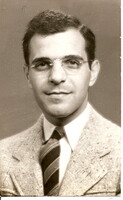 Anthony Penale as a Young Man Anthony Penale was a City College lecturer and writing teacher in 1965 when he was appointed by English Chair Edmund Volpe as the first SEEK English coordinator/director. Penale became ill in the summer of 1967 and Volpe then appointed Mina Shaughnessy as the new SEEK English coordinator/director. Short for "Search for Education, Elevation, and Knowledge," SEEK was established in 1966 as a CUNY-wide program to assist disadvantaged students who might otherwise have lacked the opportunity to study at a four-year college.
 -
 Educational Opportunity Programs: Are They Academically Justifiable? In this 22-page, July 1969 Milwaukee speech to the first annual conference on educational opportunity programs in higher education, Leslie Berger--director of CUNY's SEEK program--describes the birth and rapid growth of SEEK from 1965 to 1969; challenges the validity of admissions criteria as accurate measures of student potential; and explains SEEK’s open admissions, psychological counseling, creative teaching, stretch courses and financial aid. He also responds to calls for black administrators and teachers within EOP programs as well as more relevant curricula across colleges. Short for "Search for Education, Elevation, and Knowledge," SEEK was established as a CUNY-wide program to assist disadvantaged students who might have otherwise lacked the opportunity to study at a four-year college.
 -
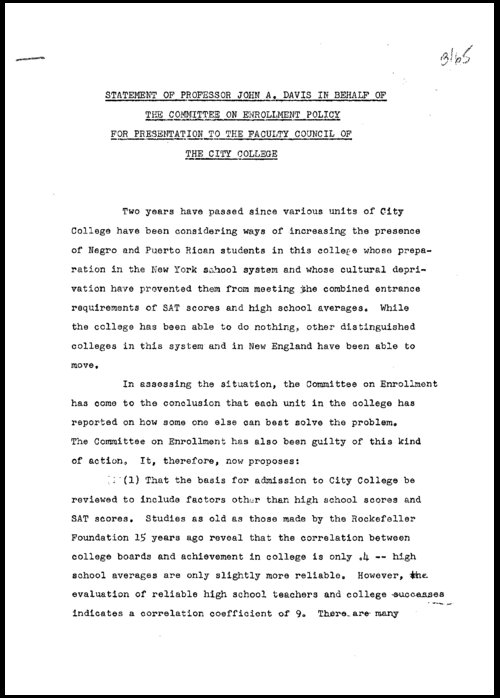 Statement of Professor John A. Davis In this 1965 statement Professor John A. Davis demands that his colleagues at City College take action to increase minority representation at the school. He writes that two years had “passed since various units of City College have been considering ways of increasing the presence of Negro and Puerto Rican students in this college.” Yet, he complains, “the college has been able to do nothing” while other colleges have acted. As a result, Davis proposes: 1) a desegregation program to immediately admit fifty students based on teacher recommendations as well as GPA/SAT scores, 2) beginning summer programs for “culturally deprived” high school juniors and seniors and then admitting them to City College with the help of “guidance and tutorial centers,” and 3) helping to improve the public schools through City’s School of Education. Davis grew up in Washington D.C. where, in the 1930s, he organized effective black boycotts of racist white businesses, setting off a legal fight that ended in a 1938 Supreme Court victory upholding the picketing rights of civil rights protesters, (New Negro Alliance v. Sanitary Grocery, Co., Inc.) Davis joined City College as a political science professor in 1953-- the same year he assisted the NAACP team in the Brown v. Board of Education case.
 -
 Janet Mayes: An Oral History of the CCNY 1960’s SEEK Program In this oral history interview, Janet Mayes, a City College SEEK writing teacher reflects on her experiences with the program. Mayes joined CCNY in the spring of 1967, making her one of the seven original SEEK writing lecturers. She co-taught a SEEK class with Audre Lorde. After a visit to the University of Iowa, Mayes theorized a new collaborative, peer-learning writing course model and walk-in writing center. After leaving City in about 1970, she began work on her doctorate, “Social Facilitation of Learning,” in clinical psychology. Mayes went on to teach at and consult for a series of New York and New Jersey colleges. In the early 1970s, she worked with Kenneth Bruffee at Brooklyn College to set up the seminal peer-tutoring program. Short for "Search for Education, Elevation, and Knowledge," SEEK was established as a CUNY-wide program to assist disadvantaged students who might otherwise lack the opportunity to study at a four-year college.
 -
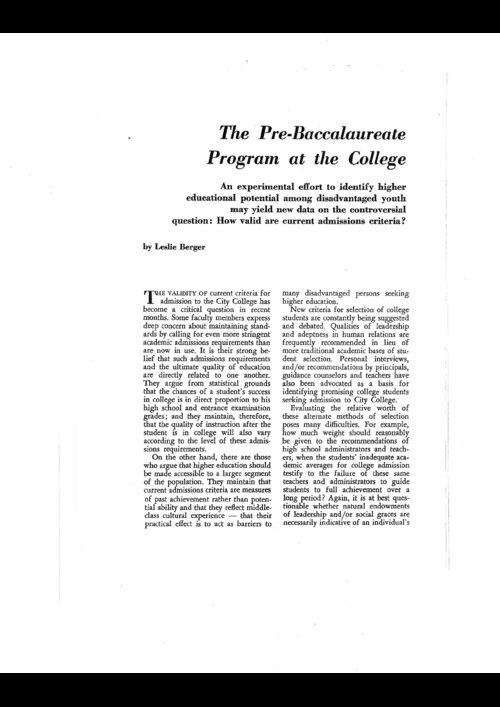 The Pre Baccalaureate Program at the College In this December 1966 City College Alumnus article, Leslie Berger publicly describes and advocates for the City College SEEK model and challenges all traditional college admissions criteria as incompetent measures of student potential. Short for "Search for Education, Elevation, and Knowledge," SEEK was established in 1966 as a CUNY-wide program to assist disadvantaged students who might otherwise lack the opportunity to study at a four-year college. Berger was the program's founding director at CUNY.
 -
 To Help Them Achieve: The Academic Talent Search Project 1966-68, Part II In the Fall of 1964, (armed with a Rockefeller Foundation grant) Brooklyn College’s School of General Studies launched a 42 student pilot program using Bowker’s model, which it called the “Academic Talent Search Project” or “ATSP.” The ATSP students were recent graduates from Brooklyn academic high schools in poverty areas. They had academic diplomas, but low high school grade point averages (pp. 3, 7). They were provisionally admitted until they could demonstrate academic success. ATSP “was designed to explore whether students with apparent college potential, but without the required academic standards for admission, could succeed in college despite financial and cultural deprivation in terms of middle-class values” (p. 7). No new students were added in later semesters; ATSP instead tracked these 42 students for four years. Brooklyn’s modest program demonstrated the complex barriers to racial integration within a conservative, white, four-year college. By 1968, ATSP’s closing report was forced to state “unequivocally that many people at the College believe the Project to have been a failure” (p. 27). After two years, 27 of the 42 ATSP students (64%) returned for a fifth semester. But their GPAs were low, averaging only 1.8 (about a C-) in their first year when they studied in small segregated tutorial groups and 1.2 (just over a D) in their second year when they entered mainstream classes. Also after two years, only one ATSP student had been fully matriculated as a regular student (pp. 14, 18). Eleven more students dropped out in the next two years, leaving only 16 of 42 (38%) in college after eight semesters. By 1968, only four ATSP students had been fully matriculated. Others persisted, but with low grade point averages. By fall of 1968, only one ATSP student had graduated and counselors believed that six more would likely eventually graduate, a potential success rate of 7 out of 42 (16.6%) (pp. 21-22). In June of 1966, ATSP was not mentioned in CUNY’s revised Master Plan (Board, 1966, June, p. 29). (This copy excludes postscript, appendices and and footnotes.)
 -
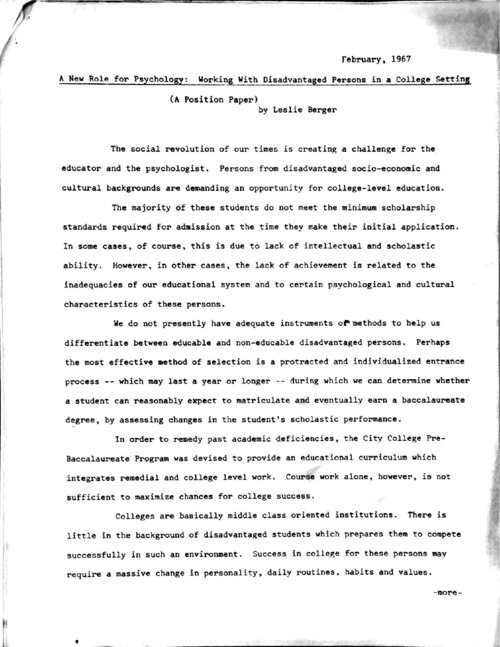 A New Role for Psychology: Working with Disadvantaged Persons in a College Setting In this 10-page "position paper," Berger describes and offers a theoretical rationale for the central role of psychological counselors within SEEK. A handwritten note adds an additional source on page 10. Short for "Search for Education, Elevation, and Knowledge," SEEK was established in 1966 as a CUNY-wide program to assist disadvantaged students who might otherwise lack the opportunity to study at a four-year college. Berger was the program's initial director.
 -
 1967 - 1968 Annual Report of the SEEK Program This is a CUNY-wide report for the SEEK program during the 1967-68 academic year. Included in the document is a cover letter from SEEK director Leslie Berger to CUNY Chancellor Albert Bowker, a table of contents, a list of SEEK administrators, and then 91 pages with 20 sections, including reports about SEEK programs at Brooklyn, City, Hunter-Bronx (Lehman), Queens, and York Colleges and The University Center. Short for "Search for Education, Elevation, and Knowledge," SEEK was established in 1965-1966 as a CUNY-wide program to assist disadvantaged students who might otherwise lack the opportunity to study at a four-year college.
 -
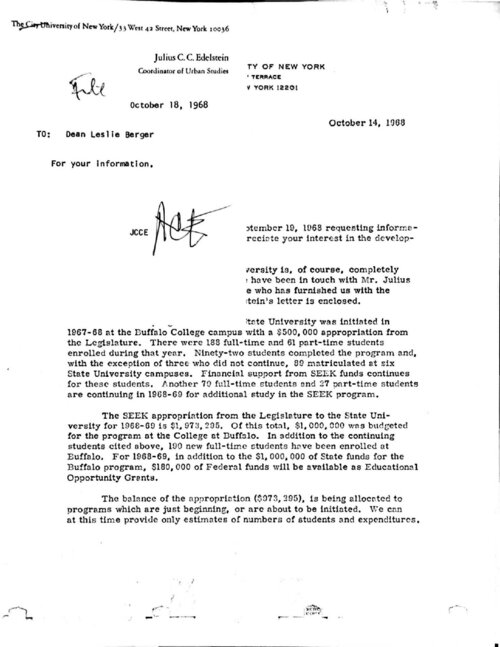 Letter from Samuel B. Gould to John H. Hughes In this letter to New York State Senator Hughes, SUNY Chancellor Gould describes the new SUNY SEEK Program. Gould had shown copies to CUNY’s Chancellor Bowker and Julius Edelstein, CUNY’s “Coordinator of Urban Studies,” who had forwarded the letter to Dean Leslie Berger. Gould describes the launch of SUNY SEEK at Buffalo College in 1967-68 with $500,000 in state funding and the program’s rapid expansion in various forms across SUNY in 1968-69 with $2 million in state funding.
 -
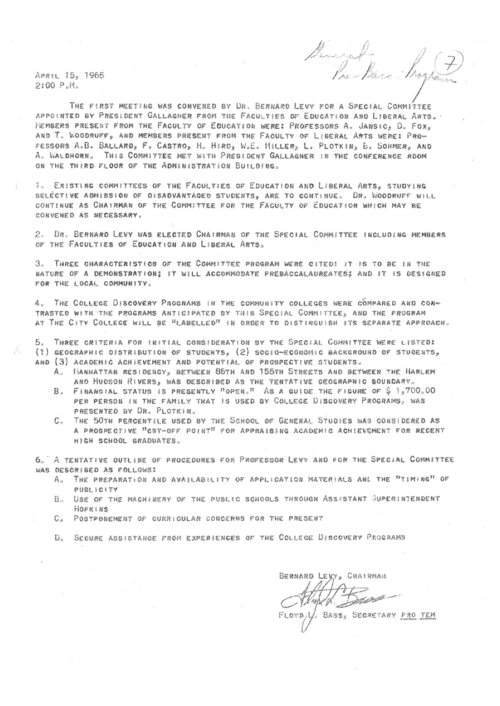 Minutes of April 1965 CCNY "Special Committee" One week after CCNY President Buell Gallagher obtained faculty approval for its creation, he sat in on this “Special Committee” meeting chaired by Bernard Levy to begin to plan a new racial and social justice admissions and support program that would draw applicants from the communities surrounding City College. In practice, the actual planning of the program quickly fell to three professors: Allen Ballard, Bernard Sohmer and Leslie Berger. Ballard and Sohmer are listed in attendance at this meeting. The efforts of the group ultimately contributed to the creation of the CUNY-wide SEEK program in 1966 following a CCNY-specific program the prior year.
 -
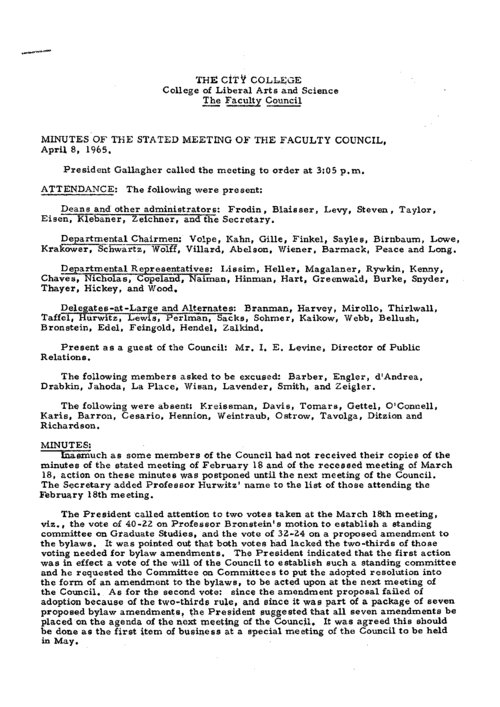 Minutes from 4/8/1965 CCNY Faculty Council Meeting In these notes from a liberal arts and sciences faculty council meeting at City College, CCNY President Gallagher describes a tentative plan to admit 100 “disadvantaged” students into an experimental program in fall 1965. After discussion, the faculty authorizes Chancellor Bowker to appoint a joint committee with the school of education to a plan and launch a CUNY-wide expansion of CCNY's experimental program that, in 1966, would become the SEEK program.
 -
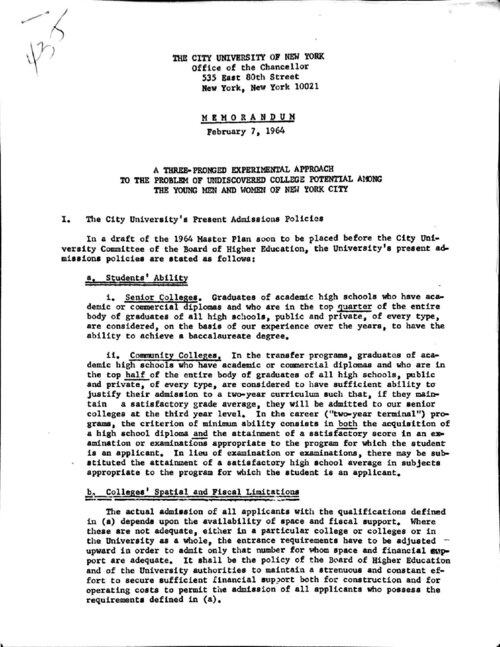 "A three-pronged experimental approach to the problem of undiscovered college potential among the young men and women of New York City" This memorandum from Chancellor Bowker’s office called for three new forms of CUNY desegregation programs (pp. 1-2). This “three-pronged experiment” would be excused from CUNY’s general obligation to admit only students with the highest grades and test scores. Its goal would be “to find out enough about the methods of selection and education of culturally disadvantaged persons of high native ability (‘potential’) to enable us to formulate policies which will place the admission to college of such students upon a firm non-discriminatory basis” (p. 2). The memo added that CUNY hoped “also to learn a great deal about the teaching of students in general” (p. 2). The third prong of the Chancellor’s office’s proposal called on senior colleges to host a “College Potentiality Search” from within their Schools of General Studies, using an elaborate, multi-tiered, application process to provisionally admit groups of students into their schools of general studies as “Pre-Matriculants.” These desegregation programs would teach on a “highly individualized and closely supervised basis” (p. 7). The Chancellor’s office assumed these new students would be underprepared and would struggle to succeed. They would be assigned to zero-credit remedial courses or a mix of remedial and credit bearing courses “until [they] clearly demonstrate a capacity to pursue college-level work” (p.7). Group and individual tutorials would “discover weaknesses and gaps in their educational backgrounds” and raise student performance “to an acceptable collegiate level.” Students would not be treated “as a group” but “as persons, to be judged on their individual records” (p.7). Although retention policies would not be altered in “mistaken generosity” to help any student who “shows himself incapable of completing college level work satisfactorily,” the goal was “for these students to be integrated into the courses and life of the College….by hard work (both on the part of the student and teacher) to a level where they will not suffer new agonies of falling “below par” (p. 7). Students would receive special “counseling and supportive services,” including faculty counseling, “psychological counseling [and] social work” (p. 7). The Chancellor’s office called for a 50-student program to begin in the fall of 1964 and suggested Brooklyn College as its location (p. 6).
1–20 of 20