CUNY Digital History Archive
Item set
Collection
CUNY Digital History Archive
Items
276–300 of 1046
Advanced search
-
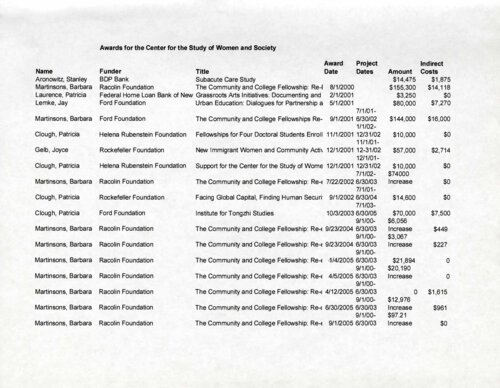 2000-05 Awards List for Center for the Study of Women and Society Compiled in 2008, this list included all the financial awards and grants the Center for the Study of Women and Society (CSWS) received for various projects between August 1, 2000, and October 6, 2005. The list contains the names of the people who submitted proposals for the funding, what institution awarded the grant, and how much was awarded. These awards came from BDP Bank, the Racolin Foundation, the Federal Home Loan Bank of New York, the Ford Foundation, the Helena Rubenstein Foundation, and the Rockefeller Foundation. The money supported fellowships, Grassroots Arts Initiatives, Urban Education, and the Institute for Tongzhi Studies, as well as the Community and College Fellowship, which was devoted to helping formerly incarcerated women get college and advanced degrees. The total amount of awards surpassed $696,000.
 -
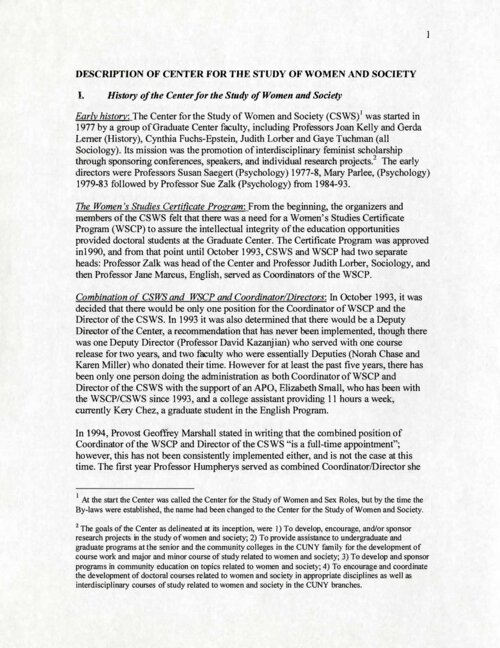 An Overview: The Center for the Study of Women and Society This document, dated 2008, described the Center for the Study of Women and Society (CSWS), beginning with its history, mission, Advisory Committee, and operating mechanisms. It stated that CSWS was formed in 1977, founded the Women's Studies Certificate Program (WSCP) in 1990, and combined the position of the director of CSWS and coordinator of WSCP in 1994. It identified the CSWS's research mission as follows: to promote the study of gender, sexuality, race, ethnicity, class, and nationality regarding women's experiences in multiple societies. College and Community Fellowship (CCF), the Community Leadership and Education After Reentry (CLEAR), the Activist Women's Voices Oral History Archive and Urban Fieldwork Internships, the Feminist Studies Group, Women's Writing Women's Lives (WWWL), the CSWS library, and an ongoing Speaker's Series were identified as CSWS's programs. Also included were CSWS's publications: Women's Studies Quarterly and the Newsletter. This was followed by its outreach efforts at the City University of New York (CUNY), national and international outreach, and computer resources available in related topics. The overview of CSWS closed with its plans for the future and past issues it had faced when trying to reach its goals.
 -
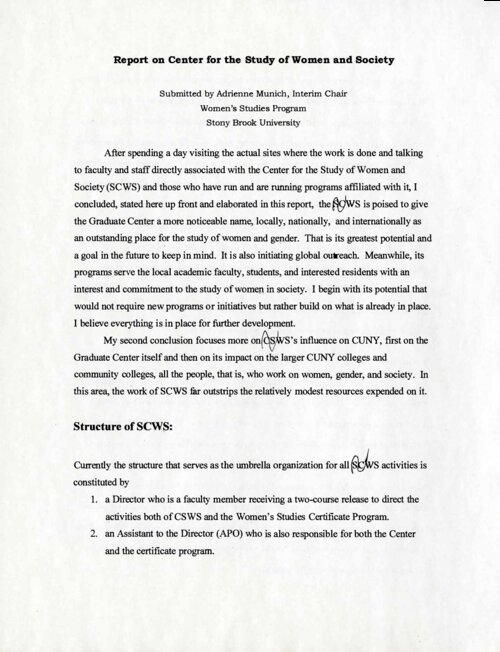 External Review for Center for the Study of Women and Society (CSWS) by Adrienne Munich This external report on the Center for the Study of Women and Society (CSWS) was submitted in May 2008 by Adrienne Munich, interim chair of the Women's Studies Program at the State University of New York (SUNY) Stony Brook University. Munich began the report by praising CSWS for its work and highlighting its importance as part of the City University of New York (CUNY). She opened the actual report with CSWS's structure and recommended additional administrative personnel, support for the director, and a college assistant dedicated exclusively to CSWS. She also underscored the importance of the Women's Studies Discipline Council, the Feminist Studies Group, Women Writing Women's Lives, College and Community Fellowship (CCF), and Community Leadership and Education Reentry (CLEAR) programs. Munich also commented on CSWS's lecture series and ongoing publications, such as Women's Studies Quarterly and the Feminist Press. The document ended with an email from Munich to GC Vice President for Research Brian Schwartz containing the aforementioned report. In this email, she identified CSWS as both a treasure and a bargain.
 -
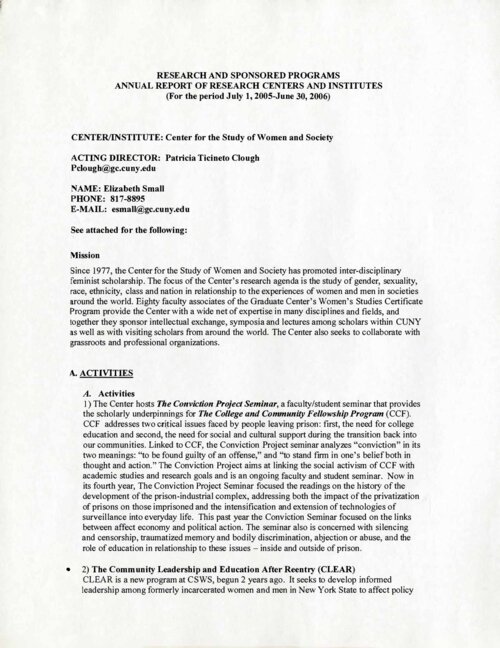 Annual Report for CSWS by Patricia Clough This report described the Center for the Study of Women and Society's (CSWS) research and sponsored programs in the 2005-06 fiscal year. It included the Conviction Project Seminar, the College and Community Fellowship Program, the Community Leadership and Education After Reentry (CLEAR) program, the Activist Women's Voices Oral History Archive, and Urban Fieldwork Internships, the Speaker Series, and international publications. This was followed by plans for the 2005–06 academic year, including journals with Duke University Press. The grants and income section included $15,000 from the City University of New York (CUNY) Vice-Chancellor, $10,000 from the 42nd Street Fund, and about $120,000 that had not yet been awarded. The report closed with the total budget for the 2004-05 fiscal year totaling $14,460 and attachments regarding different publications.
 -
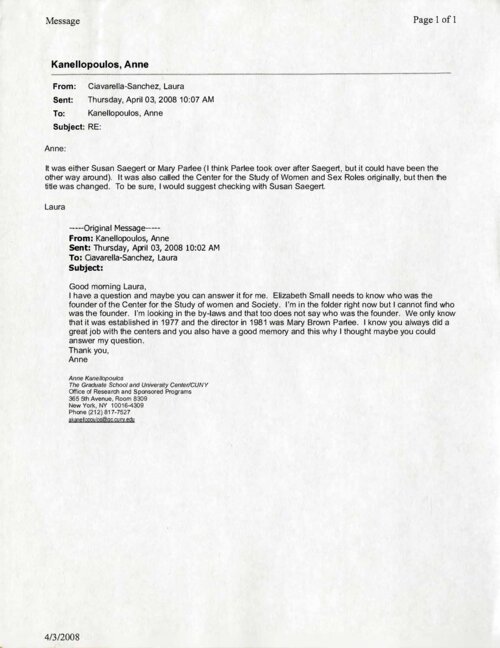 An Email Thread: Who Actually Was the First Director of the Center for the Study of Women and Society (CSWS)? This document provides an email thread that began on March 31, 2008, with Anne Humpherys, part of the Graduate Center's External Review Committee for the Center for the Study of Women and Society (CSWS). In her email, Humpherys stated she was responsible for writing CSWS's history but could not find a list of directors before 1994, when CSWS's director position was combined with the Women's Studies Certificate Program (WSCP) coordinator. Laura Ciavarella-Sanchez, Elizabeth Small, Susan Saegert, Cynthia Epstein, and Anne Kanellopoulos were added to the thread. Finally, though the original director was said to be Mary Brown Parlee, who started in 1979, it was acknowledged that Susan Saegert operationally ran the center from 1977 to 1979. The email thread also revealed that the singular "no" vote on CSWS's creation indicated skepticism and hostility to the fact that such a center was even being considered.
 -
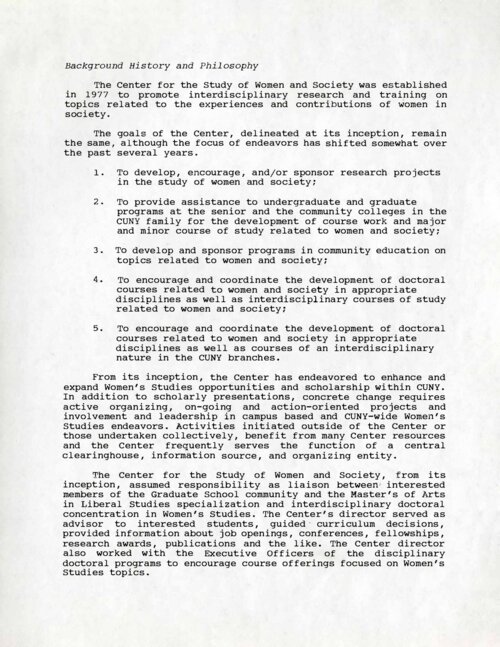 Background History and Philosophy of the Center for the Study of Women and Society (CSWS) from 1979 - 1996 This 1996 document provided a concise background history of the Center for the Study of Women and Society (CSWS) from its inception in 1977. It began with CSWS's organizing goals in 1977, which were to promote interdisciplinary research and training on topics related to the experiences and contributions of women in society. To do so, CSWS worked to provide opportunities for scholarly presentations and active organizing; acted as a liaison between City University of New York (CUNY) Graduate School members and the Master's of Arts in Liberal Studies (MALS) program's Women's Studies concentration; and provided information on job openings, conferences, fellowships, research awards, and publications. In 1983, CSWS founded the CUNY Feminist Network, which facilitated students' search for appropriate mentors. In 1985, CSWS began designing the Certificate Program in Women's Studies at the CUNY Graduate School. This was approved in the Fall of 1988 and was operative in the Spring 1989 semester. In 1987, CSWS formed the Feminist Academy to encourage members to participate in individual support and involvement through special event invitations and discounts on books from the Feminist Press. By 1996, neither the Feminist Network nor the Feminist Academy existed. The document continued with a list of activities and projects from 1984 to 1996; lists of CSWS's directors from 1979 to the time of the document's writing; a list of the Visiting Scholars from 1984 to 1997; a list of the various CSWS sponsored study groups; a list of CSWS's numerous publications; a list of the different sources of funding for CSWS activities from 1983 to 1997; CSWS governance and facilities; a list of CSWS's speakers for its ongoing speaker series from 1979 to 1996; a list of film screenings from 1979 to 1996; and a list of conferences from 1980 to 1996.
 -
 Annual Report of Research Centers and Institutes July 1, 1991 - June 30, 1992 This annual report of the Center for the Study of Women and Society (CSWS) from July 1, 1991, to June 30, 1992, provided a summary of CSWS's mission, activities, scholarly papers in refereed journals, abstracts, and other publications, financial support, facilities, equipment, budget, and personnel. CSWS's mission was identified as the development, encouragement, and sponsoring of research in women's studies; provision of assistance to both graduate and undergraduate programs at the City University of New York (CUNY) for major and minor courses; development of programs in women's studies in community education; and the encouragement and coordination of doctoral courses related to women and society. However, due to the growth of different initiatives and accomplishments, CSWS no longer assumed responsibility for coordinating women's studies courses or functioning as a primary source for student advisement, as these were now the responsibility of the Women's Studies Certificate Program office that CSWS had helped to establish. In this report, CSWS cemented its commitment to focusing on gender, race, ethnicity, and class internationally, particularly in urban communities. It stated that several books, chapters, papers, articles, abstracts, and newsletters had been published under the auspices of CSWS and were available upon request.Additionally, many CSWS members had been involved in lectures, seminars, conferences, and symposiums. CSWS members also worked with grassroots organizations, such as the New York City Coalition for Women's Mental Health, publications such as "Sex Roles: A Journal of Research" and The Feminist Press, the Feminist Academy, and the Visiting Scholars program. CSWS received grants from the Japan Institute for Women and Minor's Problems, UNIFEM, the Ford Foundation, and the CUNY Graduate School and had proposed more grants to the same agencies and the National Institute of Drug Abuse. In the 1991 – 1992 fiscal year, the budget indicated that CSWS had spent $78,000 on an income of $101,000.
 -
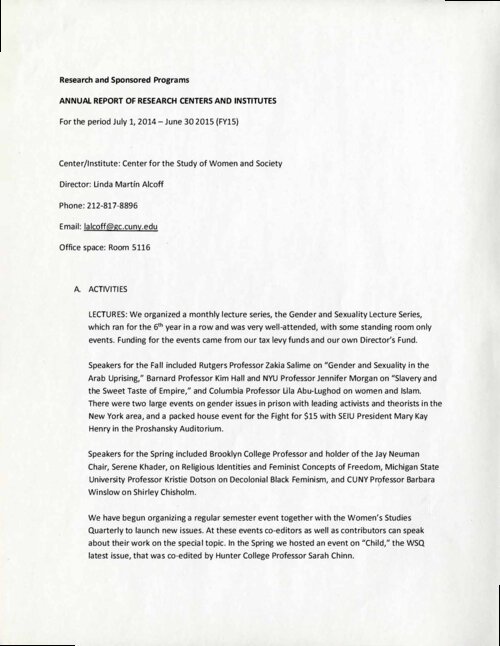 Annual Report: Center for the Study of Women and Society This July 1, 2014, annual report of the Center for the Study of Women and Society (CSWS) covered the 2014-15 fiscal year, from July 1, 2014, to June 30, 2015. It identified Professor Linda Martín Alcoff as the director of CSWS, which was now located in Room 5116 at the City University of New York (CUNY) Graduate Center at 365 5th Avenue in Manhattan. This was followed by information on the monthly Gender and Sexuality Lecture Series, which had been running successfully for six years. Next, the report provided information on CSWS's co-sponsored events, Visiting Scholars, and community outreach. In the section about plans for the future, it was revealed that CUNY's Board of Trustees had approved on March 2, 2015 the Master's of Arts program in Women's and Gender Studies. CSWS worked with CLAGS (the Center for LGBTQ Studies) to develop the Gender and Sexuality track for the MA program. The report then provided information on new faculty, the Advisory Board, and leadership changes. Regarding the latter, Professor Alcoff was to begin a sabbatical, with Queens College and Graduate Center Professor Hester Eisenstein serving as the director of CSWS, coordinator of the Women's Studies Certificate Program (WSCP), and the first director of the new MA program.
 -
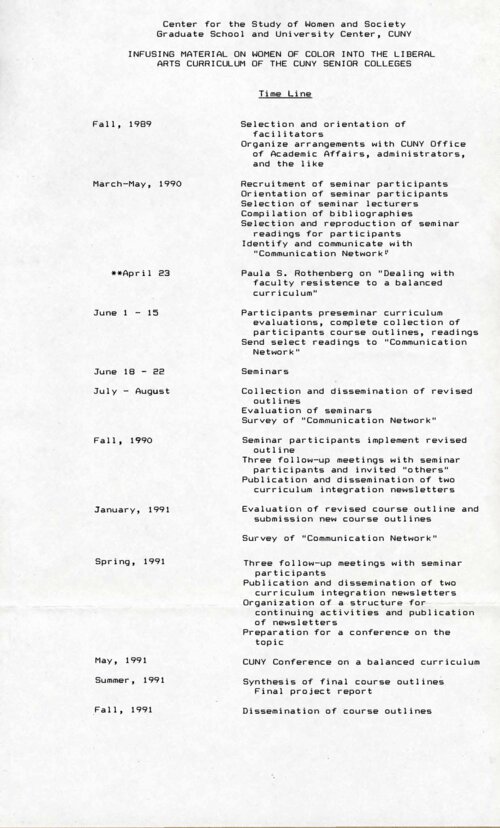 Infusing Material on Women of Color Project Timeline A part of the Ford Foundation grant proposal, this file provided a timeline for implementing the inclusion of material on and by women of color (WOC) into the liberal arts curriculum of the City University of New York (CUNY) senior colleges. The timeline had the project set to begin in the fall of 1989 with the selection and orientation of facilitators, followed by the recruitment and orientation of seminar participants from March to May 1990. That three-month period also included selecting seminar lectures and readings for participants and communication with the "Communication Network." A talk by Paula S. Rothenberg, entitled, "Dealing with Faculty Resistance to a Balanced Curriculum" was scheduled for April 23, 1990. The seminars associated with the project were expected to take place from June 18 to 22, 1990. In July and August, there would be a collection and dissemination of revised outlines for courses, evaluations of the seminars, and a survey for the "Communication Network." By the Fall of 1990, participants were expected to implement revised outlines, attend meetings, and publish two newsletters to integrate WOC material into the curricula. In May 1991, there would be a conference on what was a balanced curriculum. The final product, integrated course outlines, would be disseminated in the fall 1991 semester.
 -
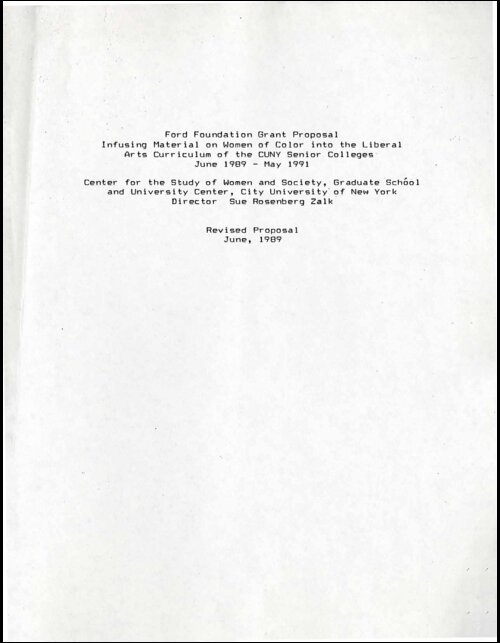 Ford Foundation Grant Proposal: Infusing Material on Women of Color into the Liberal Arts Curriculum of the CUNY Senior Colleges This revised June 1989 grant proposal from the Center for the Study of Women and Society (CSWS) to the Ford Foundation requested support for a project designed to incorporate material by and about women of color (WOC) into introductory courses at the ten senior City University of New York (CUNY) colleges. Project designers wished to encourage and assist full-time liberal arts faculty by offering seven intensive one-week seminars, each one targeting a specific introductory course in American history, American literature, economics, political science, sociology, psychology, and English composition. The project designers aimed to provide information and resources for each discipline and establish a formal and active network to continue to promote this integration long after the grant had terminated. The grant would include monthly meetings with invited speakers and discussion groups and monthly newsletters containing teaching experiences and curriculum suggestions. A "Communication Network," consisting of three colleagues per participant that might be responsive to outreach, would also be established. A primary goal of the project was to have as many CUNY faculty members as possible, both male and female, integrate a least some material on women of color into their curricula, and have them understand that they had enough resources to diversify their curricula even if they were not experts on women's, ethnic, or minority studies. The author of the proposal wrote that, all too often, the structure of women's, ethnic, and minority studies reinforced the idea that these were "special topics" and not integral parts of their specific fields of study. Each of the 100 faculty selected to participate in the project would receive a $350 stipend for their work.
 -
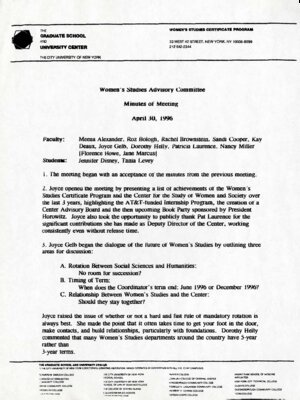 Women's Studies Advisory Committee Minutes These minutes from the Women's Studies Advisory Committee Meeting on April 10, 1996, discussed the future of Women's Studies at the City University of New York (CUNY) Graduate Center. Specifically noted was a conversation about the relationship between the Women's Studies Certificate Program (WSCP) and the Center for the Study of Women and Society (CSWS) and whether the two should remain a single organization. Joyce Gelb, the director of CSWS, stated that the decision depended on the outgoing and incoming coordinator and the president of the Graduate Center, Dr. Frances Degen Horowitz. According to the minutes, President Horowitz seemed to lean toward keeping the two programs enmeshed because they had worked together successfully for three years. The minutes stated that the cost of the combination of the two programs depended on how the coordinators were to be paid; the administrative costs were low because Joyce Gelb had negotiated a full-time position by combining the administration of the WSCP and CSWS. It was noted that Ms. Gelb stated that this combination of administrations was complex because the two programs were in fact physically separate.
 -
 A New Caucus Oral History: Joan Greenbaum Conducted May 22, 2019, as part of the Professional Staff Congress' (PSC) oral history initiative, this interview with Joan Greenbaum covered her extensive involvement in Professional Staff Congress (PSC) beginning in the early 1970s. When Greenbaum became part of the founding faculty at LaGuardia Community College, she became involved in an organization called New Directions, a group of CUNY faculty that embraced direct democracy and sought to address working conditions at CUNY. It would eventually become a New Caucus chapter from the years 1993-1997. In 2000 when the New Caucus won the election and became the leadership of the Professional Staff Congress (PSC), Greenbaum was active in "Health and Safety", a committee that fought for healthy working conditions across CUNY. Following retirement, she joined the Retiree Chapter and became the editor of their newsletter: Turning the Page.
 -
 Oral History Interview with Lilia Melani “I was not interested in changing CUNY’s policies. I wanted to transform the very nature of the power structure.” – Lilia Melani Conducted in 2019, as part of the Professional Staff Congress' (PSC) oral history initiative, this interview with Lilia Melani covered her extensive involvement in the Professional Staff Congress (PSC) and the "Melani Case", the landmark class-action suit named for her, that was brought against the Trustees of the City University of New York in 1983. The action was based on title VII and alleged sex discrimination in the Board Higher Education's employment practices. The interview covered the formation of the CUNY Women’s Coalition in 1973, which would lead to the university responding by the convening of the Chancellor’s Advisory Committee on the Status of Women led by Marilyn Gittell. In 1983 the case was settled. Melani credited her experience in the union to her fundamentally understanding the problem of sex discrimination at the university as systemic and to have helped her become a more effective feminist.
 -
 LOTUS: An Asian American Student Journal at Hunter College This is the first issue of LOTUS, a student-run publication devoted to Asian/Asian American perspectives at Hunter College, which came out in the Spring of 1988. The issue includes fiction, non-fiction, poetry, photography, and reflections on the 1988 East Coast Asian American Student Union (ECAASU) conference at Cornell University by Hunter students. Topics span mixed-race politics, Asian American experiences of counseling and psychology, beauty standards, the redress/reparations movement for Japanese war crimes, pan-Asian social movements, and the murder of Vincent Chin. The journal is an example of the ways that Asian American students self-organized intellectual, artistic, and political community before an institutionalized program took hold. The Hunter College Asian American Studies Program (AASP) was established in 1993. As the only academic program in Asian American studies in the CUNY system, the AASP offers a minor in Asian American Studies and other resources and programming. The AASP supports scholars, artists, and activists advancing scholarship in the fields of Asian American studies and critical ethnic studies and serves as a resource for New York City's Asian American communities. In 2006, the program was at risk of being cut due to a lack of funding. Students formed the Coalition for the Revitalization of Asian American Studies at Hunter (CRAASH) and saved the program within a year. CRAASH is now a student-run club that continues to advocate for the AASP.
 -
 Letter from Dr. Shirley Hune to Hunter President Jennifer J. Raab This letter was written by Dr. Shirley Hune on April 19, 2017, and addressed to Hunter College President Jennifer J. Raab. In the letter, Dr. Hune, who was instrumental to the development of Asian American studies at Hunter during her time as Assistant Provost (1990-1992), condemns Hunter's lack of commitment and investment in Asian American studies following their failure to meet student demands for an Asian American Studies Department and major and the non-reappointment of Jennifer Hayashida, director of the Asian American Studies Program (AASP). The non-reappointment of AASP director Jennifer Hayashida in 2017 alongside other efforts to restructure the AASP sparked deep concern over the future of the program. CRAASH called upon the Asian American/Asian American studies community to write to Hunter administrators in protest of the active dismantling of the AASP in the context of a long history of institutional neglect of a program that has, as Hune writes, made Hunter a leader in ethnic studies. The Hunter College Asian American Studies Program (AASP) was established in 1993. As the only academic program in Asian American studies in the CUNY system, the AASP offers a minor in Asian American Studies and other resources and programming. The AASP supports scholars, artists, and activists advancing scholarship in the fields of Asian American studies and critical ethnic studies and serves as a resource for New York City's Asian American communities. In 2006, the program was at risk of being cut due to a lack of funding. Students formed the Coalition for the Revitalization of Asian American Studies at Hunter (CRAASH) and saved the program within a year. CRAASH is now a student-run club that continues to advocate for the AASP.
 -
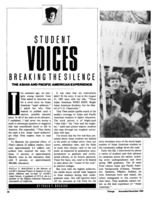 "Student Voices Breaking the Silence: The Asian and Pacific American Experience" This article was written by Paula Y. Bagasao for the November/December 1989 issue of Change: The Magazine of Higher Learning features the narratives of 10 Asian and Pacific American student voices from across the country, including those of three Hunter students—Woei-Ming New, Kelly Nishimura, and Bevayani Nautiyal. The article was written as a counter piece to the now infamous 1987 Time Magazine cover story on Asian American "whiz kids," for which Bagasao was interviewed. This article aims to portray the heterogeneity and reality of Asian American student experiences. Nishimura describes how her experience in the Asian Pacific Student Alliance at Hunter changed her relationship to it as a commuter school as well as how the largely first-generation, working class, and Third World student body shaped her consciousness. New was a restaurant worker and beneficiary of CUNY's Open Admissions policy and went on to be reportedly the first Asian American student body president in the CUNY system. The Hunter College Asian American Studies Program (AASP) was established in 1993. As the only academic program in Asian American studies in the CUNY system, the AASP offers a minor in Asian American Studies and other resources and programming. The AASP supports scholars, artists, and activists advancing scholarship in the fields of Asian American studies and critical ethnic studies and serves as a resource for New York City's Asian American communities. In 2006, the program was at risk of being cut due to a lack of funding. Students formed the Coalition for the Revitalization of Asian American Studies at Hunter (CRAASH) and saved the program within a year. CRAASH is now a student-run club that continues to advocate for the AASP.
 -
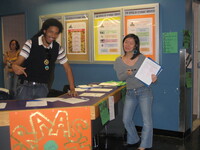 The Coalition for the Revitalization of Asian American Studies at Hunter (CRAASH), 2007-2008 These are a collection of photographs of members of the Coalition for the Revitalization of Asian American Studies at Hunter (CRAASH) taken during the club's early years. From top to bottom, CRAASH members are seen tabling and petitioning in Hunter West, having a meeting on the floor of a hallway, and speaking at their Strengthening Education: Empowering Asian American Studies conference. CRAASH did not begin as a chartered club or organization and therefore did not have access to club space and would meet wherever they could—in the library, in the hallways, and in the dorms. In the last photo, from left to right, are pictured: Olivia Lin, Jessica Lee, Christopher Eng, and Jackie Ng Fernandez. The Hunter College Asian American Studies Program (AASP) was established in 1993. As the only academic program in Asian American studies in the CUNY system, the AASP offers a minor in Asian American Studies and other resources and programming. The AASP supports scholars, artists, and activists advancing scholarship in the fields of Asian American studies and critical ethnic studies and serves as a resource for New York City's Asian American communities. In 2006, the program was at risk of being cut due to a lack of funding. Students formed the Coalition for the Revitalization of Asian American Studies at Hunter (CRAASH) and saved the program within a year. CRAASH is now a student-run club that continues to advocate for the AASP.
 -
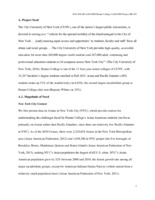 Asian American Native American Pacific Islander Serving Institutions Grant Proposal This is the successful proposal for the Asian American Native American Pacific Islander Serving Institutions (AANAPISI) grant written by Jennifer Hayashida, John Chin, and Paul McPherron. The 5-year $1.7 million Department of Education grant (2016-2021) funds the Hunter College AANAPISI Project (HCAP). HCAP supports Asian/American and Pacific Islander (API) students through a multilingual learners program, a mental health program, and a leadership program. The proposal specifically identifies the lack of support for English-language learners (ELL), lack of culturally competent advising and counseling services, and lack of thoughtfully developed leadership opportunities for API students as institutional gaps and weaknesses. It also states that Hunter, as the only CUNY college with a full-fledged Asian American studies program, is "well-positioned to serve as a model for other CUNY campuses, which collectively serve almost 53,000 API students." The AANAPISI program is one of eight federally designated Minority Serving Institution programs established by Congress in 2007 to support minority students. For an institution to qualify for an AANAPISI grant, at least 10% of its students must be Asian American and Native American Pacific Islander and 50% must receive financial assistance. 31% of Hunter students are API, many of whom are first-generation college students, ELLs, and/or from low-income immigrant families. The Hunter College Asian American Studies Program (AASP) was established in 1993. As the only academic program in Asian American studies in the CUNY system, the AASP offers a minor in Asian American Studies and other resources and programming. The AASP supports scholars, artists, and activists advancing scholarship in the fields of Asian American studies and critical ethnic studies and serves as a resource for New York City's Asian American communities. In 2006, the program was at risk of being cut due to a lack of funding. Students formed the Coalition for the Revitalization of Asian American Studies at Hunter (CRAASH) and saved the program within a year. CRAASH is now a student-run club that continues to advocate for the AASP.
 -
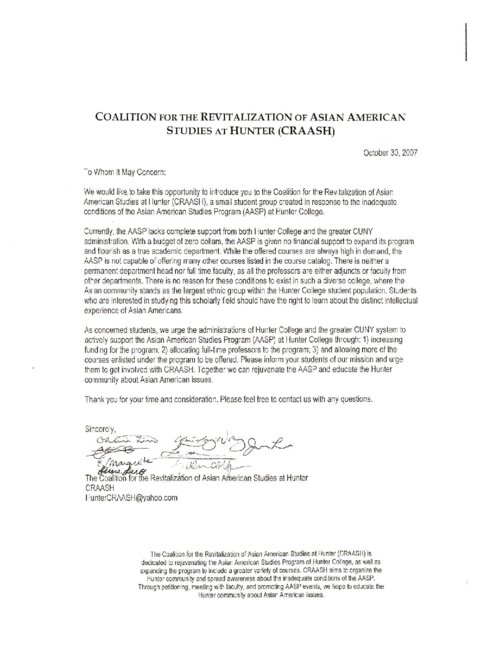 Letter announcing the Formation of the Coalition for the Revitalization of Asian American Studies at Hunter (CRAASH) In this letter dated October 30, 2007, students announce the formation of the Coalition for the Revitalization of Asian American Studies at Hunter (CRAASH). Consisting of eight students, CRAASH organized in immediate response to the inadequate conditions facing the Hunter AASP, including a $0 budget, lack of a permanent department head and full-time faculty, and stagnant course offerings. CRAASH later evolved into a formal student club, though advocating for the AASP has remained part of its central mission. The Hunter College Asian American Studies Program (AASP) was established in 1993. As the only academic program in Asian American studies in the CUNY system, the AASP offers a minor in Asian American Studies and other resources and programming. The AASP supports scholars, artists, and activists advancing scholarship in the fields of Asian American studies and critical ethnic studies and serves as a resource for New York City's Asian American communities. In 2006, the program was at risk of being cut due to a lack of funding. Students formed the Coalition for the Revitalization of Asian American Studies at Hunter (CRAASH) and saved the program within a year. CRAASH is now a student-run club that continues to advocate for the AASP.
 -
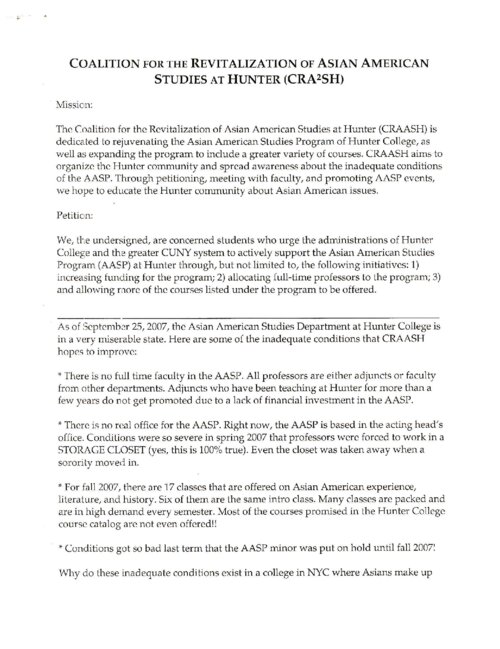 Petition for the Revitalization of Asian American Studies at Hunter This petition was circulated by the Coalition for the Revitalization of Asian American Studies at Hunter (CRAASH) in the semester of its founding in Fall 2007. The petition outlines the issues facing the program and the reasons around CRAASH's forming: no full-time faculty, no office, lack of diverse course offerings, and the institutional freeze on the AAS minor. CRAASH's demands included: increased funding for the program, the allocation of full-time professors, and the expansion of course offerings. CRAASH petitioned for three months and collected over 1,000 signatures from Hunter students. The Hunter College Asian American Studies Program (AASP) was established in 1993. As the only academic program in Asian American studies in the CUNY system, the AASP offers a minor in Asian American Studies and other resources and programming. The AASP supports scholars, artists, and activists advancing scholarship in the fields of Asian American studies and critical ethnic studies and serves as a resource for New York City's Asian American communities. In 2006, the program was at risk of being cut due to a lack of funding. Students formed the Coalition for the Revitalization of Asian American Studies at Hunter (CRAASH) and saved the program within a year. CRAASH is now a student-run club that continues to advocate for the AASP.
 -
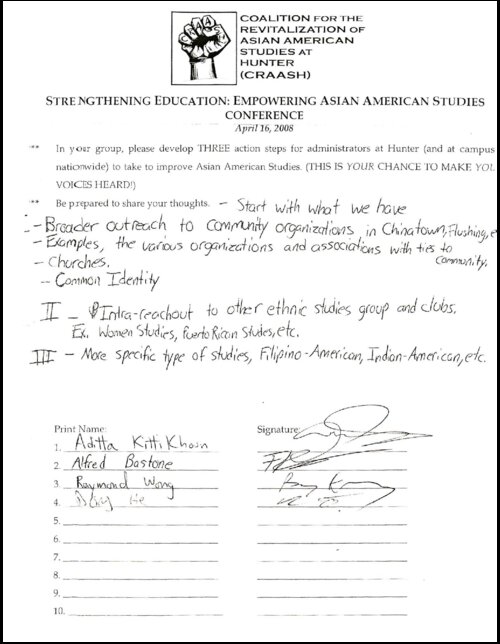 Strengthening Education: Empowering Asian American Studies Conference Action Steps These notes come out of a participant workshop at the Strengthening Education: Empowering Asian American Studies Conference hosted by the Coalition for the Revitalization of Asian American Studies at Hunter (CRAASH) on April 16, 2008, to address the need for support for Asian American Studies in higher education. Conference attendees were asked to come up with action steps for administrators to take in order to strengthen the presence and livelihood of Asian American studies at Hunter and universities nationwide. The Hunter College Asian American Studies Program (AASP) was established in 1993. As the only academic program in Asian American studies in the CUNY system, the AASP offers a minor in Asian American Studies and other resources and programming. The AASP supports scholars, artists, and activists advancing scholarship in the fields of Asian American studies and critical ethnic studies and serves as a resource for New York City's Asian American communities. In 2006, the program was at risk of being cut due to a lack of funding. Students formed the Coalition for the Revitalization of Asian American Studies at Hunter (CRAASH) and saved the program within a year. CRAASH is now a student-run club that continues to advocate for the AASP.
276–300 of 1046