CUNY Digital History Archive
Item set
Collection
CUNY Digital History Archive
Items
326–350 of 1046
Advanced search
-
 CUNY Adjunct Alert (September 2000) This September 2000 CUNY Adjunct Alert, announced an "Adjunct Awareness Campaign." in light of the newly-elected Professional Staff Congress (PSC) leadership, who were, according to the newsletter, “following through on their campaign promises to advocate for adjuncts.” Also, noted were a healthcare, disability, unemployment outreach project, CAU’s joining the National Alliance for Fair Employment (NAFFE), and the forthcoming Coalition of Contingent Academic Labor (COCAL) conference. CUNY Adjuncts Unite! (CAU), an independent coalition of CUNY part-timers founded in 1997, produced the CUNY Adjunct Alert newsletter. The National Alliance for Fair Employment (NAFFE) consisted of over 40 organizations fighting conditions associated with contingent work.
 -
 CUNY Adjunct Alert (March/April 2000) This March 2000 edition of CUNY Adjunct Alert, in addition to covering late pay and adjunct voting rights, presented a "report card on the Slates and Candidates" of the Professional Staff Congress (PSC) union election. The City University Unity Caucus (CUUC/Unity Slate) and the New Caucus stances on specific issues of importance to adjuncts were compared. CUNY Adjuncts Unite! (CAU), an independent coalition of CUNY part-timers founded in 1997, produced the CUNY Adjunct Alert newsletter.
 -
 CUNY Adjunct Alert (September 1999) The September 1999 issue of the CUNY Adjunct Alert discussed the importance of the grievance process and offered updates on a referendum on automatic dues deduction and adjunct health insurance.CUNY Adjuncts Unite! (CAU), an independent coalition of CUNY part-timers founded in 1997, produced the CUNY Adjunct Alert newsletter.
 -
 CUNY Adjunct Alert (March 1999) The March 1999 CUNY Adjunct Alert! Newsletter illustrated the tension between activist group, CUNY Adjuncts Unite!, and the Professional Staff Congress (PSC) leadership, in particular, President Irwin Polishook. The article, entitled “Irwin’s Rules of Order,” cited several alleged procedural infractions, which included the Delegate Assembly's rejection of CUNYTALK, supporting the recruitment of new members and supporting objective external vote counting. In addition, in a "Letter, to the Editor", Myrna D. Bain asked why both full- and part-time CUNY faculty “skirt our mutually unresolved questions on class and caste …” CUNY Adjuncts Unite! (CAU) an independent coalition of CUNY part-timers, founded in 1997, produced the CUNY Adjunct Alert newsletter,. The Professional Staff Congress (PSC) is the CUNY faculty and research staff union.
 -
 CUNY Adjunct Alert (February 1999) This February 1998 CUNY Adjunct Alert newsletter responded to the Professional Staff Congress (PSC) Vice President Richard Boris's positions on adjunct labor at CUNY in relation to the recently ratified contract expressed in the December 1998 issue of The Clarion. Among other points of contention, it explained how adjunct health care coverage was inferior to insurance for full-timers and how there was a lack of available information on adjunct professional development opportunities. It also included an article criticizing the Schmidt Commission for its alleged stance on the privatization of remedial courses. CUNY Adjuncts Unite! (CAU), an independent coalition of CUNY part-timers founded in 1997, produced the CUNY Adjunct Alert newsletter. The Clarion is the newspaper of the PSC.
 -
 CUNY Adjunct Alert (December 1998) This newsletter, produced by CUNY Adjunct Unite! (CAU), discussed the PSC's alleged accusations against both CAU and The Adjunct Project for violating New York State's Taylor Law. The article argued that CAU is an independent organization and therefore not under the purview of the Taylor law. CAU also accused the PSC of discouraging adjuncts from becoming union members. CUNY Adjuncts Unite! (CAU) , an independent coalition of CUNY part-timers, founded in 1997, produced the CUNY Adjunct Alert newsletter. The Adjunct Project, founded in 1994, was an activity of the Doctoral Student Council (DSC). It was established to advocate on behalf of, to disseminate information to, and to educate Graduate School and University Center (GSUC) student adjuncts on issues pertaining to their academic employment.
 -
 Adjunct Office Hours In an October 14, 1998 memo sent to Professional Staff Congress (PSC) chapter chairs, President Irwin Polishook referenced past negotiations in which the PSC had endorsed payment for an adjunct office hour but failed to secure a contractual right to office hour compensation. The memo pointed out that the individual schools could have chosen to pay adjunct faculty for regularly scheduled office hours.
 -
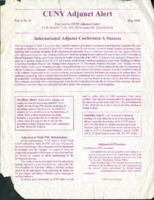 CUNY Adjunct Alert (May 1998) This May 1998 CUNY Adjunct Alert newsletter included an update on the International Adjunct Conference as well as an announcement about the decision to hold a Professional Staff Congress (PSC) referendum. Also covered was information about how adjuncts were eligible to join the NYS Teacher Retirement System (TRS) pension plan, Tax-Deferred Annuity (TDA) plans, and The Teachers Insurance and Annuity Association of America-College Retirement Equities Fund (TIAA), formerly (TIAA-CREF). CUNY Adjuncts Unite! (CAU), an independent coalition of CUNY part-timers founded in 1997, produced the CUNY Adjunct Alert newsletter.
 -
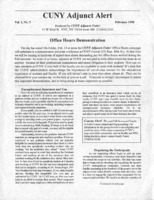 CUNY Adjunct Alert (February 1998) This February 1998 CUNY Adjunct Alert newsletter announced a demonstration for paid adjunct office hours and encouraged people to send timesheets that included unpaid office hours. In addition, it explained why CUNY had an incentive to contest adjunct's unemployment insurance claims. Other topics discussed included organizing undergraduate students and required departmental meetings for adjuncts. CUNY Adjuncts Unite! (CAU), an independent coalition of CUNY part-timers founded in 1997, produced the CUNY Adjunct Alert newsletter.
 -
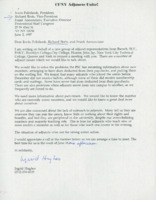 A letter from the CUNY Adjuncts Unite! In a concerted effort to unite across campuses, CUNY Adjuncts Unite! (CAU) organizers wrote a letter to the Professional Staff Congress (PSC) leadership in June 1997 about their concerns, which included poor outreach and a lack of information about new members. CAU expressed concern that, in addition to new members reporting not having had their dues deducted and not receiving ballots, many adjuncts were unaware of their right to join the union.CUNY Adjuncts Unite! (CAU) was an independent coalition of CUNY part-timers, founded in 1997.
 -
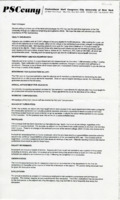 Memo: Recent negotiations on behalf of Adjuncts This 1996 memo by the Professional Staff Congress (PSC) staff,enumerated the rights and privileges that adjuncts had gained in the most recent collective bargaining agreement and legislative efforts.
 -
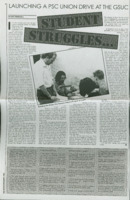 "Student Struggles" Written by Eric Marshall and published in 1996 in The Advocate, this article explained the function of the CUNY Adjunct Project (CAP) as an aggregator of data about adjunct work at CUNY. Critical of the Professional Staff Congress's (PSC) role in fighting for adjunct rights, Marshall nevertheless advocated for adjuncts to join the Professional Staff Congress (PSC) in order to “make our numbers count”. The Adjunct Project, founded in 1994, was an activity of the Doctoral Student Council (DSC). It was established to advocate on behalf of, disseminate information to, and educate the Graduate School and University Center (GSUC) student adjuncts on issues pertaining to their academic employment. The Advocate was the newspaper for the students, staff, and faculty of the Graduate Center, CUNY.
 -
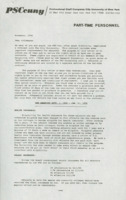 Part-time Personnel - 1994 This 1994 Professional Staff Congress (PSC) part-timers newsletter communicated improvements in adjunct working conditions that had been won in the recently ratified contract, which included expansion of health insurance eligibility and the adjunct workload course limit having been increased from six to nine hours. The newsletter also reported that the contract reflected a law signed by the governor that mandated that all employers inform all employees of the option to join a public retirement system. Adjunct faculty were urged to file grievances should violations of the contract occur.
 -
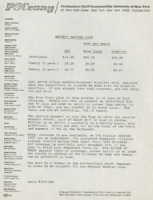 Adjunct Medical Plan This memo, produced in 1994 by the Professional Staff Congress (PSC), compared the cost of individual and family healthcare plans from HIP and Blue Cross. Specific details about each plan were also provided.
 -
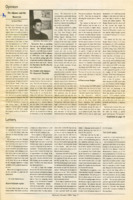 The Trouble with Adjuncts: The Transients' Mentality "The Trouble with Adjuncts: The Transients' Mentality", published in The Advocate in 1994 and written by Daniel Mozes, analyzed why adjuncts had traditionally been ineffective in advocating for their own rights. In addition to having lamented the lack of full-time faculty support and the manner in which CUNY disenfranchised contingent labor, Mozes expressed regret at adjuncts' unwillingness to get involved in grassroots struggles to improve their status. The Advocate served as the newspaper for the students, staff, and faculty of the Graduate Center, CUNY.
 -
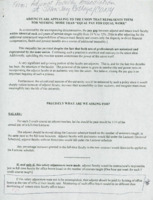 "Equal pay for Equal Work" This 1994 flyer, produced by the Adjunct Faculty Association (AFA) at John Jay College of Criminal Justice, was an appeal to the Professional Staff Congress (PSC) to stop supporting a two-tiered salaru system. The document detailed inequities in adjunct compensation. Specific demands included salary adjustments, paid office hours, job security, governance inclusion, job flexibilit, and support for scholarly activities by adjuncts.The Adjunct Faculty Association (AFA) formed shortly after the failure of the Part-time Instructional and Research Staff Union (PTU) to achieve the right to form a separate union.
 -
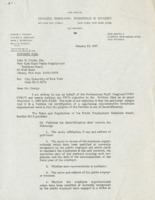 Legal Objection to PTU Petition This letter, sent in 1987 from the law offices of Guazzo, Perelson, Rushfield, and Guazzo, to the New York State Public Employment Relations Board (PERB), indicated the Professionals Staff Congress's (PSC) objections to the Part-Time Instructional and Research Staff Union (PTU) petition filed with PERB. The union's objection to the petition was PTU's claim that they were calling for certification when in fact it was a decertification attempt. According to the letter, the petition also omitted a statement offering the reasons for decertification and misrepresented the number of employee signatures. The correspondence requested that the petition be dismissed due to improper filing.The Part-Time Instructional and Research Staff Union (PTU) was a group of part-time faculty members from across CUNY who challenged the PSC for the right to represent adjuncts.
 -
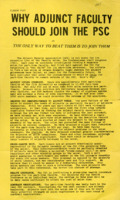 Why Adjunct Faculty Should Join the PSC This newsletter, written in 1987 by the Adjunct Faculty Association (AFA), formed shortly after the failure of the Part-time Instructional and Research Staff Union (PTU) to achieve the right to form a separate union, called for adjuncts to join the Professional Staff Congress (PSC), citing adjunct voting strength and the growing responsiveness of the union to adjunct needs.The Part-Time Instructional and Research Staff Union (PTU) was a group of part-time faculty members from across CUNY who challenged the PSC for the right to represent adjuncts.
 -
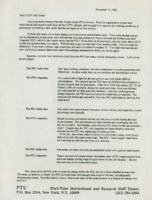 Three more Years of Do-Nothing Representation This November 14, 1986 newsletter, written by members of The Part-Time Instructional and Research Staff Union (PTU) and addressed to CUNY part-timers, outlined the PTU's arguments for, and the PSC's arguments against, the certification of a new part-timers' union. A union authorization card was provided.The Part-Time Instructional and Research Staff Union (PTU) was a group of part-time faculty members from across CUNY who challenged the PSC for the right to represent adjuncts.
 -
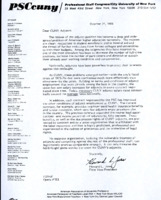 Reasons Adjuncts Should Stay in the PSC This October 21, 1986 letter, written on PSC letterhead and signed by Professional Staff Congress (PSC) Vice President Howard L. Jones, was sent to adjunct faculty. The letter stated that the "terms and conditions" of employment of adjuncts within the CUNY system exceeded national averages and emphasized recent contract improvements, which included employer-paid health insurance and tuition remission. It closed by arguing that a separate organization of adjuncts would compromise the “hard-fought gains won by the union for CUNY’s adjuncts.”
 -
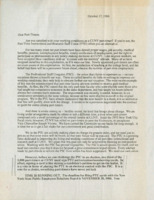 A Vote for Choice This October 17, 1986 letter, written by Jeffrey Gerson, the president of the Part-time Instructional and Research Staff Union (PTU), was a call for adjunct faculty to sign an enclosed card in support of putting the PTU on the ballot to run against the PSC.The Part-Time Instructional and Research Staff Union (PTU) was a group of part-time faculty members from across CUNY who challenged the PSC for the right to represent adjuncts.
 -
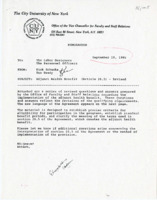 Adjunct Benefits: Questions and Answers This September 18, 1986 memo from the Office of the Vice-Chancellor for Faculty and Staff Relations at CUNY to the Labor Designees and Personnel Officers on the campuses listed a series of revised questions regarding the implementation of adjunct health benefits. The memo presented material designed to establish precise criteria for adjuncts' eligibility and to clarify all terms used in article 26.5. Interestingly, the "six-semester adjunct service requirement" had been corrected to read "two-semester adjunct service requirement" throughout the document.
 -
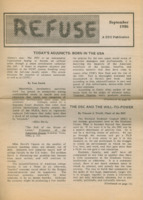 REFUSE: The DSC and the Will to Power "The DSC and the Will to Power," published in the Refuse – a Doctoral Student Council (DSC) publication, was drafted in the fall of 1986 by Vincent Tirelli, Chair of the DSC. The article made the case for creating space for "interdisciplinary activity" as an integral part of receiving a doctoral education. Drawing parallels to the fiscal problems of NYC, Tirelli maintained that student agency and involvement is critical to the health of the institution.
 -
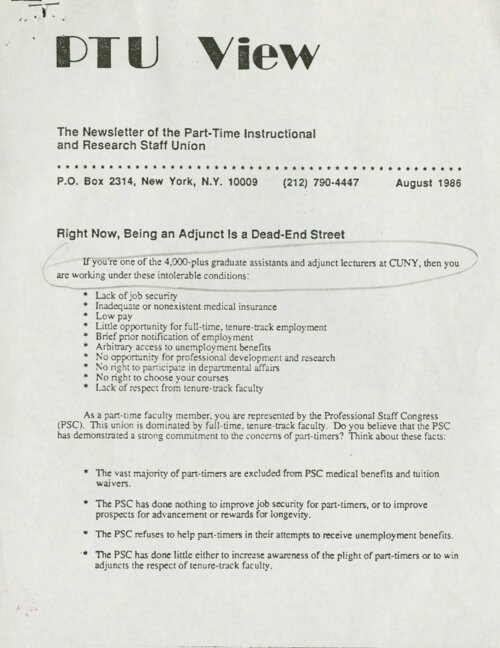 PTU View The August 1986 PTU View newsletter called for adjunct faculty to sign a "union authorization" card. In addition to listing how the Professional Staff Congress (PSC) had failed to represent the interests of contingent faculty, the PTU’s demands outlined in the newsletter included comprehensive healthcare, job security, and equal pay for equal work. The Part-time Instructional and Research Staff Union (PTU), although never formally approved as a collective bargaining agent, consisted of a group of graduate students and part-time faculty who felt that it was impossible to improve the working conditions of adjunct faculty without breaking away from the PSC and forming their own union. They filed a PERB request for representation in 1986 that would ultimately fail.
 -
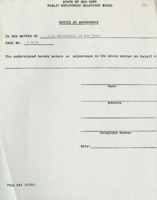 Notice of Appearance: PERB and the Part-Time and Instructional Research Staff Union This December 2, 1986 Notice of Hearing, addressed to (but not confirmed by) the City University of New York and the Professional Staff Congress, announced that a hearing would be conducted on February 26, 1987 at the NYS Public Employment Relations Board (PERB). The petitioner was listed as the Part-time Instructional and Research Staff Union (PTU) and the notice stated that the hearing pertains to a Petition for Certification/Decertification. It was signed by Jeffrey Gerson.The Part-time Instructional and Research Staff Union (PTU), although never formally approved as a collective bargaining agent, consisted of a group of graduate students and part-time faculty who felt that it was impossible to improve the working conditions of adjunct faculty without breaking away from the PSC and forming their own union.
326–350 of 1046