CUNY Digital History Archive
Item set

Collection
CUNY Digital History Archive
Items
476–500 of 1046
Advanced search
-
 Meeting with Founding Dean Dr. Kenneth Olden Prepared for an October 2009 meeting with Dr. Kenneth Olden, the founding dean of the CUNY School of Public Health at Hunter College, this document highlights many of the past successes and efforts of Hunter College's Center for Occupational and Environmental Health. Formally established in 1990 by CUNY's Board of Trustees, the Hunter College Center for Occupational and Environmental Health (COEH) was founded with the mission "to promote community and workplace health" across the New York metropolitan area. Working with community groups, unions, governmental agencies, private employers, and educational institutions, the Center educated hundreds of thousands over the course of its history.
 -
 Weapons of Mass Destruction (WMD) Train-the-Trainer Course and Cover Letter This cover letter addressed to Jean Edouard, the Director of Education and Training in the NY State Department of Environmental Conservation is requesting a letter of support for further federal funding. The letter broadly presents the main tenants of the Weapons of Mass Destruction (WMD) Training program, which the Center for Occupational and Environmental Health (COEH) proposed to develop and conduct during the 2003-2004 academic year. The proposed curriculum was a modular three-day course, with one day each devoted to WMD Chemical, Biological and Radiological Hazards, followed by a single, final day devoted to a Train-the-Trainers module. Formally established in 1990 by CUNY's Board of Trustees, the Hunter College Center for Occupational and Environmental Health (COEH) was founded with the mission "to promote community and workplace health" across the New York metropolitan area. Working with community groups, unions, governmental agencies, private employers, and educational institutions, the Center educated hundreds of thousands over the course of its history.
 -
 EPA-HWWT Training Summary 2004-2009 The Center for Occupational and Environmental Health compiled these tables breaking down the Health and Safety Training programs for Hazardous Waste Workers offered from the years 2004-2009 by type of class, number of classes, number of people trained and contact hours. In addition to "open enrollment" courses, the Center catered specific courses for New York State's Departments of Health (NYSDOH), and Environmental Conservation (NYSDEC), New York City's Department of Environmental Protection (NYCDEP), and Minority Worker Training Programs (MWTP). Between 2004 and 2009, the Center offered 163 classes, training 3,304 people in total. Formally established in 1990 by CUNY's Board of Trustees, the Hunter College Center for Occupational and Environmental Health (COEH) was founded with the mission "to promote community and workplace health" across the New York metropolitan area. Working with community groups, unions, governmental agencies, private employers, and educational institutions, the Center educated hundreds of thousands over the course of its history.
 -
 Final Report for Susan Harwood Training Grant This report, produced by Hunter College's Center for Occupational and Environmental Health and the Paper, Allied-Industrial, Chemical and Energy Workers International Union (PACE), was created at the conclusion of their three-year, Susan Harwood Training Grant (10/1997 - 9/2000). The grant funded a "Train-the-Trainer and Leadership Ergonomics Program" and allowed the Center and union to train over 600 workers across 13 states on ergonomic issues in the "papermaking and processing industry." Those trained by the Center went on to train 6000 additional workers during the same three year period. The report includes training materials used, course and participant evaluations, and discussion of project goals and effects. Formally established in 1990 by CUNY's Board of Trustees, the Hunter College Center for Occupational and Environmental Health was founded with the mission "to promote community and workplace health" across the New York metropolitan area. Working with community groups, unions, governmental agencies, private employers, and educational institutions, the Center educated hundreds of thousands over the course of its history.
 -
 EPA-HWWT Training Summary 1999-2004 The Center for Occupational and Environmental Health compiled these tables breaking down the programs for Hazardous Waste Workers Training (HWWT) offered from the years 1999-2004 by type of class, number of classes, number of people trained and contact hours. In addition to "open enrollment" courses, the Center tailored specific courses for New York State's Departments of Health, the Environmental Conservation, New York City's Department of Environmental Protection, and Minority Worker Training Programs. Between 1999 and 2004, the Center offered 106 classes, training 2,182 people in total. Formally established in 1990 by CUNY's Board of Trustees, the Hunter College Center for Occupational and Environmental Health (COEH) was founded with the mission "to promote community and workplace health" across the New York metropolitan area. Working with community groups, unions, governmental agencies, private employers, and educational institutions, the Center educated hundreds of thousands over the course of its history.
 -
 NYSDEC 8-Hour HAZWOPER Course: COEH at Hunter College Training Schedule This two-month extract from a 2009 schedule offers a brief look into the distances travelled by COEH instructors throughout New York State for their annual 8-hour HAZWOPER (Hazardous Waste Operations and Emergency Response) refresher courses. The class, which was required for all NYS Department of Environmental Conservation inspectors (and others) was offered consistently throughout the Center's history. Formally established in 1990 by CUNY's Board of Trustees, the Hunter College Center for Occupational and Environmental Health (COEH) was founded with the mission "to promote community and workplace health" across the New York metropolitan area. Working with community groups, unions, governmental agencies, private employers, and educational institutions, the Center educated hundreds of thousands over the course of its history.
 -
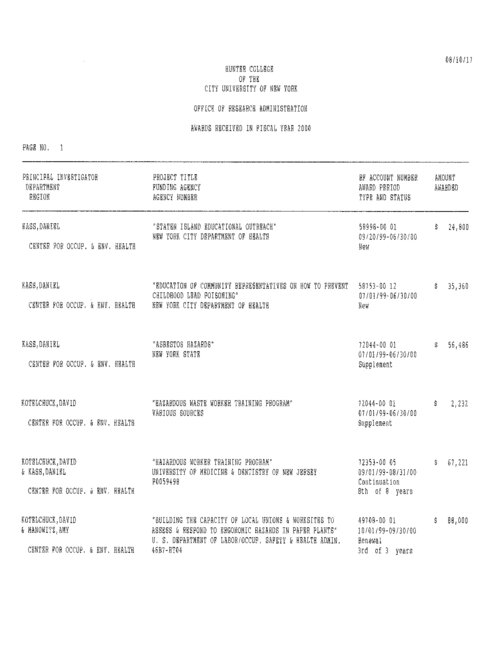 COEH Grant Awards 2000-2016 Produced by Hunter College's Office of Research Administration, this report offers summary of the various sources of funding and projects undertaken by the Center for Occupational and Environmental Health (COEH) between the years 2000 and 2016. While the projects cover a number of topics, several recurring ones, such as the "hazardous waste worker training" programs, would remain the bread and butter of the Center over the course of its history. Formally established in 1990 by CUNY's Board of Trustees, the Hunter College's COEH was founded with the mission "to promote community and workplace health" across the New York metropolitan area. Working with community groups, unions, governmental agencies, private employers, and educational institutions, the Center has educated hundreds of thousands over the course of its history.
 -
 COEH Grant Awards 1990-1999 Produced by Hunter College's Office of Research Administration, this report offers summary of the various sources of funding and projects undertaken by the COEH between the years 1990 and 1999. While the projects cover a number of topics, several recurring ones, such as the "hazardous waste worker training" programs, would remain the bread and butter of the Center over the course of its history. Formally established in 1990 by CUNY's Board of Trustees, the Hunter College Center for Occupational and Environmental Health (COEH) was founded with the mission "to promote community and workplace health" across the New York metropolitan area. Working with community groups, unions, governmental agencies, private employers, and educational institutions, the Center educated hundreds of thousands over the course of its history.
 -
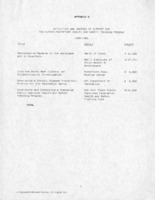 Activities and Sources of Support for the Hunter-Montefiore Health and Safety Training Program This Appendix B lists the activities and sources of support for the Hunter-Montefiore Health and Safety Training program in 1985-87. Minimizing Asbestos risks and developing a statewide public employee Health and Safety training program were dominant topics for the group. The program was a precursor to Hunter College's Center for Occupational and Environmental Health (COEH) which was formed several years later. Formally established in 1990 by CUNY's Board of Trustees, COEH was founded with the mission "to promote community and workplace health" across the New York metropolitan area. Working with community groups, unions, governmental agencies, private employers, and educational institutions, the Center educated hundreds of thousands over the course of its history.
 -
 Community Health Worker Project at Hunter College - Project Update 5/23/02 This update discusses several topics surrounding the Community Health Worker (CHW) Project run by Hunter College's Center for Occupational and Environmental Health (COEH). Included among these is a description of the progress towards creating a credit-bearing academic partnership between Hunter and Hostos Community College, and the announcement of Outreach NYC 2002, NYC's first conference for community health workers. Commencing in April 2000 with an initial class of 15 health workers from a variety of community groups, Hunter's program recruited local residents from New York City neighborhoods for an extensive 350-hour curriculum that educated participants on the topic of asthma, its management, assessment, and remediation. Following their training, these health workers where entrusted with providing outreach to their communities, serving as a "vital link between health care providers, community organizations, and the communities they serve." Formally established in 1990 by CUNY's Board of Trustees, COEH was founded with the mission "to promote community and workplace health" across the New York metropolitan area. Working with community groups, unions, governmental agencies, private employers, and educational institutions, the Center educated hundreds of thousands over the course of its history.
 -
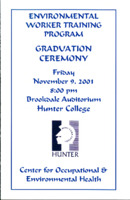 Environmental Worker Training Program Graduation Program This Graduation Ceremony program celebrates students graduating from the Environmental Worker Training Program in 2001. In addition to the conferring of certificates, students were recognized for academic achievement, attendance and professional development. Officially founded in 1990, the COEH spent decades dedicating itself to promoting community and workplace health throughout the New York area. It did so by offering courses on topics ranging from asthma to ergonomics for unions, neighborhood groups, public employees, and more.
 -
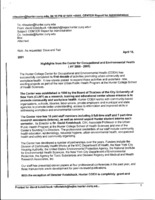 Highlights from the Center for Occupational and Environmental Health (2000-2001) After a decade of successfully implementing activities promoting urban community and workplace health, David Kotelchuck compiled the highlights of the center’s achievements and outlined future plans. This memo addressed to Nick Freudenberg, in addition to stating the mission, enumerates the qualified staff and lists a roster of high profile partners, which include but are not limited to the New York City Housing Authority and the United States Environmental Protection Agency. COEH worked with public housing residents on asbestos, lead-based paint remediation, hazardous waste materials handling as well as trainings in basic skills such as math and reading. They trained personnel to protect their own and others' health and safety when handling hazardous materials and how to safely contain hazardous chemical spills and fires. Future plans included an integrated pest management plan to address asthma and environmental health problems, a needle stick training program for medical students, and a lead poisoning prevention program. Officially founded in 1990, the COEH spent decades dedicating itself to promoting community and workplace health throughout the New York area. It did so by offering courses on topics ranging from asthma to ergonomics for unions, neighborhood groups, public employees, and more.
 -
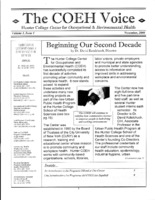 The COEH Voice Published in November 2000, this newsletter from Hunter College's Center for Occupational and Environmental Health offers a detailed look back at the center's work in its initial ten years and also anticipates its future plans. The Center, which worked with various groups throughout New York City and State, offered a variety of initiatives, many of which are outlined in this document and were intended to promote community and workplace health. Officially founded in 1990, the COEH spent decades dedicating itself to promoting community and workplace health throughout the New York area. It did so by offering courses and reports on topics ranging from asthma to ergonomics for unions, neighborhood groups, public employees, and more.
 -
 1992-1993 COEH Annual Report This annual report from 1992-1993 offers insight into Hunter College's Center for Occupational and Environmental Health (COEH) during its early years. Summarizing a year's worth of work, the document includes the Center's mission statement, a breakdown of published research, presentations, courses taught, and community outreach initiatives. Additionally, it enumerates the Center's sources of funding and personnel. Officially founded in 1990, the COEH spent decades dedicating itself to promoting community and workplace health throughout the New York area. It did so by offering courses on topics ranging from asthma to ergonomics for unions, neighborhood groups, public employees, and more.
 -
 Eugenia Wiltshire: An Oral History of the CCNY 1960s SEEK Program In this oral history interview, Eugenia Wiltshire (nee Dorothy Robinson) recalls her time attending City College in 1966-70 as one of CUNY's first SEEK students. Short for "Search for Education, Elevation, and Knowledge," SEEK was established in 1966 as a CUNY-wide program to assist disadvantaged students who might otherwise lack the opportunity to study at a four-year college.
 -
 Marvina White: An Oral History of the CCNY 1960s SEEK Program In this interview, Marvina White recounts growing up on Dyckman Street in Upper Manhattan and entering City College as part of the first class of SEEK students in 1966. White also analyzes how SEEK-- especially SEEK teachers and counsellors Barbara Christian, Betty Rawls, Mina Shaughnessy and Ed Quinn-- helped her and other students to succeed. Short for "Search for Education, Elevation, and Knowledge," SEEK was established in 1966 as a CUNY-wide program to assist disadvantaged students who might otherwise lack the opportunity to study at a four-year college.
 -
 Francee Covington: An Oral History of the CCNY 1960s SEEK Program and The Paper In 1966, Francee Covington entered City College as one the first class of SEEK students. Here, Francee remembers growing up in Brooklyn, her years as a City College student and her student journalism work on The Paper. Short for "Search for Education, Elevation, and Knowledge," SEEK was established in 1966 as a CUNY-wide program to assist disadvantaged students who might otherwise lack the opportunity to study at a four-year college.
 -
 Allen B. Ballard: An Oral History of the CCNY 1960s SEEK Program In September of 1965, City College launched SEEK, a desegregation and supportive teaching program that quickly became the direct model for new Equal Opportunity Programs at dozens of New York colleges. Here SEEK founder Allen Ballard remembers the 1960s SEEK program, including its writing program and teachers, and some of the SEEK students. Short for "Search for Education, Elevation, and Knowledge," SEEK was established as a CUNY-wide program to assist disadvantaged students who might otherwise lack the opportunity to study at a four-year college.
 -
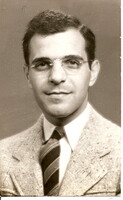 Anthony Penale as a Young Man Anthony Penale was a City College lecturer and writing teacher in 1965 when he was appointed by English Chair Edmund Volpe as the first SEEK English coordinator/director. Penale became ill in the summer of 1967 and Volpe then appointed Mina Shaughnessy as the new SEEK English coordinator/director. Short for "Search for Education, Elevation, and Knowledge," SEEK was established in 1966 as a CUNY-wide program to assist disadvantaged students who might otherwise have lacked the opportunity to study at a four-year college.
 -
 Educational Opportunity Programs: Are They Academically Justifiable? In this 22-page, July 1969 Milwaukee speech to the first annual conference on educational opportunity programs in higher education, Leslie Berger--director of CUNY's SEEK program--describes the birth and rapid growth of SEEK from 1965 to 1969; challenges the validity of admissions criteria as accurate measures of student potential; and explains SEEK’s open admissions, psychological counseling, creative teaching, stretch courses and financial aid. He also responds to calls for black administrators and teachers within EOP programs as well as more relevant curricula across colleges. Short for "Search for Education, Elevation, and Knowledge," SEEK was established as a CUNY-wide program to assist disadvantaged students who might have otherwise lacked the opportunity to study at a four-year college.
 -
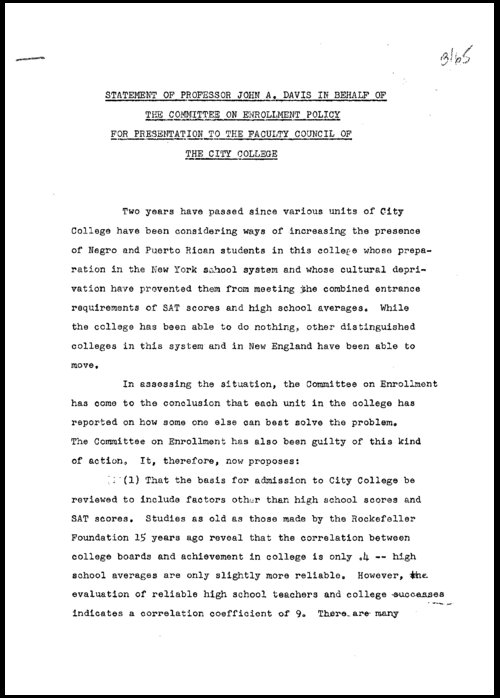 Statement of Professor John A. Davis In this 1965 statement Professor John A. Davis demands that his colleagues at City College take action to increase minority representation at the school. He writes that two years had “passed since various units of City College have been considering ways of increasing the presence of Negro and Puerto Rican students in this college.” Yet, he complains, “the college has been able to do nothing” while other colleges have acted. As a result, Davis proposes: 1) a desegregation program to immediately admit fifty students based on teacher recommendations as well as GPA/SAT scores, 2) beginning summer programs for “culturally deprived” high school juniors and seniors and then admitting them to City College with the help of “guidance and tutorial centers,” and 3) helping to improve the public schools through City’s School of Education. Davis grew up in Washington D.C. where, in the 1930s, he organized effective black boycotts of racist white businesses, setting off a legal fight that ended in a 1938 Supreme Court victory upholding the picketing rights of civil rights protesters, (New Negro Alliance v. Sanitary Grocery, Co., Inc.) Davis joined City College as a political science professor in 1953-- the same year he assisted the NAACP team in the Brown v. Board of Education case.
 -
 Janet Mayes: An Oral History of the CCNY 1960’s SEEK Program In this oral history interview, Janet Mayes, a City College SEEK writing teacher reflects on her experiences with the program. Mayes joined CCNY in the spring of 1967, making her one of the seven original SEEK writing lecturers. She co-taught a SEEK class with Audre Lorde. After a visit to the University of Iowa, Mayes theorized a new collaborative, peer-learning writing course model and walk-in writing center. After leaving City in about 1970, she began work on her doctorate, “Social Facilitation of Learning,” in clinical psychology. Mayes went on to teach at and consult for a series of New York and New Jersey colleges. In the early 1970s, she worked with Kenneth Bruffee at Brooklyn College to set up the seminal peer-tutoring program. Short for "Search for Education, Elevation, and Knowledge," SEEK was established as a CUNY-wide program to assist disadvantaged students who might otherwise lack the opportunity to study at a four-year college.
 -
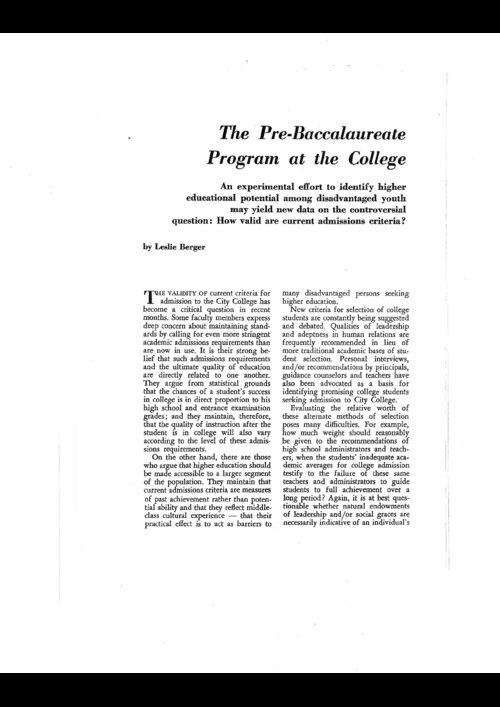 The Pre Baccalaureate Program at the College In this December 1966 City College Alumnus article, Leslie Berger publicly describes and advocates for the City College SEEK model and challenges all traditional college admissions criteria as incompetent measures of student potential. Short for "Search for Education, Elevation, and Knowledge," SEEK was established in 1966 as a CUNY-wide program to assist disadvantaged students who might otherwise lack the opportunity to study at a four-year college. Berger was the program's founding director at CUNY.
 -
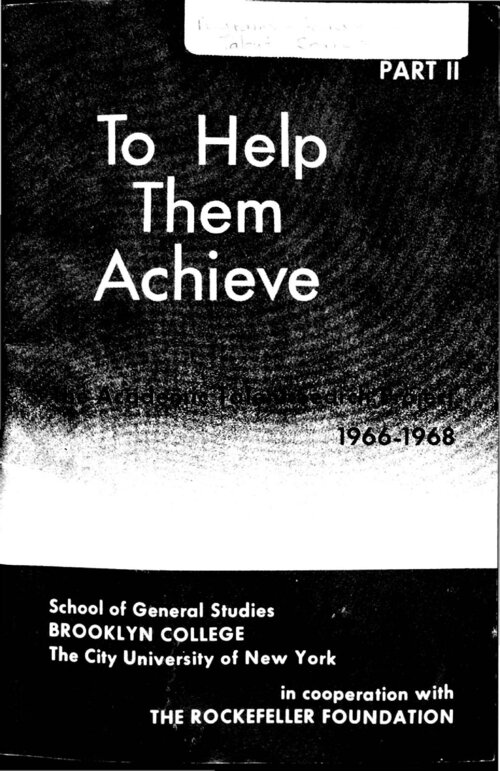 To Help Them Achieve: The Academic Talent Search Project 1966-68, Part II In the Fall of 1964, (armed with a Rockefeller Foundation grant) Brooklyn College’s School of General Studies launched a 42 student pilot program using Bowker’s model, which it called the “Academic Talent Search Project” or “ATSP.” The ATSP students were recent graduates from Brooklyn academic high schools in poverty areas. They had academic diplomas, but low high school grade point averages (pp. 3, 7). They were provisionally admitted until they could demonstrate academic success. ATSP “was designed to explore whether students with apparent college potential, but without the required academic standards for admission, could succeed in college despite financial and cultural deprivation in terms of middle-class values” (p. 7). No new students were added in later semesters; ATSP instead tracked these 42 students for four years. Brooklyn’s modest program demonstrated the complex barriers to racial integration within a conservative, white, four-year college. By 1968, ATSP’s closing report was forced to state “unequivocally that many people at the College believe the Project to have been a failure” (p. 27). After two years, 27 of the 42 ATSP students (64%) returned for a fifth semester. But their GPAs were low, averaging only 1.8 (about a C-) in their first year when they studied in small segregated tutorial groups and 1.2 (just over a D) in their second year when they entered mainstream classes. Also after two years, only one ATSP student had been fully matriculated as a regular student (pp. 14, 18). Eleven more students dropped out in the next two years, leaving only 16 of 42 (38%) in college after eight semesters. By 1968, only four ATSP students had been fully matriculated. Others persisted, but with low grade point averages. By fall of 1968, only one ATSP student had graduated and counselors believed that six more would likely eventually graduate, a potential success rate of 7 out of 42 (16.6%) (pp. 21-22). In June of 1966, ATSP was not mentioned in CUNY’s revised Master Plan (Board, 1966, June, p. 29). (This copy excludes postscript, appendices and and footnotes.)
 -
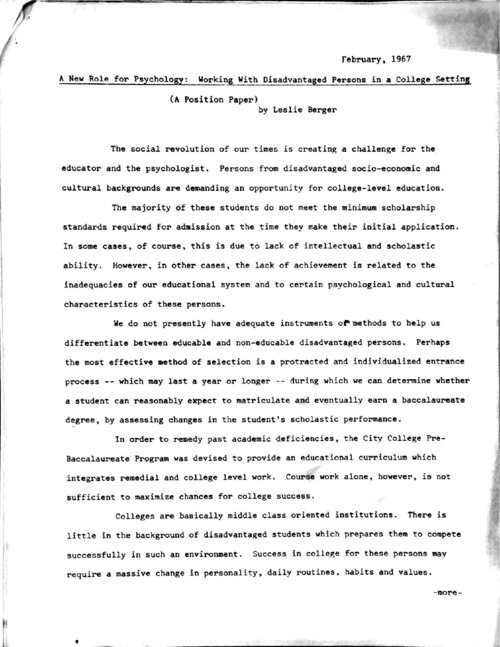 A New Role for Psychology: Working with Disadvantaged Persons in a College Setting In this 10-page "position paper," Berger describes and offers a theoretical rationale for the central role of psychological counselors within SEEK. A handwritten note adds an additional source on page 10. Short for "Search for Education, Elevation, and Knowledge," SEEK was established in 1966 as a CUNY-wide program to assist disadvantaged students who might otherwise lack the opportunity to study at a four-year college. Berger was the program's initial director.
476–500 of 1046