CUNY Digital History Archive
Item set
Collection
CUNY Digital History Archive
Items
501–525 of 1046
Advanced search
-
 1967 - 1968 Annual Report of the SEEK Program This is a CUNY-wide report for the SEEK program during the 1967-68 academic year. Included in the document is a cover letter from SEEK director Leslie Berger to CUNY Chancellor Albert Bowker, a table of contents, a list of SEEK administrators, and then 91 pages with 20 sections, including reports about SEEK programs at Brooklyn, City, Hunter-Bronx (Lehman), Queens, and York Colleges and The University Center. Short for "Search for Education, Elevation, and Knowledge," SEEK was established in 1965-1966 as a CUNY-wide program to assist disadvantaged students who might otherwise lack the opportunity to study at a four-year college.
 -
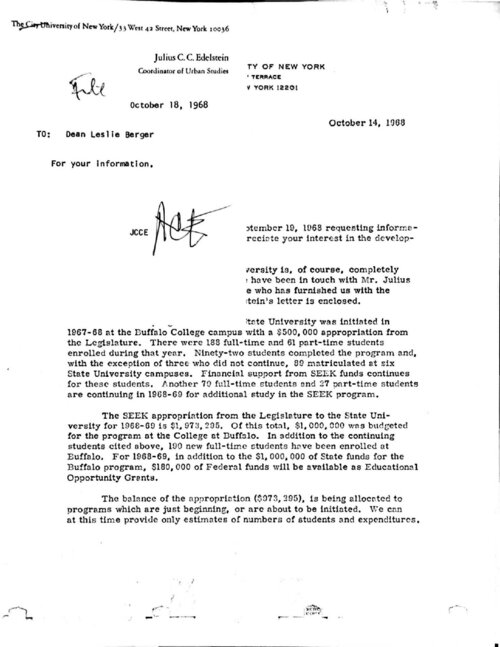 Letter from Samuel B. Gould to John H. Hughes In this letter to New York State Senator Hughes, SUNY Chancellor Gould describes the new SUNY SEEK Program. Gould had shown copies to CUNY’s Chancellor Bowker and Julius Edelstein, CUNY’s “Coordinator of Urban Studies,” who had forwarded the letter to Dean Leslie Berger. Gould describes the launch of SUNY SEEK at Buffalo College in 1967-68 with $500,000 in state funding and the program’s rapid expansion in various forms across SUNY in 1968-69 with $2 million in state funding.
 -
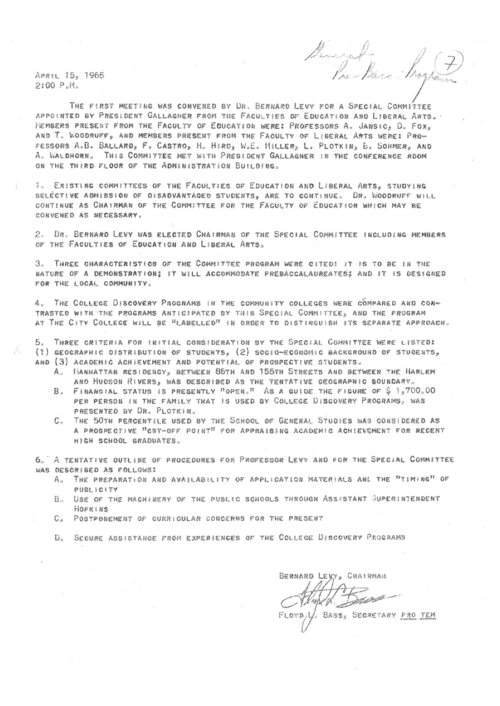 Minutes of April 1965 CCNY "Special Committee" One week after CCNY President Buell Gallagher obtained faculty approval for its creation, he sat in on this “Special Committee” meeting chaired by Bernard Levy to begin to plan a new racial and social justice admissions and support program that would draw applicants from the communities surrounding City College. In practice, the actual planning of the program quickly fell to three professors: Allen Ballard, Bernard Sohmer and Leslie Berger. Ballard and Sohmer are listed in attendance at this meeting. The efforts of the group ultimately contributed to the creation of the CUNY-wide SEEK program in 1966 following a CCNY-specific program the prior year.
 -
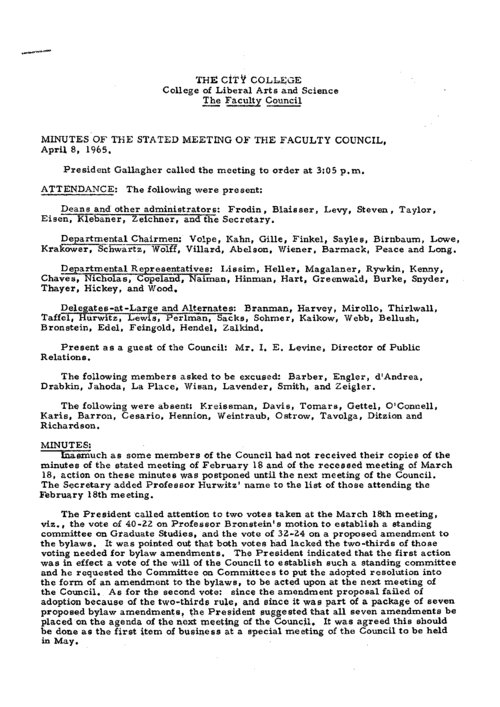 Minutes from 4/8/1965 CCNY Faculty Council Meeting In these notes from a liberal arts and sciences faculty council meeting at City College, CCNY President Gallagher describes a tentative plan to admit 100 “disadvantaged” students into an experimental program in fall 1965. After discussion, the faculty authorizes Chancellor Bowker to appoint a joint committee with the school of education to a plan and launch a CUNY-wide expansion of CCNY's experimental program that, in 1966, would become the SEEK program.
 -
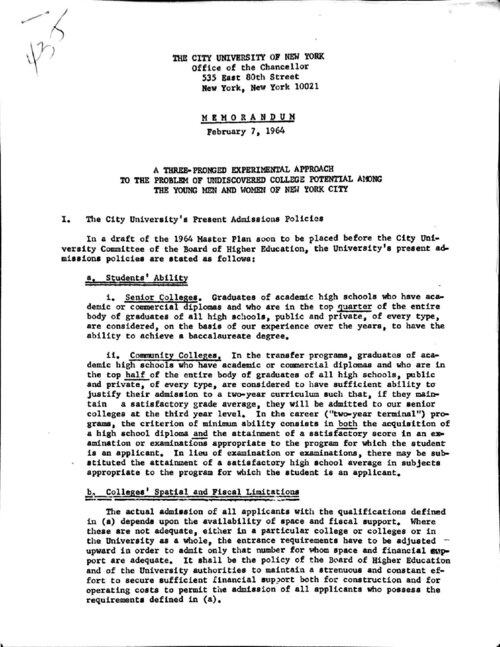 "A three-pronged experimental approach to the problem of undiscovered college potential among the young men and women of New York City" This memorandum from Chancellor Bowker’s office called for three new forms of CUNY desegregation programs (pp. 1-2). This “three-pronged experiment” would be excused from CUNY’s general obligation to admit only students with the highest grades and test scores. Its goal would be “to find out enough about the methods of selection and education of culturally disadvantaged persons of high native ability (‘potential’) to enable us to formulate policies which will place the admission to college of such students upon a firm non-discriminatory basis” (p. 2). The memo added that CUNY hoped “also to learn a great deal about the teaching of students in general” (p. 2). The third prong of the Chancellor’s office’s proposal called on senior colleges to host a “College Potentiality Search” from within their Schools of General Studies, using an elaborate, multi-tiered, application process to provisionally admit groups of students into their schools of general studies as “Pre-Matriculants.” These desegregation programs would teach on a “highly individualized and closely supervised basis” (p. 7). The Chancellor’s office assumed these new students would be underprepared and would struggle to succeed. They would be assigned to zero-credit remedial courses or a mix of remedial and credit bearing courses “until [they] clearly demonstrate a capacity to pursue college-level work” (p.7). Group and individual tutorials would “discover weaknesses and gaps in their educational backgrounds” and raise student performance “to an acceptable collegiate level.” Students would not be treated “as a group” but “as persons, to be judged on their individual records” (p.7). Although retention policies would not be altered in “mistaken generosity” to help any student who “shows himself incapable of completing college level work satisfactorily,” the goal was “for these students to be integrated into the courses and life of the College….by hard work (both on the part of the student and teacher) to a level where they will not suffer new agonies of falling “below par” (p. 7). Students would receive special “counseling and supportive services,” including faculty counseling, “psychological counseling [and] social work” (p. 7). The Chancellor’s office called for a 50-student program to begin in the fall of 1964 and suggested Brooklyn College as its location (p. 6).
 -
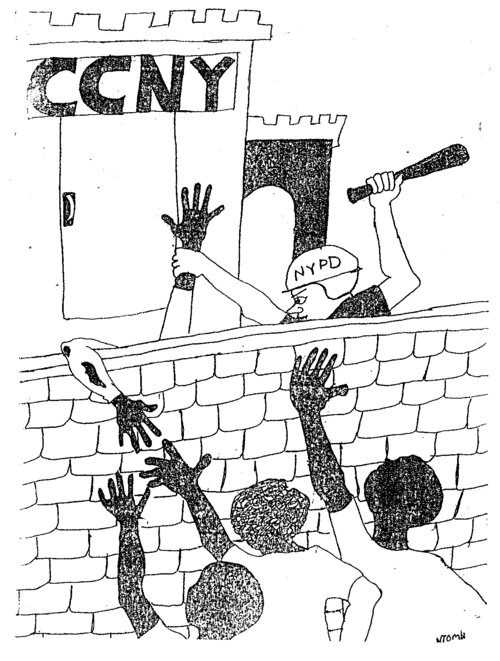 CCNY Protest Flier This April/May 1969 flier was created to protest police presence on campus and police brutality that many student activists objected to at City College. College administrators requested the police in order to secure the conditions necessary to resume classes following weeks-long protest efforts that had temporarily closed the college. The protesters, comprised largely of black and Puerto Rican students, had organized in pursuit of five demands that called for greater diversity and representation on campus. Over the course of their efforts, violence erupted between pro-strike students, anti-strike students and police, a factor that led to the resignation of CCNY President Buell Gallagher on May 12th.
 -
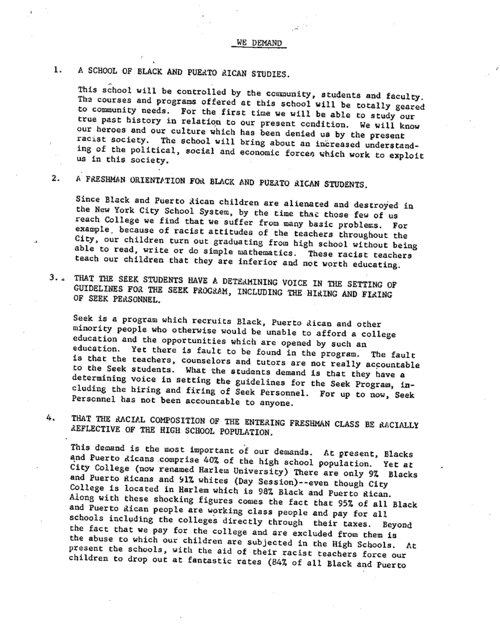 Five Demands This handout, created by a group of protesting City College students, offers insight into the motivations behind a campus-wide strike in April/May 1969. Black and Puerto Rican students, as well as white supporters, demanded the college meet these five demands that sought to reorient the college towards the largely overlooked black and Puerto Rican communities in the college's Harlem neighborhood. Steadfast in their demands, the protesting students occupied various CCNY buildings and organized marches and strikes from April 22nd through the end of the semester. Violence between pro-strike and anti-strike students and the police eventually led to the resignation of CCNY president Buell Gallagher on May 12th. Nevertheless, the protestors persistence forced the administration to negotiate and make some agreements related to the students' demands. This series of events was one of several that helped to pave the way for the policy of Open Admissions that began in fall 1970.
 -
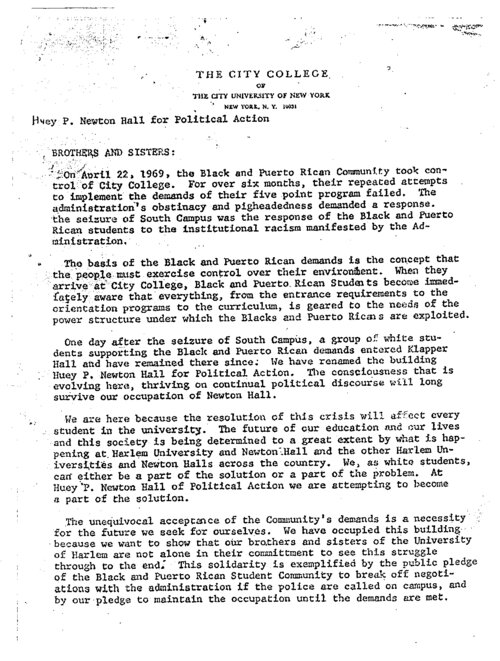 Newton Hall Statement “We as white students, can either be a part of the solution or a part of the problem. At Huey P. Newton Hall of Political Action we are attempting to become a part of the solution.” In solidarity with black and Puerto Rican students, a group of white students occupied City College's Klapper Hall at 135 Street and Convent Avenue and renamed it "Huey P. Newton Hall for Political Action," after the co-founder of the Black Panther Party. This statement was written from within “Newton Hall” by occupying students and calls for the administration’s “unequivocal acceptance” of the Five Demands. It argues that white students should join them in supporting the strike. The announcement of a meeting and an analysis of the Five Demands, which pertains to the need for greater diversity and representation on campus is included in the statement. Violence between pro-strike and anti-strike students and the police eventually led to the resignation of CCNY president Buell Gallagher on May 12th. Nevertheless, the protestors' persistence forced the administration to negotiate and make some agreements related to the students demands. This series of events was one of several that helped to pave the way for the policy of Open Admissions that began in fall 1970.
 -
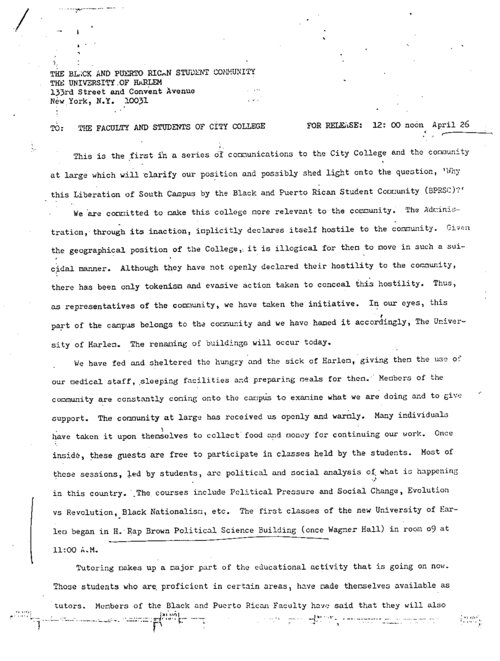 Press Release from Black and Puerto Rican Student Community This press release, written by protesting black and Puerto Rican students at City College on April 26, 1969, offers insight into the group's motivation behind their protests in the preceding months. Arguing for CCNY to better serve its surrounding Harlem community, the statement describes student efforts to create a community-based educational institution that they named, the "University of Harlem." The students' calls for CCNY's greater community involvement lay at the heart of their published Five Demands. Those demands, which called for among other things, greater diversity and representation on campus, ultimately affected the early implementation of the policy of Open Admissions.
 -
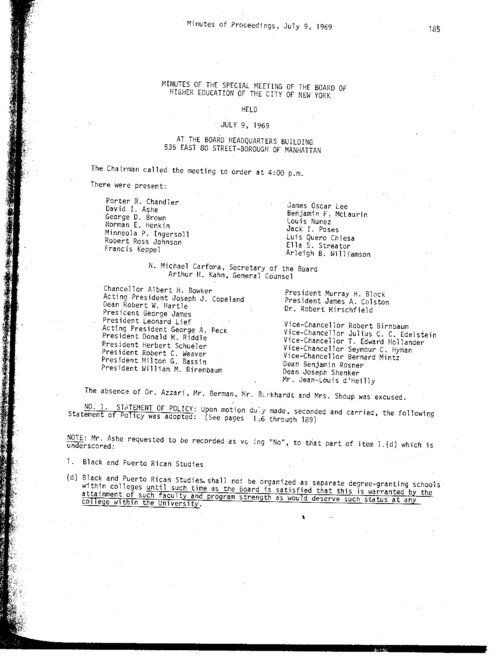 Statement of Policy by the Board of Higher Education This "statement of policy", attached to the minutes from a meeting of the Board of Higher Education on July 9, 1969, reflects the culmination of negotiations between college officials and protesting City College students. The students, most of whom were black and Puerto Rican, had previously enumerated a list of five demands pertaining to campus diversity and representation. The Board's statement offers a response and plan of action intended to address each demand. Most notably, it announces college officials' intention to expedite plans for Open Admissions. It would begin in fall 1970, instead of the previously announced start date of 1975.
 -
 "Administrative Management of the School System of New York City" The Survey of The Board of Education and The Board of Higher Education report was conducted in 1951 by George Strayer. It is an early effort to reorganize municipal colleges. Among other reports and legislative laws, it documents the shift in policy that would ultimately lead to the consolidation of New York City’s municipal colleges into one coordinated system. After a year of observation, study and analysis the report made recommendations as to the management of public education and higher education which included an increase in financial support to municiple colleges, the establishment of more junior colleges and technical schools and a transfer of the municipal college system to the State University of New York to excersise full mangerial responsibility.
 -
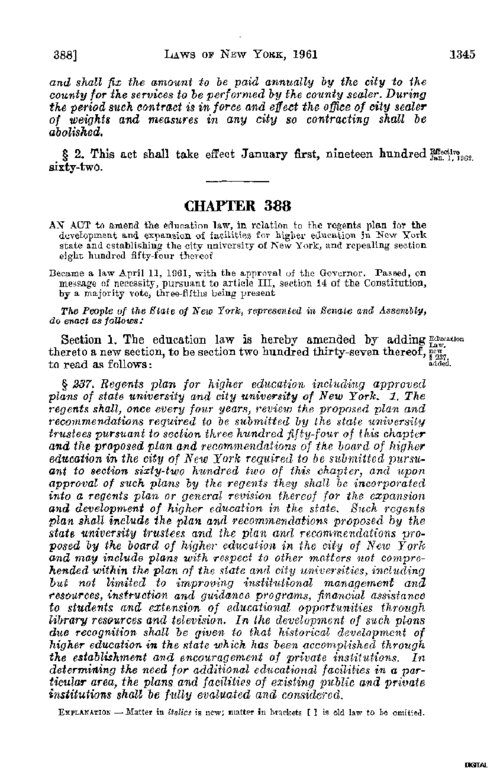 Amendment to New York State Education Law (1961) The 1961 amendment to the Education Law establishes CUNY and at the same time repeals the 1926 legal mandate for free tuition. It states that the Board of Higher Education shall be a "separate and distinct body corporate", which will administer all educational units under the general name "City University" and the college’s distinctive title. Every four years the Board of Higher Education will make recommendations to the Board of Regents including but not limited to curricula, new facilities, admission policies and funding. This funding model legalizes out of state tuition and introduces Regent College Scholarships.
 -
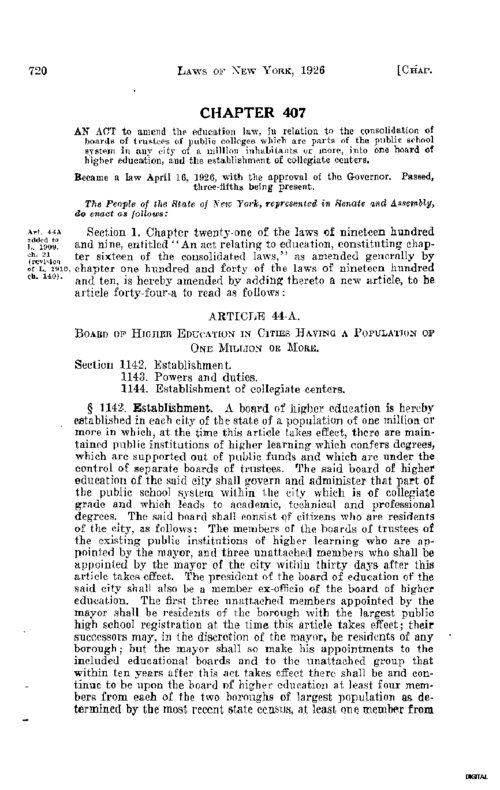 The Education Law: Chapter 407 of New York State Law (1926) This 1926 amendment to the education law legislatively establishes the legal mandate to create the Board of Higher Education and thereby reasserts free tuition as a democratic right. It offers insights into how certain policy changes paved the way for the creation of a consolidated municipal system of higher education. In article 44-A the Board of Higher Education is established as a separate entity from the Board of Education in cities with populations greater one million people. It is granted power and duties such as the acquisition of new sites and the approval of all courses. The law also outlines how funding is to be appropriated from the city to the board. Only in 1961 will the education law be repealed replacing free tuition with a Scholarly Incentive Program.
 -
 Cottrell Report: Public Higher Education in the City of New York This 48-page report provides a comprehensive survey of New York City's higher educational institutions in 1950 and its outlook over the next two decades. Commissioned by the Board of Higher Education, the study sought to identify, anticipate, and analyze the issues that the changing city would face in higher education. Divided into four chapters, the report's main findings are found in the first chapter which presents the group's general recommendations and conclusions. The majority of the findings related to ways to satisfy increased demand for higher education across the city's five boroughs. Especially interesting are the suggested capital projects which offered ideas meant to increase the capacities of the city's municipal colleges. Appendices in the back of the report provide additional insights into the population and student makeup of the colleges at mid-century.
 -
 Oral History Interview with Blanche Wiesen Cook Blanche Wiesen Cook, Eleanor Roosevelt biographer, grew up in the Bronx and Queens, and attended Hunter College as an undergraduate when it was an all female school. She treasured her time learning from Ruth Weintraub and Mina Rees, whom she describes as the founders of the City University of New York. Blanche reflects upon her life-changing experience participating in sit-ins in North Carolina as the president of the Hunter College Student Government in 1961, spurred on by Eleanor Roosevelt herself. In this interview, Blanche describes her perspective on Open Admissions as a faculty member teaching at John Jay College since 1967 when she worked closely with CUNY Senior Vice Chancellor Julius C.C. Edelstein. She expounds upon her political beliefs and how they intersect with her activism, such as participating in demonstrations to save John Jay College in the 1970’s. She stresses the importance of education in her own professional life and for society at large, and shares her own pedagogical philosophy when teaching the police officers and firefighters in her classes.
 -
 Oral History Interview with Allen Ballard This oral history interview was conducted on April 4, 2014 at SUNY Albany. Allen Ballard grew up in Philadelphia, Pennsylvania and arrived at the City College of New York in 1960 as an assistant professor of Political Science. He was one of the three black faculty members on campus. In this interview, Ballard describes his role in initiating the SEEK Program, which stands for Search for Education, Elevation and Knowledge. He provides insights into the history and implementation of the SEEK Program, including the role of black political mobilization in launching the program in 1966. Open Admissions, seen as a product of the SEEK Program, is discussed extensively in this interview. Ballard discusses the constituencies that advocated for Open Admissions, such as black and Puerto Rican students, as well as the white opposition at many of the four-year colleges. He concludes by reflecting on the success of graduates and notes that student achievement is a “cumulative and slow process.”
 -
 "Free Speech Victory" Published by the "Citizens Committee for Constitutional Liberties," this is a collection of news clippings featuring articles relating to free speech issues on CUNY college campuses in 1961. The committee had formed in opposition to the McCarran Act, legislation passed in 1950 that sought to register and monitor "subversive" and communist American citizens.
 -
 Oral History Interview with Henry Arce In this interview conducted about CUNY’s Open Admissions program, Arce describes his journey from the NYC Public School system to graduating from college. He credits his mother, who raised him alone in a Puerto Rican, immigrant community, for instilling the importance of an education. In 1966 he was recruited to be a student in SEEK program and attend City College. As a student he began to question what he refers to as the “contradictions” found in American society. Arce describes taking a class with the Poet Laureate of Puerto Rico, Diana Ramírez de Arellano as a pivotal moment in understanding his role as Puerto Rican at City College. Arce was active in the founding of PRISA (Puerto Ricans Involved in Students Action) and became their first president. He was also in a leadership position during the City College Takeover, and the formation of Harlem College which is largely credited for ultimately leading to Open Admissions. He discusses Frantz Fanon’s teachings influence on how the Takeover was organized. In addition, he describes the Five Demands which included addressing the fact the City College was 97% white despite being in predominately black Harlem. Activists emphasized that minority students were not receiving an education that prepared them to succeed at college and wanted a diverse curriculum that valued and reflected their backgrounds. Although he admits their failure may have been to “not pass the baton” on to the next generation, he also acknowledges the many successes including that fact that the racial ratio of CUNY has drastically changed and more minorities are graduating now. This interview is a lively account of a nation, city and college that was in process of questioning meritocracy and equality in education and pluralistic perspectives.
 -
 Oral History Interview with Anselma Rodriguez In this oral history, Anselma Rodriguez discusses her experiences as a student at Brooklyn College from 1969-1973. She was a founding a member of Movimiento Estudiantil Dominicanos and active in Brooklyn College's Puerto Rican Studies Department. Rodriguez also discusses her experiences as an immigrant in New York, the Trujillo regime in the Dominican Republic, Open Admissions and her role in the Financial Aid office at Brooklyn college. Although Rodriguez claims to have only been peripherally involved, she draws connections between the Open Admissions movement, the Civil Rights Movement, the Anti-Vietnam war movement, the Black Panthers and the Young Lords. She stressed intersectionality, insisting that equity in education is connected to housing rights, health care and employment opportunities. Furthermore, Rodriguez also seeks to make a distinction between race and economics, claiming that the faculty and staff who were against Open Admissions but for the imposition of tuition were discriminating against poor people regardless of race. Rodriguez’s shares insights given her later role as a Financial Aid Counselor and the real life problems encountered by first and second-generation students.
 -
 Oral History Interview with Khadija DeLoache Khadija DeLoache entered City College in the fall of 1966 with support from the CUNY Seek program. In this oral history, DeLoache discusses growing up in Harlem, her experience as a student activist, and the development of the Black Studies department at City College. DeLoache also discusses her memories of the Kennedy and Martin Luther King assassinations, and the political struggles of the 1960s. This interview was conducted by Douglas Medina for his research on the period of Open Admissions at the City University of New York.
 -
 Oral History Interview with Cecelia McCall This interview with Cecelia McCall focuses on her involvement with the New Caucus and its eventual rise to leadership in the Professional Staff Congress. In 2000 the New Caucus ran against the City University Union Caucus, which had been in leadership since 1972, and won. Cecelia was the secretary from 2000 until her retirement in 2007, working in collaboration with the other three officers to fight for the University and its constituency, which included Full-time faculty, Higher Education Officers, Adjuncts and College Lab Technicians, among others. This interview outlines Cecelia's thoughts on the challenges and successes the New Caucus' experienced during the early years of its leadership.
 -
 Oral History Interview with Stella Zahn, Sophie Davis School of Biomedical Education In this impromptu interview conducted on July 27, 2013, Stella Zahn discusses the mission, students, and founding years of the Sophie Davis Biomedical School established in 1973. Stella was initially hired to be Director of Student Services but eventually became Director of Recruitment. She speaks warmly of Dean Gellhorn and describes the way in which he structured the school's curriculum as well as his commitment to increasing the number of minority students entering the medical field. In addition, she remembers the difficulties the students had, included long commutes and home environments that were not conducive to studying. She recalls allowing female students to live with her as they studied for their board exams. Recorded in Woodstock, New York, beside a stream, the interview ends abruptly after 15 minutes.
 -
 Occupy CUNY News This Wordpress site features a collection of links and articles relating to the Occupy CUNY movement of 2011-12. No longer updated, it now serves as a repository for information on the activism of the period.
 -
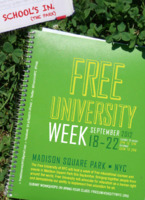 Free University Week This web page features information regarding "Free University Week," a five-day event in Madison Square Park from September 18-22, 2012 that offered free educational workshops and classes to the general public. Founded around May Day 2012, the Free University project has continued through 2017.
501–525 of 1046