CUNY Digital History Archive
Item set
Collection
CUNY Digital History Archive
Items
551–575 of 1046
Advanced search
-
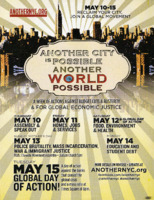 Another City is Possible This flyer announces a week of actions in NYC against budget cuts, austerity and global economic justice. May 14th concentrated on education and students with leafleting and picketing for quality public schools, free education and against student debt . Thousands of people joined at Times Square on May 15th for the culmination of the week's actions against austerity and corporate greed and in solidarity with hundreds of thousands who were rising up around the world. Among many other groups Alliance for Quality Education, Coalition for Educational Justice, New York Students Rising, Parents for Occupy Wall Street, PSC-CUNY, United Federation of Teachers and Students for a Free CUNY all worked in collaboration with Occupy Wall Street for "Another City is Possible".
 -
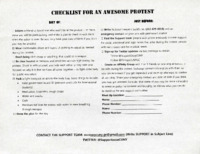 Protest Checklist Occupy CUNY created this checklist for an “awesome protest.” Tips included writing the National Lawyer’s Guild number on your arm, twitter update information and advice for affinity groups. Contact information for the Occupy CUNY support team was also provided. An offshoot of the Occupy Wall Street movement, Occupy CUNY organized around fighting the militarization of CUNY campuses, and the privatization of education. CUNY Students rallied against the Board of Trustees to oppose pay scale increases for top administrators, and tuition hikes. In addition, students collectively organized pop-up universities, direct action teach-ins, hacking spaces and general assemblies at the Graduate Center and in public spaces. Among the other planned actions, students produced political theater exposing Chancellor Goldstein and the security company, Kroll. Occupy CUNY also stood in solidarity with Cooper Union students against the implementation of tuition and Quebec’s student movement.
 -
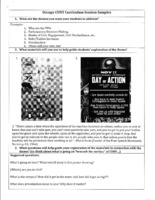 Occupy CUNY Curriculum Session Samples Curriculum made for CUNY classrooms in conjunction with the "Occupy the Octopi" poster (made for an October 21, 2011, Occupy CUNY teach-in at Washington Square Park) and a flyer for the November 17, 2011, OWS Student Strike, both created by the Graduate Center General Assembly.
 -
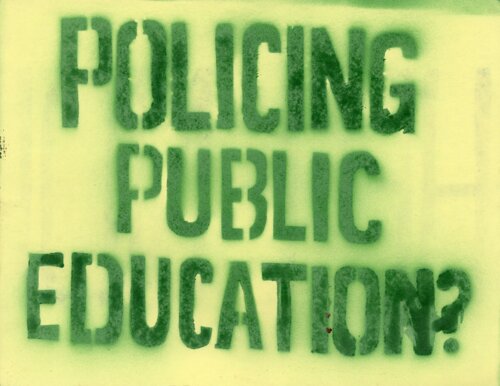 "Policing Public Education? Hell No!" Stencil Stencil made during November 2011 CUNY struggles against tuition increases and NYPD/CUNY security assaults on campus dissent. CUNY hired Kroll, Inc , a security advising company to conduct a biased investigatory report about a November 21, 2011 incident at Baruch College. On this date, NYPD and CUNY security physically attacked and arrested students, faculty, staff, and community members who were attempting to peacefully enter a Board of Trustees public hearing on a 5-year tuition increase.
 -
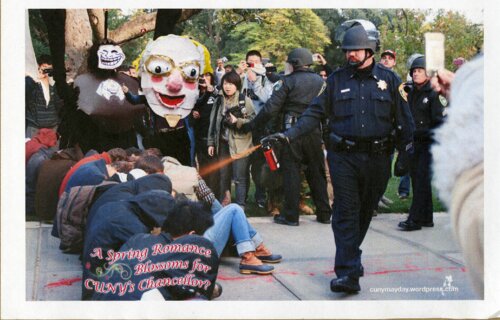 A Spring Romance Blossoms for CUNY's Chancellor? Satirical leaflets made by Occupy CUNY about Chancellor Matthew Goldstein's relationship to Kroll, Inc., a security advising company that CUNY hired to conduct a biased investigatory report about a November 21, 2011 incident at Baruch College. On this date, NYPD and CUNY security physically attacked and arrested students, faculty, staff, and community members who were attempting to peacefully enter a Board of Trustees public hearing on a 5-year tuition increase. On May 8, 2012, after the John Jay College Chairman and head of Kroll, Inc., Jules Kroll, donated $2 million to the college, the "Lynn and Jules Kroll Atrium" was unveiled. On January 4, 2013, Kroll, Inc. released a report absolving CUNY of any wrongdoing in the Baruch College incident. An offshoot of the Occupy Wall Street movement, Occupy CUNY organized around fighting the militarization of CUNY campuses, and the privatization of education. CUNY students collectively organized pop-up universities, direct action teach-ins, hacking spaces and general assemblies at the Graduate Center and in public spaces. Among the other planned actions, students produced political theater exposing Chancellor Goldstein and the security company, Kroll. Occupy CUNY also stood in solidarity with Cooper Union students against the implementation of tuition and Quebec’s student movement.
 -
 Student Week of Action in Defense of Education Occupy CUNY circulated this informational leaflet for a “Student Week of Actions” (November 14-21, 2011) in defense of education, and in solidarity with Occupy Wall Street. The schedule of Graduate Center Events included a student strike, a speak out, and a GC general assembly. Further actions such as a CUNY-wide general assembly and a walk out in protest of tuition hikes were also announced. An offshoot of the Occupy Wall Street movement, Occupy CUNY organized around fighting the militarization of CUNY campuses, and the privatization of education. CUNY Students rallied against the Board of Trustees to oppose pay scale increases for top administrators, and tuition hikes. In addition, students collectively organized pop-up universities, direct action teach-ins, hacking spaces and general assemblies at the Graduate Center and in public spaces. Among the other planned actions, students produced political theater exposing Chancellor Goldstein and the security company, Kroll. Occupy CUNY also stood in solidarity with Cooper Union students against the implementation of tuition and Quebec’s student movement.
 -
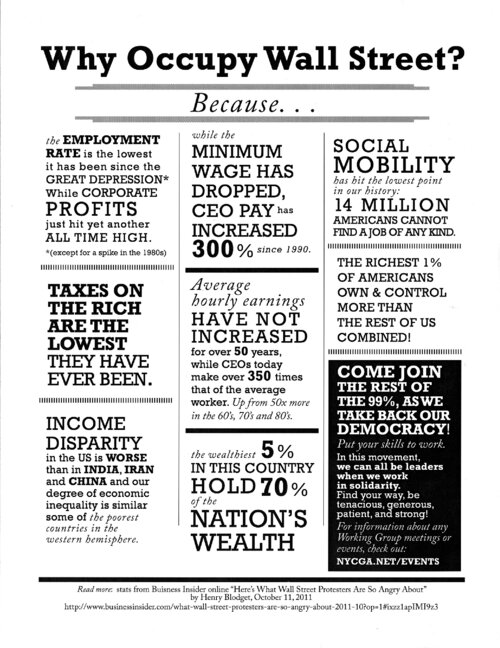 Why Occupy Wall Street?/ ¿Por qué debemos ocupar Wall Street? Citing Henry Blodget's article in "Business Insider" this bilingual informational leaflet states why one should join the 99% and join the Occupy Wall Street actions. High corporate profits, extreme income disparity and low social mobility are some of the reasons provided.
 -
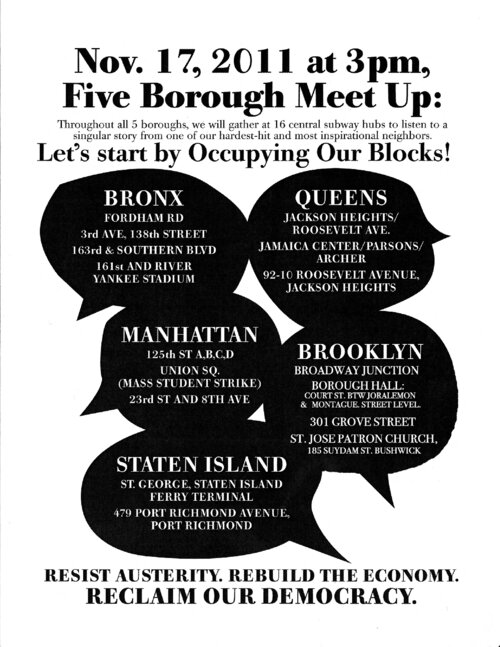 Occupy Every Block: Day of Action Organized by Occupy Wall Street this informational leaflet is a call for a Day of Action on November 17, 2011. This decentralized action was held throughout all 5 boroughs of New York City, with gatherings at 16 central subway hubs to listen to stories from the front lines of economic injustice.
 -
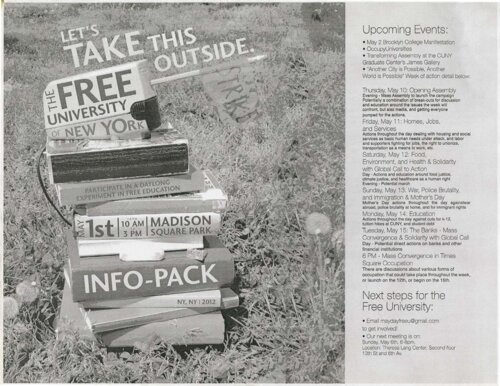 Free University Week - 1st Annual May Day Course Descriptions This pamphlet features workshops, teach-ins and events planned for the 1st annual Free University of New York City on May 1, 2012, in Madison Square Park, Manhattan, NY. In addition to talks by David Harvey, David Graeber, Francis Fox Piven, Chris Hedges, a wide array of classes ranging from Occupydrama to OccupyAlgebra were offered. Alternative banking, intersectionality of oppressions, and open source hardware and software were some of the diverse themes, explored by participants. In addition to time slots the schedule offers brief descriptions of each class. The Free University of New York City is an experiment in radical education building on the historic tradition of movement freedom schools. The project was born out of the conviction that the current system of higher education is as unequal as it is unsustainable, while vast sources of knowledge across communities are all-too-hidden and undervalued. First conceived as a form of educational strike in the run up to May Day 2012, the Free University has since organized numerous days of free crowd-sourced education in community centers, museums, parks, public spaces, and subway stations in New York City.
 -
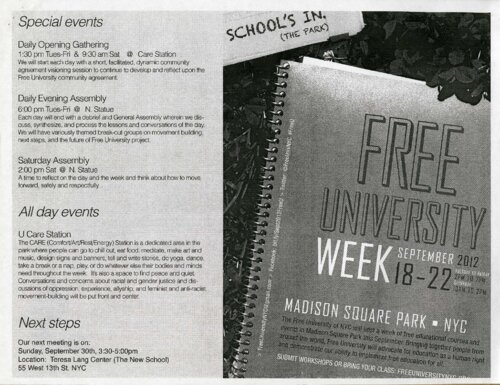 Free University Week - September 18 Information Packet "Free Education is a Right" This workshops pamphlet for "Free University Week," September 18-22, 2012, in Madison Square Park, Manhattan, NY announced a variety of topics ranging from Radical Potentiality: Recreating Academic Practices in the Humanities to a workshop on Yoga. The Free University of New York City is an experiment in radical education building on the historic tradition of movement freedom schools. The project was born out of the conviction that the current system of higher education is as unequal as it is unsustainable, while vast sources of knowledge across communities are all-too-hidden and undervalued. First conceived as a form of educational strike in the run up to May Day 2012, the Free University has since organized numerous days of free crowd-sourced education in community centers, museums, parks, public spaces, and subway stations in New York City.
 -
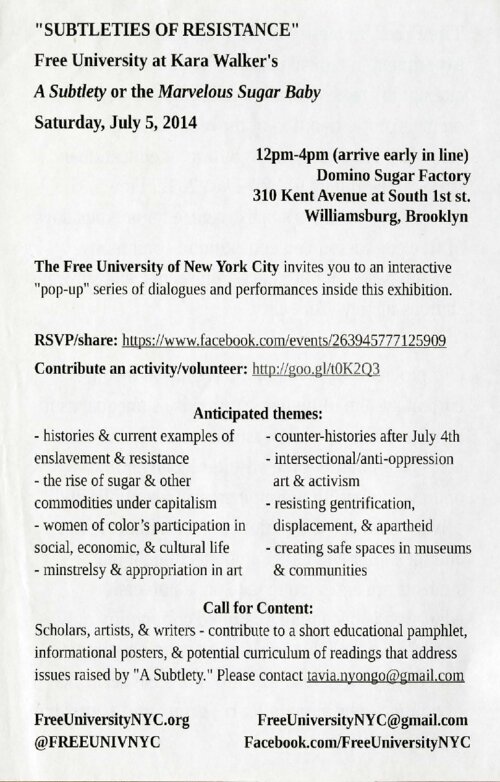 "Subtleties of Resistance" Free University at Kara Walker's
A Subtlety or the Marvelous Sugar Baby Promotional leaflet for July 5, 2014, Free University-NYC event "Subtleties of Resistance" Free University at Kara Walker's exhibition, A Subtlety or the Marvelous Sugar Baby, at the Domino Sugar Factory, Brooklyn, NY. These site-specific workshops positioned at the intersection of education, art and activism covered diverse themes ranging from gentrification to women of color's participation in social, economic, and cultural life. The Free University of New York City is an experiment in radical education building on the historic tradition of movement freedom schools. The project was born out of the conviction that the current system of higher education is as unequal as it is unsustainable, while vast sources of knowledge across communities are all-too-hidden and undervalued. First conceived as a form of educational strike in the run up to May Day 2012, the Free University has since organized numerous days of free crowd-sourced education in community centers, museums, parks, public spaces, and subway stations in New York City.
"Subtleties of Resistance" Free University at Kara Walker's
A Subtlety or the Marvelous Sugar Baby Promotional leaflet for July 5, 2014, Free University-NYC event "Subtleties of Resistance" Free University at Kara Walker's exhibition, A Subtlety or the Marvelous Sugar Baby, at the Domino Sugar Factory, Brooklyn, NY. These site-specific workshops positioned at the intersection of education, art and activism covered diverse themes ranging from gentrification to women of color's participation in social, economic, and cultural life. The Free University of New York City is an experiment in radical education building on the historic tradition of movement freedom schools. The project was born out of the conviction that the current system of higher education is as unequal as it is unsustainable, while vast sources of knowledge across communities are all-too-hidden and undervalued. First conceived as a form of educational strike in the run up to May Day 2012, the Free University has since organized numerous days of free crowd-sourced education in community centers, museums, parks, public spaces, and subway stations in New York City. -
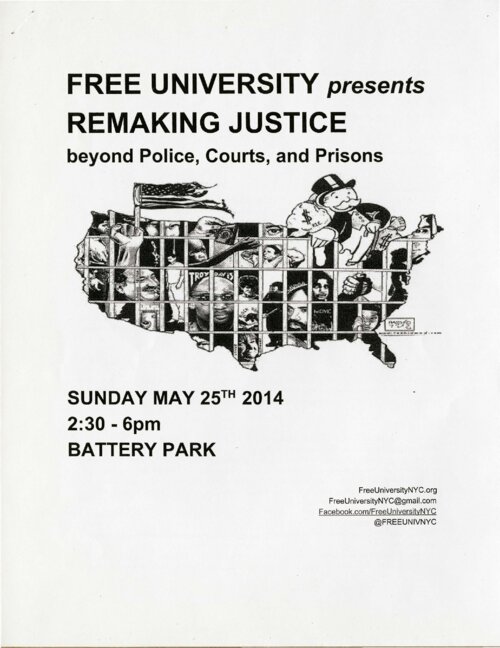 Free University Presents Remaking Justice beyond Police, Courts, and Prisons This workshops pamphlet was created for a May 25, 2014, Free University of New York City event "Remaking Justice beyond Police, Courts, and Prisons" in Battery Park, NY. Workshops were held outdoors at Battery Park and included presentations on organizing legal defense strategies, website support, Copwatch training as well as deconstructing mass incarceration from multiple perspectives. The Free University of New York City is an experiment in radical education building on the historic tradition of movement freedom schools. The project was born out of the conviction that the current system of higher education is as unequal as it is unsustainable, while vast sources of knowledge across communities are all-too-hidden and undervalued. First conceived as a form of educational strike in the run up to May Day 2012, the Free University has since organized numerous days of free crowd-sourced education in community centers, museums, parks, public spaces, and subway stations in New York City.
 -
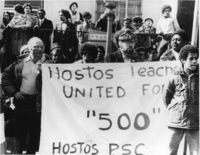 Hostos United for 500 This photograph depicts students and faculty with a sign at a rally being held across the street from "500" building a week before the building was taken over. As evident from the picture the Professional Staff Congress chapter was a driving force behind the struggle. The involvement of the union was critical and provided the continuity in the movement. From left to right faculty members Peter Roman, John Randall, Synos Mangazva are featured. By 1977, the third part of the campaign to save Hostos Community College had picked up momentum. Having extremely poor facilities, the college had acquired a second building across the street from its original location that would allow Hostos to expand. However, the 500 Grand Concourse building needed comprehensive repurposing to be useable but the college had been denied the funds necessary to prepare and occupy their second building. A fresh wave of organizing by students and faculty drove efforts to enable Hostos to continue to be a hub of opportunity for residents of the South Bronx.
 -
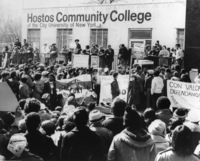 Student and Faculty Rally - Hostos United/Hostos Unido This photograph depicts a large rally that was held across the street from the "500" building a week before the take over. The rally was so massive that it halted traffic for several hours on the Grand Concourse. The various signs on display indicate the range of groups in attendance to support the struggle to defend Hostos Community College. In addition, the prevalent use of Spanish illustrates the commitment to a bilingual education. By 1977, the third part of the campaign to save Hostos had picked up momentum. Having extremely poor facilities, the college had acquired a second building across the street from its original location that would allow Hostos to expand. The 500 Grand Concourse building needed comprehensive repurposing but the college had been denied the funds necessary to prepare and occupy their second building. A fresh wave of organizing by students and faculty drove efforts to enable Hostos to continue to be a hub of opportunity for residents of the South Bronx.
 -
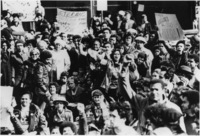 Sit-down in front of Hostos' 500 Building Students, the PSC Chapter and community activists unite behind the fight for the second building for Hostos Community College. Signs read: "VETERANS: This is our real fight - Our Aim: 500" and, translated from Spanish, "PSC demands: Give us the 500! NOW!" The Veterans Club was a central component to the Hostos United/Hostos Unido movement and several members made important contributions to the leadership. By 1977, the third part of the campaign to save Hostos had picked up momentum. The college had acquired a second building across the street from its original location that would allow Hostos to expand. The 500 Grand Concourse building needed comprehensive repurposing but the college had been denied the funds necessary to prepare and occupy their second building. A fresh wave of organizing drove efforts to enable Hostos to continue to be a hub of opportunity for residents of the South Bronx.
 -
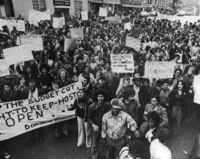 "While Hostos is Falling Down, Chase Manhattan is Making Pounds" This image depicts one of several CUNY wide demonstrations held in against crippling budget cuts that would threatened Hostos Community College's existence. Students were concerned about the impacts of retrenchment on diversity, Open Admissions and the elimination of key departments such as Nursing and Behavioral Science. In the midst of New York City's fiscal crisis, signs show the political views of the demonstrators. Staged near a branch of Manufacturer's Hanover Trust, signs read: "While Hostos is Falling Down, Chase Manhattan is Making Pounds," "We Live here, Banks Don't" and "Puerto Rican Studies -- Lehman College."
 -
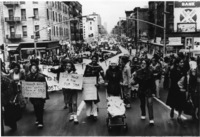 March to Gracie Mansion This a photograph of a student, faculty and staff march down Lexington avenue crossing 103 towards Gracie Mansion to raise awareness about Hostos Community College’s need for funding to complete renovations at 500 Grand Concourse. In addition to signs about the building, one, in Spanish, calls for a child care center as well. By 1977, the third part of the campaign to save Hostos Community College had picked up momentum. The college had acquired a second building across the street from its original location that would allow Hostos to expand. However, the 500 Grand Concourse building needed comprehensive repurposing and the college had been denied the funds necessary to prepare and occupy their second building. A fresh wave of organizing by students and faculty drove efforts to enable Hostos to continue to be a hub of opportunity of residents in the South Bronx.
 -
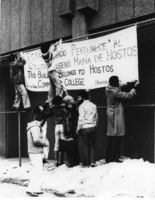 Students and Faculty Take Over the 500 Building This photograph shows student activists putting up a banner on the "500" building, marking the beginning of the takeover whose aim was to claim the building, hold classes, provide childcare as well as providing services to the students who had occupied the building. In both English and Spanish the banner states that the building belongs to Hostos Community College. To draw attention to their cause and to demand needed funding to complete renovations to the building, students and faculty occupied the property to pressure Mayor Koch and other officials to enable bond sales and renovations to proceed. This late 1970s action was a part of the third campaign to save Hostos Community College. Having extremely poor facilities, the college had acquired a second building across the street from its original location that would allow Hostos to expand. However, the 500 Grand Concourse building needed to be repurposed to be useable but the college had been denied the funds necessary to prepare and utilize the 500 building for educational use. A fresh wave of organizing by students and faculty drove efforts to enable Hostos to continue to be a hub of opportunity for residents of the South Bronx.
 -
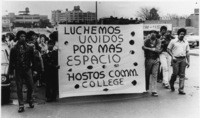 Luchemos Unidos / We Struggle United "Luchemos Unidos por Mas Espacio" sign translates to "We Struggle United for More Space." This was a student/faculty march through the community to alert the community of the campaign to acquire the 500 building. The resident's and passers'-by enthusiastic response energized a movement.
 -
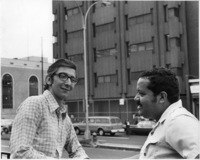 Meyer and Saunders Professor Gerald Meyer, Social Science Department, PSC Chapter chairperson and Sam Saunders, a student activist, converse across the street from Hostos Community College's 500 building. The two were co-leaders of the "Hostos Needs Space", a coalition of the Professional Staff Congress (PSC) Chapter and Student Government Organization (SGO) that organized the campaign the succeeded in obtaining the 500 building.
 -
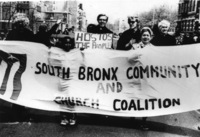 South Bronx Community and Church Coalition This photograph of South Bronx community members includes clergymen marching with a South Bronx Community and Church Coalition banner. This was the final march which celebrated the victory in saving Hostos.
 -
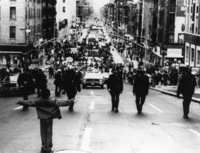 March to Gracie Mansion A young boy stretches his arms out as Hostos Community College students, professors and community organizers make their way to the Mayor's official residence to demand funding for the renovation of the 500 building. By 1977, the third part of the campaign to save Hostos Community College had picked up momentum. Having extremely poor facilities, the college had acquired a second building across the street from its original location that would allow Hostos to expand. However, the 500 Grand Concourse building needed comprehensive repurposing to be useable but the college had been denied the funds necessary to prepare and occupy their second building. A fresh wave of organizing by students and faculty drove efforts to enable Hostos to continue to be a hub of opportunity for residents of the South Bronx.
 -
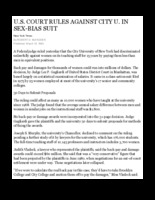 "U.S. Court Rules Against City U. in Sex-Bias Suit" Ten years after a class action lawsuit was filed in 1973 by 25 women faculty across CUNY campuses, a federal judge ruled that CUNY had "discriminated unlawfully against women on its teaching staff for 15 years by paying them less than men in equivalent positions." Popularly knows as the "Melani Case" because Brooklyn College Women's Studies Program co-coordinator Lilia Melani was the first plaintiff and organizer, the landmark case, born at Brooklyn College, affected the salaries of thousands of women employees of the university.
 -
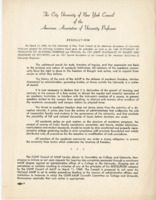 CUNY AAUP Resolution Adopted by the City University of New York Council of the American Association of University Professors, this resolution outlines a commitment to academic freedom and provides a promise to "protect the university from tactics which undermine the structure of freedom."
 -
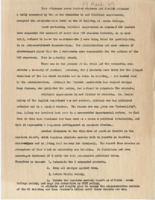 Ad Hoc Committee Statement of Demands This flier, created by the Ad Hoc Committee to End Political Suppression, lays out the group's purpose in choosing to occupy the Social Sciences (SS) Building on the Queens College campus. The group would occupy the building from March 27th, the date of the flier's creation, until April 2nd, the start of spring break, with only an hour-long disruption in between. That interruption occurred in the early morning hours of April 1st when 39 protestors were arrested and the building was temporarily cleared. The activist student group's principal motivation, as expressed in the first two of their four demands, was in support of three suspended students from the college facing criminal charges for driving out a General Electric recruiter on March 11th. Additionally, they sought the rehiring of a dismissed English instructor and the abolishment of a recently issued CUNY-wide report governing faculty firings. Though the Queens College administration would reinstate the suspended students, the college's president, Joseph P. McMurray, adamantly refused to dropped charges. Consequently, student protests continued into May.
551–575 of 1046