CUNY Digital History Archive
Item set
Collection
CUNY Digital History Archive
Items
601–625 of 1046
Advanced search
-
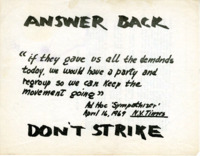 "Answer Back / Don't Strike" Another anti-protest flier, this one again calls for students to attend class instead of striking. It features a quote from an "Ad Hoc 'Sympathizer'," a member of the group largely responsible for much of the ongoing disruption on campus.
 -
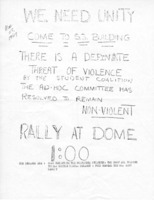 We Need Unity Produced by the Ad Hoc Committee, a left-leaning student activist group at Queens College, this flier calls for a rally at the Dome on campus. Additionally, it calls for support at the Social Sciences (S.S.) Building. Just the day before this flier was created, 500 Queens students began a sit-in in the S.S. Building in protest of a faculty member's dismissal and the administration's treatment of student protestors from a March demonstration. By April 1, 39 would be arrested as police cleared out the S.S. Building at the college administration's behest.
 -
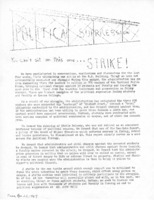 "Political Suppression - You Can't Sit on This One...Strike!" Created by the Ad Hoc Committee, a left-wing group comprised of student and faculty activists, this handout advertises an April 22, 1969 protest against the Queens College administration. The flier provides a brief summation of the group's most recent activity and lays out their demands which provided the justification for their protest efforts. From March onward, consistent student unrest on campus came to define Queens College's spring 1969 semester.
 -
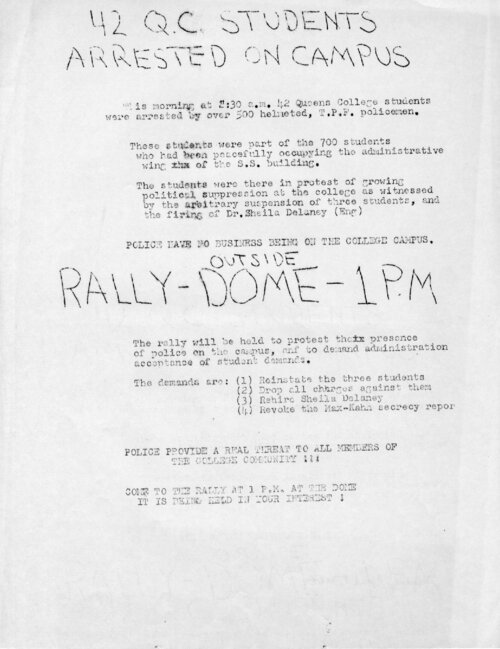 42 QC Students Arrested on Campus This flier calls for a rally on April 1st, 1969 against Queens College's decision to have city police clear a student demonstration on campus. Students from the college's Ad Hoc Committee and Students for a Democratic Society (SDS) chapter had led the occupation of the Social Sciences Building for six days until the early morning hours on April 1st when the building was emptied and 39 were arrested. (This is the number of arrestees that was reported by the New York Times.) Their protest concerned the college's dismissal of an instructor and the administration's treatment of student protestors from an earlier incident in March. The campus remained a hotbed of student unrest until graduation ceremonies in June.
 -
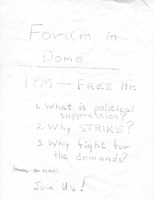 Forum in the Dome Created by the Ad Hoc Committee, a left group of student and faculty activists, this flier promotes a campus forum during Queens College's free hour on April 21, 1969. The group, protesting the administration's treatment of student and faculty activists from earlier incidents in March and April, sought to gain further popular support through the explanation of their motivations and positions. The organization's most notable effort thus far had been the organization of a six day sit-in in the Social Sciences building that culminated on April 1st with the arrest of 39. Such did not deter them, however, as their efforts continued through the end of the semester.
 -
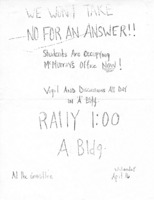 We Wont Take No For an Answer!! Produced by the Ad Hoc Committee, a left group of student and faculty activists, this flier advertises a rally at Queens College's A Building on April 16, 1969. A New York Times article from the following day reported that 150 students took control of four floors of the administrative building and blocked access to the president's office. The group, protesting the administration's treatment of student activists from earlier incidents in March and April, had previously occupied the Social Sciences Building at the start of the month and would continue demonstrations through graduation at the end of the semester.
 -
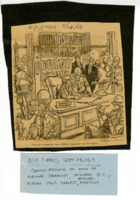 Cartoon on College Protest This political cartoon, originally from the LA Times and reprinted by the New York Times, reflects on the student unrest on college campuses across the nation in 1969. Depicting the military in charge at and around the desk of the University President, the caption quotes the President saying "They're to prevent any military take-over of this office!" At CUNY, City College, Brooklyn College and Queens College were all forced to close for several days during the spring semester in the face of widespread student demonstrations. At Queens College, in particular, the issue of police presence on campus was a major concern for protestors and administration alike.
 -
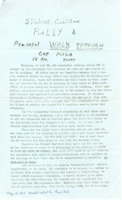 Student Coalition Rally & Peaceful Walk Through Distributed by the Student Coalition, this handout demands that Queens College students be granted access to walk through the Social Sciences Building. The building, housing President McMurray's office, had been the site of student occupation since March 1969. Those efforts, led by members of Students for a Democratic Society (SDS) and the Ad Hoc Committee were pointedly criticized in this flier distributed on May 16th. Queens College's Student Coalition belonged to the larger New York Regional Coalition of Students and Faculty, an organization of anti-protest groups from campuses across the New York metropolitan area. These students frequently came from varying sides of the political spectrum and stood firmly opposed to campus disruptions brought on by other more radical students.
 -
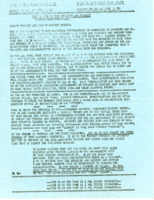 "Open Letter to the Students and Faculty (Please Read Carefully)" This is an open letter to Queens College students and faculty from the Ad Hoc Committee, a politically active group comprised of concerned faculty and student activists. The group, which held a multi-day sit-in in the Social Sciences Building in March/April 1969, was protesting the administration's dismissal of an instructor and their treatment of student protestors from an incident in March. Their demands totaled five in all and they hoped to garner more popular support on campus by holding the rally advertised on this letter.
 -
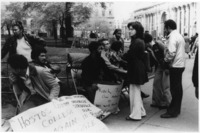 Gerald Meyer and Activists at City Hall Gerald Meyer with students at City Hall to save Hostos Community College. Some of the student in leadership were on a hunger strike to dramatize the issues plaguing Hostos Community College and their need for better facilities. By 1977, the third part of the campaign to save Hostos Community College had picked up momentum. Having extremely poor facilities, the college had acquired a second building across the street from its original location that would allow Hostos to expand. However, the 500 Grand Concourse building needed renovations to be useable but the college had been denied the funds necessary to prepare and occupy their second building. A fresh wave of organizing by students and faculty drove efforts to enable Hostos to continue to be a hub of opportunity for residents of the South Bronx.
 -
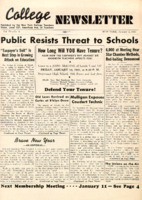 New York College Teachers Union Newsletter, January 1941 The cover of this issue of the College Newsletter, a publication of the New York College Teachers Union, includes several articles regarding the then ongoing Rapp-Coudert hearings of the early 1940s. They report on mass meetings with thousands of members of other local unions that went unreported in the New York Times. The Rapp-Coudert Committee was a New York State initiative organized in June 1940 to investigate and identify "subversive activities" and persons in New York's public schools and colleges. Several teachers' unions were targeted in the initial stages of the state's investigation as their membership rolls comprised progressive activists, many of whom had Communist ties. City College, in particular, became a target of the committee with dozens of faculty and staff called to public and private hearings.
 -
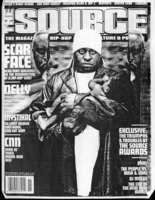 Source magazine interview with SLAM! Members This article published in The Source, a national hip-hop magazine, is about SLAM! and includes quotes from SLAM! members: Rachel Laforest, Kai Barrow and Peter Chung. They discuss SLAM! realtions with other activist groups protesting against the Republican National Committee in Philadelphia that year: "We were able to inject the issues that affect people of color into predominantly white organizations that never really did work with racial justice. Now, we have environmental groups discussing these issues," explains SLAM's Peter Chung.
 -
 York College 1973 Demonstration York College students join PSC pickets in opposing the May 1973 contract impasse. Demonstrators raise issues around tenure quotas, budget cuts, open admissions and the Professional Staff Congress union contract.
 -
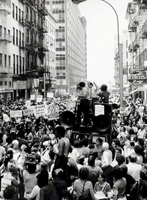 PSC demonstration at Chambers St. Near City Hall The Professional Staff Congress (PSC), the union of CUNY faculty and staff, staged this demonstration in 1976 in the midst of the city's fiscal crisis. Colleges were being threatened with closure and budgets were being cut. Union members urged the leadership to be more forceful in the fight for funding. As the signs indicate, students from across the university were also out in great numbers to defend Open Admissions and take positions against tuition and against school closings.
 -
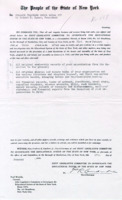 Subpoena issued to the College Teachers Union This is the subpoena that was issued to the College Teachers Union on January 27, 1941. Commanding the union's presence at a January 31st hearing before the Rapp-Coudert Committee, the document requests extensive union membership records, meeting minutes, and financial records. The Rapp-Coudert Committee was a New York State initiative organized in June 1940 to investigate and identify "subversive activities" and persons in New York's public schools and colleges. Several teachers' unions were targeted in the initial stages of the state's investigation as their membership rolls comprised progressive activists, many with alleged Communist ties. City College, in particular, became a target of the committee with dozens of faculty and staff called to public and private hearings.
 -
 Oral History Interview with Ezra Seltzer Ezra Seltzer attended Brooklyn College in the 1950s and when he was about to leave to get his Ph.D. he was offered a promotion to a faculty position in the Biology department. Although departmental politics got in the way, he chose to stay on as a "College Lab Technician" (CLT) until his 1995 retirement. Always active in his union, initially the Legislative Conference (LC), Seltzer speaks in glowing terms of Belle Zeller and of Iz Kugler but told him "I wish I were [with you] but I met Belle Zeller first." Loyal to Zeller and later to Irwin Polishook, he also speaks highly of Harold Wilson, another strong advocate for CLTs. In this interview, Seltzer discusses the history of the College Lab Technician series of titles and of their chapter of the Professional Staff Congress (PSC). He also recalls the occupational safety and health work that CLTs led, and the early political battles between the Legislative Conference and the United Federation of College Teachers before they merged into the PSC.
 -
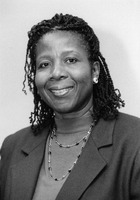 Oral History Interview with Vera Weekes Originally from Montserrat, Vera Weekes discusses her experience immigrating to the United States in 1989 and her subsequent decades at Medgar Evers College beginning in 1990. A senior paralegal and a Board of Immigration Appeals accredited representative at Citizenship Now, Vera assisted students and community members with immigration issues. In this interview, Vera discusses her work at the college, including her participation and leadership in her union, the Professional Staff Congress. She served on the union's executive council and as a delegate for non-teaching instructional staff in the Higher Education Officer (HEO) series. She describes the struggles of colleagues across the university who had no opportunity for professional advancement and how she approached her many years of struggle to improve their positions.
 -
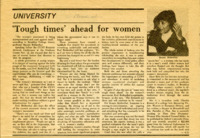 "Tough Times Ahead for Women" Brooklyn College Women's Studies Program co-founder and professor of history, Renate Bridenthal, is featured in this Clarion article, which is the PSC-CUNY faculty union publication. The Clarion covered a speech Bridenthal gave at the CUNY Feminist Network Conference at the Graduate Center, in which she spoke about the cultural backlash against the feminist movement and predicted that women would experience disproportionate effects of the economic downturn in the early 1980s. However, Bridenthal is sure to note victories and strides made within feminist scholarship, such as the Women's Studies Program at Brooklyn College.
 -
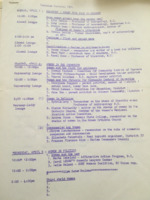 Program, Brooklyn College Feminist Festival These two versions of a program for a feminist festival held in the early years of the Brooklyn College Women's Studies Program showcase the interdisciplinary concerns of the program, as well as their commitment to an active relationship between feminist scholarship and activism. Speakers and workshops for the festival range from self-defense demonstrations to feminist arts, poetry, and film They also address activism in education, sexual violence, abortion rights, women's health, sexual orientation, and women's labor, including academics' lawsuits against sex discrimination. Presenters of note are Dolores Huerta of the farmworkers movement, Lilia Melani of the CUNY Women's Coalition lawsuit against sex discrimination, and Pat Lander, a long time co-coordinator of the Women's Studies Program at Brooklyn College.
 -
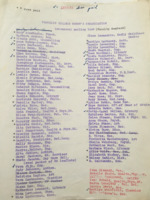 Brooklyn College Women's Organization Members List The Brooklyn College Women's Organization (BCWO) was the first organized group of women faculty at Brooklyn College, brought together across departments to address women's issues at the university. BCWO was the birthplace of feminist activity and initiatives at the college, including the Women's Studies Program, the Women's Center, the Day Care Collective, and the CUNY wide sex discrimination lawsuit campaign, led by BCWO member Lilia Melani. In her oral history, program co-founder under Renate Bridenthal remembers stuffing flyers in the mailboxes of women faculty across the college for the BCWO first meeting that was attended by many on this list.
 -
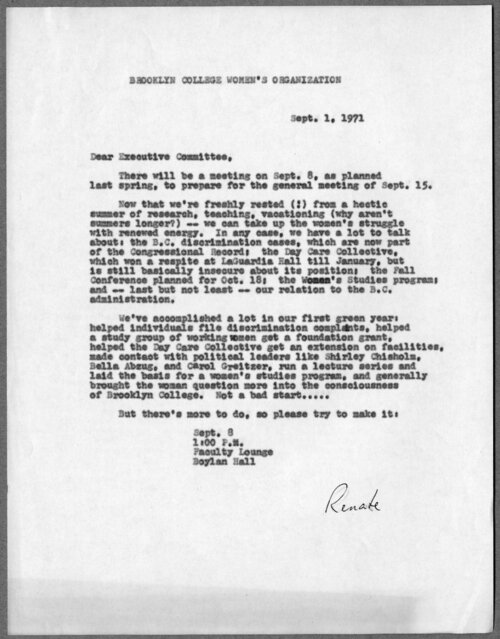 Brooklyn College Women's Organization Executive Meeting Invite The letter to the Brooklyn College Women's Organization (BCWO) executive committee invites them to a meeting to plan for a general meeting later in the month. The invitation documents the activities of the first group to convene at the university to address women's issues. Written by Renate Bridenthal (history), the group's ambitious agenda documents BWCO's role as the birthplace of the Women's Studies Program, Women's Center, Day Care Collective, and the sex discrimination lawsuit brought against CUNY on by women faculty who were discriminated against in hiring, salary, and tenure.
 -
 BWCO Response to President Kneller on Daycare Responding to the dismissive tone of a letter from Brooklyn College President John Kneller's office, the Brooklyn College Women's Organization (BCWO) wrote: "The tone and content of the letter...does not convey the cooperative spirit of which you assured us verbally at our meeting." The letter goes on to address the way that organizers were "re-routed...omit(ting) any answer to the request for which your office would be the most clearly appropriate route." This document showcases the tenacity of Brooklyn College's feminist activists, who sought accountability from the administration in their efforts to achieve adequate childcare, end employment discrimination based on sex and maternity leave, and to establish a women's studies program at Brooklyn College.
 -
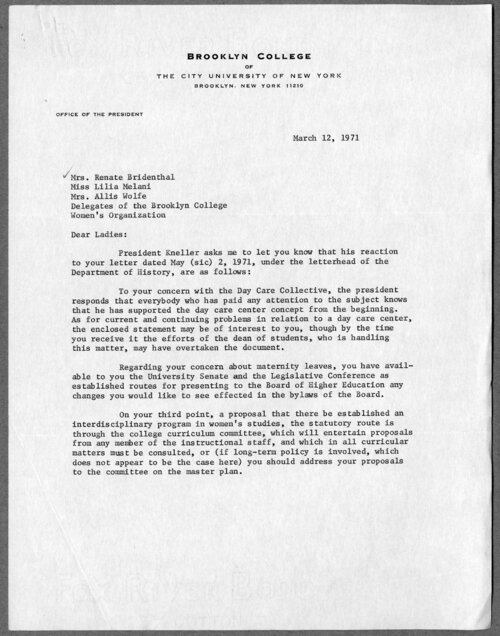 Response to the Brooklyn College Women's Organization from President Kneller In this letter addressed "Dear ladies," Brooklyn College President John Kneller's office delivers a dismissive response to complaints of sex discrimination and demands made by the Brooklyn College Women's Organization (BCWO). Kneller's office writes that he has "supported the day care concept from the beginning" but refers organizers to the dean of students instead. Regarding organizers' concerns about maternity discrimination, Kneller redirects them to the Board of Higher Education via the University Senate and Legislative Conference. And finally, he refers BCWO to the college curriculum committee to propose a Women's Studies Program. The letter makes no mention of the sex discrimination investigation led by BCWO.
 -
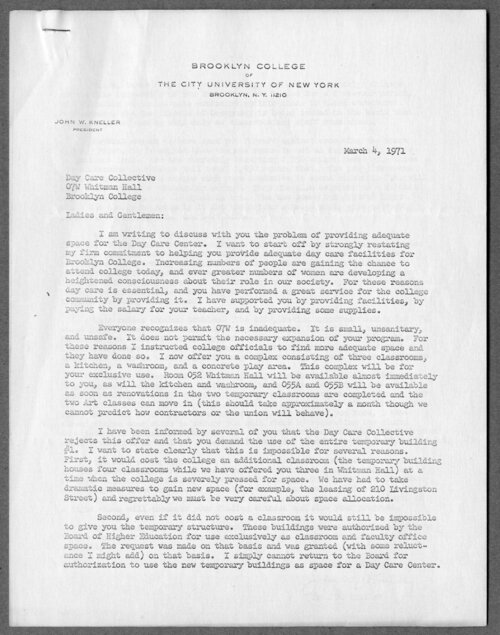 Letter from President Kneller on Daycare Center This letter from Brooklyn College President John Kneller demonstrates the level of engagement that feminist faculty and staff organizers of the Day Care Collective demanded from university leadership as they experienced dismissal after dismissal. While President Kneller proposed a temporary home for the day care program, he was forced to contend with activists who continued to demand adequate, safe childcare for children whose parents worked or studied at Brooklyn College.
 -
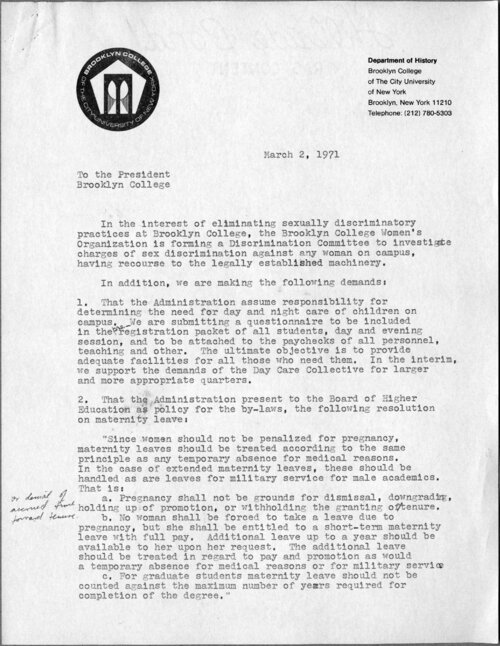 Letter from BCWO to President Kneller on Sex Discrimination This letter to Brooklyn College president John Kneller informs him of the Brooklyn College Women's Organization's (BCWO) formation of "a Discrimination Committee to investigate charges of sex discrimination against any woman on campus, having recourse to the legally established machinery." In addition, this letter from BCWO delegates Renate Bridenthal, Lilia Melani, and Allis Wolfe makes the following three demands of the administration: 1. Day and night care for children of students, faculty, and staff; 2. A resolution on maternity leave non-discrimination; and 3. The inauguration of an interdisciplinary Women's Studies Program. Both the tone and the objectives shed light onto the ways that feminist organizers saw their role as activists within the academy, their vision for improving the lives of women students and faculty, and their roadmap for accomplishing such lofty goals in the face of the structural inequalities they faced.
601–625 of 1046