CUNY Digital History Archive
Item set
Collection
CUNY Digital History Archive
Items
676–700 of 1046
Advanced search
-
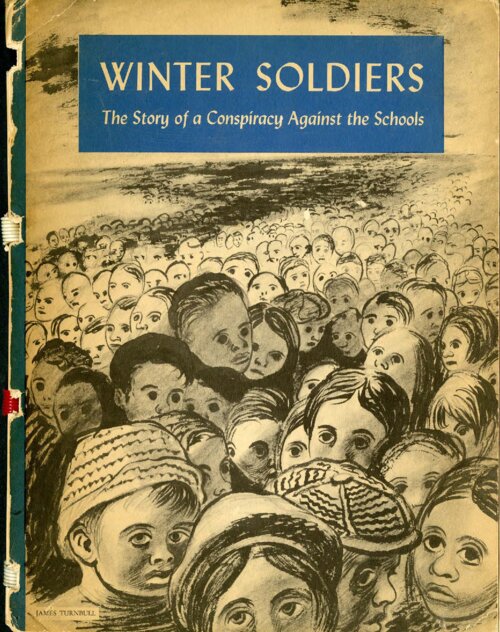 "Winter Soldiers - The Story of a Conspiracy Against the Schools" Published in 1941 by the Committee for Defense of Public Education, a joint committee of the Teachers Union and the College Teachers Union, Winter Soldiers tells the story of the Rapp-Coudert hearings and New York State's efforts to rid its public schools and colleges of "subversive influences" and persons, particularly those with communist ties. Sympathetic to the dozens of City College teachers that had been suspended or fired because of the hearings, Winter Soldiers features of a mix of story and artwork. It was created to raise money for the legal defense fund for the Rapp-Coudert victims. The text was written by Louis Lerman, one of CCNY's suspended faculty, and the drawings and graphics were contributed by some of the era's highest regarded activist artists such as Aaron Douglas, Elizabeth Olds, Louis Lozowick, Art Young, and Hugo Gellert. Many of the artists were supported under the Works Progress Administration (WPA), the government-funded Federal Art Project that hired hundreds of artists. The Project was part of President Franklin D. Roosevelt's New Deal during the Great Depression.
 -
 Suspended Faculty Reading Flier at Peace Rally This photograph shows nine of the eleven City College faculty and staff members that were suspended on April 22, 1941 as a result of the Rapp-Coudert hearings. The New York State sanctioned hearings sought to weed out "subversive influences" and persons from the state's public schools, in particular those individuals with ties to the Communist party as all of those in this photograph were alleged to have had. The photograph was taken on April 23 at a student peace strike at Lewisohn Stadium. Seated from left to right are: [unknown], David Cohen, librarian; Dr. Walter Scott Neff, psychology instructor; Dr. Saul Bernstein, biology instructor; John Kenneth Ackley, registrar; and Dr. Morris Cohen, chemistry instructor. Standing from left to right are: Louis Balamuth, physics instructor; Jesse Mintus, registrar's office; and Sidney Eisenberger, chemistry instructor.
 -
 First Contract Meeting This photograph shows the first meeting of the newly formed Professional Staff Congress (PSC) contract negotiating committee with CUNY administration. Negotiations were difficult and an agreement was not reached until July 1973. Pictured here from the left, facing the camera, are PSC team members Harold Wilson, the leader of the College Laboratory Technicians Chapter, Ada Agronin from Queens College, Irving Panken, a PSC staff member, Israel Kugler, the PSC Deputy President, Arnold Cantor, the Executive Director of the union, Belle Zeller, the President of the PSC, Irwin Polishook from Lehman College, Claude Campbell, from Staten Island Community College, and Samuel Ehrenpreis, from Bronx Community College.
 -
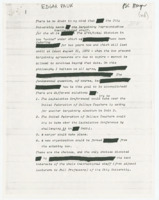 Edgar Pauk Statement on Union Merger In this draft document, Edgar Pauk, a lecturer at Queens College and vice president of the 4-year public college unit of the United Federation of College Teachers (UFCT), announces his break with the union's leader, Israel Kugler, stating that he had decided to leave the UFCT in favor of joining the rival Legislative Conference (LC). His statement speaks to many of the concerns facing the union at the time, particularly the need for a single bargaining unit for all of CUNY faculty and staff. Pauk is especially critical of both the UFCT as an organization and its leadership provided by Kugler. Pauk would come to play an important role once the two unions decided upon a merger with the creation of the Professional Staff Congress (PSC) in April 1972. In the first election of the new union in 1973, Pauk decided to run for union presidency doing so against Belle Zeller, president of the LC, and also Israel Kugler, president of the UFCT. Pauk received a meager 321 votes in the election, however, the winner, Zeller, defeated runner-up Kugler by only 124 votes. Kugler would thereafter claim that most of Pauk’s votes came from those who otherwise would have supported him, and that without Pauk in the election, he would have won. Instead, the caucus led by Zeller and members of the former LC took control of the union in its early years. While Kugler's claims remain unproven, Pauk undoubtedly had a real impact on the election though such would forever remain the extent of his influence with the PSC.
 -
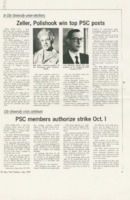 "Zeller, Polishook Win Top Posts" The first article from this issue of The New York Teacher, the monthly newspaper of the New York State United Teachers federation, reports the results of the first Professional Staff Congress (PSC) election held in April 1973. Belle Zeller, from the former Legislative Conference (LC), won the presidency by small margin over Israel Kugler, from the former United Federation of College Teachers (UFCT). A third candidate, Edgar Pauk, had a decisive impact on the election as his total vote tally was larger than Zeller’s margin of victory. A caucus, led by Irwin Polishook, supported Zeller, and won 15 of the 20 remaining seats on the union’s Executive Council. The second article details a recently authorized strike vote from union members. Set for October 1st, the strike declaration was tactically used by the PSC in order to break their deadlock with CUNY administration over the terms of a new contract. Most problematic for the newly formed PSC was the administration's initial refusal to recognize the new union as the official bargaining agent for the more than 16,000 professors, instructors and other non-classrrom staff at CUNY. Ultimately, the two sides reached an agreement not long after this article was published, rendering the strike unnecessary.The PSC was formed in April 1972 following the merging of the LC and UFCT. Leaders from both former groups sought to control the direction of the union in its earliest years, a fact that led to particularly contentious early elections. In the following election in 1976, Israel Kugler and Irwin Polishook contended for the PSC presidency. Polishook won decisively, and Kugler dissolved his caucus.
 -
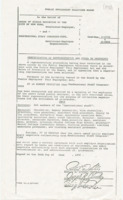 Public Employment Relations Board: Certification of Representation and Order to Negotiate This document from the Public Employment Relations Board, a New York State agency, certifies the newly formed Professional Staff Congress (PSC) as the union representation for CUNY instructional staff. Issued in June 1972, the order by PERB followed the merger of the formerly competing unions in April 1972, and the approval of the merger in a referendum by the CUNY faculty and staff. The new, united union, became the sole collective bargaining agent for all faculty and staff in CUNY.
 -
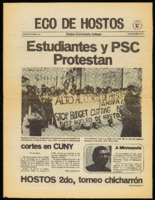 Eco De Hostos, Edición Especial, Hostos Community College, Diciembre 1974 Eco de Hostos was a bilingual student newspaper published monthly by the Office of College Relations and Development. This December 1974 issue (Spanish language edition) features an article about students, faculty and the PSC protesting against drastic budget cuts in front of the Board of Higher Education. In 1975, in response to the New York City fiscal crisis, Hostos Community College was slated to merge with Bronx Community College in order to dramatically cut spending. It was this threat that led to the second iteration of organizing to save Hostos. Determined to preserve the college for the South Bronx as a place for students to pursue a bilingual higher education, students, faculty, and community groups joined forces to keep Hostos open.
 -
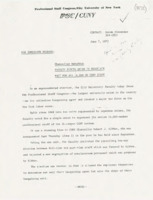 "Chancellor Rebuffed" This press release from the Professional Staff Congress (PSC) announces the recent vote from CUNY faculty and staff in favor of a single bargaining unit instead of the three preferred by CUNY administration. Overwhelmingly in favor of single representation, faculty and staff chose the PSC to be that single bargaining agent. The vote ended the split that had resulted from the collective bargaining elections of December 1968, and it ratified the merger of the two former unions, the Legislative Conference and the United Federation of College Teachers, into the single PSC.
 -
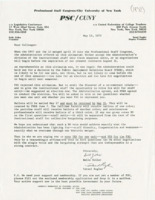 Letter from Belle Zeller and Israel Kugler to All CUNY Faculty and Staff Following the merger of the Legislative Conference and the United Federation of College Teachers on April 14, 1972, the newly formed Professional Staff Congress (PSC) faced an immediate challenge when CUNY administration refused to recognize the new union. Formed to represent all faculty and staff, the PSC's creation sought to undo the division that since 1969 saw two different bargaining units. The CUNY administration, meanwhile, desired three units for separate negotiation with: full timers, part timers and non-classroom staff. Ultimately the PSC and CUNY administration agreed to have the faculty and staff vote on whether they preferred the one unit or the three units called for by the CUNY administration. In this letter, President Belle Zeller and Deputy President Israel Kugler call on all CUNY faculty and staff to vote in favor of one unit, and for the PSC to serve as the collective bargaining agent for that single unit. The election was held in May 1972 and the faculty and staff voted overwhelmingly in favor of both measures.
 -
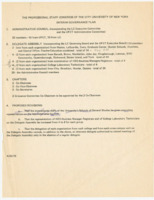 PSC Interim Governance Plan This item details the structure of the new Professional Staff Congress' (PSC) Administrative Council, Delegate Assembly and chapters. It was based on the principle of equal representation from the Legislative Conference (LC) and the United Federation of College Teachers (UFCT), the two unions that combined to form the PSC in 1972. As seen in the document, much consideration was initially given to equally dividing the positions amongst members of the two former rivals. They went so far as to include representation from both groups from each CUNY campus. In total, 20 served on the Administrative Council, 110 on the Delegate Assembly (including those from the Administrative Council), and 8 headed union chapters. This split-power situation lasted one year until the first PSC election in April 1973. In a very close election, Belle Zeller, former LC president, defeated Israel Kugler, former UFCT president, for the presidency of the PSC.
 -
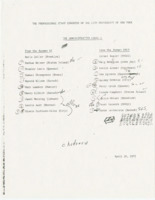 PSC Administrative Council This document lists the names of the first members of the Administrative Council for the newly formed Professional Staff Congress (PSC). Created out of a merger between the Legislative Conference (LC) and the United Federation of College Teachers (UFCT) the new union's Administrative Council included equal representation of leaders from both groups. Despite the benefits the combined PSC afforded both the LC and UFCT, the merging of the two former rivals was not without difficulties, particularly in matters of union leadership. Initially led by President Belle Zeller from the former LC and Deputy President Israel Kugler from the former UFCT, the two highest offices lacked clearly defined roles and responsibilities. This plus past lingering tensions led to much contention and a split among members into caucuses in the union's earliest days.
 -
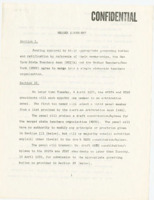 NYSTA-UTNY Merger Agreement This lengthy document lays out the terms of the merger between the New York State Teachers Association (NYSTA) and the United Teachers of New York (UTNY) set to take place on April 4, 1972. Previously the NYSTA had been affiliated with the National Education Association (NEA) and the UTNY with the American Federation of Teachers (AFT). The significance of this merger was that at CUNY, each of the competing unions was previously affiliated with a different group: the Legislative Conference (LC) with the NEA and the United Federation of College Teachers (UFCT) with the AFT. As the two statewide unions moved toward their merger, they placed increasing pressure on their affiliates in CUNY to do the same. The leaders of the LC and the UFCT agreed to merger at about the same time as the statewide unions merged. The members of the two CUNY unions quickly approved the merger in a referendum, and the PSC was officially formed on April 14, 1972.
 -
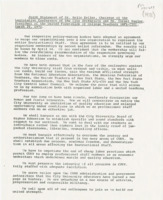 Joint Statement of Belle Zeller and Israel Kugler on Merger In this statement, President Belle Zeller of the Legislative Conference and President Israel Kugler of the United Federation of College Teachers announce the merger of the two rival unions, and call on the members of each organization to ratify the merger in a secret ballot referendum. They note the need for unity to end the dissipation of their resources. They also stress the problems facing CUNY, and its faculty and staff, which would require a unified union to have the maximum influence on events. The membership of each union strongly endorsed the merger, which took place on April 14, 1972.
 -
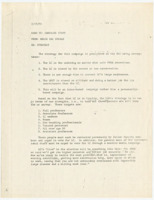 Strategy Memo to Campaign Staff Bruce MacDonald lays out the strategy for what he believes will allow the Legislative Conference (LC) to triumph against the United Federation of College Teachers (UFCT) as the single bargaining unit for CUNY faculty and staff in the upcoming election. Acknowledging that the LC was "in trouble" and "the underdog" and viewed by most members as the more conservative alternative, he states what he believes is the winning strategy: to run on their strengths and work to turn out those he believes will vote for the Legislative Conference. The UFCT wanted a single unit to represent all of CUNY, and had called for a collective bargaining election for the faculty and staff. The LC had resisted such an election out of fears they could not win in a single unit election. Ultimately, this election was never held as the two unions merged to form the Professional Staff Congress on April 14, 1972.
 -
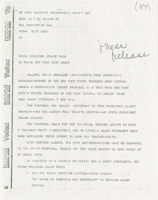 "NYSTA Outlines Merger Plan to Rival New York City Group" In this press release, representatives from the New York State Teachers Association (NYSTA) propose steps for a merger with the United Teachers of New York (UTNY). The NYSTA had previously been affiliated with the National Education Association (NEA), which in turn had been affiliated with Legislative Conference (LC) at CUNY. The LC's rival union, the United Federation of College Teachers (UFCT) meanwhile had been affiliated with the American Federation of Teachers (AFT), which had been connected to the UTNY. Following the merger of the NYSTA and UTNY on April 4, 1972, pressure was placed on CUNY's competing unions to do the same. The LC and UFCT merged to form the Professional Staff Congress/CUNY (PSC) not long after on April 14, 1972.
 -
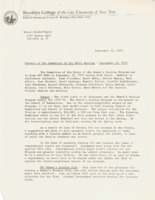 Minutes of the Women's Studies Committee of the Whole In an effort to decentralize decision-making power and include multiple perspectives both in program governance and in courses taught, the Brooklyn College Women's Studies Program created new and innovative structures for its operations. Rather than have one program chair or coordinator, each year the program was led by two co-coordinators. These meeting minutes are an example of the ways that faculty collaborated to solve shortages as a result of budget cuts that threatened co-taught classes, and shared leadership. Here, faculty debate becoming a department versus an interdisciplinary program, and discuss the establishment of a women's studies club.
 -
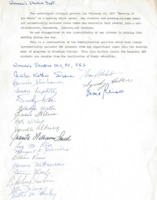 Letter to Protest 'Meeting of the Whole' Central to the founders of the Women's Studies Program and Women's Center at Brooklyn College were issues of access, collaborative input, and community inclusion in decision making. The frameworks they shaped were informed by a feminist analysis of the ways that gender, race, and class either privilege or exclude subjects from positions of power and decision-making. In this letter, twenty faculty and staff members of the Women's Studies Program and Women's Center grappled internally with issues of access, and signed on in protest of a meeting of the program during regular work hours. Signatories cited that the proposed time for the meeting excluded participation and input from critical stakeholders and community members such as working women, mothers, and students.
 -
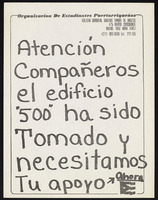 "Atención Compañeros, el edificio "500" ha sido Tomado" "Attention, Comrades, the '500' building has been taken over and we need your support - now" is the translation of the flier announcing the occupation of the 500 Grand Concourse building. By 1977, the third part of the campaign to save Hostos Community College had picked up momentum. Having extremely poor facilities, the college had acquired a second building across the street from its original location that would allow Hostos to expand. However, the 500 Grand Concourse building needed renovations to be useable but the college had been denied the funds necessary to prepare and occupy their second building. A fresh wave of organizing by students and faculty drove efforts to enable Hostos to continue to be a hub of opportunity for residents of the South Bronx.
 -
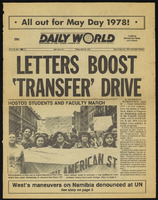 Hostos Students and Faculty March This April 28th, 1978 clipping from the Daily World shows an image of a student and faculty march to Gracie Mansion to raise awareness about Hostos Community College’s need for funding to complete renovations at 500 Grand Concourse. By 1977, the third part of the campaign to save Hostos Community College had picked up momentum. Having extremely poor facilities, the college had acquired a second building across the street from its original location that would allow Hostos to expand. However, the 500 Grand Concourse building needed renovations to be useable and the college had been denied the funds necessary to prepare and occupy their second building. A fresh wave of organizing by students and faculty drove efforts to enable Hostos to continue to be a hub of opportunity of residents in the South Bronx.
 -
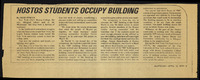 Hostos Students Occupy Building This April 12th, 1978 clipping from the Guardian describes the takeover of the 500 Grand Concourse building by Hostos Community College students and faculty to raise awareness about the college’s need for funding to complete renovations. The author, Fred Pincus, describes the community of Hostos as an effective advocate for the college and as vigilant activists that have repeatedly fought back attacks on their school. By 1977, the third part of the campaign to save Hostos Community College had picked up momentum. Having extremely poor facilities, the college had acquired a second building across the street from its original location that would allow Hostos to expand. However, the 500 Grand Concourse building needed renovations to be useable but the college had been denied the funds necessary to prepare and occupy their second building. A fresh wave of organizing by students and faculty drove efforts to enable Hostos to continue to be a hub of opportunity for residents of the South Bronx.
 -
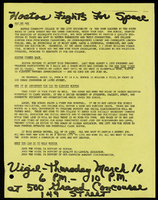 Hostos Fights for Space / Vigilia Pro Hostos This bilingual flier announces that Hostos Community College students and activists will hold a vigil to raise awareness about their need for funding to complete renovations at 500 Grand Concourse. The flier describes the urgent need for the renovations and the importance of collective action to achieve that goal. By 1977, the third part of the campaign to save Hostos Community College had picked up momentum. Having extremely poor facilities, the college had acquired a second building across the street from its original location that would allow Hostos to expand. However, the 500 Grand Concourse building needed renovations to be useable but the college had been denied the funds necessary to prepare and occupy their second building. A fresh wave of organizing by students and faculty drove efforts to enable Hostos to continue to be a hub of opportunity for residents of the South Bronx.
 -
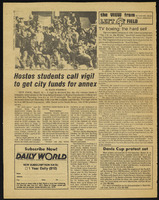 "Hostos students call vigil to get city funds for annex" This issue of the Daily World included an article stating that Hostos Community College students and activists planned a vigil to raise awareness about their need for funding to complete renovations at 500 Grand Concourse. By 1977, the third part of the campaign to save Hostos Community College had picked up momentum. Having extremely poor facilities, the college had acquired a second building across the street from its original location that would allow Hostos to expand. However, the 500 Grand Concourse building needed renovations to be useable but the college had been denied the funds necessary to prepare and occupy their second building. A fresh wave of organizing by students and faculty drove efforts to enable Hostos to continue to be a hub of opportunity for residents of the South Bronx.
 -
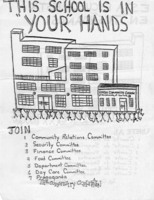 This School is in "Your" Hands / Esta Escuela Está en "Tus" Manos This flier promotes the occupation of the 500 Grand Concourse building in the Spring of 1978. To demand needed funding to complete renovations to the building, students and faculty occupied the property to run classes and activities to pressure Mayor Koch and other officials to enable bond sales and renovations to proceed. By 1977, the third part of the campaign to save Hostos Community College had picked up momentum. Having extremely poor facilities, the college had acquired a second building across the street from its original location that would allow Hostos to expand. However, the 500 Grand Concourse building needed renovations to be useable but the college had been denied the funds necessary to prepare and occupy their second building. A fresh wave of organizing by students and faculty drove efforts to enable Hostos to continue to be a hub of opportunity for residents of the South Bronx.
 -
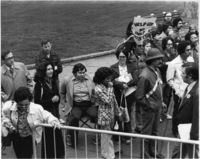 "Help Us to Help Hostos" Members of the Hostos Community College community joined a mass march in Albany against budget cuts.
 -
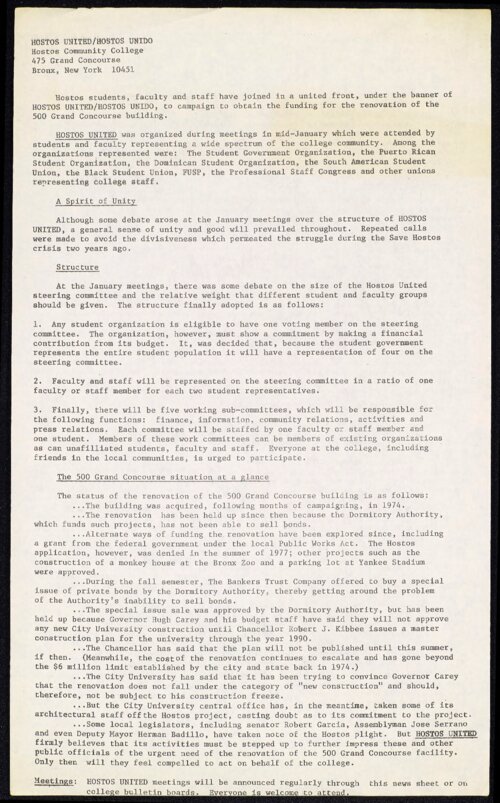 Hostos United/Hostos Unido mission statement This is the mission statement of Hostos United/Hostos Unido, an umbrella activist group that led much of the campaign to expand the college to include the 500 Grand Concourse building. The group was established in January 1978 by the Student Government Organization, the Puerto Rican Student Organization, the Dominican Student Organization, the South American Student Union, the Black Student Union, FUSP, the Professional Staff Congress and other unions representing college staff. The statement includes their mission, their structure, and a brief synopsis of the fight for improved facilities at Hostos. By 1977, the third part of the campaign to save Hostos Community College had picked up momentum. Having extremely poor facilities, the college had acquired a second building across the street from its original location that would allow Hostos to expand. However, the 500 Grand Concourse building needed renovations to be useable but the college had been denied the funds necessary to prepare and occupy their second building. A fresh wave of organizing by students and faculty drove efforts to enable Hostos to continue to be a hub of opportunity for residents of the South Bronx.
676–700 of 1046