CUNY Digital History Archive
Item set
Collection
CUNY Digital History Archive
Items
51–75 of 1046
Advanced search
-
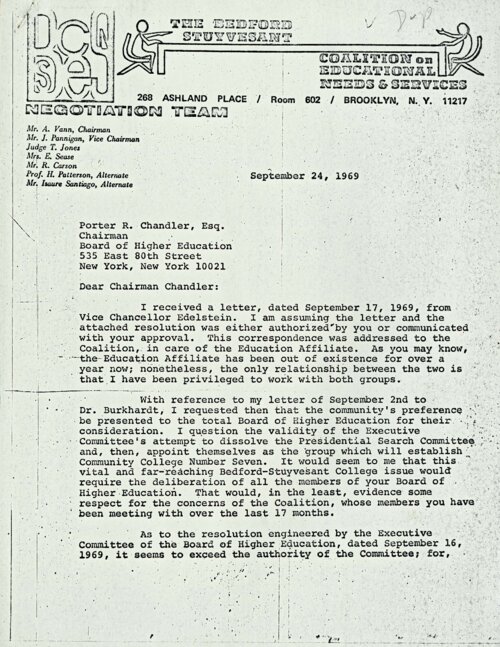 September 24, 1969 Letter from Al Vann to Porter Chandler On September 24, 1969, Al Vann, Chairman of the Bedford-Stuyvesant Coalition on Educational Needs and Services (B-SCENS) wrote a letter to Porter Chandler, Chairman of the Board of Higher Education, responding to a recent Resolution of the Executive Committee of the Board of Higher Education to disband the Presidential Search and Planning Committee for Community College 7, of which Vann had been a community-appointed member. In his letter, Vann denies the authority of the Board of Higher Education and its Executive Committee to disband the committee and, as they had also announced, to proceed in planning a college in and for Bedford-Stuyvesant without the “involvement, support and endorsement” of the B-SCENS and its members.
 -
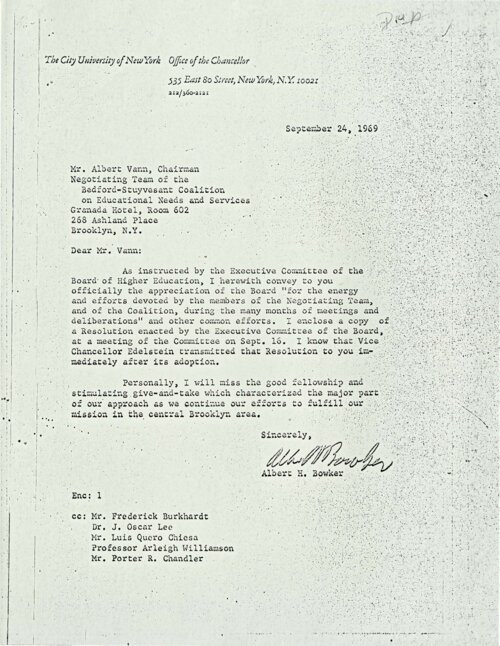 September 24, 1969 Letter from Chancellor Albert Bowker to Al Vann On September 24, 1969, Albert Bowker, Chancellor of the City University of New York (CUNY) wrote to Al Vann, a community leader of Bedford-Stuyvesant, formally informing him of the Board of Higher Education’s Resolution eight days before to dissolve the Presidential Search and Planning Committee for Community College 7, of which Vann had been a member. In his letter, Bowker reiterated words of thanks included in the resolution for the “energy and efforts” of the Bedford-Stuyvesant Coalition on Educational Needs and Services (B-SCENS) and its delegated Negotiation Team in negotiations and plans for Community College 7, and shared his personal appreciation with Vann for the “good fellowship and stimulating give-and-take” in their collaboration.
 -
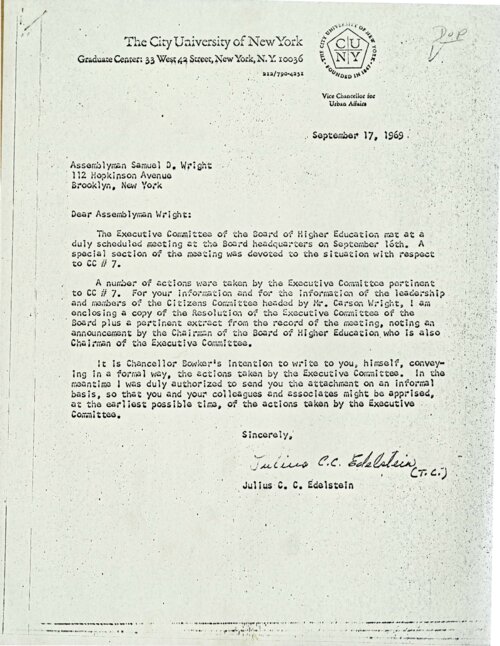 September 17, 1969 Letter from CUNY Vice Chancellor Julius C. C. Edelstein to Assemblyman Samuel Wright On September 17, 1969, Julius Edelstein, Vice Chancellor of the City University of New York (CUNY), wrote to Assemblyman Samuel Wright, who represented Central Brooklyn, to inform him of the Executive Committee of the Board of Higher Education (BHE)’s resolution the day before in relation to Community College 7. In that resolution, the Executive Committee had formally dissolved the Presidential Search and Planning Committee for Community College 7, composed of five CUNY officials and five representatives of Bedford-Stuyvesant’s education and community organizations. The BHE Executive Committee had further resolved to expedite plans for the new college for Central Brooklyn under the leadership of officials CUNY leaders would appoint.
 -
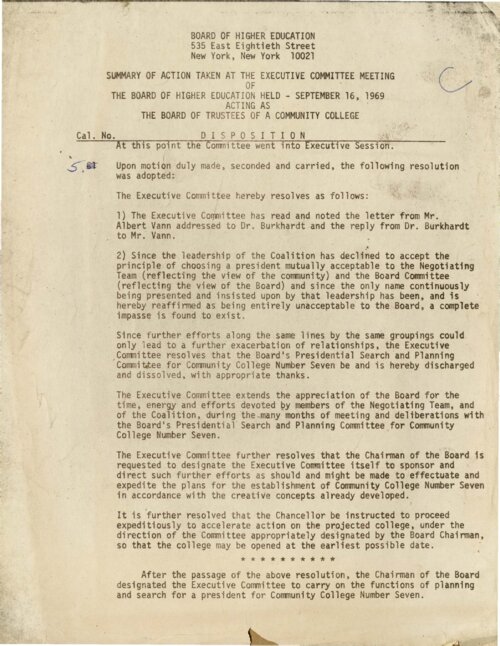 September 16, 1969 Resolution of the Board of Higher Education to Disband the Presidential Search and Planning Committee for Community College 7 On September 16, 1969 the Executive Committee of the Board of Higher Education (BHE( issued a formal resolution to dissolve the “Presidential Search and Planning Committee for Community College 7” due to the insistence of the Bedford-Stuyvesant community delegation to the committee that Rhody McCoy be appointed president of the new college. The BHE Executive Committee deemed McCoy “entirely unacceptable” for the job. The Executive Committee further resolved that Chancellor Albert Bowker should “proceed expeditiously to accelerate action on the projected college,” working with a new committee appointed entirely by the BHE.
 -
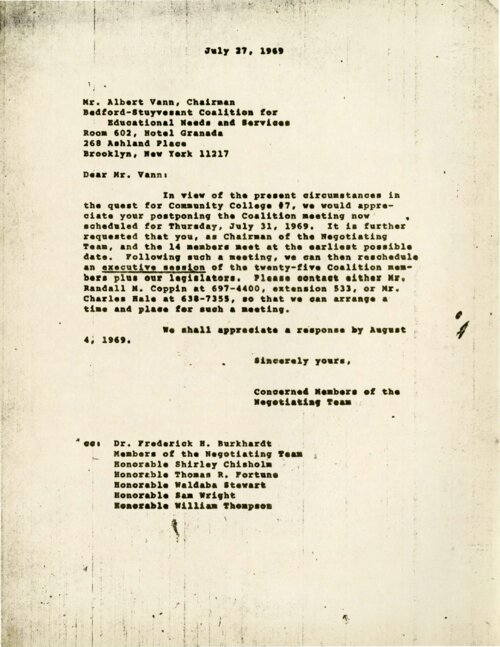 Unsigned July 27, 1969 Letter from "Concerned Members of the Negotiation Team" to Al Vann On July 27, 1969, “Concerned members of the Negotiation Team” of the Bedford-Stuyvesant Coalition on Educational Needs and Services (B-SCENS) drafted a letter to Al Vann, Chairman of the B-SCENS and the Negotiation Team, asking that he postpone an upcoming coalition meeting, instead meeting with the “fourteen members.” Those “fourteen” were likely a group of B=SCENS members who had written directly to City University of New York (CUNY) Chancellor Albert Bowker a month earlier, formally dissenting from the stance Vann had taken in deliberations over the selection of president for CUNY's proposed Community College 7.
 -
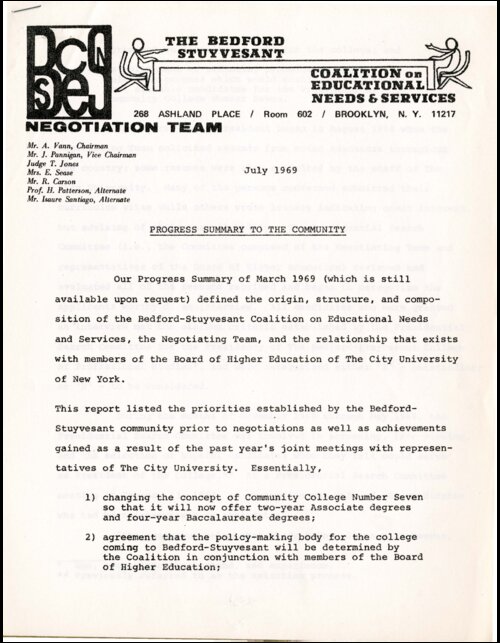 July 1969 Progress Summary to the Community from Al Vann In July 1969 Al Vann, Chairman of the Bedford-Stuyvesant Coalition on Educational Needs and Services (B-SCENS), wrote a “Progress Summary to the Community,” detailing the activities and positions of the Negotiation Team, delegated by the coalition to meet with City University of New York (CUNY) officials planning Community College 7. Approximately one month before, a splinter group of B-SCENS members had written directly to CUNY officials expressing their dissent from the Negotiation Team’s insistence that Rhody McCoy should be named the new college’s president. In his report, Vann detailed the Negotiation Team’s process and rationale for selecting McCoy as their preferred candidate, and called for the community’s support for the Negotiation Team’s authority to make decisions for a college planned by, in, and for the people of Bedford-Stuyvesant.
 -
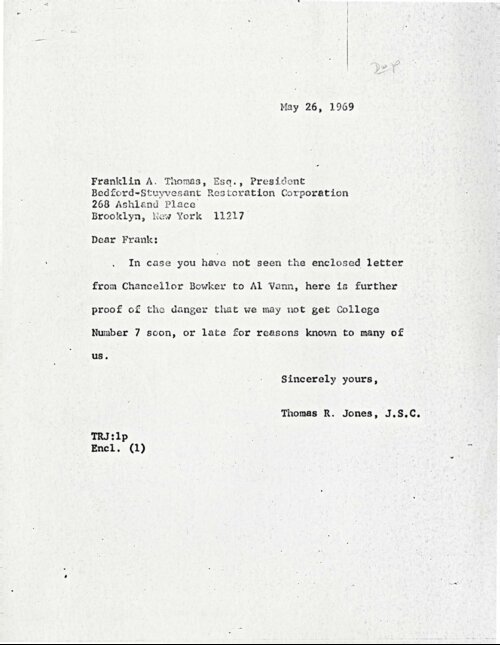 May 26, 1969 Letter from Thomas Jones to Franklin Thomas On May 26, 1969, New York State Justice Thomas Jones wrote to Franklin Thomas, president of the Bedford-Stuyvesant Restoration Corporation, forwarding a copy of a letter sent four days earlier from Albert Bowker to Al Vann, Chair of the Bedford-Stuyvesant Coalition on Educational Needs and Services. In that letter, which Jones attached, Bowker had expressed a wish to overcome an “impasse” between City University of New York (CUNY) officials and an appointed planning delegation from the Bedford-Stuyvesant community, led by Vann, over preferred candidates for the presidency of the new Community College 7. In his brief cover letter, Jones expressed his alarm over “the danger that we may not get Community College 7 soon, for reasons known to many of us.” In the coming weeks, Jones, with a contingent of other community members, would publicly split from Vann and his allies in a schism that in the end determined the fate of the new college.
 -
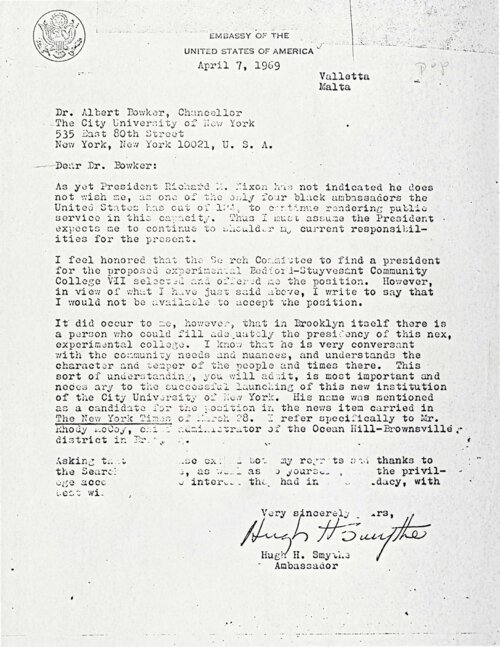 April 7, 1969, letter from Hugh Smythe to Albert Bowker declining the offer of the presidency of Community College 7 On April 7, 1969, Hugh Smythe, United States Ambassador to Malta, wrote to Dr. Albert Bowker, Chancellor of the City University of New York (CUNY) declining his offer of the position of president of Community College 7. Smythe specifically recommended that the Presidential Search Committee consider Rhody McCoy, then Unit Administrator of the experimental Ocean-Hill Brownsville School district, whose role in that struggle would soon become the flashpoint for a controversy that shaped the fate of the new college.
 -
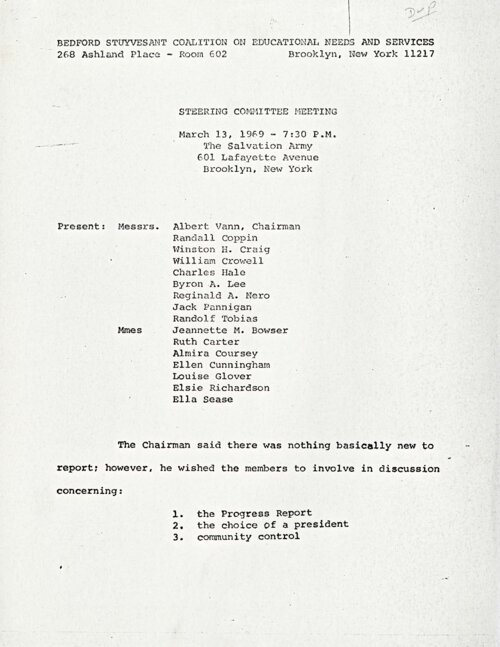 March 13, 1969 Minutes of the Steering Committee of the Bedford-Stuyvesant Coalition on Educational Needs and Services: On March 13, 1969, the Steering Committee of the Bedford-Stuyvesant Coalition on Educational Needs and Service met to discuss progress in the planning for Community College 7. At the meeting, the Committee formulated and agreed on three “definitive items” that their five member Negotiation Team would present to City University of New York (CUNY) officials at an upcoming high-level planning meeting about Community College 7, one of which was that the college be named for the late Martin Luther King, Jr. The Steering Committee also agreed they would present CUNY officials with a unanimous recommendation for a candidate for president of the new college, but deferred their deliberations over that decision to a later meeting.
 -
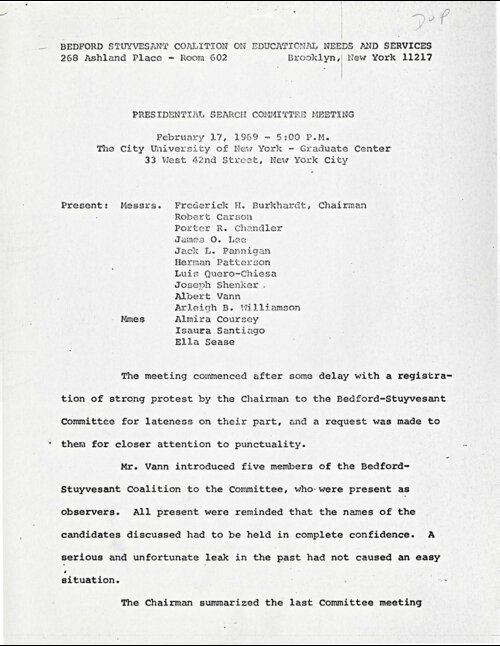 Minutes of the February 17, 1969 Meeting of the Presidential Search Committee for Community College 7 On February 17, 1969 the Presidential Search Committee for Community College 7, composed of five City University of New York (CUNY) officials and five appointed representatives of Bedfrord-Stuyvesant community organizations, met to continue their discussions of four candidates under consideration for the presidency of the new college. The meeting was marked by open disagreement between the two contingents over one candidate, Rhody McCoy. McCoy was advanced as a candidate for the presidency by the Bedford-Stuyvesant delegation, but CUNY officials deemed him inappropriate because of his lack of academic credentials and college-level experience as well as being “the subject of great controversy” for his leadership of the school community control “experiment” underway in Ocean-Hill Brownsville. In the coming weeks, McCoy’s candidacy would become a flashpoint for escalating tensions over the Bedford-Stuyvesant community’s role in leading and planning the new college.
 -
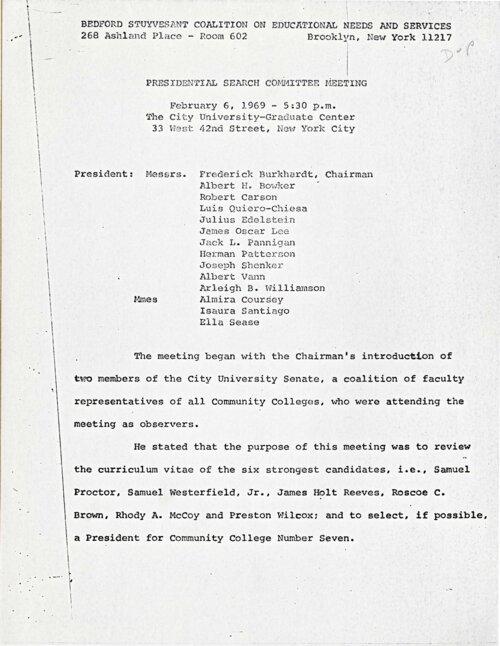 February 6, 1969 Minutes of Presidential Search Committee for Community College 7 On February 6, 1969, the Presidential Search Committee for Community College 7, composed of five City University of New York (CUNY) officials and five appointed representatives of Bedford-Stuyvesant community organizations, met to discuss criteria for selection of a president for the new college and four possible candidates for the position. Among the issues discussed at the meeting was whether “possession of a Ph.D. and experience in higher education” should be a required qualification, a questions that was not resolved at this meeting. In this meeting, the Committee agreed to contact and interview a fifth prospective candidate, Hugh Smythe, United States Ambassador to Malta, to whom they would eventually offer the position.
 -
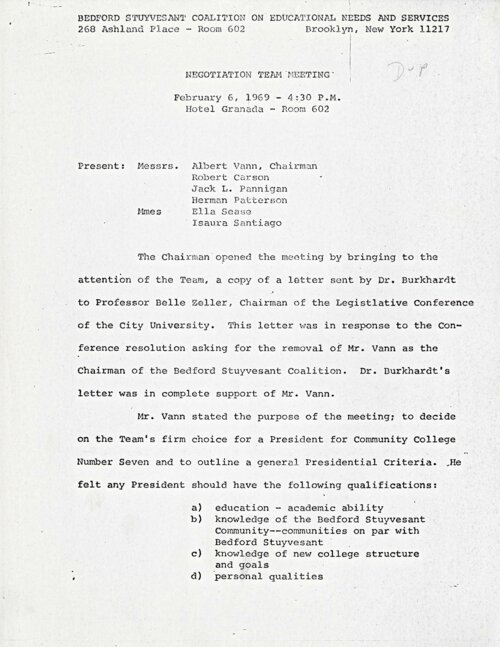 February 6, 1969 Minutes of the Negotiation Team of the Bedford-Stuyvesant Coalition on Educational Needs and Services in preparation for the Presidential Search Committee meeting for Community College 7 The five-member Negotiation Team delegated by the Bedford-Stuyvesant Coalition on Educational Needs and Services (B-SCENS) met on February 6, 1969, to prepare for a meeting to be held later that day with five City University of New York officials, at which the Bedford-Stuyvesant representatives would present their recommended candidate for president of Community College 7. The Negotiation Team agreed to recommend Rhody McCoy for the position “because of his knowledge of the New York Public School system, his ability to assume leadership, his ability to meet and systematically deal with crisis, and his demonstrated concern for the needs and goals of a Black and Puerto Rican community,” among other qualifications. The team also prepared responses to anticipated arguments against McCoy’s appointment and outlined their own objections to the candidates CUNY officials had proposed.
 -
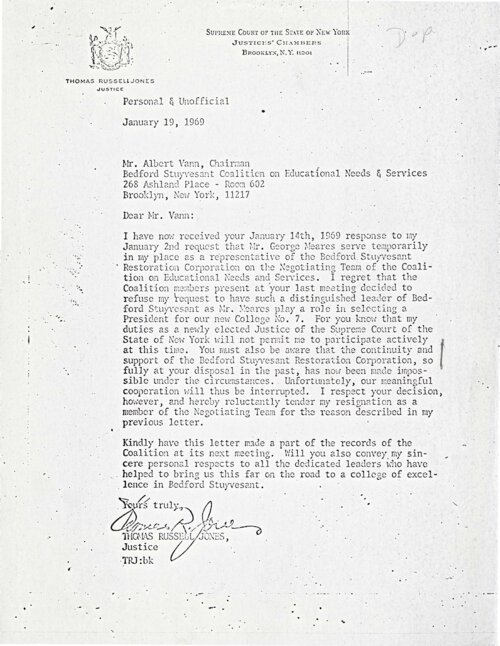 January 19, 1969, Letter from Justice Thomas Jones to Al Vann announcing Jones's resignation from the Negotiation Team for Community College 7 On January 19, 1969 New York State Justice Thomas Jones wrote to Al Vann, Chairman of the Bedford-Stuyvesant Coalition for Educational Needs and Services (B-SCENS), resigning from his position as a member of the five-member Negotiation Team appointed to represent the Bedford-Stuyvesant community in plans and negotiations with City University of New York (CUNY) officials for Community College 7. Jones’s resignation letter marked the culmination of his correspondence with Vann over the past month, in which he had initially proposed to appoint a proxy to the Negotiation Team, a suggestion Vann rejected on procedural grounds. Although Jones apparently resigned from the Negotiation Team in this letter, he remained directly involved in public discussions about Community College 7, and was a key actor in a conflict that developed in the coming weeks between Bedford-Stuyvesant community leaders over plans for the new college.
 -
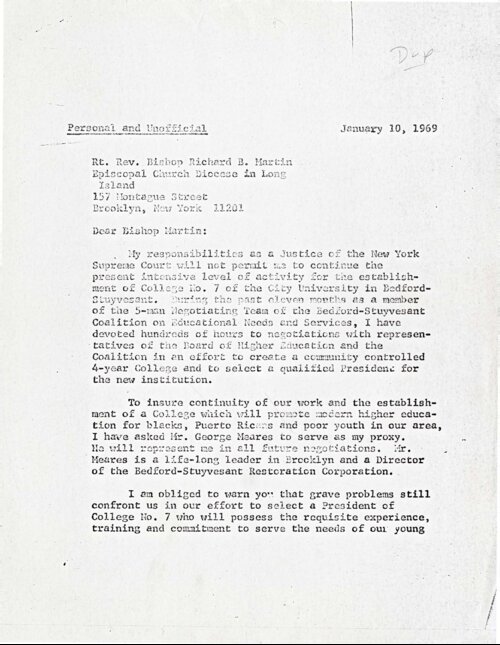 January 10, 1969. Letter from Thomas Jones to Reverend Bishop Richard B. Martin Appointing a Proxy to the Negotiation Team for Community College 7 On January 10, 1969, Justice Thomas Jones wrote to Bishop R.B. Martin, of the Long Island Episcopal Diocese, stating that he would no longer be able to participate in the activities of the five-member Negotiation Team appointed by the Bedford-Stuyvesant Coalition on Educational Needs and Services (B-SCENS) to represent their community in planning Community College 7 with City University of New York (CUNY) officials. Explaining that his “responsibilities as justice of the Supreme Court of New York will not permit me to continue the present intensive level of activity” in plans and negotiations, Jones proposed to appoint George Meares, Director of the Bedford-Stuyvesant Restoration Corporation, as his proxy on the Negotiation Team. Jones also expressed concerns that CUNY officials involved in the planning process “do not yet comprehend what community control and participation must be to overcome the ravages of educational deprivation suffered by the youth of Bedford-Stuyvesant." In the coming weeks, Jones would publicly split from prominent leaders of the Negotiation Team and their allies over key planning decisions for the new college.
 -
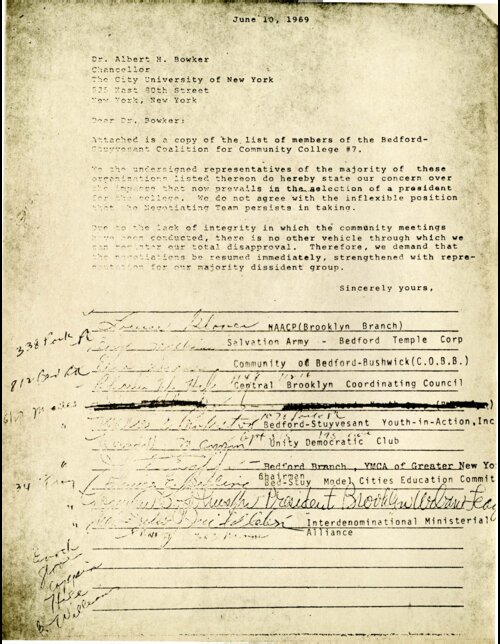 June 10, 1969 Letter from the Bedford-Stuyvesant "majority dissident" group to CUNY Chancellor Albert Bowker On June 10, 1969, ten representatives of various Bedford-Stuyvesant’s educational and community organizations wrote to Albert Bowker, Chancellor of the City University of New York (CUNY) formally expressing their disagreements with the Bedford-Stuyvesant Coalition on Educational Needs and Services (B-SCENS) Negotiation Team for Community College 7. In recent weeks, the five-member Negotiation Team, which had been appointed by B-SCENS, and chaired by Al Vann, had reached what Bowker had deemed an “impasse” with CUNY officials over the selection of a president for the new college. The letter’s signatories, who included Louise Glover of the National Association for the Advancement of Colored People (NAACP) and representatives of several local chapters of the Young Men’s Christian Association (YMCA), demanded to be represented in the ongoing deliberations with CUNY. The “majority dissenters” also cast aspersions on the processes by which Vann and his Negotiation Team had represented the preferences of the broader Bedford-Stuyvesant community.
 -
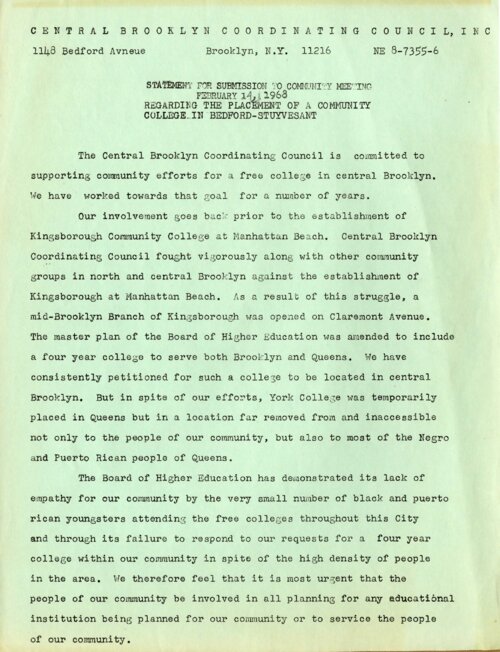 February 14, 1968 Statement of the Central Brooklyn Coordinating Committee Regarding the Placement of a Community College in Central Brooklyn On February 14, 1968, the Central Brooklyn Coordinating Council (CBCC), a community-based organization in Bedford-Stuyvesant, issued a public statement in response to City University of New York (CUNY) officials’ announcement two weeks earlier of plans to establish Community College 7 in Central Brooklyn. In the statement, the CBCC outlined a recent history of their efforts to advocate for a tuition-free college in Bedford-Stuyvesant, as well as criticized CUNY’s “lack of empathy for [their] community," demonstrated in a continuing pattern by CUNY of establishing new colleges in neighborhoods inaccessible to Black and Puerto Rican youth. The CBCC expressed support for Community College 7, concluding with demands that the community be involved directly in the planning for the new college.
 -
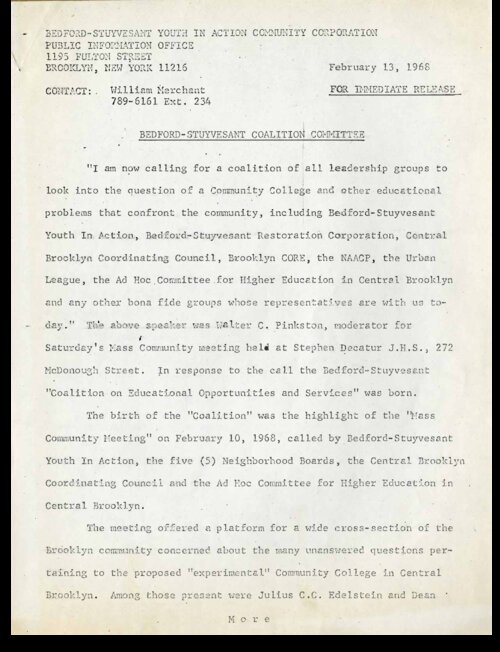 February 13, 1968 Youth in Action Press Release Announcing Formation of the Bedford-Stuyvesant Coalition on Educational Opportunities and Services In this February 13, 1968 press release, Youth in Action (YiA), a Bedford-Stuyvesant-based anti-poverty organization, announced the formation of the “Coalition on Educational Opportunities and Services,” (later changed to “Bedford-Stuyvesant Coalition on Educational Needs and Services” or B-SCENS). The new organization, which had been created in response to the mass meeting held several days earlier, was composed of prominent Bedford-Stuyvesant community-based education and anti-poverty organizations. According to press release, the Coalition would continue to meet to seek satisfactory answers from City University of New York (CUNY) officials to questions raised in that earlier meeting about CUNY’s proposed new “Community College 7” in order to allow the community to formulate and propose its own plans for the new college.
 -
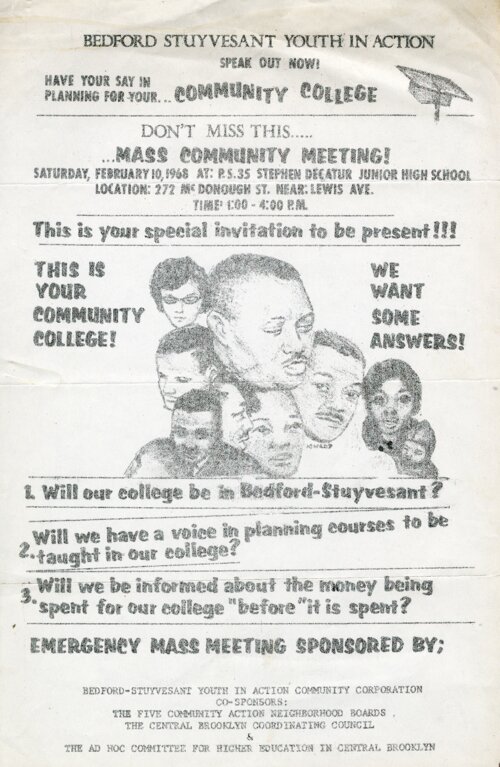 February 1968 Youth in Action Flyer: "Have Your Say in Planning for Your Community College" In this February 1968 flyer distributed in the Bedford-Stuyvesant community of Central Brooklyn, educational advocacy groups and community-based organizations responded immediately and forcefully to the announcement by the City University of New York (CUNY) of the development of a new community college in their community. Youth in Action (YiA), a Bedford-Stuyvesant-based anti-poverty organization, organized a mass, open meeting at which New York political leaders and CUNY officials would be invited to clarify their plans for the new college and respond to the community’s questions. YiA issued a special invitation to youth of Central Brooklyn to join the meeting to “[s]peak out now,” and “[h]ave your say in planning for your community college.”
 -
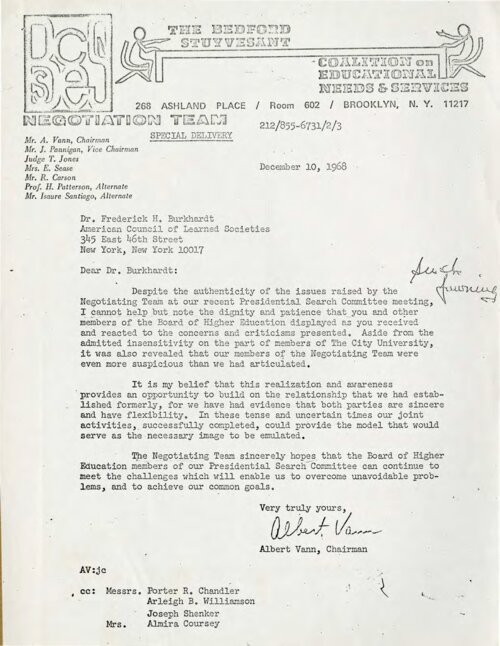 December 10, 1968 Letter from Al Vann to Frederick Burkhardt On December 10, 1968, Al Vann, Chairman of the Bedford-Stuyvesant Coalition on Educational Needs and Services (B-SCENS), wrote to Frederick Burkhardt, Chairman of the New York City Board of Higher Education, to comment on a debate that had transpired in a recent meeting of the Presidential Search Committee for Community College 7 of which they were both members. In recent weeks, the Committee had discussed several contentious issues between the delegations from the City University of New York (CUNY) and the one from the Bedford-Stuyvesant community, fueling the Bed-Stuy delegation’s concerns about CUNY's sincerity about its commitment to establish a new college controlled by the Bed-Stuy community. In the letter, Vann praised Burkhardt's “dignity and patience,” while criticizing the “admitted insensitivity” of other CUNY officials in the meeting, concluding that he was optimistic that the two parties could “continue to meet the challenges which will enable us to overcome unavoidable problems, and achieve our common goals."
 -
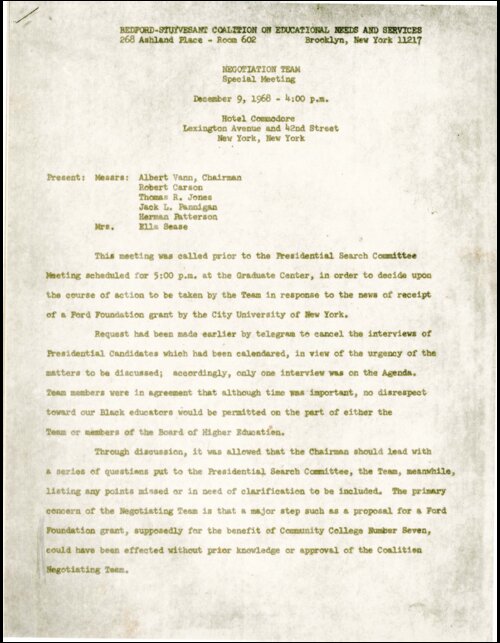 December 9, 1968 Minutes of Special Meeting of the Negotiation Team of the Bedford-Stuyvesant Coalition on Educational Needs and Services On December 9, 1968, in its second Special Meeting in less than a week, the five-member Negotiation Team of the Bedford-Stuyvesant Coalition on Educational Needs and Services met to discuss their concerns that City University of New York (CUNY) officials with whom they had been collaborating to plan Community College 7 were making key decisions without consulting them as representatives of the Central Brooklyn community. At issue was news that CUNY officials had submitted a proposal for a $440,000 grant from the Ford Foundation to support the planning and establishment of Community College 7. In minutes from the meeting, the Negotiation Team noted their “primary concern. . .that a major step, such as a proposal for a Ford Foundation grant, supposedly for the benefit of Community College 7, could have been effected without prior knowledge or approval of the Coalition Negotiation Team.” Tensions and mistrust between the Bedford-Stuyvesant and CUNY representatives involved in planning Community College 7 would continue to escalate in the coming weeks.
 -
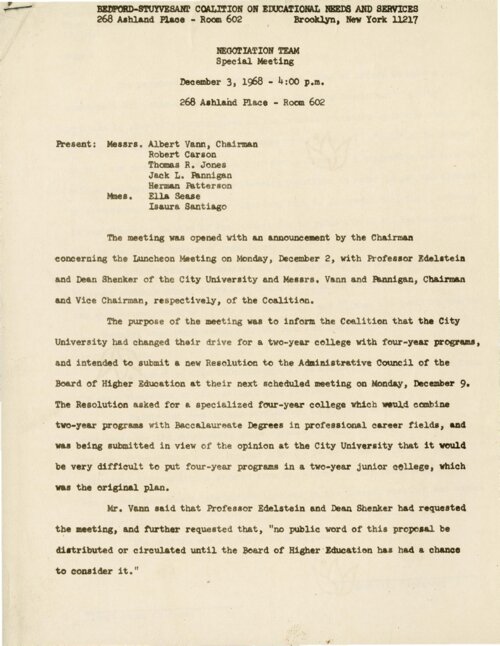 December 3, 1968 Minutes of the Special Meeting of the Negotiation Team of the Bedford-Stuyvesant Educational Needs and Services The five-member Negotiation Team of the Bedford-Stuyvesant Coalition on Educational Needs and Services met on December 3, 1968, to discuss a proposed resolution put forward by City University of New York (CUNY) officials to establish Community College 7 as a four-year college with special capacity to grant two-year degrees, rather than as a two-year “junior” as had originally been announced. The resolution, which CUNY officials proposed to submit to the Administrative Council of the Board of Higher Education for its consideration, represented an incremental victory for Bedford-Stuyvesant’s educational and community leaders, who had vigorously advocated that the new college be a four-year-degree granting institution. However, the fact that CUNY officials’ requested that “no public word of this proposal be distributed or circulated until the Board of Higher Education has had a chance to consider it” presented a conundrum for the Negotiation Team, which had been appointed to represent the Bedford-Stuyvesant community’s priorities and demands through an open and transparent process in the planning for the new college .
 -
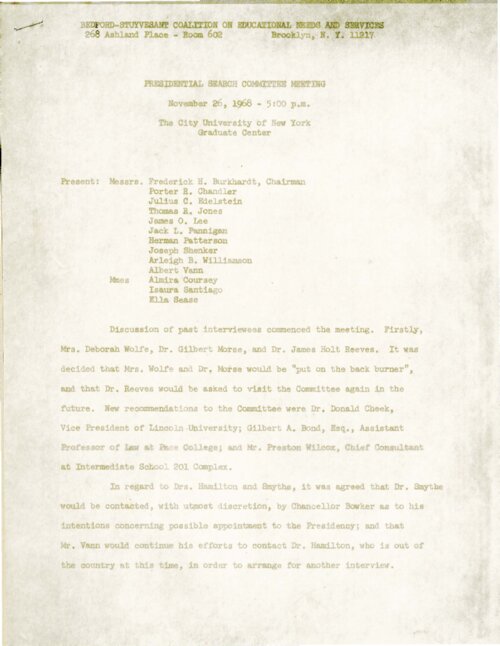 November 26, 1968 Minutes of the Presidential Search Committee for Community College 7 On November 26, 1968, the Presidential Search Committee for Community College 7, composed of five City University of New York (CUNY) officials and five appointed representatives of the Bedford-Stuyvesant community, met to discuss candidates for the presidency of the new college. In the meeting, the committee members discussed recent interviews with three candidates, and proposed new candidates they hoped to consult, including Hugh Smythe, then Ambassador to Malta. Also of note in this document is the appended list of approximately 50 additional candidates then under consideration for the presidency, including both Smythe and Rhody McCoy, a prominent leader in the Ocean Hill-Brownsville community control movement, who would later become the flashpoint of a pivotal controversy over the leadership of the new college.
 -
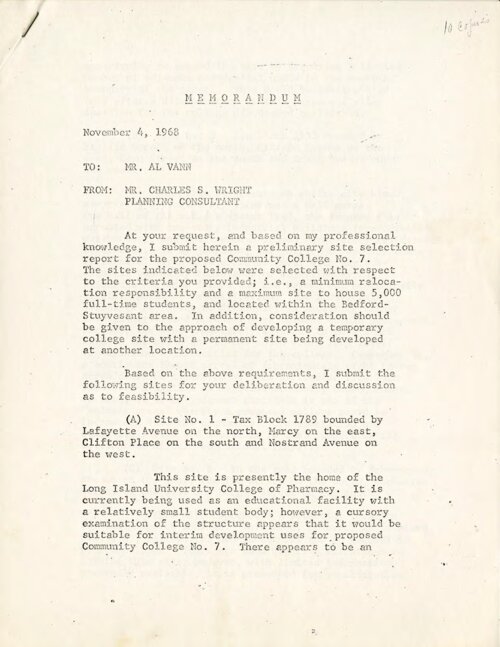 Preliminary Site Selection Report for the proposed Community College 7 On November 4, 1968, Charles Wright, Planning Consultant to the Bedford-Stuyvesant Coalition on Educational Needs and Services (B-SCEN) submitted a memo to Al Vann, chairman of the Negotiation Committee detailing four possible sites he had identified for the establishment of Community College 7. The location of the college was of central concern to the Bedford-Stuyvesant community, which had been publicly advocating for many years for a CUNY college to be located in Central Brooklyn, where it would be accessible to local Black and Puerto Rican youth. For reasons not documented in this collection, none of the four Bedford-Stuyvesant sites was selected for what became Medgar Evers College, which was ultimately built in the adjacent neighborhood of Crown Heights.
 -
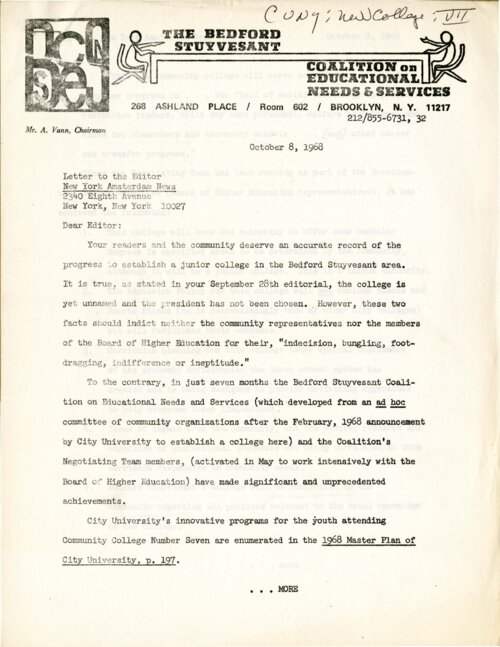 October 7, 1968, Letter from Al Vann to the editors of the New York Amsterdam News On October 7, 1968, Al Vann, chairman of the Bedford-Stuyvesant Coalition on Educational Needs and Services, wrote a letter to the Editor of the New York Amsterdam News, responding to an editorial published a week earlier. The editors of the Amsterdam News had expressed concerns that Community College 7 might never come to fruition because of the “indecision, bungling, foot-dragging or ineptitude” of the CUNY officials and Bedford-Stuyvesant community delegation, led by Vann, charged with developing and implementing the plans. In his letter, Vann details his delegation’s successes in convincing CUNY officials to agree to key demands for a college that would be controlled by the community. However, tensions among Bedford-Stuyvesant’s community leaders over the nature and extent of the community control to be demanded of CUNY, and concerns that the opportunity for a college in Central Brooklyn might be lost, continued to escalate in the coming months.
 -
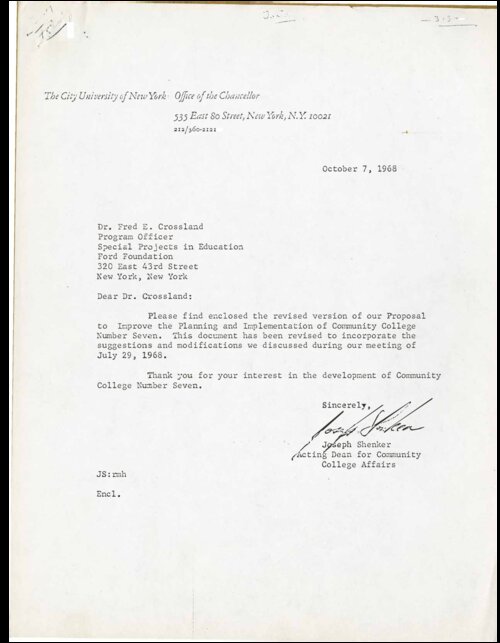 October 7, 1968, Proposal to Improve the Planning and Implementation of Community College 7 On October 7, 1968, Joseph Shenker, Acting Dean for Community College Affairs for the City University of New York, submitted a proposal to the Ford Foundation for a $440,000 grant “to Improve the Planning and Implementation of Community College 7.” The proposal included funds for key activities proposed by Bedford-Stuyvesant Coalition on Educational Needs and Services (B-SCENS)'s appointed “Negotiation Team,” representing the community’s demands for the new College. These demands included research to develop flexible admissions policies and degree pathways for educationally underserved Black youth. However, the Negotiation Team’s perception that they had been excluded from initial discussions about the proposal, and fact that the funds would be administered by CUNY, rather than by a community-based organization, fueled tensions between the two groups that would continue to escalate in the coming weeks.
51–75 of 1046