CUNY Digital History Archive
Item set
Collection
CUNY Digital History Archive
Items
726–750 of 1046
Advanced search
-
 Letter to the Editor of the New York Times: City University: On the Need to Save John Jay and Hostos On March 8, 1976 the New York Times published two letters to the editor alongside each other. Acting President of John Jay College, Gerald W. Lynch, wrote to publicly oppose the proposed merger of John Jay College with Baruch College. He argued that such a merger was unlikely to yield the financial savings that elected officials sought, that the potential losses that would result were severe, and that there were viable alternatives to the merger that would avoid such sacrifices while achieving savings. In the second letter, Peter Roman, Chairman of the Social Sciences Department at Hostos, calls the cuts "senseless, cruel, and destructive." He names the many ways the college provides for the underserved community of the South Bronx and its Spanish speaking community. In 1975, the New York City fiscal crisis led to efforts by city officials and the CUNY administration to close or merge multiple campuses in order to pay back debt owed to major banks. John Jay College was proposed to merge with Baruch College and Hostos Community College was slated to merge with Bronx Community College in order to dramatically cut spending. The proposals generated massive resistance on the part of students, faculty, and community groups.
 -
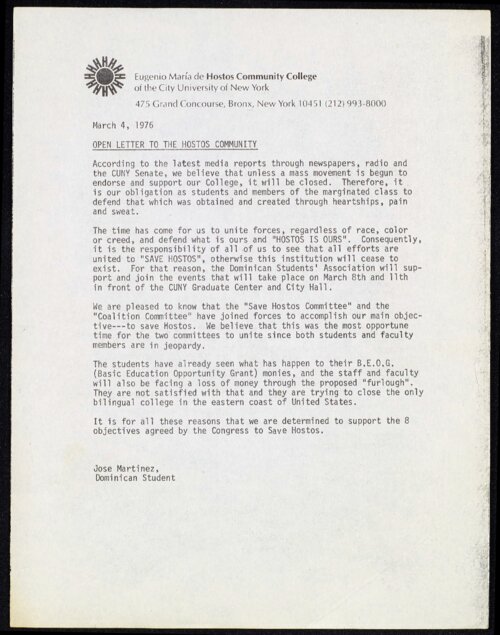 "Open Letter to the Hostos Community" / "Carta Publica a la Comunidad de Hostos" from Jose Martinez Jose Martinez wrote this open letter in both English and Spanish to the Hostos Community College community on behalf of the Dominican Students Association to state that the vulnerability of the college had become so dire that massive collective action had become necessary. Under threat of closure, student and community groups needed to join forces to prevent the City University of New York from closing the only bilingual college available for people in the South Bronx and the only such college in the eastern United States. In 1975, the New York City fiscal crisis led to efforts by city officials and the CUNY administration to close or merge multiple campuses in order to pay debts that were owed to major banks. Hostos Community College was slated to merge with Bronx Community College in order to dramatically cut spending. It was this threat that led to the second iteration of organizing to save Hostos. Determined to preserve Hostos for the South Bronx as a place for students to pursue a bilingual higher education, students, faculty, staff, and community groups joined forces to keep Hostos open.
 -
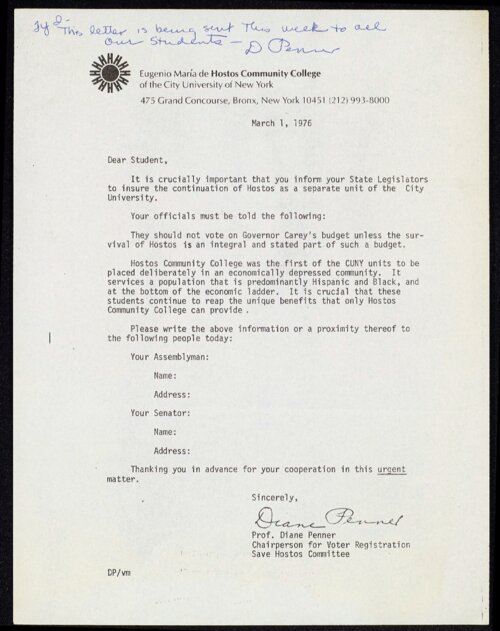 Letter to Hostos Community College Students from Professor Diane Penner Professor Diane Penner wrote this letter to the Hostos Community College student body in 1976 to encourage them to pressure state officials to oppose Hostos’ closure. As a faculty member and activist on the Save Hostos Committee, Penner’s letter gave students instructions on how to urge their representatives to protect their school. In 1975, the New York City fiscal crisis led to efforts by city officials and the CUNY administration to close or merge multiple campuses in order to pay back debt that was owed to major banks. Hostos Community College was slated to merge with Bronx Community College in order to dramatically cut spending. It was this threat that led to the second iteration of organizing to save Hostos. Determined to preserve Hostos for the South Bronx as a place for students to pursue a bilingual higher education, students, faculty, staff, and community groups joined forces to keep Hostos open. The faculty and students at Hostos Community College deployed political and protest strategies to achieve their goals.
 -
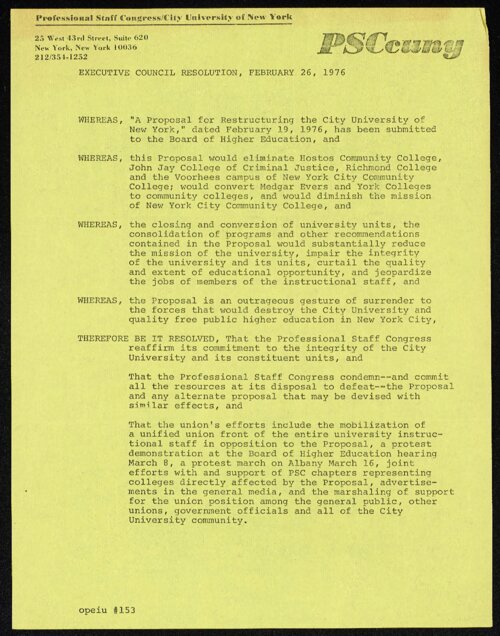 PSC/CUNY Executive Council Resolution on the Proposed Elimination of Hostos Community College In 1976, the Executive Council of the Professional Staff Congress (PSC) produced this resolution to convey their opposition to the proposal to close multiple community college campuses in New York City’s effort to save money. They also resolved to use all of their political resources to defeat the proposal and hold a demonstration to help to unify and build opposition to the proposal. The PSC, the union that represents faculty and staff employed by the City University of New York, was a crucial collaborator in all three campaigns to save Hostos Community College from inadequate facilities, budget cuts, and closure threats. In 1975, the New York City fiscal crisis led to efforts by city officials and the CUNY administration to close or merge multiple campuses in order to pay back debt that was owed to major banks. Hostos Community College was slated to merge with Bronx Community College in order to dramatically cut spending. It was this threat that led to the second iteration of organizing to save Hostos. Determined to preserve Hostos for the South Bronx as a place for students to pursue a bilingual higher education, students, faculty, the PSC, and community groups joined forces to keep Hostos open.
 -
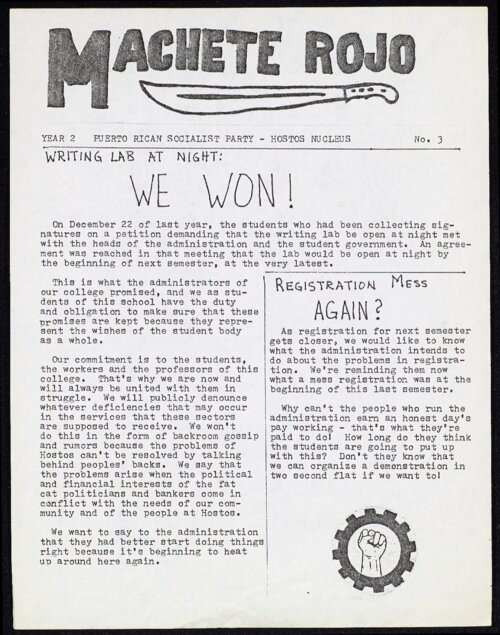 Machete Rojo: We Won! / Triunfaron Las Peticiones! El Machete Rojo was a leaflet produced by the Puerto Rican Socialist Party at Hostos Community College. This leaflet announced that student activists had successfully secured nighttime access to their writing lab, an effort that the administration of Hostos Community College had resisted. In the leaflet, student activists framed conflict at the college as overtly class-based.
 -
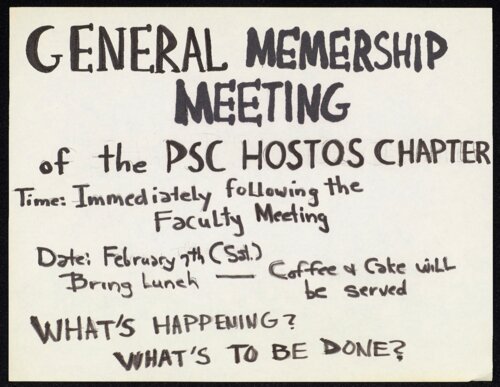 General Membership Meeting - Hostos PSC Chapter This flier announces a general membership meeting of the Hostos Community College chapter of the Professional Staff Congress (PSC). The PSC is the union that represents faculty and staff employed by the City University of New York. The PSC was a crucial collaborator in all three campaigns to save Hostos Community College from inadequate facilities, budget cuts, and closure threats.
 -
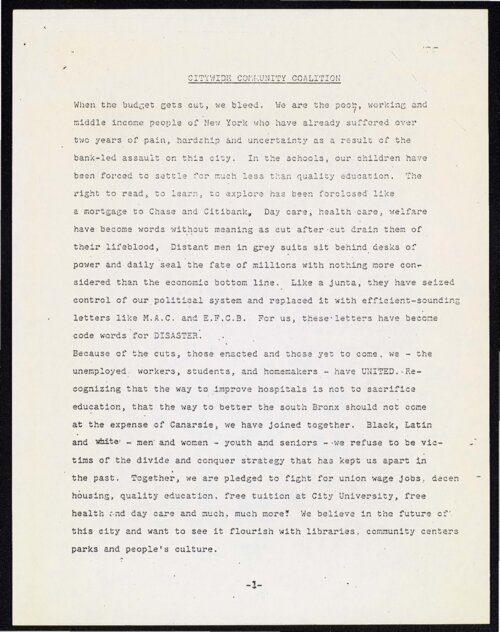 Citywide Community Coalition Mission Statement This document describes the mission of the Citywide Community Coalition (CCC), a collaboration dedicated to fighting the massive budget cuts inflicted on New Yorkers as a result of the 1975 fiscal crisis. Listing 28 groups ranging from The Association of Gypsy Cab Drivers to student, professional, political, cultural and religious organizations, the Coalition argued that the authority of the Emergency Financial Control Board and other institutions set up by the city and the state to repay the city’s debts constituted an illegitimate claim on public resources. In this mission statement, the CCC advocates for collective action to challenge the power of the banks in order to protect working and poor people of New York.
 -
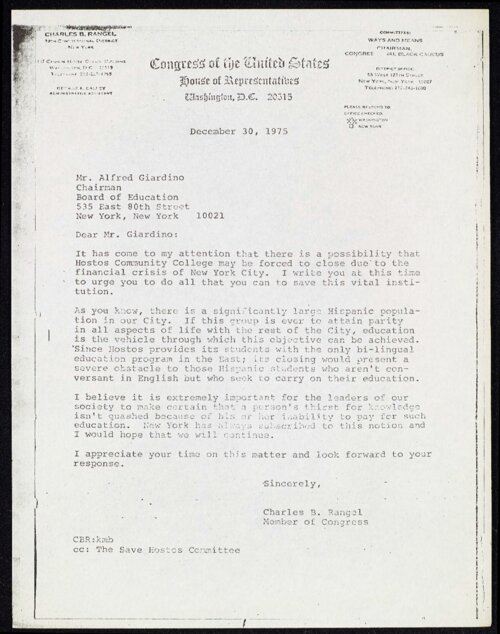 Letter from Congressman Rangel to Chairman Giardino In December 1975 Congressman Charles Rangel wrote this letter to the Chairman of the Board of [Higher] Education, Alfred Giardino, to convey his opposition to the closure of Hostos Community College. As the United States Congressman representing a substantial portion of Hostos students, Rangel articulated that the preservation of Hostos Community College was crucial in order to offer opportunities for upward mobility for members of his district who relied on bilingual education. In response to the New York City fiscal crisis that was occurring at the time, Hostos Community College was slated to merge with Bronx Community College in order to dramatically cut spending. It was this threat that led to the second iteration of organizing to save Hostos. Determined to preserve Hostos for the South Bronx as a place for students to pursue a bilingual higher education, students, faculty, staff, and community groups joined forces to keep Hostos open for the community.
 -
 Letter from President Kneller about Baccalaureate in Women's Studies More than four years after the first meeting of the Brooklyn College Women's Organization, the Women's Studies Program co-founders received this letter from Brooklyn College President John Kneller. A major victory in securing legitimacy for both the program and women's studies as an academic field, this letter informed the program faculty of the Board of Higher Education's approval for an accredited baccalaureate in Women's Studies, effective September 1974.
 -
 "The Past and Future of Women's Studies" - Conference Talk Women's Studies Program co-founder historian Renate Bridenthal gave this talk for the Brooklyn College Institute in Women's Studies for Secondary School Faculty conference in 1980. Bridenthal recounts the formation of the Brooklyn College Women's Organization of faculty and staff, and the student-run Women's Liberation Club. Such groups formed to address day care, employment discrimination, the establishment of a women's center, and the construction of the program. At the time of the presentation, the program had approximately 800 students per semester. She calls on the field to continue to question patriarchal norms, be inclusive of women in scholarship, and provide context and analysis for structural inequalities facing students and workers today.
 -
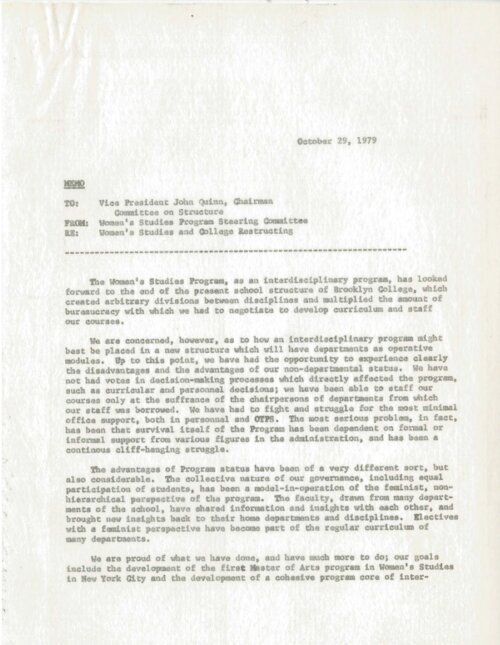 Memo to Brooklyn College Vice President John Quinn This memo from the Women's Studies Steering Committee to Brooklyn College Vice President John Quinn (also the Committee Chairman on Structure) argues for the restructuring of interdisciplinary programs into a Women's Studies department, with the aim of fostering collective governance, reducing bureaucracy in curriculum development and shared faculty appointments. This resource demonstrates the politics of resource allocation and the staffing difficulties within interdisciplinary programs.
 -
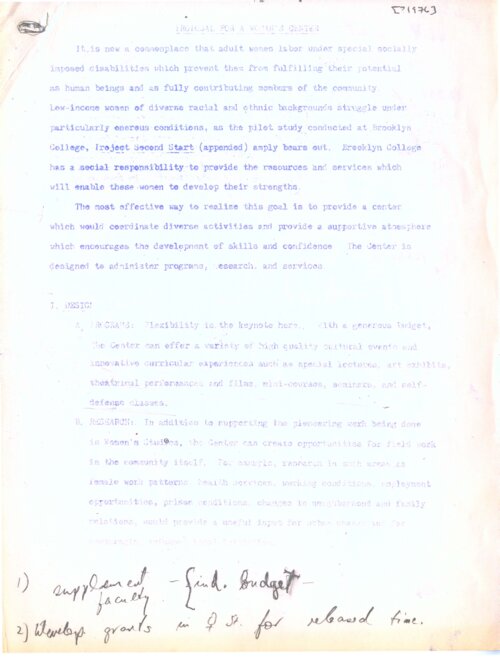 Proposal for a Women's Center at Brooklyn College Just after the establishment of the Women's Studies Program at Brooklyn College, program co-founder Tucker Farley began to push for a Women's Center as a complementary counterpart to the academic program. This proposal envisions the Women's Center as the hub of direct services and feminist activism on campus, and highlights the need for support to low income women, women of color, and caregivers. Services proposed include flexible programming, childcare, transportation, counseling, work training and placement, as well as research on women's work, health, prisons, families, and neighborhoods.
 -
 Proposal for a Women's Studies Program at Brooklyn College This proposal for a Women's Studies Program at Brooklyn College describes a nationwide demand for courses on the subject. The document illuminates the co-founders' preliminary arguments for such a program, as well as their first ideas about how to situate and structure the program within the university. Authors cite the need to examine and transform the position of women in society, and the need for Brooklyn College to be competitive in this field. The proposal advocates for a feminist pedagogy that would be best served by establishing an interdisciplinary program, which was realized shortly thereafter with baccalaureate accreditation in 1974.
 -
 Brooklyn College Women's Studies Program Coordinators (1974 – Spring 2016) This list of Brooklyn College Women's Studies Program Coordinators (1974 – Spring 2016) names the faculty and years they led the program and demonstrates the co-coordinator model in the beginning of the program's history with the aim of decentralizing singular hierarchical power. Listed as co-founders are Tucker Pamellla Farley (English), Renate Bridenthal (History), and Pat Lander (Anthropology).
 -
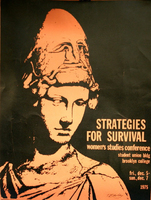 "Strategies for Survival" Conference Poster The first conference put on by the Brooklyn College Women's Studies Program was held in 1975, one year after the co-major was officially approved. The title of the conference was "Strategies for Survival" and the poster was designed by art department and Women's Studies faculty member, Fredrica Wachsberger, reflecting the imagery selected to represent women's resistance historically.
 -
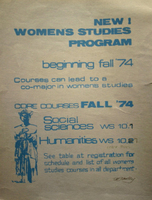 First Brooklyn College Women's Studies Program Poster The first poster for the co-major in Women's Studies at Brooklyn College was created in 1974 by art department faculty member Fredrica Wachsberger, co-coordinator of the program from 1975-1979. Marketing efforts for the new program paid off, and the nascent courses experienced high student enrollment.
 -
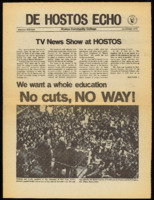 De Hostos Echo, December, 1974 De Hostos Echo is the Hostos Community College bilingual student newspaper. This 1974 issue features stories on mass demonstrations to save CUNY from budget cuts. Stories also include editorials on student activism and engagement, a mission statement for the Black Student Union, an announcement of a new student-run TV news show at Hostos Community College, and an article discussing increases in Veteran’s benefits.
 -
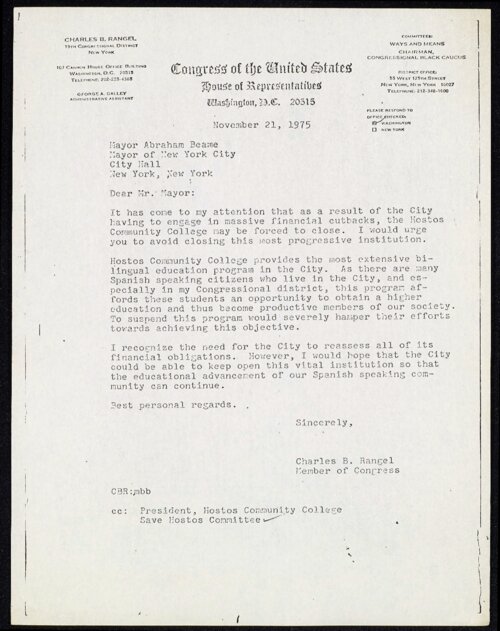 Letter to Mayor Abraham Beame from Charles B. Rangel: Notice of Potential Hostos Closure Congressman Charles Rangel wrote this letter to Mayor Abe Beame in November of 1975 to convey his opposition to the closure of Hostos Community College as a means to achieve budget cutbacks for the city. As the United States Congressman representing a substantial portion of Hostos students, Rangel urged the mayor to seek out alternative options for saving money so as to preserve Hostos Community College as a much needed resource for upward mobility in his district. In 1975, in response to the New York City fiscal crisis, Hostos Community College was slated to merge with Bronx Community College in order to dramatically cut spending. It was this threat that led to the second iteration of organizing to save Hostos. Determined to preserve Hostos for the South Bronx as a place for students to pursue a bilingual higher education, students, faculty, staff, and community groups joined forces to keep Hostos open for the community.
 -
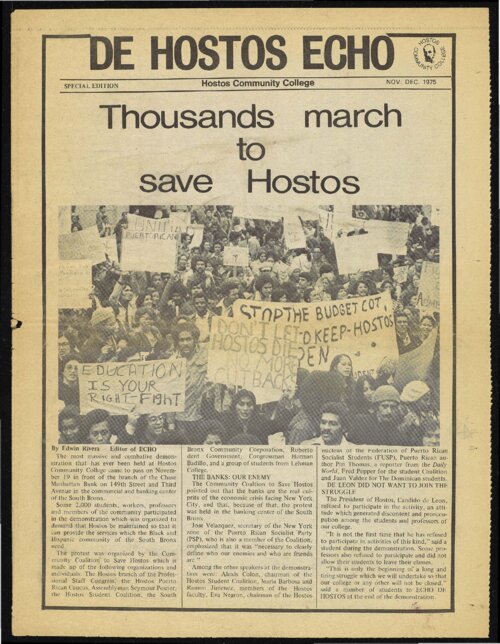 De Hostos Echo, November - December, 1975 De Hostos Echo is the Hostos Community College bilingual student newspaper. This November/December 1975 issue features stories on mass demonstrations to save the school from closure in order to deal with budget cuts. Stories also include tips for student success at the school, student election news, and editorials contextualizing the struggles happening at Hostos within a broader set of issues for CUNY community colleges. In 1975, in response to the New York City fiscal crisis, Hostos Community College was slated to merge with Bronx Community College in order to dramatically cut spending. It was this threat that led to the second iteration of organizing to save Hostos. Determined to preserve Hostos for the South Bronx as a place for students to pursue a bilingual higher education, students, faculty, and community groups joined forces to keep Hostos open for the community.
 -
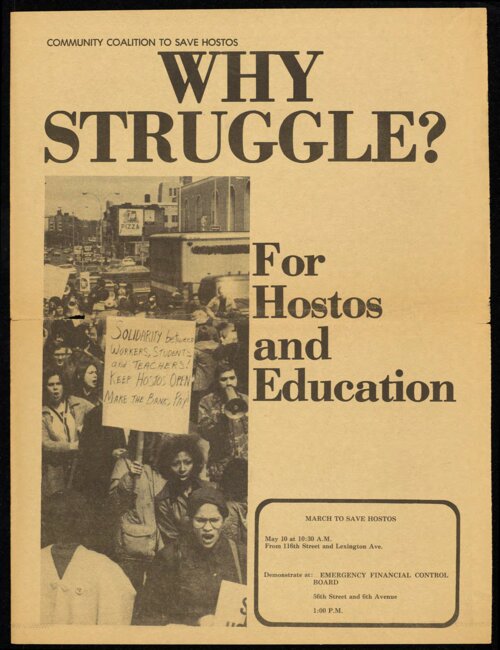 "Why Struggle? For Hostos and Education" This leaflet, distributed by the Community Coalition to Save Hostos, announces a march to the headquarters of the Emergency Financial Control Board (EFCB) in May of 1976. The EFCB was the body put in place to manage the budget crisis plaguing New York City. Made up largely of business people and bankers alongside city and state officials, the board was viewed as the driving force behind the massive cuts to public services New Yorkers sustained, including cuts to funding for CUNY. This leaflet articulates why the Community Coalition to Save Hostos was formed, the value of Hostos to its community, the efforts of those trying to stop Hostos’ closure, and solicits participation from supporters. In 1976, in response to the New York City fiscal crisis, Hostos Community College was slated to merge with Bronx Community College in order to dramatically cut spending. It was this threat that led to the second iteration of organizing to save Hostos. Determined to preserve Hostos for the South Bronx as a place for students to pursue a bilingual higher education, students, faculty, and community groups joined forces to keep Hostos open for the community.
 -
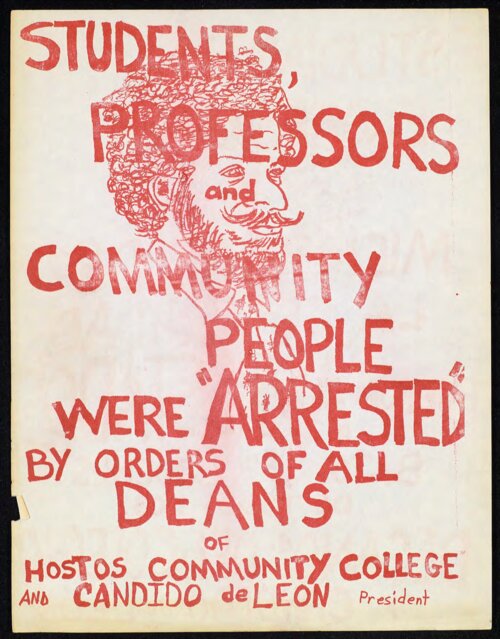 "Students, Professors, and Community People were 'Arrested' By Orders of All Deans" This 1975 flier, produced in English and Spanish, announced the arrest of those who occupied Hostos Community College in protest of the Board of Higher Education's decision to close it. This flier blames those arrests on the school's administration and President at the time. In 1975, in response to the New York City fiscal crisis, Hostos Community College was slated to merge with Bronx Community College in order to dramatically cut spending. It was this threat that led to the second iteration of organizing to save Hostos. Determined to preserve Hostos for the South Bronx as a place for students to pursue a bilingual higher education, students, faculty, and community groups joined forces to keep Hostos open for a community that wanted and needed it.
 -
 Women's Studies Program Catalog This catalog outlines the feminist perspectives and pedagogies used to establish the Women's Studies Program at Brooklyn College. The program was governed by a steering committee of faculty, students, and staff, and included co-coordinators who rotated someone new in each year. Included in the catalog are programs of study, career options, major requirements for the BA, co-listed courses, and program faculty.
 -
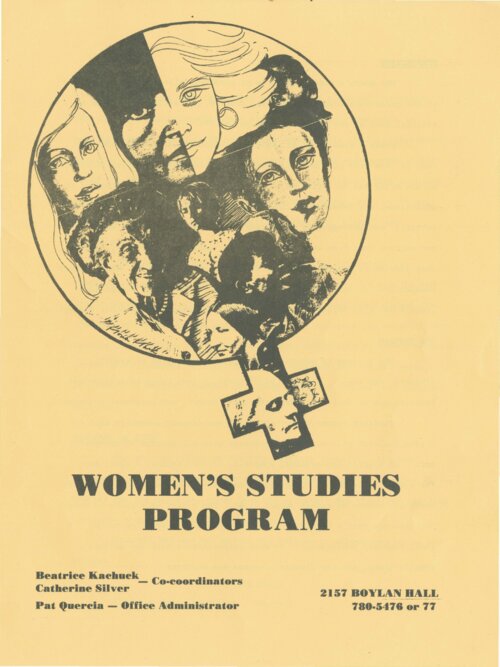 Women's Studies Program Report of Activities This report outlines the academic and outreach activities conducted by the Women's Studies Program at Brooklyn College during first year the BA was offered. This document offers a record of the establishment of program governance, collaborations with the Women's Center on returning women students, plans for a regional Women's Studies Conference, and network building with other professional women's associations.
 -
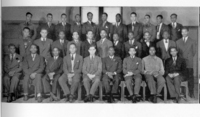 The Frederick Douglass Society, CCNY 1941 This 1941 photograph shows the members of the Frederick Douglass Society at City College (CCNY). The group, originally established in 1921 by ten black students, was one of the most active clubs on campus and, for several years, campaigned for the creation of a black history course. One of those picture here, Louis Burnham, served as president of the organization and was elected Vice President of the CCNY Student Council. After graduation he went south to organize the first chapter of the American Student Union on Black campuses. Their efforts, aided by the support of the College Teachers Union and the American Student Union, met success in the fall of 1937 with the creation of a course entitled, "Negro History and Culture." Teaching the course was the newly hired Dr. Max Yergan, the first black professor in any of the city's public colleges. Yergan's time on campus was short-lived, however, as he would soon become targeted by the Rapp-Coudert Committee and denied reappointment.
 -
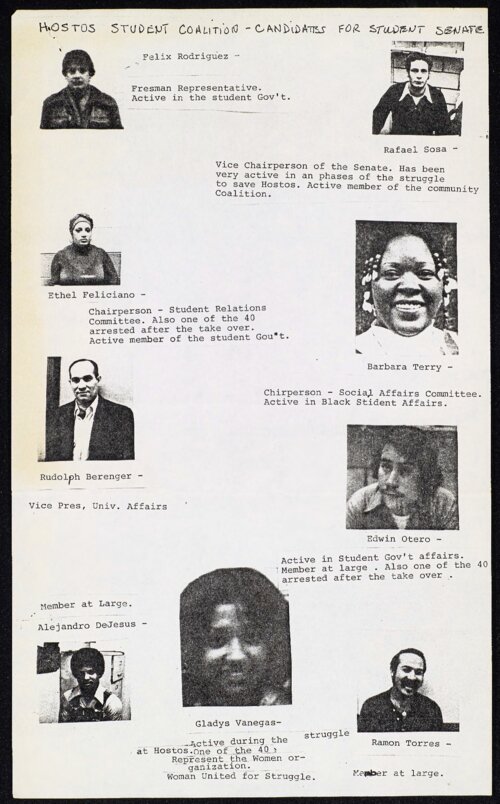 Hostos Student Coalition: Candidates for Student Senate This flier introduces the candidates for Student Senate at Hostos Community College. Many of them were activists in the occupation of the school and the effort to prevent it from being closed by the Board of Higher Education.
726–750 of 1046