CUNY Digital History Archive
Item set
Collection
CUNY Digital History Archive
Items
76–100 of 1046
Advanced search
-
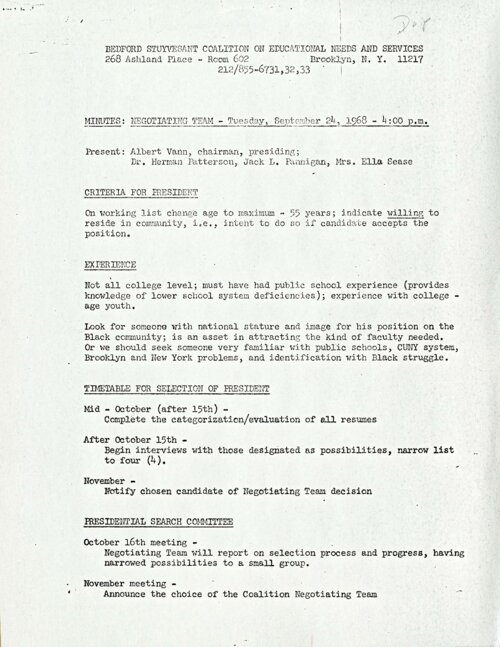 Steering Committee of the Bedford-Stuyvesant Coalition on Educational Needs and Services Minutes: Proposed Selection Criteria for the President of Community College 7 On September 24, 1968, the Steering Committee of the Bedford-Stuyvesant Coalition on Educational Needs and Services (B-SCENS) met to discuss the criteria they hoped to use in the selection of a president for a new, public college in Central Brooklyn. A broad network of local educational advocacy and community-based organizations had formed the B-SCENS as a network to gather and formalize the community’s demands for the new college, and appointed the five-member Negotiating Team to meet with an equal number of CUNY officials as a “Presidential Search Committee.” Of special note in these minutes from the Steering Committee’s meeting is the suggestion that the selected candidate’s experience would “not [be] all college level,” and would include “public school experience (provides knowledge of lower school system deficiencies; [and] experience with college-age youth.” The question of whether the new college president wouid be required to have university-level experience would emerge as a flashpoint in the months to come.
 -
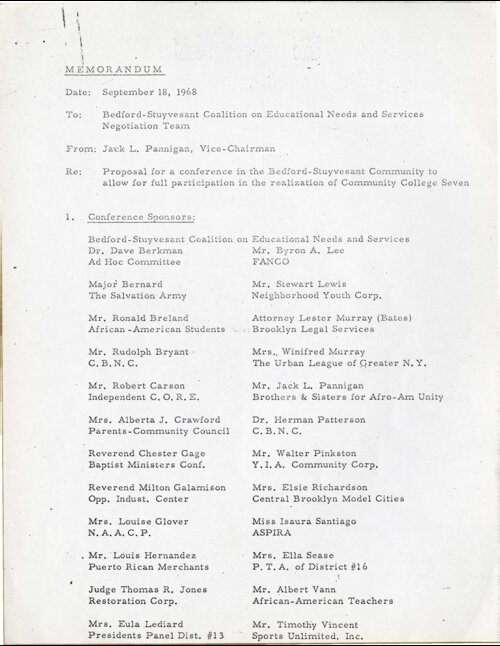 Proposal for a 1968 conference for the Bedford-Stuyvesant Community to allow for full participation in the development of Community College 7 On September 18, 1968, Jack Pannigan, head of Central Brooklyn youth club, Brothers and Sisters for African American Unity, drafted a proposal to his fellow members of the Bedford-Stuyvesant Coalition on Educational Needs and Services (B-SCENS) Steering Committee outlining plans for a workshop for community youth at which they would discuss ideas for a new public college in Central Brooklyn. Within days of the announcement, a broad network of Bedford-Stuyvesant’s educational advocacy and community-based organizations formed the B-SCENS as a network to support community members in formulating their visions and demands for the new college, and in negotiating with CUNY officials. In this proposal, Pannigan outlined plans for the B-SCENS to convene a workshop for youth from the community to formulate proposals for college curricula and admissions policies that reflected their hopes and priorities.
 -
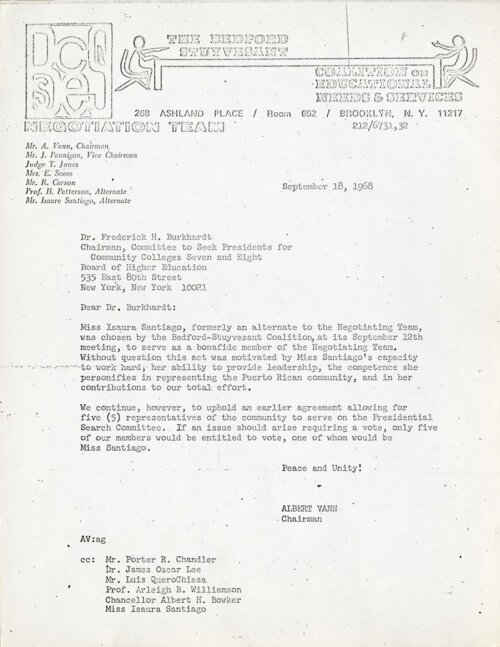 How the new Community College 7 will be "different": September 18, 1968 Letter from Al Vann to Frederick Burkhardt On September 18, 1968, Al Vann, Chairman of the Negotiation Team and Steering Committee of the Bedford-Stuyvesant Coalition on Educational Needs and Services (B-SCENS), wrote to Frederick Burkhardt, Chairman of the New York City Board of Higher Education, to describe the Bedford-Stuyvesant community’s vision for the way a new public college planned for Central Brooklyn should be “different.” In this letter, Vann wrote to Burkhardt, who served as chairman of the Committee to Seek Presidents for Colleges VII and VIII (a committee on which Vann also served as a member), emphasizing that the “difference we seek will be profound, and will be measured by the relevancy the college will have to our community and how well we meet some of our community’s needs.” Vann's letter also detailed important aspects of the community’s proposed role in making plans and decisions for the proposed college.
 -
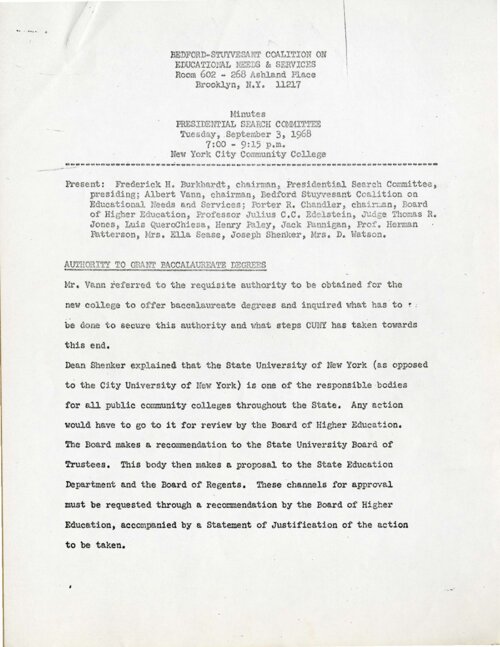 Minutes of the September 23, 1968, Presidential Search Committee Meeting On September 3, 1968, the “Presidential Search Committee” comprised of five City University of New York (CUNY) officials and five appointed representatives of the Bedford-Stuyvesant community, met to discuss a new CUNY college planned for Central Brooklyn. In this meeting, the Presidential Search Committee discussed issues of concern to Bedford-Stuyvesant constituents, including the development of a curriculum that represented the community’s priorities, and possibilities for the college, originally announced by CUNY as a two-year degree-granting institution, to open as a four-year degree granting “senior” college. At this meeting, the Presidential Search Committee also outlined criteria for selecting a president for the new college, an issue that would soon escalate into a major controversy.
 -
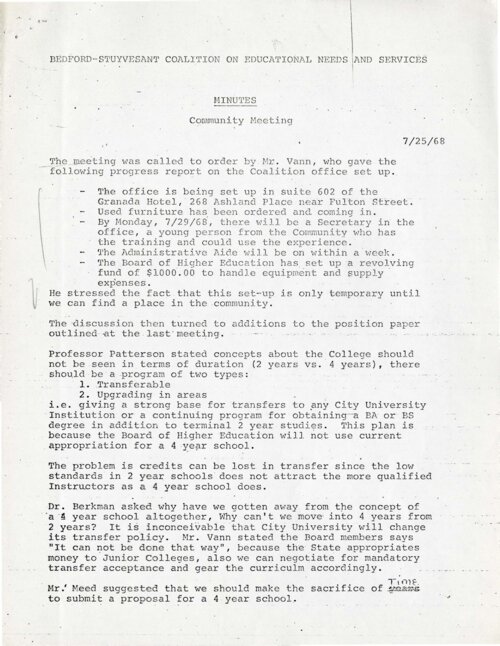 Minutes of July 25, 1968, Community Meeting of the Bedford- Stuyvesant Coalition on Educational Needs and Services On July 25, 1968, the Bedford Stuyvesant Coalition on Educational Needs and Services (B-SCENS) held a community meeting to discuss ongoing negotiations with the City University of New York (CUNY) regarding plans to develop a new college in Central Brooklyn. Albert Vann, chairman of the five-member Negotiation Team appointed by the B-SCENS to represent the Bedford-Stuyvesant community in these discussions with CUNY officials, reports on possibilities and challenges for the new college, including pathways to four-year degrees, rather than exclusively for two-year degrees, as CUNY had originally announced.
 -
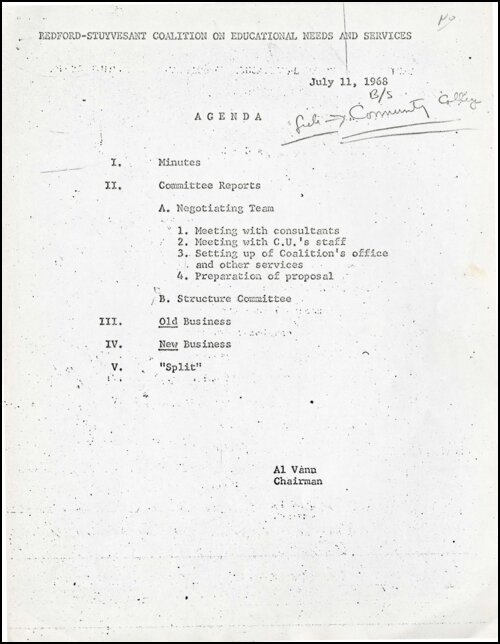 Minutes of Bedford-Stuyvesant Coalition on Educational Needs and Services Community July 11, 1968, Meeting with Negotiation Team On July 11, 1968, the Bedford-Stuyvesant Coalition on Educational Needs and Services held a community meeting, at which the five-member Negotiation Team, appointed to represent them in planning Community College 7 with City of New York (CUNY) officials, presented updates on their activities and progress. At the meeting, the Negotiation Team presented position papers drafted by three consultants on behalf of the Bedford-Stuyvesant community, arguing for the new college to open as a four-year institution and outlining pathways to realize that possibility. Among the consultants was Prof. Donald Watkins of Brooklyn College, from whose personal papers the Community College 7 collection was curated.
 -
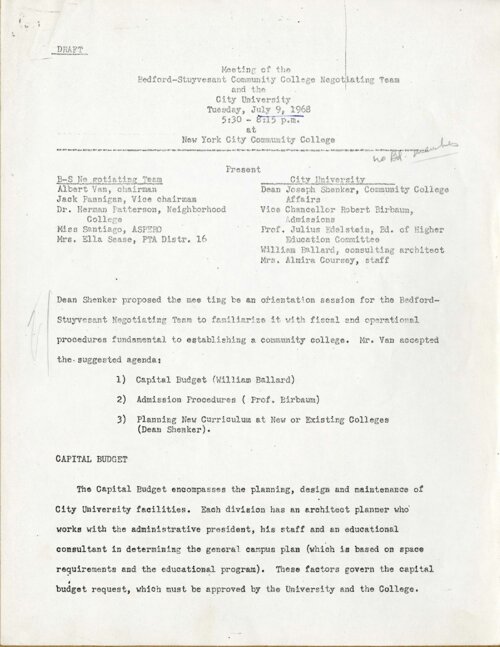 Presidential Search Committee of Community College 7: Minutes July 9, 1968, On July 9, 1968, the Presidential Search Committee for “Community College 7,” composed of five City University of New York officials and five appointed representatives of Bedford-Stuyvesant’s community-based organizations, met to discuss plans for the new college. In this meeting, CUNY officials briefed the Bedford-Stuyvesant committee members in detail on pathways and obstacles for the college to open as a four-year degree granting “senior” college, as demanded by the Central Brooklyn community. The Committee also explored possibilities for the Bedford-Stuyvesant community organizations to receive funds to support their research and planning activities in support of the new college, an issue that would prove contentious in the coming weeks with the Ford Foundation’s involvement in funding the project.
 -
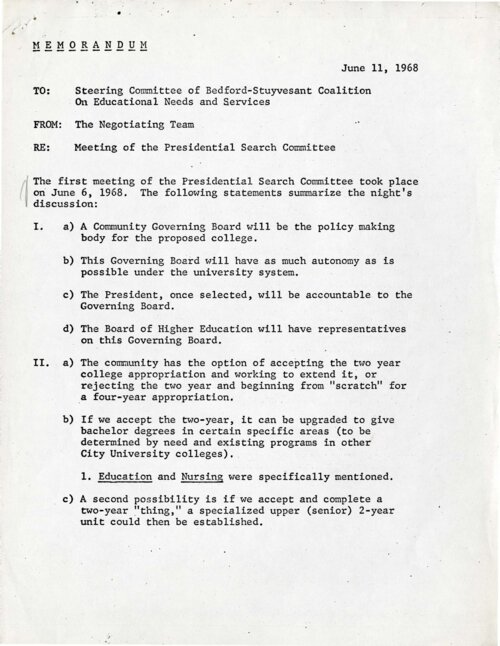 Presidential Search Negotiation Team June 6, 1968, Memo to the Bedford-Stuyvesant Coalition on Educational Needs and Services On June 6, 1968, a Presidential Search Committee comprised of five representatives from Bedford-Stuyvesant and five officials of the City University of New York (CUNY) met to discuss how they would collaborate to plan and lead a new public college in Central Brooklyn. In this memo, the Negotiation Team appointed by the Bedford-Stuyvesant Coalition on Educational Needs and Services (B-SCENS), a network of education advocacy groups and community-based organizations, outlined agreements reached with CUNY officials with respect to how the community would be represented in planning and leading the new college. Also discussed at this meeting was the key question of whether Community College 7 would be a “junior,” two-year degree granting college )as originally proposed by CUNY officials) or a “senior,” four-year degree granting college as demanded by the B-SCENS.
 -
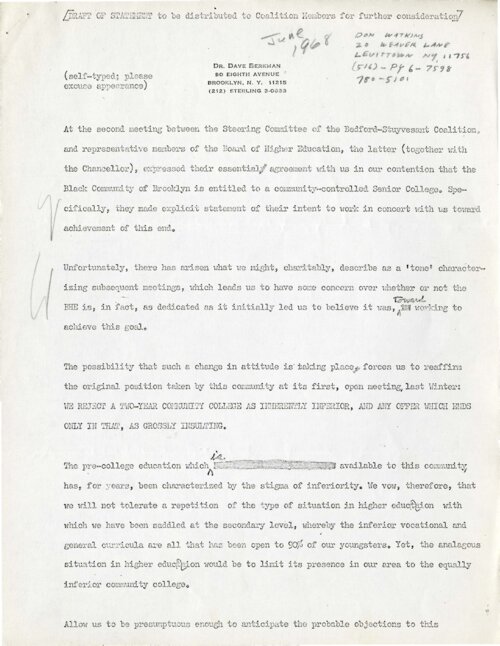 June 1968 Draft Statement for the Bedford-Stuyvesant Coalition on Educational Needs and Services (B-SCENS) In this June 1968 statement drafted for the Bedford-Stuyvesant Coalition on Educational Needs and Services (B-SCENS), Dr. Dave Berkman, Steering Committee member of the B-SCENS, presents demands for a new public college planned in and for central Brooklyn. Five months before, City University of New York (CUNY) officials had announced the establishment of “Community College 7.” In this document, Berkman lays out forceful arguments for the new college to be a “community-controlled senior college” with four-year degree granting capacities, rather than a “junior” two-year degree granting community college, as CUNY officials had originally proposed.
 -
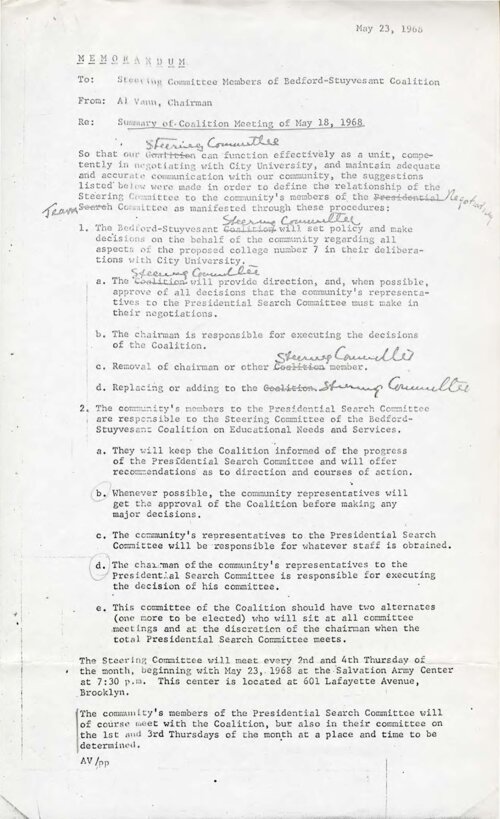 May 23, 1968, meeting minutes of the Bedford-Stuyvesant Coalition on Educational Needs and Services (B-SCENS) Steering Committee On May 23, 1968, the Steering Committee of the newly-formed Bedford-Stuyvesant Coalition on Educational Needs and Services (B-SCENS), a network of education advocacy groups and community-based organizations, met to discuss how they would represent their community in negotiations over a new public college planned in and for central Brooklyn. City University of New York (CUNY) officials had announced the establishment of “Community College 7” three weeks earlier, and had agreed to collaborate with the Central Brooklyn community in recruiting and hiring a president for the new college. At this meeting, the Steering Committee members outlined the processes by which they would be elected, and their specific responsibilities and procedures for communicating with and representing the demands of their constituents.
 -
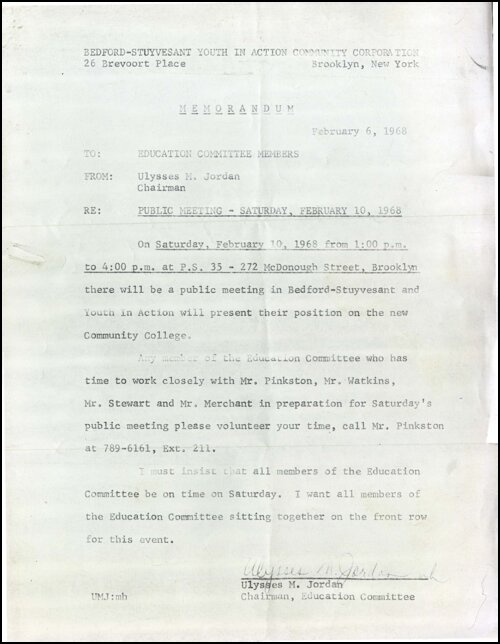 February 1968 Memo and Press Release from Youth in Action In this February 6, 1968 memo, the leaders of Youth in Action (YiA), an anti-poverty organization based in Bedford-Stuyvesant, responded to CUNY’s announcement of a new community college in their community, expressing grave concerns that community members of Central Brooklyn had not been consulted about plans or programming for the newly proposed college. In the memo, the YiA leaders invited prominent political leaders and CUNY officials, including Senator Robert Kennedy, Mayor John Lindsay, and Judge Thomas Jones to an open meeting with the Bedford-Stuyvesant community, to clarify CUNY’s plans for the new college, and respond to questions from the community.
 -
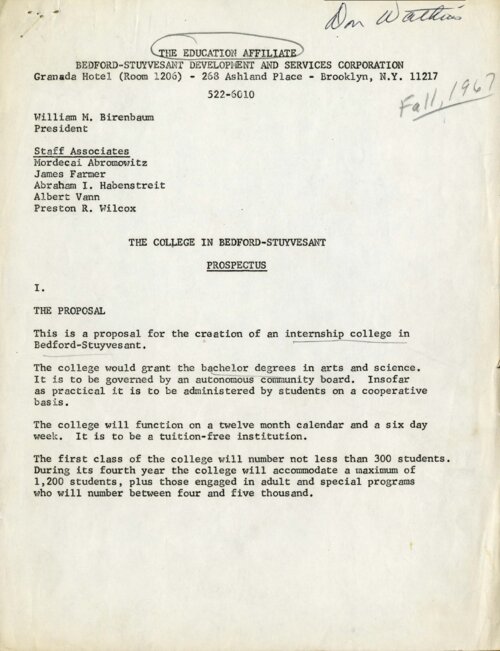 The Educational Affiliate, The College in Brooklyn: Prospectus Drafted in 1967, the Educational Affiliate, The College in Brooklyn: Prospectus, the work of the Affiliate had been inspired and supported by Senator Robert F. Kennedy. Staff of the Educational Affiliate included William Birenbaum, President, and “Staff Associates" Al Vann, James Farmer, Preston R. Wilcox, and several others. The document was headlined as a “proposal for an Internship college” and outlined a vision that included several characteristics for the proposed college that remained fundamental to the community control leaders’ demands for "Community College 7," CUNY's proposed new college in Central Brooklyn. Among these demands were free tuition and specific programs for teacher education and nursing. The language used and the programs proposed implied or assumed a four-year CUNY college would be developed.
 -
 Oral History Interview with Irini Neofistos In this interview, Irini Neofistos discussed the dynamics of the Student Liberation Action Movement's (SLAM!) role in Hunter College’s student government, which she took part in while a student at Hunter. Irini talked about her family’s radical history and the intergenerational leftist foundations of the organization. She discussed the anti-prison work that was central to her own experience in SLAM!, as well as the larger abolitionist movement that grew out of the 1990s movement and organizations such as SLAM!, Critical Resistance, and the Malcolm X Grassroots Movement. Looking to many of her comrades in the organization, she discussed the paths many SLAM! organizers have taken since leaving Hunter and the ways in which they have shaped different movement spaces in the city over the past two decades.
 -
 Oral History Interview with Sabrine Hammad In her interview, Sabrine Hammad discussed her political upbringing in a Palestinian nationalist household, and her relationships with her sisters who were also in the Student Liberation Action Movement (SLAM!) At Hunter College in the 1990s, where they all studied. She talked about the organizational structure of SLAM!, and in particular the work that she and Kai Lumumba-Barrow did in the office, and Kai’s cultivation of women of color leaders in the organization. She discussed solidarity work, including a delegation she took part in that went to Iraq in the early 2000s. She situated SLAM! within a constellation of people of color-led Left organizations in New York at the time, including within CUNY. Finally, she discussed her work after leaving SLAM!, including as an organizer with the CUNY Professional Staff Congress union.
 -
 Oral History Interview with Rachel Laforest In this interview, Rachel Laforest discussed her foundations in the New York Left and internationalist politics. She situated the Student Liberation Action Movement (SLAM!) and student organizing at CUNY in the 1990s and early 2000s within the context of a changing city, focusing in particular on contested transformations around real estate, housing, and policing. She reflects upon organized labor and the role of unions in the Left, as well as political and ideological differences within SLAM!. She talked about the Black and Puerto Rican Studies department at Hunter, where she earned her degree, as well as Black student organizations. She highlighted the work of the High School Organizing Project, a SLAM! initiative that bridged the divide between high schools and colleges in New York.
 -
 Oral History Interview with Orlando Green In this interview, Baruch College student Orlando Green discussed the afterlives of the Black power movement through various student of color formations that operated around the Student Liberation Action Movement (SLAM!), Including SOUL, FIST, STORM, and the Student Power Movement. He talked about the rise of campus policing at CUNY in the 1990s and 2000s in relation to the crackdown on protest and the targeting of student organizers such as himself. He discussed the changing political climate in New York and beyond through an analysis of electoral politics, the left, and the changing demographics and administration of CUNY.
 -
 Oral History Interview with Jesse Ehrensaft-Hawley In this interview, community organizer Jesse Ehrensaft-Hawley discussed the Student Liberation Action Movement's (SLAM!) role as a movement incubator and supportive organization, particularly in relation to the work of FIERCE and other queer youth organizations. He talked about the anti-police and anti-gentrification politics of New York in the 1990s and early 2000s, as well as the resistance they faced from a variety of power brokers in the city, including the real estate industry, the New York Police Department, and wealthy White gay stakeholders in the city.
 -
 Oral History Interview with Hank Williams In this interview, City College student Hank Williams discussed organizing at CUNY in the late 1990s and early 2000s, after the middle of the decade which he identified as the peak of the campus movement. He talked about the relationship between various campus organizations, including the Student Liberation Action Movement (SLAM!), which he organized with. He reflected upon the era of repression and austerity, as CUNY dismantled open admissions, and the racism that guided these policies.
 -
 Oral History Interview with Kamau Franklin In this interview, Kamau Franklin discussed his experiences as an organizer with the Student Liberation Action Movement (SLAM!) and other organizations in New York in the 1990s, namely the Student Power Movement and the Malcolm X Grassroots Movement. He talked about the important role Black movement elders Ashanti Alston and Kai Lumumba-Barrow played in movement parenting the young organizers in SLAM!. He also discussed the important movement work SLAM! folks did in the subsequent decades with organizations such as the Moral Mondays and Make the Road. He explained the ideological diversity of SLAM! and how it fit into the Left in New York.
 -
 Oral History Interview with Mariano Munoz In this interview, Mariano Munoz discussed his time as a student organizer in the Student Liberation Action Movement (SLAM!) at Hunter College. He described the role of political education and radical study as the organization developed an internationalist politics that brought students to Chiapas and Mexico City to work with the Zapatistas and striking students at UNAM respectively. He also discussed his experience as an undocumented student and how that shaped his time as a student-organizer with Hunter College SLAM!. He talked about the protests at the 2000 Republican National Convention in Philadelphia and the dissolution of SLAM!.
 -
 Oral History Interview with Suzy Subways In this interview, Suzy Subways discussed the queer and feminist politics of the Student Liberation Action Movement (SLAM!) and the larger movement in and beyond CUNY in the 1990s and early 2000s. She discussed her work with the Welfare Action Committee at Brooklyn College, where she studied, in the wake of welfare reform policies that pushed working class and poor mothers out of CUNY and universities across the nation in the middle of the 1990s. In addition to the gender politics of SLAM!, she also talked about the role of anarchism in the organization, as well as SLAM!'s ability to train students in organizing skills. One site of training and radicalization that she discussed was the High School Organizing Project, which sought to mobilize New York City high school students in defense of Open Admissions and the victories of struggles at CUNY from prior decades.
 -
 Oral History Interview with Neha Gautam In this interview, Neha Gautam discussed the interconnected nature of race, class, gender, sexuality, and nation in the political structure of CUNY and New York. In particular, she focused on the ways in which it radicalized her, most notably in the wake of 9/11 with the intense policing of South Asian communities in New York. This led to her participation in the Student Liberation Action Movement (SLAM!) while a student at City College in the early 2000s. She discussed the influence of Sixties organizations such as the Young Lords on SLAM! and the mutual aid work they did such as the book exchange at the Morales-Shakur Center at City College. She talked about the personal disputes, as well as political conflicts around questions of gender and sexuality that caused tension within the organization, as well as the repression from the CUNY administration.
 -
 Oral History Interview with Brad Sigal In this interview, Brad Sigal, who studied at both John Jay College of Criminal Justice and the City College of New York in the 1990s, discussed the intercampus dynamics within the Student Liberation Action Movement (SLAM!) and CUNY organizing spaces. He analyzed the impact of repression and surveillance on organizing at CUNY, and the varying levels of policing faced by organizers on different campuses. He talked about austerity, Black and Puerto Rican studies, and cuts to the Black Studies department at City College. He discussed student governance, as well as the role of Black, Dominican, and Puerto Rican student organizations in the movement at City College, and the importance of having a place to meet and organize on campus: the Morales-Shakur Center.
 -
 Oral History Interview with Chris Gunderson In this interview, Christopher Gunderson (Chris Day) discussed the internal/external structure and origins of the Student Liberation Action Movement (SLAM!), as well as the ideological debates that took place within the organization in the 1990s. He talked about the role of publications and propaganda in popularizing SLAM!, as well as the role of the rapidly expanding carceral state in suppressing the Left on and off campus. Gunderson also discussed the work he did in Mexico while he was organizing with SLAM!, which included moving to Chiapas to support the building of a movement infrastructure by the Zapatistas.
 -
 Oral History Interview with Lenina Nadal In this interview, Lenina Nadal discussed her experiences in the middle of the 1990s in the Coalition Against the Cuts and as an original member of the Student Liberation Action Movement (SLAM!). She highlighted the importance of SLAM! being a women of color-led organization and the ways the group practiced a feminist politics. She made clear the centrality of culture to SLAM! in her discussion of music, dance, poetry, theater, and popular education. She discussed connections between SLAM! and earlier struggles, including the Open Admissions struggle at the City University of New York and the founding of the Puerto Rican and Latino Studies department at Brooklyn College, which her parents were involved in.
76–100 of 1046