CUNY Digital History Archive
Item set
Collection
CUNY Digital History Archive
Items
176–200 of 1046
Advanced search
-
 CUNY Guidance for Students Traveling Home to International Countries Amidst discussions of precarity, a group often absent from the conversation were international students, members of the CUNY community resident in the United States under limited political visas far from home and family. Sent on March 13, 2020, by the Office of Student Affairs at The Graduate Center, this email exemplified an initial attempt by CUNY leaders to tabulate the movement of the international student body during the early stages of the COVID-19 pandemic. The email specifically requested that students record their travels home to international countries by entering the details into CUNYGO, the university's travel registry portal. This item is part of the City University of New York (CUNY) Distance Learning Archive, a group project developed as part of Prof. Matthew K. Gold's Spring 2020 Knowledge Infrastructures seminar in the Ph.D. Program in English at The Graduate Center, CUNY, in partnership with the Interactive Technology and Pedagogy Certificate Program. The project's goal was to resist or trouble the discourse of catastrophe around the shift to online learning caused by the COVID-19 pandemic by documenting the lived experiences of students, faculty, and staff across CUNY's 25 campuses. Further, the project wanted to document the moment of crisis response by taking a critical approach to educational technology.
 -
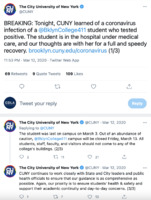 Tweet: CUNY Announcement of COVID-19 Infection at Brooklyn College On March 13, 2020, several days after Governor Andrew Cuomo declared a state of emergency across New York State, Brooklyn College, City University of New York (CUNY), reported its first positive case of COVID-19. Such a report offered two narratives: either CUNY's closure came too soon to prevent more cases, or its closure was exactly at the opportune time – right when more cases were likely to develop. This artifact demonstrated the wide-reaching spread of COVID-19 across CUNY campuses. From Manhattan to Brooklyn, the pandemic had become a pivotal part of CUNY's history. This item is part of the City University of New York (CUNY) Distance Learning Archive, a group project developed as part of Prof. Matthew K. Gold's Spring 2020 Knowledge Infrastructures seminar in the Ph.D. Program in English at The Graduate Center, CUNY, in partnership with the Interactive Technology and Pedagogy Certificate Program. The project's goal was to resist or trouble the discourse of catastrophe around the shift to online learning caused by the COVID-19 pandemic by documenting the lived experiences of students, faculty, and staff across CUNY's 25 campuses. Further, the project wanted to document the moment of crisis response by taking a critical approach to educational technology.
 -
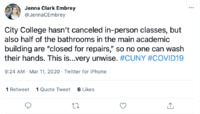 Tweet: City College Bathrooms Under Repair Amid COVID-19 Outbreak As with most public institutions, during the first wave of the Covid-19 pandemic, the City University of New York (CUNY) struggled with acquiring sufficient funding to meet the infrastructural needs of its physical facilities. With this tweet, referencing this NBC article and posted on March 11, 2020, we saw how the difficulty in maintaining functional, hygienic restrooms failed to satisfy the necessary conditions for student wellbeing amid the rise of COVID-19 in NYC. In expressing exasperation at the inaccessible state of City College's bathroom facilities, this tweet captured the locally situated impact of austerity and mismanagement of funding for maintenance and emergency preparedness of CUNY's physical infrastructure amid the public health crisis of the pandemic. This item is part of the City University of New York (CUNY) Distance Learning Archive, a group project developed as part of Prof. Matthew K. Gold's Spring 2020 Knowledge Infrastructures seminar in the Ph.D. Program in English at The Graduate Center, CUNY, in partnership with the Interactive Technology and Pedagogy Certificate Program. The project's goal was to resist or trouble the discourse of catastrophe around the shift to online learning caused by the COVID-19 pandemic by documenting the lived experiences of students, faculty, and staff across CUNY's 25 campuses. Further, the project wanted to document the moment of crisis response by taking a critical approach to educational technology.
 -
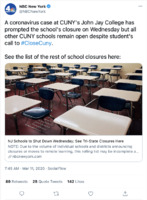 Tweet: NBC New York Report of Coronavirus Exposure at John Jay College Posted on March 11, 2020, this tweet from NBC New York reports on the first positive case of COVID-19 among the student body of John Jay College of Criminal Justice, City University of New York (CUNY). With coverage from a nationally syndicated news channel, CUNY's early experience with the pandemic revealed itself to be more than merely a local concern: It had national influence as well. This item is part of the City University of New York (CUNY) Distance Learning Archive, a group project developed as part of Prof. Matthew K. Gold's Spring 2020 Knowledge Infrastructures seminar in the Ph.D. Program in English at The Graduate Center, CUNY, in partnership with the Interactive Technology and Pedagogy Certificate Program. The project's goal was to resist or trouble the discourse of catastrophe around the shift to online learning caused by the COVID-19 pandemic by documenting the lived experiences of students, faculty, and staff across CUNY's 25 campuses. Further, the project wanted to document the moment of crisis response by taking a critical approach to educational technology.
 -
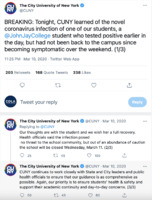 Tweet: CUNY Announcement of COVID-19 Infection at John Jay College Posted on March 10, 2020, this tweet represented the official announcement from the City University of New York (CUNY) administration regarding the exposure of John Jay's student body to COVID-19. While many other tweets in this collection show public awareness of a student testing positive for Covid-19 prior to CUNY's announcement, it is worth noting the community's shock as its fears were officially confirmed. While this tweet attempts an official conciliatory tone, it cannot be read without the sense of weight it conjured for the larger CUNY community. This item is part of the City University of New York (CUNY) Distance Learning Archive, a group project developed as part of Prof. Matthew K. Gold's Spring 2020 Knowledge Infrastructures seminar in the Ph.D. Program in English at The Graduate Center, CUNY, in partnership with the Interactive Technology and Pedagogy Certificate Program. The project's goal was to resist or trouble the discourse of catastrophe around the shift to online learning caused by the COVID-19 pandemic by documenting the lived experiences of students, faculty, and staff across CUNY's 25 campuses. Further, the project wanted to document the moment of crisis response by taking a critical approach to educational technology.
 -
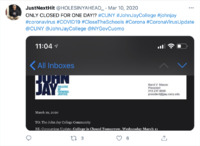 Tweet: Reaction to Coronavirus Update at John Jay College (1) Posted on March 10, 2020, this tweet records one student's outrage over the mere announced one-day closure of John Jay College of Criminal Justice of the City University of New York (CUNY) following its first confirmed case of COVID-19 among the student body. Containing a litany of CUNY-specific activist hashtags, the tweet broadly typifies the growing sense of unrest over CUNY leadership's general lack of pandemic responsiveness. This particular student framed their outrage with a screen captured email from John Jay President Karol V. Mason, which announced the exposure and offered preparatory guidance for John Jay students, faculty, and staff going forward. This item is part of the City University of New York (CUNY) Distance Learning Archive, a group project developed as part of Prof. Matthew K. Gold's Spring 2020 Knowledge Infrastructures seminar in the Ph.D. Program in English at The Graduate Center, CUNY, in partnership with the Interactive Technology and Pedagogy Certificate Program. The project's goal was to resist or trouble the discourse of catastrophe around the shift to online learning caused by the COVID-19 pandemic by documenting the lived experiences of students, faculty, and staff across CUNY's 25 campuses. Further, the project wanted to document the moment of crisis response by taking a critical approach to educational technology.
 -
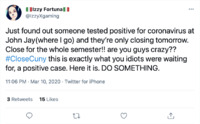 Tweet: Reaction to Coronavirus Update at John Jay College (2) As a central higher education hub for the population of New York City, City University of New York (CUNY) schools were unable to prevent COVID-19 exposures. One of the first cases of infection occurred at John Jay College of Criminal Justice. With this tweet, dated March 11, 2020, we see some of the community's reactions to that event. Note that the focus on the limited closure time instead of the threat of exposure reflected a general concern for CUNY's response. Such tweets reveal how the pandemic came to catalyze longstanding points of tension between the broader community and CUNY's administration. This item is part of the City University of New York (CUNY) Distance Learning Archive, a group project developed as part of Prof. Matthew K. Gold's Spring 2020 Knowledge Infrastructures seminar in the Ph.D. Program in English at The Graduate Center, CUNY, in partnership with the Interactive Technology and Pedagogy Certificate Program. The project's goal was to resist or trouble the discourse of catastrophe around the shift to online learning caused by the COVID-19 pandemic by documenting the lived experiences of students, faculty, and staff across CUNY's 25 campuses. Further, the project wanted to document the moment of crisis response by taking a critical approach to educational technology.
 -
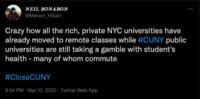 Tweet: #CloseCUNY Activism & NYC Higher Education Posted on March 10, 2020, this tweet reflected on the pandemic response efforts of private NYC universities compared to public universities like the City University of New York (CUNY). For many community members, the difference between university responses was linked to class dynamics. CUNY supports a largely immigrant and working-class population, serving as the best option for higher education to many of New York City's marginalized communities. Compared to the student populations at neighboring NYU and Columbia University, there is a stark class difference. To many members of the CUNY community, such class differences contributed to the marked apathy for the health of CUNY students. This item is part of the City University of New York (CUNY) Distance Learning Archive, a group project developed as part of Prof. Matthew K. Gold's Spring 2020 Knowledge Infrastructures seminar in the Ph.D. Program in English at The Graduate Center, CUNY, in partnership with the Interactive Technology and Pedagogy Certificate Program. The project's goal was to resist or trouble the discourse of catastrophe around the shift to online learning caused by the COVID-19 pandemic by documenting the lived experiences of students, faculty, and staff across CUNY's 25 campuses. Further, the project wanted to document the moment of crisis response by taking a critical approach to educational technology.
 -
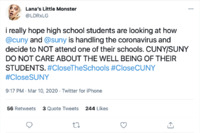 Tweet: CUNY/SUNY Pandemic Response & Student Wellbeing Posted on March 11, 2020, this tweet echoed related Twitter artifacts from this collection in scrutinizing the perceived lack of preparedness and administrative indifference of the City University of New York (CUNY) toward the health and safety of its student population. In its desire for "high school students" to be "looking" at how CUNY was dealing with COVID-19, the tweet also gestured toward a sense of posterity for the institutional landscape of public higher education. These locally situated perspectives on the university's response to the pandemic, in turn, reflected a longstanding, historically charged relationship between CUNY as an institution and the broader community of NYC citizens. This item is part of the City University of New York (CUNY) Distance Learning Archive, a group project developed as part of Prof. Matthew K. Gold's Spring 2020 Knowledge Infrastructures seminar in the Ph.D. Program in English at The Graduate Center, CUNY, in partnership with the Interactive Technology and Pedagogy Certificate Program. The project's goal was to resist or trouble the discourse of catastrophe around the shift to online learning caused by the COVID-19 pandemic by documenting the lived experiences of students, faculty, and staff across CUNY's 25 campuses. Further, the project wanted to document the moment of crisis response by taking a critical approach to educational technology.
 -
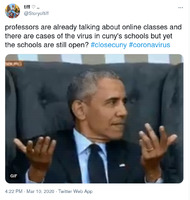 Tweet: School is still open? This tweet from a City University of New York (CUNY) student pointed out the discrepancy between faculty preparation for online teaching and the continued operation of CUNY campuses. As expressed in other tweets (see the series "Tweet: Lehman President Explanation"), many CUNY campuses were preparing for an online transition before the university's initial decision to close due to the Covid-19 pandemic. However, much of this preparation remained largely unofficial and not transparent to the CUNY student body. As demonstrated in this tweet, this apparent lack of communication created a sense of disconnect between CUNY students and administration, often expressed in a lighthearted fashion through memes. This item is part of the City University of New York (CUNY) Distance Learning Archive, a group project developed as part of Prof. Matthew K. Gold's Spring 2020 Knowledge Infrastructures seminar in the Ph.D. Program in English at The Graduate Center, CUNY, in partnership with the Interactive Technology and Pedagogy Certificate Program. The project's goal was to resist or trouble the discourse of catastrophe around the shift to online learning caused by the COVID-19 pandemic by documenting the lived experiences of students, faculty, and staff across CUNY's 25 campuses. Further, the project wanted to document the moment of crisis response by taking a critical approach to educational technology.
 -
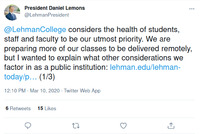 Tweet: Lehman President Explanation This series of tweets from the president of Lehman College, Daniel Lemons, provided an official response to demands for CUNY's closure, explaining that the logistics facing CUNY's transition to distance learning were markedly different from other institutions of higher education given its status as a public institution. Amidst many claims of institutional indifference, this artifact provided an official rationale for the perceived latency in CUNY's response to the pandemic, raising issues of equity and public duty within debates about health and economics. This item is part of the City University of New York (CUNY) Distance Learning Archive, a group project developed as part of Prof. Matthew K. Gold's Spring 2020 Knowledge Infrastructures seminar in the Ph.D. Program in English at The Graduate Center, CUNY, in partnership with the Interactive Technology and Pedagogy Certificate Program. The project's goal was to resist or trouble the discourse of catastrophe around the shift to online learning caused by the COVID-19 pandemic by documenting the lived experiences of students, faculty, and staff across CUNY's 25 campuses. Further, the project wanted to document the moment of crisis response by taking a critical approach to educational technology.
 -
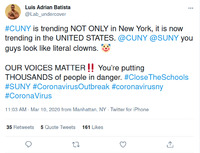 Tweet: #CloseCUNY Nationwide This tweet pointed out that the #CloseCUNY hashtag had received national circulation among Twitter's userbase during the early days of the pandemic. This hashtag expressed a growing desire for CUNY to cease in-person instruction, begun early in the pandemic, and became widely popular among the broader CUNY community. As its circulation suggested, the concerns raised in this tweet demonstrated CUNY's influence beyond simply the metropolitan area it inhabits geographically. This item is part of the City University of New York (CUNY) Distance Learning Archive, a group project developed as part of Prof. Matthew K. Gold's Spring 2020 Knowledge Infrastructures seminar in the Ph.D. Program in English at The Graduate Center, CUNY, in partnership with the Interactive Technology and Pedagogy Certificate Program. The project's goal was to resist or trouble the discourse of catastrophe around the shift to online learning caused by the COVID-19 pandemic by documenting the lived experiences of students, faculty, and staff across CUNY's 25 campuses. Further, the project wanted to document the moment of crisis response by taking a critical approach to educational technology.
 -
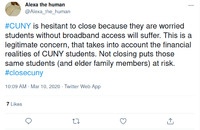 Tweet: Defense of CUNY by Student This tweet expressed a counter-narrative to the antagonism against City University of New York (CUNY) administration seen in other items in this collection, pointing out that the nature of CUNY's student body forced questions of equity to guide its decision to close the campuses while remaining open remotely. Though many artifacts in this collection underscore the expedited nature of the closing of private NYC institutions (see "Tweet: Student Complaint"), it is worth recalling that a large proportion of working-class and immigrant students who attend CUNY are reliant on its continued provision of a range of resources. Such artifacts demonstrated how the operation of CUNY is not simply a question of public health or economics but also of equity and accessibility. This item is part of the City University of New York (CUNY) Distance Learning Archive, a group project developed as part of Prof. Matthew K. Gold's Spring 2020 Knowledge Infrastructures seminar in the Ph.D. Program in English at The Graduate Center, CUNY, in partnership with the Interactive Technology and Pedagogy Certificate Program. The project's goal was to resist or trouble the discourse of catastrophe around the shift to online learning caused by the COVID-19 pandemic by documenting the lived experiences of students, faculty, and staff across CUNY's 25 campuses. Further, the project wanted to document the moment of crisis response by taking a critical approach to educational technology.
 -
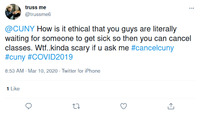 Tweet: Student Complaint This tweet questioned the ethical determination behind the City University of New York's (CUNY) continuance of in-person operations at the beginning of the pandemic. Like other artifacts in this section, this tweet expressed the broader CUNY community's perceptions of CUNY administration's reaction to the virus. Although some pointed out that concerns of equity drove CUNY's latency in closure (see "Tweet: Defense of CUNY by Student"), many saw such decisions as a question of gambling with the continued health of the community. This item is part of the City University of New York (CUNY) Distance Learning Archive, a group project developed as part of Prof. Matthew K. Gold's Spring 2020 Knowledge Infrastructures seminar in the Ph.D. Program in English at The Graduate Center, CUNY, in partnership with the Interactive Technology and Pedagogy Certificate Program. The project's goal was to resist or trouble the discourse of catastrophe around the shift to online learning caused by the COVID-19 pandemic by documenting the lived experiences of students, faculty, and staff across CUNY's 25 campuses. Further, the project wanted to document the moment of crisis response by taking a critical approach to educational technology.
 -
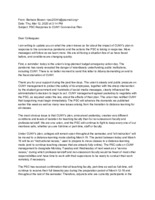 Professional Staff Congress (PSC) Response to CUNY Coronavirus Plan This March 2020 statement from the Professional Staff Congress (PSC) – the union representing 30,000 faculty, staff, and graduate students at the City University of New York (CUNY) – outlined the ambiguities in Chancellor Matos Rodriguez's declaration of "instructional recess" and brought to light several labor concerns that helped contextualize the pandemic. What about service staff during this period? How would hourly wages be determined? Who would be expected to be physically present on campuses? And what efforts were being made to convert CUNY into a safe place for face-to-face work? Through the points made in this email, one sees how the question of "learning" in the public university is never far removed from labor issues and how the concerns raised in the context of the pandemic must be considered within the long-ranging context of austerity shaped public education. This item is part of the City University of New York (CUNY) Distance Learning Archive, a group project developed as part of Prof. Matthew K. Gold's Spring 2020 Knowledge Infrastructures seminar in the Ph.D. Program in English at The Graduate Center, CUNY, in partnership with the Interactive Technology and Pedagogy Certificate Program. The project's goal was to resist or trouble the discourse of catastrophe around the shift to online learning caused by the COVID-19 pandemic by documenting the lived experiences of students, faculty, and staff across CUNY's 25 campuses. Further, the project wanted to document the moment of crisis response by taking a critical approach to educational technology.
 -
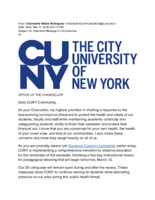 "An Important Message on Coronavirus" This email was from City University of New York (CUNY) Chancellor Félix V. Matos Rodriguez, was issued only a few hours after Gov. Cuomo's closure tweet. In this email, Chancellor Matos Rodriguez provided formal clarification regarding CUNY's transition to remote learning instigated by New York state, declaring an "instructional recess" of one week for CUNY faculty to transition their courses to online instruction. As well, the email listed resources and ongoing measures provided by CUNY administration. This item is part of the City University of New York (CUNY) Distance Learning Archive, a group project developed as part of Prof. Matthew K. Gold's Spring 2020 Knowledge Infrastructures seminar in the Ph.D. Program in English at The Graduate Center, CUNY, in partnership with the Interactive Technology and Pedagogy Certificate Program. The project's goal was to resist or trouble the discourse of catastrophe around the shift to online learning caused by the COVID-19 pandemic by documenting the lived experiences of students, faculty, and staff across CUNY's 25 campuses. Further, the project wanted to document the moment of crisis response by taking a critical approach to educational technology.
 -
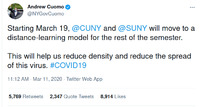 Cuomo's First Announcement Posted on March 11, 2020, this landmark tweet was the first official notice from Governor Andrew Cuomo and the State of New York that the City University of New York (CUNY) and the State University of New York (SUNY) would be transitioning to remote learning formats in response to the COVID-19 outbreak. While somewhat innocuous in an era marked by the merging of political proclamations and social media, readers should place themselves in the position of a member of the CUNY and SUNY community and imagine one's reaction to receiving notice of a life-changing decision in the form of an unceremonious Tweet. This item is part of the City University of New York (CUNY) Distance Learning Archive, a group project developed as part of Prof. Matthew K. Gold's Spring 2020 Knowledge Infrastructures seminar in the Ph.D. Program in English at The Graduate Center, CUNY, in partnership with the Interactive Technology and Pedagogy Certificate Program. The project's goal was to resist or trouble the discourse of catastrophe around the shift to online learning caused by the COVID-19 pandemic by documenting the lived experiences of students, faculty, and staff across CUNY's 25 campuses. Further, the project wanted to document the moment of crisis response by taking a critical approach to educational technology.
 -
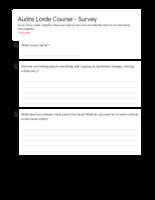 Initial Survey for Students Switching to Distance Learning The instructor in a seminar on the works of Audre Lorde distributed this copy of a survey from March 2020 during the instructional transition. Though simple in style (only seven questions/three pages in length), the form revealed what concerns motivated pedagogy during the transition. Rather than focusing primarily on technological needs and possibilities for instruction, the survey asked students about their personal experiences, dwelling on their emotional well-being and sense of satisfaction in the course. Such interactions highlight how some instructors focused distance learning around personal student outcomes. This item is part of the City University of New York (CUNY) Distance Learning Archive, a group project developed as part of Prof. Matthew K. Gold's Spring 2020 Knowledge Infrastructures seminar in the Ph.D. Program in English at The Graduate Center, CUNY, in partnership with the Interactive Technology and Pedagogy Certificate Program. The project's goal was to resist or trouble the discourse of catastrophe around the shift to online learning caused by the COVID-19 pandemic by documenting the lived experiences of students, faculty, and staff across CUNY's 25 campuses. Further, the project wanted to document the moment of crisis response by taking a critical approach to educational technology.
 -
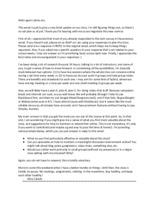 Email Chain with Students In this email exchange from early March 2020, an adjunct instructor discussed student needs and concerns with their Latinx Studies class regarding converting the course to an online format. These frank dialogues revealed how much course design relied upon student-instructor rapport. Through this artifact, we see the pertinent focuses of students and adjunct faculty at the onset of the switch to remote learning: compromises with technology platforms, desire for community, focuses on faculty communication. This item is part of the City University of New York (CUNY) Distance Learning Archive, a group project developed as part of Prof. Matthew K. Gold's Spring 2020 Knowledge Infrastructures seminar in the Ph.D. Program in English at The Graduate Center, CUNY, in partnership with the Interactive Technology and Pedagogy Certificate Program. The project's goal was to resist or trouble the discourse of catastrophe around the shift to online learning caused by the COVID-19 pandemic by documenting the lived experiences of students, faculty, and staff across CUNY's 25 campuses. Further, the project wanted to document the moment of crisis response by taking a critical approach to educational technology.
 -
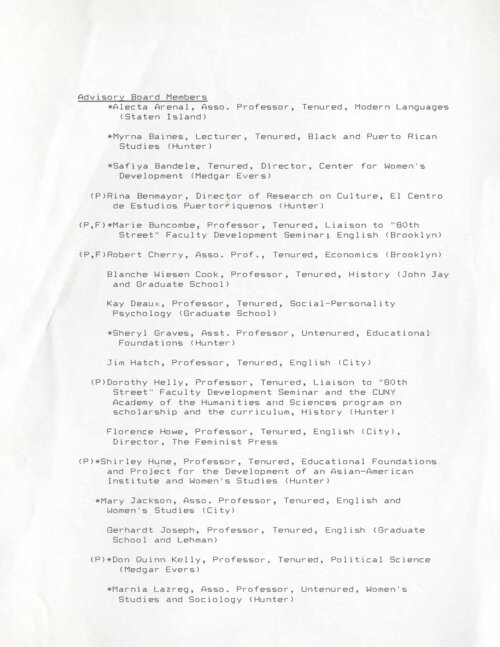 Advisory Board Meeting Agenda: Infusing Women of Color Material into CUNY Senior College Curriculum Dated March 23 and April 6, 1990, this agenda for the Advisory Board meeting for the Infusing Material on Women of Color into the Liberal Arts Curriculum of the City University of New York (CUNY) Senior Colleges served as a formal introduction to the project. It began with a list of CUNY board members from various women's, ethnic, minority studies programs. It included an overview of the project itself, the parameters set by the Ford Foundation, goals, strategies, and faculty development seminars. It then continued with a breakdown of the proposed curriculum seminars, the evaluation of the project, and the follow-up plans for disseminating information to the broader CUNY community. The Advisory Board also proposed discussing additional sources of support, the involvement of relevant programs and groups, and outlined the intended role of the Advisory Board and Procedures Committee.
 -
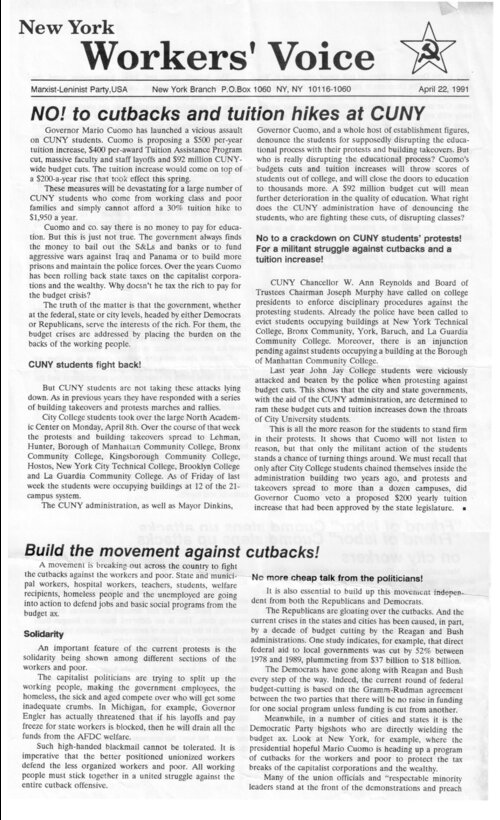 New York Workers Voice On April 22, 1991, Workers’ Voice, a Marxist newsletter, published a political analysis on the cutbacks and tuition hikes at the City University of New York (CUNY) and the solidarity movement built between the different sectors of “workers and poor.” In the article No! To cutbacks and tuition hikes at CUNY, the author argued that a militant struggle against cutbacks and a tuition increase was needed to reverse the tuition increases, budget cuts, and faculty layoffs. Subsequent articles discussed the importance of independent movement-building, taxing the rich, and the loyalty NY state and city politicians have to “business leaders.”
 -
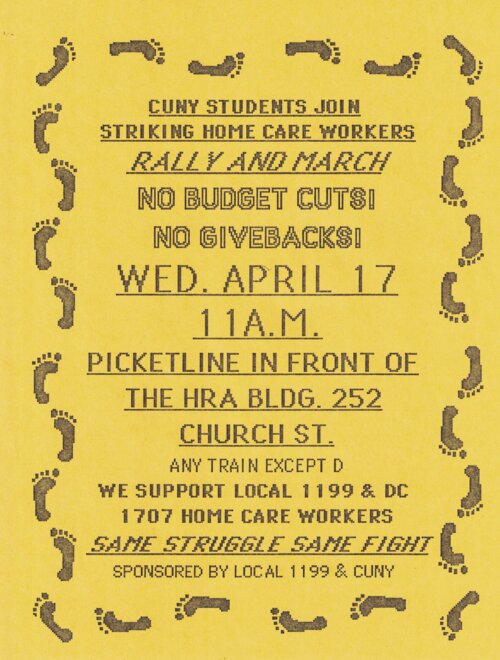 CUNY Students Join Striking Home Care Workers Flyer Sponsored by Local 1199 and CUNY strikers, this flyer promoted an April 17th rally and march in front of the Human Resources Administration (HRA) building. In solidarity with the workers of New York City, City University of New York (CUNY) students joined striking home care workers. "Same Struggle Same Fight"
 -
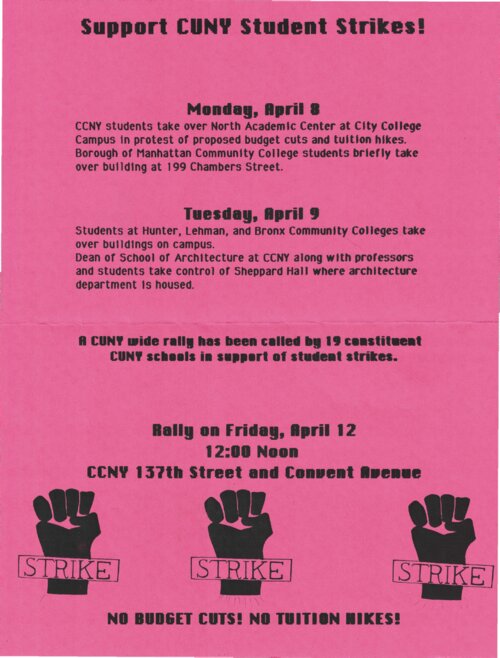 Support CUNY Student Strikes! “No Budget Cuts! No Tuition Hikes!” This 1991 flyer promoted a City University of New York (CUNY) wide rally on April 12th at City College of New York (CCNY). Chronicling April 8th’s CCNY and Borough of Manhattan student takeovers; and April 9th’s Hunter, Lehman and Bronx Community College subsequent takeovers, the flyer stated that the rally had been called by 19 constituent CUNY schools in support of student strikes.
 -
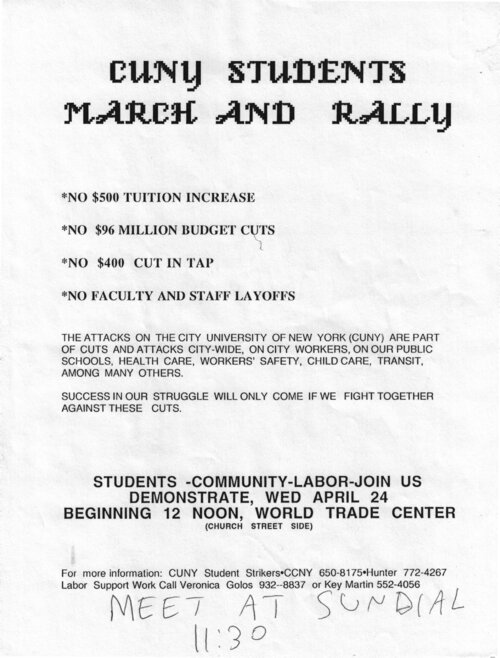 CUNY Students March and Rally This flyer promoted a city-wide protest scheduled for April 24, 1991, at the World Trade Center. Drawing connections between the struggles of students, community, and labor, this flyer stated, “success in our struggle will only come if we fight together against these cuts.”
 -
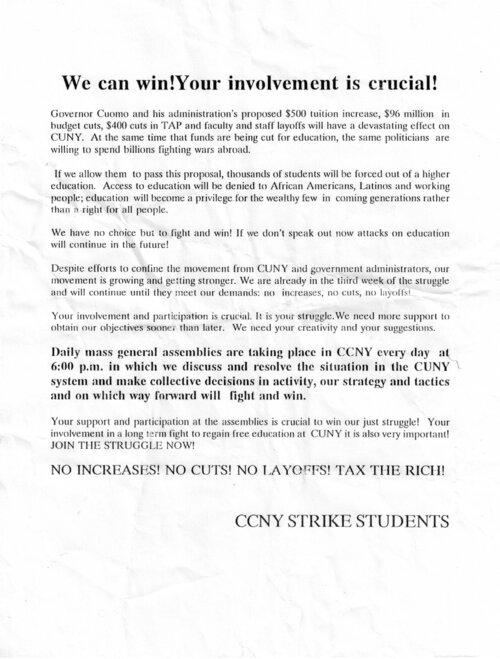 We Can Win! Your Involvement is Crucial! – CCNY Student Strikes Written three weeks into the City University of New York (CUNY) strikes of 1991, this flyer, signed CCNY STRIKE STUDENTS (City College of New York), urged students to support the movement and attend general assemblies. Daily mass general assemblies took place every day at 6 PM at CCNY, in which collective decisions in activity, strategy, and tactics were discussed. The flyer argued that if the tuition increased, budgets cut, and faculty layoffs were implemented, thousands of students would be forced out of higher education, and the attacks on education would continue.
176–200 of 1046