CLAGS
Item set
Collection
CLAGS
Time Periods
1978-1992 Retrenchment - Austerity - Tuition
1993-1999 End of Remediation and Open Admissions in Senior Colleges
2000-2010 Centralization of CUNY
2010-2020 From OWS to Covid-19
Items
1–25 of 34
Advanced search
-
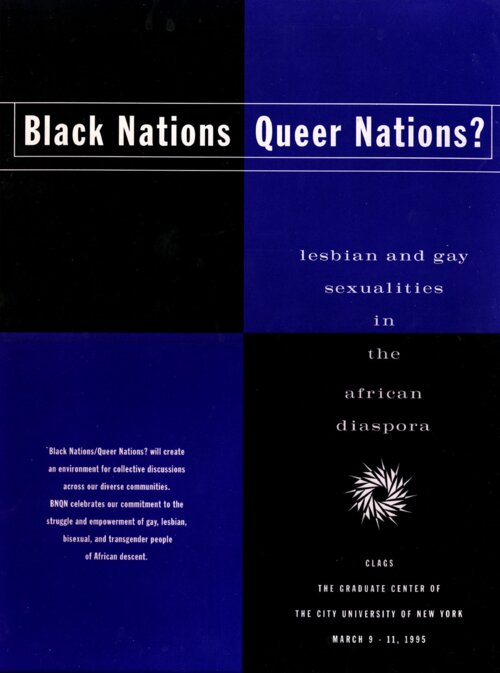 Black Nations/Queer Nations? Program This program was given to those in attendance of the Black Nations/Queer Nations? Conference held from March 9 to 11, 1995. The program provides descriptions of the conference’s many panels and workshops, including: seminars held by famed scholars such as Essex Hemphill, Barbara Smith, and M. Jacqui Alexander, as well as workshops on a variety of topics such as the dynamic interplay of Black and queer identities and the prevalence of homophobia among Black communities. Interspersed throughout the program are notable quotes by famed scholars and activists. Although formally instituted at the CUNY Graduate Center in 1991, CLAGS: The Center for LGBTQ Studies was first conceived 5 years earlier by Martin, Duberman, one of the first historians to embrace the, then infantile, field of Queer Studies. Duberman sensed the need for a formal center devoted to queer research. As the first university-based center for LGBTQ research, CLAGS continues to demonstrate its dedication to advancing Queer Studies, by hosting public events showcasing queer research and sponsoring fellowships to support queer scholars. Among its many notable contributions, CLAGS annually puts on at least one major conference and holds the Kessler Award Lecture every fall to celebrate a queer scholar who has made a notable contribution to the field of queer studies.
 -
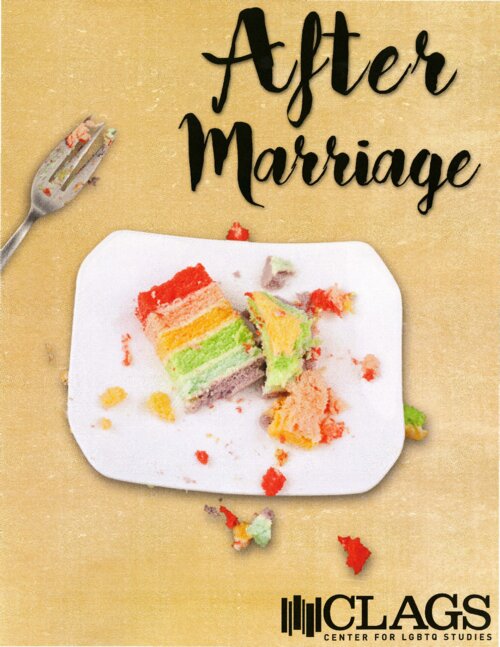 After Marriage Conference Program This program was given to those in attendance of CLAGS’ After Marriage conference, held at John Jay College of Criminal Justice on October 1 and 2, 2016. When the United States Supreme Court ruled on June 26, 2015, that same-sex marriage would become Federal law, it raised the question of what the future of queer studies would look like. In June of the following year, 49 people were killed in a mass shooting at Pulse, a gay nightclub in Orlando, Florida. These and many other events were at the heart of CLAGS’ conference. The conference brought together many notable queer scholars, such as Lisa Duggan and Heather Love. Topics of discussion included: “Queer Politics of Life and Death,” “Forms of Exclusion in Marriage Law,” “Policing Sex,” and “Queer Youth and Homelessness.” Although formally instituted at the CUNY Graduate Center in 1991, CLAGS: The Center for LGBTQ Studies was first conceived 5 years earlier by Martin, Duberman, one of the first historians to embrace the, then infantile, field of Queer Studies. Duberman sensed the need for a formal center devoted to queer research. As the first university-based center for LGBTQ research, CLAGS continues to demonstrate its dedication to advancing Queer Studies, by hosting public events showcasing queer research and sponsoring fellowships to support queer scholars. Among its many notable contributions, CLAGS annually puts on at least one major conference and holds the Kessler Award Lecture every fall to celebrate a queer scholar who has made a notable contribution to the field of queer studies.
 -
 Gay American History @40 Conference Poster This poster advertises the Gay American History @40 conference, which was held at the Theresa Lang Center of the New School from May 4th to 6th, 2016. The event, which was co-sponsored by CLAGS as well as ARCUS, the Digital Humanities Initiative, Historical Studies and Gender Studies at the New School, was held to honor the 40th anniversary of Jonathan Ned Katz’s foundational book Gay American History: Lesbians and Gay Men in the U.S.A. The conference brought together scholars and activists from across the globe for a number of different talks and events, including a keynote speech delivered by Susan Stryker. Although formally instituted at the CUNY Graduate Center in 1991, CLAGS: The Center for LGBTQ Studies was first conceived 5 years earlier by Martin, Duberman, one of the first historians to embrace the, then infantile, field of Queer Studies. Duberman sensed the need for a formal center devoted to queer research. As the first university-based center for LGBTQ research, CLAGS continues to demonstrate its dedication to advancing Queer Studies, by hosting public events showcasing queer research and sponsoring fellowships to support queer scholars. Among its many notable contributions, CLAGS annually puts on at least one major conference and holds the Kessler Award Lecture every fall to celebrate a queer scholar who has made a notable contribution to the field of queer studies.
 -
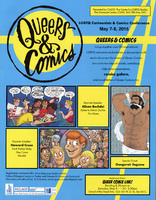 Queers and Comics Poster This poster advertises the Queers and Comics conference that was held by CLAGS at the CUNY Graduate Center on May 7th and 8th, 2015. Bringing together over 100 queer comic book artists and scholars from around the globe, the conference included panels, workshops, presentations and displays of queer comic book art. Topics of discussion included “Queers in Other Worlds,” “Queers Working in Mainstream Comics,” and “Queer Memoir.” The Keynote speakers were Howard Cruse, whose comic Wendel is widely considered to be the first gay comic strip to appear in mainstream media, and Alyson Bechdel, who was well known for her early representation of lesbian life in her comic strip Dykes to Watch Out For and who achieved mainstream fame when her graphic memoir Fun Home was turned into a Tony award-winning Broadway musical. A second Queers and Comics event was held by the California College of the Arts in 2017. Although formally instituted at the CUNY Graduate Center in 1991, CLAGS: The Center for LGBTQ Studies was first conceived 5 years earlier by Martin, Duberman, one of the first historians to embrace the, then infantile, field of Queer Studies. Duberman sensed the need for a formal center devoted to queer research. As the first university-based center for LGBTQ research, CLAGS continues to demonstrate its dedication to advancing Queer Studies, by hosting public events showcasing queer research and sponsoring fellowships to support queer scholars. Among its many notable contributions, CLAGS annually puts on at least one major conference and holds the Kessler Award Lecture every fall to celebrate a queer scholar who has made a notable contribution to the field of queer studies.
 -
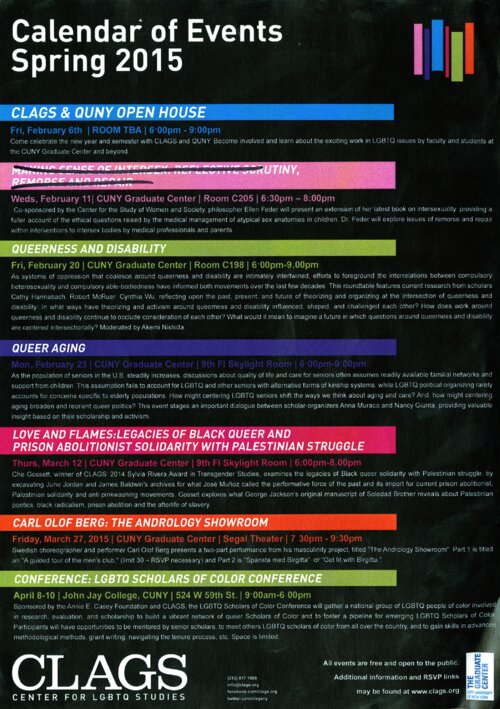 Spring 2015 Calendar of Events This item shows the events sponsored by CLAGS during the Spring 2015 semester. The diversity and range of events throughout the semester, including topics such as an intersectional look at queerness and disability and Swedish choreographer Carl Olof Berg’s two-part performance on masculinity, demonstrates CLAGS’ commitment to all forms of queer studies and in particular new developments to the field. Every spring CLAGS also helps sponsor the Rainbow Book Fair as well as at least one conference. For 2015, CLAGS helped to sponsor: the LGBTQ Scholars of Color Conference, the 2015 LGBT Health Conference, and Queers & Comics. Although formally instituted at the CUNY Graduate Center in 1991, CLAGS: The Center for LGBTQ Studies was first conceived 5 years earlier by Martin, Duberman, one of the first historians to embrace the, then infantile, field of Queer Studies. Duberman sensed the need for a formal center devoted to queer research. As the first university-based center for LGBTQ research, CLAGS continues to demonstrate its dedication to advancing Queer Studies, by hosting public events showcasing queer research and sponsoring fellowships to support queer scholars. Among its many notable contributions, CLAGS annually puts on at least one major conference and holds the Kessler Award Lecture every fall to celebrate a queer scholar who has made a notable contribution to the field of queer studies.
 -
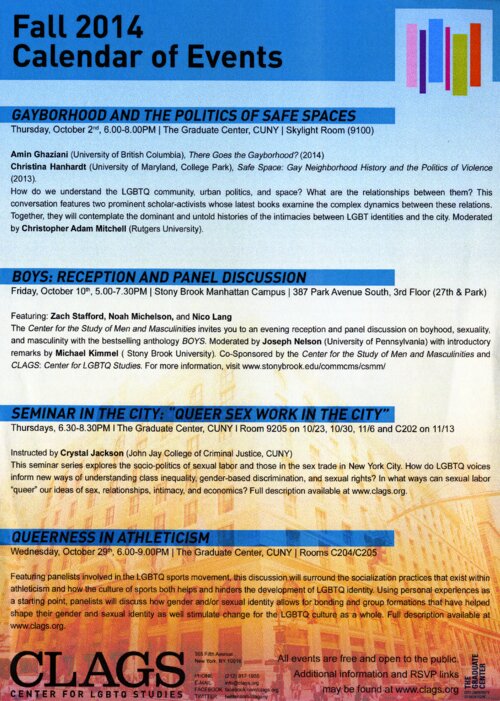 Fall 2014 Calendar of Events This item features the events sponsored by CLAGS during the Fall 2014 semester. The diversity and range of events throughout the semester, including topics such as a panel on sports culture and queerness, discussions of safe spaces, and the launch of the LGBTQ Scholars of Color Network, demonstrates CLAGS’ commitment to all forms of queer studies and in particular new developments in the field. All of these events, with the exception of “Boys: Reception and Panel Discussion,” were held on CUNY campuses. The most significant of these was the annual Kessler Lecture, awarded each year to a queer scholar believed to have made significant contributions to the field. Although formally instituted at the CUNY Graduate Center in 1991, CLAGS: The Center for LGBTQ Studies was first conceived 5 years earlier by Martin, Duberman, one of the first historians to embrace the, then infantile, field of Queer Studies. Duberman sensed the need for a formal center devoted to queer research. As the first university-based center for LGBTQ research, CLAGS continues to demonstrate its dedication to advancing Queer Studies, by hosting public events showcasing queer research and sponsoring fellowships to support queer scholars. Among its many notable contributions, CLAGS annually puts on at least one major conference and holds the Kessler Award Lecture every fall to celebrate a queer scholar who has made a notable contribution to the field of queer studies.
 -
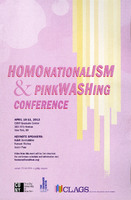 Homonationalism and Pinkwashing Poster This poster advertises the Homonationalism & Pinkwashing Conference that was held by CLAGS at the CUNY Graduate Center on April 10th and 11th, 2013. The conference addressed the way in which some groups use a focus pro-queer arguments as a means of masking or detracting from xenophobia and Islamophobia. The idea of homonationalism, as first introduced by Jasbir Puar in her 2007 book Terrorist Assemblages, is especially relevant in discussions of the Israel-Palestine Conflict. Puar, who delivered the keynote address at this conference, received a great deal of criticism for these concepts which remain controversial. This is just one of many examples that show CLAGS’ commitment to addressing emerging theories in queer studies. The conference was sold out six months early. Although formally instituted at the CUNY Graduate Center in 1991, CLAGS: The Center for LGBTQ Studies was first conceived 5 years earlier by Martin, Duberman, one of the first historians to embrace the, then infantile, field of Queer Studies. Duberman sensed the need for a formal center devoted to queer research. As the first university-based center for LGBTQ research, CLAGS continues to demonstrate its dedication to advancing Queer Studies, by hosting public events showcasing queer research and sponsoring fellowships to support queer scholars. Among its many notable contributions, CLAGS annually puts on at least one major conference and holds the Kessler Award Lecture every fall to celebrate a queer scholar who has made a notable contribution to the field of queer studies
 -
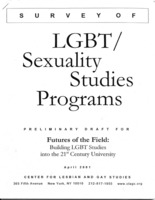 Survey of LGBT Studies Programs This survey was created in 2001 by CLAGS as an attempt to compile a comprehensive list of universities, primarily located in the United States that offered programs in LGBT studies. Under the direction of CLAGS executive directory Alisa Solomon, Paisley Currah and Jill Dolan, both of whom also served as executive directors of CLAGS, spearheaded this project. The survey was conducted as part of the preparation for the Futures of the Field: Building LGBT Studies into the 21st Century University conference held by CLAGS on April 20 and 21, 2001. Although incomplete, the survey includes information on 28 different programs. Since the survey was conducted, many more colleges have begun to offer queer studies. Although formally instituted at the CUNY Graduate Center in 1991, CLAGS: The Center for LGBTQ Studies was first conceived 5 years earlier by Martin, Duberman, one of the first historians to embrace the, then infantile, field of Queer Studies. Duberman sensed the need for a formal center devoted to queer research. As the first university-based center for LGBTQ research, CLAGS continues to demonstrate its dedication to advancing Queer Studies, by hosting public events showcasing queer research and sponsoring fellowships to support queer scholars. Among its many notable contributions, CLAGS annually puts on at least one major conference and holds the Kessler Award Lecture every fall to celebrate a queer scholar who has made a notable contribution to the field of queer studies.
 -
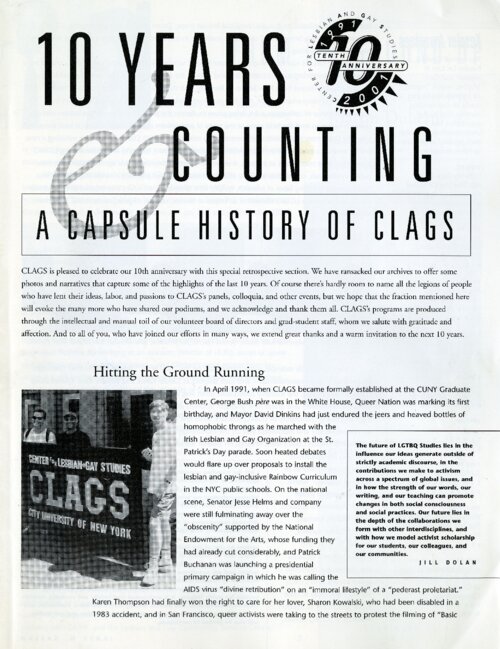 CLAGS Newsletter: 10 Year Anniversary This special edition of the CLAGS newsletter, sent to members in 2001, celebrates the 10 year anniversary of the organization as well as the progress that the center has made. The newsletter places the history of CLAGS in the context of the sociopolitical history of America as a whole. It also contains an interview with founding executive director Martin Duberman, which discusses the events leading up to the formation of CLAGS and its institutionalization at the CUNY Graduate Center. Although formally instituted at the CUNY Graduate Center in 1991, CLAGS: The Center for LGBTQ Studies was first conceived 5 years earlier by Martin, Duberman, one of the first historians to embrace the, then infantile, field of Queer Studies. Duberman sensed the need for a formal center devoted to queer research. As the first university-based center for LGBTQ research, CLAGS continues to demonstrate its dedication to advancing Queer Studies, by hosting public events showcasing queer research and sponsoring fellowships to support queer scholars. Among its many notable contributions, CLAGS annually puts on at least one major conference and holds the Kessler Award Lecture every fall to celebrate a queer scholar who has made a notable contribution to the field of queer studies.
 -
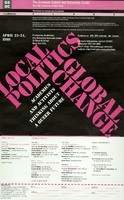 Queer Futures: Local Politics Global Change Conference Poster This poster promotes the Local Politics Global Change conference which was held on April 23rd and 24th, 1999 under the sponsorship of CLAGS and the NYU Faculty Working Group on Queer Studies. The central aim of the conference was to explore the possibilities of a queer future as imagined by academics and activists. As part of the conference, Barbara Smith, lesbian and black feminist scholar known for her work with the Combahee River Collective and the founder of Kitchen Table: Women of Color Press, presented on issues of queer politics. José Muñoz presented on Violence and Policing. A decade later, Muñoz went on to publish Cruising Utopia, a critical look at modern queer movements and a call for queer activism beyond assimilationist issues such as marriage equality. Although formally instituted at the CUNY Graduate Center in 1991, CLAGS: The Center for LGBTQ Studies was first conceived 5 years earlier by Martin, Duberman, one of the first historians to embrace the, then infantile, field of Queer Studies. Duberman sensed the need for a formal center devoted to queer research. As the first university-based center for LGBTQ research, CLAGS continues to demonstrate its dedication to advancing Queer Studies, by hosting public events showcasing queer research and sponsoring fellowships to support queer scholars. Among its many notable contributions, CLAGS annually puts on at least one major conference and holds the Kessler Award Lecture every fall to celebrate a queer scholar who has made a notable contribution to the field of queer studies.
 -
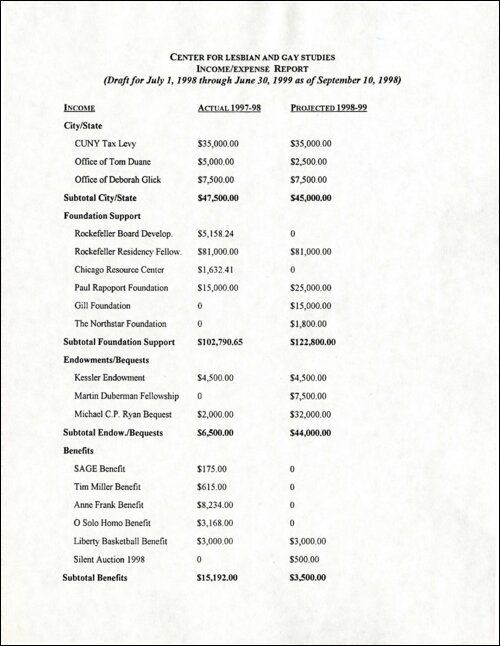 1998 Financial Report This draft of the Income/Expense Report for CLAGS from July 1, 1998, to June 30th, 1999 outlines CLAGS' financial situation over the course of a year. This document is useful in shedding light on the way that the Center operates. As the document shows, CLAGS primary income stems from foundation support and donations. The expense portion of the report highlights the various tasks performed by CLAGS including programming, advocacy, and fellowship. Every year, CLAGS provides financial support to burgeoning queer scholars. Although formally instituted at the CUNY Graduate Center in 1991, CLAGS: The Center for LGBTQ Studies was first conceived 5 years earlier by Martin, Duberman, one of the first historians to embrace the, then infantile, field of Queer Studies. Duberman sensed the need for a formal center devoted to queer research. As the first university-based center for LGBTQ research, CLAGS continues to demonstrate its dedication to advancing Queer Studies, by hosting public events showcasing queer research and sponsoring fellowships to support queer scholars. Among its many notable contributions, CLAGS annually puts on at least one major conference and holds the Kessler Award Lecture every fall to celebrate a queer scholar who has made a notable contribution to the field of queer studies.
 -
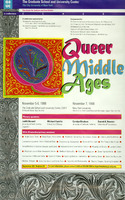 Queer Middle Ages Poster This poster advertises the Queer Middle Ages conference, which was held by CLAGS on November 5th and 6th 1998 at the CUNY Graduate Center and on November 7th, 1998 at New York University. The conference was one of the first to address the growing interest in gender and sexuality in the Middle Ages on such a large scale, with over 150 individuals in attendance. Twenty-five distinct sessions were held over the course of the three-day conference, covering a large variety of topics such as “Queering Medieval Institutions,” “Medieval Jewish Homoerotic Desire,” “Queering Queer” and “Same-Sex Desire and Medieval Religion.” Carolyn Dinshaw, one of the conferences four plenary speakers, has become one of the leading experts in this field. Although formally instituted at the CUNY Graduate Center in 1991, CLAGS: The Center for LGBTQ Studies was first conceived 5 years earlier by Martin, Duberman, one of the first historians to embrace the, then infantile, field of Queer Studies. Duberman sensed the need for a formal center devoted to queer research. As the first university-based center for LGBTQ research, CLAGS continues to demonstrate its dedication to advancing Queer Studies, by hosting public events showcasing queer research and sponsoring fellowships to support queer scholars. Among its many notable contributions, CLAGS annually puts on at least one major conference and holds the Kessler Award Lecture every fall to celebrate a queer scholar who has made a notable contribution to the field of queer studies.
 -
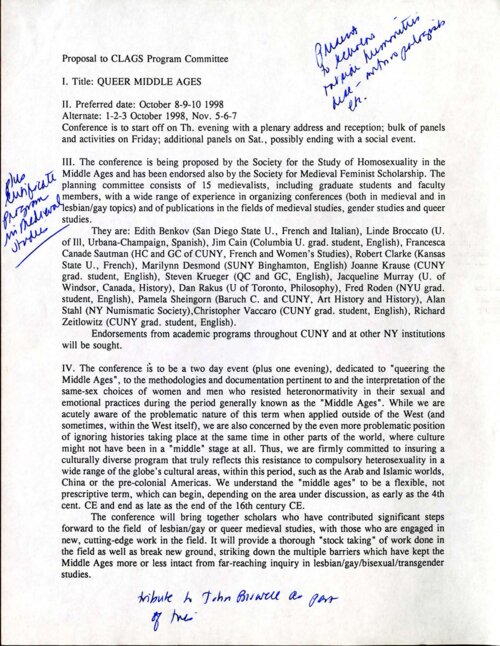 Queer Middle Ages Conference Proposal This proposal was written in advance of CLAGS’ Queer Middle Ages conference that was held on November 5-7, 1998. The conference was created by a panel of 15 graduate students and faculty. Perhaps the most notable of whom was Steven Kreuger, a leading Queer Medievalist who teaches in the English Department at Queens College as well as the Graduate Center. This hugely successful conference, held in co-sponsorship with New York University, was the first large-scale conference to focus on the growing academic field of queering the Middle Ages. Although formally instituted at the CUNY Graduate Center in 1991, CLAGS: The Center for LGBTQ Studies was first conceived 5 years earlier by Martin, Duberman, one of the first historians to embrace the, then infantile, field of Queer Studies. Duberman sensed the need for a formal center devoted to queer research. As the first university-based center for LGBTQ research, CLAGS continues to demonstrate its dedication to advancing Queer Studies, by hosting public events showcasing queer research and providing fellowships to support queer scholars. Among its many notable contributions, CLAGS annually puts on at least one major conference and holds the Kessler Award Lecture every fall to celebrate a queer scholar who has made a notable contribution to the field of queer studies.
 -
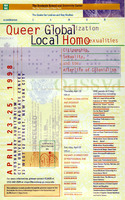 Queer Globalization/Local Homosexualities conference This poster advertises CLAGS’ Queer Globalization/Local Homosexualities conference, which was held from April 23rd to 25th, 1998 at the CUNY Graduate Center. This groundbreaking conference brought together scholars and activists from around the globe who were working at the confluence of post-colonial and queer studies. The conference, consisting of twenty distinct panels, addressed issues such as the influence of American imperialism on the global field of queer studies and the significance of queer diasporic identity. It was the first in a series of conferences held by CLAGS that was made possible through Rockefeller Foundation.'s sponsorship. Roughly 300 scholars attended this three-day conference. Although formally instituted at the CUNY Graduate Center in 1991, CLAGS: The Center for LGBTQ Studies was first conceived 5 years earlier by Martin, Duberman, one of the first historians to embrace the, then infantile, field of Queer Studies. Duberman sensed the need for a formal center devoted to queer research. As the first university-based center for LGBTQ research, CLAGS continues to demonstrate its dedication to advancing Queer Studies, by hosting public events showcasing queer research and sponsoring fellowships to support queer scholars. Among its many notable contributions, CLAGS annually puts on at least one major conference and holds the Kessler Award Lecture every fall to celebrate a queer scholar who has made a notable contribution to the field of queer studies.
 -
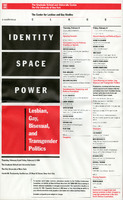 Identity Space Power This poster promotes the Identity Space Power conference that was held by CLAGS on February 8th and 9th, 1996. The conference discussed political issues related to the queer community including how to create a political agenda, how to organize, and the role of sexual identity within the political space. Among the many distinguished speakers at the conference was Cathy Cohen whose essay “Punks, Bulldaggers, and Welfare Queens” explored queer politics, and writer and activist Larry Kramer, whose largely autobiographical play The Normal Heart was recently turned into an HBO movie by Ryan Murphy. Although formally instituted at the CUNY Graduate Center in 1991, CLAGS: The Center for LGBTQ Studies was first conceived 5 years earlier by Martin, Duberman, one of the first historians to embrace the, then infantile, field of Queer Studies. Duberman sensed the need for a formal center devoted to queer research. As the first university-based center for LGBTQ research, CLAGS continues to demonstrate its dedication to advancing Queer Studies, by hosting public events showcasing queer research and sponsoring fellowships to support queer scholars. Among its many notable contributions, CLAGS annually puts on at least one major conference and holds the Kessler Award Lecture every fall to celebrate a queer scholar who has made a notable contribution to the field of queer studies.
 -
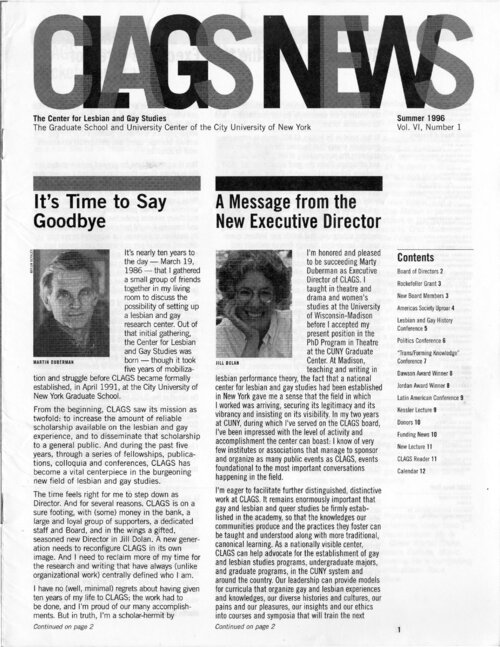 CLAGS NEWS This newsletter, dated Summer 1996, was sent to the members of CLAGS to keep them abreast of information regarding the center, including changes to the board, current news, and upcoming events. This particular issue of the newsletter is significant for two reasons. First, it contains the farewell address of CLAGS’ founder and original executive director Martin Duberman, the driving force of CLAGS from the center’s inception. A second notable article, “Uproar at Americas Society Conference,” highlights the homophobia that CLAGS was facing at the time. While CLAGS had initially helped in the planning of the Margin/Center Conference that was held at Americas Society on March 21st and 22nd 1996, the Americas Society decided to censor CLAGS’ involvement and remove the center as a co-sponsor. This issue of censorship ultimately became a focal discussion at the conference itself, but this did little to convince the Americas Society to apologize for their homophobic sleight. Although formally instituted at the CUNY Graduate Center in 1991, CLAGS: The Center for LGBTQ Studies was first conceived 5 years earlier by Martin, Duberman, one of the first historians to embrace the, then infantile, field of Queer Studies. Duberman sensed the need for a formal center devoted to queer research. As the first university-based center for LGBTQ research, CLAGS continues to demonstrate its dedication to advancing Queer Studies, by hosting public events showcasing queer research and sponsoring fellowships to support queer scholars. Among its many notable contributions, CLAGS annually puts on at least one major conference and holds the Kessler Award Lecture every fall to celebrate a queer scholar who has made a notable contribution to the field of queer studies.
 -
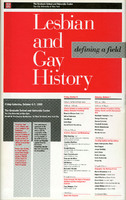 Lesbian and Gay History: Defining a Field This poster promotes a conference entitled Lesbian and Gay History: Defining a Field, which was held by CLAGS in association with the Doctoral Program in History at the CUNY Graduate Center on October 6th and 7th, 1995. As the name suggests, this conference took on the task of helping to shape the still-developing field of lesbian and gay history. Topics of discussion included the role and importance of archives, how to teach lesbian and gay history, and a number of biographies of queer individuals. Among the speakers were George Chauncey, whose book Gay New York offers an in-depth look at New York City’s queer communities from 1890-1940 and Polly Thistlethwaite, an archivist, who has worked in the library at the CUNY Graduate Center since 2002 and became Chief Librarian in 2011. Although formally instituted at the CUNY Graduate Center in 1991, CLAGS: The Center for LGBTQ Studies was first conceived 5 years earlier by Martin, Duberman, one of the first historians to embrace the, then infantile, field of Queer Studies. Duberman sensed the need for a formal center devoted to queer research. As the first university-based center for LGBTQ research, CLAGS continues to demonstrate its dedication to advancing Queer Studies, by hosting public events showcasing queer research and sponsoring fellowships to support queer scholars. Among its many notable contributions, CLAGS annually puts on at least one major conference and holds the Kessler Award Lecture every fall to celebrate a queer scholar who has made a notable contribution to the field of queer studies.
1–25 of 34