CLAGS
Item set
Collection
CLAGS
Time Periods
1978-1992 Retrenchment - Austerity - Tuition
1993-1999 End of Remediation and Open Admissions in Senior Colleges
2000-2010 Centralization of CUNY
2010-2020 From OWS to Covid-19
Items
26–34 of 34
Advanced search
-
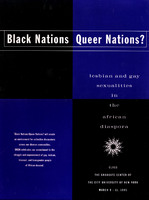 Black Nations/Queer Nations? Poster This poster promotes one of the early conferences sponsored by CLAGS, Black Nations/Queer Nations?. The conference was held at the CUNY Graduate Center over the course of three days from March 9th to 11th, 1995. This conference was among the first large-scale events to use an intersectional approach and look at "queerness" and "blackness" together, to discuss the unique experiences of queer individuals of African descent. The conference brought together famed scholars such as Essex Hemphill, Barbara Smith, and Jacqui Alexander to hold seminars and workshops on a variety of topics such as the dynamic interplay of black and queer identities and the prevalence of homophobia among Black communities. Although formally instituted at the CUNY Graduate Center in 1991, CLAGS: The Center for LGBTQ Studies was first conceived 5 years earlier by Martin, Duberman, one of the first historians to embrace the, then infantile, field of Queer Studies. Duberman sensed the need for a formal center devoted to queer research. As the first university-based center for LGBTQ research, CLAGS continues to demonstrate its dedication to advancing Queer Studies, by hosting public events showcasing queer research and sponsoring fellowships to support queer scholars. Among its many notable contributions, CLAGS annually puts on at least one major conference and holds the Kessler Award Lecture every fall to celebrate a queer scholar who has made a notable contribution to the field of queer studies.
 -
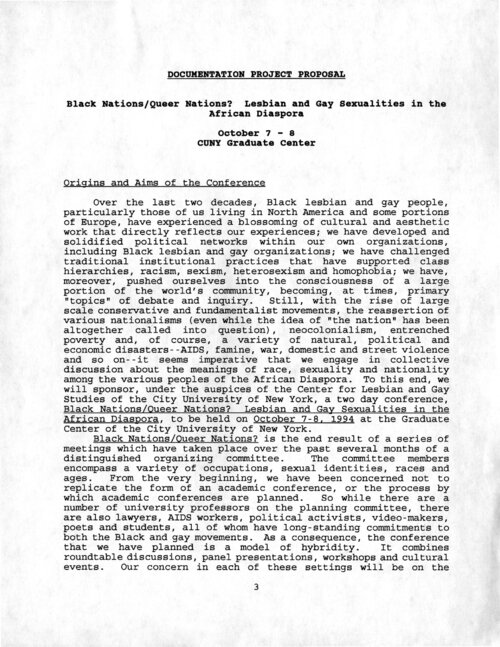 Black Nations/Queer Nations? Proposal This draft of a proposal for the Black Nations/Queer Nations? (BNQN) conference highlights the importance of having such a conference as well as the way that the event was conceived of early on. According to the proposal, BNQN was the result of several meetings of an organizing committee comprised of individuals of various backgrounds, resulting in a highly diverse conference. Leading the committee was M. Jacqui Alexander, one of the leading scholars of transnational feminism. As stated in the proposal, the aims of the conference were to propose questions such as “What is the relationship between anti-racist, anti-sexist, anti-colonialist and anti-heterosexist political struggles?” and “Is a global political movement among lesbian and gay men in the African Diaspora possible or desirable?” While the conference was originally planned for October 1994, due to unforeseen complications, it was not held until March of the following year. Although formally instituted at the CUNY Graduate Center in 1991, CLAGS: The Center for LGBTQ Studies was first conceived 5 years earlier by Martin, Duberman, one of the first historians to embrace the, then infantile, field of Queer Studies. Duberman sensed the need for a formal center devoted to queer research. As the first university-based center for LGBTQ research, CLAGS continues to demonstrate its dedication to advancing Queer Studies, by hosting public events showcasing queer research and sponsoring fellowships to support queer scholars. Among its many notable contributions, CLAGS annually puts on at least one major conference and holds the Kessler Award Lecture every fall to celebrate a queer scholar who has made a notable contribution to the field of queer studies.
 -
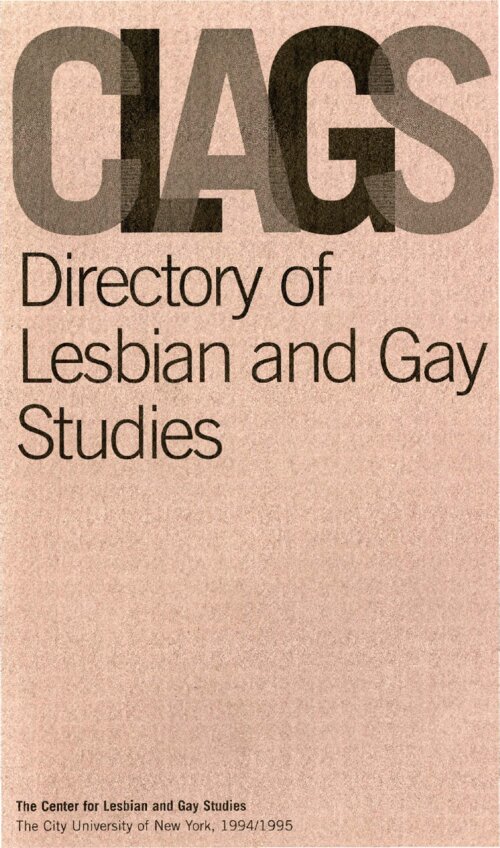 CLAGS Directory of Lesbian and Gay Studies “We believe this directory will prove an important tool for facilitating communication between scholars already working in the field or hoping to enter it. And that, in turn, will help to guarantee the secure place of lesbian and gay studies in academic life–and in the consciousness of the country at large.” – Martin Duberman July 1994 This item is an excerpt from the CLAGS Directory of Lesbian and Gay Studies. Produced by CLAGS, this directory was an attempt to create a comprehensive list of all scholars actively working within the burgeoning field of gay and lesbian studies. In this early era of the Internet, this directory, the first of its kind offered a way for lesbian and gay scholars to learn about and contact one another. In this excerpt, roughly 600 scholars are organized by academic discipline. Other sections of the directory organize the scholars by institution and offer a more comprehensive look at the research of the individual scholars. Although formally instituted at the CUNY Graduate Center in 1991, CLAGS: The Center for LGBTQ Studies was first conceived 5 years earlier by Martin, Duberman, one of the first historians to embrace the, then infantile, field of Queer Studies. Duberman sensed the need for a formal center devoted to queer research. As the first university-based center for LGBTQ research, CLAGS continues to demonstrate its dedication to advancing Queer Studies, by hosting public events showcasing queer research and sponsoring fellowships to support queer scholars. Among its many notable contributions, CLAGS annually puts on at least one major conference and holds the Kessler Award Lecture every fall to celebrate a queer scholar who has made a notable contribution to the field of queer studies.
 -
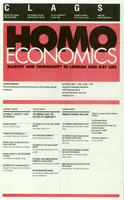 Homo Economics This poster advertises Homo Economics: Market and Community in Lesbian and Gay Life, a conference sponsored by CLAGS and held on May 7th, 1994. Like many other CLAGS events, Homo Economics was groundbreaking in that it was the first ever conference to address the unique economic circumstances faced by lesbian and gay individuals. Participants in the conference came from a number of different backgrounds, including professors, cooperate executives fundraising consultants, the National Gay and Lesbian Task Force, and the Gay Men’s Health Crisis. Some of the topics discussed include explorations of the economic effects of HIV, various conversations concerning “the gay market,” and the lived experiences of gay and lesbian professionals. Although formally instituted at the CUNY Graduate Center in 1991, CLAGS: The Center for LGBTQ Studies was first conceived 5 years earlier by Martin, Duberman, one of the first historians to embrace the, then infantile, field of Queer Studies. Duberman sensed the need for a formal center devoted to queer research. As the first university-based center for LGBTQ research, CLAGS continues to demonstrate its dedication to advancing Queer Studies, by hosting public events showcasing queer research and sponsoring fellowships to support queer scholars. Among its many notable contributions, CLAGS annually puts on at least one major conference and holds the Kessler Award Lecture every fall to celebrate a queer scholar who has made a notable contribution to the field of queer studies.
 -
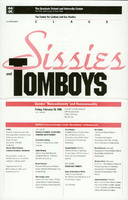 Sissies and Tomboys This poster advertises Sissies and Tomboys, CLAGS’ one-day conference, which was held at the CUNY Graduate Center on February 10th, 1995. The conference explored the relationship between homosexuality and gender “nonconformity,” how and why queer individuals are more likely to defy stereotypical masculine/feminine gender expressions. Among the conference’s speakers were Leslie Feinberg, whose 1996 book, Transgender Warriors: A History of Resistance was one of the first texts to bring transgender awareness and Gender Studies into the mainstream, and Anne Fausto-Sterling, whose work on the biology of gender is still widely taught in queer and feminist theory classes today. Although formally instituted at the CUNY Graduate Center in 1991, CLAGS: The Center for LGBTQ Studies was first conceived 5 years earlier by Martin, Duberman, one of the first historians to embrace the, then infantile, field of Queer Studies. Duberman sensed the need for a formal center devoted to queer research. As the first university-based center for LGBTQ research, CLAGS continues to demonstrate its dedication to advancing Queer Studies, by hosting public events showcasing queer research and sponsoring fellowships to support queer scholars. Among its many notable contributions, CLAGS annually puts on at least one major conference and holds the Kessler Award Lecture every fall to celebrate a queer scholar who has made a notable contribution to the field of queer studies.
 -
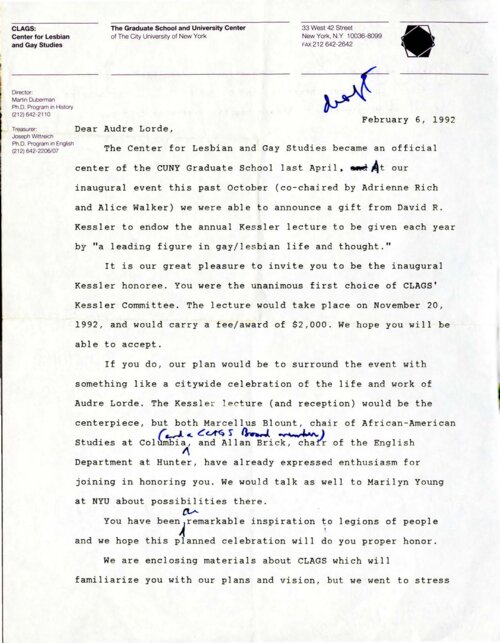 Letter to Audre Lorde The letter dated February 6, 1992, from CLAGS is addressed to Audre Lorde and invites her to be the first recipient of CLAGS’ annual Kessler award. The Kessler award, given by CLAGS each year since its sophomore year in 1992, was created with an endowment by Doctor David R. Kessler to award “a leading figure in gay/lesbian life and thought.” The recipient of the Kessler award is invited to give a lecture. Audre Lorde was a much celebrated black, lesbian, and feminist icon, who taught at multiple CUNY colleges throughout the 1970s and 1980s. She helped to create John Jay’s Black studies department and went on to become the distinguished Thomas Hunter chair at Hunter College. While it is unclear if any version of this draft was ever sent, the first Kessler award was ultimately awarded to Joan Nestle. Lorde passed away from breast cancer on November 17, 1992, just three days before the Kessler award ceremony had been scheduled. Although formally instituted at the CUNY Graduate Center in 1991, CLAGS: The Center for LGBTQ Studies was first conceived 5 years earlier by Martin, Duberman, one of the first historians to embrace the, then infantile, field of Queer Studies. Duberman sensed the need for a formal center devoted to queer research. As the first university-based center for LGBTQ research, CLAGS continues to demonstrate its dedication to advancing Queer Studies, by hosting public events showcasing queer research and sponsoring fellowships to support queer scholars. Among its many notable contributions, CLAGS annually puts on at least one major conference and holds the Kessler Award Lecture every fall to celebrate a queer scholar who has made a notable contribution to the field of queer studies.
 -
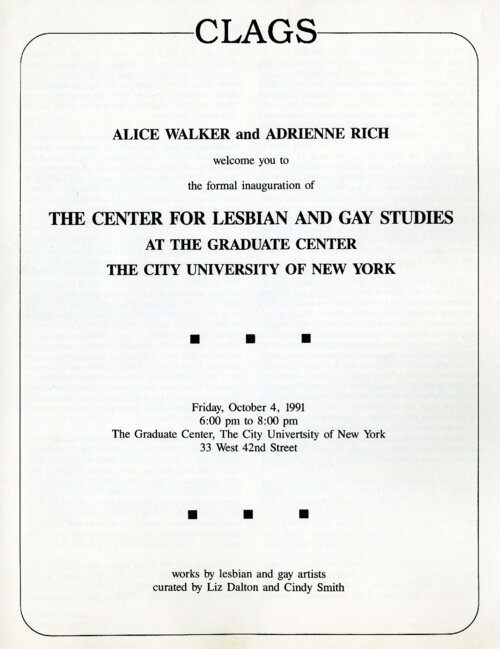 CLAGS Inauguration Event Program This program was given to those who attended CLAGS inaugural event at the CUNY Graduate Center, which was held on Friday, October 4, 1991. Hosted by esteemed queer and feminist scholars, Alice Walker and Adrienne Rich, the celebration doubled as an art exhibition, All Grown Up, curated by Liz Dalton and Cindy Smith, who included an exhibition text in the program. The exhibition featured various forms of artwork by lesbian and gay artists and raised questions around what a lesbian and gay art show should look like — questions strikingly similar to those that were being asked by CLAGS' founding members. Although formally instituted at the CUNY Graduate Center in 1991, CLAGS: The Center for LGBTQ Studies was first conceived 5 years earlier by Martin, Duberman, one of the first historians to embrace the, then infantile, field of Queer Studies. Duberman sensed the need for a formal center devoted to queer research. As the first university-based center for LGBTQ research, CLAGS continues to demonstrate its dedication to advancing Queer Studies, by hosting public events showcasing queer research and sponsoring fellowships to support queer scholars. Among its many contributions, CLAGS annually puts on at least one major conference and holds the Kessler Award Lecture every fall to celebrate a queer scholar who has made a notable contribution to the field of queer studies.
 -
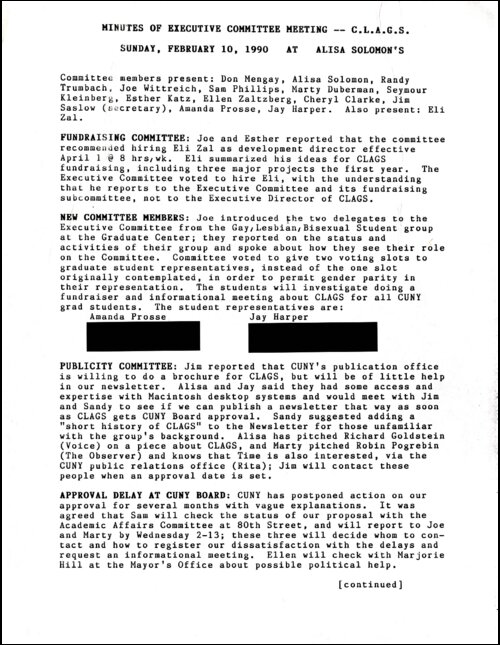 Forming CLAGS' Board: The Minutes These minutes were taken during CLAGS' executive committee meetings and are dated February 10th and December 16th, 1990. They highlight CLAGS' development process prior to its institutionalization at the CUNY Graduate Center in the spring of 1991. Both the February 10th and December 16th minutes openly discuss the relationship between CLAGS and CUNY underscoring CUNY’s hesitance to hosting a gay and lesbian focused institution. However, the meetings were primarily devoted to organizing the board and determining what needed to be addressed in order to form a functioning center. Although formally instituted at the CUNY Graduate Center in 1991, CLAGS: The Center for LGBTQ Studies was first conceived 5 years earlier by Martin Duberman, one of the first historians to embrace the, then infantile, field of Queer Studies. Duberman sensed the need for a formal center devoted to queer research. As the first university-based center for LGBTQ research, CLAGS continues to demonstrate its dedication to advancing Queer Studies, by hosting public events showcasing queer research and sponsoring fellowships to support queer scholars. Among its many notable contributions, CLAGS annually puts on at least one major conference and holds the Kessler Award Lecture every fall to celebrate a queer scholar who has made a notable contribution to the field of queer studies.
 -
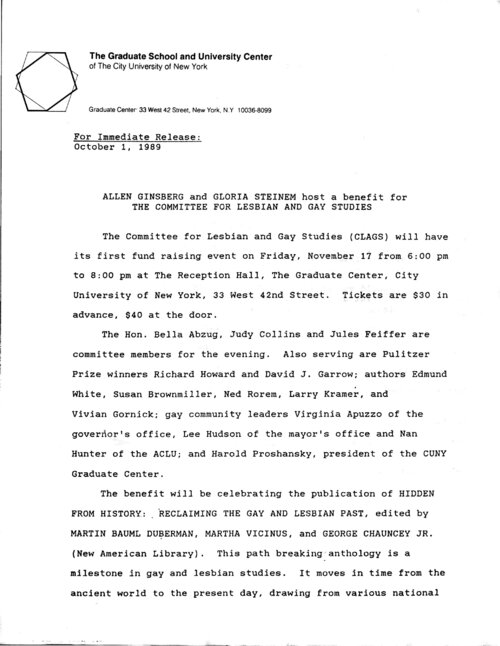 First CLAGS Benefit Proposal This press release for CLAGS’ first fundraising event was published on October 1st, 1989. The event, hosted by Beat poet Allen Ginsberg and feminist icon Gloria Steinem was part of CLAGS' effort to raise the $50,000 required to formally operate as an institution at the CUNY Graduate Center. The benefit served as a celebration for the recent book launch of Hidden from History: Reclaiming the Gay and Lesbian Past, which was edited by the founding director of CLAGS, Martin Duberman, as well as noteworthy queer scholars Martha Vicinus and George Chauncey. The book was widely successful, earning two Lambda Literary Awards, an award from the American Library Association, and a Stonewall Books Award nomination. Held on November 17th, the event was successful in raising over $11,000. Although formally instituted at the CUNY Graduate Center in 1991, CLAGS: The Center for LGBTQ Studies was first conceived 5 years earlier by Martin Duberman, one of the first historians to embrace the field of Queer Studies, then in its infancy. As the first university-based center for LGBTQ research, CLAGS continues to demonstrate its dedication to advancing Queer Studies by hosting public events showcasing queer research and sponsoring fellowships to support queer scholars. Among its many contributions, CLAGS annually puts on at least one major conference and holds the Kessler Award Lecture every fall to celebrate a queer scholar who has made a notable contribution to the field of queer studies.
26–34 of 34