CUNY Adjunct Labor
Item set
Collection
CUNY Adjunct Labor
Time Periods
1970-1977 Open Admissions - Fiscal Crisis - State Takeover
1978-1992 Retrenchment - Austerity - Tuition
1993-1999 End of Remediation and Open Admissions in Senior Colleges
2000-2010 Centralization of CUNY
Items
1–25 of 82
Advanced search
-
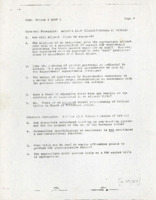 UFCT Information Notice: Classification of Titles This information notice, circulated by the United Federation of College Teachers (UFCT) in 1969, explained contract provisions and more specifically the new classification of titles which was to have been fully implemented by 1970. Beginning with the question: “How will adjunct titles be assigned?” the document, explained how CUNY would transition from using the title lecturer to using adjunct and what “rank” qualifications new appointees were expected to meet.
 -
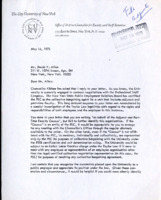 Response to the Adjunct and Part-time Faculty Caucus This letter, dated May 14th, 1973, was addressed to David Allen and signed by David Newton of Chancellor Kibbee’s office. In the letter, Newton responded to a request to a meeting by asking for identification and affiliation, explaining that the Chancellor’s office is only able to meet entities of the Professional Staff Congress (PSC) through the “regular channels” of collective bargaining.
 -
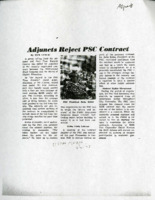 Adjuncts Reject PSC Contract Tom Lynch's 1973 article, “Adjuncts Reject PSC Contract,” published in The Meridian, The Student Voice of Lehman College, argued that the raise was inadequate in so far as it was lower than the cost of living and was less than what full-time faculty had received. Also mentioned were the comments of Aaron Alexander, a spokesperson with the Professional Staff Congress, on the Public Employees Relations Board (PERB) fact-finding report that was still being "considered" by the PSC leadership.
 -
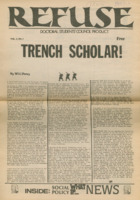 Trench Scholar! Will Petry, an adjunct who had recently been elected Chairperson of the Doctoral Students' Council (DSC) at the Graduate Center, wrote this 1986 editorial in Refuse. Petry recounted a series of specific events in relation to his employment as an adjunct at Hofstra University and Nassau Community College and lamented the inconsistencies of the “the phony credentials racket,” his inability to receive unemployment benefits, and the sacrifices he has made in order to be able to teach.
 -
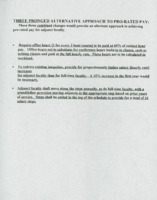 Three Pronged Alternative Approach to Pro-Rated Pay This information sheet compiled in 1995 addressed the income disparity between adjuncts and full-time faculty and proposed a three-pronged approach to lessen the income disparity. The rationale and calculation of pro-rated pay for adjunct faculty were explained in a graphic representation of a dollar, visually illustrating the proportional difference in pay.
 -
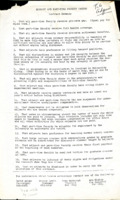 Adjunct and Part-Time Faculty Caucus Contract Demands Compiled by the "Adjunct and Part-Time Faculty Caucus", this twenty-item list included a number of contract demands specific to CUNY's large adjunct teaching population. The “Adjunct and Part-time Faculty Caucus” was a group formed in 1973. Chaired by David Allen the group published and circulated challenges to the contract the PSC had negotiated, which allegedly failed to advocate sufficiently for the rights of adjunct faculty.
 -
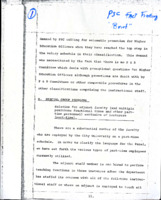 Fact Finding "Brief" This excerpt from a Fact Finding "Brief" focused on CUNY's exploitative use of adjunct faculty following the advent in 1970 of open enrollment. Following a clarification of the types of part-time positions, the brief criticized low adjunct pay, large course loads, and unequal treatment when compared to full-time faculty. Included in the excerpt is the proposal that adjuncts' compensation be commensurate with what full-time equivalent faculty would make (e.g. 1/3 teaching load = 1/3 full professor's salary).
 -
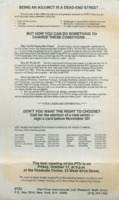 Being an Adjunct is a Dead-End Street Flyer Created by the Part-Time Instructional and Research Staff Union (PTU) in October 1986, this flyer bemoaned the status of adjunct faculty on CUNY campuses and argued for the election of the developing part-timers' "union". While acknowledging that the Professional Staff Congress (PSC) had made an effort to increase part-timer participation, the PTU argued that part-timers would be best represented by their own union. The Part-Time Instructional and Research Staff Union (PTU) was a group of part-time faculty from across CUNY who challenged the Professional Staff Congress (PSC) for the right to represent adjuncts.
 -
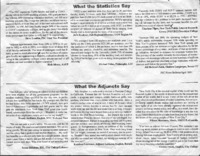 "What the Statistics Say...What the Adjuncts Say" This April 2001 piece from the Professional Staff Congress's (PSC) New Bulletin gave statistical accounts of the shortcomings in funding for CUNY colleges and the adjuncts who worked there in addition to personal stories that illustrated the consequences of austerity policies in higher education.
 -
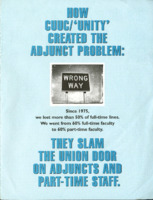 "How CUUC/Unity Created the Adjunct Problem" This flyer, produced by the New Caucus and entitled "How the CUUC/Unity Created the Adjunct Problem," highlighted the New Caucus's commitment to part-time adjunct faculty. The flyer claimed that the City University Unity Caucus (CUUC/Unity) slate, the group that had controlled the PSC for a quarter century, had divided the faculty within the bargaining unit. Structured as an FAQ, the flyer explained how adjunct labor affected full-time faculty negatively and clarified frequent misconceptions. Furthermore, the flyer featured biographies and photographs of the New Caucus officers who were running for election.
 -
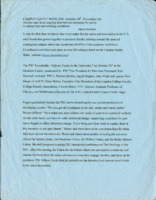 "Another step in an ongoing international campaign for parity in adjunct pay and working conditions" – Campus Equity Week 2001 Memo Written by Marcia Newfield, this 2001 memo reported on the "historic" meeting of unions in the USA and Canada to discuss adjunct labor. The Professional Staff Congress (PSC) held a roundtable at the Graduate Center called "Adjunct Equity in the University." Moderated by Eric Marshall, the panel included Barbara Bowen of the PSC and Rich Moser of the American Association of University Professors (AAUP), among others. Of particular interest, the panel discussed "whether a move towards equity would be counterproductive to developing careers."
 -
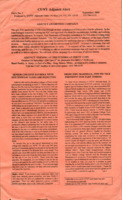 CUNY Adjunct Alert (September 2000) This September 2000 CUNY Adjunct Alert, announced an "Adjunct Awareness Campaign." in light of the newly-elected Professional Staff Congress (PSC) leadership, who were, according to the newsletter, “following through on their campaign promises to advocate for adjuncts.” Also, noted were a healthcare, disability, unemployment outreach project, CAU’s joining the National Alliance for Fair Employment (NAFFE), and the forthcoming Coalition of Contingent Academic Labor (COCAL) conference. CUNY Adjuncts Unite! (CAU), an independent coalition of CUNY part-timers founded in 1997, produced the CUNY Adjunct Alert newsletter. The National Alliance for Fair Employment (NAFFE) consisted of over 40 organizations fighting conditions associated with contingent work.
 -
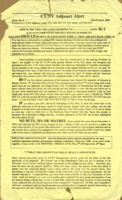 CUNY Adjunct Alert (March/April 2000) This March 2000 edition of CUNY Adjunct Alert, in addition to covering late pay and adjunct voting rights, presented a "report card on the Slates and Candidates" of the Professional Staff Congress (PSC) union election. The City University Unity Caucus (CUUC/Unity Slate) and the New Caucus stances on specific issues of importance to adjuncts were compared. CUNY Adjuncts Unite! (CAU), an independent coalition of CUNY part-timers founded in 1997, produced the CUNY Adjunct Alert newsletter.
 -
 CUNY Adjunct Alert (September 1999) The September 1999 issue of the CUNY Adjunct Alert discussed the importance of the grievance process and offered updates on a referendum on automatic dues deduction and adjunct health insurance.CUNY Adjuncts Unite! (CAU), an independent coalition of CUNY part-timers founded in 1997, produced the CUNY Adjunct Alert newsletter.
 -
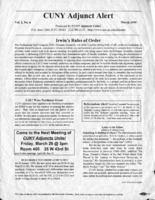 CUNY Adjunct Alert (March 1999) The March 1999 CUNY Adjunct Alert! Newsletter illustrated the tension between activist group, CUNY Adjuncts Unite!, and the Professional Staff Congress (PSC) leadership, in particular, President Irwin Polishook. The article, entitled “Irwin’s Rules of Order,” cited several alleged procedural infractions, which included the Delegate Assembly's rejection of CUNYTALK, supporting the recruitment of new members and supporting objective external vote counting. In addition, in a "Letter, to the Editor", Myrna D. Bain asked why both full- and part-time CUNY faculty “skirt our mutually unresolved questions on class and caste …” CUNY Adjuncts Unite! (CAU) an independent coalition of CUNY part-timers, founded in 1997, produced the CUNY Adjunct Alert newsletter,. The Professional Staff Congress (PSC) is the CUNY faculty and research staff union.
 -
 CUNY Adjunct Alert (February 1999) This February 1998 CUNY Adjunct Alert newsletter responded to the Professional Staff Congress (PSC) Vice President Richard Boris's positions on adjunct labor at CUNY in relation to the recently ratified contract expressed in the December 1998 issue of The Clarion. Among other points of contention, it explained how adjunct health care coverage was inferior to insurance for full-timers and how there was a lack of available information on adjunct professional development opportunities. It also included an article criticizing the Schmidt Commission for its alleged stance on the privatization of remedial courses. CUNY Adjuncts Unite! (CAU), an independent coalition of CUNY part-timers founded in 1997, produced the CUNY Adjunct Alert newsletter. The Clarion is the newspaper of the PSC.
 -
 CUNY Adjunct Alert (December 1998) This newsletter, produced by CUNY Adjunct Unite! (CAU), discussed the PSC's alleged accusations against both CAU and The Adjunct Project for violating New York State's Taylor Law. The article argued that CAU is an independent organization and therefore not under the purview of the Taylor law. CAU also accused the PSC of discouraging adjuncts from becoming union members. CUNY Adjuncts Unite! (CAU) , an independent coalition of CUNY part-timers, founded in 1997, produced the CUNY Adjunct Alert newsletter. The Adjunct Project, founded in 1994, was an activity of the Doctoral Student Council (DSC). It was established to advocate on behalf of, to disseminate information to, and to educate Graduate School and University Center (GSUC) student adjuncts on issues pertaining to their academic employment.
 -
 Adjunct Office Hours In an October 14, 1998 memo sent to Professional Staff Congress (PSC) chapter chairs, President Irwin Polishook referenced past negotiations in which the PSC had endorsed payment for an adjunct office hour but failed to secure a contractual right to office hour compensation. The memo pointed out that the individual schools could have chosen to pay adjunct faculty for regularly scheduled office hours.
 -
 CUNY Adjunct Alert (May 1998) This May 1998 CUNY Adjunct Alert newsletter included an update on the International Adjunct Conference as well as an announcement about the decision to hold a Professional Staff Congress (PSC) referendum. Also covered was information about how adjuncts were eligible to join the NYS Teacher Retirement System (TRS) pension plan, Tax-Deferred Annuity (TDA) plans, and The Teachers Insurance and Annuity Association of America-College Retirement Equities Fund (TIAA), formerly (TIAA-CREF). CUNY Adjuncts Unite! (CAU), an independent coalition of CUNY part-timers founded in 1997, produced the CUNY Adjunct Alert newsletter.
 -
 CUNY Adjunct Alert (February 1998) This February 1998 CUNY Adjunct Alert newsletter announced a demonstration for paid adjunct office hours and encouraged people to send timesheets that included unpaid office hours. In addition, it explained why CUNY had an incentive to contest adjunct's unemployment insurance claims. Other topics discussed included organizing undergraduate students and required departmental meetings for adjuncts. CUNY Adjuncts Unite! (CAU), an independent coalition of CUNY part-timers founded in 1997, produced the CUNY Adjunct Alert newsletter.
 -
 A letter from the CUNY Adjuncts Unite! In a concerted effort to unite across campuses, CUNY Adjuncts Unite! (CAU) organizers wrote a letter to the Professional Staff Congress (PSC) leadership in June 1997 about their concerns, which included poor outreach and a lack of information about new members. CAU expressed concern that, in addition to new members reporting not having had their dues deducted and not receiving ballots, many adjuncts were unaware of their right to join the union.CUNY Adjuncts Unite! (CAU) was an independent coalition of CUNY part-timers, founded in 1997.
 -
 Memo: Recent negotiations on behalf of Adjuncts This 1996 memo by the Professional Staff Congress (PSC) staff,enumerated the rights and privileges that adjuncts had gained in the most recent collective bargaining agreement and legislative efforts.
 -
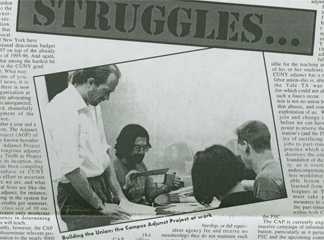
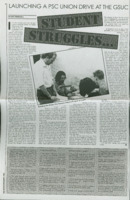 "Student Struggles" Written by Eric Marshall and published in 1996 in The Advocate, this article explained the function of the CUNY Adjunct Project (CAP) as an aggregator of data about adjunct work at CUNY. Critical of the Professional Staff Congress's (PSC) role in fighting for adjunct rights, Marshall nevertheless advocated for adjuncts to join the Professional Staff Congress (PSC) in order to “make our numbers count”. The Adjunct Project, founded in 1994, was an activity of the Doctoral Student Council (DSC). It was established to advocate on behalf of, disseminate information to, and educate the Graduate School and University Center (GSUC) student adjuncts on issues pertaining to their academic employment. The Advocate was the newspaper for the students, staff, and faculty of the Graduate Center, CUNY.
 -
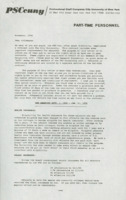 Part-time Personnel - 1994 This 1994 Professional Staff Congress (PSC) part-timers newsletter communicated improvements in adjunct working conditions that had been won in the recently ratified contract, which included expansion of health insurance eligibility and the adjunct workload course limit having been increased from six to nine hours. The newsletter also reported that the contract reflected a law signed by the governor that mandated that all employers inform all employees of the option to join a public retirement system. Adjunct faculty were urged to file grievances should violations of the contract occur.
 -
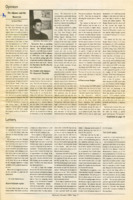 The Trouble with Adjuncts: The Transients' Mentality "The Trouble with Adjuncts: The Transients' Mentality", published in The Advocate in 1994 and written by Daniel Mozes, analyzed why adjuncts had traditionally been ineffective in advocating for their own rights. In addition to having lamented the lack of full-time faculty support and the manner in which CUNY disenfranchised contingent labor, Mozes expressed regret at adjuncts' unwillingness to get involved in grassroots struggles to improve their status. The Advocate served as the newspaper for the students, staff, and faculty of the Graduate Center, CUNY.
1–25 of 82