CUNY Adjunct Labor
Item set
Collection
CUNY Adjunct Labor
Time Periods
1970-1977 Open Admissions - Fiscal Crisis - State Takeover
1978-1992 Retrenchment - Austerity - Tuition
1993-1999 End of Remediation and Open Admissions in Senior Colleges
2000-2010 Centralization of CUNY
Items
51–75 of 82
Advanced search
-
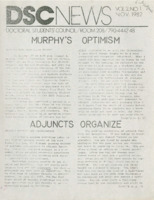 Doctoral Students Council News: Murphy's Optimism This Doctoral Students’ Council (DSC) newsletter, published in 1982, covered adjunct news that ranged from notes on a meeting the DSC steering committee had with Chancellor Murphy to a satirical piece entitled “How not to be an Adjunct”. The article "Adjuncts Organize" argued that only an independent adjunct faculty union could improve working conditions for adjuncts.The Doctoral Students’ Council, a student organization at the CUNY Graduate Center that actively addressed Adjunct issues, would later launch the Adjunct Project.
 -
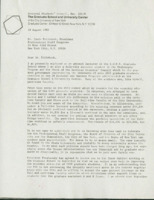 Letter: Economic Disparity In this letter addressed to President Irwin Polishook of the Professional Staff Congress (PSC), Jonathan Lang, Chair of the Doctoral Students’ Council (DSC), outlined the differences in salaries between adjunct and full-time faculty and expressed disappointment in the union’s unwillingness to confront this exploitation and inequity. The letter also stressed that the Reagan administration’s drastic cuts to graduate student financial aid made it imperative to address these inequities. The Doctoral Students’ Council, a student organization at the CUNY Graduate Center that actively addressed Adjunct issues, would later launch the Adjunct Project.
 -
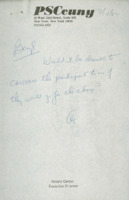 Proposal for Wrap-A-Round Adjunct Health Insurance Written in 1982, this memo discussed the possibility of implementing a "wraparound" medical health insurance plan for adjunct faculty. It argued that this option would be superior because it offered free choice of physician and 365 days of hospital coverage. In addition, there was a handwritten note at the top of the memo that asked if it would be advisable to canvass participants to see "if they would go for the change".
 -
 Reject Unlimited License to Staff their Faculties with Part-time faculty This confirmation copy of a June 24, 1982 Western Union Mailgram from Dr. Irwin Polishook to Chancellor Willard A. Genrich urged the NYS Board of Regents to reject an amendment that would allow NYS universities and colleges unlimited license to staff their faculties with part-time faculty. Polishook pointed out both the possibility of abuse of part-time faculty and the inevitable compromise in the quality of education. I
 -
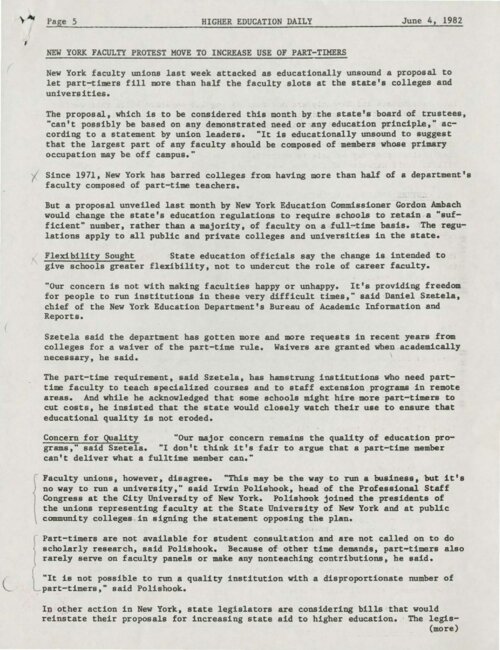 NY Faculty Protest Move to Increase Use of Part-Timers Published on June 4, 1982 in he Higher Education Daily, this article, entitled "NY Faculty Protest Move to Increase Use of Part-Timers," reported that NYS faculty unions attacked NYS Education Commissioner Gordon Ambach’s proposal to let part-timers fill more than half the faculty slots at both public and private universities. State education officials claimed that the intention was to give colleges more flexibility, while faculty unions were concerned that the proposal was “educationally unsound.”
 -
 Higher Education Faculty Leaders Denounce Plan to Replace Career Professors with Part-timers. This joint May 28, 1982 statement, signed by Nuala Drescher, Lou Stollap, and Irwin Polishook, three NYS faculty union presidents, expressed shock and denounced a proposal put forward by NYS Education Commissioner Gordon Amach, which would have allowed universities, colleges, and departments to hire more than 50 percent part-time faculty. Calling the proposal embarrassing, it claimed that it was "educationally unsound to suggest that the largest part of a faculty should be composed of members whose primary occupation may be off-campus."
 -
 Letter from the Adjuncts Benevolent Association to Mr. Polishook This November 19, 1980 letter , addressed to Irwin Polishook of the Professional Staff Congress (PSC) and sent on behalf of the Adjunct Benevolent Association, enumerated why the 9-hour teaching limitation that CUNY had institutionalized was problematic for adjunct faculty. It acknowledged that despite the intention to curtail exploitation, the unintended consequences were numerous and affected CUNY adjuncts negatively.
 -
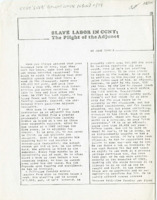 Slave Labor in CUNY: The Plight of the Adjunct "Slave Labor in CUNY: The Plight of the Adjunct," published in the City College of New York's (CCNY) Student Senate Publication in November 1979, attempted to dispel any misconceptions about adjunct faculty’s working conditions by highlighting the low pay and their precarious status. It called for adjunct faculty to "band together and refuse to be slaves."
 -
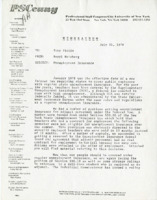 Adjuncts as Seasonal Workers This July 31, 1978 memo from Beryl Weinberg of the Professional Staff Congress (PSC) to Tony Ficcio discussed adjunct unemployment insurance. It explained the difficulties adjuncts had receiving unemployment insurance, a significant issue considering their lack of job security. Weinberg noted that no adjunct had "reasonable assurance" of re-employment considering that many had been told on the first day of class that there would be no course available to them. The memo also stated that adjuncts should be treated as if they were "seasonal workers" and if necessary the case should go to court.
 -
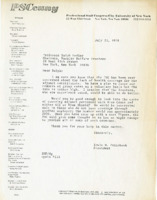 Letter from Polishook to Ledley This July 25, 1978 lfrom Professional Staff Congress (PSC) President Irwin Polishook to Professor Ralph Ledley, chairman of the Faculty Welfare Trustees, requested that the Trustees estimate the costs of health coverage for "approximately 2000" uncovered adjunct personnel.
 -
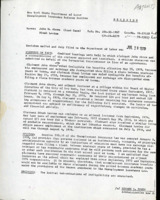 NYS Dept. of Labor Unemployment Ruling: Ineligibility to Receive Unemployment Insurance This decision, dated July 19, 1979, from the office of the New York State Department of Labor Unemployment Insurance upheld an initial determination of claimants John Abreu's and Dinah Levine’s ineligibility to receive unemployment insurance as a result of a letter of reappointment that they had received and signed. The letter of reappointment was deemed "reasonable assurance" that the two adjuncts would perform such services for the same or another institution in the next school year.
 -
 Vote for the PSC-BHE Contract This letter, written by Susan Prager in 1977, urged readers to vote in favor of the Professional Staff Congress - Board of Higher Education (PSC - BHE) contract. While the letter acknowledged that some members would be disappointed, it listed three wins including cost of living adjustments, observation waivers, and scheduled incremental raises after six semesters of employment.
 -
 " But I'm only an Adjunct " "Part-Time Teaching at CUNY" was written by members of the Committee of Untenured Faculty (CUF) in 1976. Part I of the article included a collection of anecdotes culled from adjuncts' experiences of precarity and isolation across CUNY. Part II, called "Organizing from the Bottom-up," was an account of one member’s struggle to organize adjunct faculty at CUNY between 1976-77. The author concluded " that the only rational way to go about organizing at this time is to take a strong position on the union. . . ."
 -
 PSC v. CUNY re: Dividing full-time positions into adjunct appointments This grievance, filed on September 17th, 1976, by the Professional Staff Congress (PSC), alleged that CUNY had replaced full-time faculty positions with adjunct appointments despite having sufficient course offerings to reinstate retrenched full-time faculty.
 -
 PSC Newsletter to Part-timers This June 28, 1976 memo from Susan Prager, chairperson of the Committee for Part-Time Personnel, was addressed to part-time members of the Professional Staff Congress (PSC). It included the renewed retrenchment guidelines for adjuncts and stated that violations of these guidelines were grievable.
 -
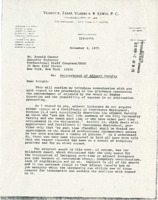 Letter to Cantor, re: Retrenchment of Adjunct Faculty This 1975 letter from Stephen C. Vladeck, a prominent labor lawyer a to Mr. Arnold Cantor, Executive Director of the Professional Staff Congress (PSC) expressed doubt about the wrongful termination of an adjunct professor and recommended that the union not take the case to arbitration.
 -
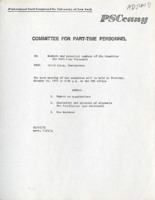 Arguments Relating to Adjuncts for Submission to Factfinders This October 10, 1975 memo, written by the Committee for Part-time Personnel and circulated among members and potential members, included both an agenda for an upcoming meeting and a list of arguments relating to adjuncts for fact-finders to present to the CUNY Board of Higher Education (BHE). The document stated that the first priority should have been to avoid a solution that would enable the BHE to decrease workloads or eliminate full-time faculty. Despite acknowledging the city's financial crisis, the memo argues for increased "Money for Adjuncts" as a way of addressing the pay disparity between full-time and part-time faculty.
 -
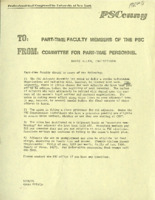 Part-Time Faculty Members of the PSC This September 29th, 1975 memo , written by David Allen of the Committee for Part-time Instructional Staff, announced a delay in the proposed strike and claimed that the decision to defer it made it unlikely that those who had been fired would be rehired. Allen provided additional information including the temporary formation of an institution of “associate membership” for those who had been laid off, the union’s intention to file a class grievance for all adjuncts, and the minimum requirements necessary to receive food stamps. The Committee for Part-time Instructional Staff was a standing committee of the Delegate Assembly. It was responsible for the consideration of problems facing part-time Instructional staff and made recommendations related to the part-time instructional staff.
 -
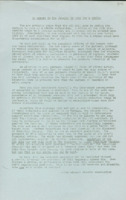 An Appeal to the Faculty to Vote for a Strike: Adjuncts will be the first to go but “you may be next." Written by the Adjunct Faculty Association, this 1975 flier argued for a strike, claiming that the budget cuts would result in the mass firings of adjunct faculty and increased workloads for full-time faculty. It also claimed that, according to the PSC, these new cuts would lead to the dismissal of 1,500 full-time faculty and that the adjuncts would be the first to go.
 -
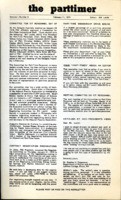 The Parttimer: Committee for Part-Time Instructional Staff This 1974 issue of The Parttimer, a Professional Staff Congress (PSC) newsletter, announced the Delegate Assembly's official approval of a newly formed Committee for Part-time Instructional Staff. The Committee for P/T personnel was an organization representing the interests of union and non-union part-time staff. Those elected included David Allen, Chair, and Bill Leicht, Vice President for Part-Time Personnel. In addition, the issue featured a letter from a physics professor at Lehman College accusing the PSC of "[selling] the adjuncts down the river" in contract negotiations.The Committee for Part-time Instructional Staff was a standing committee of the PSC Delegate Assembly responsible for addressing problems facing Part-time Instructional staff.
 -
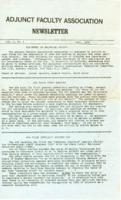 Adjunct Faculty Association Newsletter (v. 1. n. 1) This February 1974 Adjunct Faculty Association newsletter included an announcement of the formation of the Adjunct Faculty Association (AFA), the new organization's formal complaint filed against the Professional Staff Congress (PSC), several longer-form pieces on adjunct labor, and a calendar of events. The newsletter argued that the formal complaint would either force the Professional Staff Congress (PSC) to give fair representation to part-time faculty or allw AFA to establish a claim to PERB that there was no community of interest between full- and part-time faculty, which would establish the foundation for a separate bargaining unit. The newsletter also included "The AFA: a Brief History" by Sylvia Barnes, which claimed that after much discussion the organization ultimately decided that the best policy would be "to attempt to work with and through the PSC" for a contract that would "ensure better treatment of adjuncts."
 -
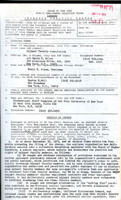 NY PERB: Improper Practice Charge This NY Public Employment Relations Board (PERB) “Improper Practice Charge,” filed in 1974 by David Allen of the Adjunct Faculty Association, alleged that the Professional Staff Congress (PSC) deliberately entered into an labor agreement that injured adjuncts. The charges included accepting “non-specific criteria” when discharging adjuncts, eliminating rehiring privileges, decreasing the workload to two courses, replacing a “semester hour” with “contact hour” and thereby reducing adjunct salaries. The PERB charge stated that “By these and other acts, the employee organization has violated its duty to represent all employees within the bargaining unit fairly. . . .”
 -
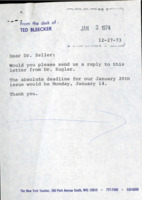 To "The New York Teacher" These 1974 letters concerned adjunct faculty job security and what constituted reasons for adjunct dismissasl. Included in this item was a request for PSC President Belle Zeller to respond to an editorial from PSC Deputy Vice President Israel Kugler, Kugler’s editorial and Zeller's response. Kugler stated it was an error to list "financial inability" and cited the precedent in Arbitrator Wildebush’s decision to pay and reinstate 15 lecturers from Brooklyn College who were fired due to a “change in personnel practices.” Zeller’s response concurred, and emphasized that appointments were subject to only two (not three) reasons: "insufficient enrollment or changes to the curriculum."
 -
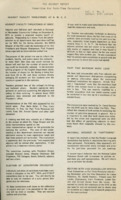 PSC Adjunct Report (V. 1, N. 2) This 1974 Professional Staff Congress (PSC) Committee for Part-Time Personnel Newsletter included articles on adjunct faculty being threatened at Borough of Manhattan Community College (BMCC), maximum workload quotas, the election of convention delegates, an increased national interest in "part-timers." and notes on a meeting with CUNY Vice-Chancellor David Newton. Of particular interest, the article entitled "Adjunct Faculty Threatened at BMCC" covered the protest in response to the proposed massive layoff of adjuncts. The purpose of the picket line was to inform students, faculty and the community about the cutbacks and resulted in a follow-up meeting with BMCC President Edgar Draper who agreed to fund courses in order to meet registration needs. In preparation for the next contract, the Committee on Part-time Personnel requested data to clarify the inequities to the CUNY Board of Higher Education.
 -
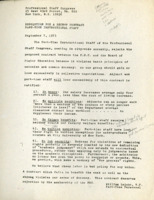 Part-Time Instructional Staff: A Resolution for a Decent Contract This September 7th, 1973 resolution was written by William Leicht, the VP of the Committee for Part-Time Instructional Staff of the PSC. It stated that a contract that "fails to benefit the weak as well as the strong, violates the basic principles of unionism." The reasons listed included a lack of salary increases, a failure to reduce the workload, and no fringe benefits. The resolution also noted that tuition exemption and job security weren't included in the contract. The Committee for Part-time Instructional Staff was a standing committee of the PSC Delegate Assembly. It was responsible for the consideration of problems facing part-time instructional staff and made recommendations related to the part-time instructional staff.
51–75 of 82