CUNY Adjunct Labor
Item set
Collection
CUNY Adjunct Labor
Time Periods
1970-1977 Open Admissions - Fiscal Crisis - State Takeover
1978-1992 Retrenchment - Austerity - Tuition
1993-1999 End of Remediation and Open Admissions in Senior Colleges
2000-2010 Centralization of CUNY
Items
76–82 of 82
Advanced search
-
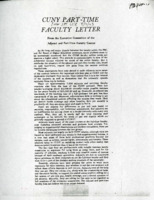 Letter from the "Adjunct and Part-time Faculty Caucus" Posted on the walls of John Jay College in 1973, this letter from the Executive Committee of the "Adjunct and Part-time Faculty Caucus" called for broader support from the CUNY community for the dignity and rights of adjunct faculty. In addition to highlighting pay and fringe benefit disparities, it discussed the fact that adjuncts had been pressing the union to work more vigorously for their interests, which included pro-rata pay, health coverage, and increased job security. The "Adjunct and Part-time Faculty Caucus" was a group formed in 1973. Chaired by David Allen, the group published and circulated challenges to the contract the PSC had negotiated, which it alleged had failed to advocate sufficiently for the rights of adjunct faculty.
 -
 Clarion: Professional Staff Congress (PSC) demands This 1972 PSC/Clarion article included some of the Professional Staff Congress's (PSC) demands for adjuncts. It called for adjunct tenure to be obtained after the tenth semester, preferential hiring rights for full-time positions, salary increases, and fringe benefits for adjunct faculty. The Clarion is the newspaper of the Professional Staff Congress, City University of New York.
 -
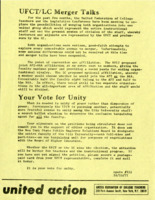 Vote for Unity: United Federation of College Teachers/Legislative Conference Merger Talks This 1971 memo, written by the United Federation of College Teachers (UFCT), described the merger talks between the UFCT and the Legislative Conference (LC) and the obstacles to consolidation into what would become the Professional Staff Congress. It faulted the LC for advocating "optional" affiliation, which would have allowed union members to join either the American Federation of Teachers (AFT) or the National Education Association (NEA), thereby splitting the faculty union and weakening its bargaining power. The UFCT advocated "joint" affiliation with the two national organizations to provide faculty with a single, unified representative in contract negotiations. During the 1960s, the United Federation of College Teachers (UFCT), and the Legislative Conference (LC) were the two main organizations that advocated for CUNY faculty. The UFCT represented part-time faculty and lecturers while the LC was the union of tenured professors. The groups merged in 1972 to form the Professional Staff Congress, which represents CUNY faculty today.
 -
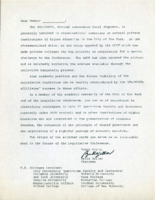 Letter to Legislative Conference Members This letter from 1971, signed by Belle Zeller, the chair of the Legislative Conference (LC), was addressed to LC members. It requested that members identify part-time faculty represented by the United Federation of College Teachers (UFCT) who would be "interested in the preservation of academic freedom, the extension of the principle of shared governance and the negotiation of a rightful package of economic benefits." This request was in response to opposition to the LC by the UFCT. During the 1960s, the United Federation of College Teachers (UFCT), and the Legislative Conference (LC) were the two main organizations that advocated for the concerns of CUNY faculty. The UFCT represented part-time faculty and lecturers while the LC was the union of tenured professors. The groups merged in 1972 to form the Professional Staff Congress, which represents CUNY faculty today.
 -
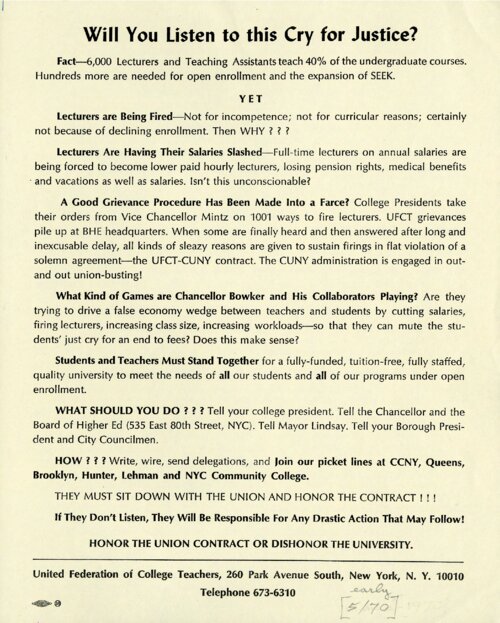 "Will You Listen to this Cry for Justice?" This flyer, produced and circulated in 1970 by the United Federation of College Teachers (UFCT), called for students and teachers to stand together and demand that CUNY honor the contract. It stated that despite 6,000 lecturers and teaching assistants (adjuncts) teaching 40 percent of CUNY's undergraduate courses and many more needed to accommodate CUNY's recently implemented Open Admissions program and the Search for Education, Elevation, and Knowledge (SEEK) program, lecturers were being fired and their hours and salaries cut.During the 1960s, the United Federation of College Teachers (UFCT), and the Legislative Conference (LC) were the two main organizations that advocated for the concerns of CUNY faculty. The UFCT represented part-time faculty and lecturers while the LC was the union of tenured professors. The groups merged in 1972 to form the Professional Staff Congress, which represents CUNY faculty today.
 -
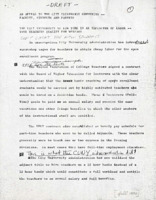 Draft of an Appeal to the City University Community This draft of a 1970 appeal to the CUNY community was written by the United Federation of College Teachers (UFCT). It accused tCUNY of paying teachers "sweatshop wages" with the objective of obtaining cheap labor for the open enrollment program. The document mentioned the hourly pay schedule established for adjuncts (a recently created title), which was intended to compensate people supplementing other full-time careers, and then noted the manner in which the administration was exploiting the Adjunct title for cheap labor. The appeal also described the conversions from lecturer positions to various Adjunct titles not being honored.
 -
 Oral History Interview with Marcia Newfield Conducted January 31, 2017, as part of the Professional Staff Congress's (PSC) oral history initiative, this interview, conducted by Irwin Yellowitz with Marcia Newfield, covered her time at the Borough of Manhattan Community College (BMCC) as an adjunct faculty member and her years as the vice president for part-time instructors (2003-2015) at the PSC. Hired as an adjunct at Borough Manhattan Community College (BMCC) in 1988, Newfield quickly became involved with the PSC and worked on issues such as healthcare, contract negotiations, and adjunct pay. In addition to her varied personal experiences at CUNY, Newfield touched on a variety of other topics, including the history of adjuncts at CUNY and the efforts of the New Caucus leadership beginning in 2000.
76–82 of 82