Community College 7
Item set
Collection
Community College 7
Time Periods
1961-1969 The Creation of CUNY - Open Admissions Struggle
Items
26–45 of 45
Advanced search
-
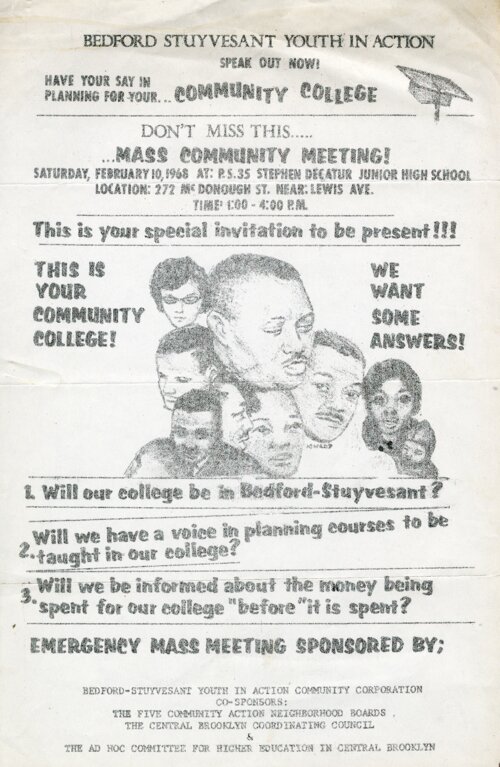 February 1968 Youth in Action Flyer: "Have Your Say in Planning for Your Community College" In this February 1968 flyer distributed in the Bedford-Stuyvesant community of Central Brooklyn, educational advocacy groups and community-based organizations responded immediately and forcefully to the announcement by the City University of New York (CUNY) of the development of a new community college in their community. Youth in Action (YiA), a Bedford-Stuyvesant-based anti-poverty organization, organized a mass, open meeting at which New York political leaders and CUNY officials would be invited to clarify their plans for the new college and respond to the community’s questions. YiA issued a special invitation to youth of Central Brooklyn to join the meeting to “[s]peak out now,” and “[h]ave your say in planning for your community college.”
 -
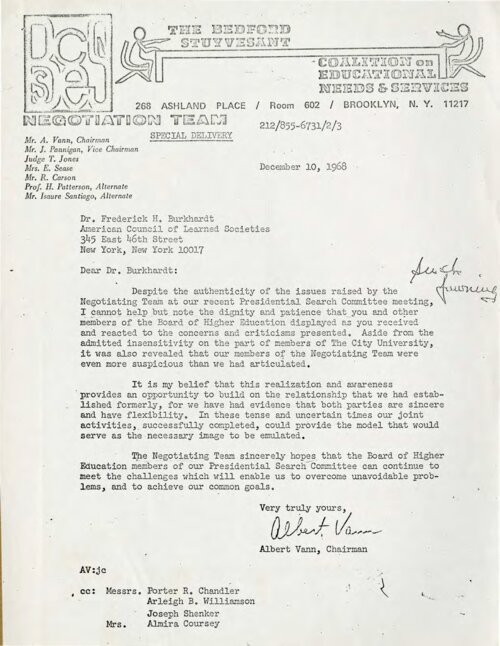 December 10, 1968 Letter from Al Vann to Frederick Burkhardt On December 10, 1968, Al Vann, Chairman of the Bedford-Stuyvesant Coalition on Educational Needs and Services (B-SCENS), wrote to Frederick Burkhardt, Chairman of the New York City Board of Higher Education, to comment on a debate that had transpired in a recent meeting of the Presidential Search Committee for Community College 7 of which they were both members. In recent weeks, the Committee had discussed several contentious issues between the delegations from the City University of New York (CUNY) and the one from the Bedford-Stuyvesant community, fueling the Bed-Stuy delegation’s concerns about CUNY's sincerity about its commitment to establish a new college controlled by the Bed-Stuy community. In the letter, Vann praised Burkhardt's “dignity and patience,” while criticizing the “admitted insensitivity” of other CUNY officials in the meeting, concluding that he was optimistic that the two parties could “continue to meet the challenges which will enable us to overcome unavoidable problems, and achieve our common goals."
 -
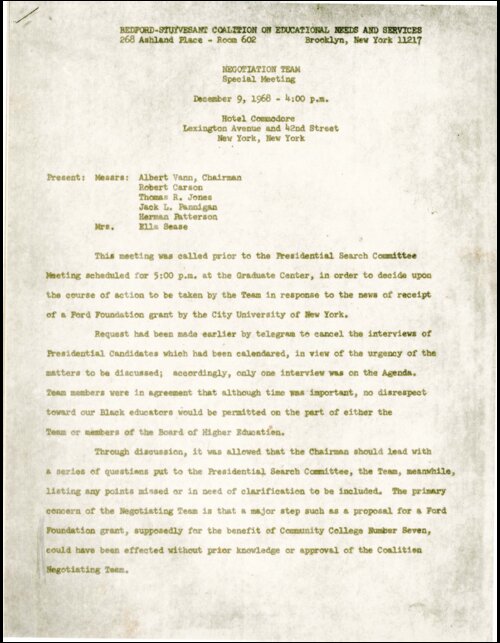 December 9, 1968 Minutes of Special Meeting of the Negotiation Team of the Bedford-Stuyvesant Coalition on Educational Needs and Services On December 9, 1968, in its second Special Meeting in less than a week, the five-member Negotiation Team of the Bedford-Stuyvesant Coalition on Educational Needs and Services met to discuss their concerns that City University of New York (CUNY) officials with whom they had been collaborating to plan Community College 7 were making key decisions without consulting them as representatives of the Central Brooklyn community. At issue was news that CUNY officials had submitted a proposal for a $440,000 grant from the Ford Foundation to support the planning and establishment of Community College 7. In minutes from the meeting, the Negotiation Team noted their “primary concern. . .that a major step, such as a proposal for a Ford Foundation grant, supposedly for the benefit of Community College 7, could have been effected without prior knowledge or approval of the Coalition Negotiation Team.” Tensions and mistrust between the Bedford-Stuyvesant and CUNY representatives involved in planning Community College 7 would continue to escalate in the coming weeks.
 -
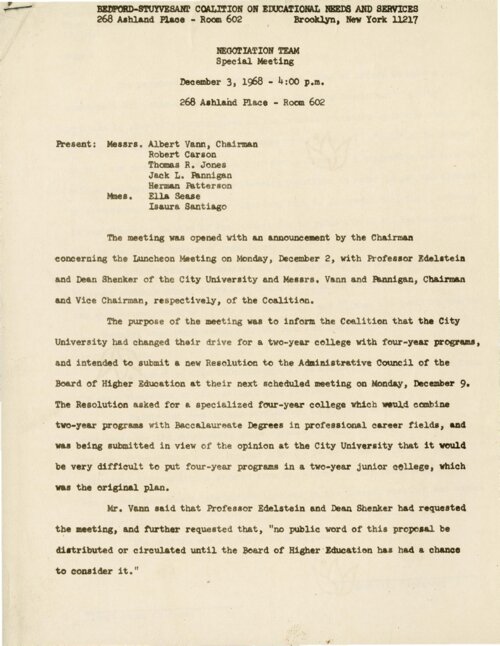 December 3, 1968 Minutes of the Special Meeting of the Negotiation Team of the Bedford-Stuyvesant Educational Needs and Services The five-member Negotiation Team of the Bedford-Stuyvesant Coalition on Educational Needs and Services met on December 3, 1968, to discuss a proposed resolution put forward by City University of New York (CUNY) officials to establish Community College 7 as a four-year college with special capacity to grant two-year degrees, rather than as a two-year “junior” as had originally been announced. The resolution, which CUNY officials proposed to submit to the Administrative Council of the Board of Higher Education for its consideration, represented an incremental victory for Bedford-Stuyvesant’s educational and community leaders, who had vigorously advocated that the new college be a four-year-degree granting institution. However, the fact that CUNY officials’ requested that “no public word of this proposal be distributed or circulated until the Board of Higher Education has had a chance to consider it” presented a conundrum for the Negotiation Team, which had been appointed to represent the Bedford-Stuyvesant community’s priorities and demands through an open and transparent process in the planning for the new college .
 -
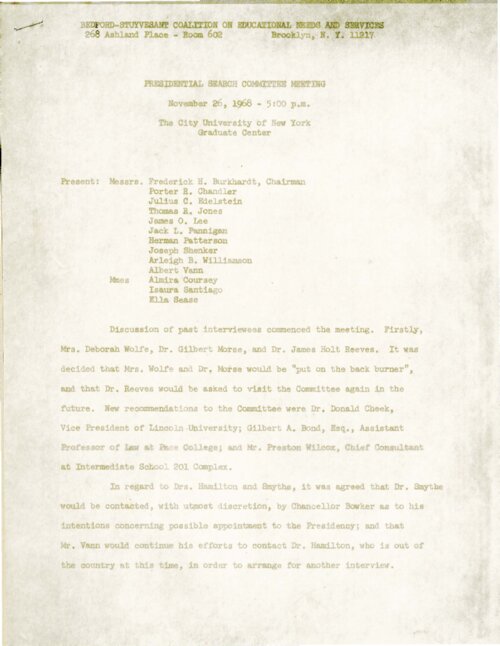 November 26, 1968 Minutes of the Presidential Search Committee for Community College 7 On November 26, 1968, the Presidential Search Committee for Community College 7, composed of five City University of New York (CUNY) officials and five appointed representatives of the Bedford-Stuyvesant community, met to discuss candidates for the presidency of the new college. In the meeting, the committee members discussed recent interviews with three candidates, and proposed new candidates they hoped to consult, including Hugh Smythe, then Ambassador to Malta. Also of note in this document is the appended list of approximately 50 additional candidates then under consideration for the presidency, including both Smythe and Rhody McCoy, a prominent leader in the Ocean Hill-Brownsville community control movement, who would later become the flashpoint of a pivotal controversy over the leadership of the new college.
 -
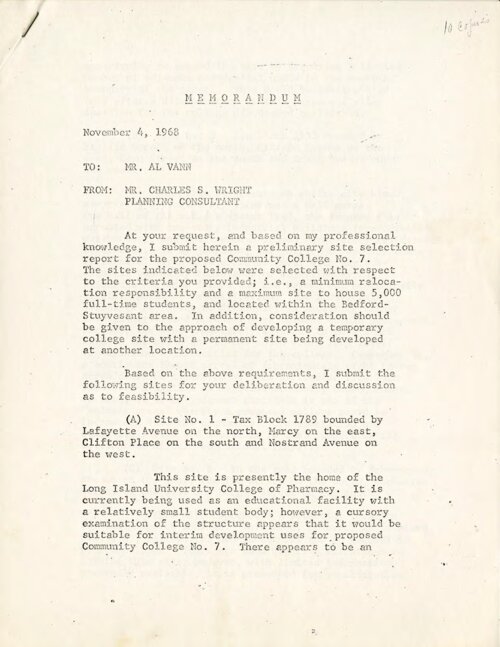 Preliminary Site Selection Report for the proposed Community College 7 On November 4, 1968, Charles Wright, Planning Consultant to the Bedford-Stuyvesant Coalition on Educational Needs and Services (B-SCEN) submitted a memo to Al Vann, chairman of the Negotiation Committee detailing four possible sites he had identified for the establishment of Community College 7. The location of the college was of central concern to the Bedford-Stuyvesant community, which had been publicly advocating for many years for a CUNY college to be located in Central Brooklyn, where it would be accessible to local Black and Puerto Rican youth. For reasons not documented in this collection, none of the four Bedford-Stuyvesant sites was selected for what became Medgar Evers College, which was ultimately built in the adjacent neighborhood of Crown Heights.
 -
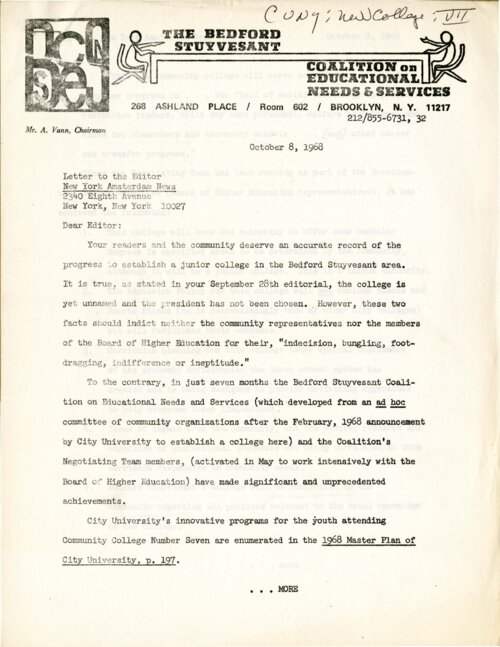 October 7, 1968, Letter from Al Vann to the editors of the New York Amsterdam News On October 7, 1968, Al Vann, chairman of the Bedford-Stuyvesant Coalition on Educational Needs and Services, wrote a letter to the Editor of the New York Amsterdam News, responding to an editorial published a week earlier. The editors of the Amsterdam News had expressed concerns that Community College 7 might never come to fruition because of the “indecision, bungling, foot-dragging or ineptitude” of the CUNY officials and Bedford-Stuyvesant community delegation, led by Vann, charged with developing and implementing the plans. In his letter, Vann details his delegation’s successes in convincing CUNY officials to agree to key demands for a college that would be controlled by the community. However, tensions among Bedford-Stuyvesant’s community leaders over the nature and extent of the community control to be demanded of CUNY, and concerns that the opportunity for a college in Central Brooklyn might be lost, continued to escalate in the coming months.
 -
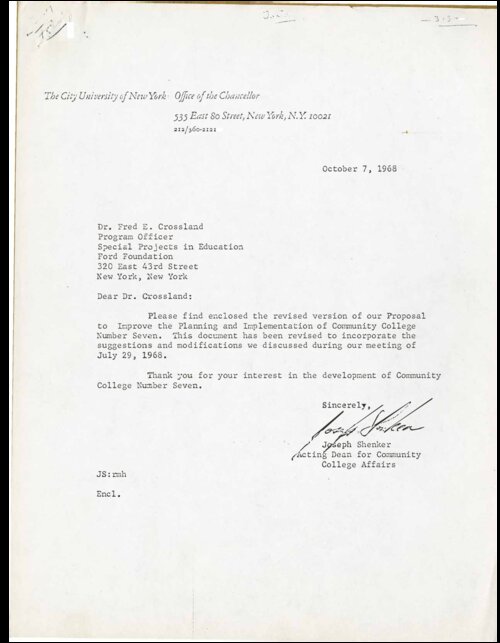 October 7, 1968, Proposal to Improve the Planning and Implementation of Community College 7 On October 7, 1968, Joseph Shenker, Acting Dean for Community College Affairs for the City University of New York, submitted a proposal to the Ford Foundation for a $440,000 grant “to Improve the Planning and Implementation of Community College 7.” The proposal included funds for key activities proposed by Bedford-Stuyvesant Coalition on Educational Needs and Services (B-SCENS)'s appointed “Negotiation Team,” representing the community’s demands for the new College. These demands included research to develop flexible admissions policies and degree pathways for educationally underserved Black youth. However, the Negotiation Team’s perception that they had been excluded from initial discussions about the proposal, and fact that the funds would be administered by CUNY, rather than by a community-based organization, fueled tensions between the two groups that would continue to escalate in the coming weeks.
 -
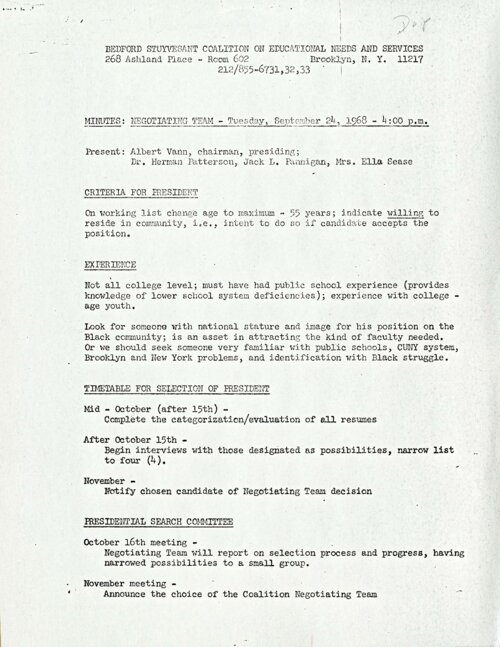 Steering Committee of the Bedford-Stuyvesant Coalition on Educational Needs and Services Minutes: Proposed Selection Criteria for the President of Community College 7 On September 24, 1968, the Steering Committee of the Bedford-Stuyvesant Coalition on Educational Needs and Services (B-SCENS) met to discuss the criteria they hoped to use in the selection of a president for a new, public college in Central Brooklyn. A broad network of local educational advocacy and community-based organizations had formed the B-SCENS as a network to gather and formalize the community’s demands for the new college, and appointed the five-member Negotiating Team to meet with an equal number of CUNY officials as a “Presidential Search Committee.” Of special note in these minutes from the Steering Committee’s meeting is the suggestion that the selected candidate’s experience would “not [be] all college level,” and would include “public school experience (provides knowledge of lower school system deficiencies; [and] experience with college-age youth.” The question of whether the new college president wouid be required to have university-level experience would emerge as a flashpoint in the months to come.
 -
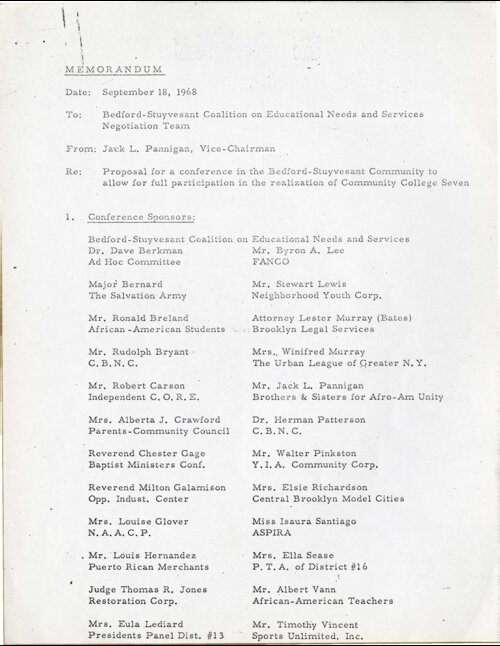 Proposal for a 1968 conference for the Bedford-Stuyvesant Community to allow for full participation in the development of Community College 7 On September 18, 1968, Jack Pannigan, head of Central Brooklyn youth club, Brothers and Sisters for African American Unity, drafted a proposal to his fellow members of the Bedford-Stuyvesant Coalition on Educational Needs and Services (B-SCENS) Steering Committee outlining plans for a workshop for community youth at which they would discuss ideas for a new public college in Central Brooklyn. Within days of the announcement, a broad network of Bedford-Stuyvesant’s educational advocacy and community-based organizations formed the B-SCENS as a network to support community members in formulating their visions and demands for the new college, and in negotiating with CUNY officials. In this proposal, Pannigan outlined plans for the B-SCENS to convene a workshop for youth from the community to formulate proposals for college curricula and admissions policies that reflected their hopes and priorities.
 -
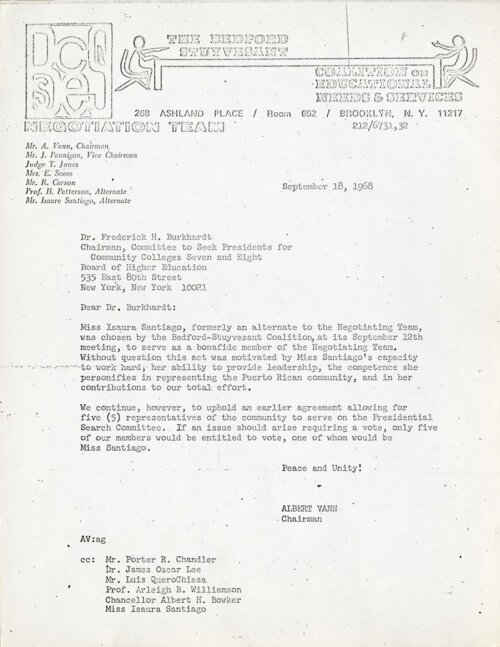 How the new Community College 7 will be "different": September 18, 1968 Letter from Al Vann to Frederick Burkhardt On September 18, 1968, Al Vann, Chairman of the Negotiation Team and Steering Committee of the Bedford-Stuyvesant Coalition on Educational Needs and Services (B-SCENS), wrote to Frederick Burkhardt, Chairman of the New York City Board of Higher Education, to describe the Bedford-Stuyvesant community’s vision for the way a new public college planned for Central Brooklyn should be “different.” In this letter, Vann wrote to Burkhardt, who served as chairman of the Committee to Seek Presidents for Colleges VII and VIII (a committee on which Vann also served as a member), emphasizing that the “difference we seek will be profound, and will be measured by the relevancy the college will have to our community and how well we meet some of our community’s needs.” Vann's letter also detailed important aspects of the community’s proposed role in making plans and decisions for the proposed college.
 -
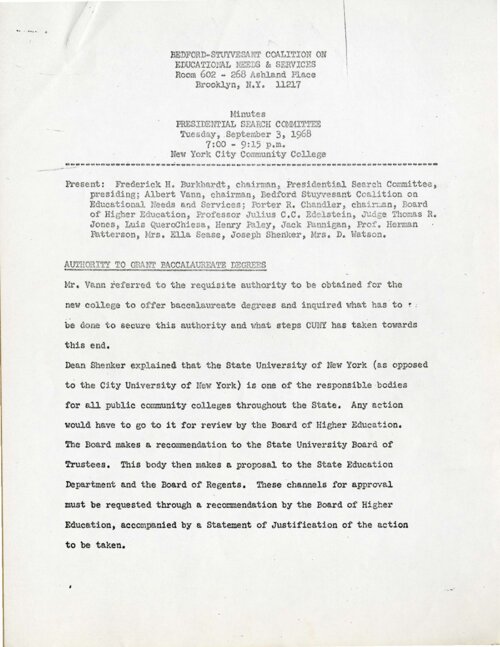 Minutes of the September 23, 1968, Presidential Search Committee Meeting On September 3, 1968, the “Presidential Search Committee” comprised of five City University of New York (CUNY) officials and five appointed representatives of the Bedford-Stuyvesant community, met to discuss a new CUNY college planned for Central Brooklyn. In this meeting, the Presidential Search Committee discussed issues of concern to Bedford-Stuyvesant constituents, including the development of a curriculum that represented the community’s priorities, and possibilities for the college, originally announced by CUNY as a two-year degree-granting institution, to open as a four-year degree granting “senior” college. At this meeting, the Presidential Search Committee also outlined criteria for selecting a president for the new college, an issue that would soon escalate into a major controversy.
 -
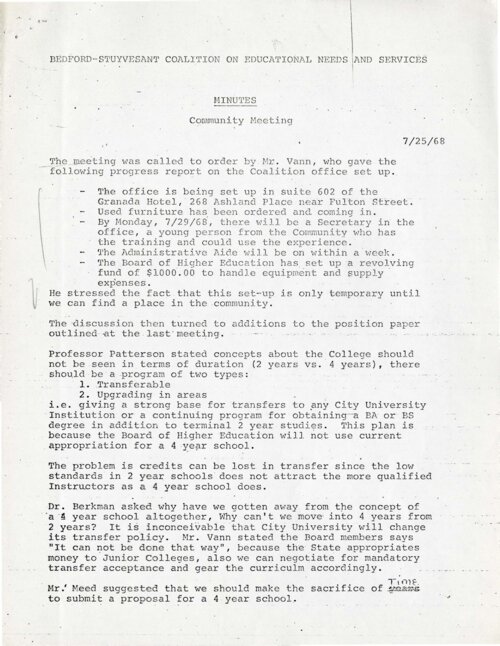 Minutes of July 25, 1968, Community Meeting of the Bedford- Stuyvesant Coalition on Educational Needs and Services On July 25, 1968, the Bedford Stuyvesant Coalition on Educational Needs and Services (B-SCENS) held a community meeting to discuss ongoing negotiations with the City University of New York (CUNY) regarding plans to develop a new college in Central Brooklyn. Albert Vann, chairman of the five-member Negotiation Team appointed by the B-SCENS to represent the Bedford-Stuyvesant community in these discussions with CUNY officials, reports on possibilities and challenges for the new college, including pathways to four-year degrees, rather than exclusively for two-year degrees, as CUNY had originally announced.
 -
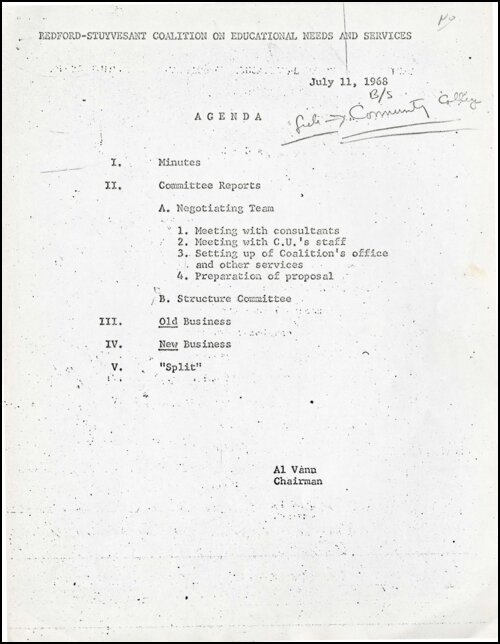 Minutes of Bedford-Stuyvesant Coalition on Educational Needs and Services Community July 11, 1968, Meeting with Negotiation Team On July 11, 1968, the Bedford-Stuyvesant Coalition on Educational Needs and Services held a community meeting, at which the five-member Negotiation Team, appointed to represent them in planning Community College 7 with City of New York (CUNY) officials, presented updates on their activities and progress. At the meeting, the Negotiation Team presented position papers drafted by three consultants on behalf of the Bedford-Stuyvesant community, arguing for the new college to open as a four-year institution and outlining pathways to realize that possibility. Among the consultants was Prof. Donald Watkins of Brooklyn College, from whose personal papers the Community College 7 collection was curated.
 -
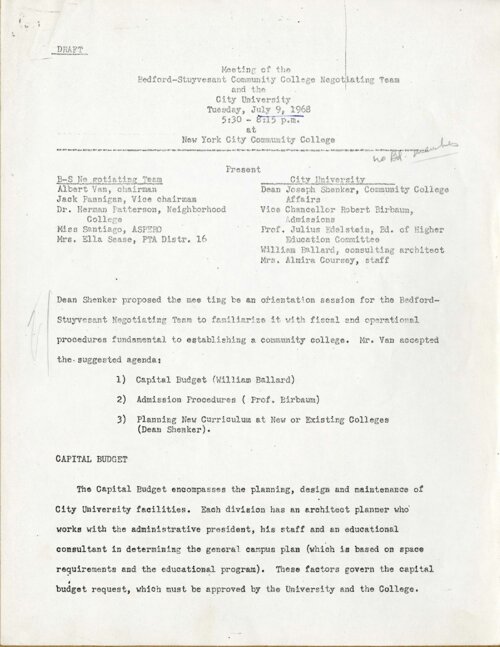 Presidential Search Committee of Community College 7: Minutes July 9, 1968, On July 9, 1968, the Presidential Search Committee for “Community College 7,” composed of five City University of New York officials and five appointed representatives of Bedford-Stuyvesant’s community-based organizations, met to discuss plans for the new college. In this meeting, CUNY officials briefed the Bedford-Stuyvesant committee members in detail on pathways and obstacles for the college to open as a four-year degree granting “senior” college, as demanded by the Central Brooklyn community. The Committee also explored possibilities for the Bedford-Stuyvesant community organizations to receive funds to support their research and planning activities in support of the new college, an issue that would prove contentious in the coming weeks with the Ford Foundation’s involvement in funding the project.
 -
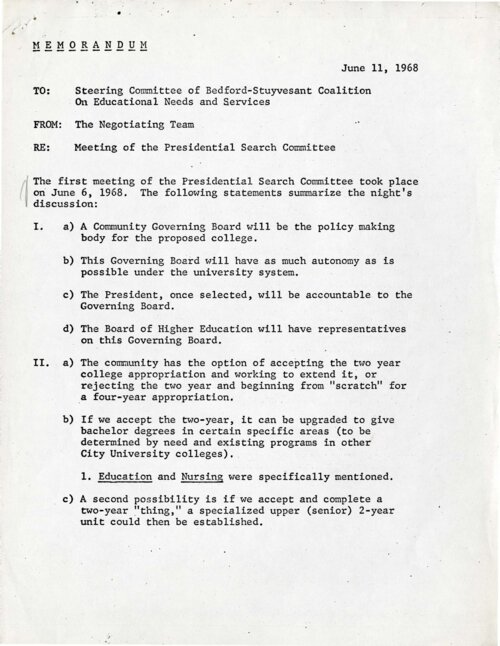 Presidential Search Negotiation Team June 6, 1968, Memo to the Bedford-Stuyvesant Coalition on Educational Needs and Services On June 6, 1968, a Presidential Search Committee comprised of five representatives from Bedford-Stuyvesant and five officials of the City University of New York (CUNY) met to discuss how they would collaborate to plan and lead a new public college in Central Brooklyn. In this memo, the Negotiation Team appointed by the Bedford-Stuyvesant Coalition on Educational Needs and Services (B-SCENS), a network of education advocacy groups and community-based organizations, outlined agreements reached with CUNY officials with respect to how the community would be represented in planning and leading the new college. Also discussed at this meeting was the key question of whether Community College 7 would be a “junior,” two-year degree granting college )as originally proposed by CUNY officials) or a “senior,” four-year degree granting college as demanded by the B-SCENS.
 -
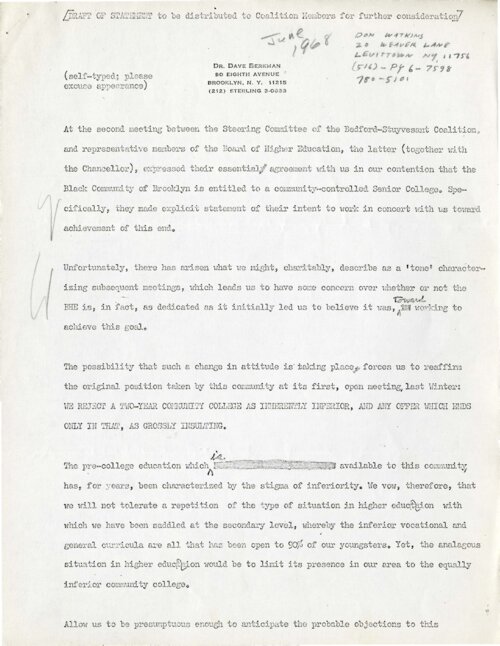 June 1968 Draft Statement for the Bedford-Stuyvesant Coalition on Educational Needs and Services (B-SCENS) In this June 1968 statement drafted for the Bedford-Stuyvesant Coalition on Educational Needs and Services (B-SCENS), Dr. Dave Berkman, Steering Committee member of the B-SCENS, presents demands for a new public college planned in and for central Brooklyn. Five months before, City University of New York (CUNY) officials had announced the establishment of “Community College 7.” In this document, Berkman lays out forceful arguments for the new college to be a “community-controlled senior college” with four-year degree granting capacities, rather than a “junior” two-year degree granting community college, as CUNY officials had originally proposed.
 -
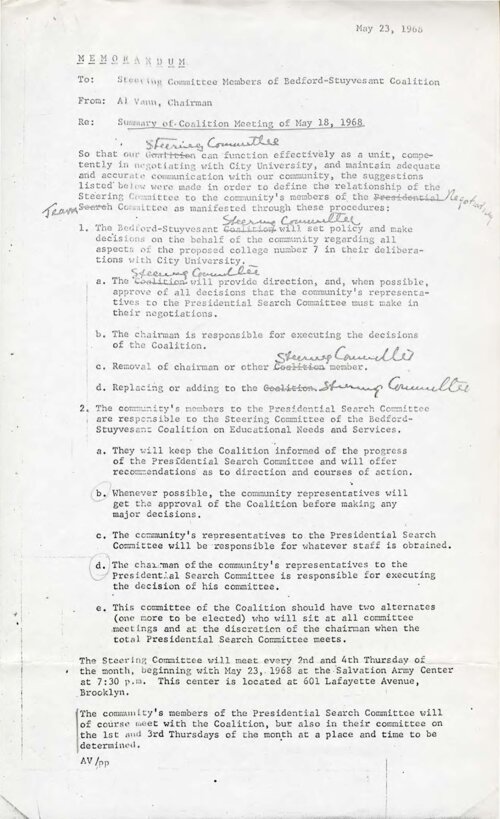 May 23, 1968, meeting minutes of the Bedford-Stuyvesant Coalition on Educational Needs and Services (B-SCENS) Steering Committee On May 23, 1968, the Steering Committee of the newly-formed Bedford-Stuyvesant Coalition on Educational Needs and Services (B-SCENS), a network of education advocacy groups and community-based organizations, met to discuss how they would represent their community in negotiations over a new public college planned in and for central Brooklyn. City University of New York (CUNY) officials had announced the establishment of “Community College 7” three weeks earlier, and had agreed to collaborate with the Central Brooklyn community in recruiting and hiring a president for the new college. At this meeting, the Steering Committee members outlined the processes by which they would be elected, and their specific responsibilities and procedures for communicating with and representing the demands of their constituents.
 -
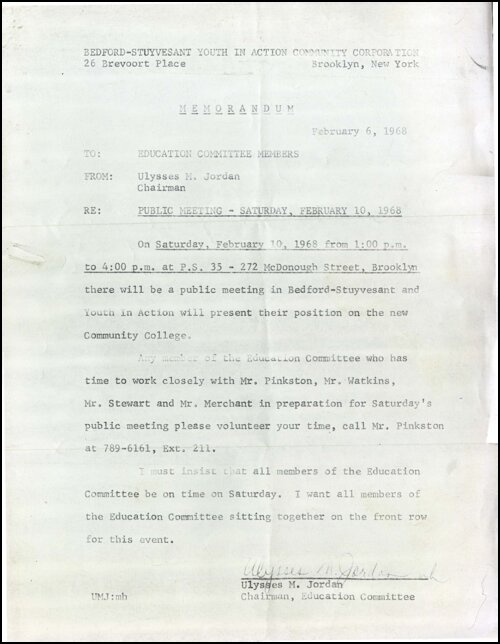 February 1968 Memo and Press Release from Youth in Action In this February 6, 1968 memo, the leaders of Youth in Action (YiA), an anti-poverty organization based in Bedford-Stuyvesant, responded to CUNY’s announcement of a new community college in their community, expressing grave concerns that community members of Central Brooklyn had not been consulted about plans or programming for the newly proposed college. In the memo, the YiA leaders invited prominent political leaders and CUNY officials, including Senator Robert Kennedy, Mayor John Lindsay, and Judge Thomas Jones to an open meeting with the Bedford-Stuyvesant community, to clarify CUNY’s plans for the new college, and respond to questions from the community.
 -
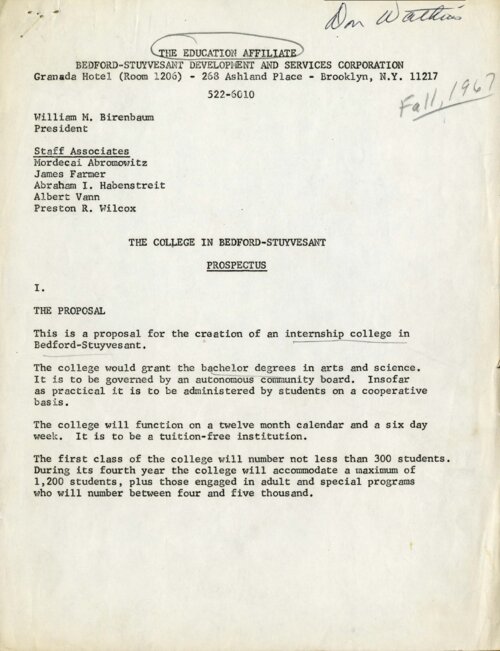 The Educational Affiliate, The College in Brooklyn: Prospectus Drafted in 1967, the Educational Affiliate, The College in Brooklyn: Prospectus, the work of the Affiliate had been inspired and supported by Senator Robert F. Kennedy. Staff of the Educational Affiliate included William Birenbaum, President, and “Staff Associates" Al Vann, James Farmer, Preston R. Wilcox, and several others. The document was headlined as a “proposal for an Internship college” and outlined a vision that included several characteristics for the proposed college that remained fundamental to the community control leaders’ demands for "Community College 7," CUNY's proposed new college in Central Brooklyn. Among these demands were free tuition and specific programs for teacher education and nursing. The language used and the programs proposed implied or assumed a four-year CUNY college would be developed.
26–45 of 45