Center for Study of Women and Society
Item set

Collection
Center for Study of Women and Society
Time Periods
1970-1977 Open Admissions - Fiscal Crisis - State Takeover
1978-1992 Retrenchment - Austerity - Tuition
1993-1999 End of Remediation and Open Admissions in Senior Colleges
2000-2010 Centralization of CUNY
2010-2020 From OWS to Covid-19
2020 and Beyond: CUNY in the Era of COVID and Racial Reckoning
Items
1–25 of 57
Advanced search
-
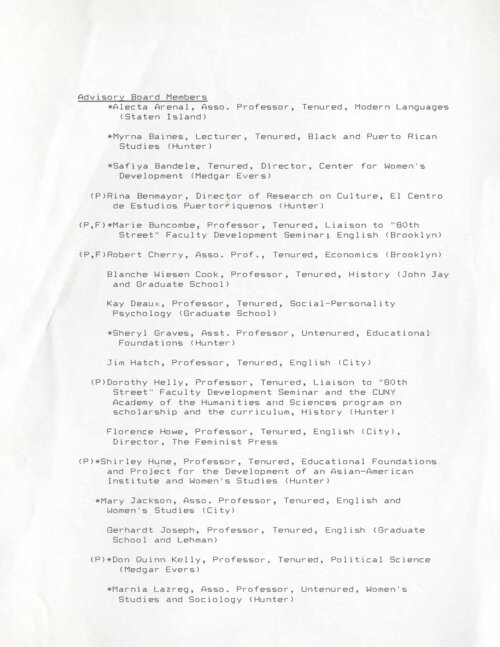 Advisory Board Meeting Agenda: Infusing Women of Color Material into CUNY Senior College Curriculum Dated March 23 and April 6, 1990, this agenda for the Advisory Board meeting for the Infusing Material on Women of Color into the Liberal Arts Curriculum of the City University of New York (CUNY) Senior Colleges served as a formal introduction to the project. It began with a list of CUNY board members from various women's, ethnic, minority studies programs. It included an overview of the project itself, the parameters set by the Ford Foundation, goals, strategies, and faculty development seminars. It then continued with a breakdown of the proposed curriculum seminars, the evaluation of the project, and the follow-up plans for disseminating information to the broader CUNY community. The Advisory Board also proposed discussing additional sources of support, the involvement of relevant programs and groups, and outlined the intended role of the Advisory Board and Procedures Committee.
 -
 Center for the Study of Women and Society Self Study – 2008 Submitted on May 7, 2008, this report on the Center for the Study of Women and Society (CSWS) was part of the City University of New York (CUNY) Center/Institute Periodic Review. The history section stated that CSWS was founded by CUNY Graduate Center faculty members Joan Kelly, Gerda Lerner, Cynthia Fuchs-Epstein, Judith Lorber, and Gaye Tuchman in 1977. Its first directors were Susan Saegert (1977-78), Mary Parlee (1979-83), and Sue Zalk (1984-93). In 1990, CSWS organized the Women's Studies Certificate Program (WSCP) for doctoral students enrolled at the Graduate Center, and since 1994, CSWS's director has also been the coordinator of the WSCP. This history was followed by the CSWS research mission, which was identified as the study of gender, sexuality, race, ethnicity, class, and nationality. The report stated that as of May 2008, the CSWS had 62 faculty associates and ran multiple programs such as the College and Community Fellowship (CCF), Community Leadership and Education After Reentry (CLEAR), Activist Women's Voices and Oral History Archive, Urban Fieldwork Internships, the Feminist Studies Group, Women Writing Women's Lives (WWWL), Visiting Scholars, Speakers Series, and three awards for students. The institutional publications were Women's Studies Quarterly, the Newsletter, and a research paper by CLEAR. The report also identified various outreach efforts by CSWS, computer resources, facilities, including the CSWS/WSCP library. This was followed by main issues and concerns, such as administrative and audience development for the Speakers Series. The report concluded with information on CSWS's faculty, students, and budget.
 -
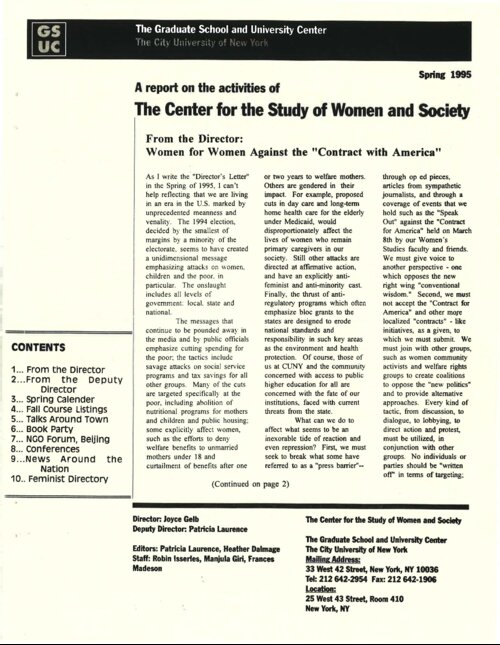 The Center for the Study of Women and Society: Report on Activities This activities report from the Center for the Study of Women and Society (CSWS) provided information for the rest of the City University of New York (CUNY) Graduate School and University Center regarding the Spring 1995 semester. It began with a letter from CSWS director, Joyce Gelb, titled "Women for Women Against the 'Contract with America,'" followed by a letter from the deputy director, Patricia Laurence. The report included the Fall 1995 course listing for the Women's Studies Certificate Program, information on newsgroups that focused on topics important to women (made available on the internet), announcements of talks and events at CSWS, CUNY, and New York City. Additional information on the United Nations NGO Forum on Women held in Beijing, relevant conferences, and news on campaigns, rallies, and calls for papers followed. Finally, a directory of CUNY feminist women faculty was also included in the report.
 -
 Expanding the Women's Activist Agenda Conference: Directory of Participants This Directory of Participants provided information on all those who participated in the "Expanding the Women's Activist Agenda: Uniting Activists, Researchers, Funders and Policymakers" conference at the City University of New York (CUNY) Graduate Center on October 16 and 17, 1995. This conference was convened by the CUNY Center for the Study of Women and Society's (CSWS) director Joyce Gelb, the CUNY Howard Samuels Center's director Marilyn Gittell, and the New York Women's Foundation executive director, Sheila Holderness. The directory provided the names and contact information of the conference's steering committee, coordinator, speakers, participants, and graduate student recorders. In total, there were 43 speakers, 100 participants, and ten student recorders.
 -
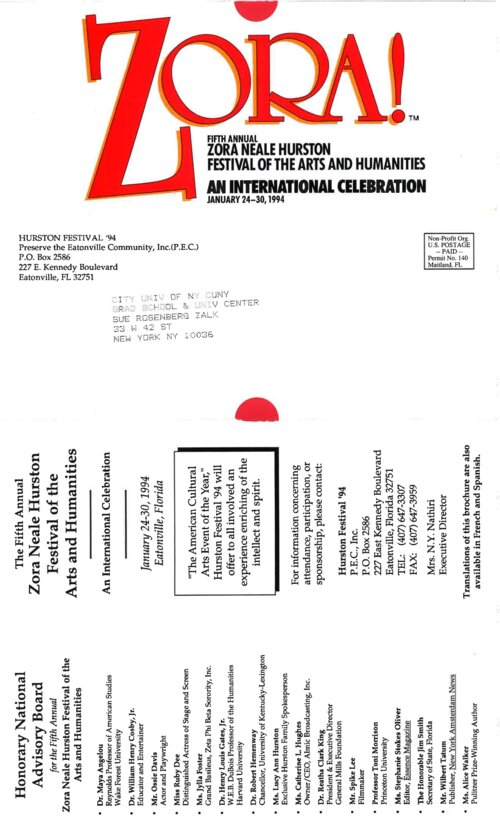 Zora Hurston Festival Pamphlet This pamphlet sent to the Center for the Study of Women and Society (CSWS) announced the Fifth Annual Zora Neale Hurston Festival of the Arts and Humanities, an international celebration, which took place from January 24-30, 1994, in Eatonville, Florida. The Association to Preserve the Eatonville Community, Inc. (P.E.C.), a non-profit historic preservation corporation, sponsored the festival. The P.E.C.'s Zora Project, named after 20th-century African-American writer, folklorist, and anthropologist Zora Neale Hurston, aimed to, among other things, explain the magnitude of contributions that persons of African descent have made to the United States' culture, a goal that aligned with CSWS's mission.
 -
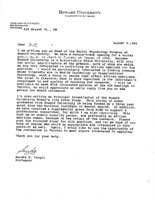 Howard University Recruitment Correspondence Indicative of the Center for the Study of Women and Society (CSWS) interest in intersectional feminism, this correspondence was sent from Dr. Sandra S. Tangri, of the Social Psychology Program at Howard University, to the director of the Center for the Study of Women and Society (CSWS), Dr. Sue Rosenberg Zalk on August 9, 1993. The fundamental purpose of the letter was to inform CSWS of an available tenure-track position for a health or organizational psychologist and a postdoctoral researcher position to work on the Howard University Women's Life Paths Study, which had received a three-year grant from the National Institute of Mental Health (NIMH). Due to Howard University's status as a historically Black university and the intersectional nature of the work, Dr. Tangri was looking for African American women to fill the positions. She informed Dr. Zalk that she would be available for interviews at the American Psychological Association (APA) convention meetings in Toronto later that year. Included was a flyer for the researcher position for CSWS to post for its members to see.
 -
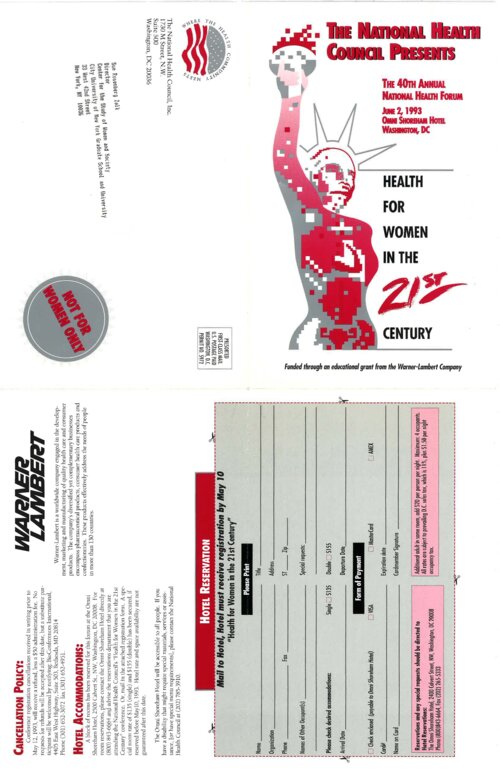 The National Health Organization for Women's Health in the 21st Century Program This pamphlet for the National Health Council's (NHC) 40th Annual Health Forum titled "Health for Women in the 21st Century," held on June 2, 1993, in the Omni Shoreham Hotel in Washington, DC, was sent to the Center for the Study of Women and Society (CSWS) due to its interdisciplinary approach to curriculum. According to the pamphlet, the forum was funded through an educational grant from the Warner-Lambert Company. This forum was for policymakers and the public. It aimed to examine the impact of changing demographics, forecasts for medical research and health delivery advancements, and other major societal trends impacting women's health. It wanted to stimulate long-term, visionary thinking in the healthcare industry and the public sector to create a healthier future for women. This pamphlet included the preliminary program agenda, the registration form, and a hotel registration form.
 -
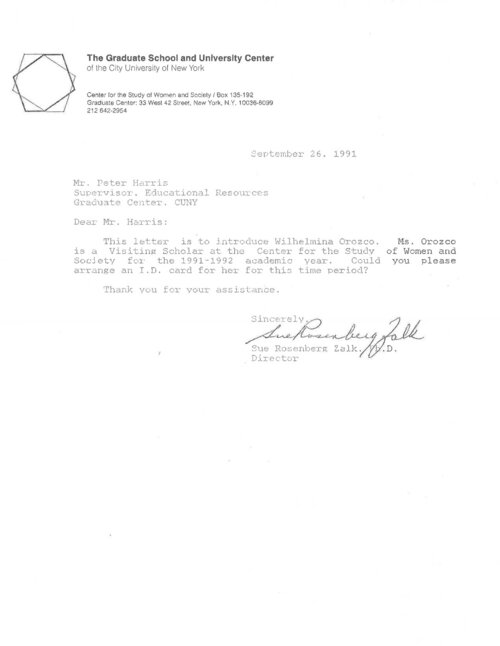 A Series of Correspondences between Zalk and Orozco Through the Visiting Scholar program, The Center for the Study of Women and Society (CSWS) supported international scholars impacting communities far beyond CUNY. This 1991-93 collection of primary materials showed the profound and lasting involvement Wilhelmina Orozco – who ran a literacy program for elderly women in Tondo, Philippines – had with the CSWS. Included are letters of support from CSWS, Dr. Sue Rosenberg Zalk, and proof of approval by the City University of New York (CUNY) Graduate Center's Dean for Research and University Programs, Solomon Goldstein. Orozco's correspondence thanked Dr. Zalk and the rest of CSWS for their hospitality and support during her five months in New York. During which, she stated, she was able to produce and edit: two videos, network with various women's groups and film collectives, coordinate a festival of Filipino women's films, participate in workshops, produce two literacy primers, and more, including writing an essay on the outcome of Anita Hill's testimony on the hearings for Clarence Thomas's confirmation to the Supreme Court of the United States. Further documents included an application to the 1992-1993 Rockefeller Humanist-in-Residence Program at the City University of New York (CUNY) Hunter College's Women's Studies Program for a project titled, "Media Portrayal of Philippine and American Women and Its Relationship to the Political Directions of the Women's Movements During the Period of American Colonization of the Philippines, 1898 – 1946". In their entirety, the files illustrate Orozco's dedication to the women's movement and the international advancement of women through scholarship, the arts, and activism.
 -
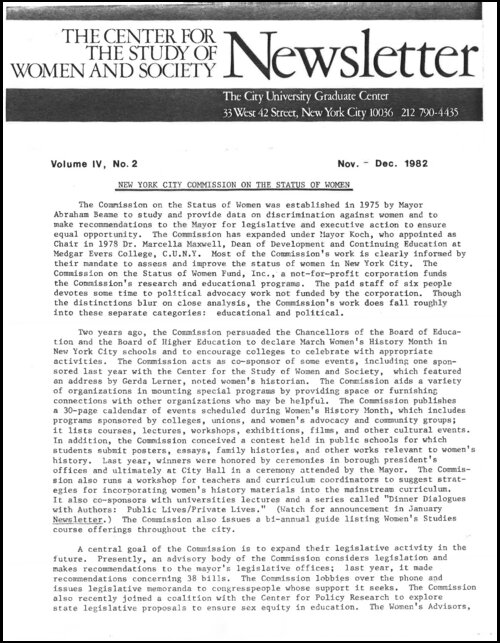 Center for the Study of Women and Society: Newsletter Volume IV, No. 2 This 1982 newsletter from the Center for the Study of Women and Society (CSWS) began with an article called "New York City Commission on the Status of Women," where editor described the commission's work as educational and political. The piece detailed the educational outreach work of the commission, especially during Women's History Month, legislative activity, and publications. An "Awards" section included submission information for the Research on Women in Education Award, the Fourth Annual Curriculum Materials Award, the Martha Bruner Scholarship Program, fellowships for graduate studies, the Annual Prize for Outstanding Psychological Research on Women, and research awards in economics and education. Information about the CUNY Feminist Network Conference, the Joan Kelly Education Fund, a summer institute, and a recent feminist publication was included in the "CUNY News" section. This was followed by the "Calls for..." section with solicitations for proposals for a Conference on Women in Music; the Sixth Berkshire Conference on the History of Women, the New York Women's Studies Association Newspaper, and beyond. The "Announcements" section included information on the showing of a play, workshops, a consulting service, a symposium, a seminar, courses, and conferences. The Newsletter closed with information on obtaining various feminist publications, dramas, and films that were ready for purchase or viewing.
 -
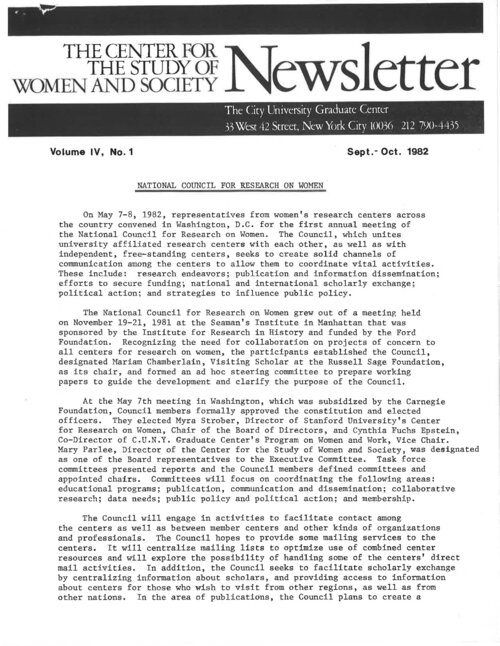 Center for the Study of Women and Society: Newsletter Volume IV, No. 1 The Center for the Study of Women and Society's (CSWS) 1982 Newsletter opens with Lisa Master's piece on the National Council for The Center for the Study of Women and Society's (CSWS) 1982 Newsletter opens with Lisa Master's article on the National Council for Research on Women that met in Washington, DC on May 7-8, 1982. Its aim was to network women's centers across the nation – both independent and at universities – and create various channels for communication, the exchange of ideas, and facilitate collaboration. Following this meeting, the Council would base its activities at CUNY Hunter College's Roosevelt House. Seminars, research awards, and a one-day conference were among other items enumerated in the "CUNY News" section. In the "Women's Studies" section, readers could find a list of Women's Studies courses offered at the CUNY Graduate Center in the Fall semester of 1982. Finally, the "Resources" section provided information on a directory for women's organizations in New York City, non-profit promoting women in the musical arts and beyond.
 -
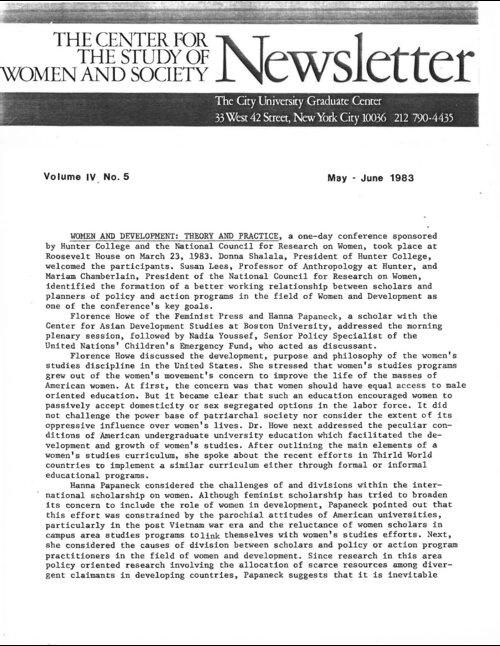 Center for the Study of Women and Society: Newsletter Volume IV No. 5 This 1983 issue of the Newsletter from the Center for the Study of Women and Society (CSWS) opened with Eleanor Fapohunda reviewing Women and Development: Theory and Practice, a one-day conference on March 23, 1983. One of the conference's stated goals was to create a better relationship between academics, activists, and policymakers. This was followed by the "Calls for..." section, which included solicitations for papers, posters, and monetary contributions. The "Resources" section shared information on support groups, publications, photographs, films, and databases, while the "Women's Studies" section provided information on seven interdisciplinary courses offered at the CUNY Graduate Center for the upcoming Fall 1983 semester. The "Book Reviews" section contained a review by Eve Hochwald of "The Working Mother: A Survey of Problems and Programs in Nine Countries" by Alice H. Cook and "Flexi-Time: Where, When and How?" by Pam Silverstein and Jozetta H. Srb. The Newsletter concluded with a list of professional opportunities available to Center members, including a manuscript competition, a new degree program, an institute, and fellowships.
 -
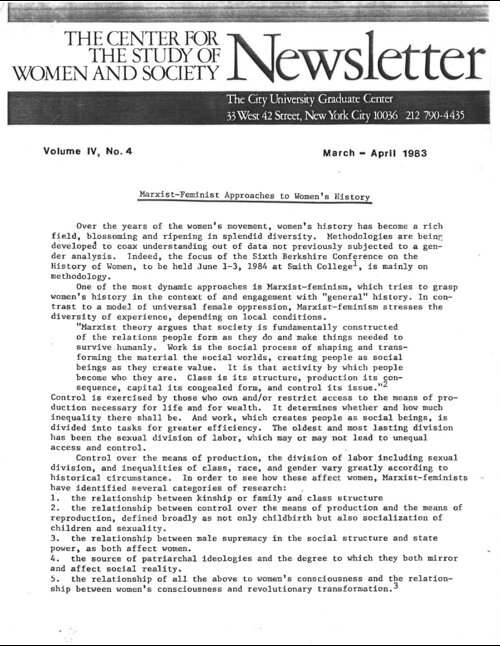 Center for the Study of Women and Society Newsletter: Volume IV, No. 4 The Center for the Study of Women and Society (CSWS) 1983 Newsletter opens with Renate Bridenthal's Marxist-Feminist Approaches to Women's History. In this piece, Bridenthal explained how feminist Marxists used Marxist theory in their research. Bridenthal then provided a literary review of recent publications guided by Marxist-feminism. The "Calls for..." section contained solicitations for abstracts, essays, memorabilia, and papers. The "CUNY News" section provided information on conferences, and beyond while the "Women and Health" section reported on the tenth anniversary of the Supreme Court legalization of abortion. The section titled "CUNY Feminist Network" reported on the formation of a new coalition to assess childcare needs across CUNY's campuses, the founding of a feminist newspaper at Brooklyn College, submission information for the directory of feminist scholars, and the creation of a feminist study and support group. It also reported preliminary conversations on the need for a Graduate Student Union. The "Book Review" section provided readers with Mary Clare Lennon's review of Lucy Gilbert and Paula Webster's "Bound by Love: The Sweet Trap of Daughterhood". The Newsletter closed with professional opportunities and other resources available to the Center's members.
 -
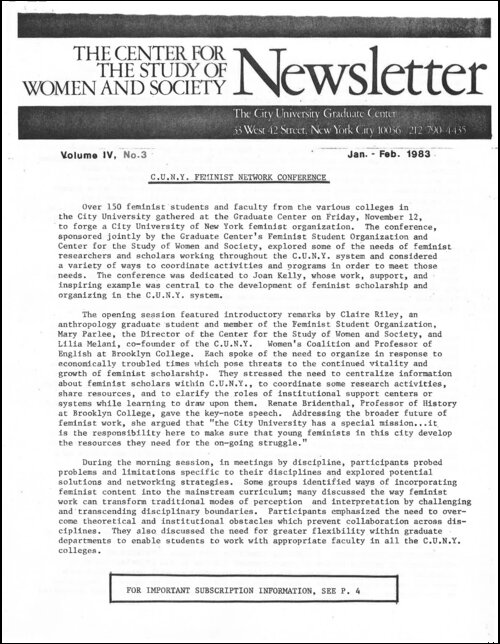 Center for the Study of Women and Society: Newsletter Volume IV, No.3 The Center for the Study of Women and Society's (CSWS) 1983 Newsletter opens with a review of the CUNY Feminist Network Conference, which convened on November 12, 1982. Lisa Master reported that the conference aimed to create a CUNY-wide feminist organization. Over 150 feminist students and faculty from various CUNY campuses attended. Participants agreed to continue in working groups that would then collaborate. In closing remarks, Terry Haywoode, a sociology doctoral student, noted the absence of women of color at the conference and urged participants to strive for more inclusivity. The Newsletter also reported on the activities of a CUNY-wide child care coalition and the CUNY Women's Coalition Annual Spring Conference. Following these reports, the Newsletter provided a list of Women's Studies courses at the CUNY Graduate Center being offered in the Spring semester of 1983. It also included opportunities available to professors and department chairs, fellowships, and calls for articles, papers, and speakers for a range of publications and events. Upcoming conferences, courses, laws, organizations, meetings, and additional resources were enumerated in the "Announcements" section. And finally, Dr. Peter Steinbook reviewed Dr. Lynn Atwater's book "The Extramarital Connection: Sex, Intimacy, and Identity."
 -
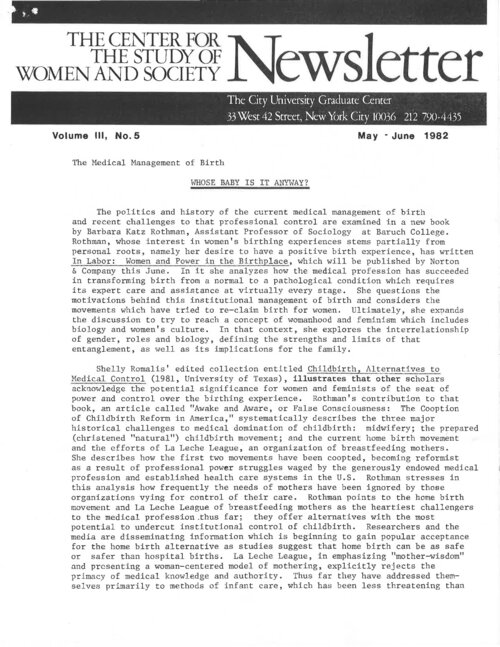 Center for the Study of Women and Society: Newsletter Volume III, No. 5 Center for the Study of Women and Society's (CSWS) May-June 1982 Newsletter began with an analysis of medical management of birth. Referencing Barbara Katz Rothman's "In Labor: Women and Power in the Birthplace." the editor argued for changes in insurance policies, laws, and licensing concerning midwives and birthing. Information on the Women and Health Research Group, which met under the guidance of the Center, was also provided. Details on seminars and workshops on childbirth followed. The Newsletter then announced two new interdisciplinary courses in the Women's Studies curriculum. The "Conferences" section provided details on six different conferences whose topics ranged from sexuality to domestic violence. Dr. Leigh Marlowe reviewed "Woman's Creation: Sexual Evolution and the Shaping of Society" by Elizabeth Fisher, followed by announcements on the National Association of Commissions for Women 13th Annual Convention; an upcoming demonstration by the Committee for Abortion Rights and Against Sterilization Abuse; the Hatch Amendment; Title IX; CUNY's Policy on Sexual Harassment which had been issued in January of that year; the Consortium for Educational Equity; the Support for Orthodox Victims of Rape and Incest counseling service; Women USA; and the Project on the Status and Education of Women. The "Media Update" section contained information on feminist publications that included Heresies, Working Papers on Women in International Development, and the Women's Independent Film Festival. This Newsletter was the last issue for the 1981 - 1982 academic year.
 -
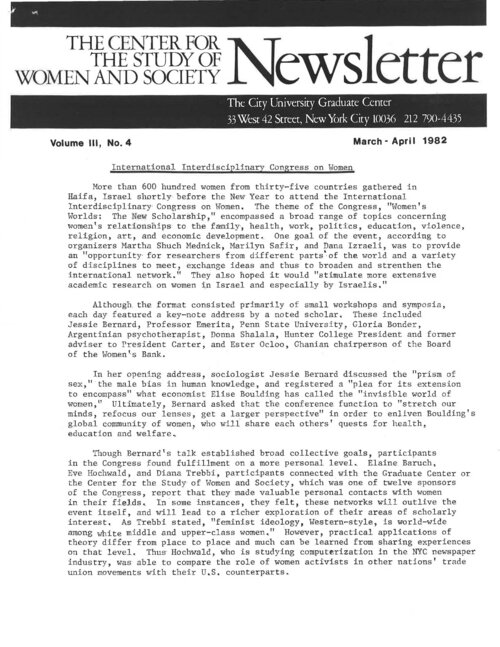 Center for the Study of Women and Society: Newsletter Volume III, No. 4 The Center for the Study of Women and Society's (CSWS) 1982 Newsletter was the first issue to feature the Center's current name; previous issues had all used "the Center for the Study of Women and Sex Roles." The Newsletter opened with a report on the International Interdisciplinary Congress on Women, held in December 1981 in Haifa, Israel, where more than 600 women from 35 countries attended. The Congress's theme "Women's Worlds; The New Scholarship" aimed at providing an opportunity for international and interdisciplinary conversations that would, in turn, spark an interest in the research of Israeli women by Israelis. The Center was one of 12 sponsors for the Congress, and some of its members could attend. The report on the International Interdisciplinary Congress on Women was followed by announcements from the Women Office Workers group, on the Equal Rights Amendment, from the Committee for Abortion and Against Sterilization Abuse, and for a demonstration for International Women's Day. Announcements for a workshop about the effects of technology on the work of secretaries, a 13-part series by the Sisterhood of Black Single Mothers, and other conferences, lectures were followed by calls for papers, publications that were of interest to Center members. The last section of the Newsletter, Rosemary Deem, reviewed "Schooling for Women's Work" by Dr. Beatrice Kachuck and a letter to the editor.
 -
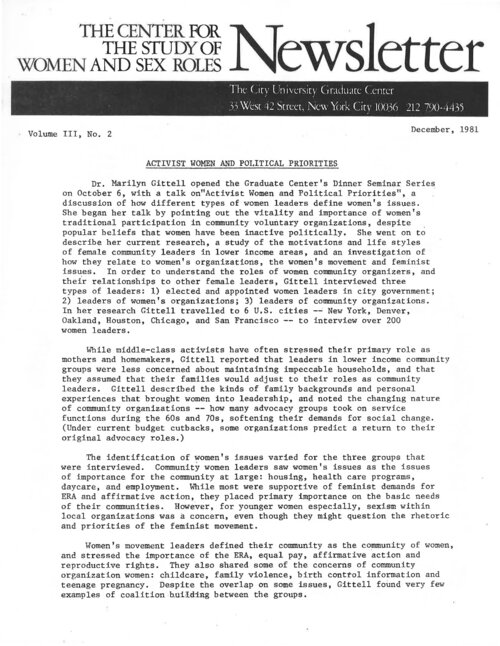 Center for the Study of for the Study of Women and Sex Roles: Newsletter Volume III, No. 2 The Center for the Study of Women and Society's (CSWS) 1981 Newsletter began with a report on Dr. Marilyn Gittell's talk on October 6, 1981, called "Activist Women and Political Priorities." This talk discussed how different types of women leaders defined women's issues. Dr. Gittell's research studied the motivations and lifestyles of female community leaders in lower-income areas and how they relate to women's organizations, the women's movement, and feminist issues. The talk concluded with the possibility of coalition-building among different groups to overcome class and race differences. The Newsletter continued with an invitation to the Center's holiday party on December 14 at 4 PM in the Center's new office, followed by calls for papers, various conferences, a symposium, and a rally. Dr. Eleanor Leacock reviewed "Comparative Perspectives of Third World Women: The Impact of Race, Sex, and Class" by Beverly Lindsay, and Ann Saltzman reviewed "Women of Spirit: Female Leadership in the Jewish and Christian Traditions" by Rosemary Ruether and Eleanor McLaughlin. The Newsletter closes with announcements for upcoming conferences, lecture series, colloquiums, submissions, fellowships, and updates on other publications.
 -
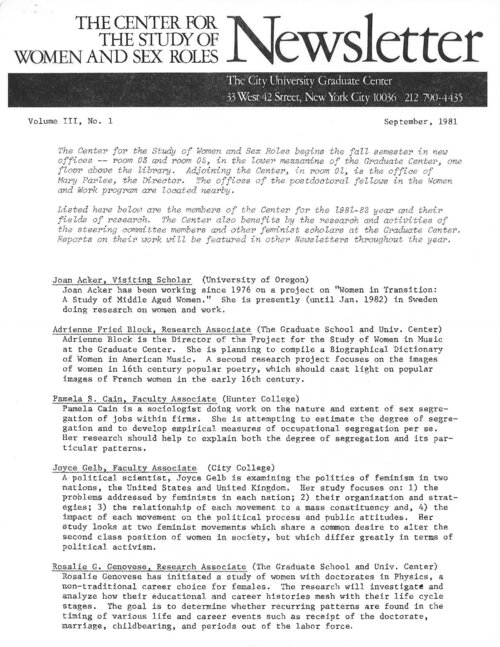 Center for the Study of for the Study of Women and Sex Roles: Newsletter Volume III, No. 1 The Center for the Study of Women and Sex Roles 's – now the Center for the Study of Women and Society (CSWS) – first issue of the third volume of the 1981 Newsletter informed readers of the Center's new office locations; and enumerated and described the research of fourteen of its 1981 – 1982 members. Four Women's Studies courses being offered at the CUNY Graduate Center in 1981 followed. It also promoted the Brown Bag Luncheon Seminars, which occurred twice a month to discuss works in progress. The Newsletter contained two book reviews: Joyce Gelb's review of "Access to Power: Cross National Studies of Women and Elites" by Cynthia Fuchs Epstein; and Rose Laub Coser and June Nash's review of "Between Money and Love: The Dialectics of Women's Home and Market Work" by Natalie J. Sokoloff. The Newsletter closes with announcements about a film festival, submission information for a research award, foundations and grants, teaching opportunities, and a colloquium.
 -
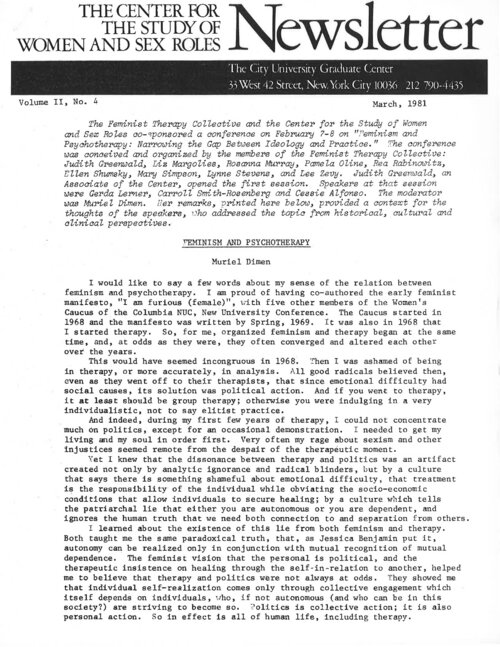 Center for the Study of for the Study of Women and Sex Roles: Newsletter Volume II, No. 4 This issue of the Newsletter dated March 1st, 1981 by the Center for the Study of Women and Sex Roles – now the Center for the Study of Women and Society (CSWS) – opened with Muriel Dimen's remarks from the "Feminism and Psychotherapy: Narrowing the Gap Between Ideology and Practice" conference co-sponsored by the Feminist Therapy Collective and the Center for the Study of Women and Sex Roles. The remarks provided context for the conference's focus: the relationship between feminism, political activism, and individual and group therapy. News concerning the Center's upcoming Newsletter, grants, educational televisions series program, an upcoming institute, and the creation of the Center for Feminism and Psychotherapy followed. The Center solicited monetary support for the Newsletter due to the Center's growth and 50% more subscriptions. The Newsletter then listed events the Center was sponsoring and announced external events and opportunities of interest to Center members. The Newsletter closes with a book review of Sokoloff's publications written by June Nash from CUNY City College's Anthropology Department.
 -
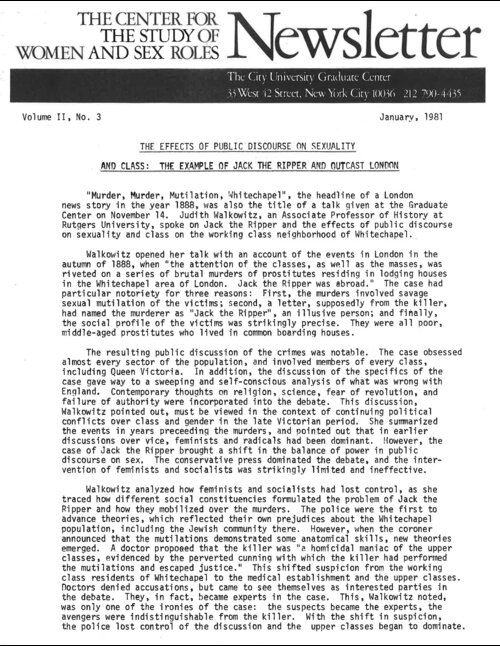 Center for the Study of for the Study of Women and Sex Roles: Newsletter Volume II, No. 3 This January 1, 1981 issue of the Newsletter from the Center for the Study of Women and Sex Roles – now the Center for the Study of Women and Society (CSWS) – began with an in-depth piece on Judith Walkowitz's November 14 talk at the CUNY Graduate Center: "Murder, Murder, Mutilation, Whitechapel." This talk focused on the notorious Jack the Ripper and how the working class of Whitechapel, England were affected by a public discourse on sexuality and class. Walkowitz claimed that conservatives dominated the conversation while feminists and socialists were sidelined. Interestingly, as more details emerged, his presumed social class and education level changed, altering the public discourse, and leading to the police losing control over the narrative. This thought-provoking piece was followed by information on five Women's Studies courses that were to be taught at the Graduate Center that Spring 1981. The Newsletter announced two upcoming conferences on feminist psychology and health practices. It also issued a call for papers from the International Psychohistorical Association and the Society for Menstrual Cycle Research. It closed with the Center's reading recommendations on recent publications.
 -
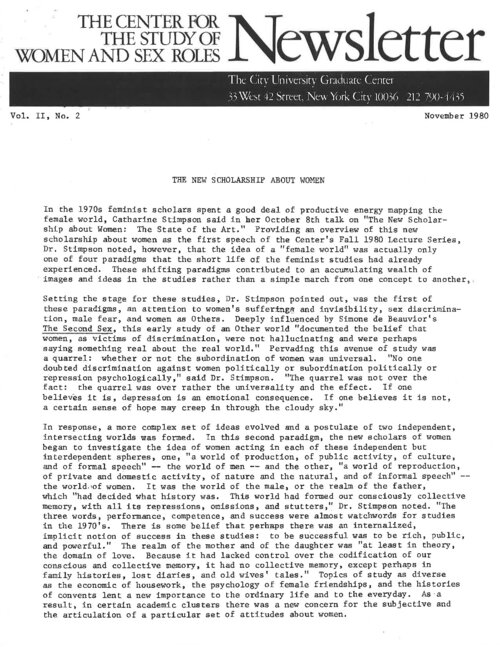 Center for the Study of for the Study of Women and Sex Roles: Newsletter Vol. II, No. 2 This November 1, 1980 Newsletter issued by the Center for the Study of Women and Sex Roles - now the Center for the Study of Women and Society (CSWS) - began with an excerpt by the Newsletter's editor, Nancy Brocklehurst. The excerpt provided context and further explanation to Catharine Stimpson's talk on October 8 called "The New Scholarship about Women: The State of the Art." The excerpt traced the movement of women's studies from a field that focused on women's sufferings, invisibility, and sex discrimination, among other things, to a field that focused on how biological differences - namely in a reproductive sense - influenced culture, education, ideology, and socialization. Notes followed this introduction on the Association for Women in Psychology, the Committee to End Sterilization Abuse, a political science course, and a support group for mothers in New Jersey. The Center also enumerated the Women's Educators' Fourth Annual Research on Women in Education Award, grants, fellowships, networks, projects, calls for papers, jobs, and conferences. The Newsletter closed with events the Center was sponsoring in November and December 1980.
 -
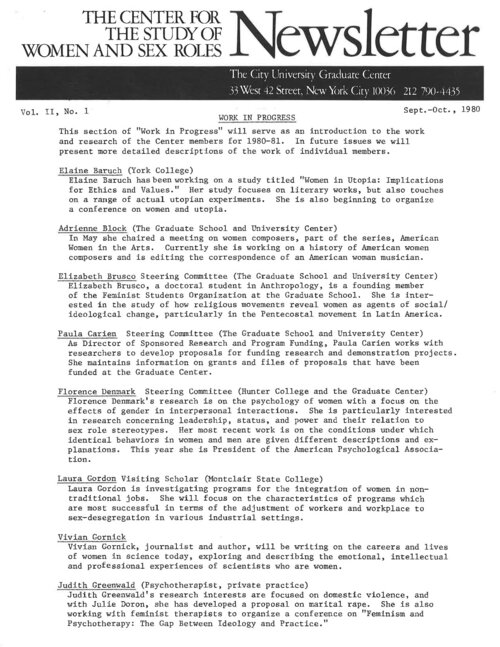 Center for the Study of for the Study of Women and Sex Roles: Newsletter Vol. II, No. 1 This 1980 issue of the Newsletter by Center for the Study of Women and Sex Roles - now the Center for the Study of Women and Society (CSWS) - dedicated its "Work in Progress" section to introduce the research twenty-six of its members would be engaged in during the 1980-1981 academic year. Its "Notes and Announcements" section included information on the International Congress of Psychology, information on the Sociologists for Women in Society, the New York Chapter of the Association for Women in Psychology, and submission information for the Research on Women in Education Award. Women's Studies courses offered at CUNY's Graduate Center in the Fall semester of 1980 followed. Also provided were information on the Women and Urban Environments Study Group, the Women and Health Research Group, the Feminist Methods of Inquiry Seminar, and the announcement of a training grant on the sociology and economics of women and work. The Newsletter closed with the list of events the Center was sponsoring for September and October 1980.
 -
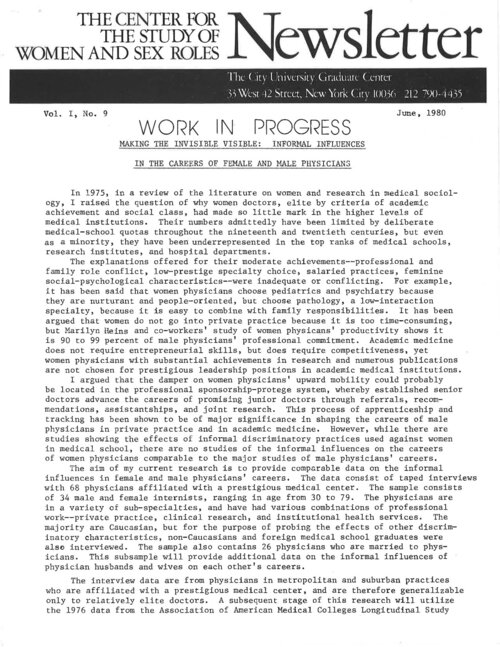 The Center for the Study of Women and Sex Roles: Newsletter Vol. I, No. 9 The Center for the Study of Women and Sex Roles - now the Center for the Study of Women and Society's (CSWS) June 1980 Newsletter began with a piece by Judith Lorber discussing her research. Her objective was to identify invisible barriers and informal influences on male and female physicians' careers, particularly those preventing qualified female physicians from advancing in their fields. This report was followed by information on research and faculty associates – and visiting scholars joining the Center members in 1980-1981. The Women's Studies Program at CUNY's Graduate Center also provided information on course offerings. A reflection on the concert and panel discussion by women composers held the previous month preceded announcements on employment opportunities, book competitions, conventions, grants, resources, and activism work.
 -
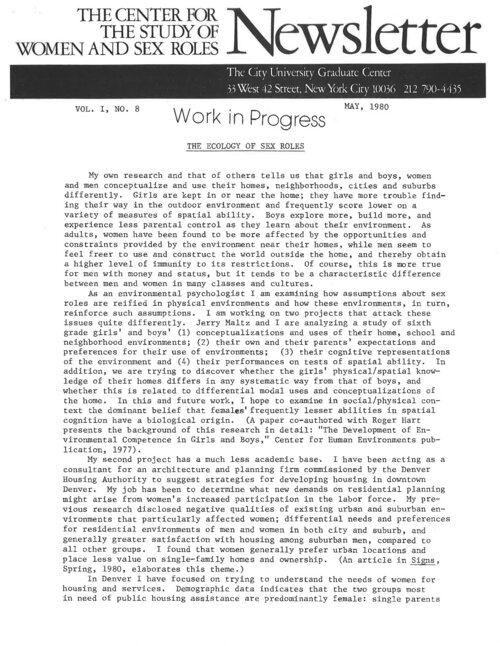 The Center for the Study of Women and Sex Roles: Newsletter VOL. I, NO. 8 The Center for the Study of Women and Sex Roles – now the Center for the Study of Women and Society's (CSWS) May 1980 Newsletter opens with a piece by Susan Saegert describing her research and the questions she wished to address in her upcoming course: "The Ecology of Sex Roles" for the Environmental Psychology Program. The questions addressed women's traditional status as caretakers played in urban planning, politics, and policymaking. New projects conducted by Center members Rita Guttman, Barbara Katz-Rothman, and Judith Lorber, who worked on subjects ranging from activism to health, were enumerated. The Newsletter also provided updates on graduate students' activities, such as a workshop by the Feminist Students Organization. The workshop was about feminist publishing, with representation from feminist journals discussing their publication's objective, their criteria for accepting articles, and what it meant to be a feminist scholar. The Newsletter concluded with a list of events the Center was sponsoring in May 1980.
 -
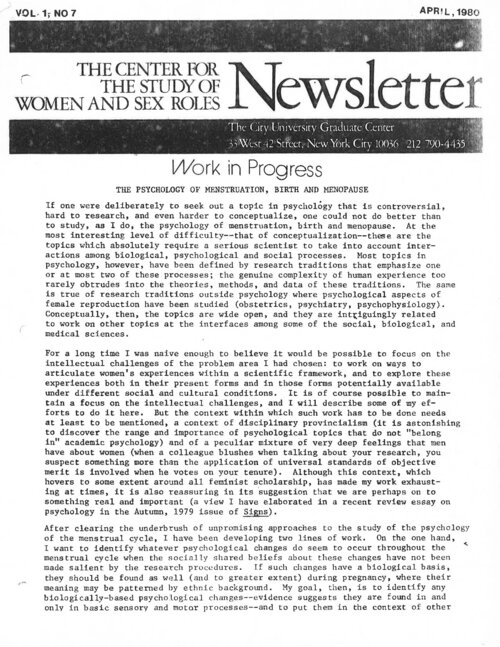 The Center for the Study of Women and Sex Roles: Newsletter VOL, 1, NO 7 The April 1980 Newsletter from the Center for the Study of Women and Sex Roles – now the Center for the Study of Women and Society (CSWS) – began with a note from the director, Mary Brown Parlee, where she discussed her research on the connection between biological, psychological, and social processes, particularly around menstruation. The "Work in Progress" section reported on Gaye Tuchman's social history of women writers and artists, which was followed by an advertisement for Rayna Rapp's talk on "Thinking About Sex as a Social Relationship." Also included were announcements for upcoming fellowships, research opportunities, a part-time position, lectures, workshops, and conferences. This Newsletter also reported on the Asian American Women's Conference, which aimed to identify the educational problems Asian/Pacific American women faced; develop strategies to work with the nation's educational systems to address the issues, and plans to report on those findings at the next national conference. The Newsletter closed with a list of the Center's events for April 1980.
 -
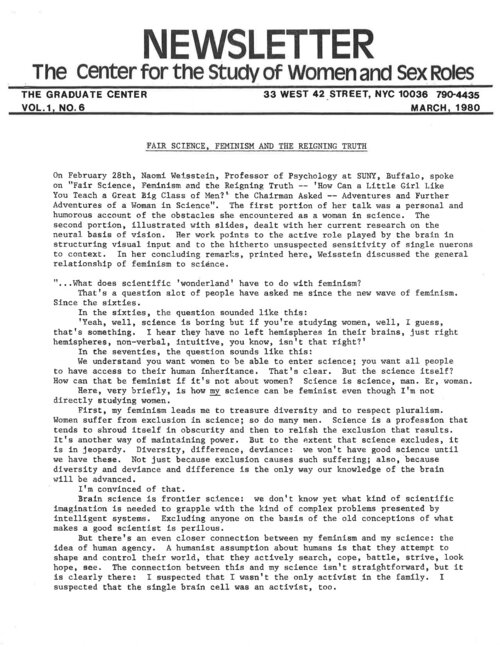 The Center For the Study of Women and Sex Roles: Newsletter VOL.1 NO. 6 The Center for the Study of Women and Sex Roles – now the Center for the Study of Women and Society's (CSWS) – March 1980 Newsletter began with a reflection on Naomi Weisstein's talk at SUNY Buffalo on February 28, 1980. Called "Fair Science, Feminism and the Reigning Truth – 'How Can a Little Girl Like You Teach a Great Big Class of Men?' The Chairman Asked – Adventures of a Woman in Science," this talk focused on the obstacles Professor Weisstein faced as a woman in science and her research. The Newsletter reprinted Weisstein's concluding remarks on the relationship between feminism and science. Specifically, she discussed how science had historically excluded women (and some men) and how this was detrimental to science itself. According to Weisstein, feminism allowed women to be scholars, scientists, and makers of change. The Newsletter also contained information on writing grants, announcements for conferences, courses, upcoming publications, and employment opportunities. Lastly, the Newsletter highlighted the work of two feminist scholars: Heidi Hartmann and Rayna Rapp. It closed with a list of the Center's events for March 1980.
1–25 of 57