Center for Study of Women and Society
Item set

Collection
Center for Study of Women and Society
Time Periods
1970-1977 Open Admissions - Fiscal Crisis - State Takeover
1978-1992 Retrenchment - Austerity - Tuition
1993-1999 End of Remediation and Open Admissions in Senior Colleges
2000-2010 Centralization of CUNY
2010-2020 From OWS to Covid-19
2020 and Beyond: CUNY in the Era of COVID and Racial Reckoning
Items
26–50 of 57
Advanced search
-
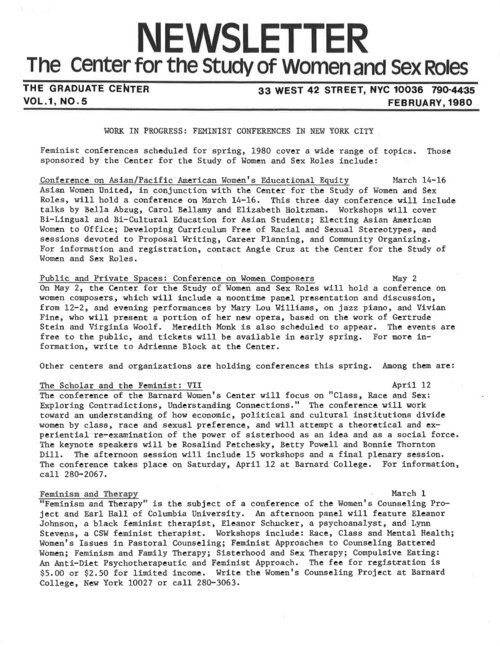 The Center For the Study of Women and Sex Roles: Newsletter VOL.1, NO. 5 The February 1980 issue of the Newsletter from the Center for the Study of Women and sex Roles – now the Center for the Study of Women and Society (CSWS) – covered the feminist conferences sponsored by the CSWS; the first on Asian and Pacific American women's education and the second focused on women composers. Further featured conferences discussed topics such as the division of women based on class, race, and sexual preferences; feminism in therapy; alternatives to academia; and motherhood. The Newsletter provided Center members with a list of events for the spring semester, including lectures, conversations with researchers, seminars, study groups, job notices, and calls for papers. The Newsletter ended with notes, announcements, and a list of events sponsored by the Center in February 1980.
 -
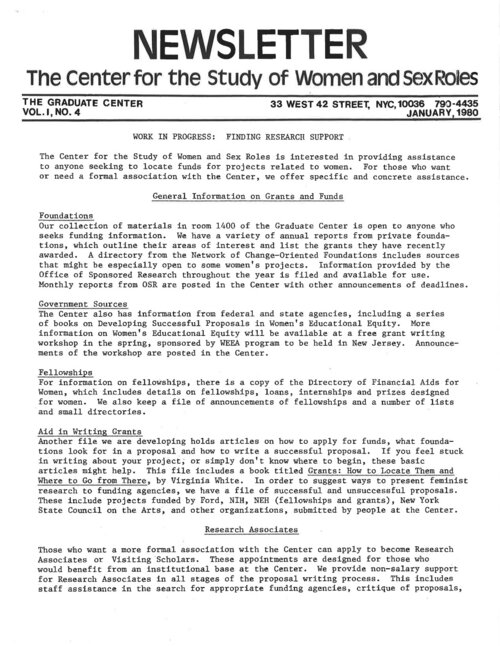 The Center For the Study of Women and Sex Roles: Newsletter VOL. I, NO. 4 The Center for the Study of Women and Sex Roles – now the Center for the Study of Women and Society's (CSWS) January 1980 Newsletter – focused on grants and funds available to its members. The issue provided information on foundations, government sources, fellowships and offered guidance in grant writing. The enumerated funding opportunities included private foundations, federal and state agencies and emphasized financial aid specific for women. Successful and unsuccessful grant proposals for Ford, the National Institute of Health (NIH), National Endowment for the Humanities (NEH), and the New York State Council on the Arts were printed to offer guidance in the grant writing process.
 -
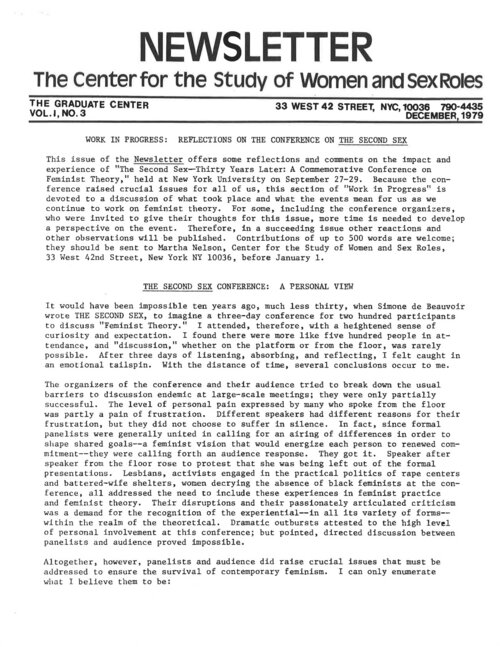 The Center for the Study of Women and Sex Roles Newsletter: The Center for the Study of Women and Sex Roles Newsletter: Vol. 1, No. 3 The Center for the Study of Women and Sex Roles – now the Center for the Study of Women and Society's (CSWS) – December 1979 Newsletter began with reflections on The Second Sex Conference, which commemorated the publication of Simone de Beauvoir's seminal book thirty years ago. The reflections focused on the event organizers, attendees, and participants' unaddressed question: what is feminism, and who gets to represent it? Following this discussion, the Newsletter called for submissions for the Women's Studies Journal, a peer-reviewed journal for the study of women across disciplines, focused on the relationship between feminist theory and academic tradition. The journal's interdisciplinary nature was underscored, inviting submissions to interest a wide range of readers.
 -
 The Center for the Study of Women and Sex Roles Newsletter: Vol. I, No. 2 The Center for the Study of Women and Sex Roles – now the Center for the Study of Women and Society's (CWSW) – November 1979 Newsletter contained notes, announcements, and information on women's studies programs and events at different City University of New York (CUNY) colleges. This particular Newsletter was critical because it was the first publication to focus on the importance of an international network of feminist scholars. Paula Webster recognized that there was no place in the United States where feminist scholars of different communities could share their work and communicate their findings in a setting that was not strictly academic. She envisioned a space where various pieces pertinent to the international women's movement could be translated, collaborated on, and distributed on a much broader scale. The Newsletter also provided a list of events the Center was offering for November 1979.
 -
 The Center for the Study of Women and Sex Roles Newsletter: Vol. 1, No. 1 The Center for the Study of Women and Sex Roles – now the Center for the Study of Women and Society's (CWSW) – October 1979 Newsletter, was the first issue published for its members and those interested in the Center's activities. This early Newsletter outlined its objective: to be a place where the Center could share information about projects and research within the City University of New York (CUNY) and feminist scholarship and developments in the women's movement beyond the university. Additionally, it stated its mission to create a network for feminist scholars, researchers, and activists. The Newsletter reported on twenty-one in progress research projects, five seminars and study groups, notes and announcements on rallies, brochures, events, studies, and job openings. The Newsletter closed with a list of the Center's events for October 1979.
 -
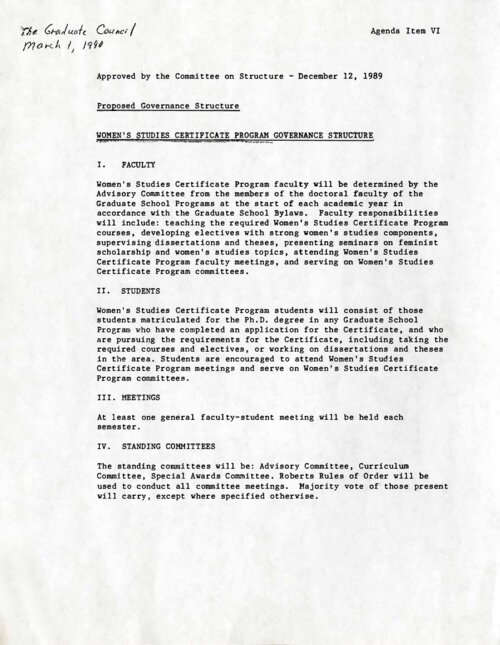 WSCP Approved Governance Structure This document contained the proposed governance structure for the Women's Studies Certificate Program (WSCP) to be approved by the City University of New York (CUNY) Graduate School's Graduate Council on March 1, 1990. The proposal included information on the faculty, students, meetings, committees, liaisons, and how to propose governance changes, which WSCP Committee approved on December 12, 1989. Furthermore, the proposal specified that the Advisory Committee would choose faculty from existing doctoral faculty at the Graduate School, and their responsibilities would include teaching required courses, developing electives, supervising dissertations and theses, presenting at seminars, attending faculty meetings, and serving on the program's committees. Students could be anyone matriculated in a Graduate School doctoral program and would be encouraged to attend meetings and serve on committees. The Advisory Committee would consist of nine faculty members and four students from the arts and humanities, social sciences, and sciences, two alternative faculty members, and two alternative students. The Center for the Study of Women and Society's (CSWS) director would be an ex-officio, non-voting member. The committee would also include one non-voting student from the Master of Arts in Liberal Studies (MALS) program and one non-voting, ex-officio co-chair from the Feminist Students Organization. The governance would include a Curriculum Committee and a Special Awards Committee. All voting would occur via mail-in ballot, and any changes in governance could be proposed by any WSCP faculty or student.
 -
 WSCP Proposal Evaluation Report This review of the Advanced Certificate Program in Women's Studies Proposal from August 1988 reiterated the need and importance of such a program at the City University of New York (CUNY). Dr. Evelyn Torton Beck wrote that the proposed program had all the necessary components to be successful: a good balance of core and individualized courses; thirty faculty from various doctorate programs at the Graduate School and University Center (Graduate Center) among the most productive and respected in their fields; high demand for such a program and qualified graduates with such certification; and the ability for implementation without additional resources. This report was completed for the New York State Education Department Cultural Education Center and identified the certificate program as a much-needed and long overdue addition to CUNY.
 -
 Women's Studies Certificate Program (WSCP) Proposal This proposal for a certificate program in Women's Studies at the City University of New York (CUNY) Graduate School and University Center (Graduate Center) provided the purpose and objectives, need, and curriculum for such a program. The author asserted that the proposed certificate program was a response to a clear need for graduate education in New York City in Women's Studies, which had established itself as an independent and interdisciplinary field of inquiry internationally for fifteen years. The CUNY Graduate Center's certificate program would be offered to students matriculated in any of its doctoral programs. The certificate program set out to provide students with the skills and knowledge to integrate women's studies in their doctoral studies and generate research and scholarship that reflected this skillset. At the time, the Graduate Center offered a concentration in Women's Studies within interdisciplinary studies, but this had proven inadequate and did not lend itself to a secure course of study. Students who wished to enroll in the certificate program were required to either have a Women's Studies undergraduate major or submit a description of their previous work in the subject with their application. Required courses for the certificate program would include Classical Feminist Texts, Proseminar in Women's Studies, Guided Research and Guided Reading in Women's Studies, and two or more electives, for a minimum of twelve credits. The faculty would be drawn from various doctoral programs at the Graduate Center. The students would have access to all CUNY libraries, the New York Public Library, and a number of collections of archives throughout New York City. This proposal was approved by the Graduate School Council on March 5, 1987, and was set to begin in the Spring 1989 semester.
 -
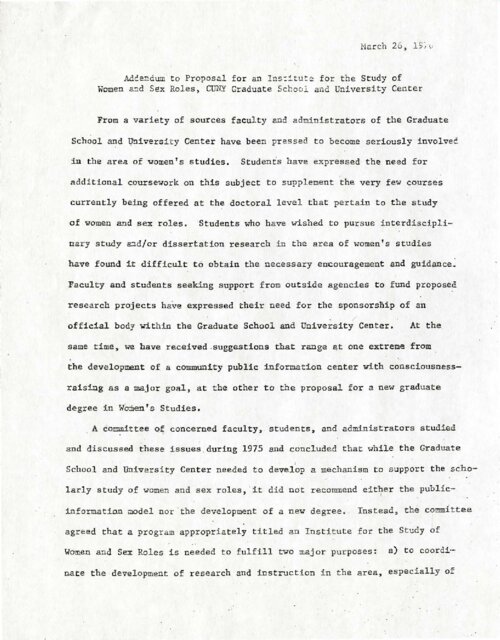 Institute for the Study of Women and Sex Roles Proposal Addendum This addendum to the proposal for an Institute for the Study of Women and Sex Roles, which would later become the Center for the Study of Women and Society (CSWS), gave a clearer picture of the Institute's desired role in the CUNY system. Expressed in this document is the need for an official body at the CUNY Graduate School and University Center to encourage and guide students looking to do research in women's studies and fund proposed faculty research projects. The document also clarified that this Institute would not develop a community public information center or create a new women's studies degree. The document outlined the next steps for creating the Institute as being approved, having a director appointed by the Graduate Studies and University Center's President, and conducting an evaluation a year later to better plan for subsequent years.
 -
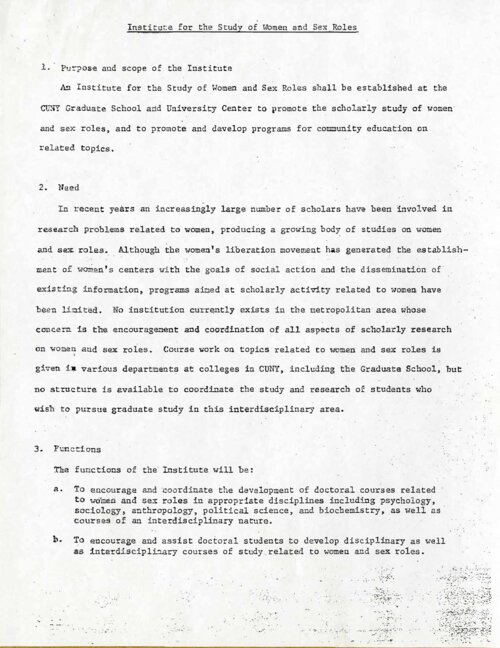 Institute for the Study of Women and Sex Roles Bylaws This two-page report detailed the Institute for the Study of Women and Sex Roles' purpose and scope, need, functions, audience, space required, estimated costs, sources of funds, and relation to existing centers, schools, and institutes in the metropolitan area. Dated October 10, 1975, this document gave a clear picture of what is now the Center for the Study of Women and Society's initial conceptualization. The report showed that the Institute's founders saw a need for a women's center in the NYC metropolitan area that focused on coordinating specific study and research at the graduate level on women and sex roles. It specified that the Institute's functions would include the creation of interdisciplinary doctoral courses related to women and sex roles; to encourage and assist doctoral students in the development of related courses; to assist all CUNY campuses in the creation of courses on the study of women and sex roles at both the undergraduate and graduate levels; and tbe sponsorship of research and community programs in women and sex roles. As a self-sufficient program, the Institute aimed to develop funding sources as it grew and forged connections with similar academic and private programs in the NYC metropolitan area.
 -
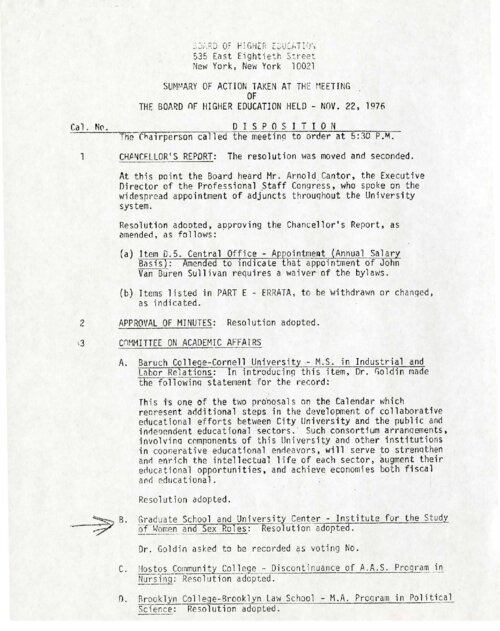 CUNY's Board of Higher Education Meeting to Approve Study of Women and Sex Roles (CSWS) This Summary of Action Taken at the November 22, 1976, Meeting of CUNY's Board of Higher Education contained a report of the approval of the Institute for the Study of Women and Sex Roles, which became the Center for the Study of Women and Society (CSWS). While the Institute was approved, it was noted that psychiatrist and board member, Dr. Gurston D. Goldin, voted against the resolution. This is the type of push back that Susan Saegert and Anne Humpherys discuss in their email regarding the history of the CSWS. The minutes stated that all costs of the Institute were to be covered by outside funding and would not require any new tax levy funding. The Board of Higher Education acknowledged that the Institute would not offer courses or give degrees. Instead, it would promote women's studies, encourage and coordinate CUNY-wide courses related to women's studies, sponsor research in the field, and develop programs in community education on the study of women and sex roles. These minutes included an emphasis on the absence of such an institution in the NYC metropolitan area.
 -
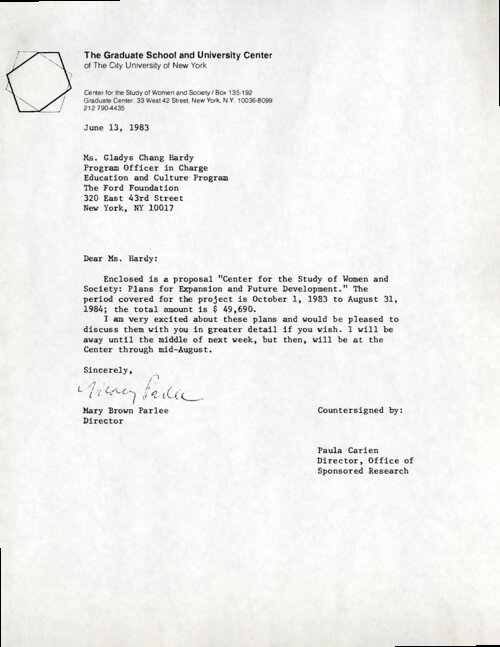 "CSWS: Plans for Expansion and Future Development" Proposal This June 13, 1983, correspondence from the Center for the Study of Women and Society's director, Mary Brown Parlee, to The Ford Foundation's Program Officer in Charge of the Education and Culture Program, Gladys Chang Hardy, included a proposal for a $49,690 project that would cover the period from October 1, 1983, to August 31, 1984. The project in question involved integrating minority group members and research on women of different ethnic and racial minorities into the workings of the Center specifically and CUNY at large. The proposed research included women activists in community organizations, nutritional and other health-related behaviors during pregnancy in urban adolescents, Hispanic and Caribbean peoples in American foreign policy, and the development of early reading strategies in kindergarten.
 -
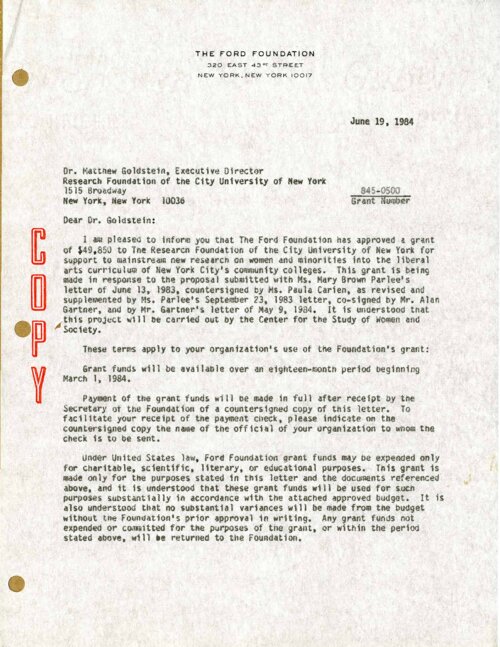 Ford Foundation Grant Approval: Mainstream New Research on Women and Minorities into the Liberal Arts Curriculum of NYC's Community Colleges This June 19, 1984, letter from the assistant secretary of the Ford Foundation, Diane L. Galloway, to the executive director of the Research Foundation of the City University of New York (CUNY) served to inform CUNY of the approval of a $49,850 grant to the Center for the Study of Women and Society (CSWS). The grant , which would be available to CUNY over eighteen months beginning on March 1, 1984, was intended for use by CSWS to support an effort to mainstream new research on women and minorities into the liberal arts curriculum of New York City's community colleges.
 -
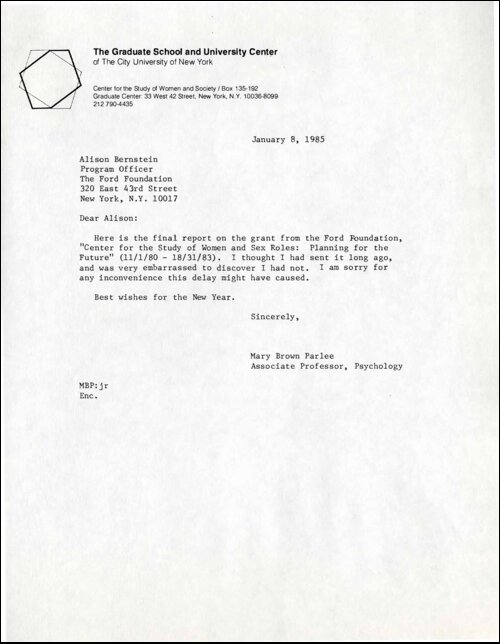 "Center for the Study of Women and Sex Roles: Planning for the Future" Ford Grant Final Report This correspondence from January 8, 1985, provided the final report for the "Center for the Study of Women and Sex Roles: Planning for the Future" grant from the Ford Foundation. The grant, which ran from November 1, 1980 to August 31, 1983, provided the Center for the Study of Women and Society (CSWS) with funds to fulfill the functions it was established to do at its inception. According to the report, the grant allowed CSWS to form the City University of New York (CUNY) Feminist Network, which coordinated activity among faculty and students throughout the twenty-one CUNY campuses. The grant enabled CSWS to facilitate and support women's research and two sets of activities. These included: (1) research and a seminar series with the Mt. Sinai School of Medicine and (2) the aforementioned CUNY Feminist Network, which united the different feminist groups at CUNY. The CUNY Feminist Network met to discuss sex, race, and class in academic, personal, and political spheres. Director of CSWS and author of the report, Mary Brown Parlee, identified CSWS's next goal as expanding the work of the Feminist Network to create real social change.
 -
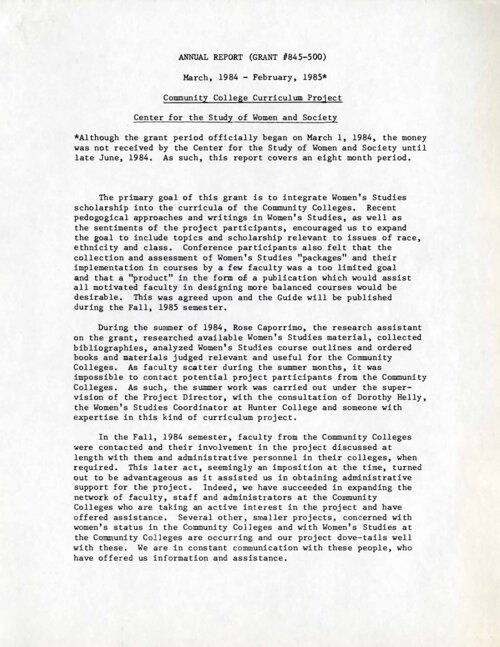 "Community College Curriculum Project" Annual Report This report submitted to the Ford Foundation by the Center for the Study of Women and Society (CSWS) summarizes what CSWS accomplished in the eight months since they received foundation funding. The purpose of the grant was to integrate Women's Studies into the curricula of the City University of New York (CUNY) community colleges, namely Kingsborough Community College, Hostos Community College, LaGuardia Community College, Manhattan Community College, New York City Technical College, Bronx Community College, and Queensborough Community College. Early on in the implementation of the original plan, it was decided that there would be a focus on race, ethnicity, and class and a publication in fall 1985 that would motivate faculty to create more balanced courses. The report detailed the work of Rose Caporrimo in researching Women's Studies material, collecting biographies, and ordering books for the community colleges under the supervision of Prof. Dorothy Helly from CUNY's Hunter College. For the Fall 1984 semester, CSWS contacted faculty at the community colleges and their administrative personnel to discuss their involvement in the project. Rather than creating curricula for specific courses, CSWS decided to focus on topics to accommodate the diversity of courses they found among the various community colleges. The grant also allowed for: 1) the CSWS to: sponsor "Sisterhood is Global: A Symposium on the Changing Status of Women Throughout the World" on November 17 and 18, 1984; 2) an in-house conference titled "Gender and Race at CUNY: Strategies for Change" on May 30, 1985; 3) a newsletter for CSWS members for the spring semester; and 4) the CUNY Feminist Network Directory, to be published in the summer of 1985. The report also requested an extension for the same grant to accommodate the four months lost at the beginning of the grant period since CSWS did not receive the funds from Ford right away. The report ended with an explanation that $1,500 of grant money was used for the "Sisterhood is Global" symposium with permission from the Ford Foundation, and 40% of the grant was to be used for faculty stipends, which would only be paid out in the summer.
 -
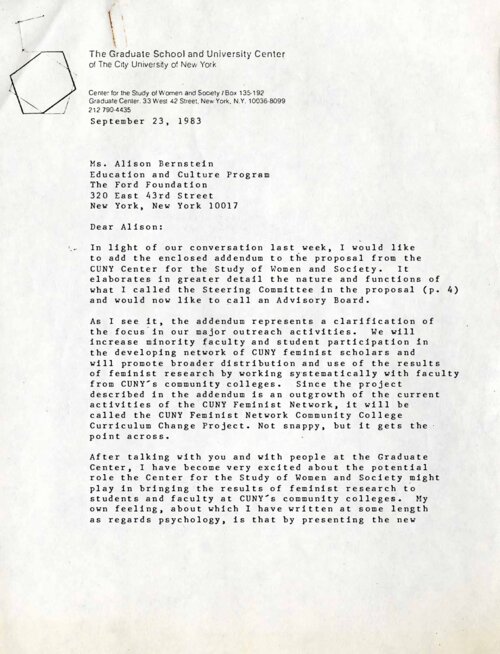 Addendum to the “Center for the Study of Women and Society: Plans for Expansion and Future Development” grant proposal This correspondence from the director of the Center for the Study of Women and Society (CSWS), Mary Brown Parlee, to Alison Bernstein from the Education and Culture Program at the Ford Foundation on September 23, 1983 served to elaborate on the nature and functions of the Advisory Board of the City University of New York's (CUNY) Feminist Network Community College Curriculum Change Project. The addendum indicated that the Advisory Board was a group that would develop a report on the current status of Women's Studies and of women students in different programs at CUNY's community colleges, and propose specific plans for increasing exposure at each CUNY community college campus. The Advisory Board would also provide resources for integrating Women's Studies material into community college courses and assess the resources from a faculty and student point of view, particularly that of minority faculty and students. The correspondence showed that the Center was thinking about the roles of race and class in feminist analysis, the importance of integrating Women's Studies beyond the graduate level, and the importance of producing accessible teaching and learning material.
 -
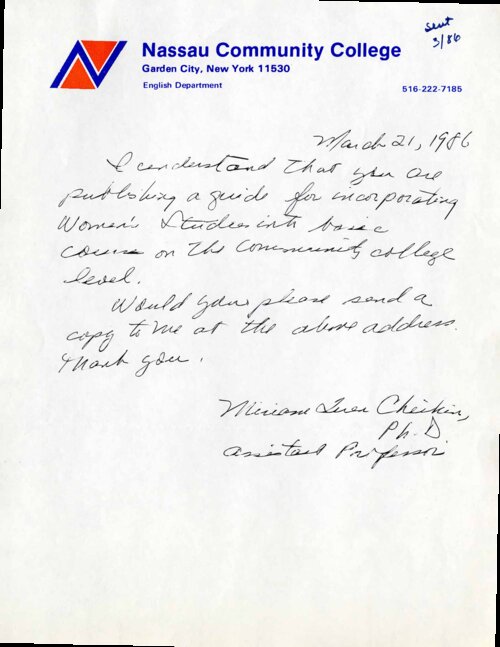 Letters requesting information regarding the Gender Balancing Project of CSWS This file from 1986 included inquiries from various educators about the Center for the Study of Women and Society's (CSWS) guide for"Putting Women into CUNY's Curriculum." This Fall 1985 publication contained resources and materials for community colleges to integrate Women's Studies materials into their curricula. Solicitations came from Nassau Community College, City University of New York (CUNY) Kingsborough Community College, Union College, Western Michigan University, Clements High School in Texas, and State University of New York (SUNY)'s Brockport and Buffalo campuses. The file also included information on correspondence from then CSWS director Sue Rosenberg Zalk to Professor Eleanor Drabo, confirming her role as a collaborator on the guide. There was also correspondence from the Formative Evaluation Research Associates (FERA), which had received a grant from the Ford Foundation to study the impact of projects aimed at integrating Women's Studies material and perspectives into undergraduate curricula.
 -
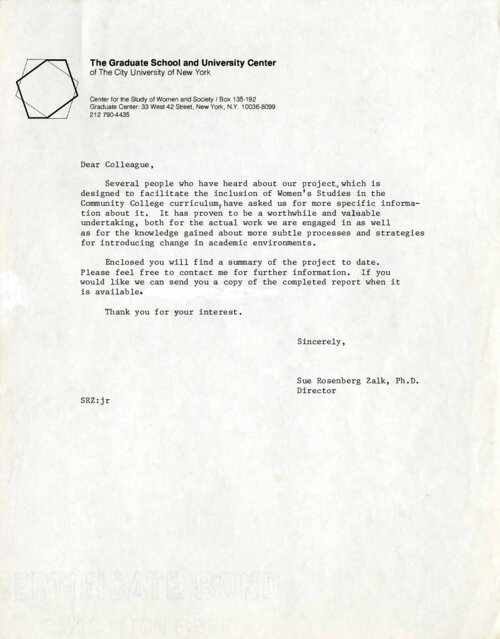 Women Studies Inclusion in Community Colleges Letter and Project Summary This 1986 summary by the director of the Center for the Study of Women and Society (CSWS), Dr. Sue Rosenberg Zalk, provided a summary of the Community College Gender-Balancing Curriculum Project, an effort to expand Women's Studies at the undergraduate level as a result of a grant from the Ford Foundation. Dr. Zalk identified a need to include and consider race, ethnicity, and class when studying gender as an essential part of the project. The Advisory Board of the project, which consisted of one representative from each of the participating City University of New York (CUNY) community colleges, agreed that a guide for incorporating Women's Studies into introductory courses would be the project's final product, directed at community colleges and distributed to all teaching staff. The project was completed in two phases. The first phase involved assessing the status of Women's Studies at the different community colleges, which proved difficult since there was such a variety of material depending on the faculty member teaching the course. This same diversity helped reshape the project to focus on developing themes that could apply to various disciplines instead of specific courses. Specifically, the Advisory Board chose to focus on women, work, and family in relation to race, class, and ethnicity. The guide would include suggested essential readings for faculty and students, a summary of the key ideas, discussion, and essay questions, and issues regarding discipline, content, and methodology for anthropology, psychology, sociology, history, economy, and literature.
 -
 Center for the Study of Women and Society Brochure This promotional brochure for the Center for the Study of Women and Society (CSWS) began with a brief history of the City University of New York (CUNY) Graduate Center, founded in 1961. The first page identified CSWS as a center that had supported interdisciplinary feminist scholarship since 1977. It stated that CSWS had 80 nationally- and internationally-known faculty and listed 18 of them from various programs, including English, history, sociology, psychology, philosophy, law, political science, criminal justice, and anthropology. The brochure also described CSWS's Speakers' Series; significant projects, such as the College and Community Fellowship Program (CCF), the Rockefeller Seminar, and the Activist Women's Voices Oral History Archive. The brochure ended with a list of contacts for women's centers and women's studies programs across CUNY's senior and community colleges.
 -
 External Review and Self-Study of Women's Studies Certificate Program (WSCP) This self study was prepared by the Women's Studies Certificate Program (WSCP) on March 23, 2007. The self study states that WSCP began in 1990 and that its student enrollment had risen steadily from 132 students in the 2001–02 academic year to 227 students in the 2005-06 academic year. These students were drawn from different doctoral programs at the City University of New York (CUNY) Graduate Center, including English, sociology, social-personality psychology, political science, art history, clinical psychology, comparative literature, developmental psychology, history, linguistics, philosophy, social welfare, and urban education. The report identified the program's required courses as "Major Feminist Texts," "Contemporary Feminist Thought," "Proseminar: Multicultural/Transnational Feminisms," "Workshop in Women's Studies," and two electives with a gender component in any field. The study stated that faculty were required to serve on the Advisory Board, develop the semester's Speaker's Series, and present their own work. The external review detailed WSCP's history, providing specific dates for programs and publications resulting from WSCP's efforts. It also described the program's relationship with doctoral programs, library resources, equipment, and facilities and well as information on how the program gave its graduates a competitive edge regarding employment after graduation. The third section of the review focused on issues faced by WSCP, such as the lack of meeting space and the lack of direction when students finished the requirements for the certificate program but did not finish the doctoral program in which they were enrolled. The review stated that it had been previously decided that the coordinator of WSCP and the director of the Center for the Study of Women and Society (CSWS) would be combined in one full-time position, which also involved teaching two of the certificat's required courses; however, this arrangement had not been honored. Additionally, WSCP suggested the possibility of a Master's of Arts program in women's studies, which was going to be difficult since the Graduate Center did not offer stand-alone Master's degrees at that time but was considering doing so. This section was followed by faculty profiles and the publications they had produced. The External Review Committee found the WSCP impressive and essential. They recommended a name change to Women's and Gender Studies, an MA program in women's and gender studies, a certificate of completion for those that fulfilled the certificate program's requirements, more publicity for the program, changes in course requirements, the introduction of a women's studies seminar paper, reinstatement of the co-taught courses, and at least 50% course release for the director of the program. The review committee also provided three possible structures for women's and gender studies at the graduate level. WSCP responded to the External Review Committee's recommendation, signed its coordinator and director of CSWS, Professor Anne Humpherys. The document ended with correspondence sent to faculty who may have wanted to meet with the External Review Committee and the schedule for the entire review process.
 -
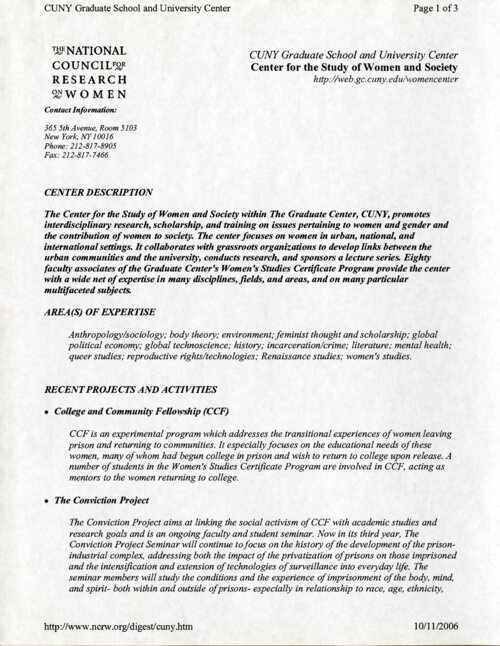 National Council for Research on Women and the Center for the Study of Women and Society This October 11, 2006, document provided a description of the Center for the Study of Women and Society (CSWS) for the National Council for Research on Women (NCRW) website. The NCRW had initially sent the CSWS a letter of recognition circa 1992, asking if the CSWS would like to be included on the NCRW's growing list of centers and institutions. It wasn't until 2006, however, that CSWS's information was made accessible on the NCRW's website. The NCRW had created a platform with the mission of connecting Women's Studies programs across the nation, offering them access to each other's research, publications, and activities. The description depicted CSWS as advancing interdisciplinary research, scholarship, and training on issues on women and gender, especially in urban settings, both nationally and internationally. It stated that CSWS had 80 faculty associated with the City University of New York (CUNY) Graduate Center's Women's Studies Certificate Program (CSWP) from many fields, including anthropology, sociology, economics, criminal justice, literature, and queer studies. The description then went on to list recent projects and activities, such as the College and Community Fellowship (CCF); the Conviction Project; the Future Matters: Technoscience, Politics, and Cultural Criticism symposium; the Facing Global Capital; Finding Human Security: a Gendered Critique project; the New Immigrant Women Archival and Oral History Project; and the Women's Studies Discipline Council. The description ended with the names of three publications that would give readers more information on CSWS.
 -
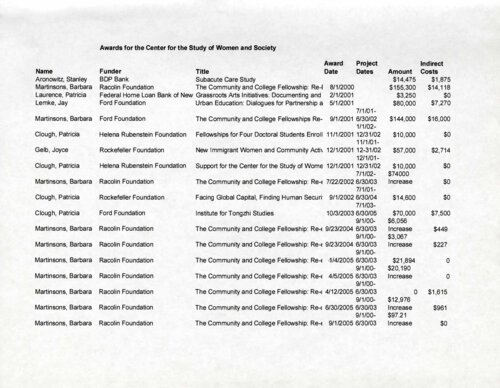 2000-05 Awards List for Center for the Study of Women and Society Compiled in 2008, this list included all the financial awards and grants the Center for the Study of Women and Society (CSWS) received for various projects between August 1, 2000, and October 6, 2005. The list contains the names of the people who submitted proposals for the funding, what institution awarded the grant, and how much was awarded. These awards came from BDP Bank, the Racolin Foundation, the Federal Home Loan Bank of New York, the Ford Foundation, the Helena Rubenstein Foundation, and the Rockefeller Foundation. The money supported fellowships, Grassroots Arts Initiatives, Urban Education, and the Institute for Tongzhi Studies, as well as the Community and College Fellowship, which was devoted to helping formerly incarcerated women get college and advanced degrees. The total amount of awards surpassed $696,000.
 -
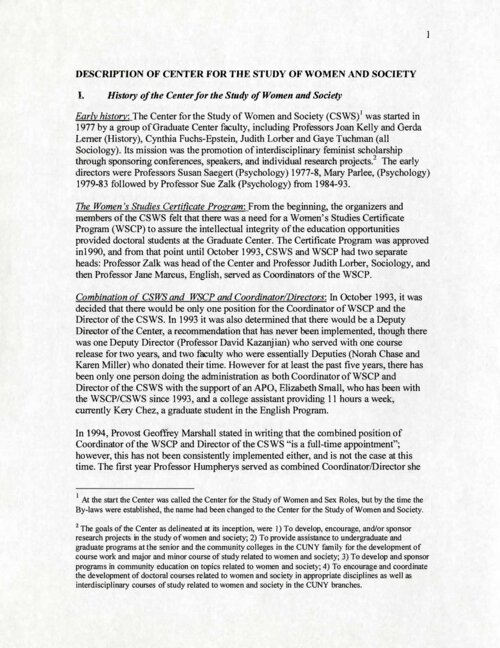 An Overview: The Center for the Study of Women and Society This document, dated 2008, described the Center for the Study of Women and Society (CSWS), beginning with its history, mission, Advisory Committee, and operating mechanisms. It stated that CSWS was formed in 1977, founded the Women's Studies Certificate Program (WSCP) in 1990, and combined the position of the director of CSWS and coordinator of WSCP in 1994. It identified the CSWS's research mission as follows: to promote the study of gender, sexuality, race, ethnicity, class, and nationality regarding women's experiences in multiple societies. College and Community Fellowship (CCF), the Community Leadership and Education After Reentry (CLEAR), the Activist Women's Voices Oral History Archive and Urban Fieldwork Internships, the Feminist Studies Group, Women's Writing Women's Lives (WWWL), the CSWS library, and an ongoing Speaker's Series were identified as CSWS's programs. Also included were CSWS's publications: Women's Studies Quarterly and the Newsletter. This was followed by its outreach efforts at the City University of New York (CUNY), national and international outreach, and computer resources available in related topics. The overview of CSWS closed with its plans for the future and past issues it had faced when trying to reach its goals.
 -
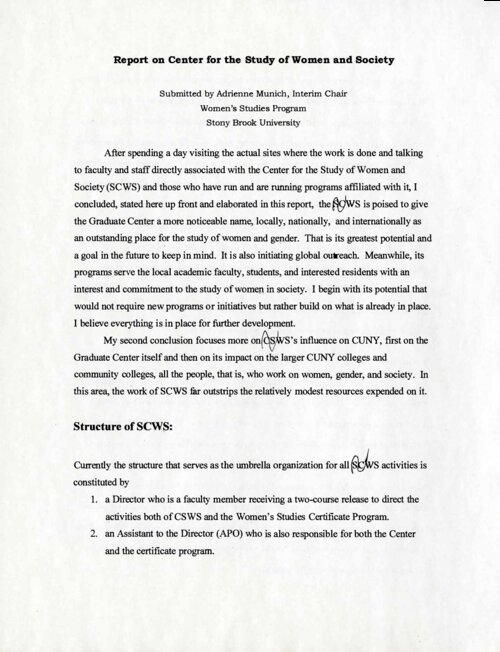 External Review for Center for the Study of Women and Society (CSWS) by Adrienne Munich This external report on the Center for the Study of Women and Society (CSWS) was submitted in May 2008 by Adrienne Munich, interim chair of the Women's Studies Program at the State University of New York (SUNY) Stony Brook University. Munich began the report by praising CSWS for its work and highlighting its importance as part of the City University of New York (CUNY). She opened the actual report with CSWS's structure and recommended additional administrative personnel, support for the director, and a college assistant dedicated exclusively to CSWS. She also underscored the importance of the Women's Studies Discipline Council, the Feminist Studies Group, Women Writing Women's Lives, College and Community Fellowship (CCF), and Community Leadership and Education Reentry (CLEAR) programs. Munich also commented on CSWS's lecture series and ongoing publications, such as Women's Studies Quarterly and the Feminist Press. The document ended with an email from Munich to GC Vice President for Research Brian Schwartz containing the aforementioned report. In this email, she identified CSWS as both a treasure and a bargain.
 -
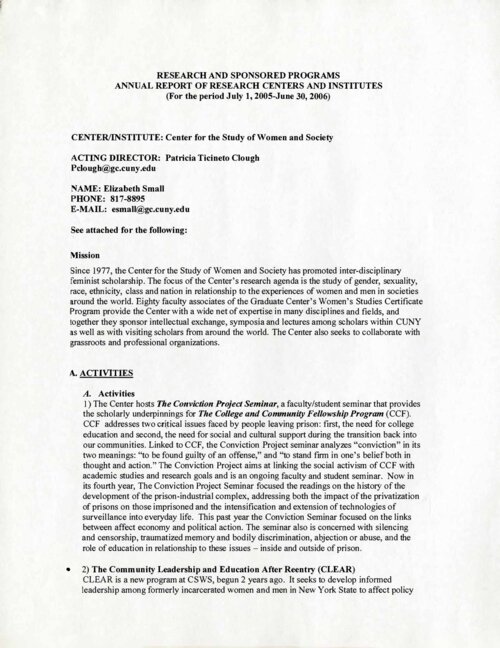 Annual Report for CSWS by Patricia Clough This report described the Center for the Study of Women and Society's (CSWS) research and sponsored programs in the 2005-06 fiscal year. It included the Conviction Project Seminar, the College and Community Fellowship Program, the Community Leadership and Education After Reentry (CLEAR) program, the Activist Women's Voices Oral History Archive, and Urban Fieldwork Internships, the Speaker Series, and international publications. This was followed by plans for the 2005–06 academic year, including journals with Duke University Press. The grants and income section included $15,000 from the City University of New York (CUNY) Vice-Chancellor, $10,000 from the 42nd Street Fund, and about $120,000 that had not yet been awarded. The report closed with the total budget for the 2004-05 fiscal year totaling $14,460 and attachments regarding different publications.
26–50 of 57