Student Strikes of 1991: Graduate Center Student Takeover
Item set
Collection
Student Strikes of 1991: Graduate Center Student Takeover
Time Periods
1978-1992 Retrenchment - Austerity - Tuition
1993-1999 End of Remediation and Open Admissions in Senior Colleges
2000-2010 Centralization of CUNY
2010-2020 From OWS to Covid-19
2020 and Beyond: CUNY in the Era of COVID and Racial Reckoning
Items
1–25 of 33
Advanced search
-
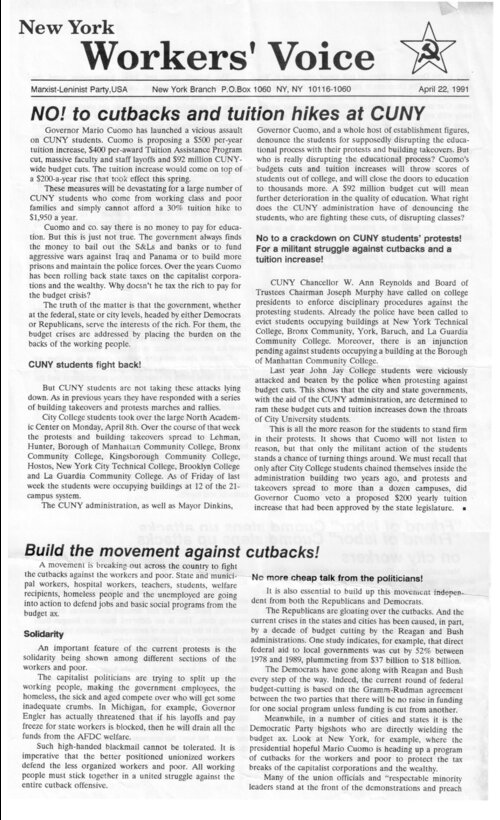 New York Workers Voice On April 22, 1991, Workers’ Voice, a Marxist newsletter, published a political analysis on the cutbacks and tuition hikes at the City University of New York (CUNY) and the solidarity movement built between the different sectors of “workers and poor.” In the article No! To cutbacks and tuition hikes at CUNY, the author argued that a militant struggle against cutbacks and a tuition increase was needed to reverse the tuition increases, budget cuts, and faculty layoffs. Subsequent articles discussed the importance of independent movement-building, taxing the rich, and the loyalty NY state and city politicians have to “business leaders.”
 -
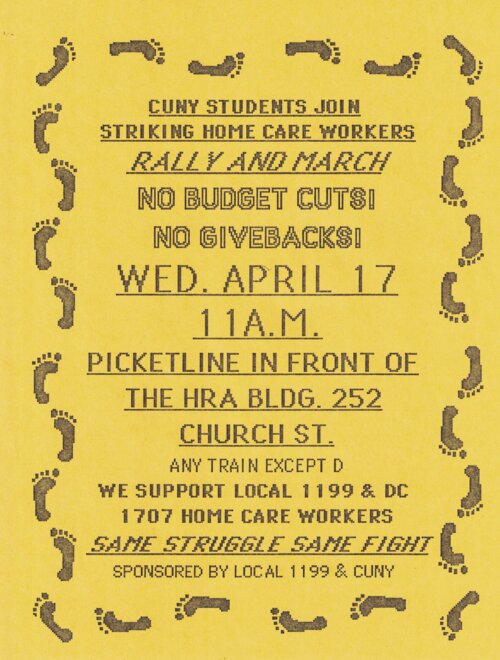 CUNY Students Join Striking Home Care Workers Flyer Sponsored by Local 1199 and CUNY strikers, this flyer promoted an April 17th rally and march in front of the Human Resources Administration (HRA) building. In solidarity with the workers of New York City, City University of New York (CUNY) students joined striking home care workers. "Same Struggle Same Fight"
 -
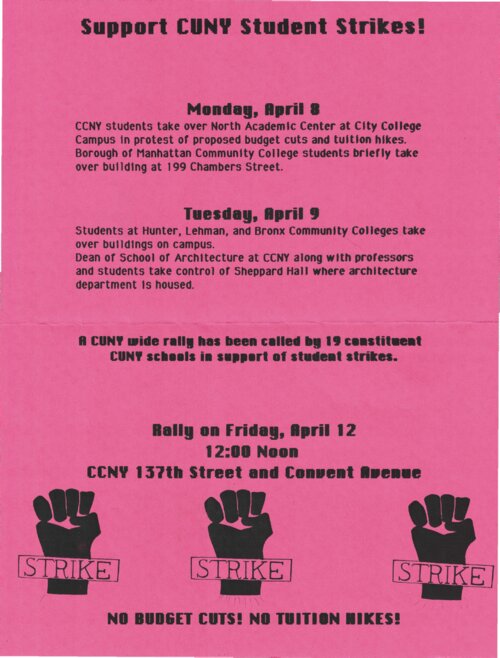 Support CUNY Student Strikes! “No Budget Cuts! No Tuition Hikes!” This 1991 flyer promoted a City University of New York (CUNY) wide rally on April 12th at City College of New York (CCNY). Chronicling April 8th’s CCNY and Borough of Manhattan student takeovers; and April 9th’s Hunter, Lehman and Bronx Community College subsequent takeovers, the flyer stated that the rally had been called by 19 constituent CUNY schools in support of student strikes.
 -
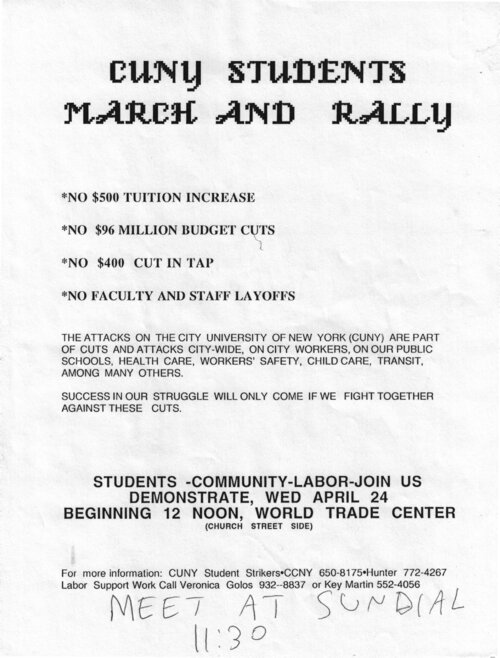 CUNY Students March and Rally This flyer promoted a city-wide protest scheduled for April 24, 1991, at the World Trade Center. Drawing connections between the struggles of students, community, and labor, this flyer stated, “success in our struggle will only come if we fight together against these cuts.”
 -
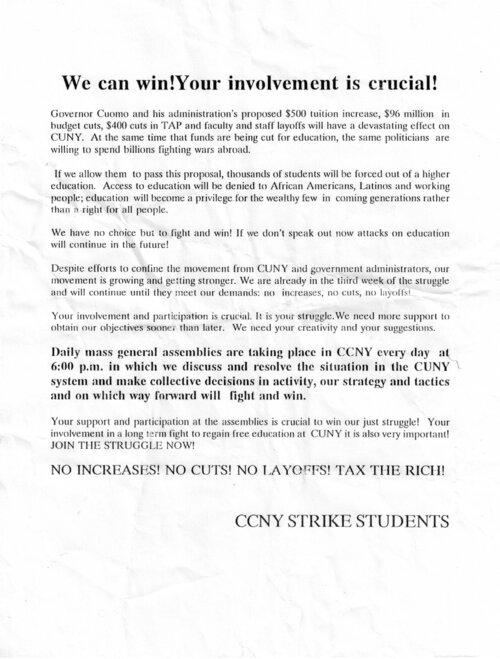 We Can Win! Your Involvement is Crucial! – CCNY Student Strikes Written three weeks into the City University of New York (CUNY) strikes of 1991, this flyer, signed CCNY STRIKE STUDENTS (City College of New York), urged students to support the movement and attend general assemblies. Daily mass general assemblies took place every day at 6 PM at CCNY, in which collective decisions in activity, strategy, and tactics were discussed. The flyer argued that if the tuition increased, budgets cut, and faculty layoffs were implemented, thousands of students would be forced out of higher education, and the attacks on education would continue.
 -
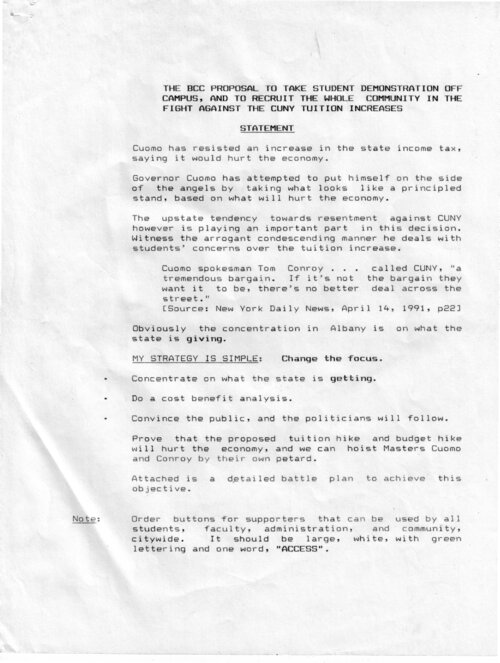 A BCC Proposal: "Access ... Access ... Access ..." Written in 1991 by Sidney Royce of the BCC (Bronx Community College) senate, this detailed proposal called to take student demonstrations off-campus and recruit the whole community to fight against the City University of New York (CUNY) tuition increases. The outlined strategy argued for a shift in focus from what Albany was “giving” CUNY to how the proposed tuition and budget hike would, in actuality, hurt New York’s economy. The document offered a historical background, a comparison of income from BBC entering students to graduating students, and a lobbying plan. Slogans included in the proposal were “Freeze or Free” or “Access … Access …Access.” This item offered a singular perspective that differed from that of many of the CUNY strikers.
 -
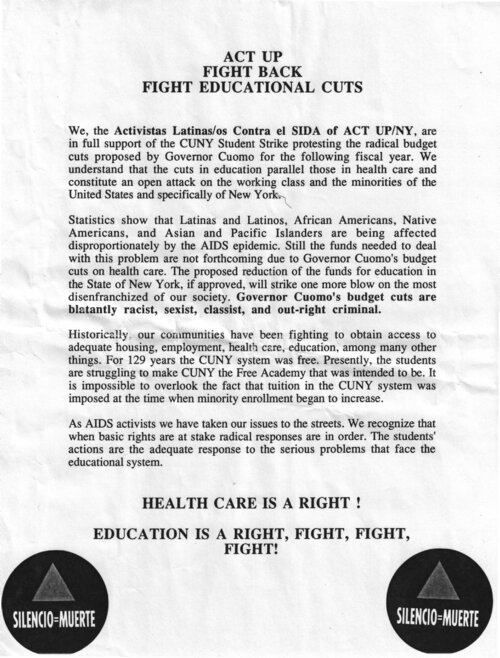 ACT UP Flyer: Education is a Right, Fight, Fight, Fight In this statement of solidarity with City Unversity of New York (CUNY) Student Strikers, members of Activistas Latinas/os Contra SIDA of ACT UP/NY drew parallels between cuts to education and cuts to health care. The flyer emphasized that when "basic rights are at stake, radical responses are in order" and served as an example of how activist movements across NYC cross-pollinated. As AIDS activists, they recognized that the students' actions were an "adequate response to the educational system's problems."
 -
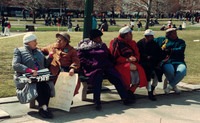 Albany Demonstration: “Save CUNY, Stop the Budget Cuts.” A series of photographs taken in 1991 at a rally in Albany, NY, ranged from Hunter College students from the School of Social Work and Bronx Community College students to a baby with a Tax the Rich sign. Union members, workers, and students descended the capital, united in solidarity against the proposed austerity measures. In one image, City University of New York (CUNY) students scaled the NY state capital building to hang a banner that stated, “Save CUNY, Stop the Budget Cuts.” On March 19th, 20,000 people descended on Albany to protest statewide austerity measures in New York. NYC municipal workers, CUNY and SUNY students, and workers from hospitals took part.
 -
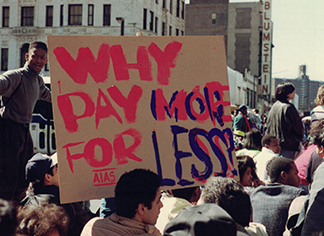
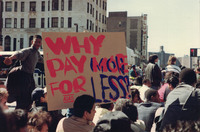 Harlem Demonstration "Why pay more for less" read a protest sign. As student takeovers spread to more City University of New York (CUNY) campuses, CUNY students organized marches and rallies across the city. These images show students marching to City College in Harlem, carrying signs, with community members cheering solidarity from nearby windows.
 -
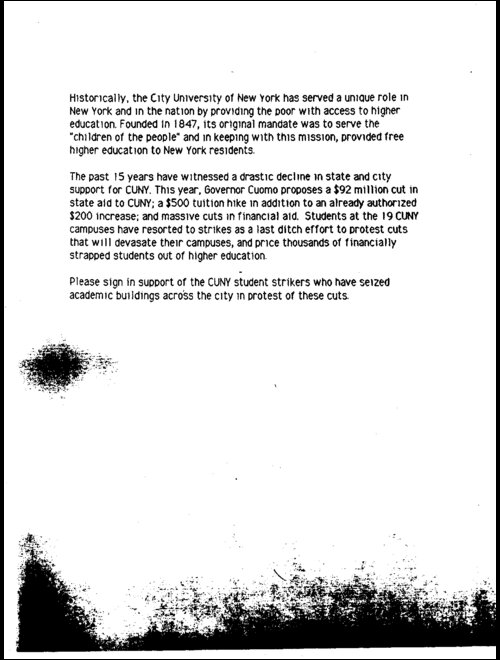 Tabeling Statement: In support of CUNY Student Strikers This statement, accompanied by a petition, was used at a tabling event held by City University of New York (CUNY) graduate students during the 1991 occupations of CUNY academic buildings. In protest of the $92 million cut in state aid, the $500 tuition hike, and student financial aid reductions, the signatories pledged support for the CUNY student strikers.
 -
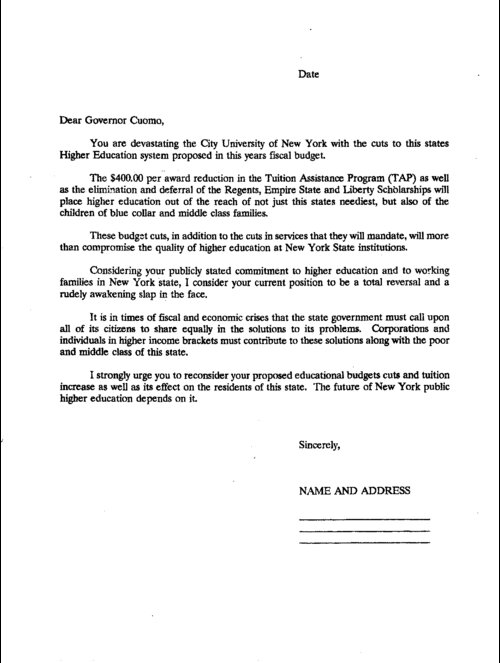 A Form Letter: "You are Devastating the City University of New York" Addressed to Governor Mario Cuomo, this form letter drafted expressly for a letter-writing campaign urged the governor to reconsider his proposed education budget cuts and tuition increases. It specifically drew attention to the reduction of funds offered by the Tuition Assistance Program (TAP) and the elimination of the three scholarship programs--Regents, Empire State, and Liberty scholarships--and claimed that these cuts would place higher education out of reach for NYC blue-collar and middle-class families.
 -
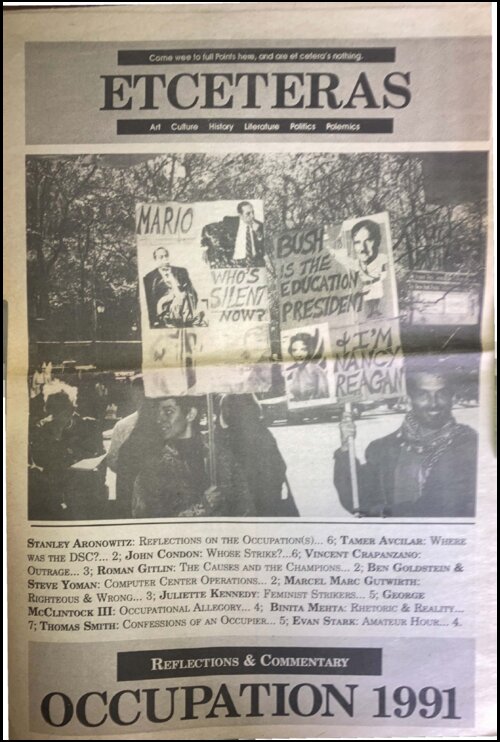 Etceteras Newspaper Volume 0 Number 0 Following the Graduate Center takeover, Etceteras Vol.0 No.0 featured reflections and commentary on the "Occupation 1991," which had lasted over a week. Various students from multiple programs not actively involved in the takeover of the Graduate Center expressed their frustration, anger, and misgivings. Tamer Avcilar of the Doctoral Student Council (DSC) stated that the takeover was an "act committed by several students who were able to take advantage of a vacuum of power" and lamented the elected officials of the DSC inability to take action. Juliette Kennedy in Feminist Strikers wrote of the fear of speaking out at the daily general assemblies and the self-righteousness of the organizers, while in "Amateur Hour," Evan Stark argued that "lacking grassroots support, the building occupation defeated itself." Stanley Aronowitz, a professor in Sociology, offered a geopolitical analogy and defended the students in their actions, as he acknowledged that the intended audience was not the legislators but rather the press, who may not have responded to more traditional modes of protest. However, to Aronowitz, the event's main success was the direct democracy that was practiced and the possibility that CUNY could become a leading "innovator in pedagogy and curriculum."
 -
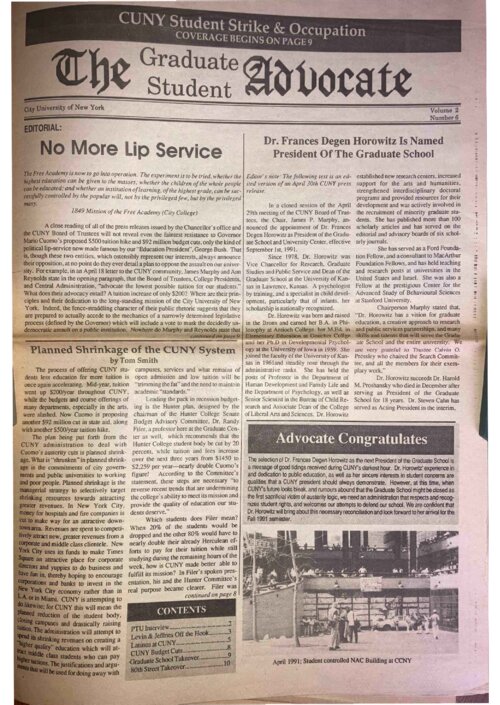 The Graduate Student Advocate, vol 2 no 6 This 1991 issue of The Graduate Student Advocate, the newspaper of the graduate students at the Graduate Center, City University of New York (CUNY). Published six times per academic year, it included editorials, articles, interviews, and letters covering the CUNY Budget Cuts, Graduate School Takeover, the 80th Street Takeover and beyond. "Cuomo's Budget Cutting Hits CUNY," written by Pam Donovan, and "Planned Shrinkage of the CUNY System" written by Tom Smith, offered analysies on the effects the budget cuts would have on CUNY at large while spelling out the expected specific shrinkage on various campuses. In the "Graduate School Strikes Back!" and the "Graduate Center Student Update," Tara McGann and Andrew Long detailed the ongoing negotiations between students, faculty, and CUNY administrative, which eventually led to ending the Graduate Center takeover on April 25th. The Strike Committee declared victory and committed to continue supporting the CUNY strikers. The Graduate Center Student Strike Update enumerated the 16 consensus demands, which included a meeting between the delegated representative of the strike committee and Chancellor Reynolds.
 -
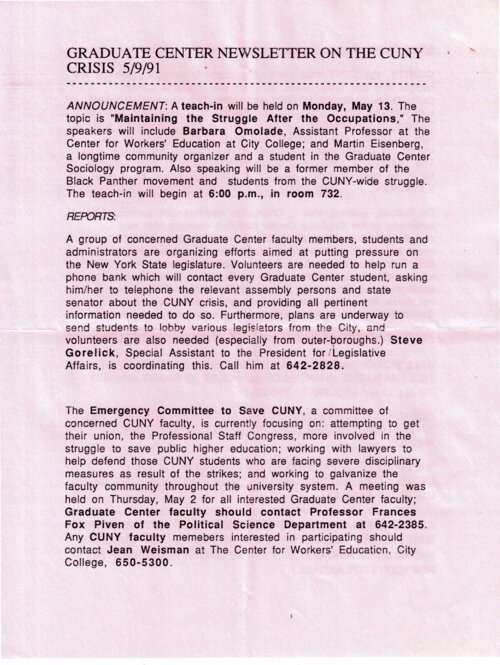 Graduate Center Newsletter on the CUNY Crisis This Graduate Center Newsletter on the CUNY Crisis, published on May 9, 1991, announced a teach-in on "Maintaining the Struggle after the Occupation," which focused on organizing efforts to continue putting pressure on the New York State legislature to resist budget cuts and tuition hikes. The newsletter reported on the formation of an "Emergency Committee to Save CUNY," comprised of concerned CUNY faculty who called on their union the Professional Staff Congress (PSC) to defend students who were facing severe disciplinary measures and to "galvanize the faculty community." In addition, CUNITY, the CUNY-wide coalition of students struggling against budget cuts and tuition hikes, shared its plan for a large rally in Albany and its fight to gain amnesty for those students facing disciplinary and legal action as a result of the strikes. The newsletter also reported on CUNY Chancellor Ann Reynold's chance meeting with students that led to an agreement to meet with them before the end of the semester.
 -
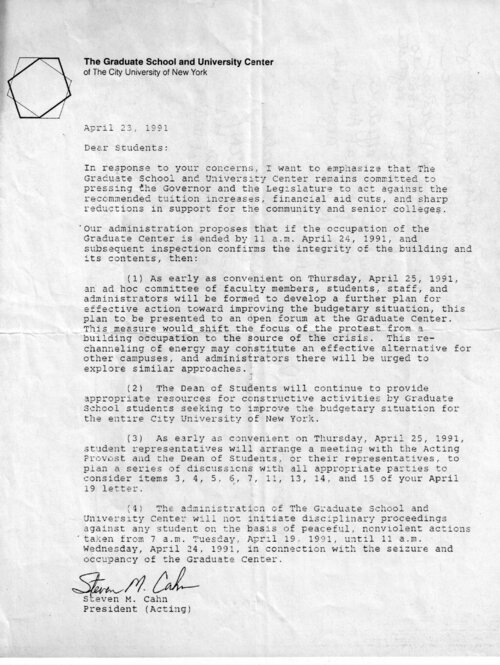 Letter to Students signed Cahn Dated April 23, 1991, and signed by the acting president of the Graduate Center Steven M, Cahn, this letter referenced an April 19th letter sent by the City University of New York (CUNY) Graduate School] students. The letter stated that the Graduate School and University Center remained committed to pressing the governor and the city and state legislatures to act against cutting CUNY’s budget, imposing tuition increases, and decreasing student financial aid and further proposed that if the occupation of the Graduate Center ended the following day, the administration would be willing to convene an ad hoc committee comprised of aculty members, students, staff and administrators and that the administration of the Graduate School would not initiate disciplinary proceedings against any students on the basis of “peaceful, nonviolent actions. . .in connection with the seizure and occupancy of the Graduate Center.”
 -
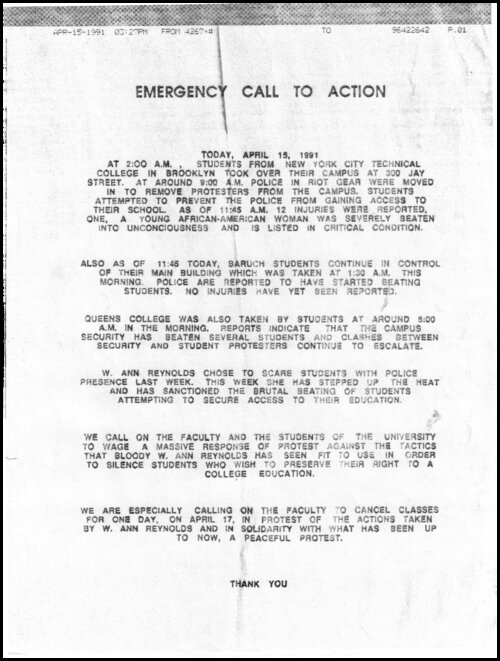 Emergency Call to Action Dated April 15th, 1991 at 3:27 PM, this facsimile was an “emergency call to action.” It reported that students who had taken over City University of New York (CUNY) campuses, including New York City Technical College, Baruch College, and Queens College were being beaten by police and campus security guards. Twelve injures from New York Technical College were reported, including one woman who was in critical condition. The document called on CUNY faculty and students to “wage a massive response of protest” and, more specifically, for faculty to cancel classes for one day on April 17th.
 -
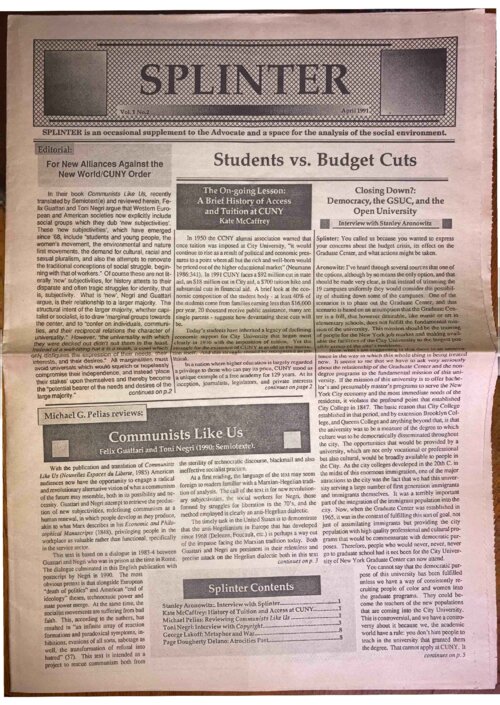 The Splinter The Splinter described itself as a supplement to The Advocate (the Graduate Center student newspaper) and a “space for the analysis of social environment.” Published in April 1991 Vol. 1 No. 2 of The Splinter featured editorials, book reviews, interviews, and analysis. Of particular interest was an article by Kate McCaffrey, “The On-going Lessons: A Brief History of Access and Tuition at CUNY,” and an interview with Stanley Aronowitz, “Closing Down?: Democracy, the GSUC, and the Open University”. Both the article and interview were concerned with holding CUNY accountable for its original mandate of offering free and open education to the citizens of New York. McCaffrey offered an analysis that demonstrated the historical connections between state and city funding, tuition imposition, unrealistic entrance requirements perpetuated as a method of maintaining income, and racial inequality. In light of the proposed state budget crisis of 1991, Aronowitz, a professor at the Graduate Center, had requested an interview to discuss the potential effect of cugts on the Graduate Center and what actions could and should be taken. He had heard several scenarios, one of which was to phase out the Graduate Center, which had been founded in 1964. Like McCaffrey, Aronowitz also based his arguments on the founding mission of CUNY (once known as the working-class Harvard), and argued that the social contract that CUNY had with the people of NYC was not a promise of upward mobility but rather the promise of equitable access to culture – one moored in a Deweyan belief in democratic education. He also emphasized the importance of preserving the Graduate Center as a place positioned to diversify the faculty across the CUNY system at large.
 -
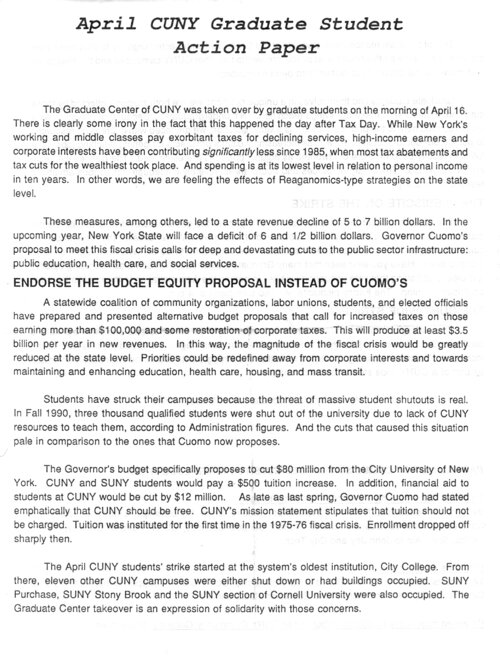 Graduate Student Action Paper Written by the Graduate Center Student Strike in April 1991, this action paper reported that the City University of New York's (CUNY) Graduate Center had been taken over by graduate students on the morning of April 16th in solidarity with the CUNY-wide strike against budget cuts and tuition increases, which started at City College and had spread to 11 other CUNY campuses. The action paper announced an endorsement of "the budget equity proposal." Prepared by a statewide coalition of community organizers, labor unions, students, and elected officials, it called for redirecting taxes towards education, healthcare, housing, and mass transit. Ranging from future employment to access to library resources, Graduate Center Students Strikers acknowledged what was directly at stake for them and reported on the first plebiscite of the takeover.
 -
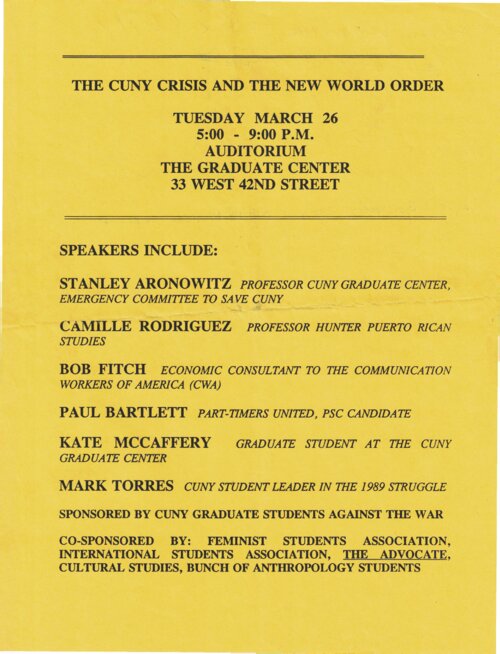 The CUNY Crisis and the New World Order Sponsored by City University of New York (CUNY) Graduate Students Against the War, this flyer announced a symposium on “The CUNY Crisis and New World Order.” Well before the CUNY strikes of 1991, Graduate Center student organizations were already involved in discussions linking the threat of austerity measures against CUNY and the rise of neoliberalism. Speakers included Stanley Aronowitz, Camille Rodriguez, Bob Fitch, Paul Bartlet, Kate McCaffery, and Mark Torres.
 -
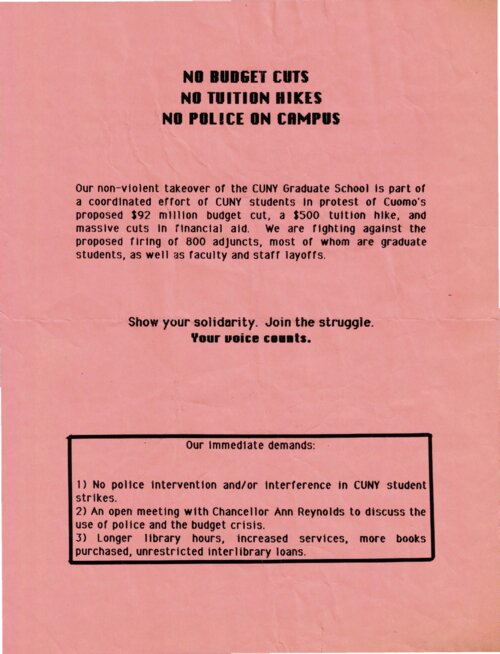 Your Voice Counts "No Budget Cuts, No Tuition Hikes, No Police on Campus" This flyer called for Graduate Center students to show solidarity in support of the City University of New York (CUNY) strike by joining the CUNY Graduate Center (GC) takeover. The pamphlet described the takeover as a “coordinated effort of CUNY students in protest of Cuomo’s proposed 92 million dollar budget cut, a $500 tuition hike and massive cuts in financial aid.” In addition, GC student strikers outlined their immediate demands, including denouncing use of the police to interfere with student strikes, a request for a meeting with Chancellor Ann Reynolds, and increased library hours.
 -
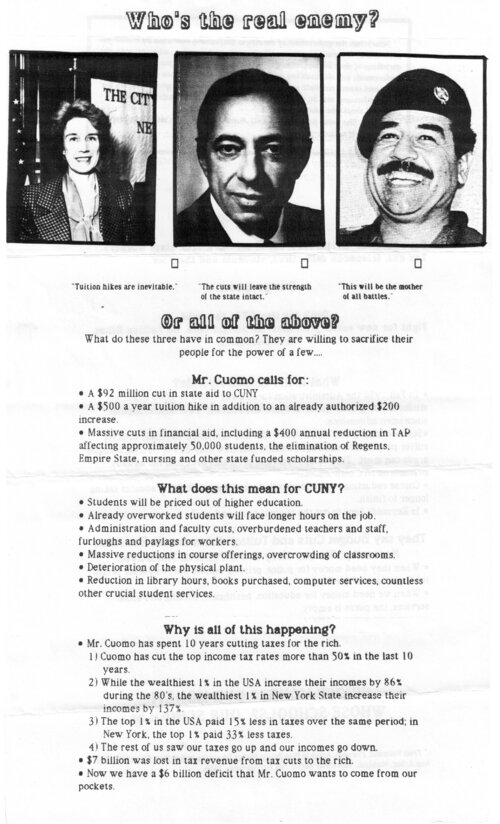 Who's the Real Enemy? Featuring images of Chancellor W. Ann Reynolds, Governor Mario Cuomo, and Iraqi dictator Saddam Hussein, this two-sided flyer from 1991 asked, "Who's the real enemy?". "All of the above" was the answer because "they are all [three] willing to sacrifice their people for the power of a few. . . ." Using bullet points, the student organizers outlined what cuts were being imposed, what was at stake for the City University of New York (CUNY), and the hidden political agenda behind the cuts. Cuomo's proposal called for steep decreases in funding for education, healthcare, and beyond, while students proposed taxing the rich and fighting for new social priorities.
 -
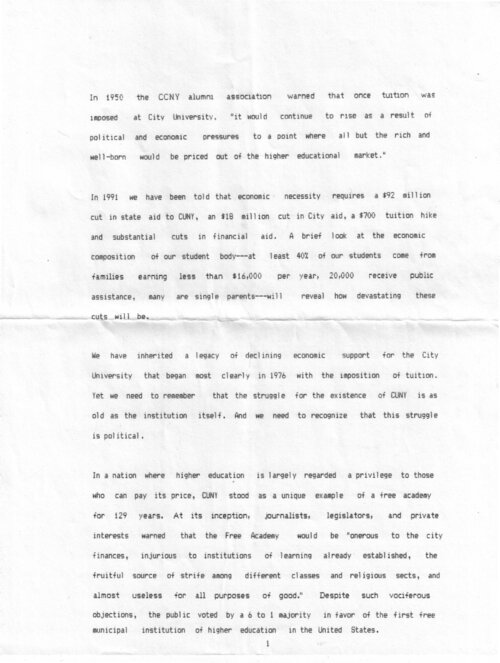 Graduate Center Teach-in: A Speech calling for Action “The struggle for the existence of CUNY is as old as the institution itself and. . .this struggle is political.” This speech, delivered by a CUNY Graduate Center student at a 1991 Graduate Center teach-in, sought to put the threat of a $92 million cut in state aid to CUNY, along with a steep tuition hike and additional cuts to students financial aid, into a broader historical context. The speaker argued that the austerity measures were an attack on public education and would directly affect the number of students being admitted, and by extension, the diversity of the student body. Tracing the decline of economic support for CUNY to the imposition of tuition during the 1976 fiscal crisis, which ended a 129-year policy of free tuition at CUNY, the speech concluded with a call for action, arguing that “ . . .the future of this university is at stake”.
 -
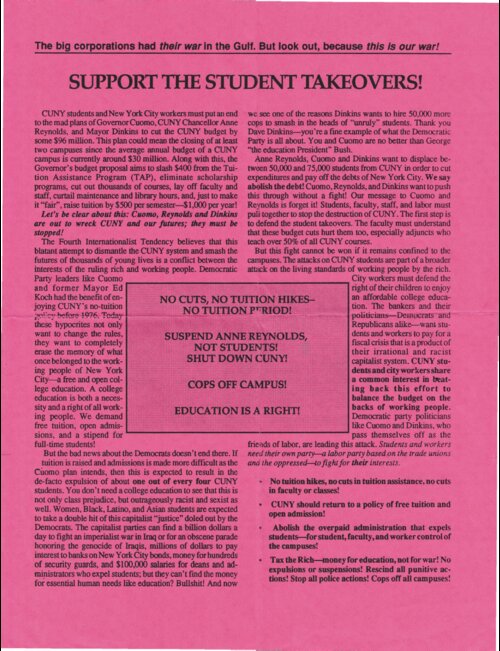 Fourth Internationalist Tendency Flyer: Support the Student Takeovers This newsletter produced by the Fourth Internationalist Tendency (FIT, a Trotskyist group) supported the CUNY student takeovers. It stated that Governor Cuomo, CUNY Chancellor Anne Reynolds, and Mayor Dinkins's proposal to cut CUNY's budget by $96 million would force the closing of campuses, slashes in the tuition assistance budget, and thousands of class cuts. The article continued to draw connections between CUNY students and city workers, stating that they had a "common interest in beating back this effort to balance the budget on the backs of working people." The back of the flyer provided an introduction to the Fourth Internationalist Tendency (FIT) that claimed to be a socialist group dedicated to a society democratically organized to fulfill people's basic needs.
 -
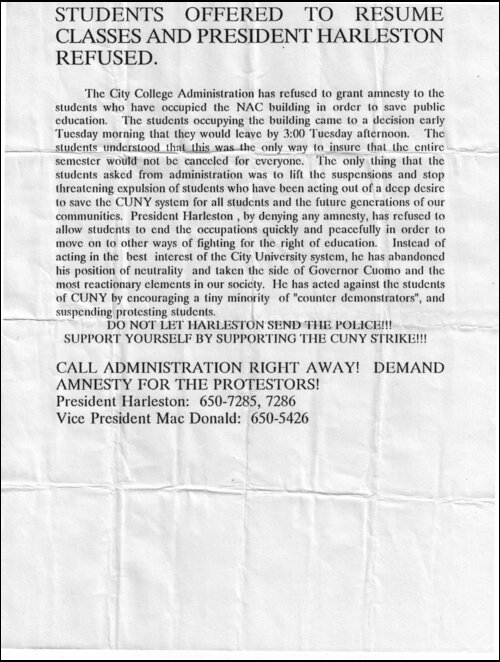 Demand Amnesty for the Protestors This City College memorandum was a call for supporters of the CUNY strike to contact President Harleston and Vice President Mac Donald and "demand amnesty for the [CCNY] protestors." The document explained that the students who had taken over the North Academic Center (NAC) building at City College had decided to leave the building to ensure that the entire semester wouldn't be canceled. Despite this decision the threat of expulsion or suspension of those who had participated had not been lifted by the college administration. In 1991 a city-wide student coalition worked in solidarity with one another to fight for the right to an education and against austerity or tuition increases. Strikes, demonstrations, teach-ins, and the takeovers of multiple buildings across campuses were among the protest tactics used. The demands included a call for Chancellor W. Ann Reynold's resignation, the elimination of tuition, no state cuts to education, and student seats on multiple CUNY committees. The protestors also called for a restructuring of the CUNY Board of Trustees and implementing a progressive state tax structure.
 -
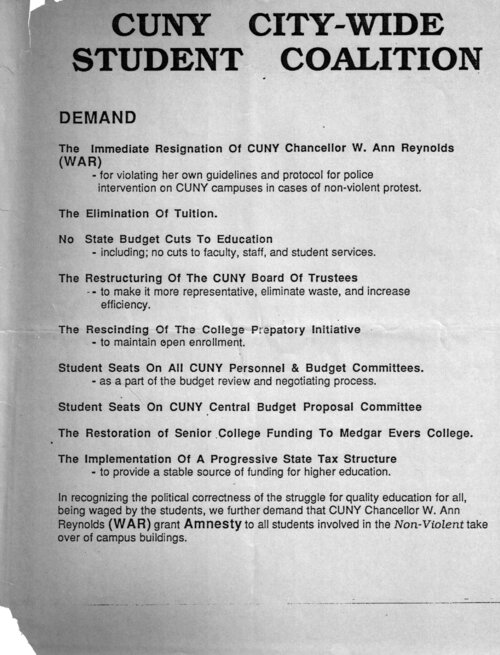 CUNY City-Wide Student Coalition This CUNY-wide student coalition document outlined ten demands which included a call for Chancellor W. Ann Reynold's resignation, the elimination of tuition, no state cuts to education, student seats on multiple CUNY committees (including budget) and the implementation of a progressive state tax structure to provide a stable source of funding for public higher education. The students also demanded that Chancellor W. Ann Reynolds grant amnesty to all the students involved in the non-violent takeovers of campus buildings. In 1991 a city-wide student coalition worked in solidarity with other groups to fight for the right to an education and against austerity and tuition increases. Strikes, demonstrations, teach-ins, and takeovers of multiple buildings across campuses were among the protest tactics used. The protestors also called for a restructuring of the CUNY Board of Trustees and implementing a progressive state tax structure.
1–25 of 33