The Shutdown: CUNY Responds to the Covid-19 Pandemic
Item set
Title
Description
On December 31, 2019, the World Health Organization (WHO) learned from a media statement released by the Wuhan Municipal Health Commission that there had been cases of “viral pneumonia” in the People’s Republic of China. On February 11, the WHO provided an official name for the novel coronavirus responsible for the illness: COVID-19. In less than a month after its naming, COVID-19 developed worldwide into a full-blown pandemic. Seattle was the first hot spot, soon followed by New York City, which became a major epicenter for infection. Many public and private institutions were forced to close their doors and switch to remote operations, including the City University of New York. Over the course of a week, the largest urban public university in the United States, comprised of approximately 250,000 students and 45,000 faculty across 25 campuses, was asked to transition from the traditional practice of collegiate learning and university operation to a digital format that could be successfully operated from the confines of individual homes, all while a pandemic raged across the globe and the city, consuming health, livelihoods, and life itself.
For the user of the CDLA collection, these contrasting scales of time and consequence are understandably disquieting. Officially sanctioned notices from the CUNY administration reassuring the student body that “...there are no confirmed coronavirus cases involving anyone in the CUNY community,” can sound naive (if not cynical) in hindsight, especially when compounded by concurrent community petitions to close the college and the circulation of the #CloseCUNY “hashtag” across social media outlets. Yet, the closing of a university is complex; in its role as a public institution, the CUNY system overwhelmingly serves the classically marginalized citizens of New York City, many of whom could not be assumed to possess the necessary equipment to engage in online instruction.

As a CUNY student’s tweet pointed out, closure of the university could not proceed without considering the double-bind of educational access and lived precarity that intersects the lives of those reliant upon public institutions. Such reasoning can be seen expressed in the official communiques of CUNY authorities, such as this series of tweets from the president of Lehman College. To close CUNY was more than simply a physical “closing of doors”; it was the denial of infrastructural access to the most vulnerable and deserving students, faculty, and staff. While possessing a duty to protect the health of its community, CUNY needed to proceed in a manner that respected its core mission to provide access to quality higher education for all.
Of course, to simply reiterate the official account of the digital transition does a disservice of forgetting those very voices that such accounts claim to value. While the university pondered solutions to structural inequity, the CUNY community was awash in uncertainty and consequential anxiety. Some doubted the sincerity of official statements, and saw a perceived lack of investment in preventative infrastructure as demonstrative of a lack of care. For some students, faculty and staff, this developed into feelings of antagonism towards CUNY as a whole. Given such an outcry and the growing rate of infections across New York state and the nation, a CUNY shut-down seemed bound to occur. Yet, even if one were acutely aware of the exact timing of the closure, they would still have been stunned by the means of its announcement. On March 11, 2020, at 11:12 AM, New York Governor Andrew Cuomo surprised the CUNY community by announcing on Twitter that CUNY would be moving to online learning within a week.

Starting March 12, CUNY would enter a five-day recess before transitioning to fully remote instruction for the remainder of the semester. In terms of public safety, such a decision could be deemed necessary: John Jay announced that same day that a COVID-19 exposure (defined by the CDC as being in close contact, within 6 feet for a total of 15 minutes or more, with a person who has tested positive for COVID-19) had occurred, and Brooklyn, Lehman, and Staten Island colleges announced exposures within the same week. But in terms of logistics, the sudden decision exacerbated further anxieties, as both students and faculty scrambled to cope with the limitations facing the integration of face-to-face coursework into digital formats. Perhaps the most succinct example of the indeterminacy facing instruction was a Queens College department email providing blanket approval to all course changes, due to inability of the administration to keep up with requests.
With such strains facing academic continuity within the first few weeks of the online transition, CUNY administration deemed another period of recalibration appropriate, suspending instruction from March 27 to April 1. Though coming at the expense of the traditional Spring Recess period, the extra time proved valuable for faculty, allowing for the restructuring and fine-tuning of teaching practices and syllabi. Though these new course designs hardly proved immune from problems (see the accompanying Teaching and Learning collection of this archive), they at least provided time for a new reality to set in: distance learning had begun.
Large questions abound: Were the difficulties in transitioning to online learning a result of Governor Cuomo’s lack of communication or CUNY’s administrative lack of power under the Cuomo administration to determine its own fate? Are the anxieties and antagonism of the CUNY community deserved or the knee-jerk reactions of a community in crisis? In the Shutdown collection of the CUNY Distance Learning Archive, we refrain from answering these questions. Rather, this collection seeks to preserve a moment, acquiring artifacts from CUNY staff, students, and faculty in order to reveal the range of subjective moments of crisis.
This collection is part of the CUNY Distance Learning Archive (CDLA), a group project developed as part of Matthew K. Gold’s Spring 2020 “Knowledge Infrastructures” seminar in the Ph.D. Program in English at The Graduate Center, CUNY, in partnership with The Interactive Technology and Pedagogy Certificate Program. All CDLA collections on the CUNY Digital History Archive website were co-curated by Travis Bartley, Nicole Cote, Zach Muhlbauer, and Stefano Morello (Project Manager).
Language
Contributor
Collection
Time Periods
Items
-
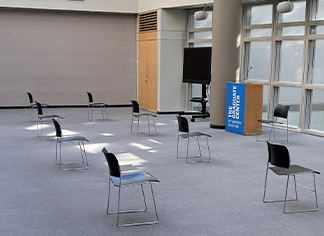
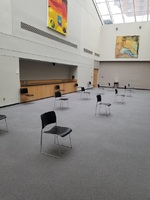 Safety Measures at The Graduate Center Taken by Charles Scott, Director of Facilities at the CUNY Graduate Center between March 2020 and May 2021, these pictures showed some of the ways in which administration and staff worked towards creating the conditions for a safe working and learning environment, as per CDC and NY State guidelines. While only a few essential workers were allowed in/required to enter the building after Governor Cuomo's March 13 executive order, over the following months, Scott and his staff explored a mired of ways in which the Graduate Center (a building where the majority of classrooms and offices have no windows nor access to natural light and air) could be safe for students, staff, and faculty. This item is part of the City University of New York (CUNY) Distance Learning Archive, a group project developed as part of Matthew K. Golds Spring 2020 Knowledge Infrastructures seminar in the Ph.D. Program in English at The Graduate Center, CUNY, in partnership with The Interactive Technology and Pedagogy Certificate Program. The project's goal was to resist or trouble the discourse of catastrophe around the shift to online learning caused by the COVID-19 pandemic by documenting the lived experiences of students, faculty, and staff across CUNY's 25 campuses. Further, we wanted to document the moment of crisis response with a critical approach to educational technology.
 -
 Selected Facebook Posts from CUNY Confessions This item offered a curated selection of informally written Facebook posts documenting student life during the abrupt transition to distance learning in mid-March of 2020. Drawing from the "CUNY Confessions" Facebook group, these compiled posts represented anonymous remarks and reflections submitted by students from multiple City University of New York (CUNY) campuses. Posts were included in the interest of surfacing the unfiltered and unseen domestic, educational, and extracurricular experiences of CUNY students during the university-wide shutdown of physical facilities following the COVID-19 outbreak across NYC. This item is part of the City University of New York (CUNY) Distance Learning Archive, a group project developed as part of Matthew K. Golds Spring 2020 Knowledge Infrastructures seminar in the Ph.D. Program in English at The Graduate Center, CUNY, in partnership with The Interactive Technology and Pedagogy Certificate Program. The project's goal was to resist or trouble the discourse of catastrophe around the shift to online learning caused by the COVID-19 pandemic by documenting the lived experiences of students, faculty, and staff across CUNY's 25 campuses. Further, we wanted to document the moment of crisis response with a critical approach to educational technology.
 -
 Recalibration Period for Educational Equity As many artifacts in this collection have suggested, the switch to online learning was abrupt for faculty, administration, and students alike. A week to transfer an entire university system to a digital format, especially when many community members did not have reliable internet access, was not enough time. As such, the City University of New York (CUNY) required a second adjustment period, or 'recalibration,' postponing classes yet again for faculty and students to acquire necessary resources for online instruction. Sent on March 23, 2020, this email from Chancellor Rodriguez summarized the rationale behind such a decision. This item is part of the City University of New York (CUNY) Distance Learning Archive, a group project developed as part of Matthew K. Golds Spring 2020 Knowledge Infrastructures seminar in the Ph.D. Program in English at The Graduate Center, CUNY, in partnership with The Interactive Technology and Pedagogy Certificate Program. The project's goal was to resist or trouble the discourse of catastrophe around the shift to online learning caused by the COVID-19 pandemic by documenting the lived experiences of students, faculty, and staff across CUNY's 25 campuses. Further, we wanted to document the moment of crisis response with a critical approach to educational technology.
 -
 What to Do If You Are Asked to Report to Work on Campus Tomorrow Sent on March 18, 2020, this artifact included a statement by the Professional Staff Congress (PSC) dictating terms for essential workers whose roles required continued in-person work during the official closure of CUNY. Despite its name, distance learning still required many CUNY employees to remain onsite for essential operations. Seeing the possibility for abuse during the pandemic, the PSC released this statement on the final day of CUNY's instructional recess period in support of labor equity during this moment of crisis. This item is part of the City University of New York (CUNY) Distance Learning Archive, a group project developed as part of Matthew K. Golds Spring 2020 Knowledge Infrastructures seminar in the Ph.D. Program in English at The Graduate Center, CUNY, in partnership with The Interactive Technology and Pedagogy Certificate Program. The project's goal was to resist or trouble the discourse of catastrophe around the shift to online learning caused by the COVID-19 pandemic by documenting the lived experiences of students, faculty, and staff across CUNY's 25 campuses. Further, we wanted to document the moment of crisis response with a critical approach to educational technology.
 -
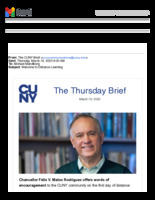 Welcome to Distance Learning The City University of New York (CUNY) traditionally has sent out regular newsletters to inform its community of significant events and accomplishments by its faculty and students. For the first week of remote learning, these newsletters would focus on the nature of online learning. We included the first of many such newsletters in this archive to mark the formal transition to distance learning on March 19, 2020, immediately following CUNY's instructional recess. This item is part of the City University of New York (CUNY) Distance Learning Archive, a group project developed as part of Matthew K. Golds Spring 2020 Knowledge Infrastructures seminar in the Ph.D. Program in English at The Graduate Center, CUNY, in partnership with The Interactive Technology and Pedagogy Certificate Program. The project's goal was to resist or trouble the discourse of catastrophe around the shift to online learning caused by the COVID-19 pandemic by documenting the lived experiences of students, faculty, and staff across CUNY's 25 campuses. Further, we wanted to document the moment of crisis response with a critical approach to educational technology.
 -
 Semester Info: Update 6.5 This series of emails from March 17th, 2020, between department faculty at Queens Colleges' Department of Art provided a snapshot of the sheer administrative burden that instituting remote learning practices was for many faculty. Rather than provide time for an exhaustive analysis of each course's teaching plans, the span of only a few days forced many departments to give a blank check to faculty course design. With little opportunity for oversight, such practices would quickly complicate the resumption of instruction. This item is part of the City University of New York (CUNY) Distance Learning Archive, a group project developed as part of Matthew K. Golds Spring 2020 Knowledge Infrastructures seminar in the Ph.D. Program in English at The Graduate Center, CUNY, in partnership with The Interactive Technology and Pedagogy Certificate Program. The project's goal was to resist or trouble the discourse of catastrophe around the shift to online learning caused by the COVID-19 pandemic by documenting the lived experiences of students, faculty, and staff across CUNY's 25 campuses. Further, we wanted to document the moment of crisis response with a critical approach to educational technology.
 -
 COVID-19 Update (Lehman College Campus COVID-19 Exposure) Sent on March 16, 2020, this email provided official notice of COVID-19 exposure among the Lehman College student body. In conjunction with John Jay College, Brooklyn College, and the College of Staten Island, this announcement marked the spread of COVID-19 to CUNY campuses across four of New York City's boroughs. This item is part of the City University of New York (CUNY) Distance Learning Archive, a group project developed as part of Prof. Matthew K. Gold's Spring 2020 Knowledge Infrastructures seminar in the Ph.D. Program in English at The Graduate Center, CUNY, in partnership with the Interactive Technology and Pedagogy Certificate Program. The project's goal was to resist or trouble the discourse of catastrophe around the shift to online learning caused by the COVID-19 pandemic by documenting the lived experiences of students, faculty, and staff across CUNY's 25 campuses. Further, the project wanted to document the moment of crisis response by taking a critical approach to educational technology.
 -
 Update on Hunter's Response to Coronavirus In the same vein as other official communiques, this email from Hunter College regarding available resources sought to strike a balance between logistical planning and human apathy. Of particular interest was the focus in this message on libraries. With many members of the City University of New York (CUNY) community coming from multi-generational, shared households, the question of space for education was a crucial – but often overlooked – concern. With the brief mention of this concern, we are reminded how the transition to distance learning was not as simple as switching on a computer; the fundamental nature of space for study outside of traditional classrooms was also complicated. This item is part of the City University of New York (CUNY) Distance Learning Archive, a group project developed as part of Prof. Matthew K. Gold's Spring 2020 Knowledge Infrastructures seminar in the Ph.D. Program in English at The Graduate Center, CUNY, in partnership with the Interactive Technology and Pedagogy Certificate Program. The project's goal was to resist or trouble the discourse of catastrophe around the shift to online learning caused by the COVID-19 pandemic by documenting the lived experiences of students, faculty, and staff across CUNY's 25 campuses. Further, the project wanted to document the moment of crisis response by taking a critical approach to educational technology.
 -
 Telecommuting Plans Released on March 15, 2020, this email represented an official communication from City University of New York (CUNY) Chancellor Matos Rodriguez on university guidelines, expectations, and intent to set up telecommunications for CUNY's operations. In this lengthy email, we again see the unique balance of conciliation and professionalism that the CUNY administration had attempted to convey throughout the pandemic. While we are typically used to separating questions of logistics and human effect, the creation of online learning systems during the pandemic revealed such concerns to be hardly disparate. This item is part of the City University of New York (CUNY) Distance Learning Archive, a group project developed as part of Prof. Matthew K. Gold's Spring 2020 Knowledge Infrastructures seminar in the Ph.D. Program in English at The Graduate Center, CUNY, in partnership with the Interactive Technology and Pedagogy Certificate Program. The project's goal was to resist or trouble the discourse of catastrophe around the shift to online learning caused by the COVID-19 pandemic by documenting the lived experiences of students, faculty, and staff across CUNY's 25 campuses. Further, the project wanted to document the moment of crisis response by taking a critical approach to educational technology.
 -
 Covid-19 Update (Lehman College campus) This submission from a member of the CUNY community included an email from Lehman College's President sent the night of March 16, 2020, discussing the consequences of the official shutdown order. In this artifact, we encounter two concerns: logistics and anxiety. On the one hand, the sudden nature of the shutdown limited some college's abilities to fully transition with necessary materials and resources to remote locations, requiring specific extensions to campus attendance to permit effective operations. On the other hand, Lehman College had just received news of student exposure to COVID-19 on its campus, raising fears that the now remote student body would be carrying the infection back to their own homes. This email showed the difficulty of facilitating the transition to distance learning, balancing the twin questions of community support and logistical analysis and needs. This item is part of the City University of New York (CUNY) Distance Learning Archive, a group project developed as part of Prof. Matthew K. Gold's Spring 2020 Knowledge Infrastructures seminar in the Ph.D. Program in English at The Graduate Center, CUNY, in partnership with the Interactive Technology and Pedagogy Certificate Program. The project's goal was to resist or trouble the discourse of catastrophe around the shift to online learning caused by the COVID-19 pandemic by documenting the lived experiences of students, faculty, and staff across CUNY's 25 campuses. Further, the project wanted to document the moment of crisis response by taking a critical approach to educational technology.
 -
 Coronavirus Update: CSI exposure Staten Island, often considered NYC's "forgotten borough," the lesser child of the more famous boroughs of Manhattan, Brooklyn, Queens, and the Bronx, was not able to avoid the pandemic. CSI President William J. Fritz sent this email on March 13, 2020, addressing the first positive case of Covid-19 in the CSI community. Despite the disparate geographies and perceived isolation of CUNY's 25 campuses across the city, the spread of COVID-19 was powerful enough in the end to register in every borough and every CUNY campus, reminding us all of the sheer reach and ubiquity of the disease. This item is part of the City University of New York (CUNY) Distance Learning Archive, a group project developed as part of Prof. Matthew K. Gold's Spring 2020 Knowledge Infrastructures seminar in the Ph.D. Program in English at The Graduate Center, CUNY, in partnership with the Interactive Technology and Pedagogy Certificate Program. The project's goal was to resist or trouble the discourse of catastrophe around the shift to online learning caused by the COVID-19 pandemic by documenting the lived experiences of students, faculty, and staff across CUNY's 25 campuses. Further, the project wanted to document the moment of crisis response by taking a critical approach to educational technology.
 -
 CUNY Guidance for Students Traveling Home to International Countries Amidst discussions of precarity, a group often absent from the conversation were international students, members of the CUNY community resident in the United States under limited political visas far from home and family. Sent on March 13, 2020, by the Office of Student Affairs at The Graduate Center, this email exemplified an initial attempt by CUNY leaders to tabulate the movement of the international student body during the early stages of the COVID-19 pandemic. The email specifically requested that students record their travels home to international countries by entering the details into CUNYGO, the university's travel registry portal. This item is part of the City University of New York (CUNY) Distance Learning Archive, a group project developed as part of Prof. Matthew K. Gold's Spring 2020 Knowledge Infrastructures seminar in the Ph.D. Program in English at The Graduate Center, CUNY, in partnership with the Interactive Technology and Pedagogy Certificate Program. The project's goal was to resist or trouble the discourse of catastrophe around the shift to online learning caused by the COVID-19 pandemic by documenting the lived experiences of students, faculty, and staff across CUNY's 25 campuses. Further, the project wanted to document the moment of crisis response by taking a critical approach to educational technology.
 -
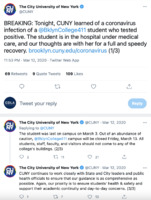 Tweet: CUNY Announcement of COVID-19 Infection at Brooklyn College On March 13, 2020, several days after Governor Andrew Cuomo declared a state of emergency across New York State, Brooklyn College, City University of New York (CUNY), reported its first positive case of COVID-19. Such a report offered two narratives: either CUNY's closure came too soon to prevent more cases, or its closure was exactly at the opportune time – right when more cases were likely to develop. This artifact demonstrated the wide-reaching spread of COVID-19 across CUNY campuses. From Manhattan to Brooklyn, the pandemic had become a pivotal part of CUNY's history. This item is part of the City University of New York (CUNY) Distance Learning Archive, a group project developed as part of Prof. Matthew K. Gold's Spring 2020 Knowledge Infrastructures seminar in the Ph.D. Program in English at The Graduate Center, CUNY, in partnership with the Interactive Technology and Pedagogy Certificate Program. The project's goal was to resist or trouble the discourse of catastrophe around the shift to online learning caused by the COVID-19 pandemic by documenting the lived experiences of students, faculty, and staff across CUNY's 25 campuses. Further, the project wanted to document the moment of crisis response by taking a critical approach to educational technology.
 -
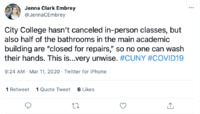 Tweet: City College Bathrooms Under Repair Amid COVID-19 Outbreak As with most public institutions, during the first wave of the Covid-19 pandemic, the City University of New York (CUNY) struggled with acquiring sufficient funding to meet the infrastructural needs of its physical facilities. With this tweet, referencing this NBC article and posted on March 11, 2020, we saw how the difficulty in maintaining functional, hygienic restrooms failed to satisfy the necessary conditions for student wellbeing amid the rise of COVID-19 in NYC. In expressing exasperation at the inaccessible state of City College's bathroom facilities, this tweet captured the locally situated impact of austerity and mismanagement of funding for maintenance and emergency preparedness of CUNY's physical infrastructure amid the public health crisis of the pandemic. This item is part of the City University of New York (CUNY) Distance Learning Archive, a group project developed as part of Prof. Matthew K. Gold's Spring 2020 Knowledge Infrastructures seminar in the Ph.D. Program in English at The Graduate Center, CUNY, in partnership with the Interactive Technology and Pedagogy Certificate Program. The project's goal was to resist or trouble the discourse of catastrophe around the shift to online learning caused by the COVID-19 pandemic by documenting the lived experiences of students, faculty, and staff across CUNY's 25 campuses. Further, the project wanted to document the moment of crisis response by taking a critical approach to educational technology.
 -
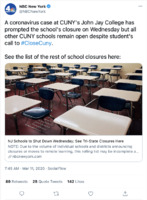 Tweet: NBC New York Report of Coronavirus Exposure at John Jay College Posted on March 11, 2020, this tweet from NBC New York reports on the first positive case of COVID-19 among the student body of John Jay College of Criminal Justice, City University of New York (CUNY). With coverage from a nationally syndicated news channel, CUNY's early experience with the pandemic revealed itself to be more than merely a local concern: It had national influence as well. This item is part of the City University of New York (CUNY) Distance Learning Archive, a group project developed as part of Prof. Matthew K. Gold's Spring 2020 Knowledge Infrastructures seminar in the Ph.D. Program in English at The Graduate Center, CUNY, in partnership with the Interactive Technology and Pedagogy Certificate Program. The project's goal was to resist or trouble the discourse of catastrophe around the shift to online learning caused by the COVID-19 pandemic by documenting the lived experiences of students, faculty, and staff across CUNY's 25 campuses. Further, the project wanted to document the moment of crisis response by taking a critical approach to educational technology.
 -
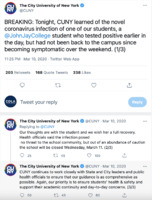 Tweet: CUNY Announcement of COVID-19 Infection at John Jay College Posted on March 10, 2020, this tweet represented the official announcement from the City University of New York (CUNY) administration regarding the exposure of John Jay's student body to COVID-19. While many other tweets in this collection show public awareness of a student testing positive for Covid-19 prior to CUNY's announcement, it is worth noting the community's shock as its fears were officially confirmed. While this tweet attempts an official conciliatory tone, it cannot be read without the sense of weight it conjured for the larger CUNY community. This item is part of the City University of New York (CUNY) Distance Learning Archive, a group project developed as part of Prof. Matthew K. Gold's Spring 2020 Knowledge Infrastructures seminar in the Ph.D. Program in English at The Graduate Center, CUNY, in partnership with the Interactive Technology and Pedagogy Certificate Program. The project's goal was to resist or trouble the discourse of catastrophe around the shift to online learning caused by the COVID-19 pandemic by documenting the lived experiences of students, faculty, and staff across CUNY's 25 campuses. Further, the project wanted to document the moment of crisis response by taking a critical approach to educational technology.
 -
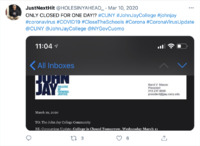 Tweet: Reaction to Coronavirus Update at John Jay College (1) Posted on March 10, 2020, this tweet records one student's outrage over the mere announced one-day closure of John Jay College of Criminal Justice of the City University of New York (CUNY) following its first confirmed case of COVID-19 among the student body. Containing a litany of CUNY-specific activist hashtags, the tweet broadly typifies the growing sense of unrest over CUNY leadership's general lack of pandemic responsiveness. This particular student framed their outrage with a screen captured email from John Jay President Karol V. Mason, which announced the exposure and offered preparatory guidance for John Jay students, faculty, and staff going forward. This item is part of the City University of New York (CUNY) Distance Learning Archive, a group project developed as part of Prof. Matthew K. Gold's Spring 2020 Knowledge Infrastructures seminar in the Ph.D. Program in English at The Graduate Center, CUNY, in partnership with the Interactive Technology and Pedagogy Certificate Program. The project's goal was to resist or trouble the discourse of catastrophe around the shift to online learning caused by the COVID-19 pandemic by documenting the lived experiences of students, faculty, and staff across CUNY's 25 campuses. Further, the project wanted to document the moment of crisis response by taking a critical approach to educational technology.
 -
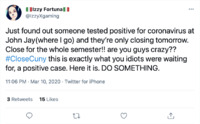 Tweet: Reaction to Coronavirus Update at John Jay College (2) As a central higher education hub for the population of New York City, City University of New York (CUNY) schools were unable to prevent COVID-19 exposures. One of the first cases of infection occurred at John Jay College of Criminal Justice. With this tweet, dated March 11, 2020, we see some of the community's reactions to that event. Note that the focus on the limited closure time instead of the threat of exposure reflected a general concern for CUNY's response. Such tweets reveal how the pandemic came to catalyze longstanding points of tension between the broader community and CUNY's administration. This item is part of the City University of New York (CUNY) Distance Learning Archive, a group project developed as part of Prof. Matthew K. Gold's Spring 2020 Knowledge Infrastructures seminar in the Ph.D. Program in English at The Graduate Center, CUNY, in partnership with the Interactive Technology and Pedagogy Certificate Program. The project's goal was to resist or trouble the discourse of catastrophe around the shift to online learning caused by the COVID-19 pandemic by documenting the lived experiences of students, faculty, and staff across CUNY's 25 campuses. Further, the project wanted to document the moment of crisis response by taking a critical approach to educational technology.
 -
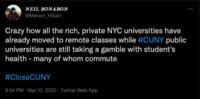 Tweet: #CloseCUNY Activism & NYC Higher Education Posted on March 10, 2020, this tweet reflected on the pandemic response efforts of private NYC universities compared to public universities like the City University of New York (CUNY). For many community members, the difference between university responses was linked to class dynamics. CUNY supports a largely immigrant and working-class population, serving as the best option for higher education to many of New York City's marginalized communities. Compared to the student populations at neighboring NYU and Columbia University, there is a stark class difference. To many members of the CUNY community, such class differences contributed to the marked apathy for the health of CUNY students. This item is part of the City University of New York (CUNY) Distance Learning Archive, a group project developed as part of Prof. Matthew K. Gold's Spring 2020 Knowledge Infrastructures seminar in the Ph.D. Program in English at The Graduate Center, CUNY, in partnership with the Interactive Technology and Pedagogy Certificate Program. The project's goal was to resist or trouble the discourse of catastrophe around the shift to online learning caused by the COVID-19 pandemic by documenting the lived experiences of students, faculty, and staff across CUNY's 25 campuses. Further, the project wanted to document the moment of crisis response by taking a critical approach to educational technology.
 -
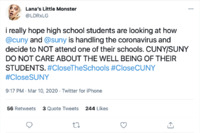 Tweet: CUNY/SUNY Pandemic Response & Student Wellbeing Posted on March 11, 2020, this tweet echoed related Twitter artifacts from this collection in scrutinizing the perceived lack of preparedness and administrative indifference of the City University of New York (CUNY) toward the health and safety of its student population. In its desire for "high school students" to be "looking" at how CUNY was dealing with COVID-19, the tweet also gestured toward a sense of posterity for the institutional landscape of public higher education. These locally situated perspectives on the university's response to the pandemic, in turn, reflected a longstanding, historically charged relationship between CUNY as an institution and the broader community of NYC citizens. This item is part of the City University of New York (CUNY) Distance Learning Archive, a group project developed as part of Prof. Matthew K. Gold's Spring 2020 Knowledge Infrastructures seminar in the Ph.D. Program in English at The Graduate Center, CUNY, in partnership with the Interactive Technology and Pedagogy Certificate Program. The project's goal was to resist or trouble the discourse of catastrophe around the shift to online learning caused by the COVID-19 pandemic by documenting the lived experiences of students, faculty, and staff across CUNY's 25 campuses. Further, the project wanted to document the moment of crisis response by taking a critical approach to educational technology.
 -
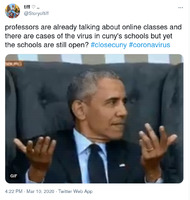 Tweet: School is still open? This tweet from a City University of New York (CUNY) student pointed out the discrepancy between faculty preparation for online teaching and the continued operation of CUNY campuses. As expressed in other tweets (see the series "Tweet: Lehman President Explanation"), many CUNY campuses were preparing for an online transition before the university's initial decision to close due to the Covid-19 pandemic. However, much of this preparation remained largely unofficial and not transparent to the CUNY student body. As demonstrated in this tweet, this apparent lack of communication created a sense of disconnect between CUNY students and administration, often expressed in a lighthearted fashion through memes. This item is part of the City University of New York (CUNY) Distance Learning Archive, a group project developed as part of Prof. Matthew K. Gold's Spring 2020 Knowledge Infrastructures seminar in the Ph.D. Program in English at The Graduate Center, CUNY, in partnership with the Interactive Technology and Pedagogy Certificate Program. The project's goal was to resist or trouble the discourse of catastrophe around the shift to online learning caused by the COVID-19 pandemic by documenting the lived experiences of students, faculty, and staff across CUNY's 25 campuses. Further, the project wanted to document the moment of crisis response by taking a critical approach to educational technology.
 -
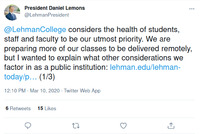 Tweet: Lehman President Explanation This series of tweets from the president of Lehman College, Daniel Lemons, provided an official response to demands for CUNY's closure, explaining that the logistics facing CUNY's transition to distance learning were markedly different from other institutions of higher education given its status as a public institution. Amidst many claims of institutional indifference, this artifact provided an official rationale for the perceived latency in CUNY's response to the pandemic, raising issues of equity and public duty within debates about health and economics. This item is part of the City University of New York (CUNY) Distance Learning Archive, a group project developed as part of Prof. Matthew K. Gold's Spring 2020 Knowledge Infrastructures seminar in the Ph.D. Program in English at The Graduate Center, CUNY, in partnership with the Interactive Technology and Pedagogy Certificate Program. The project's goal was to resist or trouble the discourse of catastrophe around the shift to online learning caused by the COVID-19 pandemic by documenting the lived experiences of students, faculty, and staff across CUNY's 25 campuses. Further, the project wanted to document the moment of crisis response by taking a critical approach to educational technology.
 -
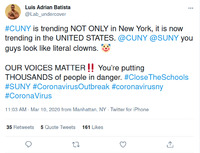 Tweet: #CloseCUNY Nationwide This tweet pointed out that the #CloseCUNY hashtag had received national circulation among Twitter's userbase during the early days of the pandemic. This hashtag expressed a growing desire for CUNY to cease in-person instruction, begun early in the pandemic, and became widely popular among the broader CUNY community. As its circulation suggested, the concerns raised in this tweet demonstrated CUNY's influence beyond simply the metropolitan area it inhabits geographically. This item is part of the City University of New York (CUNY) Distance Learning Archive, a group project developed as part of Prof. Matthew K. Gold's Spring 2020 Knowledge Infrastructures seminar in the Ph.D. Program in English at The Graduate Center, CUNY, in partnership with the Interactive Technology and Pedagogy Certificate Program. The project's goal was to resist or trouble the discourse of catastrophe around the shift to online learning caused by the COVID-19 pandemic by documenting the lived experiences of students, faculty, and staff across CUNY's 25 campuses. Further, the project wanted to document the moment of crisis response by taking a critical approach to educational technology.