LaGuardia Community College: The Early Years of Adult and Continuing Education
Item set
Collection
LaGuardia Community College: The Early Years of Adult and Continuing Education
Time Periods
1978-1992 Retrenchment - Austerity - Tuition
1993-1999 End of Remediation and Open Admissions in Senior Colleges
2000-2010 Centralization of CUNY
Items
1–25 of 28
Advanced search
-
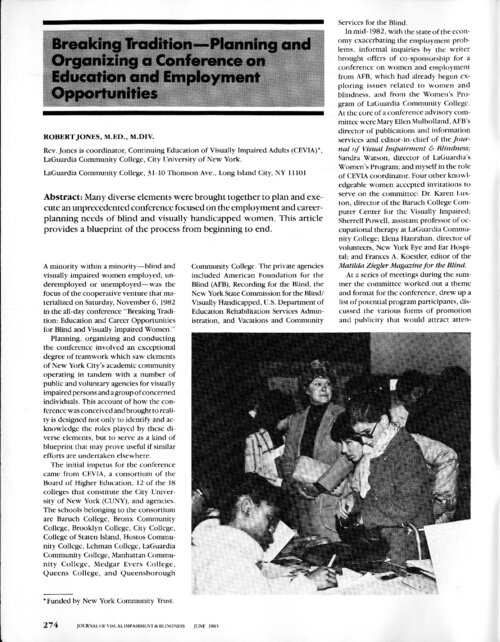 "Breaking Tradition — Planning and Organizing a Conference on Education and Employment Opportunities" In this article from the Journal of Visual Impairment & Blindness, Robert Jones, a professor at LaGuardia Community College, examines a number of the considerations that are involved in designing and holding a conference aimed at addressing the employment needs of women with visual impairments. In doing so, Jones presents a case study that describes the planning and realization of a November 6, 1982 conference that was put together with the cooperation of different organizations and CUNY colleges. Leading the efforts from within CUNY were LaGuardia's representatives on the planning committee. The college 's commitment to meeting the needs of underserved student populations quickly became a defining characteristic of LaGuardia's Continuing Education division in its early years.
 -
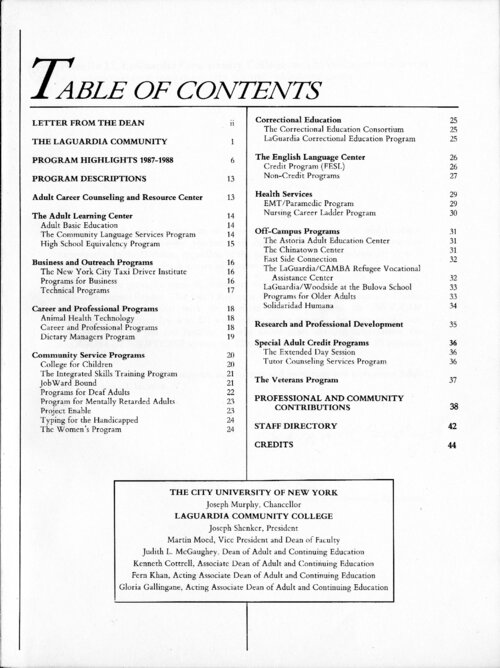 LaGuardia's Community Service Programs, 1987-88 This selection from the 1987-8 catalog of LaGuardia Community College's Continuing Education division highlights the college's commitment to serving the western Queens community. The diverse array of programs cater to local children, young adults, homeless, and those with disabilities, among others. Of particular note is the school's programming for Deaf adults and youth, an initiative that began in 1974.
 -
 "On the 20th Anniversary of the Program for Deaf Adults" This is the text of a presentation given by Fern Khan, former director of LaGuardia Community College's community service programs, on November 8, 1996. Delivered in commemoration of the twentieth anniversary of the college's Programs for Deaf Adults, Khan's speech recalls the formative years of the program, including initial hirings, outreach efforts, and funding initiatives. Remarking fondly on the collaboration between "college leadership, staff, the Deaf community, and supporters," Khan's presentation is equally a reflection of her own experiences with the program. Prior to leaving LaGuardia in 1989, Khan played a large role in shaping the college's community outreach efforts within its Continuing Education division. The college's commitment to educating the Deaf began in the early 1970s and was just one of several of the division's initiatives.
 -
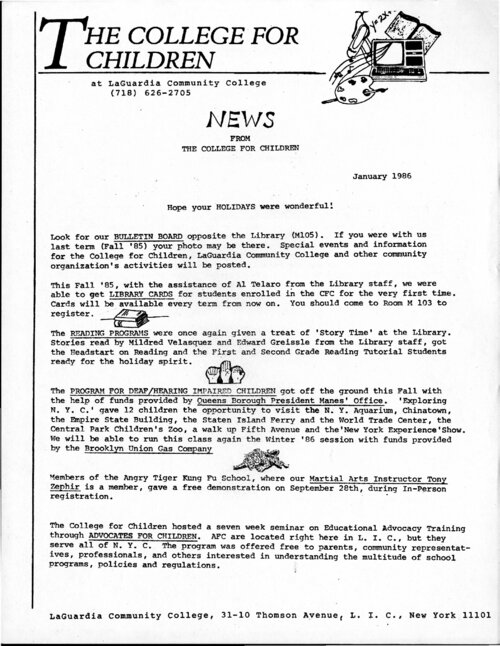 News from The College For Children, January 1986 This January 1986 newsletter from "The College for Children" at LaGuardia Community College provides a brief look into the college's unique program designed for the youth in western Queens. The newsletter includes mention of several course offerings within the program, enrollment figures, and brief summaries of recent events. The College for Children was created by LaGuardia CC in the early 1980s to serve children aged 4-14 in the surrounding community with emphasis given to underserved populations such as homeless, and Deaf youth. The program was contained within LaGuardia's Continuing Education division and represented just one of the many community-focused efforts at the school.
 -
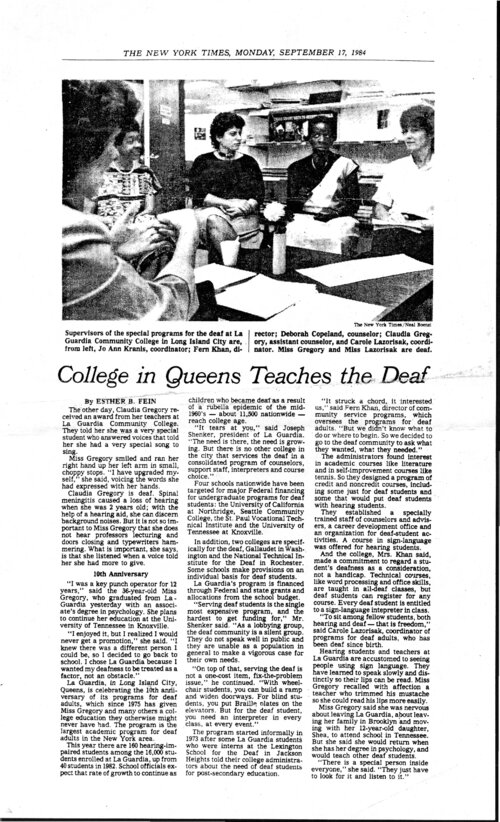 "College in Queens Teaches the Deaf" This New York Times article from September 1984 highlights the efforts of LaGuardia Community College to provide educational opportunities to Deaf students. Written on the 10th anniversary of the creation of the Programs for Deaf Adults department at LGCC, the article includes statements from LaGuardia students, faculty, and administration. LaGuardia's formal commitment to Deaf education began in 1974 and became a noteworthy component of the school's Continuing Education division.
 -
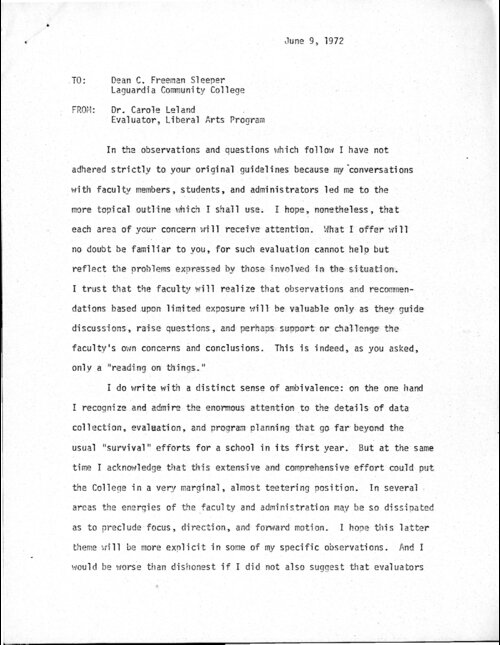 LaGuardia's Liberal Arts Program Evaluation, 1972 Written at the close of LaGuardia Community College's first academic year, this assessment of the college provides a sobering account of the difficulties present at the school in its infancy. The report, written by Dr. Carole Leland, examines various aspects of the college (e.g. atmosphere, curriculum, teaching methodology, evaluation) and bases its findings on observations and interviews conducted on campus.
 -
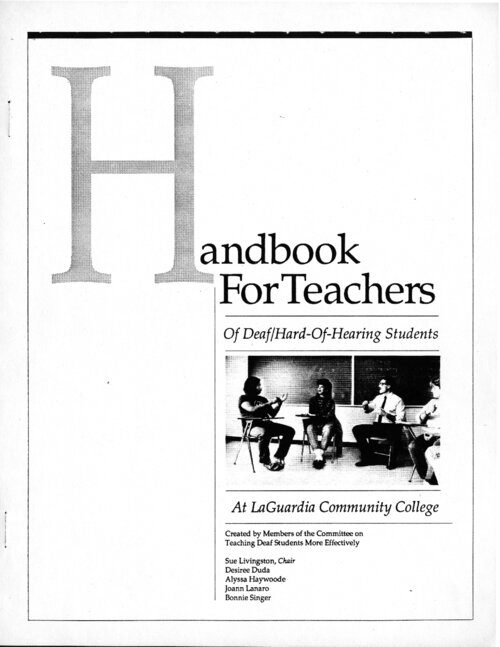 Handbook for Teachers of Deaf/Hard-Of-Hearing Students This is a handbook that was created for use by professors at LaGuardia Community College who had "a deaf or hard-of-hearing student in his/her class." The guidebook seeks to educate its readers on the realities of life with a hearing disability while shattering some existing myths. The authors include FAQs regarding "special considerations" for Deaf students including focus on the frequent need for in-class interpreters. The book also includes tips on classroom layout, communication techniques, and ways in which to engage Deaf students within existing teaching styles. LaGuardia Community College's commitment to education for the deaf can be traced to the early 1970s, and represented just one of the school's many efforts to provide opportunities for underserved populations within its Continuing Education division.
 -
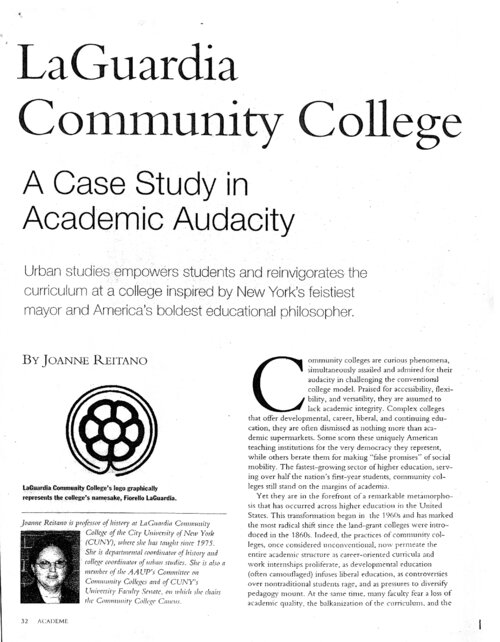 "A Case Study in Academic Audacity" Framing this 2002 case study of LaGuardia Community College around the larger conversation of community colleges nationwide, in this article, LaGuardia Professor Joanne Reitano explores the influence of Fiorello LaGuardia, former mayor of New York, and John Dewey, educational philosopher, on the creation of the college and the development of the mission and ethos of the school. The article also examines the college's unique urban studies requirement for its students. Reitano readily acknowledges the challenges faced by the school, though she offers a optimistic outlook for its future.
 -
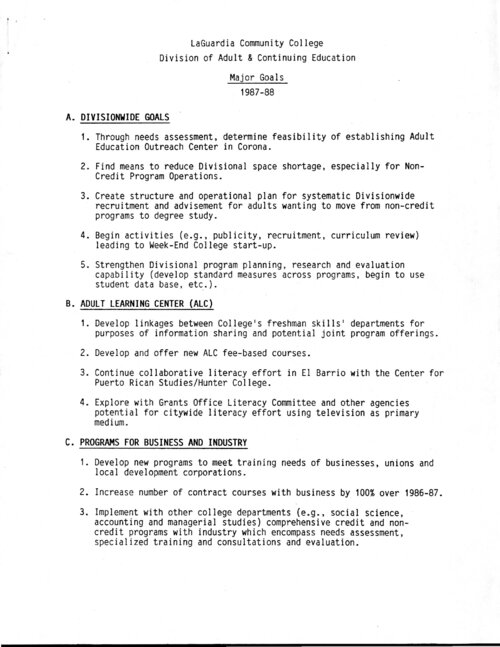 "Major Goals, 1987-88" This 1987-8 report lists the "major goals" of LaGuardia Community College's Division of Adult & Continuing Education. Outlining each of the components within the division, the report highlights the many initiatives of the college, particularly emphasizing the diverse students served via the school's continuing education programs. From its earliest years, LaGuardia committed itself to offering educational opportunities to underserved populations in western Queens.
 -
 "Open Admissions and LaGuardia Community College" This June 1972 report provides an outside assessment of LaGuardia Community College at the close of its first academic year. The document, which focuses on various aspects of Open Admissions at the college, examines both the observed successes and failings of campus programs, students, faculty, and administration. Created from observations and interviews with individuals on campus, the report is often critical of the fledgling college. Commissioned by the college's dean Freeman Sleeper, the report was created by Abraham Habenstreit, an assistant dean at Staten Island Community College.
 -
 "Post-Secondary Education and the Non-Traditional Deaf Student" This is the text of a May 1988 presentation prepared by Desiree Duda, academic coordinator of Programs for Deaf Adults at LaGuardia Community College, for the Conference on Post Secondary Education for Hearing Impaired Students. The presentation considers three types of "non-traditional" deaf students: ESL (English as a Second Language) students without educational experience in the U.S., those who entered the education system late, and those unprepared to work with others of "diverse backgrounds." Duda speaks of LaGuardia Community College's experience teaching each group, citing the college's different approaches and offering her own observations about effective teaching. The college's commitment to educating deaf students began in 1974 and became a noteworthy component of its Continuing Education division.
 -
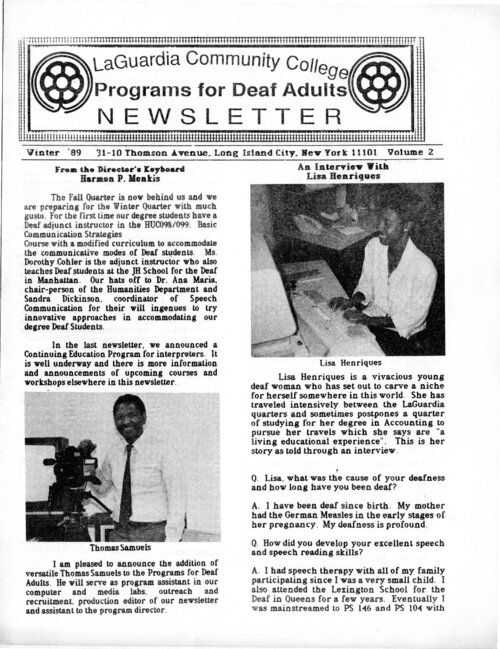 Program for Deaf Adults Newsletter, Winter 1989 This newsletter from Winter 1989 provides a glimpse into LaGuardia Community College's Programs for Deaf Adults department. The newsletter includes interviews with students and faculty, announcements of course offerings, and other news from within the department. The college's commitment to education for the deaf began in 1974 and became a noteworthy component of its Continuing Education division.
 -
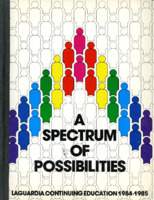 Community Service Programs, 1984-85 This selection from the 1984-5 catalog of LaGuardia Community College's Continuing Education division highlights several of the college's offerings for the western Queens community. Of particular note is the school's programming for Deaf adults and youth, an initiative that began in 1974. Other programs described cater to students with other forms of disabilities, underserved children, women returning to school, and military veterans.
 -
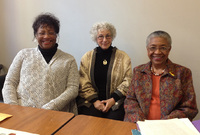 Oral History Interview with Joan Greenbaum, Fern Khan, and Sandy Watson of LaGuardia Community College Oral history interview with Sandy Watson, Joan Greenbaum, and Fern Khan of LaGuardia Community College. The interview was conducted on January 22, 2015 at the CUNY Graduate Center by Steve Brier and Andrea Ades Vásquez. The subjects discuss the founding of the college, its mission, and the array of innovative programs developed by a young faculty. Under a progressive administration, they were given free rein to build a college that would listen to, and serve, its surrounding community. Their adult and continuing education programs served a broad range of needs and many non-traditional learners.
 -
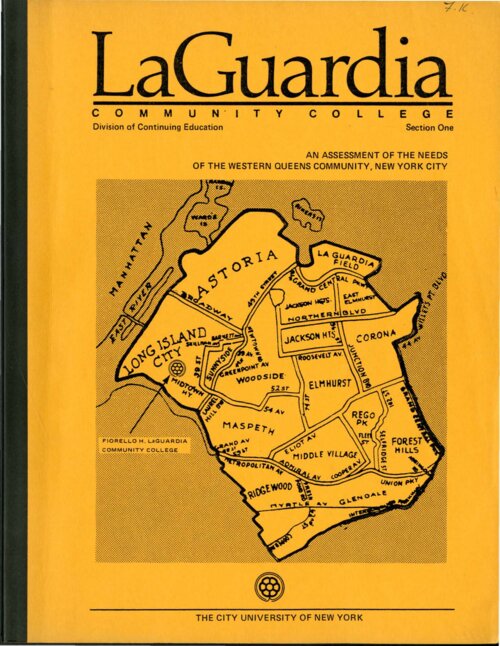 LaGuardia Community College - An Assessment of the Needs of the Western Queens Community, 1980 LaGuardia Community College opened in 1971 but in order to expand outreach and continuing education with the communities it served, this needs assessment of various communities in western Queens was undertaken in 1980. This study was initiated by Dean Augusta (Gussie) Kappner and implemented by Associate Dean and Project Director Fern Khan, and Research Assistant Edithanne Kane.
 -
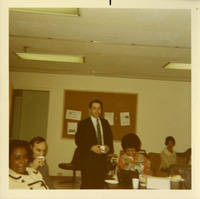 Joe Shenker, founding president of LaGuardia with the first group of students who were paraprofessionals In 1970, Joseph Shenker was appointed president of what was then still called "Community College Number Nine," which would soon become LaGuardia Community College. Still in his twenties, Shenker brought a youthful optimism and a spirit of experimentation to the college that was reflected in the faculty hired and the programs offered. This informal photo, dated 1971, shows Shenker with the first students admitted to LaGuardia. These students were paraprofessionals from NYC public schools.
 -
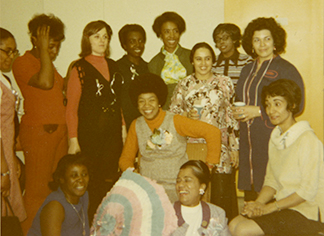
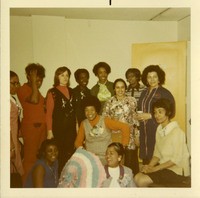 Celebration for the first group of LaGuardia Community College paraprofessional students , May 1971 Fern Khan (at center of photo) and her students who were the first group of students to enroll at LaGuardia. These students were paraprofessionals employed by the Board of Education. The program was funded following an agreement between the United Federation of Teachers union and the Board of Education as a Career Ladder program to move paraprofessionals into teaching or social work.
 -
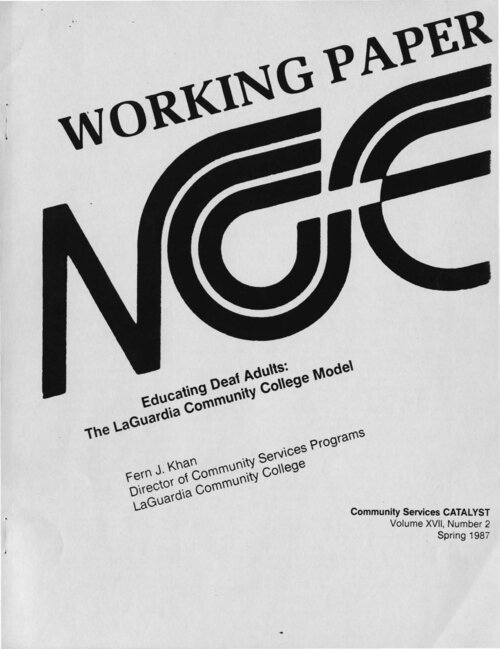 Educating Deaf Adults: The LaGuardia Community College Model Among LaGuardia Community College's innovative programs was one aimed at Deaf learners that the New York Times called "the most comprehensive educational program for deaf persons in New York City." Under the LaGuardia model, Deaf students were incorporated into regular classes with support services. The program's creators saw the effort as part of the college's mission to expand access to education to heretofore underserved populations.
 -
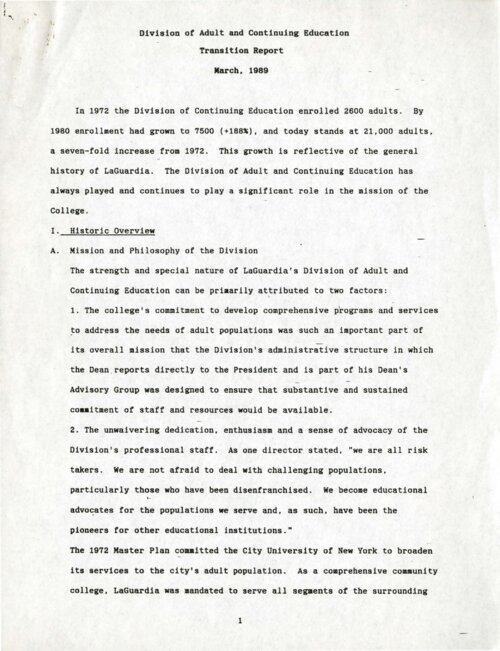 Division of Adult and Continuing Education: Transition Report, March 1989 This 1989 report chronicles the growth of the LaGuardia Community College Division of Adult and Continuing Education since its inception in 1972. The report states: "The Division of Adult and Continuing Education was envisioned as a major outreach vehicle to accomplish this mission and, from its inception, has played a pivotal role in enabling the college to fulfill its mission to provide access for non-traditional populations."
 -
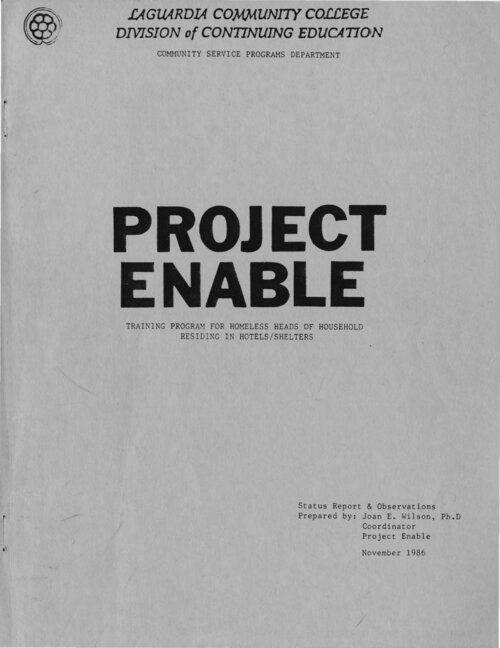 Project Enable: Training Program for Homeless Heads of Household Residing in Hotels/Shelters This November 1986 report details the activities of a training program for homeless mothers in New York City conducted by LaGuardia Community College's Division of Continuing Education. The program, which covered personal counselling, job training and placement, and housing referrals, is a concrete example of the college's expansive educational philosophy, whereby its efforts were tailored to expanding the number of people with access to its resources.
 -
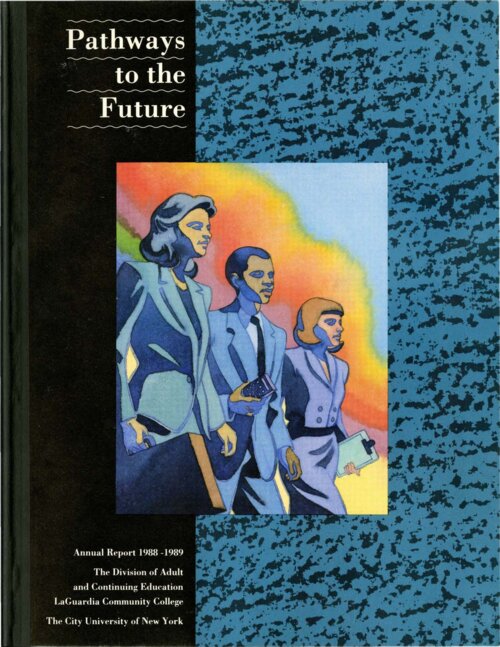 Pathways to the Future: Annual Report, 1988-1989 The Annual Report for 1988-89, prepared by the Division of Adult and Continuing Education, details the array of programs developed by LaGuardia Community College staff to expand the educational reach of the college and meet the needs of its surrounding communities. With this guiding imperative in mind, the Division designed programs intended to reach non-traditional learners, including working adults, the homeless, and those learning English for the first time.
 -
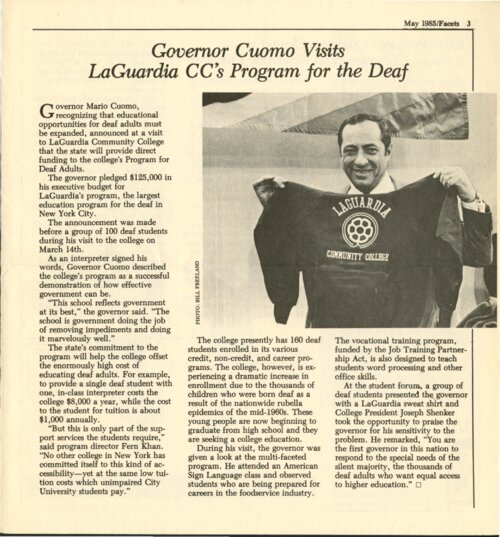 "Governor Cuomo Visits LaGuardia CC's Program for the Deaf" This article published in a CUNY-wide bulletin describes a visit by then-governor Mario Cuomo to LaGuardia's program for Deaf adults. Recognizing the success of the program, the governor pledged $125,000 in funding for the coming year.
 -
 LaGuardia Community College Division of Continuing Education: General Statement This undated document details the accomplishments of the Division of Continuing Education at LaGuardia Community College. The division's programs were designed to provide access to higher education for nontraditional learners and to respond to the needs of the community in which the college was situated. To this end, the division undertook programs to reach deaf learners, immigrants learning English for the first time, senior citizens, homeless adults, and incarcerated persons.
 -
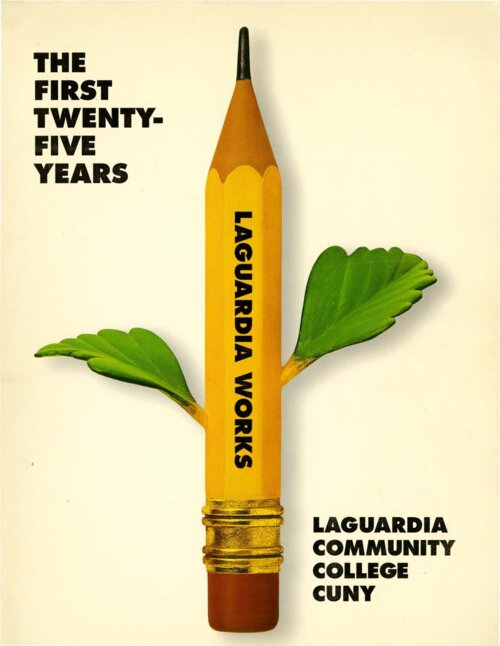 LaGuardia Works: LaGuardia Community College, the First 25 Years This booklet, published in 1997, tells the story of the first 25 years of LaGuardia Community College, from its conception as "Community College Number Nine" in 1968 through its 1971 opening and beyond. The author describes the social and economic context in which LaGuardia emerged, at a time when the City University aimed to make itself available to ever-larger segments of the population, while at the same time New York City endured an economic restructuring that deeply affected neighborhoods like Long Island City, in which the new college was situated. The booklet goes on to describe LaGuardia's distinct circumstances, including its location in a former factory building and the recruitment of an activist faculty and staff who were given free rein by an open-minded administration to create novel programs that would both utilize the city as a site of learning and expand access to higher education to heretofore underserved populations.
 -
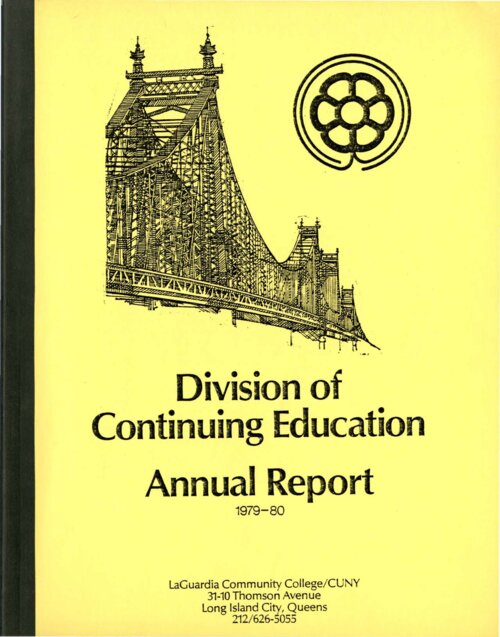 Division of Continuing Education: Annual Report, 1979-80 The Division of Continuing Education at LaGuardia Community College produced this Annual Report for 1979-80. It describes the Division's accomplishments, and the range of programs aimed at the diverse communities served by the college, and makes the case for an urban community college that identifies and responds to the specific needs of the neighborhoods in which it is situated.
1–25 of 28