Radicalism at BMCC: The Early Years
Item set
Collection
Radicalism at BMCC: The Early Years
Time Periods
1961-1969 The Creation of CUNY - Open Admissions Struggle
Items
1–25 of 51
Advanced search
-
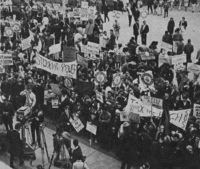 Two Photographs from 1969 Demonstration These uncaptioned images accompanied an article in the May 1969 issue of Action, the monthly newspaper of the United Federation of College Teachers. Clearly representing a range of organizations and political positions, the focus of this demonstration was generally one that supported public education. Signs from SDS (Students for a Democratic Society) read "Tax the Rich" and "Student Power. " And AFT (American Federation of Teachers) signs read "AFT: Save Education" and "AFT Position, End Tuition." Others say: "Support your local college," "No Fees Please" "No Tuition No Cuts - Free Education" and "Share the Cost of Public Education - don't Ask me to Bear it all."
 -
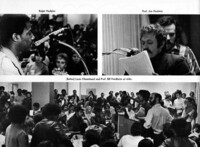 Three 1970 photographs of BMCC mass meeting Printed in Prism, the BMCC 1971 yearbook, these photographs are part of a series that documents the student takeover of one of the BMCC buildings in May 1970. Faculty members Bill Friedheim and Jim Perlstein are shown speaking in support of student demands and about the larger anti-war movement. Student leader Ralph Hudgins (top left) was one of the student leaders speaking in support of a strike to shut down the school.
 -
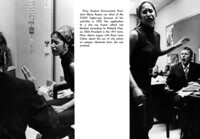 BMCC Student Government President Maria Ramos Arguing with Dean Leon Cohen BMCC student government president Maria Ramos "ran afoul of the higher-ups because of her activities in 1970." Printed in Prism, the BMCC 1971 yearbook, this photograph was one in a series that documents the student takeover of one of the BMCC buildings in May 1970. Ramos was arrested moments after this photograph was taken.
 -
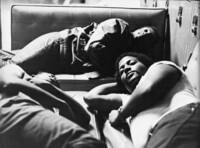 Students Sleeping Overnight at BMCC During 1970 Protest Printed in Prism, the BMCC 1971 yearbook, this photograph was one in a series that documents the student takeover of one of the BMCC buildings in May 1970. On May 6-7 over 30 students slept in the "A" building. As reported in Prism, the takeover lasted for several days.
 -
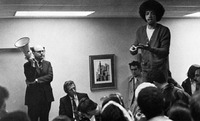 BMCC student "Louis Chessimard Outlines Grievances" Taken from the BMCC 1971 yearbook, in this image, Louis Chessimard is outlining the grievances of Borough of Manhattan Community College students to an audience which included Dean Leon Cohen and President Block (holding megaphone).
 -
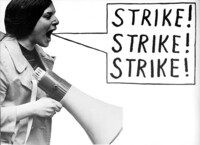 Strike! graphic from BMCC 1971 Yearbook Printed in the BMCC 1971 yearbook, Prism, this photograph was used in the "Strike!" section and was taken during the student takeover of the college in May 1970.
 -
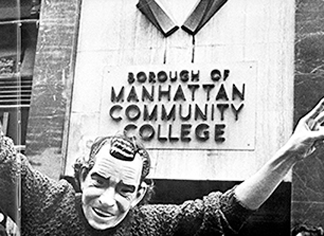
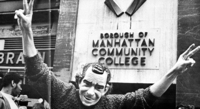 Student wearing Nixon Mask Printed in the BMCC 1971 yearbook, Prism, this photograph shows a BMCC student wearing a plastic President Nixon mask in front of BMCC's "B-bldg" at the height of the 1970's protests. Students demands included an end to student fees and a day care center for thier families as well as national issues related to the war in Vietnam.
 -
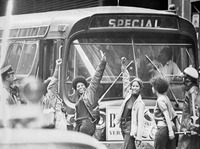 Arrest Bus - 1970 BMCC Student Strike This photograph features Maria Ramos, the Student Government President in front of the the arrest bus. The students were demanding an end to increases in tuition fees, and a day care center for children of students. Maria Ramos also confronted Dean Leon Cohen about the use of city police on campus shortly before her arrest.
 -
 Oral History Interview with Bill Friedheim and Jim Perlstein of Borough of Manhattan Community College This oral history interview with retired Borough of Manhattan Community College professors Bill Friedheim and Jim Perlstein was conducted at the CUNY Graduate Center on June 1, 2015. Friedheim and Perlstein were intimately involved in many of the radical struggles that occurred at BMCC and across the university during the 1960s and 70s. Topics covered in this interview include the origins of BMCC, its student body and facilities, connections with broader social movements, student organizations, faculty unionization, the 1971 student strike, and many others.
 -
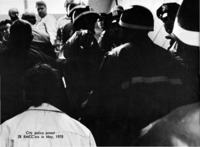 STRIKE!, Prism, 1971 Prism was the Borough of Manhattan Community College's annual yearbook. This 35 page chapter from the 1971 edition details the student strike that, in May 1970, temporarily shut down the college and resulted in 58 arrests. Filled with photos, drawings, poetry, and essays, it vividly portrays the politicized atmosphere of the college. Faculty members, including Jim Perlstein, Bill Friedheim, and Naomi Woronov, supported the students who shut down the school and even slept overnight, in the occupied buildings. Student leaders, including Louis Chessimard and Maria Ramos, had long lists of demands. Along with the "'regular demands' (withdraw all troops from Southeast Asia, free all political prisoners, cut all ties with the United States' 'war machine,' which seem to top everyone's list nowadays,...," their local demands included a call for a campus day care center and their opposition to tuition fee increases. Interesting and representative of the overall political climate, this story was not supressed or diminished but, instead, it received this thorough coverage in the school's yearbook shortly after having taken place.
 -
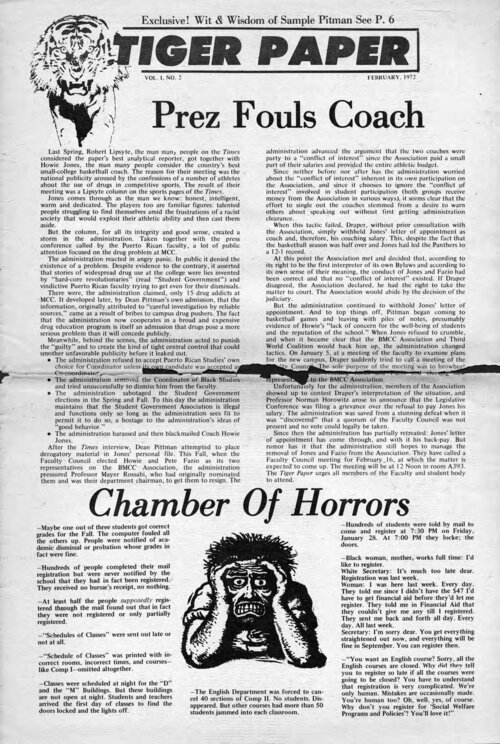 Tiger Paper, February 1972 This issue of the Tiger Paper contains humorous takedowns of the college administration, a call for free subways, a critique of the state of nursing education, and an extended interview with radical poet Sonia Sanchez.The Tiger Paper, which billed itself as "Manhattan Community College's only underground newspaper," was published between 1971 and 1974 by a group of radical faculty members at BMCC. The paper, whose name was a play on the quip of Mao Tse-tung that "U.S. imperialism is a paper tiger," addressed struggles both internal and external to the college while emphasizing the connections between them.
 -
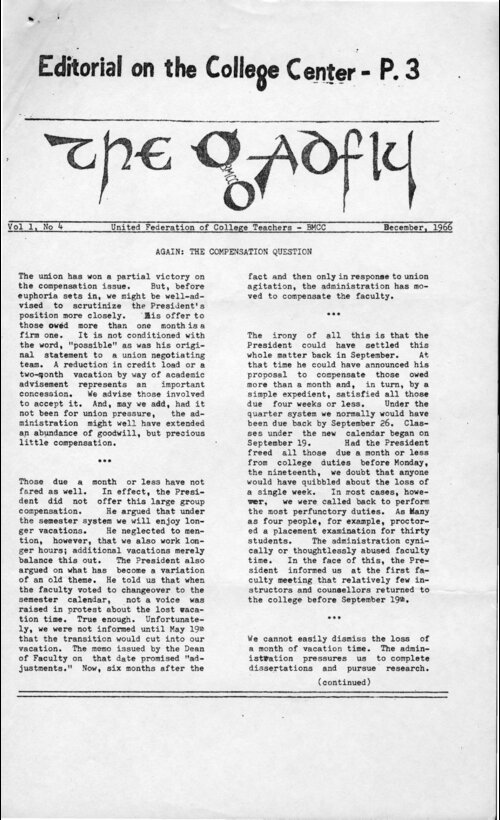 The Gadfly, December 1966 This edition of The Gadfly covers such topics as faculty compensation, "woefully inadequate" campus facilities, and BMCC's upcoming accreditation process. It also contains poetry, film reviews, and humorous pieces by faculty.The Gadfly was the newsletter of the BMCC chapter of the United Federation of College Teachers (UFCT). The UFCT and the Legislative Conference were the two main organizations that advocated for the concerns of CUNY faculty prior to their merging in 1972 to form the Professional Staff Congress (PSC).
 -
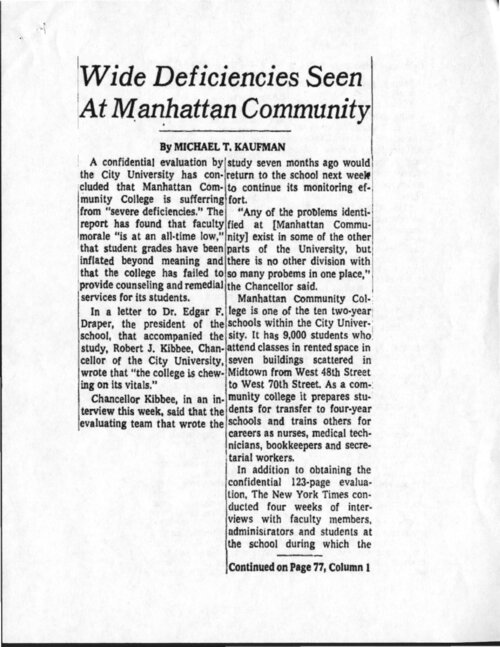 "Wide Deficiencies Seen at Manhattan Community" In May 1974 the New York Times published an investigation of alleged mismanagement at Borough of Manhattan Community College. The article was based on a confidential report compiled on the instructions of Chancellor Robert Kibbee. On the basis of the leaked report, the Times alleged that BMCC suffered from low faculty morale, consistent grade inflation, and a failure to implement the remedial education programs that became urgent following the establishment of open admissions in 1971. Radical students and faculty at BMCC, while accepting criticisms of the administration, hit back at what they felt were implied criticisms of the student body itself. The editors of Tiger Paper, a radical paper published by faculty at the college, led their May 1974 issue with an attack on this "smear job."
 -
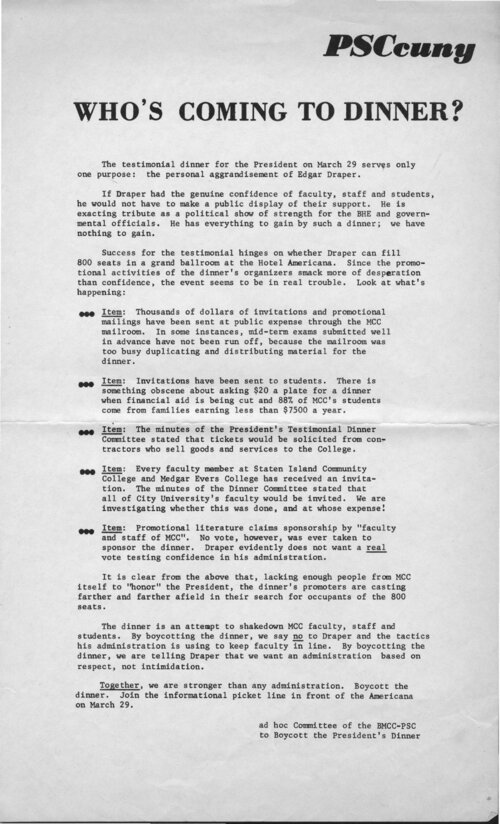 Who's Coming to Dinner? This leaflet, published by an ad hoc committee of Professional Staff Congress members at Borough of Manhattan Community College (BMCC), criticizes the plan of then-BMCC President Edgar Draper to stage a testimonial dinner to himself at the Americana hotel, an operation the committee describes as a "shakedown." The committee urged faculty to boycott and picket the event.
 -
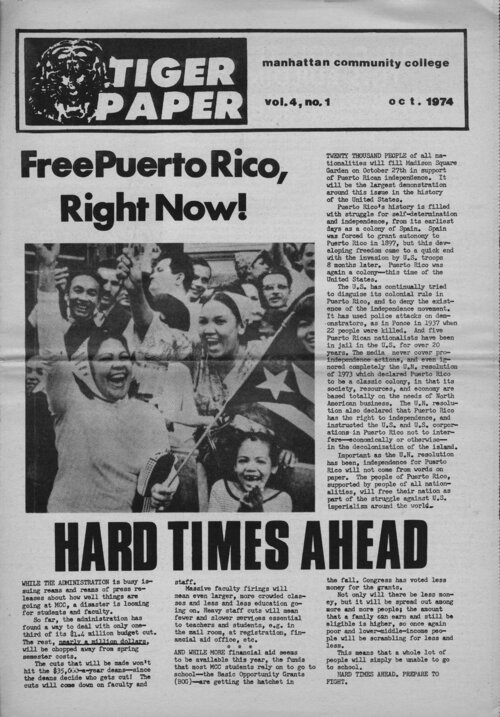 Tiger Paper, October 1974 This copy of the Tiger Paper advocates self-determination for Puerto Rico, criticizes the poor condition of facilities at BMCC, and encourages readers to remember "the spirit of Attica."The Tiger Paper, which billed itself as "Manhattan Community College's only underground newspaper," was published between 1971 and 1974 by a group of radical faculty members at BMCC. The paper, whose name was a play on the quip of Mao Tse-tung that "U.S. imperialism is a paper tiger," addressed struggles both internal and external to the college while emphasizing the connections between them.
 -
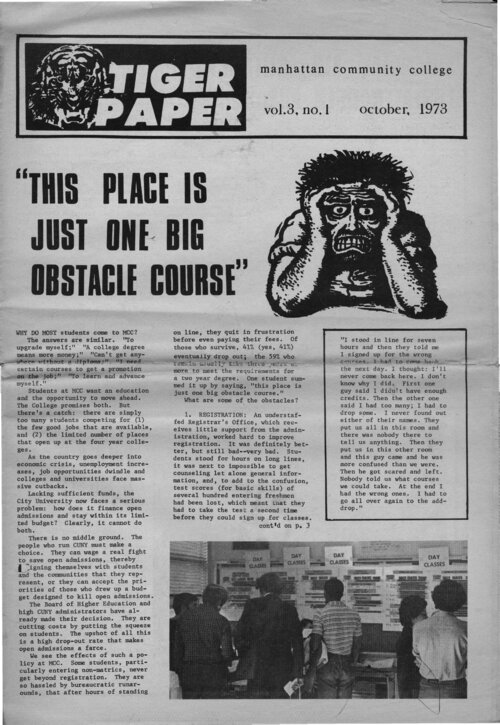 Tiger Paper, October 1973 This issue of the Tiger Paper explores the effects of financial aid reductions alongside CUNY's "Open Admission" policy, details class registration troubles at BMCC, and advocates for the boycott of "scab products."The Tiger Paper, which billed itself as "Manhattan Community College's only underground newspaper," was published between 1971 and 1974 by a group of radical faculty members at BMCC. The paper, whose name was a play on the quip of Mao Tse-tung that "U.S. imperialism is a paper tiger," addressed struggles both internal and external to the college while emphasizing the connections between them.
 -
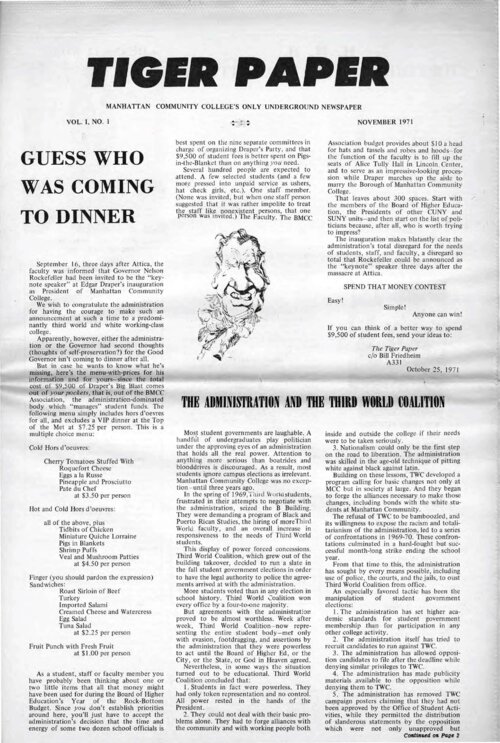 Tiger Paper, November 1971 This inaugural issue of the Tiger Paper takes on the BMCC administration over mismangement of student fees and interference in student government. It also contains stories on BMCC's newly-inaugurated childcare center, a feature on the travails of BMCC secretaries, and commentary on the Attica prison rebellion of two months prior.The Tiger Paper, which billed itself as "Manhattan Community College's only underground newspaper," was published between 1971 and 1974 by a group of radical faculty members at BMCC. The paper, whose name was a play on the quip of Mao Tse-tung that "U.S. imperialism is a paper tiger," addressed struggles both internal and external to the college while emphasizing the connections between them.
 -
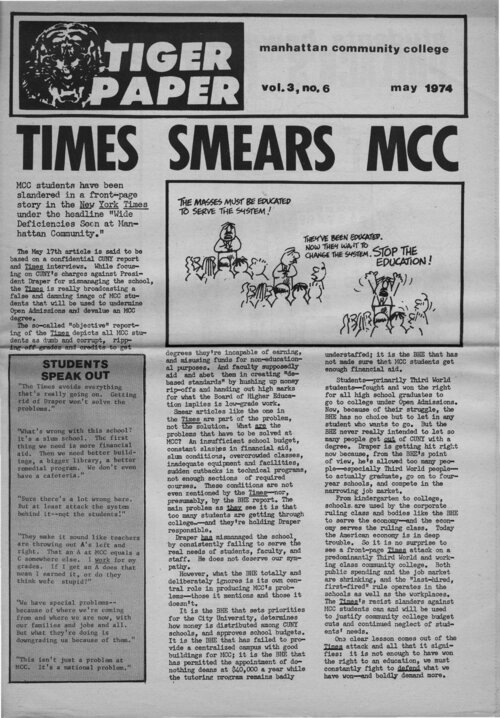 Tiger Paper, May 1974 This issue of the Tiger Paper leads with a blistering rebuke of a New York Times investigation into mismanagement at BMCC, one which Tiger Paper editors claim paints a falsely damning picture of students at the college. Additional topics covered include a newly implemented 6-semester limit for obtaining a degree, student government election irregularities, and other news events around the U.S. and the globe.The Tiger Paper, which billed itself as "Manhattan Community College's only underground newspaper," was published between 1971 and 1974 by a group of radical faculty members at BMCC. The paper, whose name was a play on the quip of Mao Tse-tung that "U.S. imperialism is a paper tiger," addressed struggles both internal and external to the college while emphasizing the connections between them.
 -
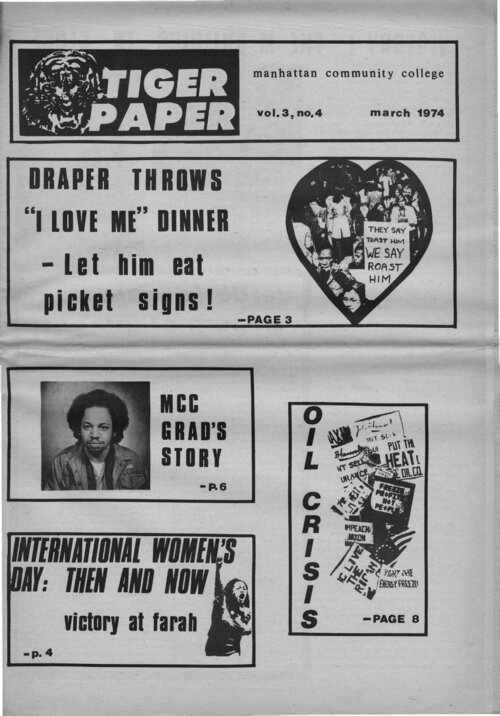 Tiger Paper, March 1974 This issue of the Tiger Paper exposes what the editors consider a sham testimonial dinner for BMCC President Edgar Draper. Other articles of interest include an extended interview with a BMCC student who served in Vietnam, the detailing of "rigged" student elections, and commentary on the ongoing Vietnam War and energy crisis. The Tiger Paper, which billed itself as "Manhattan Community College's only underground newspaper," was published between 1971 and 1974 by a group of radical faculty members at BMCC. The paper, whose name was a play on the quip of Mao Tse-tung that "U.S. imperialism is a paper tiger," addressed struggles both internal and external to the college while emphasizing the connections between them.
 -
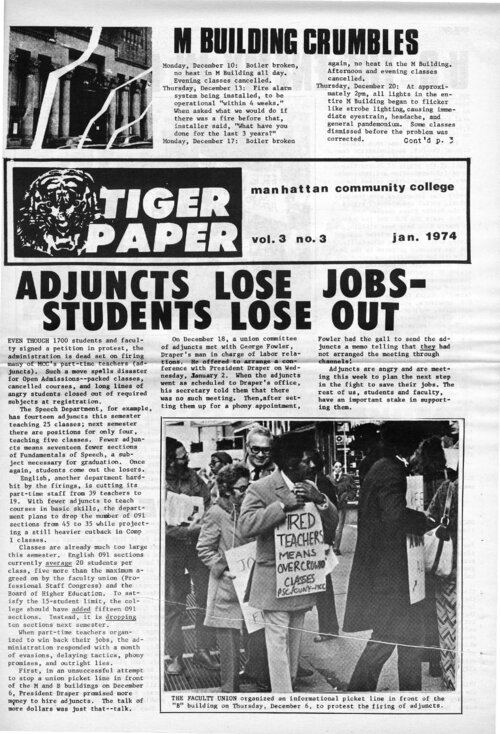 Tiger Paper, January 1974 This edition of the Tiger Paper protests the impending firing of 1,700 adjunct faculty and the consequent reduction in the number of classes offered at BMCC. "Such a move spells disaster for Open Admissions," the paper's editors write.The Tiger Paper, which billed itself as "Manhattan Community College's only underground newspaper," was published between 1971 and 1974 by a group of radical faculty members at BMCC. The paper, whose name was a play on the quip of Mao Tse-tung that "U.S. imperialism is a paper tiger," addressed struggles both internal and external to the college while emphasizing the connections between them.
 -
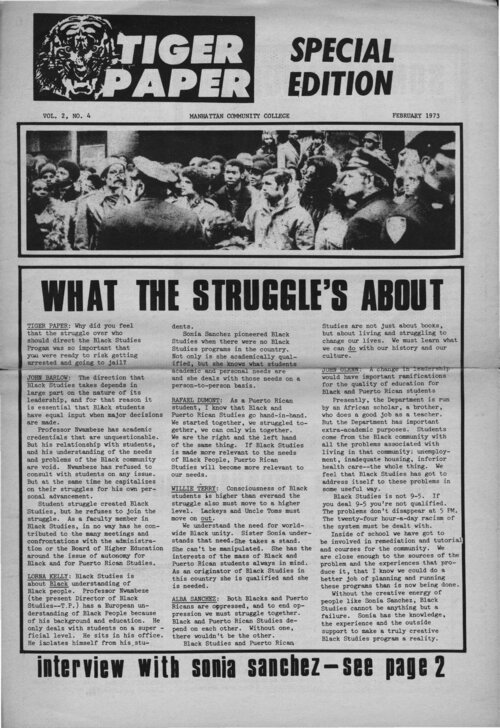 Tiger Paper, February 1973 This special issue of the Tiger Paper addresses the ongoing "struggle" over control of the Black Studies program at BMCC. The paper's editors, along with a group of radical students, supported the poet and educator Sonia Sanchez for the role of department chair. Sanchez, who is also interviewed in this issue, sought to implement an expansive vision for Black Studies at the college, one that would transcend the typical goals of academic departments.The Tiger Paper, which billed itself as "Manhattan Community College's only underground newspaper," was published between 1971 and 1974 by a group of radical faculty members at BMCC. The paper, whose name was a play on the quip of Mao Tse-tung that "U.S. imperialism is a paper tiger," addressed struggles both internal and external to the college while emphasizing the connections between them.
 -
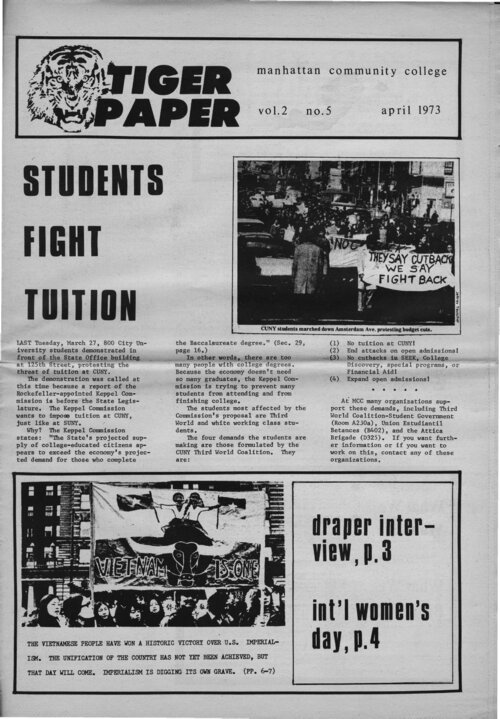 Tiger Paper, April 1973 This issue of the Tiger Paper leads with a story describing student demonstrations against the "threatened" implementation of tuition across CUNY campuses. It also features articles centered around "International Women's Day" and the Vietnam War, as well as a piece on late grade reporting at BMCC.The Tiger Paper, which billed itself as "Manhattan Community College's only underground newspaper," was published between 1971 and 1974 by a group of radical faculty members at BMCC. The paper, whose name was a play on the quip of Mao Tse-tung that "U.S. imperialism is a paper tiger," addressed struggles both internal and external to the college while emphasizing the connections between them.
 -
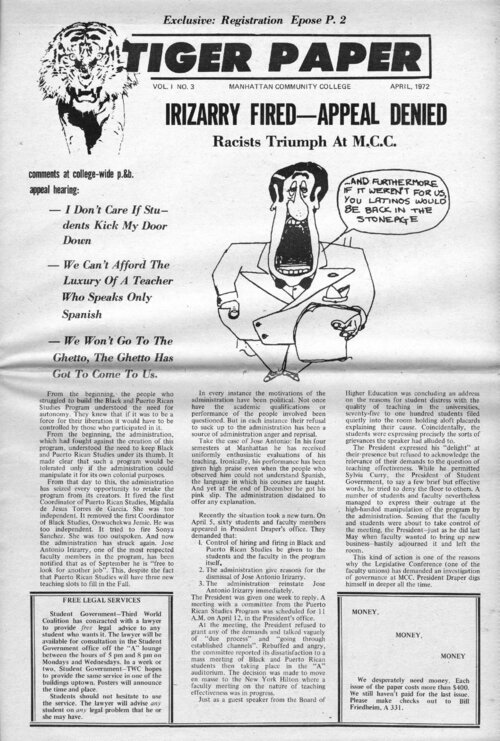 Tiger Paper, April 1972 This edition of the Tiger Paper includes: interviews with BMCC students who were veterans of the Vietnam War, criticism of the college's registration process, a front page article detailing the firing of a professor, and an interview regarding recent developments in China.The Tiger Paper, which billed itself as "Manhattan Community College's only underground newspaper," was published between 1971 and 1974 by a group of radical faculty members at BMCC. The paper, whose name was a play on the quip of Mao Tse-tung that "U.S. imperialism is a paper tiger," addressed struggles both internal and external to the college while emphasizing the connections between them.
 -
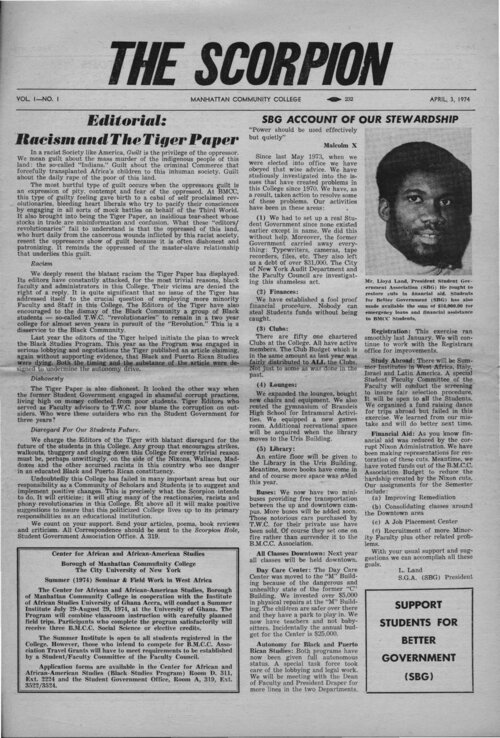 The Scorpion, April 3, 1974 In 1974 a new group called Students for Better Government took over control of the Borough of Manhattan Community College student government from the Third World Coalition. The new leadership criticized both the Third World Coalition and their faculty allies, the editors of the Tiger Paper, from a black nationalist perspective.
 -
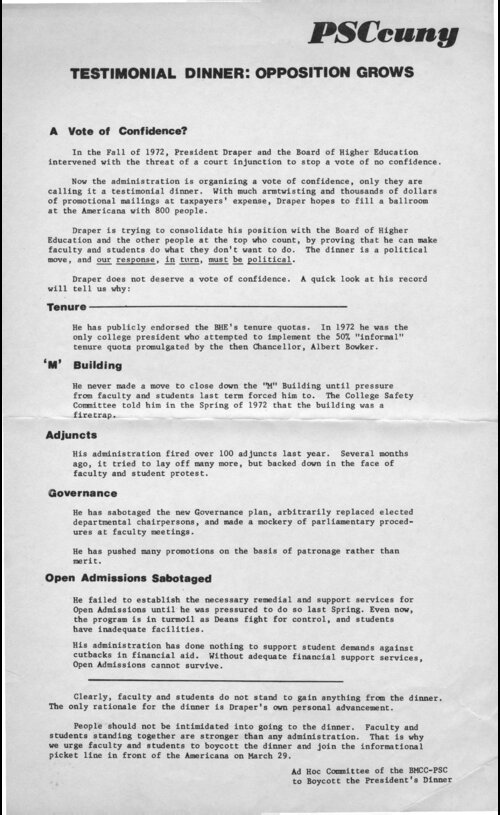 "Testimonial Dinner: Opposition Grows " This leaflet, published by an ad hoc committee of Professional Staff Congress members at Borough of Manhattan Community College (BMCC), denounces a plan by then-BMCC President Edgar Draper to hold a testimonial dinner to himself at the Americana hotel (today's Sheraton New York Times Square). The leaflet urges faculty to boycott and picket the event.
1–25 of 51