Radicalism at BMCC: The Early Years
Item set
Collection
Radicalism at BMCC: The Early Years
Time Periods
1961-1969 The Creation of CUNY - Open Admissions Struggle
Items
26–50 of 51
Advanced search
-
 Prometheus, November 13, 1970 This issue of Prometheus, BMCC's student newspaper, was the first published after the Third World Coalition assumed control of the student government; it leads with a story on the appointment of Edgar Draper as president of the college. The previous president, Murray Block, had resigned in May 1970 following the student strike and building takeovers of that month.
 -
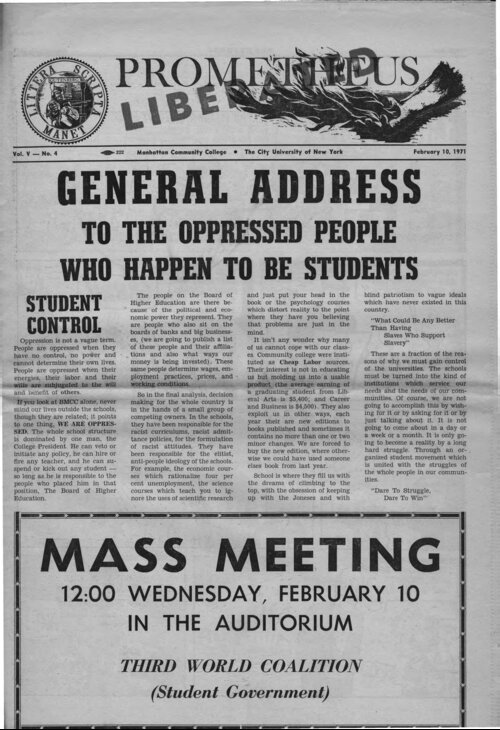 Prometheus, February 10, 1971 This issue of Prometheus, BMCC's student newspaper, is dubbed by its editors as "Liberated" Prometheus, a reflection of the editorial sensibilities of the new student government dominated by the Third World Coalition, a group of black and Latino/a students involved in a number of radical political struggles.
 -
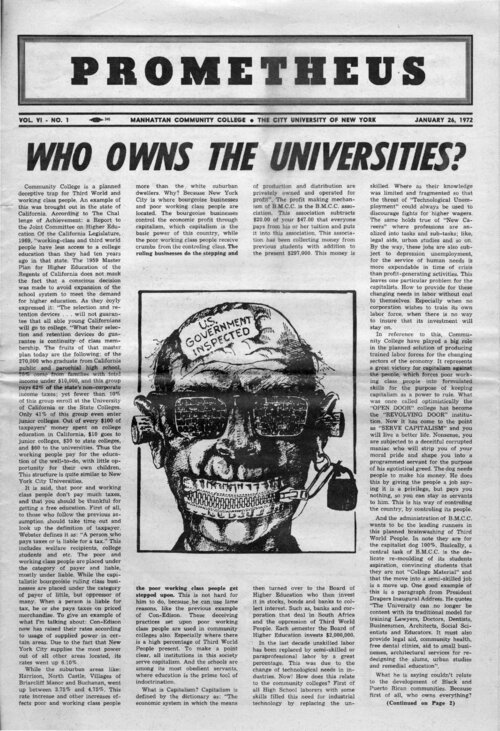 Prometheus, January 26, 1972 This issue of Prometheus, BMCC's student newspaper, reflects the evolving editorial concerns of the increasingly black and Latino/a student body. The paper contains articles on university funding, drug abuse, corporate enablers of apartheid in South Africa, the struggles of Puerto Rican political prisoners and the imprisoned radical Angela Davis, as well as articles on Portugeuse colonies in Africa and the economics of Richard Nixon's recent wage-price freeze.
 -
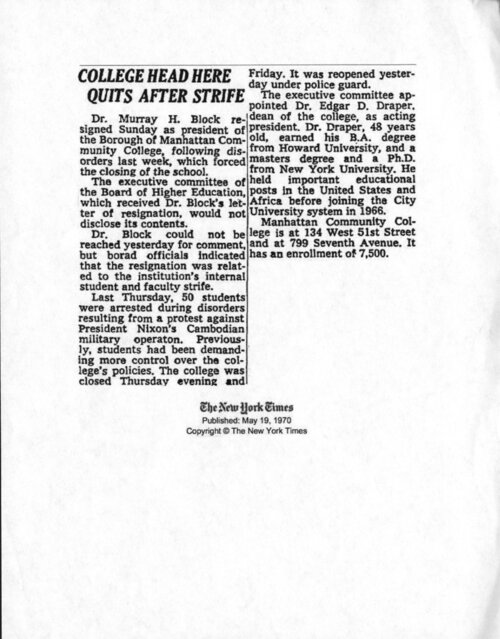 "College Head Here Quits After Strife" This New York Times article reports the resignation of Borough of Manhattan Community College president Murray Block following May 1970 demonstrations that ended with students and faculty occupying the college's buildings. Block's replacement was Edgar Draper, with whom politicized students and faculty would similarly clash.
 -
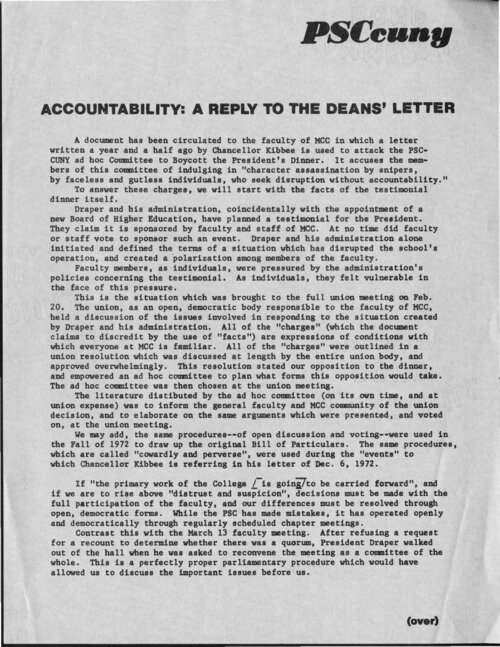 "Accountability: A Reply to the Deans' Letter" This leaflet, published by an ad hoc committee of Professional Staff Congress members at Borough of Manhattan Community College (BMCC), defends the committee's actions from critics in the CUNY administration and challenges those critics to an open debate.
 -
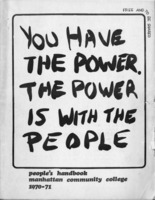 People's Handbook: Manhattan Community College, 1970-71 This handbook, a precursor to today's "disorientation" guides, offered incoming students a view of life at BMCC from the perspective of radicals in organizations that included the New University Conference, Third World Coalition, Night Students Association, and Women's Liberation. A self-published document imbued with the irreverent spirit of its time, the People's Handbook collected pointed critiques of BMCC and CUNY administration and included drawings, cartoons, and a list of resources for "surviving in the city." The book's cover reads "You have the power. The power is with the people," while the back cover declares: "Advocating the overthrow of the government is a crime. Overthrowing it is something else altogether—sometimes it is called a revolution."
 -
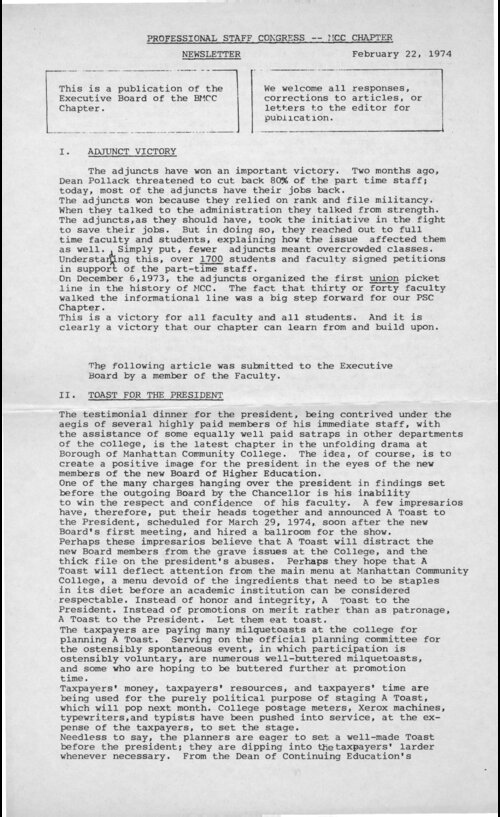 Professional Staff Congress: BMCC Chapter Newsletter, February 22, 1974 This is an early newsletter from the Professional Staff Congress chapter at Borough of Manhattan Community College (BMCC). Dated February 24, 1974, the newsletter features an article attacking BMCC president Edgar Draper for using the school's resources to organize a testimonial dinner for himself. The Professional Staff Congress, the union which represents CUNY faculty and staff, was formed in 1972 from the merger of the Legislative Conference and the United Federation of College Teachers.
 -
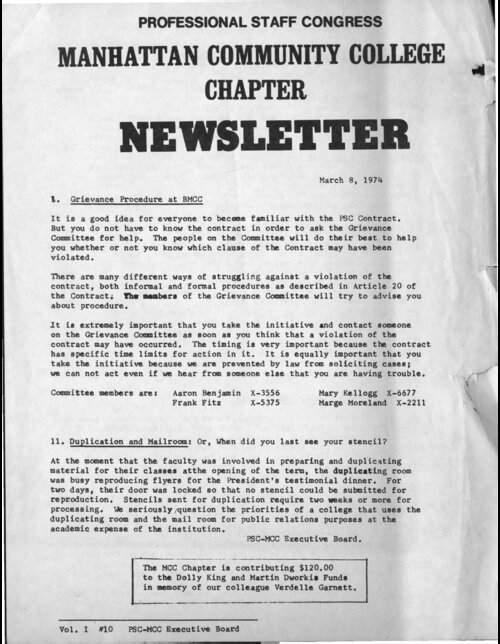 Professional Staff Congress: BMCC Chapter Newsletter, March 8, 1974 The Professional Staff Congress (PSC), the union which represents CUNY faculty and staff, was formed in 1973 from the merger of the Legislative Conference and the United Federation of College Teachers. This is an early newsletter from the PSC chapter at Borough of Manhattan Community College (BMCC), dated March 8, 1974. This issue urges faculty to become familiar with the union's grievance procedure and mocks the plans of BMCC president Edgar Draper to hold a testimonial dinner to himself at the Americana hotel.
 -
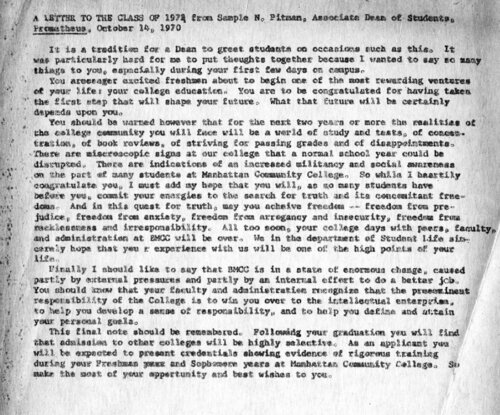 "Letter to Class of 1970" Sample Pittman was an Associate Dean of Students at Borough of Manhattan Community College (BMCC) during the early 1970s. He became known to politicized students and faculty as a hostile opponent of the Third World Coalition, the radical group that had assumed control of the student government. In this letter to the incoming freshman class, published in Prometheus, the BMCC student newspaper, Pittman warned new students of "increased militancy and social awareness on the part of many students at Manhattan Community College."
 -
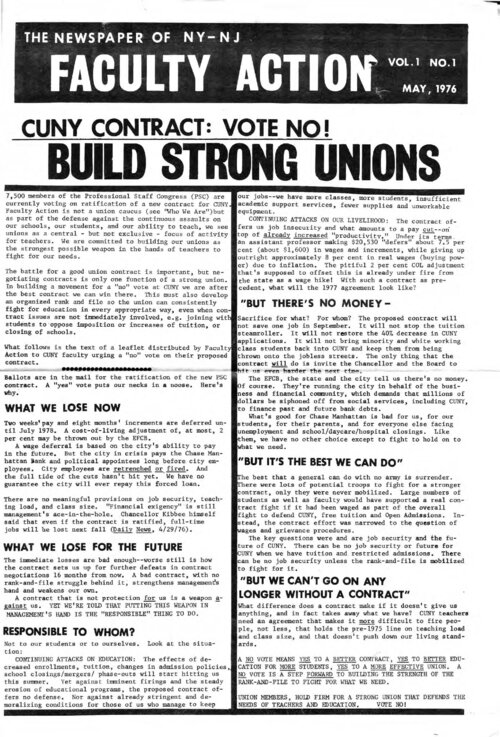 Faculty Action, May 1976 Published in May 1976, in this inaugural issue of Faculty Action, the lead story urges members of the Professional Staff Congress (PSC) to reject a recent contract negotiated by union leadership with the city and state. The issue also presents the motivation behind the paper’s founding in its call for a mobilization of teachers in the face of budget cuts across the nation. Faculty Action was a newspaper published by a group of radicals active on New York and New Jersey area campuses. The editors consistently advocated positions to the left of both CUNY administration and the Professional Staff Congress (PSC), the union representing CUNY faculty, and maintained connections with the radical social movements of the day.
 -
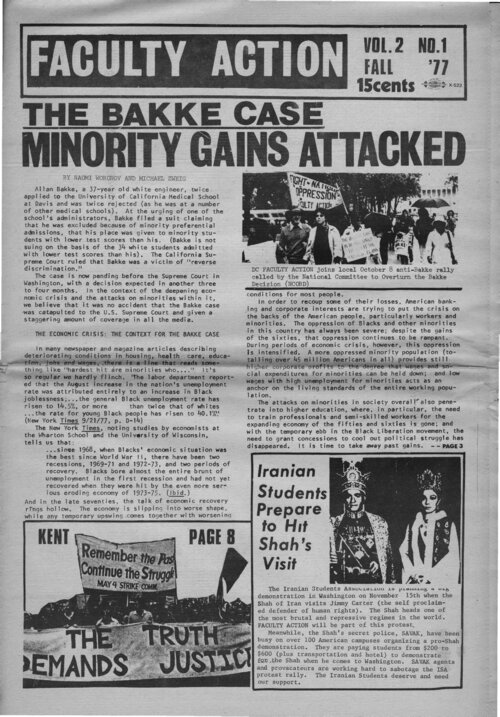 Faculty Action, Fall 1977 This issue of Faculty Action focuses on the Bakke case, in which the U.S. Supreme Court upheld the policy of affirmative action in college admissions but ruled out the use of racial quotas. Writing before the decision was issued, the editors connect the effort to roll back expansive admissions policies to the economic crisis that engulfed the US during the 1970s.Faculty Action was a newspaper published by a group of radicals active on New York and New Jersey area campuses. The editors consistently advocated positions to the left of both CUNY administration and the Professional Staff Congress (PSC), the union representing CUNY faculty, and maintained connections with the radical social movements of the day.
 -
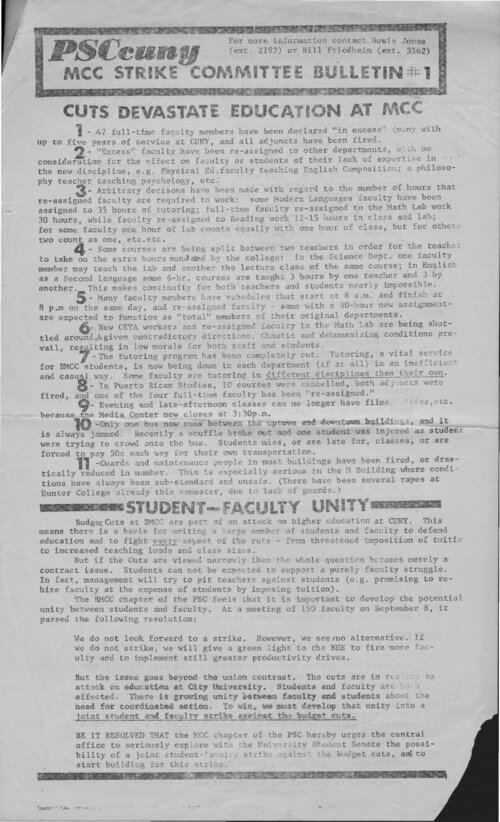 MCC Strike Committee Bulletin #1 The 1976 contract negotiations between the Professional Staff Congress (PSC) and the university occurred in the midst of the city's mid-1970s fiscal crisis. Radicals at Borough of Manhattan Community College (BMCC) formed a strike committee in order to urge the PSC to adopt a broader and more militant stance in the face of what they described as "an attack on higher education at CUNY." This bulletin details the extent of the budget cuts at BMCC and describes the committee's activities to date. In the end, no strike occurred.
 -
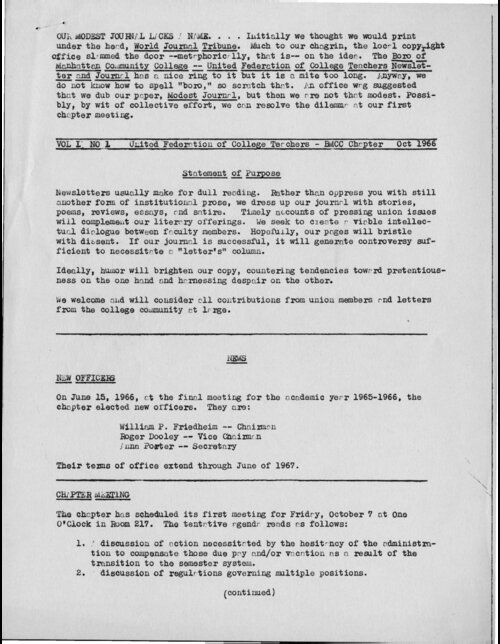 United Federation of College Teachers: BMCC Chapter Newsletter, October 1966 This is the inaugural issue of the the newsletter of the BMCC chapter of the United Federation of College Teachers (UFCT), which would later be named The Gadfly. During the 1960s, the UFCT and the Legislative Conference were the two main organizations that advocated for the concerns of CUNY faculty. The groups merged in 1972 to form the Professional Staff Conference, which represents CUNY faculty today.
 -
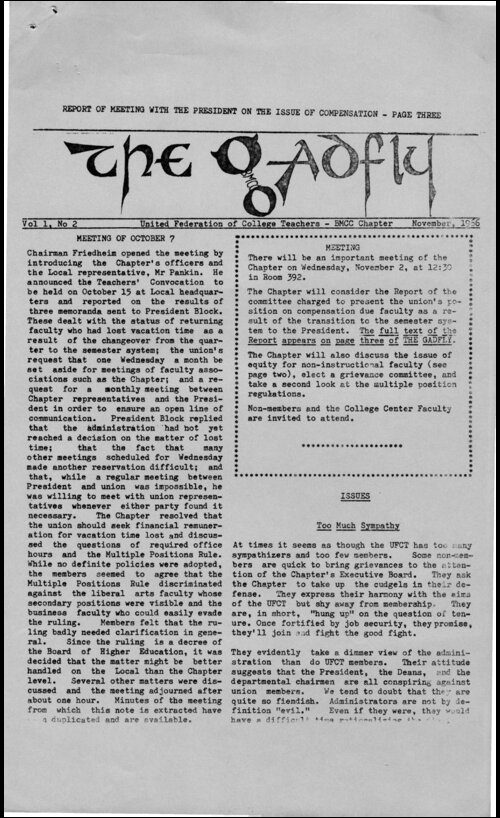 The Gadfly, November 1966 This issue of The Gadfly features a report outlining a recent meeting between union committee members and BMCC's president regarding compensation issues. It also contains editorials, essays and film reviews contributed by faculty.The Gadfly was the newsletter of the BMCC chapter of the United Federation of College Teachers (UFCT). The UFCT and the Legislative Conference were the two main organizations that advocated for the concerns of CUNY faculty prior to their merging in 1972 to form the Professional Staff Congress (PSC).
 -
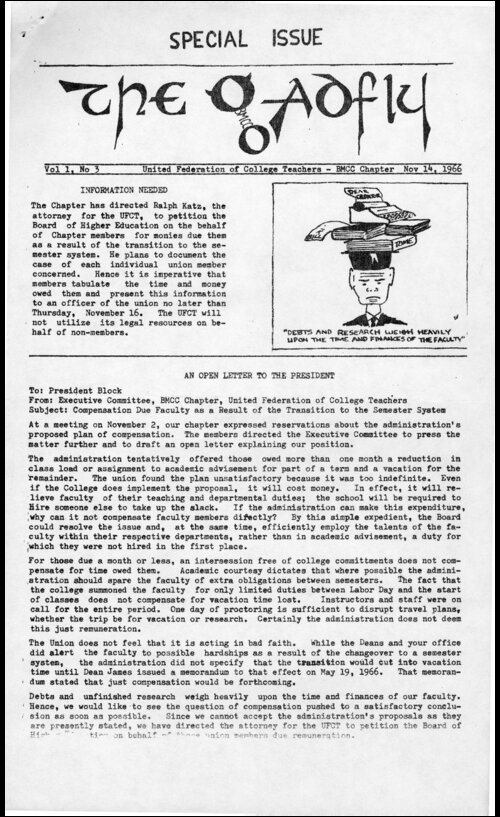 The Gadfly, November 14, 1966 This special, abbreviated issue of The Gadfly covers a dispute over compensation relating to BMCC’s transition to a semester system. It includes an open letter to the college president as well as the minutes from the union chapter’s previous meeting. The Gadfly was the newsletter of the BMCC chapter of the United Federation of College Teachers (UFCT). The UFCT and the Legislative Conference were the two main organizations that advocated for the concerns of CUNY faculty prior to their merging in 1972 to form the Professional Staff Congress (PSC).
 -
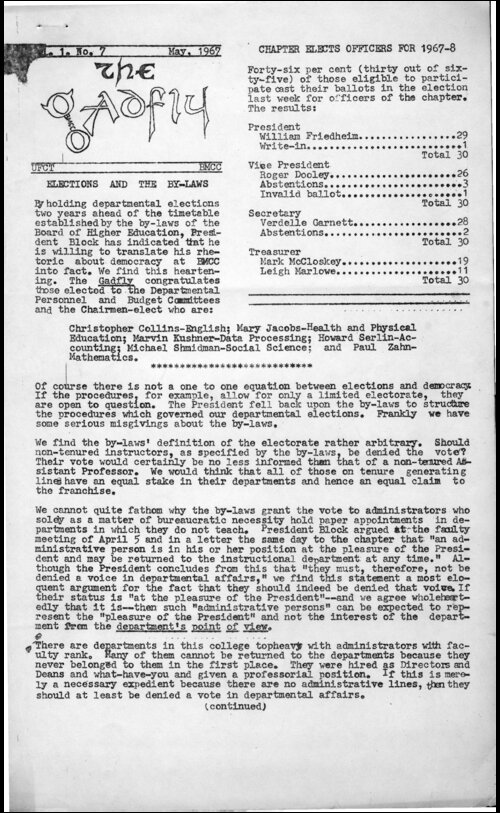 The Gadfly, May 1967 This copy of The Gadfly opens with news of chapter elections and bylaws, and contains a lengthy opinion piece entitled "A Revolutionary Purpose For the Union." Also to be found are editorials, a review of the film Blow-up, and short fiction submitted by faculty.The Gadfly was the newsletter of the BMCC chapter of the United Federation of College Teachers (UFCT). The UFCT and the Legislative Conference were the two main organizations that advocated for the concerns of CUNY faculty prior to their merging in 1972 to form the Professional Staff Congress (PSC).
 -
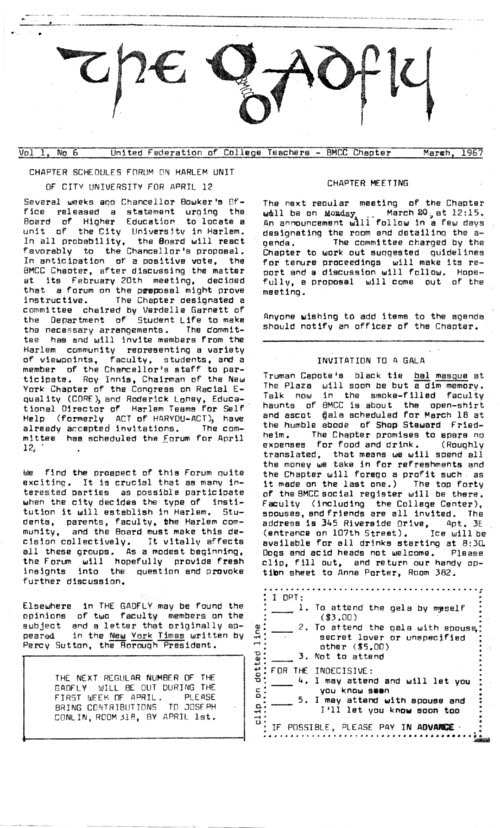 The Gadfly, March 1967 This issue of The Gadfly leads with a series of articles regarding a proposed CUNY campus to be located in Harlem. Also found is an introduction to CUNY’s new “College Discovery Program,” a critique of Playboy magazine, and faculty-contributed fiction.The Gadfly was the newsletter of the BMCC chapter of the United Federation of College Teachers (UFCT). The UFCT and the Legislative Conference were the two main organizations that advocated for the concerns of CUNY faculty prior to their merging in 1972 to form the Professional Staff Congress (PSC).
 -
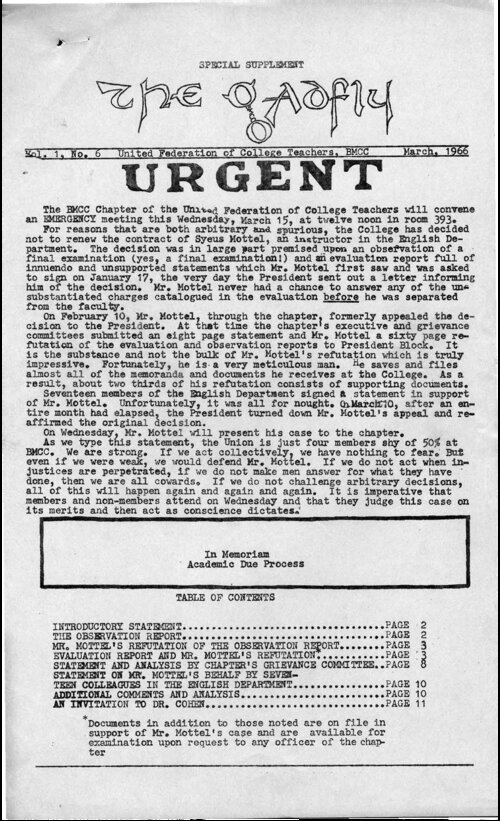 The Gadfly, March 1966 This issue of The Gadfly opens with the announcement of an emergency meeting to discuss the dismissal of a speech instructor. The rest of the paper outlines a defense of the instructor as well as an indictment of the procedures leading to his termination. The Gadfly was the newsletter of the BMCC chapter of the United Federation of College Teachers (UFCT). The UFCT and the Legislative Conference were the two main organizations that advocated for the concerns of CUNY faculty prior to their merging in 1972 to form the Professional Staff Congress (PSC).
 -
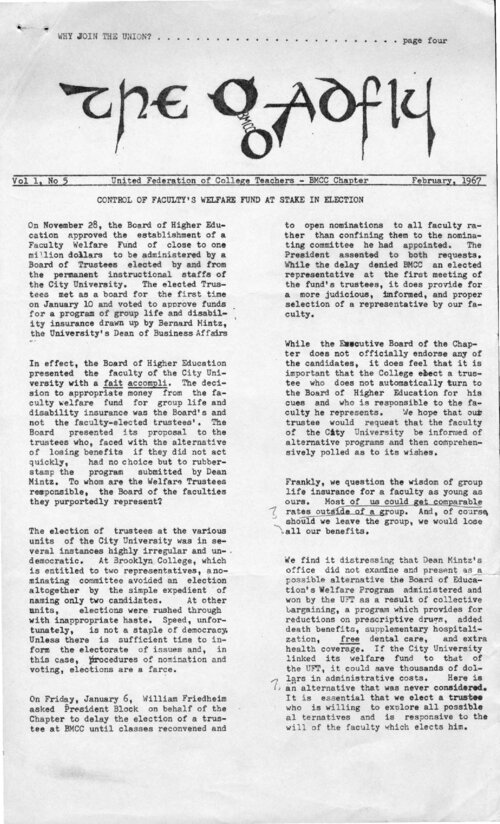 The Gadfly, February 1967 This issue of The Gadfly contains editorials, a message from the president of the UFCT's New York Local, a continued critique of the accreditation process (part one found in December 1966 issue), and short fiction by faculty. The Gadfly was the newsletter of the BMCC chapter of the United Federation of College Teachers (UFCT). The UFCT and the Legislative Conference were the two main organizations that advocated for the concerns of CUNY faculty prior to their merging in 1972 to form the Professional Staff Congress (PSC).
 -
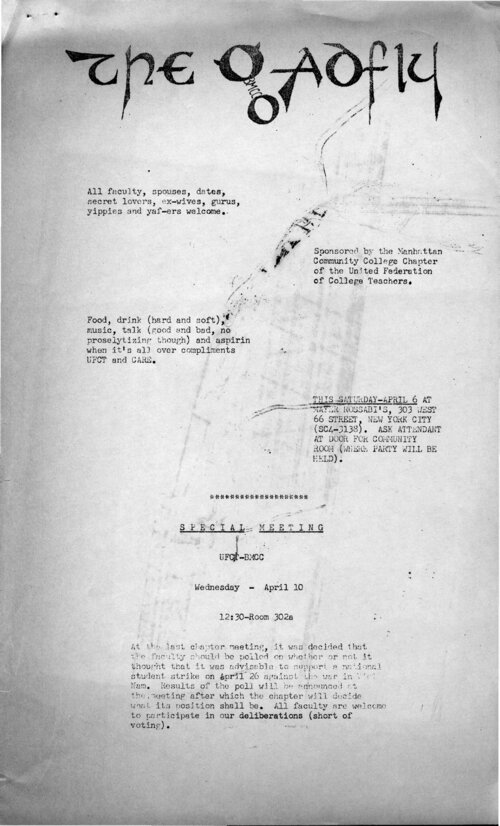 The Gadfly, April 1968 This issue of The Gadfly includes announcements of upcoming union chapter meetings as well as a response, from BMCC Professor Mayer Rossabi, to the piece "On A Revolutionary Purpose for the Union," published in the May 1967 issue.The Gadfly was the newsletter of the BMCC chapter of the United Federation of College Teachers (UFCT). The UFCT and the Legislative Conference were the two main organizations that advocated for the concerns of CUNY faculty prior to their merging in 1972 to form the Professional Staff Congress (PSC).
 -
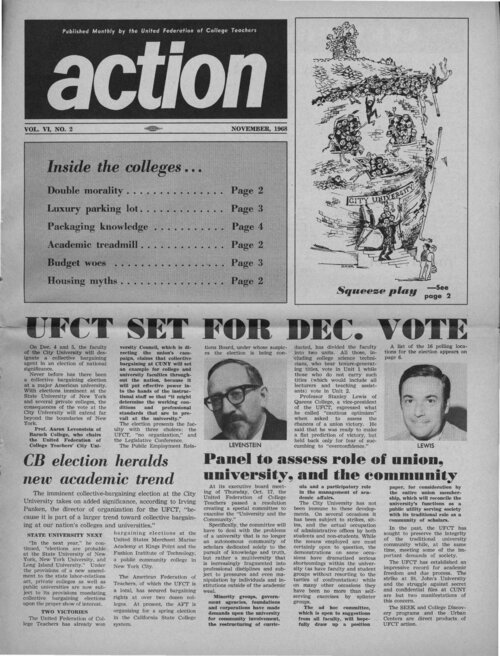 Action, November 1968 This edition of Action announces the upcoming election of a "collective bargaining agent" for CUNY faculty. The faculty are set to choose between the UFCT (the publisher of this paper), the Legislative Conference, or no organizational representation at all. This issue also includes editorials regarding campus overcrowding and faculty housing, a book review, and letters to the editor.Action was the monthly newspaper of the United Federation of College Teachers, one of the two main organizations that advocated for the concerns of CUNY employees before the formation in 1972 of the Professional Staff Congress, the union that has since represented CUNY faculty and professional staff. During this period, Action was edited by Bill Friedheim, an outspoken professor at Borough of Manhattan Community College and one of the subjects of our oral history interview on radicalism at BMCC.
 -
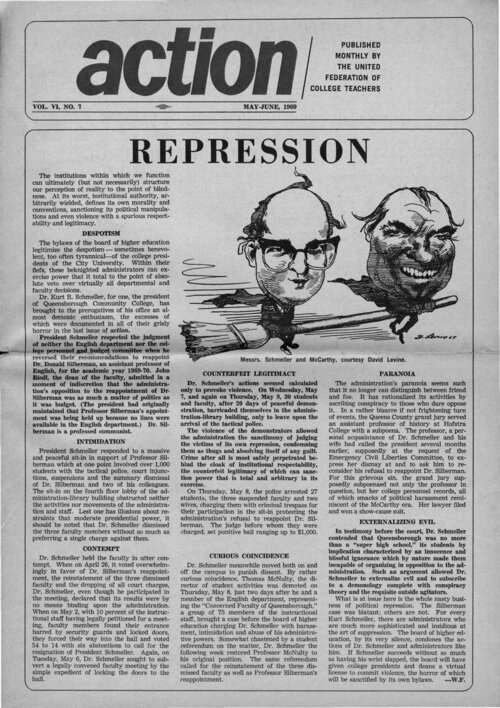 Action, May-June 1969 This issue of Action features a "forum" of five CUNY faculty reflecting on the "turmoil" present on college campuses across the nation. The professors' contributions reflect several perspectives on student protest efforts and the larger issues surrounding them.Action was the monthly newspaper of the United Federation of College Teachers, one of the two main organizations that advocated for the concerns of CUNY employees before the formation in 1972 of the Professional Staff Congress, the union that has since represented CUNY faculty and professional staff. During this period, Action was edited by Bill Friedheim, an outspoken professor at Borough of Manhattan Community College and one of the subjects of our oral history interview on radicalism at BMCC.
 -
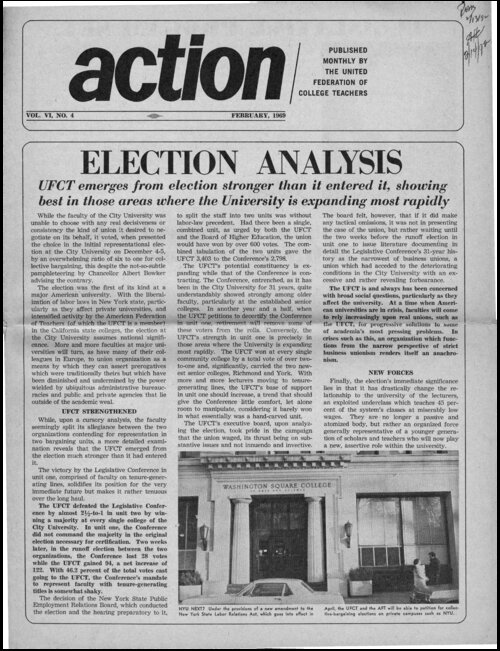 Action, February 1969 This edition of Action leads with the results of a recent CUNY-wide faculty vote regarding union representation. It also includes articles covering the UFCT's legislative efforts in Albany, ongoing threats to CUNY's budget, as well as book reviews and letters contributed by faculty from across the CUNY system.Action was the monthly newspaper of the United Federation of College Teachers (UFCT), one of the two main organizations that advocated for the concerns of CUNY employees before the formation in 1972 of the Professional Staff Congress, the union that has since represented CUNY faculty and professional staff. During this period, Action was edited by Bill Friedheim, an outspoken professor at Borough of Manhattan Community College and one of the subjects of our oral history interview on radicalism at BMCC.
 -
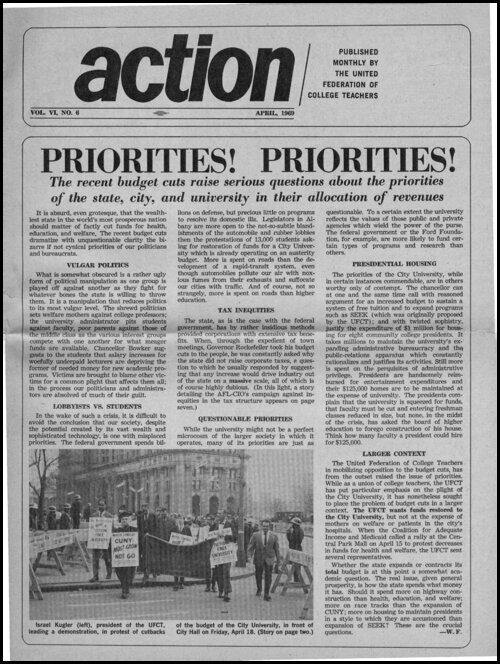 Action, April 1969 This issue of Action features stories on recent CUNY budget cuts largely attributable to a $70 million shortfall between city appropriations and CUNY requests. Also found in the paper are articles detailing new union demands for lecturers, firings at Queensborough Community College, and missteps found in the rollout of SEEK (Search for Education, Elevation, and Knowledge), a remedial program, at University Center. Action was the monthly newspaper of the United Federation of College Teachers (UFCT) and was edited by Bill Friedheim, an outspoken professor at Borough of Manhattan Community College and one of the subjects of our oral history interview on radicalism at BMCC. The UFCT was one of two main organizations that advocated for the concerns of CUNY employees before the formation in 1973 of the Professional Staff Congress, the union that has since represented CUNY faculty and professional staff.
 -
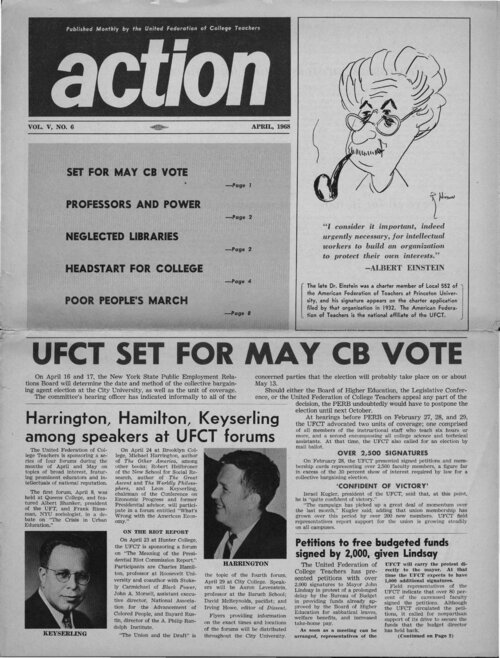 Action, April 1968 This issue of Action includes a detailed account of a City College professor's experience working within CCNY's "Pre-Baccalaureate Program," news of an upcoming collective bargaining vote, and editorials regarding various university-wide issues. It also contains articles, written just before the assasination of Dr. Martin Luther Kind, in support of the Poor People's Campaign.Action was the monthly newspaper of the United Federation of College Teachers, one of the two main organizations that advocated for the concerns of CUNY employees before the formation in 1972 of the Professional Staff Congress, the union that has since represented CUNY faculty and professional staff. During this period, Action was edited by Bill Friedheim, an outspoken professor at Borough of Manhattan Community College and one of the subjects of our oral history interview on radicalism at BMCC.
26–50 of 51