The Founding of Medgar Evers College
Item set
Collection
The Founding of Medgar Evers College
Time Periods
1961-1969 The Creation of CUNY - Open Admissions Struggle
Items
26–36 of 36
Advanced search
-
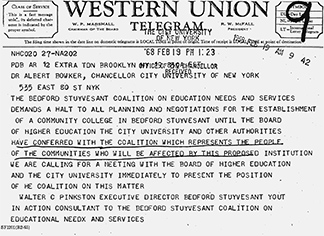
 Letter from Porter R. Chandler to Walter Pinkston In this letter from Porter R. Chandler, Chairman of the Board of Higher Education, to Walter Pinkston, Executive Director of Bedford Stuyvesant Youth in Action, Chandler informs the community leader that he will confer with the Board on the ways in which consultation with the Bedford-Stuyvesant community is to take place. The letter follows a telegram from Pinkston demanding a halt to all planning until a meeting could be arranged with the newly formed Bedford-Stuyvesant Coalition. The Coalition was tasked with representing community interests during the formation of Medgar Evers College, a role that would sometimes lead to contention with CUNY officials.
 -
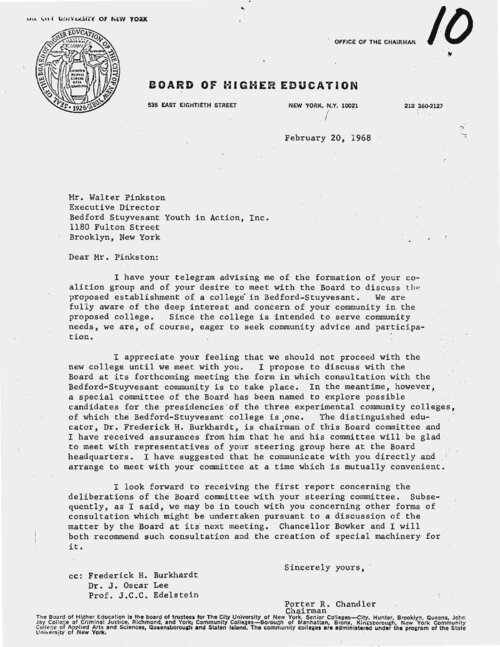
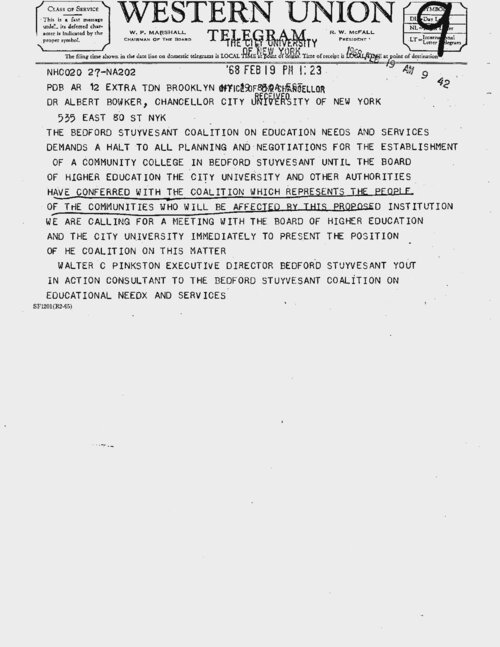 Telegram from Walter Pinkston to CUNY Chancellor Bowker Writing on behalf of the Bedford Stuyvesant Coalition on Education Needs and Services, Walter Pinkston demands that Chancellor Albert Bowker halt all planning of the new college until the Board of Higher Education and CUNY have conferred with the Coalition, which Pinkston writes, now represents the community "affected by [the] proposed institution." The Coalition, which comprised a collective of neighborhood organizations, would serve as the community's voice throughout the sometimes contentious negotiations with CUNY during the development of Medgar Evers College.
 -
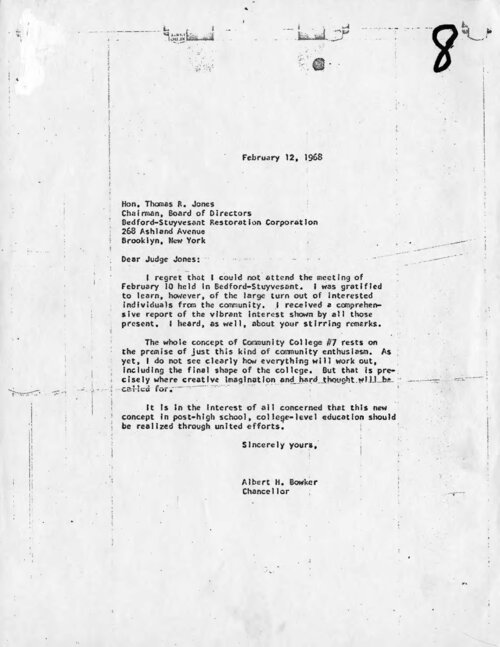 Letter from CUNY Chancellor Albert Bowker to Hon. Thomas R. Jones This is the third letter sent on February 12, 1968 from Chancellor Albert Bowker in regards to his absence at the February 10 meeting of community leaders and members at Decatur JHS. Addressed to Hon. Thomas R. Jones, chairman of the Bedford-Stuyvesant Restoration Committee, this letter informs Jones that he has received a comprehensive report from his staff and further reiterates Bowker's commitment to "unified efforts" for Community College No. 7's creation. Bowker had been previously invited to the meeting by community leader, Walter Pinkston, who had called for greater community involvement in the formation of Medgar Evers College.
 -
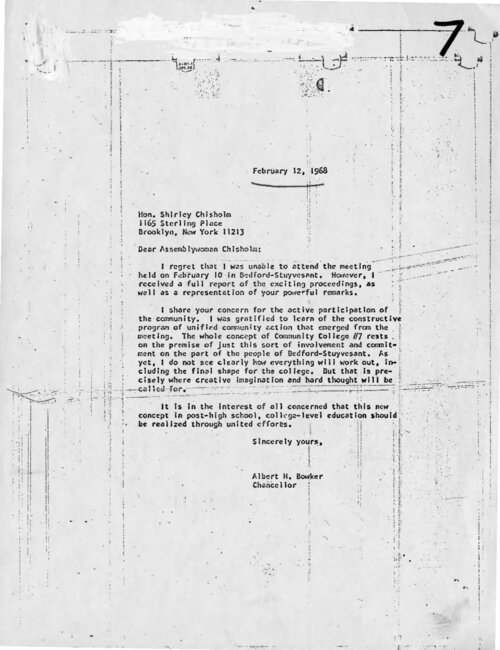 Letter from CUNY Chancellor Albert Bowker to Hon. Shirley Chisholm This is the second letter sent on February 12, 1968 from CUNY Chancellor Albert Bowker. This letter, addressed to Assemblywoman Shirley Chisholm, informs her that though he regrets not having attended the February 10th meeting at Decatur JHS, he has received a comprehensive report from his staff and is committed to community involvement in the creation of the new college. Bowker had been earlier invited to the meeting at the urgent request of Walter Pinkston, a community leader, who felt it necessary for the community to voice their concerns and desires for the proposed college.
 -
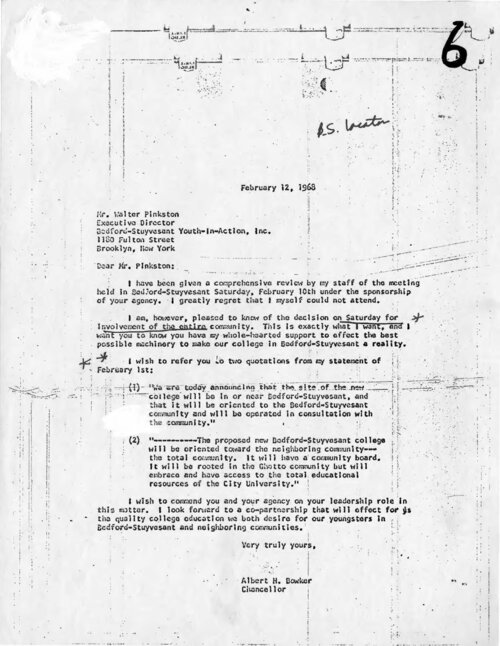 Letter from CUNY Chancellor Albert Bowker: Stating Commitment to Community Involvement This is the first of three letters sent on February 12, 1968 from Chancellor Albert Bowker in regards to his absence from a community meeting in Bedford Stuyvesant on February 10. In this letter to Walter Pinkston, executive director of Bedford Stuyvesant Youth in Action, the chancellor informs the chairman of Bedford-Stuyvesant Youth in Action that he has received a comprehensive report of the meeting from his staff and that he is committed to "the involvement of the entire community" in the creation of CUNY's new college. Bowker's presence at the meeting had earlier been urgently requested by Pinkston who felt that the community for whom the college was intended was being purposefully excluded from the planning process. Despite Bowker's assurances, tensions between CUNY officials and the Bedford-Stuyvesant community would remain constant throughout Medgar Evers College's development.
 -
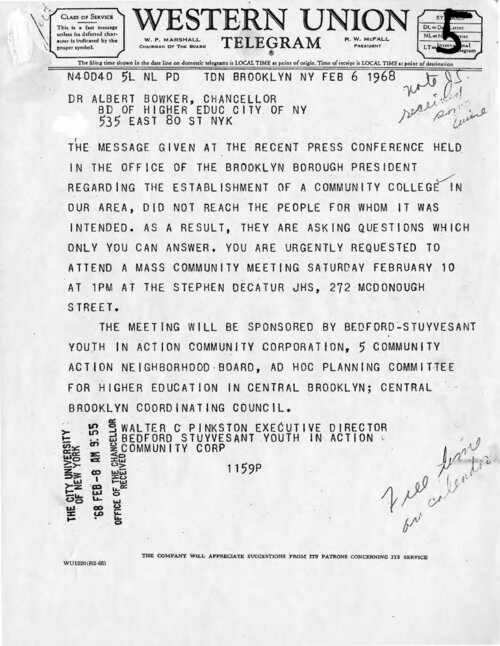 Telegram from Walter Pinkston to Chancellor Bowker: Lack of Community Involvement In this telegram sent to Chancellor Albert Bowker on February 6, 1968, Walter Pinkston, executive director of Bedford Stuyvesant Youth in Action, decries the recent announcement of Community College No. 7 because the message was delivered without any consideration given to the community. Pinkston "urgently request[s]" that the chancellor attend a meeting that Saturday, February 10, at Decatur JHS to meet with and hear the concerns of a variety of community groups in the neighborhood. Though the chancellor would not attend the meeting, Bowker would shortly reaffirm his commitment to community involvement. Throughout the development of Medgar Evers College, the Bedford-Stuyvesant community would maintain an active, if sometimes contentious, role in the creation of the institution.
 -
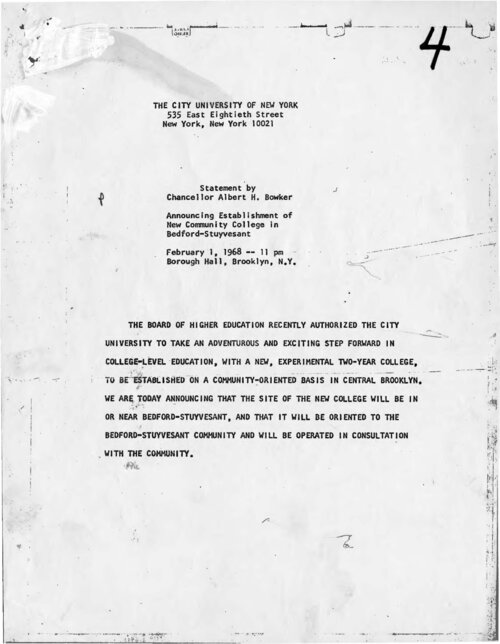 Statement by Chancellor Albert H. Bowker Announcing the Establishment of a New Community College In this statement by CUNY Chancellor Albert H. Bowker on February 1, 1968 in Brooklyn Borough Hall, Bowker announces the establishment of a new, experimental community college in Bedford Stuyvesant, Brooklyn. His announcement presents CUNY's hopes for the new institution as well as the large role that the community is expected to play in the college's creation and success. Bedford-Stuyvesant community leader, Walter Pinkston, would quickly take exception to the chancellor's announcement however, declaring that the decision to place a "community-oriented" college in the neighborhood was made without any consultation with the community itself. The community's push for participatory role in the new college's creation would persist through the planning and development of Community College No. 7 (later named Medgar Evers College).
 -
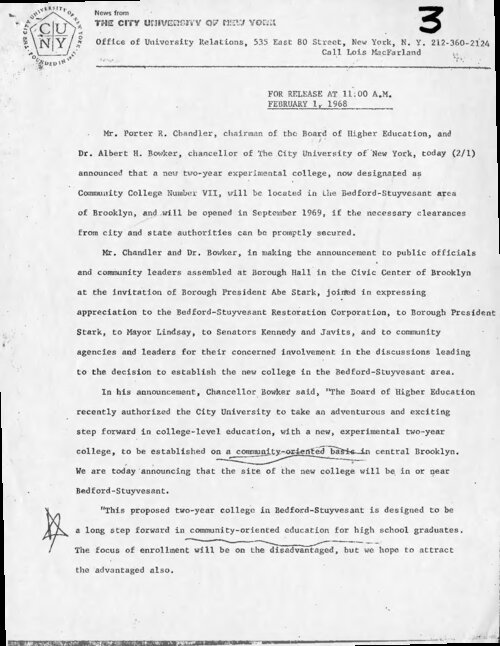 Press Release – A New Experimental College In this press release, The City University of New York's Office of University Relations announces the creation of a new, experimental, two-year college to be "established on a community-oriented basis in central Brooklyn." The press release coincided with a formal announcement made by CUNY officials at the office of the Brooklyn Borough President on February 1, 1968. The news of CUNY's plan would quickly reach the ears of Bedford-Stuyvesant community leaders, such as Walter Pinkston and Al Vann, who felt the university had not had any early consultation with the very community it had planned to center the new college around. The desire for a participatory role in the college's creation would persist throughout the college's formative years and, ultimately, it would define the development of Community College No. 7 (later named Medgar Evers College).
 -
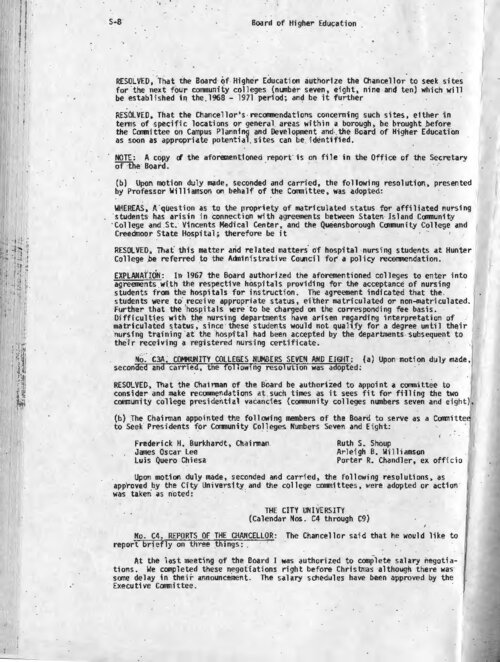 Minutes of Proceedings: Establishing Community College Number Seven In these minutes of proceedings from a January 22, 1968 meeting of the Board of Higher Education, the Board resolves to create the "Committee to Seek Presidents for Community Colleges Seven and Eight." The committee is first tasked with filling the presidential vacancy at Community College Number Seven, though its function would later be expanded during the college's development process. The meeting also calls for an amendment to the "1964 Master Plan for the City University of New York" to include the goals for the proposed college. These objectives include the new college's proposed common first semester, community-orientation, and admission procedures. Also mentioned are estimated operating budgets and facility requirements.
 -
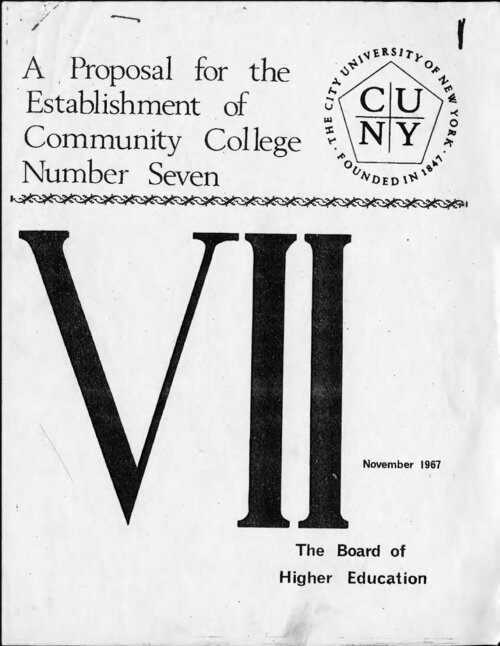 A Proposal for the Establishment of Community College Number Seven This proposal for the founding of Community College Number Seven (later named Medgar Evers College) was put forward by the Board of Higher Education in November 1967. In this excerpt (pages 11-15), the Board establishes their desire to place a new two-year college in or near a low-income community, a first for CUNY, where it will give greater emphasis to "the problems of disadvantaged youth." Consequently, it is stated, the proposed institution will be tasked to experiment with new programs designed to meet the unique needs of the community that it serves. The proposal also discusses the implementation of a common first semester, plans for location and facilities, aims for community involvement, and admissions goals.
 -
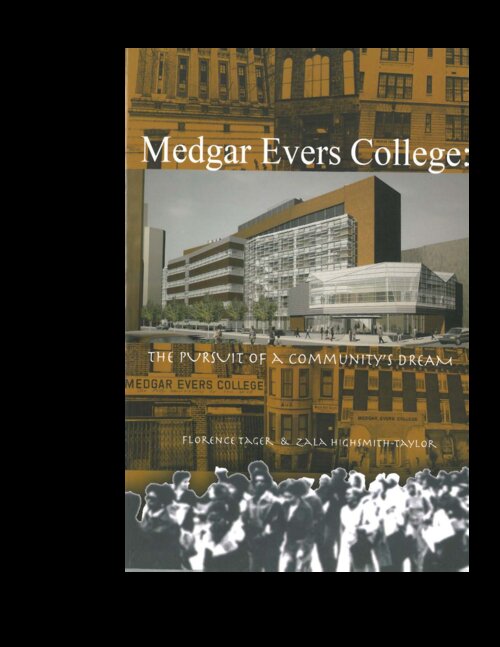 Medgar Evers College - The Pursuit of a Community's Dream In this short book, Medgar Evers College: The Pursuit of a Community's Dream, CUNY retired professors Florence Tager and Zala Highsmith-Taylor tell the story of the founding of the college. As an institution born largely out of 1960s community struggle, the book surveys the climate within New York City and CUNY that led to the confrontation between the Bedford-Stuyvesant community and the university at the time of the college's creation. In addition to the book's well-cited account of the institution's origins, it also includes photographs of faculty, staff, student life, community environment, and campus facilities (pages 35-49). The 122 page book is divided into three parts:1. Acts of Courage: A Community Challenges a University 2. Breaking Ground in the Racial Divide of New York City 3. Medgar Evers College is BornMuch of research for the book was culled from primary sources found in the Bowker Files of the CUNY archives, Louise Glover's private collection and interviews with community residents and politicians. A selected number of these files comprise "The Founding of Medgar Evers College" collection here at the CUNY Digital History Archive.
26–36 of 36