The Newt Davidson Collective
Item set
Collection
The Newt Davidson Collective
Time Periods
1946-1960 Municipal College Expansion
1961-1969 The Creation of CUNY - Open Admissions Struggle
1978-1992 Retrenchment - Austerity - Tuition
1993-1999 End of Remediation and Open Admissions in Senior Colleges
2000-2010 Centralization of CUNY
Items
1–3 of 3
Advanced search
-
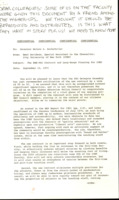 Newt Davidson Parody: Memo to Gov. Rockefeller on CUNY Planning This recently discovered (August 2017) document from the papers of historian Judith Stein, is the only extant example of what preceded the Crisis at CUNY brochure. As explained in the interview done with four members of the Newt Davidson Collective, a series of lengthy pamphlets were written anonymously and distributed across the university. They mocked the university administration for the direction it was taking, accusing them of corporatizing the university, automating teaching, and relying on adjunct labor, among other things. Crisis at CUNY and the documents that parodied CUNY administrators grew out of the research of the Newt Davidson Collective, an ad hoc group of faculty from several campuses who sought to understand reasons for this new climate of austerity in the 1970s. Their search for answers took them deep into the complex bureacracy of the City University and its links with other key institutions. The booklet and pamphlets produced by the Newt Davidson Collective would go on to circulate among CUNY faculty members and others.
 -
 Oral History Interview with Members of The Newt Davidson Collective Audio and transcription of oral history interview with Nanette Funk, Jerry Markowitz, Bill Tabb, and Mike Wallace, four of the original members of The Newt Davidson Collective.
 -
 Crisis at CUNY As the 1970s wore on, students and faculty at CUNY found themselves faced with an ominous environment. While the open admissions struggle of the late 1960s represented a signal achievement in the struggle to secure democratic access to quality higher education, now rising costs, overcrowding, layoffs, and other cutbacks threatened this ideal.Crisis at CUNY grew out of the research of the Newt Davidson Collective, an ad hoc group of faculty from several campuses who sought to understand reasons for this new climate. Their search for answers took them deep into the complex bureacracy of the City University and its links with other key institutions. The booklet would go on to circulate among CUNY radicals and others, influencing an entire generation. The authors were prescient—in many ways, the publication describes the CUNY of today as much as it does the CUNY of 1974.
1–3 of 3