Professional Staff Congress: Formation and First Contract
Item set
Collection
Professional Staff Congress: Formation and First Contract
Time Periods
1961-1969 The Creation of CUNY - Open Admissions Struggle
1970-1977 Open Admissions - Fiscal Crisis - State Takeover
Items
1–25 of 45
Advanced search
-
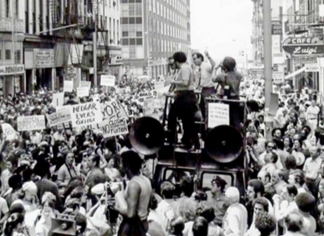
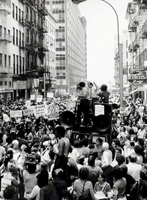 PSC demonstration at Chambers St. Near City Hall The Professional Staff Congress (PSC), the union of CUNY faculty and staff, staged this demonstration in 1976 in the midst of the city's fiscal crisis. Colleges were being threatened with closure and budgets were being cut. Union members urged the leadership to be more forceful in the fight for funding. As the signs indicate, students from across the university were also out in great numbers to defend Open Admissions and take positions against tuition and against school closings.
 -
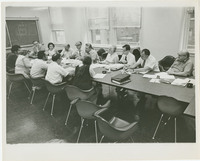 First Contract Meeting This photograph shows the first meeting of the newly formed Professional Staff Congress (PSC) contract negotiating committee with CUNY administration. Negotiations were difficult and an agreement was not reached until July 1973. Pictured here from the left, facing the camera, are PSC team members Harold Wilson, the leader of the College Laboratory Technicians Chapter, Ada Agronin from Queens College, Irving Panken, a PSC staff member, Israel Kugler, the PSC Deputy President, Arnold Cantor, the Executive Director of the union, Belle Zeller, the President of the PSC, Irwin Polishook from Lehman College, Claude Campbell, from Staten Island Community College, and Samuel Ehrenpreis, from Bronx Community College.
 -
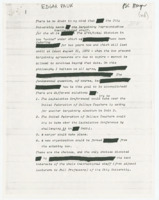 Edgar Pauk Statement on Union Merger In this draft document, Edgar Pauk, a lecturer at Queens College and vice president of the 4-year public college unit of the United Federation of College Teachers (UFCT), announces his break with the union's leader, Israel Kugler, stating that he had decided to leave the UFCT in favor of joining the rival Legislative Conference (LC). His statement speaks to many of the concerns facing the union at the time, particularly the need for a single bargaining unit for all of CUNY faculty and staff. Pauk is especially critical of both the UFCT as an organization and its leadership provided by Kugler. Pauk would come to play an important role once the two unions decided upon a merger with the creation of the Professional Staff Congress (PSC) in April 1972. In the first election of the new union in 1973, Pauk decided to run for union presidency doing so against Belle Zeller, president of the LC, and also Israel Kugler, president of the UFCT. Pauk received a meager 321 votes in the election, however, the winner, Zeller, defeated runner-up Kugler by only 124 votes. Kugler would thereafter claim that most of Pauk’s votes came from those who otherwise would have supported him, and that without Pauk in the election, he would have won. Instead, the caucus led by Zeller and members of the former LC took control of the union in its early years. While Kugler's claims remain unproven, Pauk undoubtedly had a real impact on the election though such would forever remain the extent of his influence with the PSC.
 -
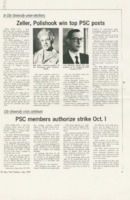 "Zeller, Polishook Win Top Posts" The first article from this issue of The New York Teacher, the monthly newspaper of the New York State United Teachers federation, reports the results of the first Professional Staff Congress (PSC) election held in April 1973. Belle Zeller, from the former Legislative Conference (LC), won the presidency by small margin over Israel Kugler, from the former United Federation of College Teachers (UFCT). A third candidate, Edgar Pauk, had a decisive impact on the election as his total vote tally was larger than Zeller’s margin of victory. A caucus, led by Irwin Polishook, supported Zeller, and won 15 of the 20 remaining seats on the union’s Executive Council. The second article details a recently authorized strike vote from union members. Set for October 1st, the strike declaration was tactically used by the PSC in order to break their deadlock with CUNY administration over the terms of a new contract. Most problematic for the newly formed PSC was the administration's initial refusal to recognize the new union as the official bargaining agent for the more than 16,000 professors, instructors and other non-classrrom staff at CUNY. Ultimately, the two sides reached an agreement not long after this article was published, rendering the strike unnecessary.The PSC was formed in April 1972 following the merging of the LC and UFCT. Leaders from both former groups sought to control the direction of the union in its earliest years, a fact that led to particularly contentious early elections. In the following election in 1976, Israel Kugler and Irwin Polishook contended for the PSC presidency. Polishook won decisively, and Kugler dissolved his caucus.
 -
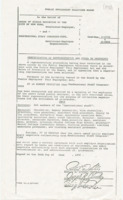 Public Employment Relations Board: Certification of Representation and Order to Negotiate This document from the Public Employment Relations Board, a New York State agency, certifies the newly formed Professional Staff Congress (PSC) as the union representation for CUNY instructional staff. Issued in June 1972, the order by PERB followed the merger of the formerly competing unions in April 1972, and the approval of the merger in a referendum by the CUNY faculty and staff. The new, united union, became the sole collective bargaining agent for all faculty and staff in CUNY.
 -
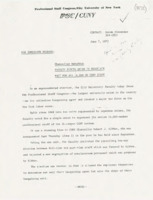 "Chancellor Rebuffed" This press release from the Professional Staff Congress (PSC) announces the recent vote from CUNY faculty and staff in favor of a single bargaining unit instead of the three preferred by CUNY administration. Overwhelmingly in favor of single representation, faculty and staff chose the PSC to be that single bargaining agent. The vote ended the split that had resulted from the collective bargaining elections of December 1968, and it ratified the merger of the two former unions, the Legislative Conference and the United Federation of College Teachers, into the single PSC.
 -
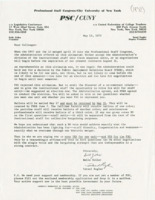 Letter from Belle Zeller and Israel Kugler to All CUNY Faculty and Staff Following the merger of the Legislative Conference and the United Federation of College Teachers on April 14, 1972, the newly formed Professional Staff Congress (PSC) faced an immediate challenge when CUNY administration refused to recognize the new union. Formed to represent all faculty and staff, the PSC's creation sought to undo the division that since 1969 saw two different bargaining units. The CUNY administration, meanwhile, desired three units for separate negotiation with: full timers, part timers and non-classroom staff. Ultimately the PSC and CUNY administration agreed to have the faculty and staff vote on whether they preferred the one unit or the three units called for by the CUNY administration. In this letter, President Belle Zeller and Deputy President Israel Kugler call on all CUNY faculty and staff to vote in favor of one unit, and for the PSC to serve as the collective bargaining agent for that single unit. The election was held in May 1972 and the faculty and staff voted overwhelmingly in favor of both measures.
 -
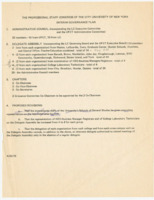 PSC Interim Governance Plan This item details the structure of the new Professional Staff Congress' (PSC) Administrative Council, Delegate Assembly and chapters. It was based on the principle of equal representation from the Legislative Conference (LC) and the United Federation of College Teachers (UFCT), the two unions that combined to form the PSC in 1972. As seen in the document, much consideration was initially given to equally dividing the positions amongst members of the two former rivals. They went so far as to include representation from both groups from each CUNY campus. In total, 20 served on the Administrative Council, 110 on the Delegate Assembly (including those from the Administrative Council), and 8 headed union chapters. This split-power situation lasted one year until the first PSC election in April 1973. In a very close election, Belle Zeller, former LC president, defeated Israel Kugler, former UFCT president, for the presidency of the PSC.
 -
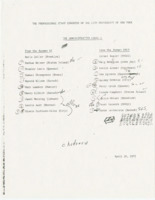 PSC Administrative Council This document lists the names of the first members of the Administrative Council for the newly formed Professional Staff Congress (PSC). Created out of a merger between the Legislative Conference (LC) and the United Federation of College Teachers (UFCT) the new union's Administrative Council included equal representation of leaders from both groups. Despite the benefits the combined PSC afforded both the LC and UFCT, the merging of the two former rivals was not without difficulties, particularly in matters of union leadership. Initially led by President Belle Zeller from the former LC and Deputy President Israel Kugler from the former UFCT, the two highest offices lacked clearly defined roles and responsibilities. This plus past lingering tensions led to much contention and a split among members into caucuses in the union's earliest days.
 -
 NYSTA-UTNY Merger Agreement This lengthy document lays out the terms of the merger between the New York State Teachers Association (NYSTA) and the United Teachers of New York (UTNY) set to take place on April 4, 1972. Previously the NYSTA had been affiliated with the National Education Association (NEA) and the UTNY with the American Federation of Teachers (AFT). The significance of this merger was that at CUNY, each of the competing unions was previously affiliated with a different group: the Legislative Conference (LC) with the NEA and the United Federation of College Teachers (UFCT) with the AFT. As the two statewide unions moved toward their merger, they placed increasing pressure on their affiliates in CUNY to do the same. The leaders of the LC and the UFCT agreed to merger at about the same time as the statewide unions merged. The members of the two CUNY unions quickly approved the merger in a referendum, and the PSC was officially formed on April 14, 1972.
 -
 Joint Statement of Belle Zeller and Israel Kugler on Merger In this statement, President Belle Zeller of the Legislative Conference and President Israel Kugler of the United Federation of College Teachers announce the merger of the two rival unions, and call on the members of each organization to ratify the merger in a secret ballot referendum. They note the need for unity to end the dissipation of their resources. They also stress the problems facing CUNY, and its faculty and staff, which would require a unified union to have the maximum influence on events. The membership of each union strongly endorsed the merger, which took place on April 14, 1972.
 -
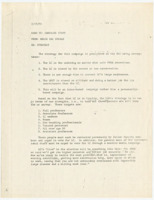 Strategy Memo to Campaign Staff Bruce MacDonald lays out the strategy for what he believes will allow the Legislative Conference (LC) to triumph against the United Federation of College Teachers (UFCT) as the single bargaining unit for CUNY faculty and staff in the upcoming election. Acknowledging that the LC was "in trouble" and "the underdog" and viewed by most members as the more conservative alternative, he states what he believes is the winning strategy: to run on their strengths and work to turn out those he believes will vote for the Legislative Conference. The UFCT wanted a single unit to represent all of CUNY, and had called for a collective bargaining election for the faculty and staff. The LC had resisted such an election out of fears they could not win in a single unit election. Ultimately, this election was never held as the two unions merged to form the Professional Staff Congress on April 14, 1972.
 -
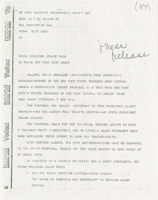 "NYSTA Outlines Merger Plan to Rival New York City Group" In this press release, representatives from the New York State Teachers Association (NYSTA) propose steps for a merger with the United Teachers of New York (UTNY). The NYSTA had previously been affiliated with the National Education Association (NEA), which in turn had been affiliated with Legislative Conference (LC) at CUNY. The LC's rival union, the United Federation of College Teachers (UFCT) meanwhile had been affiliated with the American Federation of Teachers (AFT), which had been connected to the UTNY. Following the merger of the NYSTA and UTNY on April 4, 1972, pressure was placed on CUNY's competing unions to do the same. The LC and UFCT merged to form the Professional Staff Congress/CUNY (PSC) not long after on April 14, 1972.
 -
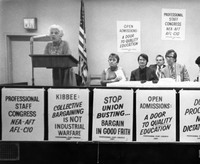 PSC Contract Rally The Professional Staff Congress (PSC) struggled to win its first contract from CUNY in 1972 and 1973. It called on support from others in the labor movement to help put pressure on the CUNY administration. At this meeting, President Belle Zeller of the PSC is speaking. In the first row behind her, at right, is Albert Shanker, United Federation of Teachers president, and to his right is Thomas Hobart, New York State United Teachers president. At the rear of the photo is Arnold Cantor, the Executive Director of the PSC.
 -
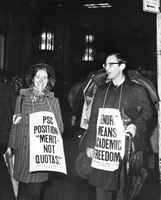 Tenure Quota Rally Carrying a sign that reads "Tenure Means Academic Freedom," Irwin Polishook, Vice President of the Professional Staff Congress (PSC), is joined by Carol Brandon, a union leader from the Borough of Manhattan Community College, at a rally against tenure quotas at CUNY. Rallies were one tactic in the PSCs’ opposition to the 50% tenure quota for academic departments in CUNY. Proposed by Chancellor Robert Kibbee in 1973, the policy was instituted by the Board of Higher Education (BHE) on October 29, 1973. The PSC also asked the faculty and staff to shun Chancellor Kibbee and reached out to the general public through ads and public relations pieces. The union placed newspaper advertisements warning prospective faculty about the tenure quotas, and reached out to politicians at the state and city levels. This campaign was a success, and on April 22, 1974 the BHE rescinded the tenure quotas.
 -
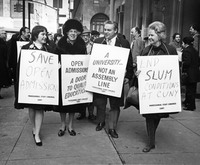 Picketing at Baruch College The Professional Staff Congress (PSC) picketed in favor of Open Admissions, among other things, in front of Baruch College in February 1973. Their efforts to save Open Admissions from budget cuts presaged the struggles that would come with fiscal crisis of the mid 1970s. While Open Admissions added many new students to CUNY after 1970, both New York State and New York City sought to cut funding for CUNY in the subsequent years. The PSC argued that this would degrade education for all students. Belle Zeller, PSC president, is second from the left, with Arnold Cantor, PSC’s Executive Director, to her right.
 -
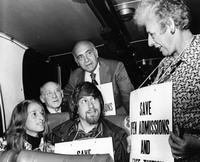 Bus Ride to Albany Rally Belle Zeller, Professional Staff Congress (PSC) president, can be seen at the right with Israel Kugler, the union's deputy president standing at the back. The photo was taken on a bus trip to Albany to rally in support of Open Admissions. The PSC opposed cuts to the program's funding and also favored CUNY's continuation of free tuition. While Open Admissions would survive the decade, free tuition would come to an end in 1976 during New York City's fiscal crisis. From its earliest years, the PSC was a strong force in Albany, thanks not only to the persistence of its lobbyists but also because of support received from the newly merged New York State United Teachers, a group representing educators throughout New York State.
 -
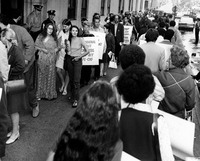 Rally Demanding Progress in Contract Negotiations This photograph captures a rally held by the Professional Staff Congress during their deadlock with CUNY administration over the terms of a new contract in 1973. As negotiations stalled, the PSC held a number of rallies demanding that CUNY administration bargain in good faith. This particular rally was held in front of the CUNY headquarters on East 80th Street in New York City. The woman holding the sign, in the center of the photograph, is Evelyn Lerner, a union leader from the New York City College of Technology. Directly in front of her is Lilia Melani, a leader at Brooklyn College, and in the late 1970s and early 1980s, the leader in the legal case that won pay equity, including retroactive payments, for the female faculty and staff at CUNY.
 -
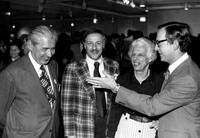 Lobby Efforts in Albany, NY Belle Zeller, Professional Staff Congress (PSC) president, was a frequent visitor to the New York legislators, first on behalf of the Legislative Conference, and then, after the merger, for the PSC. Here, in 1973, she is joined by State Senator John Markey, at the left, State Senator Kenneth LaValle to Markey’s left, and Irwin Polishook, the First Vice President of the PSC.
 -
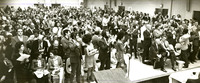 Audience at First PSC Contract Rally This October 1972 mass meeting at the Marc Ballroom at Union Square, New York came at a time when the Professional Staff Congress (PSC) was deadlocked with CUNY administration during negotiations for the union's first contract following its creation in April of that year. Don Davidson, a union leader from LaGuardia Community College, is the second figure in the first row, just left of the center aisle. The union held a number of rallies and took two strike authorization votes. Ultimately, an agreement was reached between CUNY and the PSC in July 1973.
 -
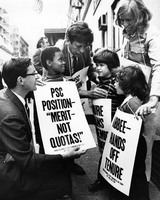 PSC Rally with Children This photograph was used by the Professional Staff Congress (PSC) as part of its campaign against a 50% tenure quota policy for academic departments that had been announced by Chancellor Robert Kibbee, and then approved by the Board of Higher Education (BHE) on October 29, 1973. The PSC strongly fought against the policy and this photograph was part of its outreach to the general public. First Vice President of the PSC, Irwin Polishook, is on the left. Jerry Meyer, a union leader from Hostos Community College is in the background. The campaign was a success, and, on April 22, 1974, the BHE rescinded the tenure quota policy.
 -
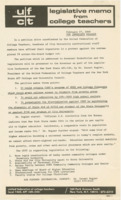 UFCT Legislative Memo: Petition Against State Budget Cuts This memo was issued to the members of the United Federation of College Teachers (UFCT) on behalf of union president Israel Kugler. It announces a petition drive against proposed budget cuts at CUNY. The document illustrates that even in times of relative calm, funding for CUNY was targeted by the New York State legislature and Governor Rockefeller. Among the petition demands was an equal funding formula to eliminate the disparity in financial support provided by the state to the State University of New York (SUNY) and the City University of New York. Although New York State did agree to full funding for CUNY's four-year colleges beginning in 1979, equal funding for SUNY and CUNY did not materialize.
 -
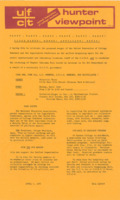 UFCT Hunter Viewpoint: "Close Ranks! Merge! Affiliate! Revel!" This flier was issued by the chair of the Hunter College Chapter of the United Federation of College Teachers, Bill Leicht. It calls on the members to vote in favor of the proposed merger with rival union, the Legislative Conference. the flier also celebrates the rehiring of Leicht after he won a grievance. Ultimately, substantial majorities of each union voted in favor of the merger. The new union, the Professional Staff Congress/CUNY (PSC), came into existence on April 14, 1972.
 -
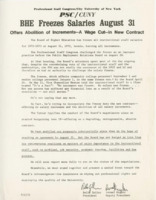 "BHE Freezes Salaries August 31" In this memorandum to CUNY faculty and staff, the Professional Staff Congress (PSC) attacks the tactics of the Board of Higher Education as the parties sought to negotiate the first contract following the merger of the Legislative Conference (LC) and the United Federation of College Teachers (UFCT) in April 1972. One major issue during negotiations was the annual increments in salary received by faculty and staff. CUNY had unsuccessfully sought to eliminate the incremental wage increases during the negotiations of the initial contracts with the LC and the UFCT in 1969. It revived the demand in the negotiations of 1972-1973, and as a tactic toward that objective froze all increments. The PSC protested that their action was in violation of the existing contracts. Ultimately a contract was agreed to in July 1973, and increments remained in force.
 -
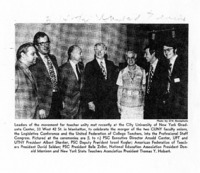 Labor Leaders at the Celebration of Merger This photograph was taken at the CUNY Graduate Center on 42nd St at a celebration of the merger of CUNY's two professional unions, the Legislative Conference and the United Federation of College Teachers, into the Professional Staff Congress (PSC). Pictured from left to right are: "PSC Executive Director Arnold Cantor; UFT and UTNY President Albert Shanker; PSC Deputy President Israel Kugler; AFT President David Selden; PSC President Belle Zeller, NEA President Donald Morrison; and New York State Teachers Association President Thomas Y. Hobart." The presence of Shanker, Hobart and the presidents of the national labor organizations illustrates the pressures that were placed upon CUNY's formerly competing labor unions to merge.
1–25 of 45