Statement of Policy by the Board of Higher Education
Item
Minutes of Proceedings, July 9, 1969 185
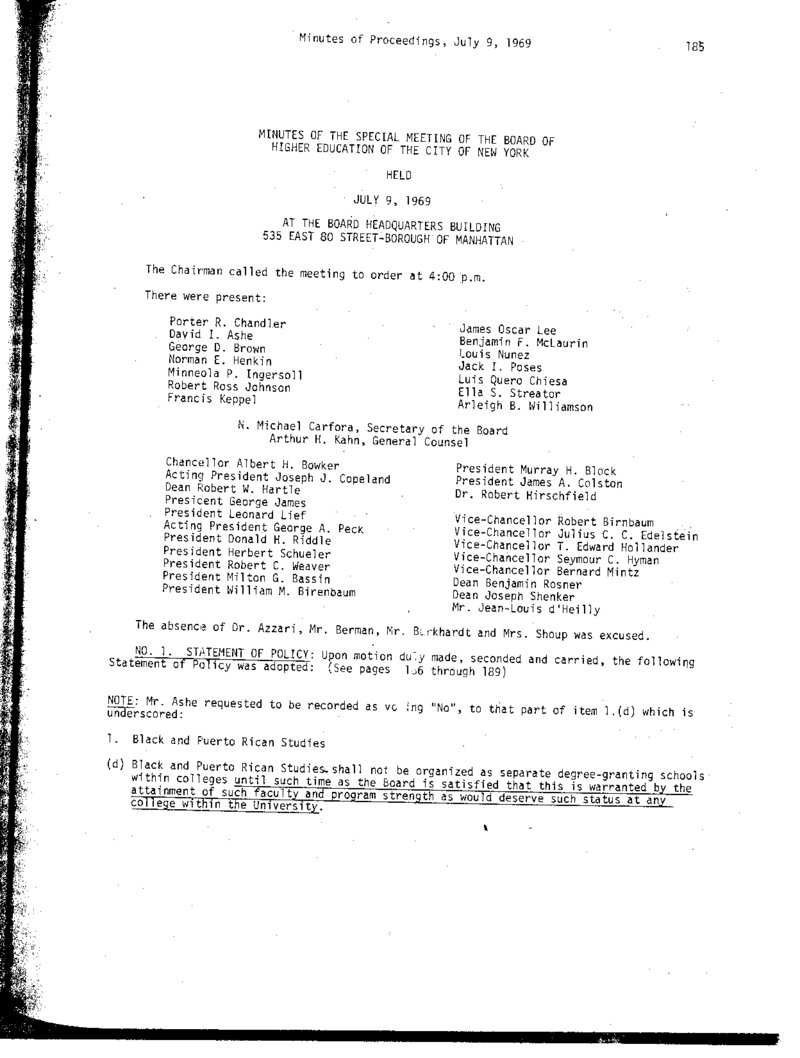
MINUTES OF THE SPECIAL MEETING OF THE BOARD OF
HIGHER EDUCATION OF THE CITY OF NEW YORK
HELD
JULY.9, 1969
AT THE BOARD HEADQUARTERS BUILDING
535 EAST 80 STREET-BOROUGH OF MANHATTAN
The Chairman called the meeting to order at 4:00 p.m.
There were present:
Porter R. Chandler
David I. Ashe Benjamin F. McLaurin
George D. Brown louis Nunez
Norman £. Henkin Jack I. Poses
Minneola P. Ingersoll] Luis Quero Chiesa
Robert Ross Johnson Ella S. Streator
Francis Keppel Arleigh B. Williamson
James Oscar Lee
N. Michael Carfora, Secretary of the Board
Arthur H. Kahn, General Counsel
Chancellor Albert H. Bowker President Murray H. Block
Acting President Joseph J. Copeland President James A. Colston
Dean Robert W. Hartle Dr. Robert Hirschfield
President George James
President Leonard Lief Vice-Chancellor Robert Birnbaum
Acting President George A. Peck Vice-Chancellor Julius C. C. Edelstein
President Donald H. Riddle Vice-Chancellor T. Edward Hollander
President Herbert Schueler Vice-Chancellor Seymour C. Hyman
President Robert C. Weaver Vice-Chancellor Bernard Mintz
President Milton G. Bassin Dean Benjamin Rosner
President William M. Birenbaum Dean Joseph Shenker
Mr. Jean-Louis d'Heilly
The absence of Or. Azzari, Mr. Berman, Mr. Burkhardt and Mrs. Shoup was excused.
NO. 1. STATEMENT OF POLICY: Upon motion duiy made, seconded and carried, the following
Statement of PoTicy was adopted: (See pages 156 through 189)
NOTE: Mr. Ashe requested to be recorded as vo ing "No", to that part of item 1.(d) which is
underscored:
1. Black and Puerto Rican Studies
(d) Black and Puerto Rican Studies. shall not be organized as separate degree-granting schools
within colleges until such time as the Board is satisfied that this is warranted by the
attainment of such faculty and program strength as would deserve such status at any
colTege within the University.
a -
186 Board of Higher Education
STATEMENT OF POLICY BY THE BOARD OF HIGHER EDUCATION
Perhaps no issue at the City University has ever received as much attention as the““Five Demands” at City
College. Negotiations at City College were followed by lengthy and intensive review and analysis by the City
College Faculty Senate and the City College Administration. The Student Senate at the College developed a
position after careful study, and polls were taken of the entire faculty to gain more insight into the issues. The
Board itself has devoted five special meetings to these issues, in addition to discussions at regular Board meetings
and meetings of its Executive Committee.
The issues with which the Board was confronted transcended the immediate concerns of City College, and in
fact the University itself. They are the basic issues of our City and of our society. In dealing with these issues, the
Board was faced with the necessity of re-examining our programs and structures so as to meet legitimate needs
and aspirations of all the City’s youth, while at the same time Preserving the educational integrity of the
University, without which we would be perpetrating a cruel hoax upon all those who desire and deserve a higher
education of true excellence. We believe that the actions we are directing meet both of these requirements.
The Board has already acted upon the matter of course requirements for education majors at the College. At
its meeting of May 9, 1969, the Executive Committee, acting for the Board, approved Spanish language and Black
and Puerto Rican history as requirements for all education majors at the college.
We now turr-our attention to the other four negotiated items.
1. BLACK AND PUERTO RICAN STUDIES
The question of the development at City College of an institution devoted to a study of Black and Puerto
Rican stud’es has served to focus the attention of the Board upon the responsibilities of the entire City University
in this fieli.
In ecamining the present position of the University, we find that courses related to Black and Puerto Rican
studies exist in each of our institutions, Indeed, in many of our colleges the number and variety of such courses
offered through the traditional academic departments are impressive, particularly when compared with both
Present and projected programs of other institutions across the nation. Nevertheless, when considering the great
body of knowledge existing in these areas, and the critical importance of these studies to the urban problems
which the City University considers its prime commitment, it is our considered judgment that further efforts
should be made, and made promptly.
We therefore state that it shall be the policy of the City University and its constituent colleges to encourage
the development of Programs of Black and Puerto Rican studies within the University, and to give the funding of
these programs special Priority. We further state that in view of our commitment both to the urban setting and to
educational excellence, the University should establish as a goal the attainment of national preeminence and
leadership in these fields.
The following guidelines shall govern the implementation of this goal:
(a) Programs at the senior colleges may be established as interdisciplinary degree programs, institutes or
departments, or in some other structure as may be desirable at any college in view of its present
Programs, special strengths, or other factors peculiar to its operations.
(b) Programs at the community colleges may be established as course sequences, program. options, or
electives.
(c) The University will establish as quickly as possible Institutes for Research in Black and Puerto Rican
Studies,
Minutes of Proceedings, July 9, 1969 187
(d) Black and Puerto Rican Studies shall not be organized as separate degree-granting schools within
‘colleges until such time as the Board is satisfied that this is warranted by the attainment of such
faculty and program strength as would deserve such status at any college within the University.
(e) All Black and Puerto Rican Studies programs, however organized, shall be subject to appropriate
faculty and administrative control as provided for in the Bylaws of the Board.
The Faculty Senate at City College, after considering the role of the College in the establishment of
programs in Black and Puerto Rican Studies, voted to create a committee to study this matter and to report back
to it in the fall. In our view, because of the great importance and urgency of this matter, it would be
inappropriate to begin the fall semester at City College with this issue still unresolved.
We therefore direct the Faculty Senate of City College, or any other faculty body as determined by the
President, to begin immediately to prepare a proposed program in Black and Puerto Rican Studies consistent with
the policies outlined above, and to submit that proposal to the President for transmission to the Board no later .
than August 15, 1969. We recognize the hardships and problems involved in asking the faculty to meet during the
summer after they have obligated themselves to other activities. However, the commitment of the University
requires that the faculty, as well as the administration and the Board, take whatever steps may be-necessary to
resolve this matter promptly and responsibly.
2. THE ORIENTATION OF BLACK AND PUERTO RICAN STUDENTS
The Board considers freshman orientation to be a matter falling under the jurisdiction of each college.
Provided that the director of any orientation program is selected by Personnel and Budget Committee procedures
consistent with the Bylaws of the Board, the Board will not substitute its judgment in this matter for that of the
duly authorized college authurities. Nothing in the Board Bylaws or policies precludes the establishment of a
student-faculty committee to recommend candidates fr appointment or reappointment as the di-ector of a
program to a duly constituted departmental P & B Ccmmittee. The Board will weicome the establishc x. of
supplementary orientation programs organized to meet the needs of any specific group of students provided thac
attendance at such programs is voluntary, and that al! cidents who wish to participate in such programs mw ac
so. Notification of the existence of such programs shc .d be given to all freshmen.
3. GUIDELINES FOR SEEK
_ For the past several years, the SEEK Prograr at City College and other units of the University has operated
outside the regular college departmental struct: . This ad-hoc arrangement, which was established to sermit
rapid expansion during the early phases of the proram’s development, is no longer adequate to meet the needs :
the program. In particular, some means must be found for appointing instructors and counsellors in the S™
Program in a departmental structure so that the can be considered for promotion and tenure in the sar-« way as
other members of the instructional staff. We therefore direct the following:
(a) Each senior college shall establish a department which shall include counsellors in the SEEK Program
and other programs of a similar nature. At the option of the President, teachers of remedial reading
and other specialists outside the traditional academic disciplines who are hired to provide special
services for SEEK and similar programs may either be included in this department, in a separate
Department for Fundamental Education if such exists, or in a program of fundamental or remedial
education in an existing department.
(b) The department shall be administered in the same manner as any other department of a college except
that for a transitional five-year period, beginning September 1, 1969, the Chairman of this Department
shall be the Director of the S [EK Program at each college, as designated by the President. The
Personnel and Budget Committee of the department shall, for the same five-year period be comprised
of the Dean of Faculty of the school or college, the Chairman of the department and three persons
188 Board of Higher Education
designated by the president. The Personnel and Budget Committee shall recommend persons for.tenure
and promotion to the President of each college, who shall review appointments for tenure and
promotion in consultation with the University.
(c) All persons teaching a subject for which there is an academic department in the college shall be hired
Chairman of the department. Any exception to the above must be reported to, and approved by, the
Committee on Expanded Educational Opportunity and the Board of Higher Education.
(4) The department shall strive to accelerate those enrolled in it to begin study in the regular college
curriculum as rapidly as possible. Thus, with the exception of courses which combine remedial with
course credit work, it should not offer credit courses, Where credit is given in such combined courses,
it shall be only for the academic content and be approved by the appropriate academic department.
(e) The colleges have authority to develop student and faculty committees to advise on matters of
curriculum, student activities, and faculty recruitment.
4, ADMISSIONS POLICY
community which we serve, the Board has reappraised the policy which it established five years ago. We have
concluded that the City University should initiate an open admissions policy as quickly as practicable.
Accordingly, we are directing the Chancellor of the University to immediately determine the feasibility -of
initiating this policy at The City University of New York for September 1970. We regard achievement of this
objective as an equitable and desirable answer to the question of admissions. In pursuit of this objective, the
Chancellor’s feasibility study shall include an examination of the financial and facilities implications, projections
The plan shall make the following general provisions:
(a) It shall offer admission to some University program to all high school graduates of the City.
(b) It shall provide for remedial and other supportive services for all students requiring them.
(c) It shall maintain and enhance the standards of academic excellence of the colleges of the University.
¥ Minutes of Proceedings, July 9, 1969 189
(d) It shall result in the ethnic integration of the colleges.
(e) It shall provide for mobility for students between various programs and units of the University.
(f) It shall assure that all students who would have been admitted to specific community or senior colleges
under the admissions criteria which we have used in the past shall still be so admitted. In increasing
educational opportunity for all, attention shall also be paid to retaining the opportunities for students
now eligible under present Board policies and practices.
The Chancellor is also instructed to undertake discussions with the Mayor and other elected City officials,
the mayoralty candidates, the Governor, legislative leaders, and community groups in order to determine if
adequate support for immediate implementation of an open enrollment plan will be forthcoming.
The Board notes that on May 5, 1969, it established a University Commission on Admissions composed of
faculty, students, administrators, alumni, and representatives of community organizations, and charges this
Commission to review and make recommendations concerning the admissions system of the University. We
further charge the Commission to recommend a specific system of admissions criteria which will implement the
preceding provisions, and which also will insure that each unit of the University is given significant responsibilities
for preparing the academically less prepared student to engage in collegiate study. We do not want to provide the
illusion of an open door to higher education which in reality is only a revolving door, admitting everyone but
leading to a high proportion of student failure after one semester. The Commission shall include such
recommendations in its report which is due to be submitted October 1, 1969.
Although the open admissions plan would be implemented in 1970, if practicable, this plan would not
provide for the additional 300 students in September 1969 who were included in the negotiated agreement at
City College and approved in the City College Faculty Senate resolution. In the face of the critical space shortage
in campus facilities at City College, which prohibits any additional student enrollment in campus-centered
teaching programs requiring small classes, tutoring sessions, etc., the Board cannot approve any additional
on-campus enrollment of special program students at this time. We are, however, transferring to the jurisdiction
of City College the University Center SEEK Program, We are authorizing City College to admit a minimum of 100
additional SEEK students beyond the number originally scheduled to be admitted into this program (400) in
September 1969. The off-campus facility will be continued, but by September 1970 will become a freshmun
center as part of the University’s overall effort to accor :modate its open admission plan.
Upon motion duly made, seconded and car ied, the meeting adjourned at 10:30 p.m.
N. MICHAEL CARFORA
Secretary of the Board
MINUTES OF THE SPECIAL MEETING OF THE BOARD OF
HIGHER EDUCATION OF THE CITY OF NEW YORK
HELD
JULY.9, 1969
AT THE BOARD HEADQUARTERS BUILDING
535 EAST 80 STREET-BOROUGH OF MANHATTAN
The Chairman called the meeting to order at 4:00 p.m.
There were present:
Porter R. Chandler
David I. Ashe Benjamin F. McLaurin
George D. Brown louis Nunez
Norman £. Henkin Jack I. Poses
Minneola P. Ingersoll] Luis Quero Chiesa
Robert Ross Johnson Ella S. Streator
Francis Keppel Arleigh B. Williamson
James Oscar Lee
N. Michael Carfora, Secretary of the Board
Arthur H. Kahn, General Counsel
Chancellor Albert H. Bowker President Murray H. Block
Acting President Joseph J. Copeland President James A. Colston
Dean Robert W. Hartle Dr. Robert Hirschfield
President George James
President Leonard Lief Vice-Chancellor Robert Birnbaum
Acting President George A. Peck Vice-Chancellor Julius C. C. Edelstein
President Donald H. Riddle Vice-Chancellor T. Edward Hollander
President Herbert Schueler Vice-Chancellor Seymour C. Hyman
President Robert C. Weaver Vice-Chancellor Bernard Mintz
President Milton G. Bassin Dean Benjamin Rosner
President William M. Birenbaum Dean Joseph Shenker
Mr. Jean-Louis d'Heilly
The absence of Or. Azzari, Mr. Berman, Mr. Burkhardt and Mrs. Shoup was excused.
NO. 1. STATEMENT OF POLICY: Upon motion duiy made, seconded and carried, the following
Statement of PoTicy was adopted: (See pages 156 through 189)
NOTE: Mr. Ashe requested to be recorded as vo ing "No", to that part of item 1.(d) which is
underscored:
1. Black and Puerto Rican Studies
(d) Black and Puerto Rican Studies. shall not be organized as separate degree-granting schools
within colleges until such time as the Board is satisfied that this is warranted by the
attainment of such faculty and program strength as would deserve such status at any
colTege within the University.
a -
186 Board of Higher Education
STATEMENT OF POLICY BY THE BOARD OF HIGHER EDUCATION
Perhaps no issue at the City University has ever received as much attention as the““Five Demands” at City
College. Negotiations at City College were followed by lengthy and intensive review and analysis by the City
College Faculty Senate and the City College Administration. The Student Senate at the College developed a
position after careful study, and polls were taken of the entire faculty to gain more insight into the issues. The
Board itself has devoted five special meetings to these issues, in addition to discussions at regular Board meetings
and meetings of its Executive Committee.
The issues with which the Board was confronted transcended the immediate concerns of City College, and in
fact the University itself. They are the basic issues of our City and of our society. In dealing with these issues, the
Board was faced with the necessity of re-examining our programs and structures so as to meet legitimate needs
and aspirations of all the City’s youth, while at the same time Preserving the educational integrity of the
University, without which we would be perpetrating a cruel hoax upon all those who desire and deserve a higher
education of true excellence. We believe that the actions we are directing meet both of these requirements.
The Board has already acted upon the matter of course requirements for education majors at the College. At
its meeting of May 9, 1969, the Executive Committee, acting for the Board, approved Spanish language and Black
and Puerto Rican history as requirements for all education majors at the college.
We now turr-our attention to the other four negotiated items.
1. BLACK AND PUERTO RICAN STUDIES
The question of the development at City College of an institution devoted to a study of Black and Puerto
Rican stud’es has served to focus the attention of the Board upon the responsibilities of the entire City University
in this fieli.
In ecamining the present position of the University, we find that courses related to Black and Puerto Rican
studies exist in each of our institutions, Indeed, in many of our colleges the number and variety of such courses
offered through the traditional academic departments are impressive, particularly when compared with both
Present and projected programs of other institutions across the nation. Nevertheless, when considering the great
body of knowledge existing in these areas, and the critical importance of these studies to the urban problems
which the City University considers its prime commitment, it is our considered judgment that further efforts
should be made, and made promptly.
We therefore state that it shall be the policy of the City University and its constituent colleges to encourage
the development of Programs of Black and Puerto Rican studies within the University, and to give the funding of
these programs special Priority. We further state that in view of our commitment both to the urban setting and to
educational excellence, the University should establish as a goal the attainment of national preeminence and
leadership in these fields.
The following guidelines shall govern the implementation of this goal:
(a) Programs at the senior colleges may be established as interdisciplinary degree programs, institutes or
departments, or in some other structure as may be desirable at any college in view of its present
Programs, special strengths, or other factors peculiar to its operations.
(b) Programs at the community colleges may be established as course sequences, program. options, or
electives.
(c) The University will establish as quickly as possible Institutes for Research in Black and Puerto Rican
Studies,
Minutes of Proceedings, July 9, 1969 187
(d) Black and Puerto Rican Studies shall not be organized as separate degree-granting schools within
‘colleges until such time as the Board is satisfied that this is warranted by the attainment of such
faculty and program strength as would deserve such status at any college within the University.
(e) All Black and Puerto Rican Studies programs, however organized, shall be subject to appropriate
faculty and administrative control as provided for in the Bylaws of the Board.
The Faculty Senate at City College, after considering the role of the College in the establishment of
programs in Black and Puerto Rican Studies, voted to create a committee to study this matter and to report back
to it in the fall. In our view, because of the great importance and urgency of this matter, it would be
inappropriate to begin the fall semester at City College with this issue still unresolved.
We therefore direct the Faculty Senate of City College, or any other faculty body as determined by the
President, to begin immediately to prepare a proposed program in Black and Puerto Rican Studies consistent with
the policies outlined above, and to submit that proposal to the President for transmission to the Board no later .
than August 15, 1969. We recognize the hardships and problems involved in asking the faculty to meet during the
summer after they have obligated themselves to other activities. However, the commitment of the University
requires that the faculty, as well as the administration and the Board, take whatever steps may be-necessary to
resolve this matter promptly and responsibly.
2. THE ORIENTATION OF BLACK AND PUERTO RICAN STUDENTS
The Board considers freshman orientation to be a matter falling under the jurisdiction of each college.
Provided that the director of any orientation program is selected by Personnel and Budget Committee procedures
consistent with the Bylaws of the Board, the Board will not substitute its judgment in this matter for that of the
duly authorized college authurities. Nothing in the Board Bylaws or policies precludes the establishment of a
student-faculty committee to recommend candidates fr appointment or reappointment as the di-ector of a
program to a duly constituted departmental P & B Ccmmittee. The Board will weicome the establishc x. of
supplementary orientation programs organized to meet the needs of any specific group of students provided thac
attendance at such programs is voluntary, and that al! cidents who wish to participate in such programs mw ac
so. Notification of the existence of such programs shc .d be given to all freshmen.
3. GUIDELINES FOR SEEK
_ For the past several years, the SEEK Prograr at City College and other units of the University has operated
outside the regular college departmental struct: . This ad-hoc arrangement, which was established to sermit
rapid expansion during the early phases of the proram’s development, is no longer adequate to meet the needs :
the program. In particular, some means must be found for appointing instructors and counsellors in the S™
Program in a departmental structure so that the can be considered for promotion and tenure in the sar-« way as
other members of the instructional staff. We therefore direct the following:
(a) Each senior college shall establish a department which shall include counsellors in the SEEK Program
and other programs of a similar nature. At the option of the President, teachers of remedial reading
and other specialists outside the traditional academic disciplines who are hired to provide special
services for SEEK and similar programs may either be included in this department, in a separate
Department for Fundamental Education if such exists, or in a program of fundamental or remedial
education in an existing department.
(b) The department shall be administered in the same manner as any other department of a college except
that for a transitional five-year period, beginning September 1, 1969, the Chairman of this Department
shall be the Director of the S [EK Program at each college, as designated by the President. The
Personnel and Budget Committee of the department shall, for the same five-year period be comprised
of the Dean of Faculty of the school or college, the Chairman of the department and three persons
188 Board of Higher Education
designated by the president. The Personnel and Budget Committee shall recommend persons for.tenure
and promotion to the President of each college, who shall review appointments for tenure and
promotion in consultation with the University.
(c) All persons teaching a subject for which there is an academic department in the college shall be hired
Chairman of the department. Any exception to the above must be reported to, and approved by, the
Committee on Expanded Educational Opportunity and the Board of Higher Education.
(4) The department shall strive to accelerate those enrolled in it to begin study in the regular college
curriculum as rapidly as possible. Thus, with the exception of courses which combine remedial with
course credit work, it should not offer credit courses, Where credit is given in such combined courses,
it shall be only for the academic content and be approved by the appropriate academic department.
(e) The colleges have authority to develop student and faculty committees to advise on matters of
curriculum, student activities, and faculty recruitment.
4, ADMISSIONS POLICY
community which we serve, the Board has reappraised the policy which it established five years ago. We have
concluded that the City University should initiate an open admissions policy as quickly as practicable.
Accordingly, we are directing the Chancellor of the University to immediately determine the feasibility -of
initiating this policy at The City University of New York for September 1970. We regard achievement of this
objective as an equitable and desirable answer to the question of admissions. In pursuit of this objective, the
Chancellor’s feasibility study shall include an examination of the financial and facilities implications, projections
The plan shall make the following general provisions:
(a) It shall offer admission to some University program to all high school graduates of the City.
(b) It shall provide for remedial and other supportive services for all students requiring them.
(c) It shall maintain and enhance the standards of academic excellence of the colleges of the University.
¥ Minutes of Proceedings, July 9, 1969 189
(d) It shall result in the ethnic integration of the colleges.
(e) It shall provide for mobility for students between various programs and units of the University.
(f) It shall assure that all students who would have been admitted to specific community or senior colleges
under the admissions criteria which we have used in the past shall still be so admitted. In increasing
educational opportunity for all, attention shall also be paid to retaining the opportunities for students
now eligible under present Board policies and practices.
The Chancellor is also instructed to undertake discussions with the Mayor and other elected City officials,
the mayoralty candidates, the Governor, legislative leaders, and community groups in order to determine if
adequate support for immediate implementation of an open enrollment plan will be forthcoming.
The Board notes that on May 5, 1969, it established a University Commission on Admissions composed of
faculty, students, administrators, alumni, and representatives of community organizations, and charges this
Commission to review and make recommendations concerning the admissions system of the University. We
further charge the Commission to recommend a specific system of admissions criteria which will implement the
preceding provisions, and which also will insure that each unit of the University is given significant responsibilities
for preparing the academically less prepared student to engage in collegiate study. We do not want to provide the
illusion of an open door to higher education which in reality is only a revolving door, admitting everyone but
leading to a high proportion of student failure after one semester. The Commission shall include such
recommendations in its report which is due to be submitted October 1, 1969.
Although the open admissions plan would be implemented in 1970, if practicable, this plan would not
provide for the additional 300 students in September 1969 who were included in the negotiated agreement at
City College and approved in the City College Faculty Senate resolution. In the face of the critical space shortage
in campus facilities at City College, which prohibits any additional student enrollment in campus-centered
teaching programs requiring small classes, tutoring sessions, etc., the Board cannot approve any additional
on-campus enrollment of special program students at this time. We are, however, transferring to the jurisdiction
of City College the University Center SEEK Program, We are authorizing City College to admit a minimum of 100
additional SEEK students beyond the number originally scheduled to be admitted into this program (400) in
September 1969. The off-campus facility will be continued, but by September 1970 will become a freshmun
center as part of the University’s overall effort to accor :modate its open admission plan.
Upon motion duly made, seconded and car ied, the meeting adjourned at 10:30 p.m.
N. MICHAEL CARFORA
Secretary of the Board
Title
Statement of Policy by the Board of Higher Education
Description
This "statement of policy", attached to the minutes from a meeting of the Board of Higher Education on July 9, 1969, reflects the culmination of negotiations between college officials and protesting City College students. The students, most of whom were black and Puerto Rican, had previously enumerated a list of five demands pertaining to campus diversity and representation. The Board's statement offers a response and plan of action intended to address each demand. Most notably, it announces college officials' intention to expedite plans for Open Admissions. It would begin in fall 1970, instead of the previously announced start date of 1975.
Creator
Board of Higher Education of the City of New York
Date
July 9, 1969
Language
English
Relation
6962
6952
6942
6932
Rights
Obtained from Contributor - Copyright Unknown
Source
McGuire, Ron
Original Format
Notes / Minutes
Board of Higher Education of the City of New York. Letter. “Statement of Policy by the Board of Higher Education”. 6962, CUNY DIGITAL HISTORY ARCHIVE, accessed September 5, 2026, https://stephenz.tailc22a4b.ts.net/s/cdha/item/1098