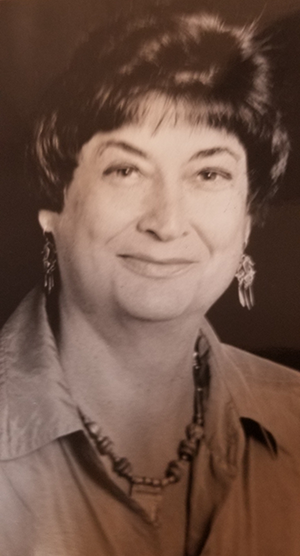
Oral History Interview with Sandi Cooper
Item

CUNY
DIGITALHISTORYARCHIVE
CUNY Digital History Archive
Interviewee: Sandi Cooper
Interviewers: Andrea Vasquez and Gerald Markowitz
Transcription by Peter D’Antonio
May 1, 2018
New York, NY
Andrea Vasquez:
Sandi Cooper:
Hello. It is May 1*, 2018 and I am interviewing Sandi Cooper.
This is Andrea Ades Vasquez at American Social History Project
and Jerry Markowitz is here with me as we begin. So we’re
talking to Sandi about her long history at CUNY. But maybe
before we get into that, can you tell us a little bit about your
personal background?
Ok. Well, I’m a native New Yorker. I grew up in the Bronx and I
went to public schools in New York City including Bronx Science
and the free City College in the 1950s before anyone talked about
tuition. While at City I had three part-time jobs but I was offered a
scholarship to go abroad for my junior year. At the last minute in
my sophomore year, at the end of the year, they had this money.
The two men they had offered it to turned it down and they were
stuck. They had to offer to me because I had the highest average in
the class although they tried very hard to find another male. The
assumption being that it would be a waste of money.
Anyway, I spent a year in Edinburgh and around Europe and it
persuaded me that I really wanted to become a historian of Europe,
of some part of Europe—I wasn’t sure what. And when I finished
at City, I was lucky to get a full scholarship to graduate school at
NYU, which was the only place in 1956 that would give money for
a doctoral program to a woman. The National Defense Education
Fund scholarships kicked in about a year or two late for me. And
so, I did a doctorate at NYU and most of the time I was working on
it, I also taught at Douglas College-Rutgers in New Jersey. Finally,
Andrea:
Sandi:
Andrea:
I realized I wasn’t going to finish this thing unless I took a year
off. So, I went to Europe and finished the research in 1965, and I
finished in 1967. It took me 10 years to do that because of all that
working at Douglas. In 1960, a full program paid you $3,850, and
even then it wasn’t enough to live on. So, I had two jobs when I
was teaching there. When I came back, Douglas wanted me to stay.
But, CUNY was opening a number of campuses, and one sounded
really exciting. After 7 years of teaching Western Civilization, the
opportunity to do interdisciplinary education which was offered at
Richmond College was just too attractive. So, for the first time in
my life, there was a battle of salary for me with Douglas. The
Douglas chair wanted me to stay, but I had some sense I owed it to
the City for the free education they gave me. Plus, they were
paying $3,000 a year more, which meant one less extra job.
And so what year was it that you started?
1967. While I was at Rutgers in the mid-1960s before I went off to
Europe for my last year of research, there was a very famous
teach-in on the Vietnam War. It went on all night long and the men
in the history department at Rutgers, included somebody named
Eugene D. Genovese, announced at something like 11 at night that
he would welcome a victory of the Vietcong. A few days later, all
hell broke loose in the national and NJ press. And I remember, in
the summer of 1965, I was teaching summer school at the men’s
campus of Rutgers and the secretary finally walked out in tears
because one more phone call came in threatening to blow the place
up if Eugene D. Genovese wasn’t fired. So, I started to take the
phone calls for her, and in my entire life I cannot remember so
much filth coming over the phone...I guess it would be on the
Internet today.
The uproar that that created is something you cannot imagine
unless you lived through it. I helped two students do doctoral
dissertations on these teach-ins, that one in particular. Anyway, as
a result of this I became very friendly with another faculty member
there named John Cammett. We were both married to other people
and on the edge of getting divorces. When I came to New York, to
CUNY, in addition to Richmond being opened, they were opening-
—or extending a program—called John Jay, which had been a
police education program at Baruch. And they hired a political
scientist from Rutgers named Don Riddle, who was a friend of
mine. They asked him if he knew anyone who would take on
history, he offered it to me but I didn’t take it. So I recommended
this Cammett guy.
Now, Riddle was hired as...?
Sandi:
Jerry:
Sandi:
Andrea:
Sandi:
Andrea:
Sandi:
Andrea:
Sandi:
Don Riddle was hired to be the dean of faculty at John Jay. And
there was a guy named Claude something-or-other who was the
provost. Then, Don became the president. Now, somebody died in
order for Don to become the president...I forgot who it was that
died. It was—I don’t think you ever knew...
Well, I knew who he was but I never met him.
Well you can cut this part out. But he died in the same way—
We’re not cutting it out so you can stop talking...(laughs) Moving
right along.
You don’t want the juice, okay. Anyway, so John Cammett went to
John Jay. CUNY was a fairly new organization because when I
went to City College there were 4 senior colleges, and I think they
were creating community colleges; and in the mid-60s, the
pressure to increase higher education opportunity was so
overwhelming that the Board of Higher Ed created campuses all
over the place. They extended John Jay to four-year status. They
created: York, Medgar Evers, Richmond. They separated uptown
Hunter and made it into Lehman. They took downtown City and
made it Baruch, although maybe that happened a little earlier. And
all of sudden, instead of four senior colleges, there were something
like six or seven community colleges.
So what was it like at Richmond when you were there and then
when it merged to become CSI?
Well, we had at Richmond in ’67 more freedom than anyone will
ever have in their lives for about five years to create an innovative
curriculum if we could and to hire people. We went from originally
40 to 80 to a 120. I mean I was involved and suddenly I’m hiring
people and I had just finished my degree myself. We spent literally
40 to 50 hours a week creating curriculum, meeting students. It
was run for a few years pretty much on the Sarah Lawrence model
with a lot of individual attention.
Where were the students coming from?
Well, they had to have two years somewhere because it was upper
division. There were also masters programs in the sciences and in
education. They had to have a couple years of college: either a
degree or credits. They had to have fairly rigid distribution
requirements. And if they hadn’t we added them, such as history,
language and so on. They had to be willing to experiment with the
classroom. At first we didn’t want to give grades. We really
Andrea:
Sandi:
Andrea:
Sandi:
wanted to be unique. And that turned out to be a mistake.
Culturally, these weren’t students who were ready to deal with the
honor system.
So what was the student body like?
Well it was everywhere and anywhere. There were people from
Staten Island who had gone to that community college. There were
kids who lived around New York City that had gone out of state,
upstate, whose families couldn’t afford it anymore. By 1970, we
got vets...guys coming back from Vietnam, a couple of whom I
got be very close to. They changed the nature of the classroom.
They really did add something that was very hard to cope with.
And, of course, those were the years where everybody was in the
streets, protesting and organizing and so on. So, Staten Island was
probably the wrong place to put an innovative college, definitely
the wrong place.
One of the students, for example, published an April Fools issue of
the school’s paper in which Jesus Christ was hanging on the cross
crying and looking down at the litter on the ground: candy
wrappers and beer cans and so on. It was an environmental protest.
Well, a local judge who was devout Catholic decided to sue the
school, the paper, for...such disrespect. [11:45] There was no
sense of humor. The Knights of Columbus paraded outside the
college criticized the president for allowing such things and not
throwing the student out. We got caught in the middle of the left-
right conundrum. There were faculty, I was one of them, who were
helping students get to Canada; and protesting outside recruitment
centers—there used to be one down by the ferry—and getting
arrested; and then there were faculty who were willing to call the
cops in and have us all pepper-sprayed.
How did it break down among the faculty?
I think most it was progressive. We had a very progressive college
governance. The entire faculty, which wasn’t large: at most it was
a hundred full timers. And we were mostly full timers, there were
almost no adjuncts—I can’t remember any adjuncts at all, certainly
not in the social sciences. Maybe in some of the professional
[programs] and we only had education and medical technology.
There were a few professional degrees but they were all full time
faculty. Our governance consisted of an assembly in which we all
met and the president at first was in charge of it, but very quickly I
got elected. He nominally chaired it, but I was called the secretary
of the faculty, and basically ran it and set the agenda. It was an
extraordinarily open kind of arrangement. And no place has this
anymore. Faculty don’t believe it that such a thing could exist. We
Gerald Markowitz:
Sandi:
Jerry:
Sandi:
had a dean who was very supportive of us. He came from City
College and didn’t think that the old college model was appropriate
for adults. That was Henry Wasser who died about a year ago; he
was in his late-90s.
Henry was quite a remarkable man, and also a pioneer in American
studies. And in the 1950s, he was the first City College faculty
member—he had been in the English [department] there—who
won a Fulbright and broke the McCarthy-ite grip on City College.
We couldn’t get anywhere, we couldn’t get into the State
Department, we couldn’t take any of those exams. Henry got the
first Fulbright that anyone got, and he went to Greece and
introduced American studies all over Europe. He was quite
interesting [14:35]. Anyway, he left City to be the Dean at
Richmond and he was really willing to tolerate the most open
arrangements, very critical of most of the central administration. I
mean I had never run into anybody like him before. [He was] very
supportive of whatever scholarship you were doing which was
important because people, then, were beginning to do things. I
mostly worked in peace research—which was something ridiculed
by the diplomatic historians. That is I worked in citizen
movements that tried to prevent war. Nobody did that kind of the
thing. But at that point, people started to do social history—I don’t
have to tell Jerry—tlabor history.
Remind us of the name of the organization that you formed was.
It was then called the Conference on Peace Research and History.
It’s now called the Peace History Society. It’s been around since
around when Kennedy was killed. We formed it in 1963 at an
OAH [Organization of American Historians] meeting, I think. It
was before women’s history was organized by quite a long time.
And we had international contact very quickly. People, in fact in
the Soviet Union, were very interested in learning about this.
Henry was willing to back that kind of scholarship. He was
supportive of just about anything.
We had a remarkable moment, which of course came to a crash
with the fiscal crisis.
So, first, what was the reaction of the students to the innovative
curriculum and the faculty activism?
I think maybe 10% of them were really interested. And a huge
number of them came completely unprepared for this kind of
education. It took us a few years to realize that our aspirations
were off the charts for most of these students. So, we basically had
to run two classes in every class. And teaching was exhausting
Andrea:
Sandi:
Andrea:
Sandi:
Andrea:
Sandi:
when you had to do that. So what I ended up doing with my two or
three really good students was meeting them in my office and
doing special projects with them. And the rest was just the same
old dreary stuff you did with everyone else. And I wasn’t the only
one who had that experience.
I imagine you were one of the few women faculty members?
Actually, Henry was better than most. For one thing, he had a wife
that had an economics degree and she couldn’t get a job anywhere-
—she’s still alive by the way, she’s in her 90s—she ended up
working for the Bureau of Labor Statistics. He was kind of aware
of the fact that women had a problem, certainly at City they did. In
the famous City College history department, they had one woman.
And if you looked at her, you had some difficulty trying to figure
out what the gender really was. So she didn’t threaten anybody.
So, I guess it was probably the early-1970s that you started
forming the women’s center?
My department was a division of social sciences, so we had a
couple of women in history, we had anthropologists, sociologists,
political science no, and a women economist. We weren’t any
majority, but we weren’t missing. Lilia Melani, in the late-1960s at
Brooklyn College began collecting statistics about the
discrimination of women after there was a study run by Marilyn
Gittell and Kate Klotsburger] [18:50] of women’s positions in
CUNY. Lilia had more friends at the community college than she
had at Richmond—we were still separate. I had a lot trouble
supporting the argument she was making because it just wasn’t
true at Richmond. And it wasn’t that true at York; at the newer
colleges, the discrimination was not visible.
In your research and your tenure review, things like that, you felt
it...
In my case, there was almost a problem. But one of the main guys
spoke up and said he wouldn’t put up with some of the suggestions
that somebody on the committee was making about the fact that I
was female and might not be serious. He said ‘she works harder
than all the rest of us.’ But, in those days it was three-year tenure.
By about 1970, Lilia was beginning to move towards this
lawsuit—I think it was 1970—and in 1969 and 1968, or 1970, in
the Political Science Association and the American Historical
Association was the early founding of women’s groups. My friend
Berenice Caroll was active in both of them: polisci and history. I
wasn’t there in 1969 at the AHA in Washington because I was
having a baby—it was hard to travel that week. That was the AHA
Andrea:
Sandi:
Andrea:
Sandi:
were Genovese attacked Staughton Lynd [20:54] for bringing up
the whole issue of peace. At AHA, Eugene said this is
inappropriate for a professional society. Later I screamed at
Eugene, and he said ‘I didn’t know it was your group supporting
that.’ He was not a very moral creature.
As a result, I think of the founding of these women’s caucuses,
some of the colleges around the country began to mutter about
doing women’s programs. At Richmond, there was woman named
Dorothy Riddle in Pscyh[ology] who basically put it together and
there was another woman named Bertha Harris who wrote a
famous book about the joy of lesbian sex, she was there and
involved. I figured, if they’re going to do psych and sociology,
they need to do history. So I scrambled to create a history class in
which absolutely none of us had any experience. However, apart
from Betty Friedan, whose book everybody knew about, I had an
uncle was a historian at City College, who wrote a book back in
the 1950s, called “Marriage, Morals and Sex in American
History.” So, I knew there was an earlier generation of Mary Beard
and my uncle and one or two others. It was a question of staying
up all night and preparing new classes.
Did the class have to get approved by a committee? Was there any
trouble with that?
You see when you’re in a new college, you have five years when
you're free of all these blasted regulations. By the time it comes to
getting them approved, they’ve been around so long...The biggest
problem we had, I don’t know what happened to Brooklyn and
Hunter where they developed very big programs, we just didn’t
have a very big faculty. The biggest problem, which I helped crash
through was getting 80" St [CUNY central office] to accept this.
There was an academic affairs vice-chancellor, he was a Jesuit,
Tim Healy, and we got passed him because he was a friend, John
and he got on famously. And once we got passed him, we got past
the board.
And that was to approve the program?
Approve the program. I think that CUNY’s colleges may have
been among the first in the country that gave majors. Now I didn’t
push for a major because I didn’t think these young women were
going to find jobs, but we had a major. After the merger, we
created a minor. There’s no point in misleading students at all,
especially ill-prepared ones. I always thought given the kind of
students we had—this may sound patronizing—it would be much
better to let them think they were majoring in something that the
world... If they were the kind of kid getting out of Vassar who
Jerry:
Sandi:
Andrea:
Sandi:
Andrea:
Sandi:
could become sub-editors at Mademoiselle or something, it’d be
another matter. But that wasn’t going to be their paths. Although
we did have one young women who ended up at a major
publishing company, for a while anyway until they folded.
Anyway, I don’t know about City, but I know about Brooklyn and
Hunter and we would sometimes get together to talk about what
was going on with these classes. The question always was one
about the balance between academic content and activism.
Whether or not the students were going to get more out of working
in the community and volunteering as I-don’t-know-what or
participating in demonstrations. I mean, there were faculty who
wanted them to get credit for just cutting school and parading. I
don’t think that was useful for students who were behind the 8-ball
sociologically and economically.
How did you resolve that tension at Richmond?
We didn’t. It got resolved when we got merged and got a
traditional old-fashioned president who simply smashed everything
and put everybody in discipline based departments and had no
patience for any experimental college work or interdisciplinary
programs or so forth and so on. And he fired a lot of the activists
that didn’t have tenure.
That was later in the seventies?
In 1975 or 1976.
What about when Open Admissions came?
That’s another complication, isn’t it? That didn’t affect Richmond
immediately because we had transfers. I know some of the
problems that the other colleges had, which was no faculty
prepared to deal with it. And suddenly everybody was scrambling
to hire remediation faculty. And the older ones amongst us, me
included, weren’t too happy about taking scarce lines that could
have gone to young historians and lit people and handing them to
high school teachers who hadn’t succeeded in teaching English and
math in high school and were now doing it in college.
Back in the earlier-1960s, I think it was Mina Shaughnessy at City
had a notion of going into some of these high schools—and
starting when kids were in 7" and 8" grade—and we had a math
teacher from the community college on Staten Island who took it
on himself to go around to the local junior highs on Staten Island
and talk to them about what kind of math they needed. And he
would actually volunteer to teach classes.
Andrea:
Sandi:
Andrea:
Sandi:
Andrea:
Sandi:
Jerry:
Sandi:
Andrea:
Sandi
Andrea:
Sandi:
It struck me that this might work, but to dump them suddenly in
regular classes...I mean we’re still struggling with this problem all
through the system, and not just the system, the country.
So did the enrollment grow a lot, or a little, out there?
At the community colleges more than at--I mean at John Jay, P’ll
tell you one thing I know, the dean of faculty at that point came
home with a white-faced horror and said he just had to admit a
student who had 35 high school average.
Wow.
Yeah, and you got him. (Laughs.) That really was...how did that
kid a high school diploma was beyond me.
So you mentioned the fiscal crisis and all the harm. How did that
affect you locally?
The fiscal crisis hit in ’75. Well, the first thing that was proposed,
and this was proposed by a vice president of the PSC—a woman at
Hunter College—was that they close five colleges down: John Jay,
Richmond, York, Medgar Evers, Hostos, and fire the faculty.
Baruch promised to take some of the John Jay faculty in...I forget
which field, not history.
No, criminal justice.
I guess so, because that program had been at Baruch originally.
And everyone else was supposed to go out into the great wild
yonder. Well, I was one of the people who helped organize the
protests and we got the Board of Higher Ed—
Which protests?
—against that project. First of all, the president of the Union—was
it Irwin [Polishook] at that point? He was silent and the Hunter
Vice President Evelyn Handler—she ended up going to Brandeis.
He didn’t say anything. And our first protest was against the
silence of the union, and we got him to speak up.
Had you been involved with either of the unions before the PSC
was formed?
No, I wasn’t involved with the union at all because the union at
Richmond and then the union at Staten Island Community College
was run by a couple of the most right wing men I have ever known
Andrea:
Sandi:
Jerry:
Sandi:
in my entire life, and they were such misogynists, it dripped off
their mustaches. I just couldn’t be in the room with them. It’s
making me itch thinking about it. Oh, they were vile, just vile.
There was a guy at the community college named Claude
Campbell who wrote articles for Clarion, nothing else—had no
PhD, was a high school English teacher---he demanded to be made
a full professor based on these Clarion articles. (Laughs.) He sued
because he wasn’t.
So the union was pressured to do something at this point?
The union was pressured, and then we began marching at 80
Street and I was so angry at these faculty at the older senior
colleges who were so ready to throw everyone under the bus that I
ran...Well, we persuaded a gentleman from Staten Island [Arleigh
Williamson] who had been sort of a ‘godfather’ of the colleges, an
elderly gentleman who believed that public education should exist
on Staten Island. He was persuaded immediately to fight against
closing Richmond, and he went to the head of the Electrical Union
who was head of the Board then, I forgot his name, he was an
Italian-American. He persuaded him to keep the college open and
to merge the two, because he said Staten Island has the right to
have a four-year college.
The Hispanic and black communities went up in arms about
Hostos and Medgar and York, which was in the middle of Jamaica.
And you know the John Jay protests were extraordinarily effective
in terms of using public relations. But, not only did they close
colleges down for a couple of weeks that June because of the fiscal
crisis, but my kids were at Hunter College High School and Hunter
College Elementary School and they were in the street with
placards. I still have the one the little one was carrying, we were on
ABC News with our placards: all three generations.
Were you able to get support from the political people in Staten
Island?
Well, the police supported us from John Jay and some of the
politicians. But this old gentleman on Staten Island, Arleigh
Williamston, a lovely 19" century New England type, was really a
sweetheart. He had such prestige out there that nobody would
argue with him. Eventually, they came up with all of these
resolutions: John Jay gave up its liberal arts majors, and we got
merged—well, we were given a president who was from City
College in the English Department because he had an Italian-
American name and he was very nasty; he and I didn’t get along at
all.
10
Jerry:
Sandi:
Andrea:
Sandi:
Andrea:
Sandi:
Andrea:
Sandi:
Were you still secretary of the faculty senate then?
Yeah, he managed to close the whole governance down, and he
instituted a City College type governance which ended the faculty
control of everything at Richmond, and put us in a model that was
very traditional with disciplines and departments. He fired the
radicals in sociology who had no tenure, no degrees. They were
instructors and lecturers and they hadn’t finished their work so
there was no protecting them. But then he started to fire historians
that we had voted tenure to. So went through the union grievance
process.
Was this fiscal exigency?
We didn’t have that much of a problem because he had already
cleaned the house. I just don’t think he liked the work they were
doing. Another guy was in peace research and a fellow in foreign
policy wasn’t doing traditional foreign policy, he was doing
something more radical. Well, we protested all the way up to the
third stage of arbitration, and I testified in all cases—the history
cases—because I had been on the P & B, and those guys’ firing
was reversed. And that meant that the president really loved me
afterwards. (Laughs.) The opinion said: ‘in the undisputed
testimony of Professor Cooper, Professor Lutzker and Professor
Fetser have totally fulfilled the requirements expected of them for
tenure.
So did he want to deny them tenure, or did they already have
tenure and he wanted to get rid of it?
No, no. They were up for tenure and he reversed all the
recommendations.
And he lost that?
He lost that, the only ones he ever lost. So, I decided I better
devote myself to another part of my career and get out of this
college’s politics. In any case, the merger of the college took away
our interdisciplinary divisions and created departments. And so,
the history faculty from Richmond, we may have been five/six
people or four/five people, but there were something like twelve of
the Staten Island ones, about a third of whom had no degrees. And
so, we were outnumbered. The language people from our place
were very well-known actually, widely published and they found
themselves drowned in a sea of people that were basically jumped
up high school teachers. I know this sounds very snooty but it was
difficult because here were people who had developed these
international reputations in French and Spanish who were being
11
Andrea:
Sandi:
Andrea:
Sandi:
Andrea:
Sandi:
Andrea:
Sandi:
given five sections of 101 to teach. So, most of them left. A couple
got graduate school appointments immediately. We lost the first
and earliest faculty in film and a very famous anthropologist, Paul
Rabinow went to the University of Chicago. It was not that Paul
Rabinow or the rest of us were snobs, it’s just that the expectations
were suddenly, overnight, thrown [away]. Really, it was very
difficult.
Anyway, I got so angry at the way the union—the leadership, the
Central union—had reacted to this closing of colleges that I ran for
the university faculty senate. I didn’t realize that there was some
kind of opposition between them. I was totally ignorant of all this.
What year was this?
°75. And I got elected and I stayed in it until I retired in 2015. A
year I got elected, I was elected to the Executive Committee and
was given a couple of big jobs to do in terms of research across
university-wide issues. And I got to be very familiar with the other
colleges which is not true, frankly of everybody that chairs either
the Senate or the Union, they usually don’t know all the other
places.
You started chairing in ’75?
No, no. I didn’t start chairing until---
Oh, you got elected as a senator?
Yes, to the Executive Committee. I think my first chairing was °94.
And it was very interesting because in ’75 with that crisis, there
was a major change with the governance of the university. So that
the state took over the senior colleges, their funding, introduced
tuition and the City took over the community colleges with some
state involvement financially. I spent a great deal of time in Albany
struggling for this kind of resolution because otherwise we were all
going to go under.
What was happening in Albany? What did you do? Who did you
talk to?
Well, I went to lobby. I went to the state senate leader, this
Republican Warren Anderson who was a racist. I think the young
Sheldon Silver was there. I can’t remember the names of all of
them. He [Silver] turned out to be a rotten egg and I don’t just
mean all this corruption stuff, I mean in terms of his unwillingness
to support anything in CUNY. I just spent a huge amount of time
every winter driving up there and down, skidding on the ice.
12
Andrea:
Sandi:
Andrea:
Sandi:
Andrea:
Sandi:
Andrea:
Sandi:
You’ve been there in February? It’s fun. And if you ever see me
doing that again, you can blow my brains out.
Right after SUNY Albany got its campus, a very good friend of
mine in American History, Larry Whitner, invites me to come see
this campus. So, he picks me up from wherever the hell I was
staying in Albany, and we go out to the campus, and whoever
designed the damn thing has this huge marble plaza. Do you know
what happens to marble when there’s ice and snow and sleet?
Larry and I were seated on our rear ends trying to get across the
plaza. That was the most horrible place in the world to be in in the
winter.
There was a legal case around the underfunding of CUNY? I think
Frank Deale and ...
Bill Crane may have been involved. I wasn’t involved in that. I
didn’t even know about it until they got turned down. That
paralleled the one that did win. The case that was brought about
the underfunding of the city’s public schools. That’s a famous
group that brought that case.
That was a later case?
Yeah, they won in the ‘90s. They still haven’t gotten the equal
funding. I knew that lawyer, he was a nice guy.
So after the fiscal crisis, I think there was such a big increase in the
use of adjunct labor.
Well there was no hiring in the 1980s. There was simply no hiring.
But in the ‘70s we were already over 3,000 adjuncts at CUNY, but
they were not there at Richmond?
Not so much at Richmond? The English department at CSI may
have had to hire adjuncts in math because of these Open
Admissions things. I mean there really was a problem of bringing
the students to the point where they could pass the test. Was that
enough to get them ready for college? I don’t think so and most
people honestly don’t think so.
If there was an expansion of adjunct hiring in the ‘70s it had to do
with Open Admissions. But in the ‘80s, I remember as a member
of the college P& B and all the rest of it, we couldn’t hire anybody.
And nobody left because there were no jobs to go to. Unless they
died or something—and we did have a few of those—they were
not replaced. I have to say, blaming Irwin Polishook for this struck
13
Andrea:
Sandi:
Andrea:
Sandi:
Jerry:
Sandi:
Jerry:
Sandi:
me as eminently unfair. He was not responsible for hiring those
adjuncts. There was nothing we could do.
But you were pushing him on the other hand. I’ve heard from other
people that were really more rank and file faculty that there was a
big demonstration down at Chambers Street around ’76 maybe. It
was all kind of pushed by faculty...
There was that meeting but there was nothing after that. I went
with Blanche but we really didn’t know what we were doing there.
Were you in touch with other faculty members who were also
organizing around that time? Either to push the union or to bring in
funding?
To push the union? No. I wasn’t. I think at that point I was frankly
running the National Berkshire Conference of Women Historians,
and earlier than that the Coordinating Committee on Women in
Historical Professions and The Peace History Society. I was active
outside CUNY. There was no point in fighting that president I had.
Honestly, I couldn’t see how the hell we were going to work out
the money problem. I don’t think Irwin was opposed to expanding
faculty hires at all.
What were the issues when you were on the Executive Committee
of the Faculty Senate in the ‘80s?
In the ‘80s, the issues were the chancellor bringing in faculty from
the Soviet Union and plunking them in colleges without asking the
departments if they wanted them. It was Joe Murphy, the red
diaper baby chancellor. I loved him, but he had no respect
whatsoever for the rest of us. Another issue was settling the Melani
et al. case, which Joe finally agreed to. I campaigned for getting
the pensions paid to either the survivors or to those still alive from
the McCarthy period for the people that had been fired from
mostly City and Brooklyn.
And that was eventually achieved.
We got that, yeah. Was it Koch? I forgot who turned around and
paid them out. I think I raised that issue, it really struck me as
outrageous. I actually spent a good deal of my time doing my own
work because it had begun to fall behind. And secondly, John
[Cammett] had his first cancer and it just was a drain. I also had
two adopted daughters at that point, one of whom was nothing but
trouble and it was really kind of difficult to balance too much
activism.
14
Jerry:
Sandi:
Jerry:
Sandi:
Andrea:
Sandi:
Jerry:
Sandi:
Now the chair of the faculty senate in the ‘80s for a while was a
radical conservative woman from Brooklyn College but we pushed
her and she finally got us some released time because working on
that senate was taking a lot of time. She found out that the union
leadership had reassigned time so she got some for us, not much
but a little. Sounds kind of selfish. I just can’t think very much that
the ‘80s were a period of anything terribly innovative. I know that
every time we tried to get a new line in any of the social sciences
or humanities, forget it. If they hired anybody, they hired
somebody to do remedial math or some science. But, I don’t know
what happened to John Jay.
There was no hiring for the ‘80s.
That’s why there’s a missing generation.
Right, right.
As a result of that, the current faculty that we did hire in the ‘90s,
there’s a whole missing generation of what would have been
associate and full professors. And none of these newer people, as
far as I can tell, have the slightest interest in faculty governance. I
mean to get people from my college to show up at the university
faculty senate was pulling teeth. Very few come and as a result,
and this may not be something anyone wants to hear, the next chair
of the senate is not going to be somebody to that you guys like at
all.
Let me ask you, I guess it’s twenty years we’re talking about. How
did you see faculty governance change over that period?
There were two problems. There was much more centralization of
authority by the presidents in the colleges. The centralization of the
central administration came in the late-nineties. And from my point
of view, that was a much bigger disaster than anything else. There
was an undermining of faculty governance because of the fact that
when you don’t hire fresh blood in a whole decade, and you’re
expecting the older ones amongst us to keep the pressure up, it’s
not going to work. We don’t have an army behind us. And it was
exceedingly difficult to get people active because the increasing
pressure, at least in the senior colleges, was to publish. Now, I
don’t’ think we hired a new historian at Staten Island until
somewhere in the ‘90s. And you [Jerry] were probably the same.
Very similar.
And they bring this guy in, he’s very able, very sweet, very right
wing. And all he’s going to do is finish his book, which he did, and
15
Jerry:
Sandi:
Jerry:
Sandi:
Jerry:
Sandi:
Andrea:
start on a second book and a second child. To get him to do any
kind of college service was liking pulling teeth without any kind of
anesthesia. It was made clear to him if he wanted to get on the
graduate faculty—which he did—or leave and get to a more
interesting, challenging place, he’d have to publish. And that’s
what’s happened since then, from then on. I hired a guy back in
2010 or ’11, whose dissertation as a book won a huge prize in
England, he suddenly became an associate professor with tenure.
He was interested, I think in doing what I was doing, and then he
got a contract for another book and goodbye, that’s that.
So, when did you become president of the faculty senate?
It’s chair, actually.
Chair, sorry. And how did that happen?
I was elected vice chair between ’94 and 98, and it’s term limited-
--which I think the union should be, I think everything should be
term limited---and I got elected in ’94 and again in ’96, and at the
end of ’98 I had served to two terms, so it was ’94 to ’98. Then
again in 2010, there was somebody running who was a community
college, very right-winger, so I stood up against him and I got
elected. Now that was one term. In 2012, I decided not to stand
again, because to be honest I’m losing my vision and it was very
difficult to read the documents and to keep up. It was really
difficult and I had obligations to do papers and so on. I really had
to save my eyesight for my research projects. So I didn’t run again.
And from then on, the group has become rightist-ish.
So talk about that period from ’94 to ’98.
Well, °94-’98 was a mess because Cuomo did not get elected and
Giuliani became mayor, and that wonderfully liberal Board of
Trustees—it became of a Board of Trustees in ’76 from being a
Board of Higher Ed—has 10 folks appointed by the governor, 5 by
the mayor, the head of the student senate (who has a vote) and the
head of the faculty senate (who doesn’t have a vote because of the
union which argued the Yeshiva decision would have dismantled
the union’s rights so we didn’t get the vote---didn’t matter, one
vote doesn’t matter). Anyway, in ’95, we started to get Ann
Paolucci, Benno Schmidt, Herman Badillo, and a list of really
inept and really right-wing political hacks of all ethnic and racial
types. I am not prejudiced, they were all of that ilk.
How did you handle them all, Sandi?
16
Sandi:
Andrea:
Sandi:
Andrea:
Sandi:
Andrea:
Sandi:
Andrea:
Sandi:
At the same time, this women, Heather MacDonald, published an
article in the Manhattan Institute Journal about what a disaster
CUNY had become. And this other guy, [Traub] published a book,
City on a Hill, which described City College as somewhere
between a sewer and the ninth circle of hell. One of my first chores
in the fall of ’94, or the spring of ’95, I don’t which it was, was to
go on Channel | with Sam Roberts with Heather MacDonald and
Jim Traub and me. And I’m supposed to be defending CUNY. I
think I have a tape of this, I don’t know what to do with these
tapes.
Oh, we’ ll take it.
Oh, good. If somebody could figure out...there’s a whole of these
tapes from the ‘90s and they’re all out of order. But if somebody’s
willing to sit with these tapes, they’re welcome to them. I can’t
play them, my machine doesn’t work.
VHS tapes? Or audio cassette?
They’re not audio cassette, they’re video.
Anyway, it started there. There was this campaign to denigrate the
whole system. From upstate New York, Pataki appointed for the
SUNY trustees one Genghis Khan wannabee after the other,
including this one woman who never wore anything less than a
$15,000 silk dress, I was always impressed by the outfits she had
out. This—what was her name?---she insisted two things: that all
CUNY students needed to take a course on good manners, for no
credit, so that they could be made acceptable to modern society.
(Laughs.) I kid you not. And that everybody have this basic
American history class—and it couldn’t be labor history or
women’s history, it had to be patriotic, and she recommended we
use Lynn Cheney’s book which is written for elementary school. A
is for America, P is for Patriotism. We had a bunch of beauties, it
was fun fighting them all.
This was the ‘90s. There were articles all the time about how
horrible one thing or another at CUNY was.
Blanche and I had one op-ed piece together in the Times posing
this, and boy did we get deluged afterwards.
What year was that op-ed?
°94 or °95. If you Google me, I think it shows up---or maybe
Blanche. Jay Hershenson was always applauding me for fighting
back, but it was always a losing battle. Even Pataki got tired of
17
Andrea:
Sandi:
Jerry:
Ann Paolucci who was so incompetent and incapable of running
anything, her first proposal was that the Trustees’ Floor—the third
floor of 80 St.—be made more welcoming, so she demanded $3
million to renovate the floor when we couldn’t hire anybody. I
think it ended up being $1 million and there was this Trustees
lounge that was created, not that I showed up to use it.
Was that a scandal, or was that not a scandal?
I couldn’t get anybody in the newspaper to listen. Nobody. The
New York Times and the Daily News were in Jay Hershenson’s
pocket and they stayed there. The faculty couldn’t get a word out.
Let’s see...Badillo became head of the Board when Pataki
removed her, I can’t remember why, but she got to be even too
much for the right wing. Badillo was sitting on a committee of
Academic Affairs, of which he knows a great deal, and I’m on this
committee as head of the senate. And in comes a proposal from
John Jay for curriculum item, and he’s looking through it and he
doesn’t like the syllabus of a course that talks about Ocean-Hill
Brownsville, I think, in a way that he’s treating both sides equally
and demanding the course be changed otherwise the whole degree
was to be held up.
Then he started to attack the remedial courses and indicated that he
didn’t want any more remediation. So, I pointed out to him that he
would be disadvantaging a very large number of students, largely
minority students but not entirely. He calls up the Daily News, and
says that the head of the Faculty Senate is a racist. It was all over
the papers. Now, it happens that one of my step-daughters is half
African-American, actually adopted her. Annie has half sisters who
are black, one of them was a cop. She came into a public meeting
of the Board, he walked out. She started screaming at him, but he
didn’t listen to her. I just kept saying Go away. She was furious:
there has never been a white woman who has helped African
Americans more. I mean, those people were truly...
Anyway, Badillo gets removed because he decides to run for
mayor again. Now why was this such an angry man? He was an
angry man because the Democrats had not pushed him for mayor;
they had pushed a black guy, Percy Sutton [1:00:00] many years
before. So he went from being supportive of progressive things to
the other side. He also had a mouth which really got him in
trouble. It wasn’t the attack on me that undid him. He claimed at
one point that he had been traveling through East Harlem and he
said those aren’t real Hispanics, those are tiny little Indian people.
I remember that.
18
Sandi:
Andrea:
Sandi:
Andrea:
Sandi:
Jerry:
Sandi:
Jerry:
Sandi:
Jerry:
Sandi:
He had a mouth. Anyway, the thing was that the ‘90s were either
grotesque or fairly hopeless. So, the woman who was vice
chancellor for academic affairs, [Louise Mirrer], she came up with
this compromise to remove remediation from the senior colleges
and to admit students to a place like Hunter who had all the
qualifications except hadn’t passed one of the tests and therefore
had to take this course which was going to be run by a BMCC
faculty member at Hunter. I mean, you talk about acrobatics. This
got through by compromise and so on and so forth. I don’t know
how she concocted this thing. I liked her and then I didn’t like her.
But I felt sorry for her because just about every day of her life
Badillo called her up to see what she was doing, and this was the
Vice Chancellor and he was a Trustee. He just didn’t know where
the lines were drawn.
There were also all these student protests around the end of
remediation?
There were student protests about that, they were increasing
tuitions on programs such as nursing and social work, which
especially on graduate programs, which were largely at places like
Hunter and at Lehman we had some. And these students were
desperate to finish these degrees, they were up to here in loans
already, and they were really persuasive but it got them nowhere.
How was the faculty receiving this in the faculty senate?
I sat there in these board meetings listening to these people, I had
no vote. The student rep had a vote, voted against it. But the
Trustees basically voted for everything that the Chancellor asked
for.
Was this Reynolds or Goldstein at this point?
Wasn’t yet Goldstein. It was...
Ann Reynolds?
Yeah, I guess it was Reynolds. [1:03:15] I’m trying to remember
now. It was just a whole era of protests, I’m trying to unravel one
from the other.
In ’89, ’90, and ’91 there were the student takeovers of various
colleges that had occurred, especially City College and John Jay.
I really don’t remember those. I think...where was I? Actually, I
was in Europe a lot giving papers. I was really out of it for a while.
I think ’90, ’91 I got elected vice-chair of the Senate. Reynolds
19
Andrea:
Sandi:
Andrea:
Sandi:
also tried to come up with a project for starting in the lower
schools—in the 7" and 8" grades—to go around and talk about
what college readiness meant. And I thought that this was
eminently reasonable. But radical faculty opposed it violently, they
said it was closing down open admissions. I thought this was
ridiculous. I mean what she was attempting, and the head of the
Senate Bob Picken was backing her. I thought you know, this
makes sense..we’re not telling these students they can’t come.
We're telling these students what they need to be able to do to
come and succeed.
I think that’s what we were doing anyway. But somehow it got
transmitted differently and it sounded as if she was shutting down
access. Sometimes, I thought some of these radical protests were
off the wall. The major thing that I really found myself fighting
against was this effort to denigrate the University and the effort to
undermine its reputation, which succeeded. We got hit. The way in
which Pataki and Giuliani finally resolved what they considered “a
mess” was to appoint Benno Schmidt head of Commission on
which they put Heather MacDonald to investigate CUNY.
We presented, a group of us, a very cogent response to their
charges and a report that was written by a political scientist at
Brooklyn whose name escapes me—the poor guy died fairly young
of cancer. It was a really well written rejoinder. We had Julius
Edelstein on our side. He had been a Vice Chancellor when Open
Admissions was created. And we had Carl McCall. We really came
up with a response and proposal...not just you ’re wrong, you’re
wrong, you're wrong. But ideas about how to meet some the
complaints some of which I think were justified. But the major
thing that was a problem was the fact that students were far too
stretched—students who were not really ready for college work—
were already stuck financially and they were far too stressed
working and in order to get financial aid they had to carry full time
programs. So, we were campaigning for part-time aid, That really
was the major focus of the Senate.
How to help students succeed while all this propaganda is out there
against CUNY?
Yeah.
And then Goldstein comes in.
Benno Schmidt brought in Goldstein. He was funny; he was on all
sides of the political spectrum. He had headed the Research
Foundation for a while and Baruch. When he was at Baruch and
the Research Foundation, he courted rich people and brought in a
20
Andrea:
Sandi:
Andrea:
Sandi:
Andrea:
Sandi:
certain amount of money. Now Goldstein graduated from City
College in 1963 in my sister’s class. And he hit up the rich alums
from City to contribute to Baruch, I think—and I can’t prove
this—by telling them that they wouldn’t be wasting their money at
Baruch as the students succeed there. City had a black president
then, Yolanda Moses, and it’s my impression that Badillo
particularly hated her and was out to get rid of her, which he did. I
thought she was good but so did the American Anthropological
Association which elected her president. And Goldstein, I think,
persuaded a lot of that money to go to Baruch. He raised over $60
million, which for CUNY was a lot of money, and that impressed
Benno Schmidt who thought he was going to do that for CUNY.
Didn’t that centralization that you talked about earlier continue?
That came out of the report. What Benno Schmidt wanted
Goldstein to do was to create a single university, as he put it, and
to make it possible for students to move around and take classes
wherever they wanted to, and for loosing up the requirements on
campuses for majors. But they weren’t willing to do it for faculty.
That is they weren’t willing to give university faculty tenure, you
got tenure according to the state statute in your department, period.
Schmidt wanted the Chancellor to be in charge of the presidents, to
hold them accountable. And essentially, if you look at what’s
required for an MBA, those were the new models. And basically,
the same thing was happening—and I didn’t realize this until a few
years later—in England. Friends of mine in history in various
colleges were told that they had to produce one article every other
year or a book. And this friend of mine in medieval history at
Sussex pointed that it takes her 5 years to translate 2-3 documents
from obscure Latin. That didn’t work. It didn’t fit the model. So
you had to start writing trash. I mean if you published recipes from
your grandmother’s kitchen and said it was a late-medieval dish
that might have worked. (Laughs.)
I mean the effort to monetize higher education really comes in
then. From my point of view, it’s only gotten worse and the result
now is the liberal arts are really on their way out.
The whole Pathways, the campaign [cross-talk at 1:11:12]...
The Pathways was the ultimate topping on this cake.
What happened from your perspective?
Alexandra Logue, the Academic Affairs Vice Chancellor, claims
that students were coming to the Trustees and to the central
21
Jerry:
Sandi:
administration from 2-year colleges claiming that their courses
were disrespected and not accepted at the senior colleges. This was
actually true in 2 or 3 places. It may have been true at Hunter. It
was definitely true at Baruch because the BMCC students did not
come in with enough math to do the coursework, and it wasn’t true
at Queens because they had worked out a program with
Queensborough. I mean I knew these colleges. It certainly wasn’t
true on Staten Island because we had 2 and 4-year students in the
same building.
Same at John Jay.
Yeah, I know. So they made a big deal out of this “problem.” So,
this guy David Crook, whose still there and still manufacturing
statistics when needed, came up with this report that demonstrated
that students were graduating with 160 and 170 credits because
they were not having their 2-year credits accepted at 4-year
colleges. So, we got two statisticians at Baruch to go over the
report and the numbers, and a friend of mine at Queens who is a
statistician-sociologist and a wonderful guy, Dean Savage, went
over the whole thing. It was complete hot air. We wrote our own
report, they ignored it. For example, there was a girl at Queens
College with 160 credits. Why? She was an art major and she
didn’t want to graduate because she’d lose access to a free studio.
If she graduated she would’ve had to take her easel and the rest of
her stuff and pay rent somewhere. We had a half-dozen cases like
that. I mean that one really made me laugh.
The main problem was that students switched majors. And maybe
that didn’t work out badly at John Jay, but if you started out at
Staten Island thinking you were going to be a nurse and you went
through the first 2-year program, the pre-nursing one, with poor
grades in certain biology and math and anatomy classes, that was
it. You could not continue. So you became a 'Soc’ major. And
people ended up graduating, on the average, with about 135
credits, not 160. You could not persuade the Trustees of any of
this. Logue, in the winter of 2011, called me in and said that she
was going to present a resolution to the Trustees to create a new
program that enabled students to move smoothly from one
campuses to another, and to fulfill the Schmidt report, essentially. I
said, well the Charter of the University Faculty Senate includes—
and it’s a Board-approved Charter—the stipulation that cross-
campus academic curriculum are the purview of our work. It didn’t
make the slightest bit of a difference. We had one committee after
another coming up with proposals I assembled about people from
every college.
22
Andrea:
Sandi:
Andrea:
Sandi:
There were a couple of community college folks, one in particular
from BMCC, who liked what she was proposing and who went
behind my back and undermined everything, agreeing to serve on
her steering committee. And that was the end of history, English,
sociology, languages, poli-sci, economics, etc.
They would get a few faculty and then they would say it was
faculty supported, right?
Yeah, that’s right. They came up with four buckets of areas of
knowledge. The bucket of world culture can be 3-credits in one
semester of Spanish. At the end of which, as a friend of mine said,
you would be able say in Spanish: Quero una cerveza, | want a
beer. [Laughs.]
The PSC also organized, right? A big campaign around Pathways
that you guys worked on?
I went to them because I had done the same thing back in the ‘90s.
I went to Irwin and pushed him into a lawsuit which eventually
didn’t go anywhere. But we did win on the first level in that
Supreme Court. The PSC basically took over. They had the
resources. Several members of my executive committee did not
want to participate in the lawsuit. They said: we’ll lose. I said: we
had to do it. Lose or no lose, we had to do it. Apparently, she’s
[Logue] published a book on how hard it is to reform higher
education.
Princeton just published it. A friend of hers used to be president of
Princeton, William Bowen. And I am the villain of the book. I
haven’t read it. I will not buy it. Anyone else who’s read it has
called me up. I’m waiting for the PSC to write a review in Clarion
of this thing, but I haven’t seen any. If it shows up in a library I
might look at it, but I couldn’t give a damn whether I’m the villain
or not the villain. The point was every step of the way, this women
absolutely refused to work with the existing faculty who were
already in position in their colleges of shaping curriculum. I mean
we had brilliant people from Baruch and Hunter and so on talking
to faculty from BMCC and so on about what they could do. We
were having them meet. All of this was ignored because this
woman had an obsession to be in charge. I think she hated the
liberal arts. She had 3 Harvard degrees in rat psychology:
baccalaureate, masters, and doctorate. And she said to me at one
point: ‘““Why do they need languages? Most of our students are
from foreign countries and speak other languages? If they’re
interested in history, they can look it up on the internet.” Yeah,
right.
23
Andrea:
Sandi:
Jerry:
Sandi:
I think the major problem in academia—from somebody who
started teaching in 1959, I was a TA then, 55 years—is that the
administration has been taken out of the hands of faculty and it is
now in the hands of professionals who have degrees in higher
education administration and MBA-kind of backgrounds. They fit
in with the pressure on public colleges from state legislatures not
to spend money on “ridiculous” things such as arts and
anthropology and that sort of thing. What Lexa Logue’s Pathways
has effectively done, at least in my place, Staten Island, was to
totally undermine the history major. I don’t know what they’re
doing now. But we had over 120 students and I don’t think there’s
anything like that at this point. Because if we don’t get them in the
early years, they don’t stay. Two or three years ago was the first
time my department had to cancel ancient history. We have a
wonderful woman who does that class and she is a firebrand.
I feel really sorry for the people that have been hired since I left.
They’re very good, they’re sharp and they’re published and all the
rest of it. I don’t know what they’re going to do with their lives.
My department has lost four of these younger people to Michigan,
Johns Hopkins, and two other places. And you know what it’s like
to recruit someone, you spend a lot of time and money. I don’t
blame them for leaving.
Just a slightly separate question I just thought about...the Graduate
Center, we’re here today. Did you have any involvement in the
evolution of this place?
No, it was created in ’62, and it was immediately taken over by
Hunter, City, and to a lesser degree, Queens. History was run by
Gertrude Himmelfarb for decades.
So give a little background about that.
Well, I mean I didn’t know that much about it until the late-sixties.
John [Cammett] was offered jobs all over the place around ’69 and
°70 when the Gramsci book hit the big time. And I was willing to
move. I mean I wasn’t to attached to Richmond at that point. He
was promised an appointment at the Graduate School and one
course at John Jay if we stayed. And they brought in John Weiss
from Wayne State who was well known in Fascist German history
at Lehman and he was given the same promise. They knew each
other from Wayne State—it was just coincidence. A year or so
later, he teaches a class here on Modern European Social and
Economic History. The head of the department, Ms. Himmelfarb,
or someone, says you can’t teach here because we didn’t vote you
in. And they also didn’t let John Weiss teach. So, effectively they
reversed the promise at which point I said to him let’s start looking
24
Jerry:
Sandi:
Jerry:
Sandi:
again. He threw in the towel and just gave up. And at that point, or
a little bit later, Himmelfarb said we’re not going to allow the
history department to be run by ideological types.
(Laughs.) I knew you’d get it.
So, that was my first encounter with the Graduate School. I wasn’t
much interested in it at that point. I didn’t have this book out yet
that I was working. But John and John Weiss were actually rather
well known at that point and they were, along with a guy named
Hayden White—who died recently, a very famous historian—the
three of them sort of did work together. Anyway, some years later,
the history executive officer was up for reappointment, and it had
been all this crowd from Brooklyn and Queens and these guys. So,
I decided with a few other people to take a look at the reading list
in European history. There wasn’t a book published on that list
since those people were in graduate school, which meant there was
nothing after the 1950s. So, I put this list together. Then, we put
this list together of more up to date, modern European history. And
a few of us went to Francis [Horowitz, Graduate Center president]
and pointed that the Graduate students were getting an education
appropriate for the McCarthy era. So, she asked us who we would
propose. So I said David Nasaw.
Who was at Staten Island at the time.
Yeah, but he had already gotten something out and he was a newer
generation. And we had spoken with him. When she appointed
Nasaw as EO and we then began updating the reading list and
modifying the whole exam project. I don’t know if you were in the
department at that point...
No, no.
Thad gotten in in either 90 or ’91, or something like that. Badillo
went to Ann Reynolds and said ‘anti-Semitic left-wingers’ have
taken over the history department. And his son, by the way, David
was getting a degree from that department. He was actually a sane
individual, the son. And why were anti-Semitic lefties taking over?
Because this guy, Howard Adelson from City College—who was a
crackpot—had gone to some Jewish organization and said that
Nasaw represented this anti-Semitic left-wing organization. I don’t
know what group he was supposed to be a part of. I don’t
remember ever going to a Nazi meeting. So, Ann Reynolds calls
me in and wants to know whether I agreed with this assessment. I
almost peed my pants laughing. It was so funny. It wasn’t funny.
Fortunately, they didn’t back out. But that’s how far they would go
to keep hold of things here.
25
Andrea:
Sandi:
Jerry:
Sandi:
Jerry:
Sandi:
I kept thinking that if I had this kind of graduate education, I’d be
lucky if I was washing floors in an elementary school. I mean, who
the hell would hire anybody who hadn’t read a book since 1960?
Anyway, that was my first involvement with the Graduate School.
It was with a group, I wasn’t by any means the star witness in any
of this. And I did get to teach a few classes here. Blanche and I did
one together on women in peace movements. I had a couple of
good students, but it wasn’t a major area for me because there just
were too many of us in modern European history and there weren’t
enough classes. I did work a lot with the MALS program which I
found, frankly, more interesting than the PhD students. The
Masters of Liberal Studies students were a much broader group of
people with wide interests in all kinds...I mean there was a woman
who ran the radio at the United Nations, and somebody who had
spent twenty years of her life in Borneo or some such place.
It’s a very big program now.
They were really very interesting students. And whatever you
offered them, they absorbed and loved to do, and they were lively.
Some of them wanted to get into the doctoral programs and some
did. But mostly, they were...I don’t know what they were, they
were all over the place. We actually had a similar degree at Staten
Island, I think a few colleges do it now, and those are the most
interesting students of all. They are adults who are working and are
there because suddenly they wake up one day and say J don’t know
anything and I want to read and learn. And frankly if my vision
were better I wouldn’t have retired because I could have taught
there, but I can’t drive at night, so I couldn’t come home, I would
have had to sleep in my office. So, I gave up. But I taught MALS
students here and they were wonderful.
Am I correct that when John [Cammett] [1:29:11] came maybe just
before David became Executive Officer, he came through another
department...
Anthropology.
Anthropology, right. The history department wouldn’t let him
teach. So he had to teach...
Well he had a class on Gramsci. The class he had back in 1969 or
°70 on modern Europe had the highest registration of any class
here and I think it drover Gertrude nuts. She really went ballistic
over that. She was afraid this place was going to be turned into
some left wing den of who knows what.
26
Andrea:
Sandi:
Andrea:
Jerry:
Sandi:
Andrea:
Sandi:
Jerry:
Andrea:
Sandi:
Andrea:
You mentioned earlier that you were one of the evaluators when
the American Social History Project was at the Graduate Center
and applied for that first grant.
I was on an NEH panel in the ‘70s. I had a friend who worked for
the NEH so she put my name down and I periodically went. It
wasn’t such easy work. You’d get a mountain of projects to read
and you had to read all of them. And when you met as a group,
everybody had to comment on all of them. I think it was Herb
Guttman who produced the first project. I wasn’t the only one there
by a long shot. I think Manning Marable [1:30:45] may have been
one of the others. That’s where we met. He was a young, skinny
kid then.
Did John have anything to do with that?
John Cammett? No.
No, he had nothing to do with that. He was in European history
anyway. I don’t even remember what Guttman proposed but it was
sort of the seed of the whole thing. I think I ran into Steve Brier
years later and I said I think I may have been on the panel that
voted that. And it was that Guttman project. He died shortly
afterwards, right?
Yeah, mid-80s.
I forgot all about that. That project if I recall was pretty
unanimously supported. It didn’t need me. I mean there were other
things... There was a project that was put in that very year by a
Greek Orthodox seminarian that wanted federal money for training
priests. [Laughs.] This, we didn’t accept. But you know, two years
later when Himmelfarb ran the thing, they were funded.
Wow.
So, I know you have an event to go to tonight. But is there any
other topic we didn’t think of yet, that you want to fill us in on?
I guess the main thing I think of about CUNY, I suppose it’s still
fulfilling the function it had when I was still a student. Honestly, I
don’t think students like me, from the kind background I came
from—or Blanche for that matter—would have done anywhere
near as well as we had with the general education they’re getting
now. To me that is really the sad part of this, very sad.
How do you see it diminished?
27
Sandi:
Andrea:
Sandi:
Andrea:
Sandi:
Andrea:
Sandi:
Andrea:
Sandi:
It’s a class thing. These kids are getting a third rate education. I
have a daughter who teaches at Harvard and her kids go to private
schools in the Boston area. I have a granddaughter who now works
at the World Bank who went to private schools on scholarship here
and Yale. The difference between what those kids got and are
getting and what we’re offering is scary.
With the funding discrepancy, right?
It’s the whole cultural differences. It’s outrageous. When I got out
of City College, I could hold my own with anyone from the Ivy
League. That is not the case now. These kids can. I mean my 17
year old grandson, as a third-year high school student, has just
spent a year in France. He has a year left in the U.S. to graduate.
He is now bilingual. He got a certificate from L ’etat de la France,
the government of France, to certify his skills. That’s outrageous.
Look at the proportion of full time faculty to student enrollment.
Right, enrollment is half a million students, and 4,000 less full time
faculty [than in the early 1970s.]
Every single time we hired more faculty full time, the enrollment
went up in far greater numbers than we were financed to hire. At
one point, there was almost an equilibrium about 10 or 12 years
ago. And then with the financial crisis, enrollment always
explodes. So some of this is the larger economy.
Well there’s 4,000 less faculty now.
Now the enrollment is going down again some. Though it’s not
down, down, down. | looked at the numbers recently and they are
somewhat down, but that’s an economy that’s doing better. And I
think if they go down in the community colleges, then you really
know it’s an economic thing. I’ve seen this go on for decades now.
You have to sort of take a longitudinal image of it. I’m not saying
they shouldn’t hire more full time faculty. But what are they going
to hire them in? They certainly aren’t going to hire them in the
liberal arts and the humanities. These kids are being pushed into
STEM classes, business, and professional training. So, in fact,
when you hire some of those faculty, such as at Baruch, you have
to pay them more money. They don’t even come unless they get
higher salaries. I don’t know how you solve this one.
As you pointed out earlier, CUNY salaries were good.
At one point they were excellent. They were very good until the
fiscal crisis. And the other thing that started to change, and nobody
paid attention to this, I didn’t realize was the health coverage. Up
28
Jerry:
Sandi:
Jerry:
Sandi:
Jerry:
Andrea:
Sandi:
until ’76, I never had a bill. All of a sudden, co-pays and the next
thing. So, your salary is diminished by all of this, especially if
you’re supporting families. I don’t know what the answer is to this
thing. Honestly, I’m not thrilled at the notion of hiring a whole lot
more business faculty, which is what they would do. At least at
Staten Island they would do that. And my guess is at other places.
A place like John Jay, the English department they probably
wouldn’t hire, but virtually every other humanities or liberal arts
department they would hire because they are all understaffed.
Well, that’s different. You mean you have that many students that
need, right?
Right.
See, I’m not sure that student enrollment exists everywhere. I don’t
know, I would have to look. I know in my former place, it doesn’t.
Maybe in English because of the requirements for so many basic
classes but having loused up—pardon my French—our history
major through Pathways, I don’t think they have enough work for
our current group. I think the adjunct crowd has shriveled. I just
can’t say anything across the board, I just don’t know from the
union’s perspective, you may have a better perspective. The fact
that this generation is getting a lousy gen-ed—there’s 2500 classes
they can choose from—so you get these graduates coming out who
don’t have anything in common to talk about. They haven’t had
any kind of shared experience. And then you get all these foreign
students who no longer have to take American history, which may
sound a little stuffy on my part, but if they’re going to stay here
they ought to know something about the place apart from how you
get a driver’s license. Anyway, if you can think of anything you
want me to say, I will try to say it.
No, this is very rich.
This is really, really interesting, and so many decades of stories
and great quotes in there Sandi.
Oh, well thank you, thank you.
29
DIGITALHISTORYARCHIVE
CUNY Digital History Archive
Interviewee: Sandi Cooper
Interviewers: Andrea Vasquez and Gerald Markowitz
Transcription by Peter D’Antonio
May 1, 2018
New York, NY
Andrea Vasquez:
Sandi Cooper:
Hello. It is May 1*, 2018 and I am interviewing Sandi Cooper.
This is Andrea Ades Vasquez at American Social History Project
and Jerry Markowitz is here with me as we begin. So we’re
talking to Sandi about her long history at CUNY. But maybe
before we get into that, can you tell us a little bit about your
personal background?
Ok. Well, I’m a native New Yorker. I grew up in the Bronx and I
went to public schools in New York City including Bronx Science
and the free City College in the 1950s before anyone talked about
tuition. While at City I had three part-time jobs but I was offered a
scholarship to go abroad for my junior year. At the last minute in
my sophomore year, at the end of the year, they had this money.
The two men they had offered it to turned it down and they were
stuck. They had to offer to me because I had the highest average in
the class although they tried very hard to find another male. The
assumption being that it would be a waste of money.
Anyway, I spent a year in Edinburgh and around Europe and it
persuaded me that I really wanted to become a historian of Europe,
of some part of Europe—I wasn’t sure what. And when I finished
at City, I was lucky to get a full scholarship to graduate school at
NYU, which was the only place in 1956 that would give money for
a doctoral program to a woman. The National Defense Education
Fund scholarships kicked in about a year or two late for me. And
so, I did a doctorate at NYU and most of the time I was working on
it, I also taught at Douglas College-Rutgers in New Jersey. Finally,
Andrea:
Sandi:
Andrea:
I realized I wasn’t going to finish this thing unless I took a year
off. So, I went to Europe and finished the research in 1965, and I
finished in 1967. It took me 10 years to do that because of all that
working at Douglas. In 1960, a full program paid you $3,850, and
even then it wasn’t enough to live on. So, I had two jobs when I
was teaching there. When I came back, Douglas wanted me to stay.
But, CUNY was opening a number of campuses, and one sounded
really exciting. After 7 years of teaching Western Civilization, the
opportunity to do interdisciplinary education which was offered at
Richmond College was just too attractive. So, for the first time in
my life, there was a battle of salary for me with Douglas. The
Douglas chair wanted me to stay, but I had some sense I owed it to
the City for the free education they gave me. Plus, they were
paying $3,000 a year more, which meant one less extra job.
And so what year was it that you started?
1967. While I was at Rutgers in the mid-1960s before I went off to
Europe for my last year of research, there was a very famous
teach-in on the Vietnam War. It went on all night long and the men
in the history department at Rutgers, included somebody named
Eugene D. Genovese, announced at something like 11 at night that
he would welcome a victory of the Vietcong. A few days later, all
hell broke loose in the national and NJ press. And I remember, in
the summer of 1965, I was teaching summer school at the men’s
campus of Rutgers and the secretary finally walked out in tears
because one more phone call came in threatening to blow the place
up if Eugene D. Genovese wasn’t fired. So, I started to take the
phone calls for her, and in my entire life I cannot remember so
much filth coming over the phone...I guess it would be on the
Internet today.
The uproar that that created is something you cannot imagine
unless you lived through it. I helped two students do doctoral
dissertations on these teach-ins, that one in particular. Anyway, as
a result of this I became very friendly with another faculty member
there named John Cammett. We were both married to other people
and on the edge of getting divorces. When I came to New York, to
CUNY, in addition to Richmond being opened, they were opening-
—or extending a program—called John Jay, which had been a
police education program at Baruch. And they hired a political
scientist from Rutgers named Don Riddle, who was a friend of
mine. They asked him if he knew anyone who would take on
history, he offered it to me but I didn’t take it. So I recommended
this Cammett guy.
Now, Riddle was hired as...?
Sandi:
Jerry:
Sandi:
Andrea:
Sandi:
Andrea:
Sandi:
Andrea:
Sandi:
Don Riddle was hired to be the dean of faculty at John Jay. And
there was a guy named Claude something-or-other who was the
provost. Then, Don became the president. Now, somebody died in
order for Don to become the president...I forgot who it was that
died. It was—I don’t think you ever knew...
Well, I knew who he was but I never met him.
Well you can cut this part out. But he died in the same way—
We’re not cutting it out so you can stop talking...(laughs) Moving
right along.
You don’t want the juice, okay. Anyway, so John Cammett went to
John Jay. CUNY was a fairly new organization because when I
went to City College there were 4 senior colleges, and I think they
were creating community colleges; and in the mid-60s, the
pressure to increase higher education opportunity was so
overwhelming that the Board of Higher Ed created campuses all
over the place. They extended John Jay to four-year status. They
created: York, Medgar Evers, Richmond. They separated uptown
Hunter and made it into Lehman. They took downtown City and
made it Baruch, although maybe that happened a little earlier. And
all of sudden, instead of four senior colleges, there were something
like six or seven community colleges.
So what was it like at Richmond when you were there and then
when it merged to become CSI?
Well, we had at Richmond in ’67 more freedom than anyone will
ever have in their lives for about five years to create an innovative
curriculum if we could and to hire people. We went from originally
40 to 80 to a 120. I mean I was involved and suddenly I’m hiring
people and I had just finished my degree myself. We spent literally
40 to 50 hours a week creating curriculum, meeting students. It
was run for a few years pretty much on the Sarah Lawrence model
with a lot of individual attention.
Where were the students coming from?
Well, they had to have two years somewhere because it was upper
division. There were also masters programs in the sciences and in
education. They had to have a couple years of college: either a
degree or credits. They had to have fairly rigid distribution
requirements. And if they hadn’t we added them, such as history,
language and so on. They had to be willing to experiment with the
classroom. At first we didn’t want to give grades. We really
Andrea:
Sandi:
Andrea:
Sandi:
wanted to be unique. And that turned out to be a mistake.
Culturally, these weren’t students who were ready to deal with the
honor system.
So what was the student body like?
Well it was everywhere and anywhere. There were people from
Staten Island who had gone to that community college. There were
kids who lived around New York City that had gone out of state,
upstate, whose families couldn’t afford it anymore. By 1970, we
got vets...guys coming back from Vietnam, a couple of whom I
got be very close to. They changed the nature of the classroom.
They really did add something that was very hard to cope with.
And, of course, those were the years where everybody was in the
streets, protesting and organizing and so on. So, Staten Island was
probably the wrong place to put an innovative college, definitely
the wrong place.
One of the students, for example, published an April Fools issue of
the school’s paper in which Jesus Christ was hanging on the cross
crying and looking down at the litter on the ground: candy
wrappers and beer cans and so on. It was an environmental protest.
Well, a local judge who was devout Catholic decided to sue the
school, the paper, for...such disrespect. [11:45] There was no
sense of humor. The Knights of Columbus paraded outside the
college criticized the president for allowing such things and not
throwing the student out. We got caught in the middle of the left-
right conundrum. There were faculty, I was one of them, who were
helping students get to Canada; and protesting outside recruitment
centers—there used to be one down by the ferry—and getting
arrested; and then there were faculty who were willing to call the
cops in and have us all pepper-sprayed.
How did it break down among the faculty?
I think most it was progressive. We had a very progressive college
governance. The entire faculty, which wasn’t large: at most it was
a hundred full timers. And we were mostly full timers, there were
almost no adjuncts—I can’t remember any adjuncts at all, certainly
not in the social sciences. Maybe in some of the professional
[programs] and we only had education and medical technology.
There were a few professional degrees but they were all full time
faculty. Our governance consisted of an assembly in which we all
met and the president at first was in charge of it, but very quickly I
got elected. He nominally chaired it, but I was called the secretary
of the faculty, and basically ran it and set the agenda. It was an
extraordinarily open kind of arrangement. And no place has this
anymore. Faculty don’t believe it that such a thing could exist. We
Gerald Markowitz:
Sandi:
Jerry:
Sandi:
had a dean who was very supportive of us. He came from City
College and didn’t think that the old college model was appropriate
for adults. That was Henry Wasser who died about a year ago; he
was in his late-90s.
Henry was quite a remarkable man, and also a pioneer in American
studies. And in the 1950s, he was the first City College faculty
member—he had been in the English [department] there—who
won a Fulbright and broke the McCarthy-ite grip on City College.
We couldn’t get anywhere, we couldn’t get into the State
Department, we couldn’t take any of those exams. Henry got the
first Fulbright that anyone got, and he went to Greece and
introduced American studies all over Europe. He was quite
interesting [14:35]. Anyway, he left City to be the Dean at
Richmond and he was really willing to tolerate the most open
arrangements, very critical of most of the central administration. I
mean I had never run into anybody like him before. [He was] very
supportive of whatever scholarship you were doing which was
important because people, then, were beginning to do things. I
mostly worked in peace research—which was something ridiculed
by the diplomatic historians. That is I worked in citizen
movements that tried to prevent war. Nobody did that kind of the
thing. But at that point, people started to do social history—I don’t
have to tell Jerry—tlabor history.
Remind us of the name of the organization that you formed was.
It was then called the Conference on Peace Research and History.
It’s now called the Peace History Society. It’s been around since
around when Kennedy was killed. We formed it in 1963 at an
OAH [Organization of American Historians] meeting, I think. It
was before women’s history was organized by quite a long time.
And we had international contact very quickly. People, in fact in
the Soviet Union, were very interested in learning about this.
Henry was willing to back that kind of scholarship. He was
supportive of just about anything.
We had a remarkable moment, which of course came to a crash
with the fiscal crisis.
So, first, what was the reaction of the students to the innovative
curriculum and the faculty activism?
I think maybe 10% of them were really interested. And a huge
number of them came completely unprepared for this kind of
education. It took us a few years to realize that our aspirations
were off the charts for most of these students. So, we basically had
to run two classes in every class. And teaching was exhausting
Andrea:
Sandi:
Andrea:
Sandi:
Andrea:
Sandi:
when you had to do that. So what I ended up doing with my two or
three really good students was meeting them in my office and
doing special projects with them. And the rest was just the same
old dreary stuff you did with everyone else. And I wasn’t the only
one who had that experience.
I imagine you were one of the few women faculty members?
Actually, Henry was better than most. For one thing, he had a wife
that had an economics degree and she couldn’t get a job anywhere-
—she’s still alive by the way, she’s in her 90s—she ended up
working for the Bureau of Labor Statistics. He was kind of aware
of the fact that women had a problem, certainly at City they did. In
the famous City College history department, they had one woman.
And if you looked at her, you had some difficulty trying to figure
out what the gender really was. So she didn’t threaten anybody.
So, I guess it was probably the early-1970s that you started
forming the women’s center?
My department was a division of social sciences, so we had a
couple of women in history, we had anthropologists, sociologists,
political science no, and a women economist. We weren’t any
majority, but we weren’t missing. Lilia Melani, in the late-1960s at
Brooklyn College began collecting statistics about the
discrimination of women after there was a study run by Marilyn
Gittell and Kate Klotsburger] [18:50] of women’s positions in
CUNY. Lilia had more friends at the community college than she
had at Richmond—we were still separate. I had a lot trouble
supporting the argument she was making because it just wasn’t
true at Richmond. And it wasn’t that true at York; at the newer
colleges, the discrimination was not visible.
In your research and your tenure review, things like that, you felt
it...
In my case, there was almost a problem. But one of the main guys
spoke up and said he wouldn’t put up with some of the suggestions
that somebody on the committee was making about the fact that I
was female and might not be serious. He said ‘she works harder
than all the rest of us.’ But, in those days it was three-year tenure.
By about 1970, Lilia was beginning to move towards this
lawsuit—I think it was 1970—and in 1969 and 1968, or 1970, in
the Political Science Association and the American Historical
Association was the early founding of women’s groups. My friend
Berenice Caroll was active in both of them: polisci and history. I
wasn’t there in 1969 at the AHA in Washington because I was
having a baby—it was hard to travel that week. That was the AHA
Andrea:
Sandi:
Andrea:
Sandi:
were Genovese attacked Staughton Lynd [20:54] for bringing up
the whole issue of peace. At AHA, Eugene said this is
inappropriate for a professional society. Later I screamed at
Eugene, and he said ‘I didn’t know it was your group supporting
that.’ He was not a very moral creature.
As a result, I think of the founding of these women’s caucuses,
some of the colleges around the country began to mutter about
doing women’s programs. At Richmond, there was woman named
Dorothy Riddle in Pscyh[ology] who basically put it together and
there was another woman named Bertha Harris who wrote a
famous book about the joy of lesbian sex, she was there and
involved. I figured, if they’re going to do psych and sociology,
they need to do history. So I scrambled to create a history class in
which absolutely none of us had any experience. However, apart
from Betty Friedan, whose book everybody knew about, I had an
uncle was a historian at City College, who wrote a book back in
the 1950s, called “Marriage, Morals and Sex in American
History.” So, I knew there was an earlier generation of Mary Beard
and my uncle and one or two others. It was a question of staying
up all night and preparing new classes.
Did the class have to get approved by a committee? Was there any
trouble with that?
You see when you’re in a new college, you have five years when
you're free of all these blasted regulations. By the time it comes to
getting them approved, they’ve been around so long...The biggest
problem we had, I don’t know what happened to Brooklyn and
Hunter where they developed very big programs, we just didn’t
have a very big faculty. The biggest problem, which I helped crash
through was getting 80" St [CUNY central office] to accept this.
There was an academic affairs vice-chancellor, he was a Jesuit,
Tim Healy, and we got passed him because he was a friend, John
and he got on famously. And once we got passed him, we got past
the board.
And that was to approve the program?
Approve the program. I think that CUNY’s colleges may have
been among the first in the country that gave majors. Now I didn’t
push for a major because I didn’t think these young women were
going to find jobs, but we had a major. After the merger, we
created a minor. There’s no point in misleading students at all,
especially ill-prepared ones. I always thought given the kind of
students we had—this may sound patronizing—it would be much
better to let them think they were majoring in something that the
world... If they were the kind of kid getting out of Vassar who
Jerry:
Sandi:
Andrea:
Sandi:
Andrea:
Sandi:
could become sub-editors at Mademoiselle or something, it’d be
another matter. But that wasn’t going to be their paths. Although
we did have one young women who ended up at a major
publishing company, for a while anyway until they folded.
Anyway, I don’t know about City, but I know about Brooklyn and
Hunter and we would sometimes get together to talk about what
was going on with these classes. The question always was one
about the balance between academic content and activism.
Whether or not the students were going to get more out of working
in the community and volunteering as I-don’t-know-what or
participating in demonstrations. I mean, there were faculty who
wanted them to get credit for just cutting school and parading. I
don’t think that was useful for students who were behind the 8-ball
sociologically and economically.
How did you resolve that tension at Richmond?
We didn’t. It got resolved when we got merged and got a
traditional old-fashioned president who simply smashed everything
and put everybody in discipline based departments and had no
patience for any experimental college work or interdisciplinary
programs or so forth and so on. And he fired a lot of the activists
that didn’t have tenure.
That was later in the seventies?
In 1975 or 1976.
What about when Open Admissions came?
That’s another complication, isn’t it? That didn’t affect Richmond
immediately because we had transfers. I know some of the
problems that the other colleges had, which was no faculty
prepared to deal with it. And suddenly everybody was scrambling
to hire remediation faculty. And the older ones amongst us, me
included, weren’t too happy about taking scarce lines that could
have gone to young historians and lit people and handing them to
high school teachers who hadn’t succeeded in teaching English and
math in high school and were now doing it in college.
Back in the earlier-1960s, I think it was Mina Shaughnessy at City
had a notion of going into some of these high schools—and
starting when kids were in 7" and 8" grade—and we had a math
teacher from the community college on Staten Island who took it
on himself to go around to the local junior highs on Staten Island
and talk to them about what kind of math they needed. And he
would actually volunteer to teach classes.
Andrea:
Sandi:
Andrea:
Sandi:
Andrea:
Sandi:
Jerry:
Sandi:
Andrea:
Sandi
Andrea:
Sandi:
It struck me that this might work, but to dump them suddenly in
regular classes...I mean we’re still struggling with this problem all
through the system, and not just the system, the country.
So did the enrollment grow a lot, or a little, out there?
At the community colleges more than at--I mean at John Jay, P’ll
tell you one thing I know, the dean of faculty at that point came
home with a white-faced horror and said he just had to admit a
student who had 35 high school average.
Wow.
Yeah, and you got him. (Laughs.) That really was...how did that
kid a high school diploma was beyond me.
So you mentioned the fiscal crisis and all the harm. How did that
affect you locally?
The fiscal crisis hit in ’75. Well, the first thing that was proposed,
and this was proposed by a vice president of the PSC—a woman at
Hunter College—was that they close five colleges down: John Jay,
Richmond, York, Medgar Evers, Hostos, and fire the faculty.
Baruch promised to take some of the John Jay faculty in...I forget
which field, not history.
No, criminal justice.
I guess so, because that program had been at Baruch originally.
And everyone else was supposed to go out into the great wild
yonder. Well, I was one of the people who helped organize the
protests and we got the Board of Higher Ed—
Which protests?
—against that project. First of all, the president of the Union—was
it Irwin [Polishook] at that point? He was silent and the Hunter
Vice President Evelyn Handler—she ended up going to Brandeis.
He didn’t say anything. And our first protest was against the
silence of the union, and we got him to speak up.
Had you been involved with either of the unions before the PSC
was formed?
No, I wasn’t involved with the union at all because the union at
Richmond and then the union at Staten Island Community College
was run by a couple of the most right wing men I have ever known
Andrea:
Sandi:
Jerry:
Sandi:
in my entire life, and they were such misogynists, it dripped off
their mustaches. I just couldn’t be in the room with them. It’s
making me itch thinking about it. Oh, they were vile, just vile.
There was a guy at the community college named Claude
Campbell who wrote articles for Clarion, nothing else—had no
PhD, was a high school English teacher---he demanded to be made
a full professor based on these Clarion articles. (Laughs.) He sued
because he wasn’t.
So the union was pressured to do something at this point?
The union was pressured, and then we began marching at 80
Street and I was so angry at these faculty at the older senior
colleges who were so ready to throw everyone under the bus that I
ran...Well, we persuaded a gentleman from Staten Island [Arleigh
Williamson] who had been sort of a ‘godfather’ of the colleges, an
elderly gentleman who believed that public education should exist
on Staten Island. He was persuaded immediately to fight against
closing Richmond, and he went to the head of the Electrical Union
who was head of the Board then, I forgot his name, he was an
Italian-American. He persuaded him to keep the college open and
to merge the two, because he said Staten Island has the right to
have a four-year college.
The Hispanic and black communities went up in arms about
Hostos and Medgar and York, which was in the middle of Jamaica.
And you know the John Jay protests were extraordinarily effective
in terms of using public relations. But, not only did they close
colleges down for a couple of weeks that June because of the fiscal
crisis, but my kids were at Hunter College High School and Hunter
College Elementary School and they were in the street with
placards. I still have the one the little one was carrying, we were on
ABC News with our placards: all three generations.
Were you able to get support from the political people in Staten
Island?
Well, the police supported us from John Jay and some of the
politicians. But this old gentleman on Staten Island, Arleigh
Williamston, a lovely 19" century New England type, was really a
sweetheart. He had such prestige out there that nobody would
argue with him. Eventually, they came up with all of these
resolutions: John Jay gave up its liberal arts majors, and we got
merged—well, we were given a president who was from City
College in the English Department because he had an Italian-
American name and he was very nasty; he and I didn’t get along at
all.
10
Jerry:
Sandi:
Andrea:
Sandi:
Andrea:
Sandi:
Andrea:
Sandi:
Were you still secretary of the faculty senate then?
Yeah, he managed to close the whole governance down, and he
instituted a City College type governance which ended the faculty
control of everything at Richmond, and put us in a model that was
very traditional with disciplines and departments. He fired the
radicals in sociology who had no tenure, no degrees. They were
instructors and lecturers and they hadn’t finished their work so
there was no protecting them. But then he started to fire historians
that we had voted tenure to. So went through the union grievance
process.
Was this fiscal exigency?
We didn’t have that much of a problem because he had already
cleaned the house. I just don’t think he liked the work they were
doing. Another guy was in peace research and a fellow in foreign
policy wasn’t doing traditional foreign policy, he was doing
something more radical. Well, we protested all the way up to the
third stage of arbitration, and I testified in all cases—the history
cases—because I had been on the P & B, and those guys’ firing
was reversed. And that meant that the president really loved me
afterwards. (Laughs.) The opinion said: ‘in the undisputed
testimony of Professor Cooper, Professor Lutzker and Professor
Fetser have totally fulfilled the requirements expected of them for
tenure.
So did he want to deny them tenure, or did they already have
tenure and he wanted to get rid of it?
No, no. They were up for tenure and he reversed all the
recommendations.
And he lost that?
He lost that, the only ones he ever lost. So, I decided I better
devote myself to another part of my career and get out of this
college’s politics. In any case, the merger of the college took away
our interdisciplinary divisions and created departments. And so,
the history faculty from Richmond, we may have been five/six
people or four/five people, but there were something like twelve of
the Staten Island ones, about a third of whom had no degrees. And
so, we were outnumbered. The language people from our place
were very well-known actually, widely published and they found
themselves drowned in a sea of people that were basically jumped
up high school teachers. I know this sounds very snooty but it was
difficult because here were people who had developed these
international reputations in French and Spanish who were being
11
Andrea:
Sandi:
Andrea:
Sandi:
Andrea:
Sandi:
Andrea:
Sandi:
given five sections of 101 to teach. So, most of them left. A couple
got graduate school appointments immediately. We lost the first
and earliest faculty in film and a very famous anthropologist, Paul
Rabinow went to the University of Chicago. It was not that Paul
Rabinow or the rest of us were snobs, it’s just that the expectations
were suddenly, overnight, thrown [away]. Really, it was very
difficult.
Anyway, I got so angry at the way the union—the leadership, the
Central union—had reacted to this closing of colleges that I ran for
the university faculty senate. I didn’t realize that there was some
kind of opposition between them. I was totally ignorant of all this.
What year was this?
°75. And I got elected and I stayed in it until I retired in 2015. A
year I got elected, I was elected to the Executive Committee and
was given a couple of big jobs to do in terms of research across
university-wide issues. And I got to be very familiar with the other
colleges which is not true, frankly of everybody that chairs either
the Senate or the Union, they usually don’t know all the other
places.
You started chairing in ’75?
No, no. I didn’t start chairing until---
Oh, you got elected as a senator?
Yes, to the Executive Committee. I think my first chairing was °94.
And it was very interesting because in ’75 with that crisis, there
was a major change with the governance of the university. So that
the state took over the senior colleges, their funding, introduced
tuition and the City took over the community colleges with some
state involvement financially. I spent a great deal of time in Albany
struggling for this kind of resolution because otherwise we were all
going to go under.
What was happening in Albany? What did you do? Who did you
talk to?
Well, I went to lobby. I went to the state senate leader, this
Republican Warren Anderson who was a racist. I think the young
Sheldon Silver was there. I can’t remember the names of all of
them. He [Silver] turned out to be a rotten egg and I don’t just
mean all this corruption stuff, I mean in terms of his unwillingness
to support anything in CUNY. I just spent a huge amount of time
every winter driving up there and down, skidding on the ice.
12
Andrea:
Sandi:
Andrea:
Sandi:
Andrea:
Sandi:
Andrea:
Sandi:
You’ve been there in February? It’s fun. And if you ever see me
doing that again, you can blow my brains out.
Right after SUNY Albany got its campus, a very good friend of
mine in American History, Larry Whitner, invites me to come see
this campus. So, he picks me up from wherever the hell I was
staying in Albany, and we go out to the campus, and whoever
designed the damn thing has this huge marble plaza. Do you know
what happens to marble when there’s ice and snow and sleet?
Larry and I were seated on our rear ends trying to get across the
plaza. That was the most horrible place in the world to be in in the
winter.
There was a legal case around the underfunding of CUNY? I think
Frank Deale and ...
Bill Crane may have been involved. I wasn’t involved in that. I
didn’t even know about it until they got turned down. That
paralleled the one that did win. The case that was brought about
the underfunding of the city’s public schools. That’s a famous
group that brought that case.
That was a later case?
Yeah, they won in the ‘90s. They still haven’t gotten the equal
funding. I knew that lawyer, he was a nice guy.
So after the fiscal crisis, I think there was such a big increase in the
use of adjunct labor.
Well there was no hiring in the 1980s. There was simply no hiring.
But in the ‘70s we were already over 3,000 adjuncts at CUNY, but
they were not there at Richmond?
Not so much at Richmond? The English department at CSI may
have had to hire adjuncts in math because of these Open
Admissions things. I mean there really was a problem of bringing
the students to the point where they could pass the test. Was that
enough to get them ready for college? I don’t think so and most
people honestly don’t think so.
If there was an expansion of adjunct hiring in the ‘70s it had to do
with Open Admissions. But in the ‘80s, I remember as a member
of the college P& B and all the rest of it, we couldn’t hire anybody.
And nobody left because there were no jobs to go to. Unless they
died or something—and we did have a few of those—they were
not replaced. I have to say, blaming Irwin Polishook for this struck
13
Andrea:
Sandi:
Andrea:
Sandi:
Jerry:
Sandi:
Jerry:
Sandi:
me as eminently unfair. He was not responsible for hiring those
adjuncts. There was nothing we could do.
But you were pushing him on the other hand. I’ve heard from other
people that were really more rank and file faculty that there was a
big demonstration down at Chambers Street around ’76 maybe. It
was all kind of pushed by faculty...
There was that meeting but there was nothing after that. I went
with Blanche but we really didn’t know what we were doing there.
Were you in touch with other faculty members who were also
organizing around that time? Either to push the union or to bring in
funding?
To push the union? No. I wasn’t. I think at that point I was frankly
running the National Berkshire Conference of Women Historians,
and earlier than that the Coordinating Committee on Women in
Historical Professions and The Peace History Society. I was active
outside CUNY. There was no point in fighting that president I had.
Honestly, I couldn’t see how the hell we were going to work out
the money problem. I don’t think Irwin was opposed to expanding
faculty hires at all.
What were the issues when you were on the Executive Committee
of the Faculty Senate in the ‘80s?
In the ‘80s, the issues were the chancellor bringing in faculty from
the Soviet Union and plunking them in colleges without asking the
departments if they wanted them. It was Joe Murphy, the red
diaper baby chancellor. I loved him, but he had no respect
whatsoever for the rest of us. Another issue was settling the Melani
et al. case, which Joe finally agreed to. I campaigned for getting
the pensions paid to either the survivors or to those still alive from
the McCarthy period for the people that had been fired from
mostly City and Brooklyn.
And that was eventually achieved.
We got that, yeah. Was it Koch? I forgot who turned around and
paid them out. I think I raised that issue, it really struck me as
outrageous. I actually spent a good deal of my time doing my own
work because it had begun to fall behind. And secondly, John
[Cammett] had his first cancer and it just was a drain. I also had
two adopted daughters at that point, one of whom was nothing but
trouble and it was really kind of difficult to balance too much
activism.
14
Jerry:
Sandi:
Jerry:
Sandi:
Andrea:
Sandi:
Jerry:
Sandi:
Now the chair of the faculty senate in the ‘80s for a while was a
radical conservative woman from Brooklyn College but we pushed
her and she finally got us some released time because working on
that senate was taking a lot of time. She found out that the union
leadership had reassigned time so she got some for us, not much
but a little. Sounds kind of selfish. I just can’t think very much that
the ‘80s were a period of anything terribly innovative. I know that
every time we tried to get a new line in any of the social sciences
or humanities, forget it. If they hired anybody, they hired
somebody to do remedial math or some science. But, I don’t know
what happened to John Jay.
There was no hiring for the ‘80s.
That’s why there’s a missing generation.
Right, right.
As a result of that, the current faculty that we did hire in the ‘90s,
there’s a whole missing generation of what would have been
associate and full professors. And none of these newer people, as
far as I can tell, have the slightest interest in faculty governance. I
mean to get people from my college to show up at the university
faculty senate was pulling teeth. Very few come and as a result,
and this may not be something anyone wants to hear, the next chair
of the senate is not going to be somebody to that you guys like at
all.
Let me ask you, I guess it’s twenty years we’re talking about. How
did you see faculty governance change over that period?
There were two problems. There was much more centralization of
authority by the presidents in the colleges. The centralization of the
central administration came in the late-nineties. And from my point
of view, that was a much bigger disaster than anything else. There
was an undermining of faculty governance because of the fact that
when you don’t hire fresh blood in a whole decade, and you’re
expecting the older ones amongst us to keep the pressure up, it’s
not going to work. We don’t have an army behind us. And it was
exceedingly difficult to get people active because the increasing
pressure, at least in the senior colleges, was to publish. Now, I
don’t’ think we hired a new historian at Staten Island until
somewhere in the ‘90s. And you [Jerry] were probably the same.
Very similar.
And they bring this guy in, he’s very able, very sweet, very right
wing. And all he’s going to do is finish his book, which he did, and
15
Jerry:
Sandi:
Jerry:
Sandi:
Jerry:
Sandi:
Andrea:
start on a second book and a second child. To get him to do any
kind of college service was liking pulling teeth without any kind of
anesthesia. It was made clear to him if he wanted to get on the
graduate faculty—which he did—or leave and get to a more
interesting, challenging place, he’d have to publish. And that’s
what’s happened since then, from then on. I hired a guy back in
2010 or ’11, whose dissertation as a book won a huge prize in
England, he suddenly became an associate professor with tenure.
He was interested, I think in doing what I was doing, and then he
got a contract for another book and goodbye, that’s that.
So, when did you become president of the faculty senate?
It’s chair, actually.
Chair, sorry. And how did that happen?
I was elected vice chair between ’94 and 98, and it’s term limited-
--which I think the union should be, I think everything should be
term limited---and I got elected in ’94 and again in ’96, and at the
end of ’98 I had served to two terms, so it was ’94 to ’98. Then
again in 2010, there was somebody running who was a community
college, very right-winger, so I stood up against him and I got
elected. Now that was one term. In 2012, I decided not to stand
again, because to be honest I’m losing my vision and it was very
difficult to read the documents and to keep up. It was really
difficult and I had obligations to do papers and so on. I really had
to save my eyesight for my research projects. So I didn’t run again.
And from then on, the group has become rightist-ish.
So talk about that period from ’94 to ’98.
Well, °94-’98 was a mess because Cuomo did not get elected and
Giuliani became mayor, and that wonderfully liberal Board of
Trustees—it became of a Board of Trustees in ’76 from being a
Board of Higher Ed—has 10 folks appointed by the governor, 5 by
the mayor, the head of the student senate (who has a vote) and the
head of the faculty senate (who doesn’t have a vote because of the
union which argued the Yeshiva decision would have dismantled
the union’s rights so we didn’t get the vote---didn’t matter, one
vote doesn’t matter). Anyway, in ’95, we started to get Ann
Paolucci, Benno Schmidt, Herman Badillo, and a list of really
inept and really right-wing political hacks of all ethnic and racial
types. I am not prejudiced, they were all of that ilk.
How did you handle them all, Sandi?
16
Sandi:
Andrea:
Sandi:
Andrea:
Sandi:
Andrea:
Sandi:
Andrea:
Sandi:
At the same time, this women, Heather MacDonald, published an
article in the Manhattan Institute Journal about what a disaster
CUNY had become. And this other guy, [Traub] published a book,
City on a Hill, which described City College as somewhere
between a sewer and the ninth circle of hell. One of my first chores
in the fall of ’94, or the spring of ’95, I don’t which it was, was to
go on Channel | with Sam Roberts with Heather MacDonald and
Jim Traub and me. And I’m supposed to be defending CUNY. I
think I have a tape of this, I don’t know what to do with these
tapes.
Oh, we’ ll take it.
Oh, good. If somebody could figure out...there’s a whole of these
tapes from the ‘90s and they’re all out of order. But if somebody’s
willing to sit with these tapes, they’re welcome to them. I can’t
play them, my machine doesn’t work.
VHS tapes? Or audio cassette?
They’re not audio cassette, they’re video.
Anyway, it started there. There was this campaign to denigrate the
whole system. From upstate New York, Pataki appointed for the
SUNY trustees one Genghis Khan wannabee after the other,
including this one woman who never wore anything less than a
$15,000 silk dress, I was always impressed by the outfits she had
out. This—what was her name?---she insisted two things: that all
CUNY students needed to take a course on good manners, for no
credit, so that they could be made acceptable to modern society.
(Laughs.) I kid you not. And that everybody have this basic
American history class—and it couldn’t be labor history or
women’s history, it had to be patriotic, and she recommended we
use Lynn Cheney’s book which is written for elementary school. A
is for America, P is for Patriotism. We had a bunch of beauties, it
was fun fighting them all.
This was the ‘90s. There were articles all the time about how
horrible one thing or another at CUNY was.
Blanche and I had one op-ed piece together in the Times posing
this, and boy did we get deluged afterwards.
What year was that op-ed?
°94 or °95. If you Google me, I think it shows up---or maybe
Blanche. Jay Hershenson was always applauding me for fighting
back, but it was always a losing battle. Even Pataki got tired of
17
Andrea:
Sandi:
Jerry:
Ann Paolucci who was so incompetent and incapable of running
anything, her first proposal was that the Trustees’ Floor—the third
floor of 80 St.—be made more welcoming, so she demanded $3
million to renovate the floor when we couldn’t hire anybody. I
think it ended up being $1 million and there was this Trustees
lounge that was created, not that I showed up to use it.
Was that a scandal, or was that not a scandal?
I couldn’t get anybody in the newspaper to listen. Nobody. The
New York Times and the Daily News were in Jay Hershenson’s
pocket and they stayed there. The faculty couldn’t get a word out.
Let’s see...Badillo became head of the Board when Pataki
removed her, I can’t remember why, but she got to be even too
much for the right wing. Badillo was sitting on a committee of
Academic Affairs, of which he knows a great deal, and I’m on this
committee as head of the senate. And in comes a proposal from
John Jay for curriculum item, and he’s looking through it and he
doesn’t like the syllabus of a course that talks about Ocean-Hill
Brownsville, I think, in a way that he’s treating both sides equally
and demanding the course be changed otherwise the whole degree
was to be held up.
Then he started to attack the remedial courses and indicated that he
didn’t want any more remediation. So, I pointed out to him that he
would be disadvantaging a very large number of students, largely
minority students but not entirely. He calls up the Daily News, and
says that the head of the Faculty Senate is a racist. It was all over
the papers. Now, it happens that one of my step-daughters is half
African-American, actually adopted her. Annie has half sisters who
are black, one of them was a cop. She came into a public meeting
of the Board, he walked out. She started screaming at him, but he
didn’t listen to her. I just kept saying Go away. She was furious:
there has never been a white woman who has helped African
Americans more. I mean, those people were truly...
Anyway, Badillo gets removed because he decides to run for
mayor again. Now why was this such an angry man? He was an
angry man because the Democrats had not pushed him for mayor;
they had pushed a black guy, Percy Sutton [1:00:00] many years
before. So he went from being supportive of progressive things to
the other side. He also had a mouth which really got him in
trouble. It wasn’t the attack on me that undid him. He claimed at
one point that he had been traveling through East Harlem and he
said those aren’t real Hispanics, those are tiny little Indian people.
I remember that.
18
Sandi:
Andrea:
Sandi:
Andrea:
Sandi:
Jerry:
Sandi:
Jerry:
Sandi:
Jerry:
Sandi:
He had a mouth. Anyway, the thing was that the ‘90s were either
grotesque or fairly hopeless. So, the woman who was vice
chancellor for academic affairs, [Louise Mirrer], she came up with
this compromise to remove remediation from the senior colleges
and to admit students to a place like Hunter who had all the
qualifications except hadn’t passed one of the tests and therefore
had to take this course which was going to be run by a BMCC
faculty member at Hunter. I mean, you talk about acrobatics. This
got through by compromise and so on and so forth. I don’t know
how she concocted this thing. I liked her and then I didn’t like her.
But I felt sorry for her because just about every day of her life
Badillo called her up to see what she was doing, and this was the
Vice Chancellor and he was a Trustee. He just didn’t know where
the lines were drawn.
There were also all these student protests around the end of
remediation?
There were student protests about that, they were increasing
tuitions on programs such as nursing and social work, which
especially on graduate programs, which were largely at places like
Hunter and at Lehman we had some. And these students were
desperate to finish these degrees, they were up to here in loans
already, and they were really persuasive but it got them nowhere.
How was the faculty receiving this in the faculty senate?
I sat there in these board meetings listening to these people, I had
no vote. The student rep had a vote, voted against it. But the
Trustees basically voted for everything that the Chancellor asked
for.
Was this Reynolds or Goldstein at this point?
Wasn’t yet Goldstein. It was...
Ann Reynolds?
Yeah, I guess it was Reynolds. [1:03:15] I’m trying to remember
now. It was just a whole era of protests, I’m trying to unravel one
from the other.
In ’89, ’90, and ’91 there were the student takeovers of various
colleges that had occurred, especially City College and John Jay.
I really don’t remember those. I think...where was I? Actually, I
was in Europe a lot giving papers. I was really out of it for a while.
I think ’90, ’91 I got elected vice-chair of the Senate. Reynolds
19
Andrea:
Sandi:
Andrea:
Sandi:
also tried to come up with a project for starting in the lower
schools—in the 7" and 8" grades—to go around and talk about
what college readiness meant. And I thought that this was
eminently reasonable. But radical faculty opposed it violently, they
said it was closing down open admissions. I thought this was
ridiculous. I mean what she was attempting, and the head of the
Senate Bob Picken was backing her. I thought you know, this
makes sense..we’re not telling these students they can’t come.
We're telling these students what they need to be able to do to
come and succeed.
I think that’s what we were doing anyway. But somehow it got
transmitted differently and it sounded as if she was shutting down
access. Sometimes, I thought some of these radical protests were
off the wall. The major thing that I really found myself fighting
against was this effort to denigrate the University and the effort to
undermine its reputation, which succeeded. We got hit. The way in
which Pataki and Giuliani finally resolved what they considered “a
mess” was to appoint Benno Schmidt head of Commission on
which they put Heather MacDonald to investigate CUNY.
We presented, a group of us, a very cogent response to their
charges and a report that was written by a political scientist at
Brooklyn whose name escapes me—the poor guy died fairly young
of cancer. It was a really well written rejoinder. We had Julius
Edelstein on our side. He had been a Vice Chancellor when Open
Admissions was created. And we had Carl McCall. We really came
up with a response and proposal...not just you ’re wrong, you’re
wrong, you're wrong. But ideas about how to meet some the
complaints some of which I think were justified. But the major
thing that was a problem was the fact that students were far too
stretched—students who were not really ready for college work—
were already stuck financially and they were far too stressed
working and in order to get financial aid they had to carry full time
programs. So, we were campaigning for part-time aid, That really
was the major focus of the Senate.
How to help students succeed while all this propaganda is out there
against CUNY?
Yeah.
And then Goldstein comes in.
Benno Schmidt brought in Goldstein. He was funny; he was on all
sides of the political spectrum. He had headed the Research
Foundation for a while and Baruch. When he was at Baruch and
the Research Foundation, he courted rich people and brought in a
20
Andrea:
Sandi:
Andrea:
Sandi:
Andrea:
Sandi:
certain amount of money. Now Goldstein graduated from City
College in 1963 in my sister’s class. And he hit up the rich alums
from City to contribute to Baruch, I think—and I can’t prove
this—by telling them that they wouldn’t be wasting their money at
Baruch as the students succeed there. City had a black president
then, Yolanda Moses, and it’s my impression that Badillo
particularly hated her and was out to get rid of her, which he did. I
thought she was good but so did the American Anthropological
Association which elected her president. And Goldstein, I think,
persuaded a lot of that money to go to Baruch. He raised over $60
million, which for CUNY was a lot of money, and that impressed
Benno Schmidt who thought he was going to do that for CUNY.
Didn’t that centralization that you talked about earlier continue?
That came out of the report. What Benno Schmidt wanted
Goldstein to do was to create a single university, as he put it, and
to make it possible for students to move around and take classes
wherever they wanted to, and for loosing up the requirements on
campuses for majors. But they weren’t willing to do it for faculty.
That is they weren’t willing to give university faculty tenure, you
got tenure according to the state statute in your department, period.
Schmidt wanted the Chancellor to be in charge of the presidents, to
hold them accountable. And essentially, if you look at what’s
required for an MBA, those were the new models. And basically,
the same thing was happening—and I didn’t realize this until a few
years later—in England. Friends of mine in history in various
colleges were told that they had to produce one article every other
year or a book. And this friend of mine in medieval history at
Sussex pointed that it takes her 5 years to translate 2-3 documents
from obscure Latin. That didn’t work. It didn’t fit the model. So
you had to start writing trash. I mean if you published recipes from
your grandmother’s kitchen and said it was a late-medieval dish
that might have worked. (Laughs.)
I mean the effort to monetize higher education really comes in
then. From my point of view, it’s only gotten worse and the result
now is the liberal arts are really on their way out.
The whole Pathways, the campaign [cross-talk at 1:11:12]...
The Pathways was the ultimate topping on this cake.
What happened from your perspective?
Alexandra Logue, the Academic Affairs Vice Chancellor, claims
that students were coming to the Trustees and to the central
21
Jerry:
Sandi:
administration from 2-year colleges claiming that their courses
were disrespected and not accepted at the senior colleges. This was
actually true in 2 or 3 places. It may have been true at Hunter. It
was definitely true at Baruch because the BMCC students did not
come in with enough math to do the coursework, and it wasn’t true
at Queens because they had worked out a program with
Queensborough. I mean I knew these colleges. It certainly wasn’t
true on Staten Island because we had 2 and 4-year students in the
same building.
Same at John Jay.
Yeah, I know. So they made a big deal out of this “problem.” So,
this guy David Crook, whose still there and still manufacturing
statistics when needed, came up with this report that demonstrated
that students were graduating with 160 and 170 credits because
they were not having their 2-year credits accepted at 4-year
colleges. So, we got two statisticians at Baruch to go over the
report and the numbers, and a friend of mine at Queens who is a
statistician-sociologist and a wonderful guy, Dean Savage, went
over the whole thing. It was complete hot air. We wrote our own
report, they ignored it. For example, there was a girl at Queens
College with 160 credits. Why? She was an art major and she
didn’t want to graduate because she’d lose access to a free studio.
If she graduated she would’ve had to take her easel and the rest of
her stuff and pay rent somewhere. We had a half-dozen cases like
that. I mean that one really made me laugh.
The main problem was that students switched majors. And maybe
that didn’t work out badly at John Jay, but if you started out at
Staten Island thinking you were going to be a nurse and you went
through the first 2-year program, the pre-nursing one, with poor
grades in certain biology and math and anatomy classes, that was
it. You could not continue. So you became a 'Soc’ major. And
people ended up graduating, on the average, with about 135
credits, not 160. You could not persuade the Trustees of any of
this. Logue, in the winter of 2011, called me in and said that she
was going to present a resolution to the Trustees to create a new
program that enabled students to move smoothly from one
campuses to another, and to fulfill the Schmidt report, essentially. I
said, well the Charter of the University Faculty Senate includes—
and it’s a Board-approved Charter—the stipulation that cross-
campus academic curriculum are the purview of our work. It didn’t
make the slightest bit of a difference. We had one committee after
another coming up with proposals I assembled about people from
every college.
22
Andrea:
Sandi:
Andrea:
Sandi:
There were a couple of community college folks, one in particular
from BMCC, who liked what she was proposing and who went
behind my back and undermined everything, agreeing to serve on
her steering committee. And that was the end of history, English,
sociology, languages, poli-sci, economics, etc.
They would get a few faculty and then they would say it was
faculty supported, right?
Yeah, that’s right. They came up with four buckets of areas of
knowledge. The bucket of world culture can be 3-credits in one
semester of Spanish. At the end of which, as a friend of mine said,
you would be able say in Spanish: Quero una cerveza, | want a
beer. [Laughs.]
The PSC also organized, right? A big campaign around Pathways
that you guys worked on?
I went to them because I had done the same thing back in the ‘90s.
I went to Irwin and pushed him into a lawsuit which eventually
didn’t go anywhere. But we did win on the first level in that
Supreme Court. The PSC basically took over. They had the
resources. Several members of my executive committee did not
want to participate in the lawsuit. They said: we’ll lose. I said: we
had to do it. Lose or no lose, we had to do it. Apparently, she’s
[Logue] published a book on how hard it is to reform higher
education.
Princeton just published it. A friend of hers used to be president of
Princeton, William Bowen. And I am the villain of the book. I
haven’t read it. I will not buy it. Anyone else who’s read it has
called me up. I’m waiting for the PSC to write a review in Clarion
of this thing, but I haven’t seen any. If it shows up in a library I
might look at it, but I couldn’t give a damn whether I’m the villain
or not the villain. The point was every step of the way, this women
absolutely refused to work with the existing faculty who were
already in position in their colleges of shaping curriculum. I mean
we had brilliant people from Baruch and Hunter and so on talking
to faculty from BMCC and so on about what they could do. We
were having them meet. All of this was ignored because this
woman had an obsession to be in charge. I think she hated the
liberal arts. She had 3 Harvard degrees in rat psychology:
baccalaureate, masters, and doctorate. And she said to me at one
point: ‘““Why do they need languages? Most of our students are
from foreign countries and speak other languages? If they’re
interested in history, they can look it up on the internet.” Yeah,
right.
23
Andrea:
Sandi:
Jerry:
Sandi:
I think the major problem in academia—from somebody who
started teaching in 1959, I was a TA then, 55 years—is that the
administration has been taken out of the hands of faculty and it is
now in the hands of professionals who have degrees in higher
education administration and MBA-kind of backgrounds. They fit
in with the pressure on public colleges from state legislatures not
to spend money on “ridiculous” things such as arts and
anthropology and that sort of thing. What Lexa Logue’s Pathways
has effectively done, at least in my place, Staten Island, was to
totally undermine the history major. I don’t know what they’re
doing now. But we had over 120 students and I don’t think there’s
anything like that at this point. Because if we don’t get them in the
early years, they don’t stay. Two or three years ago was the first
time my department had to cancel ancient history. We have a
wonderful woman who does that class and she is a firebrand.
I feel really sorry for the people that have been hired since I left.
They’re very good, they’re sharp and they’re published and all the
rest of it. I don’t know what they’re going to do with their lives.
My department has lost four of these younger people to Michigan,
Johns Hopkins, and two other places. And you know what it’s like
to recruit someone, you spend a lot of time and money. I don’t
blame them for leaving.
Just a slightly separate question I just thought about...the Graduate
Center, we’re here today. Did you have any involvement in the
evolution of this place?
No, it was created in ’62, and it was immediately taken over by
Hunter, City, and to a lesser degree, Queens. History was run by
Gertrude Himmelfarb for decades.
So give a little background about that.
Well, I mean I didn’t know that much about it until the late-sixties.
John [Cammett] was offered jobs all over the place around ’69 and
°70 when the Gramsci book hit the big time. And I was willing to
move. I mean I wasn’t to attached to Richmond at that point. He
was promised an appointment at the Graduate School and one
course at John Jay if we stayed. And they brought in John Weiss
from Wayne State who was well known in Fascist German history
at Lehman and he was given the same promise. They knew each
other from Wayne State—it was just coincidence. A year or so
later, he teaches a class here on Modern European Social and
Economic History. The head of the department, Ms. Himmelfarb,
or someone, says you can’t teach here because we didn’t vote you
in. And they also didn’t let John Weiss teach. So, effectively they
reversed the promise at which point I said to him let’s start looking
24
Jerry:
Sandi:
Jerry:
Sandi:
again. He threw in the towel and just gave up. And at that point, or
a little bit later, Himmelfarb said we’re not going to allow the
history department to be run by ideological types.
(Laughs.) I knew you’d get it.
So, that was my first encounter with the Graduate School. I wasn’t
much interested in it at that point. I didn’t have this book out yet
that I was working. But John and John Weiss were actually rather
well known at that point and they were, along with a guy named
Hayden White—who died recently, a very famous historian—the
three of them sort of did work together. Anyway, some years later,
the history executive officer was up for reappointment, and it had
been all this crowd from Brooklyn and Queens and these guys. So,
I decided with a few other people to take a look at the reading list
in European history. There wasn’t a book published on that list
since those people were in graduate school, which meant there was
nothing after the 1950s. So, I put this list together. Then, we put
this list together of more up to date, modern European history. And
a few of us went to Francis [Horowitz, Graduate Center president]
and pointed that the Graduate students were getting an education
appropriate for the McCarthy era. So, she asked us who we would
propose. So I said David Nasaw.
Who was at Staten Island at the time.
Yeah, but he had already gotten something out and he was a newer
generation. And we had spoken with him. When she appointed
Nasaw as EO and we then began updating the reading list and
modifying the whole exam project. I don’t know if you were in the
department at that point...
No, no.
Thad gotten in in either 90 or ’91, or something like that. Badillo
went to Ann Reynolds and said ‘anti-Semitic left-wingers’ have
taken over the history department. And his son, by the way, David
was getting a degree from that department. He was actually a sane
individual, the son. And why were anti-Semitic lefties taking over?
Because this guy, Howard Adelson from City College—who was a
crackpot—had gone to some Jewish organization and said that
Nasaw represented this anti-Semitic left-wing organization. I don’t
know what group he was supposed to be a part of. I don’t
remember ever going to a Nazi meeting. So, Ann Reynolds calls
me in and wants to know whether I agreed with this assessment. I
almost peed my pants laughing. It was so funny. It wasn’t funny.
Fortunately, they didn’t back out. But that’s how far they would go
to keep hold of things here.
25
Andrea:
Sandi:
Jerry:
Sandi:
Jerry:
Sandi:
I kept thinking that if I had this kind of graduate education, I’d be
lucky if I was washing floors in an elementary school. I mean, who
the hell would hire anybody who hadn’t read a book since 1960?
Anyway, that was my first involvement with the Graduate School.
It was with a group, I wasn’t by any means the star witness in any
of this. And I did get to teach a few classes here. Blanche and I did
one together on women in peace movements. I had a couple of
good students, but it wasn’t a major area for me because there just
were too many of us in modern European history and there weren’t
enough classes. I did work a lot with the MALS program which I
found, frankly, more interesting than the PhD students. The
Masters of Liberal Studies students were a much broader group of
people with wide interests in all kinds...I mean there was a woman
who ran the radio at the United Nations, and somebody who had
spent twenty years of her life in Borneo or some such place.
It’s a very big program now.
They were really very interesting students. And whatever you
offered them, they absorbed and loved to do, and they were lively.
Some of them wanted to get into the doctoral programs and some
did. But mostly, they were...I don’t know what they were, they
were all over the place. We actually had a similar degree at Staten
Island, I think a few colleges do it now, and those are the most
interesting students of all. They are adults who are working and are
there because suddenly they wake up one day and say J don’t know
anything and I want to read and learn. And frankly if my vision
were better I wouldn’t have retired because I could have taught
there, but I can’t drive at night, so I couldn’t come home, I would
have had to sleep in my office. So, I gave up. But I taught MALS
students here and they were wonderful.
Am I correct that when John [Cammett] [1:29:11] came maybe just
before David became Executive Officer, he came through another
department...
Anthropology.
Anthropology, right. The history department wouldn’t let him
teach. So he had to teach...
Well he had a class on Gramsci. The class he had back in 1969 or
°70 on modern Europe had the highest registration of any class
here and I think it drover Gertrude nuts. She really went ballistic
over that. She was afraid this place was going to be turned into
some left wing den of who knows what.
26
Andrea:
Sandi:
Andrea:
Jerry:
Sandi:
Andrea:
Sandi:
Jerry:
Andrea:
Sandi:
Andrea:
You mentioned earlier that you were one of the evaluators when
the American Social History Project was at the Graduate Center
and applied for that first grant.
I was on an NEH panel in the ‘70s. I had a friend who worked for
the NEH so she put my name down and I periodically went. It
wasn’t such easy work. You’d get a mountain of projects to read
and you had to read all of them. And when you met as a group,
everybody had to comment on all of them. I think it was Herb
Guttman who produced the first project. I wasn’t the only one there
by a long shot. I think Manning Marable [1:30:45] may have been
one of the others. That’s where we met. He was a young, skinny
kid then.
Did John have anything to do with that?
John Cammett? No.
No, he had nothing to do with that. He was in European history
anyway. I don’t even remember what Guttman proposed but it was
sort of the seed of the whole thing. I think I ran into Steve Brier
years later and I said I think I may have been on the panel that
voted that. And it was that Guttman project. He died shortly
afterwards, right?
Yeah, mid-80s.
I forgot all about that. That project if I recall was pretty
unanimously supported. It didn’t need me. I mean there were other
things... There was a project that was put in that very year by a
Greek Orthodox seminarian that wanted federal money for training
priests. [Laughs.] This, we didn’t accept. But you know, two years
later when Himmelfarb ran the thing, they were funded.
Wow.
So, I know you have an event to go to tonight. But is there any
other topic we didn’t think of yet, that you want to fill us in on?
I guess the main thing I think of about CUNY, I suppose it’s still
fulfilling the function it had when I was still a student. Honestly, I
don’t think students like me, from the kind background I came
from—or Blanche for that matter—would have done anywhere
near as well as we had with the general education they’re getting
now. To me that is really the sad part of this, very sad.
How do you see it diminished?
27
Sandi:
Andrea:
Sandi:
Andrea:
Sandi:
Andrea:
Sandi:
Andrea:
Sandi:
It’s a class thing. These kids are getting a third rate education. I
have a daughter who teaches at Harvard and her kids go to private
schools in the Boston area. I have a granddaughter who now works
at the World Bank who went to private schools on scholarship here
and Yale. The difference between what those kids got and are
getting and what we’re offering is scary.
With the funding discrepancy, right?
It’s the whole cultural differences. It’s outrageous. When I got out
of City College, I could hold my own with anyone from the Ivy
League. That is not the case now. These kids can. I mean my 17
year old grandson, as a third-year high school student, has just
spent a year in France. He has a year left in the U.S. to graduate.
He is now bilingual. He got a certificate from L ’etat de la France,
the government of France, to certify his skills. That’s outrageous.
Look at the proportion of full time faculty to student enrollment.
Right, enrollment is half a million students, and 4,000 less full time
faculty [than in the early 1970s.]
Every single time we hired more faculty full time, the enrollment
went up in far greater numbers than we were financed to hire. At
one point, there was almost an equilibrium about 10 or 12 years
ago. And then with the financial crisis, enrollment always
explodes. So some of this is the larger economy.
Well there’s 4,000 less faculty now.
Now the enrollment is going down again some. Though it’s not
down, down, down. | looked at the numbers recently and they are
somewhat down, but that’s an economy that’s doing better. And I
think if they go down in the community colleges, then you really
know it’s an economic thing. I’ve seen this go on for decades now.
You have to sort of take a longitudinal image of it. I’m not saying
they shouldn’t hire more full time faculty. But what are they going
to hire them in? They certainly aren’t going to hire them in the
liberal arts and the humanities. These kids are being pushed into
STEM classes, business, and professional training. So, in fact,
when you hire some of those faculty, such as at Baruch, you have
to pay them more money. They don’t even come unless they get
higher salaries. I don’t know how you solve this one.
As you pointed out earlier, CUNY salaries were good.
At one point they were excellent. They were very good until the
fiscal crisis. And the other thing that started to change, and nobody
paid attention to this, I didn’t realize was the health coverage. Up
28
Jerry:
Sandi:
Jerry:
Sandi:
Jerry:
Andrea:
Sandi:
until ’76, I never had a bill. All of a sudden, co-pays and the next
thing. So, your salary is diminished by all of this, especially if
you’re supporting families. I don’t know what the answer is to this
thing. Honestly, I’m not thrilled at the notion of hiring a whole lot
more business faculty, which is what they would do. At least at
Staten Island they would do that. And my guess is at other places.
A place like John Jay, the English department they probably
wouldn’t hire, but virtually every other humanities or liberal arts
department they would hire because they are all understaffed.
Well, that’s different. You mean you have that many students that
need, right?
Right.
See, I’m not sure that student enrollment exists everywhere. I don’t
know, I would have to look. I know in my former place, it doesn’t.
Maybe in English because of the requirements for so many basic
classes but having loused up—pardon my French—our history
major through Pathways, I don’t think they have enough work for
our current group. I think the adjunct crowd has shriveled. I just
can’t say anything across the board, I just don’t know from the
union’s perspective, you may have a better perspective. The fact
that this generation is getting a lousy gen-ed—there’s 2500 classes
they can choose from—so you get these graduates coming out who
don’t have anything in common to talk about. They haven’t had
any kind of shared experience. And then you get all these foreign
students who no longer have to take American history, which may
sound a little stuffy on my part, but if they’re going to stay here
they ought to know something about the place apart from how you
get a driver’s license. Anyway, if you can think of anything you
want me to say, I will try to say it.
No, this is very rich.
This is really, really interesting, and so many decades of stories
and great quotes in there Sandi.
Oh, well thank you, thank you.
29
Title
Oral History Interview with Sandi Cooper
Description
In this 2018 interview Sandi Cooper, history professor emerita, reflects on her six decade-long involvement with the university, its students, and the faculty senate. Cooper, whose research specialty focuses on peace studies, spent the majority of her academic career at the College of Staten Island and the CUNY Graduate Center. From 1975 until her retirement in 2015, she served on the University Faculty Senate, assuming an active role in fighting for the betterment of the university. Cooper chaired the senate from 1994 to 1998. This interview was conducted on May 1, 2018 by Andrea Vásquez and Gerald Markowitz.
Among the many topics covered in this interview are the early days of Richmond College—a precursor to the College of Staten Island—and its experimental curriculum and faculty governance; Cooper’s experience as a woman in academia; open admissions and the fiscal crisis of the 1970s; her experience as chair of the University Faculty Senate; her participation in the Professional Staff Congress; 1990s battles with City Hall and CUNY leadership; and the introduction and implementation of the Pathways Program in the 2010s.
Among the many topics covered in this interview are the early days of Richmond College—a precursor to the College of Staten Island—and its experimental curriculum and faculty governance; Cooper’s experience as a woman in academia; open admissions and the fiscal crisis of the 1970s; her experience as chair of the University Faculty Senate; her participation in the Professional Staff Congress; 1990s battles with City Hall and CUNY leadership; and the introduction and implementation of the Pathways Program in the 2010s.
Contributor
Vasquez, Andrea
Creator
Vasquez, Andrea
Date
May 1, 2018
Language
English
Rights
Creative Commons CDHA
Source
CUNY Digital History Archive
interviewer
Vasquez, Andrea
Markowitz, Gerald
interviewee
Cooper, Sandi
Location
New York, New York
Transcription
Andrea Vasquez: Hello. It is May 1st, 2018 and I am interviewing Sandi Cooper. This is Andrea Ades Vasquez at American Social History Project and Jerry Markowitz is here with me as we begin. So we’re talking to Sandi about her long history at CUNY. But maybe before we get into that, can you tell us a little bit about your personal background?
Sandi Cooper: Ok. Well, I’m a native New Yorker. I grew up in the Bronx and I went to public schools in New York City including Bronx Science and the free City College in the 1950s before anyone talked about tuition. While at City I had three part-time jobs but I was offered a scholarship to go abroad for my junior year. At the last minute in my sophomore year, at the end of the year, they had this money. The two men they had offered it to turned it down and they were stuck. They had to offer to me because I had the highest average in the class although they tried very hard to find another male. The assumption being that it would be a waste of money.
Anyway, I spent a year in Edinburgh and around Europe and it persuaded me that I really wanted to become a historian of Europe, of some part of Europe—I wasn’t sure what. And when I finished at City, I was lucky to get a full scholarship to graduate school at NYU, which was the only place in 1956 that would give money for a doctoral program to a woman. The National Defense Education Fund scholarships kicked in about a year or two late for me. And so, I did a doctorate at NYU and most of the time I was working on it, I also taught at Douglas College-Rutgers in New Jersey. Finally, I realized I wasn’t going to finish this thing unless I took a year off. So, I went to Europe and finished the research in 1965, and I finished in 1967. It took me 10 years to do that because of all that working at Douglas. In 1960, a full program paid you $3,850, and even then it wasn’t enough to live on. So, I had two jobs when I was teaching there. When I came back, Douglas wanted me to stay.
But, CUNY was opening a number of campuses, and one sounded really exciting. After 7 years of teaching Western Civilization, the opportunity to do interdisciplinary education which was offered at Richmond College was just too attractive. So, for the first time in my life, there was a battle of salary for me with Douglas. The Douglas chair wanted me to stay, but I had some sense I owed it to the City for the free education they gave me. Plus, they were paying $3,000 a year more, which meant one less extra job.
Andrea: And so what year was it that you started?
Sandi: 1967. While I was at Rutgers in the mid-1960s before I went off to Europe for my last year of research, there was a very famous teach-in on the Vietnam War. It went on all night long and the men in the history department at Rutgers, included somebody named Eugene D. Genovese, announced at something like 11 at night that he would welcome a victory of the Vietcong. A few days later, all hell broke loose in the national and NJ press. And I remember, in the summer of 1965, I was teaching summer school at the men’s campus of Rutgers and the secretary finally walked out in tears because one more phone call came in threatening to blow the place up if Eugene D. Genovese wasn’t fired. So, I started to take the phone calls for her, and in my entire life I cannot remember so much filth coming over the phone…I guess it would be on the Internet today.
The uproar that that created is something you cannot imagine unless you lived through it. I helped two students do doctoral dissertations on these teach-ins, that one in particular. Anyway, as a result of this I became very friendly with another faculty member there named John Cammett. We were both married to other people and on the edge of getting divorces. When I came to New York, to CUNY, in addition to Richmond being opened, they were opening-—or extending a program—called John Jay, which had been a police education program at Baruch. And they hired a political scientist from Rutgers named Don Riddle, who was a friend of mine. They asked him if he knew anyone who would take on history, he offered it to me but I didn’t take it. So I recommended this Cammett guy.
Andrea: Now, Riddle was hired as…?
Sandi: Don Riddle was hired to be the dean of faculty at John Jay. And there was a guy named Claude something-or-other who was the provost. Then, Don became the president. Now, somebody died in order for Don to become the president…I forgot who it was that died. It was¬¬—
Andrea: [Jerry obviously forgot also.]
[6:35]
Sandi: I don’t think you ever knew…
Jerry: Well, I knew who he was but I never met him.
Sandi: Well you can cut this part out. But he died in the same way¬—
Andrea: We’re not cutting it out so you can stop talking…(laughs) Moving right along.
Sandi: You don’t want the juice, okay. Anyway, so John Cammett went to John Jay. CUNY was a fairly new organization because when I went to City College there were 4 senior colleges, and I think they were creating community colleges; and in the mid-60s, the pressure to increase higher education opportunity was so overwhelming that the Board of Higher Ed created campuses all over the place. They extended John Jay to four-year status. They created: York, Medgar Evers, Richmond. They separated uptown Hunter and made it into Lehman. They took downtown City and made it Baruch, although maybe that happened a little earlier. And all of sudden, instead of four senior colleges, there were something like six or seven community colleges.
Andrea: So what was it like at Richmond when you were there and then when it merged to become CSI?
Sandi: Well, we had at Richmond in ’67 more freedom than anyone will ever have in their lives for about five years to create an innovative curriculum if we could and to hire people. We went from originally 40 to 80 to a 120. I mean I was involved and suddenly I’m hiring people and I had just finished my degree myself. We spent literally 40 to 50 hours a week creating curriculum, meeting students. It was run for a few years pretty much on the Sarah Lawrence model with a lot of individual attention.
Andrea: Where were the students coming from?
Sandi: Well, they had to have two years somewhere because it was upper division. There were also masters programs in the sciences and in education. They had to have a couple years of college: either a degree or credits. They had to have fairly rigid distribution requirements. And if they hadn’t we added them, such as history, language and so on. They had to be willing to experiment with the classroom. At first we didn’t want to give grades. We really wanted to be unique. And that turned out to be a mistake. Culturally, these weren’t students who were ready to deal with the honor system.
Andrea: So what was the student body like?
Sandi: Well it was everywhere and anywhere. There were people from Staten Island who had gone to that community college. There were kids who lived around New York City that had gone out of state, upstate, whose families couldn’t afford it anymore. By 1970, we got vets…guys coming back from Vietnam, a couple of whom I got be very close to. They changed the nature of the classroom. They really did add something that was very hard to cope with. And, of course, those were the years where everybody was in the streets, protesting and organizing and so on. So, Staten Island was probably the wrong place to put an innovative college, definitely the wrong place.
One of the students, for example, published an April Fools issue of the school’s paper in which Jesus Christ was hanging on the cross crying and looking down at the litter on the ground: candy wrappers and beer cans and so on. It was an environmental protest. Well, a local judge who was devout Catholic decided to sue the school, the paper, for…such disrespect. [11:45] There was no sense of humor. The Knights of Columbus paraded outside the college criticized the president for allowing such things and not throwing the student out. We got caught in the middle of the left-right conundrum. There were faculty, I was one of them, who were helping students get to Canada; and protesting outside recruitment centers—there used to be one down by the ferry—and getting arrested; and then there were faculty who were willing to call the cops in and have us all pepper-sprayed.
Andrea: How did it break down among the faculty?
Sandi: I think most it was progressive. We had a very progressive college governance. The entire faculty, which wasn’t large: at most it was a hundred full timers. And we were mostly full timers, there were almost no adjuncts¬—I can’t remember any adjuncts at all, certainly not in the social sciences. Maybe in some of the professional [programs] and we only had education and medical technology. There were a few professional degrees but they were all full time faculty. Our governance consisted of an assembly in which we all met and the president at first was in charge of it, but very quickly I got elected. He nominally chaired it, but I was called the secretary of the faculty, and basically ran it and set the agenda. It was an extraordinarily open kind of arrangement. And no place has this anymore. Faculty don’t believe it that such a thing could exist. We had a dean who was very supportive of us. He came from City College and didn’t think that the old college model was appropriate for adults. That was Henry Wasser who died about a year ago; he was in his late-90s.
Henry was quite a remarkable man, and also a pioneer in American studies. And in the 1950s, he was the first City College faculty member¬—he had been in the English [department] there—who won a Fulbright and broke the McCarthy-ite grip on City College. We couldn’t get anywhere, we couldn’t get into the State Department, we couldn’t take any of those exams. Henry got the first Fulbright that anyone got, and he went to Greece and introduced American studies all over Europe. He was quite interesting [14:35]. Anyway, he left City to be the Dean at Richmond and he was really willing to tolerate the most open arrangements, very critical of most of the central administration. I mean I had never run into anybody like him before. [He was] very supportive of whatever scholarship you were doing which was important because people, then, were beginning to do things. I mostly worked in peace research—which was something ridiculed by the diplomatic historians. That is I worked in citizen movements that tried to prevent war. Nobody did that kind of the thing. But at that point, people started to do social history—¬I don’t have to tell Jerry—labor history.
Gerald Markowitz: Remind us of the name of the organization that you formed was.
Sandi: It was then called the Conference on Peace Research and History. It’s now called the Peace History Society. It’s been around since around when Kennedy was killed. We formed it in 1963 at an OAH [Organization of American Historians] meeting, I think. It was before women’s history was organized by quite a long time. And we had international contact very quickly. People, in fact in the Soviet Union, were very interested in learning about this. Henry was willing to back that kind of scholarship. He was supportive of just about anything.
We had a remarkable moment, which of course came to a crash with the fiscal crisis.
Jerry: So, first, what was the reaction of the students to the innovative curriculum and the faculty activism?
Sandi: I think maybe 10% of them were really interested. And a huge number of them came completely unprepared for this kind of education. It took us a few years to realize that our aspirations were off the charts for most of these students. So, we basically had to run two classes in every class. And teaching was exhausting when you had to do that. So what I ended up doing with my two or three really good students was meeting them in my office and doing special projects with them. And the rest was just the same old dreary stuff you did with everyone else. And I wasn’t the only one who had that experience.
Andrea: I imagine you were one of the few women faculty members?
Sandi: Actually, Henry was better than most. For one thing, he had a wife that had an economics degree and she couldn’t get a job anywhere¬—she’s still alive by the way, she’s in her 90s—she ended up working for the Bureau of Labor Statistics. He was kind of aware of the fact that women had a problem, certainly at City they did. In the famous City College history department, they had one woman. And if you looked at her, you had some difficulty trying to figure out what the gender really was. So she didn’t threaten anybody.
Andrea: So, I guess it was probably the early-1970s that you started forming the women’s center?
Sandi: My department was a division of social sciences, so we had a couple of women in history, we had anthropologists, sociologists, political science no, and a women economist. We weren’t any majority, but we weren’t missing. Lilia Melani, in the late-1960s at Brooklyn College began collecting statistics about the discrimination of women after there was a study run by Marilyn Gittell and Kate Klotsburger] [18:50] of women’s positions in CUNY. Lilia had more friends at the community college than she had at Richmond—we were still separate. I had a lot trouble supporting the argument she was making because it just wasn’t true at Richmond. And it wasn’t that true at York; at the newer colleges, the discrimination was not visible.
Andrea: In your research and your tenure review, things like that, you felt it…
Sandi: In my case, there was almost a problem. But one of the main guys spoke up and said he wouldn’t put up with some of the suggestions that somebody on the committee was making about the fact that I was female and might not be serious. He said ‘she works harder than all the rest of us.’ But, in those days it was three-year tenure. By about 1970, Lilia was beginning to move towards this lawsuit—I think it was 1970—and in 1969 and 1968, or 1970, in the Political Science Association and the American Historical Association was the early founding of women’s groups. My friend Berenice Caroll was active in both of them: polisci and history. I wasn’t there in 1969 at the AHA in Washington because I was having a baby—it was hard to travel that week. That was the AHA were Genovese attacked Staughton Lynd [20:54] for bringing up the whole issue of peace. At AHA, Eugene said this is inappropriate for a professional society. Later I screamed at Eugene, and he said ‘I didn’t know it was your group supporting that.’ He was a very moral creature.
As a result, I think of the founding of these women’s caucuses, some of the colleges around the country began to mutter about doing women’s programs. At Richmond, there was woman named Dorothy Riddle in Pscyh who basically put it together and there was another woman named Bertha Harris who wrote a famous book about the joy of lesbian sex, she was there and involved. I figured, if they’re going to do psych and sociology, they need to do history. So I scrambled to create a history class in which absolutely none of us had any experience. However, apart from Betty Friedan, whose book everybody knew about, I had an uncle was a historian at City College, who wrote a book back in the 1950s, called “Marriage, Morals and Sex in American History.” So, I knew there was an earlier generation of Mary Beard and my uncle and one or two others. It was a question of staying up all night and preparing new classes.
Andrea: Did the class have to get approved by a committee? Was there any trouble with that?
Sandi: You see when you’re in a new college, you have five years when you’re free of all these blasted regulations. By the time it comes to getting them approved, they’ve been around so long…The biggest problem we had, I don’t know what happened to Brooklyn and Hunter where they developed very big programs, we just didn’t have a very big faculty. The biggest problem, which I helped crash through was getting 80th St [CUNY central office] to accept this. There was an academic affairs vice-chancellor, he was a Jesuit, Tim Healy, and we got passed him because he was a friend, John and he got on famously. And once we got passed him, we got past the board.
Andrea: And that was to approve the program?
Sandi: Approve the program. I think that CUNY’s colleges may have been among the first in the country that gave majors. Now I didn’t push for a major because I didn’t think these young women were going to find jobs, but we had a major. After the merger, we created a minor. There’s no point in misleading students at all, especially ill-prepared ones. I always thought given the kind of students we had—this may sound patronizing—it would be much better to let them think they were majoring in something that the world… If they were the kind of kid getting out of Vassar who could become sub-editors at Mademoiselle or something, it’d be another matter. But that wasn’t going to be their paths. Although we did have one young women who ended up at a major publishing company, for a while anyway until they folded.
Anyway, I don’t know about City, but I know about Brooklyn and Hunter and we would sometimes get together to talk about what was going on with these classes. The question always was one about the balance between academic content and activism. Whether or not the students were going to get more out of working in the community and volunteering as I-don’t-know-what or participating in demonstrations. I mean, there were faculty who wanted them to get credit for just cutting school and parading. I don’t think that was useful for students who were behind the 8-ball sociologically and economically.
Jerry: How did you resolve that tension at Richmond?
Sandi: We didn’t. It got resolved when we got merged and got a traditional old-fashioned president who simply smashed everything and put everybody in discipline based departments and had no patience for any experimental college work or interdisciplinary programs or so forth and so on. And he fired a lot of the activists that didn’t have tenure.
Andrea: That was later in the seventies?
Sandi: In 1975 or 1976.
Andrea: What about when Open Admissions came?
Sandi: That’s another complication, isn’t it? That didn’t affect Richmond immediately because we had transfers. I know some of the problems that the other colleges had, which was no faculty prepared to deal with it. And suddenly everybody was scrambling to hire remediation faculty. And the older ones amongst us, me included, weren’t too happy about taking scarce lines that could have gone to young historians and lit people and handing them to high school teachers who hadn’t succeeded in teaching English and math in high school and were now doing it in college.
Back in the earlier-1960s, I think it was Mina Shaughnessy at City had a notion of going into some of these high schools—and starting when kids were in 7th and 8th grade—and we had a math teacher from the community college on Staten Island who took it on himself to go around to the local junior highs on Staten Island and talk to them about what kind of math they needed. And he would actually volunteer to teach classes.
It struck me that this might work, but to dump them suddenly in regular classes…I mean we’re still struggling with this problem all through the system, and not just the system, the country.
Andrea: So did the enrollment grow a lot, or a little, out there?
Sandi: At the community colleges more than at--I mean at John Jay, I’ll tell you one thing I know, the dean of faculty at that point came home with a white-faced horror and said he just had to admit a student who had 35 high school average.
Andrea: Wow.
Sandi: Yeah, and you got him. (Laughs.) That really was…how did that kid a high school diploma was beyond me.
Andrea: So you mentioned the fiscal crisis and all the harm. How did that affect you locally?
Sandi: The fiscal crisis hit in ’75. Well, the first thing that was proposed, and this was proposed by a vice president of the PSC—a woman at Hunter College—was that they close five colleges down: John Jay, Richmond, York, Medgar Evers, Hostos, and fire the faculty. Baruch promised to take some of the John Jay faculty in…I forget which field, not history.
Jerry: No, criminal justice.
Sandi: I guess so, because that program had been at Baruch originally. And everyone else was supposed to go out into the great wild yonder. Well, I was one of the people who helped organize the protests and we got the Board of Higher Ed—
Andrea: Which protests?
Sandi —against that project. First of all, the president of the Union—was it Irwin [Polishook] at that point? He was silent and the Hunter Vice President Evelyn Handler—she ended up going to Brandeis. He didn’t say anything. And our first protest was against the silence of the union, and we got him to speak up.
Andrea: Had you been involved with either of the unions before the PSC was formed?
Sandi: No, I wasn’t involved with the union at all because the union at Richmond and then the union at Staten Island Community College was run by a couple of the most right wing men I have ever known in my entire life, and they were such misogynists, it dripped off their mustaches. I just couldn’t be in the room with them. It’s making me itch thinking about it. Oh, they were vile, just vile. There was a guy at the community college named Claude Campbell who wrote articles for Clarion, nothing else—had no PhD, was a high school English teacher---he demanded to be made a full professor based on these Clarion articles. (Laughs.) He sued because he wasn’t.
Andrea: So the union was pressured to do something at this point?
Sandi: The union was pressured, and then we began marching at 80th Street and I was so angry at these faculty at the older senior colleges who were so ready to throw everyone under the bus that I ran…Well, we persuaded a gentleman from Staten Island who had been sort of a ‘godfather’ of the colleges, an elderly gentleman who believed that public education should exist on Staten Island. He was persuaded immediately to fight against closing Richmond, and he went to the head of the Electrical Union who was head of the Board then, I forgot his name, he was an Italian-American. He persuaded him to keep the college open and to merge the two, because he said Staten Island has the right to have a four-year college.
The Hispanic and black communities went up in arms about Hostos and Medgar and York, which was in the middle of Jamaica. And you know the John Jay protests were extraordinarily effective in terms of using public relations. But, not only did they close colleges down for a couple of weeks that June because of the fiscal crisis, but my kids were at Hunter College High School and Hunter College Elementary School and they were in the street with placards. I still have the one the little one was carrying, we were on ABC News with our placards: all three generations.
Jerry: Were you able to get support from the political people in Staten Island?
Sandi: Well, the police supported us from John Jay and some of the politicians. But this old gentleman on Staten Island, Arley Williamston, a lovely 19th century New England type, was really a sweetheart. He had such prestige out there that nobody would argue with him. Eventually, they came up with all of these resolutions: John Jay gave up its liberal arts majors, and we got merged—well, we were given a president who was from City College in the English Department because he had an Italian-American name and he was very nasty; he and I didn’t get along at all.
Jerry: Were you still secretary of the faculty senate then?
Sandi: Yeah, he managed to close the whole governance down, and he instituted a City College type governance which ended the faculty control of everything at Richmond, and put us in a model that was very traditional with disciplines and departments. He fired the radicals in sociology who had no tenure, no degrees. They were instructors and lecturers and they hadn’t finished their work so there was no protecting them. But then he started to fire historians that we had voted tenure to. So went through the union grievance process.
Andrea: Was this fiscal exigency?
Sandi: We didn’t have that much of a problem because he had already cleaned the house. I just don’t think he liked the work they were doing. Another guy was in peace research and a fellow in foreign policy wasn’t doing traditional foreign policy, he was doing something more radical. Well, we protested all the way up to the third stage of arbitration, and I testified in all cases—the history cases—because I had been on the P & B, and those guys’ firing was reversed. And that meant that the president really loved me afterwards. (Laughs.) The opinion said: ‘in the undisputed testimony of Professor Cooper, Professor Lutzker and Professor [Fetser] [@ 35:32] have totally fulfilled the requirements expected of them for tenure.
Andrea: So did he want to deny them tenure, or did they already have tenure and he wanted to get rid of it?
Sandi: No, no. They were up for tenure and he reversed all the recommendations.
Andrea: And he lost that?
Sandi: He lost that, the only ones he ever lost. So, I decided I better devote myself to another part of my career and get out of this college’s politics. In any case, the merger of the college took away our interdisciplinary divisions and created departments. And so, the history faculty from Richmond, we may have been five/six people or four/five people, but there were something like twelve of the Staten Island ones, about a third of whom had no degrees. And so, we were outnumbered. The language people from our place were very well-known actually, widely published and they found themselves drowned in a sea of people that were basically jumped up high school teachers. I know this sounds very snooty but it was difficult because here were people who had developed these international reputations in French and Spanish who were being given five sections of 101 to teach. So, most of them left. A couple got graduate school appointments immediately. We lost the first and earliest faculty in film and a very famous anthropologist, Paul Rabinow went to the University of Chicago. It was not that Paul Rabinow or the rest of us were snobs, it’s just that the expectations were suddenly, overnight, thrown [away]. Really, it was very difficult.
Anyway, I got so angry at the way the union—the leadership, the Central union—had reacted to this closing of colleges that I ran for the university faculty senate. I didn’t realize that there was some kind of opposition between them. I was totally ignorant of all this.
Andrea: What year was this?
Sandi: ’75. And I got elected and I stayed in it until I retired in 2015. A year I got elected, I was elected to the Executive Committee and was given a couple of big jobs to do in terms of research across university-wide issues. And I got to be very familiar with the other colleges which is not true, frankly of everybody that chairs either the Senate or the Union, they usually don’t know all the other places.
Andrea: You started chairing in ’75?
Sandi: No, no. I didn’t start chairing until---
Andrea: Oh, you got elected as a senator?
Sandi: Yes, to the Executive Committee. I think my first chairing was ’94. And it was very interesting because in ’75 with that crisis, there was a major change with the governance of the university. So that the state took over the senior colleges, their funding, introduced tuition and the City took over the community colleges with some state involvement financially. I spent a great deal of time in Albany struggling for this kind of resolution because otherwise we were all going to go under.
Andrea: What was happening in Albany? What did you do? Who did you talk to?
Sandi: Well, I went to lobby. I went to the state senate leader, this Republican Warren Anderson who was a racist. I think the young Sheldon Silver was there. I can’t remember the names of all of them. He [Silver] turned out to be a rotten egg and I don’t just mean all this corruption stuff, I mean in terms of his unwillingness to support anything in CUNY. I just spent a huge amount of time every winter driving up there and down, skidding on the ice. You’ve been there in February? It’s fun. And if you ever see me doing that again, you can blow my brains out.
Right after SUNY Albany got its campus, a very good friend of mine in American History, Larry Whitner, invites me to come see this campus. So, he picks me up from wherever the hell I was staying in Albany, and we go out to the campus, and whoever designed the damn thing has this huge marble plaza. Do you know what happens to marble when there’s ice and snow and sleet? Larry and I were seated on our rear ends trying to get across the plaza. That was the most horrible place in the world to be in in the winter.
Andrea: There was a legal case around the underfunding of CUNY? I think Frank Deale and …
Sandi: Bill Crane may have been involved. I wasn’t involved in that. I didn’t even know about it until they got turned down. That paralleled the one that did win. The case that was brought about the underfunding of the city’s public schools. That’s a famous group that brought that case.
Andrea: That was a later case?
Sandi: Yeah, they won in the ‘90s. They still haven’t gotten the equal funding. I knew that lawyer, he was a nice guy.
Andrea: So after the fiscal crisis, I think there was such a big increase in the use of adjunct labor.
Sandi: Well there was no hiring in the 1980s. There was simply no hiring.
Andrea: But in the ‘70s we were already over 3,000 adjuncts at CUNY, but they were not there at Richmond?
Sandi: Not so much at Richmond? The English department at CSI may have had to hire adjuncts in math because of these Open Admissions things. I mean there really was a problem of bringing the students to the point where they could pass the test. Was that enough to get them ready for college? I don’t think so and most people honestly don’t think so.
If there was an expansion of adjunct hiring in the ‘70s it had to do with Open Admissions. But in the ‘80s, I remember as a member of the college P& B and all the rest of it, we couldn’t hire anybody. And nobody left because there were no jobs to go to. Unless they died or something—and we did have a few of those—they were not replaced. I have to say, blaming Irwin Polishook for this struck me as eminently unfair. He was not responsible for hiring those adjuncts. There was nothing we could do.
Andrea: But you were pushing him on the other hand. I’ve heard from other people that were really more rank and file faculty that there was a big demonstration down at Chambers Street around ’76 maybe. It was all kind of pushed by faculty…
Sandi: There was that meeting but there was nothing after that. I went with Blanche but we really didn’t know what we were doing there.
Andrea: Were you in touch with other faculty members who were also organizing around that time? Either to push the union or to bring in funding?
Sandi: To push the union? No. I wasn’t. I think at that point I was frankly running the National Berkshire Conference of Women Historians, and earlier than that the Coordinating Committee on Women in Historical Professions and The Peace History Society. I was active outside CUNY. There was no point in fighting that president I had. Honestly, I couldn’t see how the hell we were going to work out the money problem. I don’t think Irwin was opposed to expanding faculty hires at all.
Jerry: What were the issues when you were on the Executive Committee of the Faculty Senate in the ‘80s?
Sandi: In the ‘80s, the issues were the chancellor bringing in faculty from the Soviet Union and plunking them in colleges without asking the departments if they wanted them. It was Joe Murphy, the red diaper baby chancellor. I loved him, but he had no respect whatsoever for the rest of us. Another issue was settling the Milani et al. case, which Joe finally agreed to. I campaigned for getting the pensions paid to either the survivors or to those still alive from the McCarthy period for the people that had been fired from mostly City and Brooklyn.
Jerry: And that was eventually achieved.
Sandi: We got that, yeah. Was it Koch? I forgot who turned around and paid them out. I think I raised that issue, it really struck me as outrageous. I actually spent a good deal of my time doing my own work because it had begun to fall behind. And secondly, John [Cammett] had his first cancer and it just was a drain. I also had two adopted daughters at that point, one of whom was nothing but trouble and it was really kind of difficult to balance too much activism.
Now the chair of the faculty senate in the ‘80s for a while was a radical conservative woman from Brooklyn College but we pushed her and she finally got us some release time because working on that senate was taking a lot of time. She found out that the union leadership had reassigned time so she got some for us, not much but a little. Sounds kind of selfish. I just can’t think very much that the ‘80s were a period of anything terribly innovative. I know that every time we tried to get a new line in any of the social sciences or humanities, forget it. If they hired anybody, they hired somebody to do remedial math or some science. But, I don’t know what happened to John Jay.
Jerry: There was no hiring for the ‘80s.
Sandi: That’s why there’s a missing generation.
Jerry: Right, right.
Sandi: As a result of that, the current faculty that we did hire in the ‘90s, there’s a whole missing generation of what would have been associate and full professors. And none of these newer people, as far as I can tell, have the slightest interest in faculty governance. I mean to get people from my college to show up at the university faculty senate was pulling teeth. Very few come and as a result, and this may not be something anyone wants to hear, the next chair of the senate is not going to be somebody to that you guys like at all.
Andrea: Let me ask you, I guess it’s twenty years we’re talking about. How did you see faculty governance change over that period?
Sandi: There were two problems. There was much more centralization of authority by the presidents in the colleges. The centralization of the central administration came in the late-nineties. And from my point of view, that was a much bigger disaster than anything else. There was an undermining of faculty governance because of the fact that when you don’t hire fresh blood in a whole decade, and you’re expecting the older ones amongst us to keep the pressure up, it’s not going to work. We don’t have an army behind us. And it was exceedingly difficult to get people active because the increasing pressure, at least in the senior colleges, was to publish. Now, I don’t’ think we hired a new historian at Staten Island until somewhere in the ‘90s. And you [Jerry] were probably the same.
Jerry: Very similar.
Sandi: And they bring this guy in, he’s very able, very sweet, very right wing. And all he’s going to do is finish his book, which he did, and start on a second book and a second child. To get him to do any kind of college service was liking pulling teeth without any kind of anesthesia. It was made clear to him if he wanted to get on the graduate faculty—which he did—or leave and get to a more interesting, challenging place, he’d have to publish. And that’s what’s happened since then, from then on. I hired a guy back in 2010 or ’11, whose dissertation as a book won a huge prize in England, he suddenly became an associate professor with tenure. He was interested, I think in doing what I was doing, and then he got a contract for another book and goodbye, that’s that.
Jerry: So, when did you become president of the faculty senate?
Sandi: It’s chair, actually.
Jerry: Chair, sorry. And how did that happen?
Sandi: I was elected vice chair between ’90 and ’94, and it’s term limited---which I think the union should be, I think everything should be term limited---and I got elected in ’94 and again in ’96, and at the end of ’98 I had served to two terms, so it was ’94 to ’98. Then again in 2010, there was somebody running who was a community college, very right-winger, so I stood up against him and I got elected. Now that was one term. In 2012, I decided not to stand again, because to be honest I’m losing my vision and it was very difficult to read the documents and to keep up. It was really difficult and I had obligations to do papers and so on. I really had to save my eyesight for my research projects. So I didn’t run again. And from then on, the group has become rightist-ish.
Jerry: So talk about that period from ’94 to ’98.
Sandi: Well, ’94-’98 was a mess because Cuomo did not get elected and Giuliani became mayor, and that wonderfully liberal Board of Trustees—it became of a Board of Trustees in ’76 from being a Board of Higher Ed—has 10 folks appointed by the governor, 5 by the mayor, the head of the student senate (who has a vote) and the head of the faculty senate (who doesn’t have a vote because of the union which argued the Yeshiva decision would have dismantled the union’s rights so we didn’t get the vote---didn’t matter, one vote doesn’t matter). Anyway, in ’95, we started to get Ann Paolucci, Benno Schmidt, Herman Badillo, and a list of really inept and really right-wing political hacks of all ethnic and racial types. I am not prejudiced, they were all of that ilk.
Andrea: How did you handle them all, Sandi?
Sandi: At the same time, this women, Heather MacDonald, published an article in the Manhattan Institute Journal about what a disaster CUNY had become. And this other guy, [Traub] published a book, City on a Hill, which described City College as somewhere between a sewer and the ninth circle of hell. One of my first chores in the fall of ’94, or the spring of ’95, I don’t which it was, was to go on Channel 1 with Sam Roberts with Heather MacDonald and Jim Traub and me. And I’m supposed to be defending CUNY. I think I have a tape of this, I don’t know what to do with these tapes.
Andrea: Oh, we’ll take it.
Sandi: Oh, good. If somebody could figure out…there’s a whole of these tapes from the ‘90s and they’re all out of order. But if somebody’s willing to sit with these tapes, they’re welcome to them. I can’t play them, my machine doesn’t work.
Andrea: VHS tapes? Or audio cassette?
Sandi: They’re not audio cassette, they’re video.
Anyway, it started there. There was this campaign to denigrate the whole system. From upstate New York, Pataki appointed for the SUNY trustees one Genghis Khan wannabee after the other, including this one woman who never wore anything less than a $15,000 silk dress, I was always impressed by the outfits she had out. This—what was her name?---she insisted two things: that all CUNY students needed to take a course on good manners, for no credit, so that they could be made acceptable to modern society. (Laughs.) I kid you not. And that everybody have this basic American history class—and it couldn’t be labor history or women’s history, it had to be patriotic, and she recommended we use Lynn Cheney’s book which is written for elementary school. A is for America, P is for Patriotism. We had a bunch of beauties, it was fun fighting them all.
Andrea: This was the ‘90s. There were articles all the time about how horrible one thing or another at CUNY was.
Sandi: Blanche and I had one op-ed piece together in the Times posing this, and boy did we get deluged afterwards.
Andrea: What year was that op-ed?
Sandi: ’94 or ’95. If you Google me, I think it shows up---or maybe Blanche. Jay Hershenson was always applauding me for fighting back, but it was always a losing battle. Even Pataki got tired of Ann Paolucci who was so incompetent and incapable of running anything, her first proposal was that the Trustees’ Floor—the third floor of 80th St.—be made more welcoming, so she demanded $3 million to renovate the floor when we couldn’t hire anybody. I think it ended up being $1 million and there was this Trustees lounge that was created, not that I showed up to use it.
Andrea: Was that a scandal, or was that not a scandal?
Sandi: I couldn’t get anybody in the newspaper to listen. Nobody. The New York Times and the Daily News were in Jay Hershenson’s pocket and they stayed there. The faculty couldn’t get a word out. Let’s see…Badillo became head of the Board when Pataki removed her, I can’t remember why, but she got to be even too much for the right wing. Badillo was sitting on a committee of Academic Affairs, of which he knows a great deal, and I’m on this committee as head of the senate. And in comes a proposal from John Jay for curriculum item, and he’s looking through it and he doesn’t like the syllabus of a course that talks about Ocean-Hill Brownsville, I think, in a way that he’s treating both sides equally and demanding the course be changed otherwise the whole degree was to be held up.
Then he started to attack the remedial courses and indicated that he didn’t want any more remediation. So, I pointed out to him that he would be disadvantaging a very large number of students, largely minority students but not entirely. He calls up the Daily News, and says that the head of the Faculty Senate is a racist. It was all over the papers. Now, it happens that one of my step-daughters is half African-American, actually adopted her. Annie has half sisters who are black, one of them was a cop. She came into a public meeting of the Board, he walked out. She started screaming at him, but he didn’t listen to her. I just kept saying Go away. She was furious: there has never been a white woman who has helped African Americans more. I mean, those people were truly…
Anyway, Badillo gets removed because he decides to run for mayor again. Now why was this such an angry man? He was an angry man because the Democrats had not pushed him for mayor; they had pushed a black guy, Percy Sutton [1:00:00] many years before. So he went from being supportive of progressive things to the other side. He also had a mouth which really got him in trouble. It wasn’t the attack on me that undid him. He claimed at one point that he had been traveling through East Harlem and he said those aren’t real Hispanics, those are tiny little Indian people.
Jerry: I remember that.
Sandi: He had a mouth. Anyway, the thing was that the ‘90s were either grotesque or fairly hopeless. So, the woman who was vice chancellor for academic affairs, [Louise Mirrer], she came up with this compromise to remove remediation from the senior colleges and to admit students to a place like Hunter who had all the qualifications except hadn’t passed one of the tests and therefore had to take this course which was going to be run by a BMCC faculty member at Hunter. I mean, you talk about acrobatics. This got through by compromise and so on and so forth. I don’t know how she concocted this thing. I liked her and then I didn’t like her. But I felt sorry for her because just about every day of her life Badillo called her up to see what she was doing, and this was the Vice Chancellor and he was a Trustee. He just didn’t know where the lines were drawn.
Andrea: There were also all these student protests around the end of remediation?
Sandi: There were student protests about that, they were increasing tuitions on programs such as nursing and social work, which especially on graduate programs, which were largely at places like Hunter and at Lehman we had some. And these students were desperate to finish these degrees, they were up to here in loans already, and they were really persuasive but it got them nowhere.
Andrea: How was the faculty receiving this in the faculty senate?
Sandi: I sat there in these board meetings listening to these people, I had no vote. The student rep had a vote, voted against it. But the Trustees basically voted for everything that the Chancellor asked for.
Jerry: Was this Reynolds or Goldstein at this point?
Sandi: Wasn’t yet Goldstein. It was…
Jerry: Ann Reynolds?
Sandi: Yeah, I guess it was Reynolds. [1:03:15] I’m trying to remember now. It was just a whole era of protests, I’m trying to unravel one from the other.
Jerry: In ’89, ’90, and ’91 there were the student takeovers of various colleges that had occurred, especially City College and John Jay.
Sandi: I really don’t remember those. I think…where was I? Actually, I was in Europe a lot giving papers. I was really out of it for a while. I think ’90, ’91 I got elected vice-chair of the Senate. Reynolds also tried to come up with a project for starting in the lower schools—in the 7th and 8th grades—to go around and talk about what college readiness meant. And I thought that this was eminently reasonable. But radical faculty opposed it violently, they said it was closing down open admissions. I thought this was ridiculous. I mean what she was attempting, and the head of the Senate Bob Picken was backing her. I thought you know, this makes sense..we’re not telling these students they can’t come. We're telling these students what they need to be able to do to come and succeed.
I think that’s what we were doing anyway. But somehow it got transmitted differently and it sounded as if she was shutting down access. Sometimes, I thought some of these radical protests were off the wall. The major thing that I really found myself fighting against was this effort to denigrate the University and the effort to undermine its reputation, which succeeded. We got hit. The way in which Pataki and Giuliani finally resolved what they considered “a mess” was to appoint Benno Schmidt head of Commission on which they put Heather MacDonald to investigate CUNY.
We presented, a group of us, a very cogent response to their charges and a report that was written by a political scientist at Brooklyn whose name escapes me—the poor guy died fairly young of cancer. It was a really well written rejoinder. We had Julius Edelstein on our side. He had been a Vice Chancellor when Open Admissions was created. And we had Carl McCall. We really came up with a response and proposal…not just you’re wrong, you’re wrong, you’re wrong. But ideas about how to meet some the complaints some of which I think were justified. But the major thing that was a problem was the fact that students were far too stretched—students who were not really ready for college work—were already stuck financially and they were far too stressed working and in order to get financial aid they had to carry full time programs. So, we were campaigning for part-time aid, That really was the major focus of the Senate.
Andrea: How to help students succeed while all this propaganda is out there against CUNY?
Sandi: Yeah.
Andrea: And then Goldstein comes in.
Sandi: Benno Schmidt brought in Goldstein. He was funny; he was on all sides of the political spectrum. He had headed the Research Foundation for a while and Baruch. When he was at Baruch and the Research Foundation, he courted rich people and brought in a certain amount of money. Now Goldstein graduated from City College in 1963 in my sister’s class. And he hit up the rich alums from City to contribute to Baruch, I think—and I can’t prove this—by telling them that they wouldn’t be wasting their money at Baruch as the students succeed there. City had a black president then, Yolanda Moses, and it’s my impression that Badillo particularly hated her and was out to get rid of her, which he did. I thought she was good but so did the American Anthropological Association which elected her. And Goldstein, I think, persuaded a lot of that money to go to Baruch. He raised over $60 million, which for CUNY was a lot of money, and that impressed Benno Schmidt who thought he was going to do that for CUNY.
Andrea: Didn’t that centralization that you talked about earlier continue?
Sandi: That came out of the report. What Benno Schmidt wanted Goldstein to do was to create a single university, as he put it, and to make it possible for students to move around and take classes wherever they wanted to, and for loosing up the requirements on campuses for majors. But they weren’t willing to do it for faculty. That is they weren’t willing to give university faculty tenure, you got tenure according to the state statute in your department, period.
Schmidt wanted the Chancellor to be in charge of the presidents, to hold them accountable. And essentially, if you look at what’s required for an MBA, those were the new models. And basically, the same thing was happening—and I didn’t realize this until a few years later—in England. Friends of mine in history in various colleges were told that they had to produce one article every other year or a book. And this friend of mine in medieval history at Sussex pointed that it takes her 5 years to translate 2-3 documents from obscure Latin. That didn’t work. It didn’t fit the model. So you had to start writing trash. I mean if you published recipes from your grandmother’s kitchen and said it was a late-medieval dish that might have worked. (Laughs.)
I mean the effort to monetize higher education really comes in then. From my point of view, it’s only gotten worse and the result now is the liberal arts are really on their way out.
Andrea: The whole Pathways, the campaign [cross-talk at 1:11:12]…
Sandi: The Pathways was the ultimate topping on this cake.
Andrea: What happened from your perspective?
Sandi: Alexandra Logue, the Academic Affairs Vice Chancellor, claims that students were coming to the Trustees and to the central administration from 2-year colleges claiming that their courses were disrespected and not accepted at the senior colleges. This was actually true in 2 or 3 places. It may have been true at Hunter. It was definitely true at Baruch because the BMCC students did not come in with enough math to do the coursework, and it wasn’t true at Queens because they had worked out a program with Queensborough. I mean I knew these colleges. It certainly wasn’t true on Staten Island because we had 2 and 4-year students in the same building.
Jerry: Same at John Jay.
Sandi: Yeah, I know. So they made a big deal out of this “problem.” So, this guy David Crook, whose still there and still manufacturing statistics when needed, came up with this report that demonstrated that students were graduating with 160 and 170 credits because they were not having their 2-year credits accepted at 4-year colleges. So, we got two statisticians at Baruch to go over the report and the numbers, and a friend of mine at Queens who is a statistician-sociologist and a wonderful guy, Dean Savage, went over the whole thing. It was complete hot air. We wrote our own report, they ignored it. For example, there was a girl at Queens College with 160 credits. Why? She was an art major and she didn’t want to graduate because she’d lose access to a free studio. If she graduated she would’ve had to take her easel and the rest of her stuff and pay rent somewhere. We had a half-dozen cases like that. I mean that one really made me laugh.
The main problem was that students switched majors. And maybe that didn’t work out badly at John Jay, but if you started out at Staten Island thinking you were going to be a nurse and you went through the first 2-year program, the pre-nursing one, with poor grades in certain biology and math and anatomy classes, that was it. You could not continue. So you became a 'Soc’ major. And people ended up graduating, on the average, with about 135 credits, not 160. You could not persuade the Trustees of any of this. Logue, in the winter of 2011, called me in and said that she was going to present a resolution to the Trustees to create a new program that enabled students to move smoothly from one campuses to another, and to fulfill the Schmidt report, essentially. I said, well the Charter of the University Faculty Senate includes—and it’s a Board-approved Charter—the stipulation that cross-campus academic curriculum are the purview of our work. It didn’t make the slightest bit of a difference. We had one committee after another coming up with proposals I assembled about people from every college.
There were a couple of community college folks, one in particular from BMCC, who liked what she was proposing and who went behind my back and undermined everything, agreeing to serve on her steering committee. And that was the end of history, English, sociology, languages, poli-sci, economics, etc.
Andrea: They would get a few faculty and then they would say it was faculty supported, right?
Sandi: Yeah, that’s right. They came up with four buckets of areas of knowledge. The bucket of world culture can be 3-credits in one semester of Spanish. At the end of which, as a friend of mine said, you would be able say in Spanish: Quero una cerveza, I want a beer. [Laughs.]
Andrea: The PSC also organized, right? A big campaign around Pathways that you guys worked on?
Sandi: I went to them because I had done the same thing back in the ‘90s. I went to Irwin and pushed him into a lawsuit which eventually didn’t go anywhere. But we did win on the first level in that Supreme Court. The PSC basically took over. They had the resources. Several members of my executive committee did not want to participate in the lawsuit. They said: we’ll lose. I said: we had to do it. Lose or no lose, we had to do it. Apparently, she’s [Logue] published a book on how hard it is to reform higher education.
Princeton just published it. A friend of hers used to be president of Princeton, William Bowen. And I am the villain of the book. I haven’t read it. I will not buy it. Anyone else who’s read it has called me up. I’m waiting for the PSC to write a review in Clarion of this thing, but I haven’t seen any. If it shows up in a library I might look at it, but I couldn’t give a damn whether I’m the villain or not the villain. The point was every step of the way, this women absolutely refused to work with the existing faculty who were already in position in their colleges of shaping curriculum. I mean we had brilliant people from Baruch and Hunter and so on talking to faculty from BMCC and so on about what they could do. We were having them meet. All of this was ignored because this woman had an obsession to be in charge. I think she hated the liberal arts. She had 3 Harvard degrees in rat psychology: baccalaureate, masters, and doctorate. And she said to me at one point: “Why do they need languages? Most of our students are from foreign countries and speak other languages? If they’re interested in history, they can look it up on the internet.” Yeah, right.
I think the major problem in academia—from somebody who started teaching in 1959, I was a TA then, 55 years—is that the administration has been taken out of the hands of faculty and it is now in the hands of professionals who have degrees in higher education administration and MBA-kind of backgrounds. They fit in with the pressure on public colleges from state legislatures not to spend money on “ridiculous” things such as arts and anthropology and that sort of thing. What Lexa Logue’s Pathways has effectively done, at least in my place, Staten Island, was to totally undermine the history major. I don’t know what they’re doing now. But we had over 120 students and I don’t think there’s anything like that at this point. Because if we don’t get them in the early years, they don’t stay. Two or three years ago was the first time my department had to cancel ancient history. We have a wonderful woman who does that class and she is a firebrand.
I feel really sorry for the people that have been hired since I left. They’re very good, they’re sharp and they’re published and all the rest of it. I don’t know what they’re going to do with their lives. My department has lost four of these younger people to Michigan, Johns Hopkins, and two other places. And you know what it’s like to recruit someone, you spend a lot of time and money. I don’t blame them for leaving.
Andrea: Just a slightly separate question I just thought about…the Graduate Center, we’re here today. Did you have any involvement in the evolution of this place?
Sandi: No, it was created in ’62, and it was immediately taken over by Hunter, City, and to a lesser degree, Queens. History was run by Gertrude Himmelfarb for decades.
Jerry: So give a little background about that.
Sandi: Well, I mean I didn’t know that much about it until the late-sixties. John [Cammett] was offered jobs all over the place around ’69 and ’70 when the Gramsci book hit the big time. And I was willing to move. I mean I wasn’t to attached to Richmond at that point. He was promised an appointment at the Graduate School and one course at John Jay if we stayed. And they brought in John Weiss from Wayne State who was well known in Fascist German history at Lehman and he was given the same promise. They knew each other from Wayne State—it was just coincidence. A year or so later, he teaches a class here on Modern European Social and Economic History. The head of the department, Ms. Himmelfarb, or someone, says you can’t teach here because we didn’t vote you in. And they also didn’t let John Weiss teach. So, effectively they reversed the promise at which point I said to him let’s start looking again. He threw in the towel and just gave up. And at that point, or a little bit later, Himmelfarb said we’re not going to allow the history department to be run by ideological types.
(Laughs.) I knew you’d get it.
So, that was my first encounter with the Graduate School. I wasn’t much interested in it at that point. I didn’t have this book out yet that I was working. But John and John Weiss were actually rather well known at that point and they were, along with a guy named Hayden White—who died recently, a very famous historian—the three of them sort of did work together. Anyway, some years later, the history executive officer was up for reappointment, and it had been all this crowd from Brooklyn and Queens and these guys. So, I decided with a few other people to take a look at the reading list in European history. There wasn’t a book published on that list since those people were in graduate school, which meant there was nothing after the 1950s. So, I put this list together. Then, we put this list together of more up to date, modern European history. And a few of us went to Francis [Horowitz, Graduate Center president] and pointed that the Graduate students were getting an education appropriate for the McCarthy era. So, she asked us who we would propose. So I said David Nasaw.
Jerry: Who was at Staten Island at the time.
Sandi: Yeah, but he had already gotten something out and he was a newer generation. And we had spoken with him. When she appointed Nasaw as EO and we then began updating the reading list and modifying the whole exam project. I don’t know if you were in the department at that point…
Jerry: No, no.
Sandi: I had gotten in in either ’90 or ’91, or something like that. Badillo went to Ann Reynolds and said ‘anti-Semitic left-wingers’ have taken over the history department. And his son, by the way, David was getting a degree from that department. He was actually a sane individual, the son. And why were anti-Semitic lefties taking over? Because this guy, Howard Adelson from City College—who was a crackpot—had gone to some Jewish organization and said that Nasaw represented this anti-Semitic left-wing organization. I don’t know what group he was supposed to be a part of. I don’t remember ever going to a Nazi meeting. So, Ann Reynolds calls me in and wants to know whether I agreed with this assessment. I almost peed my pants laughing. It was so funny. It wasn’t funny. Fortunately, they didn’t back out. But that’s how far they would go to keep hold of things here.
I kept thinking that if I had this kind of graduate education, I’d be lucky if I was washing floors in an elementary school. I mean, who the hell would hire anybody who hadn’t read a book since 1960? Anyway, that was my first involvement with the Graduate School. It was with a group, I wasn’t by any means the star witness in any of this. And I did get to teach a few classes here. Blanche and I did one together on women in peace movements. I had a couple of good students, but it wasn’t a major area for me because there just were too many of us in modern European history and there weren’t enough classes. I did work a lot with the MALS program which I found, frankly, more interesting than the PhD students. The Masters of Liberal Studies students were a much broader group of people with wide interests in all kinds…I mean there was a woman who ran the radio at the United Nations, and somebody who had spent twenty years of her life in Borneo or some such place.
Andrea: It’s a very big program now.
Sandi: They were really very interesting students. And whatever you offered them, they absorbed and loved to do, and they were lively. Some of them wanted to get into the doctoral programs and some did. But mostly, they were…I don’t know what they were, they were all over the place. We actually had a similar degree at Staten Island, I think a few colleges do it now, and those are the most interesting students of all. They are adults who are working and are there because suddenly they wake up one day and say I don’t know anything and I want to read and learn. And frankly if my vision were better I wouldn’t have retired because I could have taught there, but I can’t drive at night, so I couldn’t come home, I would have had to sleep in my office. So, I gave up. But I taught MALS students here and they were wonderful.
Jerry: Am I correct that when John [Cammett] [1:29:11] came maybe just before David became Executive Officer, he came through another department…
Sandi: Anthropology.
Jerry: Anthropology, right. The history department wouldn’t let him teach. So he had to teach…
Sandi: Well he had a class on Gramsci. The class he had back in 1969 or ’70 on modern Europe had the highest registration of any class here and I think it drover Gertrude nuts. She really went ballistic over that. She was afraid this place was going to be turned into some left wing den of who knows what.
Andrea: You mentioned earlier that you were one of the evaluators when the American Social History Project was at the Graduate Center and applied for that first grant.
Sandi: I was on an NEH panel in the ‘70s. I had a friend who worked for the NEH so she put my name down and I periodically went. It wasn’t such easy work. You’d get a mountain of projects to read and you had to read all of them. And when you met as a group, everybody had to comment on all of them. I think it was Herb Guttman who produced the first project. I wasn’t the only one there by a long shot. I think Manning Marable [1:30:45] may have been one of the others. That’s where we met. He was a young, skinny kid then.
Andrea: Did John have anything to do with that?
Jerry: John Cammett? No.
Sandi: No, he had nothing to do with that. He was in European history anyway. I don’t even remember what Guttman proposed but it was sort of the seed of the whole thing. I think I ran into Steve Brier years later and I said I think I may have been on the panel that voted that. And it was that Guttman project. He died shortly afterwards, right?
Andrea: Yeah, mid-80s.
Sandi: I forgot all about that. That project if I recall was pretty unanimously supported. It didn’t need me. I mean there were other things…There was a project that was put in that very year by a Greek Orthodox seminarian that wanted federal money for training priests. [Laughs.] This, we didn’t accept. But you know, two years later when Himmelfarb ran the thing, they were funded.
Jerry: Wow.
Andrea: So, I know you have an event to go to tonight. But is there any other topic we didn’t think of yet, that you want to fill us in on?
Sandi: I guess the main thing I think of about CUNY, I suppose it’s still fulfilling the function it had when I was still a student. Honestly, I don’t think students like me, from the kind background I came from—or Blanche for that matter—would have done anywhere near as well as we had with the general education they’re getting now. To me that is really the sad part of this, very sad.
Andrea: How do you see it diminished?
Sandi: It’s a class thing. These kids are getting a third rate education. I have a daughter who teaches at Harvard and her kids go to private schools in the Boston area. I have a granddaughter who now works at the World Bank who went to private schools on scholarship here and Yale. The difference between what those kids got and are getting and what we’re offering is scary.
Andrea: With the funding discrepancy, right?
Sandi: It’s the whole cultural differences. It’s outrageous. When I got out of City College, I could hold my own with anyone from the Ivy League. That is not the case now. These kids can. I mean my 17 year old grandson, as a third-year high school student, has just spent a year in France. He has a year left in the U.S. to graduate. He is now bilingual. He got a certificate from L’etat de la France, the government of France, to certify his skills. That’s outrageous.
Andrea: Look at the proportion of full time faculty to student enrollment. Right, enrollment is half a million students, and 4,000 less full time faculty [than in the early 1970s.]
Sandi: Every single time we hired more faculty full time, the enrollment went up in far greater numbers than we were financed to hire. At one point, there was almost an equilibrium about 10 or 12 years ago. And then with the financial crisis, enrollment always explodes. So some of this is the larger economy.
Andrea: Well there’s 4,000 less faculty now.
Sandi: Now the enrollment is going down again some. Though it’s not down, down, down. I looked at the numbers recently and they are somewhat down, but that’s an economy that’s doing better. And I think if they go down in the community colleges, then you really know it’s an economic thing. I’ve seen this go on for decades now. You have to sort of take a longitudinal image of it. I’m not saying they shouldn’t hire more full time faculty. But what are they going to hire them in? They certainly aren’t going to hire them in the liberal arts and the humanities. These kids are being pushed into STEM classes, business, and professional training. So, in fact, when you hire some of those faculty, such as at Baruch, you have to pay them more money. They don’t even come unless they get higher salaries. I don’t know how you solve this one.
Andrea: As you pointed out earlier, CUNY salaries were good.
Sandi: At one point they were excellent. They were very good until the fiscal crisis. And the other thing that started to change, and nobody paid attention to this, I didn’t realize was the health coverage. Up until ’76, I never had a bill. All of a sudden, co-pays and the next thing. So, your salary is diminished by all of this, especially if you’re supporting families. I don’t know what the answer is to this thing. Honestly, I’m not thrilled at the notion of hiring a whole lot more business faculty, which is what they would do. At least at Staten Island they would do that. And my guess is at other places.
Jerry: A place like John Jay, the English department they probably wouldn’t hire, but virtually every other humanities or liberal arts department they would hire because they are all understaffed.
Sandi: Well, that’s different. You mean you have that many students that need, right?
Jerry: Right.
Sandi: See, I’m not sure that student enrollment exists everywhere. I don’t know, I would have to look. I know in my former place, it doesn’t. Maybe in English because of the requirements for so many basic classes but having loused up—pardon my French—our history major through Pathways, I don’t think they have enough work for our current group. I think the adjunct crowd has shriveled. I just can’t say anything across the board, I just don’t know from the union’s perspective, you may have a better perspective. The fact that this generation is getting a lousy gen-ed—there’s 2500 classes they can choose from—so you get these graduates coming out who don’t have anything in common to talk about. They haven’t had any kind of shared experience. And then you get all these foreign students who no longer have to take American history, which may sound a little stuffy on my part, but if they’re going to stay here they ought to know something about the place apart from how you get a driver’s license. Anyway, if you can think of anything you want me to say, I will try to say it.
Jerry: No, this is very rich.
Andrea: This is really, really interesting, and so many decades of stories and great quotes in there Sandi.
Sandi: Oh, well thank you, thank you.
Sandi Cooper: Ok. Well, I’m a native New Yorker. I grew up in the Bronx and I went to public schools in New York City including Bronx Science and the free City College in the 1950s before anyone talked about tuition. While at City I had three part-time jobs but I was offered a scholarship to go abroad for my junior year. At the last minute in my sophomore year, at the end of the year, they had this money. The two men they had offered it to turned it down and they were stuck. They had to offer to me because I had the highest average in the class although they tried very hard to find another male. The assumption being that it would be a waste of money.
Anyway, I spent a year in Edinburgh and around Europe and it persuaded me that I really wanted to become a historian of Europe, of some part of Europe—I wasn’t sure what. And when I finished at City, I was lucky to get a full scholarship to graduate school at NYU, which was the only place in 1956 that would give money for a doctoral program to a woman. The National Defense Education Fund scholarships kicked in about a year or two late for me. And so, I did a doctorate at NYU and most of the time I was working on it, I also taught at Douglas College-Rutgers in New Jersey. Finally, I realized I wasn’t going to finish this thing unless I took a year off. So, I went to Europe and finished the research in 1965, and I finished in 1967. It took me 10 years to do that because of all that working at Douglas. In 1960, a full program paid you $3,850, and even then it wasn’t enough to live on. So, I had two jobs when I was teaching there. When I came back, Douglas wanted me to stay.
But, CUNY was opening a number of campuses, and one sounded really exciting. After 7 years of teaching Western Civilization, the opportunity to do interdisciplinary education which was offered at Richmond College was just too attractive. So, for the first time in my life, there was a battle of salary for me with Douglas. The Douglas chair wanted me to stay, but I had some sense I owed it to the City for the free education they gave me. Plus, they were paying $3,000 a year more, which meant one less extra job.
Andrea: And so what year was it that you started?
Sandi: 1967. While I was at Rutgers in the mid-1960s before I went off to Europe for my last year of research, there was a very famous teach-in on the Vietnam War. It went on all night long and the men in the history department at Rutgers, included somebody named Eugene D. Genovese, announced at something like 11 at night that he would welcome a victory of the Vietcong. A few days later, all hell broke loose in the national and NJ press. And I remember, in the summer of 1965, I was teaching summer school at the men’s campus of Rutgers and the secretary finally walked out in tears because one more phone call came in threatening to blow the place up if Eugene D. Genovese wasn’t fired. So, I started to take the phone calls for her, and in my entire life I cannot remember so much filth coming over the phone…I guess it would be on the Internet today.
The uproar that that created is something you cannot imagine unless you lived through it. I helped two students do doctoral dissertations on these teach-ins, that one in particular. Anyway, as a result of this I became very friendly with another faculty member there named John Cammett. We were both married to other people and on the edge of getting divorces. When I came to New York, to CUNY, in addition to Richmond being opened, they were opening-—or extending a program—called John Jay, which had been a police education program at Baruch. And they hired a political scientist from Rutgers named Don Riddle, who was a friend of mine. They asked him if he knew anyone who would take on history, he offered it to me but I didn’t take it. So I recommended this Cammett guy.
Andrea: Now, Riddle was hired as…?
Sandi: Don Riddle was hired to be the dean of faculty at John Jay. And there was a guy named Claude something-or-other who was the provost. Then, Don became the president. Now, somebody died in order for Don to become the president…I forgot who it was that died. It was¬¬—
Andrea: [Jerry obviously forgot also.]
[6:35]
Sandi: I don’t think you ever knew…
Jerry: Well, I knew who he was but I never met him.
Sandi: Well you can cut this part out. But he died in the same way¬—
Andrea: We’re not cutting it out so you can stop talking…(laughs) Moving right along.
Sandi: You don’t want the juice, okay. Anyway, so John Cammett went to John Jay. CUNY was a fairly new organization because when I went to City College there were 4 senior colleges, and I think they were creating community colleges; and in the mid-60s, the pressure to increase higher education opportunity was so overwhelming that the Board of Higher Ed created campuses all over the place. They extended John Jay to four-year status. They created: York, Medgar Evers, Richmond. They separated uptown Hunter and made it into Lehman. They took downtown City and made it Baruch, although maybe that happened a little earlier. And all of sudden, instead of four senior colleges, there were something like six or seven community colleges.
Andrea: So what was it like at Richmond when you were there and then when it merged to become CSI?
Sandi: Well, we had at Richmond in ’67 more freedom than anyone will ever have in their lives for about five years to create an innovative curriculum if we could and to hire people. We went from originally 40 to 80 to a 120. I mean I was involved and suddenly I’m hiring people and I had just finished my degree myself. We spent literally 40 to 50 hours a week creating curriculum, meeting students. It was run for a few years pretty much on the Sarah Lawrence model with a lot of individual attention.
Andrea: Where were the students coming from?
Sandi: Well, they had to have two years somewhere because it was upper division. There were also masters programs in the sciences and in education. They had to have a couple years of college: either a degree or credits. They had to have fairly rigid distribution requirements. And if they hadn’t we added them, such as history, language and so on. They had to be willing to experiment with the classroom. At first we didn’t want to give grades. We really wanted to be unique. And that turned out to be a mistake. Culturally, these weren’t students who were ready to deal with the honor system.
Andrea: So what was the student body like?
Sandi: Well it was everywhere and anywhere. There were people from Staten Island who had gone to that community college. There were kids who lived around New York City that had gone out of state, upstate, whose families couldn’t afford it anymore. By 1970, we got vets…guys coming back from Vietnam, a couple of whom I got be very close to. They changed the nature of the classroom. They really did add something that was very hard to cope with. And, of course, those were the years where everybody was in the streets, protesting and organizing and so on. So, Staten Island was probably the wrong place to put an innovative college, definitely the wrong place.
One of the students, for example, published an April Fools issue of the school’s paper in which Jesus Christ was hanging on the cross crying and looking down at the litter on the ground: candy wrappers and beer cans and so on. It was an environmental protest. Well, a local judge who was devout Catholic decided to sue the school, the paper, for…such disrespect. [11:45] There was no sense of humor. The Knights of Columbus paraded outside the college criticized the president for allowing such things and not throwing the student out. We got caught in the middle of the left-right conundrum. There were faculty, I was one of them, who were helping students get to Canada; and protesting outside recruitment centers—there used to be one down by the ferry—and getting arrested; and then there were faculty who were willing to call the cops in and have us all pepper-sprayed.
Andrea: How did it break down among the faculty?
Sandi: I think most it was progressive. We had a very progressive college governance. The entire faculty, which wasn’t large: at most it was a hundred full timers. And we were mostly full timers, there were almost no adjuncts¬—I can’t remember any adjuncts at all, certainly not in the social sciences. Maybe in some of the professional [programs] and we only had education and medical technology. There were a few professional degrees but they were all full time faculty. Our governance consisted of an assembly in which we all met and the president at first was in charge of it, but very quickly I got elected. He nominally chaired it, but I was called the secretary of the faculty, and basically ran it and set the agenda. It was an extraordinarily open kind of arrangement. And no place has this anymore. Faculty don’t believe it that such a thing could exist. We had a dean who was very supportive of us. He came from City College and didn’t think that the old college model was appropriate for adults. That was Henry Wasser who died about a year ago; he was in his late-90s.
Henry was quite a remarkable man, and also a pioneer in American studies. And in the 1950s, he was the first City College faculty member¬—he had been in the English [department] there—who won a Fulbright and broke the McCarthy-ite grip on City College. We couldn’t get anywhere, we couldn’t get into the State Department, we couldn’t take any of those exams. Henry got the first Fulbright that anyone got, and he went to Greece and introduced American studies all over Europe. He was quite interesting [14:35]. Anyway, he left City to be the Dean at Richmond and he was really willing to tolerate the most open arrangements, very critical of most of the central administration. I mean I had never run into anybody like him before. [He was] very supportive of whatever scholarship you were doing which was important because people, then, were beginning to do things. I mostly worked in peace research—which was something ridiculed by the diplomatic historians. That is I worked in citizen movements that tried to prevent war. Nobody did that kind of the thing. But at that point, people started to do social history—¬I don’t have to tell Jerry—labor history.
Gerald Markowitz: Remind us of the name of the organization that you formed was.
Sandi: It was then called the Conference on Peace Research and History. It’s now called the Peace History Society. It’s been around since around when Kennedy was killed. We formed it in 1963 at an OAH [Organization of American Historians] meeting, I think. It was before women’s history was organized by quite a long time. And we had international contact very quickly. People, in fact in the Soviet Union, were very interested in learning about this. Henry was willing to back that kind of scholarship. He was supportive of just about anything.
We had a remarkable moment, which of course came to a crash with the fiscal crisis.
Jerry: So, first, what was the reaction of the students to the innovative curriculum and the faculty activism?
Sandi: I think maybe 10% of them were really interested. And a huge number of them came completely unprepared for this kind of education. It took us a few years to realize that our aspirations were off the charts for most of these students. So, we basically had to run two classes in every class. And teaching was exhausting when you had to do that. So what I ended up doing with my two or three really good students was meeting them in my office and doing special projects with them. And the rest was just the same old dreary stuff you did with everyone else. And I wasn’t the only one who had that experience.
Andrea: I imagine you were one of the few women faculty members?
Sandi: Actually, Henry was better than most. For one thing, he had a wife that had an economics degree and she couldn’t get a job anywhere¬—she’s still alive by the way, she’s in her 90s—she ended up working for the Bureau of Labor Statistics. He was kind of aware of the fact that women had a problem, certainly at City they did. In the famous City College history department, they had one woman. And if you looked at her, you had some difficulty trying to figure out what the gender really was. So she didn’t threaten anybody.
Andrea: So, I guess it was probably the early-1970s that you started forming the women’s center?
Sandi: My department was a division of social sciences, so we had a couple of women in history, we had anthropologists, sociologists, political science no, and a women economist. We weren’t any majority, but we weren’t missing. Lilia Melani, in the late-1960s at Brooklyn College began collecting statistics about the discrimination of women after there was a study run by Marilyn Gittell and Kate Klotsburger] [18:50] of women’s positions in CUNY. Lilia had more friends at the community college than she had at Richmond—we were still separate. I had a lot trouble supporting the argument she was making because it just wasn’t true at Richmond. And it wasn’t that true at York; at the newer colleges, the discrimination was not visible.
Andrea: In your research and your tenure review, things like that, you felt it…
Sandi: In my case, there was almost a problem. But one of the main guys spoke up and said he wouldn’t put up with some of the suggestions that somebody on the committee was making about the fact that I was female and might not be serious. He said ‘she works harder than all the rest of us.’ But, in those days it was three-year tenure. By about 1970, Lilia was beginning to move towards this lawsuit—I think it was 1970—and in 1969 and 1968, or 1970, in the Political Science Association and the American Historical Association was the early founding of women’s groups. My friend Berenice Caroll was active in both of them: polisci and history. I wasn’t there in 1969 at the AHA in Washington because I was having a baby—it was hard to travel that week. That was the AHA were Genovese attacked Staughton Lynd [20:54] for bringing up the whole issue of peace. At AHA, Eugene said this is inappropriate for a professional society. Later I screamed at Eugene, and he said ‘I didn’t know it was your group supporting that.’ He was a very moral creature.
As a result, I think of the founding of these women’s caucuses, some of the colleges around the country began to mutter about doing women’s programs. At Richmond, there was woman named Dorothy Riddle in Pscyh who basically put it together and there was another woman named Bertha Harris who wrote a famous book about the joy of lesbian sex, she was there and involved. I figured, if they’re going to do psych and sociology, they need to do history. So I scrambled to create a history class in which absolutely none of us had any experience. However, apart from Betty Friedan, whose book everybody knew about, I had an uncle was a historian at City College, who wrote a book back in the 1950s, called “Marriage, Morals and Sex in American History.” So, I knew there was an earlier generation of Mary Beard and my uncle and one or two others. It was a question of staying up all night and preparing new classes.
Andrea: Did the class have to get approved by a committee? Was there any trouble with that?
Sandi: You see when you’re in a new college, you have five years when you’re free of all these blasted regulations. By the time it comes to getting them approved, they’ve been around so long…The biggest problem we had, I don’t know what happened to Brooklyn and Hunter where they developed very big programs, we just didn’t have a very big faculty. The biggest problem, which I helped crash through was getting 80th St [CUNY central office] to accept this. There was an academic affairs vice-chancellor, he was a Jesuit, Tim Healy, and we got passed him because he was a friend, John and he got on famously. And once we got passed him, we got past the board.
Andrea: And that was to approve the program?
Sandi: Approve the program. I think that CUNY’s colleges may have been among the first in the country that gave majors. Now I didn’t push for a major because I didn’t think these young women were going to find jobs, but we had a major. After the merger, we created a minor. There’s no point in misleading students at all, especially ill-prepared ones. I always thought given the kind of students we had—this may sound patronizing—it would be much better to let them think they were majoring in something that the world… If they were the kind of kid getting out of Vassar who could become sub-editors at Mademoiselle or something, it’d be another matter. But that wasn’t going to be their paths. Although we did have one young women who ended up at a major publishing company, for a while anyway until they folded.
Anyway, I don’t know about City, but I know about Brooklyn and Hunter and we would sometimes get together to talk about what was going on with these classes. The question always was one about the balance between academic content and activism. Whether or not the students were going to get more out of working in the community and volunteering as I-don’t-know-what or participating in demonstrations. I mean, there were faculty who wanted them to get credit for just cutting school and parading. I don’t think that was useful for students who were behind the 8-ball sociologically and economically.
Jerry: How did you resolve that tension at Richmond?
Sandi: We didn’t. It got resolved when we got merged and got a traditional old-fashioned president who simply smashed everything and put everybody in discipline based departments and had no patience for any experimental college work or interdisciplinary programs or so forth and so on. And he fired a lot of the activists that didn’t have tenure.
Andrea: That was later in the seventies?
Sandi: In 1975 or 1976.
Andrea: What about when Open Admissions came?
Sandi: That’s another complication, isn’t it? That didn’t affect Richmond immediately because we had transfers. I know some of the problems that the other colleges had, which was no faculty prepared to deal with it. And suddenly everybody was scrambling to hire remediation faculty. And the older ones amongst us, me included, weren’t too happy about taking scarce lines that could have gone to young historians and lit people and handing them to high school teachers who hadn’t succeeded in teaching English and math in high school and were now doing it in college.
Back in the earlier-1960s, I think it was Mina Shaughnessy at City had a notion of going into some of these high schools—and starting when kids were in 7th and 8th grade—and we had a math teacher from the community college on Staten Island who took it on himself to go around to the local junior highs on Staten Island and talk to them about what kind of math they needed. And he would actually volunteer to teach classes.
It struck me that this might work, but to dump them suddenly in regular classes…I mean we’re still struggling with this problem all through the system, and not just the system, the country.
Andrea: So did the enrollment grow a lot, or a little, out there?
Sandi: At the community colleges more than at--I mean at John Jay, I’ll tell you one thing I know, the dean of faculty at that point came home with a white-faced horror and said he just had to admit a student who had 35 high school average.
Andrea: Wow.
Sandi: Yeah, and you got him. (Laughs.) That really was…how did that kid a high school diploma was beyond me.
Andrea: So you mentioned the fiscal crisis and all the harm. How did that affect you locally?
Sandi: The fiscal crisis hit in ’75. Well, the first thing that was proposed, and this was proposed by a vice president of the PSC—a woman at Hunter College—was that they close five colleges down: John Jay, Richmond, York, Medgar Evers, Hostos, and fire the faculty. Baruch promised to take some of the John Jay faculty in…I forget which field, not history.
Jerry: No, criminal justice.
Sandi: I guess so, because that program had been at Baruch originally. And everyone else was supposed to go out into the great wild yonder. Well, I was one of the people who helped organize the protests and we got the Board of Higher Ed—
Andrea: Which protests?
Sandi —against that project. First of all, the president of the Union—was it Irwin [Polishook] at that point? He was silent and the Hunter Vice President Evelyn Handler—she ended up going to Brandeis. He didn’t say anything. And our first protest was against the silence of the union, and we got him to speak up.
Andrea: Had you been involved with either of the unions before the PSC was formed?
Sandi: No, I wasn’t involved with the union at all because the union at Richmond and then the union at Staten Island Community College was run by a couple of the most right wing men I have ever known in my entire life, and they were such misogynists, it dripped off their mustaches. I just couldn’t be in the room with them. It’s making me itch thinking about it. Oh, they were vile, just vile. There was a guy at the community college named Claude Campbell who wrote articles for Clarion, nothing else—had no PhD, was a high school English teacher---he demanded to be made a full professor based on these Clarion articles. (Laughs.) He sued because he wasn’t.
Andrea: So the union was pressured to do something at this point?
Sandi: The union was pressured, and then we began marching at 80th Street and I was so angry at these faculty at the older senior colleges who were so ready to throw everyone under the bus that I ran…Well, we persuaded a gentleman from Staten Island who had been sort of a ‘godfather’ of the colleges, an elderly gentleman who believed that public education should exist on Staten Island. He was persuaded immediately to fight against closing Richmond, and he went to the head of the Electrical Union who was head of the Board then, I forgot his name, he was an Italian-American. He persuaded him to keep the college open and to merge the two, because he said Staten Island has the right to have a four-year college.
The Hispanic and black communities went up in arms about Hostos and Medgar and York, which was in the middle of Jamaica. And you know the John Jay protests were extraordinarily effective in terms of using public relations. But, not only did they close colleges down for a couple of weeks that June because of the fiscal crisis, but my kids were at Hunter College High School and Hunter College Elementary School and they were in the street with placards. I still have the one the little one was carrying, we were on ABC News with our placards: all three generations.
Jerry: Were you able to get support from the political people in Staten Island?
Sandi: Well, the police supported us from John Jay and some of the politicians. But this old gentleman on Staten Island, Arley Williamston, a lovely 19th century New England type, was really a sweetheart. He had such prestige out there that nobody would argue with him. Eventually, they came up with all of these resolutions: John Jay gave up its liberal arts majors, and we got merged—well, we were given a president who was from City College in the English Department because he had an Italian-American name and he was very nasty; he and I didn’t get along at all.
Jerry: Were you still secretary of the faculty senate then?
Sandi: Yeah, he managed to close the whole governance down, and he instituted a City College type governance which ended the faculty control of everything at Richmond, and put us in a model that was very traditional with disciplines and departments. He fired the radicals in sociology who had no tenure, no degrees. They were instructors and lecturers and they hadn’t finished their work so there was no protecting them. But then he started to fire historians that we had voted tenure to. So went through the union grievance process.
Andrea: Was this fiscal exigency?
Sandi: We didn’t have that much of a problem because he had already cleaned the house. I just don’t think he liked the work they were doing. Another guy was in peace research and a fellow in foreign policy wasn’t doing traditional foreign policy, he was doing something more radical. Well, we protested all the way up to the third stage of arbitration, and I testified in all cases—the history cases—because I had been on the P & B, and those guys’ firing was reversed. And that meant that the president really loved me afterwards. (Laughs.) The opinion said: ‘in the undisputed testimony of Professor Cooper, Professor Lutzker and Professor [Fetser] [@ 35:32] have totally fulfilled the requirements expected of them for tenure.
Andrea: So did he want to deny them tenure, or did they already have tenure and he wanted to get rid of it?
Sandi: No, no. They were up for tenure and he reversed all the recommendations.
Andrea: And he lost that?
Sandi: He lost that, the only ones he ever lost. So, I decided I better devote myself to another part of my career and get out of this college’s politics. In any case, the merger of the college took away our interdisciplinary divisions and created departments. And so, the history faculty from Richmond, we may have been five/six people or four/five people, but there were something like twelve of the Staten Island ones, about a third of whom had no degrees. And so, we were outnumbered. The language people from our place were very well-known actually, widely published and they found themselves drowned in a sea of people that were basically jumped up high school teachers. I know this sounds very snooty but it was difficult because here were people who had developed these international reputations in French and Spanish who were being given five sections of 101 to teach. So, most of them left. A couple got graduate school appointments immediately. We lost the first and earliest faculty in film and a very famous anthropologist, Paul Rabinow went to the University of Chicago. It was not that Paul Rabinow or the rest of us were snobs, it’s just that the expectations were suddenly, overnight, thrown [away]. Really, it was very difficult.
Anyway, I got so angry at the way the union—the leadership, the Central union—had reacted to this closing of colleges that I ran for the university faculty senate. I didn’t realize that there was some kind of opposition between them. I was totally ignorant of all this.
Andrea: What year was this?
Sandi: ’75. And I got elected and I stayed in it until I retired in 2015. A year I got elected, I was elected to the Executive Committee and was given a couple of big jobs to do in terms of research across university-wide issues. And I got to be very familiar with the other colleges which is not true, frankly of everybody that chairs either the Senate or the Union, they usually don’t know all the other places.
Andrea: You started chairing in ’75?
Sandi: No, no. I didn’t start chairing until---
Andrea: Oh, you got elected as a senator?
Sandi: Yes, to the Executive Committee. I think my first chairing was ’94. And it was very interesting because in ’75 with that crisis, there was a major change with the governance of the university. So that the state took over the senior colleges, their funding, introduced tuition and the City took over the community colleges with some state involvement financially. I spent a great deal of time in Albany struggling for this kind of resolution because otherwise we were all going to go under.
Andrea: What was happening in Albany? What did you do? Who did you talk to?
Sandi: Well, I went to lobby. I went to the state senate leader, this Republican Warren Anderson who was a racist. I think the young Sheldon Silver was there. I can’t remember the names of all of them. He [Silver] turned out to be a rotten egg and I don’t just mean all this corruption stuff, I mean in terms of his unwillingness to support anything in CUNY. I just spent a huge amount of time every winter driving up there and down, skidding on the ice. You’ve been there in February? It’s fun. And if you ever see me doing that again, you can blow my brains out.
Right after SUNY Albany got its campus, a very good friend of mine in American History, Larry Whitner, invites me to come see this campus. So, he picks me up from wherever the hell I was staying in Albany, and we go out to the campus, and whoever designed the damn thing has this huge marble plaza. Do you know what happens to marble when there’s ice and snow and sleet? Larry and I were seated on our rear ends trying to get across the plaza. That was the most horrible place in the world to be in in the winter.
Andrea: There was a legal case around the underfunding of CUNY? I think Frank Deale and …
Sandi: Bill Crane may have been involved. I wasn’t involved in that. I didn’t even know about it until they got turned down. That paralleled the one that did win. The case that was brought about the underfunding of the city’s public schools. That’s a famous group that brought that case.
Andrea: That was a later case?
Sandi: Yeah, they won in the ‘90s. They still haven’t gotten the equal funding. I knew that lawyer, he was a nice guy.
Andrea: So after the fiscal crisis, I think there was such a big increase in the use of adjunct labor.
Sandi: Well there was no hiring in the 1980s. There was simply no hiring.
Andrea: But in the ‘70s we were already over 3,000 adjuncts at CUNY, but they were not there at Richmond?
Sandi: Not so much at Richmond? The English department at CSI may have had to hire adjuncts in math because of these Open Admissions things. I mean there really was a problem of bringing the students to the point where they could pass the test. Was that enough to get them ready for college? I don’t think so and most people honestly don’t think so.
If there was an expansion of adjunct hiring in the ‘70s it had to do with Open Admissions. But in the ‘80s, I remember as a member of the college P& B and all the rest of it, we couldn’t hire anybody. And nobody left because there were no jobs to go to. Unless they died or something—and we did have a few of those—they were not replaced. I have to say, blaming Irwin Polishook for this struck me as eminently unfair. He was not responsible for hiring those adjuncts. There was nothing we could do.
Andrea: But you were pushing him on the other hand. I’ve heard from other people that were really more rank and file faculty that there was a big demonstration down at Chambers Street around ’76 maybe. It was all kind of pushed by faculty…
Sandi: There was that meeting but there was nothing after that. I went with Blanche but we really didn’t know what we were doing there.
Andrea: Were you in touch with other faculty members who were also organizing around that time? Either to push the union or to bring in funding?
Sandi: To push the union? No. I wasn’t. I think at that point I was frankly running the National Berkshire Conference of Women Historians, and earlier than that the Coordinating Committee on Women in Historical Professions and The Peace History Society. I was active outside CUNY. There was no point in fighting that president I had. Honestly, I couldn’t see how the hell we were going to work out the money problem. I don’t think Irwin was opposed to expanding faculty hires at all.
Jerry: What were the issues when you were on the Executive Committee of the Faculty Senate in the ‘80s?
Sandi: In the ‘80s, the issues were the chancellor bringing in faculty from the Soviet Union and plunking them in colleges without asking the departments if they wanted them. It was Joe Murphy, the red diaper baby chancellor. I loved him, but he had no respect whatsoever for the rest of us. Another issue was settling the Milani et al. case, which Joe finally agreed to. I campaigned for getting the pensions paid to either the survivors or to those still alive from the McCarthy period for the people that had been fired from mostly City and Brooklyn.
Jerry: And that was eventually achieved.
Sandi: We got that, yeah. Was it Koch? I forgot who turned around and paid them out. I think I raised that issue, it really struck me as outrageous. I actually spent a good deal of my time doing my own work because it had begun to fall behind. And secondly, John [Cammett] had his first cancer and it just was a drain. I also had two adopted daughters at that point, one of whom was nothing but trouble and it was really kind of difficult to balance too much activism.
Now the chair of the faculty senate in the ‘80s for a while was a radical conservative woman from Brooklyn College but we pushed her and she finally got us some release time because working on that senate was taking a lot of time. She found out that the union leadership had reassigned time so she got some for us, not much but a little. Sounds kind of selfish. I just can’t think very much that the ‘80s were a period of anything terribly innovative. I know that every time we tried to get a new line in any of the social sciences or humanities, forget it. If they hired anybody, they hired somebody to do remedial math or some science. But, I don’t know what happened to John Jay.
Jerry: There was no hiring for the ‘80s.
Sandi: That’s why there’s a missing generation.
Jerry: Right, right.
Sandi: As a result of that, the current faculty that we did hire in the ‘90s, there’s a whole missing generation of what would have been associate and full professors. And none of these newer people, as far as I can tell, have the slightest interest in faculty governance. I mean to get people from my college to show up at the university faculty senate was pulling teeth. Very few come and as a result, and this may not be something anyone wants to hear, the next chair of the senate is not going to be somebody to that you guys like at all.
Andrea: Let me ask you, I guess it’s twenty years we’re talking about. How did you see faculty governance change over that period?
Sandi: There were two problems. There was much more centralization of authority by the presidents in the colleges. The centralization of the central administration came in the late-nineties. And from my point of view, that was a much bigger disaster than anything else. There was an undermining of faculty governance because of the fact that when you don’t hire fresh blood in a whole decade, and you’re expecting the older ones amongst us to keep the pressure up, it’s not going to work. We don’t have an army behind us. And it was exceedingly difficult to get people active because the increasing pressure, at least in the senior colleges, was to publish. Now, I don’t’ think we hired a new historian at Staten Island until somewhere in the ‘90s. And you [Jerry] were probably the same.
Jerry: Very similar.
Sandi: And they bring this guy in, he’s very able, very sweet, very right wing. And all he’s going to do is finish his book, which he did, and start on a second book and a second child. To get him to do any kind of college service was liking pulling teeth without any kind of anesthesia. It was made clear to him if he wanted to get on the graduate faculty—which he did—or leave and get to a more interesting, challenging place, he’d have to publish. And that’s what’s happened since then, from then on. I hired a guy back in 2010 or ’11, whose dissertation as a book won a huge prize in England, he suddenly became an associate professor with tenure. He was interested, I think in doing what I was doing, and then he got a contract for another book and goodbye, that’s that.
Jerry: So, when did you become president of the faculty senate?
Sandi: It’s chair, actually.
Jerry: Chair, sorry. And how did that happen?
Sandi: I was elected vice chair between ’90 and ’94, and it’s term limited---which I think the union should be, I think everything should be term limited---and I got elected in ’94 and again in ’96, and at the end of ’98 I had served to two terms, so it was ’94 to ’98. Then again in 2010, there was somebody running who was a community college, very right-winger, so I stood up against him and I got elected. Now that was one term. In 2012, I decided not to stand again, because to be honest I’m losing my vision and it was very difficult to read the documents and to keep up. It was really difficult and I had obligations to do papers and so on. I really had to save my eyesight for my research projects. So I didn’t run again. And from then on, the group has become rightist-ish.
Jerry: So talk about that period from ’94 to ’98.
Sandi: Well, ’94-’98 was a mess because Cuomo did not get elected and Giuliani became mayor, and that wonderfully liberal Board of Trustees—it became of a Board of Trustees in ’76 from being a Board of Higher Ed—has 10 folks appointed by the governor, 5 by the mayor, the head of the student senate (who has a vote) and the head of the faculty senate (who doesn’t have a vote because of the union which argued the Yeshiva decision would have dismantled the union’s rights so we didn’t get the vote---didn’t matter, one vote doesn’t matter). Anyway, in ’95, we started to get Ann Paolucci, Benno Schmidt, Herman Badillo, and a list of really inept and really right-wing political hacks of all ethnic and racial types. I am not prejudiced, they were all of that ilk.
Andrea: How did you handle them all, Sandi?
Sandi: At the same time, this women, Heather MacDonald, published an article in the Manhattan Institute Journal about what a disaster CUNY had become. And this other guy, [Traub] published a book, City on a Hill, which described City College as somewhere between a sewer and the ninth circle of hell. One of my first chores in the fall of ’94, or the spring of ’95, I don’t which it was, was to go on Channel 1 with Sam Roberts with Heather MacDonald and Jim Traub and me. And I’m supposed to be defending CUNY. I think I have a tape of this, I don’t know what to do with these tapes.
Andrea: Oh, we’ll take it.
Sandi: Oh, good. If somebody could figure out…there’s a whole of these tapes from the ‘90s and they’re all out of order. But if somebody’s willing to sit with these tapes, they’re welcome to them. I can’t play them, my machine doesn’t work.
Andrea: VHS tapes? Or audio cassette?
Sandi: They’re not audio cassette, they’re video.
Anyway, it started there. There was this campaign to denigrate the whole system. From upstate New York, Pataki appointed for the SUNY trustees one Genghis Khan wannabee after the other, including this one woman who never wore anything less than a $15,000 silk dress, I was always impressed by the outfits she had out. This—what was her name?---she insisted two things: that all CUNY students needed to take a course on good manners, for no credit, so that they could be made acceptable to modern society. (Laughs.) I kid you not. And that everybody have this basic American history class—and it couldn’t be labor history or women’s history, it had to be patriotic, and she recommended we use Lynn Cheney’s book which is written for elementary school. A is for America, P is for Patriotism. We had a bunch of beauties, it was fun fighting them all.
Andrea: This was the ‘90s. There were articles all the time about how horrible one thing or another at CUNY was.
Sandi: Blanche and I had one op-ed piece together in the Times posing this, and boy did we get deluged afterwards.
Andrea: What year was that op-ed?
Sandi: ’94 or ’95. If you Google me, I think it shows up---or maybe Blanche. Jay Hershenson was always applauding me for fighting back, but it was always a losing battle. Even Pataki got tired of Ann Paolucci who was so incompetent and incapable of running anything, her first proposal was that the Trustees’ Floor—the third floor of 80th St.—be made more welcoming, so she demanded $3 million to renovate the floor when we couldn’t hire anybody. I think it ended up being $1 million and there was this Trustees lounge that was created, not that I showed up to use it.
Andrea: Was that a scandal, or was that not a scandal?
Sandi: I couldn’t get anybody in the newspaper to listen. Nobody. The New York Times and the Daily News were in Jay Hershenson’s pocket and they stayed there. The faculty couldn’t get a word out. Let’s see…Badillo became head of the Board when Pataki removed her, I can’t remember why, but she got to be even too much for the right wing. Badillo was sitting on a committee of Academic Affairs, of which he knows a great deal, and I’m on this committee as head of the senate. And in comes a proposal from John Jay for curriculum item, and he’s looking through it and he doesn’t like the syllabus of a course that talks about Ocean-Hill Brownsville, I think, in a way that he’s treating both sides equally and demanding the course be changed otherwise the whole degree was to be held up.
Then he started to attack the remedial courses and indicated that he didn’t want any more remediation. So, I pointed out to him that he would be disadvantaging a very large number of students, largely minority students but not entirely. He calls up the Daily News, and says that the head of the Faculty Senate is a racist. It was all over the papers. Now, it happens that one of my step-daughters is half African-American, actually adopted her. Annie has half sisters who are black, one of them was a cop. She came into a public meeting of the Board, he walked out. She started screaming at him, but he didn’t listen to her. I just kept saying Go away. She was furious: there has never been a white woman who has helped African Americans more. I mean, those people were truly…
Anyway, Badillo gets removed because he decides to run for mayor again. Now why was this such an angry man? He was an angry man because the Democrats had not pushed him for mayor; they had pushed a black guy, Percy Sutton [1:00:00] many years before. So he went from being supportive of progressive things to the other side. He also had a mouth which really got him in trouble. It wasn’t the attack on me that undid him. He claimed at one point that he had been traveling through East Harlem and he said those aren’t real Hispanics, those are tiny little Indian people.
Jerry: I remember that.
Sandi: He had a mouth. Anyway, the thing was that the ‘90s were either grotesque or fairly hopeless. So, the woman who was vice chancellor for academic affairs, [Louise Mirrer], she came up with this compromise to remove remediation from the senior colleges and to admit students to a place like Hunter who had all the qualifications except hadn’t passed one of the tests and therefore had to take this course which was going to be run by a BMCC faculty member at Hunter. I mean, you talk about acrobatics. This got through by compromise and so on and so forth. I don’t know how she concocted this thing. I liked her and then I didn’t like her. But I felt sorry for her because just about every day of her life Badillo called her up to see what she was doing, and this was the Vice Chancellor and he was a Trustee. He just didn’t know where the lines were drawn.
Andrea: There were also all these student protests around the end of remediation?
Sandi: There were student protests about that, they were increasing tuitions on programs such as nursing and social work, which especially on graduate programs, which were largely at places like Hunter and at Lehman we had some. And these students were desperate to finish these degrees, they were up to here in loans already, and they were really persuasive but it got them nowhere.
Andrea: How was the faculty receiving this in the faculty senate?
Sandi: I sat there in these board meetings listening to these people, I had no vote. The student rep had a vote, voted against it. But the Trustees basically voted for everything that the Chancellor asked for.
Jerry: Was this Reynolds or Goldstein at this point?
Sandi: Wasn’t yet Goldstein. It was…
Jerry: Ann Reynolds?
Sandi: Yeah, I guess it was Reynolds. [1:03:15] I’m trying to remember now. It was just a whole era of protests, I’m trying to unravel one from the other.
Jerry: In ’89, ’90, and ’91 there were the student takeovers of various colleges that had occurred, especially City College and John Jay.
Sandi: I really don’t remember those. I think…where was I? Actually, I was in Europe a lot giving papers. I was really out of it for a while. I think ’90, ’91 I got elected vice-chair of the Senate. Reynolds also tried to come up with a project for starting in the lower schools—in the 7th and 8th grades—to go around and talk about what college readiness meant. And I thought that this was eminently reasonable. But radical faculty opposed it violently, they said it was closing down open admissions. I thought this was ridiculous. I mean what she was attempting, and the head of the Senate Bob Picken was backing her. I thought you know, this makes sense..we’re not telling these students they can’t come. We're telling these students what they need to be able to do to come and succeed.
I think that’s what we were doing anyway. But somehow it got transmitted differently and it sounded as if she was shutting down access. Sometimes, I thought some of these radical protests were off the wall. The major thing that I really found myself fighting against was this effort to denigrate the University and the effort to undermine its reputation, which succeeded. We got hit. The way in which Pataki and Giuliani finally resolved what they considered “a mess” was to appoint Benno Schmidt head of Commission on which they put Heather MacDonald to investigate CUNY.
We presented, a group of us, a very cogent response to their charges and a report that was written by a political scientist at Brooklyn whose name escapes me—the poor guy died fairly young of cancer. It was a really well written rejoinder. We had Julius Edelstein on our side. He had been a Vice Chancellor when Open Admissions was created. And we had Carl McCall. We really came up with a response and proposal…not just you’re wrong, you’re wrong, you’re wrong. But ideas about how to meet some the complaints some of which I think were justified. But the major thing that was a problem was the fact that students were far too stretched—students who were not really ready for college work—were already stuck financially and they were far too stressed working and in order to get financial aid they had to carry full time programs. So, we were campaigning for part-time aid, That really was the major focus of the Senate.
Andrea: How to help students succeed while all this propaganda is out there against CUNY?
Sandi: Yeah.
Andrea: And then Goldstein comes in.
Sandi: Benno Schmidt brought in Goldstein. He was funny; he was on all sides of the political spectrum. He had headed the Research Foundation for a while and Baruch. When he was at Baruch and the Research Foundation, he courted rich people and brought in a certain amount of money. Now Goldstein graduated from City College in 1963 in my sister’s class. And he hit up the rich alums from City to contribute to Baruch, I think—and I can’t prove this—by telling them that they wouldn’t be wasting their money at Baruch as the students succeed there. City had a black president then, Yolanda Moses, and it’s my impression that Badillo particularly hated her and was out to get rid of her, which he did. I thought she was good but so did the American Anthropological Association which elected her. And Goldstein, I think, persuaded a lot of that money to go to Baruch. He raised over $60 million, which for CUNY was a lot of money, and that impressed Benno Schmidt who thought he was going to do that for CUNY.
Andrea: Didn’t that centralization that you talked about earlier continue?
Sandi: That came out of the report. What Benno Schmidt wanted Goldstein to do was to create a single university, as he put it, and to make it possible for students to move around and take classes wherever they wanted to, and for loosing up the requirements on campuses for majors. But they weren’t willing to do it for faculty. That is they weren’t willing to give university faculty tenure, you got tenure according to the state statute in your department, period.
Schmidt wanted the Chancellor to be in charge of the presidents, to hold them accountable. And essentially, if you look at what’s required for an MBA, those were the new models. And basically, the same thing was happening—and I didn’t realize this until a few years later—in England. Friends of mine in history in various colleges were told that they had to produce one article every other year or a book. And this friend of mine in medieval history at Sussex pointed that it takes her 5 years to translate 2-3 documents from obscure Latin. That didn’t work. It didn’t fit the model. So you had to start writing trash. I mean if you published recipes from your grandmother’s kitchen and said it was a late-medieval dish that might have worked. (Laughs.)
I mean the effort to monetize higher education really comes in then. From my point of view, it’s only gotten worse and the result now is the liberal arts are really on their way out.
Andrea: The whole Pathways, the campaign [cross-talk at 1:11:12]…
Sandi: The Pathways was the ultimate topping on this cake.
Andrea: What happened from your perspective?
Sandi: Alexandra Logue, the Academic Affairs Vice Chancellor, claims that students were coming to the Trustees and to the central administration from 2-year colleges claiming that their courses were disrespected and not accepted at the senior colleges. This was actually true in 2 or 3 places. It may have been true at Hunter. It was definitely true at Baruch because the BMCC students did not come in with enough math to do the coursework, and it wasn’t true at Queens because they had worked out a program with Queensborough. I mean I knew these colleges. It certainly wasn’t true on Staten Island because we had 2 and 4-year students in the same building.
Jerry: Same at John Jay.
Sandi: Yeah, I know. So they made a big deal out of this “problem.” So, this guy David Crook, whose still there and still manufacturing statistics when needed, came up with this report that demonstrated that students were graduating with 160 and 170 credits because they were not having their 2-year credits accepted at 4-year colleges. So, we got two statisticians at Baruch to go over the report and the numbers, and a friend of mine at Queens who is a statistician-sociologist and a wonderful guy, Dean Savage, went over the whole thing. It was complete hot air. We wrote our own report, they ignored it. For example, there was a girl at Queens College with 160 credits. Why? She was an art major and she didn’t want to graduate because she’d lose access to a free studio. If she graduated she would’ve had to take her easel and the rest of her stuff and pay rent somewhere. We had a half-dozen cases like that. I mean that one really made me laugh.
The main problem was that students switched majors. And maybe that didn’t work out badly at John Jay, but if you started out at Staten Island thinking you were going to be a nurse and you went through the first 2-year program, the pre-nursing one, with poor grades in certain biology and math and anatomy classes, that was it. You could not continue. So you became a 'Soc’ major. And people ended up graduating, on the average, with about 135 credits, not 160. You could not persuade the Trustees of any of this. Logue, in the winter of 2011, called me in and said that she was going to present a resolution to the Trustees to create a new program that enabled students to move smoothly from one campuses to another, and to fulfill the Schmidt report, essentially. I said, well the Charter of the University Faculty Senate includes—and it’s a Board-approved Charter—the stipulation that cross-campus academic curriculum are the purview of our work. It didn’t make the slightest bit of a difference. We had one committee after another coming up with proposals I assembled about people from every college.
There were a couple of community college folks, one in particular from BMCC, who liked what she was proposing and who went behind my back and undermined everything, agreeing to serve on her steering committee. And that was the end of history, English, sociology, languages, poli-sci, economics, etc.
Andrea: They would get a few faculty and then they would say it was faculty supported, right?
Sandi: Yeah, that’s right. They came up with four buckets of areas of knowledge. The bucket of world culture can be 3-credits in one semester of Spanish. At the end of which, as a friend of mine said, you would be able say in Spanish: Quero una cerveza, I want a beer. [Laughs.]
Andrea: The PSC also organized, right? A big campaign around Pathways that you guys worked on?
Sandi: I went to them because I had done the same thing back in the ‘90s. I went to Irwin and pushed him into a lawsuit which eventually didn’t go anywhere. But we did win on the first level in that Supreme Court. The PSC basically took over. They had the resources. Several members of my executive committee did not want to participate in the lawsuit. They said: we’ll lose. I said: we had to do it. Lose or no lose, we had to do it. Apparently, she’s [Logue] published a book on how hard it is to reform higher education.
Princeton just published it. A friend of hers used to be president of Princeton, William Bowen. And I am the villain of the book. I haven’t read it. I will not buy it. Anyone else who’s read it has called me up. I’m waiting for the PSC to write a review in Clarion of this thing, but I haven’t seen any. If it shows up in a library I might look at it, but I couldn’t give a damn whether I’m the villain or not the villain. The point was every step of the way, this women absolutely refused to work with the existing faculty who were already in position in their colleges of shaping curriculum. I mean we had brilliant people from Baruch and Hunter and so on talking to faculty from BMCC and so on about what they could do. We were having them meet. All of this was ignored because this woman had an obsession to be in charge. I think she hated the liberal arts. She had 3 Harvard degrees in rat psychology: baccalaureate, masters, and doctorate. And she said to me at one point: “Why do they need languages? Most of our students are from foreign countries and speak other languages? If they’re interested in history, they can look it up on the internet.” Yeah, right.
I think the major problem in academia—from somebody who started teaching in 1959, I was a TA then, 55 years—is that the administration has been taken out of the hands of faculty and it is now in the hands of professionals who have degrees in higher education administration and MBA-kind of backgrounds. They fit in with the pressure on public colleges from state legislatures not to spend money on “ridiculous” things such as arts and anthropology and that sort of thing. What Lexa Logue’s Pathways has effectively done, at least in my place, Staten Island, was to totally undermine the history major. I don’t know what they’re doing now. But we had over 120 students and I don’t think there’s anything like that at this point. Because if we don’t get them in the early years, they don’t stay. Two or three years ago was the first time my department had to cancel ancient history. We have a wonderful woman who does that class and she is a firebrand.
I feel really sorry for the people that have been hired since I left. They’re very good, they’re sharp and they’re published and all the rest of it. I don’t know what they’re going to do with their lives. My department has lost four of these younger people to Michigan, Johns Hopkins, and two other places. And you know what it’s like to recruit someone, you spend a lot of time and money. I don’t blame them for leaving.
Andrea: Just a slightly separate question I just thought about…the Graduate Center, we’re here today. Did you have any involvement in the evolution of this place?
Sandi: No, it was created in ’62, and it was immediately taken over by Hunter, City, and to a lesser degree, Queens. History was run by Gertrude Himmelfarb for decades.
Jerry: So give a little background about that.
Sandi: Well, I mean I didn’t know that much about it until the late-sixties. John [Cammett] was offered jobs all over the place around ’69 and ’70 when the Gramsci book hit the big time. And I was willing to move. I mean I wasn’t to attached to Richmond at that point. He was promised an appointment at the Graduate School and one course at John Jay if we stayed. And they brought in John Weiss from Wayne State who was well known in Fascist German history at Lehman and he was given the same promise. They knew each other from Wayne State—it was just coincidence. A year or so later, he teaches a class here on Modern European Social and Economic History. The head of the department, Ms. Himmelfarb, or someone, says you can’t teach here because we didn’t vote you in. And they also didn’t let John Weiss teach. So, effectively they reversed the promise at which point I said to him let’s start looking again. He threw in the towel and just gave up. And at that point, or a little bit later, Himmelfarb said we’re not going to allow the history department to be run by ideological types.
(Laughs.) I knew you’d get it.
So, that was my first encounter with the Graduate School. I wasn’t much interested in it at that point. I didn’t have this book out yet that I was working. But John and John Weiss were actually rather well known at that point and they were, along with a guy named Hayden White—who died recently, a very famous historian—the three of them sort of did work together. Anyway, some years later, the history executive officer was up for reappointment, and it had been all this crowd from Brooklyn and Queens and these guys. So, I decided with a few other people to take a look at the reading list in European history. There wasn’t a book published on that list since those people were in graduate school, which meant there was nothing after the 1950s. So, I put this list together. Then, we put this list together of more up to date, modern European history. And a few of us went to Francis [Horowitz, Graduate Center president] and pointed that the Graduate students were getting an education appropriate for the McCarthy era. So, she asked us who we would propose. So I said David Nasaw.
Jerry: Who was at Staten Island at the time.
Sandi: Yeah, but he had already gotten something out and he was a newer generation. And we had spoken with him. When she appointed Nasaw as EO and we then began updating the reading list and modifying the whole exam project. I don’t know if you were in the department at that point…
Jerry: No, no.
Sandi: I had gotten in in either ’90 or ’91, or something like that. Badillo went to Ann Reynolds and said ‘anti-Semitic left-wingers’ have taken over the history department. And his son, by the way, David was getting a degree from that department. He was actually a sane individual, the son. And why were anti-Semitic lefties taking over? Because this guy, Howard Adelson from City College—who was a crackpot—had gone to some Jewish organization and said that Nasaw represented this anti-Semitic left-wing organization. I don’t know what group he was supposed to be a part of. I don’t remember ever going to a Nazi meeting. So, Ann Reynolds calls me in and wants to know whether I agreed with this assessment. I almost peed my pants laughing. It was so funny. It wasn’t funny. Fortunately, they didn’t back out. But that’s how far they would go to keep hold of things here.
I kept thinking that if I had this kind of graduate education, I’d be lucky if I was washing floors in an elementary school. I mean, who the hell would hire anybody who hadn’t read a book since 1960? Anyway, that was my first involvement with the Graduate School. It was with a group, I wasn’t by any means the star witness in any of this. And I did get to teach a few classes here. Blanche and I did one together on women in peace movements. I had a couple of good students, but it wasn’t a major area for me because there just were too many of us in modern European history and there weren’t enough classes. I did work a lot with the MALS program which I found, frankly, more interesting than the PhD students. The Masters of Liberal Studies students were a much broader group of people with wide interests in all kinds…I mean there was a woman who ran the radio at the United Nations, and somebody who had spent twenty years of her life in Borneo or some such place.
Andrea: It’s a very big program now.
Sandi: They were really very interesting students. And whatever you offered them, they absorbed and loved to do, and they were lively. Some of them wanted to get into the doctoral programs and some did. But mostly, they were…I don’t know what they were, they were all over the place. We actually had a similar degree at Staten Island, I think a few colleges do it now, and those are the most interesting students of all. They are adults who are working and are there because suddenly they wake up one day and say I don’t know anything and I want to read and learn. And frankly if my vision were better I wouldn’t have retired because I could have taught there, but I can’t drive at night, so I couldn’t come home, I would have had to sleep in my office. So, I gave up. But I taught MALS students here and they were wonderful.
Jerry: Am I correct that when John [Cammett] [1:29:11] came maybe just before David became Executive Officer, he came through another department…
Sandi: Anthropology.
Jerry: Anthropology, right. The history department wouldn’t let him teach. So he had to teach…
Sandi: Well he had a class on Gramsci. The class he had back in 1969 or ’70 on modern Europe had the highest registration of any class here and I think it drover Gertrude nuts. She really went ballistic over that. She was afraid this place was going to be turned into some left wing den of who knows what.
Andrea: You mentioned earlier that you were one of the evaluators when the American Social History Project was at the Graduate Center and applied for that first grant.
Sandi: I was on an NEH panel in the ‘70s. I had a friend who worked for the NEH so she put my name down and I periodically went. It wasn’t such easy work. You’d get a mountain of projects to read and you had to read all of them. And when you met as a group, everybody had to comment on all of them. I think it was Herb Guttman who produced the first project. I wasn’t the only one there by a long shot. I think Manning Marable [1:30:45] may have been one of the others. That’s where we met. He was a young, skinny kid then.
Andrea: Did John have anything to do with that?
Jerry: John Cammett? No.
Sandi: No, he had nothing to do with that. He was in European history anyway. I don’t even remember what Guttman proposed but it was sort of the seed of the whole thing. I think I ran into Steve Brier years later and I said I think I may have been on the panel that voted that. And it was that Guttman project. He died shortly afterwards, right?
Andrea: Yeah, mid-80s.
Sandi: I forgot all about that. That project if I recall was pretty unanimously supported. It didn’t need me. I mean there were other things…There was a project that was put in that very year by a Greek Orthodox seminarian that wanted federal money for training priests. [Laughs.] This, we didn’t accept. But you know, two years later when Himmelfarb ran the thing, they were funded.
Jerry: Wow.
Andrea: So, I know you have an event to go to tonight. But is there any other topic we didn’t think of yet, that you want to fill us in on?
Sandi: I guess the main thing I think of about CUNY, I suppose it’s still fulfilling the function it had when I was still a student. Honestly, I don’t think students like me, from the kind background I came from—or Blanche for that matter—would have done anywhere near as well as we had with the general education they’re getting now. To me that is really the sad part of this, very sad.
Andrea: How do you see it diminished?
Sandi: It’s a class thing. These kids are getting a third rate education. I have a daughter who teaches at Harvard and her kids go to private schools in the Boston area. I have a granddaughter who now works at the World Bank who went to private schools on scholarship here and Yale. The difference between what those kids got and are getting and what we’re offering is scary.
Andrea: With the funding discrepancy, right?
Sandi: It’s the whole cultural differences. It’s outrageous. When I got out of City College, I could hold my own with anyone from the Ivy League. That is not the case now. These kids can. I mean my 17 year old grandson, as a third-year high school student, has just spent a year in France. He has a year left in the U.S. to graduate. He is now bilingual. He got a certificate from L’etat de la France, the government of France, to certify his skills. That’s outrageous.
Andrea: Look at the proportion of full time faculty to student enrollment. Right, enrollment is half a million students, and 4,000 less full time faculty [than in the early 1970s.]
Sandi: Every single time we hired more faculty full time, the enrollment went up in far greater numbers than we were financed to hire. At one point, there was almost an equilibrium about 10 or 12 years ago. And then with the financial crisis, enrollment always explodes. So some of this is the larger economy.
Andrea: Well there’s 4,000 less faculty now.
Sandi: Now the enrollment is going down again some. Though it’s not down, down, down. I looked at the numbers recently and they are somewhat down, but that’s an economy that’s doing better. And I think if they go down in the community colleges, then you really know it’s an economic thing. I’ve seen this go on for decades now. You have to sort of take a longitudinal image of it. I’m not saying they shouldn’t hire more full time faculty. But what are they going to hire them in? They certainly aren’t going to hire them in the liberal arts and the humanities. These kids are being pushed into STEM classes, business, and professional training. So, in fact, when you hire some of those faculty, such as at Baruch, you have to pay them more money. They don’t even come unless they get higher salaries. I don’t know how you solve this one.
Andrea: As you pointed out earlier, CUNY salaries were good.
Sandi: At one point they were excellent. They were very good until the fiscal crisis. And the other thing that started to change, and nobody paid attention to this, I didn’t realize was the health coverage. Up until ’76, I never had a bill. All of a sudden, co-pays and the next thing. So, your salary is diminished by all of this, especially if you’re supporting families. I don’t know what the answer is to this thing. Honestly, I’m not thrilled at the notion of hiring a whole lot more business faculty, which is what they would do. At least at Staten Island they would do that. And my guess is at other places.
Jerry: A place like John Jay, the English department they probably wouldn’t hire, but virtually every other humanities or liberal arts department they would hire because they are all understaffed.
Sandi: Well, that’s different. You mean you have that many students that need, right?
Jerry: Right.
Sandi: See, I’m not sure that student enrollment exists everywhere. I don’t know, I would have to look. I know in my former place, it doesn’t. Maybe in English because of the requirements for so many basic classes but having loused up—pardon my French—our history major through Pathways, I don’t think they have enough work for our current group. I think the adjunct crowd has shriveled. I just can’t say anything across the board, I just don’t know from the union’s perspective, you may have a better perspective. The fact that this generation is getting a lousy gen-ed—there’s 2500 classes they can choose from—so you get these graduates coming out who don’t have anything in common to talk about. They haven’t had any kind of shared experience. And then you get all these foreign students who no longer have to take American history, which may sound a little stuffy on my part, but if they’re going to stay here they ought to know something about the place apart from how you get a driver’s license. Anyway, if you can think of anything you want me to say, I will try to say it.
Jerry: No, this is very rich.
Andrea: This is really, really interesting, and so many decades of stories and great quotes in there Sandi.
Sandi: Oh, well thank you, thank you.
Original Format
Digital
Duration
01:39:18
Vasquez, Andrea. “Oral History Interview With Sandi Cooper.”, CUNY DIGITAL HISTORY ARCHIVE, accessed September 5, 2026, https://stephenz.tailc22a4b.ts.net/s/cdha/item/1317