Spheric: Election Special
Item
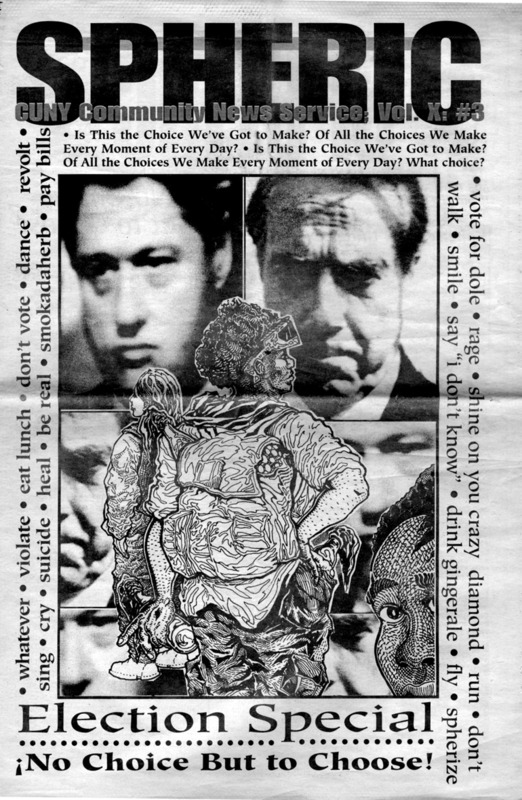
¢ Is This the Choice We’ve Got to Make? Of All the Choices We Make
Every Moment of Every Day? « Is This the Choice We’ve Got to Make?
Of All the Choices We Make Every Moment of Every Day? What choice?
f
DP 1, ABS e SIILUS e YJEM
5 @ SSPI e DOP IO} 910A «
sing ¢ cry ® suicide ¢ heal © be real ¢ smokadaherb ¢ pay bills
e whatever ¢ violate ¢ eat lunch * don’t vote ¢ dance ¢ revolt e
2 J i . A
= " : x SS ~
1 S = fs . iy ’ , .
X ) ‘ 5
is, IW. : 7 ‘
Election Special
iNo Choice But to Choose!
dZdUds e« AJ e d[BIOSUIS YULIP e ,MOUY },
},UOp e UNI e puoweKip Azeid noA uo dul
age 2 SPHERIC
OPHERIG
No Choice But to Choose
Volume X, Number 3: No Choice But to Choose
695 Park Avenue 02126
New York City 10021
Spheric is all things except square.
Spheric is a globe of students’ tongues dribbling exi/essential trip
of the brains in a society of trip of the brains falling, landing,
sinking to pieces on a well worn knit of rags worn with the tag
CUNY on it as a kefiya around the head, ears, mouth shut in
silence piercing cries in hope, anger, boredom, desire, pain, joy in
lovemaking meaning in a freedom fight fought daily in an intifada
where pens become uzis oozing revolution on sheets of paper
floating like stardust gathering in collision, companionship union
with one another, joined, added up to be a star, a sphere where
minds hold hands. Peace. Spheric loves you and yours and love.
The Ring of Fire
Staff & Contributors
Editor
Jéd Brandt
John Kim-Cover, Miguel Talvarez-Spot
Illustrations, Roger bonaire-Agard-Poetry,
Suheir Hammad-Poetry, Fred Zabinski-Odds &
Ends,The Hunter Envoy & Shield-Equipment,
Chris Day-IIlustration, Keith Mitchell-writer,
Jeannine Diego-writer, Rekhwon-writer,
epiphany praxis-writer, “Self Made Man”-
writer, Walt Whitman-Poetry, Baudelaire-
Poetry, Jessica Klonsky-writer, Alicia
Siebenaler-writer, VincentV. Louis-writer.
Co-Editor
Asif Ullah
Finance, by
Arcidiacono
jShoutOutsFromTheMouthOfMadness!
To our families (born and chosen) and/or creators, ALL PRAISE to Amu, Abu,
Boro/Choto Bhuya's; Lechona Madre de Mosca for your Moment; Jucl & Amor for
being true cousins; La Sad Girl for the necessary love; Nee for being Nee, Every
spirit known who manifests In memory through the verse here unleashed; Peace
to Zshaun, Blandon and the Sisters Hammad. Atom for the Fusion; Much love to
Rekha and Ra for confusion; Crazy Horse for the badland Moon; Charles
Baudelaire for the moment; Hunter SLAM! for the space to grow; that storm for
the right timing; Brooklyn for your rooftop limbo; the Chaplain for the promised
flow; Word to Intifada, Jihad everywhere; Word to all the gods of the earth, hand,
heart and tongue In CUNY which ts the best f'ed-up school In the world. Oh
yeah... We almost forgot about thanking the BAD GUY aka the Antagonist.
in memoriam
Nelly Pus-Pus Velasco was eaten by a
rhinoceros while walking down Fulsom
Street in her 20th year on this earth.
No matter how much joy she brought to
the people she met, she never found
peace within herself. She was an angel
before she died. She is still dancing
with all the world
No Choice
But to Choose
This special edition of Spheric was created for
like minds who share the belief that we are not
of like minds, though we've kept in mind that
someone is minding the store, but we got no
money, SO...
Election season is upon us like a limp
monsoon and for the first time in a century,
voter turn-out is expected to drop below 50%.
It is by no means certain that this is a bad
thing. The election is lurking around the corner
like a lazy mugger and our minds are on
tokens, food, sleep, the chill in the air and that
passing friend's hair. The only thing worse than
simply dismissing the paucity of our two-party
choice, would be pretending nothing was
wrong, or even just a little wrong, or even in
any way acceptable.
pheric has assembled the usual
malcontents (and a few of the newly
implicated) to trip on the situation in which we
find ourselves forced to not be ourselves for
one day of the year. That day is swiftly
becoming everyday and before long the
embodiment of everyone.
Well, the question that stabs us in our
hearts, heads, and especially our minds, is
what to do? Maybe the next question should be
“so, what's the answer?” The honest to Newt
truth is we don’t have the answer, at least not a
single one. The choice we have to make may
not even be the choice we've been offered. It
may not even exist, yet. So what. It may be
that in each single moment of every single day,
we live. That living is nothing but a string of
choices and we don’t even have to sweat it.
You can get with this or you can get with that.
Or, you can even choose not to choose and
your choice will still be chosen for yo
Within these pages we have ollected
articles from republicans, liberals, communists
and the Bewildered. We have some hope and a
bit of despair. Hopefully, you'll find some bit you
wouldn't wander across on the limited band
width of television propaganda. Remember, it’s
just a newspaper. If you want more ~ cose it.
ear ay |
The Dignity
pectoral
sien
by Jed Brandt
Hunter College
won't change a thing
xi we know it. Not voting
won't change a thing
and we know it. In this
year saturated by a weird due
between the evil
thin
¥ two lessers, some
is wronger than Dole’s limp
gn and Clinton's sleazy
ing deeper is burn
ance Somet
Some were indeed saddened by what
t had once promis t 6 LI the
Soviet Unior
fraternity and all that, people liv
a prison painted red
language the Sov
schools had
ets spoke
on telev
ittle te
buli uildre
lear hat those same workers ran
the country. The Soviet |
ed Afganistan and Prague, supported
military regimes in Africa with some
sort of Red Man's Burden, but nowhere
did the promise of socialism sing
We celebrated the fall of the
Berlin Wall on both sides and there
was a real hope the truth would final-
ly br
rion invad
th. Boris Yeltsin, a former C
ist Party apparatchik became a
SPHERIC
age 3
g OL € f
W doe “ex great ant mmunist crusader
4 t agaanst the ry h
hick ha: .
. + asa
n pe mg. The current y at
aign has all the mean i"
ness of a court feud betwee va a special code “ ,
brothers aspiring to the throne. Look- © Cussiom was en e et
ing at their spat from the outside, Union they had May Day parades,
trom Brooklyn, their battle could only here we have the ritual of voting.
f — ar we
In the Soviet se Mtareaiiein of sche einaha
Union they
had May Day
parades, here
we have the
ritual of voting
make sense on television. No one
around here talks like they do. They
don’t speak a language | understand
On TV, they say it’s how people
talk inside “the beltway”
ington D.C. But the mayor, teachers
and the New York Times speak their
languange, too. If their meanings
aren't Gear, it’s plain as day they aren't
speaking to the lives of anyone on this
street, in my college or at my job.
A few years back, events around
the world heralded a “rebirth of
democracy.” The legal fall of
Apartheid, Tienanmen Square, and
the molting of the Eastern Block put a
buzz in the air. Now it seems like the
situations that precipitated the events
over there weren't all so different
than they are here and now
By the time the Soviet Union fell
apart, no one cried for what it was
in Wash
and died for the right to vote, there is
no serious talk whatsoever about the
profound depravity of the choice we
have been offered
The cities are rot- e
ted and the farmers
have been dispossessed
by agribusiness. Segre-
gation is as bad as Jim
Crow days, but we hear
more debate from the
parties about “reverse discrimina-
tion” than the depression-level unem-
ployment among black youth. Heroin
is cool again and that means pain is
the real epidemix
Just like in the Soviet Union, the
language of the government and
media have nothing to do with the
desires and hardships of the people
Here, where the workers are
insulted by politicians, instead of
patronized, we speak of the middle
class and what it supposedly wants.
No one ever says who the middle
class is, but we're supposed to know
What is clear is that both parties
receive almost equal corporate back
ing. That neither party is fighting for
a world where borders don’t scar the
earth and prisons don’t blight what
live
would otherwise be pastoral country-
side. That no media commentators
write in their columns this simple
truth: America uses democracy the
way the Soviets used socialism
Democracy is supposed to mean
a government by “the people.” It
means the people should have power
in choosing others to represent their
interests. | have never heard ome sin-
gle politician of any stripe admit the
nature of this beast. Some promise
social benefits or an end to some par-
ticular war, but none offer the right of
people to elect their managers at
work of demand that companies
return all profits to the employees
who earned them. Not even close
Socialism is supposed to mean
that the basic people in the society, the
workers, run every facet of their lives
They run their places of work and the
schools where children are educated
Socialism is supposed to fight against
a government that is even separated
from the people. It is supposed to
fight against any group stealing the
work of others. It is supposed to be a
world without borders.
The Soviet Communist Party
wasn't a workers’ party any more
than the people here are represented
by the American government
In the structured noise of the
media, we are bombarded about the
middle class and think we belong
because there are no other classes in
the media. We hear that America is
supposed to be a color blind society
but when the politicians who say that
go home, a Guatemalan maid cooks
their dinner.
in this city --one day it will be mine
Not necessarily knowing any
other way to talk, we pretend it’s the
truth. We hope that voting matters
because somebody tells us it does. We
pretend we have a choice, because
admitting we don’t is painful. It hurts
to live without saviors. If one won't
descend from the magic of a ballot
box or heaven above - then we have
to save ourselves.
We need to find a poetry in our
hands and loves, our jobs and homes
that cannot lie. | hope while we're
learning to speak we don't take any
lie as somehow closer to true than
some other. | hope we have the pride
to rise above the insult of these elec-
tions. Like | said at the start, not vot-
ing alone won't change anything, but
at least it has the dignity of honesty
We Are Accepting
Submissions For
the Next 2 Issues:
2Q0ué es/ta America?
never submit to the man
always submit to spheric
* poems ¢ illustrations * heresy * rants » comics * satire * photography * — satis a nar is a smat sa ore
© madness « fantasies * explosives * essays « the juice » sedition © journalism © 2 msrs you tnon: memes canes,
tees By Keith Mitchell
Hunter College
as it just me, or was
ing dark-
er at the Republican
convention than their
plot for world domination? Checking
out C-SPAN, I noticed African-Ameri-
cans taking a prominent role during
the big show in San Diego.
From the ubiquitous Colin Powell,
What size are dose?”
No fear in my mind
I reached
Not too far behind
my thoughts.
And
came
oe with the answer
of Met M slidi
inted at my
Et
“Stay tight, live right
I pg lett piv
Broke off in a run
as I finished...
she said
Trying to make me
Add ot the t
Cattle.
How much she knew
she ever heard
was followed by
the wind
Or hear
I walked into.
& Richard Wright
could never make her
“Black like Me.”
e black like mee
Roger Bonair-Agard
“Dem some butter sneakers kid.
by the bitter, slick sound
ee Metal -
oie i Sh
— that trip.
my shoes
kicked them over.
In two seconds he was gone
“Cause you Black like me.”
A white woman called my card last n
“You can’t even understand my love,
And she clung - we! | my every wish -
eel li
she knew | worried about.
And still I could feel only like
Cause...
No matter how DOWN she was
She couldn’t make me feel whole
Because the only cry of “Nigger”
“Lover”
And she could never feel
Old Yeller Dréligas of Days When They Was:
Just Whistlin’ Dixie |
to Oklahoma Congressman J.C Watts’
prime-time speeches, the GOP is
making a tremendous bid at wooing
the traditionally Democrat voting
African-American community into
their ranks.
While at one time Black conserv-
atives were considered to be a fringe
grouping, their ranks are slowly
climbing. Even Jack Kemp was seen
eating at Sylvia's restaurant in
Harlem selling Dole’s program to
Black business leaders, and C. Dolores
Tucker has gotten mighty cozy with
William Bennet over the issue of
“gangster rap”. With the addition of
Black-Rush Limbaugh wannabes like
to slip
I said
the butt of the gun
night
ike a king
Of the last door shut in my face
the Hush of the last room
Because Fred Douglas & Malcolm X
Martin Luther
Armstrong Williams and Ken Ham-
mill, arch-rightwinger Clarence
Thomas, and even Phoenix Suns pow-
er forward Charles Barkley, many see a
strong rightward trend in the Black
community that could wreck havoc on
Is the right wing getting multic-
ulti? Or is this the coming age of the
Black middle class? To understand this
development, we must look at the his-
toric roots of the relationship between
Corwervatives and Republicans.
The Myth of Abraham Lincoin
and the Republican Party
One of the most overused phras-
es that was uttered at the Convention
is that the GOP is “The party of Abra-
ham Lincoln.” ly meant to
describe itself as the defender of
African-Americans’ interest, the com-
cept of Lincoln as savior of-us-poor-
Black-folk is a historical fallacy.
While Lincoln did sign the
jon Proclamation, he did so
under great pressure from anti-slav-
ery leaders. Also, fearing that Great
ss eget possble tah, in
coln hoped to tap on the energy of
against
the Union, as if slaves could just get up
and leave without serious retribution
the Union didn’t recognize the provi-
sions of the Proclamation.
Lincoln also did not envision full
equality for African-Americans. In
1858, during a debate with Stephen
Douglas, Lincoln remarked “I am not
nor ever have been, in favor of bring-
ing about in any way the social and
political equality of the white and
black races-that I am not, nor ever
been, in favor of making voters or
jurors of Negroes, nor qualifying
them to hold office nor to intimacy
with white people... And inasmuch as
they cannot so live, while they do
remain together there must be a posi-
tion of the superior and inferior, and I
as much as any other man am in favor
of having the superior position
assigned to the white race.” (Com-
plete Works of Abraham Lincoln,
vo IV, pp. 89-90)
Republicans” played a progressive
role in establishing rights for Blacks.
The creation of Freedmen
Bureaus to aid displaced former
slaves, and the 14th amendment
which guaranteed basic civil rights to
all citizens, allowed some Blacks to
gain political power. But these
changes were a drop in the bucket as
compared to the favors given to the
booming Northern capitalists.
“#0 acres and a mule,” thousands of
acres of land were given to railroad
tycoons. Without land, many ex-
slaves were reduced to the level of
sharecroppers. Soon afterwards, Klan
terror infected the South, taking away
many of the gains garnered during
this period
The Tradition of
Black Conservatives
The Tradition of the Black con-
servatives can be traced to this peri-
od of Southem sharecropping. South-
ern Black families were forced to live
in semi-feudal conditions, while sup-
plying vast amounts of labor power
to agricultural giants. Within this
225345 2. Lore
assault against affirmative action,
welfare rights, public housing and
common decency.
While they scream about inde-
pendent Black businesses, they wish
to accommodate the Black communi-
ty within the current power structure.
Under the disguise of “Empower-
ment Zones,” these conservatives are
playing the effective role of neocolo-
business in the Black community. By
prescribing workfare as a cure for
- SR Te
Ben tack Kemp was seen 1 eating
at Sylvia's restaurant in Harlem
selling Dole’s program to Black
business leaders, and C. Dolores
Tucker has gotten mighty cozy
with Bennet over the issue of
ganster rap.
context Blacks played a vital role in
the rebuilding of the U.S. economy,
while being denied their basic
human rights.
Instead of fighting for equality,
: many Black leaders wished to accoen-
modate the Black struggle for libera-
Booker T. Washington, who estab-
lished the Tuskegee Institute. Teach-
ing mostly farming and handicrafts,
Washington wasn’t interested in
developing these skills to break the
sharecropping system, rather, he saw
it as a way to reinforce the notion of
servitude towards white patriarchal
power. In his famous speech (dubbed
by W.E.B. Dubois as the “Atlanta
Comprise”) Washington denounced
Black freedom fighters like Douglass,
saying “The wisest among my race
The only way
to achieve
social justice is
by taking
matters into
our own h-nds.
understands that the agitation of
questions of social equality is the
extremist folly”.
Extolled by northern and south-
ern capitalists, Washington was, and
remains the symbol of Black conser-
vatism. With his influence reaching
all the way to the White House, Wash-
ington controlled the purse-strings of
many Black institutions. Black col-
leges didn’t serve as centers for liber-
ating, anti-imperialist education, but
as bastions of conservative ideology.
Today we still see the shadow of
Washington’ s ideology in Black
icans. in both speeches, Powell
and Watts told of how they “pulled
themselves up by their bootstraps,”
and defied racisen.
Not surprisingly, these men have
been the puppets of the right wing
unemployment and single parent fam-
ilies, cheap labor is provided to work
in these establishments. While these
zones make a hand full of Black and
white businessmen rich, they don't
seem to “em anyone else.
It would be foolish to say this
The institutions which define
control. The solution can't be found in
a system that’s the cause of our dilem-
ma in the first place.
What's at stake for the 1996 elections
Beyond the extreme manifesta-
tion of Black conservatism seen in
Black Republicans, we must under-
stand that the class contradictions
within the African-American com-
munity manifest across the political
spectrum.
For years, Black Democrats have
told us to “stay patient,” while our
communities have been ransacked by
drugs, unemployment, lack of ade-
quate health care, and a myriad of
other social
With Democrat Carol Mosley-
Braun visiting Nigerian dictator Sun-
ny Abache, and the late Ron Brown
setting up business deals for US. cor-
porations in the Third World, we
must recognize that neither political
party has our interest at heart.
The bottom line: This election
year we shouldn't go meekly into the
ters in to our own hands. Now is the
time to organize a Black communal
power structure, that would control
of our community.
(The headline was stolen from Paul
Beatty's poem that appears im Defense
of Mums.)
No Choice But to Choose
SPHERIC
The Mythology of Voting
by Robert Walker
Revolutoinary Worker
or a lot of people, official
politics in America looks
like a steamsoller paving a
road to hell — more money
for the rich, less for the poor, more
censorship and police wiretapping,
prisons instead of schools, eliminat-
ing checks to poor children to pay
military debts and so on. As if last
year wasn't extreme enough, the sys-
tem clearly seems to have its
crosshairs set on cutting social securi-
It takes a particularly extreme
form of denial these days to see Bill
and Hillary Clinton protecting peo-
ple from the right wing. They are still
presenting themselves as moderate,
even after signing the abolition of
Aid to Families with Dependent Chil-
dren (AFDC).
Even Clinton himself admitted
that some of the provisions of this bill
were unjust - like cutting off benefits
to legal immigrants and allowing
states to cut off food stamps to chil
dren. But then his political spin doc-
tors argued that it was necessary to
return Democrats to office so they
(and not the Republicans) would be
the ones monitoring these programs.
The liberal commentator Katha
Pollitt wrote in The Nation magazine,
“now we're supposed to vote for the
Democrats so they can undo their
own votes!”
Newsflash: No one in high
places is suddenly going to call off
this war on the people and announce
a period of compassion and social
justice.
So, how do people turn the tide?
How do people defeat a political
establishment that seems united on
an extreme and cruel course?
The clear and basic need of this
moment is a broad, diverse and deter-
mined movement of resistance
against the vicious polices the ruling
class is determined to carry out. Such
a resistance movement is not only
necessary — but is possible if we
dare to seize the time
The fact that this fall is the sys
tem's official political season repre
hallenge and an openi
s of real people resisting the
dampdowns.
Even as the system urges people
to participate, there are millions of
people who feel shut out by the offi-
dal non-choice of Dole vs. Dole Lite
There is a growing sense that relying
on political candidates and elections
will not bring change.
Katha Pollitt spoke for more
than herself when she wrote in The
Nation about her bitterness at seeing
congresspeople she once supported
voting for brutal welfare cuts. After
the Clinton signature on the welfare
bill, she wrote: “Advocacy politics
can't turn this around, because advo-
cacy is based on speaking for people,
rather than those people acting on
their own behalf. Enormous demon-
strations around the country, with
strikes by S.ELU and AFS.CME
[large labor unions], sit-downs in
welfare offices and 100,000 homeless
people camping out on the capital
might have affected the debate. [Lib-
eral children’s advocate] Marian
Wright Edelman issuing a press
release no longer can. Indeed the
media didn’t even pick up the most
sents
the
CUEDACKS af
recent one, eloquent as it was.”
There are literally millions who
feel an urgency to oppose the official
policies of the last few years and who
want their voices heard. We know
that many of these same people will
still go ahead and vote, even if more
of them are embarrassed to admit it
afterwards.
There is a real necessity for all
kinds of people to participate togeth-
x in something real that can actually
change the political landscape
something that will challenge and
even rupture the smothering blanket
of official politics
will confront the system with a real
something that
October Surprise and light the sky
with resistance.
How Things Really Change
In order to build our resistance
more powerfully, it is also important
to explore some realities about the
political process and to deepen our
understanding about how things real-
ly change
The official mythology says that
elections are how change is made in
this country. But the truth is that the
important transformations and
changes in history, including the his-
tory of this country, were never set-
led through elections.
For example, the United States
was filled with conflicts over slavery
But in order to run in national elec-
tions, the major political candidates
(even Abrabam Lincoln) had to swear
they wouldn't abolish slavery or radical-
ly change society as it was.
The end of slavery took a great
struggle of millions of people,
including revolts and resistance by
the slaves themselves who were not
allowed to vote. Ultimately, this
struggle developed into a civil war
where Northern armies and 200,000
former slaves shattered the armed
forces of slavery and overthrew the
social system of the Deep South. Vot-
ing and elections had little to do
with it
Or take Jim Crow segregation in
the South. Before the 1950's, Black
people were kept strictly segregated
in the Deep South — with separate,
grossly inferior schools and separate
entrances and bathrooms in official
buildings. Blacks and whites were
forbidden to date or marry. Black
people had to address all white peo-
ple as “sir” or “Ma‘am”, while even
white children were expected to call
adult Black people by their first
names
These hateful inequalities were
enforced by the lynchings of the Klan
and the legal lynchings of the south-
em shefiffs.
Jim Crow wasn't abolished at
the ballot box. Jim Crow was
destroyed because changes in the
economy and the world situation
weakened this system of oppression
and, most importantly, because Black
people fought to destroy it
Southern agriculture mecha-
nized in the ‘40s and ‘SOs. Millions of
Black farm laborers and sharecroppers
moved out of the show, dusty southern
farm towns to northern Gtes.
In those same years, the old
European colonial systems were
breaking down in Africa. The U.S
imperialists wanted to expand thier
influence in the new governments
coming to power there. Jim Crow
became an international embarrass-
ment that got in the way of US. plans.
It was hard to portray the U.S. as “the
friend of de-colonized Africa” when
everyone knew that Black people in
Mississippi couldn't hold office or sit
on juries — and could be lynched for
not stepping off the sidewalk when a
white person passed
Jim Crow was destroyed when,
in the “SOs and ‘60s, Black people rose
up in revolt — staging sit-ins and
boycotts at segregated luch counters
and bus stations, demanding an end
to special “poll-taxes” and rigged “Lit-
eracy tests” that denied Black people
equal political rights
Southern jails were filled and
major cities started to burn from the
rebellions of northern Blacks as the
Civil Rights movement segued into
the Black Liberation movement
The U.S. system was forced to
grant major concessions by intense
popular struggle. And at the time, the
system was inclined to grant certain
concessions because the old semi-feu-
dal basis for Jim Crow had been fad-
ing away in the southern farm areas.
The people wanted liberation
and at the same time the oppressors
for their own purposes found it neces-
sary to move toward new ways of
controlling Black people — new ways
that were not so crudely based on fim
Crow segregation’s open and legally
enforced inequalities.
The change was forced through
by struggle, not by voting.
Another example: Women did
not win the right to abortion through
elections. There was no wave of con-
gressional or presidential candidates
who swept into office declaring sup-
port for abortion rights.
The legalization of abortion was
forced from a reluctant Supreme
Court at a time when millions of
women were entering the workforce
— and rebelling against the system
Only after the system legalized abor-
SOME PEOPL
tion did a section of the system's
politicians openly declare their sup
port for this right
Take a more recent, and less sig-
naficant change: Bill Clinton defeating
George Bush in the 1992 presidential
election. Here's the truth: it was the
L.A. rebellion of 1992 that put that
The official
mytholo
elections are
how change is
made in this
country. The
truth is that
the important
changes in the
history of this
country were
never settled
through
elections.
“hang-dog™ look on George Bush, as
powerful forces in the U.S. ruling
class decided it was definitely time
for a change.
Even the system's own change
of presidents had more to do with
uprising in the streets than it did with
any voter registration campaigns.
The reality is that no positive or
liberating change ever happened in
this social system because of voting
or election. How does real change
?
It comes through struggle
through urating people from their dif-
ferent points of view — to do what
needs to be done for the people
through creative exposures of those
who abuse people, through diverse
forms of resistance. And at its most
thoroughgoing, change comes when
the crisis in society becomes so deep
and the struggle, organization and
consciousness of the people is at the
point where a real all-the-way revolu-
tion is possible — when power is
SPHERIC
No Choice But to Choose
A Mi Nunca Me Dio Por la Pintura...
scary
Mgnt Has NO
peauty!
by Jeannine Diego
Student of Life
ave you ever won-
dered what image
people have of you?
Everyone has from
time to time. If someone were to paint
your portrait, for example, what
would it look like? What if you were
to paint your own portrait? Ah, ya
veo. Nunca te dio por la pintura
Suppose that there exists some.
one who is, in fact, painting your por-
trait, yet you know nothing about it
You've heard of the artist, but neither
one of you have met
We'll call him Terretrato. His
work is known all over the country
admired by most, criticized by some.
This highly skilled and clever artest is
rigorously preparing for an upcoming
show. He’s spent tireless months
working on his masterpiece: you. But
wait... don’t feel flattered just yet. Ter-
retrato's portrait of you is grotesque,
distorted. It's entitled “El Enemigo.”
Enemy? That's right, and people
will believe this image; they trust’
him. Why shouldn't they? They don’t
know who you really are. You have
no control over it, simply because you
don’t even know it’s happening!
Think I'm kidding? All right, |
am. 1 know you didn’t believe it any-
way. His name's not really “Terretra-
to,” it’s “Congress.” Congress
though, is in fact highly skilled and
ever, and has been painting this por
trait of you, The Immigrant
“But, I'm not an immigrant’, you
say? Well, chances are you're lucky
enough to be the direct descendent of
one who just happened to slip
through the crack that Congress is
now trying desperately to seal. Your
parents’ or grandparents’ legal status
in the US doesn’t keep them from
forming a part of the “Immigrant
Enemy” population of this country.
The “Immigrant Enemy” por-
trait is one designed to convince the
American public that an immigration
reform bill is necessary to control and
eventually stop the flow of immi-
grants into the US, while further con-
trolling those already here.
In brief, the bill before Congress
(HR ~202) would: 1) Provide states
with the ability to deny public school-
ing to the children of illegal parents
(Am I the only one gasping for breath
here?); 2. It would restrict most med-
ical and social welfare benefits for
illegal immigrants, in addition to
enforcing some restrictions on legal
aliens; 3. It would restrict family
reunification visas, as well as spon-
sorship of legal immigrants, by
requinng that a sponsor earn at least
twice the poverty rate, while also
increasing the term of sponsor
responsibility as much as up to ter
years; 4) The
restrictions which would make it
re difficult to apply for polit-
ical asylum, for both people abroad
and those already in the US; 5) It
would make it much harder for the
federal government to sue employers
believed to use the immigration poti-
Cy for discriminatory purposes.
If it sounds like this legislation is
aimed primarily towards illegal
immigration, think again. It was only
due to pressure from some Democrat-
ic representatives that propositions
regarding legal immigrants, original-
ly contained in the bill, were rewritten
as separate legislation.
Proponents of the original bill,
disturbed and frustrated by these
cuts, sustain that even so, the bill is a
step in the desired direction of con
trolling both legal and illegal immi
gration which, according to Sen. Alan
K. Sempson (R.-Wyoming), is “strain
ing the fabric of the country.” In the
words of Lamar Smith (R.-Texas), the
ball “will encourage legal immigrants
to be productive members of our
communities and ease the burden on
the hardworking taxpayers.”
Laden with images of the immi
grant involved in a scheme to steal
valuable jobs from the unsuspect-
ing American worker and
abusing the social welfare
system, the arguments
for the bill can, at best,
be described by a famnil-
bill would enforce
iar term: “tremendo paquete
Take the words of Sen. Edward J
Kennedy (D.- Massachusetts) “Far too
often, American workers are not giv-
en first crack at the good jobs going to
many foreign workers today.”
(emphasis added)
I know, I know. We've all seen
the American laborers lining up
around the block for a crack at the
fine job of picking tomatoes out in
California, o¢ in a local sweatshop, or
a kitchen, or deli, for unheard of
wages, unheard of hours, and non-
existent benefits
Even Richard Pornbo (Califor-
nia) knows that illegal immigrant
The
that time they'll be safely tucked
away in one of the several hundred
prisons which our government is gen-
erously pouring so much of our tax
dollars into constructing.
You're not convinced, you say.
Think I'm being paranoid? Sure I am.
Well, just because you're paranoid, it
doesn't mean someone is not after
you. Earlier this year, around July,
you may have heard about a seeming-
ly harmless bill (HR~123, which
declares English the official govern-
ment language of the US. Like most,
you were probably surprised to know
that English wasn't already the offi-
cial language
“Immigrant Enemy” portrait is
one designed to convince the
American public that an
immigration reform bill is
necessary to control and eventually
stop the flow of immigrants into
the US. while further controlling
those already here.
labor is a necessary commodity in this
country, “...an insurance policy
against unharvested food, closed
farms, and higher food costs.”
En pocas palabras: it’s cheap labor,
filling jobs which would otherwise
remain unfilled or cause unrest
among North American workers.
Surely, at some point, it will
dawn on me how all of these mea-
sures are supposed to be for our own
good, particularly the provision
which would deny public schooling
to children of illegal immigrants
Does this make sense to anyone?
Perhaps, say, ten years from
now, we'can ask Mr. Elton Gallegly
from Californéa (sporsor of the provi-
sion on public schools), why those
chaldren did not just vanish into thin
air, or why they just vandalized his
neighbor's house, or became the
beads of various street gangs terroriz-
ing his own well cared
for kids?
On the other
hand, maybe by
That bill is based on the premise
that the immigrant population would
learn English more readily and quickly
if most government documents, such
as bilingual voting ballots were not
guided inensna with longa concuntca:
tons of ing voters.
In the ever-modest words of
House Speaker Newt Gingrich, the
bill takes “a modest step in the right
direction of reinforcing and reassert-
ing the greatest civilization ever to
provide freedom in the human race.”
Randy Cunningham, from Cali-
fornia, said that English proficiency
would enable workers to “achieve the
American Dream.” Sounds almost
touching, huh? Their dear concern is
just disarming, really
Particularly considering the fact
that an amendment, proposed by
Rep. Serrano of New York, was reject-
ed on two separate occasions. The
amendment would have expanded
educational opportunities and infor-
mation resources, while encouraging
all US residents to learn or maintain
skills in a language other than Eng-
lish, in addition to opposirig restric
tions on languages other than Eng-
lish, and continuing to provide
bilingual services.
At least Patrick J. Kennedy
(D,-Rhode Island) acknowledges that
“the bill is playing directly into the
politics of fear and prejudice that
Congress is so well known for.”
So, there you have it. The “Immi-
grant Enemy” portrait depicts you as a
threat. You're considered a “burden on
haed working toqpayers,” as “straining the
fabric of the country.” etc
If you believe that people know
better than to buy this papuete, consider
the words of Bob Dole: “When you have
one, two, theee million people walking
across your border
ut laws, you havea
The ignorance escala
breaking
vels in the w
the jefe of an or
Immigration Now t
tion of being the object of conquest
peaceful vtherwise, by Latino
Asians, Blacks, Arabs, or any other
group who has claimed my country
It's no secret that this is an elec-
tion year, which means that it would
be unwise for either party to run on
this issue, The clever artisans of Con:
gress know how and when to unveil
controversial masterpieces such as
these bills. This buys us some much
needed and valuable time.
Understandably, you may feel
slight discomiort at being labeled the
“Immigrant Enemy”. You're probably
even a bit skeptical. I've yet to meet
someone in New York (myself includ-
od) that takes someone's opinion just
because it’s given
Weil, that’s not necessarily a bad
thing, so I encourage you to research
the facts on your own. Find out
whether Congress's fear of you over-
taking the country is justified. The
Nabonal lmmigration Forum and The
Cato Institute (800-767-1241) can pro-
vide you with demographic and eco-
nomic facts, suited to their prejudices
ol course.
Hey, you never know a |
da por la pintura.
mepor te
LOVE ME YouRTIRED.
“YOUR FoOR
Your Hupp eb
TO BREATH HE
No Choice But to Choose
SPHERIC
ee by the Self Made Man
ow that we all agree
Welfare Ts past its
prime, we need to seri-
ously address a
replacement. For too
long food stamps-on-demand was the
rule of the land
Decades went by when millions
chose not to work because a welfare
check only took a walk to the mail-
box. Women of loose morals fornicat-
ed solely to get more of our tax man-
ey with which to support their
decadent lifestyles. Is that what made
this country great? I don’t think so.
When those first brave pilgrims
journeyed to the land that would
become America, they crafted the
unappreciated wilderness with hard
uncomplaining work. They built a
nation and their sweat paved the path
to our prosperity. It was only in the
1930's when, in a time of struggle,
unscrupulous and covert commurust
agitators fooled the people into think-
ing that government giveaways were
some bisthright
The New Deal was nothing
more than a way for the unsuccess-
ful to steal the blood, sweat and
tears of the men who made America
Great men like J.P. Morgan and
Andrew Carnegie had their fortunes
widdied away so that half-men who
didn’t work could spend their after-
noons drinking gin and complaining
about what they didn’t get for doing
nothing
Luckily, nowhere in the constitu-
tion does it state they have the right to
Under the courageous, com-
be lazy
mon sense leadership of President
Clinton, we have finally begun to
undo the folly of senseless govern-
ment waste.
But remember, no matter how
tempting it is, we can’t let our hearts
harden to harsh realities of contempo-
rary America.
What with millions of Mexicans
streaming across the border, how can
our inner-city welfare mothers learn
to compete? Just throwing them into
the workforce when they do not
know how to work is plain un-Christ-
ian. We need a middle ground on
which we all can agree
This is where the “Middle
Ground Workfare Program” comes
into action. The long learned habits of
the Culture of Poverty are hard to
— a "originally isswed the joan The bank, —
ridiculous hand-cut
nstead of tt
In the Reagan era, grant-based
education funding was transformed
into the Guaranteed Student Loan
system. This move saved our colleges
from the blatant abuses of the 1960's,
when pot-smoking terrorists used
government-provided college money
to promote sedition and promiscuity
Instead of some intellectual
hoodJu: getting a “tuition” handout,
he and his kind were forced to
take substantial personal loans. This
under
ensured that the skills we gave them
at the University would have to be
used for cash earning work and not
Beatnik poetry love-ins. Today, due to
Pot-smoking
terrorists used
government-
provided
college money
to promote
sedition and
promiscuity.
the efficiency of this system, college
students are no longer Beatniks.
However, this successful pro-
gram merely moved delinquency out
of the dorms and into the projects. We
should seize this opportunity to
expand the f 1 of aid and
encourage Citibank and Chase to
issue personal loans for those who
need some money to get by
Of course you want to know
how the destitute will repay these
loans. Massive initial capital can be
raised, but default could be disas-
rivatizator
trous. That is where the Workfare pro-
gram Comes in.
Upon receiving the loan, appli-
cants will be given a generous one-
month grace period in which to repay
their debt to society. If they choose to
neglect their responsibilities, work
will be provided.
Workfare Houses will be estab-
lished all across America and Puerto
Rico. Each Workfare house will be
directly owned by the bank which
holding the debt of its defaulters, will
contract their labor out to indepen
dent companies short of hands.
Since all of their wages will go to
repaying the defaulter’s loan, the
bank may have to issue further one-
month advances to be repaid by the
next months work. Some may com-
plain that they could not leave the sit-
uation, but their problem will be of
their own making’ The bank should
not be made to lose money intended
to help a person who obviously
divesn't take the personal responsibili-
ty of repaying debts seriously.
T expect the banks may be hesi-
tant to embark on such an ambitious
course of action, but the incentive is
great. This is not an era of big govern-
ment regulation. Once a bank holds
the Workfare loan debt, they should
be tree to do with it what they please
| suggest setting up a market for trad-
ing in debt obligations.
Rather than renting debt work-
ers from the bank on a temporary
basis, companies could buy the loan
dedt outright. They would then hold
the right to the debtor's labor. Now,
the debtor is a productive member of
society instead of milking from the
public tit, Workfare provides jobs and
makes business happy. That, my
friends, is the American Way
Undortunately, the problem runs
deeper still. The moral degeneracy
produced by the welfare state has not
merely undermined the economic
fabric of this country, but still threat
ens to cripple America’s cultural
supremacy
In states such as West Virginia,
where food stamps constitute the de
facto local currency, the faces of
George Washington, Abraham Lin
coln and Alexander Hamnilton go vir
tually unrecognized
Instead the only President they
seem to revere is FDR, patron saint
of the lazy and undeserving, whose
likene’s graces their food stamp ticket
to sumptuous, riotous living off of
our tax dollars.
To this I say “no more free rides
in America!” Hopefully, when my
plan is adopted and people realize
To replace this antiquated and
somewhat arbitrary system, we
should have Annual Citizenship
Assessments (with staff provided by
Citibank) where each man must pro-
vide proof of employment and each
woman must bring in a new Ameri-
can baby.
Decades went by when millions
chose not to work because a
welfare check only took a walk to
the mailbox. Women of loose
morals fornicated solely to get
more of our tax money with
which to support their decadent
lifestyles. Is that what made this
country great? I don’t think so.
they are living on credit, they will be
less likely to spend their money on
foreign, imported caviar. As it stands,
you can't even find good old Ameri-
can made caviar on our supermarket
shelves. The spendthrift waste of
welfare recipients, promoted by liber
al elitists, has almost destroyed our
native Sturgeon egg harvesting
industry. And that’s not the worst of
it
Mother Russia might just rise
again, resurrected by our misguided
foreign aid and their craven caviar
fueled economy. Well I don’t want
some Ivan coming in to spoon feed
me their caviar and crappy steel
She's not my Mother, Russia. If some
yak butter eating Mongol like
Ghengis Khan can run roughshod
over their boundless steppes, who
needs them
Their ilk deserve nothing from
us until they can prove themselves
worthy as citizens of America. This
Workfare program is not merely fis-
cally responsible, but will serve as the
opening volley in a cultural war to
retake the soul of America
Speaking of the soul of America
isn’t it high time we asked why any
old person fortuitous enough to be
born on our shores is automatically,
with mo backgrownd check, granted citi-
zenship? It’s like being guaranteed to
win the lottery.
Men who do not work will be
deprived of their undeserved citizen
ship and deported to some appropri-
ate country, such as Ireland. Women
who forget their duty and appear
without requisite offspring, will be
sterilized for more suitable work in
our pleasure industry
Ihave no doubt that somewhere
some panty-waist will be running
around and hollering about alleged
human rights violations. But really,
let's be up front for a minute about the
people who conjured up the bizarre
notion that people possessed special
privileges, which they call “rights,”
guaranteed by big government
Who are they? The French sissies
with all their absinthe swilling, goatee
sporting eggheads. The Germans in
their beer halls, wolfing down
sausages in mustard and Critiquing
Pure Reason or Judgment or whatev-
er is those Huns rant about in their
dialectical stupor. Hell, Karl Marx
himself was a German, and a Jew to
boot. All of them, ranting about “the
Enlightenment this, the Enlighten-
ment that.” They practically went
comunmurust
Well, we're Americans and we're
already enlightened, thank you very
much. In America we believe nothing
should be guaranteed by the govern-
ment unless somebody owns it and
that includes you. God Bless You All,
Each And Every Earned American.
age 8
SPHERIC
No Choice But to Choose
ee gg
jPublic Schools Must Die!
The Night Is Dark and I Am Far From Home
by Jonathan Kozol ¢ 269 p. * New York: Simon & Schuster ¢ $10 * 1990 (with critical annotations)
by Jessica Klonsky
n order to know what we
want and how to get it, we
need to know what is and
how and why it came to be.
As student organizers and
activists dedicated to transforming
education and the world, we need to
know exactly how schools are con-
structed to diffuse our power.
In The Night is Dark ared | Am Far
From Home, Jonathan Kozol offers an
analysis of the purpose of public edu-
cation in the United States and the
processes by which it functions.
"The problem is not that public
schools do not work well, but that they
do.” With this sentence, Kozol begins
an analysis of public education that
runs counter to much of today’s pro-
gressive school reform talk.
Much of the discussion around
the failure of public schools focuses
on flawed teaching methodologies
and/or incoenpetent or ill-intentioned
bureaucracies. Very rarely does any
one address the possibility that what
many of us see as the problems with
public schooling are not mistakes,
accidents or failings, but in fact, are
the intentions of the powers that be.
Kozol argues that the first and
primary function of United States
public school is to create good citizens
who believe that they are caring and
compassionate (and very well may
be), but also believe in their impo-
tence to take any action or make any
mark upon the world.
Kozol first addresses the straight
up lies told in classrooms across the
country. He states that many text-
books claim that “we go to foreign
nations, every time, to bring ‘new
methods,’ ‘modern technology,’ or
financial aid. Nobody tells the chil-
dren, in plain fact that we are there to
(1) to make money, (2) to operate a
missile base, (3) to put down a social
revolution.”
This kind of lie is not unexpect-
ed or mindless. According to Kozol,
these lies are part of a conscious effort
to wrap American minds in what he
calls a “shell. . . that protects us from
acute perceptions of those things we
understand, or visible action on those
evils we perceive.”
Even among so-called progres-
sive educators, the perceived necessi-
ty of these lies (either explicit or by
omission) remains. As a student
teacher in a “progressive” teacher
education program, | read an example
of a supposedly “radical” new way of
teaching elementary school students
about Thanksgiving in which stu-
dents were engaged and active
knowledge was created by them
rather than transmitted to them, and
yet, the teacher still managed to avosd
any mention of the genocide of native
people as a result of the European
Invasson.
When I brought this up to my
professor, she balked and asked if |
really thought it was appropriate to
bring up such “scary” issues with
young students.
School Is Not Real
Kozol explains how the content
taught in schools is completely
divorced from any sense of realness.
By dividing up time and areas of
study into periods, grades, sections,
units, assignments etc., schools
enforce a kind of mental disconnec-
tion. Schools are structured so that
nothing makes sense in the context of
a message to the pl
human transformabon that they had
to film or chronicle, past ages, distant
possibilities or alien suppositions.
“There is the sense that serious
matters take place, by inherent choice,
either in other lands or else in former
centuries: never where we may be and
wohaile we lige.”
To ensure that NOTHING REAL
EVER HAPPENS IN SCHOOL,
schools have created mechanisms to
diffuse and/or reroute any dissent on
4
schools is the infamous "Letter of the
Earnest Citizen.” Kozol describes
how as an organized lesson, children
write letters to their congresspersons
about an “important issue” that they
have researched in their Social Stud-
ies class. They mail the letters. A lit-
the while later, they receive a response
stating that their representative is
most concerned about this issue, that
recommendations to subcommittees
are in the works, that research is
underway, and thanks them for their
caused the dissent in the first place
The collegiate version of the
“Letter of the Earnest Citizen” rears
its head: the school-wide discussion
When Dean Jack Kruskopf of the
Graduate School of Urban Policy at
the New School met with students
who were outraged that their school
was honoring Mayor Giuliani with an
award for public service, he refused
to rescind the award and offered to
arrange a series of “discussions”
about public service as an alternative
anners
from a panel of experts
anything else
We study math, then history,
then literature and no one bothers to
explain how these human endeavours
might be related. More importantly,
very little, if any, effort is made to
connect what students learn in school
to their own lives.
In school, we might study the
Cf) Se Ae
the part of students. Kozol refers to
the many times students are told not
to criticize anything unless they can
offer a superior alternative.
How many times have we been
told by a teacher that “It is very easy
to criticize without offering some-
thing better? Kozol responds that it
is not easy at all to criticize a ritual of
aRih -
The problems with public schooling
are not mistakes,
accidents or
failings, but in fact, are the
intentions of the powers that be.
Civil Rights movement, but there is a
calculated effort to cut that study off
from where we are now
Teaching students to take the “T”
out of papers is also a part of this
mental disconnection. Kozol argues
that this staple of the educational
process fosters a feeling of impotence
in students, the sense that great things
will be done by someone else, not by
them. Kozol writes, “I hear kids
speaking often of the most important
processes of human struggle and of
social change as if the passages of
schooling or what is said in school
textbooks in the face of teachers
administrators, and an entire institu-
bon
Furthermore, realizing that
something terribly wrong is happen-
ing is the first step in creating change.
This tactic is a very common one that
stops student dissent before it has
time to develop and grow.
Teaching Lessons in Futility
Yet another tactic on the part of
concerff and dedication to civic duty
Meanwhile, the “important
issue” remains: the river is still being
polluted, stores still discriminate
against black people, their school still
does not have enough books. Noth-
ing has changed. What is more, there
was never any expectation of change
Kozol writes, “It is not the effort I con-
demn, not the wistful try and not the
good idealism I condemn. It is the will
to lead ourselves to think we are
anything at all except carry out a ritual
of effort-and-~<denial. . . This is, by now,
a bedrock item in the course of class-
room preparation: Ask, try, fail and be
refused. Speculate somewhat (write a
little essay) on the reasons for that fail-
ure. Now goon to a new subject.”
Stopping dissent in its tracks or
routing it into a pre-programmed act
of futility is not to be found sienply in
the elementary and high schools.
College is Bigger and Better
At the college level this diffusion
of dissent comes in different forms
Often times, students become rerout
ed by an examination of themselves.
The examination of the dissent itself
substitutes for action on the thing that
to protest.
This is yet another example of
how schools teach that truth is some-
thing that is said, not done. The stu-
dent who writes an eloquent essay
about the evils of pollution will be
rewarded. The student who puts his
or her body on the line to stop toxins
from being dumped in the river will
be expelled.
Kozol writes “Truth is some-
thing which occurs when actions take
place, not when phrases are con-
trived. Truth is not a word which
represents the correct response to an
examination, nor a well-written peece
of prose. Truth is not a ‘right word’
which can be printed. It is (it is only)
a ‘right deed’ which can be done.”
Educating the Master Class and Us
Much of Kozol's book deals with
how children of the ruling classes are
desensitized in school to the suffering
inflicted on others for the purposes of
their own comparative comfort
However, much of his book can
be applied to the public schools that
“serve” the oppressed. The same
processes that numb the children of
4
nen ie
No Choice But to Choose SPHERIC page 9
conse If You Do Not
ee This Is What
) You Could DO!
peace with our own conscience,” 4
Love the earth and sun and
writes Kozol. For him the only way to
“live at peace with our own con-
science” is to act on our beliets.“IF 2
YOU BELIEVE NOTHING, SAY SO. ‘S
IF YOU BELIEVE SOMETHING, @
TURN BELIEF INTO A CONCRETE
DEED."
Kozol Champs Out
Kozol wroteThe Night Is Dark
and | Am Far From Home in 1975 q
The book was republished in 1990
with annotations that serve to
soften or renege on some of the
srnget and meet fe postin the animals, despise
ltt es gence riches, give alms to every
one that asks, stand up for
the stupid and crazy,
devote your income and
labor to others, hate
tyrants, argue not
concerning God, have
patience and indulgence
toward the people, take off
your hat to nothing
Yg known or unknown or to
g any man or number of
! JF men, go freely with
/ powerful uneducated
ee persons and with the
: C4) young and with the
mothers of families, read
Spheric in the open air
every season of every
year of your life,re-
entiously serves the interests of ZAG
that flag cannot serve those of jus-
bce”
His 1990 critical annotations (Ag
add that such a statement “can be QQ
supported only by the most demean eZ
ing vision of the meaning of that
flag.” Kozol seems to have forgotten
the demeaning things done to peo
in the name of
If and when, a teacher
does take action, and at
gth should be expelled
from public school [Kozol
Children learn :
a great deal 7 examine all you have
belie out of been told at school or
church or in any book,
LP, "@ dismiss whatever insults
a“ PH§$Wi¢//): .\\ eae ” your own soul, and your
= = very flesh shall be a
y great poem and have the
richest fluency not only in
its works but in the
t. silent lines of its lips
ise Bae P® !/ and face and between
“oS tie ei!) the lashes of your eyes
Py and in every motion and
a
By joint of your body...
poem by Walt Whitman
voll advice by Spheric
the recogni-
bon of the price
that must be
paid by those
whom public
schools cannot
contain, or do not
dare to keep, than from
ten thousand lessons on
Thoreau and Malcolm X
Power knows where its own
interest lies; #0 too do those
machineries that serve and
page 10 SPHERIC No Choice But to Choose
nother man dead
where the words
to disguise what
isee make
visions palatable color
there words with
a palette more lady
like less blood
in language not mine
that houses no beauty
no comfort for
nature for me
words horrific and terrible
what this shine eye
girl sees through
bars and barbed wire
prisons prime
real estate 25 years
later no escape
2 years before me
attica was auchwitz is algeria
Tupac Shakur R.LP
suheir hammad
ripped naked and stripped
humanity forced to
craw! mudlike
and 25 years later
war criminals still celebrated
babies consecrated animals
no words there
are no words to
sugar this up
genocide passes as
eye candy for
media hungry for cash
and like cash people are
passed from hand to dirty
hand open palms
passing sand through
time not mine living
on borrowed clocks
tupac is dead and attica
forgotten
Inmates who seized Attica in 1971
in language ugly and time
up where is there space
for flowers
in hearts jailed there are
no morning glories to bid
god a good day
kids lick flames of
hot ice screams
rain stark
where the rainbow arch
to wash eyes
clean of rawanda bosnia
and iraq again
fill mouths with angels’
breath to make forget
memory absorbs like soil
there are no words
and not one word
erases my earth
91496/91896
z
=
No Choice But to Choose
SPHERIC
page | 1
Liberation & Atonement
by Blandon
Hunter College
he Day of Atonement
was established for
Black people on Octo-
ber 16, 1995 as our annual
Holy day. This observance sprout-
ed in the advent of the Million
Man March
some assertions.
was t
c k men to At on
apologetic 2g Ar a tor
generacy ater, we f
rstand the
Ce ope rator
y in the Black cx
result of the ri
tion and class structure
ety in which we live
The Honorable Minister Louis
Farrakhan called one million Black
men to Washington D.C. for an
Atonement to God and to each oth-
er
We have been unjust to our-
selves as a people because we have
internalized the warped thinking
of white supremacy. Without a love
of self, we have preyed on one
another, as planned by the ay
The slave master, the colonial
ist, the neo nialist, the CEO
and all of them from the President
m down depend on the self-sus
fB
taining ar
ty within < r
er the devastating blows of
murder, disunity and strif eV
trigger themselves; they just blame
it on “those crazy niggers
Atonement brings unity, the
lack of which is a major impedi
to our rise as a people. The
ess of Atonement allows us to
regroup and unite as a people, as
any army under siege must do in
order to launch a successful
counter attack.
The mere presence of over a
million Black men, standing in
front of the Lincoln memorial and
facing the capitol building sent
shock waves throughout America
and the world.
This shock was especially felt
by those in positions of leadership
who thought they controlled the
people. The official Black leader-
ship was shocked when the masses
favorably to Minister
respx f
Louis Farrakhan and other black
actn
ts whom the political propa
chines in this nation
One million Black men stood
as brothers on the capitol mall that
day and declared that the 13th,
14th and 15th amendments to the
Constitution, the legacy of Lincoln
and the rest of American democra
cy to be a hoax.
nymous with apology and that
therefore we have no need of it
Atonement is a process by
which progressive steps are made
toward right relations in our per
sonal lives, our homes, our com
munities, our nation and yes — the
Only when Black folk stop seeing
the white man’s ice as being
colder, will we adopt the principle
of “Do For Self.”
Black men authoritatively
declared to America that she must
make recompense to her ex-slaves
and to the poor and disenfran-
chised of this nation.
It would be criminal for any
one to try and convince Black peo-
ple that Atonement is not for us,
that somehow Atonement is syn-
One God
When an individual has truly
right relations with God you can’t
deceive him with false theology. A
true man of God can never be a
slave. It is precisely for this reason
that the white man didn’t introduce
dige
nous peoples of conquered lands
atonement to slaves and t
Atonement amongst a family
tribe, v
imperialists and slave masters
sarms
lage or nation d
effectively using their tactics
The ultimate aim of Atonement
is Liberation. This process allows
the participant to attain true free-
dom. The freedom | speak of is not
the ordinary kind that is maintained
by political sovereignty alone
True freedom allows people to
create the means for their physical
sustenance. So they should never
be beggars at the foot of other
nations. However, if there is not an
adequate trading of resources
amongst themselves, such self-suf-
ficiency will never be attained
Only when Black
the white man’s ice
Ik stop seeing
s colder than
our own will we adopt the prinxi-
ple of Do For Self
Atonement a
one another as human, worthy of
WS US tO See
each others love, respect and yes.
each other’s money. At
thers to be brotherly and
vement
causes | t
sisters to be sisterly to each other
Who would oppose such a process
unless they are against the rise of
Black people?
To free ourselves from white
supremacy, we must go past just
seeking political rights that we are,
even now, unwilling to leverage in
our favor for fear of offending the
Atonement and unity must
undergird all endeavors that are
undertaken for the good of our
lest we remain
~ ale
people
former slave masters via self
hatrec
t is a necessary and
powerful, and if we ignore it we
will be ill-equipped for
of truth that will ultimately ¢
mine if we go tree
bondage
remain in
Left: The Fruit of Islam
strike a pose beside the
capitol at the Million
Man March
Above - Hands raised at
the MMM in sign of
atonement
age 12
SPHERIC
No Choice But to Choose
sas, oe
Students Invited to Two Parties
By Alicia Siebenaler
Young Republican
any people think
that the choice is
between the lesser
‘of two evils, that the
options are not very palatable, or
indeed they are so bad that there is no
point in voting at all. These | put in to
the disillusioned camp. However, first |
would like to deal with the mty-one
vote-doesn't-count-anyway camp.
Those who do not think their
vote really counts are only partly cor-
rect: It is true that, given the electoral
college, a difference of one popular
vote either way will not change the
outcome of the election.
However, for every one of you
out there, who subscribe to this
belief, there are at least a thousand
more like you: One of you plus a
thousand more equals one thousand
and one. Now that is a number that
can effect change!
As for the disillusioned camp
there are those who advocate staying
home on election day as a means of
protest, of showing that the choices
are so bad that they will not choose
either one. This kind of protest is use-
less because in the end nothing
changes. A politician does not care
how many people turn out to cast
their ballot on election day. There
will always be a win-
ner as the outcome is
not contingent upon
mayonty turnout.
Many people are disil-
lusioned about the candi-
dates running for office. To be
sure, there is probably not
much we, as individuals,
can do to change this, but
we certainly can change
the focus of the debate
We can tell the
candidates what they should be
emphasizing. Witness the grassroots
campaign that got Ross Perot on
every ballot in the country for the ‘92
election. While it is true that Perot
has
t sum of f
who nd he n,
e who pounded the pav
t secking sagnatures were paid.
However, the Perot party's issue
concerning the national debt and
deficit greatly influenced what the
two main candidates discussed: Bush
and Clinton were forced to address
this in 1992 because of the People for
Ross Perot. We the people have the
power to determine the key issues of
an election. We need only exercise it
Whoever feels disenfranchised
must get involved with the party sys-
tem. It need not be either of the two
parties, but because the others are not
mainstream, the Democratic and
Republican parties offer the best
opportunity in which one can realize
their vision.
For better or for worse, looking
at the history of the party system, one
can see the evolution of ideas and
issues. The Republican Party of today
is not filled with abolitionist fire-
brands; and Dixiecrats have been flee-
ing the Democratic fold for decades.
The Republican Party was the
first to endorse the Equal Rights
Amendment and the northern Demo-
cratic Party sought to address the
social and economic inequalities
many Americans lived with through
the Great Society and War on Poverty
programs.
The Republican
Party was not
always con-
trolled
bya
minority faction of religious funda-
"
mentalists, nor has the Democrati
willing to sacriixe
time and e: y in order to fight for
what they b
I know there are cyni
who believe that the only people
any power are those with money
While it is true that politicians receive
great amnounts of special interest mon-
ey, the non-profit interest groups get
their money in litth $3 and $5 contr
butions from grandma and grandpa
(AARP), or you and me (NYPIRG)
You have the power to change the sit
uation if you do not like it, but are
you willing?
There are two assumptions a
politician can make in light of recent
low voter turnout: 1) The voters like
what we're talkang about and do not
care who wins, or 2) They do not vote
because they cannot bear to choose
either evil. Guess to which one they
subscribe?
Voting on Tuesday, November
Sth is neither
the beginning
nor the end of
the process of
effecting change, but
it can be the begin-
ning of your full
process. Remem-
ber, you have only
yourself to blame
if you do not
participate.
lieved was right
wut there
ith
by Vincent V. Louis
Hunter NYPIRG
he right to vote is the core
symbol of democratic
political systems
writer wrote. When a
large number of people in a democ
racy deliberately decide not to vote
in elections, the democratic political
system breaks down and it is the
young and less well off that suffer
the most as a result. The alternative
to voting is not voting; certainly,
everyone has the right not to vote:
However, more than 60% of
Americans have decided that voting
for political representatives of their
choice is more preferable to not vot-
ing at all
But, there is a long way to
go in convincing the
entire eligible voting
population in the
United States to
vote. The highest
percentage of the
non-voters are
young people
between the ages
18 and 20
years.
According to the
Census Bureau, 20% of
this age group voted in
gubernatorial elections
in 1994. The typical
question they ask is
Why should | vote?
And they reason thus: “1
have very little influence
as a CUNY student, politi-
Gare won't listen to me.”
On the other hand, almost triple
the number of voters 45 years and
older voted in these same elections
You can safely conclude that Gover-
nor George Pataki's policies will
cater to the interests of that large bloc
of voters in the older generation. |
am not interested in encouraging a
generational feud here, but simply
pointing out why young people, and
students in particular, should vote.
Since his election in 194, Gov-
ernor George Pataki has shown that
he is not particularly friendly to col
lege students. Hunter College stu
" one
a of
J
dents (and indeed other students in
the CUNY and SUNY systems) have
felt the wrath of Governor George
Pataki. One of the Governor's first
acts when he took over office in 194
was to propose cuts to the budgets of
the City University of New York
(CUNY) amd to the State |
of New York (SUNY)
The reduction in state support
for higher education bed to decisions
to raise tuition by $750.00, and to
tuveraty
eliminate some college programs, in
some cases eliminating entire depart-
SUNY systems, t
not afford to n
tionally, many students had to
on full time employment and
school part time, adding years t
their graduation t
if
level, would Georg:
ataks have pur-
sued the same policies? The governor
also had a willing accomplice: New
York City’s Mayor, Rudolph Giuliani
who won his election by 2% in 1993.
There are other issues of impor-
tance to young people that politi-
cians decide. In 1995, both Governor
Pataki and Mayor Giuliani agreed to
cut the Metropolitan Transit
Authoriy’s (MTA) budget by $86 mil
lion. How did the governor and the
city propose to pay for the obvious
shortfall that would result? (You
know the answer to this already.)
Because most politicians are interest-
ed in being re-elected again and
again, they are too willing to follow
the instructions of party bosses or
campaign contributors.
For the most part young people,
students and non-voters are left
without recourse during budget
time. At the same time multinabonal
corporations push through incinera-
tor contracts over recycling, and the
transit fare keeps going up while the
public waits on the platform for
decent service.
Whatever issue you choose
financial aid and tuition, the environ
ment, mass transit, education reform,
crime, or health insurance reform —
we're only going to get as good a sys
tem as politicians are willing to give
us during their term as elected offi-
cials. Our job as voters is to remind
them that they are servants of the peo-
ple. They are there to do our bidding.
By voting, we force politicians to
take notice of young people and stu-
dents in particular. As a result, it will
not be the same 20% to 30% of their
district electing them. Elected officials
will know that if they raise tuition
there are thousands of students
ready to vote them out of office
When students decide to exer-
cise their strength during election
time, the results make politicians
cringe.
This year's elections are of
tremendous importance. Every sin
gie state senator and state assembly
member's seat is up for election
Should we give up on the politi
cal system that we now have by
relinguishing our to vote?
No, absolutely not
By not vc
people will
continue to be disenfranchised
Someone else's electoral choice wil
then make decisions that affect the
lives of young people
Participatory democracy means
that every person eligible to take part
in it should participate. The result
can only be a s society where
every member is sufficiently
involved and taken care of
~~
—
ne
No Choice But to Choose
SPHERIC
age 13
ald
See
————
Fetishes of Commodity, Breast & Text
That
BOOMS aks:
by epiphany praxis
does not exist
Practical Epiphany
Not so long ago, | had
worked stacking books at
the Strand on Broadway. Side by side
lay sports books, philosophy, fat nov-
els and pulp editions of statistics and
strange sexual anecdotes especially
designed for reading on the toilet.
Particles of dust shed from the
volumes clogged the air of the base-
ment where | worked. A basement,
filled with well educated minimum-
wage workers who meandered
around intent to stay in random
motion while accomplishing great
amounts of nothing
Foremen with strangely serious
faces wandered around through the
aisles occasionally asking just what it
was we were doing. We were high
and bored, We found different
answers, though the truth never
changed. The majority of the staff
smoked daily
ido
paid worker on the floor do anything.
‘On day, after a slim lunch-time
joint, | walked back in the front door.
When confronted with the imposing
row upon row and stack upon stack, |
realized the entire Strand possessed
have made
the productions
of their own
minds: their
love, hope,
union, law,
genesis and
reason - in short
their own pieces
of divinity, take
the form of an
apocalyptic
Jew murdered
20 centuries ago.
not one book. There were nowhere
there any books at all. Not ome.
It was, in fact, a plantation and I
picked cotton under the florescent
sun. There were no books, only some-
thing besides the books.
Fred Bass, the owner of the
Strand, could just have easily been
selling opium or laxatives or steel or
Nikes. | arranged units. Each unit had
a value and that value was what Fred
knew how to read
Fred is, to this day, a very
wealthy man. I made $4.25 an hour.
Deciding to investigate this qua-
si-epiphany, | went to one of the
books which glowed from the back of
the store. All the books which were
not books were glowing just a little,
but this one was calling out to me
(They are, after all, still books no mat
ter their unnatural illumination or
what | thought about it.)
A wrinkled, yet gleaming print
of Capital looked more inviting than
when it had simply seemed one of
the great books men had fought and
died for.
Now it appeared to have some
use beyond its “great book”-ness. |
reached down to the ankle shelf and
opened randomly to the 4th section of
the first part and saw a little essay
entitled “The Fetishism of Commodi-
ties and the Secret Thereof.” The Secret
Thereof?, | thought, most peculiar. |
decided to steal a lithe Capital of my
own.
Enslaved to
Fearsome Dreams
Overcome with a strange
terror, I ran from work in
the middle of the next week
never to return. Running
south down Broadway, I dodged taxis
and beautiful women until, without a
thought, I found myself at the
entrance of a Christian temple, stand-
ing just before the shimmering vats of
holy water
Over the alter loomed a life-
sized Christ with thick iron nails jut-
ting from his bleeding wrists. A few
_ women sat in his shadow muttering
to themselves very quickly and qui-
etly. I went in, sat down and began
to think as a curious mist enveloped
the room. This is what I painted in
my mind.
Who are the women talking to?
Themselves, of course. Wheat are they ask-
ing? That is mot the important question
They are asking someting of their world,
themselves, their husbands, their future.
Does god exist? Yes, a most beautiful
creature radastes in these gentle women's
minds. They have made the productions
of their own minds: their love, hope,
union, law, genesis and reason, in short
their cam pieces of divinity, take the form
of an apocalyptic jew murdered twenty
centuries ago. Artisares in a small Italian
city-state carved out a likeness for him
four centuries ago, which hangs abooe
these women’s heads. For these radiant
women, their diownity is mot theirs, but ts
it form and content, his. He ts Jesus, their
Lord and Savior. He mtercedes on their
behalf unth God who is not theirs, cither,
They are his, mo matter that he is theirs.
He is no savior, save their making of him
This spiritwal creature who they have
crafted ts an object owlside of them and
over them, mot of them, yet determining
them. This Clerist, this fetish of love.
Overcome with a fearsome
thirst, | stopped by the shimmering
vats on my way out for a drink. |
dipped my cupped hands into the
elegant pool which caught the gold-
en light of the votives and I drank
great gulps.
“In the name of God!" said a
newly arrived priest
“T'll be with you in a moment,” |
replied. * I'm thirsty and this water is
so cool and delicious.”
“This water is sacred, my son.”
“This water tastes damn good
and if you're my father, you've got a
lot of explaining to do.”
"Do you mean to blaspheme in
the house of God?"
“Priest, | don't believe I can,”
and with this | departed, never to
return again
Some Idols Do
Not Wish To Be Carved
Running down Beoadway as
evening ran into the city, I
broke my neck scoping a
young honey in an appro-
priately tight skirt. The curve of her
back into the full of her backside just
about caused me pain. The streets
were filled with people going from
some place to some other place, but in
the instant my eyes put their eyes on
their prize, wasn't nothing going
nowhere.
I stood still as she kept walking,
but my discretion must have slipped
as she turned back round and walked
up to me. Her eyes had fire and her
full lips looked like they were fixing
to say exactly what I wanted to hear.
They didn’t
“Tam a total stranger to you. You
know nothing about me and I have no
time to teach you. Remember that
next time, Ponyboy.” And with that
she was off, never to return again
I did not know her name,
dreams or temprament
Learning Hieroglyphics
Running wild into Washing-
ton Square, | was only
stopped by the rounded
brute belly of a fig bearded
gentleman who held a
promise in one hand, a joke in the other.
Yes, it was fate for the gentleman
produced a sealed carate of sweet tea
from a secreted pocket in his flowing
dress and pointed to a nearby bench.
Without words we walked over and
began to drink
“Damn good tea,” I said
“Tis not tea, save in the drink-
ing,” said he. “But drinking is not that
which you wish to discuss my sweaty
brother. No drinking is not the word
today, not tea, not work nor the secret
trick of fraternity. Though fraternity is
the answer of the riddle with which
we fiddle.”
“But the tea is very good.”
“Thank you very much,” he
said. “Now really young man, why
have you bumped me from the path |
wandered?”
“1 wish to know the secret of
these strange teas which are not teas
and books which are not books and
really, underneath it all, men who are
not men
And women perhaps most of
all,” he added to my confusion.
The fat gentleman with the
promise and the joke decided, | must
assume, to offer me neither. Some-
thing rather different came from his
maw as he looked across the park,
Her eyes had
fire and her
full lips looked
like they were
fixing to say
exactly what I
wanted to hear.
They didn't.
scratched his scruffy chin and met
my eyes.
“It is clear as noonday, that man,
by his industry, changes the forms of
the materials furnished by nature, in
such a way as to make them useful to
him. The form of wood, for instance is
altered, by making a table out of it.
Yet, for alll that, the table continues to
be that common, everyday thing,
wood. You see!
“Tuminate, old man.”
“Ilumiaate | shall. As soon as
our fashioned wood steps forth as a
commodity, it is changed into some-
thing transcendent. It not only stands
with its feet on the ground, but, in
relation to all other commodities, it
stands on its head, and evolves out of
its wooden brain grotesque ideas, far
more wonderful than table-turning
ever was,” he said.
“Forgive me, where does this,
dare | call it mystical quality spring
from? Is it a table or isn’t it? Why does
it cease being just a table?” | inquired
“Clearly, from the form of the
commodity itself. For as it is pro-
duced as a commodity for exchange
with other commodities, it is not real-
ly produced to be filled with food and
wine and wild talk. Nay, it conaans a
value which is determined by its
socially necessary labor. It is created
by people for sabe. Any commodity is
like a pitcher that holds the very act of
liquid creation, that labor contained
within it. The larger the filled pitcher,
the more other pitchers it can be trad-
ed for. The pitcher will never quench
your thirst. In fact, you will dehydrate
the more water you pour into it. It is
most definitely a mysterious thing,
this commodity.”
“Quite a mouthful! Thank you,
thank you,” | offered.
“Pipe down, I'm just getting
warmed up. For the social character
of men’s labor appears to them as an
objective character stamped upon the
product of that labor; because the
relation of the producers to the sum
total of their own labor is presented to
them as a social relation, existing not
between themselves, but between the
products of their labor. That is the
flip to page 15
page 14
SPHERIC
No Choice But to Choose
Friday Night’s Not Always Alright
by Rekhwon M. Joseph
Hunter College
en and a half million more
jobs. 100 thousand more
police on the streets. 50
thousand felons denied
handguns...” The statistics swirled
around me, around my livingroom
crowded by family and I-know-you
are-but-what-am-I mud-slinging poli-
tics of Clinton /Dole-presidentia
debates
“Police” and “Felons” merged
kneaded a nice bullet and triggered
into a recent unomitable past. The
past was last Friday night
Around 3:00am,
After a continual succession of
rejections from every club in a twenty
block radius (ranging from Vertigo to
Palladium to the Bank ), my friends
Andre, Riff and I had finally decided
to surrender ourselves as clubless
refugees and call it a night
As we emerged from the steps of
a pool hall on 8th street, which had a
25 and older policy, our last attempt
for the night, we found ourselves lan-
guishing behind a squadron of
shaved headed, army-apparelled 19
year olds.
The group, being keen to club
reject astrology, noted our dejective
karma and decided to uplift our spir-
its. “Didn't get in?” the brawny, reallly
heavyweight, Fat-Joe-ish lieutenant of
the crew asked us. “Nah,” | answered
nonchalantly as a collective voice
looking ahead
Riff and Andre must not have
appreciated my vocal monopoly, as
they found this an opportunity to
hold a communion, confessing the
betrayals of the night. As we roved
the West Village streets, each one of
ws paired with two of them, | walked
at an unequal speed, seconds behind
them, weary about making friends
with street rambos at three o'clock iin
the morning.
Before long my suspicions
unfolded. As always the pint sized,
Napoleon-complexed member of the
group set things off. “Get the loot, get
the loot,” he chanted. | felt like sitting
him down and explaining to him
why it would be a great waste of
his/ their time and efforts in attempt
ing such a thing, since robbing me
would be no different than stealing
GAP bags stuffed with lint
But like the animated Decepti
they transformed into one
4
nt-ish ruffian, exhausting their
unaiorm enengies on Riff, whose com
mune was reluctantly terminated
Andre, a giant amongst us all
stood frozen, agape and unable to
even shake. |, being wise to the game.
flew with the harsh winds of the
night, knowing I had to do some
thing. So | did what I never thought I
would do,
I found myself by a payphone
punching in the taboo three digits
Fell.”
Ah, hi.” I gasped. “Ah, I'm at
I gave him directions and a
han of the scenano
“How many of them are there
he asked
Ah, alot
his question. T
they big or s
I said stupefied by
wor Are
1? Black or white?
Hoodlum or bum?
Indian or Arat
to which he later amended the latter
as meaning the same thing
Please,” I cut him off. “Just get
here
By this time Andre and Riff
zoomed past me sirening “help” help-
lessly. Napoleon, waving a .22, wasn't
far behind with his army trailing. |
realigned with my festered friends
who shouted insults at no one in par-
ticular and the world at large, while
unyieldly liquetying ghastly streets.
We must've resembled a faction
of the Fat Albert gang, the ones who
atempted to dethrone the great jabba
Albert himself. |, bei
told-you-so's at them. By a minutes
end we were at the N/R station
udy, flung |
which became our homes for the next
I was fined $65 for hopping the
plain clothes cop I took to
other thug. “But...” and I
like the animated
Decepticons,
they transformed
into one big
Voltran-ish
ruffian.
blurted away the latest events of the
night. “That's not my problem” he
said. His words rung in my ear with
the get the loot phrase in some queer
At 4:30 the faiint light of the train
in the tunnel could be seen; so could
card. | wondered if it
was the one | called for an hour agr
police sirens b
hoped not
| walked blue into the trai
Andre, $9 g. Riff look
Rocky after a fight voiced the fear we
all felt on the back of our heads: “He
could've shot me.
ng like
This Is Amerika
I'm for opportunity, responsi
bility and community...” It was Clin
ton’s turn to jab. Opportunity and
Community for who? | wondered
Probably not for the community of
thugs, I swore revenge on. Still, |
couldn't help but wonder whether
these felons had jobs, whether they'd
attempt to rob us if they did
“First let me tell you what we
have done...” the President contin-
ued. If he and his squadron had
deployed 100 thousand more cops,
where were they that night?
It's true there were a lot more
Cops on campuses and it was true that
this in turn generated a record econo-
my for makers of deoderant yet |
couldn’t understand what kind of
community this could possibly have
fostered
If handguns were being
where were these
se
flashed before me, before
| received the answer: “This is the
USA,” Dole said. “You are not going
to go without food, you are not going
to go without... This is America.”
project sh
we
i lS
Cite DAD my | {)
:
—_
> —
Lr li
No Choice But to Choose
SPHERIC
age 15
Fetish
secret we all know,” he whispered the
last bit and sipped some tea
This is weird. No, don't protest,
it really. isn’t it tea because we drink
it?” I queried
“Whose talking about drinking
tea? The existence of the things as
commodities, and the value relation
between the products af labor which
stamps them as commodities, have
absolutely no connection with their
physical properties and with the
material relations arising therefrom.
There it is a definite social relation
between men, that assumes, in their
eyes, the fantastic form of a relation
between things.”
I thought of Fred Bass, my old
overseer at the Strand and saw for the
first time the hicroglyphics he deci-
phered. Trnaly @ sick kind of wisdom: that
knows the treth of lies. But, the fat man
continued.
“These commodities, which are
now most all we see, are really just
relations between us which appear to
us creators as things which have val-
ue only in relation to each other
Where it is only by being exchanged
that the things we have created
acquire, as values, one uniform socal
status, totally different from how we
actually use them. Until, like magic,
we no longer make anything to be
used. Selling everywhere and every-
thing, nothing is what it is but is
something still,” he gasped, throwing
up his hands.
Mytho
seized E = structures are torn
down and uprooted. Then something
new and truly liberating can be born.
There is a lot of history and under-
standing behind our viewpoint that:
“Elections are the wrong arena. It’s
going to come down to revolutionary
war.”
Voting Is Not a Powersource
Another look at history: Jesse
Jackson got millions of votes, and reg-
istered millions of new voters when
he ran for president in the 1980s—and
as a reward, he was rudely dismissed
by both Dukakis and Clinton. Unions
and Black Democrats have run
decades of voter registration cam-
paigns—and the interests of
oppressed people are more crudely
ignored than at any time in the last 60
years of US. politics,
The system and its political bead-
ets are not fundamentally controlled
or even particularly influenced by the
desires of voters. It is the otherway
around: the election season is the time
when the broad population is trained
to accept and support those, policies
that the ruling class intends to carry
out. For example, after the 1992 race,
the public was suddenly supposed to
support massive cuts in social ser-
vices so the budget deficit could be
reduced.
In 1992, the ruling class installed
Clinton the candidate” of
“CHANGE,” as their next president
Many people voted thinking that
Clinton would bring “changes,” and
would create “space” for progressive
ideas and movements. it's wor
summing up: did those votes for Clin
ton bring any positive changes? Don’t
“Of course, that which we've
made which is not ours. Our own
child, our conquering and foreign
ruler; a tyrant who knows no mercy
or care. Yeah, in our wisdom, we've
created a mute stupidity which
drowns all music in noise. But this
stupidity is only the shroud of our
society and in lifting the shroud we
find the secret of who we are.”
“We are what we are not and are
not who we are?” | asked
“Something like that, but what
do | know? Not much, | tell you, but
more than those of simple science who
see our desires as simple and granted
and the flow of money as natural as
rivers. Yeah, behind the shroud” he
as
completely lost his train of thought
that this fatman product of my mind
forgot himself to be and collapsed into
my next thought, which was.
lam thirsty for this text is merely
text, a creation of the thousands who
grow the food that feeds the printer of this
page, that owr grammars are merely a
commodity of mind which I may con-
struct and fetishize and deconstruct as if
it were its own. That | may play with
specters of mind and word secking within
the thoughts themseloes the kirys to doors
found only im hand. That fetishes of com-
modity and text and broest are mot so dis-
similar and prevent the making of love
which is mine and hers and yours and
ours. That we are the love ase make wirick
us, but for now é& mot
logy of Voting
more homeless face a home- less win-
ter? Haven't more working people
been laid off, and more office workers
been “downsized”? Don't police
patrol and kill on ghetto streets like
an occupying army? Haven't the bor-
der forces grown even more and
intensified theirspersecution of imuni-
grant proletarians? Has there been
any easing of the male supremacist
ways this society keeps women
down? Doesn't fabulous wealth creat-
ed by people living in intense poverty
around the world still flow dispro-
portionally to the Undted States? And
hasn’t that domination been intensi-
fied by Clinton's support for the
NAFTA and GATT treaties?
Both insist “this is the era
of lean and mean” and that “big gov-
ernment is dead.” By this they mean
that the system no longer guarantees
the “social contracts” made with vari-
ous sectors of the population—stable
union jobs, living wages, benefits, or
even basic safety nets like welfare,
medicaid, social security, and food
stamps. Instead, the only guarantee
offered these days is more prison
cells for people who step out of line:
They demand that the people give up
their hopes and expectations, they
demand that people live with fear
and insecurity.
The reason the major candidates
seem dead-set on launching these
attacks is not because there is some
huge groundswell of meanness
among the voters.” It's the other way
nd—because the system has
inch such cutbacks, they
bilized, financed and
andeashed forces through a combina
tion of lies and appealing to prejudl-
ces— in onder to create political sup-
aro’
decid,
Gead
port for these policies.
This war on the people emerged
because it reflects and serves the cur-
rent needs of the
class who control this system. All
kinds of changes including the col-
lapse of the Soviet Union, restructur-
ing in the world economy, the
increase of US. government debt—is
leading the power structure to insist
on a wholesale downsizing.
Some voter registration organiz-
ers insist: “The fact that they ignore
us just shows we need to get even
more actively involved in the election
process at the local level.” But this
approach completely falls for the offi-
cial myth that voters have any real
power in this society, And therefore,
the story goes, if you have voters for
your cause, you will have
Over the last two centuries, the
people who run this country mur-
dered millions of Indians, enslaved
millions of Africans, sent armies of
cops and soldiers against rebelling
workers, crushed thousand of small
farmers, and drove millions of people
Out of business. They invade foreign
countries almost yearly. They use
their power structure to control, bru-
talize and kill people every single day
of the year. They do all this to pre-
serve their power and wealth. So isn’t
it strange to think that these same
bloody rulers would suddenly turn
around and hand over power to peo-
ple every November?
Climbing into a voting booth
doesn't make you powerful—any
more than climbing into the back of a
squad car makes you a cop. If voting
gave people real power, the system
would make it illegal
and if you mourn
election season
here is what
You May Do...
Always be drunk. That’s
it! The great imperative!
In order not to feel
Time’s horrid weight
bruise your shoulders,
sinking you into the
earth, get drunk and
; stay that way.
On what? Wine, poetry,
virtue, whatever.
But get drunk.
And if you sometimes
happen to wake up on
the porches of a pallace,
in the green grass of a
ditch, in the dismal
loneliness of you own
room, your drunkenness
gone or disappearing,
ask the wind, the wave,
the star, the bird, the
clock, ask eveything that
groans or rolls or sings,
everything that speaks,
ask what time it is; and
the wind the wave, the
star, the bird, the clock
will answer you: “Time
to get drunk! Don’t be
martyred slaves of Time,
get drunk forever!
Get drunk! Stay drunk!
On wine, poetry, virtue,
Spheric, whatever.”
Poem by Charles Baudelaire
Poll Advice by SPHERIC
Ses
page 16
SPHERIC
No Choice But to Choose
The Choice is Yours!
the tnd of
Tyran!
by Asif Ullah
Hunter College
lection year has always
been a confusing time for
me. Questions of who
should be president tran
late to a utilitarian calculation of
which candidate smiled more, or how
often they showed up on MTV of just
how many non-whites they kept ir
their compe if they were only
there as b
observatiogss
i want 4 sexua
rf who can't even
get out of an island
figure out how &
of a slave-days-nostalgic millionaire
who lashes his worthless millions like
a whip, to be my President. Then
again I'm not sure what or who |
want. Or at least | wasn’t sure until
the other day, when channel blading,
I caught an old Coke ad of making the
right decision
The decision was choosing the
right brand of cola and the choice was
of course between the incumbent
Coke versus the ever expanding Pep
si. Although the commercial couldn't
have lasted anymore than 30 seconds
it left me struck as if by the hammer
of the great hub-a-bub-a Viking Thor
himself repeatedly nailing me into a
Marvel ( naybe it was more
akin to what the hammering of billy
dubs must've dome to Rodney King
Whatever the case, the
MMIC
tion | rece:
i was profoundly stir-
ring, shattering years of elec
teen
y lke a
tion was this: |
In fact | hate
And like a weighty grievous black
gray cloud | let loose, storming with
thoughts potentially communist, so I
swiftly closed the windows in fear
that my thoughts may drift out and
into the ears of blue men
Why should | be forced to drink
coke when it makes me nauseous,
and Pepsi when it makes me puke? I
don't even like other brands of cola
ike squeaky-Texan- Dr. Pepper's,
who in their non-Coke/Pepsi affilia-
tion propose to resolve peoples taste
Observations
of niceties
usually leave me
in a dangling
booby trap
quandary.
buds by offering something “differ-
ent.” It’s still Cola!
Cola was, to me, a great big soft
drink bully, oppress
forms of beverages. Yet, it was cola
realized, th ad taken over th
ma am tongues of our Country
We were all buying it, I thought
as | remembered the two liter generic
cola in the fridge. It was as commor
to households across the country, and
rapidly across the globe, as was the
American dream; people bought and
drank it confidently, wholeheartedly,
and notably, fashionably, thinking
they too now belonged. Strangely
enough their dreams of belonging
were and are factually met — in the
pockets of Coke, Pepsi, and the reign
of cola
n the flood of enlightenment I
ght-left, in
ood and sta
c the common
ike
ble all at once, Even if y
e it works fc
could conceival
ered a radical soft drink. In
What would it be like if eve
stomach was steadfast, settled in a
eupepsic ecstasy?
It may mean an end to hellish
traur ar Ory Wish, if it
were the last one ever, would be t
flash t xt stop, which of rse
v a de t swkware w
shaped fixture of MacDonald
It may mean an¢ ing
warped in such constipated se
meditation in the 1
the Quy next to you grins
profusely knowing how much you
have to go and he doesn’t and just to
" “Arve:
: ee
the ¢
rd of a lot as £ t as a commandment to tens of
many bigger and better thangs. amiments already inscribed o
That's when my own silent cogi alls of the White (Man's) House
tate constipation ended. My thoughts ed to keep slaves, slaves
ve air, release That's it!" I ink this election year I finally
hollered, my tonsils ringing ten feet
above my head. “1 don’t want a Coke.
Pepsi, a lessor, a millionaire, or
I think this
election year |
finally
understand.
even a Fall or Bob
1 want a Gingerale’” Or at least
some form of gc gangerac
that would somehow
etal ills, not just par points of
merest to pink mer suits, A
ment that would address the
needs of my taste buds, why they k of chow
sometimes go a whol y without t stay fh
tasty
whatever you want to call him has @lustrations courtesy of Mague Tafcur
done little less than nothing to
address my tongue and deafening
SPHERIC
Can Be Crank Called at 212°772°4279
Your Letters of Appreciation and Deprication
Can Be Posted To - Spheric * 695 Park Avenue ¢
Room 207 TH ¢ New York City * NY ¢ 10021
| at a Sl he
Every Moment of Every Day? « Is This the Choice We’ve Got to Make?
Of All the Choices We Make Every Moment of Every Day? What choice?
f
DP 1, ABS e SIILUS e YJEM
5 @ SSPI e DOP IO} 910A «
sing ¢ cry ® suicide ¢ heal © be real ¢ smokadaherb ¢ pay bills
e whatever ¢ violate ¢ eat lunch * don’t vote ¢ dance ¢ revolt e
2 J i . A
= " : x SS ~
1 S = fs . iy ’ , .
X ) ‘ 5
is, IW. : 7 ‘
Election Special
iNo Choice But to Choose!
dZdUds e« AJ e d[BIOSUIS YULIP e ,MOUY },
},UOp e UNI e puoweKip Azeid noA uo dul
age 2 SPHERIC
OPHERIG
No Choice But to Choose
Volume X, Number 3: No Choice But to Choose
695 Park Avenue 02126
New York City 10021
Spheric is all things except square.
Spheric is a globe of students’ tongues dribbling exi/essential trip
of the brains in a society of trip of the brains falling, landing,
sinking to pieces on a well worn knit of rags worn with the tag
CUNY on it as a kefiya around the head, ears, mouth shut in
silence piercing cries in hope, anger, boredom, desire, pain, joy in
lovemaking meaning in a freedom fight fought daily in an intifada
where pens become uzis oozing revolution on sheets of paper
floating like stardust gathering in collision, companionship union
with one another, joined, added up to be a star, a sphere where
minds hold hands. Peace. Spheric loves you and yours and love.
The Ring of Fire
Staff & Contributors
Editor
Jéd Brandt
John Kim-Cover, Miguel Talvarez-Spot
Illustrations, Roger bonaire-Agard-Poetry,
Suheir Hammad-Poetry, Fred Zabinski-Odds &
Ends,The Hunter Envoy & Shield-Equipment,
Chris Day-IIlustration, Keith Mitchell-writer,
Jeannine Diego-writer, Rekhwon-writer,
epiphany praxis-writer, “Self Made Man”-
writer, Walt Whitman-Poetry, Baudelaire-
Poetry, Jessica Klonsky-writer, Alicia
Siebenaler-writer, VincentV. Louis-writer.
Co-Editor
Asif Ullah
Finance, by
Arcidiacono
jShoutOutsFromTheMouthOfMadness!
To our families (born and chosen) and/or creators, ALL PRAISE to Amu, Abu,
Boro/Choto Bhuya's; Lechona Madre de Mosca for your Moment; Jucl & Amor for
being true cousins; La Sad Girl for the necessary love; Nee for being Nee, Every
spirit known who manifests In memory through the verse here unleashed; Peace
to Zshaun, Blandon and the Sisters Hammad. Atom for the Fusion; Much love to
Rekha and Ra for confusion; Crazy Horse for the badland Moon; Charles
Baudelaire for the moment; Hunter SLAM! for the space to grow; that storm for
the right timing; Brooklyn for your rooftop limbo; the Chaplain for the promised
flow; Word to Intifada, Jihad everywhere; Word to all the gods of the earth, hand,
heart and tongue In CUNY which ts the best f'ed-up school In the world. Oh
yeah... We almost forgot about thanking the BAD GUY aka the Antagonist.
in memoriam
Nelly Pus-Pus Velasco was eaten by a
rhinoceros while walking down Fulsom
Street in her 20th year on this earth.
No matter how much joy she brought to
the people she met, she never found
peace within herself. She was an angel
before she died. She is still dancing
with all the world
No Choice
But to Choose
This special edition of Spheric was created for
like minds who share the belief that we are not
of like minds, though we've kept in mind that
someone is minding the store, but we got no
money, SO...
Election season is upon us like a limp
monsoon and for the first time in a century,
voter turn-out is expected to drop below 50%.
It is by no means certain that this is a bad
thing. The election is lurking around the corner
like a lazy mugger and our minds are on
tokens, food, sleep, the chill in the air and that
passing friend's hair. The only thing worse than
simply dismissing the paucity of our two-party
choice, would be pretending nothing was
wrong, or even just a little wrong, or even in
any way acceptable.
pheric has assembled the usual
malcontents (and a few of the newly
implicated) to trip on the situation in which we
find ourselves forced to not be ourselves for
one day of the year. That day is swiftly
becoming everyday and before long the
embodiment of everyone.
Well, the question that stabs us in our
hearts, heads, and especially our minds, is
what to do? Maybe the next question should be
“so, what's the answer?” The honest to Newt
truth is we don’t have the answer, at least not a
single one. The choice we have to make may
not even be the choice we've been offered. It
may not even exist, yet. So what. It may be
that in each single moment of every single day,
we live. That living is nothing but a string of
choices and we don’t even have to sweat it.
You can get with this or you can get with that.
Or, you can even choose not to choose and
your choice will still be chosen for yo
Within these pages we have ollected
articles from republicans, liberals, communists
and the Bewildered. We have some hope and a
bit of despair. Hopefully, you'll find some bit you
wouldn't wander across on the limited band
width of television propaganda. Remember, it’s
just a newspaper. If you want more ~ cose it.
ear ay |
The Dignity
pectoral
sien
by Jed Brandt
Hunter College
won't change a thing
xi we know it. Not voting
won't change a thing
and we know it. In this
year saturated by a weird due
between the evil
thin
¥ two lessers, some
is wronger than Dole’s limp
gn and Clinton's sleazy
ing deeper is burn
ance Somet
Some were indeed saddened by what
t had once promis t 6 LI the
Soviet Unior
fraternity and all that, people liv
a prison painted red
language the Sov
schools had
ets spoke
on telev
ittle te
buli uildre
lear hat those same workers ran
the country. The Soviet |
ed Afganistan and Prague, supported
military regimes in Africa with some
sort of Red Man's Burden, but nowhere
did the promise of socialism sing
We celebrated the fall of the
Berlin Wall on both sides and there
was a real hope the truth would final-
ly br
rion invad
th. Boris Yeltsin, a former C
ist Party apparatchik became a
SPHERIC
age 3
g OL € f
W doe “ex great ant mmunist crusader
4 t agaanst the ry h
hick ha: .
. + asa
n pe mg. The current y at
aign has all the mean i"
ness of a court feud betwee va a special code “ ,
brothers aspiring to the throne. Look- © Cussiom was en e et
ing at their spat from the outside, Union they had May Day parades,
trom Brooklyn, their battle could only here we have the ritual of voting.
f — ar we
In the Soviet se Mtareaiiein of sche einaha
Union they
had May Day
parades, here
we have the
ritual of voting
make sense on television. No one
around here talks like they do. They
don’t speak a language | understand
On TV, they say it’s how people
talk inside “the beltway”
ington D.C. But the mayor, teachers
and the New York Times speak their
languange, too. If their meanings
aren't Gear, it’s plain as day they aren't
speaking to the lives of anyone on this
street, in my college or at my job.
A few years back, events around
the world heralded a “rebirth of
democracy.” The legal fall of
Apartheid, Tienanmen Square, and
the molting of the Eastern Block put a
buzz in the air. Now it seems like the
situations that precipitated the events
over there weren't all so different
than they are here and now
By the time the Soviet Union fell
apart, no one cried for what it was
in Wash
and died for the right to vote, there is
no serious talk whatsoever about the
profound depravity of the choice we
have been offered
The cities are rot- e
ted and the farmers
have been dispossessed
by agribusiness. Segre-
gation is as bad as Jim
Crow days, but we hear
more debate from the
parties about “reverse discrimina-
tion” than the depression-level unem-
ployment among black youth. Heroin
is cool again and that means pain is
the real epidemix
Just like in the Soviet Union, the
language of the government and
media have nothing to do with the
desires and hardships of the people
Here, where the workers are
insulted by politicians, instead of
patronized, we speak of the middle
class and what it supposedly wants.
No one ever says who the middle
class is, but we're supposed to know
What is clear is that both parties
receive almost equal corporate back
ing. That neither party is fighting for
a world where borders don’t scar the
earth and prisons don’t blight what
live
would otherwise be pastoral country-
side. That no media commentators
write in their columns this simple
truth: America uses democracy the
way the Soviets used socialism
Democracy is supposed to mean
a government by “the people.” It
means the people should have power
in choosing others to represent their
interests. | have never heard ome sin-
gle politician of any stripe admit the
nature of this beast. Some promise
social benefits or an end to some par-
ticular war, but none offer the right of
people to elect their managers at
work of demand that companies
return all profits to the employees
who earned them. Not even close
Socialism is supposed to mean
that the basic people in the society, the
workers, run every facet of their lives
They run their places of work and the
schools where children are educated
Socialism is supposed to fight against
a government that is even separated
from the people. It is supposed to
fight against any group stealing the
work of others. It is supposed to be a
world without borders.
The Soviet Communist Party
wasn't a workers’ party any more
than the people here are represented
by the American government
In the structured noise of the
media, we are bombarded about the
middle class and think we belong
because there are no other classes in
the media. We hear that America is
supposed to be a color blind society
but when the politicians who say that
go home, a Guatemalan maid cooks
their dinner.
in this city --one day it will be mine
Not necessarily knowing any
other way to talk, we pretend it’s the
truth. We hope that voting matters
because somebody tells us it does. We
pretend we have a choice, because
admitting we don’t is painful. It hurts
to live without saviors. If one won't
descend from the magic of a ballot
box or heaven above - then we have
to save ourselves.
We need to find a poetry in our
hands and loves, our jobs and homes
that cannot lie. | hope while we're
learning to speak we don't take any
lie as somehow closer to true than
some other. | hope we have the pride
to rise above the insult of these elec-
tions. Like | said at the start, not vot-
ing alone won't change anything, but
at least it has the dignity of honesty
We Are Accepting
Submissions For
the Next 2 Issues:
2Q0ué es/ta America?
never submit to the man
always submit to spheric
* poems ¢ illustrations * heresy * rants » comics * satire * photography * — satis a nar is a smat sa ore
© madness « fantasies * explosives * essays « the juice » sedition © journalism © 2 msrs you tnon: memes canes,
tees By Keith Mitchell
Hunter College
as it just me, or was
ing dark-
er at the Republican
convention than their
plot for world domination? Checking
out C-SPAN, I noticed African-Ameri-
cans taking a prominent role during
the big show in San Diego.
From the ubiquitous Colin Powell,
What size are dose?”
No fear in my mind
I reached
Not too far behind
my thoughts.
And
came
oe with the answer
of Met M slidi
inted at my
Et
“Stay tight, live right
I pg lett piv
Broke off in a run
as I finished...
she said
Trying to make me
Add ot the t
Cattle.
How much she knew
she ever heard
was followed by
the wind
Or hear
I walked into.
& Richard Wright
could never make her
“Black like Me.”
e black like mee
Roger Bonair-Agard
“Dem some butter sneakers kid.
by the bitter, slick sound
ee Metal -
oie i Sh
— that trip.
my shoes
kicked them over.
In two seconds he was gone
“Cause you Black like me.”
A white woman called my card last n
“You can’t even understand my love,
And she clung - we! | my every wish -
eel li
she knew | worried about.
And still I could feel only like
Cause...
No matter how DOWN she was
She couldn’t make me feel whole
Because the only cry of “Nigger”
“Lover”
And she could never feel
Old Yeller Dréligas of Days When They Was:
Just Whistlin’ Dixie |
to Oklahoma Congressman J.C Watts’
prime-time speeches, the GOP is
making a tremendous bid at wooing
the traditionally Democrat voting
African-American community into
their ranks.
While at one time Black conserv-
atives were considered to be a fringe
grouping, their ranks are slowly
climbing. Even Jack Kemp was seen
eating at Sylvia's restaurant in
Harlem selling Dole’s program to
Black business leaders, and C. Dolores
Tucker has gotten mighty cozy with
William Bennet over the issue of
“gangster rap”. With the addition of
Black-Rush Limbaugh wannabes like
to slip
I said
the butt of the gun
night
ike a king
Of the last door shut in my face
the Hush of the last room
Because Fred Douglas & Malcolm X
Martin Luther
Armstrong Williams and Ken Ham-
mill, arch-rightwinger Clarence
Thomas, and even Phoenix Suns pow-
er forward Charles Barkley, many see a
strong rightward trend in the Black
community that could wreck havoc on
Is the right wing getting multic-
ulti? Or is this the coming age of the
Black middle class? To understand this
development, we must look at the his-
toric roots of the relationship between
Corwervatives and Republicans.
The Myth of Abraham Lincoin
and the Republican Party
One of the most overused phras-
es that was uttered at the Convention
is that the GOP is “The party of Abra-
ham Lincoln.” ly meant to
describe itself as the defender of
African-Americans’ interest, the com-
cept of Lincoln as savior of-us-poor-
Black-folk is a historical fallacy.
While Lincoln did sign the
jon Proclamation, he did so
under great pressure from anti-slav-
ery leaders. Also, fearing that Great
ss eget possble tah, in
coln hoped to tap on the energy of
against
the Union, as if slaves could just get up
and leave without serious retribution
the Union didn’t recognize the provi-
sions of the Proclamation.
Lincoln also did not envision full
equality for African-Americans. In
1858, during a debate with Stephen
Douglas, Lincoln remarked “I am not
nor ever have been, in favor of bring-
ing about in any way the social and
political equality of the white and
black races-that I am not, nor ever
been, in favor of making voters or
jurors of Negroes, nor qualifying
them to hold office nor to intimacy
with white people... And inasmuch as
they cannot so live, while they do
remain together there must be a posi-
tion of the superior and inferior, and I
as much as any other man am in favor
of having the superior position
assigned to the white race.” (Com-
plete Works of Abraham Lincoln,
vo IV, pp. 89-90)
Republicans” played a progressive
role in establishing rights for Blacks.
The creation of Freedmen
Bureaus to aid displaced former
slaves, and the 14th amendment
which guaranteed basic civil rights to
all citizens, allowed some Blacks to
gain political power. But these
changes were a drop in the bucket as
compared to the favors given to the
booming Northern capitalists.
“#0 acres and a mule,” thousands of
acres of land were given to railroad
tycoons. Without land, many ex-
slaves were reduced to the level of
sharecroppers. Soon afterwards, Klan
terror infected the South, taking away
many of the gains garnered during
this period
The Tradition of
Black Conservatives
The Tradition of the Black con-
servatives can be traced to this peri-
od of Southem sharecropping. South-
ern Black families were forced to live
in semi-feudal conditions, while sup-
plying vast amounts of labor power
to agricultural giants. Within this
225345 2. Lore
assault against affirmative action,
welfare rights, public housing and
common decency.
While they scream about inde-
pendent Black businesses, they wish
to accommodate the Black communi-
ty within the current power structure.
Under the disguise of “Empower-
ment Zones,” these conservatives are
playing the effective role of neocolo-
business in the Black community. By
prescribing workfare as a cure for
- SR Te
Ben tack Kemp was seen 1 eating
at Sylvia's restaurant in Harlem
selling Dole’s program to Black
business leaders, and C. Dolores
Tucker has gotten mighty cozy
with Bennet over the issue of
ganster rap.
context Blacks played a vital role in
the rebuilding of the U.S. economy,
while being denied their basic
human rights.
Instead of fighting for equality,
: many Black leaders wished to accoen-
modate the Black struggle for libera-
Booker T. Washington, who estab-
lished the Tuskegee Institute. Teach-
ing mostly farming and handicrafts,
Washington wasn’t interested in
developing these skills to break the
sharecropping system, rather, he saw
it as a way to reinforce the notion of
servitude towards white patriarchal
power. In his famous speech (dubbed
by W.E.B. Dubois as the “Atlanta
Comprise”) Washington denounced
Black freedom fighters like Douglass,
saying “The wisest among my race
The only way
to achieve
social justice is
by taking
matters into
our own h-nds.
understands that the agitation of
questions of social equality is the
extremist folly”.
Extolled by northern and south-
ern capitalists, Washington was, and
remains the symbol of Black conser-
vatism. With his influence reaching
all the way to the White House, Wash-
ington controlled the purse-strings of
many Black institutions. Black col-
leges didn’t serve as centers for liber-
ating, anti-imperialist education, but
as bastions of conservative ideology.
Today we still see the shadow of
Washington’ s ideology in Black
icans. in both speeches, Powell
and Watts told of how they “pulled
themselves up by their bootstraps,”
and defied racisen.
Not surprisingly, these men have
been the puppets of the right wing
unemployment and single parent fam-
ilies, cheap labor is provided to work
in these establishments. While these
zones make a hand full of Black and
white businessmen rich, they don't
seem to “em anyone else.
It would be foolish to say this
The institutions which define
control. The solution can't be found in
a system that’s the cause of our dilem-
ma in the first place.
What's at stake for the 1996 elections
Beyond the extreme manifesta-
tion of Black conservatism seen in
Black Republicans, we must under-
stand that the class contradictions
within the African-American com-
munity manifest across the political
spectrum.
For years, Black Democrats have
told us to “stay patient,” while our
communities have been ransacked by
drugs, unemployment, lack of ade-
quate health care, and a myriad of
other social
With Democrat Carol Mosley-
Braun visiting Nigerian dictator Sun-
ny Abache, and the late Ron Brown
setting up business deals for US. cor-
porations in the Third World, we
must recognize that neither political
party has our interest at heart.
The bottom line: This election
year we shouldn't go meekly into the
ters in to our own hands. Now is the
time to organize a Black communal
power structure, that would control
of our community.
(The headline was stolen from Paul
Beatty's poem that appears im Defense
of Mums.)
No Choice But to Choose
SPHERIC
The Mythology of Voting
by Robert Walker
Revolutoinary Worker
or a lot of people, official
politics in America looks
like a steamsoller paving a
road to hell — more money
for the rich, less for the poor, more
censorship and police wiretapping,
prisons instead of schools, eliminat-
ing checks to poor children to pay
military debts and so on. As if last
year wasn't extreme enough, the sys-
tem clearly seems to have its
crosshairs set on cutting social securi-
It takes a particularly extreme
form of denial these days to see Bill
and Hillary Clinton protecting peo-
ple from the right wing. They are still
presenting themselves as moderate,
even after signing the abolition of
Aid to Families with Dependent Chil-
dren (AFDC).
Even Clinton himself admitted
that some of the provisions of this bill
were unjust - like cutting off benefits
to legal immigrants and allowing
states to cut off food stamps to chil
dren. But then his political spin doc-
tors argued that it was necessary to
return Democrats to office so they
(and not the Republicans) would be
the ones monitoring these programs.
The liberal commentator Katha
Pollitt wrote in The Nation magazine,
“now we're supposed to vote for the
Democrats so they can undo their
own votes!”
Newsflash: No one in high
places is suddenly going to call off
this war on the people and announce
a period of compassion and social
justice.
So, how do people turn the tide?
How do people defeat a political
establishment that seems united on
an extreme and cruel course?
The clear and basic need of this
moment is a broad, diverse and deter-
mined movement of resistance
against the vicious polices the ruling
class is determined to carry out. Such
a resistance movement is not only
necessary — but is possible if we
dare to seize the time
The fact that this fall is the sys
tem's official political season repre
hallenge and an openi
s of real people resisting the
dampdowns.
Even as the system urges people
to participate, there are millions of
people who feel shut out by the offi-
dal non-choice of Dole vs. Dole Lite
There is a growing sense that relying
on political candidates and elections
will not bring change.
Katha Pollitt spoke for more
than herself when she wrote in The
Nation about her bitterness at seeing
congresspeople she once supported
voting for brutal welfare cuts. After
the Clinton signature on the welfare
bill, she wrote: “Advocacy politics
can't turn this around, because advo-
cacy is based on speaking for people,
rather than those people acting on
their own behalf. Enormous demon-
strations around the country, with
strikes by S.ELU and AFS.CME
[large labor unions], sit-downs in
welfare offices and 100,000 homeless
people camping out on the capital
might have affected the debate. [Lib-
eral children’s advocate] Marian
Wright Edelman issuing a press
release no longer can. Indeed the
media didn’t even pick up the most
sents
the
CUEDACKS af
recent one, eloquent as it was.”
There are literally millions who
feel an urgency to oppose the official
policies of the last few years and who
want their voices heard. We know
that many of these same people will
still go ahead and vote, even if more
of them are embarrassed to admit it
afterwards.
There is a real necessity for all
kinds of people to participate togeth-
x in something real that can actually
change the political landscape
something that will challenge and
even rupture the smothering blanket
of official politics
will confront the system with a real
something that
October Surprise and light the sky
with resistance.
How Things Really Change
In order to build our resistance
more powerfully, it is also important
to explore some realities about the
political process and to deepen our
understanding about how things real-
ly change
The official mythology says that
elections are how change is made in
this country. But the truth is that the
important transformations and
changes in history, including the his-
tory of this country, were never set-
led through elections.
For example, the United States
was filled with conflicts over slavery
But in order to run in national elec-
tions, the major political candidates
(even Abrabam Lincoln) had to swear
they wouldn't abolish slavery or radical-
ly change society as it was.
The end of slavery took a great
struggle of millions of people,
including revolts and resistance by
the slaves themselves who were not
allowed to vote. Ultimately, this
struggle developed into a civil war
where Northern armies and 200,000
former slaves shattered the armed
forces of slavery and overthrew the
social system of the Deep South. Vot-
ing and elections had little to do
with it
Or take Jim Crow segregation in
the South. Before the 1950's, Black
people were kept strictly segregated
in the Deep South — with separate,
grossly inferior schools and separate
entrances and bathrooms in official
buildings. Blacks and whites were
forbidden to date or marry. Black
people had to address all white peo-
ple as “sir” or “Ma‘am”, while even
white children were expected to call
adult Black people by their first
names
These hateful inequalities were
enforced by the lynchings of the Klan
and the legal lynchings of the south-
em shefiffs.
Jim Crow wasn't abolished at
the ballot box. Jim Crow was
destroyed because changes in the
economy and the world situation
weakened this system of oppression
and, most importantly, because Black
people fought to destroy it
Southern agriculture mecha-
nized in the ‘40s and ‘SOs. Millions of
Black farm laborers and sharecroppers
moved out of the show, dusty southern
farm towns to northern Gtes.
In those same years, the old
European colonial systems were
breaking down in Africa. The U.S
imperialists wanted to expand thier
influence in the new governments
coming to power there. Jim Crow
became an international embarrass-
ment that got in the way of US. plans.
It was hard to portray the U.S. as “the
friend of de-colonized Africa” when
everyone knew that Black people in
Mississippi couldn't hold office or sit
on juries — and could be lynched for
not stepping off the sidewalk when a
white person passed
Jim Crow was destroyed when,
in the “SOs and ‘60s, Black people rose
up in revolt — staging sit-ins and
boycotts at segregated luch counters
and bus stations, demanding an end
to special “poll-taxes” and rigged “Lit-
eracy tests” that denied Black people
equal political rights
Southern jails were filled and
major cities started to burn from the
rebellions of northern Blacks as the
Civil Rights movement segued into
the Black Liberation movement
The U.S. system was forced to
grant major concessions by intense
popular struggle. And at the time, the
system was inclined to grant certain
concessions because the old semi-feu-
dal basis for Jim Crow had been fad-
ing away in the southern farm areas.
The people wanted liberation
and at the same time the oppressors
for their own purposes found it neces-
sary to move toward new ways of
controlling Black people — new ways
that were not so crudely based on fim
Crow segregation’s open and legally
enforced inequalities.
The change was forced through
by struggle, not by voting.
Another example: Women did
not win the right to abortion through
elections. There was no wave of con-
gressional or presidential candidates
who swept into office declaring sup-
port for abortion rights.
The legalization of abortion was
forced from a reluctant Supreme
Court at a time when millions of
women were entering the workforce
— and rebelling against the system
Only after the system legalized abor-
SOME PEOPL
tion did a section of the system's
politicians openly declare their sup
port for this right
Take a more recent, and less sig-
naficant change: Bill Clinton defeating
George Bush in the 1992 presidential
election. Here's the truth: it was the
L.A. rebellion of 1992 that put that
The official
mytholo
elections are
how change is
made in this
country. The
truth is that
the important
changes in the
history of this
country were
never settled
through
elections.
“hang-dog™ look on George Bush, as
powerful forces in the U.S. ruling
class decided it was definitely time
for a change.
Even the system's own change
of presidents had more to do with
uprising in the streets than it did with
any voter registration campaigns.
The reality is that no positive or
liberating change ever happened in
this social system because of voting
or election. How does real change
?
It comes through struggle
through urating people from their dif-
ferent points of view — to do what
needs to be done for the people
through creative exposures of those
who abuse people, through diverse
forms of resistance. And at its most
thoroughgoing, change comes when
the crisis in society becomes so deep
and the struggle, organization and
consciousness of the people is at the
point where a real all-the-way revolu-
tion is possible — when power is
SPHERIC
No Choice But to Choose
A Mi Nunca Me Dio Por la Pintura...
scary
Mgnt Has NO
peauty!
by Jeannine Diego
Student of Life
ave you ever won-
dered what image
people have of you?
Everyone has from
time to time. If someone were to paint
your portrait, for example, what
would it look like? What if you were
to paint your own portrait? Ah, ya
veo. Nunca te dio por la pintura
Suppose that there exists some.
one who is, in fact, painting your por-
trait, yet you know nothing about it
You've heard of the artist, but neither
one of you have met
We'll call him Terretrato. His
work is known all over the country
admired by most, criticized by some.
This highly skilled and clever artest is
rigorously preparing for an upcoming
show. He’s spent tireless months
working on his masterpiece: you. But
wait... don’t feel flattered just yet. Ter-
retrato's portrait of you is grotesque,
distorted. It's entitled “El Enemigo.”
Enemy? That's right, and people
will believe this image; they trust’
him. Why shouldn't they? They don’t
know who you really are. You have
no control over it, simply because you
don’t even know it’s happening!
Think I'm kidding? All right, |
am. 1 know you didn’t believe it any-
way. His name's not really “Terretra-
to,” it’s “Congress.” Congress
though, is in fact highly skilled and
ever, and has been painting this por
trait of you, The Immigrant
“But, I'm not an immigrant’, you
say? Well, chances are you're lucky
enough to be the direct descendent of
one who just happened to slip
through the crack that Congress is
now trying desperately to seal. Your
parents’ or grandparents’ legal status
in the US doesn’t keep them from
forming a part of the “Immigrant
Enemy” population of this country.
The “Immigrant Enemy” por-
trait is one designed to convince the
American public that an immigration
reform bill is necessary to control and
eventually stop the flow of immi-
grants into the US, while further con-
trolling those already here.
In brief, the bill before Congress
(HR ~202) would: 1) Provide states
with the ability to deny public school-
ing to the children of illegal parents
(Am I the only one gasping for breath
here?); 2. It would restrict most med-
ical and social welfare benefits for
illegal immigrants, in addition to
enforcing some restrictions on legal
aliens; 3. It would restrict family
reunification visas, as well as spon-
sorship of legal immigrants, by
requinng that a sponsor earn at least
twice the poverty rate, while also
increasing the term of sponsor
responsibility as much as up to ter
years; 4) The
restrictions which would make it
re difficult to apply for polit-
ical asylum, for both people abroad
and those already in the US; 5) It
would make it much harder for the
federal government to sue employers
believed to use the immigration poti-
Cy for discriminatory purposes.
If it sounds like this legislation is
aimed primarily towards illegal
immigration, think again. It was only
due to pressure from some Democrat-
ic representatives that propositions
regarding legal immigrants, original-
ly contained in the bill, were rewritten
as separate legislation.
Proponents of the original bill,
disturbed and frustrated by these
cuts, sustain that even so, the bill is a
step in the desired direction of con
trolling both legal and illegal immi
gration which, according to Sen. Alan
K. Sempson (R.-Wyoming), is “strain
ing the fabric of the country.” In the
words of Lamar Smith (R.-Texas), the
ball “will encourage legal immigrants
to be productive members of our
communities and ease the burden on
the hardworking taxpayers.”
Laden with images of the immi
grant involved in a scheme to steal
valuable jobs from the unsuspect-
ing American worker and
abusing the social welfare
system, the arguments
for the bill can, at best,
be described by a famnil-
bill would enforce
iar term: “tremendo paquete
Take the words of Sen. Edward J
Kennedy (D.- Massachusetts) “Far too
often, American workers are not giv-
en first crack at the good jobs going to
many foreign workers today.”
(emphasis added)
I know, I know. We've all seen
the American laborers lining up
around the block for a crack at the
fine job of picking tomatoes out in
California, o¢ in a local sweatshop, or
a kitchen, or deli, for unheard of
wages, unheard of hours, and non-
existent benefits
Even Richard Pornbo (Califor-
nia) knows that illegal immigrant
The
that time they'll be safely tucked
away in one of the several hundred
prisons which our government is gen-
erously pouring so much of our tax
dollars into constructing.
You're not convinced, you say.
Think I'm being paranoid? Sure I am.
Well, just because you're paranoid, it
doesn't mean someone is not after
you. Earlier this year, around July,
you may have heard about a seeming-
ly harmless bill (HR~123, which
declares English the official govern-
ment language of the US. Like most,
you were probably surprised to know
that English wasn't already the offi-
cial language
“Immigrant Enemy” portrait is
one designed to convince the
American public that an
immigration reform bill is
necessary to control and eventually
stop the flow of immigrants into
the US. while further controlling
those already here.
labor is a necessary commodity in this
country, “...an insurance policy
against unharvested food, closed
farms, and higher food costs.”
En pocas palabras: it’s cheap labor,
filling jobs which would otherwise
remain unfilled or cause unrest
among North American workers.
Surely, at some point, it will
dawn on me how all of these mea-
sures are supposed to be for our own
good, particularly the provision
which would deny public schooling
to children of illegal immigrants
Does this make sense to anyone?
Perhaps, say, ten years from
now, we'can ask Mr. Elton Gallegly
from Californéa (sporsor of the provi-
sion on public schools), why those
chaldren did not just vanish into thin
air, or why they just vandalized his
neighbor's house, or became the
beads of various street gangs terroriz-
ing his own well cared
for kids?
On the other
hand, maybe by
That bill is based on the premise
that the immigrant population would
learn English more readily and quickly
if most government documents, such
as bilingual voting ballots were not
guided inensna with longa concuntca:
tons of ing voters.
In the ever-modest words of
House Speaker Newt Gingrich, the
bill takes “a modest step in the right
direction of reinforcing and reassert-
ing the greatest civilization ever to
provide freedom in the human race.”
Randy Cunningham, from Cali-
fornia, said that English proficiency
would enable workers to “achieve the
American Dream.” Sounds almost
touching, huh? Their dear concern is
just disarming, really
Particularly considering the fact
that an amendment, proposed by
Rep. Serrano of New York, was reject-
ed on two separate occasions. The
amendment would have expanded
educational opportunities and infor-
mation resources, while encouraging
all US residents to learn or maintain
skills in a language other than Eng-
lish, in addition to opposirig restric
tions on languages other than Eng-
lish, and continuing to provide
bilingual services.
At least Patrick J. Kennedy
(D,-Rhode Island) acknowledges that
“the bill is playing directly into the
politics of fear and prejudice that
Congress is so well known for.”
So, there you have it. The “Immi-
grant Enemy” portrait depicts you as a
threat. You're considered a “burden on
haed working toqpayers,” as “straining the
fabric of the country.” etc
If you believe that people know
better than to buy this papuete, consider
the words of Bob Dole: “When you have
one, two, theee million people walking
across your border
ut laws, you havea
The ignorance escala
breaking
vels in the w
the jefe of an or
Immigration Now t
tion of being the object of conquest
peaceful vtherwise, by Latino
Asians, Blacks, Arabs, or any other
group who has claimed my country
It's no secret that this is an elec-
tion year, which means that it would
be unwise for either party to run on
this issue, The clever artisans of Con:
gress know how and when to unveil
controversial masterpieces such as
these bills. This buys us some much
needed and valuable time.
Understandably, you may feel
slight discomiort at being labeled the
“Immigrant Enemy”. You're probably
even a bit skeptical. I've yet to meet
someone in New York (myself includ-
od) that takes someone's opinion just
because it’s given
Weil, that’s not necessarily a bad
thing, so I encourage you to research
the facts on your own. Find out
whether Congress's fear of you over-
taking the country is justified. The
Nabonal lmmigration Forum and The
Cato Institute (800-767-1241) can pro-
vide you with demographic and eco-
nomic facts, suited to their prejudices
ol course.
Hey, you never know a |
da por la pintura.
mepor te
LOVE ME YouRTIRED.
“YOUR FoOR
Your Hupp eb
TO BREATH HE
No Choice But to Choose
SPHERIC
ee by the Self Made Man
ow that we all agree
Welfare Ts past its
prime, we need to seri-
ously address a
replacement. For too
long food stamps-on-demand was the
rule of the land
Decades went by when millions
chose not to work because a welfare
check only took a walk to the mail-
box. Women of loose morals fornicat-
ed solely to get more of our tax man-
ey with which to support their
decadent lifestyles. Is that what made
this country great? I don’t think so.
When those first brave pilgrims
journeyed to the land that would
become America, they crafted the
unappreciated wilderness with hard
uncomplaining work. They built a
nation and their sweat paved the path
to our prosperity. It was only in the
1930's when, in a time of struggle,
unscrupulous and covert commurust
agitators fooled the people into think-
ing that government giveaways were
some bisthright
The New Deal was nothing
more than a way for the unsuccess-
ful to steal the blood, sweat and
tears of the men who made America
Great men like J.P. Morgan and
Andrew Carnegie had their fortunes
widdied away so that half-men who
didn’t work could spend their after-
noons drinking gin and complaining
about what they didn’t get for doing
nothing
Luckily, nowhere in the constitu-
tion does it state they have the right to
Under the courageous, com-
be lazy
mon sense leadership of President
Clinton, we have finally begun to
undo the folly of senseless govern-
ment waste.
But remember, no matter how
tempting it is, we can’t let our hearts
harden to harsh realities of contempo-
rary America.
What with millions of Mexicans
streaming across the border, how can
our inner-city welfare mothers learn
to compete? Just throwing them into
the workforce when they do not
know how to work is plain un-Christ-
ian. We need a middle ground on
which we all can agree
This is where the “Middle
Ground Workfare Program” comes
into action. The long learned habits of
the Culture of Poverty are hard to
— a "originally isswed the joan The bank, —
ridiculous hand-cut
nstead of tt
In the Reagan era, grant-based
education funding was transformed
into the Guaranteed Student Loan
system. This move saved our colleges
from the blatant abuses of the 1960's,
when pot-smoking terrorists used
government-provided college money
to promote sedition and promiscuity
Instead of some intellectual
hoodJu: getting a “tuition” handout,
he and his kind were forced to
take substantial personal loans. This
under
ensured that the skills we gave them
at the University would have to be
used for cash earning work and not
Beatnik poetry love-ins. Today, due to
Pot-smoking
terrorists used
government-
provided
college money
to promote
sedition and
promiscuity.
the efficiency of this system, college
students are no longer Beatniks.
However, this successful pro-
gram merely moved delinquency out
of the dorms and into the projects. We
should seize this opportunity to
expand the f 1 of aid and
encourage Citibank and Chase to
issue personal loans for those who
need some money to get by
Of course you want to know
how the destitute will repay these
loans. Massive initial capital can be
raised, but default could be disas-
rivatizator
trous. That is where the Workfare pro-
gram Comes in.
Upon receiving the loan, appli-
cants will be given a generous one-
month grace period in which to repay
their debt to society. If they choose to
neglect their responsibilities, work
will be provided.
Workfare Houses will be estab-
lished all across America and Puerto
Rico. Each Workfare house will be
directly owned by the bank which
holding the debt of its defaulters, will
contract their labor out to indepen
dent companies short of hands.
Since all of their wages will go to
repaying the defaulter’s loan, the
bank may have to issue further one-
month advances to be repaid by the
next months work. Some may com-
plain that they could not leave the sit-
uation, but their problem will be of
their own making’ The bank should
not be made to lose money intended
to help a person who obviously
divesn't take the personal responsibili-
ty of repaying debts seriously.
T expect the banks may be hesi-
tant to embark on such an ambitious
course of action, but the incentive is
great. This is not an era of big govern-
ment regulation. Once a bank holds
the Workfare loan debt, they should
be tree to do with it what they please
| suggest setting up a market for trad-
ing in debt obligations.
Rather than renting debt work-
ers from the bank on a temporary
basis, companies could buy the loan
dedt outright. They would then hold
the right to the debtor's labor. Now,
the debtor is a productive member of
society instead of milking from the
public tit, Workfare provides jobs and
makes business happy. That, my
friends, is the American Way
Undortunately, the problem runs
deeper still. The moral degeneracy
produced by the welfare state has not
merely undermined the economic
fabric of this country, but still threat
ens to cripple America’s cultural
supremacy
In states such as West Virginia,
where food stamps constitute the de
facto local currency, the faces of
George Washington, Abraham Lin
coln and Alexander Hamnilton go vir
tually unrecognized
Instead the only President they
seem to revere is FDR, patron saint
of the lazy and undeserving, whose
likene’s graces their food stamp ticket
to sumptuous, riotous living off of
our tax dollars.
To this I say “no more free rides
in America!” Hopefully, when my
plan is adopted and people realize
To replace this antiquated and
somewhat arbitrary system, we
should have Annual Citizenship
Assessments (with staff provided by
Citibank) where each man must pro-
vide proof of employment and each
woman must bring in a new Ameri-
can baby.
Decades went by when millions
chose not to work because a
welfare check only took a walk to
the mailbox. Women of loose
morals fornicated solely to get
more of our tax money with
which to support their decadent
lifestyles. Is that what made this
country great? I don’t think so.
they are living on credit, they will be
less likely to spend their money on
foreign, imported caviar. As it stands,
you can't even find good old Ameri-
can made caviar on our supermarket
shelves. The spendthrift waste of
welfare recipients, promoted by liber
al elitists, has almost destroyed our
native Sturgeon egg harvesting
industry. And that’s not the worst of
it
Mother Russia might just rise
again, resurrected by our misguided
foreign aid and their craven caviar
fueled economy. Well I don’t want
some Ivan coming in to spoon feed
me their caviar and crappy steel
She's not my Mother, Russia. If some
yak butter eating Mongol like
Ghengis Khan can run roughshod
over their boundless steppes, who
needs them
Their ilk deserve nothing from
us until they can prove themselves
worthy as citizens of America. This
Workfare program is not merely fis-
cally responsible, but will serve as the
opening volley in a cultural war to
retake the soul of America
Speaking of the soul of America
isn’t it high time we asked why any
old person fortuitous enough to be
born on our shores is automatically,
with mo backgrownd check, granted citi-
zenship? It’s like being guaranteed to
win the lottery.
Men who do not work will be
deprived of their undeserved citizen
ship and deported to some appropri-
ate country, such as Ireland. Women
who forget their duty and appear
without requisite offspring, will be
sterilized for more suitable work in
our pleasure industry
Ihave no doubt that somewhere
some panty-waist will be running
around and hollering about alleged
human rights violations. But really,
let's be up front for a minute about the
people who conjured up the bizarre
notion that people possessed special
privileges, which they call “rights,”
guaranteed by big government
Who are they? The French sissies
with all their absinthe swilling, goatee
sporting eggheads. The Germans in
their beer halls, wolfing down
sausages in mustard and Critiquing
Pure Reason or Judgment or whatev-
er is those Huns rant about in their
dialectical stupor. Hell, Karl Marx
himself was a German, and a Jew to
boot. All of them, ranting about “the
Enlightenment this, the Enlighten-
ment that.” They practically went
comunmurust
Well, we're Americans and we're
already enlightened, thank you very
much. In America we believe nothing
should be guaranteed by the govern-
ment unless somebody owns it and
that includes you. God Bless You All,
Each And Every Earned American.
age 8
SPHERIC
No Choice But to Choose
ee gg
jPublic Schools Must Die!
The Night Is Dark and I Am Far From Home
by Jonathan Kozol ¢ 269 p. * New York: Simon & Schuster ¢ $10 * 1990 (with critical annotations)
by Jessica Klonsky
n order to know what we
want and how to get it, we
need to know what is and
how and why it came to be.
As student organizers and
activists dedicated to transforming
education and the world, we need to
know exactly how schools are con-
structed to diffuse our power.
In The Night is Dark ared | Am Far
From Home, Jonathan Kozol offers an
analysis of the purpose of public edu-
cation in the United States and the
processes by which it functions.
"The problem is not that public
schools do not work well, but that they
do.” With this sentence, Kozol begins
an analysis of public education that
runs counter to much of today’s pro-
gressive school reform talk.
Much of the discussion around
the failure of public schools focuses
on flawed teaching methodologies
and/or incoenpetent or ill-intentioned
bureaucracies. Very rarely does any
one address the possibility that what
many of us see as the problems with
public schooling are not mistakes,
accidents or failings, but in fact, are
the intentions of the powers that be.
Kozol argues that the first and
primary function of United States
public school is to create good citizens
who believe that they are caring and
compassionate (and very well may
be), but also believe in their impo-
tence to take any action or make any
mark upon the world.
Kozol first addresses the straight
up lies told in classrooms across the
country. He states that many text-
books claim that “we go to foreign
nations, every time, to bring ‘new
methods,’ ‘modern technology,’ or
financial aid. Nobody tells the chil-
dren, in plain fact that we are there to
(1) to make money, (2) to operate a
missile base, (3) to put down a social
revolution.”
This kind of lie is not unexpect-
ed or mindless. According to Kozol,
these lies are part of a conscious effort
to wrap American minds in what he
calls a “shell. . . that protects us from
acute perceptions of those things we
understand, or visible action on those
evils we perceive.”
Even among so-called progres-
sive educators, the perceived necessi-
ty of these lies (either explicit or by
omission) remains. As a student
teacher in a “progressive” teacher
education program, | read an example
of a supposedly “radical” new way of
teaching elementary school students
about Thanksgiving in which stu-
dents were engaged and active
knowledge was created by them
rather than transmitted to them, and
yet, the teacher still managed to avosd
any mention of the genocide of native
people as a result of the European
Invasson.
When I brought this up to my
professor, she balked and asked if |
really thought it was appropriate to
bring up such “scary” issues with
young students.
School Is Not Real
Kozol explains how the content
taught in schools is completely
divorced from any sense of realness.
By dividing up time and areas of
study into periods, grades, sections,
units, assignments etc., schools
enforce a kind of mental disconnec-
tion. Schools are structured so that
nothing makes sense in the context of
a message to the pl
human transformabon that they had
to film or chronicle, past ages, distant
possibilities or alien suppositions.
“There is the sense that serious
matters take place, by inherent choice,
either in other lands or else in former
centuries: never where we may be and
wohaile we lige.”
To ensure that NOTHING REAL
EVER HAPPENS IN SCHOOL,
schools have created mechanisms to
diffuse and/or reroute any dissent on
4
schools is the infamous "Letter of the
Earnest Citizen.” Kozol describes
how as an organized lesson, children
write letters to their congresspersons
about an “important issue” that they
have researched in their Social Stud-
ies class. They mail the letters. A lit-
the while later, they receive a response
stating that their representative is
most concerned about this issue, that
recommendations to subcommittees
are in the works, that research is
underway, and thanks them for their
caused the dissent in the first place
The collegiate version of the
“Letter of the Earnest Citizen” rears
its head: the school-wide discussion
When Dean Jack Kruskopf of the
Graduate School of Urban Policy at
the New School met with students
who were outraged that their school
was honoring Mayor Giuliani with an
award for public service, he refused
to rescind the award and offered to
arrange a series of “discussions”
about public service as an alternative
anners
from a panel of experts
anything else
We study math, then history,
then literature and no one bothers to
explain how these human endeavours
might be related. More importantly,
very little, if any, effort is made to
connect what students learn in school
to their own lives.
In school, we might study the
Cf) Se Ae
the part of students. Kozol refers to
the many times students are told not
to criticize anything unless they can
offer a superior alternative.
How many times have we been
told by a teacher that “It is very easy
to criticize without offering some-
thing better? Kozol responds that it
is not easy at all to criticize a ritual of
aRih -
The problems with public schooling
are not mistakes,
accidents or
failings, but in fact, are the
intentions of the powers that be.
Civil Rights movement, but there is a
calculated effort to cut that study off
from where we are now
Teaching students to take the “T”
out of papers is also a part of this
mental disconnection. Kozol argues
that this staple of the educational
process fosters a feeling of impotence
in students, the sense that great things
will be done by someone else, not by
them. Kozol writes, “I hear kids
speaking often of the most important
processes of human struggle and of
social change as if the passages of
schooling or what is said in school
textbooks in the face of teachers
administrators, and an entire institu-
bon
Furthermore, realizing that
something terribly wrong is happen-
ing is the first step in creating change.
This tactic is a very common one that
stops student dissent before it has
time to develop and grow.
Teaching Lessons in Futility
Yet another tactic on the part of
concerff and dedication to civic duty
Meanwhile, the “important
issue” remains: the river is still being
polluted, stores still discriminate
against black people, their school still
does not have enough books. Noth-
ing has changed. What is more, there
was never any expectation of change
Kozol writes, “It is not the effort I con-
demn, not the wistful try and not the
good idealism I condemn. It is the will
to lead ourselves to think we are
anything at all except carry out a ritual
of effort-and-~<denial. . . This is, by now,
a bedrock item in the course of class-
room preparation: Ask, try, fail and be
refused. Speculate somewhat (write a
little essay) on the reasons for that fail-
ure. Now goon to a new subject.”
Stopping dissent in its tracks or
routing it into a pre-programmed act
of futility is not to be found sienply in
the elementary and high schools.
College is Bigger and Better
At the college level this diffusion
of dissent comes in different forms
Often times, students become rerout
ed by an examination of themselves.
The examination of the dissent itself
substitutes for action on the thing that
to protest.
This is yet another example of
how schools teach that truth is some-
thing that is said, not done. The stu-
dent who writes an eloquent essay
about the evils of pollution will be
rewarded. The student who puts his
or her body on the line to stop toxins
from being dumped in the river will
be expelled.
Kozol writes “Truth is some-
thing which occurs when actions take
place, not when phrases are con-
trived. Truth is not a word which
represents the correct response to an
examination, nor a well-written peece
of prose. Truth is not a ‘right word’
which can be printed. It is (it is only)
a ‘right deed’ which can be done.”
Educating the Master Class and Us
Much of Kozol's book deals with
how children of the ruling classes are
desensitized in school to the suffering
inflicted on others for the purposes of
their own comparative comfort
However, much of his book can
be applied to the public schools that
“serve” the oppressed. The same
processes that numb the children of
4
nen ie
No Choice But to Choose SPHERIC page 9
conse If You Do Not
ee This Is What
) You Could DO!
peace with our own conscience,” 4
Love the earth and sun and
writes Kozol. For him the only way to
“live at peace with our own con-
science” is to act on our beliets.“IF 2
YOU BELIEVE NOTHING, SAY SO. ‘S
IF YOU BELIEVE SOMETHING, @
TURN BELIEF INTO A CONCRETE
DEED."
Kozol Champs Out
Kozol wroteThe Night Is Dark
and | Am Far From Home in 1975 q
The book was republished in 1990
with annotations that serve to
soften or renege on some of the
srnget and meet fe postin the animals, despise
ltt es gence riches, give alms to every
one that asks, stand up for
the stupid and crazy,
devote your income and
labor to others, hate
tyrants, argue not
concerning God, have
patience and indulgence
toward the people, take off
your hat to nothing
Yg known or unknown or to
g any man or number of
! JF men, go freely with
/ powerful uneducated
ee persons and with the
: C4) young and with the
mothers of families, read
Spheric in the open air
every season of every
year of your life,re-
entiously serves the interests of ZAG
that flag cannot serve those of jus-
bce”
His 1990 critical annotations (Ag
add that such a statement “can be QQ
supported only by the most demean eZ
ing vision of the meaning of that
flag.” Kozol seems to have forgotten
the demeaning things done to peo
in the name of
If and when, a teacher
does take action, and at
gth should be expelled
from public school [Kozol
Children learn :
a great deal 7 examine all you have
belie out of been told at school or
church or in any book,
LP, "@ dismiss whatever insults
a“ PH§$Wi¢//): .\\ eae ” your own soul, and your
= = very flesh shall be a
y great poem and have the
richest fluency not only in
its works but in the
t. silent lines of its lips
ise Bae P® !/ and face and between
“oS tie ei!) the lashes of your eyes
Py and in every motion and
a
By joint of your body...
poem by Walt Whitman
voll advice by Spheric
the recogni-
bon of the price
that must be
paid by those
whom public
schools cannot
contain, or do not
dare to keep, than from
ten thousand lessons on
Thoreau and Malcolm X
Power knows where its own
interest lies; #0 too do those
machineries that serve and
page 10 SPHERIC No Choice But to Choose
nother man dead
where the words
to disguise what
isee make
visions palatable color
there words with
a palette more lady
like less blood
in language not mine
that houses no beauty
no comfort for
nature for me
words horrific and terrible
what this shine eye
girl sees through
bars and barbed wire
prisons prime
real estate 25 years
later no escape
2 years before me
attica was auchwitz is algeria
Tupac Shakur R.LP
suheir hammad
ripped naked and stripped
humanity forced to
craw! mudlike
and 25 years later
war criminals still celebrated
babies consecrated animals
no words there
are no words to
sugar this up
genocide passes as
eye candy for
media hungry for cash
and like cash people are
passed from hand to dirty
hand open palms
passing sand through
time not mine living
on borrowed clocks
tupac is dead and attica
forgotten
Inmates who seized Attica in 1971
in language ugly and time
up where is there space
for flowers
in hearts jailed there are
no morning glories to bid
god a good day
kids lick flames of
hot ice screams
rain stark
where the rainbow arch
to wash eyes
clean of rawanda bosnia
and iraq again
fill mouths with angels’
breath to make forget
memory absorbs like soil
there are no words
and not one word
erases my earth
91496/91896
z
=
No Choice But to Choose
SPHERIC
page | 1
Liberation & Atonement
by Blandon
Hunter College
he Day of Atonement
was established for
Black people on Octo-
ber 16, 1995 as our annual
Holy day. This observance sprout-
ed in the advent of the Million
Man March
some assertions.
was t
c k men to At on
apologetic 2g Ar a tor
generacy ater, we f
rstand the
Ce ope rator
y in the Black cx
result of the ri
tion and class structure
ety in which we live
The Honorable Minister Louis
Farrakhan called one million Black
men to Washington D.C. for an
Atonement to God and to each oth-
er
We have been unjust to our-
selves as a people because we have
internalized the warped thinking
of white supremacy. Without a love
of self, we have preyed on one
another, as planned by the ay
The slave master, the colonial
ist, the neo nialist, the CEO
and all of them from the President
m down depend on the self-sus
fB
taining ar
ty within < r
er the devastating blows of
murder, disunity and strif eV
trigger themselves; they just blame
it on “those crazy niggers
Atonement brings unity, the
lack of which is a major impedi
to our rise as a people. The
ess of Atonement allows us to
regroup and unite as a people, as
any army under siege must do in
order to launch a successful
counter attack.
The mere presence of over a
million Black men, standing in
front of the Lincoln memorial and
facing the capitol building sent
shock waves throughout America
and the world.
This shock was especially felt
by those in positions of leadership
who thought they controlled the
people. The official Black leader-
ship was shocked when the masses
favorably to Minister
respx f
Louis Farrakhan and other black
actn
ts whom the political propa
chines in this nation
One million Black men stood
as brothers on the capitol mall that
day and declared that the 13th,
14th and 15th amendments to the
Constitution, the legacy of Lincoln
and the rest of American democra
cy to be a hoax.
nymous with apology and that
therefore we have no need of it
Atonement is a process by
which progressive steps are made
toward right relations in our per
sonal lives, our homes, our com
munities, our nation and yes — the
Only when Black folk stop seeing
the white man’s ice as being
colder, will we adopt the principle
of “Do For Self.”
Black men authoritatively
declared to America that she must
make recompense to her ex-slaves
and to the poor and disenfran-
chised of this nation.
It would be criminal for any
one to try and convince Black peo-
ple that Atonement is not for us,
that somehow Atonement is syn-
One God
When an individual has truly
right relations with God you can’t
deceive him with false theology. A
true man of God can never be a
slave. It is precisely for this reason
that the white man didn’t introduce
dige
nous peoples of conquered lands
atonement to slaves and t
Atonement amongst a family
tribe, v
imperialists and slave masters
sarms
lage or nation d
effectively using their tactics
The ultimate aim of Atonement
is Liberation. This process allows
the participant to attain true free-
dom. The freedom | speak of is not
the ordinary kind that is maintained
by political sovereignty alone
True freedom allows people to
create the means for their physical
sustenance. So they should never
be beggars at the foot of other
nations. However, if there is not an
adequate trading of resources
amongst themselves, such self-suf-
ficiency will never be attained
Only when Black
the white man’s ice
Ik stop seeing
s colder than
our own will we adopt the prinxi-
ple of Do For Self
Atonement a
one another as human, worthy of
WS US tO See
each others love, respect and yes.
each other’s money. At
thers to be brotherly and
vement
causes | t
sisters to be sisterly to each other
Who would oppose such a process
unless they are against the rise of
Black people?
To free ourselves from white
supremacy, we must go past just
seeking political rights that we are,
even now, unwilling to leverage in
our favor for fear of offending the
Atonement and unity must
undergird all endeavors that are
undertaken for the good of our
lest we remain
~ ale
people
former slave masters via self
hatrec
t is a necessary and
powerful, and if we ignore it we
will be ill-equipped for
of truth that will ultimately ¢
mine if we go tree
bondage
remain in
Left: The Fruit of Islam
strike a pose beside the
capitol at the Million
Man March
Above - Hands raised at
the MMM in sign of
atonement
age 12
SPHERIC
No Choice But to Choose
sas, oe
Students Invited to Two Parties
By Alicia Siebenaler
Young Republican
any people think
that the choice is
between the lesser
‘of two evils, that the
options are not very palatable, or
indeed they are so bad that there is no
point in voting at all. These | put in to
the disillusioned camp. However, first |
would like to deal with the mty-one
vote-doesn't-count-anyway camp.
Those who do not think their
vote really counts are only partly cor-
rect: It is true that, given the electoral
college, a difference of one popular
vote either way will not change the
outcome of the election.
However, for every one of you
out there, who subscribe to this
belief, there are at least a thousand
more like you: One of you plus a
thousand more equals one thousand
and one. Now that is a number that
can effect change!
As for the disillusioned camp
there are those who advocate staying
home on election day as a means of
protest, of showing that the choices
are so bad that they will not choose
either one. This kind of protest is use-
less because in the end nothing
changes. A politician does not care
how many people turn out to cast
their ballot on election day. There
will always be a win-
ner as the outcome is
not contingent upon
mayonty turnout.
Many people are disil-
lusioned about the candi-
dates running for office. To be
sure, there is probably not
much we, as individuals,
can do to change this, but
we certainly can change
the focus of the debate
We can tell the
candidates what they should be
emphasizing. Witness the grassroots
campaign that got Ross Perot on
every ballot in the country for the ‘92
election. While it is true that Perot
has
t sum of f
who nd he n,
e who pounded the pav
t secking sagnatures were paid.
However, the Perot party's issue
concerning the national debt and
deficit greatly influenced what the
two main candidates discussed: Bush
and Clinton were forced to address
this in 1992 because of the People for
Ross Perot. We the people have the
power to determine the key issues of
an election. We need only exercise it
Whoever feels disenfranchised
must get involved with the party sys-
tem. It need not be either of the two
parties, but because the others are not
mainstream, the Democratic and
Republican parties offer the best
opportunity in which one can realize
their vision.
For better or for worse, looking
at the history of the party system, one
can see the evolution of ideas and
issues. The Republican Party of today
is not filled with abolitionist fire-
brands; and Dixiecrats have been flee-
ing the Democratic fold for decades.
The Republican Party was the
first to endorse the Equal Rights
Amendment and the northern Demo-
cratic Party sought to address the
social and economic inequalities
many Americans lived with through
the Great Society and War on Poverty
programs.
The Republican
Party was not
always con-
trolled
bya
minority faction of religious funda-
"
mentalists, nor has the Democrati
willing to sacriixe
time and e: y in order to fight for
what they b
I know there are cyni
who believe that the only people
any power are those with money
While it is true that politicians receive
great amnounts of special interest mon-
ey, the non-profit interest groups get
their money in litth $3 and $5 contr
butions from grandma and grandpa
(AARP), or you and me (NYPIRG)
You have the power to change the sit
uation if you do not like it, but are
you willing?
There are two assumptions a
politician can make in light of recent
low voter turnout: 1) The voters like
what we're talkang about and do not
care who wins, or 2) They do not vote
because they cannot bear to choose
either evil. Guess to which one they
subscribe?
Voting on Tuesday, November
Sth is neither
the beginning
nor the end of
the process of
effecting change, but
it can be the begin-
ning of your full
process. Remem-
ber, you have only
yourself to blame
if you do not
participate.
lieved was right
wut there
ith
by Vincent V. Louis
Hunter NYPIRG
he right to vote is the core
symbol of democratic
political systems
writer wrote. When a
large number of people in a democ
racy deliberately decide not to vote
in elections, the democratic political
system breaks down and it is the
young and less well off that suffer
the most as a result. The alternative
to voting is not voting; certainly,
everyone has the right not to vote:
However, more than 60% of
Americans have decided that voting
for political representatives of their
choice is more preferable to not vot-
ing at all
But, there is a long way to
go in convincing the
entire eligible voting
population in the
United States to
vote. The highest
percentage of the
non-voters are
young people
between the ages
18 and 20
years.
According to the
Census Bureau, 20% of
this age group voted in
gubernatorial elections
in 1994. The typical
question they ask is
Why should | vote?
And they reason thus: “1
have very little influence
as a CUNY student, politi-
Gare won't listen to me.”
On the other hand, almost triple
the number of voters 45 years and
older voted in these same elections
You can safely conclude that Gover-
nor George Pataki's policies will
cater to the interests of that large bloc
of voters in the older generation. |
am not interested in encouraging a
generational feud here, but simply
pointing out why young people, and
students in particular, should vote.
Since his election in 194, Gov-
ernor George Pataki has shown that
he is not particularly friendly to col
lege students. Hunter College stu
" one
a of
J
dents (and indeed other students in
the CUNY and SUNY systems) have
felt the wrath of Governor George
Pataki. One of the Governor's first
acts when he took over office in 194
was to propose cuts to the budgets of
the City University of New York
(CUNY) amd to the State |
of New York (SUNY)
The reduction in state support
for higher education bed to decisions
to raise tuition by $750.00, and to
tuveraty
eliminate some college programs, in
some cases eliminating entire depart-
SUNY systems, t
not afford to n
tionally, many students had to
on full time employment and
school part time, adding years t
their graduation t
if
level, would Georg:
ataks have pur-
sued the same policies? The governor
also had a willing accomplice: New
York City’s Mayor, Rudolph Giuliani
who won his election by 2% in 1993.
There are other issues of impor-
tance to young people that politi-
cians decide. In 1995, both Governor
Pataki and Mayor Giuliani agreed to
cut the Metropolitan Transit
Authoriy’s (MTA) budget by $86 mil
lion. How did the governor and the
city propose to pay for the obvious
shortfall that would result? (You
know the answer to this already.)
Because most politicians are interest-
ed in being re-elected again and
again, they are too willing to follow
the instructions of party bosses or
campaign contributors.
For the most part young people,
students and non-voters are left
without recourse during budget
time. At the same time multinabonal
corporations push through incinera-
tor contracts over recycling, and the
transit fare keeps going up while the
public waits on the platform for
decent service.
Whatever issue you choose
financial aid and tuition, the environ
ment, mass transit, education reform,
crime, or health insurance reform —
we're only going to get as good a sys
tem as politicians are willing to give
us during their term as elected offi-
cials. Our job as voters is to remind
them that they are servants of the peo-
ple. They are there to do our bidding.
By voting, we force politicians to
take notice of young people and stu-
dents in particular. As a result, it will
not be the same 20% to 30% of their
district electing them. Elected officials
will know that if they raise tuition
there are thousands of students
ready to vote them out of office
When students decide to exer-
cise their strength during election
time, the results make politicians
cringe.
This year's elections are of
tremendous importance. Every sin
gie state senator and state assembly
member's seat is up for election
Should we give up on the politi
cal system that we now have by
relinguishing our to vote?
No, absolutely not
By not vc
people will
continue to be disenfranchised
Someone else's electoral choice wil
then make decisions that affect the
lives of young people
Participatory democracy means
that every person eligible to take part
in it should participate. The result
can only be a s society where
every member is sufficiently
involved and taken care of
~~
—
ne
No Choice But to Choose
SPHERIC
age 13
ald
See
————
Fetishes of Commodity, Breast & Text
That
BOOMS aks:
by epiphany praxis
does not exist
Practical Epiphany
Not so long ago, | had
worked stacking books at
the Strand on Broadway. Side by side
lay sports books, philosophy, fat nov-
els and pulp editions of statistics and
strange sexual anecdotes especially
designed for reading on the toilet.
Particles of dust shed from the
volumes clogged the air of the base-
ment where | worked. A basement,
filled with well educated minimum-
wage workers who meandered
around intent to stay in random
motion while accomplishing great
amounts of nothing
Foremen with strangely serious
faces wandered around through the
aisles occasionally asking just what it
was we were doing. We were high
and bored, We found different
answers, though the truth never
changed. The majority of the staff
smoked daily
ido
paid worker on the floor do anything.
‘On day, after a slim lunch-time
joint, | walked back in the front door.
When confronted with the imposing
row upon row and stack upon stack, |
realized the entire Strand possessed
have made
the productions
of their own
minds: their
love, hope,
union, law,
genesis and
reason - in short
their own pieces
of divinity, take
the form of an
apocalyptic
Jew murdered
20 centuries ago.
not one book. There were nowhere
there any books at all. Not ome.
It was, in fact, a plantation and I
picked cotton under the florescent
sun. There were no books, only some-
thing besides the books.
Fred Bass, the owner of the
Strand, could just have easily been
selling opium or laxatives or steel or
Nikes. | arranged units. Each unit had
a value and that value was what Fred
knew how to read
Fred is, to this day, a very
wealthy man. I made $4.25 an hour.
Deciding to investigate this qua-
si-epiphany, | went to one of the
books which glowed from the back of
the store. All the books which were
not books were glowing just a little,
but this one was calling out to me
(They are, after all, still books no mat
ter their unnatural illumination or
what | thought about it.)
A wrinkled, yet gleaming print
of Capital looked more inviting than
when it had simply seemed one of
the great books men had fought and
died for.
Now it appeared to have some
use beyond its “great book”-ness. |
reached down to the ankle shelf and
opened randomly to the 4th section of
the first part and saw a little essay
entitled “The Fetishism of Commodi-
ties and the Secret Thereof.” The Secret
Thereof?, | thought, most peculiar. |
decided to steal a lithe Capital of my
own.
Enslaved to
Fearsome Dreams
Overcome with a strange
terror, I ran from work in
the middle of the next week
never to return. Running
south down Broadway, I dodged taxis
and beautiful women until, without a
thought, I found myself at the
entrance of a Christian temple, stand-
ing just before the shimmering vats of
holy water
Over the alter loomed a life-
sized Christ with thick iron nails jut-
ting from his bleeding wrists. A few
_ women sat in his shadow muttering
to themselves very quickly and qui-
etly. I went in, sat down and began
to think as a curious mist enveloped
the room. This is what I painted in
my mind.
Who are the women talking to?
Themselves, of course. Wheat are they ask-
ing? That is mot the important question
They are asking someting of their world,
themselves, their husbands, their future.
Does god exist? Yes, a most beautiful
creature radastes in these gentle women's
minds. They have made the productions
of their own minds: their love, hope,
union, law, genesis and reason, in short
their cam pieces of divinity, take the form
of an apocalyptic jew murdered twenty
centuries ago. Artisares in a small Italian
city-state carved out a likeness for him
four centuries ago, which hangs abooe
these women’s heads. For these radiant
women, their diownity is mot theirs, but ts
it form and content, his. He ts Jesus, their
Lord and Savior. He mtercedes on their
behalf unth God who is not theirs, cither,
They are his, mo matter that he is theirs.
He is no savior, save their making of him
This spiritwal creature who they have
crafted ts an object owlside of them and
over them, mot of them, yet determining
them. This Clerist, this fetish of love.
Overcome with a fearsome
thirst, | stopped by the shimmering
vats on my way out for a drink. |
dipped my cupped hands into the
elegant pool which caught the gold-
en light of the votives and I drank
great gulps.
“In the name of God!" said a
newly arrived priest
“T'll be with you in a moment,” |
replied. * I'm thirsty and this water is
so cool and delicious.”
“This water is sacred, my son.”
“This water tastes damn good
and if you're my father, you've got a
lot of explaining to do.”
"Do you mean to blaspheme in
the house of God?"
“Priest, | don't believe I can,”
and with this | departed, never to
return again
Some Idols Do
Not Wish To Be Carved
Running down Beoadway as
evening ran into the city, I
broke my neck scoping a
young honey in an appro-
priately tight skirt. The curve of her
back into the full of her backside just
about caused me pain. The streets
were filled with people going from
some place to some other place, but in
the instant my eyes put their eyes on
their prize, wasn't nothing going
nowhere.
I stood still as she kept walking,
but my discretion must have slipped
as she turned back round and walked
up to me. Her eyes had fire and her
full lips looked like they were fixing
to say exactly what I wanted to hear.
They didn’t
“Tam a total stranger to you. You
know nothing about me and I have no
time to teach you. Remember that
next time, Ponyboy.” And with that
she was off, never to return again
I did not know her name,
dreams or temprament
Learning Hieroglyphics
Running wild into Washing-
ton Square, | was only
stopped by the rounded
brute belly of a fig bearded
gentleman who held a
promise in one hand, a joke in the other.
Yes, it was fate for the gentleman
produced a sealed carate of sweet tea
from a secreted pocket in his flowing
dress and pointed to a nearby bench.
Without words we walked over and
began to drink
“Damn good tea,” I said
“Tis not tea, save in the drink-
ing,” said he. “But drinking is not that
which you wish to discuss my sweaty
brother. No drinking is not the word
today, not tea, not work nor the secret
trick of fraternity. Though fraternity is
the answer of the riddle with which
we fiddle.”
“But the tea is very good.”
“Thank you very much,” he
said. “Now really young man, why
have you bumped me from the path |
wandered?”
“1 wish to know the secret of
these strange teas which are not teas
and books which are not books and
really, underneath it all, men who are
not men
And women perhaps most of
all,” he added to my confusion.
The fat gentleman with the
promise and the joke decided, | must
assume, to offer me neither. Some-
thing rather different came from his
maw as he looked across the park,
Her eyes had
fire and her
full lips looked
like they were
fixing to say
exactly what I
wanted to hear.
They didn't.
scratched his scruffy chin and met
my eyes.
“It is clear as noonday, that man,
by his industry, changes the forms of
the materials furnished by nature, in
such a way as to make them useful to
him. The form of wood, for instance is
altered, by making a table out of it.
Yet, for alll that, the table continues to
be that common, everyday thing,
wood. You see!
“Tuminate, old man.”
“Ilumiaate | shall. As soon as
our fashioned wood steps forth as a
commodity, it is changed into some-
thing transcendent. It not only stands
with its feet on the ground, but, in
relation to all other commodities, it
stands on its head, and evolves out of
its wooden brain grotesque ideas, far
more wonderful than table-turning
ever was,” he said.
“Forgive me, where does this,
dare | call it mystical quality spring
from? Is it a table or isn’t it? Why does
it cease being just a table?” | inquired
“Clearly, from the form of the
commodity itself. For as it is pro-
duced as a commodity for exchange
with other commodities, it is not real-
ly produced to be filled with food and
wine and wild talk. Nay, it conaans a
value which is determined by its
socially necessary labor. It is created
by people for sabe. Any commodity is
like a pitcher that holds the very act of
liquid creation, that labor contained
within it. The larger the filled pitcher,
the more other pitchers it can be trad-
ed for. The pitcher will never quench
your thirst. In fact, you will dehydrate
the more water you pour into it. It is
most definitely a mysterious thing,
this commodity.”
“Quite a mouthful! Thank you,
thank you,” | offered.
“Pipe down, I'm just getting
warmed up. For the social character
of men’s labor appears to them as an
objective character stamped upon the
product of that labor; because the
relation of the producers to the sum
total of their own labor is presented to
them as a social relation, existing not
between themselves, but between the
products of their labor. That is the
flip to page 15
page 14
SPHERIC
No Choice But to Choose
Friday Night’s Not Always Alright
by Rekhwon M. Joseph
Hunter College
en and a half million more
jobs. 100 thousand more
police on the streets. 50
thousand felons denied
handguns...” The statistics swirled
around me, around my livingroom
crowded by family and I-know-you
are-but-what-am-I mud-slinging poli-
tics of Clinton /Dole-presidentia
debates
“Police” and “Felons” merged
kneaded a nice bullet and triggered
into a recent unomitable past. The
past was last Friday night
Around 3:00am,
After a continual succession of
rejections from every club in a twenty
block radius (ranging from Vertigo to
Palladium to the Bank ), my friends
Andre, Riff and I had finally decided
to surrender ourselves as clubless
refugees and call it a night
As we emerged from the steps of
a pool hall on 8th street, which had a
25 and older policy, our last attempt
for the night, we found ourselves lan-
guishing behind a squadron of
shaved headed, army-apparelled 19
year olds.
The group, being keen to club
reject astrology, noted our dejective
karma and decided to uplift our spir-
its. “Didn't get in?” the brawny, reallly
heavyweight, Fat-Joe-ish lieutenant of
the crew asked us. “Nah,” | answered
nonchalantly as a collective voice
looking ahead
Riff and Andre must not have
appreciated my vocal monopoly, as
they found this an opportunity to
hold a communion, confessing the
betrayals of the night. As we roved
the West Village streets, each one of
ws paired with two of them, | walked
at an unequal speed, seconds behind
them, weary about making friends
with street rambos at three o'clock iin
the morning.
Before long my suspicions
unfolded. As always the pint sized,
Napoleon-complexed member of the
group set things off. “Get the loot, get
the loot,” he chanted. | felt like sitting
him down and explaining to him
why it would be a great waste of
his/ their time and efforts in attempt
ing such a thing, since robbing me
would be no different than stealing
GAP bags stuffed with lint
But like the animated Decepti
they transformed into one
4
nt-ish ruffian, exhausting their
unaiorm enengies on Riff, whose com
mune was reluctantly terminated
Andre, a giant amongst us all
stood frozen, agape and unable to
even shake. |, being wise to the game.
flew with the harsh winds of the
night, knowing I had to do some
thing. So | did what I never thought I
would do,
I found myself by a payphone
punching in the taboo three digits
Fell.”
Ah, hi.” I gasped. “Ah, I'm at
I gave him directions and a
han of the scenano
“How many of them are there
he asked
Ah, alot
his question. T
they big or s
I said stupefied by
wor Are
1? Black or white?
Hoodlum or bum?
Indian or Arat
to which he later amended the latter
as meaning the same thing
Please,” I cut him off. “Just get
here
By this time Andre and Riff
zoomed past me sirening “help” help-
lessly. Napoleon, waving a .22, wasn't
far behind with his army trailing. |
realigned with my festered friends
who shouted insults at no one in par-
ticular and the world at large, while
unyieldly liquetying ghastly streets.
We must've resembled a faction
of the Fat Albert gang, the ones who
atempted to dethrone the great jabba
Albert himself. |, bei
told-you-so's at them. By a minutes
end we were at the N/R station
udy, flung |
which became our homes for the next
I was fined $65 for hopping the
plain clothes cop I took to
other thug. “But...” and I
like the animated
Decepticons,
they transformed
into one big
Voltran-ish
ruffian.
blurted away the latest events of the
night. “That's not my problem” he
said. His words rung in my ear with
the get the loot phrase in some queer
At 4:30 the faiint light of the train
in the tunnel could be seen; so could
card. | wondered if it
was the one | called for an hour agr
police sirens b
hoped not
| walked blue into the trai
Andre, $9 g. Riff look
Rocky after a fight voiced the fear we
all felt on the back of our heads: “He
could've shot me.
ng like
This Is Amerika
I'm for opportunity, responsi
bility and community...” It was Clin
ton’s turn to jab. Opportunity and
Community for who? | wondered
Probably not for the community of
thugs, I swore revenge on. Still, |
couldn't help but wonder whether
these felons had jobs, whether they'd
attempt to rob us if they did
“First let me tell you what we
have done...” the President contin-
ued. If he and his squadron had
deployed 100 thousand more cops,
where were they that night?
It's true there were a lot more
Cops on campuses and it was true that
this in turn generated a record econo-
my for makers of deoderant yet |
couldn’t understand what kind of
community this could possibly have
fostered
If handguns were being
where were these
se
flashed before me, before
| received the answer: “This is the
USA,” Dole said. “You are not going
to go without food, you are not going
to go without... This is America.”
project sh
we
i lS
Cite DAD my | {)
:
—_
> —
Lr li
No Choice But to Choose
SPHERIC
age 15
Fetish
secret we all know,” he whispered the
last bit and sipped some tea
This is weird. No, don't protest,
it really. isn’t it tea because we drink
it?” I queried
“Whose talking about drinking
tea? The existence of the things as
commodities, and the value relation
between the products af labor which
stamps them as commodities, have
absolutely no connection with their
physical properties and with the
material relations arising therefrom.
There it is a definite social relation
between men, that assumes, in their
eyes, the fantastic form of a relation
between things.”
I thought of Fred Bass, my old
overseer at the Strand and saw for the
first time the hicroglyphics he deci-
phered. Trnaly @ sick kind of wisdom: that
knows the treth of lies. But, the fat man
continued.
“These commodities, which are
now most all we see, are really just
relations between us which appear to
us creators as things which have val-
ue only in relation to each other
Where it is only by being exchanged
that the things we have created
acquire, as values, one uniform socal
status, totally different from how we
actually use them. Until, like magic,
we no longer make anything to be
used. Selling everywhere and every-
thing, nothing is what it is but is
something still,” he gasped, throwing
up his hands.
Mytho
seized E = structures are torn
down and uprooted. Then something
new and truly liberating can be born.
There is a lot of history and under-
standing behind our viewpoint that:
“Elections are the wrong arena. It’s
going to come down to revolutionary
war.”
Voting Is Not a Powersource
Another look at history: Jesse
Jackson got millions of votes, and reg-
istered millions of new voters when
he ran for president in the 1980s—and
as a reward, he was rudely dismissed
by both Dukakis and Clinton. Unions
and Black Democrats have run
decades of voter registration cam-
paigns—and the interests of
oppressed people are more crudely
ignored than at any time in the last 60
years of US. politics,
The system and its political bead-
ets are not fundamentally controlled
or even particularly influenced by the
desires of voters. It is the otherway
around: the election season is the time
when the broad population is trained
to accept and support those, policies
that the ruling class intends to carry
out. For example, after the 1992 race,
the public was suddenly supposed to
support massive cuts in social ser-
vices so the budget deficit could be
reduced.
In 1992, the ruling class installed
Clinton the candidate” of
“CHANGE,” as their next president
Many people voted thinking that
Clinton would bring “changes,” and
would create “space” for progressive
ideas and movements. it's wor
summing up: did those votes for Clin
ton bring any positive changes? Don’t
“Of course, that which we've
made which is not ours. Our own
child, our conquering and foreign
ruler; a tyrant who knows no mercy
or care. Yeah, in our wisdom, we've
created a mute stupidity which
drowns all music in noise. But this
stupidity is only the shroud of our
society and in lifting the shroud we
find the secret of who we are.”
“We are what we are not and are
not who we are?” | asked
“Something like that, but what
do | know? Not much, | tell you, but
more than those of simple science who
see our desires as simple and granted
and the flow of money as natural as
rivers. Yeah, behind the shroud” he
as
completely lost his train of thought
that this fatman product of my mind
forgot himself to be and collapsed into
my next thought, which was.
lam thirsty for this text is merely
text, a creation of the thousands who
grow the food that feeds the printer of this
page, that owr grammars are merely a
commodity of mind which I may con-
struct and fetishize and deconstruct as if
it were its own. That | may play with
specters of mind and word secking within
the thoughts themseloes the kirys to doors
found only im hand. That fetishes of com-
modity and text and broest are mot so dis-
similar and prevent the making of love
which is mine and hers and yours and
ours. That we are the love ase make wirick
us, but for now é& mot
logy of Voting
more homeless face a home- less win-
ter? Haven't more working people
been laid off, and more office workers
been “downsized”? Don't police
patrol and kill on ghetto streets like
an occupying army? Haven't the bor-
der forces grown even more and
intensified theirspersecution of imuni-
grant proletarians? Has there been
any easing of the male supremacist
ways this society keeps women
down? Doesn't fabulous wealth creat-
ed by people living in intense poverty
around the world still flow dispro-
portionally to the Undted States? And
hasn’t that domination been intensi-
fied by Clinton's support for the
NAFTA and GATT treaties?
Both insist “this is the era
of lean and mean” and that “big gov-
ernment is dead.” By this they mean
that the system no longer guarantees
the “social contracts” made with vari-
ous sectors of the population—stable
union jobs, living wages, benefits, or
even basic safety nets like welfare,
medicaid, social security, and food
stamps. Instead, the only guarantee
offered these days is more prison
cells for people who step out of line:
They demand that the people give up
their hopes and expectations, they
demand that people live with fear
and insecurity.
The reason the major candidates
seem dead-set on launching these
attacks is not because there is some
huge groundswell of meanness
among the voters.” It's the other way
nd—because the system has
inch such cutbacks, they
bilized, financed and
andeashed forces through a combina
tion of lies and appealing to prejudl-
ces— in onder to create political sup-
aro’
decid,
Gead
port for these policies.
This war on the people emerged
because it reflects and serves the cur-
rent needs of the
class who control this system. All
kinds of changes including the col-
lapse of the Soviet Union, restructur-
ing in the world economy, the
increase of US. government debt—is
leading the power structure to insist
on a wholesale downsizing.
Some voter registration organiz-
ers insist: “The fact that they ignore
us just shows we need to get even
more actively involved in the election
process at the local level.” But this
approach completely falls for the offi-
cial myth that voters have any real
power in this society, And therefore,
the story goes, if you have voters for
your cause, you will have
Over the last two centuries, the
people who run this country mur-
dered millions of Indians, enslaved
millions of Africans, sent armies of
cops and soldiers against rebelling
workers, crushed thousand of small
farmers, and drove millions of people
Out of business. They invade foreign
countries almost yearly. They use
their power structure to control, bru-
talize and kill people every single day
of the year. They do all this to pre-
serve their power and wealth. So isn’t
it strange to think that these same
bloody rulers would suddenly turn
around and hand over power to peo-
ple every November?
Climbing into a voting booth
doesn't make you powerful—any
more than climbing into the back of a
squad car makes you a cop. If voting
gave people real power, the system
would make it illegal
and if you mourn
election season
here is what
You May Do...
Always be drunk. That’s
it! The great imperative!
In order not to feel
Time’s horrid weight
bruise your shoulders,
sinking you into the
earth, get drunk and
; stay that way.
On what? Wine, poetry,
virtue, whatever.
But get drunk.
And if you sometimes
happen to wake up on
the porches of a pallace,
in the green grass of a
ditch, in the dismal
loneliness of you own
room, your drunkenness
gone or disappearing,
ask the wind, the wave,
the star, the bird, the
clock, ask eveything that
groans or rolls or sings,
everything that speaks,
ask what time it is; and
the wind the wave, the
star, the bird, the clock
will answer you: “Time
to get drunk! Don’t be
martyred slaves of Time,
get drunk forever!
Get drunk! Stay drunk!
On wine, poetry, virtue,
Spheric, whatever.”
Poem by Charles Baudelaire
Poll Advice by SPHERIC
Ses
page 16
SPHERIC
No Choice But to Choose
The Choice is Yours!
the tnd of
Tyran!
by Asif Ullah
Hunter College
lection year has always
been a confusing time for
me. Questions of who
should be president tran
late to a utilitarian calculation of
which candidate smiled more, or how
often they showed up on MTV of just
how many non-whites they kept ir
their compe if they were only
there as b
observatiogss
i want 4 sexua
rf who can't even
get out of an island
figure out how &
of a slave-days-nostalgic millionaire
who lashes his worthless millions like
a whip, to be my President. Then
again I'm not sure what or who |
want. Or at least | wasn’t sure until
the other day, when channel blading,
I caught an old Coke ad of making the
right decision
The decision was choosing the
right brand of cola and the choice was
of course between the incumbent
Coke versus the ever expanding Pep
si. Although the commercial couldn't
have lasted anymore than 30 seconds
it left me struck as if by the hammer
of the great hub-a-bub-a Viking Thor
himself repeatedly nailing me into a
Marvel ( naybe it was more
akin to what the hammering of billy
dubs must've dome to Rodney King
Whatever the case, the
MMIC
tion | rece:
i was profoundly stir-
ring, shattering years of elec
teen
y lke a
tion was this: |
In fact | hate
And like a weighty grievous black
gray cloud | let loose, storming with
thoughts potentially communist, so I
swiftly closed the windows in fear
that my thoughts may drift out and
into the ears of blue men
Why should | be forced to drink
coke when it makes me nauseous,
and Pepsi when it makes me puke? I
don't even like other brands of cola
ike squeaky-Texan- Dr. Pepper's,
who in their non-Coke/Pepsi affilia-
tion propose to resolve peoples taste
Observations
of niceties
usually leave me
in a dangling
booby trap
quandary.
buds by offering something “differ-
ent.” It’s still Cola!
Cola was, to me, a great big soft
drink bully, oppress
forms of beverages. Yet, it was cola
realized, th ad taken over th
ma am tongues of our Country
We were all buying it, I thought
as | remembered the two liter generic
cola in the fridge. It was as commor
to households across the country, and
rapidly across the globe, as was the
American dream; people bought and
drank it confidently, wholeheartedly,
and notably, fashionably, thinking
they too now belonged. Strangely
enough their dreams of belonging
were and are factually met — in the
pockets of Coke, Pepsi, and the reign
of cola
n the flood of enlightenment I
ght-left, in
ood and sta
c the common
ike
ble all at once, Even if y
e it works fc
could conceival
ered a radical soft drink. In
What would it be like if eve
stomach was steadfast, settled in a
eupepsic ecstasy?
It may mean an end to hellish
traur ar Ory Wish, if it
were the last one ever, would be t
flash t xt stop, which of rse
v a de t swkware w
shaped fixture of MacDonald
It may mean an¢ ing
warped in such constipated se
meditation in the 1
the Quy next to you grins
profusely knowing how much you
have to go and he doesn’t and just to
" “Arve:
: ee
the ¢
rd of a lot as £ t as a commandment to tens of
many bigger and better thangs. amiments already inscribed o
That's when my own silent cogi alls of the White (Man's) House
tate constipation ended. My thoughts ed to keep slaves, slaves
ve air, release That's it!" I ink this election year I finally
hollered, my tonsils ringing ten feet
above my head. “1 don’t want a Coke.
Pepsi, a lessor, a millionaire, or
I think this
election year |
finally
understand.
even a Fall or Bob
1 want a Gingerale’” Or at least
some form of gc gangerac
that would somehow
etal ills, not just par points of
merest to pink mer suits, A
ment that would address the
needs of my taste buds, why they k of chow
sometimes go a whol y without t stay fh
tasty
whatever you want to call him has @lustrations courtesy of Mague Tafcur
done little less than nothing to
address my tongue and deafening
SPHERIC
Can Be Crank Called at 212°772°4279
Your Letters of Appreciation and Deprication
Can Be Posted To - Spheric * 695 Park Avenue ¢
Room 207 TH ¢ New York City * NY ¢ 10021
| at a Sl he
Title
Spheric: Election Special
Description
This special edition of Spheric, a Hunter College newspaper produced by activists from the CUNY Coalition, includes several articles covering the 1996 U.S. presidential election alongside critiques of the nation's political system. It also features student-submitted poetry, artwork, book reviews, and other articles focused on social justice.
Contributor
Subways, Suzy
Creator
Spheric
Date
1996
Language
English
Publisher
Spheric
Relation
631
671
2531
Rights
Copyrighted
Source
Subways, Suzy
Original Format
Newspaper / Magazine / Journal
Spheric. Letter. 1995. “Spheric: Election Special”. 631, 1995, CUNY DIGITAL HISTORY ARCHIVE, accessed September 5, 2026, https://stephenz.tailc22a4b.ts.net/s/cdha/item/133