Coalition Press, c. 1995
Item
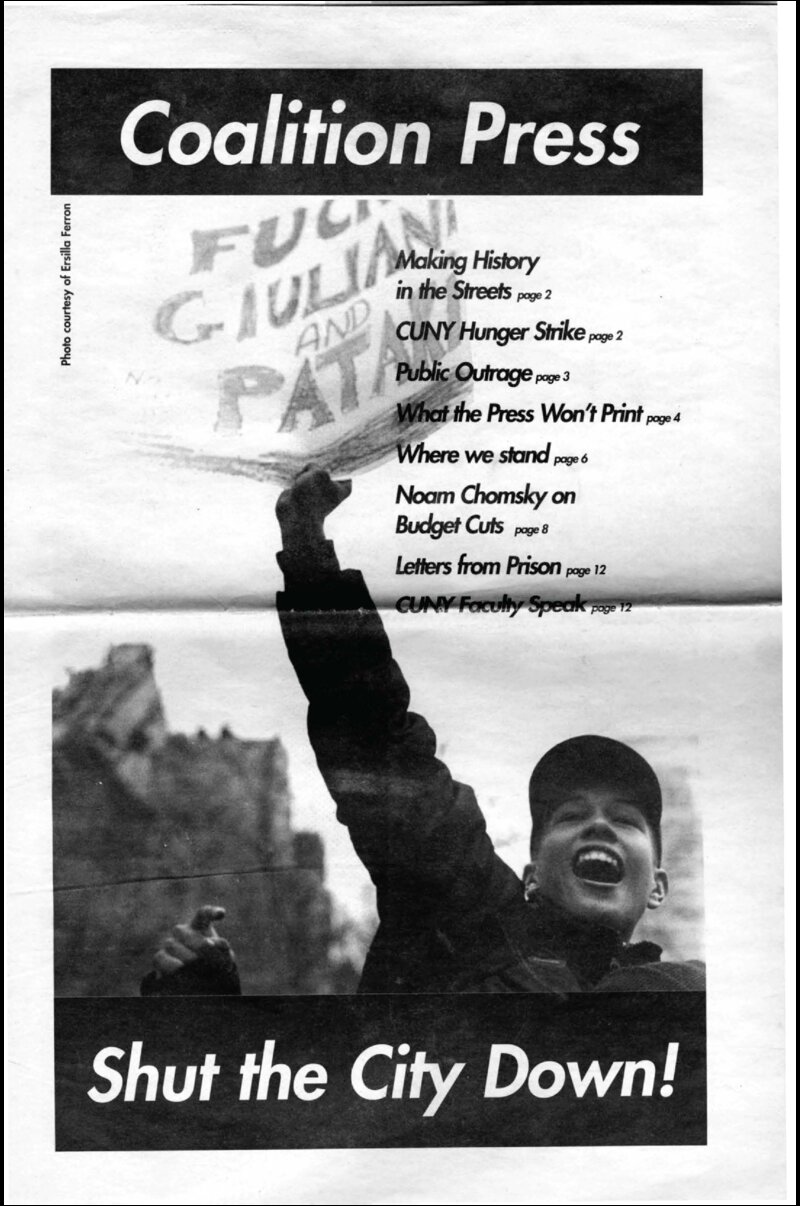
Coalition Press
2 - = :
' > * %
‘ss ¥ : fy r e °
j > ©" in the Streets poge 2
CUNY Hunger Strike pose 2
Photo courtesy of Ersilla Ferron
& ri j rUDIIC OIGE page 3
Noam Chomsky on
Letters from Prison page 12
Shut the City Down!
43 Hunger
Striking
Students
Arrested by
Campus
Security Force
RH on the scene
Tuesday, April 11, the City College securi-
ty “peace” officers arrested forty-three students
conducting a peaceful hunger strike to protest
the Governor's proposed budget cuts to the
CUNY system. The students held their hunger
strike in the open rotunda in the North
Academic Center (NAC), a
large building which is usu-
ally open to students round
the clock. Yolanda Moses,
President of City College,
entered the NAC at mid-
night to announce that the
building was closed and to
order the arrest of all stu-
dents choosing to remain
there. With media observ-
ing, the special campus
security team used their
power of arrest to cart off
the students to the 24th
Police Precinct on west 100th Street where the
fifteen women and twenty-eight men were held
all night until being released at eight o'clock in
the morning. All were charged with criminal
trespass, a misdemeanor B. Upon being
released, the students quietly returned to City
College to continue their hunger strike.
NYPD riot police had also been called
onto campus but remained outside the build-
ing. This was the first time CUNY security has
arrested students. The police-trained security
team is an innovation of Chancellor Reynolds
in response to the 1991 CUNY-wide take-
overs.
The following day President Moses
explained that she had ordered the arrests to
prevent a building takeover. However, it was
pointed out to her thot the students had made
no attempt to close the building or exclude
anyone from entering. Nevertheless, she insist-
ed that students would not be allowed to con-
tinue their hunger protest over night
The student government is housed in the
NAC building and is given permission to use
the building at all times. Among the arrested
hunger strikers were two student government
officers, Malik Small, President of the Day
Student Government (and son of CCNY
Professor James Small}, and Tyler Hemingway,
the President of the Graduate Student
Government. In solidarity with the group, they
allowed themselves to be arrested as well.
The event was covered by New York |
and WBAI, and was reported in the
Amsterdam News, El Diario, and The Village
Voice as well. The mainstream press has so far
shown litle interest.
Coalition page 2
18 Thousand
Students
Protest at City
Hall
70 Students Arrested
RH on the scene
In the largest student protest in years, twelve
thousand students swarmed over City Hall Park
on Thursday, March 23rd to protest Pataki’s
budget. CUNY students were joined by thou-
sands of high-school students and many stu-
dents from the private colleges in New York.
Although the organizers of the rally, the
CUNY Coalition against the Budget Cuts, had
announced its peaceful intentions and had
called upon the
police in letters to the
Mayor and the
Police Commissioner
to respect that peace-
ful intent, the police
— in full force of
astounding numbers
including riot police
and police mounted
on horses — were
given orders to barri-
cade the crowd in
order to forcibly pre-
vent a march out of
the City Hall area to Wall Street. Under these
orders, the police refused every attempt on the
part of groups or individuals to leave the rally
area fgr whatever reason. The police refused
even to accommodate children’s groups from
elementary schools brought by their teachers,
All exits were forcibly closed to keep the
crowd penned in.
Violence erupted when the police allowed
a small group to begin a march north onto
Chambers Street, then closed them off from the
rest of their fellow protesters, surrounded them
, and began to arrest them without warning.
Many in the group, among them a faculty
Chair from City College in cap and gown,
then sat down in sign of passive protest but
were arrested anyway
Alter the initial violence subsided, the
police at the corner of Chambers and
Broadway indicated that the demonstrators
should march to the east around City Hall. As
they proceeded to march in this direction they
encountered more police who were not
informed that the marchers had been told by
the westernmost police contingent to proceed.
These officers pushed angrily into the crowd
instigating further violence and making more
arrests. Police hit indiscriminately at women
and men, hitting one woman with a billy-club
who was loudly screaming that she was preg:
nont. Several members of the press were beat-
en and thrown to the ground. A representative
from City Council Member Tom Duane's office
was hit and shoved to the pavement and then
told to get out of the street. One police officer
was hit on his helmet with an army helmet
wielded by a student in the crowd. The officer
was knocked unconscious by this blow and
had to be dragged off by his fellows.
When this skirmish calmed and the attack-
ing police were called away, the crowd
resumed its peaceful march around City Hall.
As the marchers approached full circle at the
stage area, some gathered at the barricades
at Broadway and demanded to be allowed to
cross the street. The police gathered on the
opposite side of the barricade, shoulder to
shoulder, about four bodies deep and pushed
the barricades against the protesters who,
however, refused to give ground. Although
rally leaders using bullhorns urged the students
to back away from the barricades, students
continued to gather to help keep the barri-
cades back. The students and police engaged
in a ten minute face off with the barricade
between them. The police began to shove the
barricades over, entrapping students who were
sandwiched between their comrades on their
side and the advancing police on the other.
The situation nearly resulted in serious injuries
ironically prevented only by the escalation of
the police assault: They sprayed the crowd
with pepper gas causing sudden dispersal and
confusion in the crowd during which they
made further arrests
The crowd, which had intended to gather
peacefully and was not prepared for these
assaults, gradually backed off with the arrival
of the mounted police. Several school contin-
gents then left the park and headed to
Borough of Manhattan Community College.
There they regrouped and headed to 1 Police
Plaza where mony of the arrested students
were being held.
The protest then continued with speakers
using a small megaphone. As the speakers
walked away from the area they were arrested
for using a bullhorn without a permit. Among
the speakers arrested was the faculty Chair
from City College who had only moments
While police were running
amok in the crowd, a police
livtenant was heard yelling at
his officers “What are you
doing in the rally area?
You're not supposed fo be
here. Get back behind the
barricades!” Clearly the
police were out of control.
before been released from jail on his arrest at
the City Hall rally site. The by now modest
crowd, which contained many high-school stu-
dents, was almost outnumbered by riot police.
Observing these arrests, the group decided
that it would leave en masse to prevent any-
one from being singled out for arrest. After sev-
eral more speakers were heard, everyone
began to move towards Park Row. As night fell
the group left the area without further incident.
Public
Outrage
March 29, 1995
Honorable Rudolph Giuliani
Mayor
City Hall
New York, New York 10007
Dear Mayor Giuliani:
lam writing to express my outrage and
my extreme concern regarding the New York
City Police Department's response to student
demonstrators at Thursday, March 23rd’s
rally opposing cuts to education funding.
It is my understanding, from a number of
eyewitness accounts, including a member of
my staff who was acting as a legal observer,
that it appeared as if the vast majority of the
students arrested were randomly picked oyt
of the crowd, and some were then recklessly
assaulted by the police. Additionally, numer-
ous incidents of random strangling, macing,
choking, grabbing, and dragging of student
demonstrators and observers by police offi-
cers were witnessed. Finally, excessive police
verbal harassment of students included a
enormous amount of profanity and inappro-
priate anatomical references. Most of these
incidents came in response to peaceful
behavior by the students. From all accounts,
the violence on the parts of the demonstrators
appears to have been limited.
Because | had concerns that such inci-
dents might occur, | assigned one of my staff
to monitor the rally. While acting as a legal
observer with Rev. Timothy Mitchell of the
Ebenezer Baptist Church, he saw a young,
African American woman being dragged
and strangled by several police officers on
Chambers Street. When my assistant and the
Rev. Mitchell shouted to the police to stop
hurting the woman, Rev. Mitchell was
promptly grabbed by four police officers who
then slammed him against the side of a
police vehicle. In response to this violence,
my aide tried to communicate to the officers
that the man they were attacking was a cler-
gy member. A police officer then knocked my
aide down with his nightstick. Once on the
ground, he was told to move to the sidewalk.
Officers then promptly walked over him. For
your information, my aide has since filed a
complaint with the Civilian Complaint Review
Board.
Thomas K. Duane
Council Member, 3rd District, Manhattan
April 4, 1995
St. Mark’s
CHURCH IN-THE-BOWERY
Hon. Rudolph Giuliani
Mayor
City of New York
City Hall
New York, New York 10007
Dear Mayor Giuliani:
The members of our congregation were
distressed to witness and to hear of the
attacks on people of our City March 23,
1995 at a demonstration on behalf of
schools of the City University of New York.
We realize, of course, that the actions of
the police may have been undertaken with-
out your personal knowledge. We do, how-
ever, regret that none of your public state-
ments since March 23 seem to recognize the
nature of the assault on the Constitutional
rights of New Yorkers. We had wished for
better from someone with such a long and
distinguished legal career.
Rights of New Yorkers were violated.
Innocent citizens were beaten, attacked with
chemicals, and manhandled. Credentialed
members of the press and Legal Observers
were attacked by NYPD officers. We are
enclosing a resolution requesting what we
consider quite reasonable steps by your
Administration.
We look forward to hearing from you.
Sincerely yours,
Canon Lloyd Casson
Priest-in-Charge
A RESOLUTION
Whereas, the Congregation of st.
Markts Church in-the-Bowery has a long his-
tory of supporting the Constitutional right of
citizens to peacefully protest the actions of
government with which they disagree; and
Whereas, this Congregation also
upholds the well-recognized role of the City
University of New York in the education of
the people of our City, especially the sons
and daughters of poor, working-class, and
immigrant families who struggle to improve
their economic condition; and
Whereas, by eyewitness reports of peo-
ple of our congregation, officers of the New
York City Police Department attacked many
students and other New Yorkers who were
present at the otherwise peaceiul CUNY
demonstration on Thursday, March 23, 1995
in opposition to the unconscionable budget
cuts recommended by you and by Governor
Pataki; and
Whereas, in addition to witnessing
attacks on demonstrators, our people also
witnessed unprovoked attacks on cre-
dentialed members of the press, creden-
tialed Legal Observers from the CUNY
Law School at Queens College, and
innocent passersby;
And whereas, we believe that such
conduct by officers under the authority
of the Mayor of the City of New York
does a disservice to law and order in
this city by reinforcing many negative
stereotypes about police officers held
by many young people and by teach-
ing young people that their police are
free to violate Constitutional rights of
freedom of speech, press, and assem-
bly;
Now, therefore, be it resolved that
the Vestry of St. Mark’s Church
in-the-Bowery strongly condemns the
unprovoked violence and violations of
Constitutional Rights by the police of
the City of New York during and fol-
lowing the City Hall budget-cut protest
of Thursday, March 23, 1995;
And be it further resolved that the
Vestry strongly urges that the Mayor of
the City of New York undertake the fol-
lowing steps: (1) investigate the police
misconduct and discipline those officers
responsible; (2) direct that those citizens who
were injured by unprovoked police action be
appropriately reimbursed for damages suf-
fered; (3) offer immediate, unambiguous
assurances to the people of the City of New
York that as they carry out their lawtul rights
to assemble and protest that there be no rep-
etition of the police actions of Thursday,
March 23, 1995.
Adopted unanimously by the Vestry of
St. Mark's Church-in-the- Bowery,
New York City
April 3, 1995Brigid Allyson, Clerk of
the Vestry
Coalition page 3
CUNY Coalition Calls on Mayor and the Police
Commissioner to Commit fo Non-Violence
Press release prior to March 23rd’s rally at City Hall:
The CUNY Coalition will announce the events planned for March
23, 1995. Students from throughout the New York City area will be
striking and carrying out peaceful demonstrations to protest a 25%
reduction in spending for both the CUNY and SUNY systems, as well
as the elimination and reduction of financial aid for all university stu-
dents. The Coalition wants to avoid a repetition of the events that
took place at Hunter College on Wednesday, March 15, in which the
police dispersed a peaceful demonstration by means of force, caus-
ing one student to be hospitalized. The Coalition will demand that the
Mayor and the Police Commissioner make a commitment to denounc-
ing the use of violence against those demonstrating on that day.
In response to the hospitalizing of a Hunter College student par-
ticipating in a peaceful demonstration against the proposed cuts to
higher education, the CUNY Coalition called on Mayor Rudolph
Guiliani and Police Commissioner Bratton today to make a formal
commitment to non-violence in responding to many peaceful demon-
strations being organized by students.
Before writing to the Mayor and Bratton, the CUNY Coalition
spoke with eye wit
nesses and reviewed
press reports and
video footage of the
incident. Based upon
this review, it deter-
mined that the attack
was unprovoked and
occurred just as the
students were leaving
the area. “We said
our peace and were
moving off the street, when they rushed in and started hitting anyone
within reach.” said Jed Brandt, a Hunter College student. The
demonstration organized by the Hunter College students had about
150 participants.
The CUNY Coalition expressed its fear that the Police
Department would respond to its March 23 rally at City Hall, which
is expected to have more than 7,000 [more than 10,000 actually
appeared] participants, similarly. The CUNY Coalition’s letter asked
the Mayor and the Police Commissioner to “send a clear and
unequivocal message to your officers that violence cannot be used to
curtail this demonstration.” A commitment to non-violence has been
the CUNY Coalition’s public position, which it reiterated in its letter.
The actions of the students, the Coalition argues, is not the question.
Commenting on the Mayor's response to dissent within his administra-
tion, his attacks on the press, and response to groups opposed to his
budget cuts, the CUNY Coalition expressed its deep concern that this
Administration will respond to peaceful political dissent with violence.
“Look. We're committed to non-violence. We've trained dozens of
marshals to ensure that it stays peaceful. But if the Hunter incident is
any indication, this Mayor and Police Commissioner have decided to
use violence to suppress their political opponents”, said Alex Vitale, a
Sociology graduate student.
“Did the Mayor or the Police Commissioner respond to the beat-
ing of the Hunter student? No. They sent the signal that beating peo-
ple up who peacefully disagree with the government is OK. The
Mayor needs to reverse that message at the March 23 rally,” said
Yvonne Lassalle, a CUNY Graduate Student.
The CUNY Coalition is using the March 23 rally to focus atten-
tion on the State’s and City’s lack of commitment to providing access
to higher education, health care, social services etc. that have tradi-
tionally been the cornerstone of a free and democratic society. For
the CUNY Coalition, the current round of cuts to higher education are
a continuation of a national trend towards social and economic aus-
terity.
CUNY Coalition against the Budget Cuts
212-642-2851
Hotline 212-642-2549
Coalition page 4
March 20, 1995
Police Commissioner Bratton
One Police Plaza =|
New York, New York 10038
Dear Commissioner Bratton:
We are writing to express our deep con-
cern over the New York City Police
Department’s unprovoked attack against several
Hunter College students on Wednesday March
15, 1995. These students were participating in
a peaceful, non-violent demonstration to bring
attention to the proposed cuts to higher educo-
tion. Based upon our conversations with eye-
witnesses and our review of news reports and
video footage of the event, there can be no
doubt that the Police Officers in question
the Press
attacked the students without cause as they
were in the process of leaving the area. Such
behavior is unacceptable.
As you are well aware, the CUNY
Coalition will be holding a peaceful rally and -
march on March 23, 1995 at 12:00 P.M.,
which will convene at City Hall. The march will
proceed from City Hall to Lower Manhattan.
We expect over 7,000 students, faculty, par-
ents, union members and their leadership and
elected officials to participate in this peaceful
demonstration. Over 1,000 faculty and admin-
istrators will march separately to this demonstra-
tion via the Brooklyn Bridge walkway. Like
demonstrations organized by the CUNY
Coalition in the past, this demonstration will be
conducted peacefully.
The CUNY Coalition has made a strong
and public commitment to non-violent political
expression and has organized a large number
of well trained marshals and legal observers to
ensure that the March 23 demonstration runs
efficiently. Like the Hunter College students, the
CUNY Coalition is exercising its right to peace-
fully make its concerns and positions known.
We urge you, in the strongest terms possi-
ble, to make a public commitment to not use
violence to suppress the peaceful actions that
will occur on March 23. You must send a clear
and unequivocal message to your officers that
violence cannot be used to curtail this demon-
stration. It is imperative that the Police
Department not repeat the Hunter College inci-
dent. Acts of intimidation and violence will
only heighten the tension that has already been
created by the Police Department's previous
acts of unprovoked violence.
Sincerely,
The CUNY Coalition
A copy of this letter was also addressed to the
Mayor.
The following is a statement given to the press
on March 28, 1995
Today, March 28, students from the CUNY Coalition against the
Cuts joined other CUNY student groups, Public Advocate Mark
Green and representatives of several elected officials to hold a press
conference at the steps of City Hall. The press conference was called
to respond to Mayor Giuliani and Governor Pataki’s statements and
to media coverage of the events that took place in March 23.
The media’s coverage of our rally, with a few notable excep-
tions, seriously misrepresented the event. The media have chosen to
insist upon the isolated incidents of violence that took place.
Furthermore, the media have exaggerated and belabored the role of
the students in them. Finally, in spite of the fact that both the Mayor
and the Governor's opinions on these issues have already received
detailed treatment in the media, the media have continued to high-
light them, while consistently downplaying the demands of the
demonstrators. Just as the Mayor attempted to silence us by force,
the media has attempted to silence us in print.
First and foremost, the students demand an end to the trend of
disinvestment from CUNY, which has been intensified since 1989.
The yearly rounds of cuts CUNY put through since 1989 has meant
the budget will have been cut close to 40% in 6 years. These cuts
Students assert that the budget crisis is largely created by
State policies that cut taxes for corporations and the most
wealthy. The Governor's tax cut will amount to about a $20
tax savings for the average New Yorker, while dramatically
increasing the cost of higher education and reducing other
vital public services. Students argued that these cuts represent
a continuation of the State’s attempt to renege on its responsi-
bility to provide public goods - education, health care, social
services etc. Already New York State ranks 47th in the nation
the percentage of state taxes spending on higher education.
Students insist that the State is using public spending as a
straw man to divert attention from the current revenue shortfalls
created in large part due to the absence of a progressive tax
program. Since close to two thirds of CUNY students work
over 30 hours a week, their demand for progressive taxation
is made as workers and tax payers . Students are adamant:
the City and State must put an end to corporate welfare, and
stop reneging on their responsibilities to guarantee minimal
standards of living for New Yorkers.
(Yvonne Lasalle, CUNY Coalition against the Budget Cuts
Media Committee)
Won’t Print
undermine CUNY’s ability to fulfill its historic role of integrating
minorities and recent immigrants into the economic, cultural, and
political life of the city. They also threaten CUNY’s long-standing
record of academic excellence, which has produced more top cor-
porate executives and Nobel laureates than any other educational
institution in the country. Students want to be heard loud and clear:
full funding to meet enrollment must be provided. They will not stand
by and watch their University turned into a trade-school system.
The students’ insistence on reinstating free and open admissions
in CUNY comes from a deep-seated conviction that the state's
responsibility to guarantee equal educational access can only be
properly fulfilled through funding of public
higher education. Students believe that pro-
posals that attempt to solve fiscal problems
through the centralization of programs at
specific CUNY campuses do not address
the devastating implications this will have
on students’ educational opportunities.
These proposals also fail to take into
account the positive role that many cam-
puses play in otherwise seriously economi-
cally depressed areas. Just as deplorable is
the attack on remediation programs, for it
is the City and State’s own failure to edu-
cate at elementary and secondary levels
that creates these needs. Why should those
hurt by the government's incompetence be
punished twice?
Coalition page 5
Our Untrustworthy CUNY Board of
Trustees: At the Source of CUNY’s
Troubles
Andrew Long
What many people have to understand,
especially liberals, is that any discussion of
the CUNY Board of Trustees and the policies
they implement is also, necessarily, a discus-
sion of finance capital and the privatization
of public debt and assets, notably our col-
Mayors, from 1989 to 1993, CUNY lost
$200 million in funding. We can’t get rid of
this board, whom one state Senate aide
likened to Giuliani in the way the way they
lose state funding.
Still, the stench gets stronger. With
regard to the information above consider that
James Murphy, the chairman of the board, is
also a vice president for the Fleet Financial
Group. This bank is one of the largest in the
region, and has supported many upstate
WHuereE WE STAND:
leges and our educations. The New York City
and state budgets (and this goes for the
Federal budget too) are finally determined
around the question of public debt service,
incurred through the issuance of municipal
and state bonds. The School Construction
Authority, the Urban Development
Corporation, the Port Authority, and the NYS
Dormitory Authority are a few examples.
Much of this money goes toward the construc-
tion of large buildings or public works, such
as the Javits Center. When CUNY builds a
new building, for example, the debt is
financed by the Dormitory Authority.
What we must understand about this
debt is that the authorities which are responsi-
1
meta it, that is, for its incurrance and for its
—— et, elected, but are appointed
«7 né New York State Governor and the
Mayor of New York. In fact, the State of
New York and the City cannot incur debt
without a referendum. In the early 1960s a
New York lawyer, John Mitchell (yes, of
Watergate infamy) worked out this plan to
sidestep these public debt laws by setting up
these authorities which are not bound by the
law, and yet, can act in the name of the state.
This “right” was affirmed when the UDC went
bust and a court of appeal decided that the
state had a “moral” obligation to pay off the
UDC debt. So, working class and middle
class tax payers (clearly the same thing) pay
debt service for a debt they did not vote for
and cannot control. Remember, New York
State does not have a progressive tax, but
rather one which favors corporations, which
pay less and less these days, as well as the
wealthiest residents of the state. Consider
also that the wealthy individuals who buy this
debt from the financial houses which sell it,
Lazard Freres and Fleet Financial Group, for
example, receive interest payments which are
exempt from city, state, and federal taxes.
They get you coming and going.
And so with the CUNY Board of Trustees.
There are 13 trustees appointed by the
Governor and the Mayor to terms of varying
lengths. There is also an ex-officio trustee for
the faculty, Sandi Cooper, who does not have
a vote, and one for CUNY students. The stu-
dent trustee is the chair of the University
Student Senate, Anthony Giordano, and he
does have a vote. Of the 13 current trustees
most were appointed by Cuomo, Koch, and
Dinkins, and that’s where liberals get a lump
in their throats. Consider that this group of
trustees selected Ann Reynolds as the CUNY
Chancellor, raised tuition, and has now
declared fiscal exigency. Moreover, while
this group of trustees was in power, again,
appointed by our liberal Governor and
Coalition page 6
Republicans, and in 1993 supported Liz
Holtzman’s candidacy for the U.S. Senate
with a $450,000 donation. This is notable
because Holtzman was then the City
Comptroller and chose Fleet as the under-
writer for, yes, municipal bonds. The scandal
forced the otherwise quiet and stately Murphy
into the limelight, and showed what kind of
financial rodent he really is. How can a man
whose job is about private profit from public
debt sit on our Board. What about a conflict
of interest?
The next suspect is Michael Del Giudice,
who worked for State Assemblyman Stanley
Steingut and is now a general partner with
Lazard Freres. Lazard Freres also traffics in
public debt, particularly through Felix
Assistance Corporation. Del Giudice also
emerged to the light of day for his role on the
quasi-public body known as the Hudson River
Park Conservancy. This group wants to take
the Westway land and do the usual (private)
development. Lazard Freres owns several
large plots of land in the 30s. Tanning on the
piers at Christopher Street or taking a stroll
by the Hudson, has assumed an immense,
and expensive, political significance. Their
plan includes private residential units and
commercial spaces which will block public
access to the waterfront. Michael Del
Giudice should not be on our board, again,
due to a conflict of interest.
Finally, we get to William Howard.
Although he is African American, he has
always acceded to the racist caricatures of
CUNY students, and never spoken out against
the press and his fellow trustees when they
have gone “wilding”. Howard is currently
employed by the New York State Banking
Department, though his past includes stints
with various banks and insurance companies,
notably with the New York branch of the
Bank of Credit and Commerce (BCCI) the
bank that was manipulated by the CIA to
fund various dictators around the world incld-
ing the Saudi regime. They finally feeced
their smaller and poorer investors in the
Middle East when they bellied up and were
eventually closed.
The point is that the CUNY Board of
Trustees is about big money, as we know
from the budget debate. CUNY is a signifi-
cant portion of the budget, and if your profes-
sional obligations lead you to argue for a
good credit rating with Standard and Poor’s
as well as debt service, then you will not sup-
port increases for public institutions like
CUNY, unless there is some profit to be
made. What we need is an accountable
board with some conflict of interest guide-
lines.
The Historical Mission of CUNY
The CUNY Coalition against the Budget
Cuts supports both the original mission
behind the establishment of City College in
1847 and the Open Admission Policy estab-
lished in 1969.
The establishment of City College in
1847 as a free tuition academy reflected a
democratic vision that viewed the university as
the foundation for a democratic polity, Our
goal at the CUNY Coalition is to restore that
vision, A democratic polity requires both edu-
cated citizens and visionary leaders. The
City University of New York was established
to serve these functions. In the original vision
of the establishment of CUNY, the University
was to be the measure of the degree to which
culture is democratically disseminated
throughout the City. A progressive, dynamic
culture depends upon the University as the
site of new forms of knowledge production
and cultural resources that foster the develop-
ment of the free individual and a critical citi-
zenry. The CUNY Coalition supports this
democratic vision and will fight to uphold it.
We see the attack on CUNY as an attack on
democracy.
The democratic promise of a University
cannot be fulfilled unless we have a way of
ensuring that the University students reflect the
qualities of the citizens of the City as a
whole.
CUNY has been an effective force in
ensuring that the working poor, women and
so-called “minorities” are able to participate
in the democratic polity of New York. The
Open Admissions Policy established in 1969
place in a democratic polity nor in a public
university. African American and Puerto
Rican students who organized the student
strikes of 1969 that were instrumental in the
establishment of the Open Admissions Policy,
realized that they represented the changing
face of New York. The CUNY Coalition sup-
ports their historic victory and the results of
that victory. By 1971, enrollment of students
of color increased by 24% at the senior col-
leges and 36% at the community colleges.
The CUNY Coalition would not be here today
if it were not for the visionary foresight of
those students from 1969. We define our
struggle in part as a continuation of their fight
for democracy.
The City University of New York is the
only guarantee we have of maintaining a
democratic polity in New York. CUNY is a
precious cultural resource. The citizens of
New York cannot afford to place their future
in the hand of reactionary forces that threaten
democracy. CUNY is the best mechanism we
have, as citizens in a free society, of overcom-
ing the serious class, race and gender divi-
sions that have plagued the history of our
country. To uphold CUNY and to foster the
growth of CUNY is to further the development
of democracy. words:505
The Virtue of Remedial Programs at CUNY
Rob Hollander
CUNY is regularly attacked for offering
remedial courses in English language skills
and mathematics. Remedial offerings, it is
claimed, compromise CUNY’s reputation by
lowering academic standards in the curricu-
lum. A level of proficiency should be a pre-
requisite of admission to an institution of high-
er learning, say such critics as our own Board
of Trustees member Hermann Badillo. Those
without required skills should not be admitted.
The attack on remediation is, in other words,
an attack on open admissions.
The argument against remediation con-
tains a simple fallacy and is further confused
by the irresponsibility of CUNY’s critics and
the subterfuge of their political ends. That a
university can only be judged by the lowest
end of its curriculum is simply false. Offering
remediation at CUNY in no way compromises
its higher level offerings. The mere presence
of remediation cannot prevent dedicated stu-
dents from obtaining the high quality educa-
tion CUNY has provided for decades. On the
contrary, remediation brings that oppor-
tunity to many dedicated but underprivi-
leged students who otherwise would be
unable to take advantage of it.
By offering remedial courses,
CUNY broadens its curriculum to pro-
vide a service unavailable in our failed
public high-school system. If New
Yorkers cannot learn to read and write
in the distracting drug- and weapons-
filled public high-school environment,
why shouldn't they be taught in an envi-
ronment conducive to learning? The
high-schools are filled with very young
kids struggling to grow-up under our
society's most adverse conditions. It’s
no wonder so little actual learning hap-
pens there. The CUNY colleges, howev-
er, are filled with serious working adults
(75% of CUNY students work, 33% full-
time) who have chosen to put some
direction in their lives. College is about
learning, thinking, questioning, sharing
knowledge, expanding horizons, and
working hard — very hard — to keep
up and to get ahead. Drugs and vio-
lence are not a part of the scene. The
role models are professors, not drug
dealers. The college environment is
exactly where we want our kids to be
even if it's just to learn to multiply frac-
tions and read o newspaper.
Those who wish to eliminate reme-
dial courses offer no responsible alter-
native to them. If our young people are
not to learn basic skills in college, and
cannot learn them in high-school, what third
alternative is there? Are we to consign an
entire segment of our society to illiteracy? Is it
to the benefit of this city that many of it’s citi-
zens cannot read a newspaper to inform
themselves of what is happening around them
and to them? Does anyone really think that
the answer to our urban woes is educational
ghettoization? Not having an informed and
critical citizenry may be in the interest of
those who wish to maintain a stranglehold on
political power, but it is not to the advantage
of society at large. The members of civil soci-
ety must be educated and informed or they
will not have the wherewithal to bring them-
selves successfully into the future. Self-determi-
nation cannot be replaced by paternalism, as
our current administration well proves.
The City University is and should be
unlike any other university: New York is unlike
any other town. New Yorkers must understand
that remediation is not a danger to CUNY.
They must recognize the crucial need among
the young of the inner city for remedial offer-
ings, and they must recognize that the inte-
grated college environment is the best place
for a remedial program.
The Governor's proposed budget will do
more harm to CUNY's reputation, standing,
and standards than the presence of remedial
programs ever could. Tenured faculty will be
fired, making it increasingly difficult to attract
high-quality teachers to come here in the
future, knowing that tenure means nothing at
CUNY. Professors’ burdens will also increase.
Downsizing will force professors to travel
from campus to campus, making the job even
less attractive.
Let's stop worrying about how the fulfill
ment of CUNY’s mission will affect the mainte-
nance of its academic standards. CUNY has
proven time and again that an institution of
higher learning need not be elite and exclu-
sionary to offer the highest possible quality of
education. It cannot continue to do that without
reasonable funding. The down-sizing of CUNY
is not the solution to the problem of declining
standards, it is the sole cause of the problem.
CUNY COALITION AGAINST THE BUDGET
Cuts
DEMANDS
No BUDGET CUTS
No TUITION HIKES
Save TAP AND EQUAL OPPORTUNITY PRO-
GRAMS (SEEK HEOP)
RESTORE LITERACY PROGRAMS
RESTORE OPEN ADMISSIONS
FULL FUNDING TO MEET ENROLLMENT
TAX WALL STREET TO FUND OUR SCHOOLS
CANCEL THE DEBT
No DISCIPLINARY ACTIONS TAKEN IN ANY
STAFF ORGANIZING AGAINST THE CUTS:
COMPLETE IMMUNITY FOR ALL
Who We are and Why We are Important to
New York
Christopher J.Malone
“Maybe instead of protesting...go and
find a job for a day so you'd make a little
extra money so you could pay for your edu-
cation.”
- Mayor Rudy Giuliani, on the March
23rd Protest
Once again, Giuliani has erred. This
time it is especially egregious, since his petu-
lant comments made in the wake of the
March 23rd student protest were so far off
the mark that the mind boggles to think they
came from the lips of a politician who claims
to understand New York. Well, in this mean
season of debate over education, we might
stop to do some educating ourselves - please,
pay attention Rudy.
First of all, CUNY students work. Period.
In larger numbers than most higher education
school systems. 31.7% of students at senior
colleges work full time; 32.4% of community
college students work full time. Two thirds of
all CUNY students work over 20 hours per
_ week. And over 75% of all students in the
CUNY system hold down some kind of job
outside of school.
Why do we work? Quite simply, because
we have to. Consider this: 91% of the stu-
dents at Hostos College, for instance, live
below the poverty line. Half of all CUNY stu-
dents have family incomes below $22,000.
Over 80% of all senior college students come
from families earning less than $50,000;
nearly 90% of community college students
come from families earning less than
$50,000.
In short, if there is anyone who under-
stands the realities as well as the importance
of work, it is the CUNY student and her/his
family who comprise the working poor and
lower middle class of New York City.
In addition, CUNY is one of the most eth-
nically diversified colleges in the
world. 32% of CUNY students are
African American; 30% are White;
26% are Latino; and about 11% are
Asian. 60% of senior college students
are female, while 65% of community
colleges are female.
If our Mayor cannot quite under-
stand who we are at CUNY, then per-
haps he might understand what we
mean to the New York economy.
The tax revenues: CUNY gradu-
ates pay $414 million more in State
and City taxes each yeor than they
would pay had they not gone to col-
lege. In addition, CUNY employees
pay another $63 million per year in
State and City sales and income tox.
The expenditures: The direct eco-
nomic impact of CUNY on New York,
adding up all the direct expenditures
attributable to the system, totals nearly
$6 billion. This includes: about $1 bil-
lion a year spent by students while in
college; $3.9 billion spent by the grad-
vates from the years 1970-1993 that
they would not have spent had they
not gone to college; $167 million in
university expenditures; $170 million
in construction; $521 million in
employee expenditures
Now, take this expenditure figure
and multiply it by 2.1 - the factor pro-
vided by the U.S. Department of
Commerce which is used to account for addi-
tional economic impact that results from re-
spending after original expenditures - and
you get a total economic impact of CUNY on
New York of $12.1 billion, 9 times the annu-
al CUNY budget.
If 40 jobs are created for each million
dollars pumped into the New York economy
(Department of Commerce estimates), this
means that CUNY necessarily leads to the
creation of 484,000 New York jobs.
Combine this with the 25,000 CUNY employ-
ees, and that is over a half-million jobs gen-
Pataki and Giuliani want to cut back on
funding for education. Apparently they need
a little educating themselves. If they do not
want a lesson in either the social demograph-
ics of CUNY students or the financial impact
of the CUNY system, then perhaps finally they
might prefer the humanities. | have in mind a
quote from a German poet, Goethe, they
might consider as they go about their mind-
less business: “There is nothing more frightful
than to see ignorance in action.”
Coalition page 7
NOAM CHOMSKY: AN INTERVIEW
Noam Chomsky, one of the most respected voices on the left today, an early outspoken critic of the war in Vietnam,
was blacklisted throughout New York media for his sharp criticism of U.S. support of the State of Isreal. He currently
holds a Distinguished Chair at MIT where he teaches linguistics, a field he revolutionized in 1957 with his book Syntactic
Structures. His recent political publications include Manufacturing Consent, a critique of corporate control of U.S. media.
He is interviewed by Bryan Lesseraux, one of the eight Hunter students arrested for peaceful protest on March 18th,
and also one of the hunger strikers arrested at CCNY.
L:To begin with, do you consider the US to be a democratic
society? If not, what is not democratic about it?
C: Well, democracy isn’t o matter of yes or no, it’s a matter of mony dimensions.
Countries can vary on those dimensions in a whole bunch of different ways. In some
respects the US is a very free society and a very democratic society. People are free
from state control and violence here to an unusual degree. There's freedom of speech
here to a unique degree. You have the formal right to participate in elections. All of
these things are things which have been fought for and are worth achieving and
maintaining. And they're steps towards a democratic society.
On the other hand it’s a society with a deeply totalitarian character in many
respects. It's a business-run society. Since early in this century, private corporate pow-
ers — which are really just tyranny — have gained enormous privilege and power
over the society, the economy and, by now, the international economy. It’s not just
here, but it’s strikingly here. These are powers which are not in the constitution. They
were never given by legislation. They were fixed by courts and lawyers primarily. It's
just a form of tyranny. It was strongly opposed in its very early days by American lib-
ertarians, people like Thomas Jefferson, as it was even opposed by Adam Smith, who
barely could see it in his day. It very much narrows the actual functioning of democra-
cy.
Furthermore, there’s the matter of propaganda. The leading scholar of corporate
propaganda—there are a few, not many people study it, but it’s a crucially important
topic—the leading scholar, Alex Carey pointed out in one of his essays that there are
three major developments in the 20th century: one is the growth of democracy, two is
the growth of corporations, three is the growth of corporate propaganda in order to
prevent democracy from functioning. This is very conscious. It’s particularly true in the
United States where there is a very class-conscious business class and, for all kinds of
historical reasons, this is a uniquely business-un society.
The public relations industry is a US invention and it is designed, as its leaders
say, to control the public mind; to win “the everlasting battle for the minds of men.”
And it puts huge resources into this for obvious reasons—it wants to protect privilege
and power. The corporate media are just one part of it. Our educational institutions
are another. The scale of these efforts is really staggering. It ranges from everything
from television and cinema to books, articles, media, classes—it goes right across the
spectrum—sports events, recreation, churches. There is no institution in the US that
hasn’t been under corporate attack as an effort to win the everlasting battle for the
minds of men. They've spent a huge amount of money and it has changed the coun-
try. It's one reason, | think, why this country is so far off the spectrum on issue after
issue. | mean, we're the only industrial country that doesn’t have a health care sys-
tem. We're the only industrial country where the working class is so weak and beaten
down. It’s the only country in the industrial world where there’s such a level of reli-
gious fanaticism. It’s extraordinary, the US is off the spectrum in this respect; there are
cults all over the place. It’s just a very strange society. | think in large measure, not
totally, but in large measure, it is attributable to this [corporate propaganda].
Also, the intellectual culture is extremely narrow and very conformist. | don’t want
to exaggerate, it’s not all that different in other countries, but it’s unique here. It’s par-
ticularly dramatic because it’s such a free society. So it’s a kind of voluntary totalitari-
anism. People aren't doing it becouse they're afraid they're going to be sent to the
gulogs.
So you've got a very complicated situation with many positive things and many
very negative things. And there have been struggles over this for wo hundred years.
It doesn’t just take shape. This is the outcome of many struggles, some of which have
been won, some of which have been lost by the general population. And you end up
with the thing that you see when you look out the window; New York is an extremely
ich city, probably the richest in the world, and it’s a third world city. Large parts of
the population are living in third world levels of misery.
L: Since this interview will be published in student newspapers, let me ask you a
question about academia. | think that, ideally, the role of the academic should be
about giving to society an original, forwardooking and transformative vision of the
world. Is that even possible in the US considering the conditions you've just men-
tioned?
C: Well, there are people who try to do that but they're weeded out. In fact,
they're weeded out from kindergarten. The educational system has institutional prop-
Coalition page 8
erties and one of them is to try to instill obedience and conformism.
Now, this is never one hundred percent successful. There are all kinds
of people who escape it and go on to do remarkable things, but it’s
never easy. The general pattern of privilege and punishment is such that
the outcome, to a very large extent, is conformism, obedience and so
on.
Now, there are differences. For example, the natural sciences ore
different. If you instill conformism and obedience in the natural sciences
or mathematics, they just die. In the fields that are not so closely con-
nected to ideological control and domination there is a much greater
tendency to support and stimulate creativity and independence of
thought. But not in fields that matter for ideological management and
control, Now again, this is not a hundred percent. But the tendencies
are, | think, fairly clear. | see it very clearly from right where I'm sitting
[Chomsky is speaking from his home in Massachusetts near MIT,} I'll
compare two of the world’s leading universities which are within a mile
or two of each other where I've lived all of my adult life. One is
Harvard, the other is MIT. MIT is o science-bosed university. Harvard is
a sort of humanities-based university. Each has the other, of course, but
those are the centers. MIT is politically, | suppose, much more conserva-
tive. But for someone like me, MIT is a far more hospitable environment
than Harvard. | get along fine at MIT. People are often very reactionary
(at MIT), but at Harvard | couldn't survive for a minute. [Chomsky is
interrupted momentarily by a phone call.]
L: Before getting off the topic we were discussing, let me read you
@ question that was prepared by a friend of mine which ties right in
with this discussion: Real democracy requires substantial preparation on
the part of large sectors of the population—people must be able to take
over the management of public affairs and make decisions about pro-
duction, distribution, investment, etc. However, the educational system,
primary and secondary school, are designed to instill submissiveness,
apathy, and obedience to authority; to impose regimentation and con-
trol; and to snuff out creativity and curiosity which are necessary for
participation in public life. How badly does this affect the process of
democratization? Is it even possible in this context?
C: Sure, it's possible. We're the richest country in the world. Let's
take the poorest country in the hemisphere, one of the poorest countries
in the world, Haiti. People in Haiti live under conditions which we can’t
even imagine. I'm talking about ninety percent of Haitians, not the few
who live up in the hills and have super wealth. The peasants of Haiti
and people living in Haitian slums succeeded a couple of years ago in
creating the basis for a democratic society. They created grassroots
movements, unions, associations and so on. They had no resources;
they were living in real misery. Yet, they created a lively, vibrant, civil
society which swept their own President into office to everyone's
amazement and shock. Then they had to be crushed by force, in which
we helped. You read in the newspapers that we have to go to Haiti
and teach them about democracy. You can only collapse in ridicule
when you read that. We need to go to Haiti to learn something about
democracy. Again, it’s a sign of the totalitarian streak in the intellectual
culture that people can’t see that. Many educated people could hardly
understand what | just said, although, if you look at it, it’s quite obvi-
ous. [The Haitian people] didn’t have a great educational system, you
con be sure of that. If they can [create a democratic society], we can
do it.
In fact, this has happened all through history. Take a look at the
formation of unions, They're one of the major democratizing forces in
modern industrial society. They support the creation of rights and so on
Take a county right next door, one that is very much like us, Canada,
One of the reasons why they have a functioning health care system and
other social programs is because they had a strong labor movement
That's where it comes from. Well, who formed the labor movement?
People who went to Harvard? No, it was the workers struggling on the
steel strike lines creating democracy.
So sure, we have to understand what the institutions [which prevent
democracy] are, although most of us are very privileged people: we
have all kinds of opportunities that most people don’t hove. If we
decide to use those privilages, fine. If not, too bad for the world.
L: What are the possibilities for achieving
non-violent social change which might lead to
meaningful democracy? Developments which
threaten to change the way power is distrib-
uted might be expected to provoke resistance
from the “ruling class”. Is it therefore even
possible to achieve change within a non-vio-
lent framework?
C: Nobody knows the answer to that.
Look, you can’t predict tomorrow's weather.
To try to predict the result of social struggles is
completely hopeless. A rational person will try
to push non-violent methods to their limits.
Nobody wants violence if they're sane. So
you try to achieve what you can by organiz-
ing people to create more
democratic and just forms. If
those efforts are resisted by
violence, well, then you have
to ask yourself the question,
“Do we undertake self-
defense through violence or
no?” That's basically the
question.
L: This may be a bit out
of theme, but what you are
saying makes me think of the
situation in Chiappas. Any
violence on the part of the
Zapatistas was used as a last
resort
C; Incidentally, it was not
a violent movement. They
happen to hold guns, but they're not particu-
larly violent. In fact, they’re mostly resisting
violence. Now you can ask whether that’s
right or wrong, | happen to think it’s right, but
that’s another question.
L: Right, here's a situation where ormed
struggle was turned to as a last resort. It
seems to be a very just movement. The orga-
nization is very democratic. They have a kind
of bottom-up way of organizing. They seem to
be abiding by the rules of the Geneva con-
vention. They're not killing enemy prisoners or
running around slaughtering innocent people.
There’s a lot less violence there than in Peru.
C: There’s no question. If you're thinking
of Shining Path it’s not even close.
L: You would think that this would be
something that could really inspire people.
You have a lot of Mexican immigrants living
in very poor conditions here in the US. Those
whom I’ve spoken to are very much in sup-
port of the Zapatistas. Plus you have a lot of
groups on the Left who have been waiting for
a revolution close to home. Human Rights
groups and foreign journalists are saying that
whatever atrocities there were in Chiappas
were committed by the government and not
the EZLN. | wonder why this isn’t galvanizing
large groups of people in this time of crisis. It
would seem to be an excellent model for peo-
ple to follow.
C: Well, it did. The way the government
reacted to the Zapatista movement when it
finally broke—they knew it was there before-
hand but I'm talking about once it became
public—they reacted very violently and then
they backed off. And the reason they backed
off is because they were afraid that Mexico
was going to blow up. They had too much
support. Maybe people didn’t support every-
thing they were doing but they were in sym-
pathy with a good bit of what they were up
to. So you had huge demonstrations in
Mexico City, and it just happened again May
1. One respect in which the United States is
off the map is that nobody knows what May
1 is. Everywhere else in the world people
know what it is. I a labor holiday in solidari-
ty with the struggles of American workers.
You have to look very far to find somebody
who knows this. One of the enormous propa-
ganda successes in the United States is that
even that has been driven out of peoples
heads. But elsewhere they know it and on
May Day in Mexico there were big anti-gov-
ernment demonstrations, which is kind of
unusual. They have a kind of Stalinist-style
union which usually controls the thing, but not
this time. ...S0, why didn’t it galvanize peo-
ple? It did galvanize a lot of people-
L: | was referring to here in the US,
specifically.
C: It did here too. There's a lot of interest
BY BRYAN LESSERAUX
in it on the Left. A lot of people went down to
the convention [in Mexico City]. It doesn’t get
around here, partly because the Left has no
resources. If you want to get information
around you have to be part of some network.
But if you read the Left journals like Z
Magazine or In These Times, it was there.
People were interested, but in order to “galva-
nize” the Left there has to be a Left. And
while there are plenty of people, and a lot of
them are doing very important things, they're
very scattered and very isolated. That's the
effect of atomizing people. The major effort of
the whole advertising, propaganda system
has been to separate people from one anoth-
er, to turn them into atoms of consumption—
just you and the tube, that’s the perfect
arrangement. And when you get to that
stage, people aren't in contact, they don’t
know what it means to work together and so
on,
L: Let me ask you a question about the
cuts to education and also to social services,
here in New York and throughout the country.
Who, generally, do you think is going to ben-
efit from these cuts? In whose interests are
they?
C: (He laughs) Well, | share everyone
else’s opinion. It’s not even an opinion. The
New York Times pointed out a few days ago
in an article about the Giuliani budget, and if
you look you'll find, buried in the article
somewhere, this sentence, “all tax cuts benefit
businesses.” The cuts that are made in things
like education and transport and health and
so on, those are taxes. They don’t call them
taxes. But if you cut down public support for
transportation, you're increasing the cost of
transportation. Now that’s a tax. You may not
call it a tax but that’s exactly what it is. It’s a
transfer of public funds to the state, to govern-
ment authorities. That's what a tax is. But it’s
very regressive tax. It’s a tax paid by the
poor for the benefit of the rich. The rich bene-
fit when poor people take subways. If poor
people didn’t take subways they wouldn't be
able to drive their limousines or take taxi cabs.
| don’t know if you were around for the last
subway strike—well, you're too young—but
you couldn't live in New York. So the rich
gain by having people take subways, but they
don’t want to pay for it. They want poor peo-
ple to pay for it and pay through the nose.
Rich people do what | did when | went down
to NYU the other day [to give a lecture enti-
tled, “Bringing the Third World Home".] They
come by airplane and spend three hundred
dollars to get from Boston to New York and
back. Now that’s not for the folks downtown.
Well who pays for the airplane? The public
pays. They pay for the cost of building them,
they pay for the maintenance of the airport
and so on. So those things stay up. A good
part of the Pentagon budget is for that, plus
other things
The same is true of tuition at CUNY. It’s a
tax! It’s a civic institu-
tion, you're putting
funds, in this case,
into the city govern-
ment, and the idea is
to make the poor
people pay for it.
They call this “cutting
taxes”. It’s not, it’s just
redistributing taxes,
It's redistributing them
and making them
even more regressive
than they are
And it’s nice of
Giuliani to say pub-
licly what everybody
knew all along—that
he’s trying to drive
poor people out of the city. New York is sup-
posed to be a city for rich folk, not for ordi-
nary people. It used to be a working class
city. The manufacturing base was destroyed. It
didn’t just disappear. It was destroyed by
social planning and investment and destroying
factories and building high-rises and so on.
This is all social planning designed to turn it
into a city for investment bankers, corporate
lawyers and so on and so forth, and Giuliani
is just pursuing it a step further. There’s a good
book on this by Robert Fitch called, The
Assassination of New York that gives you
some of the background. It’s all just continuing
right now in front of our eyes. And the whole
budget is just an illustration of this, down to
the tiny details.
In this respect it’s like the Gingrich
Contract, which is just a way of redistributing
power, even more, towards the rich and away
from the poor. Poor means here most of the
population, mind you. I'm not talking about
slum dwellers, I'm talking about eighty percent
of the population.
L: Yet, we're being told, and most people
seem to believe, that these cuts are inevitable,
that there simply isn’t enough money available
for social spending, that we have to cut back
now in order not to get our economy into fur-
ther trouble.
C: Why are they inevitable? New York
has got money coming out of its ears. Pick up
the May 15 issue of Fortune magazine. |
haven't seen it yet but I’m willing to guess that,
in their article on the Fortune 500, they're
going to be euphoric about the rate of profits.
That money is there. Look at the financial insti-
tutions, take a walk down Madison Avenue.
Does it look poor? There’s plenty of money
around. The idea is to just put it into the pock-
ets of rich people even more and to make
poor people, the general population, suffer
even more. There’s nothing inevitable about
budget cuts. It’s a decision to tax the general
population for the benefit of the rich.
L: | think that people are beginning to
realize that, in fighting against these cuts, it
Coalition page 9
is futile to fight only for o particular group,
such as students. | think people now see that
these cuts hit us all in many different areas
and that it is necessary to start uniting with
other groups out there.
C: Now that's interesting. | noticed a sort
of striking asymmetry about that when | was
down at NYU. | was in contact with the
Clerical and Technical Workers Union. They
gave me some of their literature and, in fact, |
talked about it at the conference. They are
calling for working together with students. But
| didn’t here students talking about working
together with them. This is just an example.
The idea of reaching out is not hard. There
are plenty of people that want to reach out.
L; Well, at Hunter, and at some of the
other CUNY schools, we've reached out in
the sense that we've had demonstrations
alongside 1199, the Health and Hospitals
Workers Union; and also the Transit Workers
Union. Reverend Al Sharpton wos also
involved in the April 4 demonstration. We've
gotten together for the purpose of a demon-
stration, but not in terms of something long
term.
C: Well, that’s what has to be devel-
oped. What we're missing in the country, in
fact, what's been shattered is cooperative
work among community groups and labor
groups and student interest groups and so on,
who basically all have the same interests.
That has got to be rebuilt. It was shattered by
plan.
let's take, say, the unions. They didn’t
just disappear, they were killed. During the
Reagan years, for example. Business Week
had a very good article about a year ago in
which they described the way the Reagan
administration, cooperating with owners and
investors, simply carried out completely crimi-
nal actions—Business Week described them
that way—to destroy the unions. For example,
there are laws about firing labor organizers.
But the Reagan administration told business
enterprises that they would not apply the
laws, that it was fine to fire labor organizers.
As a result the unions declined severely. They
stopped enforcing the OSHA regulations—the
safety and health regulations. So, industrial
accidents shot up. The social policy was
designed to drive down wages. That drives
two members of the family into working with
low wages, with much higher hours and no
benefits. And an awful lot of them, about
twenty five percent, ore parttime. This is all
social policy and it has had its effects along-
side all the other stuff. And it’s got to be
reversed, there’s nothing automatic about it.
L: Do you think what we're facing here,
with the city and state budget cuts to CUNY
and other programs and institutions, are a
local version of what's going on with third
world countries forced to undergo austerity
measures?
C: Sure, it’s exactly that.
L: know that some of the same institu-
tions are profiting from both situations. Chase
Manhattan bank, for example, has interests in
both CUNY and the Mexican economy. Is this
indicative of what's going on? Are the same
institutions profiting from both situations?
C: Sure. I've been writing about this for
a long time. Look, there’s been about a centu-
ry and a half of struggle in which people
tried to gain some kind of decent social con-
tract. There was a time, not very long ago in
fact, where the great mass of working people
simply wanted to take over industry. They did-
n't see any reason why they should be subor-
Coalition page 10
dinated to orders from authorities. This wasn’t
very far back, incidentally. But by about the
1920's that was declining. In recent years,
and also in Europe and elsewhere, there has
been a kind of a social contract established
in which privilege and power is maintained,
but with certain conditions—adequate stan-
dards of living, health care, workers rights
and so on, Some kind of contract like that
was established differently in different coun-
tries. And it didn’t just come, there was a lot
of struggle involved. In the United States, in
particular, it was very violent. The United
States had a much more violent labor history
than any other industrialized country, and it
was last to get these rights. [These rights]
have been on hold since about the 1950's
and, in the United States, actually reversed.
Starting from about the 1970's there has
been what you can only call a “rollback”
going on. The effort has been to rollback the
whole thing and drive the society back to
what the dream always was; namely, that (the
US) would be a third world society at home
just as it is abroad. And that’s exactly what's
been happening very dramatically in the last
fifteen years. The current goings-on in
Washington and in City Hall and Albany in
New York are just a part of it. They're an
acceleration of it. It’s very much like structural
adjustment. All of these programs have very
standard features: morket discipline for poor
people, plenty of privilege and power and
state subsidies for rich people—of course,
nobody believes in the market for themselves.
B: | want to ask you about a response
you gave to one of the questions | asked you
after your lecture at NYU. You said that pres-
suring legislators through letter-writing and
whatnot does help, that it does make some
changes.
C: It can often make a lot of changes.
B: OK, but the democrats have been cut-
ting social services for a long time also. You
see that with Morio Cuomo, he cut everything
with the exception of the cops. And they
aren't proposing any real alternatives-
C: Well, make them do it. Either make
them do it or throw them out. That's the way
democracy works, you make them do it or
you throw them out.
L: But in our two-party system both par-
ties are beholden to the same interests.
C: Yes, they are, but that’s because we
don’t do anything about it. Remember, there's
one group that’s fighting a bitter, unending,
self-conscious, class war. And if they're the
only ones fighting it they're going to run the
whole political system. It’s pretty simple.
L: So, what are the best steps to take,
voter registration drives, trying to get people
to write letters, protesting in the streets?
C: Everything. Everything is a step to
take. You organize people; you get them to
go on demonstrations; you get them to form
political clubs; you then get them to beat on
the doors of their legislators and the editorial
offices; to set up their own newspapers; to
make a third party if that's necessary, actual-
ly, a second party would be more honest; you
form unions. It’s all the right thing to do. All of
it is right. There are questions of tactics,
where you put your efforts. That you just
decide. That | can’t tell you. But all of these
efforts are the right ones.
Look, if you were on the other side of the
barricades, sitting in some corporate board
room, and the question came up, “Where
should we put our efforts, controlling the
media, creating artificial wants through adver-
tising so people get hooked, cutting down the
mass transport system?”—the answer would
be everywhere.
L: Historically, or at least within the last
century or so, what do you see as having
been the most successful student movement in
terms of affecting long-term change, in help-
ing to create more lasting, democratic institu-
tions. What student movement could serve as
@ model for students now?
C: There are no models, you have to
make up your own models. First of all, stu-
dents are a transitory group. They're nota
fixed social group. You go through your stu-
dent years. Furthermore, students are young,
so they're kind of marginal within the social
system. And they're under a lot of pressure;
you've got to shape up or you might get
kicked out—like everybody else. Although stu-
dents happen to be a lot freer than every-
body else, freer than they'll ever be the rest of
their lives, There have been times when stu-
dents have done something with these privi-
leges. For example, during the 60's. Now, |
thought a lot of things that the student move-
ment did were completely crazy and destruc-
tive, including things like the Columbia
strike—and | got into a big orgument with
them about that. But a lot of the things they
did were very important, and not just to
young people. They changed the country very
dramatically. It’s just a very different country
from what it was, say, in the 1960’s—and a
much more civilized one. And the same thing
happened right through the 80’s, like with the
anti-apartheid campaign, a lot of them were
students. And, to a lesser extent, in the soli-
darity movements with Central America there
were some students involved. And it's the
same on issue after issue. [Students] just have
to decide where they want to put their ener-
gies and efforts. You can put them into getting
you can put them into trying to do something
decent about the world. Make your choice,
the same way you do in later life.
L: | think that’s the shift that has to take
place, a shift away from seeing our school
years simply as a launching pad for a
career in big business or whatever. We
spend four, five, sometimes six years in col-
lege. That's a long time for something that
many of us view simply as a transitory
phase. Maybe if these cuts go through and
begin to really affect us, students will begin
to make the shift towards building up our
strength here at school in order to have
something in place that can affect change.
C: | would agree with that, but | would
also think that taking a walk through the
streets of New York would make you think,
even without the cuts. | mean, New York is
just obscene. The contrast of super wealth
and misery is so sharp in New York, you
just can’t walk through the place without
feeling disgusted, cuts or no cuts.
The question people have to ask them-
selves is, Who am 1? What kind of a person
am |? What kind of a world do | want to
live in?
L: But, realistically, if you look around,
students and the general population don’t
seem to be tremendously affected by it.
C: That's because they don’t see it. You
can walk around and not see it. The first
thing you have to learn to do is look. Look
at what's in front of your eyes and ask your-
self, “Is that the kind of world | want to live
in?” “Is that the kind of person | want to
be?” | think very few people would say yes.
L: | agree. | think that we allow our-
===
te anaes
“Remember, there’s one
group that’s fighting a
bitter, unending, self-
conscious, class war.
And if they’re the only
ones fighting it they’re
going to run the whole
political system. It’s
pretty simple.”
selves to be brainwashed into believing that
the people out there who don’t have jobs,
who oren't cleaning themselves and who
are living on the street, are at fault for their
own circumstances; that they have the same
chance as everyone else in society but they
can’t cut it
C: That's what's drilled into your head
And it’s not just about the people out on the
streets, it's also about the guys working.
They don’t live like the people in the high-
rises, although they're working twice as
hard. That's what's drilled into your head,
but people should have enough indepen-
dence of mind to be able to resist that kind
of nonsense. | mean, look, if you went back
to the Soviet Union, people had a lot of
communist propaganda drilled into their
heads and a lot of people were affected,
but you didn’t have to be
L: | think we undergo a kind of anti-
communist propaganda which is very simi-
lar. Taxes being used for government pro-
grams that help people are seen as a move
towards socialism, communism and all the
things those systems are associated with.
C: Put yourself back in that corporate
board room and ask what you want people
to see and what you want people to
believe. What you want them not to see is
private tyranny. What you want them to see
is big government. And if they're unhappy
about things they should be unhappy about
government. Now, from the point of view of
the guy in the corporate board room, gov-
ernment is a good thing because it funnels
money to them. But it’s also a dangerous
thing because, theoretically, the public
could get involved. Government is potential-
ly democratic; corporations are not, they're
only tyrannical. So, naturally, they don’t
want you to see corporations and private
power. They want you fo see government.
And on this, there is no difference
between the two parties. If you read Bill
Clinton’s campaign literature, it’s a joke
They started off with their little book called,
Mandate For Change, which they were sell
ing in drug stores and what not. The first
chapter of it is called ‘Entrepreneurial
Economics’ or something like that. It's about
how “we” (Clinton, Gore, etc.) are “new
democrats, not the old-fashioned democ-
rats, and how “we” are going to help
“workers and their firms.” If you take a look
through that chapter, nothing about bosses
investors, owners, managers, profits—that's
not there, just “workers and their firms’
They do mention entrepreneurs, which are
the nice guys who come around everyone
nce and a while to help the “workers and
their firms.” This is just childish propaganda
Stalinist-style. But it's for democrats. And
nobody even pointed it out. That's the level
of brain washing in the educated populo-
tion. Just try to find the word “profits” in the
mainstream press. When they want to say
profits” what they say is “jobs”. So
Clinton goes to Indonesia and gets “jobs”
for Americans; namely, a thirty-five billion
dollar Exxon contract to develop an oil
field. (Sarcastically) This is going to create
a lot of jobs for Americans. It will create
profits for a few Americans but you’re not
allowed to say that
Coalition page 11
From Prison
The following letters are two of a pack-
age of four letters sent to us by a sister
from a prison in New Jersey. The CUNY
Coalition encourages its readership to
reply. If you want to reply, or need more
information, contact the Coalition Press
care of The Advocate, CUNY Graduate
Center, 33 West 42nd Street, New York,
NY 10036 or call 212-642-2852. We
are printing the letter anonymously for
the author's protection.
4-1-30 ADM
Sistahs, Brothas; i apologize for the
delay in getting this here out to you, but i
ran across a few problems that needed my
full attention.
| hope that this will get to you in time
before the next demo, [i think] this would be
of some encouragemnts, and spiritually
Let me know when and if you recieve
this because it is important that you let me
know these people here sometime mess with
my outgoing maill
Also, let the brothas, and sistahs in
prison or jail who was arrested that they are
not alone and that we in here have them in
mind as welll
I would have sent you other things but i
am was/is pressed for time and i need to get
this out to you now, But when i’m sure that
you got this i will send perhaps some of my
poems and other writings ... Looking to hear
from you soon and hopefully we kan work
together in the future on more politikal
issues, politics, and struggle -
Long live the Resistance!
Revolutionary Solidarity:
Sistahs, Brothas, Faculty Memebas, &
Everyday People
March ‘95
On behalf of Andrew Long of the stu-
dents government, | am able to forward you
this letter of solidarity, on behalf of my kom-
rades and many other New Afrikan prison-
ers in and outside of the state of New York...
First of all, “we love you!” We in here
not only praise your efforts but we
whole-heartedly and unkompromisingly sup-
port you as well. There is no power on earth
that is more greater than the absolute power
of the people; the people will soon feel their
own power only if we/you keep the pressure
on and never letting up until the demands of
the people has been met...”we will win!”...
Sistahs & brothas, anytime a govern-
ment put more prisons before education is a
gov't that is unjust and is a gov't that cares
nothing about the of children and their fami-
lies...And, it is a gov't that is taking a back-
wards road to internal death, and a people's
revolution will ultimately sweep arcoss this
sick and fascist government!
Sistohs & brothas, please, don’t
Coalition page 12
Coalition Press is entirely student produced
and is published under the auspices of The
Graduate Center Advocate
33 West 42 Street, NYC 10036
Editor: Robert Hollander
Design: Robert Egert
Photography: Ersillia Ferron
Solidarity
mis-understand what is already
going on people are already in
Amerikkka’s prisons because of no
education or the lack of education;
because of the impossibilities of not
finding jobs. Perhaps, if | had had a
full and proper education, and per-
haps, if | had had a chance to work
[probably] | wouldn’t be here to-day
in prison...S0, don’t play into the
head games in thinking that this is
something new that just started
when certain assholes got into
power there in New York! The stu-
dents in N.Y. are just now getting to
feel the effects of what so many oth-
ers have and/is suffering from. Do
not let the nonsense by few ass-
holes in government, as well as,
some of these leadership figures dis-
engage you the students from the
overall struggles of oppressed peo-
ple s all over this society. We kan
only rock and change this system as
one united voice whether we are in
prison or outside of prisons, But the
struggles must be join on all fronts
(especially) if we/you want to be
effective in the fight back against
these racist cuts!
In konclusion, | was listening to
(WBAI) the whole time of the
demonstration and | kan kome up
with only one analysis; one konclu-
sion—and, that is, (the demonstra-
tions wasn’t about education - it
was about “life!”)...
Sistahs & brothas, you have all
intered into a stage where your lives
are at stake; the moment the pigs
vamped down upon you their wicket
intentions proved to inflict such an
injury upon you that you'd think
twice before you kome back out
there, en mass...But you must keep
the pressures on and let them know
that you will not submit peacefully
to their terroristic and fascist tactics
because the people's spirits are
greater than any racist governmen-
tal forces!
Sistahs & brothas, education is
a basic human right, therfore, any
government that take the people’s
right to education and to, too, a
future have simply kalled into ques-
tion, “A People’s right to a
Revolution...
Power to the people
NAP.
From Faculty
April 12, 1995
Chancellor W. Ann Reynolds
City University of New York
535 East 80th Street
New York, NY 10021
Dear Chancellor Reynolds,
exciting unity of college administrators, faculty,
staff, and students in our struggle against
Governor Pataki’s proposed budget, may be in
jeopardy. Events over the past several weeks have
exposed a University policy which is creating an
increased climate of repression and divisiveness.
This is occurring at the very moment when we
need fo expand the activities of faculty, staff and
students to fight together against the impending
budget cuts.
With the budget cuts at hand, we believe that
every effort should be made to support and exer-
cise democratic rights to protest and express the
varied views of the CUNY community. The rights
to speak publicly, to assembly, and to communi-
cate without impediments are inherent in the
democratic process and must not be abridged in
this moment of intense need for political response.
Reports from campuses include:
excess police force in the arrests of Hunter
demonstrators at the moment of their disbanding
(including threats of college disciplinary charges);
arrests of peaceful demonstrators from City
College who were not, in fact, disrupting any col-
lege activities;
use of video cameras by university security to
record demonstrators, protesters, and observers;
interference with university e-mail of activists
in the movement to fight the cuts;
unusual presence of security personnel
around the offices of faculty activists.
We are concerned that these incidents reflect
the lock-step guidelines that were issued by you
to the college presidents, requiring specific securi-
ty measures in responding to campus protest, We
urge the CUNY community to end this atmosphere
of intimidation and to encourage rather than dis-
suade peaceful democratic protest in behalf of the
survival of the institution.
Sincerely,
CUNY Coalition of Concerned Faculty and
Staff on behalf of all campuses
2 - = :
' > * %
‘ss ¥ : fy r e °
j > ©" in the Streets poge 2
CUNY Hunger Strike pose 2
Photo courtesy of Ersilla Ferron
& ri j rUDIIC OIGE page 3
Noam Chomsky on
Letters from Prison page 12
Shut the City Down!
43 Hunger
Striking
Students
Arrested by
Campus
Security Force
RH on the scene
Tuesday, April 11, the City College securi-
ty “peace” officers arrested forty-three students
conducting a peaceful hunger strike to protest
the Governor's proposed budget cuts to the
CUNY system. The students held their hunger
strike in the open rotunda in the North
Academic Center (NAC), a
large building which is usu-
ally open to students round
the clock. Yolanda Moses,
President of City College,
entered the NAC at mid-
night to announce that the
building was closed and to
order the arrest of all stu-
dents choosing to remain
there. With media observ-
ing, the special campus
security team used their
power of arrest to cart off
the students to the 24th
Police Precinct on west 100th Street where the
fifteen women and twenty-eight men were held
all night until being released at eight o'clock in
the morning. All were charged with criminal
trespass, a misdemeanor B. Upon being
released, the students quietly returned to City
College to continue their hunger strike.
NYPD riot police had also been called
onto campus but remained outside the build-
ing. This was the first time CUNY security has
arrested students. The police-trained security
team is an innovation of Chancellor Reynolds
in response to the 1991 CUNY-wide take-
overs.
The following day President Moses
explained that she had ordered the arrests to
prevent a building takeover. However, it was
pointed out to her thot the students had made
no attempt to close the building or exclude
anyone from entering. Nevertheless, she insist-
ed that students would not be allowed to con-
tinue their hunger protest over night
The student government is housed in the
NAC building and is given permission to use
the building at all times. Among the arrested
hunger strikers were two student government
officers, Malik Small, President of the Day
Student Government (and son of CCNY
Professor James Small}, and Tyler Hemingway,
the President of the Graduate Student
Government. In solidarity with the group, they
allowed themselves to be arrested as well.
The event was covered by New York |
and WBAI, and was reported in the
Amsterdam News, El Diario, and The Village
Voice as well. The mainstream press has so far
shown litle interest.
Coalition page 2
18 Thousand
Students
Protest at City
Hall
70 Students Arrested
RH on the scene
In the largest student protest in years, twelve
thousand students swarmed over City Hall Park
on Thursday, March 23rd to protest Pataki’s
budget. CUNY students were joined by thou-
sands of high-school students and many stu-
dents from the private colleges in New York.
Although the organizers of the rally, the
CUNY Coalition against the Budget Cuts, had
announced its peaceful intentions and had
called upon the
police in letters to the
Mayor and the
Police Commissioner
to respect that peace-
ful intent, the police
— in full force of
astounding numbers
including riot police
and police mounted
on horses — were
given orders to barri-
cade the crowd in
order to forcibly pre-
vent a march out of
the City Hall area to Wall Street. Under these
orders, the police refused every attempt on the
part of groups or individuals to leave the rally
area fgr whatever reason. The police refused
even to accommodate children’s groups from
elementary schools brought by their teachers,
All exits were forcibly closed to keep the
crowd penned in.
Violence erupted when the police allowed
a small group to begin a march north onto
Chambers Street, then closed them off from the
rest of their fellow protesters, surrounded them
, and began to arrest them without warning.
Many in the group, among them a faculty
Chair from City College in cap and gown,
then sat down in sign of passive protest but
were arrested anyway
Alter the initial violence subsided, the
police at the corner of Chambers and
Broadway indicated that the demonstrators
should march to the east around City Hall. As
they proceeded to march in this direction they
encountered more police who were not
informed that the marchers had been told by
the westernmost police contingent to proceed.
These officers pushed angrily into the crowd
instigating further violence and making more
arrests. Police hit indiscriminately at women
and men, hitting one woman with a billy-club
who was loudly screaming that she was preg:
nont. Several members of the press were beat-
en and thrown to the ground. A representative
from City Council Member Tom Duane's office
was hit and shoved to the pavement and then
told to get out of the street. One police officer
was hit on his helmet with an army helmet
wielded by a student in the crowd. The officer
was knocked unconscious by this blow and
had to be dragged off by his fellows.
When this skirmish calmed and the attack-
ing police were called away, the crowd
resumed its peaceful march around City Hall.
As the marchers approached full circle at the
stage area, some gathered at the barricades
at Broadway and demanded to be allowed to
cross the street. The police gathered on the
opposite side of the barricade, shoulder to
shoulder, about four bodies deep and pushed
the barricades against the protesters who,
however, refused to give ground. Although
rally leaders using bullhorns urged the students
to back away from the barricades, students
continued to gather to help keep the barri-
cades back. The students and police engaged
in a ten minute face off with the barricade
between them. The police began to shove the
barricades over, entrapping students who were
sandwiched between their comrades on their
side and the advancing police on the other.
The situation nearly resulted in serious injuries
ironically prevented only by the escalation of
the police assault: They sprayed the crowd
with pepper gas causing sudden dispersal and
confusion in the crowd during which they
made further arrests
The crowd, which had intended to gather
peacefully and was not prepared for these
assaults, gradually backed off with the arrival
of the mounted police. Several school contin-
gents then left the park and headed to
Borough of Manhattan Community College.
There they regrouped and headed to 1 Police
Plaza where mony of the arrested students
were being held.
The protest then continued with speakers
using a small megaphone. As the speakers
walked away from the area they were arrested
for using a bullhorn without a permit. Among
the speakers arrested was the faculty Chair
from City College who had only moments
While police were running
amok in the crowd, a police
livtenant was heard yelling at
his officers “What are you
doing in the rally area?
You're not supposed fo be
here. Get back behind the
barricades!” Clearly the
police were out of control.
before been released from jail on his arrest at
the City Hall rally site. The by now modest
crowd, which contained many high-school stu-
dents, was almost outnumbered by riot police.
Observing these arrests, the group decided
that it would leave en masse to prevent any-
one from being singled out for arrest. After sev-
eral more speakers were heard, everyone
began to move towards Park Row. As night fell
the group left the area without further incident.
Public
Outrage
March 29, 1995
Honorable Rudolph Giuliani
Mayor
City Hall
New York, New York 10007
Dear Mayor Giuliani:
lam writing to express my outrage and
my extreme concern regarding the New York
City Police Department's response to student
demonstrators at Thursday, March 23rd’s
rally opposing cuts to education funding.
It is my understanding, from a number of
eyewitness accounts, including a member of
my staff who was acting as a legal observer,
that it appeared as if the vast majority of the
students arrested were randomly picked oyt
of the crowd, and some were then recklessly
assaulted by the police. Additionally, numer-
ous incidents of random strangling, macing,
choking, grabbing, and dragging of student
demonstrators and observers by police offi-
cers were witnessed. Finally, excessive police
verbal harassment of students included a
enormous amount of profanity and inappro-
priate anatomical references. Most of these
incidents came in response to peaceful
behavior by the students. From all accounts,
the violence on the parts of the demonstrators
appears to have been limited.
Because | had concerns that such inci-
dents might occur, | assigned one of my staff
to monitor the rally. While acting as a legal
observer with Rev. Timothy Mitchell of the
Ebenezer Baptist Church, he saw a young,
African American woman being dragged
and strangled by several police officers on
Chambers Street. When my assistant and the
Rev. Mitchell shouted to the police to stop
hurting the woman, Rev. Mitchell was
promptly grabbed by four police officers who
then slammed him against the side of a
police vehicle. In response to this violence,
my aide tried to communicate to the officers
that the man they were attacking was a cler-
gy member. A police officer then knocked my
aide down with his nightstick. Once on the
ground, he was told to move to the sidewalk.
Officers then promptly walked over him. For
your information, my aide has since filed a
complaint with the Civilian Complaint Review
Board.
Thomas K. Duane
Council Member, 3rd District, Manhattan
April 4, 1995
St. Mark’s
CHURCH IN-THE-BOWERY
Hon. Rudolph Giuliani
Mayor
City of New York
City Hall
New York, New York 10007
Dear Mayor Giuliani:
The members of our congregation were
distressed to witness and to hear of the
attacks on people of our City March 23,
1995 at a demonstration on behalf of
schools of the City University of New York.
We realize, of course, that the actions of
the police may have been undertaken with-
out your personal knowledge. We do, how-
ever, regret that none of your public state-
ments since March 23 seem to recognize the
nature of the assault on the Constitutional
rights of New Yorkers. We had wished for
better from someone with such a long and
distinguished legal career.
Rights of New Yorkers were violated.
Innocent citizens were beaten, attacked with
chemicals, and manhandled. Credentialed
members of the press and Legal Observers
were attacked by NYPD officers. We are
enclosing a resolution requesting what we
consider quite reasonable steps by your
Administration.
We look forward to hearing from you.
Sincerely yours,
Canon Lloyd Casson
Priest-in-Charge
A RESOLUTION
Whereas, the Congregation of st.
Markts Church in-the-Bowery has a long his-
tory of supporting the Constitutional right of
citizens to peacefully protest the actions of
government with which they disagree; and
Whereas, this Congregation also
upholds the well-recognized role of the City
University of New York in the education of
the people of our City, especially the sons
and daughters of poor, working-class, and
immigrant families who struggle to improve
their economic condition; and
Whereas, by eyewitness reports of peo-
ple of our congregation, officers of the New
York City Police Department attacked many
students and other New Yorkers who were
present at the otherwise peaceiul CUNY
demonstration on Thursday, March 23, 1995
in opposition to the unconscionable budget
cuts recommended by you and by Governor
Pataki; and
Whereas, in addition to witnessing
attacks on demonstrators, our people also
witnessed unprovoked attacks on cre-
dentialed members of the press, creden-
tialed Legal Observers from the CUNY
Law School at Queens College, and
innocent passersby;
And whereas, we believe that such
conduct by officers under the authority
of the Mayor of the City of New York
does a disservice to law and order in
this city by reinforcing many negative
stereotypes about police officers held
by many young people and by teach-
ing young people that their police are
free to violate Constitutional rights of
freedom of speech, press, and assem-
bly;
Now, therefore, be it resolved that
the Vestry of St. Mark’s Church
in-the-Bowery strongly condemns the
unprovoked violence and violations of
Constitutional Rights by the police of
the City of New York during and fol-
lowing the City Hall budget-cut protest
of Thursday, March 23, 1995;
And be it further resolved that the
Vestry strongly urges that the Mayor of
the City of New York undertake the fol-
lowing steps: (1) investigate the police
misconduct and discipline those officers
responsible; (2) direct that those citizens who
were injured by unprovoked police action be
appropriately reimbursed for damages suf-
fered; (3) offer immediate, unambiguous
assurances to the people of the City of New
York that as they carry out their lawtul rights
to assemble and protest that there be no rep-
etition of the police actions of Thursday,
March 23, 1995.
Adopted unanimously by the Vestry of
St. Mark's Church-in-the- Bowery,
New York City
April 3, 1995Brigid Allyson, Clerk of
the Vestry
Coalition page 3
CUNY Coalition Calls on Mayor and the Police
Commissioner to Commit fo Non-Violence
Press release prior to March 23rd’s rally at City Hall:
The CUNY Coalition will announce the events planned for March
23, 1995. Students from throughout the New York City area will be
striking and carrying out peaceful demonstrations to protest a 25%
reduction in spending for both the CUNY and SUNY systems, as well
as the elimination and reduction of financial aid for all university stu-
dents. The Coalition wants to avoid a repetition of the events that
took place at Hunter College on Wednesday, March 15, in which the
police dispersed a peaceful demonstration by means of force, caus-
ing one student to be hospitalized. The Coalition will demand that the
Mayor and the Police Commissioner make a commitment to denounc-
ing the use of violence against those demonstrating on that day.
In response to the hospitalizing of a Hunter College student par-
ticipating in a peaceful demonstration against the proposed cuts to
higher education, the CUNY Coalition called on Mayor Rudolph
Guiliani and Police Commissioner Bratton today to make a formal
commitment to non-violence in responding to many peaceful demon-
strations being organized by students.
Before writing to the Mayor and Bratton, the CUNY Coalition
spoke with eye wit
nesses and reviewed
press reports and
video footage of the
incident. Based upon
this review, it deter-
mined that the attack
was unprovoked and
occurred just as the
students were leaving
the area. “We said
our peace and were
moving off the street, when they rushed in and started hitting anyone
within reach.” said Jed Brandt, a Hunter College student. The
demonstration organized by the Hunter College students had about
150 participants.
The CUNY Coalition expressed its fear that the Police
Department would respond to its March 23 rally at City Hall, which
is expected to have more than 7,000 [more than 10,000 actually
appeared] participants, similarly. The CUNY Coalition’s letter asked
the Mayor and the Police Commissioner to “send a clear and
unequivocal message to your officers that violence cannot be used to
curtail this demonstration.” A commitment to non-violence has been
the CUNY Coalition’s public position, which it reiterated in its letter.
The actions of the students, the Coalition argues, is not the question.
Commenting on the Mayor's response to dissent within his administra-
tion, his attacks on the press, and response to groups opposed to his
budget cuts, the CUNY Coalition expressed its deep concern that this
Administration will respond to peaceful political dissent with violence.
“Look. We're committed to non-violence. We've trained dozens of
marshals to ensure that it stays peaceful. But if the Hunter incident is
any indication, this Mayor and Police Commissioner have decided to
use violence to suppress their political opponents”, said Alex Vitale, a
Sociology graduate student.
“Did the Mayor or the Police Commissioner respond to the beat-
ing of the Hunter student? No. They sent the signal that beating peo-
ple up who peacefully disagree with the government is OK. The
Mayor needs to reverse that message at the March 23 rally,” said
Yvonne Lassalle, a CUNY Graduate Student.
The CUNY Coalition is using the March 23 rally to focus atten-
tion on the State’s and City’s lack of commitment to providing access
to higher education, health care, social services etc. that have tradi-
tionally been the cornerstone of a free and democratic society. For
the CUNY Coalition, the current round of cuts to higher education are
a continuation of a national trend towards social and economic aus-
terity.
CUNY Coalition against the Budget Cuts
212-642-2851
Hotline 212-642-2549
Coalition page 4
March 20, 1995
Police Commissioner Bratton
One Police Plaza =|
New York, New York 10038
Dear Commissioner Bratton:
We are writing to express our deep con-
cern over the New York City Police
Department’s unprovoked attack against several
Hunter College students on Wednesday March
15, 1995. These students were participating in
a peaceful, non-violent demonstration to bring
attention to the proposed cuts to higher educo-
tion. Based upon our conversations with eye-
witnesses and our review of news reports and
video footage of the event, there can be no
doubt that the Police Officers in question
the Press
attacked the students without cause as they
were in the process of leaving the area. Such
behavior is unacceptable.
As you are well aware, the CUNY
Coalition will be holding a peaceful rally and -
march on March 23, 1995 at 12:00 P.M.,
which will convene at City Hall. The march will
proceed from City Hall to Lower Manhattan.
We expect over 7,000 students, faculty, par-
ents, union members and their leadership and
elected officials to participate in this peaceful
demonstration. Over 1,000 faculty and admin-
istrators will march separately to this demonstra-
tion via the Brooklyn Bridge walkway. Like
demonstrations organized by the CUNY
Coalition in the past, this demonstration will be
conducted peacefully.
The CUNY Coalition has made a strong
and public commitment to non-violent political
expression and has organized a large number
of well trained marshals and legal observers to
ensure that the March 23 demonstration runs
efficiently. Like the Hunter College students, the
CUNY Coalition is exercising its right to peace-
fully make its concerns and positions known.
We urge you, in the strongest terms possi-
ble, to make a public commitment to not use
violence to suppress the peaceful actions that
will occur on March 23. You must send a clear
and unequivocal message to your officers that
violence cannot be used to curtail this demon-
stration. It is imperative that the Police
Department not repeat the Hunter College inci-
dent. Acts of intimidation and violence will
only heighten the tension that has already been
created by the Police Department's previous
acts of unprovoked violence.
Sincerely,
The CUNY Coalition
A copy of this letter was also addressed to the
Mayor.
The following is a statement given to the press
on March 28, 1995
Today, March 28, students from the CUNY Coalition against the
Cuts joined other CUNY student groups, Public Advocate Mark
Green and representatives of several elected officials to hold a press
conference at the steps of City Hall. The press conference was called
to respond to Mayor Giuliani and Governor Pataki’s statements and
to media coverage of the events that took place in March 23.
The media’s coverage of our rally, with a few notable excep-
tions, seriously misrepresented the event. The media have chosen to
insist upon the isolated incidents of violence that took place.
Furthermore, the media have exaggerated and belabored the role of
the students in them. Finally, in spite of the fact that both the Mayor
and the Governor's opinions on these issues have already received
detailed treatment in the media, the media have continued to high-
light them, while consistently downplaying the demands of the
demonstrators. Just as the Mayor attempted to silence us by force,
the media has attempted to silence us in print.
First and foremost, the students demand an end to the trend of
disinvestment from CUNY, which has been intensified since 1989.
The yearly rounds of cuts CUNY put through since 1989 has meant
the budget will have been cut close to 40% in 6 years. These cuts
Students assert that the budget crisis is largely created by
State policies that cut taxes for corporations and the most
wealthy. The Governor's tax cut will amount to about a $20
tax savings for the average New Yorker, while dramatically
increasing the cost of higher education and reducing other
vital public services. Students argued that these cuts represent
a continuation of the State’s attempt to renege on its responsi-
bility to provide public goods - education, health care, social
services etc. Already New York State ranks 47th in the nation
the percentage of state taxes spending on higher education.
Students insist that the State is using public spending as a
straw man to divert attention from the current revenue shortfalls
created in large part due to the absence of a progressive tax
program. Since close to two thirds of CUNY students work
over 30 hours a week, their demand for progressive taxation
is made as workers and tax payers . Students are adamant:
the City and State must put an end to corporate welfare, and
stop reneging on their responsibilities to guarantee minimal
standards of living for New Yorkers.
(Yvonne Lasalle, CUNY Coalition against the Budget Cuts
Media Committee)
Won’t Print
undermine CUNY’s ability to fulfill its historic role of integrating
minorities and recent immigrants into the economic, cultural, and
political life of the city. They also threaten CUNY’s long-standing
record of academic excellence, which has produced more top cor-
porate executives and Nobel laureates than any other educational
institution in the country. Students want to be heard loud and clear:
full funding to meet enrollment must be provided. They will not stand
by and watch their University turned into a trade-school system.
The students’ insistence on reinstating free and open admissions
in CUNY comes from a deep-seated conviction that the state's
responsibility to guarantee equal educational access can only be
properly fulfilled through funding of public
higher education. Students believe that pro-
posals that attempt to solve fiscal problems
through the centralization of programs at
specific CUNY campuses do not address
the devastating implications this will have
on students’ educational opportunities.
These proposals also fail to take into
account the positive role that many cam-
puses play in otherwise seriously economi-
cally depressed areas. Just as deplorable is
the attack on remediation programs, for it
is the City and State’s own failure to edu-
cate at elementary and secondary levels
that creates these needs. Why should those
hurt by the government's incompetence be
punished twice?
Coalition page 5
Our Untrustworthy CUNY Board of
Trustees: At the Source of CUNY’s
Troubles
Andrew Long
What many people have to understand,
especially liberals, is that any discussion of
the CUNY Board of Trustees and the policies
they implement is also, necessarily, a discus-
sion of finance capital and the privatization
of public debt and assets, notably our col-
Mayors, from 1989 to 1993, CUNY lost
$200 million in funding. We can’t get rid of
this board, whom one state Senate aide
likened to Giuliani in the way the way they
lose state funding.
Still, the stench gets stronger. With
regard to the information above consider that
James Murphy, the chairman of the board, is
also a vice president for the Fleet Financial
Group. This bank is one of the largest in the
region, and has supported many upstate
WHuereE WE STAND:
leges and our educations. The New York City
and state budgets (and this goes for the
Federal budget too) are finally determined
around the question of public debt service,
incurred through the issuance of municipal
and state bonds. The School Construction
Authority, the Urban Development
Corporation, the Port Authority, and the NYS
Dormitory Authority are a few examples.
Much of this money goes toward the construc-
tion of large buildings or public works, such
as the Javits Center. When CUNY builds a
new building, for example, the debt is
financed by the Dormitory Authority.
What we must understand about this
debt is that the authorities which are responsi-
1
meta it, that is, for its incurrance and for its
—— et, elected, but are appointed
«7 né New York State Governor and the
Mayor of New York. In fact, the State of
New York and the City cannot incur debt
without a referendum. In the early 1960s a
New York lawyer, John Mitchell (yes, of
Watergate infamy) worked out this plan to
sidestep these public debt laws by setting up
these authorities which are not bound by the
law, and yet, can act in the name of the state.
This “right” was affirmed when the UDC went
bust and a court of appeal decided that the
state had a “moral” obligation to pay off the
UDC debt. So, working class and middle
class tax payers (clearly the same thing) pay
debt service for a debt they did not vote for
and cannot control. Remember, New York
State does not have a progressive tax, but
rather one which favors corporations, which
pay less and less these days, as well as the
wealthiest residents of the state. Consider
also that the wealthy individuals who buy this
debt from the financial houses which sell it,
Lazard Freres and Fleet Financial Group, for
example, receive interest payments which are
exempt from city, state, and federal taxes.
They get you coming and going.
And so with the CUNY Board of Trustees.
There are 13 trustees appointed by the
Governor and the Mayor to terms of varying
lengths. There is also an ex-officio trustee for
the faculty, Sandi Cooper, who does not have
a vote, and one for CUNY students. The stu-
dent trustee is the chair of the University
Student Senate, Anthony Giordano, and he
does have a vote. Of the 13 current trustees
most were appointed by Cuomo, Koch, and
Dinkins, and that’s where liberals get a lump
in their throats. Consider that this group of
trustees selected Ann Reynolds as the CUNY
Chancellor, raised tuition, and has now
declared fiscal exigency. Moreover, while
this group of trustees was in power, again,
appointed by our liberal Governor and
Coalition page 6
Republicans, and in 1993 supported Liz
Holtzman’s candidacy for the U.S. Senate
with a $450,000 donation. This is notable
because Holtzman was then the City
Comptroller and chose Fleet as the under-
writer for, yes, municipal bonds. The scandal
forced the otherwise quiet and stately Murphy
into the limelight, and showed what kind of
financial rodent he really is. How can a man
whose job is about private profit from public
debt sit on our Board. What about a conflict
of interest?
The next suspect is Michael Del Giudice,
who worked for State Assemblyman Stanley
Steingut and is now a general partner with
Lazard Freres. Lazard Freres also traffics in
public debt, particularly through Felix
Assistance Corporation. Del Giudice also
emerged to the light of day for his role on the
quasi-public body known as the Hudson River
Park Conservancy. This group wants to take
the Westway land and do the usual (private)
development. Lazard Freres owns several
large plots of land in the 30s. Tanning on the
piers at Christopher Street or taking a stroll
by the Hudson, has assumed an immense,
and expensive, political significance. Their
plan includes private residential units and
commercial spaces which will block public
access to the waterfront. Michael Del
Giudice should not be on our board, again,
due to a conflict of interest.
Finally, we get to William Howard.
Although he is African American, he has
always acceded to the racist caricatures of
CUNY students, and never spoken out against
the press and his fellow trustees when they
have gone “wilding”. Howard is currently
employed by the New York State Banking
Department, though his past includes stints
with various banks and insurance companies,
notably with the New York branch of the
Bank of Credit and Commerce (BCCI) the
bank that was manipulated by the CIA to
fund various dictators around the world incld-
ing the Saudi regime. They finally feeced
their smaller and poorer investors in the
Middle East when they bellied up and were
eventually closed.
The point is that the CUNY Board of
Trustees is about big money, as we know
from the budget debate. CUNY is a signifi-
cant portion of the budget, and if your profes-
sional obligations lead you to argue for a
good credit rating with Standard and Poor’s
as well as debt service, then you will not sup-
port increases for public institutions like
CUNY, unless there is some profit to be
made. What we need is an accountable
board with some conflict of interest guide-
lines.
The Historical Mission of CUNY
The CUNY Coalition against the Budget
Cuts supports both the original mission
behind the establishment of City College in
1847 and the Open Admission Policy estab-
lished in 1969.
The establishment of City College in
1847 as a free tuition academy reflected a
democratic vision that viewed the university as
the foundation for a democratic polity, Our
goal at the CUNY Coalition is to restore that
vision, A democratic polity requires both edu-
cated citizens and visionary leaders. The
City University of New York was established
to serve these functions. In the original vision
of the establishment of CUNY, the University
was to be the measure of the degree to which
culture is democratically disseminated
throughout the City. A progressive, dynamic
culture depends upon the University as the
site of new forms of knowledge production
and cultural resources that foster the develop-
ment of the free individual and a critical citi-
zenry. The CUNY Coalition supports this
democratic vision and will fight to uphold it.
We see the attack on CUNY as an attack on
democracy.
The democratic promise of a University
cannot be fulfilled unless we have a way of
ensuring that the University students reflect the
qualities of the citizens of the City as a
whole.
CUNY has been an effective force in
ensuring that the working poor, women and
so-called “minorities” are able to participate
in the democratic polity of New York. The
Open Admissions Policy established in 1969
place in a democratic polity nor in a public
university. African American and Puerto
Rican students who organized the student
strikes of 1969 that were instrumental in the
establishment of the Open Admissions Policy,
realized that they represented the changing
face of New York. The CUNY Coalition sup-
ports their historic victory and the results of
that victory. By 1971, enrollment of students
of color increased by 24% at the senior col-
leges and 36% at the community colleges.
The CUNY Coalition would not be here today
if it were not for the visionary foresight of
those students from 1969. We define our
struggle in part as a continuation of their fight
for democracy.
The City University of New York is the
only guarantee we have of maintaining a
democratic polity in New York. CUNY is a
precious cultural resource. The citizens of
New York cannot afford to place their future
in the hand of reactionary forces that threaten
democracy. CUNY is the best mechanism we
have, as citizens in a free society, of overcom-
ing the serious class, race and gender divi-
sions that have plagued the history of our
country. To uphold CUNY and to foster the
growth of CUNY is to further the development
of democracy. words:505
The Virtue of Remedial Programs at CUNY
Rob Hollander
CUNY is regularly attacked for offering
remedial courses in English language skills
and mathematics. Remedial offerings, it is
claimed, compromise CUNY’s reputation by
lowering academic standards in the curricu-
lum. A level of proficiency should be a pre-
requisite of admission to an institution of high-
er learning, say such critics as our own Board
of Trustees member Hermann Badillo. Those
without required skills should not be admitted.
The attack on remediation is, in other words,
an attack on open admissions.
The argument against remediation con-
tains a simple fallacy and is further confused
by the irresponsibility of CUNY’s critics and
the subterfuge of their political ends. That a
university can only be judged by the lowest
end of its curriculum is simply false. Offering
remediation at CUNY in no way compromises
its higher level offerings. The mere presence
of remediation cannot prevent dedicated stu-
dents from obtaining the high quality educa-
tion CUNY has provided for decades. On the
contrary, remediation brings that oppor-
tunity to many dedicated but underprivi-
leged students who otherwise would be
unable to take advantage of it.
By offering remedial courses,
CUNY broadens its curriculum to pro-
vide a service unavailable in our failed
public high-school system. If New
Yorkers cannot learn to read and write
in the distracting drug- and weapons-
filled public high-school environment,
why shouldn't they be taught in an envi-
ronment conducive to learning? The
high-schools are filled with very young
kids struggling to grow-up under our
society's most adverse conditions. It’s
no wonder so little actual learning hap-
pens there. The CUNY colleges, howev-
er, are filled with serious working adults
(75% of CUNY students work, 33% full-
time) who have chosen to put some
direction in their lives. College is about
learning, thinking, questioning, sharing
knowledge, expanding horizons, and
working hard — very hard — to keep
up and to get ahead. Drugs and vio-
lence are not a part of the scene. The
role models are professors, not drug
dealers. The college environment is
exactly where we want our kids to be
even if it's just to learn to multiply frac-
tions and read o newspaper.
Those who wish to eliminate reme-
dial courses offer no responsible alter-
native to them. If our young people are
not to learn basic skills in college, and
cannot learn them in high-school, what third
alternative is there? Are we to consign an
entire segment of our society to illiteracy? Is it
to the benefit of this city that many of it’s citi-
zens cannot read a newspaper to inform
themselves of what is happening around them
and to them? Does anyone really think that
the answer to our urban woes is educational
ghettoization? Not having an informed and
critical citizenry may be in the interest of
those who wish to maintain a stranglehold on
political power, but it is not to the advantage
of society at large. The members of civil soci-
ety must be educated and informed or they
will not have the wherewithal to bring them-
selves successfully into the future. Self-determi-
nation cannot be replaced by paternalism, as
our current administration well proves.
The City University is and should be
unlike any other university: New York is unlike
any other town. New Yorkers must understand
that remediation is not a danger to CUNY.
They must recognize the crucial need among
the young of the inner city for remedial offer-
ings, and they must recognize that the inte-
grated college environment is the best place
for a remedial program.
The Governor's proposed budget will do
more harm to CUNY's reputation, standing,
and standards than the presence of remedial
programs ever could. Tenured faculty will be
fired, making it increasingly difficult to attract
high-quality teachers to come here in the
future, knowing that tenure means nothing at
CUNY. Professors’ burdens will also increase.
Downsizing will force professors to travel
from campus to campus, making the job even
less attractive.
Let's stop worrying about how the fulfill
ment of CUNY’s mission will affect the mainte-
nance of its academic standards. CUNY has
proven time and again that an institution of
higher learning need not be elite and exclu-
sionary to offer the highest possible quality of
education. It cannot continue to do that without
reasonable funding. The down-sizing of CUNY
is not the solution to the problem of declining
standards, it is the sole cause of the problem.
CUNY COALITION AGAINST THE BUDGET
Cuts
DEMANDS
No BUDGET CUTS
No TUITION HIKES
Save TAP AND EQUAL OPPORTUNITY PRO-
GRAMS (SEEK HEOP)
RESTORE LITERACY PROGRAMS
RESTORE OPEN ADMISSIONS
FULL FUNDING TO MEET ENROLLMENT
TAX WALL STREET TO FUND OUR SCHOOLS
CANCEL THE DEBT
No DISCIPLINARY ACTIONS TAKEN IN ANY
STAFF ORGANIZING AGAINST THE CUTS:
COMPLETE IMMUNITY FOR ALL
Who We are and Why We are Important to
New York
Christopher J.Malone
“Maybe instead of protesting...go and
find a job for a day so you'd make a little
extra money so you could pay for your edu-
cation.”
- Mayor Rudy Giuliani, on the March
23rd Protest
Once again, Giuliani has erred. This
time it is especially egregious, since his petu-
lant comments made in the wake of the
March 23rd student protest were so far off
the mark that the mind boggles to think they
came from the lips of a politician who claims
to understand New York. Well, in this mean
season of debate over education, we might
stop to do some educating ourselves - please,
pay attention Rudy.
First of all, CUNY students work. Period.
In larger numbers than most higher education
school systems. 31.7% of students at senior
colleges work full time; 32.4% of community
college students work full time. Two thirds of
all CUNY students work over 20 hours per
_ week. And over 75% of all students in the
CUNY system hold down some kind of job
outside of school.
Why do we work? Quite simply, because
we have to. Consider this: 91% of the stu-
dents at Hostos College, for instance, live
below the poverty line. Half of all CUNY stu-
dents have family incomes below $22,000.
Over 80% of all senior college students come
from families earning less than $50,000;
nearly 90% of community college students
come from families earning less than
$50,000.
In short, if there is anyone who under-
stands the realities as well as the importance
of work, it is the CUNY student and her/his
family who comprise the working poor and
lower middle class of New York City.
In addition, CUNY is one of the most eth-
nically diversified colleges in the
world. 32% of CUNY students are
African American; 30% are White;
26% are Latino; and about 11% are
Asian. 60% of senior college students
are female, while 65% of community
colleges are female.
If our Mayor cannot quite under-
stand who we are at CUNY, then per-
haps he might understand what we
mean to the New York economy.
The tax revenues: CUNY gradu-
ates pay $414 million more in State
and City taxes each yeor than they
would pay had they not gone to col-
lege. In addition, CUNY employees
pay another $63 million per year in
State and City sales and income tox.
The expenditures: The direct eco-
nomic impact of CUNY on New York,
adding up all the direct expenditures
attributable to the system, totals nearly
$6 billion. This includes: about $1 bil-
lion a year spent by students while in
college; $3.9 billion spent by the grad-
vates from the years 1970-1993 that
they would not have spent had they
not gone to college; $167 million in
university expenditures; $170 million
in construction; $521 million in
employee expenditures
Now, take this expenditure figure
and multiply it by 2.1 - the factor pro-
vided by the U.S. Department of
Commerce which is used to account for addi-
tional economic impact that results from re-
spending after original expenditures - and
you get a total economic impact of CUNY on
New York of $12.1 billion, 9 times the annu-
al CUNY budget.
If 40 jobs are created for each million
dollars pumped into the New York economy
(Department of Commerce estimates), this
means that CUNY necessarily leads to the
creation of 484,000 New York jobs.
Combine this with the 25,000 CUNY employ-
ees, and that is over a half-million jobs gen-
Pataki and Giuliani want to cut back on
funding for education. Apparently they need
a little educating themselves. If they do not
want a lesson in either the social demograph-
ics of CUNY students or the financial impact
of the CUNY system, then perhaps finally they
might prefer the humanities. | have in mind a
quote from a German poet, Goethe, they
might consider as they go about their mind-
less business: “There is nothing more frightful
than to see ignorance in action.”
Coalition page 7
NOAM CHOMSKY: AN INTERVIEW
Noam Chomsky, one of the most respected voices on the left today, an early outspoken critic of the war in Vietnam,
was blacklisted throughout New York media for his sharp criticism of U.S. support of the State of Isreal. He currently
holds a Distinguished Chair at MIT where he teaches linguistics, a field he revolutionized in 1957 with his book Syntactic
Structures. His recent political publications include Manufacturing Consent, a critique of corporate control of U.S. media.
He is interviewed by Bryan Lesseraux, one of the eight Hunter students arrested for peaceful protest on March 18th,
and also one of the hunger strikers arrested at CCNY.
L:To begin with, do you consider the US to be a democratic
society? If not, what is not democratic about it?
C: Well, democracy isn’t o matter of yes or no, it’s a matter of mony dimensions.
Countries can vary on those dimensions in a whole bunch of different ways. In some
respects the US is a very free society and a very democratic society. People are free
from state control and violence here to an unusual degree. There's freedom of speech
here to a unique degree. You have the formal right to participate in elections. All of
these things are things which have been fought for and are worth achieving and
maintaining. And they're steps towards a democratic society.
On the other hand it’s a society with a deeply totalitarian character in many
respects. It's a business-run society. Since early in this century, private corporate pow-
ers — which are really just tyranny — have gained enormous privilege and power
over the society, the economy and, by now, the international economy. It’s not just
here, but it’s strikingly here. These are powers which are not in the constitution. They
were never given by legislation. They were fixed by courts and lawyers primarily. It's
just a form of tyranny. It was strongly opposed in its very early days by American lib-
ertarians, people like Thomas Jefferson, as it was even opposed by Adam Smith, who
barely could see it in his day. It very much narrows the actual functioning of democra-
cy.
Furthermore, there’s the matter of propaganda. The leading scholar of corporate
propaganda—there are a few, not many people study it, but it’s a crucially important
topic—the leading scholar, Alex Carey pointed out in one of his essays that there are
three major developments in the 20th century: one is the growth of democracy, two is
the growth of corporations, three is the growth of corporate propaganda in order to
prevent democracy from functioning. This is very conscious. It’s particularly true in the
United States where there is a very class-conscious business class and, for all kinds of
historical reasons, this is a uniquely business-un society.
The public relations industry is a US invention and it is designed, as its leaders
say, to control the public mind; to win “the everlasting battle for the minds of men.”
And it puts huge resources into this for obvious reasons—it wants to protect privilege
and power. The corporate media are just one part of it. Our educational institutions
are another. The scale of these efforts is really staggering. It ranges from everything
from television and cinema to books, articles, media, classes—it goes right across the
spectrum—sports events, recreation, churches. There is no institution in the US that
hasn’t been under corporate attack as an effort to win the everlasting battle for the
minds of men. They've spent a huge amount of money and it has changed the coun-
try. It's one reason, | think, why this country is so far off the spectrum on issue after
issue. | mean, we're the only industrial country that doesn’t have a health care sys-
tem. We're the only industrial country where the working class is so weak and beaten
down. It’s the only country in the industrial world where there’s such a level of reli-
gious fanaticism. It’s extraordinary, the US is off the spectrum in this respect; there are
cults all over the place. It’s just a very strange society. | think in large measure, not
totally, but in large measure, it is attributable to this [corporate propaganda].
Also, the intellectual culture is extremely narrow and very conformist. | don’t want
to exaggerate, it’s not all that different in other countries, but it’s unique here. It’s par-
ticularly dramatic because it’s such a free society. So it’s a kind of voluntary totalitari-
anism. People aren't doing it becouse they're afraid they're going to be sent to the
gulogs.
So you've got a very complicated situation with many positive things and many
very negative things. And there have been struggles over this for wo hundred years.
It doesn’t just take shape. This is the outcome of many struggles, some of which have
been won, some of which have been lost by the general population. And you end up
with the thing that you see when you look out the window; New York is an extremely
ich city, probably the richest in the world, and it’s a third world city. Large parts of
the population are living in third world levels of misery.
L: Since this interview will be published in student newspapers, let me ask you a
question about academia. | think that, ideally, the role of the academic should be
about giving to society an original, forwardooking and transformative vision of the
world. Is that even possible in the US considering the conditions you've just men-
tioned?
C: Well, there are people who try to do that but they're weeded out. In fact,
they're weeded out from kindergarten. The educational system has institutional prop-
Coalition page 8
erties and one of them is to try to instill obedience and conformism.
Now, this is never one hundred percent successful. There are all kinds
of people who escape it and go on to do remarkable things, but it’s
never easy. The general pattern of privilege and punishment is such that
the outcome, to a very large extent, is conformism, obedience and so
on.
Now, there are differences. For example, the natural sciences ore
different. If you instill conformism and obedience in the natural sciences
or mathematics, they just die. In the fields that are not so closely con-
nected to ideological control and domination there is a much greater
tendency to support and stimulate creativity and independence of
thought. But not in fields that matter for ideological management and
control, Now again, this is not a hundred percent. But the tendencies
are, | think, fairly clear. | see it very clearly from right where I'm sitting
[Chomsky is speaking from his home in Massachusetts near MIT,} I'll
compare two of the world’s leading universities which are within a mile
or two of each other where I've lived all of my adult life. One is
Harvard, the other is MIT. MIT is o science-bosed university. Harvard is
a sort of humanities-based university. Each has the other, of course, but
those are the centers. MIT is politically, | suppose, much more conserva-
tive. But for someone like me, MIT is a far more hospitable environment
than Harvard. | get along fine at MIT. People are often very reactionary
(at MIT), but at Harvard | couldn't survive for a minute. [Chomsky is
interrupted momentarily by a phone call.]
L: Before getting off the topic we were discussing, let me read you
@ question that was prepared by a friend of mine which ties right in
with this discussion: Real democracy requires substantial preparation on
the part of large sectors of the population—people must be able to take
over the management of public affairs and make decisions about pro-
duction, distribution, investment, etc. However, the educational system,
primary and secondary school, are designed to instill submissiveness,
apathy, and obedience to authority; to impose regimentation and con-
trol; and to snuff out creativity and curiosity which are necessary for
participation in public life. How badly does this affect the process of
democratization? Is it even possible in this context?
C: Sure, it's possible. We're the richest country in the world. Let's
take the poorest country in the hemisphere, one of the poorest countries
in the world, Haiti. People in Haiti live under conditions which we can’t
even imagine. I'm talking about ninety percent of Haitians, not the few
who live up in the hills and have super wealth. The peasants of Haiti
and people living in Haitian slums succeeded a couple of years ago in
creating the basis for a democratic society. They created grassroots
movements, unions, associations and so on. They had no resources;
they were living in real misery. Yet, they created a lively, vibrant, civil
society which swept their own President into office to everyone's
amazement and shock. Then they had to be crushed by force, in which
we helped. You read in the newspapers that we have to go to Haiti
and teach them about democracy. You can only collapse in ridicule
when you read that. We need to go to Haiti to learn something about
democracy. Again, it’s a sign of the totalitarian streak in the intellectual
culture that people can’t see that. Many educated people could hardly
understand what | just said, although, if you look at it, it’s quite obvi-
ous. [The Haitian people] didn’t have a great educational system, you
con be sure of that. If they can [create a democratic society], we can
do it.
In fact, this has happened all through history. Take a look at the
formation of unions, They're one of the major democratizing forces in
modern industrial society. They support the creation of rights and so on
Take a county right next door, one that is very much like us, Canada,
One of the reasons why they have a functioning health care system and
other social programs is because they had a strong labor movement
That's where it comes from. Well, who formed the labor movement?
People who went to Harvard? No, it was the workers struggling on the
steel strike lines creating democracy.
So sure, we have to understand what the institutions [which prevent
democracy] are, although most of us are very privileged people: we
have all kinds of opportunities that most people don’t hove. If we
decide to use those privilages, fine. If not, too bad for the world.
L: What are the possibilities for achieving
non-violent social change which might lead to
meaningful democracy? Developments which
threaten to change the way power is distrib-
uted might be expected to provoke resistance
from the “ruling class”. Is it therefore even
possible to achieve change within a non-vio-
lent framework?
C: Nobody knows the answer to that.
Look, you can’t predict tomorrow's weather.
To try to predict the result of social struggles is
completely hopeless. A rational person will try
to push non-violent methods to their limits.
Nobody wants violence if they're sane. So
you try to achieve what you can by organiz-
ing people to create more
democratic and just forms. If
those efforts are resisted by
violence, well, then you have
to ask yourself the question,
“Do we undertake self-
defense through violence or
no?” That's basically the
question.
L: This may be a bit out
of theme, but what you are
saying makes me think of the
situation in Chiappas. Any
violence on the part of the
Zapatistas was used as a last
resort
C; Incidentally, it was not
a violent movement. They
happen to hold guns, but they're not particu-
larly violent. In fact, they’re mostly resisting
violence. Now you can ask whether that’s
right or wrong, | happen to think it’s right, but
that’s another question.
L: Right, here's a situation where ormed
struggle was turned to as a last resort. It
seems to be a very just movement. The orga-
nization is very democratic. They have a kind
of bottom-up way of organizing. They seem to
be abiding by the rules of the Geneva con-
vention. They're not killing enemy prisoners or
running around slaughtering innocent people.
There’s a lot less violence there than in Peru.
C: There’s no question. If you're thinking
of Shining Path it’s not even close.
L: You would think that this would be
something that could really inspire people.
You have a lot of Mexican immigrants living
in very poor conditions here in the US. Those
whom I’ve spoken to are very much in sup-
port of the Zapatistas. Plus you have a lot of
groups on the Left who have been waiting for
a revolution close to home. Human Rights
groups and foreign journalists are saying that
whatever atrocities there were in Chiappas
were committed by the government and not
the EZLN. | wonder why this isn’t galvanizing
large groups of people in this time of crisis. It
would seem to be an excellent model for peo-
ple to follow.
C: Well, it did. The way the government
reacted to the Zapatista movement when it
finally broke—they knew it was there before-
hand but I'm talking about once it became
public—they reacted very violently and then
they backed off. And the reason they backed
off is because they were afraid that Mexico
was going to blow up. They had too much
support. Maybe people didn’t support every-
thing they were doing but they were in sym-
pathy with a good bit of what they were up
to. So you had huge demonstrations in
Mexico City, and it just happened again May
1. One respect in which the United States is
off the map is that nobody knows what May
1 is. Everywhere else in the world people
know what it is. I a labor holiday in solidari-
ty with the struggles of American workers.
You have to look very far to find somebody
who knows this. One of the enormous propa-
ganda successes in the United States is that
even that has been driven out of peoples
heads. But elsewhere they know it and on
May Day in Mexico there were big anti-gov-
ernment demonstrations, which is kind of
unusual. They have a kind of Stalinist-style
union which usually controls the thing, but not
this time. ...S0, why didn’t it galvanize peo-
ple? It did galvanize a lot of people-
L: | was referring to here in the US,
specifically.
C: It did here too. There's a lot of interest
BY BRYAN LESSERAUX
in it on the Left. A lot of people went down to
the convention [in Mexico City]. It doesn’t get
around here, partly because the Left has no
resources. If you want to get information
around you have to be part of some network.
But if you read the Left journals like Z
Magazine or In These Times, it was there.
People were interested, but in order to “galva-
nize” the Left there has to be a Left. And
while there are plenty of people, and a lot of
them are doing very important things, they're
very scattered and very isolated. That's the
effect of atomizing people. The major effort of
the whole advertising, propaganda system
has been to separate people from one anoth-
er, to turn them into atoms of consumption—
just you and the tube, that’s the perfect
arrangement. And when you get to that
stage, people aren't in contact, they don’t
know what it means to work together and so
on,
L: Let me ask you a question about the
cuts to education and also to social services,
here in New York and throughout the country.
Who, generally, do you think is going to ben-
efit from these cuts? In whose interests are
they?
C: (He laughs) Well, | share everyone
else’s opinion. It’s not even an opinion. The
New York Times pointed out a few days ago
in an article about the Giuliani budget, and if
you look you'll find, buried in the article
somewhere, this sentence, “all tax cuts benefit
businesses.” The cuts that are made in things
like education and transport and health and
so on, those are taxes. They don’t call them
taxes. But if you cut down public support for
transportation, you're increasing the cost of
transportation. Now that’s a tax. You may not
call it a tax but that’s exactly what it is. It’s a
transfer of public funds to the state, to govern-
ment authorities. That's what a tax is. But it’s
very regressive tax. It’s a tax paid by the
poor for the benefit of the rich. The rich bene-
fit when poor people take subways. If poor
people didn’t take subways they wouldn't be
able to drive their limousines or take taxi cabs.
| don’t know if you were around for the last
subway strike—well, you're too young—but
you couldn't live in New York. So the rich
gain by having people take subways, but they
don’t want to pay for it. They want poor peo-
ple to pay for it and pay through the nose.
Rich people do what | did when | went down
to NYU the other day [to give a lecture enti-
tled, “Bringing the Third World Home".] They
come by airplane and spend three hundred
dollars to get from Boston to New York and
back. Now that’s not for the folks downtown.
Well who pays for the airplane? The public
pays. They pay for the cost of building them,
they pay for the maintenance of the airport
and so on. So those things stay up. A good
part of the Pentagon budget is for that, plus
other things
The same is true of tuition at CUNY. It’s a
tax! It’s a civic institu-
tion, you're putting
funds, in this case,
into the city govern-
ment, and the idea is
to make the poor
people pay for it.
They call this “cutting
taxes”. It’s not, it’s just
redistributing taxes,
It's redistributing them
and making them
even more regressive
than they are
And it’s nice of
Giuliani to say pub-
licly what everybody
knew all along—that
he’s trying to drive
poor people out of the city. New York is sup-
posed to be a city for rich folk, not for ordi-
nary people. It used to be a working class
city. The manufacturing base was destroyed. It
didn’t just disappear. It was destroyed by
social planning and investment and destroying
factories and building high-rises and so on.
This is all social planning designed to turn it
into a city for investment bankers, corporate
lawyers and so on and so forth, and Giuliani
is just pursuing it a step further. There’s a good
book on this by Robert Fitch called, The
Assassination of New York that gives you
some of the background. It’s all just continuing
right now in front of our eyes. And the whole
budget is just an illustration of this, down to
the tiny details.
In this respect it’s like the Gingrich
Contract, which is just a way of redistributing
power, even more, towards the rich and away
from the poor. Poor means here most of the
population, mind you. I'm not talking about
slum dwellers, I'm talking about eighty percent
of the population.
L: Yet, we're being told, and most people
seem to believe, that these cuts are inevitable,
that there simply isn’t enough money available
for social spending, that we have to cut back
now in order not to get our economy into fur-
ther trouble.
C: Why are they inevitable? New York
has got money coming out of its ears. Pick up
the May 15 issue of Fortune magazine. |
haven't seen it yet but I’m willing to guess that,
in their article on the Fortune 500, they're
going to be euphoric about the rate of profits.
That money is there. Look at the financial insti-
tutions, take a walk down Madison Avenue.
Does it look poor? There’s plenty of money
around. The idea is to just put it into the pock-
ets of rich people even more and to make
poor people, the general population, suffer
even more. There’s nothing inevitable about
budget cuts. It’s a decision to tax the general
population for the benefit of the rich.
L: | think that people are beginning to
realize that, in fighting against these cuts, it
Coalition page 9
is futile to fight only for o particular group,
such as students. | think people now see that
these cuts hit us all in many different areas
and that it is necessary to start uniting with
other groups out there.
C: Now that's interesting. | noticed a sort
of striking asymmetry about that when | was
down at NYU. | was in contact with the
Clerical and Technical Workers Union. They
gave me some of their literature and, in fact, |
talked about it at the conference. They are
calling for working together with students. But
| didn’t here students talking about working
together with them. This is just an example.
The idea of reaching out is not hard. There
are plenty of people that want to reach out.
L; Well, at Hunter, and at some of the
other CUNY schools, we've reached out in
the sense that we've had demonstrations
alongside 1199, the Health and Hospitals
Workers Union; and also the Transit Workers
Union. Reverend Al Sharpton wos also
involved in the April 4 demonstration. We've
gotten together for the purpose of a demon-
stration, but not in terms of something long
term.
C: Well, that’s what has to be devel-
oped. What we're missing in the country, in
fact, what's been shattered is cooperative
work among community groups and labor
groups and student interest groups and so on,
who basically all have the same interests.
That has got to be rebuilt. It was shattered by
plan.
let's take, say, the unions. They didn’t
just disappear, they were killed. During the
Reagan years, for example. Business Week
had a very good article about a year ago in
which they described the way the Reagan
administration, cooperating with owners and
investors, simply carried out completely crimi-
nal actions—Business Week described them
that way—to destroy the unions. For example,
there are laws about firing labor organizers.
But the Reagan administration told business
enterprises that they would not apply the
laws, that it was fine to fire labor organizers.
As a result the unions declined severely. They
stopped enforcing the OSHA regulations—the
safety and health regulations. So, industrial
accidents shot up. The social policy was
designed to drive down wages. That drives
two members of the family into working with
low wages, with much higher hours and no
benefits. And an awful lot of them, about
twenty five percent, ore parttime. This is all
social policy and it has had its effects along-
side all the other stuff. And it’s got to be
reversed, there’s nothing automatic about it.
L: Do you think what we're facing here,
with the city and state budget cuts to CUNY
and other programs and institutions, are a
local version of what's going on with third
world countries forced to undergo austerity
measures?
C: Sure, it’s exactly that.
L: know that some of the same institu-
tions are profiting from both situations. Chase
Manhattan bank, for example, has interests in
both CUNY and the Mexican economy. Is this
indicative of what's going on? Are the same
institutions profiting from both situations?
C: Sure. I've been writing about this for
a long time. Look, there’s been about a centu-
ry and a half of struggle in which people
tried to gain some kind of decent social con-
tract. There was a time, not very long ago in
fact, where the great mass of working people
simply wanted to take over industry. They did-
n't see any reason why they should be subor-
Coalition page 10
dinated to orders from authorities. This wasn’t
very far back, incidentally. But by about the
1920's that was declining. In recent years,
and also in Europe and elsewhere, there has
been a kind of a social contract established
in which privilege and power is maintained,
but with certain conditions—adequate stan-
dards of living, health care, workers rights
and so on, Some kind of contract like that
was established differently in different coun-
tries. And it didn’t just come, there was a lot
of struggle involved. In the United States, in
particular, it was very violent. The United
States had a much more violent labor history
than any other industrialized country, and it
was last to get these rights. [These rights]
have been on hold since about the 1950's
and, in the United States, actually reversed.
Starting from about the 1970's there has
been what you can only call a “rollback”
going on. The effort has been to rollback the
whole thing and drive the society back to
what the dream always was; namely, that (the
US) would be a third world society at home
just as it is abroad. And that’s exactly what's
been happening very dramatically in the last
fifteen years. The current goings-on in
Washington and in City Hall and Albany in
New York are just a part of it. They're an
acceleration of it. It’s very much like structural
adjustment. All of these programs have very
standard features: morket discipline for poor
people, plenty of privilege and power and
state subsidies for rich people—of course,
nobody believes in the market for themselves.
B: | want to ask you about a response
you gave to one of the questions | asked you
after your lecture at NYU. You said that pres-
suring legislators through letter-writing and
whatnot does help, that it does make some
changes.
C: It can often make a lot of changes.
B: OK, but the democrats have been cut-
ting social services for a long time also. You
see that with Morio Cuomo, he cut everything
with the exception of the cops. And they
aren't proposing any real alternatives-
C: Well, make them do it. Either make
them do it or throw them out. That's the way
democracy works, you make them do it or
you throw them out.
L: But in our two-party system both par-
ties are beholden to the same interests.
C: Yes, they are, but that’s because we
don’t do anything about it. Remember, there's
one group that’s fighting a bitter, unending,
self-conscious, class war. And if they're the
only ones fighting it they're going to run the
whole political system. It’s pretty simple.
L: So, what are the best steps to take,
voter registration drives, trying to get people
to write letters, protesting in the streets?
C: Everything. Everything is a step to
take. You organize people; you get them to
go on demonstrations; you get them to form
political clubs; you then get them to beat on
the doors of their legislators and the editorial
offices; to set up their own newspapers; to
make a third party if that's necessary, actual-
ly, a second party would be more honest; you
form unions. It’s all the right thing to do. All of
it is right. There are questions of tactics,
where you put your efforts. That you just
decide. That | can’t tell you. But all of these
efforts are the right ones.
Look, if you were on the other side of the
barricades, sitting in some corporate board
room, and the question came up, “Where
should we put our efforts, controlling the
media, creating artificial wants through adver-
tising so people get hooked, cutting down the
mass transport system?”—the answer would
be everywhere.
L: Historically, or at least within the last
century or so, what do you see as having
been the most successful student movement in
terms of affecting long-term change, in help-
ing to create more lasting, democratic institu-
tions. What student movement could serve as
@ model for students now?
C: There are no models, you have to
make up your own models. First of all, stu-
dents are a transitory group. They're nota
fixed social group. You go through your stu-
dent years. Furthermore, students are young,
so they're kind of marginal within the social
system. And they're under a lot of pressure;
you've got to shape up or you might get
kicked out—like everybody else. Although stu-
dents happen to be a lot freer than every-
body else, freer than they'll ever be the rest of
their lives, There have been times when stu-
dents have done something with these privi-
leges. For example, during the 60's. Now, |
thought a lot of things that the student move-
ment did were completely crazy and destruc-
tive, including things like the Columbia
strike—and | got into a big orgument with
them about that. But a lot of the things they
did were very important, and not just to
young people. They changed the country very
dramatically. It’s just a very different country
from what it was, say, in the 1960’s—and a
much more civilized one. And the same thing
happened right through the 80’s, like with the
anti-apartheid campaign, a lot of them were
students. And, to a lesser extent, in the soli-
darity movements with Central America there
were some students involved. And it's the
same on issue after issue. [Students] just have
to decide where they want to put their ener-
gies and efforts. You can put them into getting
you can put them into trying to do something
decent about the world. Make your choice,
the same way you do in later life.
L: | think that’s the shift that has to take
place, a shift away from seeing our school
years simply as a launching pad for a
career in big business or whatever. We
spend four, five, sometimes six years in col-
lege. That's a long time for something that
many of us view simply as a transitory
phase. Maybe if these cuts go through and
begin to really affect us, students will begin
to make the shift towards building up our
strength here at school in order to have
something in place that can affect change.
C: | would agree with that, but | would
also think that taking a walk through the
streets of New York would make you think,
even without the cuts. | mean, New York is
just obscene. The contrast of super wealth
and misery is so sharp in New York, you
just can’t walk through the place without
feeling disgusted, cuts or no cuts.
The question people have to ask them-
selves is, Who am 1? What kind of a person
am |? What kind of a world do | want to
live in?
L: But, realistically, if you look around,
students and the general population don’t
seem to be tremendously affected by it.
C: That's because they don’t see it. You
can walk around and not see it. The first
thing you have to learn to do is look. Look
at what's in front of your eyes and ask your-
self, “Is that the kind of world | want to live
in?” “Is that the kind of person | want to
be?” | think very few people would say yes.
L: | agree. | think that we allow our-
===
te anaes
“Remember, there’s one
group that’s fighting a
bitter, unending, self-
conscious, class war.
And if they’re the only
ones fighting it they’re
going to run the whole
political system. It’s
pretty simple.”
selves to be brainwashed into believing that
the people out there who don’t have jobs,
who oren't cleaning themselves and who
are living on the street, are at fault for their
own circumstances; that they have the same
chance as everyone else in society but they
can’t cut it
C: That's what's drilled into your head
And it’s not just about the people out on the
streets, it's also about the guys working.
They don’t live like the people in the high-
rises, although they're working twice as
hard. That's what's drilled into your head,
but people should have enough indepen-
dence of mind to be able to resist that kind
of nonsense. | mean, look, if you went back
to the Soviet Union, people had a lot of
communist propaganda drilled into their
heads and a lot of people were affected,
but you didn’t have to be
L: | think we undergo a kind of anti-
communist propaganda which is very simi-
lar. Taxes being used for government pro-
grams that help people are seen as a move
towards socialism, communism and all the
things those systems are associated with.
C: Put yourself back in that corporate
board room and ask what you want people
to see and what you want people to
believe. What you want them not to see is
private tyranny. What you want them to see
is big government. And if they're unhappy
about things they should be unhappy about
government. Now, from the point of view of
the guy in the corporate board room, gov-
ernment is a good thing because it funnels
money to them. But it’s also a dangerous
thing because, theoretically, the public
could get involved. Government is potential-
ly democratic; corporations are not, they're
only tyrannical. So, naturally, they don’t
want you to see corporations and private
power. They want you fo see government.
And on this, there is no difference
between the two parties. If you read Bill
Clinton’s campaign literature, it’s a joke
They started off with their little book called,
Mandate For Change, which they were sell
ing in drug stores and what not. The first
chapter of it is called ‘Entrepreneurial
Economics’ or something like that. It's about
how “we” (Clinton, Gore, etc.) are “new
democrats, not the old-fashioned democ-
rats, and how “we” are going to help
“workers and their firms.” If you take a look
through that chapter, nothing about bosses
investors, owners, managers, profits—that's
not there, just “workers and their firms’
They do mention entrepreneurs, which are
the nice guys who come around everyone
nce and a while to help the “workers and
their firms.” This is just childish propaganda
Stalinist-style. But it's for democrats. And
nobody even pointed it out. That's the level
of brain washing in the educated populo-
tion. Just try to find the word “profits” in the
mainstream press. When they want to say
profits” what they say is “jobs”. So
Clinton goes to Indonesia and gets “jobs”
for Americans; namely, a thirty-five billion
dollar Exxon contract to develop an oil
field. (Sarcastically) This is going to create
a lot of jobs for Americans. It will create
profits for a few Americans but you’re not
allowed to say that
Coalition page 11
From Prison
The following letters are two of a pack-
age of four letters sent to us by a sister
from a prison in New Jersey. The CUNY
Coalition encourages its readership to
reply. If you want to reply, or need more
information, contact the Coalition Press
care of The Advocate, CUNY Graduate
Center, 33 West 42nd Street, New York,
NY 10036 or call 212-642-2852. We
are printing the letter anonymously for
the author's protection.
4-1-30 ADM
Sistahs, Brothas; i apologize for the
delay in getting this here out to you, but i
ran across a few problems that needed my
full attention.
| hope that this will get to you in time
before the next demo, [i think] this would be
of some encouragemnts, and spiritually
Let me know when and if you recieve
this because it is important that you let me
know these people here sometime mess with
my outgoing maill
Also, let the brothas, and sistahs in
prison or jail who was arrested that they are
not alone and that we in here have them in
mind as welll
I would have sent you other things but i
am was/is pressed for time and i need to get
this out to you now, But when i’m sure that
you got this i will send perhaps some of my
poems and other writings ... Looking to hear
from you soon and hopefully we kan work
together in the future on more politikal
issues, politics, and struggle -
Long live the Resistance!
Revolutionary Solidarity:
Sistahs, Brothas, Faculty Memebas, &
Everyday People
March ‘95
On behalf of Andrew Long of the stu-
dents government, | am able to forward you
this letter of solidarity, on behalf of my kom-
rades and many other New Afrikan prison-
ers in and outside of the state of New York...
First of all, “we love you!” We in here
not only praise your efforts but we
whole-heartedly and unkompromisingly sup-
port you as well. There is no power on earth
that is more greater than the absolute power
of the people; the people will soon feel their
own power only if we/you keep the pressure
on and never letting up until the demands of
the people has been met...”we will win!”...
Sistahs & brothas, anytime a govern-
ment put more prisons before education is a
gov't that is unjust and is a gov't that cares
nothing about the of children and their fami-
lies...And, it is a gov't that is taking a back-
wards road to internal death, and a people's
revolution will ultimately sweep arcoss this
sick and fascist government!
Sistohs & brothas, please, don’t
Coalition page 12
Coalition Press is entirely student produced
and is published under the auspices of The
Graduate Center Advocate
33 West 42 Street, NYC 10036
Editor: Robert Hollander
Design: Robert Egert
Photography: Ersillia Ferron
Solidarity
mis-understand what is already
going on people are already in
Amerikkka’s prisons because of no
education or the lack of education;
because of the impossibilities of not
finding jobs. Perhaps, if | had had a
full and proper education, and per-
haps, if | had had a chance to work
[probably] | wouldn’t be here to-day
in prison...S0, don’t play into the
head games in thinking that this is
something new that just started
when certain assholes got into
power there in New York! The stu-
dents in N.Y. are just now getting to
feel the effects of what so many oth-
ers have and/is suffering from. Do
not let the nonsense by few ass-
holes in government, as well as,
some of these leadership figures dis-
engage you the students from the
overall struggles of oppressed peo-
ple s all over this society. We kan
only rock and change this system as
one united voice whether we are in
prison or outside of prisons, But the
struggles must be join on all fronts
(especially) if we/you want to be
effective in the fight back against
these racist cuts!
In konclusion, | was listening to
(WBAI) the whole time of the
demonstration and | kan kome up
with only one analysis; one konclu-
sion—and, that is, (the demonstra-
tions wasn’t about education - it
was about “life!”)...
Sistahs & brothas, you have all
intered into a stage where your lives
are at stake; the moment the pigs
vamped down upon you their wicket
intentions proved to inflict such an
injury upon you that you'd think
twice before you kome back out
there, en mass...But you must keep
the pressures on and let them know
that you will not submit peacefully
to their terroristic and fascist tactics
because the people's spirits are
greater than any racist governmen-
tal forces!
Sistahs & brothas, education is
a basic human right, therfore, any
government that take the people’s
right to education and to, too, a
future have simply kalled into ques-
tion, “A People’s right to a
Revolution...
Power to the people
NAP.
From Faculty
April 12, 1995
Chancellor W. Ann Reynolds
City University of New York
535 East 80th Street
New York, NY 10021
Dear Chancellor Reynolds,
exciting unity of college administrators, faculty,
staff, and students in our struggle against
Governor Pataki’s proposed budget, may be in
jeopardy. Events over the past several weeks have
exposed a University policy which is creating an
increased climate of repression and divisiveness.
This is occurring at the very moment when we
need fo expand the activities of faculty, staff and
students to fight together against the impending
budget cuts.
With the budget cuts at hand, we believe that
every effort should be made to support and exer-
cise democratic rights to protest and express the
varied views of the CUNY community. The rights
to speak publicly, to assembly, and to communi-
cate without impediments are inherent in the
democratic process and must not be abridged in
this moment of intense need for political response.
Reports from campuses include:
excess police force in the arrests of Hunter
demonstrators at the moment of their disbanding
(including threats of college disciplinary charges);
arrests of peaceful demonstrators from City
College who were not, in fact, disrupting any col-
lege activities;
use of video cameras by university security to
record demonstrators, protesters, and observers;
interference with university e-mail of activists
in the movement to fight the cuts;
unusual presence of security personnel
around the offices of faculty activists.
We are concerned that these incidents reflect
the lock-step guidelines that were issued by you
to the college presidents, requiring specific securi-
ty measures in responding to campus protest, We
urge the CUNY community to end this atmosphere
of intimidation and to encourage rather than dis-
suade peaceful democratic protest in behalf of the
survival of the institution.
Sincerely,
CUNY Coalition of Concerned Faculty and
Staff on behalf of all campuses
Title
Coalition Press, c. 1995
Description
A student activist newspaper produced by CUNY Coalition Against the Cuts - an organization that consisted of concerned students and faculty. The demands included no tuition hikes, no budget cuts and a restoration of funding for remedial programs such as SEEK. Much of the newspaper content was written by Rob Hollander, and most of the photos were taken by Ersellia Ferron.
Contributor
Subways, Suzy
Creator
CUNY Coalition Against the Cuts
Date
April 1995 (Circa)
Language
English
Publisher
CUNY Coalition Against the Cuts - CUNY Graduate Center student government
Rights
Copyrighted
Source
Subways, Suzy
Original Format
Newspaper / Magazine / Journal
CUNY Coalition Against the Cuts. Letter. 1995. “Coalition Press, C. 1995”, 1995, CUNY DIGITAL HISTORY ARCHIVE, accessed September 5, 2026, https://stephenz.tailc22a4b.ts.net/s/cdha/item/153