Asian American Native American Pacific Islander Serving Institutions Grant Proposal
Item
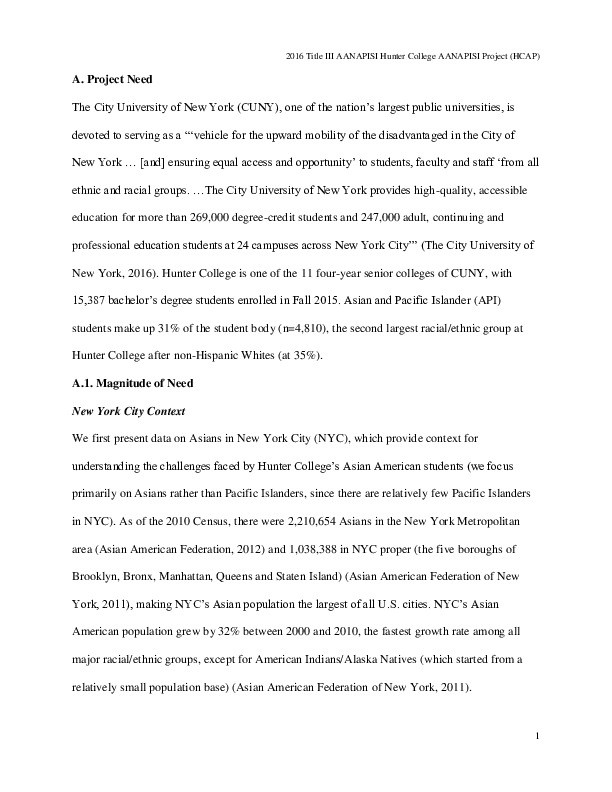
2016 Title If] AANAPISI Hunter College AANAPISI Project (HCAP)
A. Project Need
The City University of New York (CUNY), one of the nation’s largest public universities, is
devoted to serving as a “‘vehicle for the upward mobility of the disadvantaged in the City of
New York ... [and] ensuring equal access and opportunity’ to students, faculty and staff ‘from all
ethnic and racial groups. ... The City University of New York provides high-quality, accessible
education for more than 269,000 degree-credit students and 247,000 adult, continuing and
professional education students at 24 campuses across New York City’” (The City University of
New York, 2016). Hunter College is one of the 11 four-year senior colleges of CUNY, with
15,387 bachelor’s degree students enrolled in Fall 2015. Asian and Pacific Islander (API)
students make up 31% of the student body (n=4,810), the second largest racial/ethnic group at
Hunter College after non-Hispanic Whites (at 35%).
A.1. Magnitude of Need
New York City Context
We first present data on Asians in New York City (NYC), which provide context for
understanding the challenges faced by Hunter College’s Asian American students (we focus
primarily on Asians rather than Pacific Islanders, since there are relatively few Pacific Islanders
in NYC). As of the 2010 Census, there were 2,210,654 Asians in the New York Metropolitan
area (Asian American Federation, 2012) and 1,038,388 in NYC proper (the five boroughs of
Brooklyn, Bronx, Manhattan, Queens and Staten Island) (Asian American Federation of New
York, 2011), making NYC’s Asian population the largest of all U.S. cities. NYC’s Asian
American population grew by 32% between 2000 and 2010, the fastest growth rate among all
major racial/ethnic groups, except for American Indians/Alaska Natives (which started from a
relatively small population base) (Asian American Federation of New York, 2011).
2016 Title If] AANAPISI Hunter College AANAPISI Project (HCAP)
The high growth rate has been fueled primarily by immigration. Although NYC’s Asian
immigrant population is very diverse, Chinese make up the largest group and, if current growth
rates continue, will exceed Dominicans as the largest NYC immigrant group in the next few
years (New York City Department of City Planning, 2013). After Chinese, who make up about
one-third of the metro area’s Asian population, the largest Asian groups in the New York metro
area (in rank order) are Indians, Koreans, Filipinos, Pakistanis, Bangladeshis, Japanese, and
Vietnamese. Continued high rates of immigration into the New York metro area means that the
area’s Asian population remains mostly foreign-born: 68% of Asians are foreign-born, compared
to 27% for the general population (Asian American Federation, 2012).
The inflow of new Asian immigrants into NYC has been characterized as a dual
migration (Kwong, 1987), with many immigrants with high levels of education and job skills,
but also large numbers of immigrants with low levels of education and lacking in job skills.
Many Asians in NYC have undocumented immigration status and experience language barriers
to services, jobs, and education (Bateman, Abesamis-Mendoza, & Ho-Asjoe, 2009; Kim &
Keefe, 2010; Trinh-Shevrin, Islam, & Rey, 2009). Thirty-five percent (35%) of the New York
metro area’s Asians are recent immigrants, having arrived during the last decade; 38% have
limited English proficiency. Chinese speakers have the highest rate of limited English
proficiency at 62% (Asian American Federation, 2012).
The poverty rate for Asians in the New York metro area (13.8% below the poverty line)
is slightly higher than the rate for the general population (13.3%). Challenges facing NYC’s
Asian communities are reflected in Asian American students’ low level of college readiness. In
NYC, only 5% of API students attend the prestigious set of public schools accessible only
through high performance on entrance exams. Of the remaining 95% of the city’s API students
2016 Title If] AANAPISI Hunter College AANAPISI Project (HCAP)
attending general education high schools, more than one-third of graduates were “deemed not
college ready, meaning they passed Regents exams but with scores that predicted they would
need remedial classes before tackling college coursework...Only seven percent of the city’s
English learners — a group that includes many Asian students — were found to have graduated on
time and ready for college and careers” (Coalition for Asian American Children and Families,
2011, p. 4). Many API students with Limited English Proficiency are isolated at schools with
very low Asian enrollment and limited English Language Learner services (Coalition for Asian
American Children and Families, 2011).
Hunter College Students
Because of CUNY’s and Hunter College’s unique role in serving as a gateway for upward
mobility of NYC’s disadvantaged students, many of Hunter’s API students come from working
class, immigrant backgrounds and are the first generation in their families to attend college.
According to CUNY’s 2014 “Student Experience Survey,” API students at Hunter have the
highest rate of first generation college attendance among all racial groups (44% for API students,
compared to 42.6% for Latinos, 32.1% for Blacks, and 23.2% for Whites). Research shows that
students whose parents do not have four-year degrees face more obstacles, have lower academic
achievement, and have higher dropout rates than students whose parents have four-year degrees
(Harackiewicz et al., 2014; Stephens, Hamedani, & Destin, 2014).
The number of API students pursuing bachelor’s degrees who transferred from other
community colleges further suggests a sizable high-needs API student population. A national
study found that “compared to AAPIs at four-year institutions, AAPI community college
students were more likely to enter college with lower levels of academic preparation in English
and mathematics. In 2003, 55.2 percent of AAPI students entering two-year colleges had never
2016 Title If] AANAPISI Hunter College AANAPISI Project (HCAP)
taken a math course beyond Algebra II in high school, compared to 12.7 percent of AAPI
students entering four-year institutions in that same year. With one in five needing remediation
in English, AAPI students are particularly vulnerable to policies and practices that relegate
remedial English courses to two-year institutions” (National Commission on Asian American
and Pacific Islander Research in Education, p. 9). In Fall 2015, of the 4,810 API students at
Hunter College pursuing bachelor’s degrees (vs. certificates or advanced degrees), 682 (14.2%)
had transferred in from community colleges (601 [12.5%] from CUNY community colleges; 81
[1.7%] from other community colleges). The large number of API students who transfer into
Hunter College from CUNY community colleges represents an opportunity to coordinate within
the CUNY system to ease high-need and ELL students’ transition into a four-year college
environment.
Participation in Hunter College’s Search for Education, Elevation and Knowledge
(SEEK) program is also an indication of need. The SEEK program works with undergraduate
students to provide academic and financial support to students who qualify based on specific
income and academic criteria. The program aims to help students successfully meet the
challenges of college and to support both their academic and personal development. In Fall 2015,
there were 217 API students in the SEEK program (3.7% of all API students). There were 68
new SEEK students entering in Fall 2014 (most recent data available; Table 12, IR Factbook
2014). API students made up 36% of new SEEK students, the second largest group after
Hispanic students, at 39%). Receipt of NYS Tuition Assistance Program (TAP) or federal Pell
Grant awards is an important indicator of financial hardship. In Fall 2014 (most recent data
available), 2,283 (40.7%) Hunter API students received TAP awards, and 2,546 (45.3%) Hunter
API students received Pell Grant awards.
2016 Title If] AANAPISI Hunter College AANAPISI Project (HCAP)
Data on students’ place of birth are helpful for determining the degree of cultural
adjustment students may face. This analysis is incomplete because place of birth is unknown for
31.4% of Hunter API students. About another third (32.7%) are identified as being foreign-born;
35.2% are identified as being US-born; and 0.7% are identified as being born in a US territory.
Most API students — both foreign-born and US-born — have foreign-born parents who may face
hardships experienced by many immigrants and may not be familiar with how to support their
children in the U.S. educational system (Coalition for Asian American Children and Families,
2011). At least 78.4% of foreign-born API students have foreign-born parents, while 82.8% of
US-born API students have foreign-born parents; only 2.5% of US-born API students have US-
born parents. Thus, almost all of Hunter’s API students are either foreign-born or children of
foreign-born parents.
It is not surprising then that most of Hunter College’s API students are English-language
learners or non-native English speakers. Of the 4,810 API students pursuing bachelor’s degrees,
3,383 (70%) identified a language other than English as their native language (compared to 45%
for non-Hispanic Blacks, 56% for Hispanics, and 48% for non-Hispanic Whites). The rate of
non-native English speakers is high even among US-born API students. Of the US-born API
students, 41% identified a language other than English as their native language. Research
indicates that English-language learners fall far behind English-proficient students in rates of
earning bachelor’s degrees (Kanno & Cromley, 2013). Barriers to postsecondary educational
attainment extend beyond a lack of English-language skills to the structural elements of the
immigrant experience, including limited financial resources and English-language learners’
tendency to “self-eliminate” from the postsecondary education track (Kanno & Varghese, 2010).
These barriers are exacerbated because ELL status correlates to low socioeconomic status
2016 Title If] AANAPISI Hunter College AANAPISI Project (HCAP)
(Chang, et al., 2007). The most frequent non-English Asian languages were Bengali, Chinese
(Cantonese, Mandarin), Korean, Tagalog, and Urdu.
Challenges faced by API students may be reflected in delays in choosing a major. Almost
half (46.9%) of API students pursuing bachelor’s degrees have “No Major.” Otherwise, the most
popular majors are: Accounting (3.9%), Biology (2.8%), Chemistry (4.6%), Computer Science
(3.5%), Economics (2.2%), English Literature (2.7%), Media Studies (1.2%), Nursing (3.0%),
Nursing-RN Pathway (1.1%), Psychology (12.8%), Sociology (1.6%), and Special Honors BA
(1.3%). The four-year graduation rate for API students slightly trails the rate for the general
student body. For API students, 23.3% earned their degree in four years, compared to 23.6% for
all students (2008-2011 combined). Only about half (53.8%) of API students graduated within 6
years, compared to 50.4% for all students (2006-2009 combined) (Table 12, IR Factbook 2014).
These data suggest that almost half of API students require assistance in maintaining their
enrollment and graduating in a timely manner.
A.2. Project’s Focus on Addressing the Needs of Disadvantaged Individuals
The proposed project is squarely focused on addressing the needs of disadvantaged API students.
As noted above, the Asian American experience is bifurcated, with a sub-group of well-
resourced and high-performing students, but also a sizable sub-group of disadvantaged students
facing a variety of barriers to achievement in higher education. Because of CUNY’s role in
providing access to higher education for disadvantaged individuals, a large number of the more
disadvantaged API students can be found at Hunter College and the CUNY system overall.
Many of the barriers that API students at Hunter face derive from their backgrounds as first-
generation college-goers; as immigrants or children of immigrants; and as English-language
learners. As noted above, API students at Hunter have the highest rate of first-generation college
2016 Title If] AANAPISI Hunter College AANAPISI Project (HCAP)
attendance among all racial groups; almost all are immigrants or children or immigrants; and
70% identify a language other than English as their native language.
The project’s goals aim to directly tackle the resulting barriers, including basic language
and cultural barriers; a lack of opportunities to develop leadership and job skills; lack of
culturally competent advising and counseling services; absence of Hunter College admissions
information or materials in languages other than English; and lack of familial knowledge of or
engagement with admissions and advising, internships, graduate school admissions, and/or job
placement options for students after graduation. Asian American students at the College
frequently report having struggled with the college admissions and selection process and,
subsequently, with obtaining appropriate and culturally informed advising with regard to
maintaining a reasonable Time to Degree while at the same time making meaningful course and
major selections. Asian American students’ academic struggles and related life challenges may
contribute to high levels of depression, social anxiety, hostility/frustration, and academic
distress. In data analyzed from July 2012 through March 2015, Hunter College’s Counseling and
Wellness Services (CWS) noted several mental health risk factors specific to Asian American
students. On the CCAPS-62 (Counseling Center Assessment of Psychological Symptoms), a
standardized measure used in the counseling service at the point of intake, Asian students
showed several significant elevations relative to other racial/ethnic groups: relative to White
students, Asian students had significantly higher scores for Depression, Social Anxiety,
Hostility/Frustration, and Academic Distress.
Despite these elevated concerns/symptoms, Asian students may not be seeking the help
they need; they were less likely to have been in previous mental health treatment than other
groups: Asian students were significantly less likely than White, Multiracial, or Hispanic
2016 Title If] AANAPISI Hunter College AANAPISI Project (HCAP)
students to have received prior mental health treatment and they were significantly less likely
than White or Multiracial students to have been on psychiatric medications despite equivalent
clinical concerns. Additionally Asian students were significantly less likely than White students
to endorse family support. For undergraduate students, the 263 Asian clients represented 16% of
the Counseling Center demographic, despite making up 31% of the student body.
A.3. Project Addresses Gaps or Weaknesses in Services, Infrastructure, or Opportunities
Many of the academic and related difficulties that Asian American students experience may be
remedied through improvements in services and infrastructure. The project’s goals address a
wide range of institutional gaps and weaknesses with regard to lack of culturally competent
advising and counseling services; lack of opportunities within existing curricula to develop
English-language and other skills needed to thrive psychosocially and academically in higher
education; lack of thoughtfully developed leadership opportunities for high-need/ELL API
students; absence of coordination relevant to API students with community colleges and high-
need/ELL API communities.
Hunter College advising and tutoring staff have severely limited cultural competency,
exacerbated by persistent interpersonal application of the model minority myth. For Asian
American students in particular, still perceived as a culturally isolated model minority,
inappropriate or indifferent advising, with little understanding of familial, linguistic, or
socioeconomic challenges the student may face, perpetuates the sense of cultural isolation that
many of those students experience. Students receive inconsistent pre-professional advising that
frequently adheres to model minority myth or simply disregards interests/concerns of high-
need/ELL API students who may not be effective advocates for themselves in an institutional
setting. Students continue to report experiences where they are geared, by advisors (and family
2016 Title If] AANAPISI Hunter College AANAPISI Project (HCAP)
members), towards majors or professions requiring little to no civic engagement, leadership, or
creative initiative.
Research suggests that students from minority or disadvantaged backgrounds may benefit
academically if they have exposure to role models who share aspects of their identity (Stephens
et al., 2014). Although Asian students make up 31% of Hunter College’s students, only 10% of
faculty members are of Asian descent (Hum, 2012). Representation of Asian faculty is higher in
disciplines related to the natural sciences or mathematics (economics, physics and astronomy),
where about a third of faculty are Asian American, compared to disciplines such as English and
political science, where Asian Americans make up 7% of the faculty. CUNY-wide, 42% of
Asian American faculty are assistant professors, the highest rate of assistant professorships in
CUNY among all racial groups. Having a disproportionately large junior faculty is problematic
in terms of faculty not being available for mentoring when they are consumed with trying to
achieve tenure. In terms of holding senior positions in CUNY’s administration, “only 16 Asian
Americans are represented in CUNY’s executive compensation plan and half are in positions as
Administrator, Associate Administrator, and Assistant Administrator rather than in positions of
academic leadership (e.g., Dean, President)” (Hum, 2012, p. 4).
The model minority myth and deficits in advising for API students may contribute to the
lack of thoughtfully developed leadership opportunities for high-need/ELL API students and
inadequate mentorship or internship programs for students interested in working with Asian
American-led or -serving organizations in NYC. Such programs would fulfill the need to
augment classroom learning with co-curricular and/or pre-professional pursuits such as
internships, volunteering, and participating in mentorship programs. These important
opportunities may be perceived by families as distractions from “real” academic work or as lost
2016 Title If] AANAPISI Hunter College AANAPISI Project (HCAP)
wages that would supplement the family income. For high-need and ELL students in particular,
these co-curricular opportunities are often seen as being beyond reach due to limited English
proficiency, a lack of confidence as an advocate or leader, and/or the aforementioned
socioeconomic barriers.
As the only CUNY college with a full-fledged Asian American Studies Program (AASP),
Hunter College is well-positioned to serve as a model for other CUNY campuses, which
collectively serve almost 53,000 API students. Our AASP is understood by students and faculty
alike to be an institutional home for many API students on campus, and our curriculum and
services recognize and seek to support the complex educational and socioeconomic contours of
our students’ lives. We are, however, a very small academic unit with only one full-time faculty
member, Program Director and HCAP PI Jennifer Hayashida. There are six affiliated full-time
faculty, including HCAP Co-PI John Chin, housed in other departments; however, they can offer
only occasional and limited teaching or service to the AASP. As a result, nearly 90% of AASP
courses are taught by adjunct faculty members, all of whom are outstanding educators, but whose
engagement with the AASP is circumscribed by our limited ability to remunerate them for any
labor beyond classroom teaching. Program and curriculum development, student leadership, and
enhancement of API student services — cornerstones of our proposal to serve high-need/ELL API
students — lie beyond the scope of what is possible given our modest infrastructure. With HCAP
in place, however, our ability to sustainably serve high-need/ELL students in a targeted and
effective manner will be vitally enhanced.
B. Project Design Is Measurable & Addresses Needs of Target Population
In this section, we propose two measurable HCAP goals and link them to their corresponding
objectives and outcomes for the Hunter College AANAPISI Project, HCAP.
10
2016 Title If] AANAPISI Hunter College AANAPISI Project (HCAP)
Goal #1: Develop & Improve Academic Programs for High-need/ELL API Students
The first goal of the project responds to the need for culturally relevant academic programs and
leadership activities for high-need/ELL API students. In particular, the objectives as described
below aim to integrate the psychosocial development of API students through the development
of new course offerings and student leadership opportunities. In order to support psychosocial
development and measurably improve academic outcomes for students who complete an HCAP
course, the HCAP curriculum and leadership program both incorporate difference-education and
value affirmation assignments adapted from Stephens et al. (2014) as well as Harackiewicz et al.
(2014), detailed in Services. In order to maximize API student enrollment, all HCAP courses
will be offered through the AASP, using our course prefix (ASIAN). Using our online advising
platform DegreeWorks, we can advertise these courses specifically to high-need/ELL first- and
second-year API students at the College. To maximize the impact of these program
improvements, all HCAP courses will be at the introductory 100 and 200 levels. Because of the
skills integrated and the personal, interactive content, these activities share many characteristics
of highly effective first-year seminars and learning communities; such experiences should be
offered early for maximum impact (Kinzie et al., 2008; Zhao & Kuh, 2004). Each of the
proposed courses will incorporate online activities with some sections taught as hybrid courses
mixing online discussion, content, and tutorials with in-person meetings.
Table 1: Develop & Improve Academic Programs for High-Need & ELL API Students
OBJECTIVES SERVICES RESOURCES OUTCOMES
B.1.A) Integrated 1) AASP Course: - AASP 1) 1 new AASP
Curriculum “Communicating Asian communications course;
Development: Improve | American Studies” - ESL Program 1-2 sections offered each
Asian American Studies semester, including
& ESL programs by 2) AASP Course: - Counseling & online sections; total of
expanding curriculum “Mental Health Wellness Center (CWS) 270 students taught;
tailored to high- Promotion: Principles & 2) 1 new AASP
need/ELL API students’ | Practice in API counseling course; 1-3
11
academic challenges.
B.1.B) API Student
Leadership: Create
meaningful
opportunities for HCAP
students to develop
leadership skills and
engage with local API
communities and issues.
Communities”
3) ESL Basic Skills
Course: “Integrated
Academic Language
Skills: Asian American
Studies”
1) Credit-bearing HCAP
Leadership Internship
Program;
2) HCAP co-curricular
programs at CUNY
community colleges and
API community-based
organizations;
3) HCAP end-of-year
reception.
2016 Title If] AANAPISI Hunter College AANAPISI Project (HCAP)
- Reading & Writing
Center
- Career Services
- Instructional
Computing &
Information Technology
- Office of Assessment
- Office of Institutional
Research
- AASP
- Career Services
- Office of Assessment
- Center for Ethnic
Studies at Borough of
Manhattan Community
College
- LaGuardia Community
College
- Kingsborough
Community College
- Queensborough
Community College
- The Coalition for
Asian American
Children & Families
(CACF)
- Asian/Pacific Islander
Coalition on HIV/AIDS
(APICHA)
- SAKHI for South
Asian Women
- The Asian American
Writers Workshop
- MinKwon Center for
Community Action
- New York Asian
Women’s Center
- Federation of
Protestant Welfare
Agencies
sections offered each
semester, including
online sections; total of
360 students taught;
3) 1 new ESL basic
skills course; 1-2
sections each summer
and winter session,
including online
sections; total of 270
students taught;
4) Measurable
improvement in
graduation rate and GPA
of students taught in all
HCAP courses.
1) 4-10 HCAP internship
placements per academic
year; total of 40
internships;
2) 10 digital stories
produced annually by
HCAP students about
local API community
institutions and API
community issues; 40
digital stories produced
over 5 years of HCAP;
3) 27 community college
and API community-
based organization
programs in 5 years of
HCAP; total of 90
HCAP students
participating as speakers;
4) Measureable increase
in high-need/ELL API
student enrollment at
Hunter College.
12
2016 Title If] AANAPISI Hunter College AANAPISI Project (HCAP)
B.1.A. Improve AASP & ESL Programs for High-Need/ELL API Students
This first objective is central to HCAP because it focuses on improving and developing
programs that mirror API students’ experiences, backgrounds, and ambitions in order to offer
classroom activities and contexts promoting examples of successful first-generation API college
students, leading to students’ improved sense of identity and purpose. The first new course will
be an AASP core course entitled “Communicating Asian American Studies” (B.1A.1), developed
and taught by the HCAP ELL Specialist in collaboration with the ESL program where Paul
McPherron, HCAP Co-PI, is the Coordinator. The course integrates Asian American Studies
readings with a skills-based curriculum emphasizing critical thinking and oral communication.
One objective for this service is to provide high-need and ELL API students, and then especially
English learners, with crucial intensive training to become college-ready and confident while
also providing content and a credit-bearing course that will count toward graduation
requirements. The outcome will be two sections per semester starting in Spring 2017, enrolling
30 students per semester. In years 3-5 of HCAP, we will develop and offer one online section of
the course each semester. In total, 270 students will be taught over the 5 years of HCAP.
The second new course will be an AASP course developed and taught by the HCAP
Mental Health Educator in partnership with the Counseling & Wellness Center (CWS) at Hunter
College, entitled “Mental Health Promotion: Principles & Practice in API Communities”
(B.1.A.2). Course readings will address theoretical and methodological approaches to API
mental health. The objective is to increase API student engagement with API mental health
services and professions, and to institutionalize greater understanding of API mental health
issues. The outcome will be two HCAP-specific sections of the course starting in spring 2017,
13
2016 Title If] AANAPISI Hunter College AANAPISI Project (HCAP)
serving a total of 40 students per semester. In Years 3-5, we will develop one online section of
20 students per semester, serving approximately 360 API students in the five years of HCAP.
The third and final new course will be a new summer and winter basic skills seminar
specifically for students from ELL backgrounds entitled “Integrated Academic Language Skills:
Asian American Studies” (B.1.A.3). This seminar will be developed and taught by the HCAP
ELL Specialist in collaboration with the ESL program at Hunter College and will be free for all
matriculated Hunter College students. Instead of focusing on one skill, such as reading or
writing, as has been offered by ESL Program summer and winter basic skills seminars, this will
be a multi-skills course that draws on readings and topics in Asian American Studies. The
objective is to help students improve student speaking, writing, listening, and reading skills for
success in upper-division courses. The outcome for this course will be one section per summer
and winter sessions in the first two years of HCAP (starting in winter 2017), enrolling 15
students each session. In years 3-5 of HCAP, we will increase to two sections per summer and
winter, including one online section each session, totaling 270 students taught over the five years
of HCAP. Outcomes of all courses will include a measurable increase in GPA and persistence; in
addition, the Mental Health course may lead to an increase in API students engaged in the
Counseling Psychology major and/or CWS or HCAP internships.
B.1.B. Develop Student Leadership Program for High-Need/ELL API Students
This second objective dramatically expands the number of leadership opportunities for high-
need/ELL API students. For this activity, the HCAP Program Director will work with a cross-
section of local API community-based organizations to place high-need/ELL API students in
credit-bearing internships (B.1.B.1). The objective for these internships is to give high-need/ELL
API students access to opportunities from which they may currently self-exclude. These
14
2016 Title If] AANAPISI Hunter College AANAPISI Project (HCAP)
opportunities will be advertised directly through our HCAP and AASP programs, as well as
SEEK and the Offices of Advising and Career Services. The internships will take into account
academic work but will also emphasize multilingualism and students’ familiarity with local, on-
the-ground issues in API communities. Preference will be given to students who have completed
at least one HCAP course. The outcome will be an increasing number of credit-bearing HCAP
internship placements per semester, beginning with four internships in Spring 2017, for a total of
40 HCAP student internships over the five years of HCAP. At the end of every internship, HCAP
interns will produce digital stories that showcase the work of an API community-based
organization, profile a local API community leader, or describe a local issue relevant to API
communities where they worked. The annual outcome will be 10 digital stories available on the
HCAP website and used in future AASP, ESL, and HCAP courses and programs.
The second activity involves HCAP interns and students from “Communicating Asian
American Studies” who, with the HCAP Program Director, will develop and participate in
informational workshops to discuss their Hunter and HCAP experiences at CUNY community
colleges and local API community-based organizations (B.1.B.2). These sessions will be
developed and advertised in partnership with relevant community college faculty/staff as well as
API community-based organizations. The objective is to conduct outreach to socioeconomically,
geographically, and linguistically diverse API populations. The outcome will be one
informational workshop at the conclusion of each semester, totaling 10 sessions, with 30 students
featured as discussants and an estimated 300 community participants.
Starting in Spring 2017, the third activity will be an annual end-of-the-year HCAP
reception (B.1.B.3), where the objective is to showcase the work of all HCAP interns and
students. HCAP interns will present digital stories showcasing their work in API community-
15
based organizations, and students and instructors who participated in HCAP courses and
programs will present their work and teaching projects. All HCAP students’ families will be
invited to this event.
B.2. Goal #2: Enhance Student Services & Counseling For High-Need/ELL API Students
The objectives in Goal #2 respond to the fact that Hunter faculty and staff demonstrate a
profound lack of cultural awareness regarding API issues, in spite of the fact that the API
population at Hunter has nearly doubled in the past decade. As a result, API students frequently
report a sense of alienation from or frustration with an institution that treats APIs as
homogeneous, self-sufficient, or only interested in STEM areas.
Table 2: Enhance Student Services & Counseling For High-Need/ELL API Students
OBJECTIVES SERVICES RESOURCES OUTCOMES
B.2.A) Culturally
Responsive Services:
Institutionalize
knowledge of the
heterogeneity of API
experiences and
backgrounds, both
culturally and
linguistically.
B.2.B) API Mental
Health Access:
Enhance high-
need/ELL API students’
access to culturally
competent on- and off-
campus mental health
services.
1) Professional
Development for
Academic Advisors,
Career Services Advisors
and Writing Center
Tutors;
2) Online Academic
Advising Content and
Writing Exercises;
3) HCAP Multilingual
Website.
1) Counseling Program
Partnerships with API-
serving mental health
providers;
2) On-campus API
Mental Health Promotion
Programs;
- Office of Advising
- Reading & Writing
Center (RWC)
- Office of Assessment
- Office of Institutional
Research
- Office of Career
Services
- Counseling &
Wellness Services
- Counseling Program
- Office of Assessment
- The Coalition for
Asian American
Children & Families
- Madison House
1) 22 workshops with 75
faculty/staff participants
over the 5 years of
HCAP; 10,000 students
served by tutors and
advisors over the 5 years
of HCAP;
2) 20 online units and
exercises; 20,000
students served over the 5
years of HCAP;
3) Translation of College
admissions/advising and
HCAP program
information; 20,000
students served over the 5
years of HCAP.
1) 4-8 additional
partnerships with
community-based mental
health agencies working
with API populations;
2) 22 Mental Health
Promotion Programs over
the 5 years of HCAP; 500
2016 Title If] AANAPISI Hunter College AANAPISI Project (HCAP)
16
2016 Title If] AANAPISI Hunter College AANAPISI Project (HCAP)
3) Distribution of API - University Settlement | students attending over 5
mental health educational | - Henry Street years of HCAP;
materials to campus Settlement 3) Bilingual printed and
community, including - Korean Community online materials
API Mental Health Services pertaining to range of
Resource Guide. API mental health issues;
4) Measurable
increase in API students
using on- and off-campus
mental health services.
B.2.A. Culturally Responsive Services
This first objective addresses the need to conduct professional development to improve the
cultural competency of academic and pre-professional advising staff and writing tutors in order
to create more culturally and linguistically relevant support services for API students (B.2.A.1).
This objective will be met in two ways. First, bi-monthly workshops, starting in 2017, will be
held in collaboration with HCAP staff, the Offices of Advising and Career Services, and the
Reading and Writing Center. These workshops will investigate aspects of API student
backgrounds and needs, including the model minority myth, stereotype threat, and API mental
health. The objective is to institutionalize greater understanding of high-need/ELL API students’
academic and psychological issues in order for those students to be better supported and thrive
academically and psychosocially. The outcome is five cultural competency trainings per
academic year, starting with two in spring 2017, for a total of 22 workshops with a total number
of 75 participants, primarily advisors and tutors. These advisors and tutors work with nearly
2,000 API students per year; thus, the number of API students served is approximately 10,000
over the five years of HCAP.
For the second activity for this objective, the HCAP ELL Specialist and HCAP Mental
Health Educator, in collaboration with Educational Technologist Dr. Shiao-Chuan Kung, will
work with the Offices of Advising and Career Services and the Reading and Writing Center to
17
2016 Title If] AANAPISI Hunter College AANAPISI Project (HCAP)
develop culturally responsive online advising content and writing tutoring exercises based on
topics raised in the workshops and the experiences of API students receiving tutoring and
advising services (B.2.A.2). The objective is to provide an online forum for faculty, staff and
tutors to have a Hunter-specific online resource to provide culturally responsive advising and
tutoring support. A total of 20 different units and thematic exercises will be created and available
for use by all Hunter College API students, on average about 4,800 students per year. The HCAP
ELL Specialist and HCAP Mental Health Educator will be available as institutional resources for
staff in those and other units seeking as-needed assistance with particular API student issues.
For the third activity for this objective, Hunter College online Admissions and Advising
information, as well as HCAP program information, will be translated into the five most spoken
Asian languages in NYC (B.2.A.3). This information will be made available on the HCAP
website, which will be featured as a resource on the Hunter College website. The outcome, based
on tracking site analytics, is estimated at 20,000 students and family members served over the 5
years of HCAP.
B.2.B. API Mental Health Access
This second objective responds to the absence of API-specific mental health materials or
programs at the College and seeks to increase awareness of campus and community-based
mental health services available to APIs and also to institutionalize, at all levels of the College, a
greater understanding of the mental health needs of API students. This objective will be met
through increased partnerships with mental health organizations serving API communities
(B.2.B.1). These partnerships will provide a platform for mental health organizations to provide
off-campus services for Hunter College students. Outcomes will include increased API student
referrals through CWS partnerships with at least 8 API community-based mental health agencies.
18
2016 Title If] AANAPISI Hunter College AANAPISI Project (HCAP)
In addition, working with the community-based organizations, the HCAP Mental Health
Educator will, beginning in Spring 2017, offer five co-curricular workshops per academic year,
22 total, related to API student mental health (B.2.B.2). In all, 500 students will attend campus
programs on API mental health over the five years of HCAP. Finally, the HCAP Mental Health
Educator will produce printed and online materials pertaining to a range of API mental health
issues, including a Resource Guide for API Mental Health & Wellness (B.2.B.3). These
materials will be available to students on the Hunter College Center for Counseling & Wellness
and HCAP websites, distributed to all College units and distributed to local API communities
through partner organizations.
B.3. Design Successfully Addresses Needs of the Target Population
HCAP LOGIC MODEL
(ADAPTED FROM KODAMA ET AL., 2002)
Engagement with Local ; '
: High-Need APA Students
APA Community & CC —)»>
~ APA Students Access to Hunter College
Society & Culture |
* Racism * Values
* Model Minority * Language
* Generation Leadership
Development ——>
7 Career Options &
Preparedness
Culturally L .
earning
Responsive —>) Environment
Services wr
T IDENTITY Academic
Achievement
Course
Integrated
Curriculum * Basic Skills
Development ELL Course
+ AASP > Mental Health : Psychosocial
Counseling Access Activities Adjustment
19
2016 Title If] AANAPISI Hunter College AANAPISI Project (HCAP)
As outlined in Section A and our Competitive Priority Statement, the percentage of ELL, low-
income, and/or first-generation college API students at Hunter College exceeds national averages
for API students in higher education (Chang et al., 2007). Our project design is centered on
developing and improving academic programs and augmenting tutoring, counseling, and student
services in order to better support high-need/ELL API students’ sense of identity and purpose
and, as a result, improve their academic outcomes. In focusing on improving API student identity
and purpose, the project design draws on an API perspective on psychosocial student
development advanced in Kodama et al. (2002).
Briefly, Kodama et al. describe identity, including racial/ethnic identity, as central to API
students’ development; identity shares this central position with purpose, particularly plans for
college and the future and vocational aspirations and plans. Societal factors (e.g., racism, model
minority myth) and cultural factors (e.g., cultural values, language, generational status) influence
identity and purpose. We have expanded the model to include the institutional learning
environment and specific strategies designed to counteract negative influences. We show
outcomes of identity development and purpose that are implied by Kodama et al.: improved
career choice and preparedness, academic achievement, and psychosocial adjustment. Recursive
effects of these outcomes also are shown feeding back into identity and purpose, and we have
added effects of outreach activities with the larger API community.
Empirical evidence demonstrates that API students’ racial/ethnic identity and its salience,
psychosocial adjustment, and academic achievement are predicted by their experience of societal
discrimination and their campus climate as well as their background (Hurtado, Alvarado, &
Guillermo-Wann, 2015; M. Lee, 2008; R. Lee, 2003). Asian American or ethnic studies
coursework, diversity activities, and high-impact or engaged activities that enhance the learning
20
2016 Title If] AANAPISI Hunter College AANAPISI Project (HCAP)
environment also are linked to racial/ethnic identity development and salience (Hurtado et al,
2005; M. Lee, 2008) and to psychosocial and academic outcomes (Kinzie, Goyea, Shoup, &
Kuh, 2008). Development of API students’ racial/ethnic identity predicts sense of purpose
(Iwamoto & Liu, 2010; Pope, 2000), satisfaction with college (R. Lee, 2003), psychosocial
adjustment (Iwamoto & Liu, 2010; R. Lee, 2003, 2005), academic goals (Lindt & Yu, 2014),
socially responsible leadership (Dugan, Kodama & Gebhardt, 2012), and maturity of career
planning (Carter & Constantine, 2000). Although racial/ethnic identity cannot be manipulated,
experimental studies have demonstrated powerful impacts of identity-relevant brief interventions
on academic and psychosocial outcomes (Cohen & Garcia, 2014; Harackiewicz et al., 2014;
Stephens, Hamedani, & Destin, 2014; Stephens, Townsend, Hamedani, & Destin, 2015; Yeager
& Walton, 2011). Long-lasting effects of these interventions suggest beneficial recursive
processes (Cohen & Garcia, 2014; Stephens et al., 2015; Yeager & Walton, 2011).
C. Services Are Appropriate to Needs & Reflect Up-to-date Research
C.1. Goal #1: Develop & Improve Academic Programs for High-Need/ELL API Students
Through the following services, we will develop and improve academic programs that
serve high-need/ELL API students at Hunter College. These services improve academic
outcomes, represented here by improved student GPA and graduation rate, by fostering students’
psychosocial development and sense of purpose and identity within and beyond the campus
environment (Kodama et al., 2002).
C.1.A. Integrated Curriculum Development
Services for this first objective focus on two critical needs among our high-need/ELL API
students: the need for curriculum emphasizing critical academic and communication skills, and
the need for curriculum addressing API mental health and mental health services and
21
2016 Title If] AANAPISI Hunter College AANAPISI Project (HCAP)
professions. All HCAP curriculum development will be in partnership with the Counseling &
Wellness Center (CWS) or the ESL Program and integrated with Asian American Studies
materials, with the goal of thereby providing a positive and buffering effect on race-related
student self-esteem (Iwamoto and Lu, 2010; Kodama et al., 2002; M. Lee, 2008).
All HCAP courses will incorporate difference-education and value affirmation
assignments. Supported by research on first-generation college students (Stephens et al., 2014;
Harackiewicz et al., 2014), difference-education and value affirmation activities will be
presented as an integral part of the course, avoiding any implication that API students are
deficient, and will intersect with transition points—as found necessary for effectiveness (Cohen
& Garcia, 2014). HCAP alumni who are first-generation college students and English language
learners will give guest talks in classes to candidly discuss their experiences and the academic
and interpersonal challenges they have faced and overcome. Students will then complete an in-
class writing assignment reflecting on the guest talk, while a final project for the class will be a
brief digital story, or video, in which current students convey similar advice to the incoming
cohort of HCAP students. As evidenced in Stephens et al. (2014), this exercise can decrease
students’ anxiety and stress (including social-identity threat), facilitate their adjustment to
college (including sense of belonging), and improve academic and social engagement, as well as
improve GPA. In the context of HCAP in particular, Stephens’ findings indicate that first
generation students who experience difference-education interventions are more likely to utilize
and benefit from institutional services, which we also seek to enhance through services described
below. In addition, with the explanation of developing critical thinking skills, students will
participate in the values affirmation activities demonstrated by Harackiewicz et al. (2014) to
improve GPA and persistence and to reduce concerns about background. At the beginning and
22
2016 Title If] AANAPISI Hunter College AANAPISI Project (HCAP)
end of the semester, students will write about their most important values, chosen from a broad
list containing both interdependent and independent values. Difference education and values
affirmation address cultural mismatch as well as identity threat, particularly the college
environment’s emphasis on independence contrasted with first-generation students’ valuing
interdependence (Harackiewicz et al., 2014; Stephens, Fryberg, Markus, Johnson, &
Covarrubias, 2012). Mismatch with interdependence and other collectivistic cultural values is
equally relevant and detrimental psychologically for API students (Iwamoto & Liu, 2010).
C.1.A.1. “Communicating Asian American Studies”
This course will be developed and taught by the HCAP ELL Specialist in consultation with ESL
Program Coordinator Paul McPherron beginning in Spring 2017. One in five API first-year
students feel they are in need of academic assistance in English in college, a proportion similar to
Latino/a students and higher than all other racial groups (Chang et al., 2007). Courses teaching
basic skills are most effective when presented in a manner that validates students and are tailored
to their background and culture (Kinzie et al., 2008). At the same time, coursework attending to
racial/ethnic experience can enhance students’ understanding of API issues, stereotypes, and
identity as well as protecting race-related self-esteem (M. Lee, 2008; Poon, 2013). This course
attends to the multiple needs of our API students, most of whom are English language learners
and/or have foreign-born parents limited in how they can assist their children academically; as
demonstrated by Kanno and Varghese (2010), these students require support to keep up with
their English proficient peers. Consequently, while materials in “Communicating Asian
American Studies” will address API history and experience, with particular attention to the
biographies and achievements of past and present API community leaders, assignments and
learning outcomes target students’ ability to become autonomous and to find their confident
23
2016 Title If] AANAPISI Hunter College AANAPISI Project (HCAP)
voices both inside and outside the classroom in order to cogently advocate for themselves and
their critical ideas.
C.1.A.2. “Mental Health Promotion: Principles & Practice in API Communities”
Developed and taught by the HCAP Mental Health Educator beginning in Spring 2017, this
course reviews current psychological issues for API communities and focuses on models/
theories as well as empirical research. Topics include the model minority myth, racism-related
stress, collectivistic cultures, immigration and acculturation, and psychotherapy and counseling.
“Mental Health Promotion” also explores how historical, sociopolitical, and cultural variables
inform the individual and group processes of API communities. Asian American Studies content
is integrated with mental health-related skills such as developing critical thinking skills that
integrate sociopolitical and cultural variables informing API mental health; understanding how
specific psychological stress and psychotherapy impacts API individuals; identifying
institutional limits and possibilities for existing API mental health treatment.
C.1.A.3. “Integrated Academic Language Skills: Asian American Studies”
Developed by the HCAP ELL Specialist in consultation with ESL Program Coordinator Paul
McPherron, this course will initially be offered during the winter 2017 session, and then during
all subsequent winter and summer sessions. Unlike the other two HCAP courses, “Integrated
Academic Language Skills” will be a no-cost, non-credit-bearing course that meets every day for
5 weeks during summer and winter semester breaks. Unlike the semester-long, credit-bearing
course, “Communicating Asian American Studies,” this course is intended only for students from
ELL backgrounds and will focus primarily on developing the students’ basic English language
skills of reading, writing, listening, and speaking for success in Hunter College classrooms.
“Integrated Academic Language Skills” will be workshop-based, offering many chances for
24
2016 Title If] AANAPISI Hunter College AANAPISI Project (HCAP)
students to practice new language and vocabulary, drawing on key readings in Asian American
Studies and current events and a variety of print and online readings and videos related to Asian
American Studies. There will be one class trip toa museum exhibit or API community as well as
multiple guest speakers and projects addressing issues and topics of interest to local API
communities.
C.1.A.4. HCAP Online & Digital Curriculum Development
Assuming successful implementation of all HCAP courses in Years | and 2, our goal is to
enhance this curriculum in Years 3-5, and develop one hybrid online section of each course. An
emphasis on active learning and strong teacher presence provides for online teaching that is as
effective as the traditional classroom structure (Dixson, 2010), and the hybrid online structure at
CUNY allows for a 50-50 split between online and in-person learning. English learner and first-
generation student status — 70% and 44%, respectively, of Hunter’s API students — can correlate
with low socioeconomic status (Chang et al., 2007). As a result we consider it imperative to
improve the AASP and ESL Programs in ways that provide for working students’ access to
HCAP courses, without sacrificing the integral communication and critical thinking skills built
into each course. Working closely with Hunter College Educational Consultant Dr. Shiao-Chuan
Kung, the AASP has already successfully developed and implemented an online version of our
introductory course, ASIAN 21000: Asians in the U.S., and we have been impressed by the
adaptation of this course to an online environment, seeing end-of-semester improvements in
students’ facility with course concepts and willingness to intellectually engage with their peers in
an online setting. AASP faculty teaching our online course have reported a benefit supported by
research (Dixson, Kuhlhorst, & Reiff, 2006): discussion is more evenly distributed among all
students, with fewer students remaining “quiet” during discussions in online classrooms or
25
2016 Title If] AANAPISI Hunter College AANAPISI Project (HCAP)
discussion boards. Since a hybrid class at Hunter still meets in person regularly, if less
frequently, we see a valuable opportunity for working, high-need/ELL API students to engage in
different forms of participation — written as well as oral — in order to displace classroom
hierarchies of fluency or confidence.
In addition, students in all HCAP courses, either independently or in groups, will create
digital stories that narrate key API student stories and issues that the courses will address and/or
profile aspects of local API communities. Digital stories are short, 2-4 minute multi-media
narratives typically told from a first person perspective, accomplishing a variety of purposes
depending on the author and context. Much has been written about the effectiveness of using
digital stories as part of classroom projects that promote positive identity development for
students and engagement with local community issues (Davis, 2005; Davis & Weinshenker,
2009; Hull & Nelson, 2005), in particular for English language learners (Skinner & Hagood,
2008; Wan, Tanimoto, & Templeton, 2008). The digital stories created by the HCAP courses
will be made available through the HCAP website and available for use by Hunter College
faculty and staff for future instructional, professional development, and peer mentoring uses.
C.1.B. Develop Student Leadership Program for High-Need/ELL API Students
Services for this second objective attend to three critical issues among our high-need/ELL API
students: lack of access to internship opportunities for high-need/ELL API students; first-
generation college students whose families lack familiarity with the U.S. academic process and
need for co-curricular and/or pre-professional pursuits; and high-need/ELL API students who
consider themselves ineligible for leadership opportunities. Leadership development facilitates
positive academic and career outcomes and resistance to identity threat; API students’
development of socially responsible leadership has been found to be predicted by racial self-
26
2016 Title If] AANAPISI Hunter College AANAPISI Project (HCAP)
esteem, faculty mentoring, membership in both campus and off-campus organizations, leadership
in community organizations, and community service (Dugan et al., 2012).
As discussed in Section A, API students at Hunter have the highest rate of first-
generation college attendance of all racial groups, and nearly 80% of them have parents born
outside the US. Consequently, API students at the College often report feeling hampered by
family members’ lack of familiarity with the academic process in the U.S., including the need to
augment classroom learning with co-curricular and/or pre-professional pursuits such as
internships, volunteering, or participating in mentorship programs. For high-need/ELL students
in particular, these co-curricular opportunities often are seen as inaccessible due to limited
English proficiency or lack of confidence as a first-generation college student, suggesting
institutions should create more equitable opportunities (Kinzie et al., 2008).
C.1.B.1. HCAP Leaders Internship Program
This project emphasizes outreach to first- and second-year high-need/ELL API students to build
early awareness of the credit-bearing HCAP internship program. Our outreach also will take
multiple forms so as to capture as broad a cross-section of students as possible: classroom
outreach visits in AASP and ESL classes; targeted emails to high-need/ELL API students based
on GPA, ESL status, and enrollment in college opportunity programs; and promotion through
Academic Advising and Career Services. Each HCAP Leader will receive unlimited MTA
subway/bus passes in the semester of their internship.
The HCAP Program Director will work with HCAP interns to determine an appropriate
API partner organization for placement; criteria used to determine placement will include student
familiarity with the organization’s mission and/or objectives, and also the student’s academic
interests and professional goals. The student’s academic record will be taken into account, but
27
2016 Title If] AANAPISI Hunter College AANAPISI Project (HCAP)
emphasis will be placed on a holistic assessment of the student’s potential to do well and
integrate their internship experiences into their academic and professional objectives. The HCAP
Program Director will remain in close contact with internship supervisors at organizations where
interns are placed, and all three parties - HCAP Program Director, HCAP interns, and the
internship supervisor — will have monthly meetings to report on progress and any challenges that
may arise. Emphasis will be placed on developing HCAP interns’ leadership abilities through
meaningful engagement with the community-based organization’s work, with the goal of
providing a framework for students to apply their academic and personal knowledge to local
communities, and also to recognize the value of multilingualism as a resource, not a deficit, in
community-based work. Interns will be expected to submit bi-weekly one-page personal
reflections on their internship to the HCAP Program Director. The final project for this activity is
to produce a brief 10-minute digital story addressing the internship experience. These digital
stories will be presented by the student at the end-of-year HCAP Awards Reception.
C.1.B.2. HCAP Leaders Community Presentations
Nation-wide, 44% of undergraduates at community colleges are API (American Association of
Community Colleges, 2012). As discussed in Section A, 14.2% of API students at Hunter
transfer in from community colleges. At the same time, API community college students
frequently require additional academic assistance in order to become truly college ready.
Working with our partners at four CUNY community colleges with API student populations
exceeding 10%, the HCAP Program Director will organize co-curricular programs that
accomplish two objectives: First, they will help HCAP students develop leadership skills by
providing opportunities for them to present information about their educational experiences to
prospective students, for whom they can model valuable skills as first-generation and/or ELL
28
2016 Title If] AANAPISI Hunter College AANAPISI Project (HCAP)
API students (Stephens et al., 2014). Second, these programs will improve high-need/ELL API
community college students’ access to Hunter College and HCAP in particular. These HCAP
Student Leader presentations will address topics such as the college admissions process,
financial aid, and the differences between community college and the four-year experience. They
will also cover student mental health issues, pre-professional development, and services
available for English language learner students.
Working with API community partners hosting HCAP interns, the HCAP Program
Director will replicate this HCAP presentation model in a community setting, in order to provide
an additional context for HCAP students to refine their skills as public speakers, and also in
order to reach high-need/ELL API high school students. As discussed in Section A, a large
number of API high school students are isolated at schools with few to no other APIs, and API
students with limited English proficiency are frequently in schools with small API populations
and few to no services for English language learners (Coalition for Asian American Children and
Families, 2011). Like the community college presentations, these HCAP community
presentations are intended to provide an informational bridge whereby API community members
of all ages and backgrounds can comfortably pursue their questions and concerns about the
process of applying to and attending college, with an emphasis on CUNY and HCAP services in
particular.
Besides benefitting other API populations, all leadership activities will aid the HCAP
participants. High impact on grades and persistence derives from service learning and
community-based class projects as well as culminating experiences such as internships or
practicums, which, however, API students are less likely to experience than White students
(Kinzie et al., 2008).
29
2016 Title If] AANAPISI Hunter College AANAPISI Project (HCAP)
C.2. Goal #2 Services: Enhance Student Services & Counseling for API Students
Through the following services, we seek to improve high-need/ELL API students’ academic
outcomes and learning environments by enhancing campus units that make a critical difference
in high-need/ELL API students’ academic and psychosocial development (Kodama et al., 2002).
C.2.A.1. Culturally Responsive Student Services
The services for this first objective are intended to institutionalize knowledge of the
heterogeneity of API experiences and backgrounds, both culturally and linguistically. Culturally
responsive student services can significantly improve API students’ learning environment and
academic outcomes (CARE Report, 2012; Kodama et al., 2002) and are especially important for
development of API students’ sense of purpose and identity with psychosocial as well as
academic benefits (Iwamoto & Liu, 2010; Kinzie et al., 2008). Culturally responsive services are
here defined as the integration of diverse students’ backgrounds and experiences in order to
make classroom teaching or institutional interventions appropriate to them (Gay, 2000). As
discussed in Section A, Hunter student services for first-generation and ELL students have not
kept pace with the expanded API student population, and College staff demonstrate severely
limited cultural awareness concerning API students’ life experiences and psychosocial well-
being. The increase in API student enrollment over the past decade has run parallel with an
expansion of honors programs; together, these trends obscure the concrete struggles of the many
high-need/ELL API students. Institutional focus on “high-achieving” API students often results
in mismatched advising for the many high-need/ELL API students struggling to persist in their
academic work and develop a sense of psychosocial belonging and satisfaction. For API students
in particular, this one-size-fits-all advising model, with limited understanding of familial,
30
2016 Title If] AANAPISI Hunter College AANAPISI Project (HCAP)
linguistic, or socioeconomic challenges, also perpetuates the sense of cultural isolation that many
of those students experience; in contrast, faculty and staff who validate students’ cultural
background and situation can give students the social capital necessary for success (Museus &
Neville, 2012).
Beginning in Year 1, HCAP Leadership (PI, HCAP Program Director, ELL Specialist,
and Mental Health Educator) will meet with key faculty and staff in Academic Advising, the
Office of Career Services, and the Reading & Writing Center (RWC) in order to jointly develop
relevant programs to foster greater cultural responsiveness among staff and tutors in those two
units. This collaborative process is intended to encourage greater buy-in from impacted staff and
a more sustainable and dynamic relationship between HCAP and those units. With access to
culturally responsive academic and pre-professional advising as well as tutoring, high-need/ELL
API students’ academic needs and interests can be addressed in order to foster a learning
environment where stereotype threat is minimized and socioeconomic and cultural realities are
acknowledged, thereby improving students’ academic achievement and psychosocial adjustment
(Kodama et al., 2002). In Years 2-5, HCAP leadership will collaborate with these three units to
implement staff training programs that expand cultural awareness of API student experience,
including salient undergraduate issues such as the model minority myth, multilingualism, and
API intergenerational conflict, as well as pre-professional issues such as communication skills,
API mental health, and civic engagement. Online trainings will also be developed in order to
increase the number of modes for faculty and staff participation, and here we will also draw on
the digital stories of high-need and ELL students generated in all of the HCAP courses and the
Leadership Program.
31
2016 Title If] AANAPISI Hunter College AANAPISI Project (HCAP)
C.2.A.2. Multilingual Online Writing and Tutoring Exercises
This second service for improving culturally responsive services will be a further collaboration
with the Reading & Writing Center (RWC) where the HCAP ELL Specialist will work with four
or five writing tutors to create online tutorials and an interactive tutoring platform where students
can work on sentence-level grammar exercises and general essay writing concerns. The grammar
tutorials will be focused on common ELL student errors, such as verb forms and article usage,
and the general writing tutorials will focus on common writing problems experienced by API-
background students, such as “How to avoid plagiarism” and “Is a thesis statement necessary?”
The HCAP ELL Specialist will create online writing tutoring content in years 2-3 of the HCAP
program and will draw on activities and needs analysis surveys from working with students in
the “Communicating Asian American Studies” and “Integrated Academic Language Skills”
courses. In year 4, the HCAP ELL Specialist will conduct a survey of student users of the
tutorials in order to evaluate and improve the tutorial topics and content, and in year 5, the
HCAP ELL Specialist will develop and host online tutoring question and answer sessions for
students who cannot come into the RWC Center for consultations.
C.2.A.3. Multilingual HCAP Website
One in five New Yorkers is born outside the US (American Immigration Council, 2015), and
49% of New Yorkers speak a language other than English at home (NYC Mayor’s Office of
Immigrant Affairs, 2015); however, there are currently no Hunter admissions materials, printed
or online, available in a language other than English. The third service for improving culturally
responsive services is to translate Hunter admissions/advising and HCAP program information,
including administrative processes regarding admissions and financial aid. This online
32
2016 Title If] AANAPISI Hunter College AANAPISI Project (HCAP)
information will illustrate — through step-by-step guides, case studies, and API student
testimonials — how academic advising helps all students with attention to both intellectual and
pre-professional exploration as well as the imperative to maintain Time to Degree (TTD). These
materials will be translated into the five most spoken Asian languages in New York City:
Chinese (Mandarin), Korean, Arabic, Tagalog, and Urdu (NYC Mayor’s Office of Immigrant
Affairs, 2015). This multilingual information will serve ELL students and their parents, who can
then participate in their children’s academic planning with a greater degree of understanding of
the opportunities and challenges their children may face as undergraduates. The online materials
will also underscore the availability of HCAP curriculum and services, and will stress the
importance of API students’ psychosocial well-being as integral to their academic and
professional success. The link to the multilingual HCAP website will be featured on the Hunter
College homepage.
C.2.B. API Mental Health Access
The second objective of Goal #2 increases high-need and ELL API students’ access to culturally
competent on- and off-campus mental health services in order to contribute to their psychosocial
development and effect positive academic academic outcomes (Kodama et al., 2002). As
outlined in Section A, in spite of API students’ elevated risk for depression, social anxiety,
hostility/aggression and/or academic distress, they do not seek services to the degree that those
measures warrant. In fact, API students seek on-campus mental health services less frequently
than their non-API peers; despite constituting 30% of the student body, only 16% of students
served by the Counseling & Wellness Center (CWS) identify as API. With this service, we seek
to measurably increase high-need/ELL API students’ access to culturally competent API mental
33
2016 Title If] AANAPISI Hunter College AANAPISI Project (HCAP)
health agencies. As mentioned in B.1., there are currently no partnerships between the CWS and
any API mental health service providers.
C.2.B.1. API Community Partnerships to Increase API Mental Health Referrals
Working in partnership with CWS staff, the HCAP Mental Health Educator will be responsible
for instituting and sustaining partnerships with at least 8 API community-based agencies,
including Article 31 Mental Health Clinics, which provide culturally sensitive, strength-based
mental health treatment. Through these API-specific partnerships, College intake counselors can
refer API students to culturally competent off-campus mental health service providers. Please see
attached letters of support from relevant API community-based organizations.
C.2.B.2. API Mental Health Co-Curricular Programming
In addition, the HCAP Mental Health Educator will organize and promote undergraduate campus
programs relevant to APIs on topics such as cultural isolation, intergenerational communication,
peer mental health gatekeeping and suicide prevention, and managing academic stress, with the
intention of validating these experiences and institutionalizing greater understanding at the
College of the psychosocial dynamics of API students.
C.2.B.3. API Mental Health Education Materials
The HCAP Mental Health Educator will also produce and make available an API Mental Health
Community Resource Guide (print and online) outlining API mental health issues and how API
students can access culturally competent mental health services on- and off-campus. The overall
goal of these services is to increase awareness of and access to services and, concurrently, to
validate API students’ need to seek mental health services. We see this effort as benefiting not
only API students, but also the student body as a whole, which, at a racially and
socioeconomically complex institution like CUNY, experiences significant stressors pertaining
34
2016 Title If] AANAPISI Hunter College AANAPISI Project (HCAP)
to and extending beyond academic work. In all these activities, the HCAP Mental Health
Educator and Counseling staff will also promote the opportunity for further academic study
through “Mental Health Promotion: Principles & Practice in API Communities.”
D. Quality of Project Personnel
Table 3: D.1) Quality of HCAP PI & Co-PIs
HCAP Principal Investigator, Jennifer Hayashida, M.F.A., Creative Writing, has served as Director of
the Asian American Studies Program (AASP) at Hunter College since 2007. For nearly a decade, she has
directed this interdisciplinary academic unit, overseeing its development into the largest and most dynamic
AASP in New York City. Ms. Hayashida expanded AASP curriculum from 6 to 20 courses per semester,
increased the number of AASP minors from 15 in 2007 to 50 in 2015, implemented semester-long speakers’
series and monthly community engagement workshops, and has developed and implemented continuous
program assessment. She serves on multiple College-wide committees to enhance College services and
curriculum for students of color, and has developed fruitful intra- and extra- institutional relationships to
better serve the needs of API students at Hunter. Ms. Hayashida oversees the hiring and retention of all part-
time AASP faculty members, as well as part-time administrative and student staff. In 2015, Ms. Hayashida
received and successfully administered a $104,525 grant from the National Endowment for the Humanities
to support a groundbreaking Summer Seminar for Schoolteachers, “APIs in New York: Film & Literature.”
Ms. Hayashida is a nationally recognized and award-winning visual artist and translator of literature of
Asian diasporas, whose work has been exhibited and published nationally and internationally. From 2011-
2013, Ms. Hayashida served as Executive Board member of the Association of Asian American Studies
(AAAS).
Qualifications for the PI position: Ten years of experience directing the AASP at Hunter College; extensive
experience working across campus units to support cross-disciplinary curriculum development and
assessment, Asian American Studies faculty research, and API student data collection; AASP faculty and
staff supervision and evaluation; responsible for all AASP budgetary oversight; generating AASP co-
curricular programming in partnership with API community-based organizations; producing annual
program reports and overseeing academic program assessment and reviews; successfully obtaining
individual gifts and institutional grants for the AASP.
HCAP Co-Principal Investigator, John Chin, Ph.D. is an associate professor in the department of urban
policy and planning at Hunter College, City University of New York, where he is also the director of the
graduate program in urban planning. Dr. Chin has more than 20 years of experience leading federally
funded service and research projects, including multiple projects focusing on Asian immigrant
communities. Dr. Chin was the Principal Investigator of a recently completed NIH-funded study on Asian
immigrant religious institutions in NYC and their potential role in HIV prevention in the communities they
serve and also an NIH-funded study on the geography of HIV risk among Asian immigrant female sex
workers in NYC and Los Angeles. Prior to his academic/research career, he was on staff for 8 years at the
Asian & Pacific Islander Coalition on HIV/AIDS (APICHA), a NYC-based nonprofit organization, of
which he was a co-founder and Deputy Executive Director. While at APICHA, he served as the Principal
Investigator of a Special Projects of National Significance (SPNS) grant from the Health Resources and
Services Administration (HRSA), which funded the development and evaluation of an intervention to
address barriers to care for Asians living with HIV. Also at APICHA, he was project director of multiple
federally funded projects that aimed to increase access to HIV-related care and information for underserved
35
2016 Title If] AANAPISI Hunter College AANAPISI Project (HCAP)
Asian immigrant populations, including a multilingual HIV subway ad campaign and HIV info line, a
multilingual HIV counseling and testing program, and primary medical care services.
HCAP Co-Principal Investigator, Paul McPherron, Ph.D., is an associate professor of English at Hunter
College where he also coordinates the ESL program. He is a socio/applied linguist whose research interests
involve questions about English language learning and teaching in relation to identity, globalization, and
teaching policies, particularly in China and the United States. His forthcoming book Internationalizing
Teaching, Localizing Learning: An Examination of English Language Teaching Reforms and English Use
in China (2017) explores how English teachers and students in China are responding to internationalization
efforts through English teaching across China. In earlier work, he published a book on teaching and learning
English idioms entitled Cat Got Your Tongue: Recent Research and Classroom Practices for Teaching
Idioms to English Learners Around the World (2014), and he has published numerous journal articles in
leading education, TESOL, and applied linguistics journals including TESOL Quarterly, TESOL Journal,
The Asia Pacific Journal of Education, and The Journal of Language, Identity, and Education. Dr.
McPherron has held academic, administrative, and teaching positions at universities and schools around the
world where he has taught a range of ESL, linguistics, socio/applied linguistics, and cultural studies
courses. As Coordinator of the ESL program at Hunter, Dr. McPherron organizes the semester classes for
non-proficient ELL students and has created basic skills seminars during the winter and summer
intersessions for continuing proficient ELL-background students at Hunter. In addition, he has created and
coordinated a tutoring program for ELL-background students in composition courses. In total, he supervises
over 20 instructors and tutors throughout the academic year and summer sessions.
Qualifications for the Co-PI position: Ph.D. with expertise in TESOL and Applied Linguistics; Over 15
years of experience teaching English to speakers of other languages in particular to API-background
students; Over 10 years experience coordinating ESL programs and courses at universities that serve API-
background students; 4 years of program management experience at Hunter College including tasks such
as personnel supervision, budget oversight, program evaluation, development of partnerships across
departments; and timely submission of reports.
Table 4: D.2) Quality of HCAP Key Personnel
HCAP Program Director, Linta Varghese, Ph.D., Anthropology, has taught in the Asian American
Studies Program (AASP) since 2011, and served as AASP Interim Director in Spring 2015. Dr. Varghese
has developed and taught introductory, intermediate, and advanced courses in the AASP, and has worked
closely with the Office of Assessment on implementing program-wide and course-specific learning
outcomes; additionally, she has seen AASP curriculum development through all stages of divisional and
Senate committees. Dr. Varghese has served as point person for all AASP online curriculum development,
liaising with Dr. Kung on the highly successful online version of ASIAN 210, Asians in the U.S., and
conducting professional development workshops for Hunter faculty on effective uses of technology and
online curriculum to support teaching and learning. Dr. Varghese’s research examines low-wage worker
organizing in South Asian American communities in NYC, and she has extensive experience as both a
scholar and advocate working with a diverse range of local API community-based organizations, including
labor, housing, and youth programs.
HCAP Mental Health Educator, Marcia Liu, Ph.D., Counseling Psychology, has taught in the Asian
American Studies Program (AASP) since January 2016. Dr. Liu’s research examines API racial identity and
race-related stress, API family expectations, and LGBTQ experiences in API communities. She has
36
2016 Title If] AANAPISI Hunter College AANAPISI Project (HCAP)
extensive experience working with college-aged populations at institutions including Columbia University,
The New School, and NYU. Dr. Liu has provided mental health services to undergraduates, including
providing triage, intake evaluations, and short-term treatment planning; coordinated referrals to off-campus
service providers; facilitated support groups; developed and managed diversity programs and materials;
served as research manager on multivariate research projects pertaining to API youth and mental health; and
evaluated multicultural training competencies.
HCAP ELL Specialist (To Be Hired)
Qualifications for the position: Ph.D. or ABD in TESOL, Education, Asian American Studies, or related
field; 2-3 years experience teaching API-background students and ELLs at the university level;
Demonstrated interest in developing ELL courses through Asian American Studies content; Ability to
develop and teach online courses and incorporate digital stories into classroom projects; Qualitative
research experience preferred.
Educational Technologist, Shiao-Chuan Kung, Ed.D., helps faculty find effective strategies for
incorporating a range of technologies in their teaching and facilitates teaching and learning with technology
workshops. Dr. Kung’s interests include the design of blended learning courses, podcasting, and clickers.
Dr. Kung holds an Ed.D. in Instructional Technology and Media from Teachers College, Columbia
University. She has taught Hypermedia and Education at Teachers College and technology-related courses
at City College. Before joining Hunter, she was Assistant Professor in the Department of Foreign Language
Instruction at the Wenzao Ursuline College of Languages in Taiwan. She has published papers in peer-
reviewed journals such as Academic Exchange Quarterly, Educause Quarterly, Educational Media
International, ELT Journal, and ReCALL.
HCAP Community Programs Assistant, Kevin Park is currently a Hunter undergraduate majoring in
Asian American Studies via the interdisciplinary CUNY Baccalaureate (B.A.) Program. As the AASP
College Assistant, Kevin organizes monthly co-curricular programs and annual campus programming in
conjunction with our API Community Fair and the campus APAHM, Asian Pacific American Heritage
Month, showcase. Kevin has extensive experience as a community organizer, having worked with
Chinatown Youth Initiative; CAAAV, Organizing Asian Communities; GAPIMNY, Gay Asian Pacific
Islander Men of New York. He is currently President of the Hunter student organization CRAASH: An API
Student Union, where he oversees all aspects of budgeting, programming, and campus outreach.
Qualifications for the position: B.A. in Asian American Studies; extensive experience doing API community
advocacy and outreach; documented success organizing campus co-curricular programming on topics
specific to API history and experience; ability to successfully liaise between undergraduate students and
community-based organizations; extensive experience with InDesign and WordPress.
HCAP ELL Adjunct Lecturer (To Be Hired)
Qualifications for the position: MA. in TESOL, Education, Asian American Studies, or related field; 2-3
years experience teaching API-background students and ELLs at the university level; Demonstrated interest
in teaching ELL courses through Asian American Studies content; Ability to teach online courses and
incorporate digital stories into classroom projects.
Budget Manager All grant monies will be administered through the CUNY Research Foundation: The
Research Foundation of the City University of New York (RFCUNY) is a not-for-profit educational
corporation that manages private and government sponsored programs at The City University of New York
(CUNY). Since 1963, RFCUNY has provided CUNY (and non-CUNY clients more recently) with the
administrative infrastructure that supports sponsored program activities. (www.rfcuny.org)
37
2016 Title If] AANAPISI Hunter College AANAPISI Project (HCAP)
Human Resources
All administrative aspects of HCAP hiring will be managed by the Office of Human Resources at Hunter
College, supervised by HR Executive Director Galia Galansky.
Administrative Assistant, Lisa Steadwell, currently manages all matters related to hiring and contract
renewal of AASP adjunct faculty. Ms. Steadwell would be responsible for managing hiring paperwork for
all HCAP faculty and staff.
E. Adequacy of Resources
E.1. Budget Is Adequate to Support HCAP
Primary costs associated with this project are related to staffing HCAP with well-qualified
individuals whose backgrounds are distinctively suited to the HCAP mission. As discussed
below, our goal is to hire and retain HCAP faculty/staff with preexisting CUNY affiliations,
possessing the vital institutional knowledge that can ensure continuity and delivery of high-
quality HCAP products and services. Rather than distribute the budget across a number of
smaller programs, we have chosen to focus on two goals with closely integrated and evidence-
based services and outcomes.
E.2. Costs Are Reasonable in Relation to Objectives, Design & Potential Significance
The HCAP budget was developed in close collaboration with the Provost’s Office and CUNY
Research Foundation; the latter will manage the budget and assist with allocation and
distribution of grant monies. All salaries are based on institutional standards and the PSC
CUNY union contract. In developing the budget, we have made every effort to be conservative,
especially in light of housing this project at a public university operating under an austerity
budget. In order to ensure fiscal stability and minimize unexpected costs, we have minimal
service-specific expenses: translation of materials for the HCAP multilingual website, and co-
curricular programs/printed materials. This last expense has been estimated based on the critical
importance of conducting effective outreach to ensure awareness of HCAP programs, sustaining
38
2016 Title If] AANAPISI Hunter College AANAPISI Project (HCAP)
student and community engagement with HCAP programs, and providing opportunities to
recognize marginalized students’ academic and leadership achievements. Specific costs
associated with this expense include printing and updating of an API Mental Health Resource
Guide, printing of materials to promote HCAP co-curricular programs, modest honoraria for
speakers, and light refreshments.
F. Quality of the Management Plan
F.1. Adequacy of Management Plan, Including Responsibilities, Timelines & Milestones
Table 5: F.1) HCAP MANAGEMENT PLAN, INCLUDING RESPONSIBILITIES
MANAGEMENT STRUCTURE ACCOUNTABILITY STRUCTURE
PI Jennifer Hayashida Supervises
Co-PIs PI coordinates with Co-PIs on all relevant HCAP management
issues
AASP Associate Director Assists PI with all aspects of AASP and HCAP Management &
Administration; Develops & manages all aspects of API Student
Leadership
HCAP Program Assistant I Assists HCAP Program Director with all aspects of API Student
Leadership and any other administrative duties associated with
AASP and/or HCAP
Institutional Administration PI liaises with Budget Manager & Human Resources
Co-PI John Chin Supervises
Evaluator Oversees all aspects of development and implementation of HCAP
Evaluation
HCAP Mental Health Educator Responsible for developing and teaching API mental health-specific
HCAP Integrated Curriculum; Liaises with API community-based
organizations to ensure API Mental Health Access; Develops &
implements professional development re: culturally responsive
services
Co-PI Paul McPherron Supervises
HCAP ELL Specialist Responsible for developing and teaching ELL-specific HCAP
Integrated Curriculum; Develops and implements PD re: Culturally
Responsive Services
HCAP ELL Adjunct Lecturer Assists Co-PI Paul McPherron and HCAP ELL Specialist with ELL-
specific HCAP Integrated Curriculum; Teaches winter/summer
sessions of HCAP Basic Skills course
Table 6: HCAP TIMELINE & MILESTONES
Please note that Mechanisms for Feedback & Improvement listed below are in addition to the evaluation
activities outlined in Section G.
Service Year 5
Goal #1: Develop & Improve Programs for High-Need and ELL API Students
Integrated Curriculum Development
39
2016 Title If] AANAPISI Hunter College AANAPISI Project (HCAP)
Communicating
Asian American
Studies
Spring 2017
2 sections, 30
students total
Fall/Spring
4 sections, 60 students total, incl. 1 online section in the Spring semester
Mental Health
Promotion:
Principles &
Practice in API
Spring 2017
2 sections, 40
students total
Fall/Spring
4 sections, 80 students total, incl. 1 online section
Asian American
Studies
Communities
Integrated Winter 2017 Winter/Summer
Academic 1 section, 15 4 sections, 60 students total, incl. 1 online section
Language Skills: students total
Mechanisms for
Feedback &
Improvement
Pre- and post-service surveys; evaluation of student work (drawing on Stephens &
Harackiewicz); assessment of end-of-semester course evaluations
Develop API Student Leadership
HCAP Student Spring 2017 Fall/Spring Fall/Spring Fall/Spring Fall/Spring
Internship 3 internships 6 internships 8 internships 10 internships 10 internships
Program
HCAP Digital 3 stories 6 stories 10 stories
Stories
HCAP Student Spring 2017 Fall/Spring
Leader 3 presentations | 6 presentations
Community
Presentations
Mechanisms for Pre- and post-service surveys; faculty assessment of Digital Stories; post-presentation
Feedback & evaluations (students and audience)
Improvement
Goal #2: Enhance Campus Services & Counseling for High-Need and ELL API Students
Culturally Responsive Campus Services
Professional
Development for
Staff & Tutors
Multilingual
Online Writing &
Tutoring Services
Fall 2016:
Initiate
relationships
with relevant
campus units
and develop
workshops;
Spring 2017:
conduct 2
workshops
Spring 2017:
In collaboration
with RWC
Center, conduct
needs analysis
surveys of ELL
and API student
needs with
students,
instructors, and
administrators
across Hunter.
Fall/Spring: Sustain relationships with relevant campus units and continue
to develop workshops: conduct 5 workshops
Fall/Spring: Fall/Spring: Fall/Spring: Fall/Spring:
Design and upload | Design and Continue to Further edit and
20 online, upload 20 revise and add _ | revise online
sentence-level, online writing online writing activities based
interactive, tutorials about activities; on survey
grammar exercises | writing Conduct a user | results and user
and create web- concerns above | survey with feedback;
100 student
users of the
the sentence
level. Maintain
platform for
hosting exercises.
Develop and
host 20 online
and revise exercises and tutoring Q&A
sentence-level | make sessions for
exercises. necessary students who
changes. cannot come
into the RWC.
40
2016 Title If] AANAPISI Hunter College AANAPISI Project (HCAP)
Multilingual
HCAP Website
Mechanisms for
Feedback &
Fall 2016:
Translate
selected
Admissions/Ad
vising materials
& generate
materials for
HCAP site for
translation;
Spring 2017:
site goes live
Regularly scheduled in-person meetings between HCAP staff & Student Services
faculty/staff; post-workshop evaluations; student focus groups
Improvement
Fall/Spring:
Maintain and update site as necessary; feature availability of HCAP
programs & services
Mechanisms for
Feedback &
API Mental Health Access
API Community Fall/Spring: Fall/Spring: Fall/Spring: Fall/Spring: Sustain relationships
Partnerships Conduct Continue outreach | Initiate & continue referrals to 8 orgs
outreach & & initiate referrals | referrals to 8
institute 4 to first 4 orgs orgs
partnerships
Co-Curricular Fall 2016: Fall/Spring:
Programs Programs 3 co-curricular programs per semester
developed;
Spring 2017:
2 campus
programs
Educational Materials for Fall/Spring: Fall/Spring:
Materials API Mental API Mental Produce API mental health issue-specific materials
Health Health Resource for print and online
Resource Guide | Guide available to
developed all campus units in
Regularly scheduled meetings between HCAP staff & community-based orgs; post-event
evaluations; evaluation of increase in use of services/increase in referrals
Improvement
HCAP-wide Mechanisms for Feedback & Improvement — in addition to activities outlined in Section G:
Fall 2016: one-day HCAP retreat to integrate planning & implementation; Subsequent Fall/Spring: monthly
HCAP meetings (online & in-person); HCAP student surveys; HCAP Spring Town Hall
rint & online
F.2. Adequacy of Feedback & Improvement Procedures
Please refer to Table 6, Timeline & Milestones, for illustration of how specific feedback and
improvement procedures are linked to objectives and services. Because of the opportunity for
coordinated activities across HCAP, and then especially the emphasis on integrating HCAP
students into multiple facets of the program, the HCAP PI and Co-PIs seek to incorporate
mechanisms for continuous feedback and improvement within and beyond the formal HCAP
41
2016 Title If] AANAPISI Hunter College AANAPISI Project (HCAP)
structure. Our procedures for ensuring feedback and improvement recognize and utilize the
multiple ways HCAP faculty, staff, and students can work together in order to prevent program
silos and effectively reach the campus community. Monthly HCAP meetings will include all
HCAP faculty and staff, with individual or small-group meetings — and meetings with non-
HCAP faculty/staff — scheduled on an as-needed basis. In order to facilitate scheduling of
meetings, we will utilize online meeting formats (e.g. Skype or Google Hangout). These
monthly meetings will follow a consistent format that enables all team members to discuss
ongoing activities, share resources and/or strategies to overcome challenges, and plan
development of future initiatives/expansion. HCAP reports — developed by the HCAP Project
Director in accordance with our Evaluator and Co-PI John Chin — will be central to these
monthly meetings. HCAP students will, in addition to assessment mechanisms outlined in our
Evaluation section, participate in end-of-semester focus groups. Additionally, we will hold an
HCAP Town Hall at the conclusion of each academic year, intended to be a public forum to
discuss the overall functioning of HCAP with attention to students’ individual and collective
experiences of HCAP programs and services.
F.3. Adequacy of Mechanisms to Ensure High-quality Products & Services
In addition to the evaluation and feedback mechanisms listed below in Section G, the HCAP PI
and Co-PIs have, in our overall design of this proposal, emphasized the integration of HCAP
services with pre-existing institutional structures. In preparing the proposal, we have consulted
with each of the relevant College units to ensure that there is an institutional willingness to
collaborate on this effort to better serve high-need/ELL API students, and each component of
the proposal is prepared with institutional collaboration in mind. Integrating HCAP across and
between campus units — and between academic units and student services in particular —
42
2016 Title If] AANAPISI Hunter College AANAPISI Project (HCAP)
provides an effective model for ensuring consistency in the delivery of high-quality products
and services to students. At the same time, HCAP leadership is centralized in the AASP at the
College, allowing for continuity and transparency in the communication and strategy between
HCAP faculty and staff. By hiring HCAP staff who have a preexisting relationship with CUNY
—as students and/or adjunct faculty members — we seek to maintain a balance of continuity and
change, and to utilize institutional knowledge while minimizing lead time for launching HCAP.
G. Project Evaluation
The evaluation plan is designed to accommodate the multiple types of program services and
activities proposed and will include process, outcome, and impact measures. The evaluation plan
is guided by the tables in the Project Design section of the proposal. In addition, please refer to
Table 6, Timeline & Milestones, for illustration of how specific feedback and improvement
procedures are linked to objectives and services.
Process Evaluation
Process evaluation measures will track the achievement of project deliverables with regard to
services, activities, and development of materials. The primary tool for capturing process
measures will be a structured monthly report completed by the HCAP Program Director, using a
structured format developed by the evaluation team to capture dates of activities, attendance,
materials developed, etc., in addition to a wider range of implementation activities, barriers
experienced in program implementation, and strategies used to overcome barriers.
To complete the report, in addition to drawing on his or her own records, the HCAP
Program Director will access the college’s registration records (e.g., to track number of students
enrolled in HCAP courses). For credit-bearing courses, the HCAP Program Director will also
43
2016 Title If] AANAPISI Hunter College AANAPISI Project (HCAP)
retrieve and summarize student course evaluation data through the college’s online course
evaluation system, which tracks students’ satisfaction with course content and instructors.
The primary process measures and targets are outlined below, organized by the project
goals and objectives:
Table 7: Primary Measures & Targets
Goal #1: Develop And Improve Academic Programs For High-need/ELL API Students
1.A. Integrated Curriculum
Development: Improve Asian
American Studies & ESL programs
by expanding curriculum tailored to
high-need/ELL API students’
academic challenges.
- 1 new AASP communications course; 1-2 sections offered each
semester, including online sections; total of 240 students taught over
five years
- 1 new AASP counseling course; 1-3 sections offered each
semester, including online sections; total of 540 students taught over
five years
- 1 new ESL basic skills course; 1-2 sections each summer and
winter session, including online sections; total of 420 students taught
over five years
1.B. API Student Leadership:
Create meaningful opportunities for
HCAP students to develop
leadership skills and engage with
local API communities and issues.
- 3-10 credit-bearing HCAP internship placements per academic
year; total of 50 internships
- 10 digital stories produced annually by HCAP students about
local API community institutions and API community issues; total of
37 digital stories produced
- 27 community college and API community-based organization
programs in 5 years of HCAP; total of 90 HCAP students presenters
GOAL #2: Enhance Campus Services & Counseling For High-Need/ELL API Students
2.A. Culturally Responsive
Services: Institutionalize knowledge
of the heterogeneity of API
experiences and backgrounds, both
culturally and linguistically.
- 22 workshops with 75 faculty/staff participants over the 5 years
of HCAP; 10,000 students served by tutors and advisors over the 5
years of HCAP
- 20 online units and exercises; 20,000 students served over the 5
years of HCAP
- Translation of college admissions information and other
background information; 20,000 students served over the 5 years of
HCAP
2.B. API Mental Health Access:
Enhance high-need/ELL API
students’ access to culturally
competent on- and off-campus
mental health services.
- 8 additional partnerships with community-based mental health
agencies working with API populations
- 20 Mental Health Promotion Programs over the 5 years of
HCAP; 500 students attended over 5 years of HCAP
- Bilingual printed and online materials pertaining to range of
API mental health issues
44
2016 Title If] AANAPISI Hunter College AANAPISI Project (HCAP)
Outcome Evaluation
There will be two key tools for measuring outcomes. One will be pre- and post-activity
questionnaires for participants in one-time activities, such as the faculty/staff workshops to
enhance cultural responsiveness, or audience members and HCAP students in HCAP Leaders
Community Presentations, etc. The evaluation team will work with HCAP staff to develop
instruments that are able to capture change on key knowledge and attitudes targeted by the
sessions. The post-activity survey will also include some brief measures of participant
satisfaction with the quality and content of the program.
For online programs (e.g., the digital stories, HCAP multilingual website, HCAP
multilingual online advising/tutoring), we will work closely with Dr. Kung and the College ICIT
(Instructional Computing & Information Technology) unit to track analytics related to hits, click-
thrus, shares, etc. Users will also be asked to complete a brief online survey to rate how the
program affected their knowledge and attitudes and their satisfaction level with the program.
Student’ digital stories will also be assessed in relation to HCAP objectives as well as curriculum
and internship Learning Outcomes (LOs).
For student participants in HCAP courses, internship programs, and mental health
promotion programs, we will invite them to enroll as formal HCAP participants and request
permission to access their academic records via the online student administration system
CUNY first. We will aim for 100% enrollment in order to maximize evaluation data collection.
HCAP participants will complete an interviewer-administered intake form that includes brief
assessments of perceived preparation, academic identification, psychological distress, social-
identity threat, psychological well-being, social fit, social support, and use of college resources
(see Stephens et al., 2014). Also, to track racial/ethnic identity development, participants will
45
2016 Title If] AANAPISI Hunter College AANAPISI Project (HCAP)
complete the Collective Racial-Esteem scale, developed by Luhtanen & Crocker (1992) with
“social group” changed to “racial/ethnic group” as recommended (see Dugan et al., 2012).
Finally, to measure leadership skills, the intake form will include a measure of leadership self-
efficacy (Dugan et al., 2012, adapted from Bandura, 1997).
HCAP participants will then be asked to complete a follow-up assessment each year,
capturing the same items, plus a summary of their utilization of HCAP and other support
services. This will allow us to track changes within participants over time and understand
patterns of service utilization.
Impact Evaluation
Impact evaluation will aim to track four main areas of change: improvement in graduation rate;
improvement in GPA; increased enrollment of high-need and ELL API students at Hunter
College; increase of API students using on- and off-campus mental health services. Each is
discussed in more detail in the table below.
Table 8: Impact Evaluation
Targeted Area of
Change
1) Improvement in
graduation rate
2) Improvement in
GPA
3) Increased
enrollment of high-
need/ELL API students
at Hunter College
Magnitude of Change
Achieve a 6-year graduation rate
(including those who graduated more
quickly) that is 5 percentage points
higher for HCAP participants than for
Hunter College high-need/ELL API
students overall.
Achieve a final GPA that is 0.3 points
higher for HCAP participants than for
Hunter College high-need/ELL API
students overall.
Achieve an annual 5% increase in
high-need/ELL API enrollment (as
indicated by English-Language
Learner status; being foreign-born or
a child of foreign-born parents; or
transfer from community college).
Data Sources/Comments
Because we will aim to enroll HCAP
participants with a formal intake, we will
be able to track their graduation rate and
compare that rate to college-wide
statistics available through the
Institutional Research office.
As noted above, our procedure for
formally enrolling HCAP participants
will allow us to track their GPAs and
compare to college-wide statistics.
Change will be tracked using data from
the Institutional Research office.
46
2016 Title If] AANAPISI Hunter College AANAPISI Project (HCAP)
4) Increase of API Achieve an annual 5% increase in We will work with the CWS to share
students using on- and | utilization of Hunter College’s utilization data. We will also work with
off-campus mental Counseling and Wellness Services them to modify their intake forms to
health services (CWS) by API students (controlling track whether students were exposed to
for change in API student print and online materials developed
population). through HCAP. Systematically tracking
changes in utilization of off-campus
services by all high-need/ELL API
students will not be feasible; however,
we will be able to track utilization of off-
campus services by HCAP-enrolled
participants through the annual follow-
up assessment.
Data Analysis and Dissemination
All evaluation forms described above will be collected, compiled and analyzed on a monthly
basis and/or at the conclusion of each semester in order to provide necessary data for reporting to
the funder as well as for internal program management. Data will be compiled in tabular format
and will be analyzed using multivariate statistical techniques as needed.
The monthly evaluation report and the HCAP Program Director’s monthly report will be
discussed at monthly project meetings attended by key staff. These reports will allow for
tracking of completion of project deliverables and for assessment of quality of achievement of
outcomes. Any deficiencies, and successes, will be discussed at monthly meetings, and strategies
for remedying any problems will be decided upon by the HCAP team in consultation with other
relevant campus units, if necessary. An annual evaluation report will also be prepared each year
by the evaluation team, for reporting to the funder, the College, and for distribution to other
AANAPISIs in an effort to participate in the development of AANAPISI best practices.
47
A. Project Need
The City University of New York (CUNY), one of the nation’s largest public universities, is
devoted to serving as a “‘vehicle for the upward mobility of the disadvantaged in the City of
New York ... [and] ensuring equal access and opportunity’ to students, faculty and staff ‘from all
ethnic and racial groups. ... The City University of New York provides high-quality, accessible
education for more than 269,000 degree-credit students and 247,000 adult, continuing and
professional education students at 24 campuses across New York City’” (The City University of
New York, 2016). Hunter College is one of the 11 four-year senior colleges of CUNY, with
15,387 bachelor’s degree students enrolled in Fall 2015. Asian and Pacific Islander (API)
students make up 31% of the student body (n=4,810), the second largest racial/ethnic group at
Hunter College after non-Hispanic Whites (at 35%).
A.1. Magnitude of Need
New York City Context
We first present data on Asians in New York City (NYC), which provide context for
understanding the challenges faced by Hunter College’s Asian American students (we focus
primarily on Asians rather than Pacific Islanders, since there are relatively few Pacific Islanders
in NYC). As of the 2010 Census, there were 2,210,654 Asians in the New York Metropolitan
area (Asian American Federation, 2012) and 1,038,388 in NYC proper (the five boroughs of
Brooklyn, Bronx, Manhattan, Queens and Staten Island) (Asian American Federation of New
York, 2011), making NYC’s Asian population the largest of all U.S. cities. NYC’s Asian
American population grew by 32% between 2000 and 2010, the fastest growth rate among all
major racial/ethnic groups, except for American Indians/Alaska Natives (which started from a
relatively small population base) (Asian American Federation of New York, 2011).
2016 Title If] AANAPISI Hunter College AANAPISI Project (HCAP)
The high growth rate has been fueled primarily by immigration. Although NYC’s Asian
immigrant population is very diverse, Chinese make up the largest group and, if current growth
rates continue, will exceed Dominicans as the largest NYC immigrant group in the next few
years (New York City Department of City Planning, 2013). After Chinese, who make up about
one-third of the metro area’s Asian population, the largest Asian groups in the New York metro
area (in rank order) are Indians, Koreans, Filipinos, Pakistanis, Bangladeshis, Japanese, and
Vietnamese. Continued high rates of immigration into the New York metro area means that the
area’s Asian population remains mostly foreign-born: 68% of Asians are foreign-born, compared
to 27% for the general population (Asian American Federation, 2012).
The inflow of new Asian immigrants into NYC has been characterized as a dual
migration (Kwong, 1987), with many immigrants with high levels of education and job skills,
but also large numbers of immigrants with low levels of education and lacking in job skills.
Many Asians in NYC have undocumented immigration status and experience language barriers
to services, jobs, and education (Bateman, Abesamis-Mendoza, & Ho-Asjoe, 2009; Kim &
Keefe, 2010; Trinh-Shevrin, Islam, & Rey, 2009). Thirty-five percent (35%) of the New York
metro area’s Asians are recent immigrants, having arrived during the last decade; 38% have
limited English proficiency. Chinese speakers have the highest rate of limited English
proficiency at 62% (Asian American Federation, 2012).
The poverty rate for Asians in the New York metro area (13.8% below the poverty line)
is slightly higher than the rate for the general population (13.3%). Challenges facing NYC’s
Asian communities are reflected in Asian American students’ low level of college readiness. In
NYC, only 5% of API students attend the prestigious set of public schools accessible only
through high performance on entrance exams. Of the remaining 95% of the city’s API students
2016 Title If] AANAPISI Hunter College AANAPISI Project (HCAP)
attending general education high schools, more than one-third of graduates were “deemed not
college ready, meaning they passed Regents exams but with scores that predicted they would
need remedial classes before tackling college coursework...Only seven percent of the city’s
English learners — a group that includes many Asian students — were found to have graduated on
time and ready for college and careers” (Coalition for Asian American Children and Families,
2011, p. 4). Many API students with Limited English Proficiency are isolated at schools with
very low Asian enrollment and limited English Language Learner services (Coalition for Asian
American Children and Families, 2011).
Hunter College Students
Because of CUNY’s and Hunter College’s unique role in serving as a gateway for upward
mobility of NYC’s disadvantaged students, many of Hunter’s API students come from working
class, immigrant backgrounds and are the first generation in their families to attend college.
According to CUNY’s 2014 “Student Experience Survey,” API students at Hunter have the
highest rate of first generation college attendance among all racial groups (44% for API students,
compared to 42.6% for Latinos, 32.1% for Blacks, and 23.2% for Whites). Research shows that
students whose parents do not have four-year degrees face more obstacles, have lower academic
achievement, and have higher dropout rates than students whose parents have four-year degrees
(Harackiewicz et al., 2014; Stephens, Hamedani, & Destin, 2014).
The number of API students pursuing bachelor’s degrees who transferred from other
community colleges further suggests a sizable high-needs API student population. A national
study found that “compared to AAPIs at four-year institutions, AAPI community college
students were more likely to enter college with lower levels of academic preparation in English
and mathematics. In 2003, 55.2 percent of AAPI students entering two-year colleges had never
2016 Title If] AANAPISI Hunter College AANAPISI Project (HCAP)
taken a math course beyond Algebra II in high school, compared to 12.7 percent of AAPI
students entering four-year institutions in that same year. With one in five needing remediation
in English, AAPI students are particularly vulnerable to policies and practices that relegate
remedial English courses to two-year institutions” (National Commission on Asian American
and Pacific Islander Research in Education, p. 9). In Fall 2015, of the 4,810 API students at
Hunter College pursuing bachelor’s degrees (vs. certificates or advanced degrees), 682 (14.2%)
had transferred in from community colleges (601 [12.5%] from CUNY community colleges; 81
[1.7%] from other community colleges). The large number of API students who transfer into
Hunter College from CUNY community colleges represents an opportunity to coordinate within
the CUNY system to ease high-need and ELL students’ transition into a four-year college
environment.
Participation in Hunter College’s Search for Education, Elevation and Knowledge
(SEEK) program is also an indication of need. The SEEK program works with undergraduate
students to provide academic and financial support to students who qualify based on specific
income and academic criteria. The program aims to help students successfully meet the
challenges of college and to support both their academic and personal development. In Fall 2015,
there were 217 API students in the SEEK program (3.7% of all API students). There were 68
new SEEK students entering in Fall 2014 (most recent data available; Table 12, IR Factbook
2014). API students made up 36% of new SEEK students, the second largest group after
Hispanic students, at 39%). Receipt of NYS Tuition Assistance Program (TAP) or federal Pell
Grant awards is an important indicator of financial hardship. In Fall 2014 (most recent data
available), 2,283 (40.7%) Hunter API students received TAP awards, and 2,546 (45.3%) Hunter
API students received Pell Grant awards.
2016 Title If] AANAPISI Hunter College AANAPISI Project (HCAP)
Data on students’ place of birth are helpful for determining the degree of cultural
adjustment students may face. This analysis is incomplete because place of birth is unknown for
31.4% of Hunter API students. About another third (32.7%) are identified as being foreign-born;
35.2% are identified as being US-born; and 0.7% are identified as being born in a US territory.
Most API students — both foreign-born and US-born — have foreign-born parents who may face
hardships experienced by many immigrants and may not be familiar with how to support their
children in the U.S. educational system (Coalition for Asian American Children and Families,
2011). At least 78.4% of foreign-born API students have foreign-born parents, while 82.8% of
US-born API students have foreign-born parents; only 2.5% of US-born API students have US-
born parents. Thus, almost all of Hunter’s API students are either foreign-born or children of
foreign-born parents.
It is not surprising then that most of Hunter College’s API students are English-language
learners or non-native English speakers. Of the 4,810 API students pursuing bachelor’s degrees,
3,383 (70%) identified a language other than English as their native language (compared to 45%
for non-Hispanic Blacks, 56% for Hispanics, and 48% for non-Hispanic Whites). The rate of
non-native English speakers is high even among US-born API students. Of the US-born API
students, 41% identified a language other than English as their native language. Research
indicates that English-language learners fall far behind English-proficient students in rates of
earning bachelor’s degrees (Kanno & Cromley, 2013). Barriers to postsecondary educational
attainment extend beyond a lack of English-language skills to the structural elements of the
immigrant experience, including limited financial resources and English-language learners’
tendency to “self-eliminate” from the postsecondary education track (Kanno & Varghese, 2010).
These barriers are exacerbated because ELL status correlates to low socioeconomic status
2016 Title If] AANAPISI Hunter College AANAPISI Project (HCAP)
(Chang, et al., 2007). The most frequent non-English Asian languages were Bengali, Chinese
(Cantonese, Mandarin), Korean, Tagalog, and Urdu.
Challenges faced by API students may be reflected in delays in choosing a major. Almost
half (46.9%) of API students pursuing bachelor’s degrees have “No Major.” Otherwise, the most
popular majors are: Accounting (3.9%), Biology (2.8%), Chemistry (4.6%), Computer Science
(3.5%), Economics (2.2%), English Literature (2.7%), Media Studies (1.2%), Nursing (3.0%),
Nursing-RN Pathway (1.1%), Psychology (12.8%), Sociology (1.6%), and Special Honors BA
(1.3%). The four-year graduation rate for API students slightly trails the rate for the general
student body. For API students, 23.3% earned their degree in four years, compared to 23.6% for
all students (2008-2011 combined). Only about half (53.8%) of API students graduated within 6
years, compared to 50.4% for all students (2006-2009 combined) (Table 12, IR Factbook 2014).
These data suggest that almost half of API students require assistance in maintaining their
enrollment and graduating in a timely manner.
A.2. Project’s Focus on Addressing the Needs of Disadvantaged Individuals
The proposed project is squarely focused on addressing the needs of disadvantaged API students.
As noted above, the Asian American experience is bifurcated, with a sub-group of well-
resourced and high-performing students, but also a sizable sub-group of disadvantaged students
facing a variety of barriers to achievement in higher education. Because of CUNY’s role in
providing access to higher education for disadvantaged individuals, a large number of the more
disadvantaged API students can be found at Hunter College and the CUNY system overall.
Many of the barriers that API students at Hunter face derive from their backgrounds as first-
generation college-goers; as immigrants or children of immigrants; and as English-language
learners. As noted above, API students at Hunter have the highest rate of first-generation college
2016 Title If] AANAPISI Hunter College AANAPISI Project (HCAP)
attendance among all racial groups; almost all are immigrants or children or immigrants; and
70% identify a language other than English as their native language.
The project’s goals aim to directly tackle the resulting barriers, including basic language
and cultural barriers; a lack of opportunities to develop leadership and job skills; lack of
culturally competent advising and counseling services; absence of Hunter College admissions
information or materials in languages other than English; and lack of familial knowledge of or
engagement with admissions and advising, internships, graduate school admissions, and/or job
placement options for students after graduation. Asian American students at the College
frequently report having struggled with the college admissions and selection process and,
subsequently, with obtaining appropriate and culturally informed advising with regard to
maintaining a reasonable Time to Degree while at the same time making meaningful course and
major selections. Asian American students’ academic struggles and related life challenges may
contribute to high levels of depression, social anxiety, hostility/frustration, and academic
distress. In data analyzed from July 2012 through March 2015, Hunter College’s Counseling and
Wellness Services (CWS) noted several mental health risk factors specific to Asian American
students. On the CCAPS-62 (Counseling Center Assessment of Psychological Symptoms), a
standardized measure used in the counseling service at the point of intake, Asian students
showed several significant elevations relative to other racial/ethnic groups: relative to White
students, Asian students had significantly higher scores for Depression, Social Anxiety,
Hostility/Frustration, and Academic Distress.
Despite these elevated concerns/symptoms, Asian students may not be seeking the help
they need; they were less likely to have been in previous mental health treatment than other
groups: Asian students were significantly less likely than White, Multiracial, or Hispanic
2016 Title If] AANAPISI Hunter College AANAPISI Project (HCAP)
students to have received prior mental health treatment and they were significantly less likely
than White or Multiracial students to have been on psychiatric medications despite equivalent
clinical concerns. Additionally Asian students were significantly less likely than White students
to endorse family support. For undergraduate students, the 263 Asian clients represented 16% of
the Counseling Center demographic, despite making up 31% of the student body.
A.3. Project Addresses Gaps or Weaknesses in Services, Infrastructure, or Opportunities
Many of the academic and related difficulties that Asian American students experience may be
remedied through improvements in services and infrastructure. The project’s goals address a
wide range of institutional gaps and weaknesses with regard to lack of culturally competent
advising and counseling services; lack of opportunities within existing curricula to develop
English-language and other skills needed to thrive psychosocially and academically in higher
education; lack of thoughtfully developed leadership opportunities for high-need/ELL API
students; absence of coordination relevant to API students with community colleges and high-
need/ELL API communities.
Hunter College advising and tutoring staff have severely limited cultural competency,
exacerbated by persistent interpersonal application of the model minority myth. For Asian
American students in particular, still perceived as a culturally isolated model minority,
inappropriate or indifferent advising, with little understanding of familial, linguistic, or
socioeconomic challenges the student may face, perpetuates the sense of cultural isolation that
many of those students experience. Students receive inconsistent pre-professional advising that
frequently adheres to model minority myth or simply disregards interests/concerns of high-
need/ELL API students who may not be effective advocates for themselves in an institutional
setting. Students continue to report experiences where they are geared, by advisors (and family
2016 Title If] AANAPISI Hunter College AANAPISI Project (HCAP)
members), towards majors or professions requiring little to no civic engagement, leadership, or
creative initiative.
Research suggests that students from minority or disadvantaged backgrounds may benefit
academically if they have exposure to role models who share aspects of their identity (Stephens
et al., 2014). Although Asian students make up 31% of Hunter College’s students, only 10% of
faculty members are of Asian descent (Hum, 2012). Representation of Asian faculty is higher in
disciplines related to the natural sciences or mathematics (economics, physics and astronomy),
where about a third of faculty are Asian American, compared to disciplines such as English and
political science, where Asian Americans make up 7% of the faculty. CUNY-wide, 42% of
Asian American faculty are assistant professors, the highest rate of assistant professorships in
CUNY among all racial groups. Having a disproportionately large junior faculty is problematic
in terms of faculty not being available for mentoring when they are consumed with trying to
achieve tenure. In terms of holding senior positions in CUNY’s administration, “only 16 Asian
Americans are represented in CUNY’s executive compensation plan and half are in positions as
Administrator, Associate Administrator, and Assistant Administrator rather than in positions of
academic leadership (e.g., Dean, President)” (Hum, 2012, p. 4).
The model minority myth and deficits in advising for API students may contribute to the
lack of thoughtfully developed leadership opportunities for high-need/ELL API students and
inadequate mentorship or internship programs for students interested in working with Asian
American-led or -serving organizations in NYC. Such programs would fulfill the need to
augment classroom learning with co-curricular and/or pre-professional pursuits such as
internships, volunteering, and participating in mentorship programs. These important
opportunities may be perceived by families as distractions from “real” academic work or as lost
2016 Title If] AANAPISI Hunter College AANAPISI Project (HCAP)
wages that would supplement the family income. For high-need and ELL students in particular,
these co-curricular opportunities are often seen as being beyond reach due to limited English
proficiency, a lack of confidence as an advocate or leader, and/or the aforementioned
socioeconomic barriers.
As the only CUNY college with a full-fledged Asian American Studies Program (AASP),
Hunter College is well-positioned to serve as a model for other CUNY campuses, which
collectively serve almost 53,000 API students. Our AASP is understood by students and faculty
alike to be an institutional home for many API students on campus, and our curriculum and
services recognize and seek to support the complex educational and socioeconomic contours of
our students’ lives. We are, however, a very small academic unit with only one full-time faculty
member, Program Director and HCAP PI Jennifer Hayashida. There are six affiliated full-time
faculty, including HCAP Co-PI John Chin, housed in other departments; however, they can offer
only occasional and limited teaching or service to the AASP. As a result, nearly 90% of AASP
courses are taught by adjunct faculty members, all of whom are outstanding educators, but whose
engagement with the AASP is circumscribed by our limited ability to remunerate them for any
labor beyond classroom teaching. Program and curriculum development, student leadership, and
enhancement of API student services — cornerstones of our proposal to serve high-need/ELL API
students — lie beyond the scope of what is possible given our modest infrastructure. With HCAP
in place, however, our ability to sustainably serve high-need/ELL students in a targeted and
effective manner will be vitally enhanced.
B. Project Design Is Measurable & Addresses Needs of Target Population
In this section, we propose two measurable HCAP goals and link them to their corresponding
objectives and outcomes for the Hunter College AANAPISI Project, HCAP.
10
2016 Title If] AANAPISI Hunter College AANAPISI Project (HCAP)
Goal #1: Develop & Improve Academic Programs for High-need/ELL API Students
The first goal of the project responds to the need for culturally relevant academic programs and
leadership activities for high-need/ELL API students. In particular, the objectives as described
below aim to integrate the psychosocial development of API students through the development
of new course offerings and student leadership opportunities. In order to support psychosocial
development and measurably improve academic outcomes for students who complete an HCAP
course, the HCAP curriculum and leadership program both incorporate difference-education and
value affirmation assignments adapted from Stephens et al. (2014) as well as Harackiewicz et al.
(2014), detailed in Services. In order to maximize API student enrollment, all HCAP courses
will be offered through the AASP, using our course prefix (ASIAN). Using our online advising
platform DegreeWorks, we can advertise these courses specifically to high-need/ELL first- and
second-year API students at the College. To maximize the impact of these program
improvements, all HCAP courses will be at the introductory 100 and 200 levels. Because of the
skills integrated and the personal, interactive content, these activities share many characteristics
of highly effective first-year seminars and learning communities; such experiences should be
offered early for maximum impact (Kinzie et al., 2008; Zhao & Kuh, 2004). Each of the
proposed courses will incorporate online activities with some sections taught as hybrid courses
mixing online discussion, content, and tutorials with in-person meetings.
Table 1: Develop & Improve Academic Programs for High-Need & ELL API Students
OBJECTIVES SERVICES RESOURCES OUTCOMES
B.1.A) Integrated 1) AASP Course: - AASP 1) 1 new AASP
Curriculum “Communicating Asian communications course;
Development: Improve | American Studies” - ESL Program 1-2 sections offered each
Asian American Studies semester, including
& ESL programs by 2) AASP Course: - Counseling & online sections; total of
expanding curriculum “Mental Health Wellness Center (CWS) 270 students taught;
tailored to high- Promotion: Principles & 2) 1 new AASP
need/ELL API students’ | Practice in API counseling course; 1-3
11
academic challenges.
B.1.B) API Student
Leadership: Create
meaningful
opportunities for HCAP
students to develop
leadership skills and
engage with local API
communities and issues.
Communities”
3) ESL Basic Skills
Course: “Integrated
Academic Language
Skills: Asian American
Studies”
1) Credit-bearing HCAP
Leadership Internship
Program;
2) HCAP co-curricular
programs at CUNY
community colleges and
API community-based
organizations;
3) HCAP end-of-year
reception.
2016 Title If] AANAPISI Hunter College AANAPISI Project (HCAP)
- Reading & Writing
Center
- Career Services
- Instructional
Computing &
Information Technology
- Office of Assessment
- Office of Institutional
Research
- AASP
- Career Services
- Office of Assessment
- Center for Ethnic
Studies at Borough of
Manhattan Community
College
- LaGuardia Community
College
- Kingsborough
Community College
- Queensborough
Community College
- The Coalition for
Asian American
Children & Families
(CACF)
- Asian/Pacific Islander
Coalition on HIV/AIDS
(APICHA)
- SAKHI for South
Asian Women
- The Asian American
Writers Workshop
- MinKwon Center for
Community Action
- New York Asian
Women’s Center
- Federation of
Protestant Welfare
Agencies
sections offered each
semester, including
online sections; total of
360 students taught;
3) 1 new ESL basic
skills course; 1-2
sections each summer
and winter session,
including online
sections; total of 270
students taught;
4) Measurable
improvement in
graduation rate and GPA
of students taught in all
HCAP courses.
1) 4-10 HCAP internship
placements per academic
year; total of 40
internships;
2) 10 digital stories
produced annually by
HCAP students about
local API community
institutions and API
community issues; 40
digital stories produced
over 5 years of HCAP;
3) 27 community college
and API community-
based organization
programs in 5 years of
HCAP; total of 90
HCAP students
participating as speakers;
4) Measureable increase
in high-need/ELL API
student enrollment at
Hunter College.
12
2016 Title If] AANAPISI Hunter College AANAPISI Project (HCAP)
B.1.A. Improve AASP & ESL Programs for High-Need/ELL API Students
This first objective is central to HCAP because it focuses on improving and developing
programs that mirror API students’ experiences, backgrounds, and ambitions in order to offer
classroom activities and contexts promoting examples of successful first-generation API college
students, leading to students’ improved sense of identity and purpose. The first new course will
be an AASP core course entitled “Communicating Asian American Studies” (B.1A.1), developed
and taught by the HCAP ELL Specialist in collaboration with the ESL program where Paul
McPherron, HCAP Co-PI, is the Coordinator. The course integrates Asian American Studies
readings with a skills-based curriculum emphasizing critical thinking and oral communication.
One objective for this service is to provide high-need and ELL API students, and then especially
English learners, with crucial intensive training to become college-ready and confident while
also providing content and a credit-bearing course that will count toward graduation
requirements. The outcome will be two sections per semester starting in Spring 2017, enrolling
30 students per semester. In years 3-5 of HCAP, we will develop and offer one online section of
the course each semester. In total, 270 students will be taught over the 5 years of HCAP.
The second new course will be an AASP course developed and taught by the HCAP
Mental Health Educator in partnership with the Counseling & Wellness Center (CWS) at Hunter
College, entitled “Mental Health Promotion: Principles & Practice in API Communities”
(B.1.A.2). Course readings will address theoretical and methodological approaches to API
mental health. The objective is to increase API student engagement with API mental health
services and professions, and to institutionalize greater understanding of API mental health
issues. The outcome will be two HCAP-specific sections of the course starting in spring 2017,
13
2016 Title If] AANAPISI Hunter College AANAPISI Project (HCAP)
serving a total of 40 students per semester. In Years 3-5, we will develop one online section of
20 students per semester, serving approximately 360 API students in the five years of HCAP.
The third and final new course will be a new summer and winter basic skills seminar
specifically for students from ELL backgrounds entitled “Integrated Academic Language Skills:
Asian American Studies” (B.1.A.3). This seminar will be developed and taught by the HCAP
ELL Specialist in collaboration with the ESL program at Hunter College and will be free for all
matriculated Hunter College students. Instead of focusing on one skill, such as reading or
writing, as has been offered by ESL Program summer and winter basic skills seminars, this will
be a multi-skills course that draws on readings and topics in Asian American Studies. The
objective is to help students improve student speaking, writing, listening, and reading skills for
success in upper-division courses. The outcome for this course will be one section per summer
and winter sessions in the first two years of HCAP (starting in winter 2017), enrolling 15
students each session. In years 3-5 of HCAP, we will increase to two sections per summer and
winter, including one online section each session, totaling 270 students taught over the five years
of HCAP. Outcomes of all courses will include a measurable increase in GPA and persistence; in
addition, the Mental Health course may lead to an increase in API students engaged in the
Counseling Psychology major and/or CWS or HCAP internships.
B.1.B. Develop Student Leadership Program for High-Need/ELL API Students
This second objective dramatically expands the number of leadership opportunities for high-
need/ELL API students. For this activity, the HCAP Program Director will work with a cross-
section of local API community-based organizations to place high-need/ELL API students in
credit-bearing internships (B.1.B.1). The objective for these internships is to give high-need/ELL
API students access to opportunities from which they may currently self-exclude. These
14
2016 Title If] AANAPISI Hunter College AANAPISI Project (HCAP)
opportunities will be advertised directly through our HCAP and AASP programs, as well as
SEEK and the Offices of Advising and Career Services. The internships will take into account
academic work but will also emphasize multilingualism and students’ familiarity with local, on-
the-ground issues in API communities. Preference will be given to students who have completed
at least one HCAP course. The outcome will be an increasing number of credit-bearing HCAP
internship placements per semester, beginning with four internships in Spring 2017, for a total of
40 HCAP student internships over the five years of HCAP. At the end of every internship, HCAP
interns will produce digital stories that showcase the work of an API community-based
organization, profile a local API community leader, or describe a local issue relevant to API
communities where they worked. The annual outcome will be 10 digital stories available on the
HCAP website and used in future AASP, ESL, and HCAP courses and programs.
The second activity involves HCAP interns and students from “Communicating Asian
American Studies” who, with the HCAP Program Director, will develop and participate in
informational workshops to discuss their Hunter and HCAP experiences at CUNY community
colleges and local API community-based organizations (B.1.B.2). These sessions will be
developed and advertised in partnership with relevant community college faculty/staff as well as
API community-based organizations. The objective is to conduct outreach to socioeconomically,
geographically, and linguistically diverse API populations. The outcome will be one
informational workshop at the conclusion of each semester, totaling 10 sessions, with 30 students
featured as discussants and an estimated 300 community participants.
Starting in Spring 2017, the third activity will be an annual end-of-the-year HCAP
reception (B.1.B.3), where the objective is to showcase the work of all HCAP interns and
students. HCAP interns will present digital stories showcasing their work in API community-
15
based organizations, and students and instructors who participated in HCAP courses and
programs will present their work and teaching projects. All HCAP students’ families will be
invited to this event.
B.2. Goal #2: Enhance Student Services & Counseling For High-Need/ELL API Students
The objectives in Goal #2 respond to the fact that Hunter faculty and staff demonstrate a
profound lack of cultural awareness regarding API issues, in spite of the fact that the API
population at Hunter has nearly doubled in the past decade. As a result, API students frequently
report a sense of alienation from or frustration with an institution that treats APIs as
homogeneous, self-sufficient, or only interested in STEM areas.
Table 2: Enhance Student Services & Counseling For High-Need/ELL API Students
OBJECTIVES SERVICES RESOURCES OUTCOMES
B.2.A) Culturally
Responsive Services:
Institutionalize
knowledge of the
heterogeneity of API
experiences and
backgrounds, both
culturally and
linguistically.
B.2.B) API Mental
Health Access:
Enhance high-
need/ELL API students’
access to culturally
competent on- and off-
campus mental health
services.
1) Professional
Development for
Academic Advisors,
Career Services Advisors
and Writing Center
Tutors;
2) Online Academic
Advising Content and
Writing Exercises;
3) HCAP Multilingual
Website.
1) Counseling Program
Partnerships with API-
serving mental health
providers;
2) On-campus API
Mental Health Promotion
Programs;
- Office of Advising
- Reading & Writing
Center (RWC)
- Office of Assessment
- Office of Institutional
Research
- Office of Career
Services
- Counseling &
Wellness Services
- Counseling Program
- Office of Assessment
- The Coalition for
Asian American
Children & Families
- Madison House
1) 22 workshops with 75
faculty/staff participants
over the 5 years of
HCAP; 10,000 students
served by tutors and
advisors over the 5 years
of HCAP;
2) 20 online units and
exercises; 20,000
students served over the 5
years of HCAP;
3) Translation of College
admissions/advising and
HCAP program
information; 20,000
students served over the 5
years of HCAP.
1) 4-8 additional
partnerships with
community-based mental
health agencies working
with API populations;
2) 22 Mental Health
Promotion Programs over
the 5 years of HCAP; 500
2016 Title If] AANAPISI Hunter College AANAPISI Project (HCAP)
16
2016 Title If] AANAPISI Hunter College AANAPISI Project (HCAP)
3) Distribution of API - University Settlement | students attending over 5
mental health educational | - Henry Street years of HCAP;
materials to campus Settlement 3) Bilingual printed and
community, including - Korean Community online materials
API Mental Health Services pertaining to range of
Resource Guide. API mental health issues;
4) Measurable
increase in API students
using on- and off-campus
mental health services.
B.2.A. Culturally Responsive Services
This first objective addresses the need to conduct professional development to improve the
cultural competency of academic and pre-professional advising staff and writing tutors in order
to create more culturally and linguistically relevant support services for API students (B.2.A.1).
This objective will be met in two ways. First, bi-monthly workshops, starting in 2017, will be
held in collaboration with HCAP staff, the Offices of Advising and Career Services, and the
Reading and Writing Center. These workshops will investigate aspects of API student
backgrounds and needs, including the model minority myth, stereotype threat, and API mental
health. The objective is to institutionalize greater understanding of high-need/ELL API students’
academic and psychological issues in order for those students to be better supported and thrive
academically and psychosocially. The outcome is five cultural competency trainings per
academic year, starting with two in spring 2017, for a total of 22 workshops with a total number
of 75 participants, primarily advisors and tutors. These advisors and tutors work with nearly
2,000 API students per year; thus, the number of API students served is approximately 10,000
over the five years of HCAP.
For the second activity for this objective, the HCAP ELL Specialist and HCAP Mental
Health Educator, in collaboration with Educational Technologist Dr. Shiao-Chuan Kung, will
work with the Offices of Advising and Career Services and the Reading and Writing Center to
17
2016 Title If] AANAPISI Hunter College AANAPISI Project (HCAP)
develop culturally responsive online advising content and writing tutoring exercises based on
topics raised in the workshops and the experiences of API students receiving tutoring and
advising services (B.2.A.2). The objective is to provide an online forum for faculty, staff and
tutors to have a Hunter-specific online resource to provide culturally responsive advising and
tutoring support. A total of 20 different units and thematic exercises will be created and available
for use by all Hunter College API students, on average about 4,800 students per year. The HCAP
ELL Specialist and HCAP Mental Health Educator will be available as institutional resources for
staff in those and other units seeking as-needed assistance with particular API student issues.
For the third activity for this objective, Hunter College online Admissions and Advising
information, as well as HCAP program information, will be translated into the five most spoken
Asian languages in NYC (B.2.A.3). This information will be made available on the HCAP
website, which will be featured as a resource on the Hunter College website. The outcome, based
on tracking site analytics, is estimated at 20,000 students and family members served over the 5
years of HCAP.
B.2.B. API Mental Health Access
This second objective responds to the absence of API-specific mental health materials or
programs at the College and seeks to increase awareness of campus and community-based
mental health services available to APIs and also to institutionalize, at all levels of the College, a
greater understanding of the mental health needs of API students. This objective will be met
through increased partnerships with mental health organizations serving API communities
(B.2.B.1). These partnerships will provide a platform for mental health organizations to provide
off-campus services for Hunter College students. Outcomes will include increased API student
referrals through CWS partnerships with at least 8 API community-based mental health agencies.
18
2016 Title If] AANAPISI Hunter College AANAPISI Project (HCAP)
In addition, working with the community-based organizations, the HCAP Mental Health
Educator will, beginning in Spring 2017, offer five co-curricular workshops per academic year,
22 total, related to API student mental health (B.2.B.2). In all, 500 students will attend campus
programs on API mental health over the five years of HCAP. Finally, the HCAP Mental Health
Educator will produce printed and online materials pertaining to a range of API mental health
issues, including a Resource Guide for API Mental Health & Wellness (B.2.B.3). These
materials will be available to students on the Hunter College Center for Counseling & Wellness
and HCAP websites, distributed to all College units and distributed to local API communities
through partner organizations.
B.3. Design Successfully Addresses Needs of the Target Population
HCAP LOGIC MODEL
(ADAPTED FROM KODAMA ET AL., 2002)
Engagement with Local ; '
: High-Need APA Students
APA Community & CC —)»>
~ APA Students Access to Hunter College
Society & Culture |
* Racism * Values
* Model Minority * Language
* Generation Leadership
Development ——>
7 Career Options &
Preparedness
Culturally L .
earning
Responsive —>) Environment
Services wr
T IDENTITY Academic
Achievement
Course
Integrated
Curriculum * Basic Skills
Development ELL Course
+ AASP > Mental Health : Psychosocial
Counseling Access Activities Adjustment
19
2016 Title If] AANAPISI Hunter College AANAPISI Project (HCAP)
As outlined in Section A and our Competitive Priority Statement, the percentage of ELL, low-
income, and/or first-generation college API students at Hunter College exceeds national averages
for API students in higher education (Chang et al., 2007). Our project design is centered on
developing and improving academic programs and augmenting tutoring, counseling, and student
services in order to better support high-need/ELL API students’ sense of identity and purpose
and, as a result, improve their academic outcomes. In focusing on improving API student identity
and purpose, the project design draws on an API perspective on psychosocial student
development advanced in Kodama et al. (2002).
Briefly, Kodama et al. describe identity, including racial/ethnic identity, as central to API
students’ development; identity shares this central position with purpose, particularly plans for
college and the future and vocational aspirations and plans. Societal factors (e.g., racism, model
minority myth) and cultural factors (e.g., cultural values, language, generational status) influence
identity and purpose. We have expanded the model to include the institutional learning
environment and specific strategies designed to counteract negative influences. We show
outcomes of identity development and purpose that are implied by Kodama et al.: improved
career choice and preparedness, academic achievement, and psychosocial adjustment. Recursive
effects of these outcomes also are shown feeding back into identity and purpose, and we have
added effects of outreach activities with the larger API community.
Empirical evidence demonstrates that API students’ racial/ethnic identity and its salience,
psychosocial adjustment, and academic achievement are predicted by their experience of societal
discrimination and their campus climate as well as their background (Hurtado, Alvarado, &
Guillermo-Wann, 2015; M. Lee, 2008; R. Lee, 2003). Asian American or ethnic studies
coursework, diversity activities, and high-impact or engaged activities that enhance the learning
20
2016 Title If] AANAPISI Hunter College AANAPISI Project (HCAP)
environment also are linked to racial/ethnic identity development and salience (Hurtado et al,
2005; M. Lee, 2008) and to psychosocial and academic outcomes (Kinzie, Goyea, Shoup, &
Kuh, 2008). Development of API students’ racial/ethnic identity predicts sense of purpose
(Iwamoto & Liu, 2010; Pope, 2000), satisfaction with college (R. Lee, 2003), psychosocial
adjustment (Iwamoto & Liu, 2010; R. Lee, 2003, 2005), academic goals (Lindt & Yu, 2014),
socially responsible leadership (Dugan, Kodama & Gebhardt, 2012), and maturity of career
planning (Carter & Constantine, 2000). Although racial/ethnic identity cannot be manipulated,
experimental studies have demonstrated powerful impacts of identity-relevant brief interventions
on academic and psychosocial outcomes (Cohen & Garcia, 2014; Harackiewicz et al., 2014;
Stephens, Hamedani, & Destin, 2014; Stephens, Townsend, Hamedani, & Destin, 2015; Yeager
& Walton, 2011). Long-lasting effects of these interventions suggest beneficial recursive
processes (Cohen & Garcia, 2014; Stephens et al., 2015; Yeager & Walton, 2011).
C. Services Are Appropriate to Needs & Reflect Up-to-date Research
C.1. Goal #1: Develop & Improve Academic Programs for High-Need/ELL API Students
Through the following services, we will develop and improve academic programs that
serve high-need/ELL API students at Hunter College. These services improve academic
outcomes, represented here by improved student GPA and graduation rate, by fostering students’
psychosocial development and sense of purpose and identity within and beyond the campus
environment (Kodama et al., 2002).
C.1.A. Integrated Curriculum Development
Services for this first objective focus on two critical needs among our high-need/ELL API
students: the need for curriculum emphasizing critical academic and communication skills, and
the need for curriculum addressing API mental health and mental health services and
21
2016 Title If] AANAPISI Hunter College AANAPISI Project (HCAP)
professions. All HCAP curriculum development will be in partnership with the Counseling &
Wellness Center (CWS) or the ESL Program and integrated with Asian American Studies
materials, with the goal of thereby providing a positive and buffering effect on race-related
student self-esteem (Iwamoto and Lu, 2010; Kodama et al., 2002; M. Lee, 2008).
All HCAP courses will incorporate difference-education and value affirmation
assignments. Supported by research on first-generation college students (Stephens et al., 2014;
Harackiewicz et al., 2014), difference-education and value affirmation activities will be
presented as an integral part of the course, avoiding any implication that API students are
deficient, and will intersect with transition points—as found necessary for effectiveness (Cohen
& Garcia, 2014). HCAP alumni who are first-generation college students and English language
learners will give guest talks in classes to candidly discuss their experiences and the academic
and interpersonal challenges they have faced and overcome. Students will then complete an in-
class writing assignment reflecting on the guest talk, while a final project for the class will be a
brief digital story, or video, in which current students convey similar advice to the incoming
cohort of HCAP students. As evidenced in Stephens et al. (2014), this exercise can decrease
students’ anxiety and stress (including social-identity threat), facilitate their adjustment to
college (including sense of belonging), and improve academic and social engagement, as well as
improve GPA. In the context of HCAP in particular, Stephens’ findings indicate that first
generation students who experience difference-education interventions are more likely to utilize
and benefit from institutional services, which we also seek to enhance through services described
below. In addition, with the explanation of developing critical thinking skills, students will
participate in the values affirmation activities demonstrated by Harackiewicz et al. (2014) to
improve GPA and persistence and to reduce concerns about background. At the beginning and
22
2016 Title If] AANAPISI Hunter College AANAPISI Project (HCAP)
end of the semester, students will write about their most important values, chosen from a broad
list containing both interdependent and independent values. Difference education and values
affirmation address cultural mismatch as well as identity threat, particularly the college
environment’s emphasis on independence contrasted with first-generation students’ valuing
interdependence (Harackiewicz et al., 2014; Stephens, Fryberg, Markus, Johnson, &
Covarrubias, 2012). Mismatch with interdependence and other collectivistic cultural values is
equally relevant and detrimental psychologically for API students (Iwamoto & Liu, 2010).
C.1.A.1. “Communicating Asian American Studies”
This course will be developed and taught by the HCAP ELL Specialist in consultation with ESL
Program Coordinator Paul McPherron beginning in Spring 2017. One in five API first-year
students feel they are in need of academic assistance in English in college, a proportion similar to
Latino/a students and higher than all other racial groups (Chang et al., 2007). Courses teaching
basic skills are most effective when presented in a manner that validates students and are tailored
to their background and culture (Kinzie et al., 2008). At the same time, coursework attending to
racial/ethnic experience can enhance students’ understanding of API issues, stereotypes, and
identity as well as protecting race-related self-esteem (M. Lee, 2008; Poon, 2013). This course
attends to the multiple needs of our API students, most of whom are English language learners
and/or have foreign-born parents limited in how they can assist their children academically; as
demonstrated by Kanno and Varghese (2010), these students require support to keep up with
their English proficient peers. Consequently, while materials in “Communicating Asian
American Studies” will address API history and experience, with particular attention to the
biographies and achievements of past and present API community leaders, assignments and
learning outcomes target students’ ability to become autonomous and to find their confident
23
2016 Title If] AANAPISI Hunter College AANAPISI Project (HCAP)
voices both inside and outside the classroom in order to cogently advocate for themselves and
their critical ideas.
C.1.A.2. “Mental Health Promotion: Principles & Practice in API Communities”
Developed and taught by the HCAP Mental Health Educator beginning in Spring 2017, this
course reviews current psychological issues for API communities and focuses on models/
theories as well as empirical research. Topics include the model minority myth, racism-related
stress, collectivistic cultures, immigration and acculturation, and psychotherapy and counseling.
“Mental Health Promotion” also explores how historical, sociopolitical, and cultural variables
inform the individual and group processes of API communities. Asian American Studies content
is integrated with mental health-related skills such as developing critical thinking skills that
integrate sociopolitical and cultural variables informing API mental health; understanding how
specific psychological stress and psychotherapy impacts API individuals; identifying
institutional limits and possibilities for existing API mental health treatment.
C.1.A.3. “Integrated Academic Language Skills: Asian American Studies”
Developed by the HCAP ELL Specialist in consultation with ESL Program Coordinator Paul
McPherron, this course will initially be offered during the winter 2017 session, and then during
all subsequent winter and summer sessions. Unlike the other two HCAP courses, “Integrated
Academic Language Skills” will be a no-cost, non-credit-bearing course that meets every day for
5 weeks during summer and winter semester breaks. Unlike the semester-long, credit-bearing
course, “Communicating Asian American Studies,” this course is intended only for students from
ELL backgrounds and will focus primarily on developing the students’ basic English language
skills of reading, writing, listening, and speaking for success in Hunter College classrooms.
“Integrated Academic Language Skills” will be workshop-based, offering many chances for
24
2016 Title If] AANAPISI Hunter College AANAPISI Project (HCAP)
students to practice new language and vocabulary, drawing on key readings in Asian American
Studies and current events and a variety of print and online readings and videos related to Asian
American Studies. There will be one class trip toa museum exhibit or API community as well as
multiple guest speakers and projects addressing issues and topics of interest to local API
communities.
C.1.A.4. HCAP Online & Digital Curriculum Development
Assuming successful implementation of all HCAP courses in Years | and 2, our goal is to
enhance this curriculum in Years 3-5, and develop one hybrid online section of each course. An
emphasis on active learning and strong teacher presence provides for online teaching that is as
effective as the traditional classroom structure (Dixson, 2010), and the hybrid online structure at
CUNY allows for a 50-50 split between online and in-person learning. English learner and first-
generation student status — 70% and 44%, respectively, of Hunter’s API students — can correlate
with low socioeconomic status (Chang et al., 2007). As a result we consider it imperative to
improve the AASP and ESL Programs in ways that provide for working students’ access to
HCAP courses, without sacrificing the integral communication and critical thinking skills built
into each course. Working closely with Hunter College Educational Consultant Dr. Shiao-Chuan
Kung, the AASP has already successfully developed and implemented an online version of our
introductory course, ASIAN 21000: Asians in the U.S., and we have been impressed by the
adaptation of this course to an online environment, seeing end-of-semester improvements in
students’ facility with course concepts and willingness to intellectually engage with their peers in
an online setting. AASP faculty teaching our online course have reported a benefit supported by
research (Dixson, Kuhlhorst, & Reiff, 2006): discussion is more evenly distributed among all
students, with fewer students remaining “quiet” during discussions in online classrooms or
25
2016 Title If] AANAPISI Hunter College AANAPISI Project (HCAP)
discussion boards. Since a hybrid class at Hunter still meets in person regularly, if less
frequently, we see a valuable opportunity for working, high-need/ELL API students to engage in
different forms of participation — written as well as oral — in order to displace classroom
hierarchies of fluency or confidence.
In addition, students in all HCAP courses, either independently or in groups, will create
digital stories that narrate key API student stories and issues that the courses will address and/or
profile aspects of local API communities. Digital stories are short, 2-4 minute multi-media
narratives typically told from a first person perspective, accomplishing a variety of purposes
depending on the author and context. Much has been written about the effectiveness of using
digital stories as part of classroom projects that promote positive identity development for
students and engagement with local community issues (Davis, 2005; Davis & Weinshenker,
2009; Hull & Nelson, 2005), in particular for English language learners (Skinner & Hagood,
2008; Wan, Tanimoto, & Templeton, 2008). The digital stories created by the HCAP courses
will be made available through the HCAP website and available for use by Hunter College
faculty and staff for future instructional, professional development, and peer mentoring uses.
C.1.B. Develop Student Leadership Program for High-Need/ELL API Students
Services for this second objective attend to three critical issues among our high-need/ELL API
students: lack of access to internship opportunities for high-need/ELL API students; first-
generation college students whose families lack familiarity with the U.S. academic process and
need for co-curricular and/or pre-professional pursuits; and high-need/ELL API students who
consider themselves ineligible for leadership opportunities. Leadership development facilitates
positive academic and career outcomes and resistance to identity threat; API students’
development of socially responsible leadership has been found to be predicted by racial self-
26
2016 Title If] AANAPISI Hunter College AANAPISI Project (HCAP)
esteem, faculty mentoring, membership in both campus and off-campus organizations, leadership
in community organizations, and community service (Dugan et al., 2012).
As discussed in Section A, API students at Hunter have the highest rate of first-
generation college attendance of all racial groups, and nearly 80% of them have parents born
outside the US. Consequently, API students at the College often report feeling hampered by
family members’ lack of familiarity with the academic process in the U.S., including the need to
augment classroom learning with co-curricular and/or pre-professional pursuits such as
internships, volunteering, or participating in mentorship programs. For high-need/ELL students
in particular, these co-curricular opportunities often are seen as inaccessible due to limited
English proficiency or lack of confidence as a first-generation college student, suggesting
institutions should create more equitable opportunities (Kinzie et al., 2008).
C.1.B.1. HCAP Leaders Internship Program
This project emphasizes outreach to first- and second-year high-need/ELL API students to build
early awareness of the credit-bearing HCAP internship program. Our outreach also will take
multiple forms so as to capture as broad a cross-section of students as possible: classroom
outreach visits in AASP and ESL classes; targeted emails to high-need/ELL API students based
on GPA, ESL status, and enrollment in college opportunity programs; and promotion through
Academic Advising and Career Services. Each HCAP Leader will receive unlimited MTA
subway/bus passes in the semester of their internship.
The HCAP Program Director will work with HCAP interns to determine an appropriate
API partner organization for placement; criteria used to determine placement will include student
familiarity with the organization’s mission and/or objectives, and also the student’s academic
interests and professional goals. The student’s academic record will be taken into account, but
27
2016 Title If] AANAPISI Hunter College AANAPISI Project (HCAP)
emphasis will be placed on a holistic assessment of the student’s potential to do well and
integrate their internship experiences into their academic and professional objectives. The HCAP
Program Director will remain in close contact with internship supervisors at organizations where
interns are placed, and all three parties - HCAP Program Director, HCAP interns, and the
internship supervisor — will have monthly meetings to report on progress and any challenges that
may arise. Emphasis will be placed on developing HCAP interns’ leadership abilities through
meaningful engagement with the community-based organization’s work, with the goal of
providing a framework for students to apply their academic and personal knowledge to local
communities, and also to recognize the value of multilingualism as a resource, not a deficit, in
community-based work. Interns will be expected to submit bi-weekly one-page personal
reflections on their internship to the HCAP Program Director. The final project for this activity is
to produce a brief 10-minute digital story addressing the internship experience. These digital
stories will be presented by the student at the end-of-year HCAP Awards Reception.
C.1.B.2. HCAP Leaders Community Presentations
Nation-wide, 44% of undergraduates at community colleges are API (American Association of
Community Colleges, 2012). As discussed in Section A, 14.2% of API students at Hunter
transfer in from community colleges. At the same time, API community college students
frequently require additional academic assistance in order to become truly college ready.
Working with our partners at four CUNY community colleges with API student populations
exceeding 10%, the HCAP Program Director will organize co-curricular programs that
accomplish two objectives: First, they will help HCAP students develop leadership skills by
providing opportunities for them to present information about their educational experiences to
prospective students, for whom they can model valuable skills as first-generation and/or ELL
28
2016 Title If] AANAPISI Hunter College AANAPISI Project (HCAP)
API students (Stephens et al., 2014). Second, these programs will improve high-need/ELL API
community college students’ access to Hunter College and HCAP in particular. These HCAP
Student Leader presentations will address topics such as the college admissions process,
financial aid, and the differences between community college and the four-year experience. They
will also cover student mental health issues, pre-professional development, and services
available for English language learner students.
Working with API community partners hosting HCAP interns, the HCAP Program
Director will replicate this HCAP presentation model in a community setting, in order to provide
an additional context for HCAP students to refine their skills as public speakers, and also in
order to reach high-need/ELL API high school students. As discussed in Section A, a large
number of API high school students are isolated at schools with few to no other APIs, and API
students with limited English proficiency are frequently in schools with small API populations
and few to no services for English language learners (Coalition for Asian American Children and
Families, 2011). Like the community college presentations, these HCAP community
presentations are intended to provide an informational bridge whereby API community members
of all ages and backgrounds can comfortably pursue their questions and concerns about the
process of applying to and attending college, with an emphasis on CUNY and HCAP services in
particular.
Besides benefitting other API populations, all leadership activities will aid the HCAP
participants. High impact on grades and persistence derives from service learning and
community-based class projects as well as culminating experiences such as internships or
practicums, which, however, API students are less likely to experience than White students
(Kinzie et al., 2008).
29
2016 Title If] AANAPISI Hunter College AANAPISI Project (HCAP)
C.2. Goal #2 Services: Enhance Student Services & Counseling for API Students
Through the following services, we seek to improve high-need/ELL API students’ academic
outcomes and learning environments by enhancing campus units that make a critical difference
in high-need/ELL API students’ academic and psychosocial development (Kodama et al., 2002).
C.2.A.1. Culturally Responsive Student Services
The services for this first objective are intended to institutionalize knowledge of the
heterogeneity of API experiences and backgrounds, both culturally and linguistically. Culturally
responsive student services can significantly improve API students’ learning environment and
academic outcomes (CARE Report, 2012; Kodama et al., 2002) and are especially important for
development of API students’ sense of purpose and identity with psychosocial as well as
academic benefits (Iwamoto & Liu, 2010; Kinzie et al., 2008). Culturally responsive services are
here defined as the integration of diverse students’ backgrounds and experiences in order to
make classroom teaching or institutional interventions appropriate to them (Gay, 2000). As
discussed in Section A, Hunter student services for first-generation and ELL students have not
kept pace with the expanded API student population, and College staff demonstrate severely
limited cultural awareness concerning API students’ life experiences and psychosocial well-
being. The increase in API student enrollment over the past decade has run parallel with an
expansion of honors programs; together, these trends obscure the concrete struggles of the many
high-need/ELL API students. Institutional focus on “high-achieving” API students often results
in mismatched advising for the many high-need/ELL API students struggling to persist in their
academic work and develop a sense of psychosocial belonging and satisfaction. For API students
in particular, this one-size-fits-all advising model, with limited understanding of familial,
30
2016 Title If] AANAPISI Hunter College AANAPISI Project (HCAP)
linguistic, or socioeconomic challenges, also perpetuates the sense of cultural isolation that many
of those students experience; in contrast, faculty and staff who validate students’ cultural
background and situation can give students the social capital necessary for success (Museus &
Neville, 2012).
Beginning in Year 1, HCAP Leadership (PI, HCAP Program Director, ELL Specialist,
and Mental Health Educator) will meet with key faculty and staff in Academic Advising, the
Office of Career Services, and the Reading & Writing Center (RWC) in order to jointly develop
relevant programs to foster greater cultural responsiveness among staff and tutors in those two
units. This collaborative process is intended to encourage greater buy-in from impacted staff and
a more sustainable and dynamic relationship between HCAP and those units. With access to
culturally responsive academic and pre-professional advising as well as tutoring, high-need/ELL
API students’ academic needs and interests can be addressed in order to foster a learning
environment where stereotype threat is minimized and socioeconomic and cultural realities are
acknowledged, thereby improving students’ academic achievement and psychosocial adjustment
(Kodama et al., 2002). In Years 2-5, HCAP leadership will collaborate with these three units to
implement staff training programs that expand cultural awareness of API student experience,
including salient undergraduate issues such as the model minority myth, multilingualism, and
API intergenerational conflict, as well as pre-professional issues such as communication skills,
API mental health, and civic engagement. Online trainings will also be developed in order to
increase the number of modes for faculty and staff participation, and here we will also draw on
the digital stories of high-need and ELL students generated in all of the HCAP courses and the
Leadership Program.
31
2016 Title If] AANAPISI Hunter College AANAPISI Project (HCAP)
C.2.A.2. Multilingual Online Writing and Tutoring Exercises
This second service for improving culturally responsive services will be a further collaboration
with the Reading & Writing Center (RWC) where the HCAP ELL Specialist will work with four
or five writing tutors to create online tutorials and an interactive tutoring platform where students
can work on sentence-level grammar exercises and general essay writing concerns. The grammar
tutorials will be focused on common ELL student errors, such as verb forms and article usage,
and the general writing tutorials will focus on common writing problems experienced by API-
background students, such as “How to avoid plagiarism” and “Is a thesis statement necessary?”
The HCAP ELL Specialist will create online writing tutoring content in years 2-3 of the HCAP
program and will draw on activities and needs analysis surveys from working with students in
the “Communicating Asian American Studies” and “Integrated Academic Language Skills”
courses. In year 4, the HCAP ELL Specialist will conduct a survey of student users of the
tutorials in order to evaluate and improve the tutorial topics and content, and in year 5, the
HCAP ELL Specialist will develop and host online tutoring question and answer sessions for
students who cannot come into the RWC Center for consultations.
C.2.A.3. Multilingual HCAP Website
One in five New Yorkers is born outside the US (American Immigration Council, 2015), and
49% of New Yorkers speak a language other than English at home (NYC Mayor’s Office of
Immigrant Affairs, 2015); however, there are currently no Hunter admissions materials, printed
or online, available in a language other than English. The third service for improving culturally
responsive services is to translate Hunter admissions/advising and HCAP program information,
including administrative processes regarding admissions and financial aid. This online
32
2016 Title If] AANAPISI Hunter College AANAPISI Project (HCAP)
information will illustrate — through step-by-step guides, case studies, and API student
testimonials — how academic advising helps all students with attention to both intellectual and
pre-professional exploration as well as the imperative to maintain Time to Degree (TTD). These
materials will be translated into the five most spoken Asian languages in New York City:
Chinese (Mandarin), Korean, Arabic, Tagalog, and Urdu (NYC Mayor’s Office of Immigrant
Affairs, 2015). This multilingual information will serve ELL students and their parents, who can
then participate in their children’s academic planning with a greater degree of understanding of
the opportunities and challenges their children may face as undergraduates. The online materials
will also underscore the availability of HCAP curriculum and services, and will stress the
importance of API students’ psychosocial well-being as integral to their academic and
professional success. The link to the multilingual HCAP website will be featured on the Hunter
College homepage.
C.2.B. API Mental Health Access
The second objective of Goal #2 increases high-need and ELL API students’ access to culturally
competent on- and off-campus mental health services in order to contribute to their psychosocial
development and effect positive academic academic outcomes (Kodama et al., 2002). As
outlined in Section A, in spite of API students’ elevated risk for depression, social anxiety,
hostility/aggression and/or academic distress, they do not seek services to the degree that those
measures warrant. In fact, API students seek on-campus mental health services less frequently
than their non-API peers; despite constituting 30% of the student body, only 16% of students
served by the Counseling & Wellness Center (CWS) identify as API. With this service, we seek
to measurably increase high-need/ELL API students’ access to culturally competent API mental
33
2016 Title If] AANAPISI Hunter College AANAPISI Project (HCAP)
health agencies. As mentioned in B.1., there are currently no partnerships between the CWS and
any API mental health service providers.
C.2.B.1. API Community Partnerships to Increase API Mental Health Referrals
Working in partnership with CWS staff, the HCAP Mental Health Educator will be responsible
for instituting and sustaining partnerships with at least 8 API community-based agencies,
including Article 31 Mental Health Clinics, which provide culturally sensitive, strength-based
mental health treatment. Through these API-specific partnerships, College intake counselors can
refer API students to culturally competent off-campus mental health service providers. Please see
attached letters of support from relevant API community-based organizations.
C.2.B.2. API Mental Health Co-Curricular Programming
In addition, the HCAP Mental Health Educator will organize and promote undergraduate campus
programs relevant to APIs on topics such as cultural isolation, intergenerational communication,
peer mental health gatekeeping and suicide prevention, and managing academic stress, with the
intention of validating these experiences and institutionalizing greater understanding at the
College of the psychosocial dynamics of API students.
C.2.B.3. API Mental Health Education Materials
The HCAP Mental Health Educator will also produce and make available an API Mental Health
Community Resource Guide (print and online) outlining API mental health issues and how API
students can access culturally competent mental health services on- and off-campus. The overall
goal of these services is to increase awareness of and access to services and, concurrently, to
validate API students’ need to seek mental health services. We see this effort as benefiting not
only API students, but also the student body as a whole, which, at a racially and
socioeconomically complex institution like CUNY, experiences significant stressors pertaining
34
2016 Title If] AANAPISI Hunter College AANAPISI Project (HCAP)
to and extending beyond academic work. In all these activities, the HCAP Mental Health
Educator and Counseling staff will also promote the opportunity for further academic study
through “Mental Health Promotion: Principles & Practice in API Communities.”
D. Quality of Project Personnel
Table 3: D.1) Quality of HCAP PI & Co-PIs
HCAP Principal Investigator, Jennifer Hayashida, M.F.A., Creative Writing, has served as Director of
the Asian American Studies Program (AASP) at Hunter College since 2007. For nearly a decade, she has
directed this interdisciplinary academic unit, overseeing its development into the largest and most dynamic
AASP in New York City. Ms. Hayashida expanded AASP curriculum from 6 to 20 courses per semester,
increased the number of AASP minors from 15 in 2007 to 50 in 2015, implemented semester-long speakers’
series and monthly community engagement workshops, and has developed and implemented continuous
program assessment. She serves on multiple College-wide committees to enhance College services and
curriculum for students of color, and has developed fruitful intra- and extra- institutional relationships to
better serve the needs of API students at Hunter. Ms. Hayashida oversees the hiring and retention of all part-
time AASP faculty members, as well as part-time administrative and student staff. In 2015, Ms. Hayashida
received and successfully administered a $104,525 grant from the National Endowment for the Humanities
to support a groundbreaking Summer Seminar for Schoolteachers, “APIs in New York: Film & Literature.”
Ms. Hayashida is a nationally recognized and award-winning visual artist and translator of literature of
Asian diasporas, whose work has been exhibited and published nationally and internationally. From 2011-
2013, Ms. Hayashida served as Executive Board member of the Association of Asian American Studies
(AAAS).
Qualifications for the PI position: Ten years of experience directing the AASP at Hunter College; extensive
experience working across campus units to support cross-disciplinary curriculum development and
assessment, Asian American Studies faculty research, and API student data collection; AASP faculty and
staff supervision and evaluation; responsible for all AASP budgetary oversight; generating AASP co-
curricular programming in partnership with API community-based organizations; producing annual
program reports and overseeing academic program assessment and reviews; successfully obtaining
individual gifts and institutional grants for the AASP.
HCAP Co-Principal Investigator, John Chin, Ph.D. is an associate professor in the department of urban
policy and planning at Hunter College, City University of New York, where he is also the director of the
graduate program in urban planning. Dr. Chin has more than 20 years of experience leading federally
funded service and research projects, including multiple projects focusing on Asian immigrant
communities. Dr. Chin was the Principal Investigator of a recently completed NIH-funded study on Asian
immigrant religious institutions in NYC and their potential role in HIV prevention in the communities they
serve and also an NIH-funded study on the geography of HIV risk among Asian immigrant female sex
workers in NYC and Los Angeles. Prior to his academic/research career, he was on staff for 8 years at the
Asian & Pacific Islander Coalition on HIV/AIDS (APICHA), a NYC-based nonprofit organization, of
which he was a co-founder and Deputy Executive Director. While at APICHA, he served as the Principal
Investigator of a Special Projects of National Significance (SPNS) grant from the Health Resources and
Services Administration (HRSA), which funded the development and evaluation of an intervention to
address barriers to care for Asians living with HIV. Also at APICHA, he was project director of multiple
federally funded projects that aimed to increase access to HIV-related care and information for underserved
35
2016 Title If] AANAPISI Hunter College AANAPISI Project (HCAP)
Asian immigrant populations, including a multilingual HIV subway ad campaign and HIV info line, a
multilingual HIV counseling and testing program, and primary medical care services.
HCAP Co-Principal Investigator, Paul McPherron, Ph.D., is an associate professor of English at Hunter
College where he also coordinates the ESL program. He is a socio/applied linguist whose research interests
involve questions about English language learning and teaching in relation to identity, globalization, and
teaching policies, particularly in China and the United States. His forthcoming book Internationalizing
Teaching, Localizing Learning: An Examination of English Language Teaching Reforms and English Use
in China (2017) explores how English teachers and students in China are responding to internationalization
efforts through English teaching across China. In earlier work, he published a book on teaching and learning
English idioms entitled Cat Got Your Tongue: Recent Research and Classroom Practices for Teaching
Idioms to English Learners Around the World (2014), and he has published numerous journal articles in
leading education, TESOL, and applied linguistics journals including TESOL Quarterly, TESOL Journal,
The Asia Pacific Journal of Education, and The Journal of Language, Identity, and Education. Dr.
McPherron has held academic, administrative, and teaching positions at universities and schools around the
world where he has taught a range of ESL, linguistics, socio/applied linguistics, and cultural studies
courses. As Coordinator of the ESL program at Hunter, Dr. McPherron organizes the semester classes for
non-proficient ELL students and has created basic skills seminars during the winter and summer
intersessions for continuing proficient ELL-background students at Hunter. In addition, he has created and
coordinated a tutoring program for ELL-background students in composition courses. In total, he supervises
over 20 instructors and tutors throughout the academic year and summer sessions.
Qualifications for the Co-PI position: Ph.D. with expertise in TESOL and Applied Linguistics; Over 15
years of experience teaching English to speakers of other languages in particular to API-background
students; Over 10 years experience coordinating ESL programs and courses at universities that serve API-
background students; 4 years of program management experience at Hunter College including tasks such
as personnel supervision, budget oversight, program evaluation, development of partnerships across
departments; and timely submission of reports.
Table 4: D.2) Quality of HCAP Key Personnel
HCAP Program Director, Linta Varghese, Ph.D., Anthropology, has taught in the Asian American
Studies Program (AASP) since 2011, and served as AASP Interim Director in Spring 2015. Dr. Varghese
has developed and taught introductory, intermediate, and advanced courses in the AASP, and has worked
closely with the Office of Assessment on implementing program-wide and course-specific learning
outcomes; additionally, she has seen AASP curriculum development through all stages of divisional and
Senate committees. Dr. Varghese has served as point person for all AASP online curriculum development,
liaising with Dr. Kung on the highly successful online version of ASIAN 210, Asians in the U.S., and
conducting professional development workshops for Hunter faculty on effective uses of technology and
online curriculum to support teaching and learning. Dr. Varghese’s research examines low-wage worker
organizing in South Asian American communities in NYC, and she has extensive experience as both a
scholar and advocate working with a diverse range of local API community-based organizations, including
labor, housing, and youth programs.
HCAP Mental Health Educator, Marcia Liu, Ph.D., Counseling Psychology, has taught in the Asian
American Studies Program (AASP) since January 2016. Dr. Liu’s research examines API racial identity and
race-related stress, API family expectations, and LGBTQ experiences in API communities. She has
36
2016 Title If] AANAPISI Hunter College AANAPISI Project (HCAP)
extensive experience working with college-aged populations at institutions including Columbia University,
The New School, and NYU. Dr. Liu has provided mental health services to undergraduates, including
providing triage, intake evaluations, and short-term treatment planning; coordinated referrals to off-campus
service providers; facilitated support groups; developed and managed diversity programs and materials;
served as research manager on multivariate research projects pertaining to API youth and mental health; and
evaluated multicultural training competencies.
HCAP ELL Specialist (To Be Hired)
Qualifications for the position: Ph.D. or ABD in TESOL, Education, Asian American Studies, or related
field; 2-3 years experience teaching API-background students and ELLs at the university level;
Demonstrated interest in developing ELL courses through Asian American Studies content; Ability to
develop and teach online courses and incorporate digital stories into classroom projects; Qualitative
research experience preferred.
Educational Technologist, Shiao-Chuan Kung, Ed.D., helps faculty find effective strategies for
incorporating a range of technologies in their teaching and facilitates teaching and learning with technology
workshops. Dr. Kung’s interests include the design of blended learning courses, podcasting, and clickers.
Dr. Kung holds an Ed.D. in Instructional Technology and Media from Teachers College, Columbia
University. She has taught Hypermedia and Education at Teachers College and technology-related courses
at City College. Before joining Hunter, she was Assistant Professor in the Department of Foreign Language
Instruction at the Wenzao Ursuline College of Languages in Taiwan. She has published papers in peer-
reviewed journals such as Academic Exchange Quarterly, Educause Quarterly, Educational Media
International, ELT Journal, and ReCALL.
HCAP Community Programs Assistant, Kevin Park is currently a Hunter undergraduate majoring in
Asian American Studies via the interdisciplinary CUNY Baccalaureate (B.A.) Program. As the AASP
College Assistant, Kevin organizes monthly co-curricular programs and annual campus programming in
conjunction with our API Community Fair and the campus APAHM, Asian Pacific American Heritage
Month, showcase. Kevin has extensive experience as a community organizer, having worked with
Chinatown Youth Initiative; CAAAV, Organizing Asian Communities; GAPIMNY, Gay Asian Pacific
Islander Men of New York. He is currently President of the Hunter student organization CRAASH: An API
Student Union, where he oversees all aspects of budgeting, programming, and campus outreach.
Qualifications for the position: B.A. in Asian American Studies; extensive experience doing API community
advocacy and outreach; documented success organizing campus co-curricular programming on topics
specific to API history and experience; ability to successfully liaise between undergraduate students and
community-based organizations; extensive experience with InDesign and WordPress.
HCAP ELL Adjunct Lecturer (To Be Hired)
Qualifications for the position: MA. in TESOL, Education, Asian American Studies, or related field; 2-3
years experience teaching API-background students and ELLs at the university level; Demonstrated interest
in teaching ELL courses through Asian American Studies content; Ability to teach online courses and
incorporate digital stories into classroom projects.
Budget Manager All grant monies will be administered through the CUNY Research Foundation: The
Research Foundation of the City University of New York (RFCUNY) is a not-for-profit educational
corporation that manages private and government sponsored programs at The City University of New York
(CUNY). Since 1963, RFCUNY has provided CUNY (and non-CUNY clients more recently) with the
administrative infrastructure that supports sponsored program activities. (www.rfcuny.org)
37
2016 Title If] AANAPISI Hunter College AANAPISI Project (HCAP)
Human Resources
All administrative aspects of HCAP hiring will be managed by the Office of Human Resources at Hunter
College, supervised by HR Executive Director Galia Galansky.
Administrative Assistant, Lisa Steadwell, currently manages all matters related to hiring and contract
renewal of AASP adjunct faculty. Ms. Steadwell would be responsible for managing hiring paperwork for
all HCAP faculty and staff.
E. Adequacy of Resources
E.1. Budget Is Adequate to Support HCAP
Primary costs associated with this project are related to staffing HCAP with well-qualified
individuals whose backgrounds are distinctively suited to the HCAP mission. As discussed
below, our goal is to hire and retain HCAP faculty/staff with preexisting CUNY affiliations,
possessing the vital institutional knowledge that can ensure continuity and delivery of high-
quality HCAP products and services. Rather than distribute the budget across a number of
smaller programs, we have chosen to focus on two goals with closely integrated and evidence-
based services and outcomes.
E.2. Costs Are Reasonable in Relation to Objectives, Design & Potential Significance
The HCAP budget was developed in close collaboration with the Provost’s Office and CUNY
Research Foundation; the latter will manage the budget and assist with allocation and
distribution of grant monies. All salaries are based on institutional standards and the PSC
CUNY union contract. In developing the budget, we have made every effort to be conservative,
especially in light of housing this project at a public university operating under an austerity
budget. In order to ensure fiscal stability and minimize unexpected costs, we have minimal
service-specific expenses: translation of materials for the HCAP multilingual website, and co-
curricular programs/printed materials. This last expense has been estimated based on the critical
importance of conducting effective outreach to ensure awareness of HCAP programs, sustaining
38
2016 Title If] AANAPISI Hunter College AANAPISI Project (HCAP)
student and community engagement with HCAP programs, and providing opportunities to
recognize marginalized students’ academic and leadership achievements. Specific costs
associated with this expense include printing and updating of an API Mental Health Resource
Guide, printing of materials to promote HCAP co-curricular programs, modest honoraria for
speakers, and light refreshments.
F. Quality of the Management Plan
F.1. Adequacy of Management Plan, Including Responsibilities, Timelines & Milestones
Table 5: F.1) HCAP MANAGEMENT PLAN, INCLUDING RESPONSIBILITIES
MANAGEMENT STRUCTURE ACCOUNTABILITY STRUCTURE
PI Jennifer Hayashida Supervises
Co-PIs PI coordinates with Co-PIs on all relevant HCAP management
issues
AASP Associate Director Assists PI with all aspects of AASP and HCAP Management &
Administration; Develops & manages all aspects of API Student
Leadership
HCAP Program Assistant I Assists HCAP Program Director with all aspects of API Student
Leadership and any other administrative duties associated with
AASP and/or HCAP
Institutional Administration PI liaises with Budget Manager & Human Resources
Co-PI John Chin Supervises
Evaluator Oversees all aspects of development and implementation of HCAP
Evaluation
HCAP Mental Health Educator Responsible for developing and teaching API mental health-specific
HCAP Integrated Curriculum; Liaises with API community-based
organizations to ensure API Mental Health Access; Develops &
implements professional development re: culturally responsive
services
Co-PI Paul McPherron Supervises
HCAP ELL Specialist Responsible for developing and teaching ELL-specific HCAP
Integrated Curriculum; Develops and implements PD re: Culturally
Responsive Services
HCAP ELL Adjunct Lecturer Assists Co-PI Paul McPherron and HCAP ELL Specialist with ELL-
specific HCAP Integrated Curriculum; Teaches winter/summer
sessions of HCAP Basic Skills course
Table 6: HCAP TIMELINE & MILESTONES
Please note that Mechanisms for Feedback & Improvement listed below are in addition to the evaluation
activities outlined in Section G.
Service Year 5
Goal #1: Develop & Improve Programs for High-Need and ELL API Students
Integrated Curriculum Development
39
2016 Title If] AANAPISI Hunter College AANAPISI Project (HCAP)
Communicating
Asian American
Studies
Spring 2017
2 sections, 30
students total
Fall/Spring
4 sections, 60 students total, incl. 1 online section in the Spring semester
Mental Health
Promotion:
Principles &
Practice in API
Spring 2017
2 sections, 40
students total
Fall/Spring
4 sections, 80 students total, incl. 1 online section
Asian American
Studies
Communities
Integrated Winter 2017 Winter/Summer
Academic 1 section, 15 4 sections, 60 students total, incl. 1 online section
Language Skills: students total
Mechanisms for
Feedback &
Improvement
Pre- and post-service surveys; evaluation of student work (drawing on Stephens &
Harackiewicz); assessment of end-of-semester course evaluations
Develop API Student Leadership
HCAP Student Spring 2017 Fall/Spring Fall/Spring Fall/Spring Fall/Spring
Internship 3 internships 6 internships 8 internships 10 internships 10 internships
Program
HCAP Digital 3 stories 6 stories 10 stories
Stories
HCAP Student Spring 2017 Fall/Spring
Leader 3 presentations | 6 presentations
Community
Presentations
Mechanisms for Pre- and post-service surveys; faculty assessment of Digital Stories; post-presentation
Feedback & evaluations (students and audience)
Improvement
Goal #2: Enhance Campus Services & Counseling for High-Need and ELL API Students
Culturally Responsive Campus Services
Professional
Development for
Staff & Tutors
Multilingual
Online Writing &
Tutoring Services
Fall 2016:
Initiate
relationships
with relevant
campus units
and develop
workshops;
Spring 2017:
conduct 2
workshops
Spring 2017:
In collaboration
with RWC
Center, conduct
needs analysis
surveys of ELL
and API student
needs with
students,
instructors, and
administrators
across Hunter.
Fall/Spring: Sustain relationships with relevant campus units and continue
to develop workshops: conduct 5 workshops
Fall/Spring: Fall/Spring: Fall/Spring: Fall/Spring:
Design and upload | Design and Continue to Further edit and
20 online, upload 20 revise and add _ | revise online
sentence-level, online writing online writing activities based
interactive, tutorials about activities; on survey
grammar exercises | writing Conduct a user | results and user
and create web- concerns above | survey with feedback;
100 student
users of the
the sentence
level. Maintain
platform for
hosting exercises.
Develop and
host 20 online
and revise exercises and tutoring Q&A
sentence-level | make sessions for
exercises. necessary students who
changes. cannot come
into the RWC.
40
2016 Title If] AANAPISI Hunter College AANAPISI Project (HCAP)
Multilingual
HCAP Website
Mechanisms for
Feedback &
Fall 2016:
Translate
selected
Admissions/Ad
vising materials
& generate
materials for
HCAP site for
translation;
Spring 2017:
site goes live
Regularly scheduled in-person meetings between HCAP staff & Student Services
faculty/staff; post-workshop evaluations; student focus groups
Improvement
Fall/Spring:
Maintain and update site as necessary; feature availability of HCAP
programs & services
Mechanisms for
Feedback &
API Mental Health Access
API Community Fall/Spring: Fall/Spring: Fall/Spring: Fall/Spring: Sustain relationships
Partnerships Conduct Continue outreach | Initiate & continue referrals to 8 orgs
outreach & & initiate referrals | referrals to 8
institute 4 to first 4 orgs orgs
partnerships
Co-Curricular Fall 2016: Fall/Spring:
Programs Programs 3 co-curricular programs per semester
developed;
Spring 2017:
2 campus
programs
Educational Materials for Fall/Spring: Fall/Spring:
Materials API Mental API Mental Produce API mental health issue-specific materials
Health Health Resource for print and online
Resource Guide | Guide available to
developed all campus units in
Regularly scheduled meetings between HCAP staff & community-based orgs; post-event
evaluations; evaluation of increase in use of services/increase in referrals
Improvement
HCAP-wide Mechanisms for Feedback & Improvement — in addition to activities outlined in Section G:
Fall 2016: one-day HCAP retreat to integrate planning & implementation; Subsequent Fall/Spring: monthly
HCAP meetings (online & in-person); HCAP student surveys; HCAP Spring Town Hall
rint & online
F.2. Adequacy of Feedback & Improvement Procedures
Please refer to Table 6, Timeline & Milestones, for illustration of how specific feedback and
improvement procedures are linked to objectives and services. Because of the opportunity for
coordinated activities across HCAP, and then especially the emphasis on integrating HCAP
students into multiple facets of the program, the HCAP PI and Co-PIs seek to incorporate
mechanisms for continuous feedback and improvement within and beyond the formal HCAP
41
2016 Title If] AANAPISI Hunter College AANAPISI Project (HCAP)
structure. Our procedures for ensuring feedback and improvement recognize and utilize the
multiple ways HCAP faculty, staff, and students can work together in order to prevent program
silos and effectively reach the campus community. Monthly HCAP meetings will include all
HCAP faculty and staff, with individual or small-group meetings — and meetings with non-
HCAP faculty/staff — scheduled on an as-needed basis. In order to facilitate scheduling of
meetings, we will utilize online meeting formats (e.g. Skype or Google Hangout). These
monthly meetings will follow a consistent format that enables all team members to discuss
ongoing activities, share resources and/or strategies to overcome challenges, and plan
development of future initiatives/expansion. HCAP reports — developed by the HCAP Project
Director in accordance with our Evaluator and Co-PI John Chin — will be central to these
monthly meetings. HCAP students will, in addition to assessment mechanisms outlined in our
Evaluation section, participate in end-of-semester focus groups. Additionally, we will hold an
HCAP Town Hall at the conclusion of each academic year, intended to be a public forum to
discuss the overall functioning of HCAP with attention to students’ individual and collective
experiences of HCAP programs and services.
F.3. Adequacy of Mechanisms to Ensure High-quality Products & Services
In addition to the evaluation and feedback mechanisms listed below in Section G, the HCAP PI
and Co-PIs have, in our overall design of this proposal, emphasized the integration of HCAP
services with pre-existing institutional structures. In preparing the proposal, we have consulted
with each of the relevant College units to ensure that there is an institutional willingness to
collaborate on this effort to better serve high-need/ELL API students, and each component of
the proposal is prepared with institutional collaboration in mind. Integrating HCAP across and
between campus units — and between academic units and student services in particular —
42
2016 Title If] AANAPISI Hunter College AANAPISI Project (HCAP)
provides an effective model for ensuring consistency in the delivery of high-quality products
and services to students. At the same time, HCAP leadership is centralized in the AASP at the
College, allowing for continuity and transparency in the communication and strategy between
HCAP faculty and staff. By hiring HCAP staff who have a preexisting relationship with CUNY
—as students and/or adjunct faculty members — we seek to maintain a balance of continuity and
change, and to utilize institutional knowledge while minimizing lead time for launching HCAP.
G. Project Evaluation
The evaluation plan is designed to accommodate the multiple types of program services and
activities proposed and will include process, outcome, and impact measures. The evaluation plan
is guided by the tables in the Project Design section of the proposal. In addition, please refer to
Table 6, Timeline & Milestones, for illustration of how specific feedback and improvement
procedures are linked to objectives and services.
Process Evaluation
Process evaluation measures will track the achievement of project deliverables with regard to
services, activities, and development of materials. The primary tool for capturing process
measures will be a structured monthly report completed by the HCAP Program Director, using a
structured format developed by the evaluation team to capture dates of activities, attendance,
materials developed, etc., in addition to a wider range of implementation activities, barriers
experienced in program implementation, and strategies used to overcome barriers.
To complete the report, in addition to drawing on his or her own records, the HCAP
Program Director will access the college’s registration records (e.g., to track number of students
enrolled in HCAP courses). For credit-bearing courses, the HCAP Program Director will also
43
2016 Title If] AANAPISI Hunter College AANAPISI Project (HCAP)
retrieve and summarize student course evaluation data through the college’s online course
evaluation system, which tracks students’ satisfaction with course content and instructors.
The primary process measures and targets are outlined below, organized by the project
goals and objectives:
Table 7: Primary Measures & Targets
Goal #1: Develop And Improve Academic Programs For High-need/ELL API Students
1.A. Integrated Curriculum
Development: Improve Asian
American Studies & ESL programs
by expanding curriculum tailored to
high-need/ELL API students’
academic challenges.
- 1 new AASP communications course; 1-2 sections offered each
semester, including online sections; total of 240 students taught over
five years
- 1 new AASP counseling course; 1-3 sections offered each
semester, including online sections; total of 540 students taught over
five years
- 1 new ESL basic skills course; 1-2 sections each summer and
winter session, including online sections; total of 420 students taught
over five years
1.B. API Student Leadership:
Create meaningful opportunities for
HCAP students to develop
leadership skills and engage with
local API communities and issues.
- 3-10 credit-bearing HCAP internship placements per academic
year; total of 50 internships
- 10 digital stories produced annually by HCAP students about
local API community institutions and API community issues; total of
37 digital stories produced
- 27 community college and API community-based organization
programs in 5 years of HCAP; total of 90 HCAP students presenters
GOAL #2: Enhance Campus Services & Counseling For High-Need/ELL API Students
2.A. Culturally Responsive
Services: Institutionalize knowledge
of the heterogeneity of API
experiences and backgrounds, both
culturally and linguistically.
- 22 workshops with 75 faculty/staff participants over the 5 years
of HCAP; 10,000 students served by tutors and advisors over the 5
years of HCAP
- 20 online units and exercises; 20,000 students served over the 5
years of HCAP
- Translation of college admissions information and other
background information; 20,000 students served over the 5 years of
HCAP
2.B. API Mental Health Access:
Enhance high-need/ELL API
students’ access to culturally
competent on- and off-campus
mental health services.
- 8 additional partnerships with community-based mental health
agencies working with API populations
- 20 Mental Health Promotion Programs over the 5 years of
HCAP; 500 students attended over 5 years of HCAP
- Bilingual printed and online materials pertaining to range of
API mental health issues
44
2016 Title If] AANAPISI Hunter College AANAPISI Project (HCAP)
Outcome Evaluation
There will be two key tools for measuring outcomes. One will be pre- and post-activity
questionnaires for participants in one-time activities, such as the faculty/staff workshops to
enhance cultural responsiveness, or audience members and HCAP students in HCAP Leaders
Community Presentations, etc. The evaluation team will work with HCAP staff to develop
instruments that are able to capture change on key knowledge and attitudes targeted by the
sessions. The post-activity survey will also include some brief measures of participant
satisfaction with the quality and content of the program.
For online programs (e.g., the digital stories, HCAP multilingual website, HCAP
multilingual online advising/tutoring), we will work closely with Dr. Kung and the College ICIT
(Instructional Computing & Information Technology) unit to track analytics related to hits, click-
thrus, shares, etc. Users will also be asked to complete a brief online survey to rate how the
program affected their knowledge and attitudes and their satisfaction level with the program.
Student’ digital stories will also be assessed in relation to HCAP objectives as well as curriculum
and internship Learning Outcomes (LOs).
For student participants in HCAP courses, internship programs, and mental health
promotion programs, we will invite them to enroll as formal HCAP participants and request
permission to access their academic records via the online student administration system
CUNY first. We will aim for 100% enrollment in order to maximize evaluation data collection.
HCAP participants will complete an interviewer-administered intake form that includes brief
assessments of perceived preparation, academic identification, psychological distress, social-
identity threat, psychological well-being, social fit, social support, and use of college resources
(see Stephens et al., 2014). Also, to track racial/ethnic identity development, participants will
45
2016 Title If] AANAPISI Hunter College AANAPISI Project (HCAP)
complete the Collective Racial-Esteem scale, developed by Luhtanen & Crocker (1992) with
“social group” changed to “racial/ethnic group” as recommended (see Dugan et al., 2012).
Finally, to measure leadership skills, the intake form will include a measure of leadership self-
efficacy (Dugan et al., 2012, adapted from Bandura, 1997).
HCAP participants will then be asked to complete a follow-up assessment each year,
capturing the same items, plus a summary of their utilization of HCAP and other support
services. This will allow us to track changes within participants over time and understand
patterns of service utilization.
Impact Evaluation
Impact evaluation will aim to track four main areas of change: improvement in graduation rate;
improvement in GPA; increased enrollment of high-need and ELL API students at Hunter
College; increase of API students using on- and off-campus mental health services. Each is
discussed in more detail in the table below.
Table 8: Impact Evaluation
Targeted Area of
Change
1) Improvement in
graduation rate
2) Improvement in
GPA
3) Increased
enrollment of high-
need/ELL API students
at Hunter College
Magnitude of Change
Achieve a 6-year graduation rate
(including those who graduated more
quickly) that is 5 percentage points
higher for HCAP participants than for
Hunter College high-need/ELL API
students overall.
Achieve a final GPA that is 0.3 points
higher for HCAP participants than for
Hunter College high-need/ELL API
students overall.
Achieve an annual 5% increase in
high-need/ELL API enrollment (as
indicated by English-Language
Learner status; being foreign-born or
a child of foreign-born parents; or
transfer from community college).
Data Sources/Comments
Because we will aim to enroll HCAP
participants with a formal intake, we will
be able to track their graduation rate and
compare that rate to college-wide
statistics available through the
Institutional Research office.
As noted above, our procedure for
formally enrolling HCAP participants
will allow us to track their GPAs and
compare to college-wide statistics.
Change will be tracked using data from
the Institutional Research office.
46
2016 Title If] AANAPISI Hunter College AANAPISI Project (HCAP)
4) Increase of API Achieve an annual 5% increase in We will work with the CWS to share
students using on- and | utilization of Hunter College’s utilization data. We will also work with
off-campus mental Counseling and Wellness Services them to modify their intake forms to
health services (CWS) by API students (controlling track whether students were exposed to
for change in API student print and online materials developed
population). through HCAP. Systematically tracking
changes in utilization of off-campus
services by all high-need/ELL API
students will not be feasible; however,
we will be able to track utilization of off-
campus services by HCAP-enrolled
participants through the annual follow-
up assessment.
Data Analysis and Dissemination
All evaluation forms described above will be collected, compiled and analyzed on a monthly
basis and/or at the conclusion of each semester in order to provide necessary data for reporting to
the funder as well as for internal program management. Data will be compiled in tabular format
and will be analyzed using multivariate statistical techniques as needed.
The monthly evaluation report and the HCAP Program Director’s monthly report will be
discussed at monthly project meetings attended by key staff. These reports will allow for
tracking of completion of project deliverables and for assessment of quality of achievement of
outcomes. Any deficiencies, and successes, will be discussed at monthly meetings, and strategies
for remedying any problems will be decided upon by the HCAP team in consultation with other
relevant campus units, if necessary. An annual evaluation report will also be prepared each year
by the evaluation team, for reporting to the funder, the College, and for distribution to other
AANAPISIs in an effort to participate in the development of AANAPISI best practices.
47
Title
Asian American Native American Pacific Islander Serving Institutions Grant Proposal
Description
This is the successful proposal for the Asian American Native American Pacific Islander Serving Institutions (AANAPISI) grant written by Jennifer Hayashida, John Chin, and Paul McPherron. The 5-year $1.7 million Department of Education grant (2016-2021) funds the Hunter College AANAPISI Project (HCAP). HCAP supports Asian/American and Pacific Islander (API) students through a multilingual learners program, a mental health program, and a leadership program. The proposal specifically identifies the lack of support for English-language learners (ELL), lack of culturally competent advising and counseling services, and lack of thoughtfully developed leadership opportunities for API students as institutional gaps and weaknesses. It also states that Hunter, as the only CUNY college with a full-fledged Asian American studies program, is "well-positioned to serve as a model for other CUNY campuses, which collectively serve almost 53,000 API students."
The AANAPISI program is one of eight federally designated Minority Serving Institution programs established by Congress in 2007 to support minority students. For an institution to qualify for an AANAPISI grant, at least 10% of its students must be Asian American and Native American Pacific Islander and 50% must receive financial assistance. 31% of Hunter students are API, many of whom are first-generation college students, ELLs, and/or from low-income immigrant families.
The Hunter College Asian American Studies Program (AASP) was established in 1993. As the only academic program in Asian American studies in the CUNY system, the AASP offers a minor in Asian American Studies and other resources and programming. The AASP supports scholars, artists, and activists advancing scholarship in the fields of Asian American studies and critical ethnic studies and serves as a resource for New York City's Asian American communities. In 2006, the program was at risk of being cut due to a lack of funding. Students formed the Coalition for the Revitalization of Asian American Studies at Hunter (CRAASH) and saved the program within a year. CRAASH is now a student-run club that continues to advocate for the AASP.
The AANAPISI program is one of eight federally designated Minority Serving Institution programs established by Congress in 2007 to support minority students. For an institution to qualify for an AANAPISI grant, at least 10% of its students must be Asian American and Native American Pacific Islander and 50% must receive financial assistance. 31% of Hunter students are API, many of whom are first-generation college students, ELLs, and/or from low-income immigrant families.
The Hunter College Asian American Studies Program (AASP) was established in 1993. As the only academic program in Asian American studies in the CUNY system, the AASP offers a minor in Asian American Studies and other resources and programming. The AASP supports scholars, artists, and activists advancing scholarship in the fields of Asian American studies and critical ethnic studies and serves as a resource for New York City's Asian American communities. In 2006, the program was at risk of being cut due to a lack of funding. Students formed the Coalition for the Revitalization of Asian American Studies at Hunter (CRAASH) and saved the program within a year. CRAASH is now a student-run club that continues to advocate for the AASP.
Contributor
Hayashida, Jennifer
Creator
Hayashida, Jennifer
Chin, John
McPherron, Paul
Date
April 22, 2016
Language
English
Rights
Obtained from Contributor - Copyright Unknown
Source
Hunter College Asian American Studies Program
Original Format
Report / Paper / Proposal
Hayashida, Jennifer, Chin, John, and McPherron, Paul. Letter. “Asian American Native American Pacific Islander Serving Institutions Grant Proposal.”, CUNY DIGITAL HISTORY ARCHIVE, accessed September 5, 2026, https://stephenz.tailc22a4b.ts.net/s/cdha/item/1572