External Review for Center for the Study of Women and Society (CSWS) by Adrienne Munich
Item
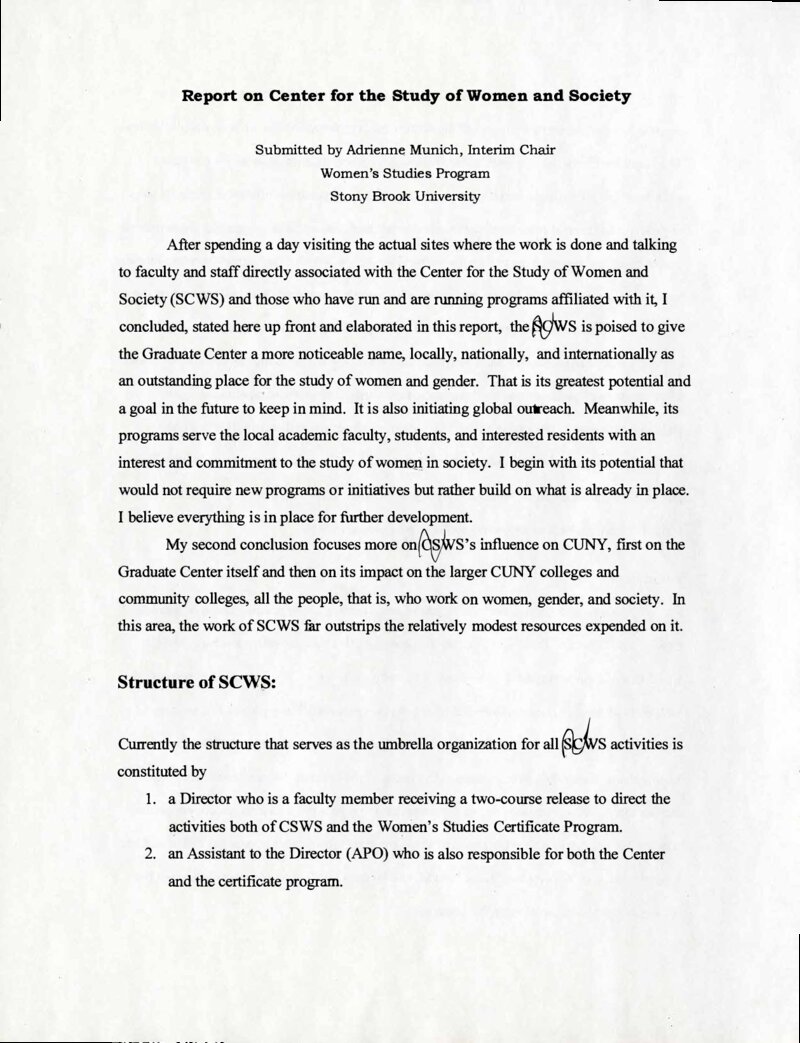
Report on Center for the Study of Women and Society
Submitted by Adrienne Munich, Interim Chair
Women’s Studies Program
Stony Brook University
After spending a day visiting the actual sites where the work is done and talking
to faculty and staff directly associated with the Center for the Study of Women and
Society (SCWS) and those who have run and are running programs affiliated with it, I
concluded, stated here up front and elaborated in this report, the Rows is poised to give
the Graduate Center a more noticeable name, locally, nationally, and internationally as
an outstanding place for the study of women and gender. That is its greatest potential and
a goal in the future to keep in mind. It is also initiating global outreach. Meanwhile, its
programs serve the local academic faculty, students, and interested residents with an
interest and commitment to the study of women in society. I begin with its potential that
would not require new programs or initiatives but rather build on what is already in place.
I believe everything is in place for further development.
My second conclusion focuses more on(shv S’s influence on CUNY, first on the
Graduate Center itself and then on its impact on the larger CUNY colleges and
community colleges, all the people, that is, who work on women, gender, and society. In
this area, the work of SCWS far outstrips the relatively modest resources expended on it.
Structure of SCWS:
Currently the structure that serves as the umbrella organization for all Gly S activities is
constituted by
1. a Director who is a faculty member receiving a two-course release to direct the
activities both of CSWS and the Women’s Studies Certificate Program.
2. an Assistant to the Director (APO) who is also responsible for both the Center
and the certificate program.
dr 1,
ed
3. an Advisory Board composed of sfx faculty members, by-laws requiring that
these members be drawn equally from the humanities and the social sciences.
The Advisory Board meets regularly, deciding on issues pertaining both to the a
curricular program and to the CSWS. Apuek
The structure rationally echoes the current arrangement. However, this arrangement
diminishes both sides of the vibrant enterprise. As the self-study points out, the two
separate entities, now under one structure, had originally been separate in some ways
although working to the same general ends: the study of women, the education of
women’s studies students, and the commitment to public policies (as a point of origin of
the discipline in a social movement).
Recommendations about Structure
One question about the structure is whether it would be best for both entities to have a
separate director. This question was answered in 1993 in favor of having one
Director/Coordinator of both entities. I do not recommend at this time that this
decision be revised. For political as well as intellectual reasons, to have both entities
supervised by one person with a vision of both related but separate missions promotes a
smooth-running enterprise. However, in order to work optimally and to fulfill even its
relatively modest and local (though CUNY-wide) mission, the structure must be supplied
with adequate resources.
Resources required:
1. At thevery least, an additional APO, or administrative person of some level
who will work exclusively for one unit. Since this report focuses on CSWS, the
person would work for the Center, coordinating its activities and making possible
the pursuit of grants and other kinds of monies and publicity.
2. Additional support for the Director/Coordinator. The teaching load for the
Director is quite heavy, heavier than it would be in other institutions for far less
work and less varied work. To teach one course per semester would seem
maximum, particularly since the work is more complex than an Executive Officer
of an academic department. In addition, the courses should be centered at the
Graduate Center. According to the interviews I had with faculty, filling the
position is particularly difficult, not because the program is weak or diminishing
or unexciting but because the position is onerous, even for those with
administrative skills and propensities. That both parts of the job have been
successful is a testimony to sacrifices made that should not be demanded and are
a particular sore point in regards to Women’s Studies where there is an implicit
expectation that women will give extra effort to the program because of
ideological commitment and gendered expectations. In other words, the
Director should be a full-time appointment.
An additional college assistant, whose duties would be exclusively at CSWS.
This position offers not only help to the Center but training to the student
awarded it. I envision that the college assistant would be in charge of publicity
and of acting as a liaison between the research activities of the Center and
students and faculty not necessarily associated with the Women’s Studies
Certificate Program.
I considered the question of a Deputy Director from the 1993 resolution, a
recommendation that was not implemented. If the right circumstances and will
to do so come together, a Deputy Director would produce more coordinated
programs and could augment the research aspect of CSWS and surely would
bring more visibility to the Center. Such a person could serve as an interface
between the Graduate Center and New York residents, which is part of its
mission of public programs. In addition such a person could more actively
pursue international fellows who would add intellectual breadth to the Center.
The person, either called a Deputy or Assistant Director would work with the
APO to work seriously for grant-writing, the success of which is measured in
years of preparation and multiple submissions; it requires great amounts of time.
Currently, even with augmented staff as above, there would be no one with the
expertise or specific job description to write grants, and would benefit from the
guidance of Brian Schwartz and his office. I believe this would be a long-term
and recommended goal.
The first three are urgent recommendations, the fourth would take CSWS to a better,
fully professional level of functioning.
Selected initiatives and activities under the umbrella of CSWS
Women’s Studies Discipline Council This activity, somewhat buried in the report,
adds to the extraordinary vitality of the Center’s activities by bringing together from the
far-flung campuses faculty who have common interests. The campuses ultimately supply
faculty to the Graduate Center, but that is only one important aspect of its function. The
importance of the Discipline Council cannot be overemphasized because it adds to the
intellectual tone of the Center, stimulates research, brings talented and new faculty
together to produce an engine of creativity, and all this within the larger institution. This
Council can infuse the enterprise of Women’s Studies with a sense of its place within
CUNY. As the self-study indicates, some of that sense of purpose is expended in
services to students. The mentoring program provides only one example of how the .
CSWS extends its reach to all the CUNY campuses for the improvement of the student =o Ae Y
quality of life. Were there the interest and resources, there could be a study of the Yagi
mentoring undertaken as a graduate research project. Significantly such a project as
mentoring (which women retuming to school or younger women who are first generation
college students particularly require, according to current research) brings in the
community colleges and the colleges to play a key role in the central mission of the
study of women and society.
Another notable accomplishment of the Discipline Council is their annual (ee, “/ )
luncheon celebrating the accomplishments of Se Sect lare erase the CUNY system.
Again, this activity brings together scholars not only to celebrate but to support and
stimulate scholarship.
Again, another way of bringing together the discipline in such a far-flung entity is
the website, and, although it may not be an explicit aspect of the Discipline Council, it
provides a similar function of integrating the discipline.
The Feminist Studies Group: CSWS functions here as a gathering place for graduate
student research and programming. Were this group only to meet to provide a forum for
presenting their own work, it would be serving an important interdisciplinary function.
But it does much more in organizing and sponsoring speakers, organizing a conference,
and an additional regular major conference on feminist pedagogy every two years. I
comment on this as a specific response to Brian Schwartz’s question about whether
CSWS serves a student component. This group serves the graduate students not by
providing them with lectures (though CSWS does that as well) but by allowing the
students to plan and initiate their lectures according to their own interests. They, thus,
receive invaluable administrative experience while they are adding to their disciplinary
knowledge.
Women Writing Women’s Lives: CSWS sponsors this group of writers working on
women’s biographies. It is another example of outreach because the group serves not
only the faculty whose research involves biography but those writers in the community
with a feminist perspective. This group gathers those community people into a forum
where they are supported and stimulated while at the same time the community people
lend their considerable expertise (and reputation) to the group. In addition to the regular
meetings organized around themes, WWWL provides a network, again whose potential
for stimulating and improving each other’s work is invaluable. That being said, the
productivity of the group is impressive and first-rate. There have been conferences
featuring the members’ work, and future activities of this nature are planned. WWWL is
another group that serves an interface function between the public and the Graduate
Center.
College and Community Fellowship (CCF) and Community Leadership and
Education after Reentry (CLEAR) : I place these two entries together because I
understand it works under the same leadership and has the same personnel associated
with it. I was asked specifically if this CSWS program may have run its course. Rather
than dwindling, I found that the project is attracting more and larger grants, the most
recent, though not in the self-study, I believe is a large grant from the Robin Hood
Foundation. The project expects even more grants in the future. Currently, it has two
doctoral students conducting research. It is an admirable project, fulfilling the visions of
the founders of Women’s Studies to make a difference in the outside world. While not
activist in the ordinary sense, the project has a one-hundred percent success rate. Not one
woman in the project has returned to prison. At present the project serves seventy-five
women, and it expects to expand to one hundred. Not only is the program of benefit to
the women it serves but it provides research opportunities.
CCF has an active and essential mentoring program staffed by volunteers. It is
the hope of the project to add more mentors. This mentorship program also reaches
across campuses to involve people as mentors. Mentoring programs provide valuable
experience for the mentors, while, it is not too strong to claim, they help ensure the
success of the mentees.
This is a vital and I believe unique component of the Center and should be
treasured by the Graduate Center for its importance and its success in attracting high-
quality donors.
Lecture series and similar programs:
I will not list or comment on individual series because the offerings seem to speak for
themselves in scope and quality. I will only respond to a query about whether CSWS
spreads itself too thin and cannot bring in an adequate audience for its numerous lectures
and programs. Director Anne Humpherys has indicated that many of the programs are
co-sponsored and are often initiated by other units. There is discrimination on her part in
not sponsoring everything, and, of course, it is sometimes hard to gauge the attendance at
events, since there are so many at the Graduate Center, not to mention in the city at any
given time. However, the co-sponsoring function seems to me one vital aspect of CSWS
in serving as a congenial while discriminating venue for the wider interests of the
Graduate Center. I cannot judge whether the many are too many, but it is certainly a rich
and complex offering.
Publications: This area makes CSWS unique, and I will offer one major and free-of-
cost suggestion to further integrate the publication activity with that of CSWS.
Women’s Studies Quarterly is already a part of the mission of CSWS. It provides
faculty with a publication, and the extraordinary quality of the Women’s Studies faculty
ensures the high quality of the editors. Such an enterprise adds luster to the Graduate
Center and certainly argues for the intellectual quality produced and sponsored by
we S. An example of the tangible benefits of the sponsorship is that some of the
research from CLEAR may be published in the Quarterly. Ina sense, this is a different
kind of mentorship but by those lights no less valuable.
The Feminist Press CSWS has co-sponsored events with the Feminist Press, and this
association seems a natural. The Feminist Press is a unique and invaluable asset to the
Graduate Center, and their activities have a national and international reach. Their
publications with their international scope and their mission to publish works that fall
under the rubric of CSWS would seem to make some sort of formal relationship and
partnership an evolutionary step in the relationship. The Feminist Press would gain a
firm institutional presence and CSWS would make official what right now is a sensible,
vital but too casual affiliation.
Recommendation: The Feminist Press become a unit under the umbrella of CSWS, with
the same sort of autonomy to raise funds to have an advisory board and so forth as
CCF/CLEAR.
Prizes and Awards: Not an inconsiderable asset, prizes and awards encourage students
and boost morale. They are a potential area for more fund-raising, should a Deputy or
Associate Director be appointed.
Future plans: I met the new director of the Center for Biography Studies and with a
member of WWWL and with the Director of MALS and heard of their plans for a
conference and further collaborations.
The Activist Women’s Voices Oral History Archive and Urban Fieldwork
Interships: Recommendation: | mention this archive and project in the section with
future plans because this seems a model for more archival work and closer affiliation
with the Mina Rees Library. I have nothing to add but to praise this project and to
suggest that some future (near future) collaboration in the library to set up an area for.the
CSWS collection of books and archives, to be supplemented by the donation of the
remarkable collection of books by Jane Marcus. The Marcus collection needs to be kept
together, and a dedicated space not only for it but perhaps with other books and archives
can be created. This is another fund-raising possibility.
In conclusion, CSWS in its present reduced state is a beehive of productive activity of an
amazing range, serving students, faculty, the public, and identified groups within the
community. Its outreach is admirable in creating an intellectual community. I believe it
might reduce lectures but not at the cost of alienating other units in the Graduate Center
and only if the effort does not seem worth the pay-off. The Center serves a very wide
community with the highest quality programs.
Respectfully submitted:
i Attachments can contain viruses that may harm your computer. Attachments may not display correctly. |
Humpherys, Anne
From: Adrienne Munich [adrienne.munich@gmail.com] Sent: Tue 5/20/2008 10:26 PM
To: Schwartz, Brian
Cc: Humpherys, Anne
Subject: My report on CSWS
Attachments: |} Report on Center for the Study of Women and Society.doc(68KB)
Dear Brian,
How interesting a day I spent, and what a pleasure to meet you. I was feeling discouraged about higher education, particularly in
NYC, and you restored my positive outlook.
I've written up this report, and hope it is adequate for your needs. If there are any questions or areas I have neglected, please do
let me know. I didn't have a whole lot to say about some of the CSWS activities; they all seemed not to need any tampering with. I
hope I have addressed the specific questions that you and Julia Wrigley raised during my meeting with you. CSCW is a treasure and
a bargain!
Warm regards, Adrienne
Adrienne Munich
Interim Chair, Women's Studies
Office Phone: 631-632-1762
Professor of English and Women's Studies
Co-Editor, Victorian Literature and Culture
Journal Phone 631-632-1365, Fax: 631-632-1303
https://wa.gc.cuny.edu/exchange/AHumpherys/Inbox/My%20report%200n%20CSWS.EML... 6/4/2008
Submitted by Adrienne Munich, Interim Chair
Women’s Studies Program
Stony Brook University
After spending a day visiting the actual sites where the work is done and talking
to faculty and staff directly associated with the Center for the Study of Women and
Society (SCWS) and those who have run and are running programs affiliated with it, I
concluded, stated here up front and elaborated in this report, the Rows is poised to give
the Graduate Center a more noticeable name, locally, nationally, and internationally as
an outstanding place for the study of women and gender. That is its greatest potential and
a goal in the future to keep in mind. It is also initiating global outreach. Meanwhile, its
programs serve the local academic faculty, students, and interested residents with an
interest and commitment to the study of women in society. I begin with its potential that
would not require new programs or initiatives but rather build on what is already in place.
I believe everything is in place for further development.
My second conclusion focuses more on(shv S’s influence on CUNY, first on the
Graduate Center itself and then on its impact on the larger CUNY colleges and
community colleges, all the people, that is, who work on women, gender, and society. In
this area, the work of SCWS far outstrips the relatively modest resources expended on it.
Structure of SCWS:
Currently the structure that serves as the umbrella organization for all Gly S activities is
constituted by
1. a Director who is a faculty member receiving a two-course release to direct the
activities both of CSWS and the Women’s Studies Certificate Program.
2. an Assistant to the Director (APO) who is also responsible for both the Center
and the certificate program.
dr 1,
ed
3. an Advisory Board composed of sfx faculty members, by-laws requiring that
these members be drawn equally from the humanities and the social sciences.
The Advisory Board meets regularly, deciding on issues pertaining both to the a
curricular program and to the CSWS. Apuek
The structure rationally echoes the current arrangement. However, this arrangement
diminishes both sides of the vibrant enterprise. As the self-study points out, the two
separate entities, now under one structure, had originally been separate in some ways
although working to the same general ends: the study of women, the education of
women’s studies students, and the commitment to public policies (as a point of origin of
the discipline in a social movement).
Recommendations about Structure
One question about the structure is whether it would be best for both entities to have a
separate director. This question was answered in 1993 in favor of having one
Director/Coordinator of both entities. I do not recommend at this time that this
decision be revised. For political as well as intellectual reasons, to have both entities
supervised by one person with a vision of both related but separate missions promotes a
smooth-running enterprise. However, in order to work optimally and to fulfill even its
relatively modest and local (though CUNY-wide) mission, the structure must be supplied
with adequate resources.
Resources required:
1. At thevery least, an additional APO, or administrative person of some level
who will work exclusively for one unit. Since this report focuses on CSWS, the
person would work for the Center, coordinating its activities and making possible
the pursuit of grants and other kinds of monies and publicity.
2. Additional support for the Director/Coordinator. The teaching load for the
Director is quite heavy, heavier than it would be in other institutions for far less
work and less varied work. To teach one course per semester would seem
maximum, particularly since the work is more complex than an Executive Officer
of an academic department. In addition, the courses should be centered at the
Graduate Center. According to the interviews I had with faculty, filling the
position is particularly difficult, not because the program is weak or diminishing
or unexciting but because the position is onerous, even for those with
administrative skills and propensities. That both parts of the job have been
successful is a testimony to sacrifices made that should not be demanded and are
a particular sore point in regards to Women’s Studies where there is an implicit
expectation that women will give extra effort to the program because of
ideological commitment and gendered expectations. In other words, the
Director should be a full-time appointment.
An additional college assistant, whose duties would be exclusively at CSWS.
This position offers not only help to the Center but training to the student
awarded it. I envision that the college assistant would be in charge of publicity
and of acting as a liaison between the research activities of the Center and
students and faculty not necessarily associated with the Women’s Studies
Certificate Program.
I considered the question of a Deputy Director from the 1993 resolution, a
recommendation that was not implemented. If the right circumstances and will
to do so come together, a Deputy Director would produce more coordinated
programs and could augment the research aspect of CSWS and surely would
bring more visibility to the Center. Such a person could serve as an interface
between the Graduate Center and New York residents, which is part of its
mission of public programs. In addition such a person could more actively
pursue international fellows who would add intellectual breadth to the Center.
The person, either called a Deputy or Assistant Director would work with the
APO to work seriously for grant-writing, the success of which is measured in
years of preparation and multiple submissions; it requires great amounts of time.
Currently, even with augmented staff as above, there would be no one with the
expertise or specific job description to write grants, and would benefit from the
guidance of Brian Schwartz and his office. I believe this would be a long-term
and recommended goal.
The first three are urgent recommendations, the fourth would take CSWS to a better,
fully professional level of functioning.
Selected initiatives and activities under the umbrella of CSWS
Women’s Studies Discipline Council This activity, somewhat buried in the report,
adds to the extraordinary vitality of the Center’s activities by bringing together from the
far-flung campuses faculty who have common interests. The campuses ultimately supply
faculty to the Graduate Center, but that is only one important aspect of its function. The
importance of the Discipline Council cannot be overemphasized because it adds to the
intellectual tone of the Center, stimulates research, brings talented and new faculty
together to produce an engine of creativity, and all this within the larger institution. This
Council can infuse the enterprise of Women’s Studies with a sense of its place within
CUNY. As the self-study indicates, some of that sense of purpose is expended in
services to students. The mentoring program provides only one example of how the .
CSWS extends its reach to all the CUNY campuses for the improvement of the student =o Ae Y
quality of life. Were there the interest and resources, there could be a study of the Yagi
mentoring undertaken as a graduate research project. Significantly such a project as
mentoring (which women retuming to school or younger women who are first generation
college students particularly require, according to current research) brings in the
community colleges and the colleges to play a key role in the central mission of the
study of women and society.
Another notable accomplishment of the Discipline Council is their annual (ee, “/ )
luncheon celebrating the accomplishments of Se Sect lare erase the CUNY system.
Again, this activity brings together scholars not only to celebrate but to support and
stimulate scholarship.
Again, another way of bringing together the discipline in such a far-flung entity is
the website, and, although it may not be an explicit aspect of the Discipline Council, it
provides a similar function of integrating the discipline.
The Feminist Studies Group: CSWS functions here as a gathering place for graduate
student research and programming. Were this group only to meet to provide a forum for
presenting their own work, it would be serving an important interdisciplinary function.
But it does much more in organizing and sponsoring speakers, organizing a conference,
and an additional regular major conference on feminist pedagogy every two years. I
comment on this as a specific response to Brian Schwartz’s question about whether
CSWS serves a student component. This group serves the graduate students not by
providing them with lectures (though CSWS does that as well) but by allowing the
students to plan and initiate their lectures according to their own interests. They, thus,
receive invaluable administrative experience while they are adding to their disciplinary
knowledge.
Women Writing Women’s Lives: CSWS sponsors this group of writers working on
women’s biographies. It is another example of outreach because the group serves not
only the faculty whose research involves biography but those writers in the community
with a feminist perspective. This group gathers those community people into a forum
where they are supported and stimulated while at the same time the community people
lend their considerable expertise (and reputation) to the group. In addition to the regular
meetings organized around themes, WWWL provides a network, again whose potential
for stimulating and improving each other’s work is invaluable. That being said, the
productivity of the group is impressive and first-rate. There have been conferences
featuring the members’ work, and future activities of this nature are planned. WWWL is
another group that serves an interface function between the public and the Graduate
Center.
College and Community Fellowship (CCF) and Community Leadership and
Education after Reentry (CLEAR) : I place these two entries together because I
understand it works under the same leadership and has the same personnel associated
with it. I was asked specifically if this CSWS program may have run its course. Rather
than dwindling, I found that the project is attracting more and larger grants, the most
recent, though not in the self-study, I believe is a large grant from the Robin Hood
Foundation. The project expects even more grants in the future. Currently, it has two
doctoral students conducting research. It is an admirable project, fulfilling the visions of
the founders of Women’s Studies to make a difference in the outside world. While not
activist in the ordinary sense, the project has a one-hundred percent success rate. Not one
woman in the project has returned to prison. At present the project serves seventy-five
women, and it expects to expand to one hundred. Not only is the program of benefit to
the women it serves but it provides research opportunities.
CCF has an active and essential mentoring program staffed by volunteers. It is
the hope of the project to add more mentors. This mentorship program also reaches
across campuses to involve people as mentors. Mentoring programs provide valuable
experience for the mentors, while, it is not too strong to claim, they help ensure the
success of the mentees.
This is a vital and I believe unique component of the Center and should be
treasured by the Graduate Center for its importance and its success in attracting high-
quality donors.
Lecture series and similar programs:
I will not list or comment on individual series because the offerings seem to speak for
themselves in scope and quality. I will only respond to a query about whether CSWS
spreads itself too thin and cannot bring in an adequate audience for its numerous lectures
and programs. Director Anne Humpherys has indicated that many of the programs are
co-sponsored and are often initiated by other units. There is discrimination on her part in
not sponsoring everything, and, of course, it is sometimes hard to gauge the attendance at
events, since there are so many at the Graduate Center, not to mention in the city at any
given time. However, the co-sponsoring function seems to me one vital aspect of CSWS
in serving as a congenial while discriminating venue for the wider interests of the
Graduate Center. I cannot judge whether the many are too many, but it is certainly a rich
and complex offering.
Publications: This area makes CSWS unique, and I will offer one major and free-of-
cost suggestion to further integrate the publication activity with that of CSWS.
Women’s Studies Quarterly is already a part of the mission of CSWS. It provides
faculty with a publication, and the extraordinary quality of the Women’s Studies faculty
ensures the high quality of the editors. Such an enterprise adds luster to the Graduate
Center and certainly argues for the intellectual quality produced and sponsored by
we S. An example of the tangible benefits of the sponsorship is that some of the
research from CLEAR may be published in the Quarterly. Ina sense, this is a different
kind of mentorship but by those lights no less valuable.
The Feminist Press CSWS has co-sponsored events with the Feminist Press, and this
association seems a natural. The Feminist Press is a unique and invaluable asset to the
Graduate Center, and their activities have a national and international reach. Their
publications with their international scope and their mission to publish works that fall
under the rubric of CSWS would seem to make some sort of formal relationship and
partnership an evolutionary step in the relationship. The Feminist Press would gain a
firm institutional presence and CSWS would make official what right now is a sensible,
vital but too casual affiliation.
Recommendation: The Feminist Press become a unit under the umbrella of CSWS, with
the same sort of autonomy to raise funds to have an advisory board and so forth as
CCF/CLEAR.
Prizes and Awards: Not an inconsiderable asset, prizes and awards encourage students
and boost morale. They are a potential area for more fund-raising, should a Deputy or
Associate Director be appointed.
Future plans: I met the new director of the Center for Biography Studies and with a
member of WWWL and with the Director of MALS and heard of their plans for a
conference and further collaborations.
The Activist Women’s Voices Oral History Archive and Urban Fieldwork
Interships: Recommendation: | mention this archive and project in the section with
future plans because this seems a model for more archival work and closer affiliation
with the Mina Rees Library. I have nothing to add but to praise this project and to
suggest that some future (near future) collaboration in the library to set up an area for.the
CSWS collection of books and archives, to be supplemented by the donation of the
remarkable collection of books by Jane Marcus. The Marcus collection needs to be kept
together, and a dedicated space not only for it but perhaps with other books and archives
can be created. This is another fund-raising possibility.
In conclusion, CSWS in its present reduced state is a beehive of productive activity of an
amazing range, serving students, faculty, the public, and identified groups within the
community. Its outreach is admirable in creating an intellectual community. I believe it
might reduce lectures but not at the cost of alienating other units in the Graduate Center
and only if the effort does not seem worth the pay-off. The Center serves a very wide
community with the highest quality programs.
Respectfully submitted:
i Attachments can contain viruses that may harm your computer. Attachments may not display correctly. |
Humpherys, Anne
From: Adrienne Munich [adrienne.munich@gmail.com] Sent: Tue 5/20/2008 10:26 PM
To: Schwartz, Brian
Cc: Humpherys, Anne
Subject: My report on CSWS
Attachments: |} Report on Center for the Study of Women and Society.doc(68KB)
Dear Brian,
How interesting a day I spent, and what a pleasure to meet you. I was feeling discouraged about higher education, particularly in
NYC, and you restored my positive outlook.
I've written up this report, and hope it is adequate for your needs. If there are any questions or areas I have neglected, please do
let me know. I didn't have a whole lot to say about some of the CSWS activities; they all seemed not to need any tampering with. I
hope I have addressed the specific questions that you and Julia Wrigley raised during my meeting with you. CSCW is a treasure and
a bargain!
Warm regards, Adrienne
Adrienne Munich
Interim Chair, Women's Studies
Office Phone: 631-632-1762
Professor of English and Women's Studies
Co-Editor, Victorian Literature and Culture
Journal Phone 631-632-1365, Fax: 631-632-1303
https://wa.gc.cuny.edu/exchange/AHumpherys/Inbox/My%20report%200n%20CSWS.EML... 6/4/2008
Title
External Review for Center for the Study of Women and Society (CSWS) by Adrienne Munich
Description
This external report on the Center for the Study of Women and Society (CSWS) was submitted in May 2008 by Adrienne Munich, interim chair of the Women's Studies Program at the State University of New York (SUNY) Stony Brook University. Munich began the report by praising CSWS for its work and highlighting its importance as part of the City University of New York (CUNY). She opened the actual report with CSWS's structure and recommended additional administrative personnel, support for the director, and a college assistant dedicated exclusively to CSWS. She also underscored the importance of the Women's Studies Discipline Council, the Feminist Studies Group, Women Writing Women's Lives, College and Community Fellowship (CCF), and Community Leadership and Education Reentry (CLEAR) programs. Munich also commented on CSWS's lecture series and ongoing publications, such as Women's Studies Quarterly and the Feminist Press. The document ended with an email from Munich to GC Vice President for Research Brian Schwartz containing the aforementioned report. In this email, she identified CSWS as both a treasure and a bargain.
Since 1977, the Center for the Study of Women and Society (CSWS), Graduate Center, City University of New York (CUNY) has promoted interdisciplinary feminist scholarship. The Center’s research agenda focuses on the intersectional study of gender, sexuality, race, ethnicity, class, and nation in societies worldwide. The Center co-sponsors the Women’s Studies Certificate Program and, most notably, hosts the only stand-alone Women’s and Gender Studies MA Program in New York City.
Contributor
Center for the Study of Women and Society
Creator
Munich, Adrienne
Date
May 20, 2008
Language
English
Rights
Copyrighted
Source
Center for the Study of Women and Society
Original Format
Report / Paper / Proposal
Munich, Adrienne. Letter. “External Review for Center for the Study of Women and Society (CSWS) by Adrienne Munich.”, CUNY DIGITAL HISTORY ARCHIVE, accessed September 5, 2026, https://stephenz.tailc22a4b.ts.net/s/cdha/item/1589