"CSWS: Plans for Expansion and Future Development" Proposal
Item
The Graduate School and University Center
of The City University of New York
Center for the Study of Women and Society / Box 135-192
Graduate Center: 33 West 42 Street, New York, N.Y. 10036-8099
212 790-4435
June 13, 1983
Ms. Gladys Chang Hardy
Program Officer in Charge
Education and Culture Program
The Ford Foundation
320 East 43rd Street
New York, NY 10017
Dear Ms. Hardy:
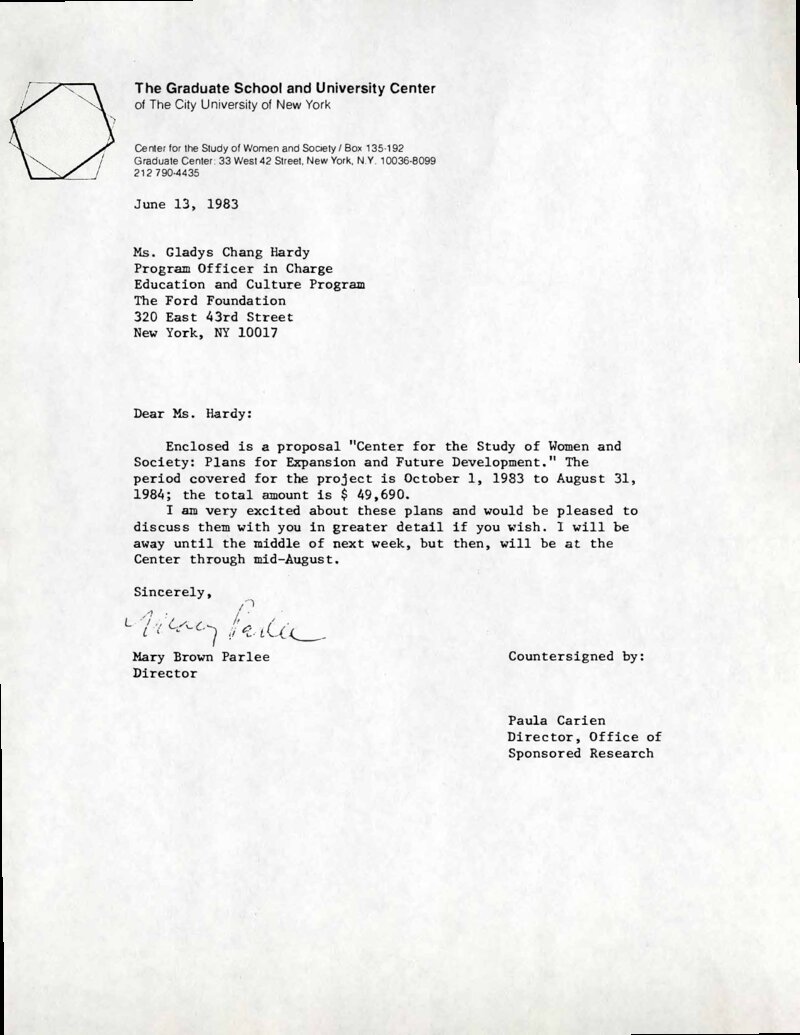
Enclosed is a proposal "Center for the Study of Women and
Society: Plans for Expansion and Future Development." The
period covered for the project is October 1, 1983 to August 31,
1984; the total amount is $ 49,690.
TI am very excited about these plans and would be pleased to
discuss them with you in greater detail if you wish. I will be
away until the middle of next week, but then, will be at the
Center through mid-August.
Sincerely,
1 “eT
L Bia.” a. | os
(i HE ) Hee
Mary Brown Parlee Countersigned by:
Director
Paula Carien
Director, Office of
Sponsored Research
June 13, 1983
Center for the Study of Women and Society
Plans for Expansion and Further Development
Mary Brown Parlee, Director
As a result of work over the past two and one half
years, supported in part by a development grant from The
Ford Foundation ($57,000) and in part by the Graduate Center
($84,500), the Center for the Study of Women and Society is
beginning to do in fact what it was established to do in
principle. It has begun to serve as a focus for coordinated
activity among faculty and students throughout the 21l-campus
City University of New York. This occurs through the
Newsletter (Appendix A), the newly-formed CUNY Feminist
Network, the directory of CUNY feminist researchers and
scholars (Appendix B), and renewed interest among faculty in
working toward increased communication and coordination of
research and Women’s Studies activities among the campuses.
This development of the Center has occurred despite the
considerable structural barriers operating to oppose the
functioning of CUNY as a university. Such persistence by
faculty and students strongly suggests that the Center’s
activities are meeting real needs of the individuals
involved. Given the potential of the City University of New
York to be the premier urban university in the country,
combining a strong faculty, a historic mission to serve
middle and working class populations, and a diverse student
body, it is encouraging - indeed, exciting -to see that
feminist scholars, researchers, and students have been in
the forefront of building organizational structures that
seem to work, in a small way, toward combining and
developing these strengths. .
The development of a continuing organizational
structure to facilitate and support women’s research at CUNY
is a necessary first stage in our effort to reach out to
other institutions and populations in New York City and to
integrate women’s research into mainstream teaching and
research within the university. Thus far, we have been most
successful with this effort through two sets of activities.
In the area of health concerns, one of the principle
research foci of the Center, substantial connections with
researchers at Mt. Sinai School of Medicine (a part of
CUNY) are beginning to bear fruit, not only in the form of
our highly successful seminar series, but also in
identification of individual researchers who now have
appointments at both Mt. Sinai and at the Graduate Center
or other CUNY campus. A group of women has also formed at
Mt. Sinai and has received funding to assess the
feasibility of establishing a research group in Community
Psychiatry. The Center has been represented in these
discussions by Charlotte Muller, a member of our Executive
Committee, and I keep in touch with the organizers (Myrna
Weiss, Marcia Hurst, Sam Bloom). Our thinking is that once
the group is established at Mt. Sinai, closer coordination
with the Center at the Graduate Center will be formalized.
Our hope is that this would strengthen not only joint
research efforts, but also the emergence of a coordinated
graduate curriculum in health and the behavioral sciences
(which continues to be discussed at the Graduate Center), a
curriculum in which women’s health issues would be an
integral part from the beginning.
The second way in which the Center’s outreach
activities are beginning to pay off is through the CUNY
Feminist Network and through related efforts that I
participate in with a group of research center and women’s
studies directors in the the New York metropolitan area.
The CUNY Feminist Network is a broad-based, grass-roots
group of CUNY faculty and students who meet to discuss both
intellectual/personal/political issues around the
integration of sex, race, and class perspectives in the
content and forms of academic life and also political
actions in support of women and minorities at CUNY.
In the meetings of the Network there is an excitement
that I think has been too often missing in feminist
scholarship and women’s studies recently: a feeling of
creative excitement and personal committment to the role of
intellectual activity in the struggle for social justice.
In my experience, it is groups of this kind that most
consistently focus on the interconnectedness of issues
around gender, race, and class, and which know and act on
the understanding that the body of researchers and scholars
has to be diverse (in race, age, sexual orientation, and the
like) if the body of knowledge produced in the academy is to
be true and useful for effecting social change. It is the
creative potential of groups such as this which compensates
for the additonal work and occasional frustration I
encounter is trying to mesh the energy of the group with the
organizational structures through which changes will have to
be made in CUNY.
An understanding of the necessity for diversity in
formulation of activities, ideas, and strategies has also
been the basis of the first coordinated activity to be
carried out by the New York Metropolitan research and
women’s studies group.“ We are planning an event in the fall
to begin the development of curricular materials and
discussions of teaching that will enable faculty to
incorporate race, sexual orientation, and class perspectives
into traditional content and modes of instruction. The fall
event will bring together a very diverse group of
individuals concerned with these issues; specific ways of
formulating the topic and planning coordinated activities
will come out of this expanded group. (A series of
workshops on different campuses, followed by a general
conference to discuss the outcomes and strategies for the
future is one possibility the smaller planning group
envisaged.)
The planning meetings for this effort by the New York
Metropolitan group have been held at the Center. This has
been done with the explicit assumption that CUNY would be
the natural place to locate, both because of the size and
diversity of the student body and its faculty, and also
because of CUNY”’s image - an accurate one - as a public
institution committed to the interestes of the diverse
publics it is intended to serve. I have agreed to
coordinate the mailing lists as we begin to work, and, not
surprisingly, the existence of CUNY Feminist Network list
and the directory of CUNY faculty and students means the
work of getting this new, regional, network off the ground
is already well underway.
The Center for the Study of Women and Society at CUNY’s
Graduate Center is thus beginning to serve as the kind of
coordinating, facilitating umbrella organization for CUNY
that was planned at its inception. Our need now is to
strengthen these ongoing activities and to plan
systematically both for expansion and for more effective
coordination over the next few years. In order to
strengthen the CUNY network of researchers and scholars, our
goals over the next year are 1) to identify and actively
recruit more minority scholars interested in research on
women and society and 2) to integrate their activities with
ongoing and new research projects in the Center. Both the
active recruitment and the development of specific research
projects incorporating sex, ethnicity, and class
perspectives are essential if the Center is to promote
research and scholarship that are appropriate for the
mission of the university and the urban contituencies it is
intended to serve. Even if we were located in an elite
private institution, however, incorporation of broader and
more diverse perspectives (almost always related to a more
broadly diverse group of researchers) is necessary if
research and scholarship about women is to fulfill its
initial promise of developing more complete and more
accurate knowledge than traditional scholarship has done.
Like many organizatons, even with substantial minority
group participation in its formal governing structures, the
Center”’s day-to-day outreach activities have been only
moderately effective in attracting faculty and students
whose research focusses on concerns of women and men of
different ethnic and racial minorities. During the next
year we propose to recruit and involve more such researchers
through a two stage process.
On the one hand, we will restaff and restructure our
Major outreach activities to highlight work of minority
scholars within CUNY that is related to women’s issues.
This will be done through the Newsletter (the "cover story”,
the books reviewed, the reviewers), the CUNY Feminist
Network Conference (a major address and workshops by
minority scholars have already been scheduled for Fall,
1983, conference), and through active efforts to identify
and integrate minority scholars working on women into the
next revision of the CUNY feminist research directory
(revision planned for Spring, 1984).
To expand and strengthen our networks within CUNY takes
time, money, and a concentrated effort to reach the target
groups of minority faculty and students. The Center now has
the necessary organizational structures in place to focus on
this Se recruitment with a reasonable likelihood of
success. It also now has a group of people involved in the
Center who genuinely want to strengthen and diversify their
research networks, and who have identified appropriate
faculty and students in the university who can guide and
assist this effort. Specifically, the 16 minority
researchers and scholars who have indicated their interest
in being included in the CUNY feminist research directory
will be asked to serve as a steering committee to recommend
people and procedures for 1) substantially expanding the
network of minority researchers and scholars, 2) developing’
programs and projects to highlight their research and other
work incorporating sex, ethnicity, and class perspectives,
and 3) integrating this work with that of other scholars at
the Center. Because CUNY faculty have generally heavy
teaching loads, particularly at the community colleges, we
are requesting released time for a core group from (or
recommended by) the steering committee so that they can
spend time at the Center to carry out this work. We are
also requesting seed money and a part-time research
assistant to support some of the programs and research
projects (in their pilot form) which the group recommends.
The second phase of the Center’s effort over the coming
year will be to use the expanding networks and their
activities to develop working relationships among
researchers who want to or are already working on projects
where multiple perspectives (based on sex, ethnicity, and
class) must necessarily be taken into account in the
research. Thus far, four such projects have been identified
as possibilities (see Appendix C). Two of them involve
integration of feminist and minority perspectives into
“mainstream” research; one involves a continued focus on
women’s health issues with minority concerns more clearly
integrated into the research; one involves integration of
feminist and minority-feminist perspectives wth the research
of a minority male faculty member at the Graduate Center.
We hope that other such opportunities for collaborative
research with multiple perspectives will develop as the
result of interactions among researchers in the Center and
at the Graduate Center over the course of the year. We are
requesting released time or research assistant support for
participation in the projects already identified so that
minority scholars associated with the Center can have
substantial input into the projects from their earliest
stages.
In sum, then, we are proposing to devote the next year
largely to active efforts to integrate minority group
members and research on women of different ethnic and racial
minorities into the workings of the Center. The first phase
will be to expand and strengthen the Center’”s network:-of
CUNY feminist researchers by explicitly focussing our major
outreach activities on research about minority women’s
issues and by minority scholars. The second phase will be
to integrate these researchers and their work and
perspectives into specific ongoing and developing research
projects in the Center and in other units of the university.
Our budget request is for support to do this in the way most
likely to be effective and productive within the
organizational structures of the City University and of the
Center. We see these efforts as critical to the development
of a first-rate research center, one where the work is both
intellectually incisive and practically relevant. It is the
next step in building an organizational structure we think
can make a difference in the university and in the knowledge
it produces, as well as in the ways research is developed
and used outside the university.
Footnotes
lthe barriers include the history of independence and
rivalry among the senior colleges, the status-related
tensions among community colleges, four year colleges, and
the Graduate Center, and the usual money- and turf-related
pressures against work in a research center at the Graduate
Center rather than in traditional departments at the
campuses. In addition, there are the practical problems
inherent in developing any CUNY-wide activity: lack of
coordination of class schedules and other activities at the
campuses and the geographic spread of the units of the
university.
2This group was convened by Cathrine Stimpson, Director
of the Rutgers University Institute for Reseach on Women.
It has met monthly for the past eighteen months. It
consists of representatives from Rutgers, New York
University, Barnard, Sarah Lawrence, The New School for
Social Research, and the City University of New York (Hunter
College, the Graduate Center). Mariam Chamberlain, of the
Russel Sage Foundation, also is a regular participant.
3While it might have been desirable to make ethnic and
racial diversity in research perspectives the major focus of
the Center since its inception, it took some time to gain a
foothold within the institution and, in doing so, to
appreciate the ways in which homogeneity is almost
invariably maintained by traditional organizational
structures. We now believe that explicit positive actions,
supported in the financial terms that those in the
institution understand, are necessary to overcome this
organizational inertia.
Requested Budget
(October 1, 1983 - August 31, 1984)
Requested from Ford CUNY Contribution
Director’s salary $41,910*
Secretary/admin. asst. $4,500 4,500
(20 hrs/wk)
Newsletter 3,000
CUNY Feminist Network
Student assistant 552
(15 hrs/wk, 4 wks)
Conference _ 2,000
Directory of CUNY women’s
studies faculty and students 750
(updating, Spring, 1984)
Steering Committee
Faculty released time
(3 faculty, 1 course each) 9,000
Consultant fees
(10 faculty, 300 each) 3,000
Graduate Assistant ~- Steering
Committee (15 hrs/wk; 10 mos) 2,340
Research Assistants
(4 @ 15hrs/wk;10 mos) or
additional faculty released
time 23,400
Seed Money 2,600
(research expenses)
Supplies, postage, xerox 500 1,500
Computer Tine 800
Telephone 600 200
fnnual Dues, NCRW 100
Totals 49,690 51,562
(Requested from The (CUNY Contribution)
Ford Foundation)
* All salaries and wages include fringe benefits: 27% for Directors salary,
20% for research and support staff.
a
Appendices
Appendix A: Sample copies of the Center for the Study
of Women and Society’s Newsletter.
Appendix B: Draft copy of the CUNY Feminist Directory.
(It will be printed in July, 1983).
Appendix C: Research projects integrating sex, ethnicity,
and class perspectives in which minority
scholars in the Center could collaborate.
Appendix C
Research Projects integrating sex, ethnicity,
and class perspectives
Women activists in community organizations and
neighborhoods. (With Professor Marilyn Gittell,
Department of Political Science and Director of
the Community Project at the CUNY Graduate Center).
Nutritional and other health-related behaviors during
pregnancy in urban adolescents. (With Professor Mary
Parlee, Department of Psychology and Director of the
Center for the Study of Women and Society, and with
Professor Barbara Katz Rothman, Department of
Sociology at CUNY”s Baruch College and the Graduate
Center).
Hispanic and Caribbean Peoples in American Foreign
Policy, an Educational Project. (With Professor
Ronald Helman, Director of the Bildner Center for
Western Hemisphere Studies, CUNY Graduate Center).
Development of Early Reading Strategies in Kindergarten.
(With Professor Dalton Miller-Jones, Department of
Psychology).
of The City University of New York
Center for the Study of Women and Society / Box 135-192
Graduate Center: 33 West 42 Street, New York, N.Y. 10036-8099
212 790-4435
June 13, 1983
Ms. Gladys Chang Hardy
Program Officer in Charge
Education and Culture Program
The Ford Foundation
320 East 43rd Street
New York, NY 10017
Dear Ms. Hardy:
Enclosed is a proposal "Center for the Study of Women and
Society: Plans for Expansion and Future Development." The
period covered for the project is October 1, 1983 to August 31,
1984; the total amount is $ 49,690.
TI am very excited about these plans and would be pleased to
discuss them with you in greater detail if you wish. I will be
away until the middle of next week, but then, will be at the
Center through mid-August.
Sincerely,
1 “eT
L Bia.” a. | os
(i HE ) Hee
Mary Brown Parlee Countersigned by:
Director
Paula Carien
Director, Office of
Sponsored Research
June 13, 1983
Center for the Study of Women and Society
Plans for Expansion and Further Development
Mary Brown Parlee, Director
As a result of work over the past two and one half
years, supported in part by a development grant from The
Ford Foundation ($57,000) and in part by the Graduate Center
($84,500), the Center for the Study of Women and Society is
beginning to do in fact what it was established to do in
principle. It has begun to serve as a focus for coordinated
activity among faculty and students throughout the 21l-campus
City University of New York. This occurs through the
Newsletter (Appendix A), the newly-formed CUNY Feminist
Network, the directory of CUNY feminist researchers and
scholars (Appendix B), and renewed interest among faculty in
working toward increased communication and coordination of
research and Women’s Studies activities among the campuses.
This development of the Center has occurred despite the
considerable structural barriers operating to oppose the
functioning of CUNY as a university. Such persistence by
faculty and students strongly suggests that the Center’s
activities are meeting real needs of the individuals
involved. Given the potential of the City University of New
York to be the premier urban university in the country,
combining a strong faculty, a historic mission to serve
middle and working class populations, and a diverse student
body, it is encouraging - indeed, exciting -to see that
feminist scholars, researchers, and students have been in
the forefront of building organizational structures that
seem to work, in a small way, toward combining and
developing these strengths. .
The development of a continuing organizational
structure to facilitate and support women’s research at CUNY
is a necessary first stage in our effort to reach out to
other institutions and populations in New York City and to
integrate women’s research into mainstream teaching and
research within the university. Thus far, we have been most
successful with this effort through two sets of activities.
In the area of health concerns, one of the principle
research foci of the Center, substantial connections with
researchers at Mt. Sinai School of Medicine (a part of
CUNY) are beginning to bear fruit, not only in the form of
our highly successful seminar series, but also in
identification of individual researchers who now have
appointments at both Mt. Sinai and at the Graduate Center
or other CUNY campus. A group of women has also formed at
Mt. Sinai and has received funding to assess the
feasibility of establishing a research group in Community
Psychiatry. The Center has been represented in these
discussions by Charlotte Muller, a member of our Executive
Committee, and I keep in touch with the organizers (Myrna
Weiss, Marcia Hurst, Sam Bloom). Our thinking is that once
the group is established at Mt. Sinai, closer coordination
with the Center at the Graduate Center will be formalized.
Our hope is that this would strengthen not only joint
research efforts, but also the emergence of a coordinated
graduate curriculum in health and the behavioral sciences
(which continues to be discussed at the Graduate Center), a
curriculum in which women’s health issues would be an
integral part from the beginning.
The second way in which the Center’s outreach
activities are beginning to pay off is through the CUNY
Feminist Network and through related efforts that I
participate in with a group of research center and women’s
studies directors in the the New York metropolitan area.
The CUNY Feminist Network is a broad-based, grass-roots
group of CUNY faculty and students who meet to discuss both
intellectual/personal/political issues around the
integration of sex, race, and class perspectives in the
content and forms of academic life and also political
actions in support of women and minorities at CUNY.
In the meetings of the Network there is an excitement
that I think has been too often missing in feminist
scholarship and women’s studies recently: a feeling of
creative excitement and personal committment to the role of
intellectual activity in the struggle for social justice.
In my experience, it is groups of this kind that most
consistently focus on the interconnectedness of issues
around gender, race, and class, and which know and act on
the understanding that the body of researchers and scholars
has to be diverse (in race, age, sexual orientation, and the
like) if the body of knowledge produced in the academy is to
be true and useful for effecting social change. It is the
creative potential of groups such as this which compensates
for the additonal work and occasional frustration I
encounter is trying to mesh the energy of the group with the
organizational structures through which changes will have to
be made in CUNY.
An understanding of the necessity for diversity in
formulation of activities, ideas, and strategies has also
been the basis of the first coordinated activity to be
carried out by the New York Metropolitan research and
women’s studies group.“ We are planning an event in the fall
to begin the development of curricular materials and
discussions of teaching that will enable faculty to
incorporate race, sexual orientation, and class perspectives
into traditional content and modes of instruction. The fall
event will bring together a very diverse group of
individuals concerned with these issues; specific ways of
formulating the topic and planning coordinated activities
will come out of this expanded group. (A series of
workshops on different campuses, followed by a general
conference to discuss the outcomes and strategies for the
future is one possibility the smaller planning group
envisaged.)
The planning meetings for this effort by the New York
Metropolitan group have been held at the Center. This has
been done with the explicit assumption that CUNY would be
the natural place to locate, both because of the size and
diversity of the student body and its faculty, and also
because of CUNY”’s image - an accurate one - as a public
institution committed to the interestes of the diverse
publics it is intended to serve. I have agreed to
coordinate the mailing lists as we begin to work, and, not
surprisingly, the existence of CUNY Feminist Network list
and the directory of CUNY faculty and students means the
work of getting this new, regional, network off the ground
is already well underway.
The Center for the Study of Women and Society at CUNY’s
Graduate Center is thus beginning to serve as the kind of
coordinating, facilitating umbrella organization for CUNY
that was planned at its inception. Our need now is to
strengthen these ongoing activities and to plan
systematically both for expansion and for more effective
coordination over the next few years. In order to
strengthen the CUNY network of researchers and scholars, our
goals over the next year are 1) to identify and actively
recruit more minority scholars interested in research on
women and society and 2) to integrate their activities with
ongoing and new research projects in the Center. Both the
active recruitment and the development of specific research
projects incorporating sex, ethnicity, and class
perspectives are essential if the Center is to promote
research and scholarship that are appropriate for the
mission of the university and the urban contituencies it is
intended to serve. Even if we were located in an elite
private institution, however, incorporation of broader and
more diverse perspectives (almost always related to a more
broadly diverse group of researchers) is necessary if
research and scholarship about women is to fulfill its
initial promise of developing more complete and more
accurate knowledge than traditional scholarship has done.
Like many organizatons, even with substantial minority
group participation in its formal governing structures, the
Center”’s day-to-day outreach activities have been only
moderately effective in attracting faculty and students
whose research focusses on concerns of women and men of
different ethnic and racial minorities. During the next
year we propose to recruit and involve more such researchers
through a two stage process.
On the one hand, we will restaff and restructure our
Major outreach activities to highlight work of minority
scholars within CUNY that is related to women’s issues.
This will be done through the Newsletter (the "cover story”,
the books reviewed, the reviewers), the CUNY Feminist
Network Conference (a major address and workshops by
minority scholars have already been scheduled for Fall,
1983, conference), and through active efforts to identify
and integrate minority scholars working on women into the
next revision of the CUNY feminist research directory
(revision planned for Spring, 1984).
To expand and strengthen our networks within CUNY takes
time, money, and a concentrated effort to reach the target
groups of minority faculty and students. The Center now has
the necessary organizational structures in place to focus on
this Se recruitment with a reasonable likelihood of
success. It also now has a group of people involved in the
Center who genuinely want to strengthen and diversify their
research networks, and who have identified appropriate
faculty and students in the university who can guide and
assist this effort. Specifically, the 16 minority
researchers and scholars who have indicated their interest
in being included in the CUNY feminist research directory
will be asked to serve as a steering committee to recommend
people and procedures for 1) substantially expanding the
network of minority researchers and scholars, 2) developing’
programs and projects to highlight their research and other
work incorporating sex, ethnicity, and class perspectives,
and 3) integrating this work with that of other scholars at
the Center. Because CUNY faculty have generally heavy
teaching loads, particularly at the community colleges, we
are requesting released time for a core group from (or
recommended by) the steering committee so that they can
spend time at the Center to carry out this work. We are
also requesting seed money and a part-time research
assistant to support some of the programs and research
projects (in their pilot form) which the group recommends.
The second phase of the Center’s effort over the coming
year will be to use the expanding networks and their
activities to develop working relationships among
researchers who want to or are already working on projects
where multiple perspectives (based on sex, ethnicity, and
class) must necessarily be taken into account in the
research. Thus far, four such projects have been identified
as possibilities (see Appendix C). Two of them involve
integration of feminist and minority perspectives into
“mainstream” research; one involves a continued focus on
women’s health issues with minority concerns more clearly
integrated into the research; one involves integration of
feminist and minority-feminist perspectives wth the research
of a minority male faculty member at the Graduate Center.
We hope that other such opportunities for collaborative
research with multiple perspectives will develop as the
result of interactions among researchers in the Center and
at the Graduate Center over the course of the year. We are
requesting released time or research assistant support for
participation in the projects already identified so that
minority scholars associated with the Center can have
substantial input into the projects from their earliest
stages.
In sum, then, we are proposing to devote the next year
largely to active efforts to integrate minority group
members and research on women of different ethnic and racial
minorities into the workings of the Center. The first phase
will be to expand and strengthen the Center’”s network:-of
CUNY feminist researchers by explicitly focussing our major
outreach activities on research about minority women’s
issues and by minority scholars. The second phase will be
to integrate these researchers and their work and
perspectives into specific ongoing and developing research
projects in the Center and in other units of the university.
Our budget request is for support to do this in the way most
likely to be effective and productive within the
organizational structures of the City University and of the
Center. We see these efforts as critical to the development
of a first-rate research center, one where the work is both
intellectually incisive and practically relevant. It is the
next step in building an organizational structure we think
can make a difference in the university and in the knowledge
it produces, as well as in the ways research is developed
and used outside the university.
Footnotes
lthe barriers include the history of independence and
rivalry among the senior colleges, the status-related
tensions among community colleges, four year colleges, and
the Graduate Center, and the usual money- and turf-related
pressures against work in a research center at the Graduate
Center rather than in traditional departments at the
campuses. In addition, there are the practical problems
inherent in developing any CUNY-wide activity: lack of
coordination of class schedules and other activities at the
campuses and the geographic spread of the units of the
university.
2This group was convened by Cathrine Stimpson, Director
of the Rutgers University Institute for Reseach on Women.
It has met monthly for the past eighteen months. It
consists of representatives from Rutgers, New York
University, Barnard, Sarah Lawrence, The New School for
Social Research, and the City University of New York (Hunter
College, the Graduate Center). Mariam Chamberlain, of the
Russel Sage Foundation, also is a regular participant.
3While it might have been desirable to make ethnic and
racial diversity in research perspectives the major focus of
the Center since its inception, it took some time to gain a
foothold within the institution and, in doing so, to
appreciate the ways in which homogeneity is almost
invariably maintained by traditional organizational
structures. We now believe that explicit positive actions,
supported in the financial terms that those in the
institution understand, are necessary to overcome this
organizational inertia.
Requested Budget
(October 1, 1983 - August 31, 1984)
Requested from Ford CUNY Contribution
Director’s salary $41,910*
Secretary/admin. asst. $4,500 4,500
(20 hrs/wk)
Newsletter 3,000
CUNY Feminist Network
Student assistant 552
(15 hrs/wk, 4 wks)
Conference _ 2,000
Directory of CUNY women’s
studies faculty and students 750
(updating, Spring, 1984)
Steering Committee
Faculty released time
(3 faculty, 1 course each) 9,000
Consultant fees
(10 faculty, 300 each) 3,000
Graduate Assistant ~- Steering
Committee (15 hrs/wk; 10 mos) 2,340
Research Assistants
(4 @ 15hrs/wk;10 mos) or
additional faculty released
time 23,400
Seed Money 2,600
(research expenses)
Supplies, postage, xerox 500 1,500
Computer Tine 800
Telephone 600 200
fnnual Dues, NCRW 100
Totals 49,690 51,562
(Requested from The (CUNY Contribution)
Ford Foundation)
* All salaries and wages include fringe benefits: 27% for Directors salary,
20% for research and support staff.
a
Appendices
Appendix A: Sample copies of the Center for the Study
of Women and Society’s Newsletter.
Appendix B: Draft copy of the CUNY Feminist Directory.
(It will be printed in July, 1983).
Appendix C: Research projects integrating sex, ethnicity,
and class perspectives in which minority
scholars in the Center could collaborate.
Appendix C
Research Projects integrating sex, ethnicity,
and class perspectives
Women activists in community organizations and
neighborhoods. (With Professor Marilyn Gittell,
Department of Political Science and Director of
the Community Project at the CUNY Graduate Center).
Nutritional and other health-related behaviors during
pregnancy in urban adolescents. (With Professor Mary
Parlee, Department of Psychology and Director of the
Center for the Study of Women and Society, and with
Professor Barbara Katz Rothman, Department of
Sociology at CUNY”s Baruch College and the Graduate
Center).
Hispanic and Caribbean Peoples in American Foreign
Policy, an Educational Project. (With Professor
Ronald Helman, Director of the Bildner Center for
Western Hemisphere Studies, CUNY Graduate Center).
Development of Early Reading Strategies in Kindergarten.
(With Professor Dalton Miller-Jones, Department of
Psychology).
Title
"CSWS: Plans for Expansion and Future Development" Proposal
Description
This June 13, 1983, correspondence from the Center for the Study of Women and Society's director, Mary Brown Parlee, to The Ford Foundation's Program Officer in Charge of the Education and Culture Program, Gladys Chang Hardy, included a proposal for a $49,690 project that would cover the period from October 1, 1983, to August 31, 1984. The project in question involved integrating minority group members and research on women of different ethnic and racial minorities into the workings of the Center specifically and CUNY at large. The proposed research included women activists in community organizations, nutritional and other health-related behaviors during pregnancy in urban adolescents, Hispanic and Caribbean peoples in American foreign policy, and the development of early reading strategies in kindergarten.
Since 1977, the Center for the Study of Women and Society (CSWS), Graduate Center, City University of New York (CUNY) has promoted interdisciplinary feminist scholarship. The Center’s research agenda focuses on the intersectional study of gender, sexuality, race, ethnicity, class, and nation in societies worldwide. The Center co-sponsors the Women’s Studies Certificate Program and, most notably, hosts the only stand-alone Women’s and Gender Studies MA Program in New York City.
Contributor
Center for the Study of Women and Society
Creator
Brown Parlee, Mary
Date
June 13, 1983
Language
English
Rights
Copyrighted
Source
Center for the Study of Women and Society
Original Format
Report / Paper / Proposal
Brown Parlee, Mary. Letter. “‘CSWS: Plans for Expansion and Future Development’ Proposal.”, CUNY DIGITAL HISTORY ARCHIVE, accessed September 5, 2026, https://stephenz.tailc22a4b.ts.net/s/cdha/item/1601