Action, April 1968
Item
Ps to
Published Monthly by the United Federation of College Teachers
VOL. V, NO. 6
SET FOR MAY CB VOTE
PROFESSORS AND POWER
NEGLECTED LIBRARIES
HEADSTART FOR COLLEGE
POOR PEOPLE'S MARCH
APRIL, 1968
—Page 1
—Page 2
—Page 2
—Page 4
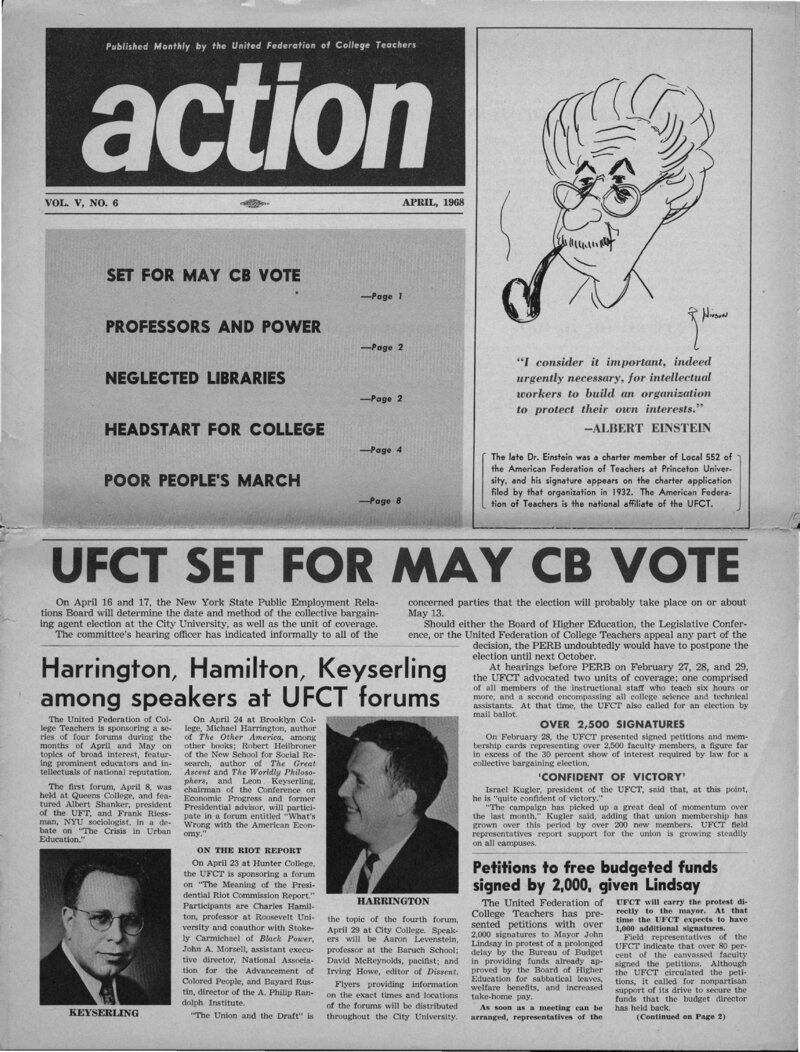
“I consider it important, indeed
urgently necessary, for intellectual
workers to build an organization
to protect their own interests.”
—ALBERT EINSTEIN
The late Dr. Einstein was a charter member of Local 552 of
the American Federation of Teachers at Princeton Univer-
sity, and his signature appears on the charter application
filed by that organization in 1932. The American Federa-
tion of Teachers is the national affiliate of the UFCT.
UFCT SET FOR MAY CB VOTE
On April 16 and 17, the New York State Public Employment Rela-
tions Board will determine the date and method of the collective bargain-
ing agent election at the City University, as well as the unit of coverage.
The committee’s hearing officer has indicated informally to all of the
The United Federation of Col-
lege Teachers is sponsoring a se-
ries of four forums during the
months of April and May on
topics of broad interest, featur-
ing prominent educators and in-
tellectuals of national reputation.
The first forum, April 8, was
held at Queens College, and fea-
tured Albert Shanker, president
of the UFT, and Frank Riess-
man, NYU sociologist, in a de-
bate on “The Crisis in Urban
Education,”
KEYSERLING
May 13.
ence, or the U:
On April 24 at Brooklyn Col-
lege, Michael Harrington, author
of The Other America, among
other books; Robert Heilbroner
of the New School for Social Re-
search, author of The Great
Ascent and The Worldly Philoso-
phers, and Leon. Keyserling,
chairman of the Conference on
Economic Progress and former
Presidential advisor, will partici-
pate in a forum entitled ‘““What’s
Wrong with the American Econ-
omy.”
ON THE RIOT REPORT
On April 23 at Hunter College,
the UFCT is sponsoring a forum
on “The Meaning of the Presi-
dential Riot Commission Report.”
Participants are Charles Hamil-
ton, professor at Roosevelt Uni-
versity and coauthor with Stoke-
ly Carmichael of Black Power,
John A. Morsell, assistant execu-
tive director, National Associa-
tion for the Advancement of
Colored People, and Bayard Rus-
tin, director of the A. Philip Ran-
dolph Institute.
“The Union and the Draft” is
Harrington, Hamilton, Keyserling
among speakers at UFCT
forums
HARRINGTON
the topic of the fourth forum,
April 29 at City College. Speak-
ers will be Aaron Levenstein,
professor at the Baruch School;
David McReynolds, pacifist; and
Irving Howe, editor of Dissent.
Flyers providing information
on the exact times and locations
of the forums will be distributed
throughout the City University.
concerned parties that the election will probably take place on or about
Should either the Board of Higher Education, the Legislative Confer-
nited Federation of College Teachers appeal any part of the
decision, the PERB undoubtedly would have to postpone the
election until next October.
At hearings before PERB on February 27, 28, and 29,
the UFCT advocated two units of coverage; one comprised
of all members of the instructional staff who teach six hours or
more, and a second encompassing all college science and technical
assistants. At that time, the UFCT also called for an election by
mail ballot.
OVER 2,500 SIGNATURES
On February 28, the UFCT presented signed petitions and mem-
bership cards representing over 2,500 faculty members, a figure far
in excess of the 30 percent show of interest required by law for a
collective bargaining election,
‘CONFIDENT OF VICTORY’
Israel Kugler, president of the UFCT, said that, at this point,
he is ‘quite confident of victory.”
“The campaign has picked up a great deal of momentum over
the last month,” Kugler said, adding that union membership has
grown over this period by over 200 new members. UFCT field
representatives report support for the union is growing steadily
on all campuses.
Petitions to free budgeted funds
signed by 2,000, given Lindsay
The United Federation of
College Teachers has pre-
sented petitions with over
2,000 signatures to Mayor John
Lindsay in protest of a prolonged
delay by the Bureau of Budget
in providing funds already ap-
proved by the Board of Higher
Education for sabbatical leaves,
welfare benefits, and increased
take-home pay.
As soon as a meeting can be
arranged, representatives of the
UFCT will carry the protest di-
rectly to the mayor. At that
time the UFCT expects to have
1,000 additional signatures.
Field representatives of the
UFCT indicate that over 80 per-
cent of the canvassed faculty
signed the petitions, Although
the UFCT circulated the peti-
tions, it called for nonpartisan
support of its drive to secure the
funds that the budget director
has held back.
(Continued on Page 2)
Professors, professionals, and power
The stated policies of a faculty association, no matter
how enlightened they might be, are purely academic—if you
will pardon a bad pun—if they cannot be effectively admin-
istered. Good will, a telephone call here and a proclamation
there are insufficient if such an association is to translate its pro-
grams into a meaningful reality in the context of modern academia.
The contemporary university is obviously not the cloistered
academe of the middle ages, but rather an institution that is more
and more characterized by an ubiquitous administrative bureaucracy
which in turn is increasingly dependent upon public legislatures,
large corporations, and founcations for its funds. A faculty asso-
ciation cannot even begin to neutralize the organized power of ad-
ministration in the best interest of faculty until it has a professional
staff of trained experts who can implement the policies that have
been democratically determined by its members.
From its inception, the United Federation of College Teachers
has retained a permanent staff of professionals who are conversant
with and constantly researching the qualitative as well as quanti-
* +
We're all for it, too
Every red-blooded American will speak in favor of liberty, equal-
ity, apple pie, frugality, industry, and democracy. In academic
parlance, democracy roughly translates as faculty governance. But,
of course, saying you are for faculty governance is just as unen-
lightening as claiming that “what America needs is a good five-cent
cigar.” What is important is not the rhetoric of faculty governance,
but rather its substance. And to refine the matter still further, we
must ask if the establishment of a university senate will provide for
meaningful faculty governance at the City University.
Given the limitations of the bylaws of the City University within
which it had to work, the senate conference deserves our commenda-
tion for the document it drafted. The new senate will provide the
faculty a university-wide forum for its views where none existed
before. The UFCT supports the senate because it strengthens the
faculty’s voice in university-wide matters.
At best, though, the faculty senate can only operate as a lobby
to the Board of Higher Education, and as such it cannot begin to.
match the influence exercised by either the administrative council
or the chancellor’s office. The senate can recommend policy to the
board, but cannot legislate independently of it, which leads us to
conclude that the term “senate” is somewhat of a misnomer, Until
the bylaws are changed, the senate will not be able to assume en-
larged authority over matters that fall within the professional com-
petence of the faculty, such as professorial rights and freedoms,
curriculum, research, and other academic issues.
The UFCT not only supports the senate, but even more important,
it is committed to strengthening it. Through collective bargaining,
we are ready to negotiate for a change in the bylaws that would
allow the senate genuine powers of legislation over matters of cru-
cial importance to faculty. A powerful senate, coupled with a strong,
democratic union negotiating with administration as an equal
through thé processes of collective bargaining, can redress a power
imbalance in academia that is today most definitely weighted in
favor of an overbearing and amorphous administrative bureaucracy.
When this happens, we will have not just the illusion of faculty gov-
ernance, but its reality.
* * *
Understocked, understaffed
A library is the hub of any great university. Unfortu-
nately, the libraries of the City University do not speak well
for the nation’s largest college system. Only its acces-
sibility to many important private and public collections
by virtue of its fortuitous location in New York City has
enabled the City University to retain its reputation for re-
search and scholarship. As everyone knows, its libraries
are woefully understocked and understaffed.
The United Federation of College Teachers considers the
improvement of CUNY’s library facilities a high priority
item on any collective bargaining agenda with the City Uni-
versity. We would negotiate for the following:
@ All CUNY libraries must meet the minimum standards estab-
lished by the American Library Association.
@ The University must provide adequate volumes and reserve
collections for all areas of the college curriculum.
@ The university must provide adequate space so that faculty
and students may study and engage in research without the
irritating distractions so common to CUNY libraries.
@ All new instructional programs must be supported by adequate
library funds.
@ The current practice of discriminating against some libraries
when budgets are made or the requirement of “crash spend-
ing” of funds at the end of the school year must be replaced
by rational and systematic budget practices.
@ Libraries in use during the summer session must be air-con-
ditioned.
A vote for the UFCT is a vote for improved library fa-
cilities.
2
*
“democratic
tative problems of university life. The UFCT’s office is maintained
year-around by its paid staff so that it might better serve its mem-
bers. Now that a collective bargaining election is imminent, the
American Federation of Teachers, the national organization with
which the UFCT is affiliated, has provided over a dozen experienced
field representatives who are bringing their professional expertise to
bear on our campaign. They do not determine our programs, but
rather help to carry them out.
As academicians we must realize that decisions rendered at City
Hall and in Albany and Washington may well have more effect upon
public and private universities in New York than policies determined
by administration, let alone faculty. Through its national affiliations
and paid legislative and legal representatives, though, ‘the United
Federation of College Teachers is in a position to exercise some
leverage at high levels of public persuasion. What all of this under-
scores is that the realities of power, even in the academic weal, do
not allow us the luxury of an organization administered by amateurs.
That is precisely why the UFCT is proud of its professional staff
and its national affiliation with the AFT.
ke +
Humanizing the multiversity
Universities have not always been characterized by faculty sub-
servience to administrative bureaucracies.
The medieval university was an organic community. It survived
for hundreds of years without chancellors, provosts, presidents, and
other similarly knighted administrators. The university was, in es-
sence, a guild which actively engaged and organized a scholarly
community of faculty and students for the mutual benefit of both.
Today, the medieval idea of universitas has given away to the
bland conformity of the academic factory. The administration is
management (in some cases enlightened and in others not), re-
sponsible to no one within its factory. It orders about its employees,
the faculty, and turns out its product, the students.
Corporate administration, with its managerial hierarchy and mas-
sive bureaucracy, has reduced faculty and students to a passive
role within the university. The academic community is fragmented
and alienated where it was once whole and organic. More often than
not, bureaucratic efficiency rather than academic need dictates the
programs and indeed the very goals of the modern multiversity.
The realities of power within the modern college do not allow
for a return the vernal academe of the medieval guild. A strong,
mn, though, operating through the machinery of collec-
tive bargaining, can help humanize the bureaucracy and counteract
the authority of the corporate management which today is the omni-
present actuality of the university turned factory. Then and only
then will our faculties begin to exercise an active and meaningful
voice in the affairs of the university.
By bran
ee
"Sorry ABoot Thal.
~UNITED “FEDERATION OF
COLLEGE TEACHERS
Local 1460, American Federation
: of Teachers, AFL-CIO”
300 Park Ave. So., N. Y., N.Y. 1
Tel: 673-6310-11
OFFICERS
DR. te KUER,
OR. Beseg LENZ
Vice-President, 4 Year Public College
REV. PETER O'REILLY —
Gisdoen Ge 4 Year Private College
HENRY ESTERLY
Vice-President, 2 Year Public College |
PROF. EDWARD ALTERMAN
Treasurer
DR. MILTON HOROWITZ
Secretary
PROF. SIDNEY SCHWARTZ
Legisiative Representative
WILLIAM FRIEDHEIM
Editor
AFT research
grants offered
The American Federation of
Teachers (the national organiza-
tion with which the UFCT is af-
filiated) provides research grants
of up to $1,000 for research and
writing related to major issues
facing all levels of education in
the United States today.
The AFT established its pro-
gram of research grants to en-
courage the publication of studies
which will provide insights into
significant educational problems.
The AFT encourages research
on the problems of higher edu-
cation. All members of the UFCT
are eligible for these stipends.
Application forms and further in-
formation are available from Dr.
Robert D. Bhaerman, Director of |
Research, American Feder:
of Teachers, 1012 14th St. N.W.,
Washington, D. C. 20005.
Petitions presented
(Continued from Page 1)
In a flyer distributed through-
out the City University prepar-
atory to the petition campaign,
the UFCT explained that the
Bureau of the Budget wanted to
withhold these funds until the
Board of Higher Education had
obtained a written pledge from
the UFCT and the LC to the ef-
fect that they would not, upon
winning a collective bargaining
election, raise questions of sal-
aries, sabbatical leaves, and wel-
fare until September, 1969.
The flyer stated: “In exchange
for this pledge, the Budget Bu-
reau may ‘promise’ (but not in
writing) to consider the current
requests of the BHE favorably.”
The UFCT pointed out that if
the current requests of the Board
of Higher Education are not
honored by the mayor, the only
conclusions are:
1, The board is too weak to .
negotiate with the city and
only genuine collective bar-
gaining can be effective.
2. CUNY faculty cannot be
content with the so-called par-
ity agreement which limits
efforts to certain salary in-
creases. It ignores such vital
matters as workload reduction,
grievance procedure, pension
improvements, etc.
The UFCT feels that only a
strong, democratic faculty asso-
ciation, working through the
processes of collective bargain-
ing, can effectively represent
the interests of the faculty in
genuine negotiations.
action
Nassau UFCT chapter asks
bargaining agent election
The UFCT chapter at Nassau
Community College has _peti-
tioned the county’s public em-
ployee relations board for a col-
lective bargaining election. On
April 10, representatives of the
signed cards authorizing the un-
ion as their collective bargain-
ing representative. In light of its
majority support, the chapter has
requested that the PERB de-
clare the UFCT the college’s CB
Picket to stop LIU sale
The status of the Brooklyn
Center of Long Island Univer-
sity still remains in doubt. Gor-
don Hoxie, the chancellor of LIU,
maintains that the sale of the
center to the City University is
merely a formality because pre-
liminary negotiations between
the two parties have already
been completed. The Board of
Higher Education of the City
University, however, has refused
to put the item on its agenda.
Dr. Hildreth Kritzer, chairman
of the center’s chapter of the
United Federation of College
Teachers, claims that she is con-
cerned lest the board postpone
consideration of the pending sale
until the summer when, with
professors and students recessed
for vacation, it will be extreme-
ly difficult to mobilize -a cam-
paign to save the campus.
On March 25, approximately
100 faculty and students picket-
ed the Board of Higher Educa-
tion while another 350 held a
tempt to pressure the City Uni-
versity to take up the matter
now. They urged affirmation of
informal statements previously
made by board members to the
effect that they were not inter-
ested in purchasing the center
because of the ill will and bad
publicity such a move would cre-
ate.
The sale was not discussed at
the board’s meeting on March 25,
nor has the item, as of this date,
been placed on the agenda for
its meetings in April or May.
VOTED AGAINST SALE
Sentiment is running against
the sale not only at the Brook-
lyn Center, but also the Brook-
ville (C. W. Post) and South-
ampton campuses of LIU. Late
in March, a university-wide sen-
ate voted overwhelmingly against
the sale of the Brooklyn Center
and, in turn, charged a commit-
tee to look into the possibility of
affiliating all three campuses
with the state university system.
Difficulties at the C. W. Post
rally on the campus in an at-campus are now building up to
turers on March 25 in front of
Higher Education offices on East 80th St.
Non-line lecturers were the only group of in-
The United Federation of College Teachers
sponsored a picket line of City University lec-
Lecturers protest at
PENSIONS ,
FOR
CUNY
LECTURERS!
FEDERATION
AFL-CIO
q
the Board of
a more rationalized system of reappointment, and
the correction of other inequities.
The 4,100 lecturers at the City University com-
prise almost 45 percent of the instructional staff.
They teach over 40 percent of all classes, includ-
crisis proportions. On February
21 the faculty voted at a mass
meeting to urge the trustees to
sell the chancellor’s “opulent”
residence and a lavishly appoint-
ed administration building as the
first step of a university-wide
austerity program. The faculty
was agitated because the chan-
cellor and trustees had substan-
tially cut departmental budgets.
If the Brooklyn Center should
be sold, the Post campus would
have to absorb most of the
former’s 101 tenured faculty. As
a result, nontenured faculty at
Post are concerned for their jobs.
Hence it is becoming easier to
mobilize sentiment against the
administration on the Brookville
campus.
It was almost exactly a year
ago that the faculties of the
Brooklyn and Southampton cam-
puses voted “no confidence” in
the chancellor. In the face of
such a vote, Hoxie has not only
remained in office, but is evident-
ly more secure in his job than he
was a year ago.
BHE
LECTURERS
GET SICK TOO!
IVE US
D FEDERATION OF
CHEE TEACHERS oc! 460
suarnir aw CENSDETION TE
UFCT will appear before the
PERB to plead the chapter's
case and to present authorization
cards representing in excess of
30 percent of the faculty, thus
by law mandating an election.
On March 21, the UFCT chap-
ter of Westchester Community
College at hearings before that
county's PERB claimed that
more than 50 percent of the
school’s instructional staff had
agent without going through the
formality of an election. The
PERB is still deliberating the
case as we go to press.
The Onondaga Community Col-
lege Federation of Teachers
(AFT) has been officially recog-
nized as that school’s CB agent.
Ninety percent of the faculty
signed cards authorizing the
UFCT’s sister local as their CB
(Continued on Page 6)
ing those at the graduate level. Although they do
the bulk of the teaching at the university, non-
line lecturers are incredibly underpaid and work
without the benefit of health and hospitalization
insurance. Nor do they fall under any of the pen-
sion plans currently in force at the university.
AFT ‘alive and well’ in California
“Tell them that we are alive
‘and well, very well indeed.”
This was the immediate reac-
structors at the City University who did not bene-
fit as a result of recent salary increases. The
pickets demanded an immediate 30 percent salary
increase, health and hospitalization insurance,
pension benefits, provisions that would provide for
ing signatures representing
close to 40 percent of the sys-
tem’s faculty.
tive faculty members had re-
jected appointment offers. Of
this number, 707 indicated that
ISRAEL KUGLER, president of the UFCT, pictured with Sen. Wayne Morse
shortly after testifying before a joint subcommittee of the Senate and
House on the Higher Education bill on March 28. His testimony supple-
mented the remarks he made before the same committee on March 6
{see story in March, 1968, Action). He spoke on behalf of a bill, spon-
sored by Senator Morse and Rep. Edith Green, which would widen op-
portunities for the disadvantaged at public and private colleges through-
out the country.
April, 1968
tion of Daniel Stubbs, the exec-
utive director of the California
State College Council (AFT)
when told that a flyer had been
distributed throughout the City
University stating that the AFT
“was defeated by an independ-
ent faculty organization in Cali-
fornia”. in what was termed a
“membership election.”
EXPRESSES SURPRISE
Professor Stubbs expressed
surprise that anyone would is-
sue such a statement since the
state board of regents has
never allowed an election to be
* held. The state colleges in
California do not come under a
public employment relations
law such as New York’s, man-
dating elections once an organ-
ization can show interest.
Only the board of regents
can call for an election in Cali-
fornia. On several occasions,
the council has presented the
regents with petitions contain-
Stubbs pointed out that the
infant AFT college council has
quintupled its membership in
just two years,
Governor Ronald Reagan has
been a very effective recruiter
for the AFT. In January, 1967,
he cut salaries at the state
colleges by 1.8 percent. At this
point, faculty members, realiz-
ing that they were virtually
powerless in the face of the
authority of both the governor
and the regents, turned to the
AFT in large and continually
increasing numbers.
The council has produced sta-
tistics which effectively drama-
tize the crisis in which the state
college finds itself, Stubbs re-
ports. As compared to the na-
tional average of 5.75 percent,
turnover in the state colleges
is presently 10.6 percent. More-
over, the turnover rate has been
increasing from year to year.
By June, 1967, 1,206 prospec-
the salary offered was unac-
ceptable; 463 stated that the
teaching load was excessive;
and 198 said that research op-
portunities were too limited
(some indicated more than one
reason).
On the basis of these statis-
tics and the results of a poll of
the entire faculty of the state
college system, the council has
presented a set of demands to
the regents who will consider
them at their next monthly
meeting, April 24.
ELECTION BEFORE LONG
Stubbs claims that it will be
increasingly difficult for the
trustees to turn down requests
that legitimately reflect the in-
terests of the faculty. Nor will
they be able to hold out much
longer against a collective bar-
gaining election. “Things will
be quite interesting,’ he said,
“should the regents arbitrarily
turn down our demands.”
Teaching the pre-baccs’
HEADSTART
FOR COLLEGE
By Leonard Kriegel
The following article originally appeared in the February 26 issue of The Nation. It
is reprinted with permission of that magazine. Professor Kriegel teaches English
at City College, where he is active in that school’s chapter of the UFCT. He
is currently working on a novel.
THE City College of New York Pre-Baccalaureate
Program was begun in September, 1965, with 109
students taken directly from New York City’s ghet-
tos. In large part the creation of Dr. Leslie Berger,
a clinical psychologist who had been with the college
since 1961, and Dr. Bernard Levy, at that time di-
rector of the college’s School of General Studies, the
program is an experimental attempt to take young
men and women who possess high school diplomas
but who ordinarily would not be admitted to the col-
lege out of the ghetto, offer them financial help and
psychological guidance as nonmatriculated students,
and then-absorb those-who-are-successful into the
college’s degree-granting program.
By September, 1967, City College’s program had grown
to include almost 500 students, not counting those who
had already dropped out or had passed from the pre-
baccalaureate to the baccalaureate stage (a point reached
when a student possesses an average of B— or better
after 30 credits, or C or better after 60 credits). Similar
programs are now in operation at Hunter College in the
Bronx, Brooklyn, York and Queens colleges, and others
are being set up at the Baruch School of Business and
the Park Avenue branch of Hunter. Dr. Berger him-
self is now at the 42nd Street headquarters of the City
University of New York, in charge of the entire Pre-
Bacc Program. The Alamac Hotel on Broadway and
71st Street has been taken over as a dormitory for some
of the students and, beginning this term, will also be
used for additional classrooms. At present, there are
more than 2,000 students in the program and, accord-
ing to Dr. Berger, by 1974 or 1975, the program should
be capable of accepting 3,500 students a year, with a
total pre-baccalaureate enrollment of 10,000.
I taught a freshman English course in the City Col-
lege Pre-Bacc Program last semester. It was one of the
classes in the program especially designed for the Pre-
Bacc students; in other cases they attend courses in the
regular college curriculum. It had been three years
since I last taught a section of freshman English (in the
academic world, one measures success in terms of how
far one can remove himself from freshmen—or, for
that matter, from students in general). I was in the pro-
gram at the request of a colleague, Leo Hamalian, who
believes as I do that tenured members of the college
English Department should teach in the program, espe-
cially those who believe that the future of City College
is inextricably bound up with the future of the Harlem
community.
I confess that I entered the program somewhat hesi-
tantly. Not only was it the kind of teaching that car-
ried no status within the department (a group of
younger teachers had been hired to work exclusively
with Pre-Bacc students); it was also the kind of teach-
ing that would test my endurance, my patience and my
talents as a teacher as nothing I had previously taught
had done. Fortunately for me, and for my students, I
found the Pre-Bacc teaching staff a remarkably dedi-
cated and helpful group.
LANGUAGE A THREAT
I learned a great deal in those early weeks. For in-
stance, I now have a much better idea of what T. S.
Eliot’s Sweeney means when he says to Doris, “I gotta
use words when I talk to you.” For if to me the art of
writing is no more than the formal organization of lan-
guage into coherent sentences and the subsequent or-
ganization of coherent sentences into coherent para-
graphs, to the majority of black and Puerto Rican stu-
dents it is simply an additional confirmation of failure
and ineptitude. For these students, language was far
more of a threat than it was a promise, and this despite
the richness of the language of the streets. From their
point of view, my job was to teach them how to make
the words drip with the fat of bureaucracy and to tie
them together with the formal invisibility of structures
designed to rigidify the soul.
I met my 14 students (Pre-Bacc classes are smaller
than regular freshman English classes, which average
25 students) on September 14. Although I had been
warned of what to expect by my colleagues in the pro-
gram, I immediately set about the task of discovering
what their problems were. I knew that most of my
students had already passed a remedial noncredit course
designed to eliminate the most glaring grammatical and
syntactical errors.
In six years of teaching full time at the City College,
I had never before taught a class with more than two
black faces in it. But the class I now stood before had
eight Negroes, four Puerto Ricans, one Mexican girl,
and a young Jewish mother of two children. I intro-
duced myself, spoke about what the course was de-
signed to do and about our texts, and gave my students
their first writing assignment, I then asked them to
write a description of Canova’s Perseus Holding the
Head of Medusa, which had been unveiled at the Met-
ropolitan a week earlier.
WHERE IS THE MUSEUM?
If my purpose really was to discover their problems,
I succeeded far better than I had planned. To begin
with, at least five of these students didn’t know where
the museum was—and most of them had been born and
“educated” in New York. And so I was initiated into
the educational box in which ghetto students find them-
selves. On the day on which the papers were due, a
Puerto Rican boy entered my office with a remarkably
ornate story of how he had been unable to get to the
museum. It was with a shock that I realized that going
to the museum frightened him. Not knowing how else
to handle it, I told him to bring the paper in the next
day or else not to bother coming to class. Fortunately,
I hit the right key. He brought the paper in the next
day and, by the end of the term, was the second best
student in the class.
That night I spent reading that first batch of papers
was probably the single most discouraging evening I
have ever spent as a teacher. I had expected the gram-
matical errors and the errors in syntax. I had not ex-
pected the kind of paper which began, “When I see in
this statue it is the white man holding the head of the
Negroe.” Virtually all of the papers contained, along
with the mechanical errors, this kind of thing. Those
that didn’t were invariably banal.
About a week later, a 27-year-old former bricklayer
in the class came to see me in my office. He wanted to
speak about! something troubling. him. “I’m dropping
history,” he announced.
“why?”
“I don’t know enough.” He shook his head, then
shrugged. “Listen, I sit there and these kids. . . . Man, ,
they talk about Freud and Marx and I sit here and I
don’t know what the hell I’m doing. I never heard of
Freud before last week.”
“Some of it’s talk,” I suggested. “It doesn’t mean
they’ve read Freud either. Look, I was an expert on
Marx when I was 18. But I didn’t read him until I
was 21.”
He shook his head again. “I feel so ignorant. You
don’t know what it feels like to sit there.” We spoke
for another 15 minutes and I finally convinced him not
to drop history (I suspect he had convinced himself and
merely came to me for confirmation). I suggested a
few books he might read. And from that moment on,
he became the class for me.
There is one student, in some classes two, to whom
a teacher speaks. And he hopes that he can connect
with the rest of the class through that student. I was
now talking to Wiley Owens, and hoping that the other
13 members of the class were listening. I wasn’t san-
guine about their prospects. After that first paper, I
jotted down the names of those students I expected to
fail. Eight out of 14; not very encouraging. During
the next few weeks, I discovered that their chief prob-
lem was not grammar or syntax, formidable as such
problems were; it was rather to permit themselves
opinions. This was true of all the students. Poverty
teaches one to tread carefully, and no one, certainly
no white professor, was going to convince them in a
few weeks that they were entitled to bring the quality
of their experience and the amount of their informa-
tion to bear upon the issues confronting them in their
lives. Not, at least, in public.
THEY ‘WANTED IN’
I soon discovered also that not all the problems were
theirs. Their teacher had a problem in accepting the
idea that their goals weren’t really different from those
of their white peers. I suppose that what I wanted were
students who were going to set about the job of remak-
ing America. What I found were students who “want
in.” Almost without exception, these students wanted
what.their white contemporaries had—and they wanted
it, significantly enough, at a time when so many white
students are turning their backs on it.
For the first half of the term, at least, success was in
the air. Curiosity was a luxury, and the civil service
action
beckoned. Most of the girls in the class reminded me
of girls with whom I had gone to college. “Teaching
is a good job for a girl until she gets married.” Few
of them were disturbed about the presence of Dow
Chemical on campus, which became an issue for the
rest of the college. Unless issues could be framed in
terms of race, they were, for the most part, indifferent
or apathetic. “I want in” is a far more traditional
American motivation than protest. Stereotypes can be
turned on their heads, and it may just be that Lyndon
Johnson knows this America better than any white
radical does. In any case, we are not going to be saved
by some updated version of a WPA Spirit of Black
America, all muscle, bone and fire.
Of course, opinions may differ as to how one gets
“in.” The contrast hit me most markedly when I went
to hear Nat Hentoff and Dan Watts, the editor of The
Liberator, discuss the role of the black writer in an
emerging revolution. At one point, a student asked,
“What should a black student do in a white school?”
“Burn it down!” Watts answered. A few snickers
from the audience, almost all of which was black.
“Look, what black people in this country have to do
is to get a piece of the action. And the way you do
that is to point a gun at Whitey’s head until he gives.
There’s no other way.”
Then I went home and took out my latest batch of
papers. I had assigned an “open theme,” and with
Watts’ rhetoric still ringing in my ears, I turned to my
first paper, the work of a rather pretty, shy young girl
from Bedford-Stuyvesant. It began, “Of all the differ-
ent ideas, I think that the very best, aside from Father’s
Day, is Mother’s Day.”
That was the first week in November, at a time when
I was still discouraged. Grammar and syntax had im-
proved, but most of my students were still writing ter-
ribly pedestrian papers. About a week later, their pa-
pers began to change in tone as well as style. Quite
suddenly, they were students, interested in discovering
what they could, aware of Vietnam, the unrest on
campus, aware now of a world filled with possibilities
as well as threats. The young girl who had written so
» glowingly about the “idea” of Mother’s Day came to
me at the end of November to ask whether she could
do her research paper on Malcolm X. “He used to
embarrass me,” she explained. “I used to hate him be-
cause I worried what people would think when he fin-
ished talking. But then, a few weeks ago, I read his
Autobiography. And you know, Professor Kriegel, that
man... he was beautiful.”
‘SLUMMING’ IN TARRYTOWN
On November 11, I drove up to Tarrytown to attend
a staff and student workshop at the converted estate of
a former tobacco magnate. There was something de-
liciously American, almost surreal, about these ghetto
youngsters being ushered politely to their rooms with
that meticulous cool possessed only by headwaiters and
house managers. “Jesus, you ought to see the rooms,”
I heard one excited student say to a just arrived friend.
It was a fine weekend—good food, ample drinks, a
magnificently symbolic setting, some useful workshops
for teachers in the program throughout the City Uni-
versity system, and just the proper spicing of revolu-
tionary rhetoric.
The Saturday afternoon panel was especially interest-
ing. Ten Pre-Bacc students from the college discussed
their reaction to the program. Nervous at first, they
began to open up about what they liked and disliked
under the firm guidance of Addison Gayle, a young
Negro writer who teaches in the program at City. As
I sat in that audience, listening to these students, I had
April, 1968
the very uncomfortable feeling that, however uncon-
sciously, they were beginning to perform a collective
role that had somehow been mapped out for them. For
the most part, their barbs were reserved for the psy-
chological counselors. Two students mentioned their
sense of inferiority before the counselors. “You can’t
open up your heart to a man who you know is your
enemy,” said one young militant. “I want to be ac-
cepted as an individual,” said a young girl.
I suppose that what disturbed me about the panel is
what disturbed me about these two remarks—that they
could have been voiced by any white student at the
college. In fact, they could be voiced by almost all
students, black and white, from Harvard to Harvey
Mudd. Perhaps the indictment that struck me as most
pathetic was one student’s lament, “They don’t care.”
Now the kind of counseling to which these students are
exposed leaves me less than satisfied, and my own stu-
dents were beginning to complain about it in private.
But while I have my doubts about the efficacy of what
ig being done, it seems to me that the problem is that
the counselors care too much. They identify with what
they cannot really feel. One of my own students was
later to complain, “I have problems with my work. I
want help. For the first time in my life, I’m really be-
ginning to read. And then, I go into the office with
these two other students. I want to talk about what
I’m doing. But we always wind up talking about that
race business. Man, I know how real it is. Who knows
better? But I have other problems, too.”
RACE ON THEIR MINDS
“That race business,” I knew, was on the mind of
every one of my Pre-Bacc students. One of the reasons
for the existence of the program, undoubtedly the ma-
jor reason, is the militancy now seizing the ghetto com-
munities of New York. But it takes an exceptional
student to hold on to his sense of militancy and racial
identity, on the one hand, and the demands made upon
him by a system which he views with a mixture of sus-
picion and desire on the other. This is not an intellec-
tual problem. If I learned nothing else during the
semester, I learned that what Nat Hentoff had written
about ghetto kids possessing “as much potential as mid-
dle-class children” remains miraculously true for many
of them—even when they are adults.
But education is one thing, and fusing the demands
made by a college curriculum to the demands made by
ghetto street life is another. Wiley Owens was able to
do it, but he had been out in the world. He had served
in the army, he was married, he had worked as a brick-
layer: he knew what it was like, he knew the prices he
had paid, and he had begun to discover what it was he
wanted. But most of my other students, like most of
the students on that panel, felt this conflict between
their aspirations and their backgrounds. “I want to play
the numbers as well as have the knowledge you have,”
said one student on that panel. It is a desire I believe
I can understand, if for no other reason than that I can
still remember how desperately I wanted to retain the
shrill Jewish street life of Jerome Avenue and Keats’
sonnets.
Unfortunately, the day comes when one has to
choose, and it seems to me a lie to pretend otherwise.
You can afford to be nostalgic about a ghetto only
when you have left it. The fact that these students,
especially the black ones, also had to choose between
their militancy and their desire for “the knowledge you
have” accounts for why a goodly number have already
dropped out of the program. It is an extremely diffi-
cult problem to handle. America is a cruel country;
it thrusts choices on us. And it seems highly unlikely
that America will permit the fulfillment of aspiration
and the retention of militancy and racial pride. It will
permit the illusion, not the reality. The day may come
when the student is going to find black ghetto life too
drab, too dead, too meaningless for him. And if it
does, he is going to be faced with the problem of
breaking the umbilical cord or dropping out of the
world of Whitey’s culture.
AWAY FROM ABSTRACTIONS
Once they had begun to find a voice, I faced the
problem of forcing my students away from abstrac-
tions. The function of the humanities is inevitably—
and this is especially true at a time when humanism is
facing the consequences of all its past compromises—
to pull the individual back to a sense of self as well as
a sense of other. “I know about you,” said a pretty
black student on that panel, as she stared out at this
audience of teachers and administrators, more than half
of them white. “My mother put the wax on your
floors.” It is, of course, just as simplistic for her to as-
sume that she can create an abstraction out of white
people because her mother waxed floors as it is for me
to expect all black students to be politically conscious
because their mothers, too, waxed floors. Possessed of
my own very real working-class credentials, I know
enough about hard physical labor to realize that it pro-
vides insight only into fatigue.
What I suspect existed in that student, and in most
of the students on that panel, was as much the desire
for rhetoric as it was the desire for revolution. And
while rhetoric may lead to revolution, it may also—
and in America such a possibility seems far more likely
—absorb just those energies that would ordinarily be
devoted to creating meaningful change. A number of
students on that panel vehemently insisted on their
right to define themselves in terms of color. But they
were just as vehement in denying that they could be
understood in terms of color. They object to the in-
herent racism in our society which enables a teacher of
history at City College to begin the first class of the
term by asking, “Will all of the Pre-Bacc students stand
up?” And since nine out of 10 Pre-Bacc students are
black or Puerto Rican, they have become what one stu-
dent accurately labeled “specimens rather than stu-
dents.”
Without pushing the Pre-Bacc Program out of pro-
portion to its achievements or aims, it is one of the few
hopeful signs in what is called “higher education” that
I know of. Despite Berkeley, despite William Arrow-
smith’s perceptive and much needed indictment of the
humanities, despite the condemnation of the corruption
of the academy by the young and a few of their over-
30 elders, the fact is that American colleges and univer-
sities have managed to remain remarkably unaffected
by the cries in our midst.
THE WALL OF ‘ACADEMIC STANDARDS’
The City College of New York, which built its repu-
tation as one of the country’s finest undergraduate in-
stitutions by serving residents of other ghettos, stands
in the heart of Harlem. But it protects itself from
Harlem with a wall built out of “academic standards.”
What is so hopeful about the Pre-Bacc Program is that
it has already dented that wall. And it promises to
break it down. I do not know what percentage of my
students will emerge with degrees from the college. I
no longer particularly care. “You’ve got to under-
stand,” a student said to me just before the term ended.
“When I came to this school, I figured that if I could
get one year... just one year ... of Whitey’s college,
I would be changed. And you know, I am. Man, they
made me hungry. And it’s not the money any more.
I want it all. Even to be a poet. Man, I want that,
too.”
There are problems in the program, including certain
signs of tension between black and Puerto Rican stu-
dents. The black students at the college, both Pre-Bacc
and matriculated, have framed a sense of community
which the Puerto Rican students do not yet possess. I
sense, among many of the Puerto Rican students, a be-
lief that they are at the periphery of the program. An-
other danger is that the program might become a mere
siphon for ghetto frustration rather than a way of
breaking through the barrier of “academic standards”
which are neither academic nor truly representative of
intellectual ability. This is something that ghetto resi-
dents will simply have to guard against in the future.
One thing mitigating against it is that the chancellor of
the City University, Albert Bowker, has wholeheartedly
supported the Pre-Bacc Program from its inception.
Teaching in the program affected me in an area I
had not at all expected. It taught me to affirm once
again that very intellectual tradition I had begun to
doubt. Shakespeare, Melville, and Milton are mine
once again, perhaps in a way that they never were be-
fore. Teaching freshman English with a group of stu-
dents who began as semiliterates has given me more
insight into that tradition than such academic plums as
teaching in the honors program or in the graduate
school. When the term ended, I went down to Cocoa
Beach, Fla., where I saw my first black road gang. A
few hundred yards down the road from where those
prisoners were working there was a shopping center, its
neon modernity structured, its cleanliness antiseptic. On
the shopping center billboard, in bold green letters, I
read: “See Stalin’s Limousine—Help Crippled Kids—
Thursday, Friday, Saturday.”
Ellison tells us that we are invisible to one another.
Watts tells black students to burn the college down, and
City College, we all realize, is no more than a momen-
tary metaphor for this America. But metaphors are
haunting: they sometimes turn into realities. Ellison
knows the virus and I am beginning to think that Watts
may really think he has found the cure. And so in des-
peration I seize upon a line from Melville who, despite
the color of his skin, was one of their spiritual fore-
bears, too. “Kings as clowns is codgers—who ain’t a
nobody?” Melville, I tell myself, knew how limited the
choices are. With that in mind, I look forward to
meeting again those 12 out of 14 students who suc-
cessfully completed the course.
UFCT's librarians’ bill passes assembly
City University’s long-neg-
lected librarians may finally
get vacations the equal of
those of other faculty mem-
bers, thanks to the United
Federation of College Teach-
ers’ bill in the state legisla-
ture.
The state assembly on
March 27 passed bill No. A.
787A, on the librarians’ va-
cations. The next move is up
to the state senate, which
has a companion Dill, S.
486A.
Prof. Sydney Schwartz,
UFCT legislative representa-
tive, and Dr. Israel Kugler,
UFCT president, lobbied for
the bill in Albany. They urge
UFCT members (and any
interested citizens) to write
to Senator John J. Marchi,
Chairman of the New York
City Committee, Senate
Chamber, Albany, N. Y.
12224, and to Senator Earl
W. Brydges, Senate Majority
Leader, same address, to
support the bill in the state
senate,
The senate librarians’ bill,
S. 486A, is sponsored by
Senator Bloom. The assem-
bly bill. was sponsored by
Assemblyman Cincotta.
Union levels protest against
welfare election procedures
The City University Council of
the United Federation of College
Teachers, comprised of chapter
chairmen, voted to protest the
procedures that have been estab-
lished for the election of welfare
trustees at the city university.
The council took action at its
meeting of April 4.
SUMMER 1968
REGULARLY SCHEDULED
JET FLIGHTS TO EUROPE
$265.00
(children '/ fare)
Scheduled flights from New York City
FLIGHT |
July 4, 1968 to Amsterdam
September 5, 1968 from Amsterdam
FLIGHT 4
July 2, 1968 to Paris
July 30, [968 from London
FLIGHT 8
July 4, 1968 to Paris
August 27, 1968 from Parls
A $75.00 deposit (refundable less $26.50)
can reserve your seat until May 31, 1968
For reservations and information, contact
BURTON WEISER
601B Surf Avenue
Brooklyn, New York 11224
Telephone. (212) 373-5738.or
341-1431
EYEGLASSES
A New Benefit for
UFCT Members Only*
The United Federation of Col-
lege Teachers will
the cost of single vision eye-
underwrite
glasses with first quality lenses
in straight frames for all UFCT
members,
1. Prescriptions for these glasses
should be prepared by your
own physician. If you wish,
you may be examined by a
registered optometrist for a
nominal fee at the
office.
. Members must come to the
UFCT office in person to
pick up the certificate need-
ed to procure the glasses,
any weekday from 9-5. It is
necessary to come to the
UFCT office in person for
your certificate to
abuse of this service.
. The offices of the registered
oculist are located in all five
boroughs for members’ con-
venience,
. Should a member desire a
more expensive frame or bi-
firm's
avoid
focal or trifocal lenses, he
would pay the difference in
cost.
YOUR DUES DOLLAR
GOES FAR IN THE UFCT
JOIN TODAY
See your Chapter Chairman for
an application card. For further
information, night or day, call
673-6310.
IT DOESN'T COST, IT PAYS
*Families not eligible.
The council feels that the pro-
cedures are highly undemocratic,
for they do not allow all those
eligible for welfare benefits to
vote for welfare trustees to rep-
resent their interests.
The present trustees, who es-
tablished the procedures for the
coming election, have stipulated
that only those who have taught
at CUNY for five years or more
are eligible to run, and only those
who have three years of service
or more can vote.
As a result, over 2,000 faculty
who receive benefits under the
welfare program have been dis-
enfranchised.
At the Borough of Manhattan
Community College, for example,
only 11 faculty members are eli-
gible to run for trustee, and only
35 faculty can vote for them, out
of approximately 175 in the pro-
gram at that school. As a result,
the two nominees for the col-
lege’s trustee are administrators,
one being a dean and the other
a division head, all of which
makes the term “faculty welfare
trustee” a misnomer.
Nassau asks
CB election
(Continued from Page 3)
representative. The local has
now drawn up a list of demands
and soon will engage the admin-
istration in negotiations,
Four AFT locals of the state
university (at Brockport, New
Paltz, Cortland, and Buffalo)
have filed petitions with the New
York State Public Employment
Relations Board asking that a
hearing be held to authorize elec-
tions at the individual colleges.
WAKE UP PLEASANTLY
BY PHONE
Reliable, Courteous Service
$5 mo.
*
MISSING IMPORTANT CALLS?
USE OUR NUMBERS
IF YOU HAVE NO PHONE
or as a
Secondary Number when
you're out. (Est. 1949)
24 Hr.Service - $7.50 Mo.
N.Y.BE3-3300 ¢ N.J.MI3-0909
Each of the locals claims to have
the necessary 30 percent show of
interest in the form of authoriza-
tion cards and faculty petitions.
DRIVING THRU EUROPE?
We'll arrange car rental - purchase.
Absolutely Lowest Rates!
Plus expert travel advice free.
(516) 295-5162... After 6 P.M.
UFCT
Fuel Oil Discount
One cent discount on each
gallon of #2 fuel oil
Low cost burner service
policies available
CENTRAL PETROLEUM
CORPORATION
325 Exterior Street
Bronx, N. Y. 10451
212-MO 9-4040
' Deliveries to: N.Y.C., Nassau,
Suffolk, Westchester,
Metropolitan New Jersey
JET FLIGHTS
TO EUROPE
BOAC - AIR FRANCE - TWA
destinati
Paris
London
code departs
June 12 (evening)
June 12 (evening)
June 23
July 10
July I
August 9
Paris
London
London
Tel Aviv*
airfare
$265.00
$245.00
$535.00
$265.00
$245.00
$245.00
returns
September 4
August 14
September |
August 20
September 4
September 12
jon
* June 23 flight to Tel Aviv includes stopover in Nice from Aug. |! to Sept. |.
Available to City University Students, Faculty and Staff.
MR. NATHAN
GREENSPAN
68 East 18th Street, Brooklyn, New York
BU 4-5749
Simmons Group Journeys
Need tax help?
See UFCT aide
Marshall Axelrod, field
representative of the United
Federation of College Teach-
ers for Hunter College, is
available to all UFCT mem-
bers who wish expert help in
preparing their income tax
returns, Axelrod’s services
are free, as a UFCT benefit.
Axelrod’s headquarters are
in the Thomas Hunter
Lounge of Hunter College.
CLASSIFIED
SERVICES
Planning a wedding, dinner, dance and
party? Eddy-Dee Entertaining Orchestra.
212-646-8181 212-236-0640
APARTMENT WANTED
University faculty member and wife desire
to sublease a furnished apartment from
Sept., 1968, through June, 1969. Bronx or
Manhattan (212) LU 8-3676.
You are cordially invited to
OUR SPECIAL
BUSINESS AND PROFESSIONAL
HOUSE PARTY
Friday-Saturday 9-1 a.m., Ages 21-40
Sunday 4-8 p.m., Over 27
Bridge nite every Wed. 7-II p.m.
Free instruction Call JU 2.3778
e OFFICIAL
UFT
e MAJOR APPLIANCE
e@ DISCOUNT OUTLET
MEMBERSHIP PRICES QUOTED ARE UNBEATABLE
e WASHERS °¢
e FREEZERS °@
e 6T.V. © STEREO
DRYERS e¢
RANGES °¢
REFRIGERATORS
DISHWASHERS
e AIR CONDITIONERS @¢
® Featuring — All Famous Brand Names
PHONE ORDERS—10 AM-6 PM—CALL WITH MAKE AND MODEL NUMBER
J
BAYSIDE, N. Y.
AMAICA GAS & ELECTRIC
42-24 BELL BOULEVARD
BA 9-2853 BA 9-2400
OPEN EVES TILL 9 PM - SAT TILL 6 PM
UFCT MEMBERSHIP DISCOUNTS
FURNITURE DISCOUNT PLAN
Guaranteed to be lower than can possibly be purchased
elsewhere.
OFFICIAL UFCT CAR PURCHASE PLAN
Cars can be purchased at
$100 above dealer's cost.
OFFICIAL UFCT CARPET DISCOUNT PLAN
Guaranteed to be lower than can possibly be purchased
elsewhere.
United Buying Service Corporation
1855 Broadway = * New
York 10023 ~ PL 7-0007
For Large
For Best
For Tremendous
On All
FURN
ELECTIONS
ERVICE
AVINGS
Periods of
ITURE
We Invite the Members of UFCT and their
Families to visi
Credit
it our Showroom.
terms arranged up to 3 years
at the LOWEST RATES in New York City.
Ge entli
fae Ea Pe:
Manufacturer's Distributors
Free Parking at: Sunrose Par
119 W. 24 St., New York
king Lot, 24th St. cor. 6th Ave.
City CHelsea 2-3354 - 5
Hours: Daily 9:00 to 5:00, Thursday to 8:00 P.M., Saturday to 4:00 P.M.
action
TRY THIS QUIZ!
DID YOUR MEDICAL PLAN
PROTECT
YOU AGAINST...
Out-of-Pocket Expenses
for Doctor Visits?
Maternity Bills?
Extra Charges for Surgery?
Extra Charges for
Specialist Care?
Confusion over panels
of participating doctors?
Uncertainty as to services
covered in full or in part?
Limitations on Certain Services?
Filling in claim forms?
Discussion of fees or
income with the doctor?
Dee Oo Oo ob oO
lee 7 ooo Ds
If you belong to a medical plan, we suggest you
check the above list* against your family’s experiences
with medical care over the past year or so.
If you can check the“yes” box for every question,
you are either an H.LP. member or you haven’t had
much need for doctors’ services lately.
*In H.LP.’s basic service program, claim forms are needed only for emergencies requising the
use of non-H.LP. physicians. They are also needed for optional benefits such as anesthesia and
prescribed drugs and appliances.
¢,
HEALTH INSURANCE PLAN OF GREATER NEW YORK
a 626 MADISON AVENUE, NEW YORK, N. YY. 10022
April, 1968 ws
King's Poor People’s Campaign
starts April 22 in Washington
In a momentous decision,
the Executive Council of the
American Federation of
Teachers, the national affili-
ate of the United Federation
of College Teachers, voted at
its meeting of March 10 to
pledge appropriate financial
and human resources to the
“Poor People’s Campaign”
led by the Rev. Martin Lu-
ther King, Jr. and sponsored
by the Southern Christian
Leadership Conference.
The “Campaign,” beginning
April 22, will take the form of a
“Poor People’s March” on Wash-
ington. On that day, Dr. King
will arrive in Washington ac-
companied by a group of 100 na-
tionally prominent clergymen to
present the demands of the
“Campaign” to Congressional
leaders. Caravans of virtually
thousands of rural and urban
poor from throughout the coun-
try will follow in Dr. King’s
wake to lobby for legislation and
to dramatize the plight of the
This article was written before the assassination
of Dr. King on April 4 in Memphis. His aides in
Washington, D. C., announced April 5 that the Poor
People’s Campaign is going ahead as planned, and
AFT President Charles Cogen announced that the
AFT’s Freedom Schools sponsorship will be con-
tinued with even greater vigor than before.
poor. If there is no response,
the participating poor will erect
shanty towns in the Washington
area as a symbol of their pover-
ty and will remain encamped ‘‘as
long as it is necessary to con-
vince federal leaders to pass nec-
essary legislation.”
DRAMATIZING POVERTY
It is Dr. King’s hope that the
Poor People’s March and subse-
quent encampment will make the
country aware of the pervasive-
ness of poverty in the United
States. The motives of the cam-
paign are educational as well as
political.
SCLC plans to establish nu-
merous Freedom Schools for the
poor who encamp in Washing-
ton. The AFT’s Washington lo-
‘cal is helping both to coordinate
and staff the Freedom Schools. A
significant number of the schools
will be manned by AFT mem-
bers.
Dr. King has been quite em-
phatic in pointing out that the
campaign will mobilize poor from
the country as well as the cities
and will cut across racial and
ethnic lines.
40 MILLION POOR
Presently, there are between
35 and 40 million Americans who
fall below the government’s pov-
erty line of $3,130 income a year
for a family and $1,540 for an
individual. The leaders of the
Campaign feel that the poor are
vulnerable to political abuse and
economic discrimination because
they remain unorganized and
hence powerless.
Left to their own devices, in a
highly organized society, the poor
cannot hope to gain adequate
employment, proper housing, a
relevant education, decent health
care, and just treatment under
the law. Through organized
pressure upon Congress, the
Campaign hopes that senators
and ‘representatives will deal
honestly and effectively with
these and other problems which
plague the poor.
As in the past, Dr. King’s em-
phasis will be on nonviolence. He
said, “We may be greeted with
violence—I cannot guarantee you
that we won’t—but we will never
respond with violence.”
Anthony Henry, the Washing-
ton coordinator of the march, in-
dicates that participants will be
free to commit acts of ‘moral
obedience” which he describes as
“being compelled to act not ac-
cording to man-made laws, but
to one’s own conscience.”
POOR PEOPLE’S CAMPAIGN 1968
EXPOSURE AND
ESCALATION
Assessing the prospects and
goals of the Campaign, King
stated: “I am not optimistic
about the immediate response of
Congress, But you can say the
goal of this campaign will be to
expose Congress. We will esca-
late the campaign on the basis
of the response we get.”
Numerous religious, political,
and labor organizations have
pledged their support to King.
The AFT was the first national
Jabor union to back King offi-
cially.
UFCT urges aid for Memphis
strikers in honor of Dr. King
The United Federation of ie WESTERN UNION a 4
College Teachers has urged SENDING BLANE
Chancellor Albert Bowker of a
City University to enlist fac- LETTERS 4/4/68 — |
ulty and student support in
behalf of the Memphis,
Tenn., sanitation department
strikers, who are trying to
get city recognition as a unit
of the American Federation
of State, County, and Mu-
nicipal Employees.
It was during an appearance in
Memphis April 4 in behalf of the
strikers that Dr. Martin Luther
King, Jr., Nobel Peace Prize win-
ner and advocate of nonviolence,
was murdered.
A copy of the telegram sent by
Dr. Israel Kugler to Chancellor
Bowker appears at the right,
along with another telegram
commending the City College ad-
ministration for suspending
classes April 5, and urging that
City University classes be sus-
pended on April 8.
Dr. Kugler also announced that
UFCT representatives will be
with the Memphis strikers’
march during the week of April
8, and he called on UFCT mem-
bers to begin immediately the
neon collection of money and cloth-
* . ing for strikers in Memphis in
Mail filled out coupon (please print) to UFCT, 300 Park Avenue Newieny orice college! ciakechonis
South, N. Y. 10010. involving as many faculty mem-
bers and students as possible.
isn’t it
time
YOU took
some action?
UFCT, NI
CHANCELLOR ALBERT H. BOWKER
CITY UNIVERSITY
NEW YORK, N. Y.
THE UFCT URGES THAT THE CITY UNIVERSITY OF NEW YORK ARRANGE
TO MAKE COLLECTIONS OF MONEY AND CLOTHING IN EVERY CLASSROOM
OF THE CITY UNIVERSITY NEXT WEEK ON BEHALF OF THE MEMPHIS
SANITATION STRIKERS AS AN APPROPRIATE TRIBUTE TO THE MEMORY
OF DR. MARTIN LUTHER KING JR.
DR. ISRAEL KUGLER
PRESIDENT
UNITED FEDERATION OF
COLLEGE TEACHERS
| want information []
| want to join oO
WESTERN UNION gi 4
terres 4/5/68 SHAE FCT, NEW YORK CITY |
CHANCELLOR ALBERT H. BOWKER
CITY UNIVERSITY
NEW YORK, N. Y.
he
Name...
Home Address...........
City and State.
THE UNITED FEDERATION OF COLLEGE TEACHERS COMMENDS THE
AUTHORITIES OF CITY COLLEGE FOR SUSPENDING CLASSES AT CITY
COLLEGE TODAY. WE URGE YOU TO SUSPEND ALL CLASSES AT THE
CITY UNIVERSITY ON MONDAY AS AN INDICATION OF OUR SENSE OF
LOSS AND OUR MOURNING FOR DR. MARTIN LUTHER KING JR., A
GREAT AND NOBLE LEADER IN THE CAUSE OF FREEDOM FOR ALL BLACK
AMERICANS AND FOR ALL MANKIND.
College....
DR. ISRAEL KUGLER
PRESIDENT
UNITED FEDERATION OF
COLLEGE TEACHERS
8 action
Published Monthly by the United Federation of College Teachers
VOL. V, NO. 6
SET FOR MAY CB VOTE
PROFESSORS AND POWER
NEGLECTED LIBRARIES
HEADSTART FOR COLLEGE
POOR PEOPLE'S MARCH
APRIL, 1968
—Page 1
—Page 2
—Page 2
—Page 4
“I consider it important, indeed
urgently necessary, for intellectual
workers to build an organization
to protect their own interests.”
—ALBERT EINSTEIN
The late Dr. Einstein was a charter member of Local 552 of
the American Federation of Teachers at Princeton Univer-
sity, and his signature appears on the charter application
filed by that organization in 1932. The American Federa-
tion of Teachers is the national affiliate of the UFCT.
UFCT SET FOR MAY CB VOTE
On April 16 and 17, the New York State Public Employment Rela-
tions Board will determine the date and method of the collective bargain-
ing agent election at the City University, as well as the unit of coverage.
The committee’s hearing officer has indicated informally to all of the
The United Federation of Col-
lege Teachers is sponsoring a se-
ries of four forums during the
months of April and May on
topics of broad interest, featur-
ing prominent educators and in-
tellectuals of national reputation.
The first forum, April 8, was
held at Queens College, and fea-
tured Albert Shanker, president
of the UFT, and Frank Riess-
man, NYU sociologist, in a de-
bate on “The Crisis in Urban
Education,”
KEYSERLING
May 13.
ence, or the U:
On April 24 at Brooklyn Col-
lege, Michael Harrington, author
of The Other America, among
other books; Robert Heilbroner
of the New School for Social Re-
search, author of The Great
Ascent and The Worldly Philoso-
phers, and Leon. Keyserling,
chairman of the Conference on
Economic Progress and former
Presidential advisor, will partici-
pate in a forum entitled ‘““What’s
Wrong with the American Econ-
omy.”
ON THE RIOT REPORT
On April 23 at Hunter College,
the UFCT is sponsoring a forum
on “The Meaning of the Presi-
dential Riot Commission Report.”
Participants are Charles Hamil-
ton, professor at Roosevelt Uni-
versity and coauthor with Stoke-
ly Carmichael of Black Power,
John A. Morsell, assistant execu-
tive director, National Associa-
tion for the Advancement of
Colored People, and Bayard Rus-
tin, director of the A. Philip Ran-
dolph Institute.
“The Union and the Draft” is
Harrington, Hamilton, Keyserling
among speakers at UFCT
forums
HARRINGTON
the topic of the fourth forum,
April 29 at City College. Speak-
ers will be Aaron Levenstein,
professor at the Baruch School;
David McReynolds, pacifist; and
Irving Howe, editor of Dissent.
Flyers providing information
on the exact times and locations
of the forums will be distributed
throughout the City University.
concerned parties that the election will probably take place on or about
Should either the Board of Higher Education, the Legislative Confer-
nited Federation of College Teachers appeal any part of the
decision, the PERB undoubtedly would have to postpone the
election until next October.
At hearings before PERB on February 27, 28, and 29,
the UFCT advocated two units of coverage; one comprised
of all members of the instructional staff who teach six hours or
more, and a second encompassing all college science and technical
assistants. At that time, the UFCT also called for an election by
mail ballot.
OVER 2,500 SIGNATURES
On February 28, the UFCT presented signed petitions and mem-
bership cards representing over 2,500 faculty members, a figure far
in excess of the 30 percent show of interest required by law for a
collective bargaining election,
‘CONFIDENT OF VICTORY’
Israel Kugler, president of the UFCT, said that, at this point,
he is ‘quite confident of victory.”
“The campaign has picked up a great deal of momentum over
the last month,” Kugler said, adding that union membership has
grown over this period by over 200 new members. UFCT field
representatives report support for the union is growing steadily
on all campuses.
Petitions to free budgeted funds
signed by 2,000, given Lindsay
The United Federation of
College Teachers has pre-
sented petitions with over
2,000 signatures to Mayor John
Lindsay in protest of a prolonged
delay by the Bureau of Budget
in providing funds already ap-
proved by the Board of Higher
Education for sabbatical leaves,
welfare benefits, and increased
take-home pay.
As soon as a meeting can be
arranged, representatives of the
UFCT will carry the protest di-
rectly to the mayor. At that
time the UFCT expects to have
1,000 additional signatures.
Field representatives of the
UFCT indicate that over 80 per-
cent of the canvassed faculty
signed the petitions, Although
the UFCT circulated the peti-
tions, it called for nonpartisan
support of its drive to secure the
funds that the budget director
has held back.
(Continued on Page 2)
Professors, professionals, and power
The stated policies of a faculty association, no matter
how enlightened they might be, are purely academic—if you
will pardon a bad pun—if they cannot be effectively admin-
istered. Good will, a telephone call here and a proclamation
there are insufficient if such an association is to translate its pro-
grams into a meaningful reality in the context of modern academia.
The contemporary university is obviously not the cloistered
academe of the middle ages, but rather an institution that is more
and more characterized by an ubiquitous administrative bureaucracy
which in turn is increasingly dependent upon public legislatures,
large corporations, and founcations for its funds. A faculty asso-
ciation cannot even begin to neutralize the organized power of ad-
ministration in the best interest of faculty until it has a professional
staff of trained experts who can implement the policies that have
been democratically determined by its members.
From its inception, the United Federation of College Teachers
has retained a permanent staff of professionals who are conversant
with and constantly researching the qualitative as well as quanti-
* +
We're all for it, too
Every red-blooded American will speak in favor of liberty, equal-
ity, apple pie, frugality, industry, and democracy. In academic
parlance, democracy roughly translates as faculty governance. But,
of course, saying you are for faculty governance is just as unen-
lightening as claiming that “what America needs is a good five-cent
cigar.” What is important is not the rhetoric of faculty governance,
but rather its substance. And to refine the matter still further, we
must ask if the establishment of a university senate will provide for
meaningful faculty governance at the City University.
Given the limitations of the bylaws of the City University within
which it had to work, the senate conference deserves our commenda-
tion for the document it drafted. The new senate will provide the
faculty a university-wide forum for its views where none existed
before. The UFCT supports the senate because it strengthens the
faculty’s voice in university-wide matters.
At best, though, the faculty senate can only operate as a lobby
to the Board of Higher Education, and as such it cannot begin to.
match the influence exercised by either the administrative council
or the chancellor’s office. The senate can recommend policy to the
board, but cannot legislate independently of it, which leads us to
conclude that the term “senate” is somewhat of a misnomer, Until
the bylaws are changed, the senate will not be able to assume en-
larged authority over matters that fall within the professional com-
petence of the faculty, such as professorial rights and freedoms,
curriculum, research, and other academic issues.
The UFCT not only supports the senate, but even more important,
it is committed to strengthening it. Through collective bargaining,
we are ready to negotiate for a change in the bylaws that would
allow the senate genuine powers of legislation over matters of cru-
cial importance to faculty. A powerful senate, coupled with a strong,
democratic union negotiating with administration as an equal
through thé processes of collective bargaining, can redress a power
imbalance in academia that is today most definitely weighted in
favor of an overbearing and amorphous administrative bureaucracy.
When this happens, we will have not just the illusion of faculty gov-
ernance, but its reality.
* * *
Understocked, understaffed
A library is the hub of any great university. Unfortu-
nately, the libraries of the City University do not speak well
for the nation’s largest college system. Only its acces-
sibility to many important private and public collections
by virtue of its fortuitous location in New York City has
enabled the City University to retain its reputation for re-
search and scholarship. As everyone knows, its libraries
are woefully understocked and understaffed.
The United Federation of College Teachers considers the
improvement of CUNY’s library facilities a high priority
item on any collective bargaining agenda with the City Uni-
versity. We would negotiate for the following:
@ All CUNY libraries must meet the minimum standards estab-
lished by the American Library Association.
@ The University must provide adequate volumes and reserve
collections for all areas of the college curriculum.
@ The university must provide adequate space so that faculty
and students may study and engage in research without the
irritating distractions so common to CUNY libraries.
@ All new instructional programs must be supported by adequate
library funds.
@ The current practice of discriminating against some libraries
when budgets are made or the requirement of “crash spend-
ing” of funds at the end of the school year must be replaced
by rational and systematic budget practices.
@ Libraries in use during the summer session must be air-con-
ditioned.
A vote for the UFCT is a vote for improved library fa-
cilities.
2
*
“democratic
tative problems of university life. The UFCT’s office is maintained
year-around by its paid staff so that it might better serve its mem-
bers. Now that a collective bargaining election is imminent, the
American Federation of Teachers, the national organization with
which the UFCT is affiliated, has provided over a dozen experienced
field representatives who are bringing their professional expertise to
bear on our campaign. They do not determine our programs, but
rather help to carry them out.
As academicians we must realize that decisions rendered at City
Hall and in Albany and Washington may well have more effect upon
public and private universities in New York than policies determined
by administration, let alone faculty. Through its national affiliations
and paid legislative and legal representatives, though, ‘the United
Federation of College Teachers is in a position to exercise some
leverage at high levels of public persuasion. What all of this under-
scores is that the realities of power, even in the academic weal, do
not allow us the luxury of an organization administered by amateurs.
That is precisely why the UFCT is proud of its professional staff
and its national affiliation with the AFT.
ke +
Humanizing the multiversity
Universities have not always been characterized by faculty sub-
servience to administrative bureaucracies.
The medieval university was an organic community. It survived
for hundreds of years without chancellors, provosts, presidents, and
other similarly knighted administrators. The university was, in es-
sence, a guild which actively engaged and organized a scholarly
community of faculty and students for the mutual benefit of both.
Today, the medieval idea of universitas has given away to the
bland conformity of the academic factory. The administration is
management (in some cases enlightened and in others not), re-
sponsible to no one within its factory. It orders about its employees,
the faculty, and turns out its product, the students.
Corporate administration, with its managerial hierarchy and mas-
sive bureaucracy, has reduced faculty and students to a passive
role within the university. The academic community is fragmented
and alienated where it was once whole and organic. More often than
not, bureaucratic efficiency rather than academic need dictates the
programs and indeed the very goals of the modern multiversity.
The realities of power within the modern college do not allow
for a return the vernal academe of the medieval guild. A strong,
mn, though, operating through the machinery of collec-
tive bargaining, can help humanize the bureaucracy and counteract
the authority of the corporate management which today is the omni-
present actuality of the university turned factory. Then and only
then will our faculties begin to exercise an active and meaningful
voice in the affairs of the university.
By bran
ee
"Sorry ABoot Thal.
~UNITED “FEDERATION OF
COLLEGE TEACHERS
Local 1460, American Federation
: of Teachers, AFL-CIO”
300 Park Ave. So., N. Y., N.Y. 1
Tel: 673-6310-11
OFFICERS
DR. te KUER,
OR. Beseg LENZ
Vice-President, 4 Year Public College
REV. PETER O'REILLY —
Gisdoen Ge 4 Year Private College
HENRY ESTERLY
Vice-President, 2 Year Public College |
PROF. EDWARD ALTERMAN
Treasurer
DR. MILTON HOROWITZ
Secretary
PROF. SIDNEY SCHWARTZ
Legisiative Representative
WILLIAM FRIEDHEIM
Editor
AFT research
grants offered
The American Federation of
Teachers (the national organiza-
tion with which the UFCT is af-
filiated) provides research grants
of up to $1,000 for research and
writing related to major issues
facing all levels of education in
the United States today.
The AFT established its pro-
gram of research grants to en-
courage the publication of studies
which will provide insights into
significant educational problems.
The AFT encourages research
on the problems of higher edu-
cation. All members of the UFCT
are eligible for these stipends.
Application forms and further in-
formation are available from Dr.
Robert D. Bhaerman, Director of |
Research, American Feder:
of Teachers, 1012 14th St. N.W.,
Washington, D. C. 20005.
Petitions presented
(Continued from Page 1)
In a flyer distributed through-
out the City University prepar-
atory to the petition campaign,
the UFCT explained that the
Bureau of the Budget wanted to
withhold these funds until the
Board of Higher Education had
obtained a written pledge from
the UFCT and the LC to the ef-
fect that they would not, upon
winning a collective bargaining
election, raise questions of sal-
aries, sabbatical leaves, and wel-
fare until September, 1969.
The flyer stated: “In exchange
for this pledge, the Budget Bu-
reau may ‘promise’ (but not in
writing) to consider the current
requests of the BHE favorably.”
The UFCT pointed out that if
the current requests of the Board
of Higher Education are not
honored by the mayor, the only
conclusions are:
1, The board is too weak to .
negotiate with the city and
only genuine collective bar-
gaining can be effective.
2. CUNY faculty cannot be
content with the so-called par-
ity agreement which limits
efforts to certain salary in-
creases. It ignores such vital
matters as workload reduction,
grievance procedure, pension
improvements, etc.
The UFCT feels that only a
strong, democratic faculty asso-
ciation, working through the
processes of collective bargain-
ing, can effectively represent
the interests of the faculty in
genuine negotiations.
action
Nassau UFCT chapter asks
bargaining agent election
The UFCT chapter at Nassau
Community College has _peti-
tioned the county’s public em-
ployee relations board for a col-
lective bargaining election. On
April 10, representatives of the
signed cards authorizing the un-
ion as their collective bargain-
ing representative. In light of its
majority support, the chapter has
requested that the PERB de-
clare the UFCT the college’s CB
Picket to stop LIU sale
The status of the Brooklyn
Center of Long Island Univer-
sity still remains in doubt. Gor-
don Hoxie, the chancellor of LIU,
maintains that the sale of the
center to the City University is
merely a formality because pre-
liminary negotiations between
the two parties have already
been completed. The Board of
Higher Education of the City
University, however, has refused
to put the item on its agenda.
Dr. Hildreth Kritzer, chairman
of the center’s chapter of the
United Federation of College
Teachers, claims that she is con-
cerned lest the board postpone
consideration of the pending sale
until the summer when, with
professors and students recessed
for vacation, it will be extreme-
ly difficult to mobilize -a cam-
paign to save the campus.
On March 25, approximately
100 faculty and students picket-
ed the Board of Higher Educa-
tion while another 350 held a
tempt to pressure the City Uni-
versity to take up the matter
now. They urged affirmation of
informal statements previously
made by board members to the
effect that they were not inter-
ested in purchasing the center
because of the ill will and bad
publicity such a move would cre-
ate.
The sale was not discussed at
the board’s meeting on March 25,
nor has the item, as of this date,
been placed on the agenda for
its meetings in April or May.
VOTED AGAINST SALE
Sentiment is running against
the sale not only at the Brook-
lyn Center, but also the Brook-
ville (C. W. Post) and South-
ampton campuses of LIU. Late
in March, a university-wide sen-
ate voted overwhelmingly against
the sale of the Brooklyn Center
and, in turn, charged a commit-
tee to look into the possibility of
affiliating all three campuses
with the state university system.
Difficulties at the C. W. Post
rally on the campus in an at-campus are now building up to
turers on March 25 in front of
Higher Education offices on East 80th St.
Non-line lecturers were the only group of in-
The United Federation of College Teachers
sponsored a picket line of City University lec-
Lecturers protest at
PENSIONS ,
FOR
CUNY
LECTURERS!
FEDERATION
AFL-CIO
q
the Board of
a more rationalized system of reappointment, and
the correction of other inequities.
The 4,100 lecturers at the City University com-
prise almost 45 percent of the instructional staff.
They teach over 40 percent of all classes, includ-
crisis proportions. On February
21 the faculty voted at a mass
meeting to urge the trustees to
sell the chancellor’s “opulent”
residence and a lavishly appoint-
ed administration building as the
first step of a university-wide
austerity program. The faculty
was agitated because the chan-
cellor and trustees had substan-
tially cut departmental budgets.
If the Brooklyn Center should
be sold, the Post campus would
have to absorb most of the
former’s 101 tenured faculty. As
a result, nontenured faculty at
Post are concerned for their jobs.
Hence it is becoming easier to
mobilize sentiment against the
administration on the Brookville
campus.
It was almost exactly a year
ago that the faculties of the
Brooklyn and Southampton cam-
puses voted “no confidence” in
the chancellor. In the face of
such a vote, Hoxie has not only
remained in office, but is evident-
ly more secure in his job than he
was a year ago.
BHE
LECTURERS
GET SICK TOO!
IVE US
D FEDERATION OF
CHEE TEACHERS oc! 460
suarnir aw CENSDETION TE
UFCT will appear before the
PERB to plead the chapter's
case and to present authorization
cards representing in excess of
30 percent of the faculty, thus
by law mandating an election.
On March 21, the UFCT chap-
ter of Westchester Community
College at hearings before that
county's PERB claimed that
more than 50 percent of the
school’s instructional staff had
agent without going through the
formality of an election. The
PERB is still deliberating the
case as we go to press.
The Onondaga Community Col-
lege Federation of Teachers
(AFT) has been officially recog-
nized as that school’s CB agent.
Ninety percent of the faculty
signed cards authorizing the
UFCT’s sister local as their CB
(Continued on Page 6)
ing those at the graduate level. Although they do
the bulk of the teaching at the university, non-
line lecturers are incredibly underpaid and work
without the benefit of health and hospitalization
insurance. Nor do they fall under any of the pen-
sion plans currently in force at the university.
AFT ‘alive and well’ in California
“Tell them that we are alive
‘and well, very well indeed.”
This was the immediate reac-
structors at the City University who did not bene-
fit as a result of recent salary increases. The
pickets demanded an immediate 30 percent salary
increase, health and hospitalization insurance,
pension benefits, provisions that would provide for
ing signatures representing
close to 40 percent of the sys-
tem’s faculty.
tive faculty members had re-
jected appointment offers. Of
this number, 707 indicated that
ISRAEL KUGLER, president of the UFCT, pictured with Sen. Wayne Morse
shortly after testifying before a joint subcommittee of the Senate and
House on the Higher Education bill on March 28. His testimony supple-
mented the remarks he made before the same committee on March 6
{see story in March, 1968, Action). He spoke on behalf of a bill, spon-
sored by Senator Morse and Rep. Edith Green, which would widen op-
portunities for the disadvantaged at public and private colleges through-
out the country.
April, 1968
tion of Daniel Stubbs, the exec-
utive director of the California
State College Council (AFT)
when told that a flyer had been
distributed throughout the City
University stating that the AFT
“was defeated by an independ-
ent faculty organization in Cali-
fornia”. in what was termed a
“membership election.”
EXPRESSES SURPRISE
Professor Stubbs expressed
surprise that anyone would is-
sue such a statement since the
state board of regents has
never allowed an election to be
* held. The state colleges in
California do not come under a
public employment relations
law such as New York’s, man-
dating elections once an organ-
ization can show interest.
Only the board of regents
can call for an election in Cali-
fornia. On several occasions,
the council has presented the
regents with petitions contain-
Stubbs pointed out that the
infant AFT college council has
quintupled its membership in
just two years,
Governor Ronald Reagan has
been a very effective recruiter
for the AFT. In January, 1967,
he cut salaries at the state
colleges by 1.8 percent. At this
point, faculty members, realiz-
ing that they were virtually
powerless in the face of the
authority of both the governor
and the regents, turned to the
AFT in large and continually
increasing numbers.
The council has produced sta-
tistics which effectively drama-
tize the crisis in which the state
college finds itself, Stubbs re-
ports. As compared to the na-
tional average of 5.75 percent,
turnover in the state colleges
is presently 10.6 percent. More-
over, the turnover rate has been
increasing from year to year.
By June, 1967, 1,206 prospec-
the salary offered was unac-
ceptable; 463 stated that the
teaching load was excessive;
and 198 said that research op-
portunities were too limited
(some indicated more than one
reason).
On the basis of these statis-
tics and the results of a poll of
the entire faculty of the state
college system, the council has
presented a set of demands to
the regents who will consider
them at their next monthly
meeting, April 24.
ELECTION BEFORE LONG
Stubbs claims that it will be
increasingly difficult for the
trustees to turn down requests
that legitimately reflect the in-
terests of the faculty. Nor will
they be able to hold out much
longer against a collective bar-
gaining election. “Things will
be quite interesting,’ he said,
“should the regents arbitrarily
turn down our demands.”
Teaching the pre-baccs’
HEADSTART
FOR COLLEGE
By Leonard Kriegel
The following article originally appeared in the February 26 issue of The Nation. It
is reprinted with permission of that magazine. Professor Kriegel teaches English
at City College, where he is active in that school’s chapter of the UFCT. He
is currently working on a novel.
THE City College of New York Pre-Baccalaureate
Program was begun in September, 1965, with 109
students taken directly from New York City’s ghet-
tos. In large part the creation of Dr. Leslie Berger,
a clinical psychologist who had been with the college
since 1961, and Dr. Bernard Levy, at that time di-
rector of the college’s School of General Studies, the
program is an experimental attempt to take young
men and women who possess high school diplomas
but who ordinarily would not be admitted to the col-
lege out of the ghetto, offer them financial help and
psychological guidance as nonmatriculated students,
and then-absorb those-who-are-successful into the
college’s degree-granting program.
By September, 1967, City College’s program had grown
to include almost 500 students, not counting those who
had already dropped out or had passed from the pre-
baccalaureate to the baccalaureate stage (a point reached
when a student possesses an average of B— or better
after 30 credits, or C or better after 60 credits). Similar
programs are now in operation at Hunter College in the
Bronx, Brooklyn, York and Queens colleges, and others
are being set up at the Baruch School of Business and
the Park Avenue branch of Hunter. Dr. Berger him-
self is now at the 42nd Street headquarters of the City
University of New York, in charge of the entire Pre-
Bacc Program. The Alamac Hotel on Broadway and
71st Street has been taken over as a dormitory for some
of the students and, beginning this term, will also be
used for additional classrooms. At present, there are
more than 2,000 students in the program and, accord-
ing to Dr. Berger, by 1974 or 1975, the program should
be capable of accepting 3,500 students a year, with a
total pre-baccalaureate enrollment of 10,000.
I taught a freshman English course in the City Col-
lege Pre-Bacc Program last semester. It was one of the
classes in the program especially designed for the Pre-
Bacc students; in other cases they attend courses in the
regular college curriculum. It had been three years
since I last taught a section of freshman English (in the
academic world, one measures success in terms of how
far one can remove himself from freshmen—or, for
that matter, from students in general). I was in the pro-
gram at the request of a colleague, Leo Hamalian, who
believes as I do that tenured members of the college
English Department should teach in the program, espe-
cially those who believe that the future of City College
is inextricably bound up with the future of the Harlem
community.
I confess that I entered the program somewhat hesi-
tantly. Not only was it the kind of teaching that car-
ried no status within the department (a group of
younger teachers had been hired to work exclusively
with Pre-Bacc students); it was also the kind of teach-
ing that would test my endurance, my patience and my
talents as a teacher as nothing I had previously taught
had done. Fortunately for me, and for my students, I
found the Pre-Bacc teaching staff a remarkably dedi-
cated and helpful group.
LANGUAGE A THREAT
I learned a great deal in those early weeks. For in-
stance, I now have a much better idea of what T. S.
Eliot’s Sweeney means when he says to Doris, “I gotta
use words when I talk to you.” For if to me the art of
writing is no more than the formal organization of lan-
guage into coherent sentences and the subsequent or-
ganization of coherent sentences into coherent para-
graphs, to the majority of black and Puerto Rican stu-
dents it is simply an additional confirmation of failure
and ineptitude. For these students, language was far
more of a threat than it was a promise, and this despite
the richness of the language of the streets. From their
point of view, my job was to teach them how to make
the words drip with the fat of bureaucracy and to tie
them together with the formal invisibility of structures
designed to rigidify the soul.
I met my 14 students (Pre-Bacc classes are smaller
than regular freshman English classes, which average
25 students) on September 14. Although I had been
warned of what to expect by my colleagues in the pro-
gram, I immediately set about the task of discovering
what their problems were. I knew that most of my
students had already passed a remedial noncredit course
designed to eliminate the most glaring grammatical and
syntactical errors.
In six years of teaching full time at the City College,
I had never before taught a class with more than two
black faces in it. But the class I now stood before had
eight Negroes, four Puerto Ricans, one Mexican girl,
and a young Jewish mother of two children. I intro-
duced myself, spoke about what the course was de-
signed to do and about our texts, and gave my students
their first writing assignment, I then asked them to
write a description of Canova’s Perseus Holding the
Head of Medusa, which had been unveiled at the Met-
ropolitan a week earlier.
WHERE IS THE MUSEUM?
If my purpose really was to discover their problems,
I succeeded far better than I had planned. To begin
with, at least five of these students didn’t know where
the museum was—and most of them had been born and
“educated” in New York. And so I was initiated into
the educational box in which ghetto students find them-
selves. On the day on which the papers were due, a
Puerto Rican boy entered my office with a remarkably
ornate story of how he had been unable to get to the
museum. It was with a shock that I realized that going
to the museum frightened him. Not knowing how else
to handle it, I told him to bring the paper in the next
day or else not to bother coming to class. Fortunately,
I hit the right key. He brought the paper in the next
day and, by the end of the term, was the second best
student in the class.
That night I spent reading that first batch of papers
was probably the single most discouraging evening I
have ever spent as a teacher. I had expected the gram-
matical errors and the errors in syntax. I had not ex-
pected the kind of paper which began, “When I see in
this statue it is the white man holding the head of the
Negroe.” Virtually all of the papers contained, along
with the mechanical errors, this kind of thing. Those
that didn’t were invariably banal.
About a week later, a 27-year-old former bricklayer
in the class came to see me in my office. He wanted to
speak about! something troubling. him. “I’m dropping
history,” he announced.
“why?”
“I don’t know enough.” He shook his head, then
shrugged. “Listen, I sit there and these kids. . . . Man, ,
they talk about Freud and Marx and I sit here and I
don’t know what the hell I’m doing. I never heard of
Freud before last week.”
“Some of it’s talk,” I suggested. “It doesn’t mean
they’ve read Freud either. Look, I was an expert on
Marx when I was 18. But I didn’t read him until I
was 21.”
He shook his head again. “I feel so ignorant. You
don’t know what it feels like to sit there.” We spoke
for another 15 minutes and I finally convinced him not
to drop history (I suspect he had convinced himself and
merely came to me for confirmation). I suggested a
few books he might read. And from that moment on,
he became the class for me.
There is one student, in some classes two, to whom
a teacher speaks. And he hopes that he can connect
with the rest of the class through that student. I was
now talking to Wiley Owens, and hoping that the other
13 members of the class were listening. I wasn’t san-
guine about their prospects. After that first paper, I
jotted down the names of those students I expected to
fail. Eight out of 14; not very encouraging. During
the next few weeks, I discovered that their chief prob-
lem was not grammar or syntax, formidable as such
problems were; it was rather to permit themselves
opinions. This was true of all the students. Poverty
teaches one to tread carefully, and no one, certainly
no white professor, was going to convince them in a
few weeks that they were entitled to bring the quality
of their experience and the amount of their informa-
tion to bear upon the issues confronting them in their
lives. Not, at least, in public.
THEY ‘WANTED IN’
I soon discovered also that not all the problems were
theirs. Their teacher had a problem in accepting the
idea that their goals weren’t really different from those
of their white peers. I suppose that what I wanted were
students who were going to set about the job of remak-
ing America. What I found were students who “want
in.” Almost without exception, these students wanted
what.their white contemporaries had—and they wanted
it, significantly enough, at a time when so many white
students are turning their backs on it.
For the first half of the term, at least, success was in
the air. Curiosity was a luxury, and the civil service
action
beckoned. Most of the girls in the class reminded me
of girls with whom I had gone to college. “Teaching
is a good job for a girl until she gets married.” Few
of them were disturbed about the presence of Dow
Chemical on campus, which became an issue for the
rest of the college. Unless issues could be framed in
terms of race, they were, for the most part, indifferent
or apathetic. “I want in” is a far more traditional
American motivation than protest. Stereotypes can be
turned on their heads, and it may just be that Lyndon
Johnson knows this America better than any white
radical does. In any case, we are not going to be saved
by some updated version of a WPA Spirit of Black
America, all muscle, bone and fire.
Of course, opinions may differ as to how one gets
“in.” The contrast hit me most markedly when I went
to hear Nat Hentoff and Dan Watts, the editor of The
Liberator, discuss the role of the black writer in an
emerging revolution. At one point, a student asked,
“What should a black student do in a white school?”
“Burn it down!” Watts answered. A few snickers
from the audience, almost all of which was black.
“Look, what black people in this country have to do
is to get a piece of the action. And the way you do
that is to point a gun at Whitey’s head until he gives.
There’s no other way.”
Then I went home and took out my latest batch of
papers. I had assigned an “open theme,” and with
Watts’ rhetoric still ringing in my ears, I turned to my
first paper, the work of a rather pretty, shy young girl
from Bedford-Stuyvesant. It began, “Of all the differ-
ent ideas, I think that the very best, aside from Father’s
Day, is Mother’s Day.”
That was the first week in November, at a time when
I was still discouraged. Grammar and syntax had im-
proved, but most of my students were still writing ter-
ribly pedestrian papers. About a week later, their pa-
pers began to change in tone as well as style. Quite
suddenly, they were students, interested in discovering
what they could, aware of Vietnam, the unrest on
campus, aware now of a world filled with possibilities
as well as threats. The young girl who had written so
» glowingly about the “idea” of Mother’s Day came to
me at the end of November to ask whether she could
do her research paper on Malcolm X. “He used to
embarrass me,” she explained. “I used to hate him be-
cause I worried what people would think when he fin-
ished talking. But then, a few weeks ago, I read his
Autobiography. And you know, Professor Kriegel, that
man... he was beautiful.”
‘SLUMMING’ IN TARRYTOWN
On November 11, I drove up to Tarrytown to attend
a staff and student workshop at the converted estate of
a former tobacco magnate. There was something de-
liciously American, almost surreal, about these ghetto
youngsters being ushered politely to their rooms with
that meticulous cool possessed only by headwaiters and
house managers. “Jesus, you ought to see the rooms,”
I heard one excited student say to a just arrived friend.
It was a fine weekend—good food, ample drinks, a
magnificently symbolic setting, some useful workshops
for teachers in the program throughout the City Uni-
versity system, and just the proper spicing of revolu-
tionary rhetoric.
The Saturday afternoon panel was especially interest-
ing. Ten Pre-Bacc students from the college discussed
their reaction to the program. Nervous at first, they
began to open up about what they liked and disliked
under the firm guidance of Addison Gayle, a young
Negro writer who teaches in the program at City. As
I sat in that audience, listening to these students, I had
April, 1968
the very uncomfortable feeling that, however uncon-
sciously, they were beginning to perform a collective
role that had somehow been mapped out for them. For
the most part, their barbs were reserved for the psy-
chological counselors. Two students mentioned their
sense of inferiority before the counselors. “You can’t
open up your heart to a man who you know is your
enemy,” said one young militant. “I want to be ac-
cepted as an individual,” said a young girl.
I suppose that what disturbed me about the panel is
what disturbed me about these two remarks—that they
could have been voiced by any white student at the
college. In fact, they could be voiced by almost all
students, black and white, from Harvard to Harvey
Mudd. Perhaps the indictment that struck me as most
pathetic was one student’s lament, “They don’t care.”
Now the kind of counseling to which these students are
exposed leaves me less than satisfied, and my own stu-
dents were beginning to complain about it in private.
But while I have my doubts about the efficacy of what
ig being done, it seems to me that the problem is that
the counselors care too much. They identify with what
they cannot really feel. One of my own students was
later to complain, “I have problems with my work. I
want help. For the first time in my life, I’m really be-
ginning to read. And then, I go into the office with
these two other students. I want to talk about what
I’m doing. But we always wind up talking about that
race business. Man, I know how real it is. Who knows
better? But I have other problems, too.”
RACE ON THEIR MINDS
“That race business,” I knew, was on the mind of
every one of my Pre-Bacc students. One of the reasons
for the existence of the program, undoubtedly the ma-
jor reason, is the militancy now seizing the ghetto com-
munities of New York. But it takes an exceptional
student to hold on to his sense of militancy and racial
identity, on the one hand, and the demands made upon
him by a system which he views with a mixture of sus-
picion and desire on the other. This is not an intellec-
tual problem. If I learned nothing else during the
semester, I learned that what Nat Hentoff had written
about ghetto kids possessing “as much potential as mid-
dle-class children” remains miraculously true for many
of them—even when they are adults.
But education is one thing, and fusing the demands
made by a college curriculum to the demands made by
ghetto street life is another. Wiley Owens was able to
do it, but he had been out in the world. He had served
in the army, he was married, he had worked as a brick-
layer: he knew what it was like, he knew the prices he
had paid, and he had begun to discover what it was he
wanted. But most of my other students, like most of
the students on that panel, felt this conflict between
their aspirations and their backgrounds. “I want to play
the numbers as well as have the knowledge you have,”
said one student on that panel. It is a desire I believe
I can understand, if for no other reason than that I can
still remember how desperately I wanted to retain the
shrill Jewish street life of Jerome Avenue and Keats’
sonnets.
Unfortunately, the day comes when one has to
choose, and it seems to me a lie to pretend otherwise.
You can afford to be nostalgic about a ghetto only
when you have left it. The fact that these students,
especially the black ones, also had to choose between
their militancy and their desire for “the knowledge you
have” accounts for why a goodly number have already
dropped out of the program. It is an extremely diffi-
cult problem to handle. America is a cruel country;
it thrusts choices on us. And it seems highly unlikely
that America will permit the fulfillment of aspiration
and the retention of militancy and racial pride. It will
permit the illusion, not the reality. The day may come
when the student is going to find black ghetto life too
drab, too dead, too meaningless for him. And if it
does, he is going to be faced with the problem of
breaking the umbilical cord or dropping out of the
world of Whitey’s culture.
AWAY FROM ABSTRACTIONS
Once they had begun to find a voice, I faced the
problem of forcing my students away from abstrac-
tions. The function of the humanities is inevitably—
and this is especially true at a time when humanism is
facing the consequences of all its past compromises—
to pull the individual back to a sense of self as well as
a sense of other. “I know about you,” said a pretty
black student on that panel, as she stared out at this
audience of teachers and administrators, more than half
of them white. “My mother put the wax on your
floors.” It is, of course, just as simplistic for her to as-
sume that she can create an abstraction out of white
people because her mother waxed floors as it is for me
to expect all black students to be politically conscious
because their mothers, too, waxed floors. Possessed of
my own very real working-class credentials, I know
enough about hard physical labor to realize that it pro-
vides insight only into fatigue.
What I suspect existed in that student, and in most
of the students on that panel, was as much the desire
for rhetoric as it was the desire for revolution. And
while rhetoric may lead to revolution, it may also—
and in America such a possibility seems far more likely
—absorb just those energies that would ordinarily be
devoted to creating meaningful change. A number of
students on that panel vehemently insisted on their
right to define themselves in terms of color. But they
were just as vehement in denying that they could be
understood in terms of color. They object to the in-
herent racism in our society which enables a teacher of
history at City College to begin the first class of the
term by asking, “Will all of the Pre-Bacc students stand
up?” And since nine out of 10 Pre-Bacc students are
black or Puerto Rican, they have become what one stu-
dent accurately labeled “specimens rather than stu-
dents.”
Without pushing the Pre-Bacc Program out of pro-
portion to its achievements or aims, it is one of the few
hopeful signs in what is called “higher education” that
I know of. Despite Berkeley, despite William Arrow-
smith’s perceptive and much needed indictment of the
humanities, despite the condemnation of the corruption
of the academy by the young and a few of their over-
30 elders, the fact is that American colleges and univer-
sities have managed to remain remarkably unaffected
by the cries in our midst.
THE WALL OF ‘ACADEMIC STANDARDS’
The City College of New York, which built its repu-
tation as one of the country’s finest undergraduate in-
stitutions by serving residents of other ghettos, stands
in the heart of Harlem. But it protects itself from
Harlem with a wall built out of “academic standards.”
What is so hopeful about the Pre-Bacc Program is that
it has already dented that wall. And it promises to
break it down. I do not know what percentage of my
students will emerge with degrees from the college. I
no longer particularly care. “You’ve got to under-
stand,” a student said to me just before the term ended.
“When I came to this school, I figured that if I could
get one year... just one year ... of Whitey’s college,
I would be changed. And you know, I am. Man, they
made me hungry. And it’s not the money any more.
I want it all. Even to be a poet. Man, I want that,
too.”
There are problems in the program, including certain
signs of tension between black and Puerto Rican stu-
dents. The black students at the college, both Pre-Bacc
and matriculated, have framed a sense of community
which the Puerto Rican students do not yet possess. I
sense, among many of the Puerto Rican students, a be-
lief that they are at the periphery of the program. An-
other danger is that the program might become a mere
siphon for ghetto frustration rather than a way of
breaking through the barrier of “academic standards”
which are neither academic nor truly representative of
intellectual ability. This is something that ghetto resi-
dents will simply have to guard against in the future.
One thing mitigating against it is that the chancellor of
the City University, Albert Bowker, has wholeheartedly
supported the Pre-Bacc Program from its inception.
Teaching in the program affected me in an area I
had not at all expected. It taught me to affirm once
again that very intellectual tradition I had begun to
doubt. Shakespeare, Melville, and Milton are mine
once again, perhaps in a way that they never were be-
fore. Teaching freshman English with a group of stu-
dents who began as semiliterates has given me more
insight into that tradition than such academic plums as
teaching in the honors program or in the graduate
school. When the term ended, I went down to Cocoa
Beach, Fla., where I saw my first black road gang. A
few hundred yards down the road from where those
prisoners were working there was a shopping center, its
neon modernity structured, its cleanliness antiseptic. On
the shopping center billboard, in bold green letters, I
read: “See Stalin’s Limousine—Help Crippled Kids—
Thursday, Friday, Saturday.”
Ellison tells us that we are invisible to one another.
Watts tells black students to burn the college down, and
City College, we all realize, is no more than a momen-
tary metaphor for this America. But metaphors are
haunting: they sometimes turn into realities. Ellison
knows the virus and I am beginning to think that Watts
may really think he has found the cure. And so in des-
peration I seize upon a line from Melville who, despite
the color of his skin, was one of their spiritual fore-
bears, too. “Kings as clowns is codgers—who ain’t a
nobody?” Melville, I tell myself, knew how limited the
choices are. With that in mind, I look forward to
meeting again those 12 out of 14 students who suc-
cessfully completed the course.
UFCT's librarians’ bill passes assembly
City University’s long-neg-
lected librarians may finally
get vacations the equal of
those of other faculty mem-
bers, thanks to the United
Federation of College Teach-
ers’ bill in the state legisla-
ture.
The state assembly on
March 27 passed bill No. A.
787A, on the librarians’ va-
cations. The next move is up
to the state senate, which
has a companion Dill, S.
486A.
Prof. Sydney Schwartz,
UFCT legislative representa-
tive, and Dr. Israel Kugler,
UFCT president, lobbied for
the bill in Albany. They urge
UFCT members (and any
interested citizens) to write
to Senator John J. Marchi,
Chairman of the New York
City Committee, Senate
Chamber, Albany, N. Y.
12224, and to Senator Earl
W. Brydges, Senate Majority
Leader, same address, to
support the bill in the state
senate,
The senate librarians’ bill,
S. 486A, is sponsored by
Senator Bloom. The assem-
bly bill. was sponsored by
Assemblyman Cincotta.
Union levels protest against
welfare election procedures
The City University Council of
the United Federation of College
Teachers, comprised of chapter
chairmen, voted to protest the
procedures that have been estab-
lished for the election of welfare
trustees at the city university.
The council took action at its
meeting of April 4.
SUMMER 1968
REGULARLY SCHEDULED
JET FLIGHTS TO EUROPE
$265.00
(children '/ fare)
Scheduled flights from New York City
FLIGHT |
July 4, 1968 to Amsterdam
September 5, 1968 from Amsterdam
FLIGHT 4
July 2, 1968 to Paris
July 30, [968 from London
FLIGHT 8
July 4, 1968 to Paris
August 27, 1968 from Parls
A $75.00 deposit (refundable less $26.50)
can reserve your seat until May 31, 1968
For reservations and information, contact
BURTON WEISER
601B Surf Avenue
Brooklyn, New York 11224
Telephone. (212) 373-5738.or
341-1431
EYEGLASSES
A New Benefit for
UFCT Members Only*
The United Federation of Col-
lege Teachers will
the cost of single vision eye-
underwrite
glasses with first quality lenses
in straight frames for all UFCT
members,
1. Prescriptions for these glasses
should be prepared by your
own physician. If you wish,
you may be examined by a
registered optometrist for a
nominal fee at the
office.
. Members must come to the
UFCT office in person to
pick up the certificate need-
ed to procure the glasses,
any weekday from 9-5. It is
necessary to come to the
UFCT office in person for
your certificate to
abuse of this service.
. The offices of the registered
oculist are located in all five
boroughs for members’ con-
venience,
. Should a member desire a
more expensive frame or bi-
firm's
avoid
focal or trifocal lenses, he
would pay the difference in
cost.
YOUR DUES DOLLAR
GOES FAR IN THE UFCT
JOIN TODAY
See your Chapter Chairman for
an application card. For further
information, night or day, call
673-6310.
IT DOESN'T COST, IT PAYS
*Families not eligible.
The council feels that the pro-
cedures are highly undemocratic,
for they do not allow all those
eligible for welfare benefits to
vote for welfare trustees to rep-
resent their interests.
The present trustees, who es-
tablished the procedures for the
coming election, have stipulated
that only those who have taught
at CUNY for five years or more
are eligible to run, and only those
who have three years of service
or more can vote.
As a result, over 2,000 faculty
who receive benefits under the
welfare program have been dis-
enfranchised.
At the Borough of Manhattan
Community College, for example,
only 11 faculty members are eli-
gible to run for trustee, and only
35 faculty can vote for them, out
of approximately 175 in the pro-
gram at that school. As a result,
the two nominees for the col-
lege’s trustee are administrators,
one being a dean and the other
a division head, all of which
makes the term “faculty welfare
trustee” a misnomer.
Nassau asks
CB election
(Continued from Page 3)
representative. The local has
now drawn up a list of demands
and soon will engage the admin-
istration in negotiations,
Four AFT locals of the state
university (at Brockport, New
Paltz, Cortland, and Buffalo)
have filed petitions with the New
York State Public Employment
Relations Board asking that a
hearing be held to authorize elec-
tions at the individual colleges.
WAKE UP PLEASANTLY
BY PHONE
Reliable, Courteous Service
$5 mo.
*
MISSING IMPORTANT CALLS?
USE OUR NUMBERS
IF YOU HAVE NO PHONE
or as a
Secondary Number when
you're out. (Est. 1949)
24 Hr.Service - $7.50 Mo.
N.Y.BE3-3300 ¢ N.J.MI3-0909
Each of the locals claims to have
the necessary 30 percent show of
interest in the form of authoriza-
tion cards and faculty petitions.
DRIVING THRU EUROPE?
We'll arrange car rental - purchase.
Absolutely Lowest Rates!
Plus expert travel advice free.
(516) 295-5162... After 6 P.M.
UFCT
Fuel Oil Discount
One cent discount on each
gallon of #2 fuel oil
Low cost burner service
policies available
CENTRAL PETROLEUM
CORPORATION
325 Exterior Street
Bronx, N. Y. 10451
212-MO 9-4040
' Deliveries to: N.Y.C., Nassau,
Suffolk, Westchester,
Metropolitan New Jersey
JET FLIGHTS
TO EUROPE
BOAC - AIR FRANCE - TWA
destinati
Paris
London
code departs
June 12 (evening)
June 12 (evening)
June 23
July 10
July I
August 9
Paris
London
London
Tel Aviv*
airfare
$265.00
$245.00
$535.00
$265.00
$245.00
$245.00
returns
September 4
August 14
September |
August 20
September 4
September 12
jon
* June 23 flight to Tel Aviv includes stopover in Nice from Aug. |! to Sept. |.
Available to City University Students, Faculty and Staff.
MR. NATHAN
GREENSPAN
68 East 18th Street, Brooklyn, New York
BU 4-5749
Simmons Group Journeys
Need tax help?
See UFCT aide
Marshall Axelrod, field
representative of the United
Federation of College Teach-
ers for Hunter College, is
available to all UFCT mem-
bers who wish expert help in
preparing their income tax
returns, Axelrod’s services
are free, as a UFCT benefit.
Axelrod’s headquarters are
in the Thomas Hunter
Lounge of Hunter College.
CLASSIFIED
SERVICES
Planning a wedding, dinner, dance and
party? Eddy-Dee Entertaining Orchestra.
212-646-8181 212-236-0640
APARTMENT WANTED
University faculty member and wife desire
to sublease a furnished apartment from
Sept., 1968, through June, 1969. Bronx or
Manhattan (212) LU 8-3676.
You are cordially invited to
OUR SPECIAL
BUSINESS AND PROFESSIONAL
HOUSE PARTY
Friday-Saturday 9-1 a.m., Ages 21-40
Sunday 4-8 p.m., Over 27
Bridge nite every Wed. 7-II p.m.
Free instruction Call JU 2.3778
e OFFICIAL
UFT
e MAJOR APPLIANCE
e@ DISCOUNT OUTLET
MEMBERSHIP PRICES QUOTED ARE UNBEATABLE
e WASHERS °¢
e FREEZERS °@
e 6T.V. © STEREO
DRYERS e¢
RANGES °¢
REFRIGERATORS
DISHWASHERS
e AIR CONDITIONERS @¢
® Featuring — All Famous Brand Names
PHONE ORDERS—10 AM-6 PM—CALL WITH MAKE AND MODEL NUMBER
J
BAYSIDE, N. Y.
AMAICA GAS & ELECTRIC
42-24 BELL BOULEVARD
BA 9-2853 BA 9-2400
OPEN EVES TILL 9 PM - SAT TILL 6 PM
UFCT MEMBERSHIP DISCOUNTS
FURNITURE DISCOUNT PLAN
Guaranteed to be lower than can possibly be purchased
elsewhere.
OFFICIAL UFCT CAR PURCHASE PLAN
Cars can be purchased at
$100 above dealer's cost.
OFFICIAL UFCT CARPET DISCOUNT PLAN
Guaranteed to be lower than can possibly be purchased
elsewhere.
United Buying Service Corporation
1855 Broadway = * New
York 10023 ~ PL 7-0007
For Large
For Best
For Tremendous
On All
FURN
ELECTIONS
ERVICE
AVINGS
Periods of
ITURE
We Invite the Members of UFCT and their
Families to visi
Credit
it our Showroom.
terms arranged up to 3 years
at the LOWEST RATES in New York City.
Ge entli
fae Ea Pe:
Manufacturer's Distributors
Free Parking at: Sunrose Par
119 W. 24 St., New York
king Lot, 24th St. cor. 6th Ave.
City CHelsea 2-3354 - 5
Hours: Daily 9:00 to 5:00, Thursday to 8:00 P.M., Saturday to 4:00 P.M.
action
TRY THIS QUIZ!
DID YOUR MEDICAL PLAN
PROTECT
YOU AGAINST...
Out-of-Pocket Expenses
for Doctor Visits?
Maternity Bills?
Extra Charges for Surgery?
Extra Charges for
Specialist Care?
Confusion over panels
of participating doctors?
Uncertainty as to services
covered in full or in part?
Limitations on Certain Services?
Filling in claim forms?
Discussion of fees or
income with the doctor?
Dee Oo Oo ob oO
lee 7 ooo Ds
If you belong to a medical plan, we suggest you
check the above list* against your family’s experiences
with medical care over the past year or so.
If you can check the“yes” box for every question,
you are either an H.LP. member or you haven’t had
much need for doctors’ services lately.
*In H.LP.’s basic service program, claim forms are needed only for emergencies requising the
use of non-H.LP. physicians. They are also needed for optional benefits such as anesthesia and
prescribed drugs and appliances.
¢,
HEALTH INSURANCE PLAN OF GREATER NEW YORK
a 626 MADISON AVENUE, NEW YORK, N. YY. 10022
April, 1968 ws
King's Poor People’s Campaign
starts April 22 in Washington
In a momentous decision,
the Executive Council of the
American Federation of
Teachers, the national affili-
ate of the United Federation
of College Teachers, voted at
its meeting of March 10 to
pledge appropriate financial
and human resources to the
“Poor People’s Campaign”
led by the Rev. Martin Lu-
ther King, Jr. and sponsored
by the Southern Christian
Leadership Conference.
The “Campaign,” beginning
April 22, will take the form of a
“Poor People’s March” on Wash-
ington. On that day, Dr. King
will arrive in Washington ac-
companied by a group of 100 na-
tionally prominent clergymen to
present the demands of the
“Campaign” to Congressional
leaders. Caravans of virtually
thousands of rural and urban
poor from throughout the coun-
try will follow in Dr. King’s
wake to lobby for legislation and
to dramatize the plight of the
This article was written before the assassination
of Dr. King on April 4 in Memphis. His aides in
Washington, D. C., announced April 5 that the Poor
People’s Campaign is going ahead as planned, and
AFT President Charles Cogen announced that the
AFT’s Freedom Schools sponsorship will be con-
tinued with even greater vigor than before.
poor. If there is no response,
the participating poor will erect
shanty towns in the Washington
area as a symbol of their pover-
ty and will remain encamped ‘‘as
long as it is necessary to con-
vince federal leaders to pass nec-
essary legislation.”
DRAMATIZING POVERTY
It is Dr. King’s hope that the
Poor People’s March and subse-
quent encampment will make the
country aware of the pervasive-
ness of poverty in the United
States. The motives of the cam-
paign are educational as well as
political.
SCLC plans to establish nu-
merous Freedom Schools for the
poor who encamp in Washing-
ton. The AFT’s Washington lo-
‘cal is helping both to coordinate
and staff the Freedom Schools. A
significant number of the schools
will be manned by AFT mem-
bers.
Dr. King has been quite em-
phatic in pointing out that the
campaign will mobilize poor from
the country as well as the cities
and will cut across racial and
ethnic lines.
40 MILLION POOR
Presently, there are between
35 and 40 million Americans who
fall below the government’s pov-
erty line of $3,130 income a year
for a family and $1,540 for an
individual. The leaders of the
Campaign feel that the poor are
vulnerable to political abuse and
economic discrimination because
they remain unorganized and
hence powerless.
Left to their own devices, in a
highly organized society, the poor
cannot hope to gain adequate
employment, proper housing, a
relevant education, decent health
care, and just treatment under
the law. Through organized
pressure upon Congress, the
Campaign hopes that senators
and ‘representatives will deal
honestly and effectively with
these and other problems which
plague the poor.
As in the past, Dr. King’s em-
phasis will be on nonviolence. He
said, “We may be greeted with
violence—I cannot guarantee you
that we won’t—but we will never
respond with violence.”
Anthony Henry, the Washing-
ton coordinator of the march, in-
dicates that participants will be
free to commit acts of ‘moral
obedience” which he describes as
“being compelled to act not ac-
cording to man-made laws, but
to one’s own conscience.”
POOR PEOPLE’S CAMPAIGN 1968
EXPOSURE AND
ESCALATION
Assessing the prospects and
goals of the Campaign, King
stated: “I am not optimistic
about the immediate response of
Congress, But you can say the
goal of this campaign will be to
expose Congress. We will esca-
late the campaign on the basis
of the response we get.”
Numerous religious, political,
and labor organizations have
pledged their support to King.
The AFT was the first national
Jabor union to back King offi-
cially.
UFCT urges aid for Memphis
strikers in honor of Dr. King
The United Federation of ie WESTERN UNION a 4
College Teachers has urged SENDING BLANE
Chancellor Albert Bowker of a
City University to enlist fac- LETTERS 4/4/68 — |
ulty and student support in
behalf of the Memphis,
Tenn., sanitation department
strikers, who are trying to
get city recognition as a unit
of the American Federation
of State, County, and Mu-
nicipal Employees.
It was during an appearance in
Memphis April 4 in behalf of the
strikers that Dr. Martin Luther
King, Jr., Nobel Peace Prize win-
ner and advocate of nonviolence,
was murdered.
A copy of the telegram sent by
Dr. Israel Kugler to Chancellor
Bowker appears at the right,
along with another telegram
commending the City College ad-
ministration for suspending
classes April 5, and urging that
City University classes be sus-
pended on April 8.
Dr. Kugler also announced that
UFCT representatives will be
with the Memphis strikers’
march during the week of April
8, and he called on UFCT mem-
bers to begin immediately the
neon collection of money and cloth-
* . ing for strikers in Memphis in
Mail filled out coupon (please print) to UFCT, 300 Park Avenue Newieny orice college! ciakechonis
South, N. Y. 10010. involving as many faculty mem-
bers and students as possible.
isn’t it
time
YOU took
some action?
UFCT, NI
CHANCELLOR ALBERT H. BOWKER
CITY UNIVERSITY
NEW YORK, N. Y.
THE UFCT URGES THAT THE CITY UNIVERSITY OF NEW YORK ARRANGE
TO MAKE COLLECTIONS OF MONEY AND CLOTHING IN EVERY CLASSROOM
OF THE CITY UNIVERSITY NEXT WEEK ON BEHALF OF THE MEMPHIS
SANITATION STRIKERS AS AN APPROPRIATE TRIBUTE TO THE MEMORY
OF DR. MARTIN LUTHER KING JR.
DR. ISRAEL KUGLER
PRESIDENT
UNITED FEDERATION OF
COLLEGE TEACHERS
| want information []
| want to join oO
WESTERN UNION gi 4
terres 4/5/68 SHAE FCT, NEW YORK CITY |
CHANCELLOR ALBERT H. BOWKER
CITY UNIVERSITY
NEW YORK, N. Y.
he
Name...
Home Address...........
City and State.
THE UNITED FEDERATION OF COLLEGE TEACHERS COMMENDS THE
AUTHORITIES OF CITY COLLEGE FOR SUSPENDING CLASSES AT CITY
COLLEGE TODAY. WE URGE YOU TO SUSPEND ALL CLASSES AT THE
CITY UNIVERSITY ON MONDAY AS AN INDICATION OF OUR SENSE OF
LOSS AND OUR MOURNING FOR DR. MARTIN LUTHER KING JR., A
GREAT AND NOBLE LEADER IN THE CAUSE OF FREEDOM FOR ALL BLACK
AMERICANS AND FOR ALL MANKIND.
College....
DR. ISRAEL KUGLER
PRESIDENT
UNITED FEDERATION OF
COLLEGE TEACHERS
8 action
Title
Action, April 1968
Description
This issue of Action includes a detailed account of a City College professor's experience working within CCNY's "Pre-Baccalaureate Program," news of an upcoming collective bargaining vote, and editorials regarding various university-wide issues. It also contains articles, written just before the assasination of Dr. Martin Luther Kind, in support of the Poor People's Campaign.Action was the monthly newspaper of the United Federation of College Teachers, one of the two main organizations that advocated for the concerns of CUNY employees before the formation in 1972 of the Professional Staff Congress, the union that has since represented CUNY faculty and professional staff. During this period, Action was edited by Bill Friedheim, an outspoken professor at Borough of Manhattan Community College and one of the subjects of our oral history interview on radicalism at BMCC.
Contributor
Friedheim, Bill
Creator
United Federation of College Teachers
Date
April 1968
Language
English
Publisher
United Federation of College Teachers
Relation
1571
Rights
Obtained from Contributor - Copyright Unknown
Source
Friedheim, Bill
Original Format
Newspaper / Magazine / Journal
United Federation of College Teachers. Letter. 1968. “Action, April 1968”. 1571, 1968, CUNY DIGITAL HISTORY ARCHIVE, accessed July 8, 2026, https://stephenz.tailc22a4b.ts.net/s/cdha/item/161