Action, April 1969
Item
Be
action
Pe TENG. 6. ae ee Se, 0 VI, NO. 6
PRIORITIES!
APRIL, 1969
PUBLISHED
MONTHLY BY
THE UNITED
FEDERATION OF
COLLEGE TEACHERS
PRIORITIES!
The recent budget cuts raise serious questions about the priorities
of the state, city, and university in their allocation of revenues
It is absurd, even grotesque, that the wealth-
iest state in the world’s most prosperous nation
should matter of factly cut funds for health,
education, and welfare, The recent budget cuts
dramatize with unquestionable clarity the bi-
zarre if not cynical priorities of our politicians
and bureaucrats.
VULGAR POLITICS
What is somewhat obscured is a rather ugly
form of political manipulation as one group is
played off against another as they fight for
whatever bones the state is willing to throw
them. It is a manipulation that reduces politics
to its most vulgar level. The shrewd politician
sets welfare mothers against college professors;
the university administrator pits students
t faculty, poor parents against those of
‘the middle class as the various interest groups
compete with one another for what meager
funds are available. Chancellor Bowker sug-
gests to the students that salary increases for
woefully underpaid lecturers are depriving the
former of needed money for new academic pro-
grams. Victims are brought to blame other vic-
tims for a common plight that affects them all;
in the process our politicians and administra-
tors are absolved of much of their guilt.
LOBBYISTS VS. STUDENTS
In the wake of such a crisis, it is difficult to
avoid the conclusion that our society, despite
the potential created by its vast wealth and
sophisticated technology, is one with misplaced
priorities. The federal government spends bil-
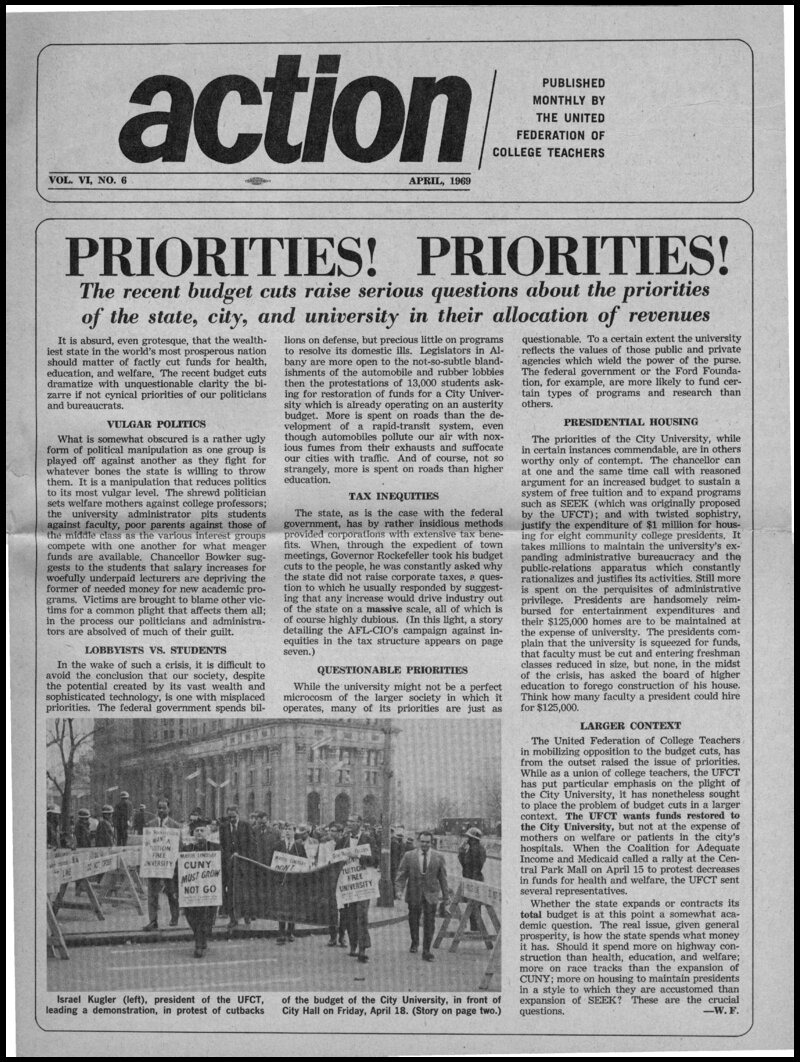
MAYOR LINDSAY
CUNY
‘NOT GO
Israel Kugler (left), president of the UFCT,
leading a demonstration, in protest of cutbacks
lions on defense, but precious little on programs
to resolve its domestic ills. Legislators in Al-
bany are more open to the not-so-subtle bland-
ishments of the automobile and rubber lobbies
then the protestations of 13,000 students ask-
ing for restoration of funds for a City Univer-
sity which is already operating on an austerity
budget. More is spent on roads than the de-
velopment of a rapid-transit system, even
though automobiles pollute our air with nox-
ious fumes from their exhausts and suffocate
our cities with traffic. And of course, not so
strangely, more is spent on roads than higher
education.
TAX INEQUITIES
The state, as is the case with the federal
government, has by rather insidious methods
provided corporations with extensive tax bene-
fits. When, through the expedient of town
meetings, Governor Rockefeller took his budget
cuts to the people, he was constantly asked why
the state did not raise corporate taxes, a ques-
tion to which he usually responded by suggest-
ing that any increase would drive industry out
of the state on a massive scale, all of which is
of course highly dubious. (In this light, a story
detailing the AFL-CIO’s campaign against in-
equities in the tax structure appears on page
seven.)
QUESTIONABLE PRIORITIES
While the university might not be a perfect
microcosm of the larger society in which it
operates, many of its priorities are just as
of the budget of the City University, in front of
City Hall on Friday, April 18. (Story on page two.)
questionable. To a certain extent the university
reflects the values of those public and private
‘agencies which wield the power of the purse.
The federal government or the Ford Founda-
tion, for example, are more likely to fund cer-
tain types of programs and research than
others.
PRESIDENTIAL HOUSING
The priorities of the City University, while
in certain instances commendable, are in others
worthy only of contempt. The chancellor can
at one and the same time call with reasoned
argument for an increased budget to sustain a
system of free tuition and to expand programs
such as SEEK (which was originally proposed
by the UFCT); and with twisted sophistry,
justify the expenditure of $1 million for hous-
ing for eight community college presidents. It
takes millions to maintain the university’s ex-
panding administrative bureaucracy and the
public-relations apparatus which constantly
rationalizes and justifies its activities. Still more
is spent on the perquisites of administrative
privilege. Presidents are handsomely reim-
bursed for entertainment expenditures and
their $125,000 homes are to be maintained at
the expense of university. The presidents com-
plain that the university is squeezed for funds,
that faculty must be cut and entering freshman
classes reduced in size, but none, in the midst
of the crisis, has asked the board of higher
education to forego construction of his house.
Think how many faculty a president could hire
for $125,000.
LARGER CONTEXT
The United Federation of College Teachers
in mobilizing opposition to the budget cuts, has
from the outset raised the issue of priorities.
While as a union of college teachers, the UFCT
has put particular emphasis on the plight of
the City University, it has nonetheless sought
to place the problem of budget cuts in a larger
context. The UFCT wants funds restored to
the City University, but not at the expense of
mothers on welfare or patients in the city’s
hospitals. When the Coalition for Adequate
Income and Medicaid called a rally at the Cen-
tral Park Mall on April 15 to protest decreases
in funds for health and welfare, the UFCT sent
several representatives.
Whether the state expands or contracts its
total budget is at this point a somewhat aca-
demic question. The real issue, given general
prosperity, is how the state spends what money
it has. Should it spend more on highway con-
struction than health, education, and welfare;
more on race tracks than the expansion of
CUNY; more on housing to maintain presidents
in a style to which they are accustomed than
expansion of SEEK? These are the crucial
questions. —W.F.
CITY PRUNES $70 MILLION
FROM UNIVERSITY BUDGET
Chancellor Albert Bowker employed an apt meta-
phor when he commented that Mayor Lindsay’s ‘“‘shoe-
horn” budgét for the City University “would provide
a shoehorn without a shoe.”
In his fiscal message to the City Council, released
on Tuesday, April 15, the mayor allotted $232 million
for the City University. The figure is somewhat de-
ceiving, because it includes $13 million for salary in-
creases that are presently being bargained for collec-
tively and according to the Chancellor, “at least $17
million for which there is no assurance for cash trans-
mission to the University.”
Funds for salary increases were not written into the
original budget submitted by the University. Normally,
the city would add money for salary increases only
after the bargaining agents had negotiated a con-
tract. Shorn of its $30 million of padded appropria-
tions, the proposed budget falls below the University’s
present level of spending.
Originally, the Chancellor asked for $270 million, but
only after pruning the requests submitted by the col-
lege presidents by $16.4 million.
If Lindsay’s budget is approved by the City Council,
the University will lack $70 million of the approxi-
mately $270 million requested, or 26 percent of its
budget.
The budget finally submitted by Chancellor Bowker
represents an increase of $65 million over last year’s
appropriation. Of that figure, $43 million is for man-
datory increases, $12 million for expenditures to im-
prove standards written into the “master plan,” in-
cluding ‘support services, and $10 million for new
programs.
The state has removed the original ceiling placed
on its contributions to the University budget and is
now pledged to match the city’s appropriation dollar
for dollar. The onus has been placed on Mayor Lind-
say and the City Council who, by cutting the Univer-
sity’s budget, deprive it of state as well as city funds.
Of course, the state is not absolved of blame for the
University’s crisis. By tying its contribution to that
of the city, it has by a clever gimmick transferred
responsibility for the budget from Albany to city hall.
Dr. Israel Kugler, president of the UFCT, together
with other representatives of the Ad-Hoc Committee
to oppose the City University budget cut, met with a
representative of Governor Nelson Rockefeller to per-
suade him of the necessity of a supplementary appro-
priation from the state. The legislature is presently
considering such an appropriation with considerable
encouragement from the UFCT and other concerned
groups which are lobbying on its behalf.
The UFCT has coordinated its efforts in opposition
to the budget cuts with the Ad-Hoc Committee and
the Students Advisory Committee (SAC). Members
of the Ad-Hoc Committee, including Dr. Kugler and
a student representative, met with Mayor Lindsay on
Tuesday, April 15, to express their considerable con-
cern over the budget cuts.
On Friday, April 18, the UFCT participated in a
demonstration at City Hall to protest the cuts. The
Ad-Hoc Committee, which comprises over 50 organiza-
tions, sponsored the demonstration. Except for a large
delegation from the UFCT, the turnout was very dis-
appointing. Many of the member organizations, while
ostensibly co-sponsors, did not send any representa-
tives to march. The Legislative Conference, the Uni-
versity Senate, and SAC were among the sponsors.
While the officers of UFCT were cheered by the turn-
out of their own members, they were somewhat dis-
mayed by the general apathy of faculty and students
toward the demonstration.
sa ames - te me cores
a Mayes
Two generations protest cutbacks of the City
University’s budget at a demonstration in front of
City Hall.
Dr. Israel Kugler warned that the “University com-
munity should not be lulled into a false sense of se-
curity now that the state has raised CUNY’s budget
ceiling, because the city has succeeded in slashing its
funds by some $70 million. Apathy, at this point, will
only succeed in destroying the City University.”
Chancellor Bowker claimed that “the mayor’s fiscal
message to the city council simply does not guarantee
sufficient funds to allow the University to admit a
freshman class and provide essential educational serv-
ices for that class and for the University’s student
body as a whole.”
The UFCT has sought to mobilize broad-based sup-
port against the budget cuts. It has worked with
parents, labor, students, and other faculty groups in
opposing the austerity budget. Dr. Kugler has ad-
monished against the restoration of funds to the Uni-
versity at the expense of welfare and medicaid. In-
stead of allowing the city and state to play various
interest groups against one another, the UFCT has
cooperated with other organizations caught in the
budget squeeze. On Tuesday, April 15, the UFCT sent
a delegation to the Central Park Mall to participate
in a demonstration sponsored by the Coalition for
Adequate Income and Medicaid. In turn, the UFCT
has sought to enlist the support of many organiza-
tions, particularly within the labor movement, to
mount a common offensive against state cuts in
health, education, and welfare.
UFCT submits demiundstor lecturers
After thorough airing before lecturers and members
and discussion and approval by its executive board,
the UFCT has submitted its collective bargaining de-
mands for lecturers to the board of higher education.
A flyer listing the demands in their entirety will be
distributed by the UFCT to lecturers and the general
university community within a week or two.
Among the demands are provisions for the follow-
ing:
@ SALARIES—Full-time lecturers shall be paid
salaries ranging from $13,000 to $22,000, distributed
over eight steps. Annual salaries for lecturers teach-
ing six hours per semester shall range from $8,666 to
$14,666 and for those teaching three hours per se-
mester, from $4,333 to $7,333.
@ FRINGE AND WELFARE BENEFITS—The
board shall provide lecturers with life, liability, and
total-disability insurance, fees for tuition and books
for continuing graduate education pursuant to a doc-
torate, 25-percent vacation pay, medical-surgical in-
surance, pension credit, and coverage by the retire-
ment system. The demands also include stipulations
covering sick, maternity, and personal leaves and a
welfare fund, administered by the UFCT to which the
board shall contribute $500 for each member of the
bargaining unit.
PUNITIVE TAYLOR ACT PASSED
In response to considerable pressure from Governor
Nelson Rockefeller and the Republican leadership, the
state legislature has passed a new Taylor Act which is
much more punitive in its effect than the original law
or the discredited Condon-Wadlin Act.
OFFICERS
ISRAEL KUGLER
President
: hd
action
published monthly during
the academic year by the
UNITED FEDERATION OF
COLLEGE TEACHERS
Local 1460, American
Federation of Teachers,
AFL-CIO
260 Park Avenue, So.,
New York, N. Y. 10010
Tel.: 673-6310-11
EDITOR
WILLIAM FRIEDHEIM
Signed articles and adver-
tisements do not neces-
sarily represent the view-
points or policies of the
UFCT.
STANLEY LEWIS
Vice-President,
4-Year Public College
PETER O'REILLY
Vice-President,
4-Year Private College
HENRY ESTERLY
Vice-President,
2-Year Public College
BERNARD FLICKER
Secretary
EDWARD ALTERMAN
Treasurer
SIDNEY SCHWARTZ
Legislative Representative
PUNITIVE MEASURES
The Republican leadership mustered exactly the
number of votes needed for passage. The law was
hastily signed into law by Governor Rockefeller. It
provides for:
© unlimited fines for striking unions;
© unlimited suspension of dues check-off;
© mandated loss of two days’ pay against individual
strikers for each day on strike; and
© imposition of one year’s probation and loss of
tenure.
In criticizing the bill, Assemblyman Frank G. Ros-
setti (D-L, 68th AD) commented: “Let’s cut out all of
this hogwash, and just put a line in this bill to tell the
working man, ‘If you go on strike we'll take you out
and put you against the wall and shoot you.’”
“OVERKILL”
Joseph Zaretski, Democratic senate majority leader,
had similarly harsh words for the bill which he con-
demned as “overkill.” “This is a union-busting bill,”
he said, “and the sole intent is to bust a union which
cannot get justice from the government.”
Raymond R. Corbett, president of the state AFL-
CIO, flayed the measure as a “blow to fair and full-
worker employer relations in government. The revised
law will provide new incentive on the part of some
government negotiators to delay or thwart contract
agreements.”
@ WORKING CONDITIONS—The board shall pro-
vide lecturers 120 square feet of private, enclosed of-
fice space, one telephone per two faculty, and a mini-
mum of 10 hours per week of secretarial service.
@ GRIEVANCE PROCEDURE—The board shall es-
tablish a grievance procedure which allows lecturers
outside, binding arbitration as a final recourse.
@ PERSONNEL FILES—The board shall abolish
all secret personnel files.
@ WORKLOAD—The total workload for full-time
lecturers shall be no more than nine hours a semes-
ter. No full-time lecturer shall be responsible for
more than 100 students per semester. Smaller classes
shall obtain for those who teach English composition,
speech, language, mathematics, SEEK and remedial
classes, science, and certain other subjects.
@ SERVICE CREDIT—Each member of the unit, in
the event of his (her) promotion to a tenure-generat-
ing position shall receive credit toward tenure for his
(her) service as a lecturer.
@ PROFESSIONAL EVALUATION —No action
shall be taken to discipline, reprimand, suspend, or
discharge any member of the unit unless subject to a
proper and professional evaluation, including class-
room observation, of his work.
@ FACULTY GOVERNANCE—Annual and part-
time lecturers shall be represented with voice on all
departmental committees in proportion to their mem-
bership in each department. In turn, they shall be
represented with voice and vote to the extent of 40
percent on the university senate, faculty councils, and
college-wide committees.
@ SABBATICAL LEAVES—Each member of the
unit shall be entitled to a sabbatical leave with pay
after six years of service.
@ ACADEMIC FREEDOM—The demands include a
comprehensive statement on academic freedom which
parallels the position of the American Civil Liberties
Union.
@ TRANSFERS—Provision is made for a transfer
policy should lecturers lose their positions as the re-
sult of the phase-out of a program at a particular
campus.
@ SPECIAL GROUPS—The proposed contract coy-
ers a variety of contingencies for special groups.
action
UFCT. ACLU OPPOSE SUMMARY
FIRINGS _— UEENSBOROUGH
Secret files at the City University open its faculty to
administrative and bureaucratic manipulation, manipu-
lation which at its worst takes the form of outright
political repression and violation of academic free-
dom. What distinguishes the case of Dr. Donald Sil-
berman, an assistant professor of English at Queens-
borough Community College, is that it is so flagrant,
or, as one member of the UFCT’s executive board in-
advertently put it, with a Freudian slip, “fragrant.”
Everything about the case smells of political suppres-
sion.
The personnel and budget committee of the English
department unanimously recommended professor Sil-
berman for reappointment. After approval by the
collegewide P and B, Professor Silberman’s name was
submitted to Dr. Kurt R. Schmeller, president of the
college, for routine approval. Dr. Schmeller held up
Professor Silberman’s letter of reappointment for three
months until April 1, when he notified the latter that
he would not be offered a contract for the academic
year 1969-70.
On February 26, the English department voted by
an overwhelming majority of 27 to 2, with 2 absten-
tions, to recommend censure of President Schmeller
and John Riedl, dean of the faculty, to a meeting of
the general faculty. The motion of censure was an
outgrowth of long-standing grievances between the
department and the administration, one of which was
the case of Professor Silberman.
The department drew up a bill of particulars to docu-
ment its charges against the administration. By way
of introduction, the document stated that “at meetings
with the president and dean of the faculty, depart-
mental officials, while representing departmental prob-
lems and views in response to administrative actions,
met with intimidation, coercion, threats, abuse, and
total absence of cooperation.”
The bill of particulars included a history of Dr.
Silberman’s case. After the department had approved
of Dr. Silberman’s initial appointment for the present
academic year, Dean Riedl sought to block it. At first,
Dean Riedl attempted to mask his political objections
to the appointment by contending that Dr. Silberman
was ill-disposed for a position at the college because
he was more interested in teaching than publication.
He expressed concern that Dr. Silberman would be
eligible for tenure after just a year because he had
taught for several semesters on a tenure-generating
line at Hunter College. To break his chain of tenured
service, the department finally agreed to hire him as a
lecturer for the first semester and an assistant pro-
fessor the second.
The report goes on to point out that Dean Riedl
“expressed disapproval of and exaggerated Dr. Silber-
man’s participation in a student-faculty sit-in at
Hunter College in the Bronx. The sit-in, interpreted
as an insurrection by the Dean, was, in fact, in oppo-
sition to the submission of class rank to the Selective
Service System as an aspect of the City University’s
participation in the war in Vietnam. The sit-in fol-
lowed the decision of Columbia University to end
this practice, and was part of a nationwide movement
on this issue supported by leading scholars.”
Dean Riedl and President Schmeller, acting in char-
acter, responded to the department’s bill of particulars
with unabashed intimidation. They informed the chair-
man and his deputy that should they present their bill
BE
|
Sitting-in at the Administration-Library building.
of particulars for wider distribution throughout the
college and should they go before the general faculty
with their motion of censure, they would, as stipulated
by the board of higher education’s memorandum on
secret files of December 18, 1967, be guilty of profes-
sional misconduct and subject to dismissal for having
revealed a confidential evaluation of a faculty mem-
ber. They were particularly exercised about the de-
partment’s revelation of Dean Riedl’s expressed mis-
givings over Professor Silberman’s participation in the
sit-in at Hunter College. Dean Riedl then denied that
politics ever entered into his evaluation of Dr. Silber-
man’s qualifications.
After the department’s initial confrontation with
Riedl and Schmeller, the controversy heated up con-
siderably. The administration claimed that due to a
budget squeeze and overstaffing in the English de-
partment, it could not grant Professor Silberman re-
appointment. In effect, Riedl and Schmeller were ab-
solving themselves of guilt by claiming that it was
not they but rather an austerity budget or unfortunate
circumstance which conspired against Professor Silber-
man. Politics, they protested, had nothing to do with
their decision.
(Manipulation of the budget provides an adminis-
tration added leverage in situations such as this. By
at once cynically and shrewdly playing department off
against department, an administration can effectively
split its faculty and isolate dissidents in its midst. At
Queensborough, lines shorn from the English depart-
ment can be dangled before other disciplines as bait,
thereby denying Professor Silberman’s embattled col-
leagues some of their potential support.)
On March 31, 29 members of the English depart-
ment signed a strong statement condemning the ad-
ministration for “disguising its original political ob-
jections with budgetary excuses.” Eleven days before,
on March 20, the executive board of the UFCT voted
the following resolution: “The UFCT executive board
supports the efforts of the English department at
The Kahn Memorandum
When on December 18, 1967, the board of higher
education voted approval of a position paper pre-
pared by its legal counsel, Arthur Kahn, which in
effect called for secret faculty files, the UFCT was
alone in protesting.
The UFCT’s efforts over the past 16 months to
mobilize support against the Kahn memorandum
have evoked more faculty apathy than protest. Only
now, after cases as blatant as that of Professor Don-
ald Silberman of Queensborough Community College
have dramatized that secret files leave faculty vul-
nerable to political repression, has a large minority
of the instructional staff expressed serious misgiv-
ings about the Kahn memorandum.
It is particularly ironic that students seem more
alert to the dangers of secret files than faculty. A
wide spectrum of student groups has now come out
in active opposition against the Kahn memorandum.
With the UFCT presently bargaining collectively for
an end to secret files, the administration may well
retreat from its position.
With the exception of a dissenting statement by
Dr. Israel Kugler, president of the UFCT, the board
rendered its original position without first hearing
testimony from the faculty.
In his statement to the board at its December,
1967, meeting, Dr. Kugler protested not only the
April, 1969
substance of the policy, but the manner in which it
was made. He emphasized that it was the position
of the UFCT that faculty exercise a voice in policies
crucial to their interests.
Dr. Kugler pointed out that the board’s decision
was at variance with the 1966 statement of the
American Civil Liberties Union, which counseled
against secret files. The American Association of
University Professors, for one, has documented hun-
dreds of cases over the years on nonreappointment
and nonpromotion for the most arbitrary and spuri-
ous of reasons.
Dr. Kugler argued, particularly
given the inadequate grievance procedures that pres-
ently obtain at the City University, that secret files
open the faculty to similar treatment.
The Kahn memorandum denies faculty access to
either observation or evaluation reports. It stipu-
lates that “no reasons for nonreappointment need be
given.” The board’s policy permits the instructional
staff to discuss observation reports only with de-
partmental chairmen and not the actual observer.
Any discussion of evaluation reports by a depart-
mental member is considered prima-facie evidence
of professional misconduct.
The UFCT is presently negotiating for an end to
secret files and a grievance procedure leading to
impartial, outside arbitration as a final recourse.
Queensborough Community College to prevent the
violation of academic freedom and due process by
the administration’s blocking of the appointment of
Dr. Silberman.”
The executive board of the student government
unanimously resolved on April 15 that Dr. Silberman
be reappointed and “that the action of the administra-
tion in vetoing the decision of the faculty is a breach
of academic freedom.”
STATEMENT BY QCC CHAPTER
‘The Queensborough Community College Chap-
ter of the UFCT is shocked and dismayed by
the summary dismissals without due process of
three members of the instructional staff, Dr.
Donald J. Silberman, Dr. Stephen H. Faigelman,
and Dr, Robert K. MacDonald.
the exer-—
ha
the building were not blocked, aisles were kept
open, there was no damage to property, and no
person was evicted from a building or prevented
_ from carrying out duties. Since they are teach-
ers and students and thus members of the
Queensborough community, they have every right
to the use of buildings as long as they do not
violate the rights of others.
Dr. Silberman has been found to be a most
competent teacher by his colleagues in his de-
partment and by the college Personnel and
Budget Committee, and both have recommended
his reappointment.
» The Queensborough Community College Chap-
ter of the UFCT believes that fundamental ques-
tions of academic freedom, due process, and
faculty rights are involved in this case. Now
the right of peaceful protest is added to the list.
The Queensborough Community College Chap-
ter of the UFCT has been informed that the
United Federation of College Teachers is joining
with the ACLU and the NYCLU in defense of
the rights of the three accused teachers.
‘We ask for the revocation of the summary
dismissals and for the immediate reinstatement
of the teachers.
UFCT Executive Committee
Queensborough Community College
April 24, 1969
(This statement was sent by telegram ‘to Chan-
cellor Albert Bowker of the City University)
Dr. Schmeller revealed his hand when a member of
the English department decided to take a leave of
absence without pay for the coming year, a decision
which freed another line. Since, ostensibly, Dr. Silber-
man had been let go because no lines were available,
the department now contended that the president
should reappoint him. On Thursday, April 17, the
president turned the department down and with his
most cynical ploy to date, charged a hand-picked com-
mittee to determine, after a survey of the department,
if still further reductions were warranted. The po-
litical harassment of a single faculty member had
now been escalated into a wholesale purge of the Eng-
lish department.
The administration’s recalcitrance prompted the
formation of the Queensborough Community College
Ad-Hoe Student-Faculty Coalition to End Political
(Continued on Page 8)
Analysis
By JAMES MONACO
(The following is an account of recent events which
led to a change of administration at University Cen-
ter SEEK. The interpretation of these events is that
of the author who teaches English at the Center.
—Ed.)
In early April, students and faculty at University
Center SEEK effected a change in administration.
The events and problems were somewhat similar to
those at Queens College SEEK earlier in the year,
but there was one significant difference: at University
Center, there was considerably less violence and pub-
licity. What follows are some notes on the events at
University Center.
BACKGROUND
University Center SEEK was established in Janu-
ary, 1968, to act as a research center for the entire
SEEK program. It is located on three floors of the
Alamac hotel, Broadway and 7ist Street, and now has
an enrollment of 540 students. Seventy-five faculty
members and counselors offer courses in music, so-
ciology, political science, history, French and Spanish,
as well as the usual SEEK preparatory courses in
English, speech, reading, and mathematics. After one,
two, or three semesters, students transfer to a regular
college of the City University. The ethnic balance
among the student body is approximately 55 percent
black, 40 percent Puerto Rican, and 5 percent white.
CHRONOLOGY
EARLY JANUARY, 1969: The Faculty—none of
them having tenure—are worried about the atmos-
phere of distrust which has been developing among
the administration, students, and faculty during the
last semester. Some faculty members call a meeting
to discuss increased faculty participation in the deci-
sion-making process, Several meetings are held, the
net result of which is to further divide the faculty
from the administration. Meanwhile, the students are
beginning to organize a skeleton student government.
FEBRUARY, 1969: Rumors of budget cuts are cir-
culating. The Director, who has previously agreed to
abide by the decisions of the semi-official faculty or-
ganization, asks the English Department to recom-
mend to him only eight of 17 members for reappoint-
ment in the fall. Such a drastic cut is not demanded
by any proposed budget cuts, The director makes it
clear to the department chairman that the list of re-
appointments is not to include the name of Steven
Cagan, one of the faculty members who had been most
active in organizing the faculty members in January.
The English department refuses to accept the direc-
tor’s demands. The faculty wants to control person-
nel decisions, as at every city college, through its
own personnel and budget committees. The director
refuses, citing the by-laws of the board of higher edu-
cation: Only tenured faculty can comprise P&B com-
mittees, the by-laws say. Since there are no tenured
personnel on the University Center Staff except the
director, he will act with full power. There are no
formal processes for evaluating staff: the director can
act only on rumor. ;
MARCH, 1969: The faculty seems to have lost the
battle, the director having assumed all power regard-
ing personnel decisions. However, the students, who
have organized a student government by now, also
find that the director wants full control over their
affairs, At a meeting of several department chairmen
with the director, the English department chairman
comes to an agreement with the director about per-
sonnel decisions, but the director refuses to act on that
agreement. Faculty give up, start looking for jobs
elsewhere.
pron etl
University Center SEEK is located in the Hotel
Alamac (right) at Broadway and 71st Street di-
4
APRIL, 1969: The students produce a document list-
ing the complaints against the director, titled “Bran-
man’s Bangles.” The pamphlet is 18 pages long and
includes a list of demands asking that a vote of con-
fidence be taken regarding the director, that students
be involved in personnel and curriculum decisions,
that the ethnic imbalance among the overwhelmingly
white faculty be corrected, and that each student and
each teacher be presented with a copy of the board of
higher education by-laws. The pamphlet outlines a
good number of administrative errors that have been
made during the past six months.
During the spring vacation, the director meets with
the students, acceding to some of the demands. It be-
comes evident as the meeting continues, however, that
the director’s interpretation of the demands is very
distant from the student’s interpretation. The SEEK
advisory council, a group of community leaders which
acts as a board of trustees for the entire SEEK pro-
gram, is called in and holds several meetings with
students, faculty who support the students, the direc-
tor, and faculty who support the director, The stu-
dents and the faculty meet separately and nominate
two candidates for the post of interim director. The
advisory council chooses one,
APRIL 15, 1969: Aijaz Ahmad, a Pakistani poet and
translator, and a member of the University Center
English department, is appointed interim director. The
majority of the 22 members of the administrative staff
resigns in protest. Three faculty members resign.
COMMENTS
1. Student revolts may be inspired by ideology but
they cannot succeed unless the other side makes seri-
ous and tangible mistakes. For example, it was ob-
vious a year ago that something was seriously wrong
with the Queens SEEK program: the program was
segregated from the rest of the college, and, more
importantly, the dropout rate was nearly twice that
of any other SEEK program. At University Center, the
director was presented with many opportunities to
ameliorate the situation; he refused, self-destructively,
to avail himself of any of them. He could, in January,
have shared some of his work with the faculty, free-
ing himself to deal with other pressing problems. In-
stead, he continued, to the end, to make plans to hire
a new and presumably more pliant faculty, while at
the same time he.told his present faculty he would
allow them to advise him on personnel matters. Even
during the first week in April, he could have taken
the students’ side and fought his administrative su-
periors, who were in many ways most responsible for
the problems of University Center.
2. At University Center, the complaints of both stu-
dents and faculty were almost always professional,
never personal. Any good administrator must learn
one lesson: The delégation of authority is the key to
success. At University Center, the director insisted
that all decisions be made at the highest level. As a
result, the research programs, which were the center’s
raison d’etre, never came into being; the student gov-
ernment was never allowed to function; decisions on
personnel were made by the director, who was forced,
of necessity, to act on hearsay, further incensing the
faculty; and absolutely’ vital curriculum revisions were
stalled.
3. Many white administrators and faculty members
come into such a situation with a double fear: fear
of the black revolution as well as fear of the student
revolution. These fears generate their own causes.
The administrator quickly becomes, through fear, dis-
honest about his whiteness as well as about his rela-
tionship to the “power structure.” Nothing is more
obvious or more annoying to students of any color;
rectly across from a ‘‘Ham ’n Eggs” which is
more noteworthy for its supposed traffic in homo-
~ SEEK IN TRANSITION
they quickly perceive that, because of the barrier of
fear and dishonesty, it is not possible to deal rationally
and reasonably with such a man. Leonard Kriegel of
City College has pointed this out in an excellent ar-
ticle in Change (March-April, 1969):
“The last thing in the world a black student needs
is a white teacher trying to make himself over as
black. Honesty in teaching black students cannot be
achieved by white teachers who stain their psyches
with walnut juice, who improvise on vaudevillian
blackface, in an attempt to make themselves darker
than they are.
“. , . What one suspects is that once again the
white man will pipe the tune and the black man will
pay the bill.”
The great majority of black students are not racists;
they want honest administrators and faculty, not nec-
essarily black administrators and faculty. Sadly, how-
ever, they have discovered that the majority of whites
in these positions canot conquer their ingrained fears.
4. The ousted director of University Center SEEK
—and men in similar situations—is not, of course, evil.
He had the best of intentions, he had worked himself
to exhaustion setting up the program over the past
year. What finally necessitated his resignation was,
simply, a lack of administrative expertise. A man in
such a difficult situation must know how to delegate
authority and he must know enough about the people
he serves to be honest with them. The ousted director
knew neither.
5. What prevented University Center from explod-
ing over this issue was, basically, the experience of
(Continued on Page 5)
S
sexuality and pros’
action
SEEK
(Continued from Page 4)
the SEEK advisory council. Having gone through this
a few months previously at Queens, they were fa-
miliar with the consequences of inaction. In this they
were privileged: few boards of trustees have the op-
portunity to observe the student revolt at separate
insitutions.
6. Aijaz Ahmad, the interim director, faces many
problems of course but the greatest of them is the
attitude of a few of his administrative superiors who,
consciously or unconsciously, do not want the principle
of joint student-faculty control to prove successful. If
the SEEK program is to survive, if any college is to
survive, student-faculty control must prove success-
ful. Finally, if the UFCT which represents more than
6,000 lecturers, all of them, at present, lacking power,
does not begin to develop a common program with
students, we will not be able to avoid similar pitched
battles in the future, which would spell destruction
for the City University. We have the public schools
as a depressing example.
Opinion
Student leaders Ray Burrows and Beatriz Mo-
rales with the former director of the Center at a
student meeting at which a vote of confidence
was taken.
PASS, FAIL, OR PUNT
By LARRY HYMAN
(Professor Hyman teaches English at Brooklyn Col-
lege. His article has appeared in abridged form in
the Kingman, a student newspaper at Brooklyn Col-
lege. The opinions expressed are Professor Hyman’s
and not necessarily those of the UFCT.)
It is difficult. to predict anything in history, and
particularly so in the middle of a revolution. But I
believe that as far as the student revolution is con-
cerned, most of the changes that are being instituted
will not affect the colleges as much as the radical stu-
dents hope or the conservative teachers fear. To dress
as they like, smoke what they want, and to have a
voice in the hiring of teachers and the determination
of the curriculum will not affect the education of
students as long as the classroom remains the same.
For it is in the classroom, after all, that the students
become part of the college or university. And if the
classroom continues to be a place where the student
must receive a grade from the teacher, then changing
attendance regulations, updating the course, or chang-
ing the instructor, will not make very much difference.
For it is in the classroom, not in the faculty councils
or deans’ offices, that the real tyranny—as far as the
students are concerned—exists.
TARGET
It is not surprising, therefore, that the grading
system is now becoming a major target of radical
students and teachers. But, despite growing support
throughout the country for limiting grades to a pass
or fail, and even for abolishing all grades, I do not
think that any really significant changes will come
about unless some provision is also made for the main-
tenance of academic standards. For it is unlikely that
teachers, at any rate, will want to give up some way
of determining competence and excellence in their
disciplines. A reformation of the present grading sys-
tem will not succeed, nor should it, if it results in a
lowering of our standards for competency and a dis-
regard. of our attempts to encourage excellence. My
proposal, therefore, is designed to free the classroom
from the tyranny of grades while still providing a
way of measuring and rewarding competence and ex-
cellence. In brief, I propose that in the classroom we
have only a pass-fail system, and that letter grades
(the only grades that would really count) be given
only in departmental exams. These departmental
exams would be taken, for the most part, only by
those who intend to major or to minor in a field, and
would be taken both upon entering a particular field
and upon completing one’s major. In general, a stu-
dent would take one or two departmental examina-
tions in his sophomore year (or at the end of his
freshman year) to determine whether he is capable of
specializing in a particular field.. He would also take
one or two comprehensive examinations in his senior
year to determine his competence for advanced pro-
fessional work.
GRADING OPTIONS
The departments could use a conventional grading
system in their examinations, and so recommend for
graduate or professional work only those students
whose grade is quite good. But if a student doesn’t
wish to “major” in anything; if he wants only to satis-
April, 1969
fy his intellectual curiosity, he could, under this sys-
tem, take no examinations at all, receive no grades,
and take a “pass” degree. In any case, a student
would be obliged to prove. his competence only in
those fields in which he has a vocational interest. Of
course, a student would have to show a minimum de-
gree of competence to receive a “pass’—but, then,
few students have any real difficulty in getting a “D”
grade.
The details of my plan would have to be worked
out, and I am sure that many changes would have
to be made. Small departments, for example, would
have to join with departments in other colleges in
order to give an examination; since in such a depart-
ment it would be difficult to remove one’s teacher
from the board of examiners. But such matters can
be worked out by faculty-student committees. What I
am concerned with here is not a blueprint but an at-
titude towards the classroom. What I would like to
see, and what I believe my proposal would accom-
plish, is to free the classroom from the tyranny of
the grade. Without the grade, the work in the class-
room would have to be meaningful in itself. The dis-
cussion would have to help the student’s own develop-
ment. No longer could a student sit in his chair tak-
ing down notes which he later gives back to his
teacher. Even those students who intend to take the
departmental examinations could not get by with note-
taking and yea-saying. For if the teacher is not the
sole author and judge of the examination (in some
cases he may have nothing to do with it), then the
student is responsible for incorporating what is said in
the classroom with what he already knows about the
subject. He must become, or try to become, a critical
thinker rather than a parrot.
CHALLENGE
For the teacher, the challenge is also greater, ob-
viously. A student who sits in his class must find the
discussion or the lecture interesting or useful on the
student’s own terms. The teacher will have to help
the student to really master his subject so that the
mastery will be recognized by impartial judges. Or
the teacher will attempt to make his course interest-
ing in itself, to stimulate the intellectual development
of all the students, regardless of whether they ever
take an examination in that field. Of course, most
teachers will try to do both.
Not only the classroom, but even the examination
could take on new meaning under my proposal. Di-
vorced from the classroom and from the individual
teacher, the examination can make its own contribu-
tion to the intellectual life of the college. It would, of
course, retain its practical purpose of encouraging the
competent and discouraging the incompetent from
entering a field as a major. But it can also do much
more. For to elect an examination committee within
a college (or a university or a region) to make up
an examination, which would then be taken by all
students, and in which sample papers with different
grades are made public, is to participate in a public
debate on some fundamental issues within a discipline.
If students were allowed to question the relevancy or
the clarity of a question or an answer, the resulting
discussion might prove to be significant. When a
teacher is forced to defend a question or an answer
in public—to both ‘students and colleagues—he may
very well be uncovering fundamental assumptions
about his discipline. And such a discussion, particu-
larly in the humanities, may make us think more
deeply about the real questions in our disciplines,
questions which get to the heart of what we are do-
ing, or think we are doing. A university-wide debate,
for example, about what are the really significant and
answerable questions about the meaning of a novel,
or about the criteria for an adequate interpretation
of a historical event, would prove more significant
intellectually than most of the research that is done
in these fields. (I have some reason for believing that
a debate about what is a good exam in the natural
sciences might also be useful.)
ORGANIZING KNOWLEDGE
This change in grading can thus be useful not only
to students but to all of us who wish to raise the in-
tellectual level of the colleges. Instead of graduating
students who have learned, for the most part, how to
give the instructor what he wants, we can devise our
comprehensive examinations so as to force students to
organize their knowledge around some basic prob-
lem. In fact, a comprehensive examination in some
fields might consist of a research project in which the
student applies what he has learned to the solution of
a genuine problem, either practical or theoretical.
But, again, my aim here is not to go into details.
What I hope to have shown here is simply that the
removal of grades from the classroom need not re-
sult in a lowering of our standards, but an oppor-
tunity to raise the intellectual level of both the class-
room and the examination. It is not only the freedom
from grades that we should seek, but the freedom to
make education more demanding and more relevant to
the needs of the student and the needs of society.
Letters
Horrors!
Dear Sir:
The article in the March issue, discussing the status
of lecturers, could have been made yet more hard-
hitting by citing names and places for the horror
stories told. I see no reason why we should protect the
anonymity of the department head and the dean who
acted so callously in the midsemester firings of two
lecturers. Usually, faculty members are not discharged
summarily in midterm except for gross misbehavior,
and this suspicion will attach to the fired lecturers
simply because they were so discharged. Furthermore,
our determination to press for better conditions for
lecturers will be more evident if we back up our
statements with concrete data.
JOHN BOARDMAN
Brooklyn College
(The atrocity reported on page three should more
than satiate one’s appetite for tales of horror.—Ed.)
5
CITY EMPLOYEES
The need to cover the high cost of specialist care is
greater today than ever before.
Nevertheless, H.I.P. is still the only plan in this area
providing fully paid specialist services—in the office, hos-
pital and home..
WHAT H.1.P. DOES
H.I.P.’s Medical Groups provide care and consulta-
tions by qualified specialists in fourteen basic specialties
—in and out of the hospital. ae ae
There are no specialist charges... no limit on visits
. no deductibles... no claim forms.
When needed in difficult cases, H.I.P. brings you the
services of specially qualified specialists and surgical
teams—also without cost to you!
AND THE OTHERS?
Compare H.I.P.’s broad coverage with the specialist
coverage given by the other plans available to City em-
ployee families.
We repeat...
|
YOU BE THE JUDGE!
HEALTH INSURANCE PLAN OF GREATER NEW YORK
625 MADISON AVENUE, NEW YORK, N.Y.10022
Unions back
tax reforms
BAL HARBOUR, Fila.
The double standard in the na-
tion’s income tax system that al-
lows the wealthiest to escape all
taxes while forcing those in pov-
erty to pay, must be corrected,
the executive council of the
AFL-CIO has declared.
A resolution passed at the mid-
winter meeting of the AFL-CIO
council was the latest in a series
of calls for tax reforms issued
by unions in recent weeks.
The council urged seven spe-
cific steps designed, it said, “to
achieve a standard of tax fair-
ness.” They were:
® Elimination of the loopholes
of special tax privileges for
wealthy families and corpora-
tions.
¢ A minimum tax on all in-
come over a total which would
provide protection for legitimate
small investors but which would
require at least some tax pay-
ment from those whose huge in-
comes are now preferentially
taxed or totally tax exempt.
@ Removal of the impover-
ished from the federal income
tax rolls.
© Reduction in the relative tax
burden for low and moderate in-
come families.
® Rejection of proposals for
new tax loopholes which would
create even more inequities in
the federal tax structure.
® Dismissal of all proposals
for a federal retail sales tax
whether called “value-added”
taxes or offered clearly as a tax
on consumers,
©@ Repeal of the provision for
double depreciation on all new
construction except low and mod-
erate-rental housing, and the 7
percent tax credit for business
investment in machines and
/ equipment.
The dimensions of the tax in-
equities were sketched in by
the council, which pointed out
that in 1967 there were 21 indi-
viduals who reported incomes
above $1 million and 155 who re-
ported incomes of $200,000 or
over who “paid not a dollar of
federal income tax.”
In contrast, some 2.5 million
persons whose incomes fell below
the government’s “poverty line”
paid $100 million in federal in-
come taxes.
The council statement stressed
that three major loopholes—cap-
ital gains, exemption of state and
local bond interest and tax wind-
falls on oil, gas, and other min-
eral operations cost the Treasury
about $7 billion in 1968. The 7
percent tax credit on investment
in machinery and equipment pro-
duced over $2 billion for corpo-
rations.
It pointed out that there are
now tax forgiveness proposals to
provide incentives to industry
for on-the-job training and in-
ner-city industrial development,
proposals that “would further
reward those who already more
than adequately share in Amer-
ica’s affluence, and use as their
excuse the plight of those who
are today in trouble because
they do not have their fair share.”
Neither will “no-strings” fed-
eral aid plans that are not sub-
ject to congressional scrutiny of
specific programs be in the na-
tional interest, the council de-
clared.
It singled out specifically “talk
of adding new tax gimmicks for
real estate operators, many of
whom are now more accurately
considered in the business of
constructing tax shelters rather
than shelters for people.”
action
EMPIRE STATE FEDERATION OF TEACHERS
1969 EUROPEAN CHARTER
New York - Paris - New York $239
July 5 to August 25
7 Weeks European Tour
(including flight)
ALL UFCT MEMBERS AND
THEIR IMMEDIATE FAMILIES
ARE ELIGIBLE
DETAILS AVAILABLE FROM:
Prof. Morton Silverstein
Fashion Institute of Technology
227 West 27th Street
New York, N.Y. 10001
Tel.: 212-673-6310
Eve.: 201-385-7538
PAN AMERICAN JET
OFFICIAL
UFCT DISCOUNT
Approved By Executive Board
NEW CARS— Official UFCT car purchase plan...exactly $100 above dealers actual cost!
CARPETING — Specially negotiated discount prices on almost all national brands.
@ STEREO AND HI-FI — Stereo consoles, stereo cabinets and stereo components including
amplifiers, preamplifiers, tuners, turntables, speakers and speaker systems and tape
recorders.
@ DIAMONDS — Uncontested value at lowest possible price!
@ PIANOS — Direct factory arrangement for special discount prices. Factory showroom
located in New York. j
@ CAMERAS AND PHOTOGRAPHIC EQUIPMENT — Cameras and accessories, movie cam-
eras, still and movie projectors, editing, copying and developing equipment, lenses and
= ADDITIONAL SERVICES
@ MAJOR APPLIANCES — Televisions, air-conditioners, refrigerators, freezers, dishwash-
ers, washing machines, dryers, disposals, ranges, radios, humidifiers, dehumidifiers,
tape recorders and vacuum cleaners are available at slightly above wholesale.
@ FURNITURE — Complete lines of furniture at slightly above dealers actual cost.
@ CUSTOM DRAPERIES, UPHOLSTERY AND SLIP COVERS — Exclusive service group
only through United Buying Service. 13 locations throughout the metropolitan area.
@ FURS—A prominent fur manufacturer and supplier to major department stores is now
contracted to offer their products at discounts exclusive to United Buying Service. Furs
available include Mink, Beaver, Leopard, Muskrat, Broadtail, Alaskan Seal, Persian
Lamb and a variety of Fun Furs.
LUGGAGE — Products of all leading manufacturers at special discount prices.
1855 Broadway, New York, N.Y. 10023
United Buying Service Corporation §j New York: (212) LT 1-9494, PL 7-0007
New Jersey: (201) 434-6788
Burm | The Greatest Buying Power in Greater New York
STUDENT UNIONS?
WASHINGTON, D.C.
Free, autonomous, broad-based,
multiracial student unions which
could negotiate with college au-
thorities were suggested as an
answer to current campus tur-
moil by AFT President David
Selden here last month.
“Tf such unions were developed
on a credible, self-governing ba-
sis, students would have a peace-
ful outlet for legitimate pro-
tests,” the AFT president said.
Selden made his proposal as he
wound up his testimony before a
special House subcommittee look-
ing into the question of cutting
off federal financial aid to dis-
ruptive college students. He told
the subcommittee, chaired by
Rep. Edith Green (D.-Ore.), that
Paragraph 504(a) of the 1968
Higher Education Act, which
singles out for punitive action
students who receive federal as-
sistance, should be repealed.
Selden said the AFT opposed
Paragraph 504(a) for several
basic reasons:
e “The legislation is an un-
warranted interference in local
affairs by the federal govern-
ment.” (Selden said it was im-
proper for a committee of Con-
OFFICIAL UFCT OIL PROGRAM
Wi SPECIAL SAVINGS—biscounts made possible through UFCT
strength and size. Deliveries in New York metropolitan area.
HE SERVICE —oil burner service contracts tailor made for your needs.
GA PERSONAL ATTENTION—aster years of service to UFCT
members we understand your need for personal attention.
Jay Manacher, Secretary-Treasurer.
CENTRAL PETROLEUM CORP.
NYC and WESTCHESTER
325 Exterior Street
Bronx, N. Y.
212-MO 9-4040
COLLECTIVE STRENGTH BRINGS YOU INDIVIDUAL BENEFITS
gress to intervene in a local mat-
ter like that at San Francisco
State and implied that subcom-
mittee members were more in-
terested in headline-grabbing
than in seeing the conflict re-
solved.)
@ “The legislation is discrim-
inatory on a class and racial
basis.” He explained, “A high
proportion of students receiving
federal assistance are non-white,
and all of those receiving such
assistance are poor. This law
would wreak a harsh penalty on
such students.”
Buy furniture, fabric mattresses at
5% above cost. My card gives you
entre to all decorator showrooms.
516—868-0317
Many of us, residents and nonresidents
of the lower West Side, have been very
unhappy with the representation in the
district. Some of us have decided to
DO something about it.
If you would like to help in this en-
deavor, you now have the opportunity.
Please send your name, address, and
telephone number immediately to me.
We need all the help we can get.
Gladys $. Benbasat
128 West 72nd Street
New York, N.Y. (2nd floor)
Please ask for
NASSAU and SUFFOLK
456 So. Franklin Street
Hempstead, L. |.
516-1V 3-9611
For Large
For Best
For Tremendous
ELECTIONS
ERVICE
AVINGS
On All Periods of
FURNITURE
We Invite the Members of UFCT and their
Families to visit our Showroom.
Credit
terms arranged up to 3 years
at the LOWEST RATES in New York City.
42x EoD ELU Fe.
Purnia (Onibany A
A ro rh fees
Manufacturer's Distributors
Free Parking at: Sunrose Parking Lot, 24th St. cor. 6th Ave.
119 W. 24 St., New York City
CHelsea 2-3354 - §
Hours: Daily 9:00 to 5:00, Thursday to 8:00 P.M., Saturday to 4:00 P.M.
@ OFFICIAL UFCT
@ MAJOR APPLIANCE
@ DISCOUNT OUTLET
MEMBERSHIP PRICES QUOTED ARE UNBEATABLE
* WASHERS -
¢ FREEZERS -
° T.V. + STEREO
DRYERS
RANGES -
¢ REFRIGERATORS -
DISHWASHERS) -
AIR CONDITIONERS -
® Featuring — All Famous Brand Names
SHOP FIRST — COME IN
WITH MAKE AND MODEL NUMBER
JAMAICA GAS & ELECTRIC
42-24 BELL BOULEVARD
BAYSIDE, N. Y. BA 9-2853 BA 9-2400
Open Eves. Till 9 p.m.—Sat. Till 6 p.m.
Queensborough
(Continued from Page 3)
Suppression. The coalition sponsored a rally on
Wednesday, April 16, in support of Professor Silber-
man. At the conclusion of the rally, students and
faculty marched to the President’s office where they
taped a list of two demands to the door, calling for
(1) reappointment of Professor Silberman to a tenure-
generating line, and (2) abolition of secret files at the
college.
On Friday, April 18, from 650 (CBS's /estimate) to
750 (the coalition’s count) students and faculty sat-in
in the fourth floor lobby of the library-administration
building in peaceful and orderly protest of the admin-
istration’s failure to renew Dr. Silberman’s contract.
No offices were occupied and the demonstrators al-
lowed administration and staff free movement through-
out the building as well as access to and from it.
Dean Riedl, guilty of a momentary indiscretion, ad-
mitted, after thorough cross-examination by the stu-
dents, that he had called Hunter College the previous
spring to ascertain Professor Silberman’s role in the
sit-in protesting the submission of class rank to the
selective service. Riedl stated that Professor Silber-
man’s participation in the demonstration at Hunter
played a significant part in his original deliberations
over the appointment. The students taped his state-
ment. Just three days before, when questioned by
representatives of the UFCT’s grievance committee,
Dean Riedl had vigorously denied that Professor Sil-
berman’s political activities at Hunter had influenced
any of his decisions.
Dr. Schmeller clearly overreacted when he sum-
marily informed the assembled students and faculty
that since they had not been invited to the fourth
floor lobby, they were guilty of criminal trespass.
According to the New York Times, he asserted that
* he would suspend all “recognizable” students. He
backed intimidation with force, when he summoned
the tactical police, who, 450 strong, moved onto the
campus. At the sight of the police, the demonstrators,
deciding that discretion was the better part of valor,
quietly vacated the building.
LATE DEVELOPMENTS
On Monday, April 23, students and faculty resumed
their sit-in. The demonstrators restrained neither the
activities nor movements of administrators or staff in
the building.
Somewhat chastened by his ill-advised move the
previous Friday, Dr. Schmeller, with the considerable
legal assistance of the corporation counsel of, the city
of New York, decided to devise a new strategy, which
he boasted would “make legal history.” He secured a
court order enjoining 25 student leaders, SDS (Stu-
dents for a Democratic Society), the Ad Hoc Com-
mittee, Professor Silberman, and selected faculty from
siting-in. Despite the order, the sit-in continued.
Dr. Schmeller next proceeded to summarily dismiss
Professor Silberman and two of his colleagues, Pro-
fessors Stephen Faigelman and Robert MacDonald
for “outrageously unprofessional conduct.” Roughly
translated, that means that they actively participated
in a peaceful sit-in. All three are union members. The
college-wide P and B, with only two dissenting votes
and a rather unbecoming forbearance, rubber-stamped
the president’s action.
While Dr. Schmeller had made his share of tactical
blunders in his enthusiasm to punish dissenters, he
had succeeded handsomely in splitting the faculty.
Numerous faculty began to complain that the English
department was overstaffed, and one, while by no
means refiecting majority sentiment, spun an elabo-
rate conspiracy theory, to the effect that it was the
conscious policy of the English department to “fo-
ment revolution by hiring radicals,” an accusation
which does not even merit the courtesy of a reply.
The students, however, and many faculty, putting
their jobs on the line, remained firm and true in their
support of professors Faigelman, MacDonald, and Sil-
berman.
The UFCT has joined with the American Civil Liber-
ties Union and the New York Civil Liberties Union in
legal defense of the three dismissed faculty members.
It is the contention of the lawyers that the restrain-
ing and enjoining orders secured by President Schmel-
ler violated the constitutional right to dissent of fac-
ulty and students who sought redress of grievances
through peaceful demonstration. It was the adminis-
tration, with its crude and impolitic recourse to police
force, rather than the demonstrators who disrupted
the life of the campus. A dean, who has broken with
the administration, has agreed to testify as a witness
on behalf of the defense. He has already contested
the president’s version of events in the Administration-
Library Building. Accounts of violence and confronta-
tion, with all of their ugly connotations, he claims, are
clearly at variance with the facts.
The Queensborough Chapter of the UFCT has is-
sued a strong and unequivocal statement deploring
the “summary dismissals without due process of three
members of the instructional staff.’ Members of the
chapter have manned an informational picket line at
the college .
By Thursday the sit-in had grown to over 1,000 par-
ticipants and at least one department, in addition to
English, had voted a resolution in condemnation of
the actions of the administration. The English de-
partment, refusing to retreat in the face of harass-
ment, released and expanded the bill of particulars
which Riedl and Schmeller had sought to repress the
previous month. In effect, the frail props upon which
the Kahn Memorandum (secret files) rested had been
undercut, for both the department and the adminis-
tration had publicly revealed confidential information.
Even though Dr. Schmeller had clearly and con-
temptuously rendered due process and academic free-
dom: a farce at Quensborough.he.continued to receive
substantial support from about one-third of the faculty.
His support, however, contracted rather than ex-
panded as he persisted in misusing hs powers. On
Friday, April 25, the faculty voted by over 2-1 to call
for the reappointment of Dr. Silberman and immediate
reinstatement of those faculty summarily dismissed;
an end to secret files; dropping of all court charges;
and a new college policy stipulating that police should
not be summoned to the campus unless there be im-
mediate and dire threats to life and property. Dr.
Dept... Sn
Mail filled-out eocees {please print) to UFCT, 260 Park Avenue
South, N. Y. 10010. oe,
coco
Schmeller participated in the meeting, but upon hear-
ing the results of the voting stated that the faculty
convocation was illegal and by no means binding upon
the administration.
Events at Queensborough, transpiring as quickly as
they are, may well date this article by the time action
reaches its readers. Nonetheless, lines have been clear-
ly drawn and, because the administration has played
such a heavy hand, a spectator’s program is not nec-
essary to distinguish the good guys from the bad.
There are, though, administrators in the City Uni-
versity who, protected by the camouflage of secret
files, are much more insidious and skilled at methods
of political suppression. The Silberman case was
blatant; other are not. Until secret files are abolished
and a grievance procedure is established whereby the
administration as an advocate does not sit as final
judge and arbiter, good teachers like Donald Silber-
man, Stephen Faigelman, and Robert MacDonald will
remain subject to political repression.
—William Friedheim
April 28, 1969
FATHER HESBURGH, TAKE NOTE
By RICHARD HIXSON
(Richard Hixson is college director
of the American Federation of Teach-
ers. His comments originally appeared
in the March issue of the AFT Ameri-
can Teacher. The opinions expressed
are his and not necessarily those of
the AFT or UFCT.—Ed.)
This column has been on my mind
for weeks. I've tried to write calmly,
but even in the small hours of the
morning there come more reports of
new waves of Guardsmen on the camp-
us, more teargassing, and more un-
provoked arrests of our members.
The central problem, it seems to me
is that college and university adminis-
trators have failed to recognize and,
inded resisted legitimate grievances
from the faculty and student segments
of the academic community. Colleges
and universities for too long have tol-
erated and condoned injustices that
should never have existed in the first
place. These conditions are, I suppose,
considered part of the “normal opera-
tions” of the university. We have for
years tried to resolve these problems.
For our pains, we are being forced into
defensive strike after defensive strike
to establish a degree of relevancy to
academe. We knew that the resolution
of our grievances would take time, but
the brutal truth is that time has run
out.
What indication do we have, for ex-
ample, that the other side of the table
wants to work with us in ending the
hideous and inhumane conditions un-
der which thousands of teaching assist-
ants must work and teach. Where is
the concrete evidence indicating that
the exploitation of these ‘academic
serfs” is equally repugnant to adminis-
trators and legislators. Who, besides
our side of the table, really fights for
a real system of due process for fac-
ulty members. We know that tenure
policies are not worth the paper they’re
written on. For example, one organi-
zation regularly reports on the out-
come of academic freedom cases. Us-
ually the accused is exonerated, rather
like the operation being a success even
though the patient has expired. Is it
rational to sustain faculty senates that
are in reality cruel charades of democ-
racy, at best, and are tools of admin-
istrations, at worst. To even call it
“communication” is a distortion.
Where are the black teachers and the
black students. The “supply and de-
mand” defense just won’t work any
longer. Who really is concerned on the
other side of the table about the eco-
nomic and working conditions of thou-
sands of faculty members in this coun-
try.
If there is anarchy and “mob tyr-
anny,” who really is to blame. We
have insisted that the other side of the
table show good faith in the redress of
our grievances, but we have seen little
evidence of it until we have taken the
defensive action necessary.
I believe we are witnessing a revul-
sion on the part of teachers and stu-
dents toward a system that allows in-
justice to be written into that system.
If I read the signs of these dangerous
times correctly, then I think that we
are seeing a struggle on the part of
faculty and students to establish the
liberty and autonomy of the university
community that should be its lifeblood.
The Orwellian propaganda of the
media and Hayakawa have sinisterly
turned the argument around.
The truth is that if fascism comes,
it will come in spite of us.
action
action
Pe TENG. 6. ae ee Se, 0 VI, NO. 6
PRIORITIES!
APRIL, 1969
PUBLISHED
MONTHLY BY
THE UNITED
FEDERATION OF
COLLEGE TEACHERS
PRIORITIES!
The recent budget cuts raise serious questions about the priorities
of the state, city, and university in their allocation of revenues
It is absurd, even grotesque, that the wealth-
iest state in the world’s most prosperous nation
should matter of factly cut funds for health,
education, and welfare, The recent budget cuts
dramatize with unquestionable clarity the bi-
zarre if not cynical priorities of our politicians
and bureaucrats.
VULGAR POLITICS
What is somewhat obscured is a rather ugly
form of political manipulation as one group is
played off against another as they fight for
whatever bones the state is willing to throw
them. It is a manipulation that reduces politics
to its most vulgar level. The shrewd politician
sets welfare mothers against college professors;
the university administrator pits students
t faculty, poor parents against those of
‘the middle class as the various interest groups
compete with one another for what meager
funds are available. Chancellor Bowker sug-
gests to the students that salary increases for
woefully underpaid lecturers are depriving the
former of needed money for new academic pro-
grams. Victims are brought to blame other vic-
tims for a common plight that affects them all;
in the process our politicians and administra-
tors are absolved of much of their guilt.
LOBBYISTS VS. STUDENTS
In the wake of such a crisis, it is difficult to
avoid the conclusion that our society, despite
the potential created by its vast wealth and
sophisticated technology, is one with misplaced
priorities. The federal government spends bil-
MAYOR LINDSAY
CUNY
‘NOT GO
Israel Kugler (left), president of the UFCT,
leading a demonstration, in protest of cutbacks
lions on defense, but precious little on programs
to resolve its domestic ills. Legislators in Al-
bany are more open to the not-so-subtle bland-
ishments of the automobile and rubber lobbies
then the protestations of 13,000 students ask-
ing for restoration of funds for a City Univer-
sity which is already operating on an austerity
budget. More is spent on roads than the de-
velopment of a rapid-transit system, even
though automobiles pollute our air with nox-
ious fumes from their exhausts and suffocate
our cities with traffic. And of course, not so
strangely, more is spent on roads than higher
education.
TAX INEQUITIES
The state, as is the case with the federal
government, has by rather insidious methods
provided corporations with extensive tax bene-
fits. When, through the expedient of town
meetings, Governor Rockefeller took his budget
cuts to the people, he was constantly asked why
the state did not raise corporate taxes, a ques-
tion to which he usually responded by suggest-
ing that any increase would drive industry out
of the state on a massive scale, all of which is
of course highly dubious. (In this light, a story
detailing the AFL-CIO’s campaign against in-
equities in the tax structure appears on page
seven.)
QUESTIONABLE PRIORITIES
While the university might not be a perfect
microcosm of the larger society in which it
operates, many of its priorities are just as
of the budget of the City University, in front of
City Hall on Friday, April 18. (Story on page two.)
questionable. To a certain extent the university
reflects the values of those public and private
‘agencies which wield the power of the purse.
The federal government or the Ford Founda-
tion, for example, are more likely to fund cer-
tain types of programs and research than
others.
PRESIDENTIAL HOUSING
The priorities of the City University, while
in certain instances commendable, are in others
worthy only of contempt. The chancellor can
at one and the same time call with reasoned
argument for an increased budget to sustain a
system of free tuition and to expand programs
such as SEEK (which was originally proposed
by the UFCT); and with twisted sophistry,
justify the expenditure of $1 million for hous-
ing for eight community college presidents. It
takes millions to maintain the university’s ex-
panding administrative bureaucracy and the
public-relations apparatus which constantly
rationalizes and justifies its activities. Still more
is spent on the perquisites of administrative
privilege. Presidents are handsomely reim-
bursed for entertainment expenditures and
their $125,000 homes are to be maintained at
the expense of university. The presidents com-
plain that the university is squeezed for funds,
that faculty must be cut and entering freshman
classes reduced in size, but none, in the midst
of the crisis, has asked the board of higher
education to forego construction of his house.
Think how many faculty a president could hire
for $125,000.
LARGER CONTEXT
The United Federation of College Teachers
in mobilizing opposition to the budget cuts, has
from the outset raised the issue of priorities.
While as a union of college teachers, the UFCT
has put particular emphasis on the plight of
the City University, it has nonetheless sought
to place the problem of budget cuts in a larger
context. The UFCT wants funds restored to
the City University, but not at the expense of
mothers on welfare or patients in the city’s
hospitals. When the Coalition for Adequate
Income and Medicaid called a rally at the Cen-
tral Park Mall on April 15 to protest decreases
in funds for health and welfare, the UFCT sent
several representatives.
Whether the state expands or contracts its
total budget is at this point a somewhat aca-
demic question. The real issue, given general
prosperity, is how the state spends what money
it has. Should it spend more on highway con-
struction than health, education, and welfare;
more on race tracks than the expansion of
CUNY; more on housing to maintain presidents
in a style to which they are accustomed than
expansion of SEEK? These are the crucial
questions. —W.F.
CITY PRUNES $70 MILLION
FROM UNIVERSITY BUDGET
Chancellor Albert Bowker employed an apt meta-
phor when he commented that Mayor Lindsay’s ‘“‘shoe-
horn” budgét for the City University “would provide
a shoehorn without a shoe.”
In his fiscal message to the City Council, released
on Tuesday, April 15, the mayor allotted $232 million
for the City University. The figure is somewhat de-
ceiving, because it includes $13 million for salary in-
creases that are presently being bargained for collec-
tively and according to the Chancellor, “at least $17
million for which there is no assurance for cash trans-
mission to the University.”
Funds for salary increases were not written into the
original budget submitted by the University. Normally,
the city would add money for salary increases only
after the bargaining agents had negotiated a con-
tract. Shorn of its $30 million of padded appropria-
tions, the proposed budget falls below the University’s
present level of spending.
Originally, the Chancellor asked for $270 million, but
only after pruning the requests submitted by the col-
lege presidents by $16.4 million.
If Lindsay’s budget is approved by the City Council,
the University will lack $70 million of the approxi-
mately $270 million requested, or 26 percent of its
budget.
The budget finally submitted by Chancellor Bowker
represents an increase of $65 million over last year’s
appropriation. Of that figure, $43 million is for man-
datory increases, $12 million for expenditures to im-
prove standards written into the “master plan,” in-
cluding ‘support services, and $10 million for new
programs.
The state has removed the original ceiling placed
on its contributions to the University budget and is
now pledged to match the city’s appropriation dollar
for dollar. The onus has been placed on Mayor Lind-
say and the City Council who, by cutting the Univer-
sity’s budget, deprive it of state as well as city funds.
Of course, the state is not absolved of blame for the
University’s crisis. By tying its contribution to that
of the city, it has by a clever gimmick transferred
responsibility for the budget from Albany to city hall.
Dr. Israel Kugler, president of the UFCT, together
with other representatives of the Ad-Hoc Committee
to oppose the City University budget cut, met with a
representative of Governor Nelson Rockefeller to per-
suade him of the necessity of a supplementary appro-
priation from the state. The legislature is presently
considering such an appropriation with considerable
encouragement from the UFCT and other concerned
groups which are lobbying on its behalf.
The UFCT has coordinated its efforts in opposition
to the budget cuts with the Ad-Hoc Committee and
the Students Advisory Committee (SAC). Members
of the Ad-Hoc Committee, including Dr. Kugler and
a student representative, met with Mayor Lindsay on
Tuesday, April 15, to express their considerable con-
cern over the budget cuts.
On Friday, April 18, the UFCT participated in a
demonstration at City Hall to protest the cuts. The
Ad-Hoc Committee, which comprises over 50 organiza-
tions, sponsored the demonstration. Except for a large
delegation from the UFCT, the turnout was very dis-
appointing. Many of the member organizations, while
ostensibly co-sponsors, did not send any representa-
tives to march. The Legislative Conference, the Uni-
versity Senate, and SAC were among the sponsors.
While the officers of UFCT were cheered by the turn-
out of their own members, they were somewhat dis-
mayed by the general apathy of faculty and students
toward the demonstration.
sa ames - te me cores
a Mayes
Two generations protest cutbacks of the City
University’s budget at a demonstration in front of
City Hall.
Dr. Israel Kugler warned that the “University com-
munity should not be lulled into a false sense of se-
curity now that the state has raised CUNY’s budget
ceiling, because the city has succeeded in slashing its
funds by some $70 million. Apathy, at this point, will
only succeed in destroying the City University.”
Chancellor Bowker claimed that “the mayor’s fiscal
message to the city council simply does not guarantee
sufficient funds to allow the University to admit a
freshman class and provide essential educational serv-
ices for that class and for the University’s student
body as a whole.”
The UFCT has sought to mobilize broad-based sup-
port against the budget cuts. It has worked with
parents, labor, students, and other faculty groups in
opposing the austerity budget. Dr. Kugler has ad-
monished against the restoration of funds to the Uni-
versity at the expense of welfare and medicaid. In-
stead of allowing the city and state to play various
interest groups against one another, the UFCT has
cooperated with other organizations caught in the
budget squeeze. On Tuesday, April 15, the UFCT sent
a delegation to the Central Park Mall to participate
in a demonstration sponsored by the Coalition for
Adequate Income and Medicaid. In turn, the UFCT
has sought to enlist the support of many organiza-
tions, particularly within the labor movement, to
mount a common offensive against state cuts in
health, education, and welfare.
UFCT submits demiundstor lecturers
After thorough airing before lecturers and members
and discussion and approval by its executive board,
the UFCT has submitted its collective bargaining de-
mands for lecturers to the board of higher education.
A flyer listing the demands in their entirety will be
distributed by the UFCT to lecturers and the general
university community within a week or two.
Among the demands are provisions for the follow-
ing:
@ SALARIES—Full-time lecturers shall be paid
salaries ranging from $13,000 to $22,000, distributed
over eight steps. Annual salaries for lecturers teach-
ing six hours per semester shall range from $8,666 to
$14,666 and for those teaching three hours per se-
mester, from $4,333 to $7,333.
@ FRINGE AND WELFARE BENEFITS—The
board shall provide lecturers with life, liability, and
total-disability insurance, fees for tuition and books
for continuing graduate education pursuant to a doc-
torate, 25-percent vacation pay, medical-surgical in-
surance, pension credit, and coverage by the retire-
ment system. The demands also include stipulations
covering sick, maternity, and personal leaves and a
welfare fund, administered by the UFCT to which the
board shall contribute $500 for each member of the
bargaining unit.
PUNITIVE TAYLOR ACT PASSED
In response to considerable pressure from Governor
Nelson Rockefeller and the Republican leadership, the
state legislature has passed a new Taylor Act which is
much more punitive in its effect than the original law
or the discredited Condon-Wadlin Act.
OFFICERS
ISRAEL KUGLER
President
: hd
action
published monthly during
the academic year by the
UNITED FEDERATION OF
COLLEGE TEACHERS
Local 1460, American
Federation of Teachers,
AFL-CIO
260 Park Avenue, So.,
New York, N. Y. 10010
Tel.: 673-6310-11
EDITOR
WILLIAM FRIEDHEIM
Signed articles and adver-
tisements do not neces-
sarily represent the view-
points or policies of the
UFCT.
STANLEY LEWIS
Vice-President,
4-Year Public College
PETER O'REILLY
Vice-President,
4-Year Private College
HENRY ESTERLY
Vice-President,
2-Year Public College
BERNARD FLICKER
Secretary
EDWARD ALTERMAN
Treasurer
SIDNEY SCHWARTZ
Legislative Representative
PUNITIVE MEASURES
The Republican leadership mustered exactly the
number of votes needed for passage. The law was
hastily signed into law by Governor Rockefeller. It
provides for:
© unlimited fines for striking unions;
© unlimited suspension of dues check-off;
© mandated loss of two days’ pay against individual
strikers for each day on strike; and
© imposition of one year’s probation and loss of
tenure.
In criticizing the bill, Assemblyman Frank G. Ros-
setti (D-L, 68th AD) commented: “Let’s cut out all of
this hogwash, and just put a line in this bill to tell the
working man, ‘If you go on strike we'll take you out
and put you against the wall and shoot you.’”
“OVERKILL”
Joseph Zaretski, Democratic senate majority leader,
had similarly harsh words for the bill which he con-
demned as “overkill.” “This is a union-busting bill,”
he said, “and the sole intent is to bust a union which
cannot get justice from the government.”
Raymond R. Corbett, president of the state AFL-
CIO, flayed the measure as a “blow to fair and full-
worker employer relations in government. The revised
law will provide new incentive on the part of some
government negotiators to delay or thwart contract
agreements.”
@ WORKING CONDITIONS—The board shall pro-
vide lecturers 120 square feet of private, enclosed of-
fice space, one telephone per two faculty, and a mini-
mum of 10 hours per week of secretarial service.
@ GRIEVANCE PROCEDURE—The board shall es-
tablish a grievance procedure which allows lecturers
outside, binding arbitration as a final recourse.
@ PERSONNEL FILES—The board shall abolish
all secret personnel files.
@ WORKLOAD—The total workload for full-time
lecturers shall be no more than nine hours a semes-
ter. No full-time lecturer shall be responsible for
more than 100 students per semester. Smaller classes
shall obtain for those who teach English composition,
speech, language, mathematics, SEEK and remedial
classes, science, and certain other subjects.
@ SERVICE CREDIT—Each member of the unit, in
the event of his (her) promotion to a tenure-generat-
ing position shall receive credit toward tenure for his
(her) service as a lecturer.
@ PROFESSIONAL EVALUATION —No action
shall be taken to discipline, reprimand, suspend, or
discharge any member of the unit unless subject to a
proper and professional evaluation, including class-
room observation, of his work.
@ FACULTY GOVERNANCE—Annual and part-
time lecturers shall be represented with voice on all
departmental committees in proportion to their mem-
bership in each department. In turn, they shall be
represented with voice and vote to the extent of 40
percent on the university senate, faculty councils, and
college-wide committees.
@ SABBATICAL LEAVES—Each member of the
unit shall be entitled to a sabbatical leave with pay
after six years of service.
@ ACADEMIC FREEDOM—The demands include a
comprehensive statement on academic freedom which
parallels the position of the American Civil Liberties
Union.
@ TRANSFERS—Provision is made for a transfer
policy should lecturers lose their positions as the re-
sult of the phase-out of a program at a particular
campus.
@ SPECIAL GROUPS—The proposed contract coy-
ers a variety of contingencies for special groups.
action
UFCT. ACLU OPPOSE SUMMARY
FIRINGS _— UEENSBOROUGH
Secret files at the City University open its faculty to
administrative and bureaucratic manipulation, manipu-
lation which at its worst takes the form of outright
political repression and violation of academic free-
dom. What distinguishes the case of Dr. Donald Sil-
berman, an assistant professor of English at Queens-
borough Community College, is that it is so flagrant,
or, as one member of the UFCT’s executive board in-
advertently put it, with a Freudian slip, “fragrant.”
Everything about the case smells of political suppres-
sion.
The personnel and budget committee of the English
department unanimously recommended professor Sil-
berman for reappointment. After approval by the
collegewide P and B, Professor Silberman’s name was
submitted to Dr. Kurt R. Schmeller, president of the
college, for routine approval. Dr. Schmeller held up
Professor Silberman’s letter of reappointment for three
months until April 1, when he notified the latter that
he would not be offered a contract for the academic
year 1969-70.
On February 26, the English department voted by
an overwhelming majority of 27 to 2, with 2 absten-
tions, to recommend censure of President Schmeller
and John Riedl, dean of the faculty, to a meeting of
the general faculty. The motion of censure was an
outgrowth of long-standing grievances between the
department and the administration, one of which was
the case of Professor Silberman.
The department drew up a bill of particulars to docu-
ment its charges against the administration. By way
of introduction, the document stated that “at meetings
with the president and dean of the faculty, depart-
mental officials, while representing departmental prob-
lems and views in response to administrative actions,
met with intimidation, coercion, threats, abuse, and
total absence of cooperation.”
The bill of particulars included a history of Dr.
Silberman’s case. After the department had approved
of Dr. Silberman’s initial appointment for the present
academic year, Dean Riedl sought to block it. At first,
Dean Riedl attempted to mask his political objections
to the appointment by contending that Dr. Silberman
was ill-disposed for a position at the college because
he was more interested in teaching than publication.
He expressed concern that Dr. Silberman would be
eligible for tenure after just a year because he had
taught for several semesters on a tenure-generating
line at Hunter College. To break his chain of tenured
service, the department finally agreed to hire him as a
lecturer for the first semester and an assistant pro-
fessor the second.
The report goes on to point out that Dean Riedl
“expressed disapproval of and exaggerated Dr. Silber-
man’s participation in a student-faculty sit-in at
Hunter College in the Bronx. The sit-in, interpreted
as an insurrection by the Dean, was, in fact, in oppo-
sition to the submission of class rank to the Selective
Service System as an aspect of the City University’s
participation in the war in Vietnam. The sit-in fol-
lowed the decision of Columbia University to end
this practice, and was part of a nationwide movement
on this issue supported by leading scholars.”
Dean Riedl and President Schmeller, acting in char-
acter, responded to the department’s bill of particulars
with unabashed intimidation. They informed the chair-
man and his deputy that should they present their bill
BE
|
Sitting-in at the Administration-Library building.
of particulars for wider distribution throughout the
college and should they go before the general faculty
with their motion of censure, they would, as stipulated
by the board of higher education’s memorandum on
secret files of December 18, 1967, be guilty of profes-
sional misconduct and subject to dismissal for having
revealed a confidential evaluation of a faculty mem-
ber. They were particularly exercised about the de-
partment’s revelation of Dean Riedl’s expressed mis-
givings over Professor Silberman’s participation in the
sit-in at Hunter College. Dean Riedl then denied that
politics ever entered into his evaluation of Dr. Silber-
man’s qualifications.
After the department’s initial confrontation with
Riedl and Schmeller, the controversy heated up con-
siderably. The administration claimed that due to a
budget squeeze and overstaffing in the English de-
partment, it could not grant Professor Silberman re-
appointment. In effect, Riedl and Schmeller were ab-
solving themselves of guilt by claiming that it was
not they but rather an austerity budget or unfortunate
circumstance which conspired against Professor Silber-
man. Politics, they protested, had nothing to do with
their decision.
(Manipulation of the budget provides an adminis-
tration added leverage in situations such as this. By
at once cynically and shrewdly playing department off
against department, an administration can effectively
split its faculty and isolate dissidents in its midst. At
Queensborough, lines shorn from the English depart-
ment can be dangled before other disciplines as bait,
thereby denying Professor Silberman’s embattled col-
leagues some of their potential support.)
On March 31, 29 members of the English depart-
ment signed a strong statement condemning the ad-
ministration for “disguising its original political ob-
jections with budgetary excuses.” Eleven days before,
on March 20, the executive board of the UFCT voted
the following resolution: “The UFCT executive board
supports the efforts of the English department at
The Kahn Memorandum
When on December 18, 1967, the board of higher
education voted approval of a position paper pre-
pared by its legal counsel, Arthur Kahn, which in
effect called for secret faculty files, the UFCT was
alone in protesting.
The UFCT’s efforts over the past 16 months to
mobilize support against the Kahn memorandum
have evoked more faculty apathy than protest. Only
now, after cases as blatant as that of Professor Don-
ald Silberman of Queensborough Community College
have dramatized that secret files leave faculty vul-
nerable to political repression, has a large minority
of the instructional staff expressed serious misgiv-
ings about the Kahn memorandum.
It is particularly ironic that students seem more
alert to the dangers of secret files than faculty. A
wide spectrum of student groups has now come out
in active opposition against the Kahn memorandum.
With the UFCT presently bargaining collectively for
an end to secret files, the administration may well
retreat from its position.
With the exception of a dissenting statement by
Dr. Israel Kugler, president of the UFCT, the board
rendered its original position without first hearing
testimony from the faculty.
In his statement to the board at its December,
1967, meeting, Dr. Kugler protested not only the
April, 1969
substance of the policy, but the manner in which it
was made. He emphasized that it was the position
of the UFCT that faculty exercise a voice in policies
crucial to their interests.
Dr. Kugler pointed out that the board’s decision
was at variance with the 1966 statement of the
American Civil Liberties Union, which counseled
against secret files. The American Association of
University Professors, for one, has documented hun-
dreds of cases over the years on nonreappointment
and nonpromotion for the most arbitrary and spuri-
ous of reasons.
Dr. Kugler argued, particularly
given the inadequate grievance procedures that pres-
ently obtain at the City University, that secret files
open the faculty to similar treatment.
The Kahn memorandum denies faculty access to
either observation or evaluation reports. It stipu-
lates that “no reasons for nonreappointment need be
given.” The board’s policy permits the instructional
staff to discuss observation reports only with de-
partmental chairmen and not the actual observer.
Any discussion of evaluation reports by a depart-
mental member is considered prima-facie evidence
of professional misconduct.
The UFCT is presently negotiating for an end to
secret files and a grievance procedure leading to
impartial, outside arbitration as a final recourse.
Queensborough Community College to prevent the
violation of academic freedom and due process by
the administration’s blocking of the appointment of
Dr. Silberman.”
The executive board of the student government
unanimously resolved on April 15 that Dr. Silberman
be reappointed and “that the action of the administra-
tion in vetoing the decision of the faculty is a breach
of academic freedom.”
STATEMENT BY QCC CHAPTER
‘The Queensborough Community College Chap-
ter of the UFCT is shocked and dismayed by
the summary dismissals without due process of
three members of the instructional staff, Dr.
Donald J. Silberman, Dr. Stephen H. Faigelman,
and Dr, Robert K. MacDonald.
the exer-—
ha
the building were not blocked, aisles were kept
open, there was no damage to property, and no
person was evicted from a building or prevented
_ from carrying out duties. Since they are teach-
ers and students and thus members of the
Queensborough community, they have every right
to the use of buildings as long as they do not
violate the rights of others.
Dr. Silberman has been found to be a most
competent teacher by his colleagues in his de-
partment and by the college Personnel and
Budget Committee, and both have recommended
his reappointment.
» The Queensborough Community College Chap-
ter of the UFCT believes that fundamental ques-
tions of academic freedom, due process, and
faculty rights are involved in this case. Now
the right of peaceful protest is added to the list.
The Queensborough Community College Chap-
ter of the UFCT has been informed that the
United Federation of College Teachers is joining
with the ACLU and the NYCLU in defense of
the rights of the three accused teachers.
‘We ask for the revocation of the summary
dismissals and for the immediate reinstatement
of the teachers.
UFCT Executive Committee
Queensborough Community College
April 24, 1969
(This statement was sent by telegram ‘to Chan-
cellor Albert Bowker of the City University)
Dr. Schmeller revealed his hand when a member of
the English department decided to take a leave of
absence without pay for the coming year, a decision
which freed another line. Since, ostensibly, Dr. Silber-
man had been let go because no lines were available,
the department now contended that the president
should reappoint him. On Thursday, April 17, the
president turned the department down and with his
most cynical ploy to date, charged a hand-picked com-
mittee to determine, after a survey of the department,
if still further reductions were warranted. The po-
litical harassment of a single faculty member had
now been escalated into a wholesale purge of the Eng-
lish department.
The administration’s recalcitrance prompted the
formation of the Queensborough Community College
Ad-Hoe Student-Faculty Coalition to End Political
(Continued on Page 8)
Analysis
By JAMES MONACO
(The following is an account of recent events which
led to a change of administration at University Cen-
ter SEEK. The interpretation of these events is that
of the author who teaches English at the Center.
—Ed.)
In early April, students and faculty at University
Center SEEK effected a change in administration.
The events and problems were somewhat similar to
those at Queens College SEEK earlier in the year,
but there was one significant difference: at University
Center, there was considerably less violence and pub-
licity. What follows are some notes on the events at
University Center.
BACKGROUND
University Center SEEK was established in Janu-
ary, 1968, to act as a research center for the entire
SEEK program. It is located on three floors of the
Alamac hotel, Broadway and 7ist Street, and now has
an enrollment of 540 students. Seventy-five faculty
members and counselors offer courses in music, so-
ciology, political science, history, French and Spanish,
as well as the usual SEEK preparatory courses in
English, speech, reading, and mathematics. After one,
two, or three semesters, students transfer to a regular
college of the City University. The ethnic balance
among the student body is approximately 55 percent
black, 40 percent Puerto Rican, and 5 percent white.
CHRONOLOGY
EARLY JANUARY, 1969: The Faculty—none of
them having tenure—are worried about the atmos-
phere of distrust which has been developing among
the administration, students, and faculty during the
last semester. Some faculty members call a meeting
to discuss increased faculty participation in the deci-
sion-making process, Several meetings are held, the
net result of which is to further divide the faculty
from the administration. Meanwhile, the students are
beginning to organize a skeleton student government.
FEBRUARY, 1969: Rumors of budget cuts are cir-
culating. The Director, who has previously agreed to
abide by the decisions of the semi-official faculty or-
ganization, asks the English Department to recom-
mend to him only eight of 17 members for reappoint-
ment in the fall. Such a drastic cut is not demanded
by any proposed budget cuts, The director makes it
clear to the department chairman that the list of re-
appointments is not to include the name of Steven
Cagan, one of the faculty members who had been most
active in organizing the faculty members in January.
The English department refuses to accept the direc-
tor’s demands. The faculty wants to control person-
nel decisions, as at every city college, through its
own personnel and budget committees. The director
refuses, citing the by-laws of the board of higher edu-
cation: Only tenured faculty can comprise P&B com-
mittees, the by-laws say. Since there are no tenured
personnel on the University Center Staff except the
director, he will act with full power. There are no
formal processes for evaluating staff: the director can
act only on rumor. ;
MARCH, 1969: The faculty seems to have lost the
battle, the director having assumed all power regard-
ing personnel decisions. However, the students, who
have organized a student government by now, also
find that the director wants full control over their
affairs, At a meeting of several department chairmen
with the director, the English department chairman
comes to an agreement with the director about per-
sonnel decisions, but the director refuses to act on that
agreement. Faculty give up, start looking for jobs
elsewhere.
pron etl
University Center SEEK is located in the Hotel
Alamac (right) at Broadway and 71st Street di-
4
APRIL, 1969: The students produce a document list-
ing the complaints against the director, titled “Bran-
man’s Bangles.” The pamphlet is 18 pages long and
includes a list of demands asking that a vote of con-
fidence be taken regarding the director, that students
be involved in personnel and curriculum decisions,
that the ethnic imbalance among the overwhelmingly
white faculty be corrected, and that each student and
each teacher be presented with a copy of the board of
higher education by-laws. The pamphlet outlines a
good number of administrative errors that have been
made during the past six months.
During the spring vacation, the director meets with
the students, acceding to some of the demands. It be-
comes evident as the meeting continues, however, that
the director’s interpretation of the demands is very
distant from the student’s interpretation. The SEEK
advisory council, a group of community leaders which
acts as a board of trustees for the entire SEEK pro-
gram, is called in and holds several meetings with
students, faculty who support the students, the direc-
tor, and faculty who support the director, The stu-
dents and the faculty meet separately and nominate
two candidates for the post of interim director. The
advisory council chooses one,
APRIL 15, 1969: Aijaz Ahmad, a Pakistani poet and
translator, and a member of the University Center
English department, is appointed interim director. The
majority of the 22 members of the administrative staff
resigns in protest. Three faculty members resign.
COMMENTS
1. Student revolts may be inspired by ideology but
they cannot succeed unless the other side makes seri-
ous and tangible mistakes. For example, it was ob-
vious a year ago that something was seriously wrong
with the Queens SEEK program: the program was
segregated from the rest of the college, and, more
importantly, the dropout rate was nearly twice that
of any other SEEK program. At University Center, the
director was presented with many opportunities to
ameliorate the situation; he refused, self-destructively,
to avail himself of any of them. He could, in January,
have shared some of his work with the faculty, free-
ing himself to deal with other pressing problems. In-
stead, he continued, to the end, to make plans to hire
a new and presumably more pliant faculty, while at
the same time he.told his present faculty he would
allow them to advise him on personnel matters. Even
during the first week in April, he could have taken
the students’ side and fought his administrative su-
periors, who were in many ways most responsible for
the problems of University Center.
2. At University Center, the complaints of both stu-
dents and faculty were almost always professional,
never personal. Any good administrator must learn
one lesson: The delégation of authority is the key to
success. At University Center, the director insisted
that all decisions be made at the highest level. As a
result, the research programs, which were the center’s
raison d’etre, never came into being; the student gov-
ernment was never allowed to function; decisions on
personnel were made by the director, who was forced,
of necessity, to act on hearsay, further incensing the
faculty; and absolutely’ vital curriculum revisions were
stalled.
3. Many white administrators and faculty members
come into such a situation with a double fear: fear
of the black revolution as well as fear of the student
revolution. These fears generate their own causes.
The administrator quickly becomes, through fear, dis-
honest about his whiteness as well as about his rela-
tionship to the “power structure.” Nothing is more
obvious or more annoying to students of any color;
rectly across from a ‘‘Ham ’n Eggs” which is
more noteworthy for its supposed traffic in homo-
~ SEEK IN TRANSITION
they quickly perceive that, because of the barrier of
fear and dishonesty, it is not possible to deal rationally
and reasonably with such a man. Leonard Kriegel of
City College has pointed this out in an excellent ar-
ticle in Change (March-April, 1969):
“The last thing in the world a black student needs
is a white teacher trying to make himself over as
black. Honesty in teaching black students cannot be
achieved by white teachers who stain their psyches
with walnut juice, who improvise on vaudevillian
blackface, in an attempt to make themselves darker
than they are.
“. , . What one suspects is that once again the
white man will pipe the tune and the black man will
pay the bill.”
The great majority of black students are not racists;
they want honest administrators and faculty, not nec-
essarily black administrators and faculty. Sadly, how-
ever, they have discovered that the majority of whites
in these positions canot conquer their ingrained fears.
4. The ousted director of University Center SEEK
—and men in similar situations—is not, of course, evil.
He had the best of intentions, he had worked himself
to exhaustion setting up the program over the past
year. What finally necessitated his resignation was,
simply, a lack of administrative expertise. A man in
such a difficult situation must know how to delegate
authority and he must know enough about the people
he serves to be honest with them. The ousted director
knew neither.
5. What prevented University Center from explod-
ing over this issue was, basically, the experience of
(Continued on Page 5)
S
sexuality and pros’
action
SEEK
(Continued from Page 4)
the SEEK advisory council. Having gone through this
a few months previously at Queens, they were fa-
miliar with the consequences of inaction. In this they
were privileged: few boards of trustees have the op-
portunity to observe the student revolt at separate
insitutions.
6. Aijaz Ahmad, the interim director, faces many
problems of course but the greatest of them is the
attitude of a few of his administrative superiors who,
consciously or unconsciously, do not want the principle
of joint student-faculty control to prove successful. If
the SEEK program is to survive, if any college is to
survive, student-faculty control must prove success-
ful. Finally, if the UFCT which represents more than
6,000 lecturers, all of them, at present, lacking power,
does not begin to develop a common program with
students, we will not be able to avoid similar pitched
battles in the future, which would spell destruction
for the City University. We have the public schools
as a depressing example.
Opinion
Student leaders Ray Burrows and Beatriz Mo-
rales with the former director of the Center at a
student meeting at which a vote of confidence
was taken.
PASS, FAIL, OR PUNT
By LARRY HYMAN
(Professor Hyman teaches English at Brooklyn Col-
lege. His article has appeared in abridged form in
the Kingman, a student newspaper at Brooklyn Col-
lege. The opinions expressed are Professor Hyman’s
and not necessarily those of the UFCT.)
It is difficult. to predict anything in history, and
particularly so in the middle of a revolution. But I
believe that as far as the student revolution is con-
cerned, most of the changes that are being instituted
will not affect the colleges as much as the radical stu-
dents hope or the conservative teachers fear. To dress
as they like, smoke what they want, and to have a
voice in the hiring of teachers and the determination
of the curriculum will not affect the education of
students as long as the classroom remains the same.
For it is in the classroom, after all, that the students
become part of the college or university. And if the
classroom continues to be a place where the student
must receive a grade from the teacher, then changing
attendance regulations, updating the course, or chang-
ing the instructor, will not make very much difference.
For it is in the classroom, not in the faculty councils
or deans’ offices, that the real tyranny—as far as the
students are concerned—exists.
TARGET
It is not surprising, therefore, that the grading
system is now becoming a major target of radical
students and teachers. But, despite growing support
throughout the country for limiting grades to a pass
or fail, and even for abolishing all grades, I do not
think that any really significant changes will come
about unless some provision is also made for the main-
tenance of academic standards. For it is unlikely that
teachers, at any rate, will want to give up some way
of determining competence and excellence in their
disciplines. A reformation of the present grading sys-
tem will not succeed, nor should it, if it results in a
lowering of our standards for competency and a dis-
regard. of our attempts to encourage excellence. My
proposal, therefore, is designed to free the classroom
from the tyranny of grades while still providing a
way of measuring and rewarding competence and ex-
cellence. In brief, I propose that in the classroom we
have only a pass-fail system, and that letter grades
(the only grades that would really count) be given
only in departmental exams. These departmental
exams would be taken, for the most part, only by
those who intend to major or to minor in a field, and
would be taken both upon entering a particular field
and upon completing one’s major. In general, a stu-
dent would take one or two departmental examina-
tions in his sophomore year (or at the end of his
freshman year) to determine whether he is capable of
specializing in a particular field.. He would also take
one or two comprehensive examinations in his senior
year to determine his competence for advanced pro-
fessional work.
GRADING OPTIONS
The departments could use a conventional grading
system in their examinations, and so recommend for
graduate or professional work only those students
whose grade is quite good. But if a student doesn’t
wish to “major” in anything; if he wants only to satis-
April, 1969
fy his intellectual curiosity, he could, under this sys-
tem, take no examinations at all, receive no grades,
and take a “pass” degree. In any case, a student
would be obliged to prove. his competence only in
those fields in which he has a vocational interest. Of
course, a student would have to show a minimum de-
gree of competence to receive a “pass’—but, then,
few students have any real difficulty in getting a “D”
grade.
The details of my plan would have to be worked
out, and I am sure that many changes would have
to be made. Small departments, for example, would
have to join with departments in other colleges in
order to give an examination; since in such a depart-
ment it would be difficult to remove one’s teacher
from the board of examiners. But such matters can
be worked out by faculty-student committees. What I
am concerned with here is not a blueprint but an at-
titude towards the classroom. What I would like to
see, and what I believe my proposal would accom-
plish, is to free the classroom from the tyranny of
the grade. Without the grade, the work in the class-
room would have to be meaningful in itself. The dis-
cussion would have to help the student’s own develop-
ment. No longer could a student sit in his chair tak-
ing down notes which he later gives back to his
teacher. Even those students who intend to take the
departmental examinations could not get by with note-
taking and yea-saying. For if the teacher is not the
sole author and judge of the examination (in some
cases he may have nothing to do with it), then the
student is responsible for incorporating what is said in
the classroom with what he already knows about the
subject. He must become, or try to become, a critical
thinker rather than a parrot.
CHALLENGE
For the teacher, the challenge is also greater, ob-
viously. A student who sits in his class must find the
discussion or the lecture interesting or useful on the
student’s own terms. The teacher will have to help
the student to really master his subject so that the
mastery will be recognized by impartial judges. Or
the teacher will attempt to make his course interest-
ing in itself, to stimulate the intellectual development
of all the students, regardless of whether they ever
take an examination in that field. Of course, most
teachers will try to do both.
Not only the classroom, but even the examination
could take on new meaning under my proposal. Di-
vorced from the classroom and from the individual
teacher, the examination can make its own contribu-
tion to the intellectual life of the college. It would, of
course, retain its practical purpose of encouraging the
competent and discouraging the incompetent from
entering a field as a major. But it can also do much
more. For to elect an examination committee within
a college (or a university or a region) to make up
an examination, which would then be taken by all
students, and in which sample papers with different
grades are made public, is to participate in a public
debate on some fundamental issues within a discipline.
If students were allowed to question the relevancy or
the clarity of a question or an answer, the resulting
discussion might prove to be significant. When a
teacher is forced to defend a question or an answer
in public—to both ‘students and colleagues—he may
very well be uncovering fundamental assumptions
about his discipline. And such a discussion, particu-
larly in the humanities, may make us think more
deeply about the real questions in our disciplines,
questions which get to the heart of what we are do-
ing, or think we are doing. A university-wide debate,
for example, about what are the really significant and
answerable questions about the meaning of a novel,
or about the criteria for an adequate interpretation
of a historical event, would prove more significant
intellectually than most of the research that is done
in these fields. (I have some reason for believing that
a debate about what is a good exam in the natural
sciences might also be useful.)
ORGANIZING KNOWLEDGE
This change in grading can thus be useful not only
to students but to all of us who wish to raise the in-
tellectual level of the colleges. Instead of graduating
students who have learned, for the most part, how to
give the instructor what he wants, we can devise our
comprehensive examinations so as to force students to
organize their knowledge around some basic prob-
lem. In fact, a comprehensive examination in some
fields might consist of a research project in which the
student applies what he has learned to the solution of
a genuine problem, either practical or theoretical.
But, again, my aim here is not to go into details.
What I hope to have shown here is simply that the
removal of grades from the classroom need not re-
sult in a lowering of our standards, but an oppor-
tunity to raise the intellectual level of both the class-
room and the examination. It is not only the freedom
from grades that we should seek, but the freedom to
make education more demanding and more relevant to
the needs of the student and the needs of society.
Letters
Horrors!
Dear Sir:
The article in the March issue, discussing the status
of lecturers, could have been made yet more hard-
hitting by citing names and places for the horror
stories told. I see no reason why we should protect the
anonymity of the department head and the dean who
acted so callously in the midsemester firings of two
lecturers. Usually, faculty members are not discharged
summarily in midterm except for gross misbehavior,
and this suspicion will attach to the fired lecturers
simply because they were so discharged. Furthermore,
our determination to press for better conditions for
lecturers will be more evident if we back up our
statements with concrete data.
JOHN BOARDMAN
Brooklyn College
(The atrocity reported on page three should more
than satiate one’s appetite for tales of horror.—Ed.)
5
CITY EMPLOYEES
The need to cover the high cost of specialist care is
greater today than ever before.
Nevertheless, H.I.P. is still the only plan in this area
providing fully paid specialist services—in the office, hos-
pital and home..
WHAT H.1.P. DOES
H.I.P.’s Medical Groups provide care and consulta-
tions by qualified specialists in fourteen basic specialties
—in and out of the hospital. ae ae
There are no specialist charges... no limit on visits
. no deductibles... no claim forms.
When needed in difficult cases, H.I.P. brings you the
services of specially qualified specialists and surgical
teams—also without cost to you!
AND THE OTHERS?
Compare H.I.P.’s broad coverage with the specialist
coverage given by the other plans available to City em-
ployee families.
We repeat...
|
YOU BE THE JUDGE!
HEALTH INSURANCE PLAN OF GREATER NEW YORK
625 MADISON AVENUE, NEW YORK, N.Y.10022
Unions back
tax reforms
BAL HARBOUR, Fila.
The double standard in the na-
tion’s income tax system that al-
lows the wealthiest to escape all
taxes while forcing those in pov-
erty to pay, must be corrected,
the executive council of the
AFL-CIO has declared.
A resolution passed at the mid-
winter meeting of the AFL-CIO
council was the latest in a series
of calls for tax reforms issued
by unions in recent weeks.
The council urged seven spe-
cific steps designed, it said, “to
achieve a standard of tax fair-
ness.” They were:
® Elimination of the loopholes
of special tax privileges for
wealthy families and corpora-
tions.
¢ A minimum tax on all in-
come over a total which would
provide protection for legitimate
small investors but which would
require at least some tax pay-
ment from those whose huge in-
comes are now preferentially
taxed or totally tax exempt.
@ Removal of the impover-
ished from the federal income
tax rolls.
© Reduction in the relative tax
burden for low and moderate in-
come families.
® Rejection of proposals for
new tax loopholes which would
create even more inequities in
the federal tax structure.
® Dismissal of all proposals
for a federal retail sales tax
whether called “value-added”
taxes or offered clearly as a tax
on consumers,
©@ Repeal of the provision for
double depreciation on all new
construction except low and mod-
erate-rental housing, and the 7
percent tax credit for business
investment in machines and
/ equipment.
The dimensions of the tax in-
equities were sketched in by
the council, which pointed out
that in 1967 there were 21 indi-
viduals who reported incomes
above $1 million and 155 who re-
ported incomes of $200,000 or
over who “paid not a dollar of
federal income tax.”
In contrast, some 2.5 million
persons whose incomes fell below
the government’s “poverty line”
paid $100 million in federal in-
come taxes.
The council statement stressed
that three major loopholes—cap-
ital gains, exemption of state and
local bond interest and tax wind-
falls on oil, gas, and other min-
eral operations cost the Treasury
about $7 billion in 1968. The 7
percent tax credit on investment
in machinery and equipment pro-
duced over $2 billion for corpo-
rations.
It pointed out that there are
now tax forgiveness proposals to
provide incentives to industry
for on-the-job training and in-
ner-city industrial development,
proposals that “would further
reward those who already more
than adequately share in Amer-
ica’s affluence, and use as their
excuse the plight of those who
are today in trouble because
they do not have their fair share.”
Neither will “no-strings” fed-
eral aid plans that are not sub-
ject to congressional scrutiny of
specific programs be in the na-
tional interest, the council de-
clared.
It singled out specifically “talk
of adding new tax gimmicks for
real estate operators, many of
whom are now more accurately
considered in the business of
constructing tax shelters rather
than shelters for people.”
action
EMPIRE STATE FEDERATION OF TEACHERS
1969 EUROPEAN CHARTER
New York - Paris - New York $239
July 5 to August 25
7 Weeks European Tour
(including flight)
ALL UFCT MEMBERS AND
THEIR IMMEDIATE FAMILIES
ARE ELIGIBLE
DETAILS AVAILABLE FROM:
Prof. Morton Silverstein
Fashion Institute of Technology
227 West 27th Street
New York, N.Y. 10001
Tel.: 212-673-6310
Eve.: 201-385-7538
PAN AMERICAN JET
OFFICIAL
UFCT DISCOUNT
Approved By Executive Board
NEW CARS— Official UFCT car purchase plan...exactly $100 above dealers actual cost!
CARPETING — Specially negotiated discount prices on almost all national brands.
@ STEREO AND HI-FI — Stereo consoles, stereo cabinets and stereo components including
amplifiers, preamplifiers, tuners, turntables, speakers and speaker systems and tape
recorders.
@ DIAMONDS — Uncontested value at lowest possible price!
@ PIANOS — Direct factory arrangement for special discount prices. Factory showroom
located in New York. j
@ CAMERAS AND PHOTOGRAPHIC EQUIPMENT — Cameras and accessories, movie cam-
eras, still and movie projectors, editing, copying and developing equipment, lenses and
= ADDITIONAL SERVICES
@ MAJOR APPLIANCES — Televisions, air-conditioners, refrigerators, freezers, dishwash-
ers, washing machines, dryers, disposals, ranges, radios, humidifiers, dehumidifiers,
tape recorders and vacuum cleaners are available at slightly above wholesale.
@ FURNITURE — Complete lines of furniture at slightly above dealers actual cost.
@ CUSTOM DRAPERIES, UPHOLSTERY AND SLIP COVERS — Exclusive service group
only through United Buying Service. 13 locations throughout the metropolitan area.
@ FURS—A prominent fur manufacturer and supplier to major department stores is now
contracted to offer their products at discounts exclusive to United Buying Service. Furs
available include Mink, Beaver, Leopard, Muskrat, Broadtail, Alaskan Seal, Persian
Lamb and a variety of Fun Furs.
LUGGAGE — Products of all leading manufacturers at special discount prices.
1855 Broadway, New York, N.Y. 10023
United Buying Service Corporation §j New York: (212) LT 1-9494, PL 7-0007
New Jersey: (201) 434-6788
Burm | The Greatest Buying Power in Greater New York
STUDENT UNIONS?
WASHINGTON, D.C.
Free, autonomous, broad-based,
multiracial student unions which
could negotiate with college au-
thorities were suggested as an
answer to current campus tur-
moil by AFT President David
Selden here last month.
“Tf such unions were developed
on a credible, self-governing ba-
sis, students would have a peace-
ful outlet for legitimate pro-
tests,” the AFT president said.
Selden made his proposal as he
wound up his testimony before a
special House subcommittee look-
ing into the question of cutting
off federal financial aid to dis-
ruptive college students. He told
the subcommittee, chaired by
Rep. Edith Green (D.-Ore.), that
Paragraph 504(a) of the 1968
Higher Education Act, which
singles out for punitive action
students who receive federal as-
sistance, should be repealed.
Selden said the AFT opposed
Paragraph 504(a) for several
basic reasons:
e “The legislation is an un-
warranted interference in local
affairs by the federal govern-
ment.” (Selden said it was im-
proper for a committee of Con-
OFFICIAL UFCT OIL PROGRAM
Wi SPECIAL SAVINGS—biscounts made possible through UFCT
strength and size. Deliveries in New York metropolitan area.
HE SERVICE —oil burner service contracts tailor made for your needs.
GA PERSONAL ATTENTION—aster years of service to UFCT
members we understand your need for personal attention.
Jay Manacher, Secretary-Treasurer.
CENTRAL PETROLEUM CORP.
NYC and WESTCHESTER
325 Exterior Street
Bronx, N. Y.
212-MO 9-4040
COLLECTIVE STRENGTH BRINGS YOU INDIVIDUAL BENEFITS
gress to intervene in a local mat-
ter like that at San Francisco
State and implied that subcom-
mittee members were more in-
terested in headline-grabbing
than in seeing the conflict re-
solved.)
@ “The legislation is discrim-
inatory on a class and racial
basis.” He explained, “A high
proportion of students receiving
federal assistance are non-white,
and all of those receiving such
assistance are poor. This law
would wreak a harsh penalty on
such students.”
Buy furniture, fabric mattresses at
5% above cost. My card gives you
entre to all decorator showrooms.
516—868-0317
Many of us, residents and nonresidents
of the lower West Side, have been very
unhappy with the representation in the
district. Some of us have decided to
DO something about it.
If you would like to help in this en-
deavor, you now have the opportunity.
Please send your name, address, and
telephone number immediately to me.
We need all the help we can get.
Gladys $. Benbasat
128 West 72nd Street
New York, N.Y. (2nd floor)
Please ask for
NASSAU and SUFFOLK
456 So. Franklin Street
Hempstead, L. |.
516-1V 3-9611
For Large
For Best
For Tremendous
ELECTIONS
ERVICE
AVINGS
On All Periods of
FURNITURE
We Invite the Members of UFCT and their
Families to visit our Showroom.
Credit
terms arranged up to 3 years
at the LOWEST RATES in New York City.
42x EoD ELU Fe.
Purnia (Onibany A
A ro rh fees
Manufacturer's Distributors
Free Parking at: Sunrose Parking Lot, 24th St. cor. 6th Ave.
119 W. 24 St., New York City
CHelsea 2-3354 - §
Hours: Daily 9:00 to 5:00, Thursday to 8:00 P.M., Saturday to 4:00 P.M.
@ OFFICIAL UFCT
@ MAJOR APPLIANCE
@ DISCOUNT OUTLET
MEMBERSHIP PRICES QUOTED ARE UNBEATABLE
* WASHERS -
¢ FREEZERS -
° T.V. + STEREO
DRYERS
RANGES -
¢ REFRIGERATORS -
DISHWASHERS) -
AIR CONDITIONERS -
® Featuring — All Famous Brand Names
SHOP FIRST — COME IN
WITH MAKE AND MODEL NUMBER
JAMAICA GAS & ELECTRIC
42-24 BELL BOULEVARD
BAYSIDE, N. Y. BA 9-2853 BA 9-2400
Open Eves. Till 9 p.m.—Sat. Till 6 p.m.
Queensborough
(Continued from Page 3)
Suppression. The coalition sponsored a rally on
Wednesday, April 16, in support of Professor Silber-
man. At the conclusion of the rally, students and
faculty marched to the President’s office where they
taped a list of two demands to the door, calling for
(1) reappointment of Professor Silberman to a tenure-
generating line, and (2) abolition of secret files at the
college.
On Friday, April 18, from 650 (CBS's /estimate) to
750 (the coalition’s count) students and faculty sat-in
in the fourth floor lobby of the library-administration
building in peaceful and orderly protest of the admin-
istration’s failure to renew Dr. Silberman’s contract.
No offices were occupied and the demonstrators al-
lowed administration and staff free movement through-
out the building as well as access to and from it.
Dean Riedl, guilty of a momentary indiscretion, ad-
mitted, after thorough cross-examination by the stu-
dents, that he had called Hunter College the previous
spring to ascertain Professor Silberman’s role in the
sit-in protesting the submission of class rank to the
selective service. Riedl stated that Professor Silber-
man’s participation in the demonstration at Hunter
played a significant part in his original deliberations
over the appointment. The students taped his state-
ment. Just three days before, when questioned by
representatives of the UFCT’s grievance committee,
Dean Riedl had vigorously denied that Professor Sil-
berman’s political activities at Hunter had influenced
any of his decisions.
Dr. Schmeller clearly overreacted when he sum-
marily informed the assembled students and faculty
that since they had not been invited to the fourth
floor lobby, they were guilty of criminal trespass.
According to the New York Times, he asserted that
* he would suspend all “recognizable” students. He
backed intimidation with force, when he summoned
the tactical police, who, 450 strong, moved onto the
campus. At the sight of the police, the demonstrators,
deciding that discretion was the better part of valor,
quietly vacated the building.
LATE DEVELOPMENTS
On Monday, April 23, students and faculty resumed
their sit-in. The demonstrators restrained neither the
activities nor movements of administrators or staff in
the building.
Somewhat chastened by his ill-advised move the
previous Friday, Dr. Schmeller, with the considerable
legal assistance of the corporation counsel of, the city
of New York, decided to devise a new strategy, which
he boasted would “make legal history.” He secured a
court order enjoining 25 student leaders, SDS (Stu-
dents for a Democratic Society), the Ad Hoc Com-
mittee, Professor Silberman, and selected faculty from
siting-in. Despite the order, the sit-in continued.
Dr. Schmeller next proceeded to summarily dismiss
Professor Silberman and two of his colleagues, Pro-
fessors Stephen Faigelman and Robert MacDonald
for “outrageously unprofessional conduct.” Roughly
translated, that means that they actively participated
in a peaceful sit-in. All three are union members. The
college-wide P and B, with only two dissenting votes
and a rather unbecoming forbearance, rubber-stamped
the president’s action.
While Dr. Schmeller had made his share of tactical
blunders in his enthusiasm to punish dissenters, he
had succeeded handsomely in splitting the faculty.
Numerous faculty began to complain that the English
department was overstaffed, and one, while by no
means refiecting majority sentiment, spun an elabo-
rate conspiracy theory, to the effect that it was the
conscious policy of the English department to “fo-
ment revolution by hiring radicals,” an accusation
which does not even merit the courtesy of a reply.
The students, however, and many faculty, putting
their jobs on the line, remained firm and true in their
support of professors Faigelman, MacDonald, and Sil-
berman.
The UFCT has joined with the American Civil Liber-
ties Union and the New York Civil Liberties Union in
legal defense of the three dismissed faculty members.
It is the contention of the lawyers that the restrain-
ing and enjoining orders secured by President Schmel-
ler violated the constitutional right to dissent of fac-
ulty and students who sought redress of grievances
through peaceful demonstration. It was the adminis-
tration, with its crude and impolitic recourse to police
force, rather than the demonstrators who disrupted
the life of the campus. A dean, who has broken with
the administration, has agreed to testify as a witness
on behalf of the defense. He has already contested
the president’s version of events in the Administration-
Library Building. Accounts of violence and confronta-
tion, with all of their ugly connotations, he claims, are
clearly at variance with the facts.
The Queensborough Chapter of the UFCT has is-
sued a strong and unequivocal statement deploring
the “summary dismissals without due process of three
members of the instructional staff.’ Members of the
chapter have manned an informational picket line at
the college .
By Thursday the sit-in had grown to over 1,000 par-
ticipants and at least one department, in addition to
English, had voted a resolution in condemnation of
the actions of the administration. The English de-
partment, refusing to retreat in the face of harass-
ment, released and expanded the bill of particulars
which Riedl and Schmeller had sought to repress the
previous month. In effect, the frail props upon which
the Kahn Memorandum (secret files) rested had been
undercut, for both the department and the adminis-
tration had publicly revealed confidential information.
Even though Dr. Schmeller had clearly and con-
temptuously rendered due process and academic free-
dom: a farce at Quensborough.he.continued to receive
substantial support from about one-third of the faculty.
His support, however, contracted rather than ex-
panded as he persisted in misusing hs powers. On
Friday, April 25, the faculty voted by over 2-1 to call
for the reappointment of Dr. Silberman and immediate
reinstatement of those faculty summarily dismissed;
an end to secret files; dropping of all court charges;
and a new college policy stipulating that police should
not be summoned to the campus unless there be im-
mediate and dire threats to life and property. Dr.
Dept... Sn
Mail filled-out eocees {please print) to UFCT, 260 Park Avenue
South, N. Y. 10010. oe,
coco
Schmeller participated in the meeting, but upon hear-
ing the results of the voting stated that the faculty
convocation was illegal and by no means binding upon
the administration.
Events at Queensborough, transpiring as quickly as
they are, may well date this article by the time action
reaches its readers. Nonetheless, lines have been clear-
ly drawn and, because the administration has played
such a heavy hand, a spectator’s program is not nec-
essary to distinguish the good guys from the bad.
There are, though, administrators in the City Uni-
versity who, protected by the camouflage of secret
files, are much more insidious and skilled at methods
of political suppression. The Silberman case was
blatant; other are not. Until secret files are abolished
and a grievance procedure is established whereby the
administration as an advocate does not sit as final
judge and arbiter, good teachers like Donald Silber-
man, Stephen Faigelman, and Robert MacDonald will
remain subject to political repression.
—William Friedheim
April 28, 1969
FATHER HESBURGH, TAKE NOTE
By RICHARD HIXSON
(Richard Hixson is college director
of the American Federation of Teach-
ers. His comments originally appeared
in the March issue of the AFT Ameri-
can Teacher. The opinions expressed
are his and not necessarily those of
the AFT or UFCT.—Ed.)
This column has been on my mind
for weeks. I've tried to write calmly,
but even in the small hours of the
morning there come more reports of
new waves of Guardsmen on the camp-
us, more teargassing, and more un-
provoked arrests of our members.
The central problem, it seems to me
is that college and university adminis-
trators have failed to recognize and,
inded resisted legitimate grievances
from the faculty and student segments
of the academic community. Colleges
and universities for too long have tol-
erated and condoned injustices that
should never have existed in the first
place. These conditions are, I suppose,
considered part of the “normal opera-
tions” of the university. We have for
years tried to resolve these problems.
For our pains, we are being forced into
defensive strike after defensive strike
to establish a degree of relevancy to
academe. We knew that the resolution
of our grievances would take time, but
the brutal truth is that time has run
out.
What indication do we have, for ex-
ample, that the other side of the table
wants to work with us in ending the
hideous and inhumane conditions un-
der which thousands of teaching assist-
ants must work and teach. Where is
the concrete evidence indicating that
the exploitation of these ‘academic
serfs” is equally repugnant to adminis-
trators and legislators. Who, besides
our side of the table, really fights for
a real system of due process for fac-
ulty members. We know that tenure
policies are not worth the paper they’re
written on. For example, one organi-
zation regularly reports on the out-
come of academic freedom cases. Us-
ually the accused is exonerated, rather
like the operation being a success even
though the patient has expired. Is it
rational to sustain faculty senates that
are in reality cruel charades of democ-
racy, at best, and are tools of admin-
istrations, at worst. To even call it
“communication” is a distortion.
Where are the black teachers and the
black students. The “supply and de-
mand” defense just won’t work any
longer. Who really is concerned on the
other side of the table about the eco-
nomic and working conditions of thou-
sands of faculty members in this coun-
try.
If there is anarchy and “mob tyr-
anny,” who really is to blame. We
have insisted that the other side of the
table show good faith in the redress of
our grievances, but we have seen little
evidence of it until we have taken the
defensive action necessary.
I believe we are witnessing a revul-
sion on the part of teachers and stu-
dents toward a system that allows in-
justice to be written into that system.
If I read the signs of these dangerous
times correctly, then I think that we
are seeing a struggle on the part of
faculty and students to establish the
liberty and autonomy of the university
community that should be its lifeblood.
The Orwellian propaganda of the
media and Hayakawa have sinisterly
turned the argument around.
The truth is that if fascism comes,
it will come in spite of us.
action
Title
Action, April 1969
Description
This issue of Action features stories on recent CUNY budget cuts largely attributable to a $70 million shortfall between city appropriations and CUNY requests. Also found in the paper are articles detailing new union demands for lecturers, firings at Queensborough Community College, and missteps found in the rollout of SEEK (Search for Education, Elevation, and Knowledge), a remedial program, at University Center.
Action was the monthly newspaper of the United Federation of College Teachers (UFCT) and was edited by Bill Friedheim, an outspoken professor at Borough of Manhattan Community College and one of the subjects of our oral history interview on radicalism at BMCC. The UFCT was one of two main organizations that advocated for the concerns of CUNY employees before the formation in 1973 of the Professional Staff Congress, the union that has since represented CUNY faculty and professional staff.
Action was the monthly newspaper of the United Federation of College Teachers (UFCT) and was edited by Bill Friedheim, an outspoken professor at Borough of Manhattan Community College and one of the subjects of our oral history interview on radicalism at BMCC. The UFCT was one of two main organizations that advocated for the concerns of CUNY employees before the formation in 1973 of the Professional Staff Congress, the union that has since represented CUNY faculty and professional staff.
Contributor
Friedheim, Bill
Creator
United Federation of College Teachers
Date
April 1969
Publisher
United Federation of College Teachers
Rights
Creative Commons CDHA
Source
Friedheim, Bill
Original Format
Newspaper / Magazine / Journal
United Federation of College Teachers. Letter. 1969. “Action, April 1969”, 1969, CUNY DIGITAL HISTORY ARCHIVE, accessed September 5, 2026, https://stephenz.tailc22a4b.ts.net/s/cdha/item/162