The Gadfly, March 1966
Item
>
SPECIAL SUPPLEMENT
Pa United Federation of College Teachers, BMCC Marc
URGENT
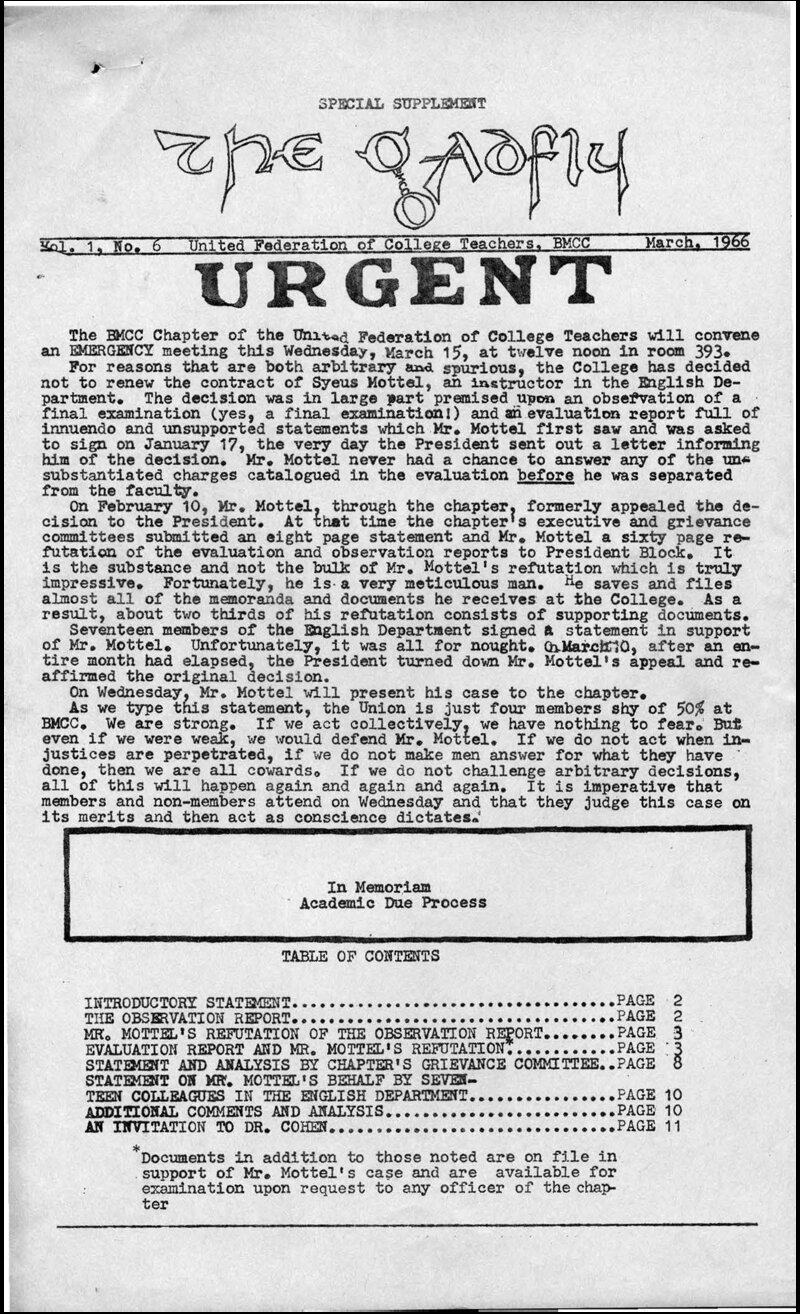
The BMCC Chapter of the United Federation of College Teachers will convene
an EMERGENCY meeting this Wednesday, March 15, at twelve noon in room 393.
For reasons that are both arbitrary and spurious, the College has decided
not to renew the contract of Syeus Mottel, an instructor in the Mnglish De-
partment. The decision was in large part premised upon an obsefvation of a
final examination (yes, a final examination!) and a evaluation report full of
innuendo and unsupported statements which Mr. Mottel first saw and was asked
to sign on January 17, the very day the President sent out a letter informing
him of the decision. Mr. Mottel never had a chance to answer any of the un«
substantiated charges catalogued in the evaluation before he was separated
from the faculty.
On February 10, Mr. Mottel, through the chapter, formerly appealed the de-
cision to the President. At thet time the chapter's executive and grievance
committees submitted an eight page statement and Mr. Mottel a sixty page re-
futation of the evaluation and observation reports to President Block.
is the substance and not the bulk of Mr. Mottel's refutation which is truly
impressive, Fortunately, he is-a very meticulous man. He saves and files
almost all of the memoranda and documents he receives at the College. As a
result, about two thirds of his refutation consists of supporting documents.
Seventeen members of the English Department signed & statement in support
of Mr. Mottel., Unfortunately, it was all for nought. MMarciti0, after an en=-
tire month had elapsed, the President turned down Mr. Mottel's appeal and ree
affirmed the original decision.
On Wednesday, Mr. Mottel will present his case to the chapter.
As we type this statement, the Union is just four members shy of 50% at
BMCC. We are strong. If we act collectively, we have nothing to fear. But
even if we were weak, we would defend Mr. Mottel. If we do not act when ine
justices are perpetrated, if we do not make men answer for what they have ~
done, then we are all cowards. If we do not challenge arbitrary decisions,
all of this will happen again and again and again. It is imperative that
members and non-members attend on Wednesday and that they judge this case on
its merits and then act as conscience dictates.’
In Memoriam
Academic Due Process
TABLE OF CONTENTS
INTRODUCTORY STATEMENT. ccc ccrccccrcccccoccccccccssccesesl AGH 2
THE OBSERVATION REPORT o's ce 6o'10.01e.e baw acaleio civiows bee's e.sleis's's o@,0 Als 2
MR. MOTTEL'S REFUTATION OF THE OBSERVATION REPORT oceesee PAGE 3
EVALUATION REPORT AND MR. MOTTEL'S REFUTATION. .ccesceeeeePAGE |
STATEMENT AND ANALYSIS BY CHAPTER'S GRIEVANCE COMMITTEE, .PAGE
STATEMENT ON MR. MOTTEL'S BEHALF BY SEVEN-=
TEEN COLLEAGUES IN THE ENGLISH DEPARTMENT...cccccesscceeeF AGE 10
ADDITIONAL COMMENTS AND ANALYSIS....ccseccccccsccecsveveel AGH 10
AN INVITATION TO DR. COHEN. cccesccccceccccescccsovcccccoe AGE 11
*Documents in addition to those noted are on file in
.support of Mr. Mottel's case and are available for
examination upon request to any officer of the chap-
ter
F page two
I. INTRODUCTORY STATEMENT BY WILLIAM FRIEDHEIM
The United Federation of College Teachers protests and appeals the termination of
Syeus Mottell's contract on two grounds:
1. His observation and evaluation were in violation of academic due process.
2. The procedures employed by Gerald Cohen, Chairman of the English Depart-
ment did not allow for a proper evaluation of Mr Mottell's classroom
performance.
C alba
Professor Mosbedh did not apprise Mr Mottel of his written observation and evaluation
reports until January 17, the very date affixed to his letter of separation. In
effect, the Chairman confronted Mr Mottell with a fait accompli. Only now, ex post
facto, can Mr Mottel enter a defense on his behalf and correct what he considers errors
of fact, judgement, and sound academic procedure. On the last count, we find Professor
Cohen wanting and in breach of due process.
Although Professor Cohen sat in on Mr Mottel's classes twice during the semester, he
filed only one report. He based his assessment upon an observation of a final exami-
nation in one of Mr M ttelis performance classes. Under no circumstances do we
feel a final examination is a fair or proper gauge of an instructor's ability.
President Block has previously directed Departmental Chairmen to observe members of
the teaching faculty thrce times a year. Over the past twelve months, Professor Cohen
placed only two reports on file in the Office @f the Dean of the College. One of
these we described above. We submit that by the college's own standards, Mr Mottells
teaching has not been properly evaluated.
What we find most disturbing, is that Professor Cohen's evaluation and observation of
Mr Mottel was solely punitive and not at all corrective. An observation report is of
little benefit to an instructor unless he is a party to it and after sufficient dis-
cussion, provided an opportunity to correct whatever his shortcomings as a teacher may
be. Clearly, by using it only to document his case against Mr Mottel, Professor Chhen
violated the intent of the observation report.
We suspect that Professor Cohen approached the particulars of Mr Mottel's case deduc-
tively. He started with the general premise that the College should not renew Mr
Mottel's contract. With this as his point of departure, he sought the evidence nece-
ssary to support a recommendation 6f dismissal. Evaluation and observation reports
did not shape his decision but rather his decision shaped his observation and evalaua-
tion. AS DEPARTMENTAL CHAIRMAN, HE NEVER CONSULTED WITH MR MOTTEL WHEN HE HAD CAUSE
TO DOUBT THE PROPRIETY OF HIS ACTIONS, BUT RATHER WILLY NILLY TURNED HERSAY EVIDENCE
AGAINST HIM. One example will suffice for this introductory statement. When a student
aide at Mr Mottel's request, asked the Chairman for a grade sheet so that she could
record the marks on post cards, provided by the students, Professor Cohen gave his
a sent and then cited the incident negatively in Mr Mottel's evaluation. If he questioned
the wisdom of allowing a student aide access to a grade sheet, he could have confided
the fact to Mr Mottel (instead, he of his own free will, permitted the aide to copy
the grades). Why did he permit the aide to copy the grades unless he wanted the episode
to serve another purpose, to build a case against Mr Mottel. Professor Cohen did not
evaluate Mr Mottel, he kept him under surveillance. In essence he assumed the role
of a policeman. He collected evidence against Mr M,ttel, who in turn was never privy
to this information and, hence, could not answer to it.
Professor Cahen's evaluation of Mr M ttel is a three paged single spaced compilation
of offenses, allegedly perpetrated o¥er the past year. Only now, after the decision
to terminate his contract, does Mr Mottel know the charges against him.
In his defense, we submit Mr Mottel's point by point refutation, complete with
supporting evidence, of Dr Cohen's wrrtten observation and evaluation and an analysis
of both these documents drawn up by the Grievance Committee of the BMCC Chapter.
The presentations of both Mr Mottel and the Grievance Committee should substantiate
the general conclusions of this brief introductory statement.
II. CHAIRMAN GERALD COHEN'S REPORT OF HIS OBSERVATION OF MR MOTTEL'S SPEECH CLASS
OF DECEMBER 19,1966, DATED JANUARY 6, 1967.
The aim of the lesson was the presentation of 10 minute speeches (arguments). The
organization of the lesson was thus based upon delivery of these, speeches, and this
constituted the full class hour. The following tpoles’ were treated by the Students:
ESP; Red China; Viet Nam; woman's role in society; LSD drugs.
With regard to student response, there was no opportunity for discussion or for the
raising of question. Mr Mottel remained seated throughout the session, and he himself
commented on the subject matter of most of the speeches. Some of the students were
not. =!G=ntive, ond were pierline and talking. two of them rather eyarcircally. Tho
oN
page three
instructor did not discourage them. There were eight students attending; then one
arrived at 11:15; another left and returned later; a new arrival came in at 11:35.
Since this has happened in the past, it is recorded here for purposes of discussing
the matter with Mr M,ttel.
Another matter that should be mentioned concerns Mr Mottel's comments; they were limited
to commendation on length, research, "beautiful" control of information, sources,
being two minutes short. Although the instnictor was probably recording errors in
organization, delivery, pronunciation, no mentjjon of these was brought to the sttudent's
attention during this session. There were numerous serious errors being made which
should have been called to the attention of the class. Some examples follow: slurring
of words; "listenin',"' "tree'' for "three," "incourage-dem-reconize-reconition, de key-
"prezzing.'"' There were other errors in intonation, accent, mispronunciation, and
slurring. When Mr M ttel held up cards indicating time used, the speakers seemed
nervous.
From the time of the observation to the date of its presentation to me (January 17,
1967), Dr Cohen did not, at any time, discuss the report or offer me any suggestions
as directed by college regulations and as stipulated on the observation sheet itself.
Dr Cohen did not indicate anywhere on his report that he was observing a final examina~
tion and not a representative lesson. During a regular lesson, corrections are made,
but not during a final examination. Allowing students to converse amongst themselves
offers a release of tension between presentations of individual ten minute final oral
reports, Hence, students were permitted to talk between presentations, but never
during the speeches themselves.
The question arises: Is it advisable for a departmental chairman to observe a final
examination as an official observation without indicating it in a report?
Dr Cohen makes note of a student leaving a returning later. The student who left and
later returned did so with my permission, previously agreed upon.
Dr Cphen makes note of the tardiness of two students. A teacher can exercise little
control over a student's tardiness on any one particular day. Dr Cohen alleges that
my classes are characterized by frequent tardiness on the part of the students, but
fails to substantiate his accusation. Also, he did not discuss the matter with me as
noted in the report.
Dr Cohen states "instructor was probably recording errors," however, Dr Cohen never
asked to see these notations. His inadequate grasp of the speech sciences is evident
$n the particular "examples" he noted. Dr Cohen was aware that student errers are in-
dicated on personal rating sheets. During a final examination, it is not the practice
to make public issues of them. The students' rating sheets are available for inspection
and review for the students and student-instructor conferences are conducted to re-
enforce comments made on rating sheets.
Dr Cohen notes "the speakers seemed nervous" by the holding up of cards to indicate the
passage of time. The students and I agreed collectively upon the use of the time cards.
This is a usual procedure in most formal public speaking occasions. Also, the pacing
of the student's talk was one of over-all considerations in determining student's
e “fective control of the speaking situation.
IV. CHAIRMAN GERALD COHEN'S EVALUATION OF MR MOTTEL'S RG,E IN THE DEPARTMENT FOR
"SECOND ANNUAL A. POINTMENT," DATED JANUARY 9, 1967. MB MOTTEL'S REJOINDERS ARE
INTERSPSRSED IN INDENTED PARAGRAPHS
(Although this report was written January 9, 1967, I was not given the
opportunity to read it until January 17, 1967. -- Syeus Mottel)
Since the last general evaluation of MrSyeus Mottel on Februrary 18, 1966, a few weeks
after my arrival here, I have had the benefit of additional contact with his classroom,
his students, and his colleagues. I still feel that Mr MSttel brgings tohis students
what I have called a "facile" way of treating his subject matter. To his credit, he
does have a sense of humor; however, as I indicated earlier, I have not seen a suffi-
cient demonstration of scholarly effectiveness in the classroom or elsewhere. The
observation reports indidate that there is not much evidence of student response in the
classroom, that there is a need for immediate on-the-spot criticism of students'
delivery, pronunciation and accent, and that there is distraction in the classtoom.
In other matters pertaining to scholarly ability, I have already reported (in December,
1966, and on January 12, 1967) that Mr Mottel has not advanced in graduate work since
page four
he took two courses in New York University's graduate theater program, summer, 1964.
Considerable time has passed since he received his MA degree.
While I have not attended graduate classes since 1964, my activities with
with various professional and theatrical organizations have directly
contributed to my effectiveness as an instructor of speech. Professional
congact with organizations such as Speech Association of America
and Speech Association of Eastern States are cited as examples. Directing
productions for United States Department of Health, Education, and Wel-
fare, Long Island Repertory, Actors Studio, Kornblee Gallery Players
are cited as professional theatrical examples.
It should be noted that my earlier reports were written during my earlier association
with Mr Mottel; heir negative criticismswas not over-emphasized since I had hoped
that encouragement would lead to improvement. This has not been the result
Suggestions made directly to me by Dr Cohen about my classroom perfor-
mance have been considered and incorporated by me in my classroom
techniques. (e.g. immediate comment to student upon conclusion of talk.)
Last spring, and again this seamaster, I have listened to complaints from students,
and I have received two phone calls from parents.
Why were these tomplaints from students and phone calls from parents"
never communicated to me by Dr Choen? There is no substantial evidence
of the incidents given nor any indication as to the nature of these
a¥leged complaints.
Some students expressed dissatisfaction with Mr Mottel because of his arrangement of
one contact hour per week in the lamguage laboratory. They said they felt a lack of
contact with the instructor.
If students complained of lack of contact in my classes, why was I not
c consulted? Howmcould I resolve the situation or answer to the students"
complaints unless I was made aware of the circumstance. Again, Dr Cchen
does not substantiate his remarks.
I did not honor their requests for section changes but referred them to further dis-
cussion with Mr Mottel.
The requests for "section changes" were not “referred"to me; nor is there
any reference to the identities of these students.
My a€tention has also been called to reports of Mr Mrtel's absense from the laboratory
sessions while they were in session. I discussed this with Mr Mottel, with the director
of the language laboratory, and with the Division Head.
These brief absenses, when they did occur, were necessitated by physical
diiscomfort resulting from a packed schedule. The language lab, however,
was never leftg unattended. There was always a technical assistant or
student aide present. (ED. NOTE: Mr Mottel here has attached a copy of
his schedule in the language lab which shows, for Friday, hours in the
laboratory from 2:15 to 5:50, a cla8S FROM 6:00 to 7:05 and Language Lab
again from 7:15 to 8:20.)
There have been other difficulties in Mr Mottel"s relationship with students: the
instance of Miss Jacqueline Waterman (memo of April 19, 1966), regarding her hearing
disability and her problems with the laboratory;
I notified Dr Choen that Miss Waterman's hearing disability made speech class
a tryitig éxpefiénce for her; she Needed a speciat kind Gf class:
The request for exemption was refused by Dr Chhen and I therefore dropped
the matter, What difficulties is Dr Cohen talking about?
the instance of a student (November 17, 1966) who was described as "highly disturbed
and emotionally overwrought . . . near hysteria," due to Mr MOttel's interrogation
about a workshop exemption.
Whose quote is this and to what does it refer? I was never consulted
on the matter by Dr Cohen,
In December there were problems in the Performing Arts Club; these were called to my
attention by students, and I directed them to Mr M°%tte1. I felt phat they should
discuss their criticism of him as their faculty advisor with Mr M ttel since this is
a club activityy io
I served as faculty advisor since the beginning of 1965. I am pleased with
all accomplishments of this clubas noted below. I know of no problems in
the club related to my conduct with its members, and can only assume that
what Dr Cohen is referring to is the discussions I had with Dr Paula
Langsam, who expressed an interest in the club.
page six
The memorandum of October 6, 1966 is a reply to Mr Mottel's description of ‘overcrowded"
classés at a time when classes were in the process of being split. On September 30, ° ~~”
when an effort had been made to split one of his classes, Mr M@ttel attacked the
qualifications of the teacher who had been assigned to the split class during the emer-
gency.
I presented my professional judgement and was upheld by Dr Gourevitch on this
basis. At no time did I attack the qualifications of the teacher. (BD NOTE:
Mr Mottel here has attached two memoranda, one from the teacher in question
who writes "I've never taught speech before.'' The second memoranda, from
Chairman Cohen, discusses the class split under discussion.)
He wanted to secure additional part-time teachers and I reminded him in the memorandum
of October 6, that department chairmen could not staff courses in the way he suggested.
I never attempted "to secure additional part-time teachers.' I merely requested
information and guidance from Dr Cohen. (ED NOTE: Several memoranda are here
attached. They consist of an exchange of notes between Mr Mottel and Chairman
Cohen on the subject.)
At that time, I received a call from "a friend of someone in the department" who stated
that she heard that the Speech classes were "overcrowded," and her friend told her
to call me about a position. When I inquired about the source of her exaggerated
information, she hung up the phone. I found the whole matter unfair and distasteful;
especially since enrollment problems were resolved shortly after the beginning of the
semester.
Quote of "a friend of someone in the department" links me to this incident
without substantiation. If there is anything unfair and distasteful about
ths matter, it is the blame placed upon me for a call from someone unknown
both to the Chairman and to me. How does this unsubstantiated situation enter
into an evaluation of an instructor's qualifications?
We have had discussions about these matters, and in addition we attempted to organize
a Communication Arts Workshop. Mr Mottel was unwilling to follow the suggestion (memo
of November 7, 1966) which had been relayed to me by our administration (and by a member
of the City University Office of Yevelopment) to the effect that all negotiations between
Actors Studio and BMCC should be based upon the institutions themselves, and not upon
the tole of Mr M ttel in these negotiations. He then notified me that the negotiations
were tepminated -- < A
am very ppoud of my efforts, however unsuccessful, to organize a Communications
Arts Workshop through the Actors Studio at BMCC. At all times, I pursued the
matter through channels at the suggestion of Dean James.
The Actors Studio had asked me to serve as a liason representative between them
and BMCC. As indicated in my report, my role was unofficial and resulted from
my association with both institutions. Dr Cohen insisted that my name and the
name of Lee Strasberg (artistic director of Actors Studio) be withdrawn from
the proposal. Not I, buth he Actirs Studio, for reasons separate and apatt from
this circumstance, decided to terminate the discussions at approximately the same
thme Dr Cohen had made his suggestions.
I urge the administration to review this matter most carefu'lym not only with
respect to my dismissal, but also as to the reasons underlying the loss of this
most promising opportunity for BMCC. (Ed Note: Several memoranda substantiating
Mr Mottel's remarks are here attached as well as the proposal for the workshop)
The minutes and correspondence of the department's Speech Committee indicate that Mr
Mottel has not been cooperative, and that he has been involved in considerable conflict
with some of his colleagues. They have comlained that he has placed departmental issues
(new electives, laboratory, syllabus, definitions of workshop) on a personal level, and
that he has not contributed to the attempts to improve the Speech program and the role
of the laboratory. This difficulty in his relationship with colleagues was first noted
Nebruary 18, 1966.
The discussions within the speech committee were supposed to be on a professional
basis. I would hope that differences of opinion would not be construed as
"conflict with some of his colleagues." The situation within the committee was
presented several times to the Head of the Division of Liberal Arts for review
of basic disregard of democratic procedures. 4
The prcedure of Dr Langsam, as chairman of the speech committee consisting of
four members, was to initiate new business by memorandum, decisions by memorandum,
decisions by questionnaire, and offer little opportunity for open discussion.
Normal democratic courses of open discussion, debate and compromise were thereby
curfiailed. (ED NOTE: Attached memoranda @eal with arbitrarily cancelled meeting of
the committee, decisions of the committee chairman pettaining to a debate course,
a questionnaire for committee members,, a memo asking members if they wish to
have a meeting as suggested by a committee member, memorandum requesting a mailed
vote on a potential new course, exchange between chairman of committee and Mr
Mottel cn the hack of discussion, etc.)
Yee men eA Te Zan Stargate Ae: a a LM MPLS y se ene, dean eed |
page tive
The items dated March 8, 1966 and January 12, 1967 describe additional nines f
On March 8 Mr Mottel wrote to me about changing a student's grade in speec’ A ie
C to a BY to “enable her to make the Dean's List." I discussed this matter wi
i E ent t is action.
March 9, and refused to consent to this ac :
ees I appreciated Dr Cohen's thinking on the matter and considered the matter
ended with his lack of consent allowing for the grade change.
Another example of poor judgement regarding students was called to Pe ee reane aie.
January 12, 1967, when three student are were ah cee eee the cules
When they were questioned they said he ha reques er fea ks
i * ate" for him to do it himself. The students were reporte:
wine cepa eateune they knew they were not allowed to handle ee nae me felt
they were obliged to comply woth the request of a faculty member « : ques Ee ae
them and this was comfirmed. Similarly, Mr Mottel's final examination was eee
typed in the English Office, and he was reminded that this was a biolation of bo g
Se ae eas nob fully stated and hence, by implication and sisi
are damaging. The student (only one, not three) was not entering gra ae
on an official form. She was asked to copy grades onto postcards supplie
by students. She was asked to do this in Dr Cohen's office, in as
presence and with his full knowledge. If he felt that this was no aa
correct procedure, he could have contacted me and denied the aide acc
to the grade sheets. This he did not do although I handed in mg
completed grade sheets TWO DAYS IN ADVANCE of the set deadl ine® e
quotation Dr Cohen uses ("too late’) referred to the time of day not
the lateness of my performance.
I asked the secretary of the EDnglish Department to type portions of
a draft of the final exam on siggle sheets, since they derived from various
sources, She was requested to do this awayfrom all students. Thereafter,
she informed me that the typing of even a draft should not be done in
that office and i removed all the papers and brought all papers to the
proper office,
The memoranda of September 21, Ociovex 3, October 4, October 6, and October 10,
1966, call attention to Mr Mottel"s failure to cooperatre with the scheduling of clas-
ses. On these occasions, andj others, my attention has been aalled to the arbitrary
rearrangement of his scheduie, students and rooms. This was particularly disturbing
to the department's schedule during fall semester whea there was anticipated heavy
enrollment in Speech which took time to resolve. I have continuously honored Mr
M,ttel's requests for prograa changes, often with sore inconvenience; however, the
memoranda show I have had to stress several times that the college requires all members
of the faculty to be available to teach courses throughout the day and evening.
Although I always block programs to suit faculty needs, Mr M ttel's insistence on
certain hours has proved to be unreasonable. "
Rearrangement of my schedule was always conducted with Dr Choen's knowledge
3 and aPproval. Never did I fail to cooperate with Dr Cohen's suggestions
a “ Tok s Ce Se ASH, ae ea ES 9 FE oe pr ee ae, =
i or requests. I always respected the Chalina” © 2° "Sesent In-vegard ‘to his
scheduling of classes.
There is a seridus conflict between his duties to Actors Studio and his obligations
to our college.
A careful consideration of my activities at BMCC and my open interest in
aiding the college's development would belie this statement. If Dr
Cohen disagrees, an explicit statement of thi¥'conflict"' would be helpful
both t both to the college and to me.
In a related matter, the administration of this college has called to Mr Mottel's
attention, and to mine, that protocol and correct procedure should be observed by him
in college affairs. The above-mentioned memos to him indicate that he has not followed
academic procedures although his attention has been called to these. (On October 10,
1966, Mr M°ttel was told thatg he could not reschedule a class to Wednesdays 12-2, sine
this is against college regulations).
Specifically, how did I vielate "protocol® and "academic" procedures. Agai,
Dr Choen has not substantiated nis comments. Dr Cohen may be referring to
the one occasion when I consulted Dean Moscolo regarding a change of room/
It was done in order to relieve Dr Choen of an unessential chore. I never
had any thought of superceding college protocol. Rather, I was concerned
with the humane desire to aid my chairman by not burdening him with trivia
when his varied concerns were heavy. .. ». If there are any other incidents,
I woujld welcomes Dr Choen's detailing £ them sinee I was never informed
of them. The inasday incident" was twiciiateiv resolved when % was
SE ees ya 3- =
page six
The memorandum of October 6, 1966 is a reply to Mr Mottel's description of ‘overcrowded"
classés at a time when classes were in the process of being split. On September 30, ° ~~”
when an effort had been made to split one of his classes, Mr M@ttel attacked the
qualifications of the teacher who had been assigned to the split class during the emer-
gency.
I presented my professional judgement and was upheld by Dr Gourevitch on this
basis. At no time did I attack the qualifications of the teacher. (BD NOTE:
Mr Mottel here has attached two memoranda, one from the teacher in question
who writes "I've never taught speech before.'' The second memoranda, from
Chairman Cohen, discusses the class split under discussion.)
He wanted to secure additional part-time teachers and I reminded him in the memorandum
of October 6, that department chairmen could not staff courses in the way he suggested.
I never attempted "to secure additional part-time teachers.' I merely requested
information and guidance from Dr Cohen. (ED NOTE: Several memoranda are here
attached. They consist of an exchange of notes between Mr Mottel and Chairman
Cohen on the subject.)
At that time, I received a call from "a friend of someone in the department" who stated
that she heard that the Speech classes were "overcrowded," and her friend told her
to call me about a position. When I inquired about the source of her exaggerated
information, she hung up the phone. I found the whole matter unfair and distasteful;
especially since enrollment problems were resolved shortly after the beginning of the
semester.
Quote of "a friend of someone in the department" links me to this incident
without substantiation. If there is anything unfair and distasteful about
ths matter, it is the blame placed upon me for a call from someone unknown
both to the Chairman and to me. How does this unsubstantiated situation enter
into an evaluation of an instructor's qualifications?
We have had discussions about these matters, and in addition we attempted to organize
a Communication Arts Workshop. Mr Mottel was unwilling to follow the suggestion (memo
of November 7, 1966) which had been relayed to me by our administration (and by a member
of the City University Office of Yevelopment) to the effect that all negotiations between
Actors Studio and BMCC should be based upon the institutions themselves, and not upon
the tole of Mr M ttel in these negotiations. He then notified me that the negotiations
were tepminated -- < A
am very ppoud of my efforts, however unsuccessful, to organize a Communications
Arts Workshop through the Actors Studio at BMCC. At all times, I pursued the
matter through channels at the suggestion of Dean James.
The Actors Studio had asked me to serve as a liason representative between them
and BMCC. As indicated in my report, my role was unofficial and resulted from
my association with both institutions. Dr Cohen insisted that my name and the
name of Lee Strasberg (artistic director of Actors Studio) be withdrawn from
the proposal. Not I, buth he Actirs Studio, for reasons separate and apatt from
this circumstance, decided to terminate the discussions at approximately the same
thme Dr Cohen had made his suggestions.
I urge the administration to review this matter most carefu'lym not only with
respect to my dismissal, but also as to the reasons underlying the loss of this
most promising opportunity for BMCC. (Ed Note: Several memoranda substantiating
Mr Mottel's remarks are here attached as well as the proposal for the workshop)
The minutes and correspondence of the department's Speech Committee indicate that Mr
Mottel has not been cooperative, and that he has been involved in considerable conflict
with some of his colleagues. They have comlained that he has placed departmental issues
(new electives, laboratory, syllabus, definitions of workshop) on a personal level, and
that he has not contributed to the attempts to improve the Speech program and the role
of the laboratory. This difficulty in his relationship with colleagues was first noted
Nebruary 18, 1966.
The discussions within the speech committee were supposed to be on a professional
basis. I would hope that differences of opinion would not be construed as
"conflict with some of his colleagues." The situation within the committee was
presented several times to the Head of the Division of Liberal Arts for review
of basic disregard of democratic procedures. 4
The prcedure of Dr Langsam, as chairman of the speech committee consisting of
four members, was to initiate new business by memorandum, decisions by memorandum,
decisions by questionnaire, and offer little opportunity for open discussion.
Normal democratic courses of open discussion, debate and compromise were thereby
curfiailed. (ED NOTE: Attached memoranda @eal with arbitrarily cancelled meeting of
the committee, decisions of the committee chairman pettaining to a debate course,
a questionnaire for committee members,, a memo asking members if they wish to
have a meeting as suggested by a committee member, memorandum requesting a mailed
vote on a potential new course, exchange between chairman of committee and Mr
Mottel cn the hack of discussion, etc.)
Yee men eA Te Zan Stargate Ae: a a LM MPLS y se ene, dean eed |
page seven
What does the date of February 18, 1966 indicate? Dr Cohen did not assume his
duties until a few weeks prior to this dates‘ In the "few weeks after my arrival
here" stated on page one of Dr Cohen's evaluation report, was he aware of
"difficulty in his relationship with colleagues," and if so, why was I not
notified.
The present members of the Speech Committee were not members of the faculty at
that time. I have every reason to assume that Dr Cyoman, who was chairman of
the Committee in February, 1966 and formerly Co-ordinator of Speech; was quite
satisfied with me and my professional conduct. How does Dr Cohen support
"difficulty in his relationship with colleagues" when I received the next highest
number of votes permitting me to serve on the Faculty Council for the remainder
of this school year?
ED NOTE: Attached memorandum reads: "To Whom It May Concern: At the Regent
of Mr Syeus Mottel, I submit the following history of the Speech Committee ingofar
as it may help to refute Dr Cohen's charges against Mr Mottel with respect to
this Committee. In all honesty, I make the following statements because having
been Mr Mottel's supervisor for at least two quarters, I found Mr M,ttel's work
quite satisfactory. As co-ordinator of the Inglish department during the Summer
Quarter of 1965 and as Co-ordinator of Speech during the Fall Wuarter of 1965
I had occasion to directly observe his work in and out of the classroom. My
favorable report is in his file. After January 1, 1966 I was not required to
observe classes, but as Chairman of the Speech Committee until September, 1966,
I always found Mr Mottel very cooperative.
As of September, 1965 the Speech Committee was comprised of Mr Edward
DeRom, My Syeus Mottel, and myself. During the year 1965-1966 we held one
contact hour of speech in the language laboratory where studentsused specially
prepared tapes for voice and dickton improvement. At the end of the Spring
Quarter, favorable evidence of the success of this method was sent to Dr Cohen
and Dr Gourevitch in the form of student comment. Mr Mottel had been most
cooperative and had spent much time in preparing tapes.
In April, 1966, Dr Cohen placed Mr Charrier on the CommBttee , Mr Charrier
was then teaching one speech course in the evening division. Mr Charrier and
Mrs Langsam were on the speech staff during the summer session. While Mr Mottel
and I were on vacation, one member of the Committee revised the syllabus and
wrote letters to department chairmen in other colleges. This revised syllabus
was submitted at the first meeting of the new Speech Committee on September 26,
1966 by the new chairman who was also elected at that same meeting by a 3-2
vote. The committee was now composed of Mr Charrier, Mrs Langsam (Chairman),
Mr Polisar (lecturer), Mr Mottel, and myself. Objections to this syllabus were
raised and after a series of five meetings, a new syllabus was a proved by the
committee. Between October and December 19th, the chairman of the committee
initiated three pieces of new business by memorandum and asked fr written comments.
Since open exchange was not allowed, policy by fiat becamse the standard.
A request for an open meeting was turned down and at least one piece of business
presented to the department chairman had never been presented éven in memorandum
form to the entire committee. On December 19% a committee meeting was held
but the agenda as it had been set up in the meeting of October 31st had been
reversed. A rather important item pending for months did not get discussed.
With reference to Mr Mottel's behavior, at not time did I consider his
actions to be on an unprofessional level. From an analysis of the minutes, there
is nothing that would denote Mr Mottel's suggestions as being on a personal
rather than a professional level. I regard any comments made by Mr Mottel in
correspondence to the Committee Chairman as being in the interest of the
democratic process of committee operation. : ret reat 1
SUBMITTED BY A COLLEAGUE OF
MR. MOTTEL
Mr Mottel has not fulfilled his departmental responsibilities which were to implement
the programs (department forum, department contribution to Student Life programs,
arrangements for speakers) of the department committee of which he is chairman. I have
not received a single report from him, nor have we seen any evidence of progress; there
are no programs or speakers,
As far as departmental responsibilities, I submit the attached documents of the
minutes of the Extra-Curricular Committee and activities concerning the
Separtment Social. All minutes were submitted to Dr Cohen contrary to his
statement. (ED NOTE: Several memoranda are attached.)
Although I have made every effort tt accomefate Mr Mottel, and to give him the opportu-
nity to improve, I do not feel that he has demonstrated suffivient growth in his re-
lations with the department, its programs, and the students it serves. I do not
not recommend the reappointment of Mr Mottel in September, 1967,
I camplied with all recommendations made directly by the Chairman to improve
my effectiveness as a faculty member of BMCC. Unfortunately, Dr Cohen did not
confide most of his criticisms incorporated im the evaluation report to me
page eight
until January 17, 1967, the day my letter of reappofntment was dated. His approach
disregards fundamental considerations of academic due process.
I therefore respectuflly request for this reason and those previously mentioned in
this refutation a reversal of the decision made on “anuary 17, 1967.
V. STATEMENT BY THE GRIEVANCE COMMITTEE OF THE UNITED FEDERATION OF COLLEGE TEACHERS,
BMCC CHAPTER.
An analysis of Dr Gerald Cohen's observation and evaluation of Mr S Mottel indicates
that the presentation can be conveniently organized around the following main headings:
1. Class Scheduling 2. Speech Committee
3. Relations with Students 4. The Actors Studio
5. Professional Growth 6. Departmental Responsibility
?. Observation
This study of Dr Cohen's comments will be succinct and does not purport to be defini-
tive. In general, it should be noted that the animus of Dr Cohen's remarks, the
injurious tone of kits presentation ill becomes a senior member of a department. It is
disturbing that thoughts and ideas are not logically related, that there is no basic
paragraphing and the entire report mingles heresay, ambiguities and half-truths.
DEPARTMENTAL RESPONSIBILITY: Memoranda covering this (Extracurrisular Acitivities)
Committee to which Mr Mottel was elected Chairman indicate that we was as active a
chairman as most chairmen of similar committees throughout the college.
It is almost unbelieveable that on the basis of the facts Dr Cohen can write
with no hesitation that Mr Mottel "has mot fulfilled his departmental responsibilities."
CLASS SCHEDULING: Dr Cohen makes much of Mr Mottel's failure to cooperate with
scheduling of classes. Actually, reference to memoranda of September 2lsty October
3rd, 4th, 6%, and 10% is spurious because these memoranda dealt with one problem which
is quite simple. Mr Mottel was given two classes of thirty students each. The
optimum number of students for a speech class is twenty. Mr Mottel requested Dr
Cohen to form another section of twenty students and he volunteered to helpt the
Department recruit part-time instructors. Dr Cohen first assigned Miss Braun to
teach the section. However, as Miss Braun stated she had never taught a speech class,
Mr Mottel questioned the advisability of assigning the section to her. Therefore
Dr Cohen took the assignment away from Miss Braun, did not create another section,
did not receive part-time help and thus forced Mr Mottel to teach two sections, each
fifty percent larger than the designated maximum population.
By imuendo, Dr Cohen suggests that Mr Mottel was behind the phone call of an
unnamed lady who inquired about apart-time job teaching speech.
Dr Cohen's discussion of thiss problem of over-crowding actually distorts the
problem involved. For example, how did Mr M ttel"attack the qualifications of the
teacher?" Did not the teacher herself write Mr M ttel that she had not previously
taught a ppeech class? S
As one studies this case, it is difficult to find any reason to blame Mr
Mottel's conduct.
SPEECH COMMITTEE: Dr Cohen tries to use Mr Mottel's behavior as a member of the
English Department's Speech Committee to indicate that Mr M ttel has not been cooper-
ative. However, what real evidence does he present? He refers to minutes and
correspondence of the committee but nothing is presented to document this viewpoint.
The fact that all members of the committee did not necessarily get along with the
Chairman, who joined the faculty last September, does not mean one is uncooperative.
The tenuous nature of Dr Cohen's allegation is underscored when he states that he
first noted Mr Mottel's difficulty with his colleagues on February 18, 1966, only a
few weeks after he (Br Cohen) joined the BMCC faculty. How, after such a brief
tenure as Chairman, could Dr Cohen be fully acquainted with the facts?
The statement submitted by Dr Croman on the history of the speech committee
should remove any doubt of there being anything at all in Dr Cohen's charge.
RELATION WITH STUDENTS: Dr Cohen's statement about Mr M ttel's relations with students
show to what extreme Dr Cohen has gone to try and make a°case out of nothing. Dr
Cohen writes that he has listened to complaints from students. Which students?
Were these complaints ever referred to Mr M ttel? Dr Cohen also states that he received
two phone calls from parents. Who are their children? Why did not Dr Cohen discuss
this withMr Mottel? Dr Cohen goes on to say some students expressed dissatisfaction
with Mr Mottel because of ome contact hour per week in the laboratory. However, Dr
Cohen didnot speak to Mr M ttel about this and, furthermore, no student mentioned
it either. 2
page nine
Dr Cohen raises the issue of Miss Jacqueline Waterman. Mr Mottel tried to
obtain an exemption for this young lady in her own interests and because her degree
of deafness made the whole period a tense and useless experience.
Dr Yohen also tries to criticize Mr Mottel's conduct as Advisor to the Per-
forming Arts Club. However, Dr Cohen does not tell us that the Chairman of the Speech
Sub-Committee of the Department has intruded on the conduct of this club thus under-
mining Mr Mottel's position. She had visitied a rehearsal of the Performing Arts Club
and discussed her theatrical backgroun@ with a view toward replacing Mr Mottel as
advisor. She later apologized to Mr M ttel for visiting the rehearsal without discus-
sing it with him. Subsequently some students went to Dean Cohen to discuss the pos-
sibility of a new advisor.
THs ACTORS STUDIO: Mr Mottel, who had ben with the Actors Studio since 1959, worked
out in conjunction with the studio a teachers' training program. The propwsal was
submitted to Dr Cohen. Of course, this proposal spoke of Mr Mottel as the liason
representative and was submitted above his name. Dr Cohen states that "administration!
at this college and "a member of the City University Office of Development" requested
that Mr Mottel's name not be used. Of course, Dr Cohen does not state which adminis-
trative office at this college or who at City University objected. There are reasons
to believe that the bbjections to use of Mr Mottel's name are exaggerated. Proposals
submitted by Dr Scolnick, Prof Irving Cohen, and Prof Jesse A Pavis were filled in
with their names. At any rate, Dr Cohen requested Mr M ttel to delete all reference
to himself. The Actors Studio, which was primarily working through Mr M’ttel, withdrew
from the proposal. “
Mr Mottel was trying to organize an exciting program for the college and was
hamstrung at almost every turn. Hven superficially considered, one wonders about
Dr Cohen's motive.
PROFESSIONAL GROWTH: Dr Cohen writes that, "There is a serious conflict between his
(Mr Mott#1l's) duties to Actors Studio and his obligations to our college." In no
place in his entire evaluation is any documentation offered to back this assertion.
Indeed a more logical understanding of Mr Mjttel's relation to Actors Studio in the
theatrical life of New York is ignored. Everyone is familiar with the commanding
role of the Actors Studio in the theatrical life of New York and the nation. Mr Mot-
tel's active participation with the Studio, his continuing training under the direction
of Mr Lee Strasburg, is active professional graven in the best meaning of the term.
..,, Mr Mottel's contiuing experience in the theater will not only enrich his own
ability to teach and communicate but will in Years ahead result in concrete achieve-
ment for this college if Mr M ttel is allowed to develop projects and plans like that
with Actors Studio. ‘ei
OBSERVATION: Dr Cohen did not indicate that he was attending a final examination in
speech. He raised the issue that there was talking and noise but did not--point out
that this occured between speech presentations. Dr Cohen'sobservation that there were
late students does not deserve comment. 2
Dr Cohen went to great lengths to turn eidence against Mr Mottel when he cited
his use of "beautiful" and student phrases such as "incourage-dem-reconize."
Actually, little of substance is presented by Dr Cohen. Since Mr M,ttel was
conducting a final examination, he did not discuss the student's presentation with them
after delivery. Obviously, Mr Mottel as well as Dr Cohen noted all the errors made by
his students. Dr Cohen himself wrote that Mr Mottel was recording errors.
That Dr Cohen should take such exception to an agreed upon manner of indicating
time (holding up cards) is petty.
We also question Dr Cohen's competence to observe Mr Mottel. Dr Cohen's
training is not_in the area of speech. Why did not Dr_Cohen_ask a senior members of
the Speech faculty to sit tn on’ one of Me Mottel's classes? ne only faculty
member who both specializes if speech and observed Mr Mottel, Dr Charlotte Croman,
filed a favorable report in the Fall of 1965.
CONCLUSION: This point by point analysis of every item brought up by Dr Cohen shows
the vindictive and specious nature of the charges. Indeéd, what is striking in the
four pages of observation and evaluation is that on internal evidence alone the
allegations are without substance and validity. It seems clear and without the
teaat doubt that any reasonable person must entirely discount and discard Dr Cohen's
curtous fone hee cs11eagues on the faculty Mr Mottel is respected as a fine teacher,
gentleman, and a man who is also doing serious work in the theater. Mr Mottel has
now been given a seat on the Faculty Council since the college-wide election placed
him as first alternate member.
Last spring, unasked and without profit for himself, Mr Mottel photographed and
selected a brilliant display of innauguration pictures. In every respect Mr MAtt>)
is a man who has given a great deal to make BMCC the ch>??-~='-~ ovitege is it.
GRIEVANCE CO)MITTEE
Charlotte Cyoman
Verdelle Garnett
Jesse Pavis
Mayer Rossabi
De ope ETE en et i
page ten
VI. STATEMENT ON MR MOTTEL'S DISMI3SAL BY MEMBERS OF THE ENGLISH DEPARTMENT
Fourteen members of the English Department signed this statement
in its entirety. Three additional members signed an alternate state-
ment which omitted the second paragraph. This comprises over 75%
of the Department's regular faculty.
We are deeply concerned that Syeus Mottel has not been reappointed for
1967-1968. As colleagues, we respect his professional attitudes toward
teaching, committee work, and extra-curricular activities as well as his
cultural contributions to New York City.
We feel that the reasons for his dismissal have not been sufficiently
clarified and that the procedure of his dismissal was highly questionable.
In such an atmosphere of doubt, insecurity, and reprisal, we all feel unduly
vulnerable. If Mr Mottel's dismissal were to be upheld under these circum~
stances, department morale would be severely lowered and the continuation of
academic due process at BMCC would be undermbned.
We therefore respectfully request President Block to reconsider —
the case and to help us form a true and unga&ased opinion of this affair,
VII. ADDITIONAL COMMENTS AITD AITALYSIS ;
An additional comment or two is in order,
‘Then the Chapter-formally appgaled Mr. Mottel's case before Pres=
ident Block on Friday, February 10, Dr. Block intf®oduced two new argu-
ments in support of the original decision, First he pointed out that
there were other documents on file.yaich reinforced the conclusions
reached by Dr. Cohen, Chairman of the English Department, We asked to
see the documents. Obviously we could not defend Mr. Mottel if we did
not have access to all the pertinent evidence. The President answered
that he could not meet our request. At that point, we indicated that
an appeal was no more than a futile exerfise if we did not know the
full extent of the administration's case against Mr. Mottel. Should
a lawyer defend a client without first lmowing the charges against him?
The President indicated that Mr. Mottel did not have a PhD nor was
he progressing toward one, iiis original letter of appointment had spe-
ecified that a PhD, was necessary for a tenure appointment. (Mr. Mottel
was not up for tenure this year.) Our answer to this was quite simple.
A number of faculty members teaching academic subjects, had been granted
tenure without a PhD, EVE! MORE IMPORTANT, MR. MOTTEL, ‘10 TAS li0T
TAKE! A GRADUATE COURSE (ifOR DOES ilE TiTEND TO) SIUCE tif RECEIVED IIs
MASTER'S DEGREE, IiAS MORE TAIT THE EQUIVALENT OF A PID, Iii tS FIELD
(SPEECI AND THEATRE) GIVE! EIS EXPERIENCE AID AFFILIATION WIT Tiik ACTS
ORS STUDIO, PROBABLY TIiE PREMIER TIIEATRE GROUP Ii! THE COUNTRY. PRESI-
DH'T KAPLAI! OF Tiig NEW STATE UNIVERSITY ‘Ni1Cil WILL SPECIALIZE Ml! Tiik
PERFORMING ARTS (IiUCLUDIIG SPEECH AID THEATRE), IAS INDICATED TIAT is
COLLEGE IS if0T GOING TO SEEK OUT Pls, BUT RATIER MH! ‘WO AVE TRATIT&
NG AMD PROFESSIONAL EXPERIGICE WITIi GROUPS SUCII AS Tiiz ACTORS STUDIO.
(SEE PAGE NINE FOR MORE Ol! TiS.) May we also point out that Dr. Cohen
did not substantiate any of the charges he levelled against Mr, Mottel
in the evaluation report. Of particular significance is the observation
that President Block, when hearing this appeal, played the role of ad-
vocate, constantly intervening on behalf of Dr. Cohen. ile did not ad=
judicate the case impartially,
In the letter in which President Block notified Mr, Mottel of his
decision, he indicated that in addition to examining the material sub=
mitted, he discussed the case with the "responsible (emphasis ours)
supervisory personnel of the College, and with various faculty groups,
including members of the English Department." We find the adjective
responsible quite curious, In addition to Dr. Cohen, only one other
person ever observed Mr. Mottel's classes. (S)he submitted a very
favorable report. Is (s)he irresponsible? Ilow does one define respon
sible? Is Dr. Cohen's evaluation responsible?
In the same letter Dr. Block stated:
It is the prerogative and responsibility of an institution
«
SPECIAL SUPPLEMENT
Pa United Federation of College Teachers, BMCC Marc
URGENT
The BMCC Chapter of the United Federation of College Teachers will convene
an EMERGENCY meeting this Wednesday, March 15, at twelve noon in room 393.
For reasons that are both arbitrary and spurious, the College has decided
not to renew the contract of Syeus Mottel, an instructor in the Mnglish De-
partment. The decision was in large part premised upon an obsefvation of a
final examination (yes, a final examination!) and a evaluation report full of
innuendo and unsupported statements which Mr. Mottel first saw and was asked
to sign on January 17, the very day the President sent out a letter informing
him of the decision. Mr. Mottel never had a chance to answer any of the un«
substantiated charges catalogued in the evaluation before he was separated
from the faculty.
On February 10, Mr. Mottel, through the chapter, formerly appealed the de-
cision to the President. At thet time the chapter's executive and grievance
committees submitted an eight page statement and Mr. Mottel a sixty page re-
futation of the evaluation and observation reports to President Block.
is the substance and not the bulk of Mr. Mottel's refutation which is truly
impressive, Fortunately, he is-a very meticulous man. He saves and files
almost all of the memoranda and documents he receives at the College. As a
result, about two thirds of his refutation consists of supporting documents.
Seventeen members of the English Department signed & statement in support
of Mr. Mottel., Unfortunately, it was all for nought. MMarciti0, after an en=-
tire month had elapsed, the President turned down Mr. Mottel's appeal and ree
affirmed the original decision.
On Wednesday, Mr. Mottel will present his case to the chapter.
As we type this statement, the Union is just four members shy of 50% at
BMCC. We are strong. If we act collectively, we have nothing to fear. But
even if we were weak, we would defend Mr. Mottel. If we do not act when ine
justices are perpetrated, if we do not make men answer for what they have ~
done, then we are all cowards. If we do not challenge arbitrary decisions,
all of this will happen again and again and again. It is imperative that
members and non-members attend on Wednesday and that they judge this case on
its merits and then act as conscience dictates.’
In Memoriam
Academic Due Process
TABLE OF CONTENTS
INTRODUCTORY STATEMENT. ccc ccrccccrcccccoccccccccssccesesl AGH 2
THE OBSERVATION REPORT o's ce 6o'10.01e.e baw acaleio civiows bee's e.sleis's's o@,0 Als 2
MR. MOTTEL'S REFUTATION OF THE OBSERVATION REPORT oceesee PAGE 3
EVALUATION REPORT AND MR. MOTTEL'S REFUTATION. .ccesceeeeePAGE |
STATEMENT AND ANALYSIS BY CHAPTER'S GRIEVANCE COMMITTEE, .PAGE
STATEMENT ON MR. MOTTEL'S BEHALF BY SEVEN-=
TEEN COLLEAGUES IN THE ENGLISH DEPARTMENT...cccccesscceeeF AGE 10
ADDITIONAL COMMENTS AND ANALYSIS....ccseccccccsccecsveveel AGH 10
AN INVITATION TO DR. COHEN. cccesccccceccccescccsovcccccoe AGE 11
*Documents in addition to those noted are on file in
.support of Mr. Mottel's case and are available for
examination upon request to any officer of the chap-
ter
F page two
I. INTRODUCTORY STATEMENT BY WILLIAM FRIEDHEIM
The United Federation of College Teachers protests and appeals the termination of
Syeus Mottell's contract on two grounds:
1. His observation and evaluation were in violation of academic due process.
2. The procedures employed by Gerald Cohen, Chairman of the English Depart-
ment did not allow for a proper evaluation of Mr Mottell's classroom
performance.
C alba
Professor Mosbedh did not apprise Mr Mottel of his written observation and evaluation
reports until January 17, the very date affixed to his letter of separation. In
effect, the Chairman confronted Mr Mottell with a fait accompli. Only now, ex post
facto, can Mr Mottel enter a defense on his behalf and correct what he considers errors
of fact, judgement, and sound academic procedure. On the last count, we find Professor
Cohen wanting and in breach of due process.
Although Professor Cohen sat in on Mr Mottel's classes twice during the semester, he
filed only one report. He based his assessment upon an observation of a final exami-
nation in one of Mr M ttelis performance classes. Under no circumstances do we
feel a final examination is a fair or proper gauge of an instructor's ability.
President Block has previously directed Departmental Chairmen to observe members of
the teaching faculty thrce times a year. Over the past twelve months, Professor Cohen
placed only two reports on file in the Office @f the Dean of the College. One of
these we described above. We submit that by the college's own standards, Mr Mottells
teaching has not been properly evaluated.
What we find most disturbing, is that Professor Cohen's evaluation and observation of
Mr Mottel was solely punitive and not at all corrective. An observation report is of
little benefit to an instructor unless he is a party to it and after sufficient dis-
cussion, provided an opportunity to correct whatever his shortcomings as a teacher may
be. Clearly, by using it only to document his case against Mr Mottel, Professor Chhen
violated the intent of the observation report.
We suspect that Professor Cohen approached the particulars of Mr Mottel's case deduc-
tively. He started with the general premise that the College should not renew Mr
Mottel's contract. With this as his point of departure, he sought the evidence nece-
ssary to support a recommendation 6f dismissal. Evaluation and observation reports
did not shape his decision but rather his decision shaped his observation and evalaua-
tion. AS DEPARTMENTAL CHAIRMAN, HE NEVER CONSULTED WITH MR MOTTEL WHEN HE HAD CAUSE
TO DOUBT THE PROPRIETY OF HIS ACTIONS, BUT RATHER WILLY NILLY TURNED HERSAY EVIDENCE
AGAINST HIM. One example will suffice for this introductory statement. When a student
aide at Mr Mottel's request, asked the Chairman for a grade sheet so that she could
record the marks on post cards, provided by the students, Professor Cohen gave his
a sent and then cited the incident negatively in Mr Mottel's evaluation. If he questioned
the wisdom of allowing a student aide access to a grade sheet, he could have confided
the fact to Mr Mottel (instead, he of his own free will, permitted the aide to copy
the grades). Why did he permit the aide to copy the grades unless he wanted the episode
to serve another purpose, to build a case against Mr Mottel. Professor Cohen did not
evaluate Mr Mottel, he kept him under surveillance. In essence he assumed the role
of a policeman. He collected evidence against Mr M,ttel, who in turn was never privy
to this information and, hence, could not answer to it.
Professor Cahen's evaluation of Mr M ttel is a three paged single spaced compilation
of offenses, allegedly perpetrated o¥er the past year. Only now, after the decision
to terminate his contract, does Mr Mottel know the charges against him.
In his defense, we submit Mr Mottel's point by point refutation, complete with
supporting evidence, of Dr Cohen's wrrtten observation and evaluation and an analysis
of both these documents drawn up by the Grievance Committee of the BMCC Chapter.
The presentations of both Mr Mottel and the Grievance Committee should substantiate
the general conclusions of this brief introductory statement.
II. CHAIRMAN GERALD COHEN'S REPORT OF HIS OBSERVATION OF MR MOTTEL'S SPEECH CLASS
OF DECEMBER 19,1966, DATED JANUARY 6, 1967.
The aim of the lesson was the presentation of 10 minute speeches (arguments). The
organization of the lesson was thus based upon delivery of these, speeches, and this
constituted the full class hour. The following tpoles’ were treated by the Students:
ESP; Red China; Viet Nam; woman's role in society; LSD drugs.
With regard to student response, there was no opportunity for discussion or for the
raising of question. Mr Mottel remained seated throughout the session, and he himself
commented on the subject matter of most of the speeches. Some of the students were
not. =!G=ntive, ond were pierline and talking. two of them rather eyarcircally. Tho
oN
page three
instructor did not discourage them. There were eight students attending; then one
arrived at 11:15; another left and returned later; a new arrival came in at 11:35.
Since this has happened in the past, it is recorded here for purposes of discussing
the matter with Mr M,ttel.
Another matter that should be mentioned concerns Mr Mottel's comments; they were limited
to commendation on length, research, "beautiful" control of information, sources,
being two minutes short. Although the instnictor was probably recording errors in
organization, delivery, pronunciation, no mentjjon of these was brought to the sttudent's
attention during this session. There were numerous serious errors being made which
should have been called to the attention of the class. Some examples follow: slurring
of words; "listenin',"' "tree'' for "three," "incourage-dem-reconize-reconition, de key-
"prezzing.'"' There were other errors in intonation, accent, mispronunciation, and
slurring. When Mr M ttel held up cards indicating time used, the speakers seemed
nervous.
From the time of the observation to the date of its presentation to me (January 17,
1967), Dr Cohen did not, at any time, discuss the report or offer me any suggestions
as directed by college regulations and as stipulated on the observation sheet itself.
Dr Cohen did not indicate anywhere on his report that he was observing a final examina~
tion and not a representative lesson. During a regular lesson, corrections are made,
but not during a final examination. Allowing students to converse amongst themselves
offers a release of tension between presentations of individual ten minute final oral
reports, Hence, students were permitted to talk between presentations, but never
during the speeches themselves.
The question arises: Is it advisable for a departmental chairman to observe a final
examination as an official observation without indicating it in a report?
Dr Cohen makes note of a student leaving a returning later. The student who left and
later returned did so with my permission, previously agreed upon.
Dr Cphen makes note of the tardiness of two students. A teacher can exercise little
control over a student's tardiness on any one particular day. Dr Cohen alleges that
my classes are characterized by frequent tardiness on the part of the students, but
fails to substantiate his accusation. Also, he did not discuss the matter with me as
noted in the report.
Dr Cohen states "instructor was probably recording errors," however, Dr Cohen never
asked to see these notations. His inadequate grasp of the speech sciences is evident
$n the particular "examples" he noted. Dr Cohen was aware that student errers are in-
dicated on personal rating sheets. During a final examination, it is not the practice
to make public issues of them. The students' rating sheets are available for inspection
and review for the students and student-instructor conferences are conducted to re-
enforce comments made on rating sheets.
Dr Cohen notes "the speakers seemed nervous" by the holding up of cards to indicate the
passage of time. The students and I agreed collectively upon the use of the time cards.
This is a usual procedure in most formal public speaking occasions. Also, the pacing
of the student's talk was one of over-all considerations in determining student's
e “fective control of the speaking situation.
IV. CHAIRMAN GERALD COHEN'S EVALUATION OF MR MOTTEL'S RG,E IN THE DEPARTMENT FOR
"SECOND ANNUAL A. POINTMENT," DATED JANUARY 9, 1967. MB MOTTEL'S REJOINDERS ARE
INTERSPSRSED IN INDENTED PARAGRAPHS
(Although this report was written January 9, 1967, I was not given the
opportunity to read it until January 17, 1967. -- Syeus Mottel)
Since the last general evaluation of MrSyeus Mottel on Februrary 18, 1966, a few weeks
after my arrival here, I have had the benefit of additional contact with his classroom,
his students, and his colleagues. I still feel that Mr MSttel brgings tohis students
what I have called a "facile" way of treating his subject matter. To his credit, he
does have a sense of humor; however, as I indicated earlier, I have not seen a suffi-
cient demonstration of scholarly effectiveness in the classroom or elsewhere. The
observation reports indidate that there is not much evidence of student response in the
classroom, that there is a need for immediate on-the-spot criticism of students'
delivery, pronunciation and accent, and that there is distraction in the classtoom.
In other matters pertaining to scholarly ability, I have already reported (in December,
1966, and on January 12, 1967) that Mr Mottel has not advanced in graduate work since
page four
he took two courses in New York University's graduate theater program, summer, 1964.
Considerable time has passed since he received his MA degree.
While I have not attended graduate classes since 1964, my activities with
with various professional and theatrical organizations have directly
contributed to my effectiveness as an instructor of speech. Professional
congact with organizations such as Speech Association of America
and Speech Association of Eastern States are cited as examples. Directing
productions for United States Department of Health, Education, and Wel-
fare, Long Island Repertory, Actors Studio, Kornblee Gallery Players
are cited as professional theatrical examples.
It should be noted that my earlier reports were written during my earlier association
with Mr Mottel; heir negative criticismswas not over-emphasized since I had hoped
that encouragement would lead to improvement. This has not been the result
Suggestions made directly to me by Dr Cohen about my classroom perfor-
mance have been considered and incorporated by me in my classroom
techniques. (e.g. immediate comment to student upon conclusion of talk.)
Last spring, and again this seamaster, I have listened to complaints from students,
and I have received two phone calls from parents.
Why were these tomplaints from students and phone calls from parents"
never communicated to me by Dr Choen? There is no substantial evidence
of the incidents given nor any indication as to the nature of these
a¥leged complaints.
Some students expressed dissatisfaction with Mr Mottel because of his arrangement of
one contact hour per week in the lamguage laboratory. They said they felt a lack of
contact with the instructor.
If students complained of lack of contact in my classes, why was I not
c consulted? Howmcould I resolve the situation or answer to the students"
complaints unless I was made aware of the circumstance. Again, Dr Cchen
does not substantiate his remarks.
I did not honor their requests for section changes but referred them to further dis-
cussion with Mr Mottel.
The requests for "section changes" were not “referred"to me; nor is there
any reference to the identities of these students.
My a€tention has also been called to reports of Mr Mrtel's absense from the laboratory
sessions while they were in session. I discussed this with Mr Mottel, with the director
of the language laboratory, and with the Division Head.
These brief absenses, when they did occur, were necessitated by physical
diiscomfort resulting from a packed schedule. The language lab, however,
was never leftg unattended. There was always a technical assistant or
student aide present. (ED. NOTE: Mr Mottel here has attached a copy of
his schedule in the language lab which shows, for Friday, hours in the
laboratory from 2:15 to 5:50, a cla8S FROM 6:00 to 7:05 and Language Lab
again from 7:15 to 8:20.)
There have been other difficulties in Mr Mottel"s relationship with students: the
instance of Miss Jacqueline Waterman (memo of April 19, 1966), regarding her hearing
disability and her problems with the laboratory;
I notified Dr Choen that Miss Waterman's hearing disability made speech class
a tryitig éxpefiénce for her; she Needed a speciat kind Gf class:
The request for exemption was refused by Dr Chhen and I therefore dropped
the matter, What difficulties is Dr Cohen talking about?
the instance of a student (November 17, 1966) who was described as "highly disturbed
and emotionally overwrought . . . near hysteria," due to Mr MOttel's interrogation
about a workshop exemption.
Whose quote is this and to what does it refer? I was never consulted
on the matter by Dr Cohen,
In December there were problems in the Performing Arts Club; these were called to my
attention by students, and I directed them to Mr M°%tte1. I felt phat they should
discuss their criticism of him as their faculty advisor with Mr M ttel since this is
a club activityy io
I served as faculty advisor since the beginning of 1965. I am pleased with
all accomplishments of this clubas noted below. I know of no problems in
the club related to my conduct with its members, and can only assume that
what Dr Cohen is referring to is the discussions I had with Dr Paula
Langsam, who expressed an interest in the club.
page six
The memorandum of October 6, 1966 is a reply to Mr Mottel's description of ‘overcrowded"
classés at a time when classes were in the process of being split. On September 30, ° ~~”
when an effort had been made to split one of his classes, Mr M@ttel attacked the
qualifications of the teacher who had been assigned to the split class during the emer-
gency.
I presented my professional judgement and was upheld by Dr Gourevitch on this
basis. At no time did I attack the qualifications of the teacher. (BD NOTE:
Mr Mottel here has attached two memoranda, one from the teacher in question
who writes "I've never taught speech before.'' The second memoranda, from
Chairman Cohen, discusses the class split under discussion.)
He wanted to secure additional part-time teachers and I reminded him in the memorandum
of October 6, that department chairmen could not staff courses in the way he suggested.
I never attempted "to secure additional part-time teachers.' I merely requested
information and guidance from Dr Cohen. (ED NOTE: Several memoranda are here
attached. They consist of an exchange of notes between Mr Mottel and Chairman
Cohen on the subject.)
At that time, I received a call from "a friend of someone in the department" who stated
that she heard that the Speech classes were "overcrowded," and her friend told her
to call me about a position. When I inquired about the source of her exaggerated
information, she hung up the phone. I found the whole matter unfair and distasteful;
especially since enrollment problems were resolved shortly after the beginning of the
semester.
Quote of "a friend of someone in the department" links me to this incident
without substantiation. If there is anything unfair and distasteful about
ths matter, it is the blame placed upon me for a call from someone unknown
both to the Chairman and to me. How does this unsubstantiated situation enter
into an evaluation of an instructor's qualifications?
We have had discussions about these matters, and in addition we attempted to organize
a Communication Arts Workshop. Mr Mottel was unwilling to follow the suggestion (memo
of November 7, 1966) which had been relayed to me by our administration (and by a member
of the City University Office of Yevelopment) to the effect that all negotiations between
Actors Studio and BMCC should be based upon the institutions themselves, and not upon
the tole of Mr M ttel in these negotiations. He then notified me that the negotiations
were tepminated -- < A
am very ppoud of my efforts, however unsuccessful, to organize a Communications
Arts Workshop through the Actors Studio at BMCC. At all times, I pursued the
matter through channels at the suggestion of Dean James.
The Actors Studio had asked me to serve as a liason representative between them
and BMCC. As indicated in my report, my role was unofficial and resulted from
my association with both institutions. Dr Cohen insisted that my name and the
name of Lee Strasberg (artistic director of Actors Studio) be withdrawn from
the proposal. Not I, buth he Actirs Studio, for reasons separate and apatt from
this circumstance, decided to terminate the discussions at approximately the same
thme Dr Cohen had made his suggestions.
I urge the administration to review this matter most carefu'lym not only with
respect to my dismissal, but also as to the reasons underlying the loss of this
most promising opportunity for BMCC. (Ed Note: Several memoranda substantiating
Mr Mottel's remarks are here attached as well as the proposal for the workshop)
The minutes and correspondence of the department's Speech Committee indicate that Mr
Mottel has not been cooperative, and that he has been involved in considerable conflict
with some of his colleagues. They have comlained that he has placed departmental issues
(new electives, laboratory, syllabus, definitions of workshop) on a personal level, and
that he has not contributed to the attempts to improve the Speech program and the role
of the laboratory. This difficulty in his relationship with colleagues was first noted
Nebruary 18, 1966.
The discussions within the speech committee were supposed to be on a professional
basis. I would hope that differences of opinion would not be construed as
"conflict with some of his colleagues." The situation within the committee was
presented several times to the Head of the Division of Liberal Arts for review
of basic disregard of democratic procedures. 4
The prcedure of Dr Langsam, as chairman of the speech committee consisting of
four members, was to initiate new business by memorandum, decisions by memorandum,
decisions by questionnaire, and offer little opportunity for open discussion.
Normal democratic courses of open discussion, debate and compromise were thereby
curfiailed. (ED NOTE: Attached memoranda @eal with arbitrarily cancelled meeting of
the committee, decisions of the committee chairman pettaining to a debate course,
a questionnaire for committee members,, a memo asking members if they wish to
have a meeting as suggested by a committee member, memorandum requesting a mailed
vote on a potential new course, exchange between chairman of committee and Mr
Mottel cn the hack of discussion, etc.)
Yee men eA Te Zan Stargate Ae: a a LM MPLS y se ene, dean eed |
page tive
The items dated March 8, 1966 and January 12, 1967 describe additional nines f
On March 8 Mr Mottel wrote to me about changing a student's grade in speec’ A ie
C to a BY to “enable her to make the Dean's List." I discussed this matter wi
i E ent t is action.
March 9, and refused to consent to this ac :
ees I appreciated Dr Cohen's thinking on the matter and considered the matter
ended with his lack of consent allowing for the grade change.
Another example of poor judgement regarding students was called to Pe ee reane aie.
January 12, 1967, when three student are were ah cee eee the cules
When they were questioned they said he ha reques er fea ks
i * ate" for him to do it himself. The students were reporte:
wine cepa eateune they knew they were not allowed to handle ee nae me felt
they were obliged to comply woth the request of a faculty member « : ques Ee ae
them and this was comfirmed. Similarly, Mr Mottel's final examination was eee
typed in the English Office, and he was reminded that this was a biolation of bo g
Se ae eas nob fully stated and hence, by implication and sisi
are damaging. The student (only one, not three) was not entering gra ae
on an official form. She was asked to copy grades onto postcards supplie
by students. She was asked to do this in Dr Cohen's office, in as
presence and with his full knowledge. If he felt that this was no aa
correct procedure, he could have contacted me and denied the aide acc
to the grade sheets. This he did not do although I handed in mg
completed grade sheets TWO DAYS IN ADVANCE of the set deadl ine® e
quotation Dr Cohen uses ("too late’) referred to the time of day not
the lateness of my performance.
I asked the secretary of the EDnglish Department to type portions of
a draft of the final exam on siggle sheets, since they derived from various
sources, She was requested to do this awayfrom all students. Thereafter,
she informed me that the typing of even a draft should not be done in
that office and i removed all the papers and brought all papers to the
proper office,
The memoranda of September 21, Ociovex 3, October 4, October 6, and October 10,
1966, call attention to Mr Mottel"s failure to cooperatre with the scheduling of clas-
ses. On these occasions, andj others, my attention has been aalled to the arbitrary
rearrangement of his scheduie, students and rooms. This was particularly disturbing
to the department's schedule during fall semester whea there was anticipated heavy
enrollment in Speech which took time to resolve. I have continuously honored Mr
M,ttel's requests for prograa changes, often with sore inconvenience; however, the
memoranda show I have had to stress several times that the college requires all members
of the faculty to be available to teach courses throughout the day and evening.
Although I always block programs to suit faculty needs, Mr M ttel's insistence on
certain hours has proved to be unreasonable. "
Rearrangement of my schedule was always conducted with Dr Choen's knowledge
3 and aPproval. Never did I fail to cooperate with Dr Cohen's suggestions
a “ Tok s Ce Se ASH, ae ea ES 9 FE oe pr ee ae, =
i or requests. I always respected the Chalina” © 2° "Sesent In-vegard ‘to his
scheduling of classes.
There is a seridus conflict between his duties to Actors Studio and his obligations
to our college.
A careful consideration of my activities at BMCC and my open interest in
aiding the college's development would belie this statement. If Dr
Cohen disagrees, an explicit statement of thi¥'conflict"' would be helpful
both t both to the college and to me.
In a related matter, the administration of this college has called to Mr Mottel's
attention, and to mine, that protocol and correct procedure should be observed by him
in college affairs. The above-mentioned memos to him indicate that he has not followed
academic procedures although his attention has been called to these. (On October 10,
1966, Mr M°ttel was told thatg he could not reschedule a class to Wednesdays 12-2, sine
this is against college regulations).
Specifically, how did I vielate "protocol® and "academic" procedures. Agai,
Dr Choen has not substantiated nis comments. Dr Cohen may be referring to
the one occasion when I consulted Dean Moscolo regarding a change of room/
It was done in order to relieve Dr Choen of an unessential chore. I never
had any thought of superceding college protocol. Rather, I was concerned
with the humane desire to aid my chairman by not burdening him with trivia
when his varied concerns were heavy. .. ». If there are any other incidents,
I woujld welcomes Dr Choen's detailing £ them sinee I was never informed
of them. The inasday incident" was twiciiateiv resolved when % was
SE ees ya 3- =
page six
The memorandum of October 6, 1966 is a reply to Mr Mottel's description of ‘overcrowded"
classés at a time when classes were in the process of being split. On September 30, ° ~~”
when an effort had been made to split one of his classes, Mr M@ttel attacked the
qualifications of the teacher who had been assigned to the split class during the emer-
gency.
I presented my professional judgement and was upheld by Dr Gourevitch on this
basis. At no time did I attack the qualifications of the teacher. (BD NOTE:
Mr Mottel here has attached two memoranda, one from the teacher in question
who writes "I've never taught speech before.'' The second memoranda, from
Chairman Cohen, discusses the class split under discussion.)
He wanted to secure additional part-time teachers and I reminded him in the memorandum
of October 6, that department chairmen could not staff courses in the way he suggested.
I never attempted "to secure additional part-time teachers.' I merely requested
information and guidance from Dr Cohen. (ED NOTE: Several memoranda are here
attached. They consist of an exchange of notes between Mr Mottel and Chairman
Cohen on the subject.)
At that time, I received a call from "a friend of someone in the department" who stated
that she heard that the Speech classes were "overcrowded," and her friend told her
to call me about a position. When I inquired about the source of her exaggerated
information, she hung up the phone. I found the whole matter unfair and distasteful;
especially since enrollment problems were resolved shortly after the beginning of the
semester.
Quote of "a friend of someone in the department" links me to this incident
without substantiation. If there is anything unfair and distasteful about
ths matter, it is the blame placed upon me for a call from someone unknown
both to the Chairman and to me. How does this unsubstantiated situation enter
into an evaluation of an instructor's qualifications?
We have had discussions about these matters, and in addition we attempted to organize
a Communication Arts Workshop. Mr Mottel was unwilling to follow the suggestion (memo
of November 7, 1966) which had been relayed to me by our administration (and by a member
of the City University Office of Yevelopment) to the effect that all negotiations between
Actors Studio and BMCC should be based upon the institutions themselves, and not upon
the tole of Mr M ttel in these negotiations. He then notified me that the negotiations
were tepminated -- < A
am very ppoud of my efforts, however unsuccessful, to organize a Communications
Arts Workshop through the Actors Studio at BMCC. At all times, I pursued the
matter through channels at the suggestion of Dean James.
The Actors Studio had asked me to serve as a liason representative between them
and BMCC. As indicated in my report, my role was unofficial and resulted from
my association with both institutions. Dr Cohen insisted that my name and the
name of Lee Strasberg (artistic director of Actors Studio) be withdrawn from
the proposal. Not I, buth he Actirs Studio, for reasons separate and apatt from
this circumstance, decided to terminate the discussions at approximately the same
thme Dr Cohen had made his suggestions.
I urge the administration to review this matter most carefu'lym not only with
respect to my dismissal, but also as to the reasons underlying the loss of this
most promising opportunity for BMCC. (Ed Note: Several memoranda substantiating
Mr Mottel's remarks are here attached as well as the proposal for the workshop)
The minutes and correspondence of the department's Speech Committee indicate that Mr
Mottel has not been cooperative, and that he has been involved in considerable conflict
with some of his colleagues. They have comlained that he has placed departmental issues
(new electives, laboratory, syllabus, definitions of workshop) on a personal level, and
that he has not contributed to the attempts to improve the Speech program and the role
of the laboratory. This difficulty in his relationship with colleagues was first noted
Nebruary 18, 1966.
The discussions within the speech committee were supposed to be on a professional
basis. I would hope that differences of opinion would not be construed as
"conflict with some of his colleagues." The situation within the committee was
presented several times to the Head of the Division of Liberal Arts for review
of basic disregard of democratic procedures. 4
The prcedure of Dr Langsam, as chairman of the speech committee consisting of
four members, was to initiate new business by memorandum, decisions by memorandum,
decisions by questionnaire, and offer little opportunity for open discussion.
Normal democratic courses of open discussion, debate and compromise were thereby
curfiailed. (ED NOTE: Attached memoranda @eal with arbitrarily cancelled meeting of
the committee, decisions of the committee chairman pettaining to a debate course,
a questionnaire for committee members,, a memo asking members if they wish to
have a meeting as suggested by a committee member, memorandum requesting a mailed
vote on a potential new course, exchange between chairman of committee and Mr
Mottel cn the hack of discussion, etc.)
Yee men eA Te Zan Stargate Ae: a a LM MPLS y se ene, dean eed |
page seven
What does the date of February 18, 1966 indicate? Dr Cohen did not assume his
duties until a few weeks prior to this dates‘ In the "few weeks after my arrival
here" stated on page one of Dr Cohen's evaluation report, was he aware of
"difficulty in his relationship with colleagues," and if so, why was I not
notified.
The present members of the Speech Committee were not members of the faculty at
that time. I have every reason to assume that Dr Cyoman, who was chairman of
the Committee in February, 1966 and formerly Co-ordinator of Speech; was quite
satisfied with me and my professional conduct. How does Dr Cohen support
"difficulty in his relationship with colleagues" when I received the next highest
number of votes permitting me to serve on the Faculty Council for the remainder
of this school year?
ED NOTE: Attached memorandum reads: "To Whom It May Concern: At the Regent
of Mr Syeus Mottel, I submit the following history of the Speech Committee ingofar
as it may help to refute Dr Cohen's charges against Mr Mottel with respect to
this Committee. In all honesty, I make the following statements because having
been Mr Mottel's supervisor for at least two quarters, I found Mr M,ttel's work
quite satisfactory. As co-ordinator of the Inglish department during the Summer
Quarter of 1965 and as Co-ordinator of Speech during the Fall Wuarter of 1965
I had occasion to directly observe his work in and out of the classroom. My
favorable report is in his file. After January 1, 1966 I was not required to
observe classes, but as Chairman of the Speech Committee until September, 1966,
I always found Mr Mottel very cooperative.
As of September, 1965 the Speech Committee was comprised of Mr Edward
DeRom, My Syeus Mottel, and myself. During the year 1965-1966 we held one
contact hour of speech in the language laboratory where studentsused specially
prepared tapes for voice and dickton improvement. At the end of the Spring
Quarter, favorable evidence of the success of this method was sent to Dr Cohen
and Dr Gourevitch in the form of student comment. Mr Mottel had been most
cooperative and had spent much time in preparing tapes.
In April, 1966, Dr Cohen placed Mr Charrier on the CommBttee , Mr Charrier
was then teaching one speech course in the evening division. Mr Charrier and
Mrs Langsam were on the speech staff during the summer session. While Mr Mottel
and I were on vacation, one member of the Committee revised the syllabus and
wrote letters to department chairmen in other colleges. This revised syllabus
was submitted at the first meeting of the new Speech Committee on September 26,
1966 by the new chairman who was also elected at that same meeting by a 3-2
vote. The committee was now composed of Mr Charrier, Mrs Langsam (Chairman),
Mr Polisar (lecturer), Mr Mottel, and myself. Objections to this syllabus were
raised and after a series of five meetings, a new syllabus was a proved by the
committee. Between October and December 19th, the chairman of the committee
initiated three pieces of new business by memorandum and asked fr written comments.
Since open exchange was not allowed, policy by fiat becamse the standard.
A request for an open meeting was turned down and at least one piece of business
presented to the department chairman had never been presented éven in memorandum
form to the entire committee. On December 19% a committee meeting was held
but the agenda as it had been set up in the meeting of October 31st had been
reversed. A rather important item pending for months did not get discussed.
With reference to Mr Mottel's behavior, at not time did I consider his
actions to be on an unprofessional level. From an analysis of the minutes, there
is nothing that would denote Mr Mottel's suggestions as being on a personal
rather than a professional level. I regard any comments made by Mr Mottel in
correspondence to the Committee Chairman as being in the interest of the
democratic process of committee operation. : ret reat 1
SUBMITTED BY A COLLEAGUE OF
MR. MOTTEL
Mr Mottel has not fulfilled his departmental responsibilities which were to implement
the programs (department forum, department contribution to Student Life programs,
arrangements for speakers) of the department committee of which he is chairman. I have
not received a single report from him, nor have we seen any evidence of progress; there
are no programs or speakers,
As far as departmental responsibilities, I submit the attached documents of the
minutes of the Extra-Curricular Committee and activities concerning the
Separtment Social. All minutes were submitted to Dr Cohen contrary to his
statement. (ED NOTE: Several memoranda are attached.)
Although I have made every effort tt accomefate Mr Mottel, and to give him the opportu-
nity to improve, I do not feel that he has demonstrated suffivient growth in his re-
lations with the department, its programs, and the students it serves. I do not
not recommend the reappointment of Mr Mottel in September, 1967,
I camplied with all recommendations made directly by the Chairman to improve
my effectiveness as a faculty member of BMCC. Unfortunately, Dr Cohen did not
confide most of his criticisms incorporated im the evaluation report to me
page eight
until January 17, 1967, the day my letter of reappofntment was dated. His approach
disregards fundamental considerations of academic due process.
I therefore respectuflly request for this reason and those previously mentioned in
this refutation a reversal of the decision made on “anuary 17, 1967.
V. STATEMENT BY THE GRIEVANCE COMMITTEE OF THE UNITED FEDERATION OF COLLEGE TEACHERS,
BMCC CHAPTER.
An analysis of Dr Gerald Cohen's observation and evaluation of Mr S Mottel indicates
that the presentation can be conveniently organized around the following main headings:
1. Class Scheduling 2. Speech Committee
3. Relations with Students 4. The Actors Studio
5. Professional Growth 6. Departmental Responsibility
?. Observation
This study of Dr Cohen's comments will be succinct and does not purport to be defini-
tive. In general, it should be noted that the animus of Dr Cohen's remarks, the
injurious tone of kits presentation ill becomes a senior member of a department. It is
disturbing that thoughts and ideas are not logically related, that there is no basic
paragraphing and the entire report mingles heresay, ambiguities and half-truths.
DEPARTMENTAL RESPONSIBILITY: Memoranda covering this (Extracurrisular Acitivities)
Committee to which Mr Mottel was elected Chairman indicate that we was as active a
chairman as most chairmen of similar committees throughout the college.
It is almost unbelieveable that on the basis of the facts Dr Cohen can write
with no hesitation that Mr Mottel "has mot fulfilled his departmental responsibilities."
CLASS SCHEDULING: Dr Cohen makes much of Mr Mottel's failure to cooperate with
scheduling of classes. Actually, reference to memoranda of September 2lsty October
3rd, 4th, 6%, and 10% is spurious because these memoranda dealt with one problem which
is quite simple. Mr Mottel was given two classes of thirty students each. The
optimum number of students for a speech class is twenty. Mr Mottel requested Dr
Cohen to form another section of twenty students and he volunteered to helpt the
Department recruit part-time instructors. Dr Cohen first assigned Miss Braun to
teach the section. However, as Miss Braun stated she had never taught a speech class,
Mr Mottel questioned the advisability of assigning the section to her. Therefore
Dr Cohen took the assignment away from Miss Braun, did not create another section,
did not receive part-time help and thus forced Mr Mottel to teach two sections, each
fifty percent larger than the designated maximum population.
By imuendo, Dr Cohen suggests that Mr Mottel was behind the phone call of an
unnamed lady who inquired about apart-time job teaching speech.
Dr Cohen's discussion of thiss problem of over-crowding actually distorts the
problem involved. For example, how did Mr M ttel"attack the qualifications of the
teacher?" Did not the teacher herself write Mr M ttel that she had not previously
taught a ppeech class? S
As one studies this case, it is difficult to find any reason to blame Mr
Mottel's conduct.
SPEECH COMMITTEE: Dr Cohen tries to use Mr Mottel's behavior as a member of the
English Department's Speech Committee to indicate that Mr M ttel has not been cooper-
ative. However, what real evidence does he present? He refers to minutes and
correspondence of the committee but nothing is presented to document this viewpoint.
The fact that all members of the committee did not necessarily get along with the
Chairman, who joined the faculty last September, does not mean one is uncooperative.
The tenuous nature of Dr Cohen's allegation is underscored when he states that he
first noted Mr Mottel's difficulty with his colleagues on February 18, 1966, only a
few weeks after he (Br Cohen) joined the BMCC faculty. How, after such a brief
tenure as Chairman, could Dr Cohen be fully acquainted with the facts?
The statement submitted by Dr Croman on the history of the speech committee
should remove any doubt of there being anything at all in Dr Cohen's charge.
RELATION WITH STUDENTS: Dr Cohen's statement about Mr M ttel's relations with students
show to what extreme Dr Cohen has gone to try and make a°case out of nothing. Dr
Cohen writes that he has listened to complaints from students. Which students?
Were these complaints ever referred to Mr M ttel? Dr Cohen also states that he received
two phone calls from parents. Who are their children? Why did not Dr Cohen discuss
this withMr Mottel? Dr Cohen goes on to say some students expressed dissatisfaction
with Mr Mottel because of ome contact hour per week in the laboratory. However, Dr
Cohen didnot speak to Mr M ttel about this and, furthermore, no student mentioned
it either. 2
page nine
Dr Cohen raises the issue of Miss Jacqueline Waterman. Mr Mottel tried to
obtain an exemption for this young lady in her own interests and because her degree
of deafness made the whole period a tense and useless experience.
Dr Yohen also tries to criticize Mr Mottel's conduct as Advisor to the Per-
forming Arts Club. However, Dr Cohen does not tell us that the Chairman of the Speech
Sub-Committee of the Department has intruded on the conduct of this club thus under-
mining Mr Mottel's position. She had visitied a rehearsal of the Performing Arts Club
and discussed her theatrical backgroun@ with a view toward replacing Mr Mottel as
advisor. She later apologized to Mr M ttel for visiting the rehearsal without discus-
sing it with him. Subsequently some students went to Dean Cohen to discuss the pos-
sibility of a new advisor.
THs ACTORS STUDIO: Mr Mottel, who had ben with the Actors Studio since 1959, worked
out in conjunction with the studio a teachers' training program. The propwsal was
submitted to Dr Cohen. Of course, this proposal spoke of Mr Mottel as the liason
representative and was submitted above his name. Dr Cohen states that "administration!
at this college and "a member of the City University Office of Development" requested
that Mr Mottel's name not be used. Of course, Dr Cohen does not state which adminis-
trative office at this college or who at City University objected. There are reasons
to believe that the bbjections to use of Mr Mottel's name are exaggerated. Proposals
submitted by Dr Scolnick, Prof Irving Cohen, and Prof Jesse A Pavis were filled in
with their names. At any rate, Dr Cohen requested Mr M ttel to delete all reference
to himself. The Actors Studio, which was primarily working through Mr M’ttel, withdrew
from the proposal. “
Mr Mottel was trying to organize an exciting program for the college and was
hamstrung at almost every turn. Hven superficially considered, one wonders about
Dr Cohen's motive.
PROFESSIONAL GROWTH: Dr Cohen writes that, "There is a serious conflict between his
(Mr Mott#1l's) duties to Actors Studio and his obligations to our college." In no
place in his entire evaluation is any documentation offered to back this assertion.
Indeed a more logical understanding of Mr Mjttel's relation to Actors Studio in the
theatrical life of New York is ignored. Everyone is familiar with the commanding
role of the Actors Studio in the theatrical life of New York and the nation. Mr Mot-
tel's active participation with the Studio, his continuing training under the direction
of Mr Lee Strasburg, is active professional graven in the best meaning of the term.
..,, Mr Mottel's contiuing experience in the theater will not only enrich his own
ability to teach and communicate but will in Years ahead result in concrete achieve-
ment for this college if Mr M ttel is allowed to develop projects and plans like that
with Actors Studio. ‘ei
OBSERVATION: Dr Cohen did not indicate that he was attending a final examination in
speech. He raised the issue that there was talking and noise but did not--point out
that this occured between speech presentations. Dr Cohen'sobservation that there were
late students does not deserve comment. 2
Dr Cohen went to great lengths to turn eidence against Mr Mottel when he cited
his use of "beautiful" and student phrases such as "incourage-dem-reconize."
Actually, little of substance is presented by Dr Cohen. Since Mr M,ttel was
conducting a final examination, he did not discuss the student's presentation with them
after delivery. Obviously, Mr Mottel as well as Dr Cohen noted all the errors made by
his students. Dr Cohen himself wrote that Mr Mottel was recording errors.
That Dr Cohen should take such exception to an agreed upon manner of indicating
time (holding up cards) is petty.
We also question Dr Cohen's competence to observe Mr Mottel. Dr Cohen's
training is not_in the area of speech. Why did not Dr_Cohen_ask a senior members of
the Speech faculty to sit tn on’ one of Me Mottel's classes? ne only faculty
member who both specializes if speech and observed Mr Mottel, Dr Charlotte Croman,
filed a favorable report in the Fall of 1965.
CONCLUSION: This point by point analysis of every item brought up by Dr Cohen shows
the vindictive and specious nature of the charges. Indeéd, what is striking in the
four pages of observation and evaluation is that on internal evidence alone the
allegations are without substance and validity. It seems clear and without the
teaat doubt that any reasonable person must entirely discount and discard Dr Cohen's
curtous fone hee cs11eagues on the faculty Mr Mottel is respected as a fine teacher,
gentleman, and a man who is also doing serious work in the theater. Mr Mottel has
now been given a seat on the Faculty Council since the college-wide election placed
him as first alternate member.
Last spring, unasked and without profit for himself, Mr Mottel photographed and
selected a brilliant display of innauguration pictures. In every respect Mr MAtt>)
is a man who has given a great deal to make BMCC the ch>??-~='-~ ovitege is it.
GRIEVANCE CO)MITTEE
Charlotte Cyoman
Verdelle Garnett
Jesse Pavis
Mayer Rossabi
De ope ETE en et i
page ten
VI. STATEMENT ON MR MOTTEL'S DISMI3SAL BY MEMBERS OF THE ENGLISH DEPARTMENT
Fourteen members of the English Department signed this statement
in its entirety. Three additional members signed an alternate state-
ment which omitted the second paragraph. This comprises over 75%
of the Department's regular faculty.
We are deeply concerned that Syeus Mottel has not been reappointed for
1967-1968. As colleagues, we respect his professional attitudes toward
teaching, committee work, and extra-curricular activities as well as his
cultural contributions to New York City.
We feel that the reasons for his dismissal have not been sufficiently
clarified and that the procedure of his dismissal was highly questionable.
In such an atmosphere of doubt, insecurity, and reprisal, we all feel unduly
vulnerable. If Mr Mottel's dismissal were to be upheld under these circum~
stances, department morale would be severely lowered and the continuation of
academic due process at BMCC would be undermbned.
We therefore respectfully request President Block to reconsider —
the case and to help us form a true and unga&ased opinion of this affair,
VII. ADDITIONAL COMMENTS AITD AITALYSIS ;
An additional comment or two is in order,
‘Then the Chapter-formally appgaled Mr. Mottel's case before Pres=
ident Block on Friday, February 10, Dr. Block intf®oduced two new argu-
ments in support of the original decision, First he pointed out that
there were other documents on file.yaich reinforced the conclusions
reached by Dr. Cohen, Chairman of the English Department, We asked to
see the documents. Obviously we could not defend Mr. Mottel if we did
not have access to all the pertinent evidence. The President answered
that he could not meet our request. At that point, we indicated that
an appeal was no more than a futile exerfise if we did not know the
full extent of the administration's case against Mr. Mottel. Should
a lawyer defend a client without first lmowing the charges against him?
The President indicated that Mr. Mottel did not have a PhD nor was
he progressing toward one, iiis original letter of appointment had spe-
ecified that a PhD, was necessary for a tenure appointment. (Mr. Mottel
was not up for tenure this year.) Our answer to this was quite simple.
A number of faculty members teaching academic subjects, had been granted
tenure without a PhD, EVE! MORE IMPORTANT, MR. MOTTEL, ‘10 TAS li0T
TAKE! A GRADUATE COURSE (ifOR DOES ilE TiTEND TO) SIUCE tif RECEIVED IIs
MASTER'S DEGREE, IiAS MORE TAIT THE EQUIVALENT OF A PID, Iii tS FIELD
(SPEECI AND THEATRE) GIVE! EIS EXPERIENCE AID AFFILIATION WIT Tiik ACTS
ORS STUDIO, PROBABLY TIiE PREMIER TIIEATRE GROUP Ii! THE COUNTRY. PRESI-
DH'T KAPLAI! OF Tiig NEW STATE UNIVERSITY ‘Ni1Cil WILL SPECIALIZE Ml! Tiik
PERFORMING ARTS (IiUCLUDIIG SPEECH AID THEATRE), IAS INDICATED TIAT is
COLLEGE IS if0T GOING TO SEEK OUT Pls, BUT RATIER MH! ‘WO AVE TRATIT&
NG AMD PROFESSIONAL EXPERIGICE WITIi GROUPS SUCII AS Tiiz ACTORS STUDIO.
(SEE PAGE NINE FOR MORE Ol! TiS.) May we also point out that Dr. Cohen
did not substantiate any of the charges he levelled against Mr, Mottel
in the evaluation report. Of particular significance is the observation
that President Block, when hearing this appeal, played the role of ad-
vocate, constantly intervening on behalf of Dr. Cohen. ile did not ad=
judicate the case impartially,
In the letter in which President Block notified Mr, Mottel of his
decision, he indicated that in addition to examining the material sub=
mitted, he discussed the case with the "responsible (emphasis ours)
supervisory personnel of the College, and with various faculty groups,
including members of the English Department." We find the adjective
responsible quite curious, In addition to Dr. Cohen, only one other
person ever observed Mr. Mottel's classes. (S)he submitted a very
favorable report. Is (s)he irresponsible? Ilow does one define respon
sible? Is Dr. Cohen's evaluation responsible?
In the same letter Dr. Block stated:
It is the prerogative and responsibility of an institution
«
Title
The Gadfly, March 1966
Description
This issue of The Gadfly opens with the announcement of an emergency meeting to discuss the dismissal of a speech instructor. The rest of the paper outlines a defense of the instructor as well as an indictment of the procedures leading to his termination. The Gadfly was the newsletter of the BMCC chapter of the United Federation of College Teachers (UFCT). The UFCT and the Legislative Conference were the two main organizations that advocated for the concerns of CUNY faculty prior to their merging in 1972 to form the Professional Staff Congress (PSC).
Contributor
Friedheim, Bill
Creator
United Federation of College Teachers, BMCC
Date
March 1966
Language
English
Publisher
United Federation of College Teachers, BMCC
Rights
Creative Commons CDHA
Source
Friedheim, Bill
Original Format
Newspaper / Magazine / Journal
United Federation of College Teachers, BMCC. Letter. 1966. “The Gadfly, March 1966”, 1966, CUNY DIGITAL HISTORY ARCHIVE, accessed September 5, 2026, https://stephenz.tailc22a4b.ts.net/s/cdha/item/168