The Gadfly, March 1967
Item
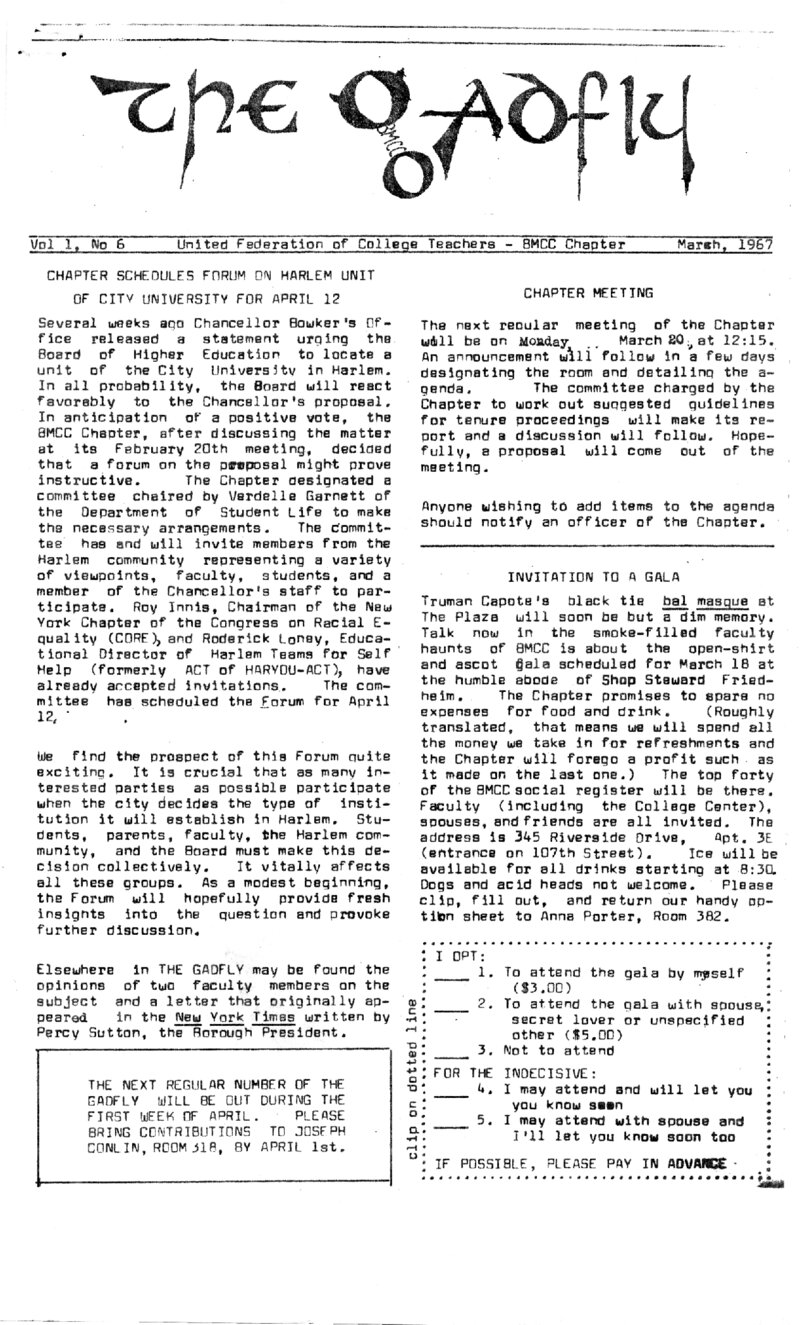
Vol 1, No 6
Z
OAoF
United Federation of College Teachers - SMCC Chapter
Mareh, 1967
CHAPTER SCHEDULES FORUM ON HARLEM UNIT
OF CITY UNIVERSITY FOR APRIL 12
Several weeks ago Chancellor Bowker's Of-
fice released a statement urging the
Board of Higher Education to locate a
unit of the City University in Harlem.
In all probability, the Board will react
favorably to the Chancellor's proposal.
In anticipation of a positive vote, the
8MCC Chapter, after discussing the matter
at its February 20th meeting, deciced
that a forum on the peeposal might prove
instructive. The Chapter designated a
committee chaired by Vardelle Garnett of
the Department of Student Life to make
the necessary arrangements. The commit-
tee has and will invite members from the
Harlem community representing a variety
of viewpoints, faculty, students, and a
member of the Chancellor's staff to par-
ticipate. Roy Innis, Chairman of the New
York Chapter of the Congress on Racial E-
quality (CORE), and Roderick Loney, Educa-
tional Director of Harlem Teams for Self
Help (formerly ACT of HARYOU-ACT), have
already accepted invitations. The com
mittee has scheduled the Forum for April
12, ° .
we find the prospect of this Forum quite
exciting. It is crucial that as many in-
terested parties as possible participate
when the city decides the type of insti-
tution it will establish in Harlem. Stu-
dents, parents, faculty, the Harlem com-
munity, and the Soard must make this de-
cision collectively. It vitally affects
all these groups. As a modest beginning,
the Forum will hopefully provide fresh
insignts into the question and provoke
further discussion.
Elsewhere in THE GADFLY may be found the
opinions of twa faculty members on the
subject and a letter that originally ap-
peared in the New York Times written by
Percy Sutton, the Rorough President.
THE NEXT REGULAR NUMBER OF THE
GADFLY wWILL BE OUT DURING THE
FIRST WEEK OF APRIL. PLEASE
BRING CONTRIBUTIONS TO JOSEPH
CONLIN, ROOM 318, BY APRIL Ist.
clip on dotted line
CHAPTER MEETING
The next regular meeting of the Chapter
will be on Monday _. March 20, at 12:15.
An announcement will follow in a few days
designating the room and detailing the a-
genda. The committee charged by the
Chapter to work out suqgested quidelines
for tenure proceedings will make its re-
port and a discussion will follow. Hope-
fully, a proposal will come out of the
meeting.
Anyone wishing to add items to the agenda
should notify an officer of the Chapter.
INVITATION TO A GALA
black tie bal masque at
will soon be but a dim memory.
Talk now in the smoke-filled faculty
haunts of 8MCC is about the open-shirt
and ascot fjala scheduled for March 18 at
the humble abode of Shop Steward Fried-
Truman Capote 's
The Plaza
heim. The Chapter promises to spare no
expenses for food and drink. (Roughly
translated, that means we will spend all
the money we take in for refreshments and
the Chapter will forego a profit such. as
it made on the last one.) The top forty
of the 8MCC social register will be there.
Faculty (including the College Center),
spouses, endfriends are all invited. The
address is 345 Riverside Drive, Apt. 3E
(entrance on 107th Street). Ice will be
available for all drinks starting at 8:30,
Dogs and acid heads not welcome. Please
clip, fill out, and return our handy op-
tion sheet to Anna Porter, Room 382,
a? aon er enne eeaeee peee
My
Qo.
Us.
s+.
1. To attend the gala by mpself
($3.00)
2. To attend the gala with spouse:
secret lover or unspecified
other ($5.00)
3. Not to attend
FOR THE INDECISIVE:
4, I may attend and will let you
you know seen
5. I may attend with spouse and
T'll let you know soon too
é
°
.
.
.
sereenaeeee
re ee
: IF POSSIBLE, PLEASE PAY IN ADVANCE —
veeevcsccccees}
ed
SoCo R Dee SoH CREE eeses
re i ee) eee eersoes coe
2
BOI GO OUI IOI IIIS ICICI ISIOISICIOIIOOIFIOI ICIS IO IIE IOICIIIIO IGG IK
ST JOHN'S, MIDDLE STATES, AND THE UNION
In the lash number of THE GADFLY we predicted rather gloomily that by next December,
when the issue had faded almost entirely from public view, the Middle States Accrediting
Association would take an unrepentent St John's off probation and back into its good
&TaC&%>s. Happily, subsequent events have not fully borne out our apprehensions.
Mivadle States' public report on St John's, issued last December 1, was no more than a
clever piece of sophistry. The Asso¢iation argued that violationsof academic freedom
and due process were not sufficient grounds for revocation of accreditation. The MSA,
however, covered its tracks when it concluded in the face of what had gone before that
the summary dismissal of thirty-one faculty members was symptomatic of "institutional
weaknesses." Unfortunately, the Report never specified what these structural shortcom-
ings are.
The American Civil Liberties Union, in a letter released for public dissemination on
February 1, criticized the Middle States Association for failing to make the contin-
uation of the University's accreditation contingent upon due process for those dis-
missed and never elaborating what precisely was meant by "institutional weaknesses."
In a most welcome reply, the Association noted that it had instructed the University
in a letter dispatched shortly after it received the ACLU's inquiry that it would have
to resolve the dismissals in a satisfactory manner if the MSA was to lift the "show
cause" order and extend the school's accreditation.
On March 8, Father Cahill, President of St John's, announced that the University was
willing to submit the cases of the thirty-one Instryjctors to the American Arbitration
Association for "a final and bending decision."' Quite obviously, the move was in
response to the Middle States letter which implied that the University would lose its
accreditation should it fail to deal justly and equitably with those whom the trustees
had separated from the faculty.
The intriguing question now is what would have been the role of Middle States in this
whole nasty affair had not the United Federation of College Teachers and later the
ACLU invested hundreds of work hours and thousands of dollars toward keeping the
dismissals alive as a public and moral issue? If the MSA was consistent in its reason-
ing that flawed the December Report, it would not have pressed St John's on the dis-
missal. The record shows quite conclusively that it responded to pressure frm the
UFCT and the ACLU. Had the issue disappearedé from the public eye, we doubt that any
of the aggrieved would have gained satisfaction from the University.
Even if the union had never wrested a concession from the University, the time, money,
and energy it expended on the case would not have been wasted. When injustice is done,
someone must protest. Men in power must realize that if they do not behave responsibly,
others will rise to oppose them. If not, there will be many more St John's and men
of i11 will will continue with impunity to abuse their fellows.
LETTER FROM BERNARD MINTZ, VICE-CHANCELLOR FOR BUSINESS AFFAIRS
Dear Sir: I write in the spirit of your expressed statement (Gadfly Vol 1, No 5, p 3)
eh es "And we think it is a sign of strength, not weakness, when someone faces
up to‘énd learns from his mistakes."
The lead article in this same issue of your publication contains two mistakes as
follows:
1. In paragraph #6 you state that one would lose one's group life insurance
benefits if one left the group. This is incorrect since the program provides
that the member does have the privelege of converting to a personal
contract. White this is an error of fact, this same paragraph contains
an error of judgment based on a lack of knowledge of insurance rate
structures. Comparable rates could not be obtained outside the group.
2. In paragraph 3'. you make reference to the failure of my office to examine
and evaluate the supplemental program benefits of the Board of Education
and state, "Here is an alternative that was never considered." Your state-
ment is in error. The program benefits you call attention to were con-
sidered and upon evaluation, narticularly in reference to programs of-
fered in other universities in the nation, were given a lower priority
than those currently chosen.
(ED. NOTE: We would first point out that unless one transfers his insurance to a personal
contract at substantially higher rates, he will lose all benefits whenthe leaves the
groupe Second; whileChancellor Mintz may have considered the UFT's welfare plan as-an al-
ternative, the trustees and, much more important, the faculties they’ theoretically repre-
sent did’not. We. are bemised that Vice Chancellor Mintz did: not comment on the article's
main thrust,. namely, that elections for trustees were in. most, cases- undemocratic and con-
dicted with unseemly haste. . Nor did he answer to our. contentjion that the trustees were
yecnonsible to the Chancellor's Office and not to the faculties they purportedly represent,
3.
ROK OOOO OO IO IGRI IOI IOI II IIOI SI ICICI I I I ICICI AIG dC ACIS aC I I AK aR
*
SYMPOSIUM: A UNIVERSITY FOR HARLEM by Milton T Stubbs
Education has probably outgrown its traditional limits. It was bounded by classroom
procedure on one hand and by the textbook on the other. The demands of equal oppor-
tunity for all clearly places responsibility for a multi-faceted approach to the prob-
lems of our time within the aegis of education. As the self-determination of peoples
and of various population groups becomes more pressing, the demand for a facility to
achieve that staffs which gives power to its leaders and hope to its followers is in-
creasingly resurgent. The task of increasing community participation in decision-making
at all levels, as well: as ~ increasing efficiency in demonstrating to that citizenry
the means for understanding these processes falls clearly within the framework of
education today.
But the magic of Manhattan diminishes as well as enhances the capacity of education to
effect meaningful change. Manhattan hangs between East and West; it lies between the
successful urban culture and its demise. Manhattan inspires the poet to sing its
songs and the cocial commentator to decry its pathologies. It is that contrast which
lends an aura of defeat and fatalism to the uninspired streets of East Harlem as well
as the jittery dynamic to its One Hundred Twenty Fifth Street. And yet, it forms the
material fromwhich daily dreams are fashioned, dreams which may grow and flourish
in the arts or sciences ut which more often spring to life only to die in the echoes
of Harlem's darkened alleys. It becomes the newborn cry of an infant to an indifferent
world society, a society which creates conditions for the reliving of past antagonisms
by young people shuttered away from the world of inquiry and joy. Downtown, mighty
glass and steel bu@idings stand proudly on the lands of the once powerful baronial
families while uptown the Hamilton House crumbles on the edges of its now quartered and
sold plots.
There is no doubt that the glittering proliferation of the new in both architectural
and technological spheres has created in its wake vast pockets of drift. As rapid
growth becomes a staple of urban life, the glaring contrasts between affluence and
human want are more clearly outlined. Within walking distance of one of the nation's
most influential universities exists an area which provides grist for its intellectual
mills. But that university's remedies continue to be in terms of statistics, refined
literary productions, and brilliant lectures. The great lwing laboratory, however,
remains outside the walled sanctuary and makes little if any impact on these discussions.
It is this community, nevertheless, which attests to the failure of modern humanism
to address itself’ to problems which greatly affect the well-being of every citizen.
Rows of broken windows and blocks of empty shells that once rang with the laughter of
children seem to shudder beneath the weight of their burdens: the transient society,
the unenforced housing code, and all the other results of social decay. Occasionally
a cleared lot becomes the landscape for a new development but, again, that very contrast
becomes testimony to present-day inability to keep pace with or to understand the
results of the urbanization process.
As Education assumes a primary role on the search for meaningful resolutions of social
problems, the university becomes essential to the continuation of learning processes
on the basic levels. An institution which resembles the multiversity in its insistence
on the application of technologies to the problems of living and which insures continual
fesearch on the genesis of those problems may yet grow from the imagination of an
enlightened citizenry. A College Forum for the free and open expression of community
interest in its development and growth both in the urban planning phases and in the
commercial-economic phases would undoubtedly contribute much to the badly-needed
restructuring of blighted areas. It would offer hope to the disaffected and channel
the voices of protest toward constructuve madas.
The long list of successful persons associated with the Arts and Sciences .as well as
with other phases of American life attests to the power of the non-white to achieve in
other areas where the means for achievement were available. The Harlem Renabssance
of the thirties and its ramifications coud become the American Renaissance of the last
half of the twentieth century. The community is a vast laboratory for the development
of more productive teaching techniques for the integration of community resources
with an institution geared to educational research could provide an invaluable example
of a phenomenon fulfilling our committment to the pursuit of excellence in all educa-
tional spheres. Needless to say, Harlem represents to untold millions of Americans
the "Capital" of Negro culture. For a school to address itself exclusively to that
community would be a significant tribute to our committment.
The four-year school could work in liason with community colleges which would handle
terminal programs, insure job placement, and encourage the interest in diversified
studies for the Liberal Arts major, aiming towards the development of sound and respon-
sible keadership in the community.
A cultural center integrated into the college could house productions of opera, theater,
and music in much the same way that Lincoln Center provides those offerings for affluent
ie ee ee ee ee ee ee ee ee ee es
persons. The focus might well be on the experimental derivation of new themes and the
presentation of low-cost productions to area residents. The Schomburg Collection, now
housed in the Countee Cullen Branch of the New Work Public Library, an excellent assem-
blage of materials relating to Negro History, could be housed in the same location.
A facility for producing the stimulus for exhibiting athletic prowess as well as being
the location for important athletic meets would probably find ready acceptance by the
poeple of the community:
Perhaps the issue of racial imbalance need be mentioned here for it will undoubtedly
produce problema both for the affluent Negro who dees not feel in tune with the rank
and file and for the guilt or fear-ridden individual who does not understand the
exigencies involved in developing sommunity organization for the underpriveleged.
First, stellar upward growth of Southern Negro colleges attests to the fact that achive-
ment is not wholly predicated on a racially-integrated basis. Surely, the drive for
integration must continue as the move is made toward a less divided society. In the
meantime, progress can be made which acknowledges the primary fact of the cultural
wealth, however, undeveloped, that is available in the Harlem area. Secondly, the
vital integration could be achieved by the acceptance of non-Negro candidates on a
selective basis in much the same way that Howard University in Washington, D.C. has
become an integrated college.
New York City is at present a crucial and, in some ways, a model city. The people of
the world daily traverse the halls of the United Nations. Open trading that is crucial
to world economies takes place in our great banks. It is with a certain drama that
many dignitaries come to the United States by way of New York's harbors. The well-known
tour by foreign personages invariably includes the metropolis. It is probably only
rarely, and then upon request, that Harlem is included in the tour. If the avoidance
of that reality is emblematic of personal concern, then the development of an exemplary
and resourceful community could achieve a turning toward Harlem rather than a turning-
away from those realities.
Where the proposed M.I.T. project for the development of Welfare Island and the Harlem
River area purports to achieve a middle income community, a daring plan for the construc-
tion of an exciting architectural park, integrated with the existing or to-be-construc-
ted public housing projects would further exemplify American interest in environmental
beauty for all its people.
The perhaps too often repeated comment that the time for meaningful action on these
issues is becoming very limited probably need not be repeated again here. But, at_the
risk of extending that’ cliche, even a cawnal observatiom of current events in the Harlem
area reveals a pressing need for resolution of those.problems which previous generations
of Americans have been unable to resolve. The growing political activism and perhaps
the deepening alienation between those in the mainstream of twentieth-century American
life andthe inhbbitants of the ghetto are demonstrative of the great need for action.
Hopefully, a Metropolitan University may become the means for effecting community growth
aS well as providing an avenue for the demonstration of Harlem's vigor and its
inhabitants' unrelenting pursuit of opportunity.
SYMPOSIUM: A UNIVERSITY FOR HARLEM II by William Friedheim
The prospect of a unity of the City University located in Harlem is at once dismaying
and exciting. Harlem needs a college, not any college but one that would relate to the
community honestly and without condescension. What Harlem cries for is not an updated
version of the white man's burden but new and radical solutions to problems that have
plagued the American Negro for generations. A college governed by men who assume
that Harlem has bittle to offer, that its way of life is inferior and unworthy of pre-
servation and that its inhabitants must be made over in the image of the dominant
culture of thewhite middle classes, has no pbace above 12%! Street. If Harlem is to
have a college, it must be radical and experimental in its approach to both education
and the community. Anything less is hardly worth the &ffort.
A two-year liberal arts college would probably best serve Harlem's interests. It would,
hapefully, attract an integrated student body and, more important, provide a quality
education geared to the needs and problems unique to the community. Actually, inte-
gration is a secondary consideration. To date it has been a one-way street. The pre-
vailing concept of integration is to wrest Negroes from their "disadvantaged cultures"
(a term which smacks of the worst kind fo condescension) and acquaint them with the
values and ethics of their "cilturally advantaged" brothers. Negroes are integrating
into white society on white terms.
The tragedy of all this is that few Caucasians ever stray into Harlem. If integration
is to become a campkete process, whites must be shaken from their ethnocrentrism and
brought into touch with black society. A college in Harlem which attracts white stu-
dents coubd balance out the process of integration. A unit of the City University
SOK ROR OGIO ICAO IO IOI IE SICA I IOI TRIO IOI IOI IOI I a GO i a a a ok A i A i
SEO OKO OOOO RO ORR ROO IORI IIR OR IOI OI II II IC I AAC Cf ak
Will only drawn students from outside the community, however, if the curriculum it
offers and its faculty are notonly superior, but unique. If there is only one two year
college in the whole system specializing in the liberal arts, for example, it will
attract students from all parts of New York City. If, however, other institutions offer
similar programs, students will not journey to Harlem for their education. Since the
city lacks a community college devoted principally to the liberal arts, it would seem
opportune for the Board to locate such a unit in Harlem.
To be successful, the college must function as an integral part of Harlem. First, and
quite obviously, it must have an extended "discovery" program. Our secondary schools
have demoralized rather than educated vast numbers of students in Harlem and, for that
matter, the entire City of New York. Small classes and an intensive remedial program
could redeem the intellectual talents of these young men and women and qualify them for
admission into the college as fully matriculated students. Second, if the community
is to benefit by the presence of a unit of the City University, the college must address
itself to the everyday realities of Harlem; it dare not abstract thecommunity's problems.
Lectures on responsibility and platitudes about freedom and equality are meaningless
and evasive answers to the questions that press heaviest upon the community. Poverty
and powerlessness are endemic in much of Harlem. Courses on the sociology of poverty
and, even more important, the mechanics of power, are part of a tough, pragmatic cur-
riculum that is so essential if the college is ta come to grips with Harlem's problems.
How do the poor wrest concessions from the political establishment? How does power
work? These are questions tmat we cannot shy away from. If the school cannot help
its students improve the quality of their lives, if it cannot heighten their awareness
of self and community, it does not belong in Harlem. Courses in Negro and Puerto Rican
history must do more than catlogue the frustrafions of a race; they must add an
historical dimension and understanding to its place in contemporary society. Man isa
creature of experience. History has marked and scarred all of us.
Finally, the school must instill pride in the Harlem community. For example, the college
could train architects whe in turn might imagimatively renovate and preserve the in-
tegrity of the area's neighborhoods. Harlem deserves a better fate than to be bulldozed
out of existence.
Of course, if the school is to lure students from all over the city, it cannot exist
solely to "service" the Harlem community. Bold and experimental programs, however, in
addition to a full complement of courses in the liberal arts, will provide sufficiently
for an integrated student body. Students will travel to Harlem or any other part of the
city for a quality education. In closing I must admit that as a non-resident I am not
thoroughly conversant with Harlem's problems. Given the htmitations of my knowledge
of the community's needs, however, I believe that my proposals are valid.
SYMPOSIUM ‘A. UNIVERSITY FOR HARLEM III
(The following is the text of a letter on the subject written
to the New York Times recently by Percy E Sutton, President
of the Borough of Manhattan, February 6, 1967.)
I wish to raise objections to the thinking contained in the letter from Lois M Snook
published Feb 1, wherein there are delineated proposals for the establishment, in Harlem.
of a commujity college, or a four-year unit for students interested in careers in
health, education, or welfare. The letter describes these proposals as "'creative and
heartening."
I demur to the proposal for a nonspecialized two-year community college in Harlem.
I would favor locating in Harlem the highly specialized Baruch School of Business Ad-
ministration of the City College. This would be "creative and heartening."
There is reason and suvport for my view. Of recent years there has been an increasing
tenbdncy for students of our city to avoid those nonspecialized schools and colleges
located in areas of de facto segregation. This avoidance by all except those who live
in the segregated areas in time results in a restricted, segregated sfudent body com-
posed, in the main, of residents of the ghettos. Too soon there, ter follow institu-
tionalized segregation and inferior staffing and facilties.
A by-product of the nonspecialized and eventually segregated educational institution is
absence of opportunity for students of the ghetto to relate to the outside world in
which they must one day work and live.
Akso, such spégkaatzed facilities would give its polyglot students close contact, perhaps
for the first time, with the minority groups which make up more than one of eight of
our city's population and tend to elevate the nature of the community. Not to be lost
sight of in site location is the positvé need to encourage the outside world to enter
SOO OR GOO IOI IGG ISI ICICI I IG ICICI A I a i Keo
. 6
the heretofore "special world" of the ghetto. A two-year non-speaciabized community
college would not offer this encouragement. A specialized Baruch School would.
Academic integration is a necessity to New York. I do not believe that New York can
achieve its full potential for greatness so long as there exist within its boundaries
ghetto areas virtually unknown to the majority population. Twe such areas in Manhattan
are Harlem and the Lewer East Side. Each is like an eddy in the mainstream of New
York. Yet there is every reason to bdlieve that both communities can, with proper
attention, become vibrant factors on the metropolitan scene. A manner of advancement
toward this goal is by a more realistic consideration of the urban realities as they
exist today, and the abaridonment of old concepts and the adoption of new and creative
approaches. Construction of highly specialized institutions in ghetto areas is crea-
tive. Accordingly, I have suggested that the highly specialized Police Academy of
Science, which will offer courses at the college level, be located on the Lower East
Side, and that the Baruch School of Business Administration be located in Harlem.
Such advantages flowing from these specialized institutions are fundamental to the
progress of the great cities of aur nation. I believe they can be achieved if we will
climb out of the tut and address ourselves to the problems of 1967. I have called
these views to the attention of the Board of Higher Education and I believe that its
members will give serious consideration to the proposal.
COLLEGE DISCOVERY PROGRAM by Verdelle Garnett
Many of you have expressed an interest in learning just what the College Discovery
Program is all about. Surprisingly few of the faculty have a clear picture of the
goals and rationale of this experimental program. I welcome this opportunity, therefore,
to inform you of how this imaginative program seeks to meet the needs of a highly
select student popukation.
The purpose of the College Discovery Program is to provide the opportunity to earn a
bacculaureate degree to youngsters whose chances of being admitted to college are
hampered by earlier lack of opportunity. Because of the experimental nature of the
program, selection criteria are somewhat more complex, and in some aspects, more flex-
ible than those used in selecting students as regular matriculants.
Students participating in the College Discovery Program were selected on the basis of
academic qualifications, sncio-ecohnomic data, and the recommendations of high school
teachers and principals. The academfic criteria were the number of credits the student
was expected to complete by graduation in mathematics, science, and language, Students
peesentingtféwer than twelve units of academic work in high school were excluded on the
grounds that making up such a great deficiency is extremely difficult within the scope
of the College Discovery Program. Socio-economic criteria included financial depriva-
tiom, low education of parents, broken home, ethnic background, etc. These data were
then cross-tabulated, modified, and a random selection of students made. Any student
accepted for or eligible for matriculation as a regular student in any branch of the
City University System was elminated as not needing the special services of the
Program.
An analysis of current class rankings reveals that 34% of the currently enrolled
College Discovery students attained a grade index of 2.00 or better. A breakdown by
class reveals that 39% of the 1965 group and 31% of the 1966 group attained the 2.00
level. All things considered, this is a respectable achievement.
For the second consecutive year, several of our students have been chosen to participate
on the Panel of Americans, Inc., a volunteer human relatkons discussion group. Upon
referral by the Board of Education, May@r's Commission on Human Rights, major parents
of civic organizations, the students appear as speakers before groups of teenagers in
areas of racial or religious tension.
One young man has been working very hard to reduce anti-social activities in his
neighborhood in East New York. He and some of his neighborhood group have been invited
t 1
© appear before a Senate panely members
Phi Beta Delta, a ~ BMCC sorority, many of whage*‘are College Discovery girls, has a
project designed to help a local charity. Phi Zeta Kappa, a BMCC fraternity approxi-
mately half of whom are in the program, has tentative plans to adopt a Vietnamese
orphan.
I hepe, from time te time, to share with you additional interesting information about
this dynamic program.
FERRO RO ROR ORR IO OIRO IO RGR IOI OIG ORIG IOI IR OK Ig Ok ROI AR aR
. d
x FORO OOO ORO OOK OO IGOR IR IG RO AGA Ok AC ak kk
FILMS
DUTCHMAN by Leonard Quart
In the dimly lit, poorly venilated, almost surreal atmosphere of an empty subway car,
Lula, a yellow-haired, white temptress, takes a bite out of her apple (Eve?) and slinks
toward Clay, a solitary, respectable-looking, young Negro. The scene begins Leroi
Hones' mordant allegory evoking the twisted and mutually annihilating relationships
between whites and Negwoes in America. Lula toys with the seemingly ingenuous and
hesitant Clay, enticing him sexually and using him as a foil for her slow, ritualized
dance. She taunts him about his masculinity and his being a black bourgeois and at-
temmpts to denude him of his respectability. Lula demands that Clay live up to her
fantasies about Negroes as she undulates her body to enact her conception of negritude.
The embarrassed Clay endures her presumptious role-phgying with increasing hostility
until he cannot repress his anger. It bursts loose in a monologue permeated with
Negro vernacular; Clay lashes out at white society and Lula and speaks of the repressed
desire hidden in every Negro to murder all whites and destroy western culture. The
movie ends apocalyptically with Lula's murder of Clay, a concrete metaphor for the
emasculation and destruction of the Negro male bn out society.
Dutchman is basically a filmed stage play, padded with a number of cinematic shots of
trains leaving and entering empty subway stations. The film is static and circumscribed,
dependent ondialogue and performance rather than the dynamic eye of the camera.
However, the performances by Shirley Knight and Al Freeman Jr are powerful and intelli-
gent, caphuring the dissonant rhythms of Negro slang and the crude, uneven poetry and
passion of the dialogue and rhetoric. The film develops slowly, moving from light
repartee to the apocalypse and though one questions Jones' premises and logic, one
cannot elude the unease and apprehension that his rhetoric elicits. Jones' fantasies
are didactic nightmares, enveloped in blood and hate and, while absurd and awkward
intellectually, they are touched with a truth which transcends subtlety and reason.
REPORT ON OUMMUNITY COLLEGE ADMINISTRATORS' CONFERENCE by Joseph Conlin
When THE GADFLY bussed up to the Comm@nity College Administrators' Conference (CCAC)
at Albany last week, we expected a typically dull convention weekend. The printed
program listed the usual fare: Assistant Chancellor O'Brien speaking on his best
irrelevant policies and seemingly interminable workshops and seminars on such topics
as secretarial intimidation and deception without pain.
What a surprise to discover that the program was a front for the digestion of the
press, that the Conference was in reality a quasi-religious exercise. The first tip-eff
should have been the program notation that "no non-administrative personaél will be
admitted" but we thought nothing of that. We had our first apprehensions only when
we were confronted with the tight security at the entrance to the Arthur Whitmore
Auditorium near the Capitol. A portly business manager from East River Community
College nudged us as we approached the four Gurkh&* ‘ge guards at the door: "more likely
a Jew doin' the sights in Mecca than one of them inwuacre, eh?" Realizing that "them"
meant "us,'' we passed for administrative by assuming our most pompous expression and
conspicuously condescended to everyone within sight of the guards.
The floor was like no convention we have ever seen. In place of folding chairs from
the undertaker were office swivel chairs, each behind a walnut desk topped by family
picture, "in-out" trays, Statue of Liberty paperweights, and various papers and note~
books. Knowing that BMCC's Dean Bloom was ill with virus, we found his nameplate and
sat down silently. The platform (or, should we say, altar) was comprised of three
filing cabinets pushed together. Behind it stood a short, gray man of about forty-
five, respBendent in scarlet velveteen business suit. "Isn't the Cotrdinator-Celebrant
just ideal," a fiftyish Dean of Student Life from upstate whispered.
When all were seated, the C-C began to speak in a monotone perfected from years of
PA work. "To: Administrators-Assembled; From: Cotrdinator-Celebrant; Subject: Rite."
After a pause, he continued, "The rite for today is that prescribed for the second
Wednesday after midterm. The agenda will include hymn, litany, and the ravishment
of a freshman from Oneida County. The hymn is ta kenfrom the by-laws dealing with
the use of telephones for personal calls."
It was hardly a hymn, closer to a hypnotic chant by the C-C with the congregation
joining in only to the extent of humming. The Celebrant held a volume of the by-laws
in outstretched arms and swung the book slowly back and forth. Nonchalantly at first,
but then frenetically, the congregation weaved in unison, following his motions,
their eyes half-closed, lips flecked with tin y white bubbles of saliva. Here and
there a Dean of Women bolted upright, moanmng, "CUNY, SUNY," and collapsed in the
aisle where, like a beefeater at a coronation, she lay unattended.
SOR ORR OOO ISO GI IOI IO III II III OIG TI II IIR ICICI ICI AR KH a i a ot
. a
oO
ee ee ee ee ee a
Eventually --it seemed an eternity-- the C-C ended the hymn by placing the by-laws in
his "out" tray. The congregation hushed almost immediately, so exhausted were they,
and two Assistant Celebrants joined the Chief at the altar.
lst Cel: In the beginning was a great void until into that void came The Administrator]
2nd Cel: Administrator of Administrator, Director of Directors
3rd Cel: Dean of Deans, Business Manager of Business Managers.
lst Cel: Yea, and C hancellor of Chancellors, Cotrdinator of Colrdinators, President
of Presidents. Yea, all this and more for he had many Assistants.
2nd Cel: And the Assistants had Assistants
3rd Cel: And they Adjuncts
lst Cel: Yea, and they begat others of all ranks and positions on the Great Organizational
Chart, both Temporary and Permanent, Interim and Intermediary. And the
Administrator of Administrators saw that it was good and distributed long
titles to all. And the titles were frequently changed so that faculty and
studentry might stand in proper awe of the Great Mystery.
2nd Cel: And each title more imposing than the last.
3rd Cel: While function stood dubious and unaltered
2nd Cel: And the changes were frequent
3rd Cel: And with the changes raises
lst Cel: Yea, and so has it always been done
Congregation: Hallelujah, all hallelujah CUNY and SUNY
lst Cel: And so there was education
2nd Cel: And the servicing of the disadvantaged
3rd Cel: For the administrators created faculty and studentry
ist Cel: Yea, and what they giveth they may taketh away for without them there is naught
2nd Cel: Neither education
3rd Cel: Nor Servicing
2nd Cel: Nor concepts
3rd Cel: Nor contingencies
ist Cel: Yea, let faculty and studentry do due homage and in return have succor. Yea,
and Lesser Administrators too for remember that thou art clerk and to clerk
thou canst return
2nd and 3rd Cels: For the policies shall pour forth fromabove as if from a cornucopia
and all heads shouldst spin in the deluge
Congregation: CUNY and SUNY, SUNY and CUNY
So it went on for hours. We have recorded only that which we can remember precisely.
At the finish, the CoJrdinator-Celebrant broke the cadence (and, apparently, the spell)
by breaking into a football sort of cheer; "Get out there and administer; get out there
and Service those disadvantaged devils; get out there and pummel them teachers!# Ten or
so were so taken up in the grotesque ritual that they took the charge literally and tore
screaming from their seats and down the aisle. Having no stomach for the ravishing that
was to follow, we joined them, earning inconspicuousness by crossing our eyes and moaning,
“CUNY, CUNY, SUNY, SUNY' until we were safely on our Greyhound, in no condition but to
leave the driving to them.
—eeeeeeeSSSSSSSeSSSseS
IN MEMORIAM
THE GADFLY marks with sorrow the untimely passing of two respected members
of the faculty and the UFCT, Dr Arnold Wells of Data Processing and Mrs
Sheila Hollingsworth of the English Department. Both were pronounced dead
on arrival at the Polyclinic Hospital last Friday following their tragic
accident on the third fboor, The two close friends were familiar compant n
at BMCC. They were a quaint sight as they left the college together on h en
afternoon holding hands as if they were Sophomores, °
“That, in fact," mused a grief—stricken Dean Larsen Bloom, "was the cause
of their accident." What Dr Bloom meant was that since the beginnin £
the present semester, Mrs Hollingsworth, like Dr Wells, was on a tenure-
generating line. "There were so many ‘ifs™ involved Dean Bloom continued
the small puddle near the elevator, a by-product of the vain, int hich ,
the couple carelessly walked, immediately electrocuting themselves. “The
again, it was only this semester that Mrs Hollingsworth was put on a tenure
.
* PEK K KEK KK KIKI HK KKK RIK KKK KK IKK KKK AKER ERK KKK KEK EK ERRER KER RE EK EK EKER ERK ERR EEK ERERK EEK EK
generating line.
If she hadn''t been generating tenure too, Dr Wells
would have harmlessly grounded out.
Finally, if it had been but two
hours later, Dr Wells would not have been generating tenure because
"
of his religion.
(Dr Wells is an observant member of a strict religious'
faith which forbids tenure generation on weekends.}
Unfortunately, as American Management Association electrician, Steven
"Steve" Harkins explained it, the combination of water (an exéé@éént
conductor of tenure) and the physical contact between the two faculty
members, resulted in a short of over 16,000 tenurevolts, "enough to
kill a Dean."
died on the way to the hospital.
Despite the efficiency of the city ambulance crew, both
"We take a lot of precautions because
of all the tenure being generated around here," Harkins explained,
"but these flukes will always fool ya."
BMCC and the UFCT will both sorely miss these able colleagues.
them farewell and the families of both express their appreciation for
the thoughtful remembrances which faculty and administration have sent.
It goes without saying that this must not happen again.
We bid'
Would it be too
much for the college to spend a few dollars on rubber hall mats in view
of the consequences at stake?
*
FRO ORO OOO III AO I A A aI oC ake ok
*
LUNCHING OUT?
. WITH THE GADFLY'S DINING EDITO.
Rann
eS ae
eH EK
ROO ORO OH OO GIG IO A A a a Ok ak aca ak ok
HERO CITY ****
JACK-MO DELI ***
More and more faculty gourmets are unwinding
after a rigorous morning schedule over an
extended, Mediterranean-style lunch at HERO
CITY on Seventh Avenue at 50th Street. They
have a good thing going. While not yet lis-
ted among New York's le plus chic dining sa-
lons (CITY is only a year old), the easy-
paced atmosphere in the comfortable Michael-
angelo Room is calculated to relieve a try-
ing day. One feels right at home. Well-
mannered and groomed BMCC students speak
quietly of their studies and aspirations and
the faculty diner can have his privacy at no
extra charge on the Leonardo DaVinci Mezza-
nine (entrance at the rear).
The decor is in the good taste typical of
Italian Restaurants both in the dining area
and at the friendly bar which is enlivened
by colorful LP Record jackets. Drinks are
moderately priced and exciting; you'll want
to try the Rheingold on draft before lunch.
The menu is traditional and served cafeteria
style. Pasta lovers speak reverently of
ERO CITY's spaghetti; traditionalists buy
hree hundred salami and cheese heroes every
day. You may wish to sample the steak and
onion sandwich or the meatball hero (each a-
about one dollar). We selected the sausage
with pepper hero ($.85) with sauce, added a
few hot cherry peppers and a pickle from the
relish counter, and a pop-top can of Diet
Pepsi, (Parmesan cheese, salt, pepper, and
sugar are provided at each table, day and
evening. ) It was excellent. The peppers
sparked the pungence of the sausage and the
icy Pepsi provided a titillating thrill af-
km
‘ter, each mouthful.
The combination is high-
ly recommendedas is the Eggplant Parmagiana,
the best west of Napoli in this writer's es-
timation.
HERO CITY's lavatories are inconveniently
located if you decide on the Michaelangelo
Room but it's a minor failure and HERO CITY
deserves this month's GADFLY's four star ra-
ting.
eee eee ee eee es
On a pleasant spring noon you'll want to
leave BMCC by the 50th Street entrance, cut
directly through the Meyers Brothers' Park-~
ing Garage to 49th, cross the street and
stop in at inauspicious little JACK-MO DELI.
Unpretentiously fronted as it may be, there
is nothing retiring about the quality of the
cuisine served up by the two owners and as—
sisted by the comely cashier and drink girl,
Stella.
Daily Specials draw the economy lunchers but,
in fact, there's not an expensive item on
the JACK-MOE menu which is quaintly lettered
on the wall behind JACK-MO's authentic
stainless-steel and glass cold table. You
may select a ham and cheese on roll for less
than a dollar or perhaps your taste runs to
hot pastrami or tongue. Side_orders of po-
tato salad or colé slaw will satisfy the
most voracious eater. The rear wall of the
intimate room is dominated by a glass fron-
ted refrigerator where diners select their
own drink from a comprehensive collection of
fine carton milks (in pints and half-pints),
sodas in any flavor you can name, all varie-
ties of beer including the esoteric foreign
brands, and Yoo-Hoo Chocolate Drink.
You may dine in or "take out" at JACK-MO. We
suggest that you plan on a full-course lunch
some day. Sit at the atmospheric formica
tables opposite the sandwich counter and en-
joy Jack's and Mo's clever banter, a shout-
ing routine they've been doing for over
thirty years which fills the DELI with a de-
lightful dim, Join in the fun by ordering a
sandwich yith "mayonnSise from Mo and then
changing your mind to mustard. Mo will give
FOC C OOOO GOROG nok ear TDs Jeo money" Sx worth: 08 dibeceecccrr ee
10
«
«
SRO ROR OOOO OOO IORI III IO IOI ISIC ICICI IIR IIIA AER II IAC aR CI RO
THE "PLAYBOW:!!' AMERICAN STYLE
By William Friedheim
I am always a little wary when someone tells me that they read Playboy because it's
“intellectually stimulating." No matter how hard I try, I canne*.conceive of anyone
pouring assiduously over the magazine's copy, whining ecstatically as they sample the
profundities of what Hugh Hefner, the monthly's editor, has modestly labeled the "Playboy
Philosophy." (Nor, must I admit, can I really understand why some men of letters have
labored at such great length in scholarly articles to refute Hefner. Certainly, there
are more sophisticated and substantial defenses of sexual freedom than the sophomoric
writings of Mr. Hefner. Yet, many, who should know better, cannot dismiss his pieces
lightly.) As an occasional reader of P ayboy, I must admit that I am not overawed by
its intellectual content. I find the'pictoral essays," as the editors call them, a good
deal more palatable than some of the Playboy prose. And I suspect, despite protests to
the contrary, that others look at rather than read Playboy.
Playboy, T am afraid, if it is to fall under the scrutiny of academicians, should arouse
bee penate of the sociologist, not the philosopher. Its pages reflect and tell us
much about prevailing American values. Beneath its panoply of busty women and bawdy
cartoons are precisely the same social attitudes and postures that decorate the pages of
Good Housekeeping, Redbook and Better Homes. And like many of the slick woman's magazines,
Playboy ‘seeks to package the American dream for mass consumption. Its thrust is utopian
and its utopia uniquely American.
Playboy"serves a consumers society. Its pages literally bulge with advertising. The maga-
zine markets not only clothes and cars and stereo equipment, but attitudes, advise, ideas,
intellectuals, ethics, ettiquette, ideal playmates and even correct positions for sexual
intercourse. Status, of course, is a natural by-product of all these items.
Playboy's vision of a consumer's paradise cuts across and even obliterates class lines.
America really does not have classes. Status rather than class stratifies our society.
And consumer products play a vital role in structuring status stratification. Material
goods are the trappings of status; they are symbols manipulated by Madison Avenue.
you smoke Marlboro's, you are a real man; if you drive a Mustang, you are a swinger.
you surround your person with enough consumer items, you can make of yourself whatever
you want. By some strange osmosis, these products transfer prestige, sex appeal, success,
youth, social acceptability (usually in the form of sweet breath) and a whole spate of
other qualities to the lucky purchaser. Obviously not all Americans are comfortable in
this world of symbols, nor have they been completely conditioned by American advertising..
Playboy however not only parrots the Madison Avenue ethic, it pushes it to its logical
It views people as well as consum r products as symbols.
If
If
absurdity.
The Playmate or the bunny is not a woman; she’ is an object. She is just as essential
to the aspiring playboy as a sports car or the well stocked liquor cabinet. ‘Those
well endowed young ladies who pose in the "altogether" (Playboy's cute euphemism for
nude) are suppose to appeal to neither the aesthetic or "the dirty old man" in the
magazine's readers. Rather they arouse one's property instincts. Mr. Hefner and his
editors clothe their women only with symbolic garments. For example, we might be told
that Bunny Jane (42-18-37) is a serious student of existentialism and plans to study at
the Sorbonne Above this caption sits a lass of amazon dimensions, nude except for a
volume of Sartre seductively positioned to cover the "42" of her ill-proportioned torso.
A second caption qu%tes Jane as saying something like 'I find boys who are not familiar
with the great books so terribly dull." Sartre and the canned quote establish Jane's
scholarly credentials. She is obviously ready made for the intellectual playboy.
Playmate Samantha who spends most of her waking hours either racing her Honda 500 or
surf boarding is tailored for the hipster playboy. The magazine retails playmates for
every variety of playboy. Such are the benefits of our pluralistic society.
Much like the magazine's elaborate "pictoral essays," the Playboy philosophy portrays
men and women as things and not human beings. Publisher Hefner is constatnly knocking
down straw men. His points of departure are categories and not people. He labels
everyone and everything. His "philosophy" is top heavy, to mention but a few categories,
with "puritans" and "victorians, (bad guys), and"humanists " and "libertarians" (good
guys). Of course he consigns all prudes to either the puritan or victorian bin. By
wresting them out of historical context and only exminingat face value their public
pronouncements on sex, Hefner seriously distorts both the Puritans and the Victorians.
But then Mr. Hefner deals with ideas as one would a marketable commodity. He's a
merchant, not an intellectual and he is selling his particular style of sex.
editorial offices, he has hundreds of quotations, probably gleaned from the index of
the "Great Books," filed according to these spurious categories. They are already
prefabricated for assembly into the Playboy philosophy. Philosophy, like Bunny Jane,
In his
11
ORI II II SIOI I IIGI IIIS IGOR III I IDI OIG GIORGI IIIS ISIC IGIG I ICICI IGA ACO
is but one of the many assessories necessary for the complete Playboy.
Playboy publishes some of the worst stories and most mediocre essays of some of the
country's best writers. The editors evidently judge manuscripts not on the basis of
content, but rather the name of the author. For handsome fees, gifted men of letters
have warmed over old articles for presentation in Playboy. The magazine is not in the
business of discovering talent or providing a forum for new and seminal ideas, but
rather showing off,at their most conventional,authors who have already been annointed
by success. Mr. Hefner will publish controversy, but only after others have chewed on
and pre-digested it for the readers of Playboy. The Playboy, Hugh Hefner style, is
not interested in the substance of knowledge, but rather its superficial frosting.
The trouble with American playboys is that they have to work so strenuously at their
avocation. Hugh Hefner, closetted in his Chicago mansion, reportedly labors ten to
fourteen hours a day editing his magazine and managing his business affairs. By any
but American standards, he is not a playboy. Like most Americans, he feels compelled
to work. The Rockefellers and the Kennedys, to mention but two of our wealthier families,
do not idle their time away at leisure. They are all gainfully employed. So is Hefner.
His business is leisure. In essense he has extended the Protestant Ethic to leisure
time pursuits. Protestants, from Martin Luther to the New England Puritans considered
hard work and success at one's calling as signs that one would achieve salvation and
find happiness in life after death. The enlightenment changed all that, and Hugh Hefner
is just as much a son of the enlightenment as,for example, Ben Franklin was. Only
he has done venerable Ben onebetter. Franklin symbolized the secularizatien of the
Protestant Ethic in that he turned work into a virtue and concluded that left to his
own labor, man could find happiness in this life and create heaven on earth. Hefner
is just as dedicated to building a heavenly city, whether it be in Chicago or Philadelphia,
as Franklin was. Only Hefner seeks to turn the world into one vast den of leisure, a
super Playboy Club as it were. The irony of it all is that Hefner must take such great
pains and effort to simulate leisure.
Love comes no easier to the playboy than does leisure. Hefner preaches that love must
spring free and natural from the hearts and genitals of mature men and women. Yet,
espite his pronouncements to the contrary, love to Mr. Hefner is no more than sex and
sex in turn merely a matter of technique. The "Playboy Advisor" provides handy tips on
the art of courting from the selection of the proper vintage wine at dinner to fore-
play before sexual intercourse. The Playboy is obviously as inhibited at love as he is
at most any other endeavor. Doubt lingers in his mind as he wonders if his pin-striped
double breasted suit is properly stylish, his taste in wine and food impeccably correct
and his bedside manner up to snuff. He is always plagued by the question, "Am I doing
it right?" or "What would Hef’ think?" There is little that is natural or instinctive
about the playboy. His world is one of aritifacts and not people. And he has dehumanized
the American woman by turning her into just another furnishing essential for the Play-
boy"pad."'
The leading woman's magazines view the American female in precisely the same terms that
Playboy does. The women in these Journals are no less stereotyped or unreal than the
bunnies in Playboy. Good Housekeeping markets its type of woman as does Mr. Hefner his.
Behind all of this lies the assumption that man can make anything he wishes of woman
or for that matter himself and his world.
Hefner believes that life is a game that one plays at. Like so many Americans, he is a
consummate player of roles. If one masters the preper techniques and purchases the
necessary appurtenances, he can strike any pose from businessman to intellectual to
playboy. Two hundred years ago, Ben Franklin , with great gusto, played at all these
roles. He believed that if man put his reason to work, he could accomplish anything.
But at the same time,troubled by his very success, he poked fun at his monumental vanity
and often parodied his achievements. No such sense of humor redeems his modern day
counterpart. With an optimism and naivite more characteristic of Franklin's age than
his own, Hefner searches for the good life, seemingly unaware that he has chosen to move
in a universe of objects and not human beings.
Z
OAoF
United Federation of College Teachers - SMCC Chapter
Mareh, 1967
CHAPTER SCHEDULES FORUM ON HARLEM UNIT
OF CITY UNIVERSITY FOR APRIL 12
Several weeks ago Chancellor Bowker's Of-
fice released a statement urging the
Board of Higher Education to locate a
unit of the City University in Harlem.
In all probability, the Board will react
favorably to the Chancellor's proposal.
In anticipation of a positive vote, the
8MCC Chapter, after discussing the matter
at its February 20th meeting, deciced
that a forum on the peeposal might prove
instructive. The Chapter designated a
committee chaired by Vardelle Garnett of
the Department of Student Life to make
the necessary arrangements. The commit-
tee has and will invite members from the
Harlem community representing a variety
of viewpoints, faculty, students, and a
member of the Chancellor's staff to par-
ticipate. Roy Innis, Chairman of the New
York Chapter of the Congress on Racial E-
quality (CORE), and Roderick Loney, Educa-
tional Director of Harlem Teams for Self
Help (formerly ACT of HARYOU-ACT), have
already accepted invitations. The com
mittee has scheduled the Forum for April
12, ° .
we find the prospect of this Forum quite
exciting. It is crucial that as many in-
terested parties as possible participate
when the city decides the type of insti-
tution it will establish in Harlem. Stu-
dents, parents, faculty, the Harlem com-
munity, and the Soard must make this de-
cision collectively. It vitally affects
all these groups. As a modest beginning,
the Forum will hopefully provide fresh
insignts into the question and provoke
further discussion.
Elsewhere in THE GADFLY may be found the
opinions of twa faculty members on the
subject and a letter that originally ap-
peared in the New York Times written by
Percy Sutton, the Rorough President.
THE NEXT REGULAR NUMBER OF THE
GADFLY wWILL BE OUT DURING THE
FIRST WEEK OF APRIL. PLEASE
BRING CONTRIBUTIONS TO JOSEPH
CONLIN, ROOM 318, BY APRIL Ist.
clip on dotted line
CHAPTER MEETING
The next regular meeting of the Chapter
will be on Monday _. March 20, at 12:15.
An announcement will follow in a few days
designating the room and detailing the a-
genda. The committee charged by the
Chapter to work out suqgested quidelines
for tenure proceedings will make its re-
port and a discussion will follow. Hope-
fully, a proposal will come out of the
meeting.
Anyone wishing to add items to the agenda
should notify an officer of the Chapter.
INVITATION TO A GALA
black tie bal masque at
will soon be but a dim memory.
Talk now in the smoke-filled faculty
haunts of 8MCC is about the open-shirt
and ascot fjala scheduled for March 18 at
the humble abode of Shop Steward Fried-
Truman Capote 's
The Plaza
heim. The Chapter promises to spare no
expenses for food and drink. (Roughly
translated, that means we will spend all
the money we take in for refreshments and
the Chapter will forego a profit such. as
it made on the last one.) The top forty
of the 8MCC social register will be there.
Faculty (including the College Center),
spouses, endfriends are all invited. The
address is 345 Riverside Drive, Apt. 3E
(entrance on 107th Street). Ice will be
available for all drinks starting at 8:30,
Dogs and acid heads not welcome. Please
clip, fill out, and return our handy op-
tion sheet to Anna Porter, Room 382,
a? aon er enne eeaeee peee
My
Qo.
Us.
s+.
1. To attend the gala by mpself
($3.00)
2. To attend the gala with spouse:
secret lover or unspecified
other ($5.00)
3. Not to attend
FOR THE INDECISIVE:
4, I may attend and will let you
you know seen
5. I may attend with spouse and
T'll let you know soon too
é
°
.
.
.
sereenaeeee
re ee
: IF POSSIBLE, PLEASE PAY IN ADVANCE —
veeevcsccccees}
ed
SoCo R Dee SoH CREE eeses
re i ee) eee eersoes coe
2
BOI GO OUI IOI IIIS ICICI ISIOISICIOIIOOIFIOI ICIS IO IIE IOICIIIIO IGG IK
ST JOHN'S, MIDDLE STATES, AND THE UNION
In the lash number of THE GADFLY we predicted rather gloomily that by next December,
when the issue had faded almost entirely from public view, the Middle States Accrediting
Association would take an unrepentent St John's off probation and back into its good
&TaC&%>s. Happily, subsequent events have not fully borne out our apprehensions.
Mivadle States' public report on St John's, issued last December 1, was no more than a
clever piece of sophistry. The Asso¢iation argued that violationsof academic freedom
and due process were not sufficient grounds for revocation of accreditation. The MSA,
however, covered its tracks when it concluded in the face of what had gone before that
the summary dismissal of thirty-one faculty members was symptomatic of "institutional
weaknesses." Unfortunately, the Report never specified what these structural shortcom-
ings are.
The American Civil Liberties Union, in a letter released for public dissemination on
February 1, criticized the Middle States Association for failing to make the contin-
uation of the University's accreditation contingent upon due process for those dis-
missed and never elaborating what precisely was meant by "institutional weaknesses."
In a most welcome reply, the Association noted that it had instructed the University
in a letter dispatched shortly after it received the ACLU's inquiry that it would have
to resolve the dismissals in a satisfactory manner if the MSA was to lift the "show
cause" order and extend the school's accreditation.
On March 8, Father Cahill, President of St John's, announced that the University was
willing to submit the cases of the thirty-one Instryjctors to the American Arbitration
Association for "a final and bending decision."' Quite obviously, the move was in
response to the Middle States letter which implied that the University would lose its
accreditation should it fail to deal justly and equitably with those whom the trustees
had separated from the faculty.
The intriguing question now is what would have been the role of Middle States in this
whole nasty affair had not the United Federation of College Teachers and later the
ACLU invested hundreds of work hours and thousands of dollars toward keeping the
dismissals alive as a public and moral issue? If the MSA was consistent in its reason-
ing that flawed the December Report, it would not have pressed St John's on the dis-
missal. The record shows quite conclusively that it responded to pressure frm the
UFCT and the ACLU. Had the issue disappearedé from the public eye, we doubt that any
of the aggrieved would have gained satisfaction from the University.
Even if the union had never wrested a concession from the University, the time, money,
and energy it expended on the case would not have been wasted. When injustice is done,
someone must protest. Men in power must realize that if they do not behave responsibly,
others will rise to oppose them. If not, there will be many more St John's and men
of i11 will will continue with impunity to abuse their fellows.
LETTER FROM BERNARD MINTZ, VICE-CHANCELLOR FOR BUSINESS AFFAIRS
Dear Sir: I write in the spirit of your expressed statement (Gadfly Vol 1, No 5, p 3)
eh es "And we think it is a sign of strength, not weakness, when someone faces
up to‘énd learns from his mistakes."
The lead article in this same issue of your publication contains two mistakes as
follows:
1. In paragraph #6 you state that one would lose one's group life insurance
benefits if one left the group. This is incorrect since the program provides
that the member does have the privelege of converting to a personal
contract. White this is an error of fact, this same paragraph contains
an error of judgment based on a lack of knowledge of insurance rate
structures. Comparable rates could not be obtained outside the group.
2. In paragraph 3'. you make reference to the failure of my office to examine
and evaluate the supplemental program benefits of the Board of Education
and state, "Here is an alternative that was never considered." Your state-
ment is in error. The program benefits you call attention to were con-
sidered and upon evaluation, narticularly in reference to programs of-
fered in other universities in the nation, were given a lower priority
than those currently chosen.
(ED. NOTE: We would first point out that unless one transfers his insurance to a personal
contract at substantially higher rates, he will lose all benefits whenthe leaves the
groupe Second; whileChancellor Mintz may have considered the UFT's welfare plan as-an al-
ternative, the trustees and, much more important, the faculties they’ theoretically repre-
sent did’not. We. are bemised that Vice Chancellor Mintz did: not comment on the article's
main thrust,. namely, that elections for trustees were in. most, cases- undemocratic and con-
dicted with unseemly haste. . Nor did he answer to our. contentjion that the trustees were
yecnonsible to the Chancellor's Office and not to the faculties they purportedly represent,
3.
ROK OOOO OO IO IGRI IOI IOI II IIOI SI ICICI I I I ICICI AIG dC ACIS aC I I AK aR
*
SYMPOSIUM: A UNIVERSITY FOR HARLEM by Milton T Stubbs
Education has probably outgrown its traditional limits. It was bounded by classroom
procedure on one hand and by the textbook on the other. The demands of equal oppor-
tunity for all clearly places responsibility for a multi-faceted approach to the prob-
lems of our time within the aegis of education. As the self-determination of peoples
and of various population groups becomes more pressing, the demand for a facility to
achieve that staffs which gives power to its leaders and hope to its followers is in-
creasingly resurgent. The task of increasing community participation in decision-making
at all levels, as well: as ~ increasing efficiency in demonstrating to that citizenry
the means for understanding these processes falls clearly within the framework of
education today.
But the magic of Manhattan diminishes as well as enhances the capacity of education to
effect meaningful change. Manhattan hangs between East and West; it lies between the
successful urban culture and its demise. Manhattan inspires the poet to sing its
songs and the cocial commentator to decry its pathologies. It is that contrast which
lends an aura of defeat and fatalism to the uninspired streets of East Harlem as well
as the jittery dynamic to its One Hundred Twenty Fifth Street. And yet, it forms the
material fromwhich daily dreams are fashioned, dreams which may grow and flourish
in the arts or sciences ut which more often spring to life only to die in the echoes
of Harlem's darkened alleys. It becomes the newborn cry of an infant to an indifferent
world society, a society which creates conditions for the reliving of past antagonisms
by young people shuttered away from the world of inquiry and joy. Downtown, mighty
glass and steel bu@idings stand proudly on the lands of the once powerful baronial
families while uptown the Hamilton House crumbles on the edges of its now quartered and
sold plots.
There is no doubt that the glittering proliferation of the new in both architectural
and technological spheres has created in its wake vast pockets of drift. As rapid
growth becomes a staple of urban life, the glaring contrasts between affluence and
human want are more clearly outlined. Within walking distance of one of the nation's
most influential universities exists an area which provides grist for its intellectual
mills. But that university's remedies continue to be in terms of statistics, refined
literary productions, and brilliant lectures. The great lwing laboratory, however,
remains outside the walled sanctuary and makes little if any impact on these discussions.
It is this community, nevertheless, which attests to the failure of modern humanism
to address itself’ to problems which greatly affect the well-being of every citizen.
Rows of broken windows and blocks of empty shells that once rang with the laughter of
children seem to shudder beneath the weight of their burdens: the transient society,
the unenforced housing code, and all the other results of social decay. Occasionally
a cleared lot becomes the landscape for a new development but, again, that very contrast
becomes testimony to present-day inability to keep pace with or to understand the
results of the urbanization process.
As Education assumes a primary role on the search for meaningful resolutions of social
problems, the university becomes essential to the continuation of learning processes
on the basic levels. An institution which resembles the multiversity in its insistence
on the application of technologies to the problems of living and which insures continual
fesearch on the genesis of those problems may yet grow from the imagination of an
enlightened citizenry. A College Forum for the free and open expression of community
interest in its development and growth both in the urban planning phases and in the
commercial-economic phases would undoubtedly contribute much to the badly-needed
restructuring of blighted areas. It would offer hope to the disaffected and channel
the voices of protest toward constructuve madas.
The long list of successful persons associated with the Arts and Sciences .as well as
with other phases of American life attests to the power of the non-white to achieve in
other areas where the means for achievement were available. The Harlem Renabssance
of the thirties and its ramifications coud become the American Renaissance of the last
half of the twentieth century. The community is a vast laboratory for the development
of more productive teaching techniques for the integration of community resources
with an institution geared to educational research could provide an invaluable example
of a phenomenon fulfilling our committment to the pursuit of excellence in all educa-
tional spheres. Needless to say, Harlem represents to untold millions of Americans
the "Capital" of Negro culture. For a school to address itself exclusively to that
community would be a significant tribute to our committment.
The four-year school could work in liason with community colleges which would handle
terminal programs, insure job placement, and encourage the interest in diversified
studies for the Liberal Arts major, aiming towards the development of sound and respon-
sible keadership in the community.
A cultural center integrated into the college could house productions of opera, theater,
and music in much the same way that Lincoln Center provides those offerings for affluent
ie ee ee ee ee ee ee ee ee ee es
persons. The focus might well be on the experimental derivation of new themes and the
presentation of low-cost productions to area residents. The Schomburg Collection, now
housed in the Countee Cullen Branch of the New Work Public Library, an excellent assem-
blage of materials relating to Negro History, could be housed in the same location.
A facility for producing the stimulus for exhibiting athletic prowess as well as being
the location for important athletic meets would probably find ready acceptance by the
poeple of the community:
Perhaps the issue of racial imbalance need be mentioned here for it will undoubtedly
produce problema both for the affluent Negro who dees not feel in tune with the rank
and file and for the guilt or fear-ridden individual who does not understand the
exigencies involved in developing sommunity organization for the underpriveleged.
First, stellar upward growth of Southern Negro colleges attests to the fact that achive-
ment is not wholly predicated on a racially-integrated basis. Surely, the drive for
integration must continue as the move is made toward a less divided society. In the
meantime, progress can be made which acknowledges the primary fact of the cultural
wealth, however, undeveloped, that is available in the Harlem area. Secondly, the
vital integration could be achieved by the acceptance of non-Negro candidates on a
selective basis in much the same way that Howard University in Washington, D.C. has
become an integrated college.
New York City is at present a crucial and, in some ways, a model city. The people of
the world daily traverse the halls of the United Nations. Open trading that is crucial
to world economies takes place in our great banks. It is with a certain drama that
many dignitaries come to the United States by way of New York's harbors. The well-known
tour by foreign personages invariably includes the metropolis. It is probably only
rarely, and then upon request, that Harlem is included in the tour. If the avoidance
of that reality is emblematic of personal concern, then the development of an exemplary
and resourceful community could achieve a turning toward Harlem rather than a turning-
away from those realities.
Where the proposed M.I.T. project for the development of Welfare Island and the Harlem
River area purports to achieve a middle income community, a daring plan for the construc-
tion of an exciting architectural park, integrated with the existing or to-be-construc-
ted public housing projects would further exemplify American interest in environmental
beauty for all its people.
The perhaps too often repeated comment that the time for meaningful action on these
issues is becoming very limited probably need not be repeated again here. But, at_the
risk of extending that’ cliche, even a cawnal observatiom of current events in the Harlem
area reveals a pressing need for resolution of those.problems which previous generations
of Americans have been unable to resolve. The growing political activism and perhaps
the deepening alienation between those in the mainstream of twentieth-century American
life andthe inhbbitants of the ghetto are demonstrative of the great need for action.
Hopefully, a Metropolitan University may become the means for effecting community growth
aS well as providing an avenue for the demonstration of Harlem's vigor and its
inhabitants' unrelenting pursuit of opportunity.
SYMPOSIUM: A UNIVERSITY FOR HARLEM II by William Friedheim
The prospect of a unity of the City University located in Harlem is at once dismaying
and exciting. Harlem needs a college, not any college but one that would relate to the
community honestly and without condescension. What Harlem cries for is not an updated
version of the white man's burden but new and radical solutions to problems that have
plagued the American Negro for generations. A college governed by men who assume
that Harlem has bittle to offer, that its way of life is inferior and unworthy of pre-
servation and that its inhabitants must be made over in the image of the dominant
culture of thewhite middle classes, has no pbace above 12%! Street. If Harlem is to
have a college, it must be radical and experimental in its approach to both education
and the community. Anything less is hardly worth the &ffort.
A two-year liberal arts college would probably best serve Harlem's interests. It would,
hapefully, attract an integrated student body and, more important, provide a quality
education geared to the needs and problems unique to the community. Actually, inte-
gration is a secondary consideration. To date it has been a one-way street. The pre-
vailing concept of integration is to wrest Negroes from their "disadvantaged cultures"
(a term which smacks of the worst kind fo condescension) and acquaint them with the
values and ethics of their "cilturally advantaged" brothers. Negroes are integrating
into white society on white terms.
The tragedy of all this is that few Caucasians ever stray into Harlem. If integration
is to become a campkete process, whites must be shaken from their ethnocrentrism and
brought into touch with black society. A college in Harlem which attracts white stu-
dents coubd balance out the process of integration. A unit of the City University
SOK ROR OGIO ICAO IO IOI IE SICA I IOI TRIO IOI IOI IOI I a GO i a a a ok A i A i
SEO OKO OOOO RO ORR ROO IORI IIR OR IOI OI II II IC I AAC Cf ak
Will only drawn students from outside the community, however, if the curriculum it
offers and its faculty are notonly superior, but unique. If there is only one two year
college in the whole system specializing in the liberal arts, for example, it will
attract students from all parts of New York City. If, however, other institutions offer
similar programs, students will not journey to Harlem for their education. Since the
city lacks a community college devoted principally to the liberal arts, it would seem
opportune for the Board to locate such a unit in Harlem.
To be successful, the college must function as an integral part of Harlem. First, and
quite obviously, it must have an extended "discovery" program. Our secondary schools
have demoralized rather than educated vast numbers of students in Harlem and, for that
matter, the entire City of New York. Small classes and an intensive remedial program
could redeem the intellectual talents of these young men and women and qualify them for
admission into the college as fully matriculated students. Second, if the community
is to benefit by the presence of a unit of the City University, the college must address
itself to the everyday realities of Harlem; it dare not abstract thecommunity's problems.
Lectures on responsibility and platitudes about freedom and equality are meaningless
and evasive answers to the questions that press heaviest upon the community. Poverty
and powerlessness are endemic in much of Harlem. Courses on the sociology of poverty
and, even more important, the mechanics of power, are part of a tough, pragmatic cur-
riculum that is so essential if the college is ta come to grips with Harlem's problems.
How do the poor wrest concessions from the political establishment? How does power
work? These are questions tmat we cannot shy away from. If the school cannot help
its students improve the quality of their lives, if it cannot heighten their awareness
of self and community, it does not belong in Harlem. Courses in Negro and Puerto Rican
history must do more than catlogue the frustrafions of a race; they must add an
historical dimension and understanding to its place in contemporary society. Man isa
creature of experience. History has marked and scarred all of us.
Finally, the school must instill pride in the Harlem community. For example, the college
could train architects whe in turn might imagimatively renovate and preserve the in-
tegrity of the area's neighborhoods. Harlem deserves a better fate than to be bulldozed
out of existence.
Of course, if the school is to lure students from all over the city, it cannot exist
solely to "service" the Harlem community. Bold and experimental programs, however, in
addition to a full complement of courses in the liberal arts, will provide sufficiently
for an integrated student body. Students will travel to Harlem or any other part of the
city for a quality education. In closing I must admit that as a non-resident I am not
thoroughly conversant with Harlem's problems. Given the htmitations of my knowledge
of the community's needs, however, I believe that my proposals are valid.
SYMPOSIUM ‘A. UNIVERSITY FOR HARLEM III
(The following is the text of a letter on the subject written
to the New York Times recently by Percy E Sutton, President
of the Borough of Manhattan, February 6, 1967.)
I wish to raise objections to the thinking contained in the letter from Lois M Snook
published Feb 1, wherein there are delineated proposals for the establishment, in Harlem.
of a commujity college, or a four-year unit for students interested in careers in
health, education, or welfare. The letter describes these proposals as "'creative and
heartening."
I demur to the proposal for a nonspecialized two-year community college in Harlem.
I would favor locating in Harlem the highly specialized Baruch School of Business Ad-
ministration of the City College. This would be "creative and heartening."
There is reason and suvport for my view. Of recent years there has been an increasing
tenbdncy for students of our city to avoid those nonspecialized schools and colleges
located in areas of de facto segregation. This avoidance by all except those who live
in the segregated areas in time results in a restricted, segregated sfudent body com-
posed, in the main, of residents of the ghettos. Too soon there, ter follow institu-
tionalized segregation and inferior staffing and facilties.
A by-product of the nonspecialized and eventually segregated educational institution is
absence of opportunity for students of the ghetto to relate to the outside world in
which they must one day work and live.
Akso, such spégkaatzed facilities would give its polyglot students close contact, perhaps
for the first time, with the minority groups which make up more than one of eight of
our city's population and tend to elevate the nature of the community. Not to be lost
sight of in site location is the positvé need to encourage the outside world to enter
SOO OR GOO IOI IGG ISI ICICI I IG ICICI A I a i Keo
. 6
the heretofore "special world" of the ghetto. A two-year non-speaciabized community
college would not offer this encouragement. A specialized Baruch School would.
Academic integration is a necessity to New York. I do not believe that New York can
achieve its full potential for greatness so long as there exist within its boundaries
ghetto areas virtually unknown to the majority population. Twe such areas in Manhattan
are Harlem and the Lewer East Side. Each is like an eddy in the mainstream of New
York. Yet there is every reason to bdlieve that both communities can, with proper
attention, become vibrant factors on the metropolitan scene. A manner of advancement
toward this goal is by a more realistic consideration of the urban realities as they
exist today, and the abaridonment of old concepts and the adoption of new and creative
approaches. Construction of highly specialized institutions in ghetto areas is crea-
tive. Accordingly, I have suggested that the highly specialized Police Academy of
Science, which will offer courses at the college level, be located on the Lower East
Side, and that the Baruch School of Business Administration be located in Harlem.
Such advantages flowing from these specialized institutions are fundamental to the
progress of the great cities of aur nation. I believe they can be achieved if we will
climb out of the tut and address ourselves to the problems of 1967. I have called
these views to the attention of the Board of Higher Education and I believe that its
members will give serious consideration to the proposal.
COLLEGE DISCOVERY PROGRAM by Verdelle Garnett
Many of you have expressed an interest in learning just what the College Discovery
Program is all about. Surprisingly few of the faculty have a clear picture of the
goals and rationale of this experimental program. I welcome this opportunity, therefore,
to inform you of how this imaginative program seeks to meet the needs of a highly
select student popukation.
The purpose of the College Discovery Program is to provide the opportunity to earn a
bacculaureate degree to youngsters whose chances of being admitted to college are
hampered by earlier lack of opportunity. Because of the experimental nature of the
program, selection criteria are somewhat more complex, and in some aspects, more flex-
ible than those used in selecting students as regular matriculants.
Students participating in the College Discovery Program were selected on the basis of
academic qualifications, sncio-ecohnomic data, and the recommendations of high school
teachers and principals. The academfic criteria were the number of credits the student
was expected to complete by graduation in mathematics, science, and language, Students
peesentingtféwer than twelve units of academic work in high school were excluded on the
grounds that making up such a great deficiency is extremely difficult within the scope
of the College Discovery Program. Socio-economic criteria included financial depriva-
tiom, low education of parents, broken home, ethnic background, etc. These data were
then cross-tabulated, modified, and a random selection of students made. Any student
accepted for or eligible for matriculation as a regular student in any branch of the
City University System was elminated as not needing the special services of the
Program.
An analysis of current class rankings reveals that 34% of the currently enrolled
College Discovery students attained a grade index of 2.00 or better. A breakdown by
class reveals that 39% of the 1965 group and 31% of the 1966 group attained the 2.00
level. All things considered, this is a respectable achievement.
For the second consecutive year, several of our students have been chosen to participate
on the Panel of Americans, Inc., a volunteer human relatkons discussion group. Upon
referral by the Board of Education, May@r's Commission on Human Rights, major parents
of civic organizations, the students appear as speakers before groups of teenagers in
areas of racial or religious tension.
One young man has been working very hard to reduce anti-social activities in his
neighborhood in East New York. He and some of his neighborhood group have been invited
t 1
© appear before a Senate panely members
Phi Beta Delta, a ~ BMCC sorority, many of whage*‘are College Discovery girls, has a
project designed to help a local charity. Phi Zeta Kappa, a BMCC fraternity approxi-
mately half of whom are in the program, has tentative plans to adopt a Vietnamese
orphan.
I hepe, from time te time, to share with you additional interesting information about
this dynamic program.
FERRO RO ROR ORR IO OIRO IO RGR IOI OIG ORIG IOI IR OK Ig Ok ROI AR aR
. d
x FORO OOO ORO OOK OO IGOR IR IG RO AGA Ok AC ak kk
FILMS
DUTCHMAN by Leonard Quart
In the dimly lit, poorly venilated, almost surreal atmosphere of an empty subway car,
Lula, a yellow-haired, white temptress, takes a bite out of her apple (Eve?) and slinks
toward Clay, a solitary, respectable-looking, young Negro. The scene begins Leroi
Hones' mordant allegory evoking the twisted and mutually annihilating relationships
between whites and Negwoes in America. Lula toys with the seemingly ingenuous and
hesitant Clay, enticing him sexually and using him as a foil for her slow, ritualized
dance. She taunts him about his masculinity and his being a black bourgeois and at-
temmpts to denude him of his respectability. Lula demands that Clay live up to her
fantasies about Negroes as she undulates her body to enact her conception of negritude.
The embarrassed Clay endures her presumptious role-phgying with increasing hostility
until he cannot repress his anger. It bursts loose in a monologue permeated with
Negro vernacular; Clay lashes out at white society and Lula and speaks of the repressed
desire hidden in every Negro to murder all whites and destroy western culture. The
movie ends apocalyptically with Lula's murder of Clay, a concrete metaphor for the
emasculation and destruction of the Negro male bn out society.
Dutchman is basically a filmed stage play, padded with a number of cinematic shots of
trains leaving and entering empty subway stations. The film is static and circumscribed,
dependent ondialogue and performance rather than the dynamic eye of the camera.
However, the performances by Shirley Knight and Al Freeman Jr are powerful and intelli-
gent, caphuring the dissonant rhythms of Negro slang and the crude, uneven poetry and
passion of the dialogue and rhetoric. The film develops slowly, moving from light
repartee to the apocalypse and though one questions Jones' premises and logic, one
cannot elude the unease and apprehension that his rhetoric elicits. Jones' fantasies
are didactic nightmares, enveloped in blood and hate and, while absurd and awkward
intellectually, they are touched with a truth which transcends subtlety and reason.
REPORT ON OUMMUNITY COLLEGE ADMINISTRATORS' CONFERENCE by Joseph Conlin
When THE GADFLY bussed up to the Comm@nity College Administrators' Conference (CCAC)
at Albany last week, we expected a typically dull convention weekend. The printed
program listed the usual fare: Assistant Chancellor O'Brien speaking on his best
irrelevant policies and seemingly interminable workshops and seminars on such topics
as secretarial intimidation and deception without pain.
What a surprise to discover that the program was a front for the digestion of the
press, that the Conference was in reality a quasi-religious exercise. The first tip-eff
should have been the program notation that "no non-administrative personaél will be
admitted" but we thought nothing of that. We had our first apprehensions only when
we were confronted with the tight security at the entrance to the Arthur Whitmore
Auditorium near the Capitol. A portly business manager from East River Community
College nudged us as we approached the four Gurkh&* ‘ge guards at the door: "more likely
a Jew doin' the sights in Mecca than one of them inwuacre, eh?" Realizing that "them"
meant "us,'' we passed for administrative by assuming our most pompous expression and
conspicuously condescended to everyone within sight of the guards.
The floor was like no convention we have ever seen. In place of folding chairs from
the undertaker were office swivel chairs, each behind a walnut desk topped by family
picture, "in-out" trays, Statue of Liberty paperweights, and various papers and note~
books. Knowing that BMCC's Dean Bloom was ill with virus, we found his nameplate and
sat down silently. The platform (or, should we say, altar) was comprised of three
filing cabinets pushed together. Behind it stood a short, gray man of about forty-
five, respBendent in scarlet velveteen business suit. "Isn't the Cotrdinator-Celebrant
just ideal," a fiftyish Dean of Student Life from upstate whispered.
When all were seated, the C-C began to speak in a monotone perfected from years of
PA work. "To: Administrators-Assembled; From: Cotrdinator-Celebrant; Subject: Rite."
After a pause, he continued, "The rite for today is that prescribed for the second
Wednesday after midterm. The agenda will include hymn, litany, and the ravishment
of a freshman from Oneida County. The hymn is ta kenfrom the by-laws dealing with
the use of telephones for personal calls."
It was hardly a hymn, closer to a hypnotic chant by the C-C with the congregation
joining in only to the extent of humming. The Celebrant held a volume of the by-laws
in outstretched arms and swung the book slowly back and forth. Nonchalantly at first,
but then frenetically, the congregation weaved in unison, following his motions,
their eyes half-closed, lips flecked with tin y white bubbles of saliva. Here and
there a Dean of Women bolted upright, moanmng, "CUNY, SUNY," and collapsed in the
aisle where, like a beefeater at a coronation, she lay unattended.
SOR ORR OOO ISO GI IOI IO III II III OIG TI II IIR ICICI ICI AR KH a i a ot
. a
oO
ee ee ee ee ee a
Eventually --it seemed an eternity-- the C-C ended the hymn by placing the by-laws in
his "out" tray. The congregation hushed almost immediately, so exhausted were they,
and two Assistant Celebrants joined the Chief at the altar.
lst Cel: In the beginning was a great void until into that void came The Administrator]
2nd Cel: Administrator of Administrator, Director of Directors
3rd Cel: Dean of Deans, Business Manager of Business Managers.
lst Cel: Yea, and C hancellor of Chancellors, Cotrdinator of Colrdinators, President
of Presidents. Yea, all this and more for he had many Assistants.
2nd Cel: And the Assistants had Assistants
3rd Cel: And they Adjuncts
lst Cel: Yea, and they begat others of all ranks and positions on the Great Organizational
Chart, both Temporary and Permanent, Interim and Intermediary. And the
Administrator of Administrators saw that it was good and distributed long
titles to all. And the titles were frequently changed so that faculty and
studentry might stand in proper awe of the Great Mystery.
2nd Cel: And each title more imposing than the last.
3rd Cel: While function stood dubious and unaltered
2nd Cel: And the changes were frequent
3rd Cel: And with the changes raises
lst Cel: Yea, and so has it always been done
Congregation: Hallelujah, all hallelujah CUNY and SUNY
lst Cel: And so there was education
2nd Cel: And the servicing of the disadvantaged
3rd Cel: For the administrators created faculty and studentry
ist Cel: Yea, and what they giveth they may taketh away for without them there is naught
2nd Cel: Neither education
3rd Cel: Nor Servicing
2nd Cel: Nor concepts
3rd Cel: Nor contingencies
ist Cel: Yea, let faculty and studentry do due homage and in return have succor. Yea,
and Lesser Administrators too for remember that thou art clerk and to clerk
thou canst return
2nd and 3rd Cels: For the policies shall pour forth fromabove as if from a cornucopia
and all heads shouldst spin in the deluge
Congregation: CUNY and SUNY, SUNY and CUNY
So it went on for hours. We have recorded only that which we can remember precisely.
At the finish, the CoJrdinator-Celebrant broke the cadence (and, apparently, the spell)
by breaking into a football sort of cheer; "Get out there and administer; get out there
and Service those disadvantaged devils; get out there and pummel them teachers!# Ten or
so were so taken up in the grotesque ritual that they took the charge literally and tore
screaming from their seats and down the aisle. Having no stomach for the ravishing that
was to follow, we joined them, earning inconspicuousness by crossing our eyes and moaning,
“CUNY, CUNY, SUNY, SUNY' until we were safely on our Greyhound, in no condition but to
leave the driving to them.
—eeeeeeeSSSSSSSeSSSseS
IN MEMORIAM
THE GADFLY marks with sorrow the untimely passing of two respected members
of the faculty and the UFCT, Dr Arnold Wells of Data Processing and Mrs
Sheila Hollingsworth of the English Department. Both were pronounced dead
on arrival at the Polyclinic Hospital last Friday following their tragic
accident on the third fboor, The two close friends were familiar compant n
at BMCC. They were a quaint sight as they left the college together on h en
afternoon holding hands as if they were Sophomores, °
“That, in fact," mused a grief—stricken Dean Larsen Bloom, "was the cause
of their accident." What Dr Bloom meant was that since the beginnin £
the present semester, Mrs Hollingsworth, like Dr Wells, was on a tenure-
generating line. "There were so many ‘ifs™ involved Dean Bloom continued
the small puddle near the elevator, a by-product of the vain, int hich ,
the couple carelessly walked, immediately electrocuting themselves. “The
again, it was only this semester that Mrs Hollingsworth was put on a tenure
.
* PEK K KEK KK KIKI HK KKK RIK KKK KK IKK KKK AKER ERK KKK KEK EK ERRER KER RE EK EK EKER ERK ERR EEK ERERK EEK EK
generating line.
If she hadn''t been generating tenure too, Dr Wells
would have harmlessly grounded out.
Finally, if it had been but two
hours later, Dr Wells would not have been generating tenure because
"
of his religion.
(Dr Wells is an observant member of a strict religious'
faith which forbids tenure generation on weekends.}
Unfortunately, as American Management Association electrician, Steven
"Steve" Harkins explained it, the combination of water (an exéé@éént
conductor of tenure) and the physical contact between the two faculty
members, resulted in a short of over 16,000 tenurevolts, "enough to
kill a Dean."
died on the way to the hospital.
Despite the efficiency of the city ambulance crew, both
"We take a lot of precautions because
of all the tenure being generated around here," Harkins explained,
"but these flukes will always fool ya."
BMCC and the UFCT will both sorely miss these able colleagues.
them farewell and the families of both express their appreciation for
the thoughtful remembrances which faculty and administration have sent.
It goes without saying that this must not happen again.
We bid'
Would it be too
much for the college to spend a few dollars on rubber hall mats in view
of the consequences at stake?
*
FRO ORO OOO III AO I A A aI oC ake ok
*
LUNCHING OUT?
. WITH THE GADFLY'S DINING EDITO.
Rann
eS ae
eH EK
ROO ORO OH OO GIG IO A A a a Ok ak aca ak ok
HERO CITY ****
JACK-MO DELI ***
More and more faculty gourmets are unwinding
after a rigorous morning schedule over an
extended, Mediterranean-style lunch at HERO
CITY on Seventh Avenue at 50th Street. They
have a good thing going. While not yet lis-
ted among New York's le plus chic dining sa-
lons (CITY is only a year old), the easy-
paced atmosphere in the comfortable Michael-
angelo Room is calculated to relieve a try-
ing day. One feels right at home. Well-
mannered and groomed BMCC students speak
quietly of their studies and aspirations and
the faculty diner can have his privacy at no
extra charge on the Leonardo DaVinci Mezza-
nine (entrance at the rear).
The decor is in the good taste typical of
Italian Restaurants both in the dining area
and at the friendly bar which is enlivened
by colorful LP Record jackets. Drinks are
moderately priced and exciting; you'll want
to try the Rheingold on draft before lunch.
The menu is traditional and served cafeteria
style. Pasta lovers speak reverently of
ERO CITY's spaghetti; traditionalists buy
hree hundred salami and cheese heroes every
day. You may wish to sample the steak and
onion sandwich or the meatball hero (each a-
about one dollar). We selected the sausage
with pepper hero ($.85) with sauce, added a
few hot cherry peppers and a pickle from the
relish counter, and a pop-top can of Diet
Pepsi, (Parmesan cheese, salt, pepper, and
sugar are provided at each table, day and
evening. ) It was excellent. The peppers
sparked the pungence of the sausage and the
icy Pepsi provided a titillating thrill af-
km
‘ter, each mouthful.
The combination is high-
ly recommendedas is the Eggplant Parmagiana,
the best west of Napoli in this writer's es-
timation.
HERO CITY's lavatories are inconveniently
located if you decide on the Michaelangelo
Room but it's a minor failure and HERO CITY
deserves this month's GADFLY's four star ra-
ting.
eee eee ee eee es
On a pleasant spring noon you'll want to
leave BMCC by the 50th Street entrance, cut
directly through the Meyers Brothers' Park-~
ing Garage to 49th, cross the street and
stop in at inauspicious little JACK-MO DELI.
Unpretentiously fronted as it may be, there
is nothing retiring about the quality of the
cuisine served up by the two owners and as—
sisted by the comely cashier and drink girl,
Stella.
Daily Specials draw the economy lunchers but,
in fact, there's not an expensive item on
the JACK-MOE menu which is quaintly lettered
on the wall behind JACK-MO's authentic
stainless-steel and glass cold table. You
may select a ham and cheese on roll for less
than a dollar or perhaps your taste runs to
hot pastrami or tongue. Side_orders of po-
tato salad or colé slaw will satisfy the
most voracious eater. The rear wall of the
intimate room is dominated by a glass fron-
ted refrigerator where diners select their
own drink from a comprehensive collection of
fine carton milks (in pints and half-pints),
sodas in any flavor you can name, all varie-
ties of beer including the esoteric foreign
brands, and Yoo-Hoo Chocolate Drink.
You may dine in or "take out" at JACK-MO. We
suggest that you plan on a full-course lunch
some day. Sit at the atmospheric formica
tables opposite the sandwich counter and en-
joy Jack's and Mo's clever banter, a shout-
ing routine they've been doing for over
thirty years which fills the DELI with a de-
lightful dim, Join in the fun by ordering a
sandwich yith "mayonnSise from Mo and then
changing your mind to mustard. Mo will give
FOC C OOOO GOROG nok ear TDs Jeo money" Sx worth: 08 dibeceecccrr ee
10
«
«
SRO ROR OOOO OOO IORI III IO IOI ISIC ICICI IIR IIIA AER II IAC aR CI RO
THE "PLAYBOW:!!' AMERICAN STYLE
By William Friedheim
I am always a little wary when someone tells me that they read Playboy because it's
“intellectually stimulating." No matter how hard I try, I canne*.conceive of anyone
pouring assiduously over the magazine's copy, whining ecstatically as they sample the
profundities of what Hugh Hefner, the monthly's editor, has modestly labeled the "Playboy
Philosophy." (Nor, must I admit, can I really understand why some men of letters have
labored at such great length in scholarly articles to refute Hefner. Certainly, there
are more sophisticated and substantial defenses of sexual freedom than the sophomoric
writings of Mr. Hefner. Yet, many, who should know better, cannot dismiss his pieces
lightly.) As an occasional reader of P ayboy, I must admit that I am not overawed by
its intellectual content. I find the'pictoral essays," as the editors call them, a good
deal more palatable than some of the Playboy prose. And I suspect, despite protests to
the contrary, that others look at rather than read Playboy.
Playboy, T am afraid, if it is to fall under the scrutiny of academicians, should arouse
bee penate of the sociologist, not the philosopher. Its pages reflect and tell us
much about prevailing American values. Beneath its panoply of busty women and bawdy
cartoons are precisely the same social attitudes and postures that decorate the pages of
Good Housekeeping, Redbook and Better Homes. And like many of the slick woman's magazines,
Playboy ‘seeks to package the American dream for mass consumption. Its thrust is utopian
and its utopia uniquely American.
Playboy"serves a consumers society. Its pages literally bulge with advertising. The maga-
zine markets not only clothes and cars and stereo equipment, but attitudes, advise, ideas,
intellectuals, ethics, ettiquette, ideal playmates and even correct positions for sexual
intercourse. Status, of course, is a natural by-product of all these items.
Playboy's vision of a consumer's paradise cuts across and even obliterates class lines.
America really does not have classes. Status rather than class stratifies our society.
And consumer products play a vital role in structuring status stratification. Material
goods are the trappings of status; they are symbols manipulated by Madison Avenue.
you smoke Marlboro's, you are a real man; if you drive a Mustang, you are a swinger.
you surround your person with enough consumer items, you can make of yourself whatever
you want. By some strange osmosis, these products transfer prestige, sex appeal, success,
youth, social acceptability (usually in the form of sweet breath) and a whole spate of
other qualities to the lucky purchaser. Obviously not all Americans are comfortable in
this world of symbols, nor have they been completely conditioned by American advertising..
Playboy however not only parrots the Madison Avenue ethic, it pushes it to its logical
It views people as well as consum r products as symbols.
If
If
absurdity.
The Playmate or the bunny is not a woman; she’ is an object. She is just as essential
to the aspiring playboy as a sports car or the well stocked liquor cabinet. ‘Those
well endowed young ladies who pose in the "altogether" (Playboy's cute euphemism for
nude) are suppose to appeal to neither the aesthetic or "the dirty old man" in the
magazine's readers. Rather they arouse one's property instincts. Mr. Hefner and his
editors clothe their women only with symbolic garments. For example, we might be told
that Bunny Jane (42-18-37) is a serious student of existentialism and plans to study at
the Sorbonne Above this caption sits a lass of amazon dimensions, nude except for a
volume of Sartre seductively positioned to cover the "42" of her ill-proportioned torso.
A second caption qu%tes Jane as saying something like 'I find boys who are not familiar
with the great books so terribly dull." Sartre and the canned quote establish Jane's
scholarly credentials. She is obviously ready made for the intellectual playboy.
Playmate Samantha who spends most of her waking hours either racing her Honda 500 or
surf boarding is tailored for the hipster playboy. The magazine retails playmates for
every variety of playboy. Such are the benefits of our pluralistic society.
Much like the magazine's elaborate "pictoral essays," the Playboy philosophy portrays
men and women as things and not human beings. Publisher Hefner is constatnly knocking
down straw men. His points of departure are categories and not people. He labels
everyone and everything. His "philosophy" is top heavy, to mention but a few categories,
with "puritans" and "victorians, (bad guys), and"humanists " and "libertarians" (good
guys). Of course he consigns all prudes to either the puritan or victorian bin. By
wresting them out of historical context and only exminingat face value their public
pronouncements on sex, Hefner seriously distorts both the Puritans and the Victorians.
But then Mr. Hefner deals with ideas as one would a marketable commodity. He's a
merchant, not an intellectual and he is selling his particular style of sex.
editorial offices, he has hundreds of quotations, probably gleaned from the index of
the "Great Books," filed according to these spurious categories. They are already
prefabricated for assembly into the Playboy philosophy. Philosophy, like Bunny Jane,
In his
11
ORI II II SIOI I IIGI IIIS IGOR III I IDI OIG GIORGI IIIS ISIC IGIG I ICICI IGA ACO
is but one of the many assessories necessary for the complete Playboy.
Playboy publishes some of the worst stories and most mediocre essays of some of the
country's best writers. The editors evidently judge manuscripts not on the basis of
content, but rather the name of the author. For handsome fees, gifted men of letters
have warmed over old articles for presentation in Playboy. The magazine is not in the
business of discovering talent or providing a forum for new and seminal ideas, but
rather showing off,at their most conventional,authors who have already been annointed
by success. Mr. Hefner will publish controversy, but only after others have chewed on
and pre-digested it for the readers of Playboy. The Playboy, Hugh Hefner style, is
not interested in the substance of knowledge, but rather its superficial frosting.
The trouble with American playboys is that they have to work so strenuously at their
avocation. Hugh Hefner, closetted in his Chicago mansion, reportedly labors ten to
fourteen hours a day editing his magazine and managing his business affairs. By any
but American standards, he is not a playboy. Like most Americans, he feels compelled
to work. The Rockefellers and the Kennedys, to mention but two of our wealthier families,
do not idle their time away at leisure. They are all gainfully employed. So is Hefner.
His business is leisure. In essense he has extended the Protestant Ethic to leisure
time pursuits. Protestants, from Martin Luther to the New England Puritans considered
hard work and success at one's calling as signs that one would achieve salvation and
find happiness in life after death. The enlightenment changed all that, and Hugh Hefner
is just as much a son of the enlightenment as,for example, Ben Franklin was. Only
he has done venerable Ben onebetter. Franklin symbolized the secularizatien of the
Protestant Ethic in that he turned work into a virtue and concluded that left to his
own labor, man could find happiness in this life and create heaven on earth. Hefner
is just as dedicated to building a heavenly city, whether it be in Chicago or Philadelphia,
as Franklin was. Only Hefner seeks to turn the world into one vast den of leisure, a
super Playboy Club as it were. The irony of it all is that Hefner must take such great
pains and effort to simulate leisure.
Love comes no easier to the playboy than does leisure. Hefner preaches that love must
spring free and natural from the hearts and genitals of mature men and women. Yet,
espite his pronouncements to the contrary, love to Mr. Hefner is no more than sex and
sex in turn merely a matter of technique. The "Playboy Advisor" provides handy tips on
the art of courting from the selection of the proper vintage wine at dinner to fore-
play before sexual intercourse. The Playboy is obviously as inhibited at love as he is
at most any other endeavor. Doubt lingers in his mind as he wonders if his pin-striped
double breasted suit is properly stylish, his taste in wine and food impeccably correct
and his bedside manner up to snuff. He is always plagued by the question, "Am I doing
it right?" or "What would Hef’ think?" There is little that is natural or instinctive
about the playboy. His world is one of aritifacts and not people. And he has dehumanized
the American woman by turning her into just another furnishing essential for the Play-
boy"pad."'
The leading woman's magazines view the American female in precisely the same terms that
Playboy does. The women in these Journals are no less stereotyped or unreal than the
bunnies in Playboy. Good Housekeeping markets its type of woman as does Mr. Hefner his.
Behind all of this lies the assumption that man can make anything he wishes of woman
or for that matter himself and his world.
Hefner believes that life is a game that one plays at. Like so many Americans, he is a
consummate player of roles. If one masters the preper techniques and purchases the
necessary appurtenances, he can strike any pose from businessman to intellectual to
playboy. Two hundred years ago, Ben Franklin , with great gusto, played at all these
roles. He believed that if man put his reason to work, he could accomplish anything.
But at the same time,troubled by his very success, he poked fun at his monumental vanity
and often parodied his achievements. No such sense of humor redeems his modern day
counterpart. With an optimism and naivite more characteristic of Franklin's age than
his own, Hefner searches for the good life, seemingly unaware that he has chosen to move
in a universe of objects and not human beings.
Title
The Gadfly, March 1967
Description
This issue of The Gadfly leads with a series of articles regarding a proposed CUNY campus to be located in Harlem. Also found is an introduction to CUNY’s new “College Discovery Program,” a critique of Playboy magazine, and faculty-contributed fiction.The Gadfly was the newsletter of the BMCC chapter of the United Federation of College Teachers (UFCT). The UFCT and the Legislative Conference were the two main organizations that advocated for the concerns of CUNY faculty prior to their merging in 1972 to form the Professional Staff Congress (PSC).
Contributor
Friedheim, Bill
Creator
United Federation of College Teachers, BMCC
Date
March 1967
Language
English
Publisher
United Federation of College Teachers, BMCC
Rights
Creative Commons CDHA
Source
Friedheim, Bill
Original Format
Newspaper / Magazine / Journal
United Federation of College Teachers, BMCC. Letter. 1967. “The Gadfly, March 1967”, 1967, CUNY DIGITAL HISTORY ARCHIVE, accessed September 5, 2026, https://stephenz.tailc22a4b.ts.net/s/cdha/item/169