Interview with Baruch College Senior on the Distance Learning Experience
Item
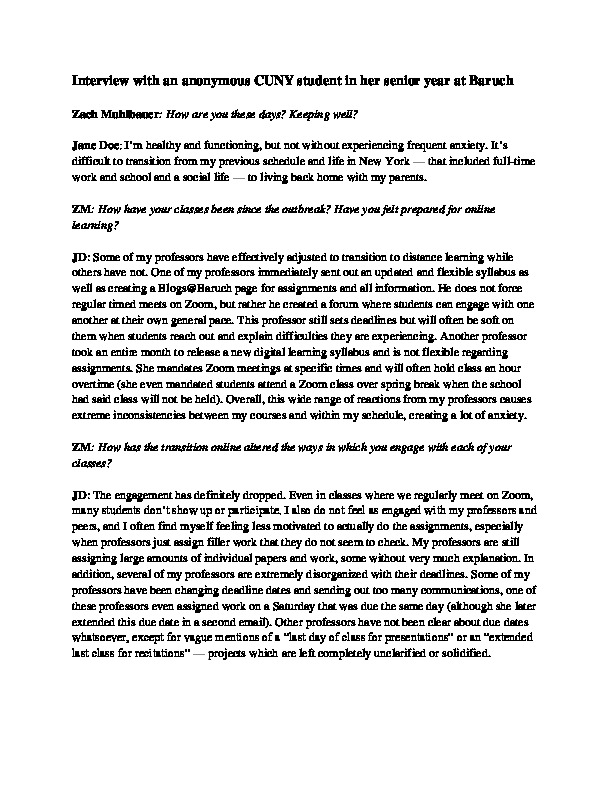
Interview with an anonymous CUNY student in her senior year at Baruch
Zach Muhlbauer: How are you these days? Keeping well?
Jane Doe: I’m healthy and functioning, but not without experiencing frequent anxiety. It’s
difficult to transition from my previous schedule and life in New York — that included full-time
work and school and a social life — to living back home with my parents.
ZM: How have your classes been since the outbreak? Have you felt prepared for online
learning?
JD: Some of my professors have effectively adjusted to transition to distance learning while
others have not. One of my professors immediately sent out an updated and flexible syllabus as
well as creating a Blogs @ Baruch page for assignments and all information. He does not force
regular timed meets on Zoom, but rather he created a forum where students can engage with one
another at their own general pace. This professor still sets deadlines but will often be soft on
them when students reach out and explain difficulties they are experiencing. Another professor
took an entire month to release a new digital learning syllabus and is not flexible regarding
assignments. She mandates Zoom meetings at specific times and will often hold class an hour
overtime (she even mandated students attend a Zoom class over spring break when the school
had said class will not be held). Overall, this wide range of reactions from my professors causes
extreme inconsistencies between my courses and within my schedule, creating a lot of anxiety.
ZM: How has the transition online altered the ways in which you engage with each of your
classes?
JD: The engagement has definitely dropped. Even in classes where we regularly meet on Zoom,
many students don’t show up or participate. I also do not feel as engaged with my professors and
peers, and I often find myself feeling less motivated to actually do the assignments, especially
when professors just assign filler work that they do not seem to check. My professors are still
assigning large amounts of individual papers and work, some without very much explanation. In
addition, several of my professors are extremely disorganized with their deadlines. Some of my
professors have been changing deadline dates and sending out too many communications, one of
these professors even assigned work on a Saturday that was due the same day (although she later
extended this due date in a second email). Other professors have not been clear about due dates
whatsoever, except for vague mentions of a “last day of class for presentations” or an “extended
last class for recitations” — projects which are left completely unclarified or solidified.
ZM: To what extent have you been in contact with your classmates and professors?
JD: I am in very frequent contact with most of my classmates and professors. However, one of
my professors often does not send out communications and will only vaguely answer questions
in her inconsistent Zoom classes. She has not provided any place to hand in our homework
questions, nor has she clarified most future assignments; she always says that there will
“eventually” be a group project and that she will “at some point” be creating a Dropbox folder
for us. However, many professors are very responsive over email, and thus are attuned to the
concerns of students like myself. I had a paper that was assigned and due on a certain date, which
I failed to complete. I emailed my professor that night, saying that I had not been able to time
manage very well, due to the loss of my job and living back at home. He was very sympathetic
and concerned, giving me a several-day extension as well as saying that he understood that the
world was turned upside down, so not being able to time manage was conceivable.
ZM: Has your workload increased, decreased, or remained fairly steady since the outbreak?
How so?
JD: Different professors have reacted in a variety of ways with respect to the workloads that they
assign. In my class that has a more flexible syllabus — with a more reasonable and
understanding professor — my workload has decreased, where my professor got rid of the
extended final paper as well as the final exam. However, regarding my professors that have not
adjusted as well to the transition, many of them have added even more work to the syllabus, or
kept on long difficult assignments, in formats that are not conducive to distance learning. One
professor assigned a new group project to be completed from home, which will be very difficult
to manage considering the altered schedules of all students during this unstable time. It will be
hard to communicate with students whose schedules have been greatly affected by the pandemic.
In another class, my professor kept a 16-page research paper due, along with three 6-page papers.
Assuming that students have more time now than ever is not fair and is inconsiderate of those
who may be struggling to keep afloat in basic areas of their lives.
ZM: In light of recent events, what are your thoughts and feelings on graduating in May? How
would you react to a remote graduation?
JD: I’m sad I won’t get to walk in my cap and gown, and at a glance I don’t think I would attend
a remote graduation if it was offered. Needless to say, this whole ordeal is not how I imagined
my last semester of college would shake out, but really, I think I’m just trying to take it day by
day and focus on what’s in front of me, rather than worrying about my graduation ceremony.
Zach Muhlbauer: How are you these days? Keeping well?
Jane Doe: I’m healthy and functioning, but not without experiencing frequent anxiety. It’s
difficult to transition from my previous schedule and life in New York — that included full-time
work and school and a social life — to living back home with my parents.
ZM: How have your classes been since the outbreak? Have you felt prepared for online
learning?
JD: Some of my professors have effectively adjusted to transition to distance learning while
others have not. One of my professors immediately sent out an updated and flexible syllabus as
well as creating a Blogs @ Baruch page for assignments and all information. He does not force
regular timed meets on Zoom, but rather he created a forum where students can engage with one
another at their own general pace. This professor still sets deadlines but will often be soft on
them when students reach out and explain difficulties they are experiencing. Another professor
took an entire month to release a new digital learning syllabus and is not flexible regarding
assignments. She mandates Zoom meetings at specific times and will often hold class an hour
overtime (she even mandated students attend a Zoom class over spring break when the school
had said class will not be held). Overall, this wide range of reactions from my professors causes
extreme inconsistencies between my courses and within my schedule, creating a lot of anxiety.
ZM: How has the transition online altered the ways in which you engage with each of your
classes?
JD: The engagement has definitely dropped. Even in classes where we regularly meet on Zoom,
many students don’t show up or participate. I also do not feel as engaged with my professors and
peers, and I often find myself feeling less motivated to actually do the assignments, especially
when professors just assign filler work that they do not seem to check. My professors are still
assigning large amounts of individual papers and work, some without very much explanation. In
addition, several of my professors are extremely disorganized with their deadlines. Some of my
professors have been changing deadline dates and sending out too many communications, one of
these professors even assigned work on a Saturday that was due the same day (although she later
extended this due date in a second email). Other professors have not been clear about due dates
whatsoever, except for vague mentions of a “last day of class for presentations” or an “extended
last class for recitations” — projects which are left completely unclarified or solidified.
ZM: To what extent have you been in contact with your classmates and professors?
JD: I am in very frequent contact with most of my classmates and professors. However, one of
my professors often does not send out communications and will only vaguely answer questions
in her inconsistent Zoom classes. She has not provided any place to hand in our homework
questions, nor has she clarified most future assignments; she always says that there will
“eventually” be a group project and that she will “at some point” be creating a Dropbox folder
for us. However, many professors are very responsive over email, and thus are attuned to the
concerns of students like myself. I had a paper that was assigned and due on a certain date, which
I failed to complete. I emailed my professor that night, saying that I had not been able to time
manage very well, due to the loss of my job and living back at home. He was very sympathetic
and concerned, giving me a several-day extension as well as saying that he understood that the
world was turned upside down, so not being able to time manage was conceivable.
ZM: Has your workload increased, decreased, or remained fairly steady since the outbreak?
How so?
JD: Different professors have reacted in a variety of ways with respect to the workloads that they
assign. In my class that has a more flexible syllabus — with a more reasonable and
understanding professor — my workload has decreased, where my professor got rid of the
extended final paper as well as the final exam. However, regarding my professors that have not
adjusted as well to the transition, many of them have added even more work to the syllabus, or
kept on long difficult assignments, in formats that are not conducive to distance learning. One
professor assigned a new group project to be completed from home, which will be very difficult
to manage considering the altered schedules of all students during this unstable time. It will be
hard to communicate with students whose schedules have been greatly affected by the pandemic.
In another class, my professor kept a 16-page research paper due, along with three 6-page papers.
Assuming that students have more time now than ever is not fair and is inconsiderate of those
who may be struggling to keep afloat in basic areas of their lives.
ZM: In light of recent events, what are your thoughts and feelings on graduating in May? How
would you react to a remote graduation?
JD: I’m sad I won’t get to walk in my cap and gown, and at a glance I don’t think I would attend
a remote graduation if it was offered. Needless to say, this whole ordeal is not how I imagined
my last semester of college would shake out, but really, I think I’m just trying to take it day by
day and focus on what’s in front of me, rather than worrying about my graduation ceremony.
Title
Interview with Baruch College Senior on the Distance Learning Experience
Description
Recorded and transcribed by by Zach Muhlbauer, on April 21, 2020, this interview with an anonymous undergraduate student at CUNY's Baruch College who grappled with the abrupt transition to remote learning formats during the interviewee's final semester of college in Spring 2020. The interview began with a well-being check-in. The anonymous student reflected on picking up the pieces of her social, occupational, and academic identities and identified a diverse spectrum of learning experiences during the shift to online modes. The interview then discussed a series of concerns ranging from her feelings of preparedness to her perspective on student engagement in online formats to the level of contact and communication that she had maintained with classmates and instructors alike.
Throughout the interview, the student unpacked remote teaching practices of multiple instructors overseeing her upper-level courses as a graduating senior, reflecting on their strengths and weakness in ways that shed light on the diverse learning experiences of CUNY students during the pandemic. On the one hand, the student expressed gratitude for one of her instructors, describing them as "a reasonable and understanding professor," who redesigned their class to accommodate their students' personal struggles and emergent learning needs. On the other hand, the student drew attention to the broken lines of communication evidenced by other professors, pointing in particular to a heavier workload, vague or nonexistent class communications, inflexible requirements, and assessment methods, as well as the unclear adoption of remote technology.
This item is part of the City University of New York (CUNY) Distance Learning Archive, a group project developed as part of Prof. Matthew K. Gold's Spring 2020 Knowledge Infrastructures seminar in the Ph.D. Program in English at The Graduate Center, CUNY, in partnership with the Interactive Technology and Pedagogy Certificate Program. The project's goal was to resist or trouble the discourse of catastrophe around the shift to online learning caused by the COVID-19 pandemic by documenting the lived experiences of students, faculty, and staff across CUNY's 25 campuses. Further, the project wanted to document the moment of crisis response by taking a critical approach to educational technology.
Throughout the interview, the student unpacked remote teaching practices of multiple instructors overseeing her upper-level courses as a graduating senior, reflecting on their strengths and weakness in ways that shed light on the diverse learning experiences of CUNY students during the pandemic. On the one hand, the student expressed gratitude for one of her instructors, describing them as "a reasonable and understanding professor," who redesigned their class to accommodate their students' personal struggles and emergent learning needs. On the other hand, the student drew attention to the broken lines of communication evidenced by other professors, pointing in particular to a heavier workload, vague or nonexistent class communications, inflexible requirements, and assessment methods, as well as the unclear adoption of remote technology.
This item is part of the City University of New York (CUNY) Distance Learning Archive, a group project developed as part of Prof. Matthew K. Gold's Spring 2020 Knowledge Infrastructures seminar in the Ph.D. Program in English at The Graduate Center, CUNY, in partnership with the Interactive Technology and Pedagogy Certificate Program. The project's goal was to resist or trouble the discourse of catastrophe around the shift to online learning caused by the COVID-19 pandemic by documenting the lived experiences of students, faculty, and staff across CUNY's 25 campuses. Further, the project wanted to document the moment of crisis response by taking a critical approach to educational technology.
Creator
Muhlbauer, Zach (Interviewer)
Anonymous (Interviewee)
Date
April 21, 2020
Language
English
Publisher
CDHA
Rights
Creative Commons Attribution
Source
CUNY Distance Learning Archive
Original Format
Article / Essay
Muhlbauer, Zach (Interviewer), and Anonymous (Interviewee). Letter. “Interview With Baruch College Senior on the Distance Learning Experience.”, CUNY DIGITAL HISTORY ARCHIVE, accessed September 5, 2026, https://stephenz.tailc22a4b.ts.net/s/cdha/item/1905