Prometheus, November 13, 1970
Item
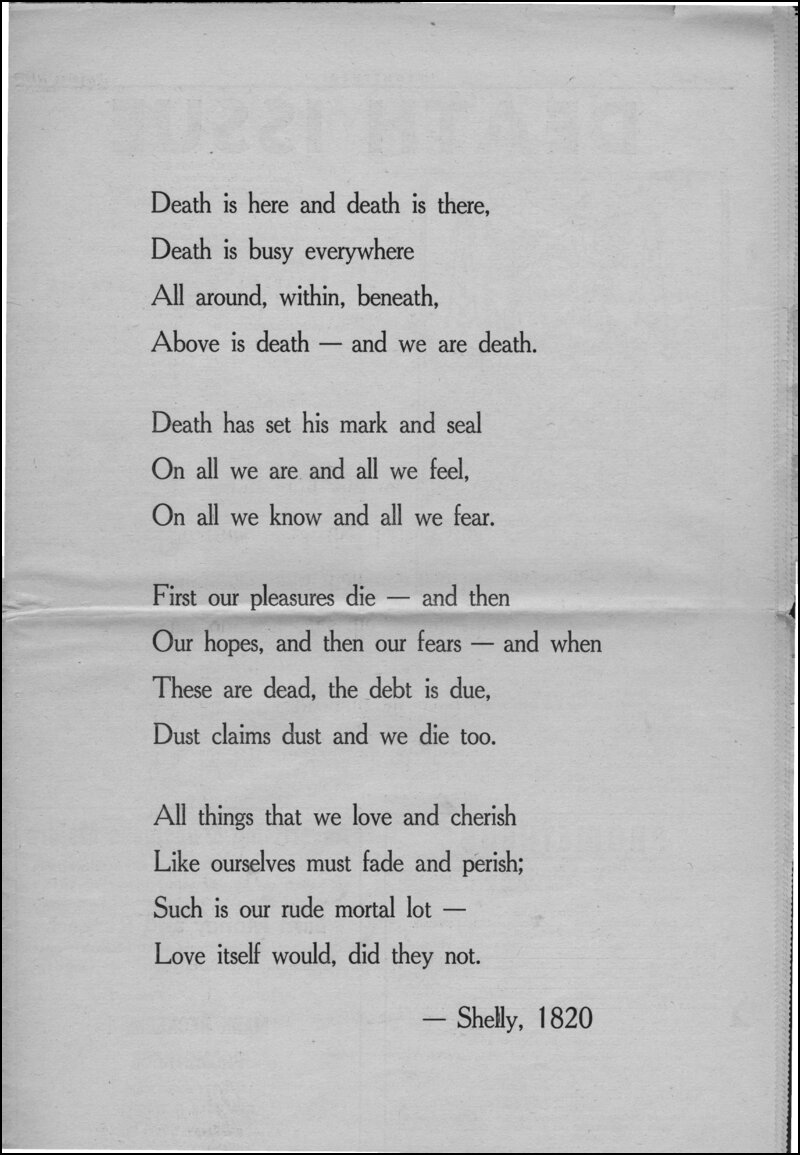
Death is here and death is there,
Death is busy everywhere
All around, within, beneath,
Above is death — and we are death.
Death has set his mark and seal
On all we are and all we feel,
On all we know and all we fear.
First our pleasures die wi and then
Our hopes, and then our fears — and when
These are dead, the debt is due,
Dust claims dust and we die too.
All things that we love and cherish
Like ourselves must fade and perish;
Such is our rude mortal lot —
Love itself would, did they not.
— Shelly, 1820
Page Two
01 BRE RED AN ERAT GND NARS
Bijan aBanannicy BAIR SAAR
Sam ttatcal Bas gAgetes RARER RENATO |
ie ira ganas nnanB saga NSS aac ms
end
THE EFFIGY OF THE DEAD PERSON
(x. Mirror, 2, Conch, g. Lyre. 4. Vase with flowers, 5, Holy Cake.)
“,..in almost any week you can read the obituaries of good
dead friends... The company of jerks is neither stimulating or
rewarding, so for a long time you have tried to avoid it. There
are many ways to do this and you learn most of them. But the
jerks and twerps, the creeps and squares and the drips flourish
and seem, with the new antibiotics, to have attained a sort of
creeping immortality, while people that you care for die pub-
lically or anonymously each month. Those that make the New
York Times in death are gone away as far as, and are probably
little happier than, those that made the Key West Citizen or
the Billings (Montana) Gazette.”
— Ernest Hemingway, 1956
PROMETHEUS
Published bi-weekly by the students of Borough of Manhattan Community
College of the City University of New York. All written correspondence
should be addressed to: Editor: PROMETHEUS, Borough of Manhattan
Community College, 134 West 51st Street, New York, N.Y. 10020. Advertising
rates furnished upon request.
EDITORIAL BOARD
Alan Asnen, Mark Beckerman, Louis J. Cassano, Richard Kornberg,
Gus Koutsoftas, Mark Williams, Debra Moriarty
MANAGING EDITORS .. Alan Asnen, Mark Beckerman
EDITOR Louis J. Cassano
NEWS EDITOR .. Mark Williams
ARTS EDITOR .. Richard Kornberg
PHOTO EDITOR .. Gus Koutsofias
SPORTS EDITOR .. . Johnnie L. Curtis
FACULTY ADVISOR .. Prof, Mel Daus
STAFF
Joe Garcia, Jeff Kiffin, Rose Baker, Leona Jeffers, Debra Moriarty,
Jan Seides, Alvin C. Niples, Stretch Allen.
All articles are the sole responsibility of their author, and do not neces-
sarily reflect the opinion of the editors of PROMETHEUS.,
Address all correspondence to PROMETHEUS, c/o Manhattan Com-
munity College, 134 W. 51 Street, New York, N.Y. 10020.
PROMETHEUS is a member of the Intercollegiate Press (IP), the College
Press Service (CPS), the United States Students Press Association (USSPA)
and receives the newsletters of the National Association of State Universities
and Land-Grant Colleges (NASU) and the American Council on Education
(ACE).
Printed by: Boro Printing Co. oe
216 W. 18 Street 222
PROMETHEUS
-ever since, Canadian and” A‘
DEATH ISSUE
Music, when soft voices die,
Vibrates in the memory,
Odours, when sweet violets sicken,
Live within the sense they quicken.
Rose leaves, when the rose is dead
Are heaped for the beloved bed;
And so thy thoughts, when thou are gone,
Love itself shall slumber on.
—Shelly, 1821
“Il Faciste Canadien”
By BRIAN JOHNSON (CPS)
TORONTO (CPS-CUP)—Despite
reassurances from Prime Minister
Pierre Trudeau to the contrary,
police are using the War Measures
Act to deport Americans seeking
political asylum in Canada.
Harrington said. “The cop then
said, ‘We don’t like Americans’.”
Harrington said when he asked
to call his attorney the policeman
replied: “You call your attorney
and I’ll kick your balls right up
your throat.”
‘I looked at him,” said Harring-
ton, ‘and he was ready to do it.”
Police released Harrington and
told him he would be extradicted
as soon as possible. “But since then,
I’ve been followed everywhere I’ve
gone. My sister-in-law has also
been watched. And there’s a cop
ear outside of my apartment all
the time.” Police broke into and
ransacked the apartment of Har-
rington’s girl friend, Carol Grafton.
They told neighbors they were
looking for a member of the FLQ.
On the advice of his lawyer and
George Harrington, an American
citizen living in Toronto, was ar-
rested by police here Wednesday
under the Act and was told he
would be extradicted to the United
States, where he would face
charges resulting out of last May’s
protest at Kent State University
against the American invasion of
Cambodia.
Harrington was living at Kent
State as a non-student when four
¢tudents were murdered by Nation-
al Guardsmen. He fled to Canada
last month after receiving a su- friends and parents in the United
poena from state authorities. “And States, Harrington flew out of To-
pee yYonto™ Wednesday night to-return
can police have been following me to Ohio before he could be extra-
from Vancouver to Toronto,” Har- dicted. “The police will be waiting
rington said. for me at Cleveland Hopkins air-
Two Toronto police picked up port,” he said. “They’ll know, be-
Harrington at a boutique in York- cause all my friends’ phones are
ville Village (a favorite hangout) tapped in the U.S.”
and arrested him on a false charge “Tf I stayed here, they’d try to
of assault and battery, the charge throw me in jail for being with
— an excuse to get Harrington the FLQ and I’m not going to be
down to the station — was dropped able to prove my innocence. I
as soon as he arrived. would have to sit in jail here, and
“When I asked what I was being then again in the States. I might
charged with, a cop told me that as well just eliminate one stage.
under the War Measures Act he My main objective is to get politi-
didn’t have to tell me anything,” (Continued on Page 3)
Advertising & Business Majors
Why compete for a job when you only have two years
of college and little or no experience? We offer a
great chance to do something now for your career.
Earn Money and Respect
Gain solid media background as YOU formulate rates
and help our advertisers create their campaigns.
Send us a note or sell yourself to
MARK BECKERMAN
PROMETHEUS
160 WEST 50th STREET
NEW YORK, N. Y. 10012
Above Roxy Lanes — 262-5467, 66
November 13, 1970
Vol. V — No. 2 <> 222 Manhattan Community College © The City University of New York November 13, 1970:
Draper Named President
OCT. 28 — Dr. Albert H. Bowker,
chancellor of the City University of
New York, today announced the ap-
pointment of Dr. Edgar D. Draper as
president of CUNY’s Borough of
Manhattan Community . College,
which enrolls 7,000 students. The ap-
pointment was made by the Board of
Higher Education and this morning
|(10/28) confirmed by the Board of
Trustees of the State University of
New York.
Dr. Draper has been acting presi-
dent of the two year college located
at 134 West 51 Street since May, hav-
ing served as dean of the colege from
1966 until that time. Dr. Draper’s ap-
pointment was recommended by the
board’s Presidential Search Commit-
tee, including student, faculty, and
alumni representatives after a five-
month, nation-wide search.
Dr. Draper is the third president
of the college, which opened in 1964.
He succeeds Dr. Murray H. Block,
“who resigned in May and is currently
deputy to the chancellor for campus
relations at the State University of
New York.
- In announcing the appointment of
the 49-year old educator, Dr. Bow-
ker said, “Dr. Draper’s devoted and
skillful service to the college and his
perception of its vital educational
mission have identified him as an
ideal leader for an institution that is
virtually a show window for two-
year community colleges in the heart
of Manhattan. The college’s innova-
tive and sound service to the business
community, its growing impact in
medical services, and its liberal arts
transfer work are well known. It will
be a significant force in the develop-
ment of lower Manhattan as the per-
manent campus in the Washington
Market area is built and occupied.”
Canadiene
(Continued from Page 2)
cal asylum in Canada, but that’s
impossible now.”
Harrington is charged back in
Ohio on nine counts: first degree
riot, outside agitation, intention to
incite a riot, inciting a riot, arson,
obstruction of justice, assaulting a
police officer, assaulting a fireman,
and illegal flight to avoid prosecu-
tion. is
Eleven students are already in
jail on charges arising from the
protests at Kent State University
and 14 more are being sought.
Although a-federal grand jury,
a presidential commission, and the
FBI have found the national guard
guilty of murder, the state author-
ities have found them innocent
and are charging students and pro-
fessors instead.
Dr. Draper holds the B. A. degree
from Howard University and _ the
M. A. and Ph.D. degrees from New
York University.
3eore his appointment as dean of
the college, Dr. Draper was program
associate for education in the Office
of the Governor, Nelson A. -Rocke-
Pres. Edgar Draper
feller. His previous positions include
that of deputy chief of party for the
United Nations in the Institute of
Public Administration of the Sudan;
executive secretary of the African-
American Trade and Development
Association; assistant director of the
Conference on African Resources at
New York University; and president
of Tubman College in Liberia. He
has also been associated with Morgan
State College in Baltimore, Mary-
land, and with Texas Southern Uni+
versity in Houston, Texas.
In an interview today, Dr. Draper
expressed his gratitude to Chancellor
Bowker and to Chancellor Ernest L.
Boyer of State University of New
York, to the Board of Higher Educa-
tion and its presidential search com-
mittee for the opportunity being af-
forded him.
“The task of a comprehensive com-
munity college like BMCC,” he said,
_ “is particularly difficult in this highly
heterogeneous metropolitan commun-
ity where aspirations and environ-
mental circumstances differ so greatly,
But therein lies the challenge and
the opportunity I hope to meet suc-
cessfully. :
“Thanks to the new open admis-
sions policy of City University, we
now hold our doors open to all young
people who have the ability and de-
sire to pursue a college education. At
BMCC we will attempt to provide the
kinds of educational programs that
our students desire for meeting their
life goals. We will continue to offer
programs so varied that they will pro-
vide a place for students who wish
to become lawyers, doctors, teachers,
and businessmen as well as for’ those
who wish to be secretaries, accoun- ,
tants, machine technicians, nurses, or
serve in one of the paramedical
fields.”
Speaking of his college’s students,
Dr. Draper said, “BMCC students rep-
resent a microcosm of our metropoli-
tan society. Some come from affluent
middle class families while others
come from the very lowest levels of
social deprivation.”
“It is my dream,” he said, “to have
BMCC provide each of its students
with the means to develop to the
highest potential in the chosen field,
and to help every one of our students
build bridges to a tomorrow where
each individual will find his place
among his peers for a better and more
rewarding life.”
Dr. Draper was born in Baltimore,
Maryland. He is married to the form-
er Emma J. Williams. Dr. and Mrs.
Draper have three children and live
in Huntington, New York. Mrs.
(Continued on Page 14)
mn ARES TS Se RED SES So ee
The Editors and Staff of PROMETHEUS
wish to extend their congratulations to the
newly elected representatives of the Student
Body and sincerely hope that they experience
success in all of their future ventures.
The Students for Academic Justice wish to congratulate
the Third World Coalition and to thank all those who supported
us during the Student Government Election.
|
FBI Evidence |
~ Questioned
By RENA STEINZOR
Madison, Wisc. (CPS) — Two weeks
after the Army Mathematics Research
Center (AMRC) blew up, the FBI
issued an affidavit accusing four men
of the bombing.
Almost everything that the people
of this country know about the al-
leged involvement of those four men
with the bombing is contained in that
one 16-page document.
Building on the FBI’s calculated
public image of being omniscent, and
omnipotent, the affidavit has had the
widespread effect of prejudging the
four guilty. In addition, using the
affidavit as a justification, the FBI
has alerted law enforcement agencies
and the American people at large
that the four suspects are “armed and
dangerous” thereby possibly setting
up the atmosphere for a shoot out at
the scene of their apprehension.
Just how accurate and complete
is this powerful affidavit?
Four major areas of evidence as
presented by the FBI are question-
able:
the identity of and the link be-
tween the alleged getaway car the
-bombers used and the car the four
men were allegedly using the day af-
ter the bombing.
(Continued on Page 12)
SPORTS
The wrestling team will begin its
fourth full season with a match at
Bronx Community College December
12th. The Grapplers have scheduled
seven dual meets and will participate
in two tournaments.
Co-captains of this year’s “Panthers”
will be Eddie Laracuente and Ahmed
Tekay. Both wrestlers saw action last
season and their experience will prove
helpful. Other wrestlers showing great
promise include Mike Gonzales at
heavyweight and Renee Hernandez at
191 Ibs.
There are still open spots on the
varsity and if anyone is interested in
participating he should contact Prof.
Fazio. The team works out every Mon-
day from 12-2 p.m. in Rm. B504.
Everyone is welcome to join in with
no experience necessary.
* * *
David Vasquez, BMCC sopho-
more, lost his first in six fights at
Madison Square Garden, Tuesday
night, Oct. 6th, fighting Ricardo
Delgado, Olympic gold medal win-
ner. The fight was for the semi-
finals in the flyweight division.
The “New York Times” described
the fight as “a toe-to-toe slugfest”
between the two boxers.
Vasquez was a member of the
American team at the Mexico City
Olympics and has been a_-pro less
than a year. He had won all his five
fights before Tuesday, three by
knockouts.
Page Four
PROMETHEUS
November 13, 1970
PROOF!
By JOHN HAMER (CPS)
(CPS) — This week nearly 400. very
special Americans will die needlessly.
Not in Indochina, not in airplane
accidents, not on the nation’s high-
“ways.
They'll die on the job, in Ameri-
can industry. In the 25 years since
World War II, America’s. factories,
foundries, mills, plants and shops
have been killing their workers at
the incredible average rate of about
15,000 per year.
In addition, every day 8,500 work-
ers are disabled on the job.
Every day, more than 27,000 work-
ers are injured on the job.
And every year, some 390,000 work-
ers contract occupational diseases,
many of which are crippling, chronic,
or fatal.
That this carnage still goes on
and the conditions which cause it are
not eliminated is a damning indict-
ment of corporate indifference, gov-
ernmental inefficiency and, until re-
cently, labor apathy.
But the move to clean up and make
safe the industrial environment, where
‘some 80 million working Americans
spend half their waking hours, is be-
ginning. Small groups of union mem-
bers, college students, environmental-
ists, doctors, scientists, and even leg-
islators are coming together to form
strong, active alliances. The prob-
Jems are immense; the obstacles for-
midable. But the many horrifying
thazards of America’s workplaces have
engendered great dedication among
the new crusaders for the health and
safety of American workers.
A few selected examples of the
lethality and toxicity of industrial en-
vironments may demonstrate why:
ITEM — Union Carbide’s plant in
‘Tonowanda, New York, near Buffalo,
manufactures the “molecular sieve,”
an absorbent chemical powder with
many commercial. uses. Last spring,
‘union examinations of 18 workers
who had been employed in that de-
partment showed’ that all 18 had
acute bronchitis, all 18 had suffered
from dermatitis, 7 had emphysema
and 2 had: circulatory problems
caused by ulcerated sores. Yet Union
Carbide claimed none of the men
had “any occupationally incurred
‘pulmonary (lung) problems,” accord-
ing to company medical records.
Harvey Cowan, a chemical opera-
tor at the plant for more than 5 years,
left in 1967 totally disabled from em-
physema. He filed for workmen's
compensation in 1969 after suffering
2 heart attacks, but Union Carbide
refused_to bring the case before the
compensation board. On Sept. 26,
1970, Cowan died, at age 55.
A union representative who ap-
proached management got this reply
from one executive: “I’m not in the
business of safety, I’m in the business
of making molecular sieves.”
ITEM — Workers in the American
textile industry are almost unani-
mously assaulted by a trio of danger-
ous hazards in weaving mills, most
of which are located in Southern
POLLUTION
states. Clouds of raw cotton fibers
cause a serious respiratory ailment
known as_ byssinosis, from which
100,000 workers are now suffering and
to which another 50,000 are exposed.
Breathing tiny particles of asbestos, a
hazard in textile mills since the 1800's,
results in asbestiosis, a loss of lung
function, or mesothelioma, a deadly
form of lung cancer which is unique
to those who have breathed asbestos
dust. And finally, eardrum-damaging
noise pollution in mills is among the
worst in American industry, with
workers constantly exposed to decibel
levels above 100, when 85 decibels
are harmful.
Nonetheless, a textile industry
trade journal recently described bys-
sinosis as “a thing thought up by
venal doctors who attended last year’s
International Labor Organization
meetings in Africa where inferior
races are bound to be afflicted by new
diseases more superior people defeat-
ed years ago.” The industry continues
to deny that conditions in their
plants have any relation to lung dis-
eases and breathing problems among
workers.
Acoustical engineering studies in-
dicate noise could be reduced in mills
for about 50 cents per month per em-
ployee. Yet the industry does noth-
ing, despite the convincing evidence
and realtively low cost of correction.
ITEM — Proponents of American
nuclear power — both for industry
and defense — have consistently main-
tained that mining large stockpiles of
uranium is more vital than protecting
miners by setting strict exposure stan-
dards for radon, the cancer-producing
gas emitted in mines. Environmen-
talists familiar with the Atomic En-
ergy Commission's long reluctance to
establish truly safe standards for ra-
diation exposure were not surprised
when the industry's Federal Radia-
tion Council dragged its feet in de-
manding proper ventilation of radon
gas in uranium mines. :
For mining operations on the Col-
orado Plateau, the FRC set “stan-
dards” that were 10 to 100 times the
levels set by the International Com
mission on Radiological Protection, a
neutral, non-industrial agency. Still,
compensation claims by disabled min-
ers or the families of decéased min-
ers are often denied because “little is
known” about the correlation be-
tween deadly radon gas and cancer.
But much is known, it seems, about
the profit-making potential of the
uranium industry, for which the AEG
and the FRC have both lobbied in
Congress. z
Who is at work to begin correcting
such shocking and criminal condi-
tions in American industry?
Among student ‘efforts, one which,
shows promise is a newly formed pro-
ject by Environmental Resources,
Inc., one of two lasting organizations
which grew out of the Environmental
Teach-In and Earth Day last April 22.
In their head office in. Washington,
D.C., the five initial members of the
project have started building a work-
ing resource library, establishing . a
general handbook on the_ problem
and several brief booklets on specific
problems and diseases.
Led by Rick Atkins, a third-year
medical student on leave from Stan-
ford, and Paul Witt, a Stanford. po-
litical science graduate, the group
stresses “‘sensitization’? to workers’
problems and local initiatives by co-
alition groups of students, workers,
and community members. They have
received a $20,000 grant from the
Stern Foundation to begin work, and
their advisory board includes Leon-
ard Woodcock, Stewart Udall, Wil-
lard Wirtz, and George Wald.
Among specific student activities
they will help organize and promote
are:
@ conducting inventories of local
industrial hazards and _ applicable
laws;
@ holding seminars and_teach-ns
on the problem of in-plant pollution;
@ making university laboratories
and skills available for analyzing gas
and partculate matter found within
plants;
@ setting up regional, -week-long
training sessions at medical schools
for union representatives and univer-
sity students.
In addition, the project members
hope ‘to interest the national media
in the problem, perhaps eliciting a
network documentary. They also want
to establish a national toll-free tele-
phone number for workers to call for
specific answers on industrial hazards.
Another student group begun this
summer is Youth Projects, led by”
former University of Pennsylvania in-
structor Jim Goodell. Also working
with foundation grant money, they
have several projects underway, one
of which is a content analysis of news
media in coal mining regions of Ap-
palachia. The horrors of Black Lung
disease among miners and the cal-
lousness and corruption of owners and
umion leaders have been nationally
documented, but the local media in
those areas have been largely silent.
Goodell hopes to gather evidence on
how the industry-dominated owner-
ship of newspapers and_ television
stations results in bias in the news.
Among labor unions active in oc-
cupational environment problems, the
most militant is probably the Oil,
Chemical and Atomic Workers union
(OCAW). Led by their tough, ex-
perienced legislative director, Tony
Mazzochi, the OCAW has sponsored
several regional conferences to hear
its members’ grievances about hazar-
dous working conditions, managerial
unconcern, and to recommend cours-
es of action.
“Things are far worse in American
industry today than they've ever
been,” Mazzochi tells OCAW parti-
cipants, “and that’s because modern
technology is taking us rapidly along
new paths without anyone having
checked in advance to see what the
consequences of these new activities
would be. . . . You have been hear-
ing about the rise in cancer, heart
conditions and emphysema in our
society. . . . We, the oil, chemical and
atomic workers, are becoming among
the chief victims of these kinds of
crippling diseases because we work
in the very industries that contribute
most to their development.
“Though we've talked about health
and safety for a long time in the trade
union movement, the emphasis has
been on the safety aspect of it —
whether a fellow gets his hand caught
in a machine, or whether a gal gets
her hair caught in a ventilating de-
vice. . . . But the industry we work
in has a danger that most people are
unaware of, and it’s insidious. It’s the
danger of a contaminated environ-
ment, the workplace; sometimes we
don't feel, see, or smell, any of which
most of us become contemptuous,
because it doesn’t affect us immedi-
ately.”
Gleen Paulson, a young Rockefel-
ler University scientist, has accom-
panied Mazzochi to explain to work-
ers the chemical and medical impli-
cations of the substances to which
they are exposed. Paulson was work-
ing on air pollution problems in New
York City last year when Mazzochi
asked him to visit the National Lead
plant in Sayreville, N.J., which had
just had a series of carbon monoxide
(CO) accidents. One worker had been
killed, two suffered extensive brain
damage and several collapsed on the
job. None of the men was older than
bs
National Lead management instal-
led several monitoring devices which
they insisted would prevent future
accidents. But when Paulson and
Mazzochi toured the plant, they be-
came suspicious of the monitors.
Supposedly set.to.go-off-when the CO
level reached the danger point of 50
ppm (parts per million), the first de-
vice Paulson inspected was set at 100
ppm. Others were found set at 200
and one at 400!
This blatant disregard for work-
ers’ safety was enough to convince
Paulson, who began devoting consid-
erable time and effort to the OCAW
cause.
One valuable OCAW source is a
book, The Documentation of .Thres-
hold Limit Values, which sets ex-
posure levels for many dangerous
common industrial chemicals. Put out
by the Conference of Governmental
Industrial Hygienists, the book has
helped workers learn and. set stan-
‘dards in their factories.
One problem, however, is that of
the approximately 6,000 industrial
chemicals in use today, only 500 have
been researched fully enough to have
set standards. And through expand-
ing technology, at least 1,000 new
chemicals are brought into use every
year! This hampers union efforts to
protect workers.”
Another problem is that interna-
tional standards sometimes differ
from U.S. levels. One example Maz-
zocki often cites is toluene, a sub-
stance used extensively in oil refin-
tries. The American standard is 225
ppm, but Russian scientists have set
a level for their workers at 25 ppm!
“Now I don’t know who’s correct,”
Mazzochi says, “‘but if there has to
be an error, let the error be on the
side of the worker, instead of on the
side of the boss. . . . I say, let’s have
the lower level, and if it’s over-safe,
fine, because once you've been ex-
posed to the higher level, it’s irre-
versible.”
Another union legislative represen-
a
November 13, 1970
PROMETHEUS
Page Five
KILLS
tative, Frank Wallick of the United
Auto Workers, has also been active
in the battle for strict occupational
health and safety standards. He be-
ieves that fundamental changes in
the attitudes of corporate manage-
ment will be necessary.
“The only way out is for industry
to redesign its factories from the
ground up to minimize pollution,”
Wallick declares. “But companies
won't do this on their own. They
need to be prodded. And for that,
-unions need allies. We need the en-
-vironmentalist, the scientist and the
“student.”
Wallick feels that the scientific and
_academic communities do have com-
mon grounds with workers, and the
industrial: environment issue is a
unique opportunity for them to build
an aliance. This would be a “really
meaningful way” for students of med-
icine, law, engineering, architecture
_and journalism, among others, to use
their training, Wallick says. He is
very enthusiastic about Environmen-
tal Resources’ new project — “My
hope is this will really open eyes in
the labor movement.”
Still another labor group at work
-on the problems is the Alliance for
Labor Action, with headquarters in
Washington, D.C. The ALA has re-
cently organized students to assist
UAW members on_ strike against
General Motors. But they are also
deeply concerned about occupational
health and safety.
. One young ALA intern, Jim Bran-
‘son, from the Antioch School for the
Study of Basic Human Problems, has
compiled a handbook on noise pol-
lution. Branson, who formerly work-
ed for the Black Lung Association in
West Virginia, has also become ac-
tive in the Environmental Resources
work environments project.
The absence of effective federal
laws has ong been a major hindrance
to workers’ efforts. The Occupational
-Health and Safety Bill, introduced
this year in the Senate by Harrison
Williams and in the House by Dom-
-inick Daniels, both New Jersey Dem-
ocrats, shows considerable promise.
The bill was described by former Sec-
retary of Interior Stewart L. Udall
-as “the -most far-reaching work of en-
vironmental legislation (disguised as
labor legislation) to come along in
decades.”
A telling comment on the bill’s po-*
tency is the fact that it has been
vehemently opposed by the US.
Chamber of Commerce and other in-
dustrial lobby groups. The bill is
strongly endorsed by the AFL-CIO,
-the UAW, Environmental Action and
-other informed organizations.
Among its provisions, the bill
would:
@ give industry the “general duty”
of providing workers “a place of em-
ployment which is safe and health-
ful”;
@ empower the Secretary of Labor
to set national health and _ safety
_standards for work environments; ,
@ call for unannounced federal in-
spections of workplaces and prompt
disclosure of the findings to workers;
@ allow the Secretary of Labor to
ae ae Be a Pe
The Garden of Prosperpine
¥
Wy
63x623
ALGERNON CHARLES SWINBURNE
Here, where the world is:quiet,
Here, where all trouble seems
Dead winds’ and spent waves’ riot
In. doubtful dreams of dreams;
I watch the green field growing
For reaping folk and sowing,
For harvest time and mowing,
A sleepy world of streams.
I am tired of tears and laughter,
And men that laugh and weep
Of what may come hereafter
For men that sow to reap:
I am weary of days-and hours,
Blown buds of barren flowers,
Desires and dreams and powers
And everything but sleep.
Here life has death for neighbor,
And far from eye or ear
Wan waves and wet winds labor,
_ Weak ships and spirits steer;
They drive adrift, and whither
They wot not who make thither;
But no such winds blow hither,
And no such things grow here.
No growth of moor or coppice,
No heather-flower or vine,
But bloomless buds of poppies,
Green grapes of Prosper pine,
Pale beds of flowering rushes
Where no leaf blooms or blushes,
Save this whereout she crushes
For dead men deadly wine.
Pale, without name or number,
In fruitless fields of corn,
They bow themselves and slumber
All night till light is: born;
And like a soul belated,
In hell and heaven unmated,
By cloud and mist abated
Comes out of darkness morn,
Though one were strong as seven,
He too with death shall dwell,
Nor wake with wings in heaven,
Nor weep for pains in hell;
Though one were fair as roses,
‘His beauty clouds and closes;
And well though love re poses,
In the end it is not well.
PRA AS BN a a dn en Pe PURI Ue Sn DE La ed SSUES USL SU SERS UNLRL SU SU SURO SES UUSU STU SUE ESE
SA GAR, GAR GAR SRR GSR RA AAS
Pale, beyond porch and portal,
Crowned with calm leaves, she stand.
Who gathers all things mortal
With cold immortal hands;
Her languid lips are sweeter
Than love’s who fears to greet her
To men that mix and meet her
From many times and lands.
She waits for each and other,
She waits for all men born;
Forgets the earth her mother,
The life of fruits and corn;
And spring and seed and swallow
Take wing for her and follow
Where summer song rings hollow
And flowers are put to scorn.
There go the loves that wither,
The old loves with wearier wings;
And all dead years draw thither,
And all disastrous things;
Dead dreams of days forsaken
Blind buds that snows have shaken,
Wild leaves that winds have taken,
Red strays of ruined springs.
We are not sure of sorrow,
And joy was never sure;
To-day will die to-morrow
Time stoops to no man’s lure;
And love, grown faint and fretful
With lips but half regretful
Sighs, and with eyes forgetful
Weeps that no loves endure.
From too much love of living,
From hope and fear set free,
We thank with brief thanksgiving
Whatever gods may be
That no life lives for ever;
That dead men rise up never;
That even the weariest river
Winds somewhere safe to sea.
Then star nor sun shall weaken,
Nor any change of light:
Nor-sound of waters shaken,
Nor any sound or sight:
Nor wintry leaves nor vernal,
Nor days nor things diurnal;
Only the sleep eternal
In an eternal night.
Zp
DADADLDADNODDDOHOR:
SS
ZA
mart esFuilnstnege eatin Magy City ar tat aetna Seeieabiah alkane,
“ Page Six
PROMETHEUS
November 13, 1970
. United States
of America
Congressional Record
PROCEEDINGS AND DEBATES OF THE or CONGRESS, FIRST SESSION
Vol. 115
WASHINGTON, FRIDAY, JULY 11, 1969
No. 115
Draft TARRed
And Feathered
By BRUCE LOVELETT
College Press Service
WASHINGTON — (CPS) — For the
last five months Curtis Tarr, the new
director of the Selective Service sys-
‘tem, has been engineering a full-scale
drive to convert the image of the draft
machine from one of the inept, unfair,
discriminatory bureaucracy it was un-
der Gen. Lewis B. Hershey, to an ef-
ficient, modern, benevolent agency
which is seeking to meet the needs of
the military while being as fair to
everybody as it possibly can.
The image is a good one, with a face-
lifting on every level. The new image
doesn’t change the fact that the Selec-
tive Service System is in the business
of deciding which young lads are going
to become cannon-fodder or pencil-
pushers for the armed forces.
-But Tarr has eliminated the most
obvious and blatant inequities and
rhetoric that used to anger liberals
about Gen. Hershey’s operation.
One area in which this is especially
clear is the respect which the new di-
rector has shown_for the unfavorable
zuiings recently handed down against
the Selective Service System by the
Supreme Court. In June, when the
Supreme Court ruled that conscien-
tious objectors need not base. their
claims of religious grounds, Tarr swift-
ly responded by drafting the first in-
terpretation. of the law and regulations
ever done by the Selective Service
System, embodying the ‘spirit, and in-
deed, in several instances, the actual
words of the Supreme Court decision,
In contrast, when, in 1965, the high
court ruled that church membership
and belief in a Supreme Being were
not prerequisites for CO status, Gen.
Hershey’s only response was to issue,
unexplained, three years later, a new
version of the CO form which elim-
inated references to church member-
ship and belief in a Supreme Being.
The system’s new “liberal and mod-
ern” image is also reflected by changes
which have been made in the system’s
house organ, Selective Service News.
Gen. Hershey’s amusing but grisly
front page, right-wing editorials have
been eliminated and the News has tak-
en on a totally new look. The format
has changed from an old-fashioned,
four-column letterpress job to a more
fluid three-column offset format, print-
ed in dark blue ink on pastel blue pa-
per. Tarr has moved his column to the
inside pages, and the copy has lost its
humorous nature, The News used to
be packed with wonderful trivialities
which read like a Ripley’s Believe It
or Not for the war machine. This fas-
cinating copy has been dropped, and
the News now concentrates on hard
news about the functioning of this sys-
tem. Tarr also makes sure that the ar-
ticles mention recent court decisions
which have come down against the
system. whenever. they are relevant,
annother innovation of the News.
These changes, however, are mere-
ly deceptive shirts of the system’s im-
age. Under all the new, liberal rhetoric,
the system still continues to concen-
trate on its dual role of channeling the
military with men to be converted into
killers.
Tarr’s response to the Supreme
Court’s action in January, which elim-
inated punitive induction of violators
of draft rules, became clear in late
June; when the Selective Service reg-
ulations were amended to allow in-
duction of men whose numbers had ,
been reached but who had failed to
report to a Pre-induction physical
when ordered to. Confronted with the
large number of men who fail to re-
port to physicals, and the unwilling-
ness of the Justice Department to pros-
ecute these men for violation of the
draft law, Tarr amended the regula-
tions in such a way that serious re-
sistors could be weeded out from pro-
erastinators and men who are not cer-
tain that they are willing to face pri-
son.
Under the new regulation, men who
fail to report for the physical will be
ordered to report for induction, and
INTAKE STROKE - -
jae AIR
21% OXYGEN
<4 |. 79% NITROGEN
17% HYDROGEN
83% CARBON
NTA
‘MANIFOLD
‘EXHAUST:
MANIFOLD
‘COMPRESSED
given a complete physical at the in-
duction station. Those who fail to
show up, or who refuse to step for-
ward when their name is called will
then be reported to the Justice Depart-
ment for refusal of induction. Many
men who skip the physical are ap-
parently expected to report for in-
duction, thereby accomplishing the
system’s purpose without the expense
and hassle of a criminal prosecution.
In this way the number of draft law
trials is kept low, which was the func-
tion of the more blatantly oppressive
delinquency rules in the first place, and
yet the system is able to efficiently deal
with the failure of men to report for
physicals.
While the new Supreme Court rul-
ing, and Tarr’s guidelines for judging
CO cases have doubled the number of
new alternative service registrants per
month over the summer and have
caused several draft board members to
THE INTERNAL COMBUSTION CYCLE.”
COMPRESSION STROKE
| INTAKE VALVE OPEN
. EXHAUST ST
FUEL-AIRMIXTURE
Sl
a 2 as
Top Court
ToRuleOnDraft
WASHINGTON (CPS) — For the
second year in a row, the Supreme
Court can be expected to be the ma-
jor source of reforms in the draft.
Last term (October 1969-July, 1970)
the court ruled on several cases that
the Selective Service System was over-
stepping its legal authority in its day-
to-day functions. The Court found
that Selective Service Regulations,
which are written and put into force
by proclamation of the President,
gave many powers to the system
which were not provided for in the
law as passed by the Congress.
Under the leadership of Chief Jus-
ROKE
AiR CLEANER
EXPELLING ._
BURNED GASES’
5 CARBON DIOXIDE
VAPOR.
RON MONOXIDE
(OC
NITROGEN
SULPHUROUS ACID.
HYDROCHLORIC ACIO.
tice Warren Burger — but usually
over his strong objection — the
Court found that a number of regu.
lations in conflict with the intent or
actual working of Congressional ac-
tion, including regulations providing
for priority induction of draft law
violators, punitive reclassification of
college students, prosecution of men
who fail to register beyond their 23rd
birthday (after the statue of limita-
tions expires) and excluding non-re-
ligious objectors to all wars from
conscientious objector status, were in
conflict with the Congressional ac-
tion.
This year the Court is being asked
to focus on two draft issues: the right
of registrants to be represented by a
lawyer during dealings with -their
tive conscientious objection to a pat.
ticular war.
In Weller v. United States, the
Court is being asked to overturn a
finding by Judge Peckham of the
North District of California which
dismissed: an indictment against Wel ,
ler for failure to report for induction,
The District Court ruled in favor of
Weller’s claim when he found that a
registrant may assume that he has any
right which is not specifically deny
registrants the privilege of legal coun-
sel at their appearances before the lo«
cal board, the system has traditionally
held, both in regulations and less
formal documents, that the meeting
between the local board and the indi-
vidual registrant is not a formal, legal
confrontation, and therefore specific
ally excludes legal counsel from par-
ticipation at such meetings.
Judge Peckham, however, agreed
with Weller’s contention that the per-
sonal appearance before the local
board is far more serious in terms of
sits» potentialmeffectona—registrant’s
life and liberty than many other
forms of administrative hearings
where counsel has been regarded as
a right such as security clearance in-
vestigations. “Certainly, failing to es-
tablish a conscientious objector claim
is as serious as the impact of loss of
access to classified information,” he
said, “hardly what most people would
consider a ‘right.’”
In the other major case, Guy Porter
Gillette is appealing his conviction
for failing to submit to induction on
the grounds that his religious train-
ing and belief is unconstitutionally
discriminated against by the require-
ment in the draft law that conscien-
tious objectors be opposed to all wars,
not just the specific wars in which
they might expect to fight.
This “selective objection” is the
crux of a major dispute over the
whole conscientious objector status.
Qn one hand, some churches hold as
a doctrine of faith that their mem-
bers must decide for themselvés
whether a specific war is in conflict
with their beliefs or not. These faiths
hold that there are situations in
which war is a justifiable means of
resolving conflict, and that the indi-
vidual is responsible to determine for
himself and act in accordance with
his determination as to the morality
‘of a particular conflict.
The draft law specifically excludes
from exemption these adherents to
the just war doctrine, and has tradi-
tionally required opposition to all
wars as a primary precondition for
recognition. Presently, Selective Ser-
vice officials oppose extension of this
exemption to selective objectors be-
cause of difficulty in determining
their “sincerity.” They seem to feel
——
November 13, 1970
PROMETHEUS
Page Seven
“Quebec LIBRE!”
(This story was written. Wednes-
day, Oct. 7 and telexed from Ottawa
in time for our release — that’s one
reason why there’s so much copy. The
lead may be a little outdated by the
time you get it, but certainly the main
part of the copy isn’t. I strongly urge
you to run this, re-writing the top of
the story from local press accounts
for timeliness if necessary. Or, you
can call us here in DC where we will
have the latest scoop. But it is really
important to give people the back-
ground for this action which deals
with the struggles of people in our
exploited neighbor nextdoor. The
story was written by Canadian Uni-
versity Press, our counterparts for the
Canadian student press. Very good
people by the way.)
By WILLA MARCUS and
JENNIFER PENNEY
College Press Service — Canadian
University Press
MONTREAL (CPS) — The strug-
gle between government and_ police
officials and the Front de Liberation
Quebecois (FLQ) has escalated al-
most hourly since the FLQ kidnap-
ping of British Trade Commissioner
James Cross on Monday of this week
(Oct. 5).
On Tuesday night, after a day of
secret meetings with harried Quebec
and British officials, the Canadian
federal government announced its
refusal to accept the conditions for
the release of Cross, instead letting
loose a full-scale sweep of police raids
and arrests in Montreal.
In another police effort to come
down on radical and revolutionary
separatists, the “combined anti-ter-
rorist squad” of the Montreal Police,
Quebec Provincial Police, and the
Royal Canadian Mounted Police
rounded up 25 FLQ members and
sympathizers Wednesday morning
and is holding them without charge,
though none is suspected of having
connections with the kidnapping.
On Monday following the abduc-
tion police had made raids without
warrants on homes and offices of left-
wing activists and separatists in Mon-
treal. While the raids had ceased
Tuesday in lieu of less overt police
activity, many separatists are still be-
ing kept under close surveillance.
The kidnapping was the first suc-
cessful attempt by the FLQ in the
wake of a series of diplomatic abduc-
tions by other liberation groups
throughout the world. Two others
had apparently been planned for last
February (Moshe Golan, _ Israel’s
Trade Commissioner) and in August
(American Consul Harrison Burgess)
but had been broken up by the secret
police squad.
Quebec Justice Minister Jerome
Choquette has refused to release the
document which contained the FLQ
demands to be met for the return of
Cross, and ordered the confiscation of
as-yet-unopened copies of the declara-
tion sent to newspapers and other
media in the area. As a result the
people of Quebec have no version
other than Choquette’s as to the ra-
tionale of the kidnappers. ;
The demands as Choquette re-
Jeased them are:
@ An indefinite number of Que-
bec’s political prisoners (FLQ mem-
bers mainly, who have been jailed un-
der convictions of bombings and of
“sedition”) must be released from
jail, and immediate arrangements
made for their flight to Cuba or Al-
geria. This demand. is to be subject
to the ratification of the prisoners in-
dividually;
@ Payment of $500,000 in gold —
a “voluntary tax” to be placed aboard
the aircraft ferrying the released pris-
oners;
@ The publication of the FLQ
political manifesto in all the Quebec
mass media;
@ The Post Office Department
must reinstate all former employees
of Lapalme Ltd. (450 truck drivers
were fired by the government last
year during a militant strike);
@ The identification by police of
the informer who broke up the plan-
ned kidnapping of American Trade
Consul Burgess;
@ Immediate calling off of any po-
lice activity in the hunt for Cross and
the FLQ kidnappers;
The demands were accompanied by
very specific instructions for the tele-
vised release and flight of the -prison-
ers and the gold. The FLQ empha-
sized that their political objectives be
clearly defined to the public by the
release to the media of their political
program written this spring, by a one-
hour telecast of the released prison-
ers, and by an invitation which was
to be issued to the public to meet
the prisoners and attend their de-
parture. :
Robert Lemieux, a member of the
Movement for the Defense of Quebec
Political Prisoners and lawyer for sev-
eral of the FLQ prisoners said that
he has seen the document which
FLQ members sent to police and that
it reads almost identically to the one
found by police in connection with
the planned American kidnapping.
That statement reads: “With the
kidnapping of Consul Burgess the
FLQ wants to underline its revolu-
tionary solidarity with all countries
who are fighting against economic,
social and cultural holds of the Am-
ericans throughout the world — in
other words, an unconditional sup-
port to the revolutionary movements
in Latin American and Palestine —
support for American Blacks and all
the people of Africa and Asia who
are working for their liberation.”
The statement also calls for “man-
ufacturing workers, miners and forest
workers, service workers, teachers and
students, unemployed, take what be-
longs to you: your work, your determ-
ination, and your liberty.”
Lemieux has been attempting to
see 21 of the political prisoners who
are referred to in the demands, but
has been refused access to nine of
them. Of those he has been able to
see, Lemieux says most are willing
to be part of the agreement and be
flown to Cuba or Algeria.
He said of the government’s re-
fusal to negotiate: “There is no doubt
in my mind that James Cross will be
executed if the demands are not met.
That is my personal opinion, based
on my experience.”
He said he has known many FLQ
members since terrorist activity be-
gan in Quebec in 1963, and he had
noticed that members of the move-
ment developed a deeper commit-
ment to the revolutionary cause with
each passing year.
The FLQ was created in the early
sixties in Quebec in response to grow-
ing awareness of the Quebecois that
they were being severely oppressed
both culturally and economically by
the English-speaking Canadians and
Americans.
From a terrorist organization which
planted bombs in mailboxes to illus-
trate its deflance of Federalism, the
organization has now developed a po-
litical program which includes work-
ing with trade unionists ,tenants or-
ganizations and other groups in Que-
bec against the English monopoly of
power. “The enemies of our enemies
are our friends,” their manifesto reads.
While clashes betwen French and
English have been an ongoing part of
Canadian history, it has not been un-
til recently, with the decline of the
Catholic Church (the Roman Capi-
talist Church, the FLQ calls it) and
the defeat of the corrupt and dictator-
like 20-year regime of Premier Dup-
lessis, that the French have recognized
the extent of the erosion of their cul-
ture and their self-determination.
The separatist Parti Quebecois,
formed only last year received 24 per-
cent of the vote in the provincial
election in the spring. The party has
a large Socialist wing.
Meanwhile, the salaries of the
French in Quebec are only 65 percent
of the English there and the French
suffer the brunt of the 15 percent un-
employment. English Canadians and
- Americans are the managers of indus-
try and of the banks and of the big
universities in Quebec. Over three-
quarters of the industry in Quebec
(Canada’s most industrialized prov-
ince) is American-owned. And_ the
Liberal government has been escalat-
ing the fight against the growing left-
wing separatist element in Quebec
even as they gather strength. Sedition
laws against the advocation of separa-
tion or over-throwing of the govern-
ment have been used for years to keep
the French in their places. And in the
past years, laws against demonstra-
tions in Montreal were passed to stop
the massive protests against new laws
which favor the English language for
Quebec immigrants in the schools.
Two months ago the provincial
government passed a “‘no-knock” law
so that police who “suspect individ-
uals of illegal possession of explos-
ives” can enter and search homes and
offices of left-wing activists at will.
Quebec has been infamous for its
locking up of prisoners for months
at a time without a trial or hearing.
It is in this context that the FLQ has
resorted to the tactics of other libera-
tion movements throughout — the
world. James Cross is a representative
of one of the oldest of colonialist re-
gimes, and that which first began its
oppression of French people over two
centuries ago.
MANIFESTO OF THE FRONT
DE LIBERATION QUEBECOIS
MONTREAL (CPS-CUP) — The
following is the Manifesto of the
Front de Liberation Quebecois, a doc-
ument discovered by police author-
ities in August, 1970. It was written
in May, 1970, and has never been
printed in English in Canada or the
United States. The publication of this
document is one of the demands made
by the kidnappers of the British at-
tache Cross. The Manifesto was ob-
tained by Canadian University Press
from a bi-lingual sister in Montreal.
OBJECTIVES
1. We want to answer the challenge
of the status quo. We want to answer
the challenge of the businessmen who
believe they can maintain the current
political and economic system by
sowing the fear of change among the
population.
To the threats of the Royal Trust
we oppose real bombs. All we are do-
ing is answering their violence with
counter-violence.
We are defending ourselves against
the constant attacks of the anti-work-
er, anti-Quebec forces that make up
the financial institutions, the big
companies, the Chamber of Com-
merce, etc., who are all maintained
by the Liberal Party and Trudeau-
Bourassa.
2. We are attacking the economic
organs that use puppet politicians
who speak French (like Trudeau-
Bourassa-Drapeau) to protect their
interests, and with whom people per-
iodically have “dialogue” in that
phony exercise of democracy — elec-
tions.
3. We are fighting this clique of
exploiters who make up the capital-
ist bourgeoisie that is dominated by
Anglo-American financiers, and which
some ambitious French-Canadians
have been collaborating.
4. We are fighting all forms of ex-
vloitation, the most blatant being
linguistic segregation: the necessity to
speak two languages because we are
Quebecois. Our colonialist bosses are
responsible for this.
5. We are fighting all sorts of rac-
ism, discrimination and segregation.
We are in solidarity with all struggles
being waged by people who are vic-
tims of American imperialism. We
support the struggle led by those first
exploited on this continent, the In-
dians. We are in solidarity with the
American Blacks and Puerto Ricans
who are fighting Yankee capitalism.
6. We are with all workers who im-
migrated to Quebec and with whom
we want to fight our common enemy:
Anglo-American capitalism. We want
to wage the struggle for nation liber-
ation with all workers.
7. While supporting all trade union
struggles, the FLQ hopes unionized
workers will throw themselves vigor-
ously into the second front. As soon
as possible workers’ representatives
must replace the people’s phony rep-
resentatives in Parliament. When a
real workers’ party is created, the
FLQ will no longer have a reason to
exist.
8. The FLQ is fighting the owners
of the means of communication
(moyen d’axxinformation) who are
trying to make us believe that the
current government serves all of so-
ciety. The current government serves
only those who finance it.
We are fighting these capitalists
who monopolize all the major means
of information, and who are trying to
make it seem that we are the enemies
of the people of Quebec. It is up to
the free intellectuals (freethinking
(Continued on Page 14)
Page Eight
PROMETHEUS
November 13, 1970
LAW AND
An Open Letter
To College Students
from
John Edgar Hoover, Director
Federal Bureau of Investigation
United States Department of Justice
As a 1970 college student, you belong to the best educated, most sophisti-
cated, most poised generation in our history.
The vast majority of you, I am convinced, sincerely love America and want
to make it a better country.
You do have ideas of your own — and that’s good. You see things wrong
in our society which we adults perhaps have minimized or overlooked. You
are outspoken and rank and hate hypocrisy. ‘Vhat is good too.
There's nothing wrong with student dissent or student demands for changes
in society or the display of student unhappiness over aspects of our national
policy. Student opinion is a legitimate aspect of public opinion in our society.
But there is real ground for concern about the extremism which led to
violence, lawlessness, and disrespect for the rights of others on many college
campuses during the past year.
The extremists are a small minority of students and faculty members who
have lost faith in America. They ridicule the flag, poke fun at American insti-
tutions, seek to destroy our society. They are not interested in genuine reform.
They take advantage of the tensions, strife, and often legitimate frustrations of
students to promote campus chaos. They have no rational, intelligent plan of
the future either for the university or the Nation.
The extremists are of wide variety: adherents of the Students for a Demo-
cratic Society (SDS) including the Weatherman; members of the Young Socialist
Alliance (YSA), the Trotskyist youth group; the Communist Party’s Young
Workers Liberation League (YWLL). Or they may be associated with the Stu-
dent Mobilization Committee to End the War in Vietnam (SMC), a Trotskyist-
dominated antiwar group.
Many are not associated with any national group. The key point is not
so much the identification of extremists but learning to recognize and under-
stand the mentality of extremism which believes in violence and destruction.
Based on our experience in the FBI, here are some of the ways in which
extremists will try to lure you into their activities:
1. They'll encourage you to lose respect for your parents and the older gen-
eration. This will be one of their first attacks, trying to cut you off from home.
You'll hear much about the “failures” and “hypocrisy” of your parents and
their friends. The older generation has made mistakes but your parents and
millions of other adults worked hard, built, sacrificed, and suffered to make
America what it is today. It is their country too. You may disagree with them,
but don’t discredit their contributions.
2. They'll try to convert you to the idea that your college is “irrelevant” and
a “tool of the Establishment.” The attack against the college administration
often is bitter, arrogant, and unreasoning. SDSers, for example, have sought to
disrupt the colleges by demanding the right to select professors, determine the
curriculum, and set grading standards.
3. They'll ask you to abandon your basic common sense. Campus extremism
thrives on specious. generalizations, wild accusations, and unverified allegations.
Complex issues of state are wrapped in slogans and cliches. Dogmatic statements
are issued as if they were the final truth. You should carefully examine the facts.
Don’t blindly follow courses of action suggested by extremists. Don’t get involved
in a cause just because it seems “fashionable” or the “thing to do.” Rational
discussion and rational analysis are needed more than ever before.
4. They'll try to envelop you in a mood of negativism, pessimism, and alien-
ation toward yourself, your school, your Nation. This is one of the most insidious
of New Left poisons. SDS and its allies judge America exclusively from its flaws.
They see nothing good, positive, and constructive. This leads to a philosophy
of bitterness, defeatism, and rancor. I would like you to know your country
more intimately. I would want you to look for the deeper unifying forces in
America, the moods of national character, determination, and sacrifice which
are working to correct these flaws. The real strength of our Nation is the power
of morality, decency, and conscience which rights the wrong, corrects error, and
works for equal opportunity under the law.
5. They'll encourage you to disrespect the law and hate the law enforcement
officer. Most college students have good friends who are police officers. You
know that when extremists call the police “pigs” they are wrong. The officer
protects your rights, lives, and property. He is your friend and he needs your
support.
6. They'll tell you that any action is honorable and right if it’s “sincere” or
“idealistic” in motivation. Here is one of the most seductive of New Left appeals
— that if an arsonist’s or anarchist’s heart is in the right place, if he feels he is
doing something for “humanity” or a “higher cause,” then his act, even if illegal,
is justifiable. Remember that acts have consequences. The alleged sincerity of
the perpetrator does not absolve him from responsibility. His acts may affect
the rights, lives, and property of others. Just being a student or being on campus
does not automatically confer immunity or grant license to violate the law. Just
because you don’t like a Jaw doesn’t mean you can violate it with impunity.
7. They'll ask you to believe that you, as a student and citizen, are powerless
by democratic means to effect change in our society. Remember the books on
American history you have read. They tell the story of the creative self-renewal
of this Nation through change. Public opinion time after time has brought new
policies, goals, and methods. ‘The individual is not helpless or caught in “bureauc-
racy” as these extremists claim.
8. They'll encourage you to hurl bricks and stones instead of logical argu-
ment at those who disagree with your views. I remember an old saying?~“He
who strikes the first blow has run out of ideas.” Violence is as ancient as the
cave man; as up-to-date as the Weatherman. Death and injury, fear, distrust,
animosity, polarization, counter-violence — these arise from violence. The very
use of violence shows the paucity of rational thought in the SDS, its inability to
come up with any intelligent critique of our society.
Personally, I don’t think the outlook for campus unrest this year is as bleak
as some phophets of pessimism proclaim. The situation at some colleges is serious,
but certainly not hopeless.
Along with millions of other adults, I’m betting on the vast majority of stu-
dents who remain fair-minded, tolerant, inquisitive, but also firm about certain
basic principles of human dignity, respect for the rights of others, and a willing-
ness to learn. I am confident our faith has not been misplaced.
FBI QUITS JOHN JAY
were ordered to leave John Jay Col-
lege be re-enrolled without delay.”
in big trouble. He explained he had
sent the draft of the letter to the FBI
By DAVID BURNHAM
(From the N.Y. Times, October 24,
1970) — The Federal Bureau of Inves-
tigation has forced a group of its ag-
ents to drop out of the John Jay Col-
lege of Criminal Justice because a pro-
fessor there criticized the FBI.
Donald H. Riddle, president of John
Jay, a branch of the City University,
said yesterday that he had been in-
formed by the New York office of the
FBI that its director, J. Edgar Hoover,
had decided that no agents would
study at the college as long as the pro-
fessor who had criticized the agency
continued to teach there.
“They said they were not trying to
force me to fire the professor but they
just wanted me to know Mr. Hoover’s
feelings,” Dr. Riddle said. “I told them
the professor was staying.”
Immediately after the conversation,
15 agents left the college. The president
said one of them showed the registrar
a letter from the New York office “di-
recting this individual to resign from
the college.”
Spokesmen at FBI headquarters in
both New York and Washington re-
fused to comment on the matter.
The subject of Mr. Hoover’s annoy-
ance, Dr. Abraham S. Blumberg, de-
scribed the FBI’s action as “Kafkaes-
que” and said it had had a “chilling
effect on free discussion at the college.”
Dr. Blumberg has a law degree from
Columbia University and a Ph.D. in
sociology from the New School of So-
cial Research, and is the author of
three books on criminal justice. He
said his criticism of the FBI was made
last July, during his 30-hour graduate
course at John Jay on law and so-
ciety.
“One day,” he said, “there was a 25-
minute discussion during which many
of the old critical chestnuts about the
FBI — such as that they had been a
bit slow on civil rights — were aired.
At one point, I said something about
the cult of personality and that Mr.:
Hoover had been in power too long.”
Three months later, Dr. Blumberg
said, one of the summer-session stu-
dents. who was an FBI agent called him
to say that he was writing a letter to
the professor with a proposed outline
or his thesis about the FBI.
“Several hours later,” the professor
said, “the agent called to say he was
typing pool and that it had immedi-
ately been ‘sent upstairs.’”
Dr. Blumberg said the agent later
told him that the FBI had taken his
badge, his gun, and his membership
card in the FBI Association, had ques-
tioned him for several hours and had
kept him under virtual house arrest.
The professor said the agent, who
has since resigned from the FBI, later
showed him a copy of the letter.
(Continued on Page 13)
EO SSeS Set NSS Sa oe So
Profs Blast Hoover Withdrawal
Of FBI Agents From John Jay ..
City University’s professors on Oct.
26, called the FBI's removal of 15
agents from John Jay College “a
threat to the teacher’s right to teach
and the student’s right to learn.”
In a telegram to FBI Director J.
Edgar Hoover, who ordered the res-
ignation of the students on October
23, CUNY’s Legislative Conference
said:
“We urge you to apologize to the
entire academic community, and we
further urge that the agents who
The Conference, which is the of-
ficial representative of the City Uni-
versity’s career faculty, labeled Hoov-
er’s move a “rejection of the freedom
to criticize.”
The agents were ordered by Hoov-
er to resign from the John Jay Col-
lege of Crimnal Justice, a branch of
CUNY, as a result of criticism of the
agency and its director by Prof. Ab-
raham S. Blumberg.
The New York office of the FBI
told John Jay President Donald H.
Riddle that no agents would be al-
owed to study at the college as long
as Prof. Blumberg remained there.
Dr. Riddle has said the professor
would stay.
The Conference told Mr. Hoover
that it commended Dr. Riddle “for
his forthright stand against your at-
tempted intimdation.”
The Conerence’s telegram said,
“We re-affirm our unalterable oppo-
sition to infringements on academic
freedom, whatever the source.”
“November 13; 1970
PROMETHEUS
Page Nine
ORDER
Nixon Rejected
Nixon’s peace plan of October 8,
1970 like all the American peace
plans since the Indochina war be-
gan, is a camoflauged proposal for
the Vietnamese people to surren-
der.
“The Vietnamese people under-
stood it, and rejected it today.
The American people also must
‘understand it and reject this “peace
initiative.”
On July 28, 1965 Lyndon John-
son told the press about “Amer-
ica’s willingness to begin uncondi-
tional discussions with any govern-
ment at any place at any time.”
Many liberals were heartened
by this offer but on second sight it
became obvious that Johnson was
refusing to talk with the National
Liberation Front doing the fight-
jing; he was only proposing to talk
with a “government” somewhere
ypresumably that of the Democratic
Republic of Vietnam.
Sometime later at Manila John-
son offered to withdraw “Ameri-
can troops” six months “after the
other side withdraws its forces
north and that of its so-called sub-
versive forces as well — i.e. the
“Viet Cong.” Again many liberals
at first hailed the offer until it be-
came clear that what Johnson was
suggesting was that six months
after the “enemy” stopped fighting
and left South Vietnam the United
States would withdraw its forces
leaving the government in the
hands of General Ky for a total
victory for the American puppets.
Nixon’s present plan is in the
same tradition. It is in effect a call
for surrender and it would mean
that the quarter of a century strug-
gle by the Vietnamese people
against imperialism would end in
total failure.
The two key sections of the Nix-
on Offer are: a “cease-fire-in-place”
and.a willingness “to negotiate an
agreed timetable for complete
withdrawals as a part of an overall
settlement.” This is with some
modifications nothing more than
the Korea-formula.
Under a “cease-fire-in-place” the
various armies would presumably
stay where they are. According to
Washington the “Viet Cong control
less than 10 percent of the country.
Assuming the U.S. would be will-
ing to let it control a larger area,
say 20 or 30 percent, the real issue
is who would have police power in
South Vietnam. The shooting
would stop which means that the
roads and railroads now closed to
the puppet Thieu regime and vil-
lages that are “insecure” after
nightfall (the vast majority) would
come under Thieu’s dominance. It
would mean the same kind of
bloodbath of thousands of nation-
alists as Diem conducted from 1954
to 1960 — and which actually caus-
ed the civil war. It would mean
the end of the Provisional Reyolu-
tionary Government infra-struc-
ture which reaches into every nook
and cranny of the country, includ-
ing Saigon right up to the palace.
Anticipating this problem the
PRG has stated that a cease-fire is
impossible unless there is a coali-
tion government reflecting the na-
tional will, that will rule in the
interim period between the cease-
fire and some form of elections.
The difference may be subtle but
it is overriding. If the order of
peace-making includes a cease-fire
first and without a coalition gov-
ernment, then the Vietnamese na-
tionalists will be totally destroyed
before the next stage of peace-
making takes place. If the order of
priorities is agreement on a coali-
tion and on U.S. withdrawal and
the will of the people can be fairly
expressed. In one case—Nixon’s—
we are talking in the reality of
surrender; in the PRG proposal of
a true settlement.
This becomes even more obvious
when one examines the “with-
drawal” suggestion. Nixon’s exact
words are: “We are prepared to
withdraw all our forces as part of
a settlement BASED ON THE
PRINCIPLES I SPELLED OUT
PREVIOUSLY. ...” The principles
spelled out previously call for
“mutual” withdrawal of U.S. and
“North Vietnam” troops simultane-
ously — not much different than
Johnson’s offer at Manila, because
the U.S. would undoubtedly de-
mand withdrawal of “irregulars”—
e.g. “Viet Cong” as well. What this
means in effect is this — there
would be a cease-fire, during which
Thieu could wreak vengence on his
enemies and any attempt by the
“Viet Cong” to defend its comrades
would be called a violation of the
cease-fire. After the cease-fire went
into effect there would be endless
negotiations — for two decades in
Korea — over the next step, during
which time the U.S. troops would
remain endlessly in Vietnam as
they have in Korea. In other words,
the war would not end, it would
be indefinitely stalemated under
permanent occupation by the U.S.
and its puppet forces.
The great tragedy of the Nixon
offer, insofar as opinion in the
United States is concerned, is that:
it has immobilized the liberals and
created a false concept of “national
unity.” Many liberals favor the-
Nixon plan sincerely because they.
do want a Korean type settlement,
so that the United States saves
both face and power. Others are
afraid to speak out against it be-
cause the cease-fire idea is enor-
mously attractive to many citizens
who will not look deeper into the
problem. To oppose an end to the
killing would be like opposing
motherhood or virtue.
As a corollary to this tragedy the
sudden national unity gives Nixon
and Mitchell a wonderful camou-
flage for accelerating repression.
If the American people truly be-
lieve that Nixon “sincerely” wants
to end the war, those who con-
tinue to fight it will be read out of
polite society and be considered
fair game for repression.
The American people should
realize the impotence of this Elec-
tion Year strategy and denounce
the continued suffering on both
sides that such attempts only pro-
long.
The National Coalition Against
War, Racism, and Repression in-
tends to pursue a real peace initia-
tive and will announce the forma-
tion of a Peoples Peace Treaty
Negotiating Team.
PROOF
(Continued from Page 5)
impose fines and seek court action
against employers who violate the
“general duty” or specific standards;
@ permit the Secretary of Labor to
elose down all or part of any plant
where workers are in “imminent dan-
ger” of injury or disease;
@ direct the Secretary of HEW to
publish a list of all known or poten-
tially toxic substances — including
those workers specifically request;
@ allow employees to refuse work,
without loss of pay, in areas where
toxic substances are found at danger-
ous concentrations.
Passage of this bill would go a long
way towards realization of the goals
industrial environmentalists dream
about. But the bill’s future is not at
all clear, partly because it has not
won widespread, active support
among the bulk of traditional envi-
ronmental groups.
“The environmental groups are
rightfully up in arms about air pol-
lution in the Delaware Valley and oil
slicks along the Gulf Coast,” Maz-
zochi once charged, “but they are
blind to the places where blue collar
employees earn a living. They think
the ‘environment’ begins out here in
the trees. They realy don’t believe
industry is killing its workers.”
TARRED
(Continued from Page 6)
resign, the overall effect of these ac-
tions on the efficient functioning of the
system has been nil. Les than one per-
cent of the current registrant pool is in-
volved in the issue of conscientious ob-
jection. These few are easily ignored
by the system, which carries on ‘with
its main function of manipulating the
lives of 22 million registrants into so-
cially useful channels.
(Ed, Note: This will be the first in a
series of articles concerning the many
aspects of the draft. In the next issue,
we will publish the first part of a two-
part article on draft resistors and mili-
tary deserters in Canada.)
DRAFT RULE
(Continued from Page 6)
that many opponents. of the war in
Vietnam might take advantage of this
difficulty in sorting the “sincere”
from the “insincere” as a springboard
to escape service without meeting the
system’s rigorous requirements which
are now applied to applicants for the
exemption.
Draft counselors agree that an anti-
system ruling in a case of this sort
would greatly increase the number of
COs. They feel, however, that the
present regulations unjustly discrim-
inate against registrants whose con-
victions prevent them from engaging
in wars such as the war in Vietnam
which violate deep moral scruples
against such self-serving wars, but
who would fight in a war to defend
their country against an overt threat
or would defend their faith from a
similar incursion. f
What will actually happen with
these cases is up for serious question
because of the uncertainty of newly
appointed Justice Harry Blackmun’s
effect on the Court’s outlook on draft
cases. Although the Court’s recent
rulings against the system have gen-
erally been by a margin of 5-3, it is
entirely possible that Blackmun may
be not only personally conservative
on this issue, but also able to con-
vince other justices to adopt a more
conservative stance.
s
+
Soedetoatentecgontoateetecontoatectectenteatectectenteatectectonteetectonty
Petition
on
Page 17
estecteMetaecteteMataMaMaMaBaMata Beate Bate DM,
Seateatats
Seageegeetee’
Saateet
etettette.
ee
s
tee
Ss
ss
RS
Seageatoetoegees
se
steserts
ost
nee
re
S
sores
e
co
ms
seers
Seatat
seaqoatens
en
tee
oS
eats
See fees
‘°
vs
a
seeds
Seefeegoes
*.
re
“
soe
Seafeats
Sask
es
%
sae
Be
By
sos
seat
°
Page Ten
PROMETHEUS
November 13, 1970
Super Eric
By ROB LANDSMAN
New York musical fans were treated to ex-
cellent shows the nights of October 23 and 24,
when Eric Clapton and his new band, “Derek and
the Dominoes,” rolled into town.
Clapton, considered by many to be the finest
blues-roek guitarist today, had previously played
with the Yardbirds, John Mayall, Cream, Blind
Faith, among others, and had also recently cut an
album as a solo artist.
The new band, however, whether they make
it or not, is all his baby, and by the way things
Jook, he shouldn’t have much to worry about.
When Clapton decided to form the Dominoes,
he chose musicians he had worked with on his
recent tour with Delaney and Bonnie. They in-
clude Bobby Whitlock on piano, Carl Radle on
guitar, and Jim Gordon playing the drums. Clap-
ton sings and runs off those fantastic licks on lead
guitar.
At the Saturday nite set at the Fillmore
East, they performed numbers from their forth-
coming double album (Eric shining of course on
his magic guitar). Also included was an oldie that
Eric wrote from Blind Faith days, “In the Presence
of the Lord,” which was warmly received by the
sell-out crowd.
Clapton is really into his music, and his per-
formances are always a delight to the ears. Play
on!
Broadway For Bella
By RICHARD KORNBERG
Since the principle reason for our just con-
cluded two week recess was to work for the politi-
eal candidates of our choice, I thought I would
be hard pressed to find something to review in-
that mode. As fate would have it, my prayers
were answered, for on the evening of November 1
a benefit entitled Broadway For Bella stormed
its way into the Felt Forum of Madison Square
Garden.
Stormed is also a good way to describe Bella
Abzug’s (congressional candidate in the: 19th dis-
trict) rise. to prominence. Before she ‘defeated
Leonard Farbstein (the incumbent representative)
in the Democratic primary, she was the type that
was always behind the scenes. Well, Mrs. Abzug
sure learned quickly and now it is difficult not
to bump into Bella on one of her campaign jaunts.
She is loud and-pushy, the perfect qualities for
someone to have when she wants to get something
done.
The evening had all the spirit of the indi-
vidual herself. Outside the arena pickets from
the Jewish Defense League protested that Bella
was anti-Israel and soft on Communism. Inside,
the audience was served a mixture of liberal
discourse and Jewish shmaltz. (There seems to be
a contradiction between outside and inside.) There
were excerpts from Broadway shows (1776, COM-
PANY, CABARET, HAIR, PURLIE, and FIDDL-
ER ON THE ROOF) and speeches and perform-
ances by many of the candidate’s followers from
the entertainment world. Mayor Lindsay even
showed up and received a tumultuous reception.
George Segal, Lauren Bacall, Robert Vaughn,
Buck Henry and Phyllis Newman were but a few
of the many guest hosts. Jimmy Breslin con-
tributed a speech in which he told those present
that “the least you can do is get your ass out of
bed on Election Day and vote.” Alan Alda did an
excellent William Buckley imitation and when
he was asked if he (Buckley) wore a Spiro Agnew
watch he answered, “I don’t wear watches. They
break when you try to wind them backwards.”
Even with all this entertainment, it was obvi-
ous that the audience had come to see the two B’s,
Bella and Barbra (Streisand, that is). Miss Streis-
and sang six songs (People, Don’t Rain On My
Parade and Happy Days Are Here Again were
three of her selections). Her screaming fans (I
The Me Nobody Knows
Second Ave. is in a state of flux. For years it
was a major thoroughfare of Jewish life. Then,
when the Lower East Side became the East Vil-
lage, many Jewish families escaped and were
replaced by that infamous breed — the hippie —
largely of the same extraction as the fleeing popu-
lace, but scorned because of their “new ideas.”
Today, many of the older residents still re-
member their avenue as the one Barbra Streisand
fondly san about in her “Second Hand Rose” —
but to the new arrivals it was a place to hang out.
The Fillmore East was born-out of the old Loew’s
Commodore and with this birth came kids from
all over the city. Just three blocks north of Bill
Graham’s rock emporium stands the Orpheum
Theatre, qutwardly tacky but inwardly proud, for
it is the home of THE ME NOBODY KNOWS.
From its four walls emit the voices of the ghetto.
In their struggle lies their hope, and ours. They
are the voices of change.
‘This is a musical that is different in many
ways. For a starter, it has the unusual distinction
Douglas Grant & Company
The Me Nobody Knows
of having its spoken text written by children be-
tween the ages of seven and eighteen attending
New York City public schools in Bedford-Stuy-
-vesant, Harlem, Jamaica, Manhattan, and the
Youth House in the Bronx..Its message is one of
today, not the past, and its rock score has a rele-
vance’ not usually encountered in the average
show. It is also refreshing not being bombarded
by the usual:rock light show, but instead seeing
slides that relate to the story at hand.
There are many interesting lives intertwined
in this kalidiscope of rejection, of hope, and of
pride. We meet real people, Lillian, Carlos, Neil
and we learn of their problems and their solu-
tions. We see and hear the irrelevancy of. their
classroom experiences and we marvel at their
ability to conjure up songs out of the sounds and
feelings of the slums.
Before I get completely carried away on my
euphoric cloud, I must admit that the second act
does not approach the beauty, charm, and humor
of the first. Oh well — this me might be too picky,
for as anyone will know who sees it — This is
where it’s at!! RK
noticed our own Prof Lois Adler in the audience
but she was more restrained) were delighted but
-when Barbra tried to leave the stage a group of
her devotees tried to follow her. If it wasn’t for
the quick response of her security guards, the
singer might have damaged- that famous append-
age that has brought ruin to the local plastic
surgeons.
An evening of politics — yes. An evening of
entertainment — definitely.
A Theatrical Day
By RICHARD KORNBERG
Once upon a time, years ago, everything was
peaceful, happy, and gay. In this make-believe
world that parents create for their children, there
were always dreams of enchanted princes and
magical fish. Nothing was Grimm except the tales.
Well these dreams can now become reality by
the simple task of marching yourself over to the
Ambassador Theatre and buying tickets to the
STORY THEATRE. It will be one of your wisest
investments.
Paul Sills, the creator of this wonderful off-
spring, has taken several Grimm’s fairy tales —
some familiar, others not — and has brought them
to life in a theatrical form. We can now actually
see Henny Penny, Cocky Locky and the rest of
the gang and relish the sight of our dreams
brought to life.
The entire evening can best be described as
a potpourri of joy. This is not a mere staging of
fairy tales; in actuality it is a touching, funny,
heart-warming review that is both whimsical and
relevant. Mr. Sill’s direction and the companys’
acting can best be described as simple yet over-
whelming. Also good sense was shown in the
choice of appropriate music (“Here Comes The
Sun” by George Harrison, “Dear Landlord” by
Bob Dylan, and “Fixin To Die Rag” by Joe Mc-
Donald are but a part of the not: so incidental
music) which ably compliments the stage action.
There aren’t any adjectives praiseworthy
enough to describe the joy I experienced during
the show. When I arose at the conclusion of the
performance to give the cast its well deserved
standing ovation, it was with a sense of release.
There were tears streaming down my face and it”
was as if I had just experienced a catharsis — a
liberation from: the everyday trouble and woes.
Even though children will love this show, at the
performance I attended, it was the adults who
were shouting bravo and begging for more. :
Isaw STORY TELLER at a Saturday matinee.
Before the day’ was over, I had the pleasure of.
attending two more theatrical undertakings.
Now we go from fairy tales to tales of fairies. |
THE DIRTIEST SHOW IN TOWN is steeped in
homosexuality. This is not evident during the first.
third of the evening, since playwright Tom Eyen™
has opted to cool the sexual aspects and mostly~
concern himself with air and water pollution. Un-
fortunately, this segment is deadly dull and seems
like a phoney attempt at intellectualism. When
the show’s skirt does fall, the nudity comes hot
and heavy. (This is not meant to be a crack about
the actors or actresses who for the most part have’
great bodies.)
Both the female and the male anatomy be-
come increasingly more evident. This non-exist-
ence of clothing seems to give birth to the exist-
ence of a comedy. The lines become much funnier,
for Tom Eyen has changed his writing style in
mid-stream. The verbose is replaced with comic
bichiness.
While much of the sex play is of the hetero-
sexual school, the dialogue these people espouse
seems homosexual. Gay humor can be very funny
and the mostly Broadway-type audience at the
Astor Place Theatre seemed to eat it up.
For my,third show of the day, I traveled to
the Theatre Four and saw SENSATIONS. In its
playbill is the claim that it was suggested by
Shakespeare’s ROMEO AND JULIET. (This ver-
sion’s sexual preference make it seem that it was
also suggested by THE DIRTIEST SHOW IN
TOWN.)
The term suggestion is important for this is
not the ROMEO AND JULIET purists expect. Its
only relation to the original is in its basic story
(the love of Romeo for Juliet). What we do have
is an expansion from the source. Taking five or
six of the Shakespearian characters, Paul Za-
krzewski seems to have given them new person-
alities and relationships. The Friar is now a
circus buffoon but with a mad and macabre touch
(Continued on Page 11)
November 13, 1970
PROMETHEUS
Page Eleven
By RICHARD KORNBERG
The coming of autumn seems not only to
change the color of leaves, but also the type films
playing in and around Manhattan. Already “Five
Easy Pieces” has captured everyone’s fancy and
before the last leaf has fallen from the soon to be
denuded trees, there will be numerous other films
on everybody’s must see list.
Surely the strangest and hopefully one of the
most popular will be WHERE’S PAPA. Carl
Reiner, its director, has made a hilarious comedy
that will anger some and please many.
The hero, Gordon (George Segal), has the un-
fortunate task of having to take care of his crazy
mother, Ruth Gordon. This woman makes Mrs.
Portnoy seem like a dream, not a complaint. Gor-
don is unable to find a nurse to help him with his
burden. (He interviews one past employee and
explains to the woman that his mother has im-
proved. She responds, “How, has she died?”)
Finally he discovers his dream nurse and girl (it’s
love at first sight) and things look like they are
brightening.
Unfortunately, mother has other ideas. When-
ever she sees a girl becoming too close to her son,
she has some subtle ways of screwing things up.
The dinner table seems to be her main field of
action. At one point, she lets her head fall into
the bowl of mashed potatoes and at another she
pulls her son’s pants down and starts kissing his
behind. These are not actions that a prospective
daughter-in-law appreciates.
The family unit is not the only target of
script writer Robert Klane’s comedic barrage, for
this is a film which touches many phases of so-
ciety. This movie has the feel and sound of today.
(Thescript is so liberally sprinkled with so-called
four letter words that it would make the French
chef blush. One character even has the dubious
distinction of having the name, Muthafucka.)
In its ad campaign, the distributor — of
WHERE’S PAPA has been making reference to
the supposedly infamous “tush scene.” All I can
say is’ that it certainly fosters the idea of close
relationships between mother and son.
Another part that is guaranteed to raise a few
eyebrows is the Central Park rape scene. Gordon’s
brother Sidney is at first coerced and then will-
ingly submits to attacking a beautiful. woman.
Unfortunately, this woman turns out to be a man,
and a policeman to boot, and Sidney ends up in the
can (the jail, that is).
¢ Carl Reiner’s lunacy, a hilarious screenplay
» AND REFERRAL SERVICES
Abortions up to 24 weeks of pregnancy are
now legal in New York State. There are no
residency restrictions at cooperating hospitals
and clinics. Only the consent of the patient
and the performing physician is required.
If you think you are pregnant, consult your
doctor. Don’t delay. Early abortions are
simpler and safer.
If you need information or professional assist-
ance, including immediate registration into
available hospitals and clinics, telephone:
160 WEST 86th STREET
NEW YORK, N. Y. 10024
212 - 873 - 6650
8 A.M. TO 10 P.M.
SEVEN-DAYS A WEEK
Aportion COUNSELING, INFORMATION
THE ABORTION INFORMATION AGENCY, INC.
The Little Fauss and Big Halsy Menage
and a wonderful cast make WHERE’S PAPA one
of the funniest pictures of the year.
OTHER NEW ARRIVALS
LITTLE FAUSS AND BIG HALSY — or
in other words, little results and big talent. The
acting cannot be bettered and some scenes,
especially those involving Michael J. Pollard
succeed, but the overall result is one of sameness.
This film seems like a copy of every recent suc-
cessful youth-oriented movie. Since it has the
benefit of Robert Redford’s name, I am sure
audiences will come in droves.
WUSA — Paul Newman, Joanne Woodward
and Anthony Perkins head the cast of this un-
usual movie which surprisingly seems to be a
cross. between “The Manchurian Candidate” and
“Rachel, Rachel.” Even though this movie, which
is about a southern patriotic radio station, starts
slowly, it builds to an engrossing climax. _
. BURN — Eyen though this Marlon Brando
starrer is set in a politically repressed, predomi-
nantly black country, its mind is in the old West.
There's room. All it takes is the
right kind of training. And it’s to
be had. At Control Data Computer
Training School. We’re part of
Control Data Corporation, makers
of the world’s most powerful
computers. So, when you train in
computer programming, computer
technology and computer console
operation with us, you're dealing
with the real thing.
CONTROL DATA
COMPUTER
Admissions Office:
105 Madison Ave., N.Y., N.Y, 10016
Phone: (212) 889-1210
DAY AND EVENING CLASSES
Computer Technology, and Computer Console
Operation,
= Tuition Assistance
Available ~
m Free Aptitude Analysis
= Approved for Veterans
= Approved for non-immigrant
alien students (I-20)
© Accredited by the
Trade and Technical
Schools.
the federally insured
loan program.
TRAINING SCHOOL
NOW FORMING in Computer Programming, oD
|
= National Placement Service @ Licensed by the New York i
State Dept. of Education,
National Association of
© Eligible institution under
That is the only way I can explain its pedestrian
good-guy — bad-guy predictability. While its
sentiments are in the right place, it will only im-
press the most naive, with its heavy handed
parallels to today’s problems.
“a.k.a. CASSIUS CLAY” — While primarily
a sports documentary, it also captures the flavor
of the man. Much of the world famous Clay
humor ‘Even Tarzan, king of the jungle in black
Africa, is white,” and “Angel food cake is the
white cake — Devils food cake is the black cake,”
is now captured for posterity.
The owl is really a pussycat
A Theatrical Day
(Continued from Page 10)
thrown in. Mercutio is homosexual and his desires
extend to Tybalt and Romeo. (This is but one of
the several hints of mint in this production.)
Radio announcements, war statistics, and soap
opera (Verona Place) are intersperced in this un-
usual production. Many plays are described as a
show with music. This one is music with a show.
No less than twenty songs have been composed
by Wally Harper and this is the evening’s greatest
asset. Never before has the rock medium been
used with such success. Each song has a terrific
beat, yet also is beautifully melodious. It is a
full-bodied, musically rich, memorable score.
Where this production disappoints is in its
direction. This highly imaginative musical is de-
cidedly left wing — Jerry Dodge, a right wing
director, does not bring out the show’s full po-
tential.
Even though this musical is not as great as it
could be, let us listen to our sages and “don’t look
a gift horse in the mouth (This expression may
not be as old as Shakespeare but it definitely fits
in this case.)
What a day of theatre that was!!
ere
our tomorrows today
compute y PON BELOW
MAIL THE COU
Please mail me information on the
Computer Programming Course
[] Computer Technology Course
[1 Computer Console Course «
T name
srreer.,
Fcury
STATE, 2IP.
: HOME PHONE.
C | am eligible for GI benefits
ee
AGE
ce
ee ee i
ee
Page Twelve
PROMETHEUS
- «November 13, 1970
GENOCIDE
It has become increasingly evident that the United States has embarked on
a course of blatant and subtle Genocide against people of color here in America
and around the world, especially in Indochina. The Nixon-Agnew Administra-
tion has become the prime spokesman for the manifestation of Genocide, racism,
division, sexism, and fear-peddling within our nation. Oppressed peoples —
black, white, red, brown, and yellow people — throughout the world are com-
pelled to demand that the United Nations act on the problem of America’s
violent and racist acts against mankind.
The National Coalition Against War, Racism and Repression is issuing a
call for a week of Confrontation and Education on the issue of Genocide begin-
ning November 15, 1970 and ending with a massive nonviolent march and rally
on November 21, 1970. The march and rally will be a prelude to acts of non-
violent civil disobedience. This week of action shall place before the peoples
of the world through the General Assembly and through public demonstrations
the question as to whether the policies of the American government shall con-
tinue to deprive, not only people of color, but also freedom seeking whites, the
basic right to conditions’ of life unencumbered by situations of Genocide, or
whether the U.S. will continue its racist wars of repression and aggression un-
checked. To show our solidarity with the Indo-Chinese people who are suffering
at the hands of America’s international policies we are in personal contact with
and. will invite to address the November 2lst rally the following individuals:
Madame Nguyen Thi Binh, Foreign Minister of the Provisional Revolutionary
Government, and Prince Norodon Sihanouk, deposed leader of the Cambodian
people.
We do not use the word Genocide loosely, by any means. Genocide was
defined by the U.N. Convention on the Prevention and Punishment of Genocide
which was adopted by the U.N. on December 8, 1948, but which the U.S. gov-
ernment has never ratified. Furthermore, the U.S. has never ratified three other
significant conventions of the U.N. dealing with Genocide and discrimination —
“Convention on the Political Rights of Women,” March 31, 1953; “Convention
on Slavery,” September 7, 1956; and the “Convention on the Abolition of Forced
Labor,” June 25, 1957. The U.N. definition of Genocide is “not only killing mem-
bers of the victimized group, but also inflicting measures which cause serious
bodily or mental harm to members of the group and inflicting on the group con- .
ditions of life calculated to bring about its physical destruction, in whole or in
part.”
=» We: recognize that the effectiveness of the U.N. has been historically hamp-.
ered since it has been dominated by the “great powers’ of the world. If the U.N.
is to fulfill its mandate as the world organ for peaceful settlements of conflict,
then it must resist the pressures of those “world powers” and deal honestly with
the greatest threat to the peace and equality of mankind — the United States
Government.
Our cause is just and serious. The daily conditions of life of non-white
people within this country is constant proof of the racist subjugation and slavery
this nation maintains within its own borders, as well as throughout the world.
Indians, Mexican-Americans, Puerto Ricans, and Blacks are given the choice
of poverty, squalid housing, butcher-style medical treatment, edited non-educa-
tion, or emasculation of their dignity and heritage to “fit into the mainstream
of American life,” When any of them resist these choices, as witness the Young
Lords, the Black Panther. Party, and the National Chicano Moratorium, they
become the targets of violent police aggression, “lawful murder,” kangaroo
justice and countless daily acts of intimidation and harassment. As these acts of
racist repression have continued throughout our nation’s history, many of us,
have seen this “disease” spread to other sections within our society. We> now-
recognize that it has gone beyond its racist origins and into the entire fabric of
the country. The advent of the Administration’s repression of the struggles of
Women’s Liberation, Students, Gay Liberation, and Rank and File Labor, il-
lustrate the consequences of leaving this racist and militarist. disease unchecked.,
People of color share a deep understanding of the common ‘struggle of
all those who have become the victims of America’s oppressive and militarist
policies. We, in this country, unite together in this common action with people:
throughout the world who are fighting for a just and free community of peoples:
regardless of color, sex, or class.
* * * *
SPEAKERS LIST :
The following is a partial list of available speakers for the Nov. 15-21 Geno
cide Action of the National -Coalition.
WILLIAM DOUTHARD — Coordinator of Nat’l Coalition
DR. JOHN FROINES — Chicago Conspiracy
J. METZ ROLLINS — Director, Nat'l Committee of Black Churchmen
RENNIE DAVIS — Chicago Conspiracy
WILLIE JENKINS — Social Service Employees Union
ANGIE DICKERSON — Committee to Petition the U.N.
ROBERTO ELIAS — Chicano Moratorium
FATHER TOM HAYES — Vietnam Peace Parade Committee
DR. ROBERT GREENBLATT — New University Conference
BILL BRIGGS — National Welfare Rights Organization
AL EVANOFF — District 65 of the Retail and Wholesale Dept. Store Union
DORIS TURNER — Local 1199 Drug and Hospital Workers Union
JANE LOGAN — Harlem Committee Against Genocide
REV. JAMES BEVEL — Making A Nation
FLO KENNEDY — Attorney
REV. F. D. KIRKPATRICK — Chairman Peoples Platform
HAYWOOD BURNS — Nat'l Council of Black Lawyers
RON YOUNG -— Fellowship of Reconciliation
TRUDI YOUNG — Women Strike for Peace
Our Week of Protest is outlined as follows:
November 15, 1970 — Day of Prayer and Meditation y
November 16, 1970 — Presentation of Petition and documentation to U.
-Thant and Mr. Hambro, President. of the General Assembly.
‘After the presentation of | the petitions and documentation, there shall follows.
five (5) days of demonstrations that will illustrate the specific history of oppres-
sion of groups by this Nation.
November 16, 1970 — Indians -
November 17, 1970 — Chicanos and Puerto Ricans
November 18, 1970 — Blacks .
November 19, 1970 — Asians
November 20, 1970 — Women’s Liberation, Gay Liberation, Students and
New Life Style people. %
November 21, 1970 — National Mass March and Rally followed by an Or-
ganized Act of Non-Violent Civil Disobedience.
11:30 A.M. - 1 P.M. — Staging at Columbus Circle
1 P.M. - 2 P.M. — March to United Nations
2 P.M. - 4 P.M. — Rally at Ist Avenue between 42nd and 44th Streets
4 P.M. — Act of Non-Violent Civil Disobedience
FS SSSSSSSHPSSSSS HSS HSS SSO SOOO OOOO SOOO HOH OE OOOOO OOOOH OE OOOH PD OPOO OOH OHO OO HOODOO OOOOO SESS ESSE OSH SESE SO SO OSOEVOOOSOSOSESOOSOSOOOSD
Jock Strap
Various Peace and anti-Racism
groups around the country have
formed the New National Coalition
Against War, Racism and Repression.
Ina letter from them that we have
received was included a statement on
the Nixon “peace” proposal (see page
9) and a calendar of national peace
events.
' Seattle will be the scene of an-
other Conspiracy trial on Nov. 9. In
mid-November there will be a trial
of anti-draft demonstrators in Ro-
chester, N.Y.; Nov. 15-23 will see a
number of demonstrations at the UN.
SERIO Ri ACR AO
The big thing happening right
how within the new National Coali-
tion is the Revolutionary Peoples
Constitutional Convention (Nov. 4-7)
-in Washington, D.C.,° organized by
the local Black Panther Party Chap-
ter.
eR IR A io ia
‘The SEEK students at Queens Col-
lege have begun a culturally-oriented
program titlked MBARI SEEK. The
program was conceived as a memorial
to Dr. Lloyd Delany, the late Inter-
im Director for-Q.C.’s SEEK program.
All events are free and open to the
public. Nov. 6 — 4 P.M. (Queens
College Theater): Max Roach; Nov.
13 — 4 P.M. (Queens College Thea-
tre): Ornette Coleman; Nov. 19 — 1
P.M.: (Queens College Theater):
Program of Third World poets Nov.
20 — 4 P.M. (Queens College Thea-
tre): Leon Thomas, formally vocalist
with Pharoh Sanders.
SEEKER EEE EERE
Letter received recently:
Dear Sir:
I am a home typist with some ex-
perience in typing term papers for
college students. I understand many
students from your school would be
interested in such a service at reas-
onable rates.
If you will inform me by mail as
to how I may advertise my services
at your school, through school paper
or otherwise, I will send you my
~ rates and the number at which I can
be reached for typing service.
Yours truly,
Mrs. Patricia Amado
Ed. Note: The letter was handwritteh.
io oe ok ok ae
NEW DEATH STATISTICS
WASHINGTON (CPS) — A total
of 840,057 people have died in the
U.S.-Asian War, not including losses
among Southeast Asian ciyilians and
troops in Laos and Cambodia accord-
ing to the current U.S. Department
of Defense figures. American lives lost
in the Southeast Asian conflict: num-
ber 43,674 “resulting from action
from hostile forces,” and 8,554 from
other war-related causes. Saigon gov-
ernment casualties are listed at 114,-
544, in addition to 4.096 among Am-
erican allied forces. The Defense De-
partment claims that the North and
the NLF have lost 671,742 soldiers
since the death count began in Jan-
uary, 1961.
KEES ER
The Christophers today announced
publication of “God’s Good Earth —
and Ours,” a 20-page booklet dealing
with the environmental crisis.
Written by Dr. James Megivern,
formerly Chairman of the Theology
Department of St. John’s University
and currently a consultant with the
United Nations, the publication ex-
plores the impact of the Judaeo-
Christian attitude toward creation on
Western man’s treatment of his en-
vironment. The booklet also analyzes
the Biblical themes that can foster a
new, more responsible attitude toward
creation and recommends specific
steps that individuals can take to
reverse water, air and land pollution,
“God made the world, but He en-
trusted it to man’s keeping,” said
Father Richard Armstrong, discuss-
ing the reasons for this new Christo-
pher publication. “We lope that
‘God’s Good‘ Earth — and Ours’ will
stimulate those who read it to take
positive steps, individually and in
groups, to halt the degradation of
the environment.”
Individual copies of “God’s Good
Earth — and Ours” may be obtained,
free of charge, from The Christo-
phers, 12 East 48th Street, New York,
N.Y. 10017.
November 13, 1970
PROMETHEUS
Page Thirteen
Strike Struck
By GUS KOUTSOFTAS
& GAIL MERCER
On May 14th, 1970, fifty-six
BMCC students, along with Profes-
sors Friedheim and Perlstein, were
arrested for unfounded reasons.
Some rather strange circumstances
led to the bust.
On the morning of the 14th, some
of the more concerned members of
the faculty and student body
picketed in front of the “A” build-
ing, demanding, among other is-
sues, free education. On that day’s
agenda a meeting was scheduled to
take place in the auditorium. At
that meeting approximately 200
students were discussing problems
concerning this school in relation
to the society and how to go about
solving them. At-one point Leon
Cohen, ex-dean, announced, with
the aid of a bullhorn, that everyone
must leave because our presence
was violating the Henderson Law,
a law which no one had previous
knowledge. The fact that he was
accompanied by “New York’s Fin-
est” prompted the students and
faculty to leave the building in
“retreat” to the Unity Center, op-
posite the “A” building.
Approximately three o’clock that ~
afternoon, Deputy Inspector Fink,
with what seemed to be a regiment
of storm troopers ready to blitz a
V.C. stronghold, blocked the main
entrance to the “A” building and
several of the doors leading to the
auditorium. Mr. Fink then instruct-
ed his men to arrest four students
We were then ‘hussled” off to the
18th precinct house in_ police
wagons and buses, where we were
booked and photographed. Each
photograph included the arresting
officer, four ‘desperate criminals”
and the plaintiff. The plaintiffs
were ex-deans Mascola, Cohen and
Draper (who, incidentally, is now
president of the school). The crime
we were accused of was criminal
tresspassing. We all felt confident
the police couldn’t hold us very
Jong, but after eight hours, we
found that they were quite capable
of holding us as long as they de-
sired. After araignment in evening
court we were released about
11 P.M.
The next morning the faculty of
BMCC overwhelmingly decided to
demand from the administration
the dropping of all charges. Unfor-
tunately for all concerned, the
Board of Higher Education refused.
A pre trial hearing was set for
June 16, but was postponed and
re-postponed, forcing the BMCC 58
to remain in the city during the
entire summer for a possible hear-
ing. Of course the deans that is-
sued the complaints didn’t have to
be there. A final hearing was then
set for October 22 at 9:30 A.M.
On the morning of the hearing
we waited impatiently for our
case to be called. An hour later the
defendents were individually iden-
tified, and bench warrants were is-
sued for fabsentees. At twelve
o’clock our lawyers, Jethro Eisen-
stein and Eliot Wilke informed us
that we should leave and return
at two-fiften. The reason: the pro-
secuting attorney was not ready.
The assistant district attorney had
to meet with his witnesses and re-
hearse their coinciding and obvious
lies. This delay angered everyone
because two weeks earlier, when
the defense was not prepared, the
judge threatened to waive the
hearing and try the case directly.
The judge could delay the hearing
for the prosecution and threaten
the defense for doing the same
thing previously. This, in itself,
proved to be a mockery of justice.
The hearing finally did start, and
the prosecution, led by assistant
D.A. Robert Tanenbaum, called its
first witness, Mr. Philip Gaynor,
assistant to the Dean of Adminis-
tration.
_ Mr. Gaynor stated under oath
that he patrolled the halls the day
of the bust, keeping a steady eye
on the auditorium entrances. He
said the school was open for classes
and that the students’ meeting in
the auditroium was preventing
scheduled classes from being held,
although attendance was limited
throughout the day. He further
stated that no one had permission
to be in the auditorium and denied
that Dr. Gustave Manasse, head of
counseling services, or any other
member of the administration
sanctioned our returning. The
judge, the Honorable Judge Kid-
der, then began questioning Mr.
Gaynor. He asked if the students
had any right to be in the audi-
torium. The witness answered,
“No.” Judge Kidder than asked if
Mr. Gaynor made any effort to stop
anyone from entering the audi-
torium or at least say something
to them, and again he answered no.
At this point the judge. became
rather upset and said loudly, “Do
you mean to tell me that you stood
there like a cigar store Indian and
did nothing.” It became obvious to
the judge that Mr. Gaynor and
other members of the administra-
tion were not interested in keeping
people out of the auditorium, but
however, were anxious to keep
them in, thus setting up the bust.
It seems that the administration
wanted to harrass and punish those
with backbone enough to take a
stand against them. Mr. Gaynor
went on to make an even bigger
ass of himself when asked the num-
ber of students in the auditorium
before the three p.m. bust. He said
that there were about 65 students
in the auditorium before the ar-
rests were made. This brought a
moan from the defendents because
Mr. Gaynor previously testified
that many students left the audi-
torium as the arrests were being
made. With fifty-eight students
being arrested and still others be-
ing left behind by the police, it was
ridiculous to claim that only 65
students occupied the auditorium.
Student support of the strike was
much greater.
Mr. Gaynor also said that he
didn’t know if any of the students
scheduled in the auditorium com-
plex even appeared for classes.
Judge Kidder interjected that, be-
cause of all the noise and con-
fusion, he couldn’t see how the
students could possibly know what
was going on.
The next star witness for the ad-
ministration was Patrolman Rus-
sell, who was so well informed that
he thought the auditorium was the
library. The witness testified that
Mr. Fink was in street clothes.
Why? Probably to avert attention
and make it as hard as possible for
the strikers to know what was go-
ing to happen. Officer Russell then
testified that Deputy Inspector
Fink stood in the doorway of room
235 and announced to the students
that they would have to leave or
be arrested. None of those arrested
remember any such warning. Of-
ficer Russell also said that none of
the exits leading out of the audi-
toriums were blocked, another mis-
conception on his part.
How could this all happen when
the school was officially open?
It was now getting late and the
defendents were faced with the
possibility of another long day of
hearings when, following a short
L SEa IEE MR EAREREEEEAaReEmaORETERAIEENT
WW. Ac Actua Leaiaion ceed come aod eure nah odba nan kana aaAais cided kinnactdaese aan ios aeainunnaauamenendnenensasciasesaaneaal
EPPA AEE P AAT T IAT T TPIT AT PATA PP TAL PATTI
BOER IARI ALIA P DITA TAPIA ATARI TTT AIS
recess, attorney Tanenbaum, after
confering with Mr. Gaynor, said
that no witness for the prosecution
could add anything to the testi-
monies of the previous witnesses
and that there were no witnesses
who could testify that any member
of the administration told the
strikers in the auditorium to leave.
He therefore dropped the charges.
No matter, the judge would have
thrown the case out of court. The
judge went on to say that we re-
ceived a fair trial.
Was it a fair trial? Did fifty-six
students and two professors have
to suffer throughout the summer
for totally ridiculous reasons? Did
the plaintiffs have the right to ig-
nore the hearings completely? Did
the Court have the right to give
the prosecution special treatment?
There is only one answer. Their
kind of justice is no justice at all.
Special thanks to Attorneys
Jethro Eisenstein and Eliot Wilke,
and the Legal Aid Society.
FBI
(Continued from Page 8)
‘Terribly Sad’
“For the most part, it was a very
reserved discussion about the internal
problems of the bureau,” Dr. Blum-
berg said. “The letter was rather piti-
ful in a way, because it appeared to be
written by a man who was troubled
by his role in life, who had some ques-
tions about the institution which he
was working for, but was basically
loyal.”
“The best analogy for what occur-
red,” President Riddle said, “is the
Garden of Eden. One of their men was
tempted by the apple of konwledge, he
raised questions and he was thrown
out of the garden.”
“Tt think the FBI’s reaction is ter-
ribly sad because we have something
to offer them,” Dr. Riddle continued.
“About half of the agents who re-
signed had been sent by the FBI to
John Jay to prepare them as instruc-
tors at the FBI’s expanding police-
training program.” The others were
studying on their own time.
“It is terribly naive of the FBI to
think they can send their agents to
any college in America and not find
someoné who is critical of the bureau,”
Dr. Riddle said.
Dr. Blumberg said: “The issue is
freedom of inquiry — can we examine
issues rationally. What disturbs me
most — in a way — is the crude, red-
neck quality of the FBI’s reaction.
They came in swinging a meat-cleaver.”
Both Dr. Riddle and Dr. Blumberg
asked that the name of the former
agent not be disclosed.
The John Jay School of Criminal
Justice has 5,000 students, 600 of them
at the graduate level. A majority of its
students are New York City policemen
attending college on their own time.
PETITION ON PAGE 17
SSA EE ALIA HAE OE ERAGE HAUL AEE EH EAAEENA
Page Fourteen
PROMETHEUS
November 13, 1970
EDUCATION
NSC Resolution
This resolution was passed by the
23rd National Student Congress, on
Sept. 15, 1970.
INEQUITIES AT THE
CITY UNIVERSITY OF NEW YORK
FACT: 1)' As of Sept. 1970, the senior
colleges of the City University of New
York (CUNY) will be instituting an
Open Admissions Program. This pro-
gram will permit students who have
achieved either an eighty percent av-
erage grade in high school or who have
graduated in-the top half of their class
to enter the CUNY senior colleges.
These students will have the same sta-
tus as matriculated CUNY students in
that they will pay no tuition, pay the
same fees, and have the same accred-
itation as matriculated students. 2) The
CUNY School of General Studies (SGS)
program, while somewhat more selec-
tive in its-choice of students than Open
Admissions, is designed to accomplish
the same ends as Open Admissions and
serves between 75,000 and 100,000 stu-
dents. SGS students are required to
pay tuition in order to participate in
this older program. A large number
of these students are Blacks, Puerto
Ricans, or members of other under-
priviledged minority groups. Students
who are now part of the SGS program
will not be permitted to participate in
the Open Admission Program.
DECLARATION: USNSA believes in
the equality of all students and is op-
posed to any discrimination on the
basis of age, class, race, or sex. 1) By
requiring that SGS students, who are
themselves under great hardship, pay
part of the cost of Open Admissions
and obtain none of its benefits, the
trustees and administrators of CUNY
are engaging in age, class, and racial
discrimination. This policy, in effect,
causes divisions among the needy peo-
ple of New York City. 2) The 23rd Na-
tional Student Congress and its offi-
cers condemn the trustees and admin-
istrators of CUNY for their blatantly
discriminatory policies against SGS
students, and demand that these poli-
cies be ended at once by including
SGS students in the Open Admissions
Program. 3) NSA demands that the
New York State and Federal Govern-
ments adequately fund the city col-
leges, provide financial assistance to
all underpriviledged students and that
this assistance be provided without any
reservations concerning the political
activities of these students.
MANDATE: 1) The 23rd National
Student Congress mandates that its
officers and staff work to change the
Federal Government's priorities so that
the City University of New York as
well as other institutions like it may
receive adequate funding and finan-
eial assistance for all of their working
class students. 2) The N.Y. Metropoli-
tan Regional officers of the USNSA
shall work to end discriminatory poli-
cies of CUNY’s administrators and
trustees by working for the inclusion
of SGS students into the Open Admis-
sions Program. 3) The USNSA’s Met.
N.Y. regional officers shall work to ob-
tain adequate local funding for CUNY
and financial aid for its working class
student.
Nat'l Ed. Policy
ST. LOUIS (CPS) — The American
Council on Education has commend-
ed the Scranton Commission “for its
fair and factual definition of the prob-
lem of campus unrest.”
The commendation was first an-
nounced at ACE’s 53rd annual meeting
here October 7-9 and urges that the
Commission’s “full report should be
widely and thoughtfully read” and
that “serious and open-minded consid-
eration be accorded the recommenda-
tions in the report.”
This year’s ACE convention was
convened around the subject of open
admissions but resulted in no general
endorsement or plan of action on .the
theme: “Higher Education for Every-
body?”
In the wake of this spring’s anti-
government turmoil on the nation’s
campuses, the Council held eight pan-
el discussions focusing on problems of
“Higher Education” using background
papers from various sociologists, politi-
cal scientists and administrators. Stu-
dent representation on the panels was
limited to two students from Washing-
ton University in St. Louis. None of
the demands or issues of last spring’s
student strike were discussed.
The main task confronting “Higher
Education,” issued in pleas by two
separate keynote speakers, is the de-
velopment of national leadership in
the academic community in pressing
for legislation to establish universal
higher education.
Daniel P. Moynihan, special coun-
sellor to the President, suggested that
college and university administrators
could begin to solve problems on their
campuses by responding to the Nixon
administration proposals for higher ed-
ucation. He lauded the Higher Educa-
tion Opportunity Act which would pro-
vide federal subsidies to be “used in
such a way that the resources avail-
able to poor students are brought up
to the level of middle income stu-
dents.” It would also provide loan
funds for upper-income students. Last
year Moynihan called for reforms in
the secondary education system which
would emphasize “vocational” train-
ing, particularly for “minority” groups,
to help build “a stable working class
population.”
Moynihan suggested that “the uni-
versities are so preoccupied with in-
ternal problems — the difficulty of
managing what now exists — that they
cannot for the moment give much
thought to the larger problems of ex-
pansion.”
Noting that the Nixon administra-
tion is addressing itself to this need
to “expand” access to colleges and uni-
versities to solve their problems, Moy-
nihan described the proposal for crea-
tion of a National Foundation for High-
er Education, to be administered by a
semi-autonomous board and director
appointed by the President, whose pur-
pose it would be “to redress the im-
balances that earlier forms of federal
aid have wrought.” The Foundation
would provide funds to support “ex-
cellence, new ideas and reform in high
education;” would strengthen institu-
tions which “play a uniquely valuable
role” or are “faced with special dif-
ficulties;” and would provide an or-
ganization concerned with “the de-
velopment of national policy in high-
er education.”
In another speech at the convention,
Samuel B. Gould, who most recently
resigned as chancellor of the beleag-
uered State University of New York,
chided administrators for forgetting
they are educators as well. “There are
four kinds of presidents left,” he said,
“those in transition, those in flight,
those in desperation, and those who
are newly anointed.” SUNY has four
university centers.
(This story was written from three
CPS reports filed by the staff of Stu-
dent Life at Washington University, St.
Louis.)
Draper
(Continued from Page 3)
Draper is an instructor at Manasquan
Elementary School in Huntington.
Dr. Draper served in the U. S. Army
during the Second World War. He
has traveled extensively in Ethiopia,
Liberia, Sudan, India, Japan, Thai-
land, Burma, England, France, Italy,
Switzerland, Portugal, Jamaica, Puer-
to Rico, and Canada.
His public service has been exten-
sive and varied. He is chairman of
the National Program Advisory Com-
mittee of the National Conference of
Christians and Jews; secretary-treas-
urer of the New York State Associa-
tion of Junior Colleges; and a mem-
ber of the Board of Trustees of the
Hanson Place Methodist Church. He
is a member of the Joint Legislative
Committee to Revise and Simplify
the Education Law in the state, and
a member of the board of the Alumni
Association of the NYU Graduate
School of Public Administration. He
holds membership in the American
Society for Public Administration,
the British Royal Society for Public
Administration, the American - Po-
litical Science Association, and Phi
Beta Sigma.
FBI Evidence
(Continued from Page 3)
the testimony of ace informant
Max Sliter.
the purchase of materials alleg-
edly used to make the bomb.
the. alleged letter to Elliot Silber-
berg which establishes the alleged in-
volvement of Burt and Fine in the
bombing.
Taken in chronological order, the’
first point that must be examined in
the FBI affidavit is the identity, make,
and position of the alleged “getaway”
car on the morning of the bombing.
A Dane County Sheriff, Harry L.
Nye, claims he saw a “light colored
Chevrolet Corvair” driving on Park’
Street near the scene of the blast im-
mediately after it occurred. “A light
colored Corvair” was later stopped on
Highway 12, leading north through
Sauk County. In the car allegedly
were the four suspects — David Fine,’
Leo Burt, and Karl and Dwight Arm-
strong. :
The four told a county sheriff that
they were on their way “to camp” at
Devil’s Lake. As a final fact in their
set of evidence tying the four to the
bombing through their “getaway
car,” the affidavit reports that Donald
Armstrong, Dwight and Karl’s father
owns a “light colored” Chevrolet
Corvair that his sons might have been
using the day of the bombing.
It would be difficult for anyone to
estimate how many Chevrolet Cor-
vairs of a light color exist in Dane
County. The number probably runs
in the hundreds. Any police depart-
ment showing even a minimal degree
of responsibility would stop every
one of a number of cars traveling out
of Madison on any one of a number
of roads the morning after a bomb-
ing. Fine, Burt and the Armstrongs,
if the party stopped was indeed them,
were possibly one of many parties of
people traveling in that make car on
the morning of the bombing. No con-
crete connection can be made _ be-
tween their car and the Park Street
car seen directly after the bombing
as the facts are presented in the affi-
davit. In fact, no legitimate connec-
tion can be made between the Park
Street car and the bombing itself.
Point two. Maxim Sliter — the
prime informant. Or so it would ap-
pear from the affidavit.
Sliter is a sixty-year-old man with
a long criminal record. Rumor has
it he is a family friend of the Arm-
strongs. He was stopped by the FBI
on his way out of his home town,
Minneapolis.
The FBI alleges, in the affidavit,
that Sliter had a conversation with
(Be ee eo a ee I ee I ee eI I eI I I I II
“Quebec’’
(Continued from Page 7)
to denounce this monopoly of infor-
mation.
9. The FLQ is in solidarity with
all Quebecois movements that are
militating for real economic libera-
tion of Quebec workers and are fight-
ing for the political emancipation of
Quebec workers and are fighting for
the political emancipation of Quebec.
It will be independence or destruc-
tion.
MEANS (MOYEN D’ACTION)
1. To fight the reactionary forces
who are effectively working against
the Quebec people it is urgent that
we form a common front (front com-
mun) of all the progressive forces in
Quebec. It is necessary to end our
isolation which plays into the, hands
of the Establishment. We must con-
tinue the fight together. The enemies
of our enemies are our friends.
2. This common front will reunite
the numerous movements, commit-
tees and popular associations that are
currently militating in favour of a
real democracy, real economic libera-
tion, cultural revolution and for in-
dependence and socialism in Quebec.
3. The leaders of all these move-
ments in coordination with the po-
litical committees of trade unions
must meet together to establish a base
together to participate in the publish-
ing of a Manifesto and to elaborate
a total strategy (strategie globale)
that will respect the particular char-
acteristics of each of the movements.
4. This committee of the common
front that will unite all the delegates
of the different movements, associa-
tions, and small groups will orient
action, coordinate and mobilize for it.
To do this it can:
“Work for the diffusion of docu-
mentation and furnish analysis and
propaganda;
“Organize peaceful demonstrations
(manifestations pacifiques), the aim
of which is to politicize large numbers
of people;
“Contact militant trade unionists
and put themselves at the service of
workers’ struggles;
“Explain the political action of the
FLQ.”
5. Help the Front de Liberation
Quebecois to diffuse this manifesto
in your area and explain the political
objectives of the FLQ.
November 13, 1970
the Armstrong brothers during which
they told him “they were responsible
for the bombing of the Badger Army
Ammunition Plant on January 1,
1970.” According to the FBI, the
brothers also told him they used a
nitrate bomb on the munition plant.
Sliter denies ever telling the FBI
that the Armstrong brothers confes-
sed the first New Year’s Gang bomb-
ing. In a story by Jim Hougan print-
ed in the Capital Times, Sliter is
-quoted as remarking that young peo-
ple like the Armstrongs. would never
tell “anything like that (the bomb-
ing) to an old man like him.
Sliter claims he is being “used and
reused.” Other observevrs of the
scene, familiar with FBI methods, con-
tend that the release of the name of
a prime informant is very rare in
-eases like the bombing. Further spec-
-ulation contends that Sliter is being
used by the FBI to cover up for their
true informer, if indeed they have
one.
In any case, Sliter’s credibility as a
witness, should the case ever come to
‘trial, has already been seriously un-
dermined.
Point three — the purchase of the
fuel oil and the alleged hideout of
.the alleged bombers.
The FBI has yet to concretely de-
termine, in the affidavit or elsewhere,
precisely what kind of bomb was
used to blow up the AMRC. They
“suspect that it was made out of a mix-
ture of fuel oil and ammonium ni-
trate fertilizer.
~The affidavit says that the U-Haul
trailer was rented at the Forest Har-
‘bor ENCO station on 6130 University
Ayenue by Karl Armstrong. ‘The son
station’s manager — Dennis
~“Wipperfurth told the FBI that he
then saw Armsrtong purchasing fuel
oil at a station up the road and load-
ing it on the U-Haul.
A quick check of the two stations
by Cardinal reporters revealed that
they are a third of a mile apart with
a hill in between. It is absolutely im-
‘possible for Wipperfurth to have ob-
served Karl Armstrong purchasing
fuel oil at the second station from his
own station. Wipperfurth was not
available for comment.
An employee at the second station,
the Owens Service station, told the
Cardinal that Wipperfurth was no-
where near his station at the time of
the purchase. He added that he did,
however, observe Karl Armstrong pur-
chasing six barrels of fuel oil from a
fellow employee. He stated further
that the FBI visited several service
‘stations who may have sold large
‘quantities of fuel oil to different peo-
‘ple near the time of the bombings
and that his station was just one of
many that the FBI called upon dur-
ing the course of their investigation.
Further, even grating the possibil-
‘ity that the bomb used on the AMRC
‘was a mixture involving fuel oil and
fertilizer, there are other much more
prosaic reasons that Armstrong might
shave had for purchasing the fuel oil.
Farms all around Madison use large
‘quantities of fuel oil for heat in win-
ter.
Point four — the opened letter to
Elliot Silberberg which, the FBI
claims they found near his trash can
in front of his former residence of
‘947 Spaight Street.
The letter included a personal note
to Silberberg allegedly signed by Fine
and Burt and a political statement
PROMETHEUS
signed by the Marion Delgado col-
lective which explains the bombing.
Silberberg told an _ out-of-town
newspaper in an interview the morn-
ing after the warrants came out, “As
far as I am concerned, the only peo-
ple who saw that letter were the
FBL”
He never receive it and the FBI
has yet to divulge how and where
they got it.
In addition, a legal question re-
mains open as to whether the letter
can be introduced as court evidence.
Even assuming that the letter is legit-
imate, a search warrant is required
to open first class mail by anyone
other than the addressee.
In conclusion, we have then a com-
pilation of totally circumstantial evi-
dence in four major areas: the cars
after the bombing, the testimony of
Sliter, the purchase of alleged bomb
materials, and the alleged letter to
silberberg.
Reactions to the affidavit have been
varied. The Armstrongs’ father sta-
ted to the media that he felt the FBI
“wouldn’t issue a warrant unless it
had a good reason to.”
People within the movement have
said that they feel the affidavit is be-
ing used to pressure potential in-
formants.
Legally, the affidavit was prepared
in order to obtain warrants for the
arrest of the four suspects. No in-
dictments have been handed down by
the Grand Jury as yet. But in the
minds of too many American people
the affidavit is a trial and a convic-
tion.
(From the CPS Midwest Bureau—
The Wisconsin Daily Cardinal).
Dear Sir,
MPAS has in the past few months
assisted a great number of students
obtain low-cost abortions in New York
State.
Through careful research, and co-
operation with hospitals and hospital-
affiliated clinics, we are able to ad-
vise prospective patients of the best
possible medical help, when distressed
as the result of a problem pregnancy.
Referrals are made to Board Cer-
tified Gynecologists at hospitals and
clinics in the City, and to a private
gynecological clinic on Long Island, to
which a limousine service -is provided
from this office, (at no expense to the
student).
Students who telephone this office
are given all the necessary informa-
tion, and a complete explanation of the
various medical procedures. Appoint-
ments are made with doctors for the
same day as the girl’s arrival at this
office, so that waiting is eliminated.
If the patient is less than twelve
weeks pregnant, the operation takes
place in the morning, and providing
the gynecologist agrees, she may leave
in the late afternoon, following her
post-operative examination. Contra-
ceptive advice will then be given if
requested. Patients more than twelve
weeks pregnant will be required to
stay overnight.
A charge of $10.00 is made by MPAS
for administrative work involved, in-
formation and referral. Pregnancy
tests will also be arranged if neces~
sary, at no cost to the student.
As a guide, the total fee, payable to
the doctor, would. vary from , $300.00
to $375.00, but could be higher if the
woman is more than twelve weeks
pregnant, and/or admitted to a hos-
pital.
For students in need of our services,
we can be contacted day or night by
calling (212) 288-4500.
Yours very sincerely,
John Stanley, Director
Page Fifteen
THE DOCTOR'S BAG
By ARNOLD WERNER, M.D.
Address letters to Dr. Arnold Wer-
ner, Box 974, East Lansing, Mi. 48823. i
QUESTION: I am bothered by the
habit of masturbation. I try’ to fight it
off and am sometimes successful, but
never entirely. Could this be harmful
to me in the future, and what can you
suggest to help me with this problem?
ANSWER: Feelings of guilt, anxiety
and depression accompany masturba-
tion for a great many men and women.
Disturbing feelings of this nature often
begin in early childhood and are an-
other reflection of the way misinforma-
tion and repression has guided us in
the development of sexual attitudes.
The vast majority of men, and a not
much smaller percentage* of women,
have masturbated for varying periods
of time during their sexually mature
years.
Not only is masturbation harmless,
but it is beneficial in situations where
intercourse is not available or not prac-
tical. The ability to masturbate with-
out feelings of guilt, anxiety or de-
pression provides safe release for sex-
ual tension and does not lead to any
harmful effects. In fact, women who
have achieved orgasm through mas-
turbation have a greater tendency to
achieve orgasm in sexual intercourse.
The need for sexual release is a high-
ly individual matter. The person who
experiences guilt with masturbation
might have problems of loneliness, iso-
lation and fears that contribute to his
or her lowered self esteem. Help with
these problems are advisable.
Considering the long years of sexual
maturity most of us spend single, so-
ciety should have stopped frowning
on masturbation as a form of sexual
release a long time ago. This whole
topic is dealt with in greater depth in
a book by Albert Ellis called “Sex
Without Guilt,” published in paper-
back by Grove Press. While Dr. Ellis
goes overboard in parts of the book,
the chapters dealing with masturba-
tion and petting are especially good.
ie oa a ae a a ae ae ae
QUESTION: I have an embarassing
problem: I perspire heavily. I have
tried everything and have even per-
spired after taking a shower! I’m afraid
this is nervous perspiration. Can a doc-
tor give me some sort of pills? I’m
ruining all of my clothes. Help!
ANSWER: There is considerable
variation as to how much a person
perspires. In addition to temperature,
individual idiosyncracy plays a con-
siderable role. In certain medical con-
ditions, perspiration is increased. We’ve
all experienced this with a fever, but
people with hyperthyroidism also per-
spire heavily. A visit to your doctor
can usually rule this out.
Anxiety~ often causes increased
sweating (perspiration always struck
me as being a little too dainty). If you
are suffering from severe anxiety you
might want to talk with.a professional
mental health worker. I understand
that Arrid extra dry is a particularly
effective underarm deodorant. A word
of caution: use it only under your arms
or you run the risk of skin irritation.
REESE ERE
QUESTION: If the birth control pill
is “medication,” are its effects in any
way altered by the consumption of
other medications such as aspirin, cold
tablets or prescribed drugs, such as
penicillin, or by the consumption of
Brrrtortonteegonteegontnetontveteatontertontetoatectoateeteateeteafoetoatentees
oe
e nelontotont * s
b e,e z
& &
a
& BS
& &
& Ks
Bs rs
& a
& &
a &
& &
see$
%
reat
$
sodoageetonteegentoeteatoetetoateotoateetoateeteatoeteeteetetoateetoatoeteets
3
alcohol which supposedly has increased.
effects when taken along with medica-
tion?
ANSWER: None of the drugs which
you mention will affect the action of
birth control pills. It would always be
a wise move to tell a doctor you are
on birth control pills at the time he is
prescribing any new medication for
you. Certain medicines which have an
effect on hormone production might be
contraindicated if a person is on birth
control pills. Incidentally, it is prob-
ably not advisable for the nursing
mother to be on oral contraceptives, as
the drug comes through in the milk.
ARCO I ICRI HOR Hee
QUESTION: I have just had a baby.
It is two weeks old and I am breast-
feeding her. If I were to return to
taking mescaline or amphetamines,
would my milk be harmful to my baby
in any way?
ANSWER: A variety of drugs do ap-
pear in mother’s milk. Usually they
are not there in a very high concen-
tration. Accurate data is difficult to
come by on the subject of ampheta-
mine and mescaline excretion in milk,
But there is little reason to doubt that
some drug -gets through. The situation
is complicated by the fact that “street”?
drugs vary tremendously in content
and some contain fairly potent poisons,
which may enter the milk in large
amounts.
An important consideration should
be the potential difficulty that could
arise for your helpless infant if you
were to be out of commission on a bad
trip. In addition, amphetamines mark-
edly decrease one’s appetite, and the
nursing mother needs a fair amount of
food above her own requirements to
keep the milk factory running. It is
very important that the mother have
an adequate amount of milk, fruit,
vegetables and protein in the form of
meat, poultry or fish. Nursing mothers
are also given vitamins.
Breast-feeding has been gaining in
popularity again in recent years. It
has tremendous practical advantages
as you always carry the food supply
with you and there is no fussing with
“bottles, ete. It is economical and many
women find it very gratifying. My own
-careful observation of babies at the
breast makes me think that they have
a good thing going for them and they
know it. La Leche League is an asso-
ciation of volunteer breast-feeding
mothers. Check your local telephone
directory.
oR RR
QUESTION: I live off campus and
have a limited amount of refrigerator
space. Which of the following types of
things would it be safe to keep out of
the refrigerator without spoiling (as
long as months): catsup, peanut butter,
barbeque sauce, jelly, pickles, relish,
mustard, pickled beets?
ANSWER: My, but you-have a lime
ited diet. Many food containers are
marked indicating whether they need
to be refrigerated after opening. Pick-
les, relish and pickled beets probably
should be refrigerated after opening.
Some mustards should be as well, but
this is easily beaten by using dry
mustard and mixing as much as you
want each time. The other items on
your list that do not require refrigera-
tion include dried fruits, halvah and
certain types of salami. You can alsa
save on refrigeration space by using
dry milk and mixing a serving at a
time; it’s also very cheap. Processed
cheeses (ask your local grocer) also do
not require refrigeration.
Most things made from milk, cream
and eggs, such as mayonnaise, custards
and cream pies as well as potato sal-
ads, etc., must be refrigerated at all
times. Many people get serious food
poisoning from these products which
(Continued on Page 19)
Page Sixteen
PROMETHEUS
November 13, 1970
INFLAT
Chancellor’s Message
Members of The Board of
Higher Education
Ladies and Gentlemen:
As Chancelor of the City University
of New York, I have prepared for
your consideration a budget request
for the 1971-72 fiscal year totaling
$462.9 million. This request repre-
sents an increase of $140.0 million
over the budget allocation approved
by the City for the current fiscal year.
A large part of this increase will
finance the second year of open ad-
missions.
In September of this year, the Uni-
versity enrolled 34,500 freshmen in
its nine senior and. seven community
colleges now in operation. This rep-
resents an extraordinary increase in
enrollment of 15,000 students, which
is 81 percent over the total number of
freshmen enrolled in the fall of 1969.
Primarily as a result of the increase
in the freshman class, total enroll-
ment in the University has gone up
24,000 to just short of 200,000 stu-
dents; full-time day session enroll-
ment has reached a new high of more
than 100,000 students.
The University was funded in 1970.
71 for only 30,000 freshmen because
the City and the State reduced the
University’s estimate of its 1970-71
freshman class from 35,000 to 30,000
freshmen. As a result, the current
, budget is underfunded by $11.0 mil-
lion. Large numbers of students are
on reduced programs and a high pro-
portion of regular day session classes
are being taught on an emergency
basis by part-time faculty. This bud-
get request, therefore, includes $11.0
million to cover the underfunding of
the 1970-71 budget.
In the second year of open admis-
sions, we expect a freshman class of
$6,000 students. We also expect en-
rollment to grow as a result of in-
creasing numbers of transfer students
and veterans returning from the
armed forces. The 1971-72 Budget
Request includes $50.3 million to
finance a total enrollment increase of
27,601 students at all levels. An addi-
tional $22.0 million is requested to
recruit new faculty trained in reme-
diation and counseling to provide
‘extra support for students who are
admitted with below-standard read-
ing and mathematical skills. The
Yotal workload increase in the 1971-
72 budget amounts to $83.3 million.
The 1971-72 budget reflects the
opening of two new colleges: College
No. Seventeen, which will offer four-
year and two-year programs, and
Community College No. Nine, to be
located in Long Island City, Queens.
In addition, the total request reflects
continued expansion of SEEK and
College Discovery programs, the ad-
dition of a second year at E. M. de
Hostos Community College, and con-
tinued expansion of both the Insti-
tute of Health Sciences at Hunter Col-
lege and The City College’s School of
Nursing.
Despite the opening of two new
colleges, the University’s open admis-
sions program has created a nearly
catastrophic space problem. Every
college is desperately overcrowded
and has been forced to rent space off
campus to accommodate the enor-
mous increase in enrollment. Class-
rooms are used steadily from eight in
the morning until ten at night. Large
numbers of faculty members do not
have office space on campus; cafeteria
space and study space on campus are
inadequate to serve all the students.
While the statewide average for space
for all colleges and universities (ex-
cluding residential space) is 183
square feet per student, the City Uni-
versity’s campuses operate at 48 per-
cent less, or 95 square feet per stu-
dent.
Construction of some facilities will
be completed in the course of the
next 12 months, but we shall be re-
quired to rent at least another million
square feet in 1971-72 only to main-
tain the present minimally tolerable
conditions without further deteriora-
tion. My request, therefore includes
a total of $13.0 million to provide
funds for the rental and maintenance
of space required for the new enroll-
ments.
A special study of the University’s
security needs has identified the urg-
ent need for $5.0 million for expand-
ed guard service and security equip-
ment. Theft of property and assaults
on faculty and students have increas-
ed to the point where the City can no
Jonger ignore the problem. The City
has never financed security services
for the colleges. The small security
forces at some of the campuses were
established from funds diverted from
educational uses.
Mandatory cost increases continue
to account for a substantial propor-
tion of the rise in the University’s
budget. The increase of $45.6 million
over the current year will cover in-
crements for staff and across-the-board
salary increases required under exist-
ing collective bargaining agreements;
cost increases for library books, sup-
‘plies, equipment and other purchased
items; and the increased costs of pen-
sions, health plans and other em-
ployee benefits.
. This year’s budget request, while
showing a very large increase of
:$140.0 million, is nevertheless one of
the tightest that the University has
ever requested. With workload and
mandatory increases accounting for
$128.9 million out of the $140.0 mil-
lion increase, the 1971-72 budget re-
quest contains only $11.4 million for
deficiency adjustments and new pro-
grams — the smallest request for these
purposes in recent years.
In preparing their individual re-
quests, most of the colleges limited
their budget increases to amounts ab-
solutely necessary to cover mandatory
and workload increases, with only
small amounts requested for defici-
ency adjustments and new programs.
I should report to you that several
private institutions in the City have
indicated an interest in helping with
open admission students. While many
problems need to be worked out, it
may be possible to use some resources
(Continued on Page 19)
ON
LUES
Looking Ahead
By GEORGE X. MC GOUGH
University Campus (October 20).
According to my calendar, the next
Spring is due to arrive sometime
~in April, 1971. With the exception
“of the machinations and wiles of
Mother Nature, much of the bud-
ding flora and fauna. witnessed
during the advent of the Vernal
Equinox is a result of the inter-
vention of the naked ape.
Other things that rise in Spring
are also often due to the acts of
man. CUNY students have been
very fortunate in the past few
years in that many of the issues
that contribute to the recurrent
Spring scene have been sown and
nurtured on their behalf. All things
being equal, including recurring
life cycles and institutional cycles,
CUNY students can expect hyper-
active reactions at the end of the
Winter tunnel to fee increases and
possible tuition charges.
The information/rumor mill at
the University is carrying the story
that the University budget request
is in the neighborhood of $450 to
$470 million. For those of you with
short memories, last year’s request
was only $370 million which was
subsequently reduced by our pru-
dent City and State fathers to $320
million. The City and State reduc-
tions were based upon their respec-
tive estimates of 32,500 and 30,000
incoming freshmen under Open
Admissions. It is known now that
the actual enrollment is a hair
short of 35,000 which means that
some 5,000 have not been budgeted
for, or the University’s appropri-
ations are short approximately 8-10
million dollars. But that’s a prob-
lem for this year’s budget.
the i/r mill also carries another
message about next year’s near
half billion dollar budget: No in-
creases in fees; Never, Never,
Never, No, No, No Tuition. How-
ever, this is not reality. Remember
this message is in the University’s
budget request. And a request is
all it is to the elected leaders of
the City and State who ultimately
determine the actual appropri-
ations to the University.
One needs only to recall the
chain of events last year. The Uni-
versity initially requested a budget
of $370 million based upon a fresh-
men enrollment of 35,000 students
under Open Admissions. Hizzoner
the Mayor reduced the enrollment
figure to 32,500, made other cuts
in the request and recommended
that fees and tuition charges to
graduate students be increased. Big
John based this recommendation
on the fact that fee charges and
tuition charges have always been
in some direct ratio to the total
budget of the University. Governor
Rockefeller could hardly tell the
Leader of the Big Six that he did
not agree with him. The Guv went
even further. He cut the CUNY
enrollment estimate to 30,000 and
recommended that level of funding
to the State Legislature. That is
why today, City University’s bud-
get is 8-10 million dollars shy. We
did indeed enroll 35,000; 5,000 of
whom have not been budgeted for.
And what about next year. Cur-
rent information indicates that the
University’s budget request will
“approach $470 million, or $150 mil-
lion more than we actually re«
ceived for this fiscal year. Naturs
ally, the University will not ins
clude recommendations for fee ins
creases (and CU officials never,
never mention tuition). However,
considering the political climate of
the public and its attitude toward
‘campus disruptions, radiclibs, and
other assorted higher education
undesirables, we can expect some
facsimle of the following scenario:
On December 1, 1970 Mayor John
Lindsay in a letter to the Governor
(whoever he is) certified the City
University’s budget at $420 million
citing the facts that the University
could make savings of $15 million
through economics and that the
University’s enrollment estimates
were overexaggerated. The Mayor
further recommended fee increases
for graduate students and a $20 in
crease in non-instructional fees for
all undergraduates. —
On January 15, 1971 Governor
Whatsisface announced that he
was recommending a $389 million
budget for the City University.
The Governor further recommend-
ed that the University submit a
proposal for tuition to be paid by
students of families who could
afford it. The Governor re-iterated
the State’s commitment to the City
University and the concept of Full
Opportunity and Open Admissions.
The Governor expressed his regret
that current fiscal circumstances
have forced him to recommend the
tuition concept.
Sometime in the Spring of 1970,
when the word finally filtered
down to the campuses, students
protest, disrupt, demonstrate, ete,
Spring will have sprung. Campus
hyperactivity will assume a pro-
portion in relation to the amount
of fee increases, on which groups
of students (day session under-
grads are in line for the most heat
this year), and how many of last
year’s fee fight leaders still have
what it takes to mount yet another
campaign. There will, of course be
the usual walk on eggs by the Uni-
versity administration, the BHE,
and the college presidents about
their inability to control such pros
tests because in all actuality the
Mayor and the Governor are re-
sponsible. Other forebodings will
predict that any violent protests
will result in a pollution of the
academic environment through re
pressive state legislation and re«
prisals by way of further budget
cuts. So, keep quiet, lump it, and
like it.
(Continued on Page 19)
“November 13, 1970 4 PROMETHEUS Page Seventeen
o
SIGN or PAY
The new CUNY budget is on its way to the GOVERNOR.
MOST LIKELY HE WILL CUT IT AGAIN.
THIS MEANS A RAISE IN FEES.
ENOUGH SIGNATURES ON THIS PETITION
WILL STOP A RAISE IN FEES.
WE, students of the City University of New York and residents of the State of New York are against another
raise in fees on any level, graduate or undergraduate. We believe that the budget which is sent by the Chancellor
should be approved instead of continuously cut.
NAME ADDRESS
Page Eighteen PROMETHEUS November 13, 1970
PI Aft fennel ifretnrel firatnnel ifirstaoel frratmcel frvel frsimcchfirarwmocl frarmcch prichifirsinash i fiesiancl firtinnch frarnocl
sinacl frinnclh ostnnehAratocl frswmoch footy
NAME ADDRESS
|
|
ee ae a eee
SSS a RENTS POPSET DIE TUS UGRUDENIOMTTN TES S(T
en ieee a
{
ae a eee ga ae i ae eee nee ee eee ee
"
-
November 13, 1970
PROMETHEUS
Page Nineteen
(Continued from Page 15)
are easily contaminated by dangerous
bacteria in warm weather.
ko Rok ae
QUESTION: I have a problem which
is of some concern to me. The instruc-
tion booklet that came with my dia-
phragm says that each time you have
intercourse you must insert another
applicator full of spermicidal cream. I
anticipate spending a long weekend
with my boyfriend soon, and it strikes
me that there might arise a serious, if
not messy, situation if most of the
weekend is spent in bed, as I antici-
pate. Can you offer any reasonable
suggestions or solutions to this prob-
lem? I will not take birth control pills
because they make me throw up every
time I brush my teeth. Nor will I con-
sider any other method of birth con-
trol.
ANSWER: In this land of leisure and
plenty, I should have known that it
was only a matter of time before I re-
ceived a letter like yours. Your prob-
lem clearly boils down to a matter of
timing. A diaphragm should be insert-
ed within two hours of having inter-
course and should be left in place for
at least six hours following intercourse.
The instruction booklet you quote is
essentially correct although intercourse
occurring twice in succession shortly
after insertion ofthe diaphragm should
not cause any difficulty. Judicial be-
havior suggests an additional applica
tion of spermicidal cream (without re-
moving the diaphragm!) beore inter-
course occurs again. If you want to try
THE DOCTOR'S BAG
a fourth time, you have your choice
of using more cream or having your
boyfriend use a condom.
Many people make the mistake of
not pacing themselves properly on a
long weekend. Careful scheduling of
sleep, eating, attendance to other phy-
siological functions and _ cautious
amounts of sun and exercise usually
permit the requisite six-hour post-in-
tercourse interval to occur so that a pit
stop for diaphragm change and re-
fueling can take place.
eR a a
QUESTION: All my life I have had
the unique capability to pass .a far
greater volume of gas than the average
member of my species. An explanation
of my gaseous state escapes me be-
cause I consume a normal daily diet
and can turn on with anything from
cereal to sauerkraut. I recently consid-
ered a medical examination thinking
my problem (and often that of others
in the immediate vicinty) might be due
to a metabolic disorder or an over-
abundance of micro-organisms in my
digestive tract. Also, what are the
physiological consequences of observ-
ing proper etiquette when the pressure
builds and “not firing at will.”
ANSWER: Gaseousness is a rather
common condition. It may be mani-
fested by flatulence (passing of large
amounts of gas or flatus through the
rectum) as you describe or excessive
belching. Some readers’ pristine self-
image may be shattered but, most peo-
3 MESSAGE
(Continued from Page 16)
for remediation and basic freshman
courses at these institutions.
In addition, I must address myself
to the special problem of fees. Last
year, at the request of the City, the
Board of Higher Education raised
“graduate tuition from $10 a credit to
$45 a credit for matriculated teacher
education students and from $35 a
credit to $45 a credit for all other
graduate students. This increase was
the second successive increase in grad-
uate fees in two years. I do not be-
lieve a further increase in graduate
tuition is justified at this time and I
strongly urge against any such in-
crease.
The Board must also re-examine
the status of undergraduate resident
non-matriculated students. Such stu-
dents, though meeting the present
standards for admission, are now re-
quired to pay tuition charges because
they did-not meet the matriculation
standards in effect at the time they
graduated from high school. ‘This in-
equity must be remedied as quickly
as possible. I have reserved $2.0 mil-
lion from tuition to be received in
1971-72 under the existing fee income
schedules in order to take a first step
toward eliminating inequities in the
evening session fee structure.
These funds will permit a signifi-
cant reduction in the requirements
for tuition-free status. Funds have
also been reserved for the elimination
of summer session tuition for matric-
ulated community college students,
As I look ahead to next year and
the years immediately following, I
believe that the most urgent problem
facing institutions of higher educa-
tion is the problem of finance. The
Board of Higher Education took a
first step in facing to this problem last
year when it formed the Citizens
Commission on The City University.
The Commission is in the process of
completing its work and we can look
forward to important recommenda-
tions on new funding arrangements
when it renders its report in the very
near future. Meanwhile, we have esti-
mated the funding of the 1971-72 bud-
get request under existing State legis-
lation. Under present laws, both City
Financing and State aid reach new
highs in 1971-72, with City: support
increasing from $136.7 million. to
$202.4 million.
In continuation of a long-standing
policy of this Board, this proposed
budget will be distributed widely in
the University community and is be-
ing sent to all community groups and
individuals who have indicated an
interest in receiving it. The Board's
Committee on Budget and Finance
has scheduled a public hearing on
this budget request to be held on
Wednesday, November 18, 1970.
Be ee De a I IO TI PTOI TIS
WRESTLING SCHEDULE — 1970-71
DECEMBER
DATE OPPONENT PLACE TIME
Sat. 12 Bronx Community College Away 2:00 P.M.
Tues. 22 Westchester Community College Away 6:00 P.M.
JANUARY
Sat. 2 Bronx Tournament
at Bronx Community College Away 11:00 AM.
Sat... 9 Queensborough Community College Away 2:00 P.M.
Wed. 20 Dutchess Community College Away 6:00 P.M.
FEBRUARY :
Wed. 3 Yeshiva University Away 7:30 P.M.
Wed. 17 Staten Island Community College Home 6:00 P.M.
Coach: Martin Twersky
ple pass about two to three quarts of
gas daily. Mercifully, almost all of it is
odorless and passed silently.
There are three basic sources of gas
in our intestinal tract. Air enters when
we swallow foods and liquids; carbon
dioxide is released during digestive
processes and bacteria produces meth-
ane, hydrogen and hydrogen sulfide
through fermentative processes. The
latter three are inflammable. There are
metabolic disorders and infections of
the gastrointestinal tract which can
produce gaseousness, but by far the
most common cause is aerophagia, or
air swallowing. A common sign of an-
xiety, this condition becomes a com-
pulsive habit in some people. Air in-
take can accompany increased swal-
lowing of saliva, gum chewing, suck-
ing on hard candy, ete. People with
this condition can also admit large
volumes of air to the stomach during
respiration.
Aside from an explanation of the
process and reassurance, the source I
consulted recommends exhaling prior
to swallowing any food or liquid. As
well, you should eliminate whipped
foods and carbonated beverages from
your diet. He also suggests holding
something between your teeth, like a
pencil, which would make it difficult
to swallow! Of course, if you are es-
pecially anxious you might consider
seeking help for that.
I could find no reported cases of ex-
plosions resulting from not “firing at
will” but cramps could result after a
while.
a oa a ok ao ao aoa a
QUESTION: I have an acutely em-
barrassing and nerve-wracking prob-
lem. I have a very large vagina. It has
been that way since my first sexual
experience, but it seems to be getting
larger. The more sexually aroused I
am, the larger is my vagina.
My spouse seems rather concerned
about my problem, although we enjoy
our sex life tremendously. I am get-
ting worried that eventually it will
interefer with our enjoyment. I have
heard that exercise may help — if so,
what kind? Please help me. I try to
laugh at my husband’s humorous (he
thinks) insinuations, but I am really
worried.
ANSWER: Masters and Johnson in
their scholarly opus “Human Sexual
Response,” published in 1966 by Little,
Brown, comment at length upon the
physiological responses of the sexual
organs during excitement. Among their
observations is the fact that the inner
two thirds of the vagina expand tre-
mendously during sexual excitement.
This does not seem to occur in the out-
er one third of the vagina.
There are a variety of muscles in
the vaginal wall and surrounding areas
which are under voluntary control.
Exercises are recommended for wom-
en with a relaxed vaginal opening as
a variant of normal anatomy, or as a
result of pregnancy and childbirth,
These helpful exercises are not com-
monly used in this country. It may be
because whe have a heritage of secrecy
surrounding sex.
Imagining that there is an object in
her vagina, the woman tries to squeeze
that object and pull her vagina up-
wards. The woman can tell when she
is doing it correctly as it also results
in a tightening and lifting of the rec-
tum. The contraction is held for a
couple of seconds and then released.
The sort of isometric exercise is re~
peated several times in a row. After
a while a woman develops the ability
to contract and release these muscles
for several minutes at a time several
times a day. When good control is es-
tablished, rhythmic contracting can be
alternated with contractions lasting for
a minute or two. These exercises can
be done in_an inconspicuous fashion
anytime you are sitting.
If you continue to have difficulty, a
sharp gynecologist should be able to
help you further.
QUESTION: During the past few
years I have experienced a full feel-
ing in my ears, nasal passages and
throat when I exercise strenuouly. It
is difficult for me to hear what I am
saying when this happens. No amouht
of expectorating helps though it feels
as if I am plugged with mucus.
What is it? What can I do about it?
ANSWER: You are probably experi-
encing a blockage of your eustachian
tubes. This tube connects the middle
ear (the area behind the eardrum)
with the pharynx (roughly translated
to throat) and serves to keep the air
pressure equalized on both sides of
the eardrum. In some people the pas-
sage way is more winding than in oth-
ers and it may become blocked off be-
cause of swelling of tissues. This can
occur during periods of strenuous
physical activity and rapid breathing.
The blocked tube creates a sense of
fullness throughout the area. The de-
sire to expectorate is probably created
by the sense of fullness and is very
close to the solution. Try swallowing
and yawning. This will pump air
through the tubes and alleviate the
fullness.
ie oie ob oe ae ae ok ok a ah ao ae
QUESTION: About two years ago I
discloated my shoulder and since then
it has “popped out” six or seven times.
What is a dislocated shoulder? I have
heard that there is no way short of an
operation to return it to normal.
Secondly, what do you think of
weight lifting as a means of keeping
in shape?
ANSWER: Joints are held in place
by muscles, tendons and ligaments. A
dislocation is a disturbance of the nor-
mal relationship of the parts of a joint
resulting in inevitable tearing or
stretching of ligaments. Once a joint
has been dislocated, it becomes easier
for it to “pop out” on subsequent oc-
casions when an unusual force is ap~
plied to it. Each time is a little easier
than the one before. “
Examination by an orthopedic surs—~
geon sounds indicated in your ‘case.
Corrective surgery entails tightening
up of loosened structures and occas-
sionally transplanting a ligament.
People who weight lift say it’s great.
Most people feel that it is supplemen-
tary to a well-rounded exercise pro-
gram. Excessive weight lifting can lead
to high blood pressure. In your case,
weight lifting that would involve your
injured shoulder should only be at your
doctor’s recommendation. In fact, I’d
raise my arm slowly in class if I were
you.
(BRB 2
Looking
(Continued from Page 16)
Well, if any of you are out there
listening, better get off the pot and
plan ahead. Every student group
has an interest in protecting the
University’s budget. For those who
work for state legislative candi-
dates during the two-week pre-
election recess, get promises from
‘them that they will do what they
can to support the University‘s re-
quest. To SGS students: You
escaped a tuition increase last year
by the skin of your teeth. You are
a very vunerable group and low
man on budget surgeon’s list. Don’t
let the budget request continue to
carry your contributions, your tu-
ition, to support the rest of us in
our tuition-free University. Grad
students; Win that court case. Day
session types: YOU’RE NEXT.
Jean-Louis d’Heilly, where are
you? Appoint someone to lead the
troops to Albany. Ad Hoc Com-
mittee for the City University, ad
hoc it. Bernie Smith, step forward.
CUNY Co-ordinating Committee,
the fight is on again. Somebody,
please do something.
oy
Page Twenty a : PROMETHEUS : November 13, 1970
EE
THE BERNARD M. BARUCH COLLEGE
OF
THE CITY UNIVERSITY OF NEW YORK
17 LEXINGTON AVENUE * NEW YORK, N. Y. 10010
673-7700
OFFICE OF THE PRESIDENT June 22, 1970°
sat err io “ge colic:
Dr. Frederick Burkhardt
Board of Higher Education
535 East 80th Street
New York, New York
Dear Dr. Burkhardt:
This is to submit my resignation as President of Baruch College effective
September 1, 1970.
When in January, 1969, I accepted the presidency of this college, I did
so in the context .of the Keppel Report, which outlined a challenging
mission for the new institution, and of the Board of Higher Education's
announced policy that the primary responsibility of the president is to
conserve and enhance the educational program of the college, In other
words, I accepted the task of building the college into an instrument
capable of fulfilling the mission assigned to it.
the City and State, it has been impossible for me to make substantial >
progress toward this goal, —
In each of the past two years, at precisely the season when most dcademic =
recruitment is done, grave questions have loomed as to the level of Univer-
sity funding for the coming year. Established colleges are inconvenienced
by this, but ones with a major new academic curriculum are greatly stymied
in their recruitment and educational planning.
More discouraging is the fact that in both years the funds provided to the
City University by the City and State of New York have been inadequate. i
Baruch, as a new city college attempting to establish a curriculum in Liberal
Arts and to upgrade its ongoing Business and Public Administration offerings,
has been particularly penalized by the inadequacy of the CUNY budget. Need-
ing proportionately more, it has received proportionately less in terms of
relative need than longer established institutions. Boe.
The rigors of college presidencies in these days of rapid change, confronta-~
tions, and conflict are difficult enough when there is adequate support.
When they are accentuated by financial: uncertainty and what seems to be
chronic financial inadequacy, I find the results: not commensurate with the
effort.
I want to express appreciation for the courtesies you and your colleagues
on the Board of Higher Education have extended to me.
Sincerely yours,
Robert C, Weaver
Death is busy everywhere
All around, within, beneath,
Above is death — and we are death.
Death has set his mark and seal
On all we are and all we feel,
On all we know and all we fear.
First our pleasures die wi and then
Our hopes, and then our fears — and when
These are dead, the debt is due,
Dust claims dust and we die too.
All things that we love and cherish
Like ourselves must fade and perish;
Such is our rude mortal lot —
Love itself would, did they not.
— Shelly, 1820
Page Two
01 BRE RED AN ERAT GND NARS
Bijan aBanannicy BAIR SAAR
Sam ttatcal Bas gAgetes RARER RENATO |
ie ira ganas nnanB saga NSS aac ms
end
THE EFFIGY OF THE DEAD PERSON
(x. Mirror, 2, Conch, g. Lyre. 4. Vase with flowers, 5, Holy Cake.)
“,..in almost any week you can read the obituaries of good
dead friends... The company of jerks is neither stimulating or
rewarding, so for a long time you have tried to avoid it. There
are many ways to do this and you learn most of them. But the
jerks and twerps, the creeps and squares and the drips flourish
and seem, with the new antibiotics, to have attained a sort of
creeping immortality, while people that you care for die pub-
lically or anonymously each month. Those that make the New
York Times in death are gone away as far as, and are probably
little happier than, those that made the Key West Citizen or
the Billings (Montana) Gazette.”
— Ernest Hemingway, 1956
PROMETHEUS
Published bi-weekly by the students of Borough of Manhattan Community
College of the City University of New York. All written correspondence
should be addressed to: Editor: PROMETHEUS, Borough of Manhattan
Community College, 134 West 51st Street, New York, N.Y. 10020. Advertising
rates furnished upon request.
EDITORIAL BOARD
Alan Asnen, Mark Beckerman, Louis J. Cassano, Richard Kornberg,
Gus Koutsoftas, Mark Williams, Debra Moriarty
MANAGING EDITORS .. Alan Asnen, Mark Beckerman
EDITOR Louis J. Cassano
NEWS EDITOR .. Mark Williams
ARTS EDITOR .. Richard Kornberg
PHOTO EDITOR .. Gus Koutsofias
SPORTS EDITOR .. . Johnnie L. Curtis
FACULTY ADVISOR .. Prof, Mel Daus
STAFF
Joe Garcia, Jeff Kiffin, Rose Baker, Leona Jeffers, Debra Moriarty,
Jan Seides, Alvin C. Niples, Stretch Allen.
All articles are the sole responsibility of their author, and do not neces-
sarily reflect the opinion of the editors of PROMETHEUS.,
Address all correspondence to PROMETHEUS, c/o Manhattan Com-
munity College, 134 W. 51 Street, New York, N.Y. 10020.
PROMETHEUS is a member of the Intercollegiate Press (IP), the College
Press Service (CPS), the United States Students Press Association (USSPA)
and receives the newsletters of the National Association of State Universities
and Land-Grant Colleges (NASU) and the American Council on Education
(ACE).
Printed by: Boro Printing Co. oe
216 W. 18 Street 222
PROMETHEUS
-ever since, Canadian and” A‘
DEATH ISSUE
Music, when soft voices die,
Vibrates in the memory,
Odours, when sweet violets sicken,
Live within the sense they quicken.
Rose leaves, when the rose is dead
Are heaped for the beloved bed;
And so thy thoughts, when thou are gone,
Love itself shall slumber on.
—Shelly, 1821
“Il Faciste Canadien”
By BRIAN JOHNSON (CPS)
TORONTO (CPS-CUP)—Despite
reassurances from Prime Minister
Pierre Trudeau to the contrary,
police are using the War Measures
Act to deport Americans seeking
political asylum in Canada.
Harrington said. “The cop then
said, ‘We don’t like Americans’.”
Harrington said when he asked
to call his attorney the policeman
replied: “You call your attorney
and I’ll kick your balls right up
your throat.”
‘I looked at him,” said Harring-
ton, ‘and he was ready to do it.”
Police released Harrington and
told him he would be extradicted
as soon as possible. “But since then,
I’ve been followed everywhere I’ve
gone. My sister-in-law has also
been watched. And there’s a cop
ear outside of my apartment all
the time.” Police broke into and
ransacked the apartment of Har-
rington’s girl friend, Carol Grafton.
They told neighbors they were
looking for a member of the FLQ.
On the advice of his lawyer and
George Harrington, an American
citizen living in Toronto, was ar-
rested by police here Wednesday
under the Act and was told he
would be extradicted to the United
States, where he would face
charges resulting out of last May’s
protest at Kent State University
against the American invasion of
Cambodia.
Harrington was living at Kent
State as a non-student when four
¢tudents were murdered by Nation-
al Guardsmen. He fled to Canada
last month after receiving a su- friends and parents in the United
poena from state authorities. “And States, Harrington flew out of To-
pee yYonto™ Wednesday night to-return
can police have been following me to Ohio before he could be extra-
from Vancouver to Toronto,” Har- dicted. “The police will be waiting
rington said. for me at Cleveland Hopkins air-
Two Toronto police picked up port,” he said. “They’ll know, be-
Harrington at a boutique in York- cause all my friends’ phones are
ville Village (a favorite hangout) tapped in the U.S.”
and arrested him on a false charge “Tf I stayed here, they’d try to
of assault and battery, the charge throw me in jail for being with
— an excuse to get Harrington the FLQ and I’m not going to be
down to the station — was dropped able to prove my innocence. I
as soon as he arrived. would have to sit in jail here, and
“When I asked what I was being then again in the States. I might
charged with, a cop told me that as well just eliminate one stage.
under the War Measures Act he My main objective is to get politi-
didn’t have to tell me anything,” (Continued on Page 3)
Advertising & Business Majors
Why compete for a job when you only have two years
of college and little or no experience? We offer a
great chance to do something now for your career.
Earn Money and Respect
Gain solid media background as YOU formulate rates
and help our advertisers create their campaigns.
Send us a note or sell yourself to
MARK BECKERMAN
PROMETHEUS
160 WEST 50th STREET
NEW YORK, N. Y. 10012
Above Roxy Lanes — 262-5467, 66
November 13, 1970
Vol. V — No. 2 <> 222 Manhattan Community College © The City University of New York November 13, 1970:
Draper Named President
OCT. 28 — Dr. Albert H. Bowker,
chancellor of the City University of
New York, today announced the ap-
pointment of Dr. Edgar D. Draper as
president of CUNY’s Borough of
Manhattan Community . College,
which enrolls 7,000 students. The ap-
pointment was made by the Board of
Higher Education and this morning
|(10/28) confirmed by the Board of
Trustees of the State University of
New York.
Dr. Draper has been acting presi-
dent of the two year college located
at 134 West 51 Street since May, hav-
ing served as dean of the colege from
1966 until that time. Dr. Draper’s ap-
pointment was recommended by the
board’s Presidential Search Commit-
tee, including student, faculty, and
alumni representatives after a five-
month, nation-wide search.
Dr. Draper is the third president
of the college, which opened in 1964.
He succeeds Dr. Murray H. Block,
“who resigned in May and is currently
deputy to the chancellor for campus
relations at the State University of
New York.
- In announcing the appointment of
the 49-year old educator, Dr. Bow-
ker said, “Dr. Draper’s devoted and
skillful service to the college and his
perception of its vital educational
mission have identified him as an
ideal leader for an institution that is
virtually a show window for two-
year community colleges in the heart
of Manhattan. The college’s innova-
tive and sound service to the business
community, its growing impact in
medical services, and its liberal arts
transfer work are well known. It will
be a significant force in the develop-
ment of lower Manhattan as the per-
manent campus in the Washington
Market area is built and occupied.”
Canadiene
(Continued from Page 2)
cal asylum in Canada, but that’s
impossible now.”
Harrington is charged back in
Ohio on nine counts: first degree
riot, outside agitation, intention to
incite a riot, inciting a riot, arson,
obstruction of justice, assaulting a
police officer, assaulting a fireman,
and illegal flight to avoid prosecu-
tion. is
Eleven students are already in
jail on charges arising from the
protests at Kent State University
and 14 more are being sought.
Although a-federal grand jury,
a presidential commission, and the
FBI have found the national guard
guilty of murder, the state author-
ities have found them innocent
and are charging students and pro-
fessors instead.
Dr. Draper holds the B. A. degree
from Howard University and _ the
M. A. and Ph.D. degrees from New
York University.
3eore his appointment as dean of
the college, Dr. Draper was program
associate for education in the Office
of the Governor, Nelson A. -Rocke-
Pres. Edgar Draper
feller. His previous positions include
that of deputy chief of party for the
United Nations in the Institute of
Public Administration of the Sudan;
executive secretary of the African-
American Trade and Development
Association; assistant director of the
Conference on African Resources at
New York University; and president
of Tubman College in Liberia. He
has also been associated with Morgan
State College in Baltimore, Mary-
land, and with Texas Southern Uni+
versity in Houston, Texas.
In an interview today, Dr. Draper
expressed his gratitude to Chancellor
Bowker and to Chancellor Ernest L.
Boyer of State University of New
York, to the Board of Higher Educa-
tion and its presidential search com-
mittee for the opportunity being af-
forded him.
“The task of a comprehensive com-
munity college like BMCC,” he said,
_ “is particularly difficult in this highly
heterogeneous metropolitan commun-
ity where aspirations and environ-
mental circumstances differ so greatly,
But therein lies the challenge and
the opportunity I hope to meet suc-
cessfully. :
“Thanks to the new open admis-
sions policy of City University, we
now hold our doors open to all young
people who have the ability and de-
sire to pursue a college education. At
BMCC we will attempt to provide the
kinds of educational programs that
our students desire for meeting their
life goals. We will continue to offer
programs so varied that they will pro-
vide a place for students who wish
to become lawyers, doctors, teachers,
and businessmen as well as for’ those
who wish to be secretaries, accoun- ,
tants, machine technicians, nurses, or
serve in one of the paramedical
fields.”
Speaking of his college’s students,
Dr. Draper said, “BMCC students rep-
resent a microcosm of our metropoli-
tan society. Some come from affluent
middle class families while others
come from the very lowest levels of
social deprivation.”
“It is my dream,” he said, “to have
BMCC provide each of its students
with the means to develop to the
highest potential in the chosen field,
and to help every one of our students
build bridges to a tomorrow where
each individual will find his place
among his peers for a better and more
rewarding life.”
Dr. Draper was born in Baltimore,
Maryland. He is married to the form-
er Emma J. Williams. Dr. and Mrs.
Draper have three children and live
in Huntington, New York. Mrs.
(Continued on Page 14)
mn ARES TS Se RED SES So ee
The Editors and Staff of PROMETHEUS
wish to extend their congratulations to the
newly elected representatives of the Student
Body and sincerely hope that they experience
success in all of their future ventures.
The Students for Academic Justice wish to congratulate
the Third World Coalition and to thank all those who supported
us during the Student Government Election.
|
FBI Evidence |
~ Questioned
By RENA STEINZOR
Madison, Wisc. (CPS) — Two weeks
after the Army Mathematics Research
Center (AMRC) blew up, the FBI
issued an affidavit accusing four men
of the bombing.
Almost everything that the people
of this country know about the al-
leged involvement of those four men
with the bombing is contained in that
one 16-page document.
Building on the FBI’s calculated
public image of being omniscent, and
omnipotent, the affidavit has had the
widespread effect of prejudging the
four guilty. In addition, using the
affidavit as a justification, the FBI
has alerted law enforcement agencies
and the American people at large
that the four suspects are “armed and
dangerous” thereby possibly setting
up the atmosphere for a shoot out at
the scene of their apprehension.
Just how accurate and complete
is this powerful affidavit?
Four major areas of evidence as
presented by the FBI are question-
able:
the identity of and the link be-
tween the alleged getaway car the
-bombers used and the car the four
men were allegedly using the day af-
ter the bombing.
(Continued on Page 12)
SPORTS
The wrestling team will begin its
fourth full season with a match at
Bronx Community College December
12th. The Grapplers have scheduled
seven dual meets and will participate
in two tournaments.
Co-captains of this year’s “Panthers”
will be Eddie Laracuente and Ahmed
Tekay. Both wrestlers saw action last
season and their experience will prove
helpful. Other wrestlers showing great
promise include Mike Gonzales at
heavyweight and Renee Hernandez at
191 Ibs.
There are still open spots on the
varsity and if anyone is interested in
participating he should contact Prof.
Fazio. The team works out every Mon-
day from 12-2 p.m. in Rm. B504.
Everyone is welcome to join in with
no experience necessary.
* * *
David Vasquez, BMCC sopho-
more, lost his first in six fights at
Madison Square Garden, Tuesday
night, Oct. 6th, fighting Ricardo
Delgado, Olympic gold medal win-
ner. The fight was for the semi-
finals in the flyweight division.
The “New York Times” described
the fight as “a toe-to-toe slugfest”
between the two boxers.
Vasquez was a member of the
American team at the Mexico City
Olympics and has been a_-pro less
than a year. He had won all his five
fights before Tuesday, three by
knockouts.
Page Four
PROMETHEUS
November 13, 1970
PROOF!
By JOHN HAMER (CPS)
(CPS) — This week nearly 400. very
special Americans will die needlessly.
Not in Indochina, not in airplane
accidents, not on the nation’s high-
“ways.
They'll die on the job, in Ameri-
can industry. In the 25 years since
World War II, America’s. factories,
foundries, mills, plants and shops
have been killing their workers at
the incredible average rate of about
15,000 per year.
In addition, every day 8,500 work-
ers are disabled on the job.
Every day, more than 27,000 work-
ers are injured on the job.
And every year, some 390,000 work-
ers contract occupational diseases,
many of which are crippling, chronic,
or fatal.
That this carnage still goes on
and the conditions which cause it are
not eliminated is a damning indict-
ment of corporate indifference, gov-
ernmental inefficiency and, until re-
cently, labor apathy.
But the move to clean up and make
safe the industrial environment, where
‘some 80 million working Americans
spend half their waking hours, is be-
ginning. Small groups of union mem-
bers, college students, environmental-
ists, doctors, scientists, and even leg-
islators are coming together to form
strong, active alliances. The prob-
Jems are immense; the obstacles for-
midable. But the many horrifying
thazards of America’s workplaces have
engendered great dedication among
the new crusaders for the health and
safety of American workers.
A few selected examples of the
lethality and toxicity of industrial en-
vironments may demonstrate why:
ITEM — Union Carbide’s plant in
‘Tonowanda, New York, near Buffalo,
manufactures the “molecular sieve,”
an absorbent chemical powder with
many commercial. uses. Last spring,
‘union examinations of 18 workers
who had been employed in that de-
partment showed’ that all 18 had
acute bronchitis, all 18 had suffered
from dermatitis, 7 had emphysema
and 2 had: circulatory problems
caused by ulcerated sores. Yet Union
Carbide claimed none of the men
had “any occupationally incurred
‘pulmonary (lung) problems,” accord-
ing to company medical records.
Harvey Cowan, a chemical opera-
tor at the plant for more than 5 years,
left in 1967 totally disabled from em-
physema. He filed for workmen's
compensation in 1969 after suffering
2 heart attacks, but Union Carbide
refused_to bring the case before the
compensation board. On Sept. 26,
1970, Cowan died, at age 55.
A union representative who ap-
proached management got this reply
from one executive: “I’m not in the
business of safety, I’m in the business
of making molecular sieves.”
ITEM — Workers in the American
textile industry are almost unani-
mously assaulted by a trio of danger-
ous hazards in weaving mills, most
of which are located in Southern
POLLUTION
states. Clouds of raw cotton fibers
cause a serious respiratory ailment
known as_ byssinosis, from which
100,000 workers are now suffering and
to which another 50,000 are exposed.
Breathing tiny particles of asbestos, a
hazard in textile mills since the 1800's,
results in asbestiosis, a loss of lung
function, or mesothelioma, a deadly
form of lung cancer which is unique
to those who have breathed asbestos
dust. And finally, eardrum-damaging
noise pollution in mills is among the
worst in American industry, with
workers constantly exposed to decibel
levels above 100, when 85 decibels
are harmful.
Nonetheless, a textile industry
trade journal recently described bys-
sinosis as “a thing thought up by
venal doctors who attended last year’s
International Labor Organization
meetings in Africa where inferior
races are bound to be afflicted by new
diseases more superior people defeat-
ed years ago.” The industry continues
to deny that conditions in their
plants have any relation to lung dis-
eases and breathing problems among
workers.
Acoustical engineering studies in-
dicate noise could be reduced in mills
for about 50 cents per month per em-
ployee. Yet the industry does noth-
ing, despite the convincing evidence
and realtively low cost of correction.
ITEM — Proponents of American
nuclear power — both for industry
and defense — have consistently main-
tained that mining large stockpiles of
uranium is more vital than protecting
miners by setting strict exposure stan-
dards for radon, the cancer-producing
gas emitted in mines. Environmen-
talists familiar with the Atomic En-
ergy Commission's long reluctance to
establish truly safe standards for ra-
diation exposure were not surprised
when the industry's Federal Radia-
tion Council dragged its feet in de-
manding proper ventilation of radon
gas in uranium mines. :
For mining operations on the Col-
orado Plateau, the FRC set “stan-
dards” that were 10 to 100 times the
levels set by the International Com
mission on Radiological Protection, a
neutral, non-industrial agency. Still,
compensation claims by disabled min-
ers or the families of decéased min-
ers are often denied because “little is
known” about the correlation be-
tween deadly radon gas and cancer.
But much is known, it seems, about
the profit-making potential of the
uranium industry, for which the AEG
and the FRC have both lobbied in
Congress. z
Who is at work to begin correcting
such shocking and criminal condi-
tions in American industry?
Among student ‘efforts, one which,
shows promise is a newly formed pro-
ject by Environmental Resources,
Inc., one of two lasting organizations
which grew out of the Environmental
Teach-In and Earth Day last April 22.
In their head office in. Washington,
D.C., the five initial members of the
project have started building a work-
ing resource library, establishing . a
general handbook on the_ problem
and several brief booklets on specific
problems and diseases.
Led by Rick Atkins, a third-year
medical student on leave from Stan-
ford, and Paul Witt, a Stanford. po-
litical science graduate, the group
stresses “‘sensitization’? to workers’
problems and local initiatives by co-
alition groups of students, workers,
and community members. They have
received a $20,000 grant from the
Stern Foundation to begin work, and
their advisory board includes Leon-
ard Woodcock, Stewart Udall, Wil-
lard Wirtz, and George Wald.
Among specific student activities
they will help organize and promote
are:
@ conducting inventories of local
industrial hazards and _ applicable
laws;
@ holding seminars and_teach-ns
on the problem of in-plant pollution;
@ making university laboratories
and skills available for analyzing gas
and partculate matter found within
plants;
@ setting up regional, -week-long
training sessions at medical schools
for union representatives and univer-
sity students.
In addition, the project members
hope ‘to interest the national media
in the problem, perhaps eliciting a
network documentary. They also want
to establish a national toll-free tele-
phone number for workers to call for
specific answers on industrial hazards.
Another student group begun this
summer is Youth Projects, led by”
former University of Pennsylvania in-
structor Jim Goodell. Also working
with foundation grant money, they
have several projects underway, one
of which is a content analysis of news
media in coal mining regions of Ap-
palachia. The horrors of Black Lung
disease among miners and the cal-
lousness and corruption of owners and
umion leaders have been nationally
documented, but the local media in
those areas have been largely silent.
Goodell hopes to gather evidence on
how the industry-dominated owner-
ship of newspapers and_ television
stations results in bias in the news.
Among labor unions active in oc-
cupational environment problems, the
most militant is probably the Oil,
Chemical and Atomic Workers union
(OCAW). Led by their tough, ex-
perienced legislative director, Tony
Mazzochi, the OCAW has sponsored
several regional conferences to hear
its members’ grievances about hazar-
dous working conditions, managerial
unconcern, and to recommend cours-
es of action.
“Things are far worse in American
industry today than they've ever
been,” Mazzochi tells OCAW parti-
cipants, “and that’s because modern
technology is taking us rapidly along
new paths without anyone having
checked in advance to see what the
consequences of these new activities
would be. . . . You have been hear-
ing about the rise in cancer, heart
conditions and emphysema in our
society. . . . We, the oil, chemical and
atomic workers, are becoming among
the chief victims of these kinds of
crippling diseases because we work
in the very industries that contribute
most to their development.
“Though we've talked about health
and safety for a long time in the trade
union movement, the emphasis has
been on the safety aspect of it —
whether a fellow gets his hand caught
in a machine, or whether a gal gets
her hair caught in a ventilating de-
vice. . . . But the industry we work
in has a danger that most people are
unaware of, and it’s insidious. It’s the
danger of a contaminated environ-
ment, the workplace; sometimes we
don't feel, see, or smell, any of which
most of us become contemptuous,
because it doesn’t affect us immedi-
ately.”
Gleen Paulson, a young Rockefel-
ler University scientist, has accom-
panied Mazzochi to explain to work-
ers the chemical and medical impli-
cations of the substances to which
they are exposed. Paulson was work-
ing on air pollution problems in New
York City last year when Mazzochi
asked him to visit the National Lead
plant in Sayreville, N.J., which had
just had a series of carbon monoxide
(CO) accidents. One worker had been
killed, two suffered extensive brain
damage and several collapsed on the
job. None of the men was older than
bs
National Lead management instal-
led several monitoring devices which
they insisted would prevent future
accidents. But when Paulson and
Mazzochi toured the plant, they be-
came suspicious of the monitors.
Supposedly set.to.go-off-when the CO
level reached the danger point of 50
ppm (parts per million), the first de-
vice Paulson inspected was set at 100
ppm. Others were found set at 200
and one at 400!
This blatant disregard for work-
ers’ safety was enough to convince
Paulson, who began devoting consid-
erable time and effort to the OCAW
cause.
One valuable OCAW source is a
book, The Documentation of .Thres-
hold Limit Values, which sets ex-
posure levels for many dangerous
common industrial chemicals. Put out
by the Conference of Governmental
Industrial Hygienists, the book has
helped workers learn and. set stan-
‘dards in their factories.
One problem, however, is that of
the approximately 6,000 industrial
chemicals in use today, only 500 have
been researched fully enough to have
set standards. And through expand-
ing technology, at least 1,000 new
chemicals are brought into use every
year! This hampers union efforts to
protect workers.”
Another problem is that interna-
tional standards sometimes differ
from U.S. levels. One example Maz-
zocki often cites is toluene, a sub-
stance used extensively in oil refin-
tries. The American standard is 225
ppm, but Russian scientists have set
a level for their workers at 25 ppm!
“Now I don’t know who’s correct,”
Mazzochi says, “‘but if there has to
be an error, let the error be on the
side of the worker, instead of on the
side of the boss. . . . I say, let’s have
the lower level, and if it’s over-safe,
fine, because once you've been ex-
posed to the higher level, it’s irre-
versible.”
Another union legislative represen-
a
November 13, 1970
PROMETHEUS
Page Five
KILLS
tative, Frank Wallick of the United
Auto Workers, has also been active
in the battle for strict occupational
health and safety standards. He be-
ieves that fundamental changes in
the attitudes of corporate manage-
ment will be necessary.
“The only way out is for industry
to redesign its factories from the
ground up to minimize pollution,”
Wallick declares. “But companies
won't do this on their own. They
need to be prodded. And for that,
-unions need allies. We need the en-
-vironmentalist, the scientist and the
“student.”
Wallick feels that the scientific and
_academic communities do have com-
mon grounds with workers, and the
industrial: environment issue is a
unique opportunity for them to build
an aliance. This would be a “really
meaningful way” for students of med-
icine, law, engineering, architecture
_and journalism, among others, to use
their training, Wallick says. He is
very enthusiastic about Environmen-
tal Resources’ new project — “My
hope is this will really open eyes in
the labor movement.”
Still another labor group at work
-on the problems is the Alliance for
Labor Action, with headquarters in
Washington, D.C. The ALA has re-
cently organized students to assist
UAW members on_ strike against
General Motors. But they are also
deeply concerned about occupational
health and safety.
. One young ALA intern, Jim Bran-
‘son, from the Antioch School for the
Study of Basic Human Problems, has
compiled a handbook on noise pol-
lution. Branson, who formerly work-
ed for the Black Lung Association in
West Virginia, has also become ac-
tive in the Environmental Resources
work environments project.
The absence of effective federal
laws has ong been a major hindrance
to workers’ efforts. The Occupational
-Health and Safety Bill, introduced
this year in the Senate by Harrison
Williams and in the House by Dom-
-inick Daniels, both New Jersey Dem-
ocrats, shows considerable promise.
The bill was described by former Sec-
retary of Interior Stewart L. Udall
-as “the -most far-reaching work of en-
vironmental legislation (disguised as
labor legislation) to come along in
decades.”
A telling comment on the bill’s po-*
tency is the fact that it has been
vehemently opposed by the US.
Chamber of Commerce and other in-
dustrial lobby groups. The bill is
strongly endorsed by the AFL-CIO,
-the UAW, Environmental Action and
-other informed organizations.
Among its provisions, the bill
would:
@ give industry the “general duty”
of providing workers “a place of em-
ployment which is safe and health-
ful”;
@ empower the Secretary of Labor
to set national health and _ safety
_standards for work environments; ,
@ call for unannounced federal in-
spections of workplaces and prompt
disclosure of the findings to workers;
@ allow the Secretary of Labor to
ae ae Be a Pe
The Garden of Prosperpine
¥
Wy
63x623
ALGERNON CHARLES SWINBURNE
Here, where the world is:quiet,
Here, where all trouble seems
Dead winds’ and spent waves’ riot
In. doubtful dreams of dreams;
I watch the green field growing
For reaping folk and sowing,
For harvest time and mowing,
A sleepy world of streams.
I am tired of tears and laughter,
And men that laugh and weep
Of what may come hereafter
For men that sow to reap:
I am weary of days-and hours,
Blown buds of barren flowers,
Desires and dreams and powers
And everything but sleep.
Here life has death for neighbor,
And far from eye or ear
Wan waves and wet winds labor,
_ Weak ships and spirits steer;
They drive adrift, and whither
They wot not who make thither;
But no such winds blow hither,
And no such things grow here.
No growth of moor or coppice,
No heather-flower or vine,
But bloomless buds of poppies,
Green grapes of Prosper pine,
Pale beds of flowering rushes
Where no leaf blooms or blushes,
Save this whereout she crushes
For dead men deadly wine.
Pale, without name or number,
In fruitless fields of corn,
They bow themselves and slumber
All night till light is: born;
And like a soul belated,
In hell and heaven unmated,
By cloud and mist abated
Comes out of darkness morn,
Though one were strong as seven,
He too with death shall dwell,
Nor wake with wings in heaven,
Nor weep for pains in hell;
Though one were fair as roses,
‘His beauty clouds and closes;
And well though love re poses,
In the end it is not well.
PRA AS BN a a dn en Pe PURI Ue Sn DE La ed SSUES USL SU SERS UNLRL SU SU SURO SES UUSU STU SUE ESE
SA GAR, GAR GAR SRR GSR RA AAS
Pale, beyond porch and portal,
Crowned with calm leaves, she stand.
Who gathers all things mortal
With cold immortal hands;
Her languid lips are sweeter
Than love’s who fears to greet her
To men that mix and meet her
From many times and lands.
She waits for each and other,
She waits for all men born;
Forgets the earth her mother,
The life of fruits and corn;
And spring and seed and swallow
Take wing for her and follow
Where summer song rings hollow
And flowers are put to scorn.
There go the loves that wither,
The old loves with wearier wings;
And all dead years draw thither,
And all disastrous things;
Dead dreams of days forsaken
Blind buds that snows have shaken,
Wild leaves that winds have taken,
Red strays of ruined springs.
We are not sure of sorrow,
And joy was never sure;
To-day will die to-morrow
Time stoops to no man’s lure;
And love, grown faint and fretful
With lips but half regretful
Sighs, and with eyes forgetful
Weeps that no loves endure.
From too much love of living,
From hope and fear set free,
We thank with brief thanksgiving
Whatever gods may be
That no life lives for ever;
That dead men rise up never;
That even the weariest river
Winds somewhere safe to sea.
Then star nor sun shall weaken,
Nor any change of light:
Nor-sound of waters shaken,
Nor any sound or sight:
Nor wintry leaves nor vernal,
Nor days nor things diurnal;
Only the sleep eternal
In an eternal night.
Zp
DADADLDADNODDDOHOR:
SS
ZA
mart esFuilnstnege eatin Magy City ar tat aetna Seeieabiah alkane,
“ Page Six
PROMETHEUS
November 13, 1970
. United States
of America
Congressional Record
PROCEEDINGS AND DEBATES OF THE or CONGRESS, FIRST SESSION
Vol. 115
WASHINGTON, FRIDAY, JULY 11, 1969
No. 115
Draft TARRed
And Feathered
By BRUCE LOVELETT
College Press Service
WASHINGTON — (CPS) — For the
last five months Curtis Tarr, the new
director of the Selective Service sys-
‘tem, has been engineering a full-scale
drive to convert the image of the draft
machine from one of the inept, unfair,
discriminatory bureaucracy it was un-
der Gen. Lewis B. Hershey, to an ef-
ficient, modern, benevolent agency
which is seeking to meet the needs of
the military while being as fair to
everybody as it possibly can.
The image is a good one, with a face-
lifting on every level. The new image
doesn’t change the fact that the Selec-
tive Service System is in the business
of deciding which young lads are going
to become cannon-fodder or pencil-
pushers for the armed forces.
-But Tarr has eliminated the most
obvious and blatant inequities and
rhetoric that used to anger liberals
about Gen. Hershey’s operation.
One area in which this is especially
clear is the respect which the new di-
rector has shown_for the unfavorable
zuiings recently handed down against
the Selective Service System by the
Supreme Court. In June, when the
Supreme Court ruled that conscien-
tious objectors need not base. their
claims of religious grounds, Tarr swift-
ly responded by drafting the first in-
terpretation. of the law and regulations
ever done by the Selective Service
System, embodying the ‘spirit, and in-
deed, in several instances, the actual
words of the Supreme Court decision,
In contrast, when, in 1965, the high
court ruled that church membership
and belief in a Supreme Being were
not prerequisites for CO status, Gen.
Hershey’s only response was to issue,
unexplained, three years later, a new
version of the CO form which elim-
inated references to church member-
ship and belief in a Supreme Being.
The system’s new “liberal and mod-
ern” image is also reflected by changes
which have been made in the system’s
house organ, Selective Service News.
Gen. Hershey’s amusing but grisly
front page, right-wing editorials have
been eliminated and the News has tak-
en on a totally new look. The format
has changed from an old-fashioned,
four-column letterpress job to a more
fluid three-column offset format, print-
ed in dark blue ink on pastel blue pa-
per. Tarr has moved his column to the
inside pages, and the copy has lost its
humorous nature, The News used to
be packed with wonderful trivialities
which read like a Ripley’s Believe It
or Not for the war machine. This fas-
cinating copy has been dropped, and
the News now concentrates on hard
news about the functioning of this sys-
tem. Tarr also makes sure that the ar-
ticles mention recent court decisions
which have come down against the
system. whenever. they are relevant,
annother innovation of the News.
These changes, however, are mere-
ly deceptive shirts of the system’s im-
age. Under all the new, liberal rhetoric,
the system still continues to concen-
trate on its dual role of channeling the
military with men to be converted into
killers.
Tarr’s response to the Supreme
Court’s action in January, which elim-
inated punitive induction of violators
of draft rules, became clear in late
June; when the Selective Service reg-
ulations were amended to allow in-
duction of men whose numbers had ,
been reached but who had failed to
report to a Pre-induction physical
when ordered to. Confronted with the
large number of men who fail to re-
port to physicals, and the unwilling-
ness of the Justice Department to pros-
ecute these men for violation of the
draft law, Tarr amended the regula-
tions in such a way that serious re-
sistors could be weeded out from pro-
erastinators and men who are not cer-
tain that they are willing to face pri-
son.
Under the new regulation, men who
fail to report for the physical will be
ordered to report for induction, and
INTAKE STROKE - -
jae AIR
21% OXYGEN
<4 |. 79% NITROGEN
17% HYDROGEN
83% CARBON
NTA
‘MANIFOLD
‘EXHAUST:
MANIFOLD
‘COMPRESSED
given a complete physical at the in-
duction station. Those who fail to
show up, or who refuse to step for-
ward when their name is called will
then be reported to the Justice Depart-
ment for refusal of induction. Many
men who skip the physical are ap-
parently expected to report for in-
duction, thereby accomplishing the
system’s purpose without the expense
and hassle of a criminal prosecution.
In this way the number of draft law
trials is kept low, which was the func-
tion of the more blatantly oppressive
delinquency rules in the first place, and
yet the system is able to efficiently deal
with the failure of men to report for
physicals.
While the new Supreme Court rul-
ing, and Tarr’s guidelines for judging
CO cases have doubled the number of
new alternative service registrants per
month over the summer and have
caused several draft board members to
THE INTERNAL COMBUSTION CYCLE.”
COMPRESSION STROKE
| INTAKE VALVE OPEN
. EXHAUST ST
FUEL-AIRMIXTURE
Sl
a 2 as
Top Court
ToRuleOnDraft
WASHINGTON (CPS) — For the
second year in a row, the Supreme
Court can be expected to be the ma-
jor source of reforms in the draft.
Last term (October 1969-July, 1970)
the court ruled on several cases that
the Selective Service System was over-
stepping its legal authority in its day-
to-day functions. The Court found
that Selective Service Regulations,
which are written and put into force
by proclamation of the President,
gave many powers to the system
which were not provided for in the
law as passed by the Congress.
Under the leadership of Chief Jus-
ROKE
AiR CLEANER
EXPELLING ._
BURNED GASES’
5 CARBON DIOXIDE
VAPOR.
RON MONOXIDE
(OC
NITROGEN
SULPHUROUS ACID.
HYDROCHLORIC ACIO.
tice Warren Burger — but usually
over his strong objection — the
Court found that a number of regu.
lations in conflict with the intent or
actual working of Congressional ac-
tion, including regulations providing
for priority induction of draft law
violators, punitive reclassification of
college students, prosecution of men
who fail to register beyond their 23rd
birthday (after the statue of limita-
tions expires) and excluding non-re-
ligious objectors to all wars from
conscientious objector status, were in
conflict with the Congressional ac-
tion.
This year the Court is being asked
to focus on two draft issues: the right
of registrants to be represented by a
lawyer during dealings with -their
tive conscientious objection to a pat.
ticular war.
In Weller v. United States, the
Court is being asked to overturn a
finding by Judge Peckham of the
North District of California which
dismissed: an indictment against Wel ,
ler for failure to report for induction,
The District Court ruled in favor of
Weller’s claim when he found that a
registrant may assume that he has any
right which is not specifically deny
registrants the privilege of legal coun-
sel at their appearances before the lo«
cal board, the system has traditionally
held, both in regulations and less
formal documents, that the meeting
between the local board and the indi-
vidual registrant is not a formal, legal
confrontation, and therefore specific
ally excludes legal counsel from par-
ticipation at such meetings.
Judge Peckham, however, agreed
with Weller’s contention that the per-
sonal appearance before the local
board is far more serious in terms of
sits» potentialmeffectona—registrant’s
life and liberty than many other
forms of administrative hearings
where counsel has been regarded as
a right such as security clearance in-
vestigations. “Certainly, failing to es-
tablish a conscientious objector claim
is as serious as the impact of loss of
access to classified information,” he
said, “hardly what most people would
consider a ‘right.’”
In the other major case, Guy Porter
Gillette is appealing his conviction
for failing to submit to induction on
the grounds that his religious train-
ing and belief is unconstitutionally
discriminated against by the require-
ment in the draft law that conscien-
tious objectors be opposed to all wars,
not just the specific wars in which
they might expect to fight.
This “selective objection” is the
crux of a major dispute over the
whole conscientious objector status.
Qn one hand, some churches hold as
a doctrine of faith that their mem-
bers must decide for themselvés
whether a specific war is in conflict
with their beliefs or not. These faiths
hold that there are situations in
which war is a justifiable means of
resolving conflict, and that the indi-
vidual is responsible to determine for
himself and act in accordance with
his determination as to the morality
‘of a particular conflict.
The draft law specifically excludes
from exemption these adherents to
the just war doctrine, and has tradi-
tionally required opposition to all
wars as a primary precondition for
recognition. Presently, Selective Ser-
vice officials oppose extension of this
exemption to selective objectors be-
cause of difficulty in determining
their “sincerity.” They seem to feel
——
November 13, 1970
PROMETHEUS
Page Seven
“Quebec LIBRE!”
(This story was written. Wednes-
day, Oct. 7 and telexed from Ottawa
in time for our release — that’s one
reason why there’s so much copy. The
lead may be a little outdated by the
time you get it, but certainly the main
part of the copy isn’t. I strongly urge
you to run this, re-writing the top of
the story from local press accounts
for timeliness if necessary. Or, you
can call us here in DC where we will
have the latest scoop. But it is really
important to give people the back-
ground for this action which deals
with the struggles of people in our
exploited neighbor nextdoor. The
story was written by Canadian Uni-
versity Press, our counterparts for the
Canadian student press. Very good
people by the way.)
By WILLA MARCUS and
JENNIFER PENNEY
College Press Service — Canadian
University Press
MONTREAL (CPS) — The strug-
gle between government and_ police
officials and the Front de Liberation
Quebecois (FLQ) has escalated al-
most hourly since the FLQ kidnap-
ping of British Trade Commissioner
James Cross on Monday of this week
(Oct. 5).
On Tuesday night, after a day of
secret meetings with harried Quebec
and British officials, the Canadian
federal government announced its
refusal to accept the conditions for
the release of Cross, instead letting
loose a full-scale sweep of police raids
and arrests in Montreal.
In another police effort to come
down on radical and revolutionary
separatists, the “combined anti-ter-
rorist squad” of the Montreal Police,
Quebec Provincial Police, and the
Royal Canadian Mounted Police
rounded up 25 FLQ members and
sympathizers Wednesday morning
and is holding them without charge,
though none is suspected of having
connections with the kidnapping.
On Monday following the abduc-
tion police had made raids without
warrants on homes and offices of left-
wing activists and separatists in Mon-
treal. While the raids had ceased
Tuesday in lieu of less overt police
activity, many separatists are still be-
ing kept under close surveillance.
The kidnapping was the first suc-
cessful attempt by the FLQ in the
wake of a series of diplomatic abduc-
tions by other liberation groups
throughout the world. Two others
had apparently been planned for last
February (Moshe Golan, _ Israel’s
Trade Commissioner) and in August
(American Consul Harrison Burgess)
but had been broken up by the secret
police squad.
Quebec Justice Minister Jerome
Choquette has refused to release the
document which contained the FLQ
demands to be met for the return of
Cross, and ordered the confiscation of
as-yet-unopened copies of the declara-
tion sent to newspapers and other
media in the area. As a result the
people of Quebec have no version
other than Choquette’s as to the ra-
tionale of the kidnappers. ;
The demands as Choquette re-
Jeased them are:
@ An indefinite number of Que-
bec’s political prisoners (FLQ mem-
bers mainly, who have been jailed un-
der convictions of bombings and of
“sedition”) must be released from
jail, and immediate arrangements
made for their flight to Cuba or Al-
geria. This demand. is to be subject
to the ratification of the prisoners in-
dividually;
@ Payment of $500,000 in gold —
a “voluntary tax” to be placed aboard
the aircraft ferrying the released pris-
oners;
@ The publication of the FLQ
political manifesto in all the Quebec
mass media;
@ The Post Office Department
must reinstate all former employees
of Lapalme Ltd. (450 truck drivers
were fired by the government last
year during a militant strike);
@ The identification by police of
the informer who broke up the plan-
ned kidnapping of American Trade
Consul Burgess;
@ Immediate calling off of any po-
lice activity in the hunt for Cross and
the FLQ kidnappers;
The demands were accompanied by
very specific instructions for the tele-
vised release and flight of the -prison-
ers and the gold. The FLQ empha-
sized that their political objectives be
clearly defined to the public by the
release to the media of their political
program written this spring, by a one-
hour telecast of the released prison-
ers, and by an invitation which was
to be issued to the public to meet
the prisoners and attend their de-
parture. :
Robert Lemieux, a member of the
Movement for the Defense of Quebec
Political Prisoners and lawyer for sev-
eral of the FLQ prisoners said that
he has seen the document which
FLQ members sent to police and that
it reads almost identically to the one
found by police in connection with
the planned American kidnapping.
That statement reads: “With the
kidnapping of Consul Burgess the
FLQ wants to underline its revolu-
tionary solidarity with all countries
who are fighting against economic,
social and cultural holds of the Am-
ericans throughout the world — in
other words, an unconditional sup-
port to the revolutionary movements
in Latin American and Palestine —
support for American Blacks and all
the people of Africa and Asia who
are working for their liberation.”
The statement also calls for “man-
ufacturing workers, miners and forest
workers, service workers, teachers and
students, unemployed, take what be-
longs to you: your work, your determ-
ination, and your liberty.”
Lemieux has been attempting to
see 21 of the political prisoners who
are referred to in the demands, but
has been refused access to nine of
them. Of those he has been able to
see, Lemieux says most are willing
to be part of the agreement and be
flown to Cuba or Algeria.
He said of the government’s re-
fusal to negotiate: “There is no doubt
in my mind that James Cross will be
executed if the demands are not met.
That is my personal opinion, based
on my experience.”
He said he has known many FLQ
members since terrorist activity be-
gan in Quebec in 1963, and he had
noticed that members of the move-
ment developed a deeper commit-
ment to the revolutionary cause with
each passing year.
The FLQ was created in the early
sixties in Quebec in response to grow-
ing awareness of the Quebecois that
they were being severely oppressed
both culturally and economically by
the English-speaking Canadians and
Americans.
From a terrorist organization which
planted bombs in mailboxes to illus-
trate its deflance of Federalism, the
organization has now developed a po-
litical program which includes work-
ing with trade unionists ,tenants or-
ganizations and other groups in Que-
bec against the English monopoly of
power. “The enemies of our enemies
are our friends,” their manifesto reads.
While clashes betwen French and
English have been an ongoing part of
Canadian history, it has not been un-
til recently, with the decline of the
Catholic Church (the Roman Capi-
talist Church, the FLQ calls it) and
the defeat of the corrupt and dictator-
like 20-year regime of Premier Dup-
lessis, that the French have recognized
the extent of the erosion of their cul-
ture and their self-determination.
The separatist Parti Quebecois,
formed only last year received 24 per-
cent of the vote in the provincial
election in the spring. The party has
a large Socialist wing.
Meanwhile, the salaries of the
French in Quebec are only 65 percent
of the English there and the French
suffer the brunt of the 15 percent un-
employment. English Canadians and
- Americans are the managers of indus-
try and of the banks and of the big
universities in Quebec. Over three-
quarters of the industry in Quebec
(Canada’s most industrialized prov-
ince) is American-owned. And_ the
Liberal government has been escalat-
ing the fight against the growing left-
wing separatist element in Quebec
even as they gather strength. Sedition
laws against the advocation of separa-
tion or over-throwing of the govern-
ment have been used for years to keep
the French in their places. And in the
past years, laws against demonstra-
tions in Montreal were passed to stop
the massive protests against new laws
which favor the English language for
Quebec immigrants in the schools.
Two months ago the provincial
government passed a “‘no-knock” law
so that police who “suspect individ-
uals of illegal possession of explos-
ives” can enter and search homes and
offices of left-wing activists at will.
Quebec has been infamous for its
locking up of prisoners for months
at a time without a trial or hearing.
It is in this context that the FLQ has
resorted to the tactics of other libera-
tion movements throughout — the
world. James Cross is a representative
of one of the oldest of colonialist re-
gimes, and that which first began its
oppression of French people over two
centuries ago.
MANIFESTO OF THE FRONT
DE LIBERATION QUEBECOIS
MONTREAL (CPS-CUP) — The
following is the Manifesto of the
Front de Liberation Quebecois, a doc-
ument discovered by police author-
ities in August, 1970. It was written
in May, 1970, and has never been
printed in English in Canada or the
United States. The publication of this
document is one of the demands made
by the kidnappers of the British at-
tache Cross. The Manifesto was ob-
tained by Canadian University Press
from a bi-lingual sister in Montreal.
OBJECTIVES
1. We want to answer the challenge
of the status quo. We want to answer
the challenge of the businessmen who
believe they can maintain the current
political and economic system by
sowing the fear of change among the
population.
To the threats of the Royal Trust
we oppose real bombs. All we are do-
ing is answering their violence with
counter-violence.
We are defending ourselves against
the constant attacks of the anti-work-
er, anti-Quebec forces that make up
the financial institutions, the big
companies, the Chamber of Com-
merce, etc., who are all maintained
by the Liberal Party and Trudeau-
Bourassa.
2. We are attacking the economic
organs that use puppet politicians
who speak French (like Trudeau-
Bourassa-Drapeau) to protect their
interests, and with whom people per-
iodically have “dialogue” in that
phony exercise of democracy — elec-
tions.
3. We are fighting this clique of
exploiters who make up the capital-
ist bourgeoisie that is dominated by
Anglo-American financiers, and which
some ambitious French-Canadians
have been collaborating.
4. We are fighting all forms of ex-
vloitation, the most blatant being
linguistic segregation: the necessity to
speak two languages because we are
Quebecois. Our colonialist bosses are
responsible for this.
5. We are fighting all sorts of rac-
ism, discrimination and segregation.
We are in solidarity with all struggles
being waged by people who are vic-
tims of American imperialism. We
support the struggle led by those first
exploited on this continent, the In-
dians. We are in solidarity with the
American Blacks and Puerto Ricans
who are fighting Yankee capitalism.
6. We are with all workers who im-
migrated to Quebec and with whom
we want to fight our common enemy:
Anglo-American capitalism. We want
to wage the struggle for nation liber-
ation with all workers.
7. While supporting all trade union
struggles, the FLQ hopes unionized
workers will throw themselves vigor-
ously into the second front. As soon
as possible workers’ representatives
must replace the people’s phony rep-
resentatives in Parliament. When a
real workers’ party is created, the
FLQ will no longer have a reason to
exist.
8. The FLQ is fighting the owners
of the means of communication
(moyen d’axxinformation) who are
trying to make us believe that the
current government serves all of so-
ciety. The current government serves
only those who finance it.
We are fighting these capitalists
who monopolize all the major means
of information, and who are trying to
make it seem that we are the enemies
of the people of Quebec. It is up to
the free intellectuals (freethinking
(Continued on Page 14)
Page Eight
PROMETHEUS
November 13, 1970
LAW AND
An Open Letter
To College Students
from
John Edgar Hoover, Director
Federal Bureau of Investigation
United States Department of Justice
As a 1970 college student, you belong to the best educated, most sophisti-
cated, most poised generation in our history.
The vast majority of you, I am convinced, sincerely love America and want
to make it a better country.
You do have ideas of your own — and that’s good. You see things wrong
in our society which we adults perhaps have minimized or overlooked. You
are outspoken and rank and hate hypocrisy. ‘Vhat is good too.
There's nothing wrong with student dissent or student demands for changes
in society or the display of student unhappiness over aspects of our national
policy. Student opinion is a legitimate aspect of public opinion in our society.
But there is real ground for concern about the extremism which led to
violence, lawlessness, and disrespect for the rights of others on many college
campuses during the past year.
The extremists are a small minority of students and faculty members who
have lost faith in America. They ridicule the flag, poke fun at American insti-
tutions, seek to destroy our society. They are not interested in genuine reform.
They take advantage of the tensions, strife, and often legitimate frustrations of
students to promote campus chaos. They have no rational, intelligent plan of
the future either for the university or the Nation.
The extremists are of wide variety: adherents of the Students for a Demo-
cratic Society (SDS) including the Weatherman; members of the Young Socialist
Alliance (YSA), the Trotskyist youth group; the Communist Party’s Young
Workers Liberation League (YWLL). Or they may be associated with the Stu-
dent Mobilization Committee to End the War in Vietnam (SMC), a Trotskyist-
dominated antiwar group.
Many are not associated with any national group. The key point is not
so much the identification of extremists but learning to recognize and under-
stand the mentality of extremism which believes in violence and destruction.
Based on our experience in the FBI, here are some of the ways in which
extremists will try to lure you into their activities:
1. They'll encourage you to lose respect for your parents and the older gen-
eration. This will be one of their first attacks, trying to cut you off from home.
You'll hear much about the “failures” and “hypocrisy” of your parents and
their friends. The older generation has made mistakes but your parents and
millions of other adults worked hard, built, sacrificed, and suffered to make
America what it is today. It is their country too. You may disagree with them,
but don’t discredit their contributions.
2. They'll try to convert you to the idea that your college is “irrelevant” and
a “tool of the Establishment.” The attack against the college administration
often is bitter, arrogant, and unreasoning. SDSers, for example, have sought to
disrupt the colleges by demanding the right to select professors, determine the
curriculum, and set grading standards.
3. They'll ask you to abandon your basic common sense. Campus extremism
thrives on specious. generalizations, wild accusations, and unverified allegations.
Complex issues of state are wrapped in slogans and cliches. Dogmatic statements
are issued as if they were the final truth. You should carefully examine the facts.
Don’t blindly follow courses of action suggested by extremists. Don’t get involved
in a cause just because it seems “fashionable” or the “thing to do.” Rational
discussion and rational analysis are needed more than ever before.
4. They'll try to envelop you in a mood of negativism, pessimism, and alien-
ation toward yourself, your school, your Nation. This is one of the most insidious
of New Left poisons. SDS and its allies judge America exclusively from its flaws.
They see nothing good, positive, and constructive. This leads to a philosophy
of bitterness, defeatism, and rancor. I would like you to know your country
more intimately. I would want you to look for the deeper unifying forces in
America, the moods of national character, determination, and sacrifice which
are working to correct these flaws. The real strength of our Nation is the power
of morality, decency, and conscience which rights the wrong, corrects error, and
works for equal opportunity under the law.
5. They'll encourage you to disrespect the law and hate the law enforcement
officer. Most college students have good friends who are police officers. You
know that when extremists call the police “pigs” they are wrong. The officer
protects your rights, lives, and property. He is your friend and he needs your
support.
6. They'll tell you that any action is honorable and right if it’s “sincere” or
“idealistic” in motivation. Here is one of the most seductive of New Left appeals
— that if an arsonist’s or anarchist’s heart is in the right place, if he feels he is
doing something for “humanity” or a “higher cause,” then his act, even if illegal,
is justifiable. Remember that acts have consequences. The alleged sincerity of
the perpetrator does not absolve him from responsibility. His acts may affect
the rights, lives, and property of others. Just being a student or being on campus
does not automatically confer immunity or grant license to violate the law. Just
because you don’t like a Jaw doesn’t mean you can violate it with impunity.
7. They'll ask you to believe that you, as a student and citizen, are powerless
by democratic means to effect change in our society. Remember the books on
American history you have read. They tell the story of the creative self-renewal
of this Nation through change. Public opinion time after time has brought new
policies, goals, and methods. ‘The individual is not helpless or caught in “bureauc-
racy” as these extremists claim.
8. They'll encourage you to hurl bricks and stones instead of logical argu-
ment at those who disagree with your views. I remember an old saying?~“He
who strikes the first blow has run out of ideas.” Violence is as ancient as the
cave man; as up-to-date as the Weatherman. Death and injury, fear, distrust,
animosity, polarization, counter-violence — these arise from violence. The very
use of violence shows the paucity of rational thought in the SDS, its inability to
come up with any intelligent critique of our society.
Personally, I don’t think the outlook for campus unrest this year is as bleak
as some phophets of pessimism proclaim. The situation at some colleges is serious,
but certainly not hopeless.
Along with millions of other adults, I’m betting on the vast majority of stu-
dents who remain fair-minded, tolerant, inquisitive, but also firm about certain
basic principles of human dignity, respect for the rights of others, and a willing-
ness to learn. I am confident our faith has not been misplaced.
FBI QUITS JOHN JAY
were ordered to leave John Jay Col-
lege be re-enrolled without delay.”
in big trouble. He explained he had
sent the draft of the letter to the FBI
By DAVID BURNHAM
(From the N.Y. Times, October 24,
1970) — The Federal Bureau of Inves-
tigation has forced a group of its ag-
ents to drop out of the John Jay Col-
lege of Criminal Justice because a pro-
fessor there criticized the FBI.
Donald H. Riddle, president of John
Jay, a branch of the City University,
said yesterday that he had been in-
formed by the New York office of the
FBI that its director, J. Edgar Hoover,
had decided that no agents would
study at the college as long as the pro-
fessor who had criticized the agency
continued to teach there.
“They said they were not trying to
force me to fire the professor but they
just wanted me to know Mr. Hoover’s
feelings,” Dr. Riddle said. “I told them
the professor was staying.”
Immediately after the conversation,
15 agents left the college. The president
said one of them showed the registrar
a letter from the New York office “di-
recting this individual to resign from
the college.”
Spokesmen at FBI headquarters in
both New York and Washington re-
fused to comment on the matter.
The subject of Mr. Hoover’s annoy-
ance, Dr. Abraham S. Blumberg, de-
scribed the FBI’s action as “Kafkaes-
que” and said it had had a “chilling
effect on free discussion at the college.”
Dr. Blumberg has a law degree from
Columbia University and a Ph.D. in
sociology from the New School of So-
cial Research, and is the author of
three books on criminal justice. He
said his criticism of the FBI was made
last July, during his 30-hour graduate
course at John Jay on law and so-
ciety.
“One day,” he said, “there was a 25-
minute discussion during which many
of the old critical chestnuts about the
FBI — such as that they had been a
bit slow on civil rights — were aired.
At one point, I said something about
the cult of personality and that Mr.:
Hoover had been in power too long.”
Three months later, Dr. Blumberg
said, one of the summer-session stu-
dents. who was an FBI agent called him
to say that he was writing a letter to
the professor with a proposed outline
or his thesis about the FBI.
“Several hours later,” the professor
said, “the agent called to say he was
typing pool and that it had immedi-
ately been ‘sent upstairs.’”
Dr. Blumberg said the agent later
told him that the FBI had taken his
badge, his gun, and his membership
card in the FBI Association, had ques-
tioned him for several hours and had
kept him under virtual house arrest.
The professor said the agent, who
has since resigned from the FBI, later
showed him a copy of the letter.
(Continued on Page 13)
EO SSeS Set NSS Sa oe So
Profs Blast Hoover Withdrawal
Of FBI Agents From John Jay ..
City University’s professors on Oct.
26, called the FBI's removal of 15
agents from John Jay College “a
threat to the teacher’s right to teach
and the student’s right to learn.”
In a telegram to FBI Director J.
Edgar Hoover, who ordered the res-
ignation of the students on October
23, CUNY’s Legislative Conference
said:
“We urge you to apologize to the
entire academic community, and we
further urge that the agents who
The Conference, which is the of-
ficial representative of the City Uni-
versity’s career faculty, labeled Hoov-
er’s move a “rejection of the freedom
to criticize.”
The agents were ordered by Hoov-
er to resign from the John Jay Col-
lege of Crimnal Justice, a branch of
CUNY, as a result of criticism of the
agency and its director by Prof. Ab-
raham S. Blumberg.
The New York office of the FBI
told John Jay President Donald H.
Riddle that no agents would be al-
owed to study at the college as long
as Prof. Blumberg remained there.
Dr. Riddle has said the professor
would stay.
The Conference told Mr. Hoover
that it commended Dr. Riddle “for
his forthright stand against your at-
tempted intimdation.”
The Conerence’s telegram said,
“We re-affirm our unalterable oppo-
sition to infringements on academic
freedom, whatever the source.”
“November 13; 1970
PROMETHEUS
Page Nine
ORDER
Nixon Rejected
Nixon’s peace plan of October 8,
1970 like all the American peace
plans since the Indochina war be-
gan, is a camoflauged proposal for
the Vietnamese people to surren-
der.
“The Vietnamese people under-
stood it, and rejected it today.
The American people also must
‘understand it and reject this “peace
initiative.”
On July 28, 1965 Lyndon John-
son told the press about “Amer-
ica’s willingness to begin uncondi-
tional discussions with any govern-
ment at any place at any time.”
Many liberals were heartened
by this offer but on second sight it
became obvious that Johnson was
refusing to talk with the National
Liberation Front doing the fight-
jing; he was only proposing to talk
with a “government” somewhere
ypresumably that of the Democratic
Republic of Vietnam.
Sometime later at Manila John-
son offered to withdraw “Ameri-
can troops” six months “after the
other side withdraws its forces
north and that of its so-called sub-
versive forces as well — i.e. the
“Viet Cong.” Again many liberals
at first hailed the offer until it be-
came clear that what Johnson was
suggesting was that six months
after the “enemy” stopped fighting
and left South Vietnam the United
States would withdraw its forces
leaving the government in the
hands of General Ky for a total
victory for the American puppets.
Nixon’s present plan is in the
same tradition. It is in effect a call
for surrender and it would mean
that the quarter of a century strug-
gle by the Vietnamese people
against imperialism would end in
total failure.
The two key sections of the Nix-
on Offer are: a “cease-fire-in-place”
and.a willingness “to negotiate an
agreed timetable for complete
withdrawals as a part of an overall
settlement.” This is with some
modifications nothing more than
the Korea-formula.
Under a “cease-fire-in-place” the
various armies would presumably
stay where they are. According to
Washington the “Viet Cong control
less than 10 percent of the country.
Assuming the U.S. would be will-
ing to let it control a larger area,
say 20 or 30 percent, the real issue
is who would have police power in
South Vietnam. The shooting
would stop which means that the
roads and railroads now closed to
the puppet Thieu regime and vil-
lages that are “insecure” after
nightfall (the vast majority) would
come under Thieu’s dominance. It
would mean the same kind of
bloodbath of thousands of nation-
alists as Diem conducted from 1954
to 1960 — and which actually caus-
ed the civil war. It would mean
the end of the Provisional Reyolu-
tionary Government infra-struc-
ture which reaches into every nook
and cranny of the country, includ-
ing Saigon right up to the palace.
Anticipating this problem the
PRG has stated that a cease-fire is
impossible unless there is a coali-
tion government reflecting the na-
tional will, that will rule in the
interim period between the cease-
fire and some form of elections.
The difference may be subtle but
it is overriding. If the order of
peace-making includes a cease-fire
first and without a coalition gov-
ernment, then the Vietnamese na-
tionalists will be totally destroyed
before the next stage of peace-
making takes place. If the order of
priorities is agreement on a coali-
tion and on U.S. withdrawal and
the will of the people can be fairly
expressed. In one case—Nixon’s—
we are talking in the reality of
surrender; in the PRG proposal of
a true settlement.
This becomes even more obvious
when one examines the “with-
drawal” suggestion. Nixon’s exact
words are: “We are prepared to
withdraw all our forces as part of
a settlement BASED ON THE
PRINCIPLES I SPELLED OUT
PREVIOUSLY. ...” The principles
spelled out previously call for
“mutual” withdrawal of U.S. and
“North Vietnam” troops simultane-
ously — not much different than
Johnson’s offer at Manila, because
the U.S. would undoubtedly de-
mand withdrawal of “irregulars”—
e.g. “Viet Cong” as well. What this
means in effect is this — there
would be a cease-fire, during which
Thieu could wreak vengence on his
enemies and any attempt by the
“Viet Cong” to defend its comrades
would be called a violation of the
cease-fire. After the cease-fire went
into effect there would be endless
negotiations — for two decades in
Korea — over the next step, during
which time the U.S. troops would
remain endlessly in Vietnam as
they have in Korea. In other words,
the war would not end, it would
be indefinitely stalemated under
permanent occupation by the U.S.
and its puppet forces.
The great tragedy of the Nixon
offer, insofar as opinion in the
United States is concerned, is that:
it has immobilized the liberals and
created a false concept of “national
unity.” Many liberals favor the-
Nixon plan sincerely because they.
do want a Korean type settlement,
so that the United States saves
both face and power. Others are
afraid to speak out against it be-
cause the cease-fire idea is enor-
mously attractive to many citizens
who will not look deeper into the
problem. To oppose an end to the
killing would be like opposing
motherhood or virtue.
As a corollary to this tragedy the
sudden national unity gives Nixon
and Mitchell a wonderful camou-
flage for accelerating repression.
If the American people truly be-
lieve that Nixon “sincerely” wants
to end the war, those who con-
tinue to fight it will be read out of
polite society and be considered
fair game for repression.
The American people should
realize the impotence of this Elec-
tion Year strategy and denounce
the continued suffering on both
sides that such attempts only pro-
long.
The National Coalition Against
War, Racism, and Repression in-
tends to pursue a real peace initia-
tive and will announce the forma-
tion of a Peoples Peace Treaty
Negotiating Team.
PROOF
(Continued from Page 5)
impose fines and seek court action
against employers who violate the
“general duty” or specific standards;
@ permit the Secretary of Labor to
elose down all or part of any plant
where workers are in “imminent dan-
ger” of injury or disease;
@ direct the Secretary of HEW to
publish a list of all known or poten-
tially toxic substances — including
those workers specifically request;
@ allow employees to refuse work,
without loss of pay, in areas where
toxic substances are found at danger-
ous concentrations.
Passage of this bill would go a long
way towards realization of the goals
industrial environmentalists dream
about. But the bill’s future is not at
all clear, partly because it has not
won widespread, active support
among the bulk of traditional envi-
ronmental groups.
“The environmental groups are
rightfully up in arms about air pol-
lution in the Delaware Valley and oil
slicks along the Gulf Coast,” Maz-
zochi once charged, “but they are
blind to the places where blue collar
employees earn a living. They think
the ‘environment’ begins out here in
the trees. They realy don’t believe
industry is killing its workers.”
TARRED
(Continued from Page 6)
resign, the overall effect of these ac-
tions on the efficient functioning of the
system has been nil. Les than one per-
cent of the current registrant pool is in-
volved in the issue of conscientious ob-
jection. These few are easily ignored
by the system, which carries on ‘with
its main function of manipulating the
lives of 22 million registrants into so-
cially useful channels.
(Ed, Note: This will be the first in a
series of articles concerning the many
aspects of the draft. In the next issue,
we will publish the first part of a two-
part article on draft resistors and mili-
tary deserters in Canada.)
DRAFT RULE
(Continued from Page 6)
that many opponents. of the war in
Vietnam might take advantage of this
difficulty in sorting the “sincere”
from the “insincere” as a springboard
to escape service without meeting the
system’s rigorous requirements which
are now applied to applicants for the
exemption.
Draft counselors agree that an anti-
system ruling in a case of this sort
would greatly increase the number of
COs. They feel, however, that the
present regulations unjustly discrim-
inate against registrants whose con-
victions prevent them from engaging
in wars such as the war in Vietnam
which violate deep moral scruples
against such self-serving wars, but
who would fight in a war to defend
their country against an overt threat
or would defend their faith from a
similar incursion. f
What will actually happen with
these cases is up for serious question
because of the uncertainty of newly
appointed Justice Harry Blackmun’s
effect on the Court’s outlook on draft
cases. Although the Court’s recent
rulings against the system have gen-
erally been by a margin of 5-3, it is
entirely possible that Blackmun may
be not only personally conservative
on this issue, but also able to con-
vince other justices to adopt a more
conservative stance.
s
+
Soedetoatentecgontoateetecontoatectectenteatectectenteatectectonteetectonty
Petition
on
Page 17
estecteMetaecteteMataMaMaMaBaMata Beate Bate DM,
Seateatats
Seageegeetee’
Saateet
etettette.
ee
s
tee
Ss
ss
RS
Seageatoetoegees
se
steserts
ost
nee
re
S
sores
e
co
ms
seers
Seatat
seaqoatens
en
tee
oS
eats
See fees
‘°
vs
a
seeds
Seefeegoes
*.
re
“
soe
Seafeats
Sask
es
%
sae
Be
By
sos
seat
°
Page Ten
PROMETHEUS
November 13, 1970
Super Eric
By ROB LANDSMAN
New York musical fans were treated to ex-
cellent shows the nights of October 23 and 24,
when Eric Clapton and his new band, “Derek and
the Dominoes,” rolled into town.
Clapton, considered by many to be the finest
blues-roek guitarist today, had previously played
with the Yardbirds, John Mayall, Cream, Blind
Faith, among others, and had also recently cut an
album as a solo artist.
The new band, however, whether they make
it or not, is all his baby, and by the way things
Jook, he shouldn’t have much to worry about.
When Clapton decided to form the Dominoes,
he chose musicians he had worked with on his
recent tour with Delaney and Bonnie. They in-
clude Bobby Whitlock on piano, Carl Radle on
guitar, and Jim Gordon playing the drums. Clap-
ton sings and runs off those fantastic licks on lead
guitar.
At the Saturday nite set at the Fillmore
East, they performed numbers from their forth-
coming double album (Eric shining of course on
his magic guitar). Also included was an oldie that
Eric wrote from Blind Faith days, “In the Presence
of the Lord,” which was warmly received by the
sell-out crowd.
Clapton is really into his music, and his per-
formances are always a delight to the ears. Play
on!
Broadway For Bella
By RICHARD KORNBERG
Since the principle reason for our just con-
cluded two week recess was to work for the politi-
eal candidates of our choice, I thought I would
be hard pressed to find something to review in-
that mode. As fate would have it, my prayers
were answered, for on the evening of November 1
a benefit entitled Broadway For Bella stormed
its way into the Felt Forum of Madison Square
Garden.
Stormed is also a good way to describe Bella
Abzug’s (congressional candidate in the: 19th dis-
trict) rise. to prominence. Before she ‘defeated
Leonard Farbstein (the incumbent representative)
in the Democratic primary, she was the type that
was always behind the scenes. Well, Mrs. Abzug
sure learned quickly and now it is difficult not
to bump into Bella on one of her campaign jaunts.
She is loud and-pushy, the perfect qualities for
someone to have when she wants to get something
done.
The evening had all the spirit of the indi-
vidual herself. Outside the arena pickets from
the Jewish Defense League protested that Bella
was anti-Israel and soft on Communism. Inside,
the audience was served a mixture of liberal
discourse and Jewish shmaltz. (There seems to be
a contradiction between outside and inside.) There
were excerpts from Broadway shows (1776, COM-
PANY, CABARET, HAIR, PURLIE, and FIDDL-
ER ON THE ROOF) and speeches and perform-
ances by many of the candidate’s followers from
the entertainment world. Mayor Lindsay even
showed up and received a tumultuous reception.
George Segal, Lauren Bacall, Robert Vaughn,
Buck Henry and Phyllis Newman were but a few
of the many guest hosts. Jimmy Breslin con-
tributed a speech in which he told those present
that “the least you can do is get your ass out of
bed on Election Day and vote.” Alan Alda did an
excellent William Buckley imitation and when
he was asked if he (Buckley) wore a Spiro Agnew
watch he answered, “I don’t wear watches. They
break when you try to wind them backwards.”
Even with all this entertainment, it was obvi-
ous that the audience had come to see the two B’s,
Bella and Barbra (Streisand, that is). Miss Streis-
and sang six songs (People, Don’t Rain On My
Parade and Happy Days Are Here Again were
three of her selections). Her screaming fans (I
The Me Nobody Knows
Second Ave. is in a state of flux. For years it
was a major thoroughfare of Jewish life. Then,
when the Lower East Side became the East Vil-
lage, many Jewish families escaped and were
replaced by that infamous breed — the hippie —
largely of the same extraction as the fleeing popu-
lace, but scorned because of their “new ideas.”
Today, many of the older residents still re-
member their avenue as the one Barbra Streisand
fondly san about in her “Second Hand Rose” —
but to the new arrivals it was a place to hang out.
The Fillmore East was born-out of the old Loew’s
Commodore and with this birth came kids from
all over the city. Just three blocks north of Bill
Graham’s rock emporium stands the Orpheum
Theatre, qutwardly tacky but inwardly proud, for
it is the home of THE ME NOBODY KNOWS.
From its four walls emit the voices of the ghetto.
In their struggle lies their hope, and ours. They
are the voices of change.
‘This is a musical that is different in many
ways. For a starter, it has the unusual distinction
Douglas Grant & Company
The Me Nobody Knows
of having its spoken text written by children be-
tween the ages of seven and eighteen attending
New York City public schools in Bedford-Stuy-
-vesant, Harlem, Jamaica, Manhattan, and the
Youth House in the Bronx..Its message is one of
today, not the past, and its rock score has a rele-
vance’ not usually encountered in the average
show. It is also refreshing not being bombarded
by the usual:rock light show, but instead seeing
slides that relate to the story at hand.
There are many interesting lives intertwined
in this kalidiscope of rejection, of hope, and of
pride. We meet real people, Lillian, Carlos, Neil
and we learn of their problems and their solu-
tions. We see and hear the irrelevancy of. their
classroom experiences and we marvel at their
ability to conjure up songs out of the sounds and
feelings of the slums.
Before I get completely carried away on my
euphoric cloud, I must admit that the second act
does not approach the beauty, charm, and humor
of the first. Oh well — this me might be too picky,
for as anyone will know who sees it — This is
where it’s at!! RK
noticed our own Prof Lois Adler in the audience
but she was more restrained) were delighted but
-when Barbra tried to leave the stage a group of
her devotees tried to follow her. If it wasn’t for
the quick response of her security guards, the
singer might have damaged- that famous append-
age that has brought ruin to the local plastic
surgeons.
An evening of politics — yes. An evening of
entertainment — definitely.
A Theatrical Day
By RICHARD KORNBERG
Once upon a time, years ago, everything was
peaceful, happy, and gay. In this make-believe
world that parents create for their children, there
were always dreams of enchanted princes and
magical fish. Nothing was Grimm except the tales.
Well these dreams can now become reality by
the simple task of marching yourself over to the
Ambassador Theatre and buying tickets to the
STORY THEATRE. It will be one of your wisest
investments.
Paul Sills, the creator of this wonderful off-
spring, has taken several Grimm’s fairy tales —
some familiar, others not — and has brought them
to life in a theatrical form. We can now actually
see Henny Penny, Cocky Locky and the rest of
the gang and relish the sight of our dreams
brought to life.
The entire evening can best be described as
a potpourri of joy. This is not a mere staging of
fairy tales; in actuality it is a touching, funny,
heart-warming review that is both whimsical and
relevant. Mr. Sill’s direction and the companys’
acting can best be described as simple yet over-
whelming. Also good sense was shown in the
choice of appropriate music (“Here Comes The
Sun” by George Harrison, “Dear Landlord” by
Bob Dylan, and “Fixin To Die Rag” by Joe Mc-
Donald are but a part of the not: so incidental
music) which ably compliments the stage action.
There aren’t any adjectives praiseworthy
enough to describe the joy I experienced during
the show. When I arose at the conclusion of the
performance to give the cast its well deserved
standing ovation, it was with a sense of release.
There were tears streaming down my face and it”
was as if I had just experienced a catharsis — a
liberation from: the everyday trouble and woes.
Even though children will love this show, at the
performance I attended, it was the adults who
were shouting bravo and begging for more. :
Isaw STORY TELLER at a Saturday matinee.
Before the day’ was over, I had the pleasure of.
attending two more theatrical undertakings.
Now we go from fairy tales to tales of fairies. |
THE DIRTIEST SHOW IN TOWN is steeped in
homosexuality. This is not evident during the first.
third of the evening, since playwright Tom Eyen™
has opted to cool the sexual aspects and mostly~
concern himself with air and water pollution. Un-
fortunately, this segment is deadly dull and seems
like a phoney attempt at intellectualism. When
the show’s skirt does fall, the nudity comes hot
and heavy. (This is not meant to be a crack about
the actors or actresses who for the most part have’
great bodies.)
Both the female and the male anatomy be-
come increasingly more evident. This non-exist-
ence of clothing seems to give birth to the exist-
ence of a comedy. The lines become much funnier,
for Tom Eyen has changed his writing style in
mid-stream. The verbose is replaced with comic
bichiness.
While much of the sex play is of the hetero-
sexual school, the dialogue these people espouse
seems homosexual. Gay humor can be very funny
and the mostly Broadway-type audience at the
Astor Place Theatre seemed to eat it up.
For my,third show of the day, I traveled to
the Theatre Four and saw SENSATIONS. In its
playbill is the claim that it was suggested by
Shakespeare’s ROMEO AND JULIET. (This ver-
sion’s sexual preference make it seem that it was
also suggested by THE DIRTIEST SHOW IN
TOWN.)
The term suggestion is important for this is
not the ROMEO AND JULIET purists expect. Its
only relation to the original is in its basic story
(the love of Romeo for Juliet). What we do have
is an expansion from the source. Taking five or
six of the Shakespearian characters, Paul Za-
krzewski seems to have given them new person-
alities and relationships. The Friar is now a
circus buffoon but with a mad and macabre touch
(Continued on Page 11)
November 13, 1970
PROMETHEUS
Page Eleven
By RICHARD KORNBERG
The coming of autumn seems not only to
change the color of leaves, but also the type films
playing in and around Manhattan. Already “Five
Easy Pieces” has captured everyone’s fancy and
before the last leaf has fallen from the soon to be
denuded trees, there will be numerous other films
on everybody’s must see list.
Surely the strangest and hopefully one of the
most popular will be WHERE’S PAPA. Carl
Reiner, its director, has made a hilarious comedy
that will anger some and please many.
The hero, Gordon (George Segal), has the un-
fortunate task of having to take care of his crazy
mother, Ruth Gordon. This woman makes Mrs.
Portnoy seem like a dream, not a complaint. Gor-
don is unable to find a nurse to help him with his
burden. (He interviews one past employee and
explains to the woman that his mother has im-
proved. She responds, “How, has she died?”)
Finally he discovers his dream nurse and girl (it’s
love at first sight) and things look like they are
brightening.
Unfortunately, mother has other ideas. When-
ever she sees a girl becoming too close to her son,
she has some subtle ways of screwing things up.
The dinner table seems to be her main field of
action. At one point, she lets her head fall into
the bowl of mashed potatoes and at another she
pulls her son’s pants down and starts kissing his
behind. These are not actions that a prospective
daughter-in-law appreciates.
The family unit is not the only target of
script writer Robert Klane’s comedic barrage, for
this is a film which touches many phases of so-
ciety. This movie has the feel and sound of today.
(Thescript is so liberally sprinkled with so-called
four letter words that it would make the French
chef blush. One character even has the dubious
distinction of having the name, Muthafucka.)
In its ad campaign, the distributor — of
WHERE’S PAPA has been making reference to
the supposedly infamous “tush scene.” All I can
say is’ that it certainly fosters the idea of close
relationships between mother and son.
Another part that is guaranteed to raise a few
eyebrows is the Central Park rape scene. Gordon’s
brother Sidney is at first coerced and then will-
ingly submits to attacking a beautiful. woman.
Unfortunately, this woman turns out to be a man,
and a policeman to boot, and Sidney ends up in the
can (the jail, that is).
¢ Carl Reiner’s lunacy, a hilarious screenplay
» AND REFERRAL SERVICES
Abortions up to 24 weeks of pregnancy are
now legal in New York State. There are no
residency restrictions at cooperating hospitals
and clinics. Only the consent of the patient
and the performing physician is required.
If you think you are pregnant, consult your
doctor. Don’t delay. Early abortions are
simpler and safer.
If you need information or professional assist-
ance, including immediate registration into
available hospitals and clinics, telephone:
160 WEST 86th STREET
NEW YORK, N. Y. 10024
212 - 873 - 6650
8 A.M. TO 10 P.M.
SEVEN-DAYS A WEEK
Aportion COUNSELING, INFORMATION
THE ABORTION INFORMATION AGENCY, INC.
The Little Fauss and Big Halsy Menage
and a wonderful cast make WHERE’S PAPA one
of the funniest pictures of the year.
OTHER NEW ARRIVALS
LITTLE FAUSS AND BIG HALSY — or
in other words, little results and big talent. The
acting cannot be bettered and some scenes,
especially those involving Michael J. Pollard
succeed, but the overall result is one of sameness.
This film seems like a copy of every recent suc-
cessful youth-oriented movie. Since it has the
benefit of Robert Redford’s name, I am sure
audiences will come in droves.
WUSA — Paul Newman, Joanne Woodward
and Anthony Perkins head the cast of this un-
usual movie which surprisingly seems to be a
cross. between “The Manchurian Candidate” and
“Rachel, Rachel.” Even though this movie, which
is about a southern patriotic radio station, starts
slowly, it builds to an engrossing climax. _
. BURN — Eyen though this Marlon Brando
starrer is set in a politically repressed, predomi-
nantly black country, its mind is in the old West.
There's room. All it takes is the
right kind of training. And it’s to
be had. At Control Data Computer
Training School. We’re part of
Control Data Corporation, makers
of the world’s most powerful
computers. So, when you train in
computer programming, computer
technology and computer console
operation with us, you're dealing
with the real thing.
CONTROL DATA
COMPUTER
Admissions Office:
105 Madison Ave., N.Y., N.Y, 10016
Phone: (212) 889-1210
DAY AND EVENING CLASSES
Computer Technology, and Computer Console
Operation,
= Tuition Assistance
Available ~
m Free Aptitude Analysis
= Approved for Veterans
= Approved for non-immigrant
alien students (I-20)
© Accredited by the
Trade and Technical
Schools.
the federally insured
loan program.
TRAINING SCHOOL
NOW FORMING in Computer Programming, oD
|
= National Placement Service @ Licensed by the New York i
State Dept. of Education,
National Association of
© Eligible institution under
That is the only way I can explain its pedestrian
good-guy — bad-guy predictability. While its
sentiments are in the right place, it will only im-
press the most naive, with its heavy handed
parallels to today’s problems.
“a.k.a. CASSIUS CLAY” — While primarily
a sports documentary, it also captures the flavor
of the man. Much of the world famous Clay
humor ‘Even Tarzan, king of the jungle in black
Africa, is white,” and “Angel food cake is the
white cake — Devils food cake is the black cake,”
is now captured for posterity.
The owl is really a pussycat
A Theatrical Day
(Continued from Page 10)
thrown in. Mercutio is homosexual and his desires
extend to Tybalt and Romeo. (This is but one of
the several hints of mint in this production.)
Radio announcements, war statistics, and soap
opera (Verona Place) are intersperced in this un-
usual production. Many plays are described as a
show with music. This one is music with a show.
No less than twenty songs have been composed
by Wally Harper and this is the evening’s greatest
asset. Never before has the rock medium been
used with such success. Each song has a terrific
beat, yet also is beautifully melodious. It is a
full-bodied, musically rich, memorable score.
Where this production disappoints is in its
direction. This highly imaginative musical is de-
cidedly left wing — Jerry Dodge, a right wing
director, does not bring out the show’s full po-
tential.
Even though this musical is not as great as it
could be, let us listen to our sages and “don’t look
a gift horse in the mouth (This expression may
not be as old as Shakespeare but it definitely fits
in this case.)
What a day of theatre that was!!
ere
our tomorrows today
compute y PON BELOW
MAIL THE COU
Please mail me information on the
Computer Programming Course
[] Computer Technology Course
[1 Computer Console Course «
T name
srreer.,
Fcury
STATE, 2IP.
: HOME PHONE.
C | am eligible for GI benefits
ee
AGE
ce
ee ee i
ee
Page Twelve
PROMETHEUS
- «November 13, 1970
GENOCIDE
It has become increasingly evident that the United States has embarked on
a course of blatant and subtle Genocide against people of color here in America
and around the world, especially in Indochina. The Nixon-Agnew Administra-
tion has become the prime spokesman for the manifestation of Genocide, racism,
division, sexism, and fear-peddling within our nation. Oppressed peoples —
black, white, red, brown, and yellow people — throughout the world are com-
pelled to demand that the United Nations act on the problem of America’s
violent and racist acts against mankind.
The National Coalition Against War, Racism and Repression is issuing a
call for a week of Confrontation and Education on the issue of Genocide begin-
ning November 15, 1970 and ending with a massive nonviolent march and rally
on November 21, 1970. The march and rally will be a prelude to acts of non-
violent civil disobedience. This week of action shall place before the peoples
of the world through the General Assembly and through public demonstrations
the question as to whether the policies of the American government shall con-
tinue to deprive, not only people of color, but also freedom seeking whites, the
basic right to conditions’ of life unencumbered by situations of Genocide, or
whether the U.S. will continue its racist wars of repression and aggression un-
checked. To show our solidarity with the Indo-Chinese people who are suffering
at the hands of America’s international policies we are in personal contact with
and. will invite to address the November 2lst rally the following individuals:
Madame Nguyen Thi Binh, Foreign Minister of the Provisional Revolutionary
Government, and Prince Norodon Sihanouk, deposed leader of the Cambodian
people.
We do not use the word Genocide loosely, by any means. Genocide was
defined by the U.N. Convention on the Prevention and Punishment of Genocide
which was adopted by the U.N. on December 8, 1948, but which the U.S. gov-
ernment has never ratified. Furthermore, the U.S. has never ratified three other
significant conventions of the U.N. dealing with Genocide and discrimination —
“Convention on the Political Rights of Women,” March 31, 1953; “Convention
on Slavery,” September 7, 1956; and the “Convention on the Abolition of Forced
Labor,” June 25, 1957. The U.N. definition of Genocide is “not only killing mem-
bers of the victimized group, but also inflicting measures which cause serious
bodily or mental harm to members of the group and inflicting on the group con- .
ditions of life calculated to bring about its physical destruction, in whole or in
part.”
=» We: recognize that the effectiveness of the U.N. has been historically hamp-.
ered since it has been dominated by the “great powers’ of the world. If the U.N.
is to fulfill its mandate as the world organ for peaceful settlements of conflict,
then it must resist the pressures of those “world powers” and deal honestly with
the greatest threat to the peace and equality of mankind — the United States
Government.
Our cause is just and serious. The daily conditions of life of non-white
people within this country is constant proof of the racist subjugation and slavery
this nation maintains within its own borders, as well as throughout the world.
Indians, Mexican-Americans, Puerto Ricans, and Blacks are given the choice
of poverty, squalid housing, butcher-style medical treatment, edited non-educa-
tion, or emasculation of their dignity and heritage to “fit into the mainstream
of American life,” When any of them resist these choices, as witness the Young
Lords, the Black Panther. Party, and the National Chicano Moratorium, they
become the targets of violent police aggression, “lawful murder,” kangaroo
justice and countless daily acts of intimidation and harassment. As these acts of
racist repression have continued throughout our nation’s history, many of us,
have seen this “disease” spread to other sections within our society. We> now-
recognize that it has gone beyond its racist origins and into the entire fabric of
the country. The advent of the Administration’s repression of the struggles of
Women’s Liberation, Students, Gay Liberation, and Rank and File Labor, il-
lustrate the consequences of leaving this racist and militarist. disease unchecked.,
People of color share a deep understanding of the common ‘struggle of
all those who have become the victims of America’s oppressive and militarist
policies. We, in this country, unite together in this common action with people:
throughout the world who are fighting for a just and free community of peoples:
regardless of color, sex, or class.
* * * *
SPEAKERS LIST :
The following is a partial list of available speakers for the Nov. 15-21 Geno
cide Action of the National -Coalition.
WILLIAM DOUTHARD — Coordinator of Nat’l Coalition
DR. JOHN FROINES — Chicago Conspiracy
J. METZ ROLLINS — Director, Nat'l Committee of Black Churchmen
RENNIE DAVIS — Chicago Conspiracy
WILLIE JENKINS — Social Service Employees Union
ANGIE DICKERSON — Committee to Petition the U.N.
ROBERTO ELIAS — Chicano Moratorium
FATHER TOM HAYES — Vietnam Peace Parade Committee
DR. ROBERT GREENBLATT — New University Conference
BILL BRIGGS — National Welfare Rights Organization
AL EVANOFF — District 65 of the Retail and Wholesale Dept. Store Union
DORIS TURNER — Local 1199 Drug and Hospital Workers Union
JANE LOGAN — Harlem Committee Against Genocide
REV. JAMES BEVEL — Making A Nation
FLO KENNEDY — Attorney
REV. F. D. KIRKPATRICK — Chairman Peoples Platform
HAYWOOD BURNS — Nat'l Council of Black Lawyers
RON YOUNG -— Fellowship of Reconciliation
TRUDI YOUNG — Women Strike for Peace
Our Week of Protest is outlined as follows:
November 15, 1970 — Day of Prayer and Meditation y
November 16, 1970 — Presentation of Petition and documentation to U.
-Thant and Mr. Hambro, President. of the General Assembly.
‘After the presentation of | the petitions and documentation, there shall follows.
five (5) days of demonstrations that will illustrate the specific history of oppres-
sion of groups by this Nation.
November 16, 1970 — Indians -
November 17, 1970 — Chicanos and Puerto Ricans
November 18, 1970 — Blacks .
November 19, 1970 — Asians
November 20, 1970 — Women’s Liberation, Gay Liberation, Students and
New Life Style people. %
November 21, 1970 — National Mass March and Rally followed by an Or-
ganized Act of Non-Violent Civil Disobedience.
11:30 A.M. - 1 P.M. — Staging at Columbus Circle
1 P.M. - 2 P.M. — March to United Nations
2 P.M. - 4 P.M. — Rally at Ist Avenue between 42nd and 44th Streets
4 P.M. — Act of Non-Violent Civil Disobedience
FS SSSSSSSHPSSSSS HSS HSS SSO SOOO OOOO SOOO HOH OE OOOOO OOOOH OE OOOH PD OPOO OOH OHO OO HOODOO OOOOO SESS ESSE OSH SESE SO SO OSOEVOOOSOSOSESOOSOSOOOSD
Jock Strap
Various Peace and anti-Racism
groups around the country have
formed the New National Coalition
Against War, Racism and Repression.
Ina letter from them that we have
received was included a statement on
the Nixon “peace” proposal (see page
9) and a calendar of national peace
events.
' Seattle will be the scene of an-
other Conspiracy trial on Nov. 9. In
mid-November there will be a trial
of anti-draft demonstrators in Ro-
chester, N.Y.; Nov. 15-23 will see a
number of demonstrations at the UN.
SERIO Ri ACR AO
The big thing happening right
how within the new National Coali-
tion is the Revolutionary Peoples
Constitutional Convention (Nov. 4-7)
-in Washington, D.C.,° organized by
the local Black Panther Party Chap-
ter.
eR IR A io ia
‘The SEEK students at Queens Col-
lege have begun a culturally-oriented
program titlked MBARI SEEK. The
program was conceived as a memorial
to Dr. Lloyd Delany, the late Inter-
im Director for-Q.C.’s SEEK program.
All events are free and open to the
public. Nov. 6 — 4 P.M. (Queens
College Theater): Max Roach; Nov.
13 — 4 P.M. (Queens College Thea-
tre): Ornette Coleman; Nov. 19 — 1
P.M.: (Queens College Theater):
Program of Third World poets Nov.
20 — 4 P.M. (Queens College Thea-
tre): Leon Thomas, formally vocalist
with Pharoh Sanders.
SEEKER EEE EERE
Letter received recently:
Dear Sir:
I am a home typist with some ex-
perience in typing term papers for
college students. I understand many
students from your school would be
interested in such a service at reas-
onable rates.
If you will inform me by mail as
to how I may advertise my services
at your school, through school paper
or otherwise, I will send you my
~ rates and the number at which I can
be reached for typing service.
Yours truly,
Mrs. Patricia Amado
Ed. Note: The letter was handwritteh.
io oe ok ok ae
NEW DEATH STATISTICS
WASHINGTON (CPS) — A total
of 840,057 people have died in the
U.S.-Asian War, not including losses
among Southeast Asian ciyilians and
troops in Laos and Cambodia accord-
ing to the current U.S. Department
of Defense figures. American lives lost
in the Southeast Asian conflict: num-
ber 43,674 “resulting from action
from hostile forces,” and 8,554 from
other war-related causes. Saigon gov-
ernment casualties are listed at 114,-
544, in addition to 4.096 among Am-
erican allied forces. The Defense De-
partment claims that the North and
the NLF have lost 671,742 soldiers
since the death count began in Jan-
uary, 1961.
KEES ER
The Christophers today announced
publication of “God’s Good Earth —
and Ours,” a 20-page booklet dealing
with the environmental crisis.
Written by Dr. James Megivern,
formerly Chairman of the Theology
Department of St. John’s University
and currently a consultant with the
United Nations, the publication ex-
plores the impact of the Judaeo-
Christian attitude toward creation on
Western man’s treatment of his en-
vironment. The booklet also analyzes
the Biblical themes that can foster a
new, more responsible attitude toward
creation and recommends specific
steps that individuals can take to
reverse water, air and land pollution,
“God made the world, but He en-
trusted it to man’s keeping,” said
Father Richard Armstrong, discuss-
ing the reasons for this new Christo-
pher publication. “We lope that
‘God’s Good‘ Earth — and Ours’ will
stimulate those who read it to take
positive steps, individually and in
groups, to halt the degradation of
the environment.”
Individual copies of “God’s Good
Earth — and Ours” may be obtained,
free of charge, from The Christo-
phers, 12 East 48th Street, New York,
N.Y. 10017.
November 13, 1970
PROMETHEUS
Page Thirteen
Strike Struck
By GUS KOUTSOFTAS
& GAIL MERCER
On May 14th, 1970, fifty-six
BMCC students, along with Profes-
sors Friedheim and Perlstein, were
arrested for unfounded reasons.
Some rather strange circumstances
led to the bust.
On the morning of the 14th, some
of the more concerned members of
the faculty and student body
picketed in front of the “A” build-
ing, demanding, among other is-
sues, free education. On that day’s
agenda a meeting was scheduled to
take place in the auditorium. At
that meeting approximately 200
students were discussing problems
concerning this school in relation
to the society and how to go about
solving them. At-one point Leon
Cohen, ex-dean, announced, with
the aid of a bullhorn, that everyone
must leave because our presence
was violating the Henderson Law,
a law which no one had previous
knowledge. The fact that he was
accompanied by “New York’s Fin-
est” prompted the students and
faculty to leave the building in
“retreat” to the Unity Center, op-
posite the “A” building.
Approximately three o’clock that ~
afternoon, Deputy Inspector Fink,
with what seemed to be a regiment
of storm troopers ready to blitz a
V.C. stronghold, blocked the main
entrance to the “A” building and
several of the doors leading to the
auditorium. Mr. Fink then instruct-
ed his men to arrest four students
We were then ‘hussled” off to the
18th precinct house in_ police
wagons and buses, where we were
booked and photographed. Each
photograph included the arresting
officer, four ‘desperate criminals”
and the plaintiff. The plaintiffs
were ex-deans Mascola, Cohen and
Draper (who, incidentally, is now
president of the school). The crime
we were accused of was criminal
tresspassing. We all felt confident
the police couldn’t hold us very
Jong, but after eight hours, we
found that they were quite capable
of holding us as long as they de-
sired. After araignment in evening
court we were released about
11 P.M.
The next morning the faculty of
BMCC overwhelmingly decided to
demand from the administration
the dropping of all charges. Unfor-
tunately for all concerned, the
Board of Higher Education refused.
A pre trial hearing was set for
June 16, but was postponed and
re-postponed, forcing the BMCC 58
to remain in the city during the
entire summer for a possible hear-
ing. Of course the deans that is-
sued the complaints didn’t have to
be there. A final hearing was then
set for October 22 at 9:30 A.M.
On the morning of the hearing
we waited impatiently for our
case to be called. An hour later the
defendents were individually iden-
tified, and bench warrants were is-
sued for fabsentees. At twelve
o’clock our lawyers, Jethro Eisen-
stein and Eliot Wilke informed us
that we should leave and return
at two-fiften. The reason: the pro-
secuting attorney was not ready.
The assistant district attorney had
to meet with his witnesses and re-
hearse their coinciding and obvious
lies. This delay angered everyone
because two weeks earlier, when
the defense was not prepared, the
judge threatened to waive the
hearing and try the case directly.
The judge could delay the hearing
for the prosecution and threaten
the defense for doing the same
thing previously. This, in itself,
proved to be a mockery of justice.
The hearing finally did start, and
the prosecution, led by assistant
D.A. Robert Tanenbaum, called its
first witness, Mr. Philip Gaynor,
assistant to the Dean of Adminis-
tration.
_ Mr. Gaynor stated under oath
that he patrolled the halls the day
of the bust, keeping a steady eye
on the auditorium entrances. He
said the school was open for classes
and that the students’ meeting in
the auditroium was preventing
scheduled classes from being held,
although attendance was limited
throughout the day. He further
stated that no one had permission
to be in the auditorium and denied
that Dr. Gustave Manasse, head of
counseling services, or any other
member of the administration
sanctioned our returning. The
judge, the Honorable Judge Kid-
der, then began questioning Mr.
Gaynor. He asked if the students
had any right to be in the audi-
torium. The witness answered,
“No.” Judge Kidder than asked if
Mr. Gaynor made any effort to stop
anyone from entering the audi-
torium or at least say something
to them, and again he answered no.
At this point the judge. became
rather upset and said loudly, “Do
you mean to tell me that you stood
there like a cigar store Indian and
did nothing.” It became obvious to
the judge that Mr. Gaynor and
other members of the administra-
tion were not interested in keeping
people out of the auditorium, but
however, were anxious to keep
them in, thus setting up the bust.
It seems that the administration
wanted to harrass and punish those
with backbone enough to take a
stand against them. Mr. Gaynor
went on to make an even bigger
ass of himself when asked the num-
ber of students in the auditorium
before the three p.m. bust. He said
that there were about 65 students
in the auditorium before the ar-
rests were made. This brought a
moan from the defendents because
Mr. Gaynor previously testified
that many students left the audi-
torium as the arrests were being
made. With fifty-eight students
being arrested and still others be-
ing left behind by the police, it was
ridiculous to claim that only 65
students occupied the auditorium.
Student support of the strike was
much greater.
Mr. Gaynor also said that he
didn’t know if any of the students
scheduled in the auditorium com-
plex even appeared for classes.
Judge Kidder interjected that, be-
cause of all the noise and con-
fusion, he couldn’t see how the
students could possibly know what
was going on.
The next star witness for the ad-
ministration was Patrolman Rus-
sell, who was so well informed that
he thought the auditorium was the
library. The witness testified that
Mr. Fink was in street clothes.
Why? Probably to avert attention
and make it as hard as possible for
the strikers to know what was go-
ing to happen. Officer Russell then
testified that Deputy Inspector
Fink stood in the doorway of room
235 and announced to the students
that they would have to leave or
be arrested. None of those arrested
remember any such warning. Of-
ficer Russell also said that none of
the exits leading out of the audi-
toriums were blocked, another mis-
conception on his part.
How could this all happen when
the school was officially open?
It was now getting late and the
defendents were faced with the
possibility of another long day of
hearings when, following a short
L SEa IEE MR EAREREEEEAaReEmaORETERAIEENT
WW. Ac Actua Leaiaion ceed come aod eure nah odba nan kana aaAais cided kinnactdaese aan ios aeainunnaauamenendnenensasciasesaaneaal
EPPA AEE P AAT T IAT T TPIT AT PATA PP TAL PATTI
BOER IARI ALIA P DITA TAPIA ATARI TTT AIS
recess, attorney Tanenbaum, after
confering with Mr. Gaynor, said
that no witness for the prosecution
could add anything to the testi-
monies of the previous witnesses
and that there were no witnesses
who could testify that any member
of the administration told the
strikers in the auditorium to leave.
He therefore dropped the charges.
No matter, the judge would have
thrown the case out of court. The
judge went on to say that we re-
ceived a fair trial.
Was it a fair trial? Did fifty-six
students and two professors have
to suffer throughout the summer
for totally ridiculous reasons? Did
the plaintiffs have the right to ig-
nore the hearings completely? Did
the Court have the right to give
the prosecution special treatment?
There is only one answer. Their
kind of justice is no justice at all.
Special thanks to Attorneys
Jethro Eisenstein and Eliot Wilke,
and the Legal Aid Society.
FBI
(Continued from Page 8)
‘Terribly Sad’
“For the most part, it was a very
reserved discussion about the internal
problems of the bureau,” Dr. Blum-
berg said. “The letter was rather piti-
ful in a way, because it appeared to be
written by a man who was troubled
by his role in life, who had some ques-
tions about the institution which he
was working for, but was basically
loyal.”
“The best analogy for what occur-
red,” President Riddle said, “is the
Garden of Eden. One of their men was
tempted by the apple of konwledge, he
raised questions and he was thrown
out of the garden.”
“Tt think the FBI’s reaction is ter-
ribly sad because we have something
to offer them,” Dr. Riddle continued.
“About half of the agents who re-
signed had been sent by the FBI to
John Jay to prepare them as instruc-
tors at the FBI’s expanding police-
training program.” The others were
studying on their own time.
“It is terribly naive of the FBI to
think they can send their agents to
any college in America and not find
someoné who is critical of the bureau,”
Dr. Riddle said.
Dr. Blumberg said: “The issue is
freedom of inquiry — can we examine
issues rationally. What disturbs me
most — in a way — is the crude, red-
neck quality of the FBI’s reaction.
They came in swinging a meat-cleaver.”
Both Dr. Riddle and Dr. Blumberg
asked that the name of the former
agent not be disclosed.
The John Jay School of Criminal
Justice has 5,000 students, 600 of them
at the graduate level. A majority of its
students are New York City policemen
attending college on their own time.
PETITION ON PAGE 17
SSA EE ALIA HAE OE ERAGE HAUL AEE EH EAAEENA
Page Fourteen
PROMETHEUS
November 13, 1970
EDUCATION
NSC Resolution
This resolution was passed by the
23rd National Student Congress, on
Sept. 15, 1970.
INEQUITIES AT THE
CITY UNIVERSITY OF NEW YORK
FACT: 1)' As of Sept. 1970, the senior
colleges of the City University of New
York (CUNY) will be instituting an
Open Admissions Program. This pro-
gram will permit students who have
achieved either an eighty percent av-
erage grade in high school or who have
graduated in-the top half of their class
to enter the CUNY senior colleges.
These students will have the same sta-
tus as matriculated CUNY students in
that they will pay no tuition, pay the
same fees, and have the same accred-
itation as matriculated students. 2) The
CUNY School of General Studies (SGS)
program, while somewhat more selec-
tive in its-choice of students than Open
Admissions, is designed to accomplish
the same ends as Open Admissions and
serves between 75,000 and 100,000 stu-
dents. SGS students are required to
pay tuition in order to participate in
this older program. A large number
of these students are Blacks, Puerto
Ricans, or members of other under-
priviledged minority groups. Students
who are now part of the SGS program
will not be permitted to participate in
the Open Admission Program.
DECLARATION: USNSA believes in
the equality of all students and is op-
posed to any discrimination on the
basis of age, class, race, or sex. 1) By
requiring that SGS students, who are
themselves under great hardship, pay
part of the cost of Open Admissions
and obtain none of its benefits, the
trustees and administrators of CUNY
are engaging in age, class, and racial
discrimination. This policy, in effect,
causes divisions among the needy peo-
ple of New York City. 2) The 23rd Na-
tional Student Congress and its offi-
cers condemn the trustees and admin-
istrators of CUNY for their blatantly
discriminatory policies against SGS
students, and demand that these poli-
cies be ended at once by including
SGS students in the Open Admissions
Program. 3) NSA demands that the
New York State and Federal Govern-
ments adequately fund the city col-
leges, provide financial assistance to
all underpriviledged students and that
this assistance be provided without any
reservations concerning the political
activities of these students.
MANDATE: 1) The 23rd National
Student Congress mandates that its
officers and staff work to change the
Federal Government's priorities so that
the City University of New York as
well as other institutions like it may
receive adequate funding and finan-
eial assistance for all of their working
class students. 2) The N.Y. Metropoli-
tan Regional officers of the USNSA
shall work to end discriminatory poli-
cies of CUNY’s administrators and
trustees by working for the inclusion
of SGS students into the Open Admis-
sions Program. 3) The USNSA’s Met.
N.Y. regional officers shall work to ob-
tain adequate local funding for CUNY
and financial aid for its working class
student.
Nat'l Ed. Policy
ST. LOUIS (CPS) — The American
Council on Education has commend-
ed the Scranton Commission “for its
fair and factual definition of the prob-
lem of campus unrest.”
The commendation was first an-
nounced at ACE’s 53rd annual meeting
here October 7-9 and urges that the
Commission’s “full report should be
widely and thoughtfully read” and
that “serious and open-minded consid-
eration be accorded the recommenda-
tions in the report.”
This year’s ACE convention was
convened around the subject of open
admissions but resulted in no general
endorsement or plan of action on .the
theme: “Higher Education for Every-
body?”
In the wake of this spring’s anti-
government turmoil on the nation’s
campuses, the Council held eight pan-
el discussions focusing on problems of
“Higher Education” using background
papers from various sociologists, politi-
cal scientists and administrators. Stu-
dent representation on the panels was
limited to two students from Washing-
ton University in St. Louis. None of
the demands or issues of last spring’s
student strike were discussed.
The main task confronting “Higher
Education,” issued in pleas by two
separate keynote speakers, is the de-
velopment of national leadership in
the academic community in pressing
for legislation to establish universal
higher education.
Daniel P. Moynihan, special coun-
sellor to the President, suggested that
college and university administrators
could begin to solve problems on their
campuses by responding to the Nixon
administration proposals for higher ed-
ucation. He lauded the Higher Educa-
tion Opportunity Act which would pro-
vide federal subsidies to be “used in
such a way that the resources avail-
able to poor students are brought up
to the level of middle income stu-
dents.” It would also provide loan
funds for upper-income students. Last
year Moynihan called for reforms in
the secondary education system which
would emphasize “vocational” train-
ing, particularly for “minority” groups,
to help build “a stable working class
population.”
Moynihan suggested that “the uni-
versities are so preoccupied with in-
ternal problems — the difficulty of
managing what now exists — that they
cannot for the moment give much
thought to the larger problems of ex-
pansion.”
Noting that the Nixon administra-
tion is addressing itself to this need
to “expand” access to colleges and uni-
versities to solve their problems, Moy-
nihan described the proposal for crea-
tion of a National Foundation for High-
er Education, to be administered by a
semi-autonomous board and director
appointed by the President, whose pur-
pose it would be “to redress the im-
balances that earlier forms of federal
aid have wrought.” The Foundation
would provide funds to support “ex-
cellence, new ideas and reform in high
education;” would strengthen institu-
tions which “play a uniquely valuable
role” or are “faced with special dif-
ficulties;” and would provide an or-
ganization concerned with “the de-
velopment of national policy in high-
er education.”
In another speech at the convention,
Samuel B. Gould, who most recently
resigned as chancellor of the beleag-
uered State University of New York,
chided administrators for forgetting
they are educators as well. “There are
four kinds of presidents left,” he said,
“those in transition, those in flight,
those in desperation, and those who
are newly anointed.” SUNY has four
university centers.
(This story was written from three
CPS reports filed by the staff of Stu-
dent Life at Washington University, St.
Louis.)
Draper
(Continued from Page 3)
Draper is an instructor at Manasquan
Elementary School in Huntington.
Dr. Draper served in the U. S. Army
during the Second World War. He
has traveled extensively in Ethiopia,
Liberia, Sudan, India, Japan, Thai-
land, Burma, England, France, Italy,
Switzerland, Portugal, Jamaica, Puer-
to Rico, and Canada.
His public service has been exten-
sive and varied. He is chairman of
the National Program Advisory Com-
mittee of the National Conference of
Christians and Jews; secretary-treas-
urer of the New York State Associa-
tion of Junior Colleges; and a mem-
ber of the Board of Trustees of the
Hanson Place Methodist Church. He
is a member of the Joint Legislative
Committee to Revise and Simplify
the Education Law in the state, and
a member of the board of the Alumni
Association of the NYU Graduate
School of Public Administration. He
holds membership in the American
Society for Public Administration,
the British Royal Society for Public
Administration, the American - Po-
litical Science Association, and Phi
Beta Sigma.
FBI Evidence
(Continued from Page 3)
the testimony of ace informant
Max Sliter.
the purchase of materials alleg-
edly used to make the bomb.
the. alleged letter to Elliot Silber-
berg which establishes the alleged in-
volvement of Burt and Fine in the
bombing.
Taken in chronological order, the’
first point that must be examined in
the FBI affidavit is the identity, make,
and position of the alleged “getaway”
car on the morning of the bombing.
A Dane County Sheriff, Harry L.
Nye, claims he saw a “light colored
Chevrolet Corvair” driving on Park’
Street near the scene of the blast im-
mediately after it occurred. “A light
colored Corvair” was later stopped on
Highway 12, leading north through
Sauk County. In the car allegedly
were the four suspects — David Fine,’
Leo Burt, and Karl and Dwight Arm-
strong. :
The four told a county sheriff that
they were on their way “to camp” at
Devil’s Lake. As a final fact in their
set of evidence tying the four to the
bombing through their “getaway
car,” the affidavit reports that Donald
Armstrong, Dwight and Karl’s father
owns a “light colored” Chevrolet
Corvair that his sons might have been
using the day of the bombing.
It would be difficult for anyone to
estimate how many Chevrolet Cor-
vairs of a light color exist in Dane
County. The number probably runs
in the hundreds. Any police depart-
ment showing even a minimal degree
of responsibility would stop every
one of a number of cars traveling out
of Madison on any one of a number
of roads the morning after a bomb-
ing. Fine, Burt and the Armstrongs,
if the party stopped was indeed them,
were possibly one of many parties of
people traveling in that make car on
the morning of the bombing. No con-
crete connection can be made _ be-
tween their car and the Park Street
car seen directly after the bombing
as the facts are presented in the affi-
davit. In fact, no legitimate connec-
tion can be made between the Park
Street car and the bombing itself.
Point two. Maxim Sliter — the
prime informant. Or so it would ap-
pear from the affidavit.
Sliter is a sixty-year-old man with
a long criminal record. Rumor has
it he is a family friend of the Arm-
strongs. He was stopped by the FBI
on his way out of his home town,
Minneapolis.
The FBI alleges, in the affidavit,
that Sliter had a conversation with
(Be ee eo a ee I ee I ee eI I eI I I I II
“Quebec’’
(Continued from Page 7)
to denounce this monopoly of infor-
mation.
9. The FLQ is in solidarity with
all Quebecois movements that are
militating for real economic libera-
tion of Quebec workers and are fight-
ing for the political emancipation of
Quebec workers and are fighting for
the political emancipation of Quebec.
It will be independence or destruc-
tion.
MEANS (MOYEN D’ACTION)
1. To fight the reactionary forces
who are effectively working against
the Quebec people it is urgent that
we form a common front (front com-
mun) of all the progressive forces in
Quebec. It is necessary to end our
isolation which plays into the, hands
of the Establishment. We must con-
tinue the fight together. The enemies
of our enemies are our friends.
2. This common front will reunite
the numerous movements, commit-
tees and popular associations that are
currently militating in favour of a
real democracy, real economic libera-
tion, cultural revolution and for in-
dependence and socialism in Quebec.
3. The leaders of all these move-
ments in coordination with the po-
litical committees of trade unions
must meet together to establish a base
together to participate in the publish-
ing of a Manifesto and to elaborate
a total strategy (strategie globale)
that will respect the particular char-
acteristics of each of the movements.
4. This committee of the common
front that will unite all the delegates
of the different movements, associa-
tions, and small groups will orient
action, coordinate and mobilize for it.
To do this it can:
“Work for the diffusion of docu-
mentation and furnish analysis and
propaganda;
“Organize peaceful demonstrations
(manifestations pacifiques), the aim
of which is to politicize large numbers
of people;
“Contact militant trade unionists
and put themselves at the service of
workers’ struggles;
“Explain the political action of the
FLQ.”
5. Help the Front de Liberation
Quebecois to diffuse this manifesto
in your area and explain the political
objectives of the FLQ.
November 13, 1970
the Armstrong brothers during which
they told him “they were responsible
for the bombing of the Badger Army
Ammunition Plant on January 1,
1970.” According to the FBI, the
brothers also told him they used a
nitrate bomb on the munition plant.
Sliter denies ever telling the FBI
that the Armstrong brothers confes-
sed the first New Year’s Gang bomb-
ing. In a story by Jim Hougan print-
ed in the Capital Times, Sliter is
-quoted as remarking that young peo-
ple like the Armstrongs. would never
tell “anything like that (the bomb-
ing) to an old man like him.
Sliter claims he is being “used and
reused.” Other observevrs of the
scene, familiar with FBI methods, con-
tend that the release of the name of
a prime informant is very rare in
-eases like the bombing. Further spec-
-ulation contends that Sliter is being
used by the FBI to cover up for their
true informer, if indeed they have
one.
In any case, Sliter’s credibility as a
witness, should the case ever come to
‘trial, has already been seriously un-
dermined.
Point three — the purchase of the
fuel oil and the alleged hideout of
.the alleged bombers.
The FBI has yet to concretely de-
termine, in the affidavit or elsewhere,
precisely what kind of bomb was
used to blow up the AMRC. They
“suspect that it was made out of a mix-
ture of fuel oil and ammonium ni-
trate fertilizer.
~The affidavit says that the U-Haul
trailer was rented at the Forest Har-
‘bor ENCO station on 6130 University
Ayenue by Karl Armstrong. ‘The son
station’s manager — Dennis
~“Wipperfurth told the FBI that he
then saw Armsrtong purchasing fuel
oil at a station up the road and load-
ing it on the U-Haul.
A quick check of the two stations
by Cardinal reporters revealed that
they are a third of a mile apart with
a hill in between. It is absolutely im-
‘possible for Wipperfurth to have ob-
served Karl Armstrong purchasing
fuel oil at the second station from his
own station. Wipperfurth was not
available for comment.
An employee at the second station,
the Owens Service station, told the
Cardinal that Wipperfurth was no-
where near his station at the time of
the purchase. He added that he did,
however, observe Karl Armstrong pur-
chasing six barrels of fuel oil from a
fellow employee. He stated further
that the FBI visited several service
‘stations who may have sold large
‘quantities of fuel oil to different peo-
‘ple near the time of the bombings
and that his station was just one of
many that the FBI called upon dur-
ing the course of their investigation.
Further, even grating the possibil-
‘ity that the bomb used on the AMRC
‘was a mixture involving fuel oil and
fertilizer, there are other much more
prosaic reasons that Armstrong might
shave had for purchasing the fuel oil.
Farms all around Madison use large
‘quantities of fuel oil for heat in win-
ter.
Point four — the opened letter to
Elliot Silberberg which, the FBI
claims they found near his trash can
in front of his former residence of
‘947 Spaight Street.
The letter included a personal note
to Silberberg allegedly signed by Fine
and Burt and a political statement
PROMETHEUS
signed by the Marion Delgado col-
lective which explains the bombing.
Silberberg told an _ out-of-town
newspaper in an interview the morn-
ing after the warrants came out, “As
far as I am concerned, the only peo-
ple who saw that letter were the
FBL”
He never receive it and the FBI
has yet to divulge how and where
they got it.
In addition, a legal question re-
mains open as to whether the letter
can be introduced as court evidence.
Even assuming that the letter is legit-
imate, a search warrant is required
to open first class mail by anyone
other than the addressee.
In conclusion, we have then a com-
pilation of totally circumstantial evi-
dence in four major areas: the cars
after the bombing, the testimony of
Sliter, the purchase of alleged bomb
materials, and the alleged letter to
silberberg.
Reactions to the affidavit have been
varied. The Armstrongs’ father sta-
ted to the media that he felt the FBI
“wouldn’t issue a warrant unless it
had a good reason to.”
People within the movement have
said that they feel the affidavit is be-
ing used to pressure potential in-
formants.
Legally, the affidavit was prepared
in order to obtain warrants for the
arrest of the four suspects. No in-
dictments have been handed down by
the Grand Jury as yet. But in the
minds of too many American people
the affidavit is a trial and a convic-
tion.
(From the CPS Midwest Bureau—
The Wisconsin Daily Cardinal).
Dear Sir,
MPAS has in the past few months
assisted a great number of students
obtain low-cost abortions in New York
State.
Through careful research, and co-
operation with hospitals and hospital-
affiliated clinics, we are able to ad-
vise prospective patients of the best
possible medical help, when distressed
as the result of a problem pregnancy.
Referrals are made to Board Cer-
tified Gynecologists at hospitals and
clinics in the City, and to a private
gynecological clinic on Long Island, to
which a limousine service -is provided
from this office, (at no expense to the
student).
Students who telephone this office
are given all the necessary informa-
tion, and a complete explanation of the
various medical procedures. Appoint-
ments are made with doctors for the
same day as the girl’s arrival at this
office, so that waiting is eliminated.
If the patient is less than twelve
weeks pregnant, the operation takes
place in the morning, and providing
the gynecologist agrees, she may leave
in the late afternoon, following her
post-operative examination. Contra-
ceptive advice will then be given if
requested. Patients more than twelve
weeks pregnant will be required to
stay overnight.
A charge of $10.00 is made by MPAS
for administrative work involved, in-
formation and referral. Pregnancy
tests will also be arranged if neces~
sary, at no cost to the student.
As a guide, the total fee, payable to
the doctor, would. vary from , $300.00
to $375.00, but could be higher if the
woman is more than twelve weeks
pregnant, and/or admitted to a hos-
pital.
For students in need of our services,
we can be contacted day or night by
calling (212) 288-4500.
Yours very sincerely,
John Stanley, Director
Page Fifteen
THE DOCTOR'S BAG
By ARNOLD WERNER, M.D.
Address letters to Dr. Arnold Wer-
ner, Box 974, East Lansing, Mi. 48823. i
QUESTION: I am bothered by the
habit of masturbation. I try’ to fight it
off and am sometimes successful, but
never entirely. Could this be harmful
to me in the future, and what can you
suggest to help me with this problem?
ANSWER: Feelings of guilt, anxiety
and depression accompany masturba-
tion for a great many men and women.
Disturbing feelings of this nature often
begin in early childhood and are an-
other reflection of the way misinforma-
tion and repression has guided us in
the development of sexual attitudes.
The vast majority of men, and a not
much smaller percentage* of women,
have masturbated for varying periods
of time during their sexually mature
years.
Not only is masturbation harmless,
but it is beneficial in situations where
intercourse is not available or not prac-
tical. The ability to masturbate with-
out feelings of guilt, anxiety or de-
pression provides safe release for sex-
ual tension and does not lead to any
harmful effects. In fact, women who
have achieved orgasm through mas-
turbation have a greater tendency to
achieve orgasm in sexual intercourse.
The need for sexual release is a high-
ly individual matter. The person who
experiences guilt with masturbation
might have problems of loneliness, iso-
lation and fears that contribute to his
or her lowered self esteem. Help with
these problems are advisable.
Considering the long years of sexual
maturity most of us spend single, so-
ciety should have stopped frowning
on masturbation as a form of sexual
release a long time ago. This whole
topic is dealt with in greater depth in
a book by Albert Ellis called “Sex
Without Guilt,” published in paper-
back by Grove Press. While Dr. Ellis
goes overboard in parts of the book,
the chapters dealing with masturba-
tion and petting are especially good.
ie oa a ae a a ae ae ae
QUESTION: I have an embarassing
problem: I perspire heavily. I have
tried everything and have even per-
spired after taking a shower! I’m afraid
this is nervous perspiration. Can a doc-
tor give me some sort of pills? I’m
ruining all of my clothes. Help!
ANSWER: There is considerable
variation as to how much a person
perspires. In addition to temperature,
individual idiosyncracy plays a con-
siderable role. In certain medical con-
ditions, perspiration is increased. We’ve
all experienced this with a fever, but
people with hyperthyroidism also per-
spire heavily. A visit to your doctor
can usually rule this out.
Anxiety~ often causes increased
sweating (perspiration always struck
me as being a little too dainty). If you
are suffering from severe anxiety you
might want to talk with.a professional
mental health worker. I understand
that Arrid extra dry is a particularly
effective underarm deodorant. A word
of caution: use it only under your arms
or you run the risk of skin irritation.
REESE ERE
QUESTION: If the birth control pill
is “medication,” are its effects in any
way altered by the consumption of
other medications such as aspirin, cold
tablets or prescribed drugs, such as
penicillin, or by the consumption of
Brrrtortonteegonteegontnetontveteatontertontetoatectoateeteateeteafoetoatentees
oe
e nelontotont * s
b e,e z
& &
a
& BS
& &
& Ks
Bs rs
& a
& &
a &
& &
see$
%
reat
$
sodoageetonteegentoeteatoetetoateotoateetoateeteatoeteeteetetoateetoatoeteets
3
alcohol which supposedly has increased.
effects when taken along with medica-
tion?
ANSWER: None of the drugs which
you mention will affect the action of
birth control pills. It would always be
a wise move to tell a doctor you are
on birth control pills at the time he is
prescribing any new medication for
you. Certain medicines which have an
effect on hormone production might be
contraindicated if a person is on birth
control pills. Incidentally, it is prob-
ably not advisable for the nursing
mother to be on oral contraceptives, as
the drug comes through in the milk.
ARCO I ICRI HOR Hee
QUESTION: I have just had a baby.
It is two weeks old and I am breast-
feeding her. If I were to return to
taking mescaline or amphetamines,
would my milk be harmful to my baby
in any way?
ANSWER: A variety of drugs do ap-
pear in mother’s milk. Usually they
are not there in a very high concen-
tration. Accurate data is difficult to
come by on the subject of ampheta-
mine and mescaline excretion in milk,
But there is little reason to doubt that
some drug -gets through. The situation
is complicated by the fact that “street”?
drugs vary tremendously in content
and some contain fairly potent poisons,
which may enter the milk in large
amounts.
An important consideration should
be the potential difficulty that could
arise for your helpless infant if you
were to be out of commission on a bad
trip. In addition, amphetamines mark-
edly decrease one’s appetite, and the
nursing mother needs a fair amount of
food above her own requirements to
keep the milk factory running. It is
very important that the mother have
an adequate amount of milk, fruit,
vegetables and protein in the form of
meat, poultry or fish. Nursing mothers
are also given vitamins.
Breast-feeding has been gaining in
popularity again in recent years. It
has tremendous practical advantages
as you always carry the food supply
with you and there is no fussing with
“bottles, ete. It is economical and many
women find it very gratifying. My own
-careful observation of babies at the
breast makes me think that they have
a good thing going for them and they
know it. La Leche League is an asso-
ciation of volunteer breast-feeding
mothers. Check your local telephone
directory.
oR RR
QUESTION: I live off campus and
have a limited amount of refrigerator
space. Which of the following types of
things would it be safe to keep out of
the refrigerator without spoiling (as
long as months): catsup, peanut butter,
barbeque sauce, jelly, pickles, relish,
mustard, pickled beets?
ANSWER: My, but you-have a lime
ited diet. Many food containers are
marked indicating whether they need
to be refrigerated after opening. Pick-
les, relish and pickled beets probably
should be refrigerated after opening.
Some mustards should be as well, but
this is easily beaten by using dry
mustard and mixing as much as you
want each time. The other items on
your list that do not require refrigera-
tion include dried fruits, halvah and
certain types of salami. You can alsa
save on refrigeration space by using
dry milk and mixing a serving at a
time; it’s also very cheap. Processed
cheeses (ask your local grocer) also do
not require refrigeration.
Most things made from milk, cream
and eggs, such as mayonnaise, custards
and cream pies as well as potato sal-
ads, etc., must be refrigerated at all
times. Many people get serious food
poisoning from these products which
(Continued on Page 19)
Page Sixteen
PROMETHEUS
November 13, 1970
INFLAT
Chancellor’s Message
Members of The Board of
Higher Education
Ladies and Gentlemen:
As Chancelor of the City University
of New York, I have prepared for
your consideration a budget request
for the 1971-72 fiscal year totaling
$462.9 million. This request repre-
sents an increase of $140.0 million
over the budget allocation approved
by the City for the current fiscal year.
A large part of this increase will
finance the second year of open ad-
missions.
In September of this year, the Uni-
versity enrolled 34,500 freshmen in
its nine senior and. seven community
colleges now in operation. This rep-
resents an extraordinary increase in
enrollment of 15,000 students, which
is 81 percent over the total number of
freshmen enrolled in the fall of 1969.
Primarily as a result of the increase
in the freshman class, total enroll-
ment in the University has gone up
24,000 to just short of 200,000 stu-
dents; full-time day session enroll-
ment has reached a new high of more
than 100,000 students.
The University was funded in 1970.
71 for only 30,000 freshmen because
the City and the State reduced the
University’s estimate of its 1970-71
freshman class from 35,000 to 30,000
freshmen. As a result, the current
, budget is underfunded by $11.0 mil-
lion. Large numbers of students are
on reduced programs and a high pro-
portion of regular day session classes
are being taught on an emergency
basis by part-time faculty. This bud-
get request, therefore, includes $11.0
million to cover the underfunding of
the 1970-71 budget.
In the second year of open admis-
sions, we expect a freshman class of
$6,000 students. We also expect en-
rollment to grow as a result of in-
creasing numbers of transfer students
and veterans returning from the
armed forces. The 1971-72 Budget
Request includes $50.3 million to
finance a total enrollment increase of
27,601 students at all levels. An addi-
tional $22.0 million is requested to
recruit new faculty trained in reme-
diation and counseling to provide
‘extra support for students who are
admitted with below-standard read-
ing and mathematical skills. The
Yotal workload increase in the 1971-
72 budget amounts to $83.3 million.
The 1971-72 budget reflects the
opening of two new colleges: College
No. Seventeen, which will offer four-
year and two-year programs, and
Community College No. Nine, to be
located in Long Island City, Queens.
In addition, the total request reflects
continued expansion of SEEK and
College Discovery programs, the ad-
dition of a second year at E. M. de
Hostos Community College, and con-
tinued expansion of both the Insti-
tute of Health Sciences at Hunter Col-
lege and The City College’s School of
Nursing.
Despite the opening of two new
colleges, the University’s open admis-
sions program has created a nearly
catastrophic space problem. Every
college is desperately overcrowded
and has been forced to rent space off
campus to accommodate the enor-
mous increase in enrollment. Class-
rooms are used steadily from eight in
the morning until ten at night. Large
numbers of faculty members do not
have office space on campus; cafeteria
space and study space on campus are
inadequate to serve all the students.
While the statewide average for space
for all colleges and universities (ex-
cluding residential space) is 183
square feet per student, the City Uni-
versity’s campuses operate at 48 per-
cent less, or 95 square feet per stu-
dent.
Construction of some facilities will
be completed in the course of the
next 12 months, but we shall be re-
quired to rent at least another million
square feet in 1971-72 only to main-
tain the present minimally tolerable
conditions without further deteriora-
tion. My request, therefore includes
a total of $13.0 million to provide
funds for the rental and maintenance
of space required for the new enroll-
ments.
A special study of the University’s
security needs has identified the urg-
ent need for $5.0 million for expand-
ed guard service and security equip-
ment. Theft of property and assaults
on faculty and students have increas-
ed to the point where the City can no
Jonger ignore the problem. The City
has never financed security services
for the colleges. The small security
forces at some of the campuses were
established from funds diverted from
educational uses.
Mandatory cost increases continue
to account for a substantial propor-
tion of the rise in the University’s
budget. The increase of $45.6 million
over the current year will cover in-
crements for staff and across-the-board
salary increases required under exist-
ing collective bargaining agreements;
cost increases for library books, sup-
‘plies, equipment and other purchased
items; and the increased costs of pen-
sions, health plans and other em-
ployee benefits.
. This year’s budget request, while
showing a very large increase of
:$140.0 million, is nevertheless one of
the tightest that the University has
ever requested. With workload and
mandatory increases accounting for
$128.9 million out of the $140.0 mil-
lion increase, the 1971-72 budget re-
quest contains only $11.4 million for
deficiency adjustments and new pro-
grams — the smallest request for these
purposes in recent years.
In preparing their individual re-
quests, most of the colleges limited
their budget increases to amounts ab-
solutely necessary to cover mandatory
and workload increases, with only
small amounts requested for defici-
ency adjustments and new programs.
I should report to you that several
private institutions in the City have
indicated an interest in helping with
open admission students. While many
problems need to be worked out, it
may be possible to use some resources
(Continued on Page 19)
ON
LUES
Looking Ahead
By GEORGE X. MC GOUGH
University Campus (October 20).
According to my calendar, the next
Spring is due to arrive sometime
~in April, 1971. With the exception
“of the machinations and wiles of
Mother Nature, much of the bud-
ding flora and fauna. witnessed
during the advent of the Vernal
Equinox is a result of the inter-
vention of the naked ape.
Other things that rise in Spring
are also often due to the acts of
man. CUNY students have been
very fortunate in the past few
years in that many of the issues
that contribute to the recurrent
Spring scene have been sown and
nurtured on their behalf. All things
being equal, including recurring
life cycles and institutional cycles,
CUNY students can expect hyper-
active reactions at the end of the
Winter tunnel to fee increases and
possible tuition charges.
The information/rumor mill at
the University is carrying the story
that the University budget request
is in the neighborhood of $450 to
$470 million. For those of you with
short memories, last year’s request
was only $370 million which was
subsequently reduced by our pru-
dent City and State fathers to $320
million. The City and State reduc-
tions were based upon their respec-
tive estimates of 32,500 and 30,000
incoming freshmen under Open
Admissions. It is known now that
the actual enrollment is a hair
short of 35,000 which means that
some 5,000 have not been budgeted
for, or the University’s appropri-
ations are short approximately 8-10
million dollars. But that’s a prob-
lem for this year’s budget.
the i/r mill also carries another
message about next year’s near
half billion dollar budget: No in-
creases in fees; Never, Never,
Never, No, No, No Tuition. How-
ever, this is not reality. Remember
this message is in the University’s
budget request. And a request is
all it is to the elected leaders of
the City and State who ultimately
determine the actual appropri-
ations to the University.
One needs only to recall the
chain of events last year. The Uni-
versity initially requested a budget
of $370 million based upon a fresh-
men enrollment of 35,000 students
under Open Admissions. Hizzoner
the Mayor reduced the enrollment
figure to 32,500, made other cuts
in the request and recommended
that fees and tuition charges to
graduate students be increased. Big
John based this recommendation
on the fact that fee charges and
tuition charges have always been
in some direct ratio to the total
budget of the University. Governor
Rockefeller could hardly tell the
Leader of the Big Six that he did
not agree with him. The Guv went
even further. He cut the CUNY
enrollment estimate to 30,000 and
recommended that level of funding
to the State Legislature. That is
why today, City University’s bud-
get is 8-10 million dollars shy. We
did indeed enroll 35,000; 5,000 of
whom have not been budgeted for.
And what about next year. Cur-
rent information indicates that the
University’s budget request will
“approach $470 million, or $150 mil-
lion more than we actually re«
ceived for this fiscal year. Naturs
ally, the University will not ins
clude recommendations for fee ins
creases (and CU officials never,
never mention tuition). However,
considering the political climate of
the public and its attitude toward
‘campus disruptions, radiclibs, and
other assorted higher education
undesirables, we can expect some
facsimle of the following scenario:
On December 1, 1970 Mayor John
Lindsay in a letter to the Governor
(whoever he is) certified the City
University’s budget at $420 million
citing the facts that the University
could make savings of $15 million
through economics and that the
University’s enrollment estimates
were overexaggerated. The Mayor
further recommended fee increases
for graduate students and a $20 in
crease in non-instructional fees for
all undergraduates. —
On January 15, 1971 Governor
Whatsisface announced that he
was recommending a $389 million
budget for the City University.
The Governor further recommend-
ed that the University submit a
proposal for tuition to be paid by
students of families who could
afford it. The Governor re-iterated
the State’s commitment to the City
University and the concept of Full
Opportunity and Open Admissions.
The Governor expressed his regret
that current fiscal circumstances
have forced him to recommend the
tuition concept.
Sometime in the Spring of 1970,
when the word finally filtered
down to the campuses, students
protest, disrupt, demonstrate, ete,
Spring will have sprung. Campus
hyperactivity will assume a pro-
portion in relation to the amount
of fee increases, on which groups
of students (day session under-
grads are in line for the most heat
this year), and how many of last
year’s fee fight leaders still have
what it takes to mount yet another
campaign. There will, of course be
the usual walk on eggs by the Uni-
versity administration, the BHE,
and the college presidents about
their inability to control such pros
tests because in all actuality the
Mayor and the Governor are re-
sponsible. Other forebodings will
predict that any violent protests
will result in a pollution of the
academic environment through re
pressive state legislation and re«
prisals by way of further budget
cuts. So, keep quiet, lump it, and
like it.
(Continued on Page 19)
“November 13, 1970 4 PROMETHEUS Page Seventeen
o
SIGN or PAY
The new CUNY budget is on its way to the GOVERNOR.
MOST LIKELY HE WILL CUT IT AGAIN.
THIS MEANS A RAISE IN FEES.
ENOUGH SIGNATURES ON THIS PETITION
WILL STOP A RAISE IN FEES.
WE, students of the City University of New York and residents of the State of New York are against another
raise in fees on any level, graduate or undergraduate. We believe that the budget which is sent by the Chancellor
should be approved instead of continuously cut.
NAME ADDRESS
Page Eighteen PROMETHEUS November 13, 1970
PI Aft fennel ifretnrel firatnnel ifirstaoel frratmcel frvel frsimcchfirarwmocl frarmcch prichifirsinash i fiesiancl firtinnch frarnocl
sinacl frinnclh ostnnehAratocl frswmoch footy
NAME ADDRESS
|
|
ee ae a eee
SSS a RENTS POPSET DIE TUS UGRUDENIOMTTN TES S(T
en ieee a
{
ae a eee ga ae i ae eee nee ee eee ee
"
-
November 13, 1970
PROMETHEUS
Page Nineteen
(Continued from Page 15)
are easily contaminated by dangerous
bacteria in warm weather.
ko Rok ae
QUESTION: I have a problem which
is of some concern to me. The instruc-
tion booklet that came with my dia-
phragm says that each time you have
intercourse you must insert another
applicator full of spermicidal cream. I
anticipate spending a long weekend
with my boyfriend soon, and it strikes
me that there might arise a serious, if
not messy, situation if most of the
weekend is spent in bed, as I antici-
pate. Can you offer any reasonable
suggestions or solutions to this prob-
lem? I will not take birth control pills
because they make me throw up every
time I brush my teeth. Nor will I con-
sider any other method of birth con-
trol.
ANSWER: In this land of leisure and
plenty, I should have known that it
was only a matter of time before I re-
ceived a letter like yours. Your prob-
lem clearly boils down to a matter of
timing. A diaphragm should be insert-
ed within two hours of having inter-
course and should be left in place for
at least six hours following intercourse.
The instruction booklet you quote is
essentially correct although intercourse
occurring twice in succession shortly
after insertion ofthe diaphragm should
not cause any difficulty. Judicial be-
havior suggests an additional applica
tion of spermicidal cream (without re-
moving the diaphragm!) beore inter-
course occurs again. If you want to try
THE DOCTOR'S BAG
a fourth time, you have your choice
of using more cream or having your
boyfriend use a condom.
Many people make the mistake of
not pacing themselves properly on a
long weekend. Careful scheduling of
sleep, eating, attendance to other phy-
siological functions and _ cautious
amounts of sun and exercise usually
permit the requisite six-hour post-in-
tercourse interval to occur so that a pit
stop for diaphragm change and re-
fueling can take place.
eR a a
QUESTION: All my life I have had
the unique capability to pass .a far
greater volume of gas than the average
member of my species. An explanation
of my gaseous state escapes me be-
cause I consume a normal daily diet
and can turn on with anything from
cereal to sauerkraut. I recently consid-
ered a medical examination thinking
my problem (and often that of others
in the immediate vicinty) might be due
to a metabolic disorder or an over-
abundance of micro-organisms in my
digestive tract. Also, what are the
physiological consequences of observ-
ing proper etiquette when the pressure
builds and “not firing at will.”
ANSWER: Gaseousness is a rather
common condition. It may be mani-
fested by flatulence (passing of large
amounts of gas or flatus through the
rectum) as you describe or excessive
belching. Some readers’ pristine self-
image may be shattered but, most peo-
3 MESSAGE
(Continued from Page 16)
for remediation and basic freshman
courses at these institutions.
In addition, I must address myself
to the special problem of fees. Last
year, at the request of the City, the
Board of Higher Education raised
“graduate tuition from $10 a credit to
$45 a credit for matriculated teacher
education students and from $35 a
credit to $45 a credit for all other
graduate students. This increase was
the second successive increase in grad-
uate fees in two years. I do not be-
lieve a further increase in graduate
tuition is justified at this time and I
strongly urge against any such in-
crease.
The Board must also re-examine
the status of undergraduate resident
non-matriculated students. Such stu-
dents, though meeting the present
standards for admission, are now re-
quired to pay tuition charges because
they did-not meet the matriculation
standards in effect at the time they
graduated from high school. ‘This in-
equity must be remedied as quickly
as possible. I have reserved $2.0 mil-
lion from tuition to be received in
1971-72 under the existing fee income
schedules in order to take a first step
toward eliminating inequities in the
evening session fee structure.
These funds will permit a signifi-
cant reduction in the requirements
for tuition-free status. Funds have
also been reserved for the elimination
of summer session tuition for matric-
ulated community college students,
As I look ahead to next year and
the years immediately following, I
believe that the most urgent problem
facing institutions of higher educa-
tion is the problem of finance. The
Board of Higher Education took a
first step in facing to this problem last
year when it formed the Citizens
Commission on The City University.
The Commission is in the process of
completing its work and we can look
forward to important recommenda-
tions on new funding arrangements
when it renders its report in the very
near future. Meanwhile, we have esti-
mated the funding of the 1971-72 bud-
get request under existing State legis-
lation. Under present laws, both City
Financing and State aid reach new
highs in 1971-72, with City: support
increasing from $136.7 million. to
$202.4 million.
In continuation of a long-standing
policy of this Board, this proposed
budget will be distributed widely in
the University community and is be-
ing sent to all community groups and
individuals who have indicated an
interest in receiving it. The Board's
Committee on Budget and Finance
has scheduled a public hearing on
this budget request to be held on
Wednesday, November 18, 1970.
Be ee De a I IO TI PTOI TIS
WRESTLING SCHEDULE — 1970-71
DECEMBER
DATE OPPONENT PLACE TIME
Sat. 12 Bronx Community College Away 2:00 P.M.
Tues. 22 Westchester Community College Away 6:00 P.M.
JANUARY
Sat. 2 Bronx Tournament
at Bronx Community College Away 11:00 AM.
Sat... 9 Queensborough Community College Away 2:00 P.M.
Wed. 20 Dutchess Community College Away 6:00 P.M.
FEBRUARY :
Wed. 3 Yeshiva University Away 7:30 P.M.
Wed. 17 Staten Island Community College Home 6:00 P.M.
Coach: Martin Twersky
ple pass about two to three quarts of
gas daily. Mercifully, almost all of it is
odorless and passed silently.
There are three basic sources of gas
in our intestinal tract. Air enters when
we swallow foods and liquids; carbon
dioxide is released during digestive
processes and bacteria produces meth-
ane, hydrogen and hydrogen sulfide
through fermentative processes. The
latter three are inflammable. There are
metabolic disorders and infections of
the gastrointestinal tract which can
produce gaseousness, but by far the
most common cause is aerophagia, or
air swallowing. A common sign of an-
xiety, this condition becomes a com-
pulsive habit in some people. Air in-
take can accompany increased swal-
lowing of saliva, gum chewing, suck-
ing on hard candy, ete. People with
this condition can also admit large
volumes of air to the stomach during
respiration.
Aside from an explanation of the
process and reassurance, the source I
consulted recommends exhaling prior
to swallowing any food or liquid. As
well, you should eliminate whipped
foods and carbonated beverages from
your diet. He also suggests holding
something between your teeth, like a
pencil, which would make it difficult
to swallow! Of course, if you are es-
pecially anxious you might consider
seeking help for that.
I could find no reported cases of ex-
plosions resulting from not “firing at
will” but cramps could result after a
while.
a oa a ok ao ao aoa a
QUESTION: I have an acutely em-
barrassing and nerve-wracking prob-
lem. I have a very large vagina. It has
been that way since my first sexual
experience, but it seems to be getting
larger. The more sexually aroused I
am, the larger is my vagina.
My spouse seems rather concerned
about my problem, although we enjoy
our sex life tremendously. I am get-
ting worried that eventually it will
interefer with our enjoyment. I have
heard that exercise may help — if so,
what kind? Please help me. I try to
laugh at my husband’s humorous (he
thinks) insinuations, but I am really
worried.
ANSWER: Masters and Johnson in
their scholarly opus “Human Sexual
Response,” published in 1966 by Little,
Brown, comment at length upon the
physiological responses of the sexual
organs during excitement. Among their
observations is the fact that the inner
two thirds of the vagina expand tre-
mendously during sexual excitement.
This does not seem to occur in the out-
er one third of the vagina.
There are a variety of muscles in
the vaginal wall and surrounding areas
which are under voluntary control.
Exercises are recommended for wom-
en with a relaxed vaginal opening as
a variant of normal anatomy, or as a
result of pregnancy and childbirth,
These helpful exercises are not com-
monly used in this country. It may be
because whe have a heritage of secrecy
surrounding sex.
Imagining that there is an object in
her vagina, the woman tries to squeeze
that object and pull her vagina up-
wards. The woman can tell when she
is doing it correctly as it also results
in a tightening and lifting of the rec-
tum. The contraction is held for a
couple of seconds and then released.
The sort of isometric exercise is re~
peated several times in a row. After
a while a woman develops the ability
to contract and release these muscles
for several minutes at a time several
times a day. When good control is es-
tablished, rhythmic contracting can be
alternated with contractions lasting for
a minute or two. These exercises can
be done in_an inconspicuous fashion
anytime you are sitting.
If you continue to have difficulty, a
sharp gynecologist should be able to
help you further.
QUESTION: During the past few
years I have experienced a full feel-
ing in my ears, nasal passages and
throat when I exercise strenuouly. It
is difficult for me to hear what I am
saying when this happens. No amouht
of expectorating helps though it feels
as if I am plugged with mucus.
What is it? What can I do about it?
ANSWER: You are probably experi-
encing a blockage of your eustachian
tubes. This tube connects the middle
ear (the area behind the eardrum)
with the pharynx (roughly translated
to throat) and serves to keep the air
pressure equalized on both sides of
the eardrum. In some people the pas-
sage way is more winding than in oth-
ers and it may become blocked off be-
cause of swelling of tissues. This can
occur during periods of strenuous
physical activity and rapid breathing.
The blocked tube creates a sense of
fullness throughout the area. The de-
sire to expectorate is probably created
by the sense of fullness and is very
close to the solution. Try swallowing
and yawning. This will pump air
through the tubes and alleviate the
fullness.
ie oie ob oe ae ae ok ok a ah ao ae
QUESTION: About two years ago I
discloated my shoulder and since then
it has “popped out” six or seven times.
What is a dislocated shoulder? I have
heard that there is no way short of an
operation to return it to normal.
Secondly, what do you think of
weight lifting as a means of keeping
in shape?
ANSWER: Joints are held in place
by muscles, tendons and ligaments. A
dislocation is a disturbance of the nor-
mal relationship of the parts of a joint
resulting in inevitable tearing or
stretching of ligaments. Once a joint
has been dislocated, it becomes easier
for it to “pop out” on subsequent oc-
casions when an unusual force is ap~
plied to it. Each time is a little easier
than the one before. “
Examination by an orthopedic surs—~
geon sounds indicated in your ‘case.
Corrective surgery entails tightening
up of loosened structures and occas-
sionally transplanting a ligament.
People who weight lift say it’s great.
Most people feel that it is supplemen-
tary to a well-rounded exercise pro-
gram. Excessive weight lifting can lead
to high blood pressure. In your case,
weight lifting that would involve your
injured shoulder should only be at your
doctor’s recommendation. In fact, I’d
raise my arm slowly in class if I were
you.
(BRB 2
Looking
(Continued from Page 16)
Well, if any of you are out there
listening, better get off the pot and
plan ahead. Every student group
has an interest in protecting the
University’s budget. For those who
work for state legislative candi-
dates during the two-week pre-
election recess, get promises from
‘them that they will do what they
can to support the University‘s re-
quest. To SGS students: You
escaped a tuition increase last year
by the skin of your teeth. You are
a very vunerable group and low
man on budget surgeon’s list. Don’t
let the budget request continue to
carry your contributions, your tu-
ition, to support the rest of us in
our tuition-free University. Grad
students; Win that court case. Day
session types: YOU’RE NEXT.
Jean-Louis d’Heilly, where are
you? Appoint someone to lead the
troops to Albany. Ad Hoc Com-
mittee for the City University, ad
hoc it. Bernie Smith, step forward.
CUNY Co-ordinating Committee,
the fight is on again. Somebody,
please do something.
oy
Page Twenty a : PROMETHEUS : November 13, 1970
EE
THE BERNARD M. BARUCH COLLEGE
OF
THE CITY UNIVERSITY OF NEW YORK
17 LEXINGTON AVENUE * NEW YORK, N. Y. 10010
673-7700
OFFICE OF THE PRESIDENT June 22, 1970°
sat err io “ge colic:
Dr. Frederick Burkhardt
Board of Higher Education
535 East 80th Street
New York, New York
Dear Dr. Burkhardt:
This is to submit my resignation as President of Baruch College effective
September 1, 1970.
When in January, 1969, I accepted the presidency of this college, I did
so in the context .of the Keppel Report, which outlined a challenging
mission for the new institution, and of the Board of Higher Education's
announced policy that the primary responsibility of the president is to
conserve and enhance the educational program of the college, In other
words, I accepted the task of building the college into an instrument
capable of fulfilling the mission assigned to it.
the City and State, it has been impossible for me to make substantial >
progress toward this goal, —
In each of the past two years, at precisely the season when most dcademic =
recruitment is done, grave questions have loomed as to the level of Univer-
sity funding for the coming year. Established colleges are inconvenienced
by this, but ones with a major new academic curriculum are greatly stymied
in their recruitment and educational planning.
More discouraging is the fact that in both years the funds provided to the
City University by the City and State of New York have been inadequate. i
Baruch, as a new city college attempting to establish a curriculum in Liberal
Arts and to upgrade its ongoing Business and Public Administration offerings,
has been particularly penalized by the inadequacy of the CUNY budget. Need-
ing proportionately more, it has received proportionately less in terms of
relative need than longer established institutions. Boe.
The rigors of college presidencies in these days of rapid change, confronta-~
tions, and conflict are difficult enough when there is adequate support.
When they are accentuated by financial: uncertainty and what seems to be
chronic financial inadequacy, I find the results: not commensurate with the
effort.
I want to express appreciation for the courtesies you and your colleagues
on the Board of Higher Education have extended to me.
Sincerely yours,
Robert C, Weaver
Title
Prometheus, November 13, 1970
Description
This issue of Prometheus, BMCC's student newspaper, was the first published after the Third World Coalition assumed control of the student government; it leads with a story on the appointment of Edgar Draper as president of the college. The previous president, Murray Block, had resigned in May 1970 following the student strike and building takeovers of that month.
Contributor
Friedheim, Bill
Creator
Prometheus
Date
November 13, 1970
Language
English
Rights
Creative Commons CDHA
Source
Friedheim, Bill
Original Format
Newspaper / Magazine / Journal
Prometheus. Letter. “Prometheus, November 13, 1970.”, CUNY DIGITAL HISTORY ARCHIVE, accessed September 6, 2026, https://stephenz.tailc22a4b.ts.net/s/cdha/item/237